An Empirical Study of Emotional Musical
Influence on Face using the Local Binary
Pattern (LBP) Approach
Ms.V.M.Deshmukh
#1Mr.AshishA.Bardekar
#2#
CSE Department, SGBAU, Amravati
P.R.M.I.T & R, College of Engineering & Technology, Badnera , Near Anjangaon Bari Road, Amravati, (M.S), India.
Abstract-In This Empirical paper, we had observed that indian classical raga music such as raag Khamaj and raag Darbrai evokes feelings and emotions. Raag Khamaj produces peace happiness, cheerfulness and Raag Darbari produces sad and Depression mood. According to Indian aesthetics, each poem or musical composition produces a certain rasa (emotion). Local Binary Patterns (LBP) have been well exploited for facial image analysis in the existing work, the LBP histograms are extracted from local facial regions, and used as a whole for the regional description. In this empirical paper we studied LBP Histogram (LBP) bins for the task of facial expression recognition while listening to Indian classical ragas. Our experiments illustrate that the selected LBP bins provide a compact and discriminative facial expression representation.The local binary pattern (LBP) operator is defined as a gray-scale invariant texture measure, derived from a general definition of texture in a local neighborhood. Due to its discriminative power and computational simplicity, the LBP texture operator has become a popular approach in various applications, including visual inspection, image retrieval, remote sensing, biomedical image analysis, motion analysis, environment modeling, and outdoor scene analysis .Subjective evaluation shows that Indian classical ragas evokes certain emotions & feelings which can be reflect on the human face and was evaluated using LBP approach.
Keyword -LBP, Facial Expression Analysis, Histogram, Classical raags, Emotional Face Expression.
I. INTRODUCTION
According to Indian aesthetics, each poem or musical composition produces a certain rasa (emotion). Literally, rasa means juice, but in musical context it implies more than an aesthetic relish-a transcendental experience. Some consider rasa as sentiment, but it is something subtle, even more than an emotion or empathy. Different types of music
Evoke different feelings and emotions. Certain sounds produce joy, others grief and yet others affection and tenderness. Rasa is essentially emotional reaction and
awareness of it. The feeling may be pleasant or sad, high or low, sublime or ludicrous, actual or imaginary, furious or peaceful. By and large, each raga is supposed to evoke a single emotion. For example, the notes of Khamajragaare
said to create a Happiness mood. darbari raga is producing sad and gives a feeling of depression. During the past few years, we have witnessed a development of a computationally simple yet very efficient texture operator called Local Binary Patterns (LBP) [3]. The LBP operator is defined as a grayscale invariant texture measure, derived from a general definition of texture in a local neighborhood. Through its extensions, the LBP operator has been made into a really powerful measure of image texture, showing excellent results in terms of accuracy and computational complexity in many empirical studies. The most important property of the LBP operator in real world applications is its tolerance against illumination changes. Another equally important is its computational simplicity, which makes it possible to analyze images in challenging real-time settings. The LBP method has already been used in a large number of applications all over the world, including visual inspection, image retrieval, remote sensing, biomedical image analysis, face image analysis, motion analysis, environment modeling, and outdoor scene analysis. More recent developments showed that the LBP approach also provides outstanding results in representing and analyzing faces in both still images and video sequences.
the fact that a face is a dynamic and non-rigid object which is difficult to handle. Its appearance varies due to changes in pose, expressions, illuminations and other factors such as age and make-up. Therefore, one needs a facial representation that is robust to these factors. Ideally, the representation should be discriminative, compact and easy to compute. In this context, the LBP based facial representation provided excellent results that outperformed many state-of-the-art methods in several face related tasks. The approach has also inspired several other research groups, including works on face recognition, facial expression recognition, gender recognition, face detection, face authentication and shape localization. The success of using LBP in facial image analysis proves simplicity and efficiency of LBP as a local texture operator, for face representation [3].
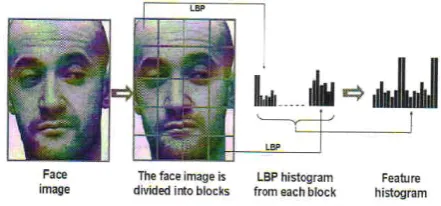
The most important properties of LBP features are their tolerance against monotonic illumination changes and their computational simplicity. In the original LBP-based facial representation, as shown in Figure 2, face images are first equally divided into non-overlapping sub-regions to extract the LBP histograms within each sub-region, which are then concatenated into a single, spatially enhanced feature histogram.
Possible criticisms of this method are that dividing the face into a grid of sub-regions is somewhat arbitrary, as sub-regions are not necessary well aligned with facial features, and that the resulting facial representation suffers from fixed size and position of sub-regions. To address these, in, by shifting and scaling a sub-window over face images, many more sub-regions are obtained. Figure2 shows the selected sub-regions for each facial expression [7].In most of the existing work, LBP histograms are extracted from local facial regions as the region-level description, where the n-bin histogram is utilized as a whole. However, not all bins in the LBP histogram are necessary to contain useful information for facial representation. It is helpful and interesting to have a closer look at the local LBP histogram at the bin level, to identify the discriminative LBP-Histogram (LBPH) bins for better facial representation.
This paper determines the emotional expression state of a person listening to different raga, emotional state such as happiness, sadness, surprise, neutral, fear and disgust, regardless of the identity of the face. In an approach to facial expression recognition from static images using LBP histograms will be computed over non-overlapping blocks for face description. A simple binary tree tournament scheme with pair wise comparison is used for classifying facial expression, such as peace, happiness, cheerful, sad & depressed will be used to classify seven facial expressions: anger, disgust, fear, happiness,
sadness, surprise and neutral. We propose a Local Binary Pattern Histogram (LBP) bins for the task of facial expression recognition while listening to Indian classical ragas. Our experiments will illustrate that the selected LBP bins provide a compact and discriminative facial expression representation. The selected LBP bins will be used to obtain the best recognition performance rate on collected database. The local binary pattern (LBP) operator is defined as a gray-scale invariant texture measure, derived from a general definition of texture in a local neighborhood. Due to its discriminative power and computational simplicity, the LBP texture operator has become a popular approach in various applications, including visual inspection, image retrieval, remote sensing, biomedical image analysis, motion analysis, environment modeling, and outdoor scene analysis.
II. LITERATURE SURVEY
Emotions give meaning to our lives. No aspect of our mental life is more important to the quality and meaning of our existence than emotions. They make life worth living, or sometimes ending. The English word “emotion” is derived from the French word „emouvoir‟ which means „move‟. Great classical philosophers-Plato, Aristotle, Spinoza, Descartes conceived emotion as responses to certain sorts of events triggering bodily changes and typically motivating characteristics behavior [6]. In 1872, Darwin wrote a treatise that established the general principles of expression and the means of expressions in both humans and animals. He also grouped various kinds of expressions into similar categories. The categorization is as follows [5]: Low spirits, anxiety, grief, dejection, despair, Joy, high spirits, love, tender feelings, and devotion. Furthermore, Darwin also cataloged the facial deformations that occur for each of the above mentioned class of expressions. For example: “the contraction of the muscles round the eyes when in grief”, “the firm closure of the mouth when in reflection”, “the depression of the corners of the mouth when in low spirits”.
performance on dynamic facial expression recognition by combining appearance and motion regard to face location changes and scale variations which are either trained for facial expression recognition or face identity recognition. Combining the outputs of these networks allows us to obtain a subject dependent or personalized recognition of facial expressions [9].
III. PROPOSED WORK
Facial Expression is one of the most powerful, nature, and immediate means for human beings to communicate their emotions and intentions. Due to its potential applications, facial expression recognition has attracted much attention over two decades. Though much progress has been made, recognizing facial expression with a high accuracy remains to be difficult due to the complexity and variety of facial expressions. With this approach we are performing an experimental study to find out while listening to classical ragas whether emotions are generated and how they get reflected on face. For this purpose to extract facial expression we are using an LBP approach.
A.LBP APPROACH TO FACE ANALYSIS
Local Binary Pattern (LBP) features have performed very well in various applications, including texture classification and segmentation, image retrieval and surface inspection [4].LBP is a simple but very efficient texture operator which labels the pixels of an image by Thresholding the 3*3 neighborhood of each pixel with the value of the center pixel and considers the result as a binary number. Figure 1 shows an example of LBP calculation. The value of the LBP code of a pixel
(xc, yc) is given by
1 ,
0
(
)2
P
p
P R p c
p
LBP
s g
g
Where gc corresponds to the gray value of the
center pixel (Xc, Yc), gp refers to gray values of P
equally spaced pixels on a circle of radius R, and S defines a Thresholding function as follows:
1,
0;
( )
0,
if x
s x
otherwise
The calculation of the LBP codes can be easily done in single scan through the image. The 256-bin histogram of the labels computed over a region can be used as a texture descriptor. The original LPB operator has been extended to consider different neighborhood sizes [2]. For example, the operator LBP4,1 uses only 4 neighbors while LBP16,2
considers the 16 neighbors on a circle of radius 2. In general, the operator LBPP,R refers to a
neighborhood size of P equally spaced pixels on a circle of radius R that form a circularly symmetric neighbor set[3].
B .DATABASE
One of the most important aspects of developing any new recognition or detection system is the choice of the database that will be used for testing the new system. However, building such a „common‟ database that can satisfy the various requirements of the problem domain and become a standard for future research is a difficult and challenging task. With respect to face recognition, this problem is close to being solved with the development of the student‟s face database which has become a standard for testing face recognition systems. When compared to face recognition, face expression recognition poses a very unique challenge in terms of building a standardized database. This challenge is due to the fact that expressions can be posed or spontaneous. Thus, with the shifting focus
LBP=1+4+16+32=53
Fig 1.Example of an LBP calculation
Fig.2 Examples of an LBP based facial representation
expressions under different conditions (lighting conditions, occlusions, head rotations, etc) The facial expressions of were recorded by a camera. The subjects were then asked about the true emotions that they had felt while listening to different raga. Their replies were documented on the listener response sheet against the recordings of the facial expressions.
IV.EXPERIMENTAL RESULTS
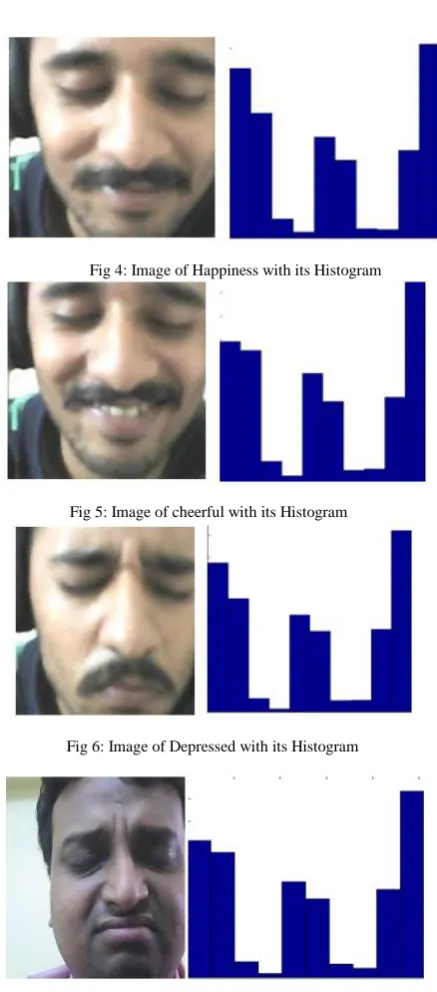
During the training, each subject was asked to listen to the classical raag i.e Raag Khamaj and Raag Darbari ,the musical segments used were Man mohan shyam rasiya,a thumri based on raag Khamaj and vilambit khayal based on raag darbari and the Five expression classes were captured with the help of camera and tested.A simple binary tree tournament scheme with pairwise comparisons is used for classifying expressions. While listening to classical raag each subject recognized the emotion felt in the specific raag and thus the result achieved was 100% . The database contains 80 images in which 4 persons are expressing three or four times the five expressions. Experiments on the Students database which consists of 4 college students with age ranging from 20-23 years showed very good results. In the experiments, out of 4, 3 sequences from the student‟s dataset were selected for basic emotional expression recognition tests. The selection criterion was that a sequence to be labeled is one of the five basic emotions. The sequences came from 4 subjects, with one to five emotions per subject. The positions of the two eyes and Mouth in the frame of each sequence were bounded and then these positions were used to determine the facial area for the whole sequence. The whole sequence was used to extract the proposed LBP features.. The LBP based approach was shown to be robust with respect to changes in illumination and errors in face alignment. Table I shows recognition rate (%) for classical raag by subject. Following figures shows images with their respective histogram and emotional expression.
Fig 3: Image of Peace with its Histogram
Fig 4: Image of Happiness with its Histogram
Fig 5: Image of cheerful with its Histogram
Fig 6: Image of Depressed with its Histogram
Fig 7: Image of Sad with its Histogram
TABLE I
RECOGNITION RATE (%) FOR CLASSICAL RAAG BY
SUBJECTS
RAAG
Recognition Rate (%)
Positive Valence Negative Valence
Peace Happy Cheerful Sad Depressed
KHAMAJ 100% 100% 100% --- ----
V.CONCLUSION
We have reported the result of the empirical study of listener‟s emotional reactions to classical Raag. We have established that classical raag music evokes different feelings and emotions. Classical raag Khamaj evokes emotion like peace, happiness, joy, where as raag Darbari evokes emotion like sad and depression. The LBP based facial representation outperformed for facial image analysis was used for several face related tasks. The approach includes work on emotional facial expression recognition while listening to Indian classical ragas.
REFERENCES
[1] Dongcheng shi, Fengguang Shi, Changchun University of Technology Changchun, China, “A Face Analysis and Description Algorithm Based on
Depth-Information”,978-1-42244-6943-7/10/$26.00,2010 IEEE.
[2] Kwang HoAn and Myung Jin chung, Senior Member, IEEE. “Cognitive Face Analysis System for Future
Interactive TV”,0098 3063/09/$20.00 2009 IEEE.
[3] Abdenvour Hadid, “The Local Binary Pattern Approach and its Application to Face Analysis”,
978-1-4244-3322-3/08/$25.00,2008 IEEE.
[4] Jo chang-yeon, “Face Detection using LBP feature”, December 12, 2008.
[5] Vinay Kumar Bettadapura, Columbia University, “Face Expression Recognition and Analysis: The State of the Art”.
[6] Alicja Wieczorkowska1,Ashoke kumar Datta 2,Ranjan
Sengupta 2,Nityananda Dey 2 and Bhaswati mukherji 3,
“On Search for Emotion in Hindustani Vocal Music”, 1
Multimedia Department ,Polosh- Japenese Institute of
Information Technology, Warsaw, Poland,2Scientific,
Research academy,Kolkata,India,3Center for Development
of Advanced Computing ,Kolkata,India.
[7] Caifeng Shan and Tommaso Gritti, Philips Research, High Tech Campus 36, Eindhoven 5656 AE, The Netherlands, caifeng.shan, tommaso. grittig @ philips. com, “Learning Discriminative LBP-Histogram Bins for Facial Expression Recognition”.
[8] Parag Chordia and Alex Rae, “Understanding Emotion in Raag: An Empirical Study of Listener Responses”,Georgia institute of Tech ,Department of Music,Atlanta.
[9] Beat Fasel, “Robust Face Analysis using Convolutional