RESEARCH
Analysis of multivariate longitudinal
kidney function outcomes using generalized
linear mixed models
Miran A Jaffa
1*, Mulugeta Gebregziabher
2and Ayad A Jaffa
3,4Abstract
Background: Renal transplant patients are mandated to have continuous assessment of their kidney function over
time to monitor disease progression determined by changes in blood urea nitrogen (BUN), serum creatinine (Cr), and estimated glomerular filtration rate (eGFR). Multivariate analysis of these outcomes that aims at identifying the differ-ential factors that affect disease progression is of great clinical significance. Thus our study aims at demonstrating the application of different joint modeling approaches with random coefficients on a cohort of renal transplant patients and presenting a comparison of their performance through a pseudo-simulation study. The objective of this compari-son is to identify the model with best performance and to determine whether accuracy compensates for complexity in the different multivariate joint models.
Methods and results: We propose a novel application of multivariate Generalized Linear Mixed Models (mGLMM) to
analyze multiple longitudinal kidney function outcomes collected over 3 years on a cohort of 110 renal transplanta-tion patients. The correlated outcomes BUN, Cr, and eGFR and the effect of various covariates such patient’s gender, age and race on these markers was determined holistically using different mGLMMs. The performance of the vari-ous mGLMMs that encompass shared random intercept (SHRI), shared random intercept and slope (SHRIS), separate random intercept (SPRI) and separate random intercept and slope (SPRIS) was assessed to identify the one that has the best fit and most accurate estimates. A bootstrap pseudo-simulation study was conducted to gauge the tradeoff between the complexity and accuracy of the models. Accuracy was determined using two measures; the mean of the differences between the estimates of the bootstrapped datasets and the true beta obtained from the application of each model on the renal dataset, and the mean of the square of these differences. The results showed that SPRI provided most accurate estimates and did not exhibit any computational or convergence problem.
Conclusion: Higher accuracy was demonstrated when the level of complexity increased from shared random
coeffi-cient models to the separate random coefficoeffi-cient alternatives with SPRI showing to have the best fit and most accurate estimates.
Keywords: Joint modeling, Multivariate longitudinal outcomes, Random coefficients
© 2015 Jaffa et al. This article is distributed under the terms of the Creative Commons Attribution 4.0 International License (http://creativecommons.org/licenses/by/4.0/), which permits unrestricted use, distribution, and reproduction in any medium, provided you give appropriate credit to the original author(s) and the source, provide a link to the Creative Commons license, and indicate if changes were made. The Creative Commons Public Domain Dedication waiver (http://creativecommons.org/ publicdomain/zero/1.0/) applies to the data made available in this article, unless otherwise stated.
Background
Monitoring kidney function is a necessity for patients who underwent kidney transplantation to assess pro-gression of renal disease. Typically three markers are
measured repeatedly over time after transplantation to ensure that no signs of kidney problems or risk of renal failure due to graft rejection are present and these include blood urea nitrogen (BUN), serum creatinine (Cr) and estimated glomerular filtration rate (eGFR). These markers are correlated and needed to ensure an accurate evaluation of the kidney function since each has its own limitations and could be influenced by demo-graphical and physiological characteristics of the patient [1–5]. Once a patient experiences graft rejection then
Open Access
*Correspondence: [email protected]
1 Epidemiology and Population Health Department, Faculty of Health Sciences, American University of Beirut, P.O. Box 11-0236, Riad El-Solh, Beirut 1107 2020, Lebanon
measurements on the kidney markers won’t be recorded and patients will no longer be monitored for kidney func-tion resulting in missing data. Given the interdependence of these outcomes in determining kidney function, it is important to evaluate the factors that affect the rate of change in these outcomes in a joint manner. The moti-vation of this study is to assess the association between the three outcomes (BUN, creatinine and eGFR) and key demographic and clinical factors accounting for the cor-relation between these markers in a multivariate fashion.
Analysis of multiple outcomes is given special attention in the literature. For example, multivariate linear mixed models (MLMM) were proposed to analyze multiple out-comes to assess and test for global exposure effect across outcomes while assuming flexible correlation structure for the multiple outcomes [6]. The idea was to provide robust estimates for the mean by separating it from the correlation parameters. This MLMM model was lim-ited to Gaussian outcomes and did incorporate longitu-dinal data. Joint modeling was also used in the context of jointly studying time to clinical event and repeated measures on surrogate outcomes [7]. Others included joint modeling of the multilevel item response theory (MLIRT) and Cox’s proportional hazard model for time to dependent terminal event with shared random effects to link the two models [8]. A modeling framework for MLIRT also referred to as latent regression was widely considered and was based on the idea that the observed measurements are a result of some imperfect interac-tion between subject-specific latent variables and meas-urement-specific parameters [9–13]. The latent traits are considered as response variables and are regressed on a set of covariates, hence the name of latent regression. The advantage of the MLIRT models resides in the separation of the measurement-specific parameters and subject-spe-cific covariates from manifest data and simultaneous esti-mation of these parameters and covariate effects [14–16]. However, deviation from the normality assumption could affect the accuracy of the estimates and the inferences for the high-level outcomes [17]. Multivariate joint mod-eling was also an alternative wherein a joint distribution is specified to jointly model all random effect [18–20]. Despite that data transformation solved the issue of non-normality it still had its imbedded disadvantages such as difficulty in the interpretation of the estimated param-eters on transformed scale. In addition, joint normality may not be always achieved especially if transformation was conducted on a component basis, and lack of uni-versal transformation that could be appropriate for the majority of datasets [21]. An alternative approach that is not constrained by the issue of non-normality is the joint modeling of multivariate longitudinal outcomes discussed in [22]. In this approach the interdependence
among outcomes is captured by using shared latent variable(s) or the correlation between random coeffi-cients corresponding to each outcome and the non-nor-mality is solved using distributions and link functions from the list of general linear models. They describe the following four approaches, (1) shared random intercept (SHRI); (2) shared random intercept and slope (SHRIS); (3) separate random intercepts (SPRI); (4) separate ran-dom intercepts and slopes (SPRIS). The application and assessment of performance for these models were limited to health services outcomes in extremely large datasets and were not applied on clinical outcomes from a rela-tively small sample size.
The goals of our study were
1. To identify the best fitting joint model from the four approaches listed in terms of the tradeoff between the complexity of the model and precision of the esti-mates including convergence related complexities that could be due to small sample size.
2. To demonstrate the application of these models on a cohort of renal transplant patients assuming that the three correlated kidney markers follow the lognormal distribution. Hence in this research work we are proposing a novel application of the joint modeling approaches, and we are conducting an innovative thorough assessment of the perfor-mance of each approach in a clinical setting char-acterized by its small sample size. Studies with small sample sizes are commonly encountered in clinical settings of high cost, or where focus is on rare diseases, pilot studies as well as basic science research. Hence demonstrating the application and understanding the performance of these models in a dataset characterized by its small sample size, and multiple outcomes with non-normal distribution and high correlation is the key novel feature of this study.
Methods
The joint modeling approach investigated in this study is the multivariate generalized linear mixed models (mGLMM) which is a generalization of the linear mixed models. Fixed and random effects are both included and are referred to as β and bi respectively in the below
incorporated through the variance–covariance matrix of the shared or separate random effects depending on the specific mGLMM. While linear mixed models are limited to normally distributed outcomes, mGLMM are extended to multiple correlated outcomes with other dis-tributions, not necessarily normal, each of which is deter-mined by its corresponding link function. The mGLMM is comprised of a set of generalized linear mixed models (GLMM) linked together by a SHRI, SHRIS, SPRI or sep-arate random intercept and slope (SPRIS).
Let Yij1, Yij2,…, Yijk be the multivariate outcomes for subject i, measured at times j = 1 to ti, for outcomes 1 to k, the different joint models can be described as such:
SHRI
For three outcomes, SHRI model can be described as follows:
where b0i ∼MVN0,σb2, σb2 is the variance for the intercept, xi is the covariate of interest and g−1 is the
link function. The model can accommodate more than one covariate. The correlation between the outcomes is assumed to be captured by the shared-common intercept.
SHRIS
bi=
b0i b1i
∼MVN(0,D2×2) where D is the vari-ance–covariance matrix of the shared intercept and slope so intuitively it includes the variances of the intercept and slope and their covariance. The correlation between the outcomes is assumed to be captured by the shared-com-mon intercept and slope.
SPRI
The concept of capturing the correlation between the outcomes through intercept only, still applies here as in SHRI but the difference is in relaxing the shared intercept theory and assuming separate intercept associated with every outcome. Relaxing this assumption adds a layer of complexity by increasing the number of parameters to be estimated in the variance–covariance matrix. SPRI can be described as such
E
Yij1|b0i=g−1(β01+b0i+β11ti+β21xi)
EYij2|b0i=g−1(β02+b0i+β12ti+β22xi)
E
Yij3|b0i=g−1(β03+b0i+β13ti+β23xi)
E
Yij1|bi=g−1(β01+b0i+(b1i+β11)ti+β21xi)
E
Yij2|bi=g−1(β02+b0i+(b1i+β12)ti+β22xi)
EYij3|bi=g−1(β03+b0i+(b1i+β13)ti+β23xi)
b0i=
b0i1 b0i2 b0i3
∼MVN(0,D3×3) where the number of
parameters to be estimated increases to 6 attributed to the 3 variances and 3 covariances between the intercepts. The correlation between the 3 outcomes is assumed to be captured by the correlation between the separate intercepts.
SPRIS
The concept of capturing the correlation between the outcomes as in SHRIS is applied here with the difference in assuming separate intercept and slope for every out-come which adds another level of complexity on SPRI. SPRIS can be described as such:
bi=
bi1 bi2 bi3
=
�
b0i1 b1i1
�
�
b0i2 b1i2
�
�
b0i3 b1i3
�
∼MVN(0,D6×6) where
D is the variance–covariance matrix for the 3 intercepts and 3 slopes associated with every outcome resulting in an increase of the number of parameters to be estimated to 21. For all the models, the dependence between and within outcomes is captured by the structure of the vari-ance–covariance matrix that can be determined by the measures of model fitting AIC, BIC and −2log l.
The univariate counterpart of these models can be reduced to GLMM with random intercept only (RI) and with random intercept and slope (RIS).
Pseudo‑simulation bootstrap study
To assess the performance of each model a pseudo sim-ulation bootstrap study was conducted using a renal dataset and assuming that the three kidney outcomes (BUN, Cr and eGFR) follow the lognormal distribu-tion. The covariates were limited to time and square of time since SPRIS exhibited convergence problems when other covariates were included. The square of time was included in the analysis to account for the curvilinear
E
Yij1|b0i=g−1(β01+b0i1+β11ti+β21xi)
E
Yij2|b0i=g−1(β02+b0i2+β12ti+β22xi)
EYij3|b0i=g−1(β03+b0i3+β13ti+β23xi)
E
Yij1|bi1=g−1(β01+b0i1+(b1i1+β11)ti+β21xi)
EYij2|bi2=g−1(β02+b0i2+(b1i2+β12)ti+β22xi)
E
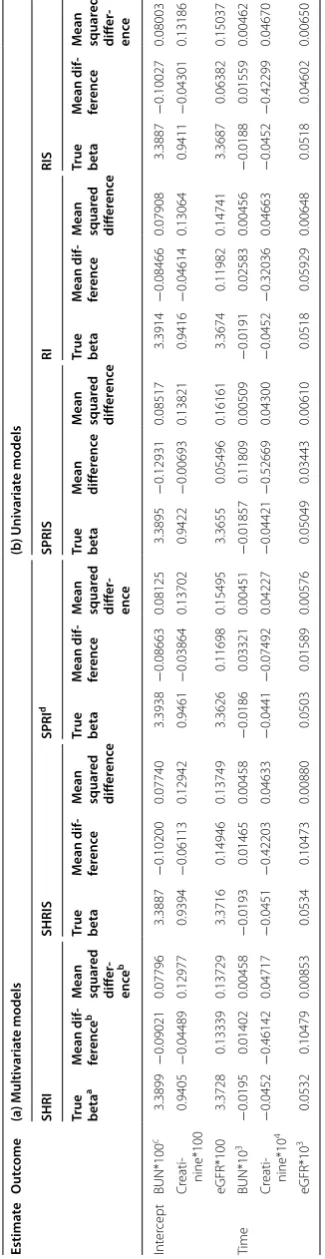
relationship between time and each of the outcomes. We implemented 2,000 replications each with a sample size of 110 individuals boot strapped from the cohort of renal patients. The performance of the 4 multivari-ate models (SHRI, SHRIS, SPRI, SPRIS) and that of the univariate random intercept model (RI), and random intercept and slope model (RIS) was examined. The per-formance was determined in terms of accuracy assessed by two measures; the mean of the differences between the estimates of the bootstrapped datasets and the true beta obtained from the application of each model on the renal dataset, and the mean of the square of these differences. Specifically, true betas are the fixed effects
(β11,β12,β13,β21,β22,β23) in the models’ equations. These parameters are estimated by applying the general-ized linear mixed models on the renal transplant data-set to reflect the estimated effects of the corresponding covariates on the changes in kidney outcomes. In Table 1, the differences between the estimates generated in the simulation studies and these betas are computed to deter-mine the accuracy of the various models, noting that the smaller the difference the more accurate the model. For simplicity, we refer to these measures as mean difference, and mean squared difference respectively. This compari-son helped us achieve the following objectives:
1. Identify the multivariate models that exhibited better performance than the other models.
2. Determine whether the complex separate random models (SPRI and SPRIS) had any advantage in terms of accuracy of the estimates over the simpler shared random effect models (SHRI and SHRIS). Accord-ingly, we can gauge complexity versus precision. 3. Examine whether including the slope as random
effect along with the intercept as in the SHRIS and SPRIS models has any respective advantage over the models that assume solely random intercept as in SHRI and SPRI.
4. Evaluate whether there was a gain in accuracy under the multivariate modeling versus the univariate sepa-rate analysis implemented on every outcome.
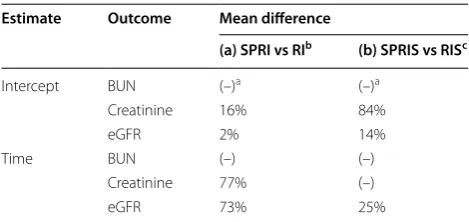
The bootstrap results are presented in Tables 1, 2, and 3 for the multivariate and univariate implementation of the models with 2,000 replications. In Table 1 we present the mean difference and mean squared difference for the estimates under every model while in Table 2 we provide percent reductions in these measures for a specific mul-tivariate model versus the others. In Table 3 the percent reductions in these measures between univariate and multivariate models are presented.
Objective 1 As evidenced in Tables 1 and 2 (see also 2nd footnote labeled as b in Table 2, and Table 2 columns
a, b, and c), we notice that 6 out of 12 estimates i.e. 50% of the estimates generated under SPRI had the smallest mean difference, and mean squared difference compared to those generated under the other models that include SHRI, SHRIS, and SPRIS. Specifically, 50% of the esti-mates generated under SPRI had an associated mean difference, and mean squared difference that are respec-tively 58.7% and 12% smaller on average than those gen-erated under the other models. Hence, this leads to the conclusion that SPRI demonstrated the best performance compared to the other 3 models.
Objective 2 Compared to SHRI, 83% of the estimates generated under SPRI had associated mean difference that is 40% smaller on average, and mean squared dif-ference that are close in value (15% reduction in mean squared differences under SPRI in 50% of the estimates) (see Table 2 column d, and footnote Table 2). In this con-text, we denote that the eGFR outcome had a significant 32% reduction in mean squared difference under SPRI compared to SHRI. When we compared SPRIS to SHRIS (see Table 2 column e, and footnote Table 2), we realized that about 50% of the estimates generated under SPRIS exhibited an approximate average reduction of 73% in mean difference compared to SHRIS; meanwhile, an observed reduction of 19% in mean squared difference was captured in only 33% of the estimates under SPRIS. Hence, mean squared difference did not greatly differ between SHRIS and SPRIS. Accordingly, one can con-clude that separate modeling of the random effect had it be solely intercept (SPRI), or both intercept and slope (SPRIS) had an advantage specifically in mean difference reduction over the simpler models that assume shared random effects (SHRI and SHRIS).
Hence SPRI appeared to have better performance than the other models and increasing the level of com-plexity by going from SPRI to SPRIS did not improve on the accuracy of the estimates that were generated under SPRI. Hence, these results lead to the conclusion that modeling the slope as a random effect along with the intercept did not improve the performance of the associ-ated models (SHRIS and SPRIS) compared to the simpler models that assume solely random intercept (SHRI and SPRI).
Objective 4 Our bootstrap pseudo simulation study also aimed at investigating the effect of multivariate modeling versus the univariate implementation of the models that assume that the outcomes are independent. In this regard a comparison was undertaken between the performance of the RI model and that of SHRI and SPRI, and between RIS and that of SHRIS and SPRIS (Tables 1, 3). The per-formance of SHRI and RI did not significantly differ since their associated mean difference and mean squared dif-ferences were close (see Table 1). Hence, this observa-tion indicates that under models with random intercept, the multivariate shared model (SHRI) did not improve the accuracy of the estimates compared to those gener-ated under the univariate random intercept model (RI). However, this conclusion did not hold when we com-pared SPRI and RI. Specifically, we noticed that 66% of the estimates generated under SPRI had a 42% average reduction in mean difference compared to those esti-mates generated under RI (see Table 3 column a, and footnote Table 3). For instance, 77 and 73% reductions in mean difference were observed for the slope estimates of the outcomes creatinine and eGFR generated under SPRI compared to those generated under RI. Nonetheless, the mean squared differences did not greatly differ in the estimates of these two models.
When SHRIS and RIS were compared, a minimal reduction (only 4%) was denoted for the mean squared differences in the majority of the estimates (about 80%) that were generated under SHRIS compared to RIS; but the mean differences did not differ between the 2 mod-els. Hence SHRIS and RIS exhibited similar performance. Compared to RIS, about 50% of the estimates generated under SPRIS exhibited an observed reduction in the mean difference by about 41% on average (see Table 3 column b, and footnote Table 3), while the mean squared difference did not greatly differ between the 2 models. These results suggest that multivariate modeling specifi-cally SPRI and SPRIS had an advantage in performance specifically in Mean Difference compared to the univari-ate models RI and RIS respectively (Table 3). However, this conclusion did not hold for the shared multivariate models SHRI and SHRIS wherein their associated mean difference and mean squared difference did not greatly
Table
1
B
ootstr
apping on the (a) multiv
aria
te mo
dels and (b
) univ aria te mo dels: r eplic at
e 2,000 sample siz
e 110
a T
rue beta obtained fr
om the applica
tion of ev
er
y model on the r
enal tr
ansplan
t da
taset
.
b M
ean diff
er
enc
e and mean squar
ed diff er enc e r epr esen t r espec tiv
ely the a
ver
age devia
tion and its squar
e of ev
er
y bootstr
ap estima
te fr
om the true v
alue beta.
c M
ean diff
er
enc
e and mean squar
ed diff
er
enc
e should be multiplied b
y the number specified ne
xt t
o the out
come name
.
d SPRI model has best r
esults c
ompar
ed t
o other models: 50% of the estima
tes ha
ve smallest mean diff
er
enc
e and mean squar
ed diff
er
enc
e under SPRI.
Estima te O ut come (a) Multiv aria te models (b ) Univ aria te models SHRI SHRIS SPRI d SPRIS RI RIS
True beta
a M ean dif -fer enc e b M ean squar ed diff er -enc e b
True beta
M ean dif -fer enc e M ean squar ed diff er enc e
True beta
M ean dif -fer enc e M ean squar ed diff er -enc e
True beta
M ean diff er enc e M ean squar ed diff er enc e
True beta
M ean dif -fer enc e M ean squar ed diff er enc e
True beta
[image:5.595.69.232.97.728.2]differ from those under the univariate RI and RIS respec-tively. Hence only the separate multivariate models (SPRI and SPRIS) exhibited improved performance over their univariate counterpart models RI and RIS. This result also endorses our conclusion in objective 2 which stated that separate random effect models (SPRI and SPRIS)
had better performance compared to the shared random effect models (SHRI and SHRIS).
Motivating example: renal transplant application The current study was motivated by the cohort of renal transplant patients. The dataset consisted of 110 patients who underwent renal transplantation in the year 2000 and were followed for 3 years (till year 2003) post-trans-plant until they experience graft rejection or end of study period. After the scheduled termination date of the study in year 2003, patients were no longer followed and assessment of their kidney function was not undertaken afterwards.
In case of graft rejection, patients had to revert back to the dialysis regimen and were not monitored afterwards. About 19% of the patients in this cohort experienced graft rejection. Renal function and progression of renal disease is assessed by 3 correlated markers, BUN, serum Cr, and eGFR. These outcomes follow the lognormal distribu-tion. In this study BUN and Cr had a positive correlation of 0.624 (P value <0.0001), while BUN and eGFR had a negative correlation of −0.63 (P value <0.0001) and that of Cr and eGFR was −0.71 (P value <0.0001). Changes in the levels of markers are what usually determine the progression of renal disease. In this regard, decrease in Table 2 Percent reduction in mean difference and mean squared difference that correspond to: SPRI compared to all other multivariate models (a, b, and c)b; SPRI compared to SHRI (d); SPRIS compared to SHRIS (e); SPRI compared to SPRIS(f)
a SPRI did not generate the smallest mean difference and/or mean squared difference compared to all multivariate models.
b 50% of the estimates under SPRI had the smallest mean difference and mean squared difference compared to all other models with 58.7% and 12% average overall reduction respectively.
c No reduction was observed under SPRI or SPRIS.
d 83% of the estimates under SPRI had smaller mean difference compared to SHRI with average overall reduction of 40%, and 50% had smaller mean squared differ-ence with average reduction of 15%.
e 50% of the estimates under SPRIS had smaller mean difference compared to SHRIS with average overall reduction of 73%, and 33% had smaller mean squared dif-ference with average reduction of 19%.
f 66% of the estimates under SPRI had smaller mean difference compared to SPRIS with average overall reduction of 72%, and 100% had smaller mean squared differ-ence with average reduction of 9%.
Estimate Outcome (a) SPRI vs SHRI (b) SPRI vs
SHRIS (c) SPRI vs SPRIS (d) SPRI vs SHRld (e) SPRIS vs SHRISe (f) SPRI vs SPRISf
Mean difference Intercept BUN 4% 15% 33% 4% (–)c 33%
Creatinine (–)a (–) (–) 14% 89% (–)c
eGFR (–) (–) (–) 12% 63% (–)
Time BUN (–) (–) (–) (–)c (–) 96%
Creatinine 84% 82% 86% 84% (–) 86%
eGFR 85% 85% 54% 85% 67% 74%
Mean squared
dif-ference Intercept BUNCreatinine (–)(–) (–)(–) (–)(–) (–)(–) (–)(–) 5%1%
eGFR (–) (–) (–) (–) (–) 28%
Time BUN 2% 2% 11% 2% (–) 11%
Creatinine 10% 9% 2% 10% 7% 2%
eGFR 32% 35% 6% 32% 31% 6%
Table 3 Percent reduction in mean difference that corre‑ spond to: SPRI Compared to RI (a); SPRIS compared to RIS (b)
a No reduction was observed in mean difference under SPRI compared to RI or SPRIS compared to RIS.
b 66% of the estimates under SPRI had smaller mean difference compared to RI with average overall reduction of 42%.
c 50% of the estimates under SPRIS had smaller mean difference compared to RIS with average overall reduction of 41%.
Estimate Outcome Mean difference
(a) SPRI vs RIb (b) SPRIS vs RISc
Intercept BUN (–)a (–)a
Creatinine 16% 84%
eGFR 2% 14%
Time BUN (–) (–)
Creatinine 77% (–)
[image:6.595.64.539.126.302.2] [image:6.595.56.291.461.572.2]the level of BUN and Cr indicates an improvement in the kidney function over time. However, the opposite is true for eGFR where an increase in the levels of this marker indicates improved kidney function. This explains the positive correlation between BUN and Cr, and the nega-tive ones between these markers and eGFR. The normal values for BUN are between 8 and 25 mg per 100 mL of blood, for Cr the normal range is between 0.7 and 1.3 mg per 100 mL of blood, and for eGFR this range is approxi-mately between 90 and 120 mL/min/1.73 m2 for men and women respectively. Measurements on the three markers were taken on every patient for a 3-year period starting with the baseline measure pre-transplant regis-tered as month 0, then at months 1, 3, 6, 12, 24, and 36 post-transplant.
The four models examined in this study were applied on this cohort of patients and the objective was to esti-mate the slope for every outcome over time along with some associated key covariates that include patient’s age, gender, and race and the vital status (deceased or living)
of the respective donor along with some basic demo-graphics such as donor’s gender and race (see Table 4). Applying the mGLMM on this cohort of patients enabled us to assess the effect of these various covariates on all the renal markers (BUN, creatinine and eGFR) collec-tively through the joint modeling approach. Moreover, the random effects term in the mGLMM accounts for the correlations between the repeated measures for every patient and the different markers respectively, and for the between-patients variation in the length of stay and com-pleteness of measurements of renal outcomes. This vari-ation emerges between patients who may dropout before the intended termination date of the study. In addition, the link functions and the generalized approach available in mGLMM make it feasible to model the renal outcomes measured in this study and which were found to follow the lognormal distribution without necessitating any transformation to achieve normality.
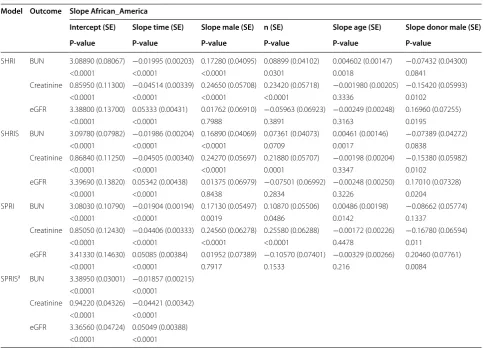
By applying the four models we were able to identify the one(s) that had the best fit determined by measures
Table 4 Application of the four multivariate models on the renal transplant dataset with all covariates
a SPRIS converged for time and time squared covariates only.
Model Outcome Slope African_America
Intercept (SE) Slope time (SE) Slope male (SE) n (SE) Slope age (SE) Slope donor male (SE) P-value P-value P-value P-value P-value P-value
SHRI BUN 3.08890 (0.08067) −0.01995 (0.00203) 0.17280 (0.04095) 0.08899 (0.04102) 0.004602 (0.00147) −0.07432 (0.04300) <0.0001 <0.0001 <0.0001 0.0301 0.0018 0.0841
Creatinine 0.85950 (0.11300) −0.04514 (0.00339) 0.24650 (0.05708) 0.23420 (0.05718) −0.001980 (0.00205) −0.15420 (0.05993) <0.0001 <0.0001 <0.0001 <0.0001 0.3336 0.0102
eGFR 3.38800 (0.13700) 0.05333 (0.00431) 0.01762 (0.06910) −0.05963 (0.06923) −0.00249 (0.00248) 0.16960 (0.07255) <0.0001 <0.0001 0.7988 0.3891 0.3163 0.0195
SHRIS BUN 3.09780 (0.07982) −0.01986 (0.00204) 0.16890 (0.04069) 0.07361 (0.04073) 0.00461 (0.00146) −0.07389 (0.04272) <0.0001 <0.0001 <0.0001 0.0709 0.0017 0.0838
Creatinine 0.86840 (0.11250) −0.04505 (0.00340) 0.24270 (0.05697) 0.21880 (0.05707) −0.00198 (0.00204) −0.15380 (0.05982) <0.0001 <0.0001 <0.0001 0.0001 0.3347 0.0102
eGFR 3.39690 (0.13820) 0.05342 (0.00438) 0.01375 (0.06979) −0.07501 (0.06992) −0.00248 (0.00250) 0.17010 (0.07328) <0.0001 <0.0001 0.8438 0.2834 0.3226 0.0204
SPRI BUN 3.08030 (0.10790) −0.01904 (0.00194) 0.17130 (0.05497) 0.10870 (0.05506) 0.00486 (0.00198) −0.08662 (0.05774) <0.0001 <0.0001 0.0019 0.0486 0.0142 0.1337
Creatinine 0.85050 (0.12430) −0.04406 (0.00333) 0.24560 (0.06278) 0.25580 (0.06288) −0.00172 (0.00226) −0.16780 (0.06594) <0.0001 <0.0001 <0.0001 <0.0001 0.4478 0.011
eGFR 3.41330 (0.14630) 0.05085 (0.00384) 0.01952 (0.07389) −0.10570 (0.07401) −0.00329 (0.00266) 0.20460 (0.07761) <0.0001 <0.0001 0.7917 0.1533 0.216 0.0084
SPRISa BUN 3.38950 (0.03001) −0.01857 (0.00215)
<0.0001 <0.0001
Creatinine 0.94220 (0.04326) −0.04421 (0.00342) <0.0001 <0.0001
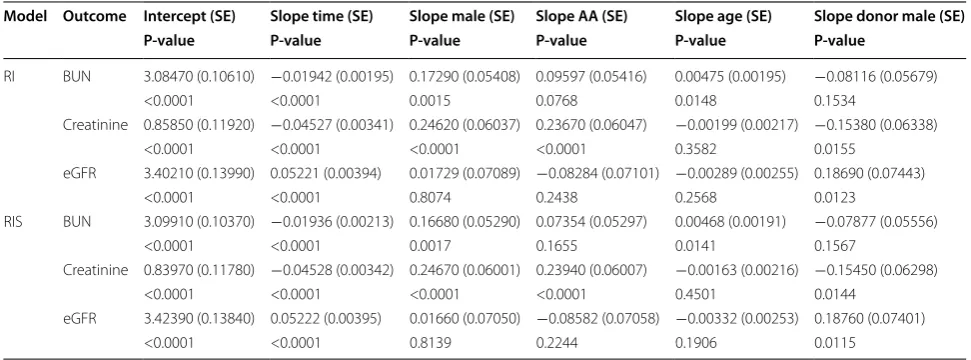
[image:7.595.56.542.369.718.2]such as AIC, BIC and −2 log likelihood (see Table 5), and compare the associated standard errors for each model. In addition we applied the univariate random intercept model (RI) and univariate random intercept and slope (RIS) on every outcome separately (see Table 6) to com-pare the estimates obtained under the multivariate appli-cation versus the univariate ones. The multivariate model SPRIS did not converge when all these covariates were included concurrently but just with the covariates time and time square. The relation between time and the three markers appeared to be curvilinear; hence, time squared was also included in the model to account for this non-linear relationship. The fitting measures when the 4 mod-els were applied on the renal dataset with only time and time squared as covariates are also presented in Table 5. The variance–covariance matrices of the multivariate and univariate models are reported in Appendix 1 and Appendix 2, respectively.
As an overall discussion of the estimates we can deduce that for all multivariate models (see Table 4) patients appear to have improved kidney function over time as evidenced by the negative slopes of BUN and Cr, and positive ones for eGFR. This improvement was demon-strated by the estimated decrease of 1.02 mg per 100 mL of blood in BUN on average across all multivariate mod-els and 1.1 mg per 100 mL of blood for Cr. Along the same line, eGFR levels were estimated to increase by an average across all multivariate models of 1.1 mL/ min/1.73 m2. This significant improvement in the pro-gression of renal disease over time detected in the multi-variate models was also established in unimulti-variate models (see Table 6). Gender appeared to be significantly associ-ated with the changes in BUN and Cr but not with eGFR, and males patients were shown to have inferior kidney function compared to females. This conclusion was dem-onstrated in the multivariate models with the attributed increase in BUN levels for males versus females of 1.2 mg per 100 mL of blood and of 1.3 mg per 100 mL of blood for Cr (see Table 4). A similar conclusion was reached under the univariate models (see Table 6). This detected increase in the levels of these markers in males compared to females led to the conclusion that female patients have better prognosis of kidney disease compared to males that could be attributed to the protective effect of estro-gen [23].
[image:8.595.57.290.368.486.2]Race was found to be associated with BUN and Cr in the SHRI and SPRI models and only Cr in SHRIS. In the univariate models (see Table 6), race was found to be associated only with Cr and, unlike the multivariate mod-els, no association was detected with BUN. Specifically, non-African American patients appeared to be at a dis-advantage compared to other races due to their 1.1 mg Table 5 Measures of fit for the multivariate models
applied on renal transplant dataset with (a) all covariates (b) time and time squared
a SPRIS model converged for only Time and Time Squared covariates.
Model AIC BIC −2logl
(a) All covariates SHRI 4,000.21 4,010.98 3,992.21 SHRIS 3,999 4,015.14 3,987 SPRI 3,358.24 3,382.46 3,340.24 SPRISa (–) (–) (–)
(b) Time and time squared SHRI 4,040.59 4,051.39 4,032.59 SHRIS 4,036.7 4,052.91 4,024.7 SPRI 3,732 3,756.64 3,714.34 SPRISa 3,749.12 3,808.53 3,705.12
Table 6 Application of the two univariate models on the renal transplant dataset with all covariates
Model Outcome Intercept (SE) Slope time (SE) Slope male (SE) Slope AA (SE) Slope age (SE) Slope donor male (SE) P-value P-value P-value P-value P-value P-value
RI BUN 3.08470 (0.10610) −0.01942 (0.00195) 0.17290 (0.05408) 0.09597 (0.05416) 0.00475 (0.00195) −0.08116 (0.05679) <0.0001 <0.0001 0.0015 0.0768 0.0148 0.1534
Creatinine 0.85850 (0.11920) −0.04527 (0.00341) 0.24620 (0.06037) 0.23670 (0.06047) −0.00199 (0.00217) −0.15380 (0.06338) <0.0001 <0.0001 <0.0001 <0.0001 0.3582 0.0155
eGFR 3.40210 (0.13990) 0.05221 (0.00394) 0.01729 (0.07089) −0.08284 (0.07101) −0.00289 (0.00255) 0.18690 (0.07443) <0.0001 <0.0001 0.8074 0.2438 0.2568 0.0123
RIS BUN 3.09910 (0.10370) −0.01936 (0.00213) 0.16680 (0.05290) 0.07354 (0.05297) 0.00468 (0.00191) −0.07877 (0.05556) <0.0001 <0.0001 0.0017 0.1655 0.0141 0.1567
Creatinine 0.83970 (0.11780) −0.04528 (0.00342) 0.24670 (0.06001) 0.23940 (0.06007) −0.00163 (0.00216) −0.15450 (0.06298) <0.0001 <0.0001 <0.0001 <0.0001 0.4501 0.0144
[image:8.595.55.541.546.726.2]per 100 mL of blood increase in BUN levels on average and 1.3 mg per 100 mL of blood increase on average in Cr (see Table 4). This conclusion was also valid under the univariate models; nevertheless, it was just demonstrated with Cr.
Age appeared to be positively correlated with BUN in all models and with every 1 year increase in age of trans-plantation corresponds to an increase in BUN levels of approximately 1.6 mg per 100 mL of blood on average. Hence those patients who had their renal transplanta-tion at older ages were at a disadvantage in terms of renal function and progression of kidney disease compared to those patients who had the transplant at younger ages. This conclusion holds for all models had it be multivari-ate or univarimultivari-ate.
Males were better donors than females since patients who received their kidneys from male donors exhibited a decrease of approximately 1.2 mg per 100 mL of blood in their Cr levels, and an increase of approximately 1.2 mL/ min/1.73 m2 in eGFR levels compared to patients who had female donors (Tables 4, 6). This result is in line with other studies that showed females to be poorer donors than males, an observation attributed to nephron under-dosing and hence nephron overload in females [23–25]. No association was detected between the donor’s race and BUN in all models. The other covariates such as donor’s gender and vital status were found to be not asso-ciated with any of the outcomes and as a result were not included in any of the models.
Comparison of models fit
SPRI exhibited the best fit as demonstrated by its low-est associated pseudo AIC, BIC and −2log l (see Table 5) wherein average decreases of 641, 631 and 650 in these measures were denoted between SPRI compared to the other models SHRI and SHRIS. Compared to the uni-variate model RI, the standard errors generated under SPRI were mostly slightly larger than the ones generated under RI. However, this was not the case when we com-pared the standard errors under SHRI and those under the univariate model RI wherein all the estimates under SHRI had smaller SE than those under RI. The same conclusion was observed when we compared SHRIS to RIS and we denoted that all estimates under SHRIS had smaller standard errors than those with RIS. This conclu-sion was anticipated since only one additional parameter (variance of the intercept) needed to be estimated under SHRI as indicated in the variance–covariance matrix (see Appendix 1). The same case was denoted for RI where also one additional parameter (variance of the intercept) needed to be estimated for every outcome (see Appendix 2) leading to three additional parameters that pertain to the three outcomes. The same can be said for SHRIS and
RIS models. However SPRI had additional six parameters in the variance–covariance matrix (see Appendix 1). A comparison of the four multivariate models based on the application to the renal data with time and time squared as covariates (see Table 5), SPRI still exhibited the best fit and its associated AIC, BIC and −2log l were the smallest compared to SHRI, SHRIS and SPRIS.
Discussion
that SPRIS should be used with caution in settings of small sample size. SPRI had the best fit when applied to the renal dataset and generated the most accurate esti-mates with minimum mean difference and mean squared differences. This advantage could be due to the fact that the number of parameters in the variance–covariance matrix for SPRI (6 parameters) is midway between the SHRI’s (1 parameter) and SHRIS’ (3 parameters) and that for SPRIS (21 parameters). This result is in agreement with what has been shown in studies with large sample size [22] where SPRI also demonstrated the best fit in terms of smallest AIC, BIC and −2log l. To validate these models using another independent dataset, the mGLMM approach was applied on a longitudinal study of type 1 diabetic patients with large sample size and multiple car-diovascular disease outcomes that have mixed non-nor-mal distributions [27, 28]. Our results showed that SPRI had the best fit in terms of smallest AIC, BIC, and -2log l compared to the other models and had the minimum mean difference and mean difference squared in the majority of the estimates. This confirms again that SPRI had the best performance and best fit in the context of large datasets as was the case with the small dataset.
Models with separate random effects exhibited bet-ter performance in bet-terms of mean difference and mean
squared differences compared to those with shared ones and also demonstrated superior performance than the univariate RI and RIS models. Nonetheless, increasing the level of complexity from SPRI to SPRIS by adding the slope as a random effect along with the intercept did not increase the level of accuracy; on the contrary conver-gence problems were encountered. Hence it appears that the SPRI model that is midway in complexity was favored by the renal dataset and the bootstrap study.
Conclusion
In the context of a relatively small sample size study, we were able to demonstrate that the mGLLMs with SPRIs and separate random intercepts and slopes (SPRIS) gen-erated more accurate estimates compared to the SHRI and SHRIS models. Similar conclusion was reached when we compared SPRI and SPRIS to their univariate alterna-tives RI and RIS. Convergence issues were encountered with SPRIS when the number of covariates increased, however, SPRI had the best fit and most accurate perfor-mance compared to the other models and its successful convergence was consistently achieved.
Appendix 1 See Tables 7, 8, 9.
Table 7 Variance–covariance matrix of SHRI and SHRIS when applied on renal transplant dataset with all covariates Model Outcome Variance intercept (SE) Covariance intercept, slope Variance slope (SE) Variance
residuals (SE)
SHRI 0.02077 (0.005809)
BUN 0.1494 (0.009515)
Creatinine 0.4197 (0.02320)
eGFR 0.6791 (0.03934)
SHRIS 0.01562 (0.007302) 0.000242 (0.000277) 0.000016 (0.00002)
BUN 0.1431 (0.0114)
Creatinine 0.4151 (0.02342)
eGFR 0.6929 (0.04286)
Table 8 Variance–covariance matrix of SPRI when applied on renal transplant dataset with all covariates Outcome Variance
intercept (SE) Covariance intercepts BUN, Cr (SE) Covariance intercepts BUN, eGFR (SE) Covariance intercepts Cr, eGFR (SE) Variance Residuals (SE)
SPRI BUN 0.05856 (0.01151) 0.0666 (0.01145) −0.07767 (0.01343) −0.1188 (0.01764) 0.1345 (0.007824) Creatinine 0.04257 (0.01542) 0.4102 (0.02357)
[image:10.595.57.538.444.572.2] [image:10.595.53.540.632.699.2]Appe ndix 2 See Table 10.
Compliance with ethical guidelines
Competing interests
The authors declare that they have no competing interests.
Ethics
This study was granted exemption from requiring ethics approval from the Institutional Review Board at the Medical University of South Carolina.
Funding
This work was supported by the National Institutes of Health Grants HL077192 and HL087986 (AAJ).
Received: 26 January 2015 Accepted: 1 June 2015
References
1. James GD, Seally JE, Alderman M, Ljungman S, Mueller FB, Pecker MS et al (1988) A longitudinal study of urinary creatinine and creatinine clear-ance in normal subjects. Race, sex and age differences. Am J Hypertens 1:124–131
2. Schrier RW (2008) Blood urea nitrogen and serum creatinine not married in heart failure. Circ Heart Fail 1:25–33
Table 9 Variance–covariance matrix of SPRIS when applied on renal transplant dataset with covariates time and time squared
a SPRIS converged for only time and time squared covariates.
SPRISa Intercept Intercerpt Intercept Slope Slope Slope
BUN (SE) Cr (SE) eGFR (SE) BUN (SE) Cr (SE) eGFR (SE)
Intercept 0.2606 BUN (SE) (0.02609)
Intercerpt 0.2932 0.1229 Cr (SE) (0.04267) (0.05179)
Intercept −0.3064 −0.1173 <0.000001 eGFR (SE) (0.04685) (0.05906) (–)
Slope −0.00231 0.00442 −0.00964 0.006384 BUN (SE) (0.002248) (0.004197) (0.1256) 0.1897
Slope −0.0047 0.003245 −0.00905 0.005992 <0.000001 Cr (SE) (0.002801) (0.004418) (0.118) (0.1781) (0.002482)
Slope 0.005316 −0.00378 0.009299 −0.00616 <0.000001 <0.000001 eGFR (SE) (0.003132) (0.005003) (0.1212) (0.183) (0.002792) (–)
Table 10 Variance–covariance matrix of RI and RIS when applied on renal transplant dataset with all covariates
Model Outcome Variance intercept (SE) Covariance intercept, slope (SE) Variance slope (SE) Variance residuals (SE)
RI BUN 0.05553 (0.01111) 0.1352 (0.007904) Creatinine 0.03038 (0.01423) 0.4205 (0.02455) eGFR 0.04494 (0.01956) 0.5599 (0.03268) RIS BUN 0.0543 (0.01257) −0.00049 (0.000564) 0.00012 (0.000038) 0.1166 (0.007530)
Creatinine 0.01192 (0.02067) 0.000865 (0.000829) <0.000001 (–) 0.4211 (0.02463) eGFR 0.02113 (0.02826) 0.001116 (0.001122) <0.000001 (–) 0.5605 (0.03278)
Abbreviations
BUN: blood urea nitrogen; Cr: serum creatinine; eGFR: estimated glomerular filtration rate; mGLMM: multivariate generalized linear mixed model; MLIRT: multilevel item response theory; MLMM: multivariate linear mixed model; SHRI: shared random intercept; SHRIS: shared random intercept and slope; SPRI: Separate random intercept; SPRIS: separate random intercept and slope.
Authors’ contributions
Methodology: MAJ and MG. Acquisition of data: MAJ. Analysis and interpreta-tion: MAJ and MG. Clinical interpretainterpreta-tion: AAJ and MAJ. Drafting of the manu-script: MAJ, MG and AAJ; Critical revision of the clinical intellectual content: MAJ and AAJ; Critical revision of the important intellectual content: MAJ, MG, and AAJ. All authors read and approved the final manuscript.
Author details
1 Epidemiology and Population Health Department, Faculty of Health Sciences, American University of Beirut, P.O. Box 11-0236, Riad El-Solh, Beirut 1107 2020, Lebanon. 2 Department of Public Health Sciences, Medical University of South Carolina, Charleston, SC 29425, USA. 3 Department of Medicine, Medical Uni-versity of South Carolina, Charleston, SC, USA. 4 Department of Biochemistry and Molecular Genetics, Faculty of Medicine, American University of Beirut, P.O. Box 11-0236, Riad El-Solh, Beirut 1107 2020, Lebanon.
Acknowledgements
[image:11.595.62.539.113.294.2] [image:11.595.55.544.378.470.2]3. Froissart M, Rossert J, Jacquot C, Paillard M, Houillier P (2005) Predictive performance of the modification of diet in renal disease and Cockcroft-Gault equations for estimating renal function. J Am Soc Nephrol 16:763–773
4. Verhave JC, Fesler P, Ribstein J, du Cailar G, Mimran A (2005) Estimation of renal function in subjects with normal serum creatinine levels: influence of age and body mass index. Am J Kidney Dis 46:233–241
5. Cirillo M, Anastasio P, De Santo NG (2005) Relationship of gender, age, and body mass index to errors in predicted kidney function. Nephrol Dial Transplant 20:1791–1798
6. Sammel M, Lin X, Ryan L (1999) Multivariate linear mixed models for multiple outcomes. Stat Med 18:2479–2492
7. Xu J, Zeger SL (2001) The evaluation of multiple surrogate endpoints. Biometrics 57:81–87
8. He B, Luo S (2013) Joint modeling of multivariate longitudinal measure-ments and survival data with applications to Parkinson’s disease. Stat Methods Med Res (In Press Published on line first on April 16, 2013) 9. Adams R, Wilson M, Wu M (1997) Multilevel item response models: an
approach to errors in variables regression. J Educ Behav Stat 22(1):47–76 10. Andersen E (2004) Latent regression analysis based on the rating scale
model. Psychol Sci 46:209–226
11. Christensen K, Bjorner J, Kreiner S, Petersen J (2004) Latent regression in loglinear Rasch models. Commun Stat Theory Methods 33(6):1295–1313 12. Mislevy R (1985) Estimation of latent group effects. J Am Stat Assoc
80:993–997
13. Zwinderman A (1991) A generalized Rasch model for manifest predictors. Psychometrika 56(4):589–600
14. Maier K (2001) A Rasch hierarchical measurement model. J Educ Behav Stat 26(3):307–330
15. Kamata A (2001) Item analysis by the hierarchical generalized linear model. J Educ Meas 38(1):79–93
16. Fox J (2005) Multilevel IRT using dichotomous and polytomous response data. Br J Math Stat Psychol 58(1):145–172
17. Pinheiro J, Liu C, Wu Y (2001) Efficient algorithms for robust estimation in linear mixed-effects models using the multivariate t distribution. J Comput Graph Stat 10(2):249–276
18. Fieuws S, Verbeke G (2004) Joint modeling of multivariate longitudinal profiles: pitfalls of the random effect approach. Stat Med 23:3093–3104 19. Fieuws S, Verbeke G, Molenberghs G (2007) Random-effects models for
multivariate repeated measures. Stat Methods Med Res 16(5):387–397 20. Bandyopadhyay S, Ganguli B, Chatterjee A (2011) A review of multivariate
longitudinal data analysis. Stat Methods Med Res 20(4):299–330 21. Lachos V, Bandyopadhyay D, Dey D (2011) Linear and nonlinear
mixed-effects models for censored HIV viral loads using normal/independent distributions. Biometrics 67:1594–1604
22. Gebregziabher M, Zhao Y, Dismuke CE, Axon N, Hunt KJ, Egede LE (2013) Joint modeling of multiple longitudinal cost outcomes using multivari-ate generalized linear mixed models. Health Serv Outcomes Res Method 13:39–57
23. Zeier M, Dohler B, Oplez G, Ritz E (2002) The effect of donor gender on graft failure. J Am Soc Nephrol 13:2570–2576
24. Kasiske BL, Umen JA (1986) The influence of age, sex, race and body habitus on kidney weight in humans. Arch Pathol Lab Med 110:55–60 25. Brenner BM, Cohen RA, Milford EL (1992) In renal transplantation, one size
may not fit all. J Am Soc Nephrol 3:162–169
26. Jaffa MA, Woolson RF, Lipsitz SR (2011) Slope estimation for bivariate lon-gitudinal outcomes adjusting for informative right censoring by using a discrete survival model: application to the renal transplant cohort. J Royal Stat Soc A 174:387–402
27. EDIC Research Group (1999) Epidemiology of diabetes interventions and complications (EDIC): design, implementation and preliminary results of long-term follow up of diabetes control and complications trial cohort. Diabetes Care 22:99–111
28. The DCCT Research Group (1986) The diabetes control and complications trial (DCCT): design and methodologic considerations for the feasibility phase. Diabetes 35:530–545
Submit your next manuscript to BioMed Central and take full advantage of:
• Convenient online submission • Thorough peer review
• No space constraints or color figure charges • Immediate publication on acceptance
• Inclusion in PubMed, CAS, Scopus and Google Scholar • Research which is freely available for redistribution