White Rose Research Online URL for this paper:
http://eprints.whiterose.ac.uk/1370/
Article:
Heiss, Stephan and Weigert, S. orcid.org/0000-0002-6647-3252 (2001) Discrete
Moyal-type representations for a spin. Physical Review A. art no. 012105. ISSN 1094-1622
https://doi.org/10.1103/PhysRevA.63.012105
[email protected] https://eprints.whiterose.ac.uk/ Reuse
Items deposited in White Rose Research Online are protected by copyright, with all rights reserved unless indicated otherwise. They may be downloaded and/or printed for private study, or other acts as permitted by national copyright laws. The publisher or other rights holders may allow further reproduction and re-use of the full text version. This is indicated by the licence information on the White Rose Research Online record for the item.
Takedown
If you consider content in White Rose Research Online to be in breach of UK law, please notify us by
Discrete Moyal-type representations for a spin
Stephan Heiss and Stefan Weigert*
Institut de Physique, Universite´ de Neuchaˆtel, Rue A.-L. Breguet 1, CH-2000 Neuchaˆtel, Switzerland
~Received 17 May 2000; published 8 December 2000!
In Moyal’s formulation of quantum mechanics, a quantum spin s is described in terms of continuous symbols, i.e., by smooth functions on a two-dimensional sphere. Such prescriptions to associate operators with Wigner functions, P or Q symbols, are conveniently expressed in terms of operator kernels satisfying the Stratonovich-Weyl postulates. In analogy to this approach, a discrete Moyal formalism is defined on the basis of a modified set of postulates. It is shown that appropriately modified postulates single out a well-defined set of kernels that give rise to discrete symbols. Now operators are represented by functions taking values on
(2s11)2points of the sphere. The discrete symbols contain no redundant information, contrary to the
con-tinuous ones. The properties of the resulting discrete Moyal formalism for a quantum spin are worked out in detail and compared to the continuous formalism.
DOI: 10.1103/PhysRevA.63.012105 PACS number~s!: 03.65.Sq
I. INTRODUCTION
The idea of representing quantum mechanics of a particle in phase spaceG goes back to Wigner@1#. He established a one-to-one correspondence between a quantum state uc& in the particle Hilbert spaceHand a real function
Wc~p,q!5
2
h
E
Gdxc*~q1x!c~q2x!exp@2i px/\#. ~1!
Its properties suggest an interpretation as a quasiprobability in phase space, the only drawback being the negative values it may take. A more general framework for phase-space rep-resentations @2#of quantum states as well as operators Aˆ is given by the relation
WA~q, p!5Tr@Dˆ~q, p!Aˆ#, ~2!
with an operator kernel@3,4#
Dˆ~q, p!52Dˆ~q, p!Pˆ Dˆ†~q, p!, ~q, p!
PG. ~3!
Here Pˆ :(qˆ,pˆ)→(2qˆ,2pˆ) is the unitary, involutive parity
operator, while Dˆ (q,p) describes translations in phase space @5#. If the operator Aˆ is chosen as the density matrix of a pure state, Aˆ5rˆc5uc&^cu, Eq. ~2! reduces to Eq.~1!. The
kernelDˆ (q,p) can be derived from a set of conditions that a
phase-space representation is required to satisfy~see below!. It is intimately related to the behavior of a function WA(q, p)
under translations mapping the phase space G onto itself. The map ~2! from operators to functions (Aˆ→WA) has an
important feature: its inverse, mapping functions to operators (WA→Aˆ ) are mediated by the same kernel —in other words,
the kernelDˆ (q,p) is self-dual.
For a quantum spin, the symbol associated with an opera-tor is a continuous function defined on a sphereS2, which is
the phase space of classical spin. Now, instead of translations in planar phase space, it is the group SU(2) of rotations that plays a dominant role when the Moyal formalism is set up. As for a particle, the set of Stratonovich-Weyl postulates@6# characterizes the symbols in an elegant way. For clarity, the postulates are now displayed in their familiar form for the continuous symbols:
~S0! linearity: Aˆ°WA is a linear one to one map,
~S1! reality: WA†~n!5WA*~n!,
~S2! standardization: 2s11 4p
E
S2WA~n!dn5Tr@Aˆ#,
~S3! traciality: 2s11 4p
E
S2WA~n!WB~n!dn5Tr@Aˆ Bˆ#,
~S4! covariance: Wg•A5WA g
, gPSU~2!.
It is natural to have a linear relation between operators and symbols (S0), while (S1) implies that Hermitean operators are represented by real functions. The third condition (S2) maps the identity operator to the constant function on phase space, and traciality (S3) expresses statistical averages in terms of symbols. The covariant transformation of the sym-bols (S4) with respect to rotations gPSU(2) effectively
in-troduces phase-space points as arguments of the symbols. The continuous Moyal representation for a spin @7,8# com-patible with these conditions can be based on a self-dual kernel Dˆ (n) ~see Sec. 2!in analogy to Eq.~2!.
In order to have a consistent and full-fledged classical formalism it is necessary to introduce a product between symbols that keeps track of the noncommutativity of the un-derlying operators. This Moyal product@2#, or twisted prod-uct, for two operators Aˆ and Bˆ expresses the WAB of the
operator product Aˆ Bˆ in terms of the symbols WA and WB,
*Email address: [email protected]
WAB~n!5WA~n!!WB~n!
5
E
S2
E
S2L~n,m,k!WA~m!WB~k!dmdk, ~4!
with a function L(n,m,k) of three arguments given explic-itly in@7#, for example. The!product is known to be asso-ciative.
Other continuous representations for a spin do exist, such as the Berezin symbols of spin operators @9# that are the analog of the P and Q symbols@5#for a particle. Instead of a single self-dual kernel, the Berezin symbols require, how-ever, a pair of two different kernels, dual to each other: One of the kernels maps operators to functions while its dual is needed for the inverse procedure. It will become clear later on that the self-dual and the dual approaches correspond to defining orthogonal and nonorthogonal bases, respectively, in the vector space As of operators acting on the Hilbert space of a spin s. When slightly modifying the postulates of Stratonovich, they are also compatible with kernels that are not self-dual.
A common feature of these representations is the
redun-dancy of the continuous symbols. When represented by a
(2s11)3(2s11) matrix, a Hermitean operator is fixed by the values of (2s11)2 real parameters. Consequently, the values of the symbols being continuous functions on the sphere, cannot all be independent—in other words, the infor-mation contained in a symbol is redundant. The discrete ver-sion of P and Q symbols for a spin s, introduced in@10,11#as a means to reconstruct the quantum state of a spin, allows one to characterize a spin operator Aˆ by using only the
mini-mal number of parameters. In fact, a discrete symbol can be
considered as living on a ‘‘discretized sphere,’’ that is, as a function taking~real!values on a finite set of points on the sphere only. Such a formalism will be called a discrete Moyal-type formalism.
The purpose of the present paper is to develop the discrete Moyal formalism in analogy to the continuous one. In par-ticular, the kernel and its dual defining the discrete symbols will be derived from a set of appropriate Stratonovich-type postulates. Subsequently, the properties of these symbols are studied in detail.
II. CONTINUOUS REPRESENTATIONS
A. Continuous self-dual kernel: Wigner symbols
The Stratonovich-Weyl correspondence for a spin s is a rule associating with each operator AˆPAson a Hilbert space Hsa function WA on the sphereS2, called its~Wigner!
sym-bol. Let us define it in the spirit of Eq. ~2! by means of a universal operator kernelDˆ (n), which can also be thought of
as a field of operators on the sphere. Then, the first require-ment (S0) is already satisfied, and the postulates (S1) to (S4) turn into conditions on the kernel:
~C1! reality: Dˆ†~n!
5Dˆ~n!,
~C2! standardization: 2s11 4p
E
S2dnDˆ~n!5Iˆ,
~C3! traciality: 2s11 4p
E
S2dnTr@Dˆ~n!Dˆ~m!#Dˆ~n!
5Dˆ~m!,
~C4! covariance: Dˆ~g•n!5UˆgDˆ~n!Uˆg
†, g
PSU~2!,
where the matrices Uˆg are a unitary (2s11)-dimensional
irreducible representation of the group SU(2).
The existence of a kernel Dˆ (n) satisfying (C1 –C4) has been proven in@6#by explicit construction. The derivation in @7#starts by expanding the kernel in a basis associated with the eigenstates of the operator sˆ•nz,
Dˆ~n!5
(
m,m852s s
Zmm8~n!um,nz
&^
m8
,nzu, ~5!with unknown coefficients Zmm8(n). It follows from (C1 –C4) that one must have
Zmm
8
s
~n!
5
A
4p 2s11 l(
502s
«l
A
2l11K
s l s
m m
8
2m m8
L
Yl,m82m~n!, ~6!where«051 and«l561,l51, . . . ,2s, and the definition of
the Clebsch-Gordan coefficient given in @7#is used. Conse-quently, there are 22s different kernels that define a Stratonovich-Weyl correspondence rule.
A new and simple derivation of the kernelDˆ (n),
indepen-dent of the argument given in @7#, is presented now. It has two important advantages: On the one hand, it will provide a form of the kernel similar to that one of a particle~3!, which is interesting from a conceptual point of view. On the other hand, it will be possible to transfer this approach to a large extent to the case of the discrete Moyal formalism.
Expand the kernel in the eigenbasis of the operator sˆ•n,
Dˆ~n!5
(
m,m852s s
Dmm8~n!um,n
&^
m8
,nu, ~7!where the expansion coefficientsDmm8 are unknown so far. According to the reality condition (C1) they must satisfy Dmm8(n)5Dm*8m(n). In a first step, the numbersDmm8(n) are
shown not to depend on the label n. Consider the transfor-mation of Dˆ (n) under a rotation g. According to (C4) one
must have
(
m,m852ss
Dmm8~g•n!um,g•n
&^
m8
,g•nu5UˆgDˆ~n!Uˆg
†
5
(
m,m852s s
Dmm8~n!um,Rgn
&^
m8
,Rgnu,where Uˆgum,n
&
5um,Rgn&
5um,g•n&
with a rotation matrixRgPSO(3) representing gPSU(2) in R3. Consequently, one must have for any g that
Dmm8~g•n!5Dmm
8~n!, ~9!
which is only possible if Dmm8 does not depend on n.
Con-sider next a rotation g(n) about the axis n by an angle w
P@0,2p), represented by the unitary Uˆg(n)5exp(in•ˆsw).
The left-hand-side of (C4) is invariant under this transfor-mation while the right-hand-side transforms:
Dˆ~Rg(n)n!5Dˆ~n!
5
(
m,m852s s
Dmm8exp@i~m2m
8
!w#um,n&^
m8
,nu,~10!
which is possible only if
Dmm85D~m!dmm8. ~11!
Therefore, covariance of the kernel under elements of SU(2) requires it to be diagonal in the basis associated with the direction n,
Dˆ~n!5
(
m52s s
D~m!um,n
&^
m,nu. ~12!Next, the condition of traciality will be exploited. Upon re-writing (C3) in the form
E
S2dnds~m,n!Dˆ~n!5Dˆ~m!, ~13!
the functionds(m,n)[(2s11)Tr@Dˆ (m)Dˆ (n)#/(4p) is seen
to be the reproducing kernel for a certain subset of (2s
11)2 functions on the sphere @12,7#. In other words, ds(m,n) acts in this space as a delta function with respect to
integration over S2, and for spin s, it reads explicitly
ds~m,n!5
(
l50 2s
(
m52ll
Ylm~m!Ylm*~n!5
(
l50 2s
2l11
4p Pl~m•n!.
~14!
Here the addition theorem for spherical harmonics Ylm(n),l
50, . . . ,2s,2l<m<l has been used to express the sum
over m in terms of Legendre polynomials Pl(x),21<x<1.
Upon choosing m[nz and with nz•n5cosu, the condition
(C3) becomes
Tr@Dˆ~nz!Dˆ~n!#5
(
l50 2s
2l11
2s11Pl~cosu!. ~15!
Use now the expansion ~12! of the kernel on the left-hand-side as well as the identity
u
^
m,nzum8
,n&
u25
(
l50 2s
2l11 2s11
K
s l s
m 0 m
L
3
K
s l s
m
8
0 m8
L
Pl~cosu!, ~16!leading to
Tr@Dˆ~nz!Dˆ~n!#
5
(
l50 2s
S
m(
52s s
D~m!
K
s l s m 0 mL
D
2 2l11
2s11Pl~cosu!. ~17!
Compare now the coefficients of the Legendre polynomials
Pl(cosu) with those in Eq.~15!. This leads to (2s11)
con-ditions
(
m52ss
D~m!
K
s l sm 0 m
L
5«l, «l561, l50, . . . ,2s. ~18!These equations can be solved for D(m) by means of an orthogonality relation for Clebsch-Gordan coefficients@13#,
D~m!5
(
l50 2s
«l
2l11 2s11
K
s l s
m 0 m
L
. ~19!Thus, the self-dual kernel for the continuous Moyal formal-ism is given by
Dˆ~n!5
(
m52s s
(
l50 2s«l
2l11 2s11
K
s l s
m 0 m
L
um,n&^
m,nu, ~20!Out of these 22s11distinct solutions, only 22sare compatible with the condition of standardization (C2) that has not been used until now. This condition imposes
(
m52ss
D~m!51, ~21!
being satisfied if and only if«0511.
The set of solutions ~20! coincides indeed with those found in @7#. The easiest way to see this is to calculate the matrix elements of the kernel Dˆ (n) in Eq. ~20!with respect to the standard basisum,nz
&
. One reproduces the coefficientsof the expansion ~6!:
^
m,nzuDˆ (n)um8
,nz&
5Zmm8(n). The expansion~20!is interesting from a conceptual point of view. It allows one to interpret physically the kernelDˆ (n) in analogy with the kernel for a particle given in Eq.~3!by writingDˆ~n!5UˆnDˆ~nz!Uˆn
†, ~22!
Heisenberg-Weyl group. It is known that this procedure turns rotations Uˆg into translations Dˆ (q,p). As shown in@14#, the
operatorDˆ (nz) contracts in the following way:
Dˆ~nz!→2Pˆ , ~23!
if«l511,l50, . . . ,2s. Therefore, the operatorDˆ (nz) plays
the role of parity for a spin as is by no means immediately obvious when looking at it.
Finally, we would like to point out that the integral kernel
L, defining the ! product of symbols~4!, has a simple ex-pression in terms of Wigner kernels:
L~n,m,k!5
S
2s41p1D
2
Tr@Dˆ~n!Dˆ~m!Dˆ~k!#. ~24!
B. Continuous dual kernels: Berezin symbols
Wigner symbols of spin operators are calculated by means of a kernel that is its own dual. Other phase-space represen-tations are known that do not exhibit this ‘‘symmetry’’ be-tween an operator and its symbol. P and Q symbols for a particle are familiar examples that have their analog in the ‘‘Berezin’’ symbols for a spin. It will be shown now that these symbolic representations also have a simple description in terms of kernels satisfying a modified set of Stratonovich-Weyl postulates. The conditions (C1 –C4) must be relaxed slightly in order to allow for a pair of dual kernels.
The required generalization is easily understood in terms of linear algebra. The ensemble of all operators in the self-dual kernel is nothing but a ~overcomplete! set of vectors spanning the linear space As of operators on the Hilbert space of the spin s. As the traciality (C3) indicates, this family of vectors is ‘‘orthogonal’’ with respect to integration over the sphere as a scalar product. Each operator Aˆ can be written as a linear combination of the elements of the kernel with its Wigner symbol as expansion coefficients. More pre-cisely, the expansion coefficients WA(n) with respect to the
basisDˆ (n) are given by the ‘‘scalar product’’ of Aˆ with the same basis vector as shown, for example, in Eq. ~2!. The essential point now is, that there are also nonorthogonal bases of the same space. Given a nonorthogonal basis, de-noted byDˆnnPS2, its dual basisDˆnis uniquely determined
through the scalar product. Furthermore, the dual basis also spans the original space, which implies that now there will be two different expansions of one operator Aˆ defining a symbol Anand its dual An, respectively. Consequently, both
kernels and symbols come in pairs. The familiar P and Q symbols—or Berezin symbols@9#—will be seen to be related in this way.
Nonorthogonal bases are allowed in the present frame-work if, first of all, traciality (C3) is relaxed to
~C
8
3! traciality: 2s11 4pE
S2dn Tr@DˆmDˆn#Dˆn5Dˆm.
~25!
The kernel and its dual are both real in analogy to (C1). Explicitly, the symbols and their duals are given by
An5Tr@AˆDˆn#, An
5Tr@AˆDˆn#. ~26!
Furthermore, one is free to normalize one of the kernels,Dˆn,
say, in analogy to (C2), and one requires it to transform covariantly (C4).
It is possible as before to derive the explicit form of the kernels by a reasoning in analogy to above. The general an-satz for bothDˆnandDˆnin the basis referring to the axis n as
in ~7!is again reduced to diagonal form by exploiting their behavior under rotations:
Dˆn5
(
m52s s
Dmum,n
&^
m,nu, Dˆn5
(
m52s s
Dmum,n
&^
m,nu,~27!
with two sets of numbers DmandDm, which do not depend
on n. It is necessary that the trace of these two operators with labels m[nzand n, say, equals the reproducing kernel with
respect to integration over the sphere, that is, instead of Eq. ~15!one needs to have
Tr@DˆnzDˆ n
#5
(
l50 2s
2l11
2s11Pl~cosu!, ~28!
where cosu[nz•n. This leads to the conditions
F
m(
52s s
Dm
K
s l s
m 0 m
L
GF
m(
52s sDm
K
s l sm 0 m
L
G
51, ~29!with l50, . . . ,2s. The ensemble of solutions is parameter-ized by (2s11) finite nonzero real numbersgl:
(
m52ss
Dm
K
s l sm 0 m
L
5F
m(
52s sDm
K
s l sm 0 m
L
G
21
5gl,
~30!
Solving for the expansion coefficients, one obtains
Dm5
(
l50 2s
gl
2l11 2s11
K
s l s
m 0 m
L
, ~31! Dm5
(
l50 2s
gl212l11 2s11
K
s l s
m 0 m
L
. ~32!As in the self-dual case, the standardization implies that g0511. This class of solutions for kernels that are not their own dual has been obtained in @8# by an entirely different approach. Self-dual kernels are a small subset; they require Dm[Dm, which is g
l5gl2
1 or g
l561 in agreement with
Eq. ~20!. Each set of numbersgldefines a consistent
gl5
K
s l s
s 0 s
L
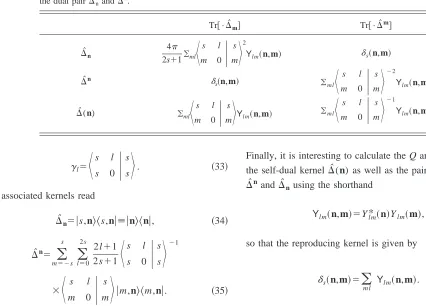
. ~33!The associated kernels read
Dˆn5us,n
&^
s,nu[un&^
nu, ~34!Dˆn
5
(
m52s s
(
l50 2s2l11 2s11
K
s l s
s 0 s
L
21
3
K
s l s
m 0 m
L
um,n&^
m,nu. ~35!This choice has the advantage that one of the two symbols reduces to the expectation value of an operator Aˆ in coherent states @5#. It turns out to be just the Q symbol of Aˆ , QA(n)
5
^
nuAˆun&
, that is, its expectation in a spin-coherent state. At the same time, one falls back on a familiar expression for the dual symbol, namely the P symbol for Aˆ , defined by an expansion in terms of a linear combination of operators pro-jecting on coherent states,Aˆ5~
2s11! 4p
E
S2PA~n!un
&^
nudn. ~36!In the present notation, Eq.~26!implies that
QA~n![An5Tr@AˆDˆn#, PA~n![An5Tr@AˆDˆn
#, ~37!
so that Eq.~36!reads
Aˆ5~2s11!
4p
E
S2dn Tr@AˆDˆn
#Dˆn. ~38!
It is obvious now that one has ~see Ref.@7#!
Tr@Aˆ Bˆ#5~
2s11! 4p
E
S2dnPA~n!QB~n!
5~2s11!
4p
E
S2dn AnBn. ~39!
Finally, it is interesting to calculate the Q and P symbols of the self-dual kernelDˆ (n) as well as the pair of dual kernels DˆnandDˆ
nusing the shorthand
Ylm~n,m!5Ylm*~n!Ylm~m!, ~40!
so that the reproducing kernel is given by
ds~n,m!5
(
mlYlm~n,m!. ~41!
Table I shows the expansion coefficients of the kernels in-troduced so far in terms of other kernels. Note that the entries of last row, the Q and P symbols of the self-dual kernel Dˆ (n), do simultaneously provide the Wigner symbols of the dual kernelsDˆmandDˆm.
III. DISCRETE MOYAL-TYPE REPRESENTATIONS
A particular feature of the kernels discussed so far is their redundancy; the linear space of Hermitean operators for a spin s has dimension (2s11)2, while the kernels consist of a continuously labeled set of basis vectors. In other words, there are at most Ns5(2s11)2 linearly independent
opera-tors among allDˆ (n), nPS2. In this section discrete kernels will be introduced, denoted byDˆn,n51, . . . ,Ns. No linear
relations must exist between the operatorsDˆnthat constitute
the kernel, that is, they are a basis ofAsin the strict sense. It is natural to expect that a subset of precisely Ns operators
Dˆ (nn), n51, . . . ,Ns will give rise to a discrete kernel.
Therefore, evaluating a continuous symbol of an operator Aˆ at Ns points nn of the sphereS2 provides a promising
can-didate for a discrete symbol, i.e., the set An[An
n, n
51, . . . ,Ns. For brevity, Ns points onS2 are called a
con-stellation.
As before, one might expect orthogonal and nonorthogo-nal kernels to exist. It turns out, however, that an appropri-ately modified set of Stratonovich-Weyl postulates covering discrete kernels does not allow for orthogonal ones.
There-TABLE I. Expansion coefficients of the dual kernelsDˆm, Dˆm, and the self-dual kernelDˆ (m) in terms of
the dual pairDˆnandDˆn.
Tr@•Dˆm# Tr@•Dˆm#
Dˆn
4p
2s11(ml
K
s l s
m 0 m
L
2Ylm~n,m! ds~n,m!
Dˆn d
s~n,m! (ml
K
s l s
m 0 m
L
22
Ylm~n,m!
Dˆ (n) (ml
K
s l s
m 0 m
L
Ylm~n,m!(ml
K
s l s
m 0 m
L
21
[image:6.612.69.495.77.383.2]fore, we start immediately by deriving the discrete non-orthogonal kernels coming as before in combination with a dual.
A. Discrete dual kernels
By analogy with the continuous representation of the pre-ceding section, one modifies the Stratonovich-Weyl postu-lates in the following way ~throughout, the index n takes all the values from 1 to Ns):
~D0! linearity: Aˆ°An is a linear map,
~D1! reality: Dˆn†5Dˆn,
~D2! standardization: 1 2s11 n
(
51Ns
Dˆn
5Iˆ,
~D3! traciality: Dˆn5
1 2s11 m
(
51Ns
Tr@DˆnDˆm#Dˆm,
~D4! covariance: Dˆg•n5UˆgDˆnUˆg †, g
PSU~2!.
Let us briefly comment on these conditions. Linearity is au-tomatically satisfied if discrete symbols are defined via ker-nels, that is, An5Tr@AˆDˆn#. The second condition— reality—is obvious, and in ~D2!the kernelDˆn dual toDˆ
n is
standardized. The duality between Dˆn and Dˆn is made
pre-cise by the condition of traciality since ~D3! only holds if one has
1 2s11Tr@D
ˆ
nDˆm#5dn m
, n,m51, . . . ,Ns, ~42!
which, upon considering the trace as a scalar product, coin-cides with the condition defining the dual of a given basis. As a matter of fact, if $Dˆn%, n51, . . . ,Ns, is a basis, its
unique dual is guaranteed to exist. Finally, covariance under rotations gPSU(2) must be reinterpreted carefully. Under a
transformation g, a constellation associated with Nspoints on
the sphere will, in general, be mapped to a different constel-lation. In other words, the imageDˆg•n5Dˆ (g•nn) is typically not one of the operatorsDˆn. Nevertheless, condition~D4!is
not empty; For appropriately chosen rotations gnm one can
indeed map an operator defined at nn to another one
associ-ated with the point nm, say. In this case, the consequences
for the coefficients of the operatorsDˆn andDˆm are identical to those obtained in the continuous case. Similarly, invari-ance of the operatorDˆn under rotations about the axis nn has
the same impact as before. Thus the general ansatz for the discrete kernel @obtained from ~7! by setting n→nn] is re-duced by exploiting the postulates~D1-4!to the form
Dˆn[Dˆ~nn!5
(
m52s s
Dmum,nn
&^
m,nnu, n51, . . . ,Ns.~43!
Therefore, the discrete kernel Dˆn can be thought of as a
subset of Ns operators Dˆ (nn), each one associated with a
point nn of the sphere.
Let us mention an important difference between discrete and continuous kernelsDˆnandDˆ (n), which arises in spite of
their formal similarity. Once the coefficientsDm are fixed, a
continuous kernel is determined completely. Discrete ker-nels, however, come in a much wider variety since they de-pend, in addition, on the selected constellation of points on the sphere. The discrete kernel does not enjoy the SU(2) symmetry in the same way as does the continuous one. The discrete subgroups of SU(2) being limited in type, the con-tinuous symmetry will usually not turn into a discrete one. Note, further, that the elements of the dual kernel depend, in general, on all the points of the constellation: Dˆn
5Dˆn(n1. . . ,nNs). This is easily seen from Eq.~42!since the
variation of a single Dˆn will have an effect on all$Dˆn% in
order to maintain duality.
The additional freedom of selecting specific constellations is connected to a subtle point: actually, not all constellations of Nspoints give rise to a basis in the spaceAs. This remark
is easily understood by considering R3 as an example of a linear space. The ~continuous! collection of all unit vectors in three space clearly spans it while not every subset of three vectors is a basis—they might lie in a plane. By analogy, one must ensure that the operators Dˆn,n51, . . . ,Ns, associated
with a specific constellation, do indeed form a basis of As. The operators are linearly independent if the determinant of their symmetric Gram matrixG@15#satisfies
detG.0, Gnn85Tr@DˆnDˆn8#, ~44!
a condition that will be studied later in more detail.
Suppose now that the NsoperatorsDˆnin Eq.~43!do form
a basis. Then, the kernel dual to it, that is the set of operators Dˆn, is determined by the condition~42!instead of Eq. ~28!. Therefore, one cannot proceed as before to derive the condi-tions~29!. In particular, it is no longer true that the elements of the dual kernel have an expansion analogous to Eq.~43!. This follows immediately from the impossibility of satisfy-ing Eq.~29! by an ansatz forDˆn of the form ~43!: Eq.~43! represents Ns conditions but its dual would depend only on
(2s11) free parametersDm. Nevertheless, a dual kernelDˆn
does exist and it is determined unambiguously—it simply cannot be written as in~43!. Consequently, one expands any ~self-adjoint!operator Aˆ either in terms of a given kernel,
Aˆ5 1
2s11 n
(
51Ns
AnDˆn, An5Tr@AˆDˆn#, ~45!
Aˆ52s1 11 n
(
51Ns
AnDˆn, An5Tr@AˆDˆn#. ~46!
The collection A[(A1, . . . ,ANs) of real coefficients in Eq.
~46! is defined as the discrete phase-space symbol of the operator Aˆ , and Adual[(A1, . . . ,ANs) is the dual symbol.
The relation between the discrete symbol and its dual as well as between the pair of kernels is linear. It is easily implemented by means of the Gram matrixGand its inverse
G21,
~G21!
nn8[Gnn85
1
~2s11!2Tr@D
ˆnDˆn8#. ~47!
The matrix Gthus plays the role of a metric,
Dˆn5~2s11!
(
m51
Ns
GmnDˆm, ~48!
and the dual symbol is determined according to
An5~2s11!
(
n851
Ns
Gnn8An8. ~49!
The trace of two operators Aˆ and Bˆ is easily found to be expressible as a combination of a discrete symbol and a dual one,
Tr@Aˆ Bˆ#5
(
n51
Ns
AnBn5
(
n51Ns
AnBn, ~50!
which is the discretized version of Eq. ~39!.
In order to have a discrete Moyal product, we seek to reproduce the multiplication of operators on the level of symbols. Using the definition of the symbols, it is straight-forward to see that
~Aˆ Bˆ!l5Al!Bl5
1
~2s11!2 m
(
,n51
Ns
LlmnAmBn, ~51!
with the trilinear kernel
Llmn5Tr@DˆmDˆnDˆ
l#, ~52!
in close analogy to Eq.~4!.
B. Discrete P and Q symbols
A particularly interesting set of symbols emerges if, for a given allowed constellation, only one of the coefficients in the expansion ~43! is different from zero, Dm5dms, say.
Then, the kernel consists of Ns operators projecting on
co-herent states,
Qˆn5unn
&^
nnu. ~53!This is obviously the nonredundant counterpart of Eq. ~34!, implying that a self-adjoint operator Aˆ is determined by a symbol that consists of Nspure-state expectation values, the
discrete Q symbol,
An5Tr@Aˆ Qˆn#5
^
nnuAˆunn&
. ~54!Let us point out that the introduction of discrete symbols has actually been triggered by the search for a simple method to reconstruct the density matrix of a spin through expectation values@10#. In fact, this problem is solved by Eq.~54!in the most economic way. If Aˆ is chosen to be the density matrix rˆ of a spin s, then thenth component of the Q symbol equals the probability of measuring the eigenvalue s in the direction
nn,
ps~nn!5u
^
nnurˆunn&
u. ~55!Knowledge of the Ns measurable probabilities ps(nn) thus
amounts to knowing the density matrix rˆ .
If the Q symbol~54!determines an operator Aˆ , the values of the continuous Q symbol of Aˆ at points different from those of the constellation must be functions of the numbers (A1, . . . ,ANs). For a coherent stateun0&Þunn
&
, not amem-ber of the constellation, this dependence reads explicitly
^
n0uAˆun0&5 1 2s11 n(
51Ns
Anu
^
n0unn&
u2. ~56!Here, the P symbol A of Aˆ is required, calculated easily from its Q symbol by means of Eq.~49!once the matrix
G[Gnn85Tr@QˆnQˆn8#5u
^
nnunn8&
u2, ~57!has been inverted. Furthermore, knowledge ofG21provides immediately the dual kernel Qˆn via Eq.~48!but no explicit general expression such as Eq. ~35!is known.
It will be shown now how to directly determine the matrix elements of the dual kernel without using the inverse of G. The orthogonality of the kernel and its dual, Eq.~42!can be written as
dnn85
1
2s11Tr@QˆnQˆ
n8#
5
1
2s11 m,m
(
852ss
^
m8
uQˆnum&^
muQˆn8um8
&
, ~58!using the completeness relation for the z eigenstatesum,nz
&
.Introduce an (Ns3Ns) matrix Q with elements Qn,mm8
5
^
muQˆnum8
&
, where the index (m,m8
) of the columns runsthrough Ns values according to
$~2s,2s!,~2s,2s21!, . . . ,~2s,0!,~2s21,2s!, . . . ,~0,0!%. ~59!
As is obvious from Eq.~58!, the matrix elements of the dual kernel, Qmm
8
n
of the matrix Qhas been found. The expansion coefficients of a coherent stateun
&
in the standard basisum,nz&
are givenby
^
m,nzun&
5 1~11uzu2 !s
S
2s
s2m
D
1/2
zs2m, ~60!
where the complex number z is the stereographic image in the complex plane of the point n on the sphere. Therefore, one can writeQas a product of three matrices, two of which are diagonal:Q5D1ND2. The diagonal matrices
D15diag@~11uznu2!22s#, ~61! D25diag
FS
2s
2s2m
D
1/2
S
2s 2s2m8
D
1/2
G
, ~62! with n51, . . . ,Ns, and m,m8
50, . . . ,2s, have inversessince all diagonal entries are different from zero. The hard part of the inversion is due to the matrix Nwith elements
Nn,mm85zn
2s2m
~zn*!2s2m8, ~63!
similar to but not identical to the structure of a Vandermonde matrix. As discussed in the following section, particular con-stellations give rise to matrices N with inversion formulas simpler than the general one. OnceNhas been inverted, the matrix elements of the dual kernel are given by the rows of the (Ns3Ns) matrix
Q21
5D221
N21D 1
21
. ~64!
For discrete Q symbols, the kernel L in Eq. ~52!, which implements the discrete! product, has the form
Lmnl5Tr@QˆmQˆnQˆl#5
^
nlunm&^
nmunn&^
nnunl&
, ~65!which, by using results from Ref.@8#, can be written as
Lmnl5 1
42s~11nm
•nn1nn•nl1nl•nm1inm•nn∧nl!2s ~66!
5g0~nm•nn!sg0~nn•nl!sg0~nl•nm!seisa(mnl), ~67!
where g0(nm•nn)5(11nm•nn)/2, and, defining g(mnl) as
the term in parentheses of Eq.~66!, one has
a~mnl !51i ln
S
g~mnl !g*~mnl !
D
. ~68! Therefore, the phaseahas a geometrical interpretation@8#: It is given by the surface of the geodesic triangle given by the points nm,nn,nl.IV. CONSTELLATIONS
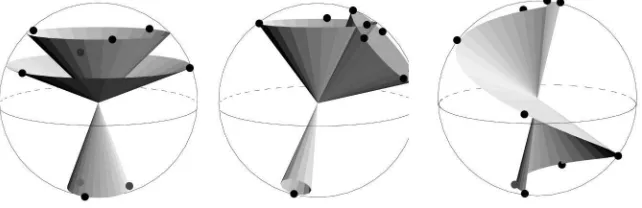
In this section, examples of specific constellations are pre-sented for which it is possible to prove that the Gram matrix has a determinant different from zero. Furthermore, in some cases, relatively simple expressions for the dual kernel or, equivalently, for the inverse of the Gram matrix G are ob-tained. The kernel is supposed throughout to consist of Ns projection operators Qˆn on coherent states as given in Eq. ~53!. In other words, the focus is on discrete Q symbols and the P symbols related to them. Note that, once a constellation has been shown to give rise to a basis inAs, the inversion of its Gram matrix is always possible but lengthy~already for a spin 1/2!: Express the matrix elements ofG21in terms of the cofactors ofG. Four different types of constellations will be discussed involving randomly chosen points, points on nested cones, on free cones, and on spirals~see Fig. 1!.
A. Random constellations
As shown in Ref. @16#, almost any distribution of Ns
points on the sphereS2gives rise to an allowed constellation. A random selection of directions leads with probability 1 to an invertible Gram matrix. This result shows that in an in-finitesimal neighborhood of any forbidden constellation, one can find an allowed one.
B. Nested cones
Historically, this family of constellations provided the first example of allowed constellations for both integer and half-integer spins @17#. For an integer value of s consider (2s11) cones about one axis in space, ez, say, all with
different opening angles. Distribute (2s11) directions over each of these nested cones in such a way that the ensemble of directions on each cone is invariant under a rotation about ez
[image:9.612.54.375.61.165.2]by an angle 2p/(2s11). For specific opening angles of the cones, the inversion of the matrixNin Eq.~63!reduces after a Fourier transformation to the inversion of (2s11) Vander-monde matrices of size (2s11)3(2s11). For a half-integer spin, the same construction is possible except that the
FIG. 1. Examples of nested cones, free cones, and a spiral constellation for spin quantum
number s51. Each set of nine
directions on different cones must also lie on different me-ridians. There is, in fact, a slight generalization of this result: the same calculation with (2s11) arbitrary different open-ing angles leads to (2s11) generalized Vandermonde ma-trices with a nonzero determinant.
Constellations on nested cones are useful also for numeri-cal numeri-calculations because they allow one to distribute Ns points in a homogeneous fashion on the surface of the sphere. If two points of a constellation approach each other, the determinant of the matrix G typically becomes very large, with a disastrous effect on numerical precision.
C. Free cones
Here is another family of constellations involving (2s
11) cones with directions located on them. However, now the cones may be oriented arbitrarily ~no nesting!, and the number of directions may vary from cone to cone. For ex-ample, the number of points on a cone can be chosen to equal the multiplicities of the spherical harmonics Ylm with
l52s. It is claimed that allowed constellations can be iden-tified by taking into account the following properties ~tested numerically for values up to s56):
~1! The determinant ofG is zero if there are more than (4s11) directions on a single cone.
~2!If there are (4s11) points on one cone, then another cone will contain at most (4s21) points, allowing for no more than (4s23) directions on the third cone, etc.
~3! It is necessary to have directions located on at least (2s11) different cones.
For a spin 1/2, these properties will be shown to hold in Sec. V. The first of these observations can be proved for arbitrary spin s by using a particular decomposition of the matrixG,
G5g†g, ~69!
exploiting the fact that a positive definite matrix can always be written as the ‘‘square’’ of its ‘‘root.’’ A lengthy calcula-tion involving properties of rotacalcula-tion matrices, Legendre polynomials, and spherical harmonics leads to a factoriza-tion, g5dy, the first matrix being diagonal and having (2s
11) different entries,
d(l)5 2
A
p~2s!!A~
2s111l!!~2s2l!!, l50, . . . ,2s, ~70!each value occurring (2l11) times. The second matrix has columns given by the Ns lowest spherical harmonics
evalu-ated at one of the Nspoints of the constellation,
y5
S
Y00~n1! Y00~n2! . . . Y00~nNs!
Y121~n1! Y121~n2! . . . Y121~nNs!
A A A
Y2s2s~n1! Y2s2s~n2! . . . Y2s2s~nNs!
D
.
~71!
Consequently, the Gram matrixGis invertible if and only if det yÞ0. The matrix ~71! can accommodate at most (4s
11) directions on one cone, corresponding to one value of qwith respect to some fixed axis. The subsequent multiplici-ties (4s21),(4s23), . . . , are due to applying the same ar-gument to the remaining subspaces with dimensions 2(l
21)11,2(l22)11, . . . .
In physical terms, the determinant of Eq. ~71! is easily interpreted as a Slater determinant of a quantum system: it equals the~totally antisymmetric!ground-state wavefunction of Nsnoninteracting fermions restricted to move on a sphere. The node lines of this wave function correspond to forbidden constellations in which the corresponding operator kernel is degenerate, i.e., does not give rise to a basis in As.
D. Spirals
A particularly convenient constellation is defined in the following way: Let the Ns directions be defined by Ns com-plex numbers points zn constructed from a single point z0 ~neither of modulus one nor purely real!,
zn5z0
n21
, n51, . . . ,Ns. ~72!
The points are thus located on a spiral in the complex plane. The matrix Ndefined in Eq. ~63!then turns into an (Ns
3Ns) Vandermonde matrix, that is,
Vnm5xn m21
, n,m51, . . . ,Ns. ~73!
Its inverse is known explicitly given, for example, in @18#, with elements
Vnm21
5 ~21!
n11
)
lÞm~xl2xm!
SNs2n~$xl%l51
Ns
2xm!, ~74!
where SNs2n($xl%l51
Ns
2xm) is the symmetrical function
con-structed out of the N2n numbers xnwithnÞl. One has, for
example, S2(x1,x2,x3)5x1x21x1x31x2x3.
V. DISCRETE MOYAL REPRESENTATION FOR A SPIN 1Õ2
In this section, the discrete Moyal representation will be worked out in detail for a spin with quantum number s
51/2, allowing for explicit results throughout. For clarity, it is assumed from the outset that the kernel consists of four
projection operators
Qˆn5unn
&^
nnu, n51, . . . ,Ns. ~75!It is easy to generalize the results derived below to the case of four linear combinations ofu6nn
&^
6nnu compatible withEq. ~12!.
Let us start with the determination of the dual kernel that can be found by the intermediate step of inverting the (4
Gmn5u
^
nmunn&
u251
2~11nm•nn!. ~76! This matrix is easily factorized:G5g†g/2, where
g5
S
1 1 1 1
n1x n2x n3x n4x
n1y n2y n3y n4y
n1z n2z n3z n4z
D
. ~77!
The absolute value of the determinant ofgis proportional to the volume of the tetrahedron defined by the four points nn
on the surface of the sphere implying udetGu518Vtetra. Since a ‘‘flat’’ tetrahedron has no volume, the entire set of forbidden constellations has a simple geometric description:
detG50⇔the four points nn are located on a circle onS2.
~78!
Consequently, allowed constellations are characterized by three vectors on a cone~any three points on a sphere define a circle!, plus any fourth vector not on this cone. This agrees with the earlier statements about free-cones constellations.
Here is a simple way to invert the matrix g and subse-quentlyG. Consider a matrix
f5
S
1 fx1 fy1 fz1
1 fx2 fy2 fz2
1 fx3 fy3 fz3
1 fx4 fy4 fz4
D
, ~79!
defined in terms of four vectors fn5( fxn, fyn, fzn) not required to have length one. The matrix elements of the of productf
andgare given by
~fg!nm511fm•nn. ~80!
This is a diagonal matrix if the scalar products fm•nm equal
to21 whenevermÞn. Geometrically, such four vectors are constructed easily: the vector f1 points to the unique inter-section of the three planes tangent to the sphere at the points
2n2, 2n3 and2n4. Analytically, this vector reads
f1
5n2∧n31n3∧n41n4∧n2
~n2∧n3!•n4
, ~81!
and the three remaining vectors follow from cyclic permuta-tion of the numbers 1 to 4. With this choice the inverse of the matrixg can be written as
g21
5d21f, ~82! wheredis the diagonal matrix in~80!:dnn511fn•nn.
Con-sequently, the inverse of the Gram matrix G for a general allowed constellation is given by
G21
52d21ff†d21, ~83! having matrix elements
Gmn21[Gmn52
11fm•fn
~11nm•fm!~11nn•fn!
. ~84!
In general, the elements Qˆn of the dual kernel will thus be linear combinations of all four projection operators Qˆn.
It is interesting to express the kernel and its dual in terms of the Pauli matrices s5(sx,sy,sz):
Qˆn5
1
2~I1nn•s!, Qˆ
n
52 I1f
n•s
11fn•nn, ~85!
allowing one to show easily that they satisfy the required duality.
For reference, we give the Q and P symbols of the spin operator
sn51
2nn, s
n
5 2f
n
11fn•nn
, ~86!
and of the identity
In51, In5
4
11fn•nn, ~87!
and the symbols of arbitrary operators for a spin 1/2 follow from linear combinations.
VI. DISCUSSION
Operator kernels have been used for a systematic study of phase-space representations of a quantum spin s. The kernels have been derived from appropriate Stratonovich-Weyl pos-tulates taking slightly different forms for continuous and crete representations, respectively. Emphasis is on the
dis-crete Moyal formalism that allows one to describe
Hermitean operators, including density matrices, by a
mini-mal number of probabilities easily measured by a
Stern-Gerlach apparatus. As a useful byproduct, a natural and most economic method of state reconstruction emerges when a quantum spin is described in terms of discrete symbols. Fur-ther, Schro¨dinger’s equation for a spin s turns into a set of coupled linear differential equations for (2s11)2 probabili-ties@19#.
In addition, a new form of the kernel defining continuous Wigner functions for a spin has been given in Eq.~22!: It has been expressed as an ensemble of operators obtained from all possible rotations of one fixed operator. This is entirely analogous to the elegant expression of the kernel for particle-Wigner functions as an ensemble of all possible phase-space
translations of the parity operator. Therefore, continuous
phase-space representations for both spin and particle sys-tems now are seen to derive from structurally equivalent op-erator kernels.
and ~46!#. However, only a finite subset of points in phase space ~corresponding to an allowed constellation! are in-volved reflecting thus the discretization characteristic of quantum mechanics.
The Ns projection operators associated with a constella-tion of points define a nonorthogonal basis for Hermitean operators acting on the Hilbert space of the spin. Each pro-jection is a positive operator, and, altogether, they give rise to a resolution of unity. One might suspect that they define a positive operator-valued measure @20#. However, this is not the case since the closure relation does not involve just the
bare projections but they are multiplied with factors—some
of which necessarily take negative values. Such an obstruc-tion through ‘‘negative probabilities’’ is not surprising; other phase-space representations are based on quantum mechani-cal ‘‘quasi-probabilities,’’ known to have this property, too. Let us close with a synopsis of the fundamental Moyal-type representations for particle and spin systems known so far. Table II provides both a summary and points at open questions. The individual entries give the names of the fa-miliar continuous phase-space representations~see@21#for a survey!, while the corresponding quantities for the discrete formalism are in square brackets. Future work will focus on developing a discrete Moyal-type formalism for a quantum particle. To do this, one must exhibit, for example, a pair of
dual kernels, one of which would consist of a countable set of projection operators on coherent states. This set is re-quired to be a basis in the linear space of ~bounded?! opera-tors on the particle Hilbert space. It is not obvious in how the associated discrete P symbol would reflect the subtleties of its continuous counterpart which may be singular. Similarly, the existence of a self-dual discrete kernel for a quantum particle is an open question.
ACKNOWLEDGMENT
St.W. acknowledges financial support by the Schwei-zerische Nationalfonds.
@1#E.P. Wigner, Phys. Rev. 40, 749~1932!.
@2#J.E. Moyal, Proc. Cambridge Philos. Soc. 45, 99~1949!.
@3#A. Royer, Phys. Rev. A 15, 449~1977!.
@4#P. Huguenin and J.-P. Amiet, Me´caniques Classique et
Quan-tique dans l’Espace de Phase~Universite´ de Neuchaˆtel,
Neu-chaˆtel, 1981!.
@5#A. Perelomov, Generalized Coherent States and their
Applica-tions~Springer-Verlag, Berlin, 1986!.
@6#R.L. Stratonovich, JETP 4, 891~1957!.
@7#J. Va´rilly and J. M. Gracia-Bondı´a, Ann. Phys. ~N.Y.! 190,
107~1989!.
@8#J.-P. Amiet and M.B. Cibils, J. Phys. A 24, 1515~1991!.
@9#F.A. Berezin, Commun. Math. Phys. 40, 153~1975!.
@10#J.-P. Amiet and St. Weigert, J. Phys. A 31, L543~1998!.
@11#St. Weigert, in Reconstruction of Spin States and its
Concep-tual Implications, in New Insights in Quantum Mechanics,
ed-ited by H.-D. Doebner, S. T. Ali, M. Keyl, and R. F. Werner
~World Scientific, Singapore, 2000!.
@12#F.T. Arecchi, E. Courtens, R. Gilmore, and H. Thomas, Phys.
Rev. A 6, 2211~1972!.
@13#A. R. Edmonds, Angular Momentum in Quantum Mechanics
~Princeton University Press, Princeton, NJ, 1957!.
@14#J.-P. Amiet and St. Weigert, Phys. Rev. A~to be published!;
A.B. Klimov and S.M. Chumakov, J. Opt. Soc. Am. ~to be
published!.
@15#W. H. Greub, Linear Algebra~Springer, Berlin, 1963!.
@16#J.-P. Amiet and St. Weigert, J. Opt. B 2, 18 (2000).
@17#J.-P. Amiet and St. Weigert, J. Phys. A 32, 269~1999!.
@18#L. Verde-Star, J. Math. Anal. Appl. 131, 341~1988!.
@19#St. Weigert, Phys. Rev. Lett. 84, 802~2000!.
@20#J.M. Jauch and C.M. Piron, Helv. Phys. Acta 40, 559~1967!.
[image:12.612.315.560.95.176.2]@21#C. Brif and A. Mann, Phys. Rev. A 59, 971~1999!.
TABLE II. Synopsis of continuous and discrete @in square
brackets#phase-space representations for both particle and spin
sys-tems.
Self-dual kernel Dual pairs
particle Wigner functions
@unknown#
P, Q symbols
@unknown#
spin Stratonovich/Varilly
@impossible#
Berezin symbols