A safety evaluation of Canagliflozin: a first in class treatment for Type 2 Diabetes
Luke D. Boyle, John P.H. Wilding
Address Correspondence to John PH Wilding: John P H Wilding
Department of Obesity & Endocrinology University of Liverpool
Clinical Sciences Centre University Hospital Aintree Longmoor Lane
Liverpool L9 7AL Tel: +44 151 529 5885 Fax +44 151 529 5888
Abstract
Introduction: Type 2 diabetes mellitus (T2DM) is a public health challenge globally. Numerous treatments are available which can improve insulin sensitivity or stimulate its secretion including biguanides, sulphonylureas, and glitazones; as well as insulin, GLP-1 agonists and DPP-IV inhibitors. These are usually unable to halt progression with high resulting morbidity and mortality. New therapies are therefore being developed; inhibition of glucose reabsorption from the renal filtrate was proposed as a novel therapeutic target, and sodium/glucose co-transporter 2 (SGLT2) inhibitors were developed accordingly, with cCanagliflozin the first to launch in the US in 2013.
Areas covered: This evaluation includes a description of the mechanism of action of canagliflozin and summarises its pharmacokinetic data, before describing its clinical applications and efficacy data from clinical studies of both subjects with T2DM controlled on diet and exercise, and those on glucose-lowering antidiabetic agents and insulin. The evaluation focuses primarily on the safety of canagliflozin mainly in clinical trials conducted for initial registration clinical studies due to very little postmarketing data available, and discusses its safety in special populations, before comparing its safety with existing therapies wherever such comparisons are possible.
suggest no increased risk of CV disease, but longer duration outcome studies are essential to prove long-term safety and efficacy.
Keywords
Introduction
Type 2 diabetes mellitus (T2DM) is a rapidly growing public health challenge now at epidemic levels. The global prevalence of the disease is estimated at 285 million people, which represents 6.4% of the world’s adult population.
the nephron; the remainder is absorbed via SGLT1, a more widely expressed transporter that is also responsible for gut glucose absorption.
Familial Renal Glucosuria (caused by defects in the SGLT2 transporter gene, SLC5A2) can lead to significant glucosuria; up to 134g/day has been reported in the literature.32 Interestingly, most patients with this condition remain asymptomatic, typically reporting only polyuria, or they are diagnosed when glycosuria is found due to electrolyte imbalance as an incidental finding, when being investigated for something else.33 Interestinglyn addition, Powell et al. have recently reported improved glycaemic control in SGLT2 knockout mice.34 It is therefore possible that humans lacking SGLT2 may have improved glycemic control, although this has not been formally tested.
Mechanism of action
In non-diabetic individuals the kidney contributes up to 20% of gluconeogenesis (more post-prandially), uses approximately 10% of total body glucose and filters and reabsorbs up to approximately 180g of glucose per day. After filtering into the nephrons through the glomeruli, most of this glucose load is reabsorbed in the proximal convoluted tubule. Approximately 90% is reabsorbed in the S1 segment of the proximal convoluted tubule, with the remainderother 10% reabsorbedin thein the distal straight tubules (S2 and S3 segments)before the filtrate reaches the Loop of Henle. Figure 1 illustrates this process.1
Negligible glucose
in urine
Collecting duct
Glucose
SGLT
2
SGLT
1
S
1segment of
proximal tubule
Most
Glucose reabsorption
Remainder
Distal S
2/3segment of
Proximal tubule
The sodium/glucose co-transporters (SLC5 gene family), are active transporters, driving glucose reabsorption by the sodium gradient maintained by the Na+-K+ ATPase of the basal membrane. SGLT1 and SGLT2 are responsible for intestinal and renal glucose reabsorption respectively. SGLT1 is expressed mostly in the intestine (for dietary glucose absorption) with some found in the kidney, whereas SGLT2 is found almost exclusively in the kidney (for renal glucose absorption). These transporters differ in two other respects; unlike SLGT1, SGLT2 is specific for glucose (SGLT1 binds both glucose and galactose), and SGLT2 has a much higher capacity for transport than SGLT1. SGLT2 is responsible for reabsorption of almost all filtered glucose. Canagliflozin is a sodium-glucose cotransporter 2 (SGLT2) inhibitor and a low-potency SGLT1 inhibitor, reducing glucose absorption in the intestine by 6% due to activity on SGLT1 in one study.1
Pharmacokinetics
Clinical applications and efficacy
Canagliflozin (Invokana®; Janssen Research and Development, LLC, Raritan, NJ, USA; Mitsubishi Tanabe Pharma Corporation, Osaka, Japan) was FDA approved on 29 March 2013 to be used with diet and exercise, to improve glycaemic control in adults with T2DM on the basis of the data generated from the clinical studies described below; it was subsequently approved in the European Union in October 2013.4 To date there have been fewer than ten major studies to evaluate the clinical efficacy and safety of canagliflozin – two in subjects with T2DM controlled by diet and exercise, with the others involving patients using oral agents or insulin.
In subjects with T2DM controlled by diet and exercise
In subjects with T2DM and taking oral agents or insulin
Safety evaluation
Safety in clinical studies
Stenlöf et al. reported the overall incidence of AEs as modestly higher for subjects treated with canagliflozin compared with placebo, with incidence of serious AEs low across treatment groups. Ten subjects in the canagliflozin groups (2.6%) discontinued treatment due to AEs, compared with two subjects (1.0%) in the placebo group; no single AE term accounted for more than a single discontinuation. Two deaths occurred during the treatment period (one with placebo and one with canagliflozin 100 mg); neither was considered to be drug-related. The incidence of genital mycotic infections was higher in both males and females with canagliflozin compared with placebo; these AEs were generally mild to moderate in severity, treated with topical and/or oral antifungal therapies and resolved without interruption of study drug treatment. There was a modest increase in lower UTIs with canagliflozin 100 and 300 mg compared with placebo, no upper UTIs, and all were mild to moderate in severity – none led to study discontinuation. AEs related to osmotic diuresis and reduced intravascular volume were ≤3.0% and led to few study discontinuations. The percentage of subjects with documented hypoglycaemia was similar with canagliflozin 100 and 300mg and placebo (3.6, 3.0 and 2.6%, respectively), with no report of severe hypoglycaemia. Interestingly, modest improvements in indices of liver function, including alanine aminotransferase (ALT) and alkaline phosphatase, were observed with canagliflozin relative to placebo.5
telopeptide of type I collagen levels together with slight decreases in bone-specific alkaa- line phosphatase and 1,25-(OH)2 vitamin D levels from baseline to week 12 were reported in the canagliflozin groups. The clinical relevance of these small changes is unknown and there were no AEs suggestive of changes in bone-related markers.6
In a randomised, double blind placebo-controlled multicentre trial by Wilding et al. presented in 2012, 469 adult patients with T2DM inadequately controlled with metformin and a sulphonylurea were given oral canagliflozin 100 or 300mg/day or placebo for 26 weeks. The overall incidence of adverse events did not differ between groups; however, the canagliflozin treated patients experienced a higher incidence of genital fungal infections (18.7% vs 3.8% in women and 4.9% vs 1.3% in men). More patients in the canagliflozin groups also experienced hypoglycaemia (28.8% vs 15.4%). In another similar, but much smaller study involving only 29 patients, Devineni et al. reported that symptomatic hypoglycaemia occurred in 6 patients on canagliflozin 100mg, 3 patients in the 300mg group, and 3 patients in the placebo group. None of these hypoglycaemic episodes were classed as severe or serious.2
Canagliflozin treatment has been associated with several changes in fasting plasma lipids, including increases in HDL-Cholesterol and decreases in triglycerides, and increases in LDL-Cholesterol.
tertile suggested that these subgroup factors had no meaningful impact on the change from baseline in LDL-C with canagliflozin. A post-hoc analysis was also conducted to determine if response to statin medications was altered in subjects on canagliflozin, which suggested no substantive differences in response to statin in subjects in the canagliflozin relative to the non-canagliflozin group.
The canagliflozin 2-year rat carcinogenicity study described an increase in LCTs, phaeochromocytomas, and renal tubular cell tumours; however the mechanistic toxicology program showed that the increase in LCTs was related to increased LH seen in canagliflozin-treated rats (an increase in LH is a well established mechanism of tumorigenesis in the rat); this rise in LH is not seen in clinical studies. The increase in phaeochromocytomas and RTTs was related to the induction of carbohydrate malabsorption and its metabolic consequences (canagliflozin does not cause significant induce carbohydrate malabsorption in humans). In addition, reports from the dapagliflozin, another SGLT2 inhibitor, showed a numerical imbalance in the occurrence of breast and bladder cancer events, therefore a careful assessment of the occurrence of these tumours has been conducted. These tumour adverse events occurred at a low and similar incidence across treatment groups in all studies to date, in fact few events of breast, bladder, or renal cancer and no events of phaeochromocytoma or LCTs were reported in the Phase 3 clinical program, correct as of 15 Nov 2012. There has been no meaningful imbalance in the events of breast, bladder, and renal cancers in the data reported since.
Postmarketing data
relatively recently FDA approved (on 29 March 2013) to be used with diet and exercise,to improve glycaemic control in adults with T2DM,little postmarketing data is available. However, the FDA is requiring five post-marketing studies for canagliflozin, including a CV outcomes trial, an enhanced pharmacovigilance programme (monitoring for malignancy, severe pancreatitis, severe hypersensitivity reactions, photosensitivity reactions, liver abnormalities, and adverse pregnancy outcomes), a bone safety study, and two paediatric studies.4All of this data is awaited with interest.
Safety in special populations
Three special populations in particular must be considered carefully when evaluating the safety of a novel antidiabetic agent; patients with chronic kidney disease (CKD), due to the large numbers of patients with T2DM who develop diabetic nephropathy & particularly relevant for agents where the kidney is the main site for drug action, elderly patients, since the risks of hypoglycaemia and postural hypotension are higher (and consequences often more serious) in this population, and they are more likely to have bone disease. In fact all patients with T2DM have an increased risk of bone fractures, for reasons yet to be fully understood, which can be amplified by some oral antidiabetic agents e.g. thiazolidinediones. Therefore, it is also important to assess the effects of SGLT2 inhibitors on bone structure and function.4
Canagliflozin was associated with slightly higher rates of genital mycotic infections in males and females compared with placebo, but incidences were low across groups and none led to study discontinuation. The incidence of UTIs was higher with canagliflozin 300 mg compared with canagliflozin 100 mg and placebo, with no upper UTI AEs reported. All UTIs were considered mild or moderate in severity, with none leading to study discontinuation. Incidences of pollakiuria and AEs related to reduced intravascular volume (i.e. postural dizziness and orthostatic hypotension) were increased with canagliflozin 300mg relative to canagliflozin 100mg and placebo; these were low across groups, generally mild or moderate in intensity and infrequently led to discontinuation. There was no report of polyuria (increased urine volume) in any group.
Most subjects (96.3%) were on background therapy associated with an increased risk of hypoglycaemia (i.e. insulin or sulphonylurea agents). Among these subjects, the proportion with documented hypoglycaemia episodes was higher with canagliflozin 100 and 300 mg (52.9 and 51.2%, respectively) compared with placebo (36.4%). Six subjects experienced severe hypoglycaemia episodes [4 (4.7%), 1 (1.2%) and 1 (1.1%) with canagliflozin 100 and 300 mg and placebo, respectively]. There were no documented hypoglycaemia episodes reported among subjects who were not on insulin or a sulphonylurea agent.
magnesium were seen with canagliflozin 100 and 300 mg, whereas no change was observed with placebo (mean percent changes of 9.1, 14.6 and 0.0%, respectively). Dose-related increases in serum phosphate were seen with canagliflozin 100 and 300 mg compared with placebo (mean percent changes of 4.9, 9.5 and 1.0%, respectively). Canagliflozin 100 and 300 mg were associated with non–dose- related increases in haemoglobin compared with a minimal change with placebo (mean percent changes of 5.3, 3.1 and –0.5%, respectively); corresponding changes in haematocrit were observed (mean percent changes of 6.0, 4.8 and –0.1%, respectively).
Changes in renal function parameters were observed with both canagliflozin doses compared with placebo. Transient Ddecreases in eGFR from baseline were observed in all treatment groups and were larger in the canagliflozin 100 and 300 mg groups relative to the placebo group: mean percent changes of –9.1, –10.1 and –4.5%, respectively. The reductions in eGFR with canagliflozin were largest at week 3 (the first post baseline measurement) and then trended back towards baseline over the 26-week treatment period. Increases in BUN were observed with canagliflozin 100 and 300 mg compared with placebo (mean percent changes of 12.1, 12.5 and 4.9%, respectively); these increases also occurred early and then trended towards baseline over the remaining treatment period. Canagliflozin 100 and 300 mg were associated with greater decreases in urine ACR compared with placebo, with median percent reductions of –29.9, –20.9 and –7.5%, respectively. Progression of albuminuria from baseline to week 26 was examined, with a lower proportion of subjects in the canagliflozin 100 and 300 mg groups progressing relative to those in the placebo group (5.1, 8.3 and 11.8%, respectively).7
This regimen could include any oral hypoglycaemic agent or injectable treatment (including insulin). This randomized double-blind phase III trial was completed over 26 weeks and is currently being followed with a 78 week extension period. Patients were randomized to receive canagliflozin 100 mg daily, 300 mg daily, or placebo. Rates of any AE were similar between the canagliflozin 100 mg group and placebo at 174 incidents each, but were slightly higher in the canagliflozin 300 mg group, with 184 incidents reported. A higher rate of mycotic infections was seen in the canagliflozin 100 mg and 300 mg groups compared to placebo with 22, 20, and 2 events, respectively, being reported. Pollakiuria was reported in five, six, and 12 cases and polyuria was observed in zero, four, and four subjects in the placebo, canagliflozin 100 mg, and canagliflozin 300 mg groups, respectively. Discontinuation due to any AE occurred in ten patients receiving placebo, five receiving canagliflozin 100 mg daily, and in 17 receiving canagliflozin 300 mg daily. As expected, hypoglycemia was seen more often in participants on multiple antidiabetic agents, including a slightly higher incidence in the canagliflozin 100 mg and 300 mg compared with placebo at 66, 76, and 82 events, respectively. There were no clinically significant changes in laboratory markers between study groups. Based on this trial, canagliflozin may be a reasonable option for elderly patients without cardiovascular disease.3
which resulted in increases in beta-CTx of 16.8% without decreases in P1 NP. However, there is no increase in the incidence of fracture compared to placebo. Dual-energy X-ray absorptiometry (DEXA) scan results with canagliflozin use showed minimal changes in bone mineral density (BMD) at the lumbar spine, distal forearm, femoral neck, and total hip. In contrast, , which is a benefit compared topioglitazone, which is known to have an increased rateisk of fractures of 5.1% over one year compared toa risk of2.5% in those treated with placebo therapy.4
Comparison with the safety of other agents
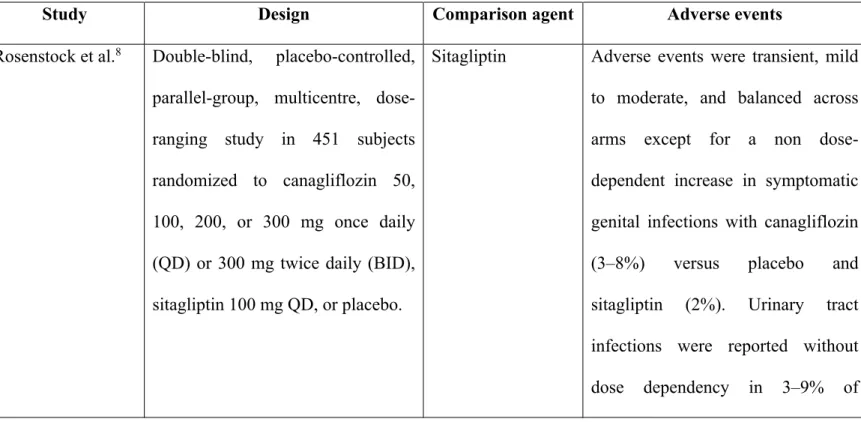
A number of the clinical studies evaluating the efficacy of canagliflozin against existing therapies have made direct comparison of its safety compared with that of other agents possible – the safety data provided by these studies is summarised in Table 1.
TABLE 1 Comparison of the safety of canagliflozin with that of other agents
Study Design Comparison agent Adverse events
Rosenstock et al.8 Double-blind, placebo-controlled, parallel-group, multicentre, dose-ranging study in 451 subjects randomized to canagliflozin 50, 100, 200, or 300 mg once daily (QD) or 300 mg twice daily (BID), sitagliptin 100 mg QD, or placebo.
canagliflozin, 6% of placebo, and 2% of sitagliptin arms. Overall incidence of hypoglycaemia was low.
Lavalle-González et al.9
Randomised, double blind, four-arm, parallel-group, Phase 3 study conducted at 169 centres in 22 countries between April 2010 and August 2012. Participants (N = 1,284) with T2DM aged ≥18 and ≤80 years who had inadequate glycaemic control (HbA1c ≥7.0% [53 mmol/mol] and ≤10.5% [91 mmol/mol]) on metformin therapy received canagliflozin 100 mg or 300 mg, sitagliptin 100 mg, or placebo (n =368, 367, 366, 183, respectively) for a 26 week, placebo- and active-controlled period followed by a 26 week, active-controlled period (placebo group switched to sitagliptin [placebo/sitagliptin]) and were included in a modified intent-to-treat analysis.
Sitagliptin Overall AE and AE-related
Cefalu et al.2 1,450 patients with T2DM inadequately controlled with metformin. Mean age was 56.2 years, mean HbA1c was 7.8%, mean FPG was 9.2 mmol/L, and mean body weight was 86.6 kg. Intervention: Canagliflozin 100 or 300 mg orally once daily or glimepiride at a titrated dose (mean, 5.6 mg) orally once daily for 52 weeks.
Glimepiride Overall incidence of adverse events did not differ between groups; however, the canagliflozin-treated patients experienced a higher incidence of genital fungal infections (14.3% with canagliflozin
100 mg and 23.8% with
canagliflozin 300 mg vs 3.7% with glimepiride in women; 6.7% and 8.3% vs 1.1%, respectively, in men), UTIs (6.4% with both doses of canagliflozin vs 4.4% with glimepiride), and osmotic diuresis related adverse events (all less than 3%).
Gross et al.2 Randomized, double blind, active-controlled, multicentre study with
755 patients with T2DM
inadequately controlled with metformin plus a sulfonylurea (mean age 56.7 years, mean HbA1c 8.1%, mean FPG 9.3 mmol/L and mean body weight 88.3kg) given oral canagliflozin 300mg once daily or sitagliptin 100mg
Conclusion
Expert Opinion
The primary advantage canagliflozin confersover that mostotherexisting oral therapies is that of weight loss, which although modest, is approximately equivalent to what is seen with GLP1 receptor agonists. A low intrinsic risk of hypoglycaemia and reductions in blood pressure are also potential advantages. The fact do not, isthat the it has amode of action that is completelyindependent of insulinallows use across the time course of type 2 diabetes, including in combination with insulin. It also has a favourable side effect profile aside from genital and urinary tract infections, and a low intrinsic risk of causing hypoglycaemia in e.g. the elderly.
Presently canagliflozin is unlikely to significantly impact on current treatment strategies, due to the lack of postmarketing data available and the cost of the drug whilst it is under patent. It is very unlikely that given the efficacy and safety of metformin that canagliflozin would be commonly used as that it would ever be used as a first line agent, except in those with metformin intolerance except in those with severe CKD, and in patients with renal disease the maximum dose of canagliflozin licenced is the lower dose i.e. 100mg.It is more likelyin our view that canagliflozin would be most frequently best used as a second line agent in combination with existing therapies, including insulin.
depleted patients, and the possibility of an increased thromboembolic risk, particularly during the early period of treatment where volume depletion appears to be most apparent is also a potential concern. The outcome data to date is reassuring, but only the planned long-term prospective studies can provide a definitive answer.It is also unlikely in our opinion that canagliflozin will be prescribed routinely by general physicians – it will in all likelihood be prescribed almost exclusively in the specialist setting for patients not achieving glycaemic control on existing therapy. The coming years will see diabetologists embrace stratified medicine that as yet the field has neglected to do, and specialists will be involved in the creation of much improved clinical guidelines and algorithms with a stronger evidence base, so that patients get ‘bespoke’ treatment depending on their personal clinical indicators which with further research will be used in future to better predict response to therapy in T2DM.
Drug Summary Box
Drug name Canagliflozin
Phase FDA Approved
Indication Type 2 Diabetes – second line
combination agent
Mechanism of action Inhibition of kidney sodium/glucose co-transporter 2, reducing glucose
reabsorption from the renal filtrate
Route of administration Oral
Chemical structure
Pivotal trials Stenlöf et al.
References
1. Boyle LD, Wilding JPH. Emerging sodium/glucose co-transporter 2 inhibitors for type 2 diabetes.Expert Opin Emerg Drugs. 2013;18:375–91.
doi:10.1517/14728214.2013.831405.
2. Cada DJ, Ingram KT, Levien TL, Baker DE. Canagliflozin.Hosp Pharm. 2013;48:855–67. doi:10.1310/hpj4810-855.
3. Dietrich E, Powell J, Taylor JR. Canagliflozin: a novel treatment option for type 2 diabetes.Drug Des Devel Ther. 2013;7:1399–408.
doi:10.2147/DDDT.S48937.
4. Rosenwasser, Rebecca; Sultan, Senan; Sutton, David; Choksi, Rushab; Epstein B. SGLT-2 inhibitors and their potential in the treatment of diabetes.Diabetes, Metab Syndr Obes Targets Ther. 2013;6:453–467.
doi:10.2147/DMSO.S34416.
5. Stenlöf K, Cefalu WT, Kim K, et al. Efficacy and safety of canagliflozin monotherapy in subjects with type 2 diabetes mellitus inadequately controlled with diet and exercise.Diabetes Obes Metab. 2013;15:372–82.
doi:10.1111/dom.12054.
6. Inagaki N, Kondo K, Yoshinari T, Maruyama N, Susuta Y, Kuki H. Efficacy and safety of canagliflozin in Japanese patients with type 2 diabetes: a
randomized, double-blind, placebo-controlled, 12-week study.Diabetes Obes Metab. 2013;15:1136–45. doi:10.1111/dom.12149.
7. Yale J, Bakris G, Cariou B. Efficacy and safety of canagliflozin in subjects with type 2 diabetes and chronic kidney disease.Diabetes, Obes ….
2013:463–473. Available at:
http://onlinelibrary.wiley.com/doi/10.1111/dom.12090/full.
8. Rosenstock J, Aggarwal N, Polidori D, et al. Dose-Ranging Effects of Canagliflozin, a Sodium-Glucose Cotransporter 2 Inhibitor, as Add-On to Metformin in Subjects With Type 2 Diabetes.Diabetes Care.
2012;35:1232–1238. doi:10.2337/dc11-1926.
9. Lavalle-González FJ, Januszewicz A, Davidson J, et al. Efficacy and safety of canagliflozin compared with placebo and sitagliptin in patients with type 2 diabetes on background metformin monotherapy: a randomised trial.