Available online: https://edupediapublications.org/journals/index.php/IJR/ P a g e | 1366
Effect of Training Models according to Exercises in Development of
some Special Physical Capabilities and Accuracy in Performance of
Basic Skills in Football
A.M.D. Adnan Fidoos Omer, M. D. Nasr Khalid, Abdul Razzak, Marwan Abdul Latif Abul Jabbar
College of Physical Education
University of Anbar, Iraq
Summary of the Research
Presence of weakness and decline in level in some particular physical abilities as well as decline in accuracy in performance skills for the research sample and shown from slow moment and excessive handling or situation of recession and failure to achieve most targets.
Abstract:
The study explanation of training models according to exercises of sports in training program and learning about effects of those models upon variables of research under consideration. As for research hypothesis, there were variance of statistical significance in trial results before or after between research control and experiment groups and, so presence of significant statistical variance between post-trials between control and experiment groups and valid for group under experiment, and research methodology used in research sample were; 20 players representing club (Ararat) taken as experimental group and 20 players representing club (Shaklawa) as control group. The most important conclusions which drawn by researchers that the models of training according to exercises of game used in research brought development in some specific physical abilities and accuracy in performance of basic skills used in the research, as for recommendations adoption of training model according to exercises of games at
particular preparation stage and method of training is natural and repetitive nature in the training program for trainers.
Available online: https://edupediapublications.org/journals/index.php/IJR/ P a g e | 1367 aspects, so trainers depend over it during
training practice, because of their effect effective and athletic in solving problems which appear during practice of training. That efforts are made in area of sports training, results of teaching and different studies achieved development in game of football despite the problems appeared in the training practice or while performing and which requires scientific solution through filed follow-up and through experience of researchers in area of football without any decline there with clear and tangible level of some physical aspects, than negativity in accuracy of performance of some basic skills of football and this decline as a result of decline in coordination and interconnected level between physical and skills aspects where football needs performance of movements accurately and quickly in different trends of high level in coordinated motion.
Object of research:
Number of groups from training models used in sports exercises in training program.
To learn effect of training model according to sports exercises on some special physical abilities and accuracy in performance of basic skills of football. Hypothesis of research
There are significant statistical differences between pre and post trails for my group in research theoretically and practically and in favour of post trails. There are significant
statistical differences in post trail results between control and experimental group and in favour of post
trails for experimental group.
Scope of research :
1-1-5 Human Scope : Players of Ararat Club and Players of Shaqlawa
Riyadhi.
3-1-5 Time Scope : For period starting 25/6/2016 and ending at 29/10/2016.
3-1-5 Place Scope : Playground of Ararat Sports Club.
Theoretical Chapter : Exercises of Sports
Available online: https://edupediapublications.org/journals/index.php/IJR/ P a g e | 1368 lot of positions and stances and good
trainer is one, who can organize game with conditions and duties contributory in research limit that required to achieve’’ (2.95) See (Hanfi Mahmood Mukhtar 1978) that the trainer should take following into consideration while giving exercises.
Do not be difficult to understand and comprehend and no need for long
explanation.
To be available on the side of cheerleader
Be consistent with physical and mental capabilities of players. To be available at the time of
competition individually and with the team.
Do not neglect periods of rest (5:178)
While seeing (Thamar Mohsin and Wasiq Naji 1975) that exercises are the most important exercises in development of football for below reasons:
That exercises are similar to the competitive environment of real play or close to it.
All team players can apply it.
No need for extra devices and can be applied at any place available Contributes in development of
defence and attack cases at same time.
Contributes in development and cementing physical, skill, planning, psychological and mental aspects. (3:72)
1 – Research Methodology and field procedure
2 – 1 Research Methodology
The experimental method was used and so it fits nature of research problem to be solved in order to research objectives and hypothesis of problem.
3 – 2 : Research sample:
Included in the sample of research are players of Ararat Football Club and Shaqlawa Football Club for the season 2015-2016 44 adult players, and who were selected by way of intent then divided into groups by way of lot. Control group and their strength 20 players associated with Shaqlawa Football and experimental group consist of 20 players associated with Ararat Club after exclusion of 4 players due to injury percentage reached to 90%. 3 – 3 Evenness of two research groups in variables:
Table (1)
Variables Control groups Experimental group
S E S E Calculated Table Significance
Stretching power
of lower limbs 46.2 3.3 46.4 3.5 0.91
20.2 significant Not Stretching speed 37.1 0.95 36.8 0.65 1.5
Goals 11.7 1.8 11.1 2.5 0.58
Short passes 14.2 1 14.50 0.80 1.9
3-4 Devices and tools and means to collect information:-
3-4-1 Devices and tools used in the research
Football Playground
Available online: https://edupediapublications.org/journals/index.php/IJR/ P a g e | 1369 Movable football goal posts as per
rules Whistle
Ribbon to raise goal post Stop watch
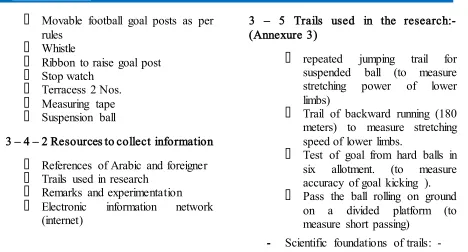
Terracess 2 Nos. Measuring tape Suspension ball
3 – 4 – 2 Resources to collect information References of Arabic and foreigner Trails used in research
Remarks and experimentation Electronic information network
(internet)
3 – 5 Trails used in the research:- (Annexure 3)
repeated jumping trail for suspended ball (to measure stretching power of lower limbs)
Trail of backward running (180 meters) to measure stretching speed of lower limbs.
Test of goal from hard balls in six allotment. (to measure accuracy of goal kicking ). Pass the ball rolling on ground
on a divided platform (to measure short passing)
- Scientific foundations of trails: - Table (2): Coefficients between validity and endurance and objectivity for trails in research sample:
T Trails Validity Endurance Objectivity
1 Stretching power of lower limbs 0.85 0.93 0.97
2 Stretching speed 0.93 0.96 0.95
3 Short aims 0.82 0.80 0.91
4 Short passes 0.80 0.93 0.95
3 – 6 Experimental exploration
Experimental exploration is done with the help of team work assistance of research sample
The goal was to experiment:-
1 – Limitation of lower limit for performance of training model used in
Research
2 – Limitation of number of training models used in training unit.
3 - Limitation of time which each model takes from models in training unit.
Available online: https://edupediapublications.org/journals/index.php/IJR/ P a g e | 1370 Table (3): Shows pulse rate after warm-up and after performance for training model used:
T Range of exercise
Pulse rate after warm-up
Lower limit of performance
Pulse rate after performanc
e
Pulse rate after (3)
minutes
Pulse rate after (5)
minutes
1 (1-4) 11-120
beats/min 12.5 min beats/min 190 beats/min 163 beats/min 125 2
(5-8) 115-120 beats /min 8 min beats/min 185 beats/min 128 3 (9-12) 125-130 beats
/min 12.5 min beats/min 187 beats/min 169 beats/min 130 4
(13-16) 120-125 beats /min 8 min beats/min 182 beats/min 130
Procedure of field research: Pre Trials:-
Pre – Trails has been done for research sample on date: 27-28/8/2016 at 5:30 on the playgrounds of Ararat Club and Shaqlawa Sports Club and special conditions set for trails in terms of location and time and team work assistance in order to achieve same conditions as the place for post-trails procedure for research sample. Execution of exercises in training program:-
Training models in training program of research sample done through training
units and in particular days and timings for them, if number of training units of research sample to be executed reaches (16) training units by (4) units in week formed as (1-3) each week and between weeks and arrangement of training cycles medium where two cycles of training with period of full cycle 14 days, where period of training unit (120 minutes) as for major part target reaches (85 minutes) and targeting part from this portion (50 minutes) to be applied to training model and in particular stage of preparation, 80-100% intense method of training used repeatedly they are what distinguishes training models used in research, they lead to and in limited conditions as well excluded and different time and space and has reached:-
Table (4): Shown is the daily, weekly and monthly and total rate for exercises used in training program
Weekly First Second Third Fourth Rate of Weekly intensity of rate of first cycle
First 80% 83% 84% 81% 82% First 84.25%
Second 85% 84% 90% 86% 86.5%
Third 92% 94% 97% 93% 94%
Second 93%
Fourth 90% 93% 94% 91% 92%
Post Trails
Available online: https://edupediapublications.org/journals/index.php/IJR/ P a g e | 1371 Table (5): Shows arithmetic mean, Standard Deviation, variance of arithmetic means and its standard deviations and value (T) calculated and tabled from the pre and post-trails with variables in research of my control group.
Trails Measuring units Trails Pre - Post - Trails
Variance of Arithmetic
Means
Variance of Standard Deviation
Value
(T) significance
S E S E
Stretching power of lower limb
No. 46.12 2.5 48.3 3.06 1.2 1.5 3.6 significant
Speed of
stretching Seconds 31.1 2.7 32.1 0.75 1 1.95 2.2 significant Accuracy
of goal
making Degree 12.6 2.5 13.2 1.13 0.6 1.23 2.7 Significant Accuracy
of short
passing Degree 21.3 1.3 22 2.30 0.6 1 2.8 significant
Value(T) opposite degree of delivery (19) and below level and significance 2.09 = (0.05)
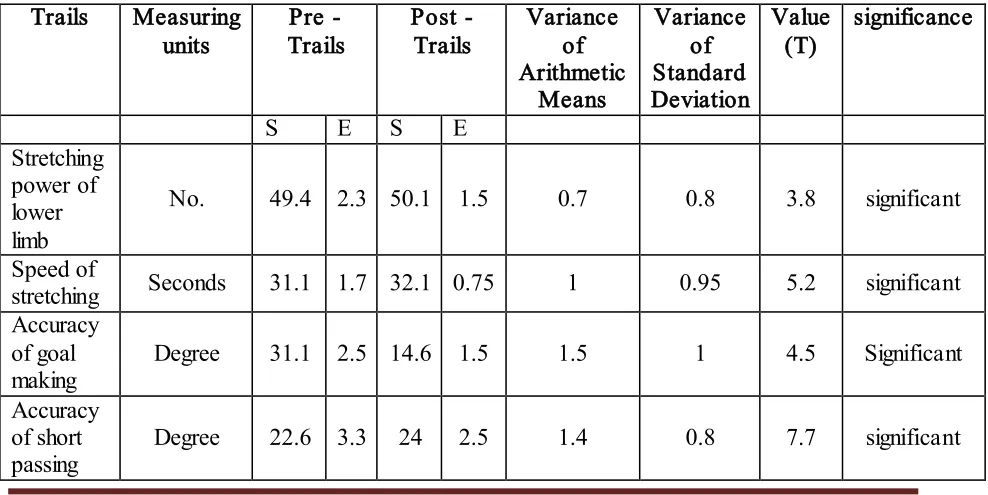
Table (6): Shows arithmetic mean, Standard Deviation, variance of arithmetic means and its standard deviations and value (T) calculated and tabled from the pre and post-trails with variables in research of experimental group.
Trails Measuring units
Pre - Trails
Post - Trails
Variance of Arithmetic
Means
Variance of Standard Deviation
Value (T)
significance
S E S E
Stretching power of lower limb
No. 49.4 2.3 50.1 1.5 0.7 0.8 3.8 significant
Speed of
stretching Seconds 31.1 1.7 32.1 0.75 1 0.95 5.2 significant Accuracy
of goal making
Degree 31.1 2.5 14.6 1.5 1.5 1 4.5 Significant
Accuracy of short passing
Available online: https://edupediapublications.org/journals/index.php/IJR/ P a g e | 1372 Value(T) opposite degree of delivery (19) and below level and significance 2.09 =
(0.05)
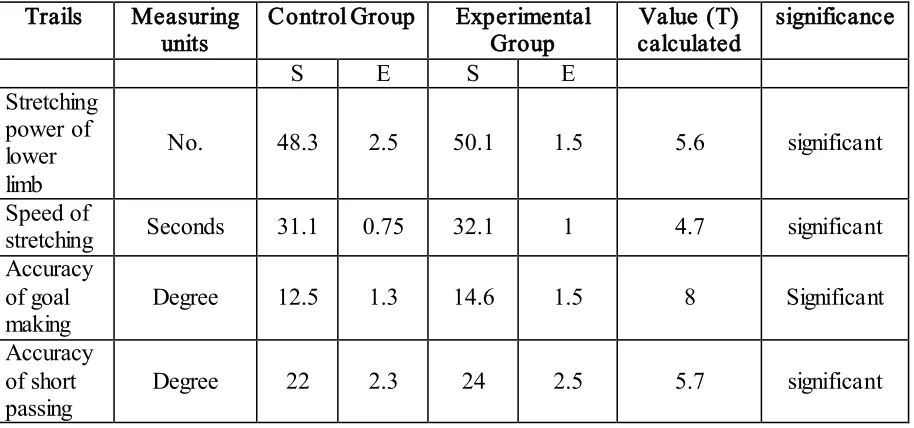
Table (7): Shows arithmetic mean, Standard Deviation, variance of arithmetic means and value (T) calculated and tabled between the pre and post-trails with variables in research of control and experimental group.
Trails Measuring
units Control Group Experimental Group calculated Value (T) significance
S E S E
Stretching power of lower limb
No. 48.3 2.5 50.1 1.5 5.6 significant
Speed of
stretching Seconds 31.1 0.75 32.1 1 4.7 significant Accuracy
of goal
making Degree 12.5 1.3 14.6 1.5 8 Significant
Accuracy of short
passing Degree 22 2.3 24 2.5 5.7 significant
After peruse at results through tables (5, 6, 7) it is clear to us that pre and post-trails for control and experimental groups are significant and in favour of variables of post trails for experimental group of research sample and which is used in training models according to exercises of play resulting in development of some special physical abilities levels and accuracy in performance of basic skills and attribute the researchers reasons for such development of training models which has been carefully reported and which resembles completely with what occurred in matches as well as they are comprehensive and diverse models for different situations which may be faced by player in the course of matches and it is agreed by all (Mohammed Kashak and Amarallah Al Basati 2000) “the nature of play during matches of football enforced directly upon players subject to change and diversity using training models and intense
and diverse training forms for different skills”
That the physical development of player whether it is associated with special physical abilities to improve performance leading to development of areas of skills and planning and this is what confirmed (Adham Saleh 2007). “the development of special physical aspect by activity and in scientific terms calculated from the effects directly on development of all associated aspects in activity”
Available online: https://edupediapublications.org/journals/index.php/IJR/ P a g e | 1373 performance and for all categories of ages
because of both effect effectiveness in physical, skill, planning and psychological development of player most modern football schools resort to it in the world” (138:7). And it is linked to exercises of physical fitness at training of accurate performance of basic skills in eloquence of conditions and situations similar to atmosphere of match leading to progress with accurate performance of player’s skills and it is what agreed to pointed by him (Salam Albalaasi) on that “training of basic skills must be under conditions similar to progress of match” (80.6) while he sees (Maufaq Al Haiti) “That use of training model according to exercises of play by basic means and ways are more effective in research of good performance and access to development of physical aspects linked with activity and so fixing and mastery of basic skills remain in similar circumstances and close to atmosphere of match” (57.9).
And see (Yousuf Lazam Kamash 1999) “That purpose of training used in play is fixing of accurate performance of player for use of basic skill in match and link with it, by learning and application of planning of play with action on development of physical qualities and special abilities so performance is added to the development of kinetic compatibility of player and same time gives training to player on requirements and focus on his duties and that can lead to the presence of positive or negative defender”. (125:10) So, can be divided into special exercises for a group, limited to players with abilities to select space, time and conditions to perform exercise, so it is a training form possible through association of components of different training circumstances and accelerate in development of physical, skill, planning aspects and requirements of match.
And through what mentioned above it is clear that importance of research to use exercises mostly develop and effect in fixing and mastering physical and skill aspects to achieve purpose of training procedure, keeping pace with scientific development achieved in play.
Conclusions and recommendations:
Shown results by use of training model according to exercises of play and repeated training battery clearly develops in variables of research for research sample under experiment where:-
- Training model used according to exercises of game contributed in development of performance of basic skills with accuracy used for research sample experimented. - Effects of training model according
to exercises of game used in particular preparation stage in progress for physical and skill variables of research.
- Training model according to exercises of game contributes in propagation of co-operation spirit and competition and seriousness and impulsiveness among players, which was reflected positive on results achieved.
Recommendations:
- Depend on training models according to exercises of games in training program and in particular preparatory stage
- Focus to contain training models used according to exercises of games in training form be made similar to requirement of performance to great extent during matches.
Available online: https://edupediapublications.org/journals/index.php/IJR/ P a g e | 1374 in development of physical, skill,
planning and other aspects for players of football.
Model for Training Model
Week : Second Target of Training Model
Team : Ararat Club
Preparatory stage :Particular - Development of particular physical
abilities and accuracy of basic skills
No. of players : 20
Devices and materials : Football, Playgound and Personalization Time of Unit : 120 minutes Type of training : Repeated
Sections of training
unit
Target ed time
for unit
Exercise s used
No. of
repeti-tions
Time to perform exercises
Rest between repetitions
No. of assem
blies
Rest between
assemblies Intensity
Main section
50 min.
12 2 7.5 4 min 1 5 min
2 2 8.5 4 min 1 5 min 87%
50 min 32 min 8 min
Training Model in Training Program Exercise (10)
Target of Exercise : Development of some particular physical abilities
and
Passing and goal making skills
Playground & Material : Rectangular playground with dimensions
(40 m x 30 m), football, goal posts as per rules,
Number
of players and participants : 10 players.
Time of performance : 12.5 minutes
Conditions of performance : play of teams with each team comprising of five players, important conditions of this exercise, the attacking team should make (5) passes among team members before performing process of goal making and condition being goal must be made inside penalty area.
Exercise (11)
Same exercise as previous but with changed conditions.
Target of exercise : Development of some particular physical abilities and Passing and goal making skills
Playground and Material : Rectangular playground with dimensions
(40 m x 30 m), football, goal posts as
per
rules,Number of players and participants :
10 players.
Time of performance : 12.5 minutes
Available online: https://edupediapublications.org/journals/index.php/IJR/ P a g e | 1375 should make (5) passes among team
members before performing process of goal making and condition being goal must be made inside penalty area in one shot.
REFERENCES:
1. Adham Saleh : Effect of control at the time of continuation of burden and repetition of physical exercises by way of training cycles in number of physical and skill variables of football for youngsters, Masters letter, University of Mosul, College of sports Training, 2007.
2. Ara Allah Ahmed Al Basati : Rules and Basics of Sports of Training and Application , Sikandria, Manshat Al Maarif, 1999.
3. Thamer Mohsin and Wasiq Naji : Special games in football training, Baghdad,Central Printing Press, 1975.
4. Thamer Mohsin and Mauqaf Moula : Developmental Exercises of Football, Dar-al-Khaleej, Oman, 1999.
5. Hanfi Mahmood Mukhtar : Scientific Basics in Football Training, Cairo, Dar- al-Fikr Arabi, 1978.
6. Salam Al-Balbisi : Effects of method used in training cycles on some physical qualities and skills of movement on football players, Masters letter, College of sports Training, University of Mosul, 2000.
7. Qasim Lazam Sabri : Theory of preparedness and limited training
areas of football, Vol. 1, Central Library, Baghdad, 2009.
8. Mohammed Kashak and Amrallah Al-Basati : Basic skill preparation and planning in football, Vol. 1, Cairo, Central Books Publishing, 2000.
9. Mauqaf Asad Mahmood : Learning and Basic Skills of football, Vol. 1, Oman Dar-Dajla, 2014.