This is a repository copy of Social structure in economic theory.
White Rose Research Online URL for this paper: http://eprints.whiterose.ac.uk/119800/
Version: Accepted Version
Article:
Jackson, W A orcid.org/0000-0001-5194-7307 (2003) Social structure in economic theory. Journal of Economic Issues. pp. 727-746. ISSN 0021-3624
[email protected] https://eprints.whiterose.ac.uk/ Reuse
Items deposited in White Rose Research Online are protected by copyright, with all rights reserved unless indicated otherwise. They may be downloaded and/or printed for private study, or other acts as permitted by national copyright laws. The publisher or other rights holders may allow further reproduction and re-use of the full text version. This is indicated by the licence information on the White Rose Research Online record for the item.
Takedown
If you consider content in White Rose Research Online to be in breach of UK law, please notify us by
SOCIAL
STRUCTURE
IN ECONOMIC THEORY
William A. Jackson
Department of Economics and Related Studies. University of York, York YO10 5DD, UK
Email: [email protected]
Abstract
Much economic theory, especially the orthodox variety, keeps away from structural methods and makes little or no reference to social structure: the word
‘structure’ is used only rarely and casually, so that its sense remains unclear. This paper argues that economics might gain from a richer, more fluid treatment of social structure, as proposed in recent social theory. After considering the structural content of heterodox economics, the paper examines how current approaches might be developed to yield new structural concepts capable of accommodating economic diversity and change. An enhanced definition of social structure could provide a structural foundation for economics without denying human agency or historical evolution.
- 1 -
Social structure is a core concept in most social sciences, but it has never quite had this status
in economics. Much economic theory, especially the orthodox variety, keeps away from
structural methods and makes little or no reference to social structure: the word structure is
used only rarely and casually, so that its sense remains unclear. This puts economics out of
step with other academic disciplines, which are more amenable to structural ideas, and
broaches the issue of whether social structure has been unduly neglected in economic theory.
Orthodox economists, committed to methodological individualism, have been wary of
social structure, lest it would undermine their individualistic stance and promote a “non
-economic,” sociological outlook. Neoclassical economics begins with rational agents who have fixed preferences defined from the outset. Social structures either are absent or have a
subordinate place as market imperfections that must be explained through individual
behavior. Any structure bringing people together to form a larger whole will contradict the
atomism of neoclassical thought. Heterodox economists, by contrast, have no such
commitment to individualistic methods and should be comfortable with social structure. It
does indeed feature in heterodox economics, but it often stays implicit and has less
prominence than one might expect.
Modern concepts of structure are based on relationships among parts of a whole: for
structural analysis to be relevant, the parts must be internally related such that they are
necessary to the whole and each part could not exist without the others (Sayer 1992, chapter
3). If the parts have no interdependence and only external relationships, then the whole is at
most an aggregate (perhaps not even that), and structural analysis ceases to be relevant. The
hallmark of a structural method is its reliance on internal relations among parts making up a
whole. Structural theory can sometimes turn into holism and give the whole precedence over
the parts, yet the original aim of structural ideas—as against holistic ones—was to ensure that
the whole could always be transformed, or else the whole-part relationship would be
redundant. A structural method, if handled properly, should never congeal into structural
wholes that overshadow their component parts.
The word structure has acquired unhelpful connotations from the analogy with physical
structures. Comparison with a building suggests something hard, permanent, and complete,
- 2 -
then enter economics as a rigid constraint that restricted human behavior. The static analogy
is misleading and offers at best a partial view of structure. In its earliest English language
uses, structure was a noun of process which referred to the act of building, not the end
product; only later has structure become static (Williams 1983). Even when seen as a state
rather than a process, structure still has a capacity for change.
This paper argues that economics might gain from a richer, more fluid treatment of social
structure, as proposed in recent social theory. After considering the structural content of
heterodox economics, the paper examines how current approaches might be developed to
yield new structural concepts capable of accommodating economic diversity and change. An
enhanced definition of social structure could provide a structural foundation for economics
without denying human agency or historical evolution.
Social Structure in Heterodox Economics
Most heterodox economics—notably institutionalism, Post Keynesianism, and the
Marxian/classical tradition—has shown awareness that economic behavior is embedded in
social structure. This may be expressed indirectly, but it underlies the theoretical arguments
being made and the rejection of methodological individualism; structural methods are at the
heart of a heterodox approach.
The agreement that economics should have a structural aspect has not, however, brought a
uniform definition of social structure, and the concept remains somewhat vague.
Ambiguities about social structure affect all social sciences, not just economics, and do not
necessarily imply careless theorizing—the varied meanings are symptoms of the subject’s
complexity as much as the theorists’ failures. The diversity of structural theories at least demonstrates that heterodox economists are escaping any stale theoretical orthodoxy and
producing new accounts of their object of study. More lucid terminology would still be
- 3 -
Particular problems arise over the link between people and social structures. Is a social
structure made up of people, or does it comprise roles and positions distinct from the people
who occupy them? The first alternative is a more humanistic view focused on personal
relations and collective agency; the second is a more structural view keeping structure and
agency apart. The two views are different but compatible: if roles are to influence behavior,
then people must fill them, and so social structure can never be cut off from the individual
members of society.
Among the many uses of the term social structure, the commonest stress roles and
positions rather than people. In sociology, the conventional meaning of structure revolves
around a society’s systemic properties, as determined by formal institutions and normalized
behavior. Textbook definitions of social structure incline toward the role-based view that
distinguishes structural positions from the people who occupy them. This stems largely from
the structural-functionalism of Talcott Parsons and his followers, which depicted societies as
complex multilayered systems with their own functional prerequisites. Parsons himself did
not clearly distinguish structures from people, and his theory can be interpreted variously, but
his fondness for systemic arguments (especially in his later work) led to a systemic notion of
social structure (1951). A role-based, structural approach has come to characterize
sociological analysis in the same way that individualism characterizes neoclassical
economics.
The systemic, Parsonian version of social structure is rare in economic theory, since
economists have usually heeded the economics/sociology dichotomy and few have drawn
their ideas from sociology. A role-based definition of social structure is, however,
discernible in strands of heterodox economics that ground themselves in social theory. The
critical realist research program, for example, situates economics within a more general,
non-reductive theoretical framework for all social science (Lawson 1997; Jackson 1995).
Following the usual sociological practice, critical realism has defined social structure as
relations among roles and positions, although it is careful to leave space for human agency as
well. The interdependence of distinct structure and agency concepts can guard against
- 4 -
Other heterodox approaches, such as institutionalism, have made less use of role-based
social structure. The work of Thorstein Veblen and John R. Commons deals extensively with
structured and socialized behavior but allows for different types and levels of structured
activity: there is no prior notion of structure. Veblen, for instance, located the regularities of
economic behavior at the individual level through the concept of habit, in other words, the
tendency to engage in previously adopted or acquired forms of action. When distributed
among a population, habits will become formalized as institutions that involve codifiable
procedures (Hodgson 1988, chapter 6). Social behavior takes on a layered quality, embracing
the individual and the social, the personal and the impersonal, and the formal and the
informal. A similar view pervades the work of Commons, who argued that collective
behavior is governed by various levels of working rules, including laws, social conventions,
and the customary practices in a specific workplace (Rutherford 1983). Layered accounts of
behavior are widespread in the old institutional economics, but their stratified nature often
remains unspoken.
A useful classification, in line with much institutionalism, divides behavioral regularities
into three types: habits, routines, and institutions (Hodgson 1994). Habits are personal and
individual—they are unique to specific people and not social structures as such, though they
help to stabilize social structure. Routines are personal and social—they pertain to a specific
group and will be part of larger social structures without having an official, legalized form.
Institutions are impersonal and social—they are not tied to a specific group and may be
codified through published rules and general social roles. This threefold classification
implies that social structures should cover both the personal and impersonal elements in
behavioral regularities.
Institutionalism acknowledges social wholes and is broadly structural, but it does not
subscribe to a unified concept of social structure. Institutions and social structures are seen as
existing on various levels. Walter Neale (1987), for instance, identified three aspects of an
institution: personal relations, social rules and principles, and the ideas and beliefs that justify
social practices. This yields a stratified outlook in which institutions have several
interdependent levels and cannot be reduced to any one level alone. A full portrayal of
institutions will require wide-ranging, non-reductive economic theory capable of representing
- 5 -
of social structure, on their own, would be too simple to accommodate this vision and would
lose the richness of the institutionalist approach.
The Marxian tradition has also understood that social structures can exist on several levels.
Of central importance here is the distinction, inspired by Marxian arguments, between system
integration and social integration (Lockwood 1964; Mouzelis 1997). System integration
refers to how institutions fit together to form a larger social system—it turns on roles and
positions rather than people. Social integration refers to how people relate to each other and
whether they come together to form social groups. Because Marxian theory has always been
thoroughly stratified, via its base/superstructure distinction, it can readily handle both
systemic and social matters. The two sorts of integration need not coincide, so systemic
problems may exist in a socially cohesive society and social problems in a systemically
well-ordered society. Even if some Marxian authors have pursued a systemic method (most
obviously in the structural Marxism of Louis Althusser), the spirit of Marx’s own work
demands a recognition of social relationships as well. The case for non-reductive theory has
been to the forefront of recent work in Marxian and radical economics, and this has brought
out the resemblance between Marxian and old institutional approaches (Resnick and Wolff
1987; Sherman 1995; Dugger and Sherman 1994, 2000; Cullenberg 1999, 2000). As with
institutional economics, Marxian writing has promoted a subtle, layered style of theory
consistent with stratified social structure.
Heterodox economics has been too diverse to have converged on any single definition of
social structure, despite the fact that structural ideas are crucial to heterodox thought. The
resulting pluralism might be written off as terminological imprecision, yet it conveys the
fluid, multiple character of social structure, which might not be evident from simpler, neater
accounts. A formal definition of social structure, consonant with its use in heterodox
economics, would have to depict it as existing on several interdependent levels. Recent
social theory has moved in this direction and could clarify the theoretical background of
- 6 -
The Meaning of Social Structure
Standard notions of social structure refer to relations among roles rather than among people.
A social structure arises when roles have a necessary or internal relationship: one role cannot
exist without the other, in the way that, say, a buyer cannot exist without a seller or a creditor
without a debtor. Under this definition, social structure does not depend on the specific
individuals occupying roles and would persist even if the entire cast of role occupants were
changed. Structure is clearly distinguished from individual agents, in the familiar dualism of
structure and agency. The conceptual gap between structure and agency can all too easily
become an apparent conflict, with agents portrayed as being constricted by their social roles.
It may thus be desirable to reassess structural concepts in order to reconcile them with human
agency. Two attempts at reassessment are considered below: the proposal that
agency-structure dualism should be replaced by a closer relation termed a duality and the
belief that social structure should incorporate more personal modes of social interaction
termed figurations.
Recent social theory has highlighted the interdependence of agency and structure and
sought to avoid giving the impression that they are opposed to each other. Anthony Giddens
(1979, 1984) referred to the “duality of structure,” whereby agency and structure are
conceptually distinct but inseparable and thoroughly intertwined: human agents create and
reproduce social structures, while a socially structured environment shapes human agents.
Social structures, in this view, enable as well as constrain human action; agency and
structure are not in eternal conflict. The duality approach contrasts with agency-structure
dualism, where the separation of agency and structure implies friction between them. Other
social theory, in different language and terminology, has also queried dualism (Bourdieu
1977; Elias 1978, 1991; Bhaskar 1979; Alexander 1985; Munch and Smelser 1987). The
trend of recent social theorizing has been to move away from a stark opposition of agency
and structure toward a closer interaction.
There is no consensus on what social structure means. Giddens coined his own definition
based on rules and resources exploited by human agents. The effect is to broaden social
structure to include items such as linguistic rules and material resources and at the same time
- 7 -
exploit it, then it becomes internalized to agency and its objective, external existence is
thrown into doubt. Giddens’ critics feel that this goes against standard usage and represents a
belittling of structure that may curtail its influence and tip the balance toward agency
(Callinicos 1985; Layder 1987; Archer 1990). The desire to draw structure and agency closer
together should not subordinate structure to agency (or vice versa); otherwise the theory may
fall back into reductionism.
Roy Bhaskar (1979, 1983) has appealed to duality without redefining structure: his
transformational model of social activity, which rests on a standard definition of social
structure, views it as inherited from the past and given from the perspective of human agency.
Agents experience pre-existing social structure as something external to them and may
reproduce it through passivity or constraint as well as through action. Role-based social
structure, as in Bhaskar, can retain structure’s identity—external to the individual—but permit human agents to reproduce it. This would be well attuned to the accent on structural
reproduction or transformation in non-neoclassical economics (Hollis and Nell 1975; Nell
1998, chapter 4). One can highlight agency-structure interdependence without discarding the
standard definition of social structure.
Another response to agency-structure dualism is the figurational sociology of Elias (1978,
1991). A “figuration,” or “figurational structure,” consists of relations among people rather
than roles and simultaneously embodies individual actors (agency) and their interdependence
(structure). In a figurational approach, societies are built up from many interwoven chains of
individuals whose behavior may or may not be normalized. Figurations take various forms,
from direct personal contacts to indirect dealings with representatives of government or
business. Individual agency does not exist, because figurational structures encapsulate all
behavior and no one can be isolated from them. Social behavior will reflect the directness of
the links within figurations: face-to-face contacts are mostly informal, while indirect contacts
are formal and institutionalized. Roles as a separate concept become redundant, but the
theory can still portray normalized behavior when personal contacts are distant and indirect.
In place of the contrast between human agency and social roles, there are different degrees of
directness within figurations. By merging agency and structure into figurations, figurational
- 8 -
Figurations on their own, however, cannot resolve the agency-structure problem. Their
chief drawback is that, in conflating agency and structure, they deny the theorist valuable
concepts and discourage a stratified view (Layder 1994, chapter 7; Mouzelis 1995, chapter 4).
Figurational methods may well oversimplify things and degenerate into structural or
individualistic reductionism depending on how the links among people are interpreted: strong
links play down human agency and imply structurally dominated behavior; weak links imply
a loose, unstructured aggregation of individuals. Instead of transcending agency-structure
dualism, figurational methods may slide toward one or the other pole.
A figurational approach is akin to the interactive sociology advocated by Erving Goffman
(1983). For Goffman, personal relations are distinct from the “institutional order” of
impersonal roles and exist as a separate “interaction order.” This consists largely of face-to-face contacts among people known to each other, but it can also include less direct personal
contacts, for example, by telephone, letter, or e-mail. Personal interactions go beyond roles
to produce their own patterns of behavior and ways of working. Although Goffman’s
sociological research dealt mainly with small-scale personal interactions among ordinary
people, similar interactions take place among those with wider social power such as heads of
state, senior politicians, and business leaders—the interaction order need not dictate a micro
emphasis. Since the interaction order and institutional order coexist, an important issue is
how they are related: Goffman saw the relation as a loose coupling, where the two orders
influence one another but remain conceptually distinct. This contrasts with Elias’s
figurational sociology, which regards figurations as the only significant level of analysis.
The allowance for institutions as a further level, in the manner of Goffman, can offer richer
theory than a reliance on figurations alone.
Theoretical ideas such as figurations or the interaction order should augment rather than
supplant the agency-structure approach (Mouzelis 1995). Figurational structures among
people can stand beside institutional structures among roles and positions. To assert that role
playing exhausts the interdependence among individuals would be an exaggeration, since
much social interaction occurs within the spaces left by incomplete roles. Figurations
represent the residual human interaction not covered by role playing. It could be argued that
all human behavior conforms to explicit or tacit social roles, but this would be implausible
- 9 -
as Elias’s figurational sociology, would overstate the personal side of social structure and minimize the impersonal character of roles. Theories that recognize both institutional and
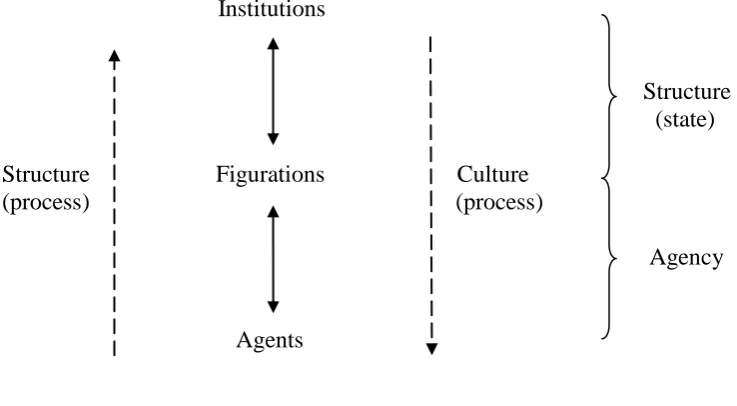
figurational structures can provide a fuller picture of human behavior. Adding figurational
[image:11.595.98.467.271.474.2]structures to social theory will give a three-tier pattern, as in figure 1.
Figure 1. Institutional and Figurational Structures
Institutions
Structure (state)
Structure Figurations Culture (process) (process)
Agency
Agents
Figurations provide the connecting tissue between individual agency and social
institutions: they can be seen as either structured agency or agent-based structure. All social
structures are created and reproduced by human agents, so one can revive structure’s original
meaning as a process to depict this: structure enters figure 1 as both a state (end product) and
a process. Some social theorists (such as Giddens, 1979) employ the term structuration to
denote the forming of structures, but structure itself can be a process and the new term is not
strictly necessary. As well as human agents creating and reproducing social structures, the
structural environment also molds human agents. Figure 1 shows this as culture, where
culture too adheres to its original meaning as a process rather than a state (Williams 1983;
- 10 -
twin, simultaneous processes of structure and culture, which bring about duality, the
generalized interdependence of agency and structure.
The crucial difference between the institutional and figurational tiers of figure 1 is that
institutions are role based and exist independently of any particular role-occupants, whereas
figurations are dependent on personal relations among human agents. The personal aspect of
figurations might raise doubts as to whether they are genuine structures comprising
necessary, internal relations. Necessity is appropriate here because social interaction hinges
on the identities of the people concerned. With employment relations, for example, the
incompleteness of contracts means that the actual way of working will depend on the rapport
between a particular employer and employee. Figurations will be less general than
institutions and more fragile, but they have a structural quality in that they require personal
relations between specific people and vanish once these relations are broken.
Any role must to some extent be standardized and recorded, so that it can be passed on to
the next role player. Not all the facets of a role have to be written down (an impossible task),
but the core activities must be well defined if the role is to have substance. The analogy is
with the roles in a play, which are established through the play’s script, even though this does
not delineate every last detail of a performance. Details missing from the script will be
supplied by the actors, whose personal interaction will add a figurational layer to the scripted
roles. Different casts can produce markedly different performances of the same play. Often
roles will have a formal, legally sanctioned expression (as in formal employment), but this is
not vital, and some roles may be founded on informal codes and customs; the role merely has
to be transmissible, by whatever means, to the next role-occupant. Each role player will
conform to the general requirements of the role, while having freedom to set up the particular
personal relationships constituting figurational structures.
Figure 1 fits in with agency-structure duality, as envisaged by Bhaskar and Giddens, but
the augmented social structure allows two versions of duality, at institutional and figurational
levels. Human agency will relate to figurational as well as institutional structures. If social
structure both enables and constrains human agents, as duality theory argues, then there may
be perceived agency-structure opposition, in either institutional or figurational domains. One
- 11 -
dualism are not mutually exclusive and that people who feel restricted by their social
surroundings will experience structure as external and solid (Mouzelis 1989; Jackson 1999).
Agency-structure dualism, with regard to both institutions and figurations, can coexist with
duality and it would therefore be wise to retain the concept of dualism (Mouzelis 1995). The
figuration/institution and duality/dualism distinctions, when combined, can provide greater
diversity in how agents relate to social structures, as shown in figure 2.
Figure 2. Duality and Dualism
Type of social structure
Institutional Figurational
Interaction and Institutional Figurational enabling duality duality Structure-agency
relationship
Separation and Institutional Figurational constraint dualism dualism
On the institutional side of figure 2, people will normally identify with their roles and feel
empowered by them: this will give institutional duality, where agency and structure interact
closely and reinforce each other. In some cases, however, people may feel hampered by their
roles and critical toward them, creating institutional dualism, a separation and tension
between agents and institutional structures. The ability to stand outside roles will be greatest
for people at the top of an organizational hierarchy, who will usually be less rule bound than
those below them and better placed to rethink current working practices. Yet they are
privileged and empowered by their senior roles and may have little reason to feel alienated or
- 12 -
they will often be following tightly specified rules and procedures; under normal
circumstances they will accept their humble status and conform to what is required of them.
Such passive behavior gives rise to institutional duality, even though the roles being fulfilled
confer little prestige and few advantages. Paradoxically, institutional dualism is more likely
to be observed among people near the top of an organizational hierarchy (rule makers) than
among those near the bottom (rule followers).
On the figurational side of figure 2, people will normally feel involved in their social
relationships and willing to sustain them: this will give figurational duality, a close and
harmonious interdependence of agents and figurations. Duality cannot be taken for granted,
though, and at times people may feel alienated and constrained by their personal relations—
the separation and tension rules out duality and produces figurational dualism. Alienation is
liable to occur among those at the bottom of a hierarchy, whose personal relations at work are
confined largely to obeying their superiors. They will not on the whole have rewarding
working relationships and may feel excluded from the collective ethos of the organization
that employs them. As one moves up a hierarchy, alienation should decrease: people of
senior rank will participate in decision making and have a personal attachment to the
organization. While institutional duality could be negatively correlated with seniority,
figurational duality should in most cases be positively correlated. Hence, the two forms of
duality/dualism are distinct from each other and do not move in tandem.
In a stable society, many people must be happy with their roles and personal relations and
prepared actively to reproduce them; institutional and figurational duality will predominate
whenever a society or economy is secure and functioning smoothly. Cases of tension and
dualism will also exist but will be diffused throughout the society and insufficient to cause
rapid and large-scale social change. If agency-structure dualism ever did become dominant,
then this would threaten existing institutions and encourage social change through top-down
reform by people in senior positions and bottom-up protests by people in junior positions.
Periods of wholesale social change are quite rare, and duality should at most times outweigh
dualism. This chimes with recent social theory, which holds that agency and structure
display a generalized interdependence or duality. Such duality is, nevertheless, compatible
- 13 -
Structural Diversity
A layered view of social structure has the advantage of being better able to depict structural
diversity. Social structure can take figurational alongside institutional forms and is no longer
limited to given roles and positions. Any gap in institutions need not be a structural void and
may indicate a figurational structure. The gulf between structural and non-structural
approaches will be reduced, and the range of behavior accessible to structural ideas will be
widened. Permitting figurations should not dilute or weaken structural analysis but, on the
contrary, enrich it and broaden its scope.
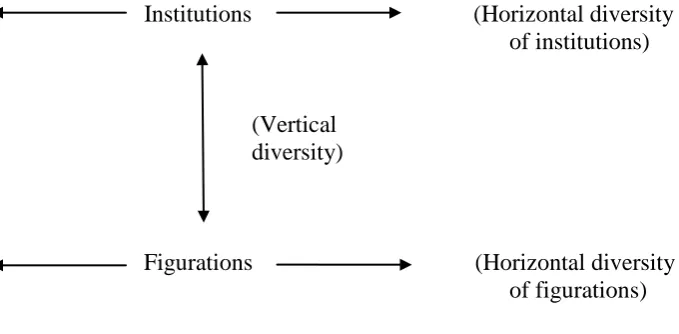
Two types of structural diversity can be distinguished, as shown in figure 3. Horizontal
diversity occurs along the institutional and figurational tiers of figure 3, because no uniform
social structure can span all human behavior. Institutional and figurational structures will
overlap, with each person playing several roles and participating in many figurations. This
subverts the idea that social structure is complete. Advanced societies contain myriad
institutions and figurations in many spheres of activity; it is better to think of plural social
[image:15.595.117.457.528.695.2]structures rather than a single, monolithic structure.
Figure 3. Structural Diversity: Horizontal and Vertical
Institutions (Horizontal diversity of institutions)
(Vertical diversity)
- 14 -
Vertical diversity occurs between the institutional and figurational tiers of figure 3 because
roles do not perfectly match personal relations. Greater vertical diversity means a greater
mismatch of institutions and figurations. Institutions can never merge with figurations, as
roles cannot cover every aspect of behavior. Activities outside roles are usually put down to
human agency, so that some behavior is socially structured while the rest is unstructured
human action. This reaffirms agency-structure dualism and neglects the figurational
structures that fill the gaps in social roles. Wherever roles are poorly matched with behavior,
the space opens up for figurations, parallel but not identical to institutions. By extending
beyond role-based behavior, figurations can compensate for incomplete roles.
Heterodox economics has long appreciated that social structure is diverse and layered.
Institutionalists, Marxians, and other heterodox authors have argued that the contractual basis
of market economies cannot cope with all economic activities: no contract is so complete that
it covers every possibility and governs in all respects the behavior of its signatories (Hodgson
1988, chapter 7). Incompleteness of contracts raises significant issues for economic theory,
such as loyalty, trust, work discipline, variable productivity, and the formation and
organization of households. An incomplete contract will show up theoretically as the
disjunction of institutional and figurational structures: formal contracts belong to the
institutional tier, the items omitted from contracts to the figurational tier. Layered structural
theory acknowledges that formal institutions do not and cannot encompass all economic
relations.
Under these circumstances, economic transactions will vary with their institutional and
figurational context. From an institutionalist viewpoint, markets are organized and
institutionalized exchange (as opposed to the spontaneous, context-free exchange of
neoclassical economics), and so the social background of transactions should be considered
(Hodgson 1988, chapter 8). Much of this background has an impersonal, institutional form,
as in the legal system establishing property rights transferable upon monetary payments. A
defining feature of markets is the impersonal relation between buyer and seller (Lazonick
1991, chapter 2; Rosenbaum 2000). The agents in a market transaction have their own
private interests and act independently. A buyer will seek the lowest price for a good and a
- 15 -
whom they trade should be irrelevant. In this sense, a formal institutional structure of
transferable property rights and advertised prices will be a prerequisite for competitive
markets.
But economic transactions also depend on personal relationships and have a figurational as
well as institutional side. Figurations will be more prominent in some cases than in others.
Everyday purchases are conducted largely through the impersonal roles of buyer and seller,
which leave little room for ongoing personal relationships. If transactions stretch out over
longer periods and involve more complex, less standardized goods and services, then
institutional roles will no longer be adequate and personal relations will come to the fore.
With employment contracts, for example, incomplete job descriptions create space for a
figurational component in work practices: any given job, however standardized it may
appear, will be carried out in slightly different ways by different employees and employers
(Simon 1951; Fox 1974; Rowlinson 1997, chapter 5). The actual methods of working will
evolve, inside the contractual guidelines, from the personal relations between managers and
workers and among the workers themselves. Another example is relational contracting,
where a good or service is provided through periodic contractual arrangements subject to
renegotiation: the need for continuous personal relationships, bolstered by trust and loyalty,
will increase the significance of figurational structures (Macaulay 1963; Goldberg 1976,
1980; Macneil 1981). Structural diversity may engender a great variety of economic
transactions.
Similar reasoning at a more general level suggests that economic systems are never
complete or perfect. According to the impurity principle, there can be no pure economic
system and all economies must possess structural diversity, with several coexisting modes of
economic behavior (Hodgson 1984, 1999). Layered social structure gives rise to a distinction
between horizontal and vertical impurity, on the same principle as the distinction between
horizontal and vertical diversity in figure 3.
Horizontal impurity concerns the varied, unstandardized nature of economic institutions
and figurations, which do not fit any single, pure scheme. Capitalist economies are mixed in
the sense that they have diverse economic relations within an essentially capitalist frame.
- 16 -
and contracts for sales, services, and employment take various forms. Administrative
planning and personal cooperation impinge on what is ostensibly a competitive market-based
society. Horizontal impurity is most tangible in the economic importance of non-market
sectors of the economy, notably the public sector and the informal sector. The variety of
institutions and figurations ensures that actual economies conform to no theoretical ideal, and
alternative types of capitalism will emerge. A distinction is frequently made between the
competitive, individualistic capitalism observed in the USA and UK and the more
cooperative, social capitalism observed in Continental Europe and Japan (Albert 1993;
Groenewegen 1997; Dore 2000). Both are horizontally impure, but the Anglo-American
approach favors formal and impersonal institutions (short-termism, impersonal contracts),
whereas the European-Japanese approach favors informal and personal figurations (long-term
arrangements, relational contracting). Diversity among institutions and figurations will also
produce diversity among economies.
Vertical impurity arises when institutions do not tally with economic behavior, causing
institutional and figurational structures to be mismatched. At face value, goods and services
are well defined and bought for fixed, standardized money payments: transactions seem to be
contractual and complete. In all but the simplest cases, however, a good or service will be
subject to uncertainty that creates gaps in any contractual agreement. For the transaction to
proceed, some non-contractual elements will be required, such as trust or loyalty between the
transactors, which go beyond institutional structures and yield impurities within the formal
institutional setting. Vertical impurities are not confined to market economies. In a planned
system, administrative procedures will be unable to cover every facet of a particular activity.
The holes left in the rules will be filled by the employees, who will find their own ways of
working. Again there will be figurations that extend beyond institutions and lead to vertical
impurities. These will appear in any economic system, as it is unfeasible to produce formal
and codified procedures for all economic activities.
Experience suggests that economies must have both horizontal and vertical impurity. The
impossibility of a perfect economic system is demonstrated by the diversity of institutions
and figurations (horizontal impurity) and by the mismatch between them (vertical impurity).
Conceivably, a new society starting from scratch might begin with a blueprint for perfect
- 17 -
happened, then vertical impurity would appear as soon as the flaws and gaps in formal
arrangements were realized, followed by horizontal impurity from revised, imperfect
institutions. Certain societies might be thought nearer to purity than others since they have
less diverse institutions and stick more closely to a given institutional pattern:
Anglo-American capitalism might, for instance, be viewed as being purer than the
European-Japanese versions inasmuch as it conforms more thoroughly to competitive market
conditions. True purity will be unattainable, though, and should not be upheld as an ideal;
any attempt to achieve purity would produce a less plural and adaptable economy.
Structural diversity and social change have been emphasized in discussions of social and
system integration. When social theory dwells on system integration, it implies that society is
equated with the system of roles and positions and that systemic failure would endanger
society itself. In practice, economic and social systems have withstood serious systemic
failures without collapsing: capitalist economies, for example, have survived chronic
depressions bringing a huge loss of employment, the main economic role. One way to
explain this is to invoke alongside system integration the idea of social integration founded
on personal relations. A society facing systemic problems may still hang together as long as
its social integration remains intact and the loss of systemic roles is not translated into public
protests and disorder. An understanding of social integration can shed light on social stability
and the related issue of structural change.
Structural Change
Because structure hints at hardness, permanence, and completeness, structural methods are
prone to criticism as being static. Fixed, rigid structures may seem to obstruct human agency
or any other vehicle of change. Ironically, static arguments would go against the historical
essence of structural thought: in the past, structure was about change rather than permanence.
Structural and stratified theories have a long pedigree in philosophy, from the ancient Greeks
- 18 -
material objects and people). An unstructured quality denoted timeless perfection, whereas a
structured quality denoted imperfection and impermanence: to be composed of parts left open
the prospect of being transformed. Structural methods have always been compatible with
change, as is evident in structure’s original meaning as a process.
Diverse structures can smoothen economic and social changes and prevent major
upheavals. By the law of requisite variety, any system must have enough complexity and
variety to cope with a changing external environment (Ashby 1968). In social sciences, the
law can be generalized to allow for the internal environment as well, that is, the
indeterminacy of human action (Hodgson 1988, chapter 11). Figurations can add extra
variability to social structure and enable it to adapt to external or internal changes, as in new
production methods, new resource discoveries, environmental problems, booms and slumps,
and so forth. Changes may first be met through figurational structures, which act as a buffer
between institutions and outside events or human behavior. This will have a stabilizing
influence whenever a disturbance proves to be temporary or limited, as a few minor
figurational adjustments will not amount to a change of economic or social system. If, on the
other hand, the adjustments cause a prolonged misalignment of institutions and figurations,
then more fundamental structural changes will ensue.
Institutions and figurations never coincide and never attain a perfect equilibrium, but at
times they will converge and at other times diverge. Major changes in social structure will
occur when institutions and figurations become discordant and roles no longer correspond to
behavior. Either roles or behavior must be modified if the tensions are to be relieved: one
kind of social structure must catch up with the other. Which changes first? Do roles adjust to
behavior, or is it the other way round? On a priori grounds either case seems possible, and
there is little reason to suppose that institutions always lag behind figurations or vice versa.
The ordering of institutional and figurational changes will vary with the sources and character
of social evolution.
Figurational changes should precede institutional ones when the driving force of history is
- 19 -
accumulation approach (Boyer 1988; Perez 1983; Tylecote 1991; Gordon 1980). From a
materialist angle, social transformation starts with new technologies and production methods
that jar with institutional structures. The mismatch should eventually prompt institutional
reforms which, if successful, will close the gap. Once the tensions are reduced, social
structure should be stable until the next big technology comes along. The effects of technical
change should emerge through figurations, as new ways of working arise that may not be
accommodated by current institutions. Figurations may be seen as transmitting technical
changes to the institutional sphere; they provide slackness in social structure, allowing
short-term adaptation to new technology in advance of more radical institutional reform. Causal
materialism suggests that figurations will normally change first and that institutions will in
the longer term catch up with them.
According to the opposite, idealist view, permanent changes begin with ideas and then
spread down to the social and material levels. Economic planning or social policies will
usually subscribe, at least implicitly, to such a view, as will attempts to recast private firms or
other organizations on theoretical principles. Laws aiming to enforce norms of acceptable
behavior, such as the banning of discrimination, also seek to mould social relations to fit a
desired conceptual pattern. If large-scale structural changes result from ideas, they will
appear first as the reform of institutional structures by macro agents at the top of an
organizational hierarchy (senior politicians, business leaders, and the like). For the reforms
to bite, there must be an initial mismatch with figurations, followed by changes of behavior in
line with the new institutional structures. Figurations can never coalesce with institutions,
and the size of the ensuing discrepancy will decide the perceived success of the reforms. Too
large a discrepancy would sap the reforms and provoke their withdrawal, but an acceptably
small discrepancy would be deemed a successful outcome. Figurations provide a slackness in
social structure that cushions the impact of new institutions.
During times of change, when institutions and figurations are misaligned, one would
expect a distancing and tension between social structure and human agency. People will feel
alienated from social structures and willing to support fundamental reforms. Within the
scheme of figure 2, this would be classified as institutional or figurational dualism. If, say,
figurations are evolving and moving away from existing roles, then people are likely to feel
- 20 -
become estranged from their previous personal relations (figurational dualism). Similar
frictions are probable when institutional change outstrips current figurations and opens a gap;
in this case the opponents of the reforms will experience institutional or figurational dualism.
Thus, a mismatch between institutions and figurations will be associated with
structure-agency conflict, and institutional structures will seem to be constraining or directing
human agency. Conversely, a period of stability or slow change—the normal state of
affairs—should witness a closer alignment of institutions and figurations and the prevalence
of institutional and figurational duality.
As explanations of social change, causal materialism and causal idealism share the
disadvantage of being reductive: they envisage only one direction of causality. Less
reductive attitudes would site emergent causal powers at various structural levels and accept
many potential sources of change. Cultural materialism, for example, is ontologically
materialist, rooting human existence in material nature, but it is not causally materialist and
does not require that all social change must stem from material production; changes might
originate in ideas and influence social structure directly through institutional reform (Jackson
1996). Structural change may see complex relations between institutions and figurations,
without one always leading the other.
The clearest present-day case of major structural change is the transition from socialist
planning to capitalism in Russia, Eastern Europe, and China. Despite the common pattern of
change, there are significant differences between Russia and China in the way that reform is
being implemented (Kotz 2000). At the risk of oversimplifying matters, these differences can
illustrate the possible types of structural change. In Russia, structural change has been
pursued openly, as the post-1991 leadership has declared the country officially capitalist and
carried out institutional reforms to create a market economy. The current economic
difficulties in Russia point to an institutional/figurational mismatch between new capitalist
institutions and social relationships (figurations) still lodged in the planning era. The fate of
the reforms will depend on whether the institutional/figurational gap eventually narrows and
social relations converge with capitalist economic institutions. In China, structural change
has taken a different course, such that economic practices have shifted in a capitalist direction
while the country’s institutions and political system have stayed nominally unchanged.
- 21 -
pressure for institutions to catch up. One might expect China’s capitalist status ultimately to
be confirmed through institutional reforms, although this remains to be seen. A speculative
view of the structural changes is that Russia is following an institution-led, idealist path and
China a figuration-led, materialist path.
The less dramatic structural changes in the established capitalist economies are often
summarized through the ideas of flexible specialization and post-Fordism (Piore and Sabel
1984; Lash and Urry 1987; Harvey 1990, part 2; Teague 1990). Among the distinguishing
features of the new post-Fordist era are smaller-scale, more specialized production;
differentiated products and components; flexible, decentralized work organization; and
diverse and fragmented consumption patterns. A key theme here is a switch from corporate
hierarchies to less formal and centralized arrangements that permit supple, flexible economic
behavior and fully exploit information technology. This may entail new figurational
structures no longer matched with institutions. Such figuration-led changes would accord
with a materialist account of history, in which new technology first shows up in figurations
and then stimulates institutional change. The distinctiveness of the new figurations may be
only a temporary phase until matching institutions emerge: informal, decentralized
arrangements may become institutionalized as a less hierarchical structure of impersonal
roles. The post-Fordist developments, if they have substance, should become permanent
once institutional structures adapt to figurational changes and the institution/figuration gap
diminishes.
Doubts persist, however, as to whether these structural changes are driven by technology.
Some decentralizing reforms in a post-Fordist vein have been imposed administratively from
above and have little connection with prior changes in work patterns or the means of
production. In this case, institutional reforms come first and figurations must adapt to the
new institutional framework. Structural change cannot be an institutional response to
spontaneous technical progress, and instead it owes more to top-down administrative
decisions. Consider, for example, the quasi-market reforms introduced into public services in
the UK and other European countries during the 1990s (Le Grand and Bartlett 1993; Flynn
and Williams 1997). The tenor of these reforms is post-Fordist, as they aim to decentralize
the public sector and promote flexibility: a public service is divided into self-managing units
- 22 -
by administrative fiat, which stands at odds with the decentralizing goals and contradicts a
bottom-up, technological account of change. The resistance aroused by quasi-market reform
programs suggests that they were not a belated institutional adjustment to existing work
practices and that the new institutions often collided with previous ways of working. One
should therefore beware assuming that post-Fordism must be propelled by new technologies
and working procedures. Figurational changes may or may not precede institutional changes,
and each case of structural reform has to be considered separately.
Layered social structure, with institutional and figurational levels, need not be an
impediment to change and can, in fact, assist economic and social transformations. In the
short term, any disturbance or event will be met through adjustments at one level, while the
other level stays unchanged. Unemployment, for instance, deprives people of employment
roles (institutional level), but the disruptive effects will be reduced if personal relations
remain relatively constant (figurational level). In other cases, an external event might be met
by adjusting figurations but leaving roles unchanged: producers might, for instance, meet a
rise in demand for their products by raising the intensity of work (figurational level) instead
of recruiting new workers or revising employment contracts (institutional level). Stratified
social structure provides slackness and flexibility that would not be present in a
single-layered, purely institutional approach. If the disturbance is temporary, then the variable level
will resume its original form, and the status quo will be restored: social structure has
stabilized institutions. If the disturbance is permanent, then the institutional/figurational
mismatch will persist and generate pressures for the invariant level to adjust and catch up
with the variable one: a misalignment of institutions and figurations provides the transitional
period during which social structures can evolve without a crisis or collapse. Generally
speaking, institutions and figurations will be mismatched during economic recessions and
rematched during the later expansions. Stratified social structure exerts a stabilizing
influence that helps economies to survive temporary problems and undergo continuous
- 23 -
Conclusion
Recent social theory has sought to broaden and “soften” social structure by adding ideas such
as duality and figurations to the standard role-based approach. The new ideas chime with
institutional and non-neoclassical economics, as in arguments about incomplete contracts and
impure economic systems, but they have not yet been incorporated into economic theorizing.
An enhanced treatment of social structure might have several benefits for institutional
research.
Recognizing figurational structures would direct attention to the informal, personal side of
economic behavior as well as to the formal, role-based side. Analysis of economic
institutions should consider the personal interactions among those who occupy roles at any
given time: it will never be enough to look only at systemic relations among roles or
positions, a point that is acknowledged on a piecemeal basis in much institutional research
but is often overlooked in heterodox theory.
A stratified structural method can also contribute to the portrayal of social change.
Stratification permits tensions within social structure, between its institutional and
figurational layers, and not just between structure and agency. This gives a less static view of
structure, in which social structure may be a means of change and not just a barrier or
obstacle. Such a view is implicit in some heterodox work, as when institutions (one layer of
social structure) clash with technology (another layer), but an explicit account would require
an augmented concept of social structure itself.
Institutionalism has suffered from the supposed contrast between structured rigidity and
unstructured flexibility: orthodox economists have played upon the connotations of structure
and made unfavorable comparisons between static institutions and dynamic laissez-faire.
Although the contrast is false and misrepresents institutionalist arguments, the traditional
image of social structure does suggest that structures are hard entities that may block human
agency and slow down economic growth. A stratified method, adopted as a theoretical
background to institutional economics, would dispel the apparent rigidity of social structure
- 24 -
including market transactions, has a layered structural context and that this is entirely
consistent with social change and economic flexibility.
References
Albert, M. Capitalism against Capitalism. London: Whurr, 1993.
Alexander, J., ed. Neofunctionalism. London: Sage, 1985.
Archer, M. “Human Agency and Social Structure: A Critique of Giddens.” In Anthony Giddens: Consensus and Controversy, edited by J. Clark, C. Modgil, and S. Modgil. London: The Falmer Press, 1990.
Ashby, W.R. “Variety, Constraint, and the Law of Requisite Variety.” In Modern Systems Research for the Behavioral Scientist, edited by W. Buckley. Chicago: Aldine, 1968.
Bhaskar, R. The Possibility of Naturalism. Brighton, U.K.: Harvester, 1979.
Bhaskar, R. “Beef, Structure, and Place: Notes from a Critical Naturalist Perspective.” Journal for the Theory of Social Behaviour 13 (1983): 81–95.
Bourdieu, P. Outline of a Theory of Practice. Cambridge: Cambridge University Press, 1977.
Boyer, R. “Technical Change and the Theory of Regulation.” In Technical Change and Economic Theory, edited by G. Dosi, C. Freeman, R. Nelson, G. Silverberg, and L. Soete. London: Pinter, 1988.
Callinicos, A.T. “Anthony Giddens: A Contemporary Critique.” Theory and Society 14 (1985): 133–166.
Cullenberg, S. “Overdetermination, Totality, and Institutions: A Genealogy of a Marxist
Institutional Economics.” Journal of Economic Issues 33 (1999): 801–815.
Cullenberg, S. “New Marxism, Old Institutionalism.” In Capitalism, Socialism, and Radical Political Economy, edited by R. Pollin. Cheltenham, U.K.: Edward Elgar, 2000.
Dore, R. Stock Market Capitalism: Welfare Capitalism—Japan and Germany versus the Anglo-Saxons. Oxford: Oxford University Press, 2000.
- 25 -
Dugger, W.M. and Sherman, H.J. Reclaiming Evolution: A Dialogue between Marxism and Institutionalism on Social Change. London: Routledge, 2000.
Elias, N. What Is Sociology? London: Hutchinson, 1978.
Elias, N. The Society of Individuals. Oxford: Blackwell, 1991.
Flynn, R., and Williams, G., eds. Contracting for Health: Quasi-Markets and the National Health Service. Oxford: Oxford University Press, 1997.
Fox, A. Beyond Contract: Work, Power, and Trust Relations. London: Faber and Faber, 1974.
Giddens, A. Central Problems in Social Theory. London: Macmillan, 1979.
Giddens, A. The Constitution of Society: Outline of the Theory of Structuration. Cambridge: Polity Press, 1984.
Goffman, E. “The Interaction Order.” American Sociological Review 48 (1983): 1–17.
Goldberg, V.P. “Toward an Expanded Economic Theory of Contract.” Journal of Economic Issues 10 (1976): 45–61.
Goldberg, V.P. “Relational Exchange: Economics and Complex Contracts.” American Behavioral Scientist 23 (1980): 337–352.
Gordon, D.M. “Stages of Accumulation and Long Economic Cycles.” In Processes of the World-System, edited by T.K. Hopkins and I. Wallerstein. London: Sage, 1980.
Groenewegen, J. “Institutions of Capitalisms: American, European, and Japanese Systems
Compared.” Journal of Economic Issues 31 (1997): 333–347.
Harvey, D. The Condition of Postmodernity: An Enquiry into the Origins of Cultural Change. Oxford: Blackwell, 1990.
Hodgson, G.M. The Democratic Economy: A New Look at Planning, Markets, and Power. Harmondsworth: Penguin, 1984.
Hodgson, G.M. Economics and Institutions: A Manifesto for a Modern Institutional Economics. Cambridge: Polity Press, 1988.
Hodgson, G.M. “Habits.” In The Elgar Companion to Institutional and Evolutionary Economics, edited by G. M. Hodgson, W. J. Samuels, and M. R. Tool. Aldershot, U.K.: Edward Elgar, 1994.
- 26 -
Hollis, M., and Nell, E.J. Rational Economic Man: A Philosophical Critique of Neoclassical Economics. Cambridge: Cambridge University Press, 1975.
Jackson, W.A. “Culture, Society, and Economic Theory.” Review of Political Economy 5 (1993): 453–469.
Jackson, W.A. “Naturalism in Economics.” Journal of Economic Issues 29 (1995): 761–80.
Jackson, W.A. “Cultural Materialism and Institutional Economics.” Review of Social Economy 54 (1996): 221–244.
Jackson, W.A. “Dualism, Duality, and the Complexity of Economic Institutions.” International Journal of Social Economics 26 (1999): 545–558.
Kotz, D.M. “Socialism and Capitalism: Lessons from the Demise of State Socialism in the Soviet Union and China.” In Capitalism, Socialism, and Radical Political Economy, edited by R. Pollin. Cheltenham, U.K.: Edward Elgar, 2000.
Lash, S., and J. Urry. The End of Organized Capitalism. Cambridge: Polity Press, 1987.
Lawson, T. Economics and Reality. London: Routledge, 1997.
Layder, D. “Key Issues in Structuration Theory.” Current Perspectives in Social Theory 8 (1987): 25–46.
Layder, D. Understanding Social Theory. London: Sage, 1994.
Lazonick, W. Business Organization and the Myth of the Market Economy. Cambridge: Cambridge University Press, 1991.
Le Grand, J., and W. Bartlett, eds. Quasi-Markets and Social Policy. London: Macmillan, 1993.
Lockwood, D. “Social Integration and System Integration.” In Explorations in Social Change, edited by G.K. Zollschan and W. Hirsch. London: Routledge, 1964.
Macaulay, S. “Non-contractual Relations in Business: A Preliminary Study.” American Sociological Review 28 (1963): 55–67.
Macneil, I.R. “Economic Analysis of Contractual Relations.” In The Economic Approach to Law, edited by P. Burrows and C.G. Veljanovski. London: Butterworth, 1981.
Mouzelis, N. “Restructuring Structuration Theory.” Sociological Review 37 (1989): 613–635.
Mouzelis, N. Sociological Theory: What Went Wrong? London: Routledge, 1995.
- 27 -
Munch, R., and N. Smelser. “Relating the Micro and Macro.” In The Micro-Macro Link, edited by J. Alexander, B. Giesen, R. Munch, and N. Smelser. Berkeley: University of California Press, 1987.
Neale, W.C. “Institutions.” Journal of Economic Issues 21 (1987): 1177–1206.
Nell, E.J. The General Theory of Transformational Growth. Cambridge: Cambridge University Press, 1998.
O’Hara, P.A. Marx, Veblen, and Contemporary Institutional Political Economy. Cheltenham, U.K.: Edward Elgar, 2000.
Parsons, T. The Social System. London: Routledge, 1951.
Perez, C. “Structural Change and the Assimilation of New Technologies in the Economic and Social System.” Futures 15 (1983): 357–375.
Piore, M.J., and C.F. Sabel. The Second Industrial Divide: Possibilities for Prosperity. New York: Basic Books, 1984.
Resnick, S., and Wolff, R. Knowledge and Class: A Marxian Critique of Political Economy. Chicago: University of Chicago Press, 1987.
Rosenbaum, E.F. “What Is a Market? On the Methodology of a Contested Concept.” Review of Social Economy 58 (2000): 455–482.
Rowlinson, M. Organisations and Institutions: Perspectives in Economics and Sociology. London: Macmillan, 1997.
Rutherford, M. “J. R. Commons’s Institutional Economics.” Journal of Economic Issues 17 (1983): 721–744.
Sayer, A. Method in Social Science: A Realist Approach. 2d ed. London: Routledge, 1992.
Sherman, H.J. Reinventing Marxism. Baltimore: Johns Hopkins University Press, 1995.
Simon, H.A. “A Formal Theory of the Employment Relationship.” Econometrica 19 (1951): 293–305.
Teague, P. “The Political Economy of the Regulation School and the Flexible Specialisation
Scenario.” Journal of Economic Studies 17 (1990): 32–54.
Tylecote, A. The Long Wave in the World Economy. London: Routledge, 1991.