i
A CORPUS-BASED COMPARATIVE STUDY OF PRAGMATIC
MARKERS:
I MEAN
AND
YOU KNOW
IN NATIVE AND NON-NATIVE
CONVERSATION
Thesis submitted in accordance with the requirements the University of
Liverpool for the degree of Doctor in Philosophy
Wensheng Mei
Ph.D
ii A CORPUS-BASED COMPARATIVE STUDY OF PRAGMATIC MARKERS:
I MEAN AND YOU KNOW IN NATIVE AND NON-NATIVE CONVERSATION
WENSHENG MEI
Abstract
This study investigates how the two pragmatic markers I mean and you know are used by Chinese EFL learners as compared to British speakers.
To describe how these two markers by used by the Chinese learners, this study first investigates how they are used in the British speakers’ data. To obtain a finer picture of how they are used by the native speakers, the interpretation of their pragmatic meanings is open to all plausible explanations instead of being confined to one single theory or framework. As a result, this study sets up its own categories and comes up with much longer function lists than previous studies. In addition, a new framework is proposed.
Following the completion of a detailed description of the pragmatic functions of I mean and you know, a detailed and systemic comparison between them in terms of the specific functions they play and their positioning are carried out on the grounds that these two markers are analyzed by following the same approach in the same data set. By highlighting the similarities and differences between them and explaining why, the comparison improves our understanding how they relate to each other in conversation.
Compared to the British speakers, the Chinese learners show different patterns of I mean and you know in their L2 English. The main features of the learners’ uses of I mean and you know are: firstly, I mean is markedly under-represented and less pragmatized while you know is markedly over-represented and more pragmatized; secondly, both I mean and you know are used in more restricted contexts; finally, the pragmatic functions of I mean are more evenly distributed while you know heavily depends on a very small number of functions.
iii
List of Contents
Title page i
Abstract ii
List of contents iii
List of tables vii
Chapter 1 Introduction 1
Chapter 2 Literature Review 10
2.1 A panoramic view of research on pragmatic markers 10
2.2 Theoretical and methodological issues in the research of pragmatic markers 18
2.2.1 Terminology 18
2.2.2 Features, functions and classification of pragmatic markers 20
2.2.2.1 Features of pragmatic markers 21
2.2.2.2 Functions of pragmatic markers 23
2.2.2.3 Classification of pragmatic markers 25
2.2.3 Main theories or models used in previous studies of pragmatic markers 29
2.2.3.1 Schourup’s (1985) Tripartite Model 29
2.2.3.2 Schiffrin’s (1987) Discourse Coherence Model 31
2.2.3.3 Blakemore’s (1987, 1992) Relevance Model 34
2.2.3.4 Brown & Levinson’s (1987) Politeness Theory 36
2.2.4 Methods used in establishing pragmatic functions of pragmatic markers in
the literature and in the present study 30
2.3 Previous studies on L2 Learners’ use of pragmatic markers 46
Chapter 3 Methodology 50
3.1 Data 50
3.2 Transcription of data 52
3.3 Cases of I mean and you know that are not considered in this study 53
3.4 Data-coding 55
3.5 The positioning of I mean and you know 55
Chapter 4 Functions of I mean and you know in the native speaker data 60
4.1 Functions of I mean 61
4.1.1 Brinton’s (2007) framework of I mean 62
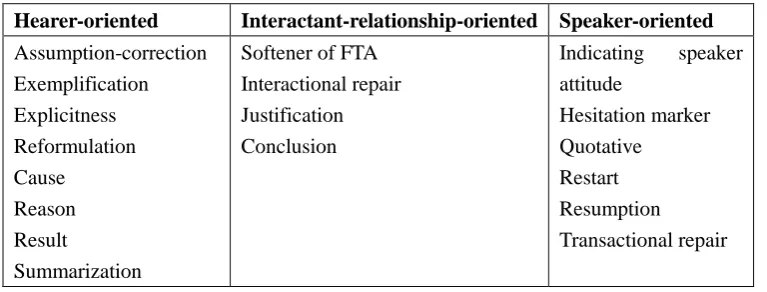
4.1.2 Pragmatic functions of I mean in this study 64
4.1.2.1 Hearer-oriented 69
4.1.2.1.1 Assumption- correction 69
4.1.2.1.2 Exemplification 71
4.1.2.1.3 Explicitness 71
4.1.2.1.4 Reformulation 72
4.1.2.1.5 Cause 72
iv
4.1.2.1.7 Result 73
4.1.2.1.8 Summarization 74
4.1.2.1.9 Quotative 74
4.1.2.2 Interactant- relationship-oriented 75
4.1.2.2.1 Interactional repair 75
4.1.2.2.2 Justification 77
4.1.2.2.3 Conclusion 80
4.1.2.2.4 Softener of FTA 80
4.1.2.3 Speaker-oriented 82
4.1.2.3.1 Transactional repair 82
4.1.2.3.2 Restart 82
4.1.2.3.3 Hesitation marker 82
4.1.2.3.4 Resumption 83
4.1.2.3.5 Indicating speaker attitude 84
4.2 Functions of you know 88
4.2.1 Functions of you know in the literature 89
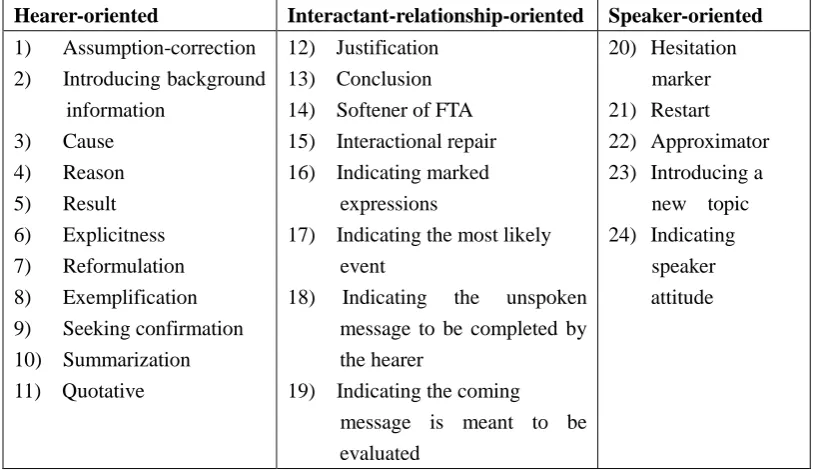
4.2.2 Functions of you know in this study 99
4.2.2.1 Hearer-oriented 103
4.2.2.1.1 Assumption-correction 103
4.2.2.1.2 Introducing background information 105
4.2.2.1.3 Cause 106
4.2.2.1.4 Reason 107
4.2.2.1.5 Result 107
4.2.2.1.6 Explicitness 108
4.2.2.1.7 Reformulation 108
4.2.2.1.8 Exemplification 109
4.2.2.1.9 Seeking information 109
4.2.2.1.10 Summarization 110
4.2.2.1.11 Quotative 112
4.2.2.2 Interactant-relationship-oriented 113
4.2.2.2.1 Justification 113
4.2.2.2.2 Conclusion 115
4.2.2.2.3 Softener of FTA 115
4.2.2.2.4 Interactional repair 117
4.2.2.2.5 Indicating marked expressions 118
4.2.2.2.6 Indicating the most likely event 121
4.2.2.2.7 Indicating unspoken message to be completed by the hearer 123 4.2.2.2.8 Indicating the coming message is meant to be evaluated 124
4.2.2.3 Speaker-oriented 125
4.2.2.3.1 Hesitation marker 125
4.2.2.3.2 Restart 126
4.2.2.3.3 Approximator 128
4.2.2.3.4 Introducing a new topic 129
v
4.3 Comparison of I mean and you know 133
4.3.1 Quantitative findings of the comparison of the use of I mean and you know in
the native speaker data 134
4.3.2 Accounting for the features of the use of I mean and you know in the native
speaker data 138
4.3.3 Comparison of turn positions and proposition positions between I mean and
you know in the native speaker data 143
Chapter 5 Uses of I mean and you know in the non-native speaker data 147
5.1 Uses of I mean in the non-native speaker data 147
5.1.1 Overall frequencies of I mean in the non-native speaker data and the native
speaker data 147
5.1.2 Distributions of the pragmatic functions played by I mean in the non-native
speaker data and the native speaker data 151
5.1.3 Distributions of turn positions of I mean in the non-native speaker data and
the native speaker data 153
5.1.4 Distributions of proposition positions of I mean in the non-native speaker
data and the native speaker data 158
5.2 Uses of you know in the non-native speaker data 160
5.2.1 Overall frequencies of you know in the non-native speaker data and the native
speaker data 160
5.2.2 Distributions of the pragmatic functions played by you know in the
non-native speaker data and the native speaker data 162
5.2.3 Distributions of turn positions of you know in the non-native speaker data and
the native speaker data 165
5.2.4 Distributions of proposition positions of you know in the non-native speaker
data and the native speaker data 167
Chapter 6 Accounting for the uses of I mean and you know in the non-native
speaker data 172
6.1 Major findings of previous studies on how L1 influence and universal constraints
and processes may affect L2 acquisition 172
6.2 Method of establishing the role of L1 influence on the Chinese EFL learners’ uses
of I mean and you know 175
6.3 Accounting for the uses of I mean in the non-native speaker data 177 6.3 Accounting for the uses of you know in the non-native speaker data 187
6.5 Summary 201
Chapter 7 Conclusion 203
7.1 Patterns of I mean and you know in the L1 English data 204 7.2 Comparison of I mean and you know in the L1 English data 207 7.3 Patterns of I mean and you know in the Chinese learners’ L2 English 210
7.3.1 Pattern of I mean in the Chinese learners’ data 210
vi
7.4 Recommendations for further research 213
References 214
vii
List of Tables
Table 2.1 Taxonomy of pragmatic markers (Fraser, 1996) 26
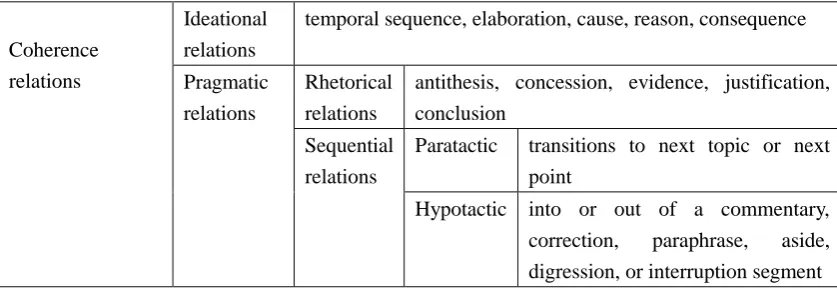
Table 2.2 Taxonomy of coherence relations (Redeker, 1990) 43
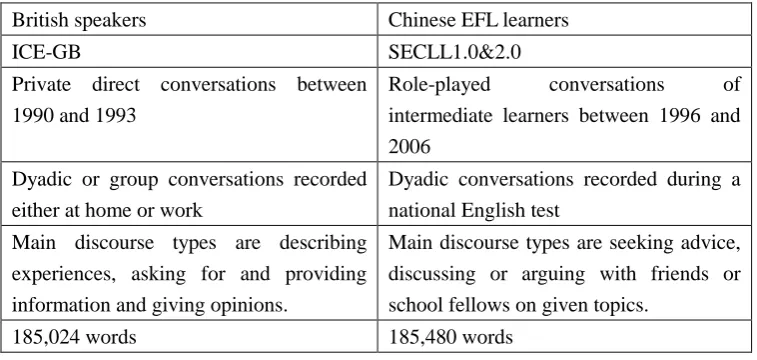
Table 3.1 Summary of the two sub-corpora chosen by this study 52
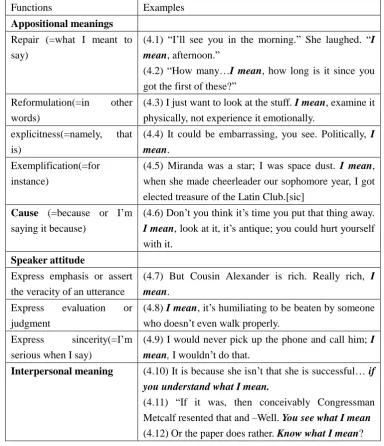
Table 4.1 Summary of pragmatic functions of I mean in Brinton’s (2007) study 63 Table 4.2 Classification of pragmatic functions of I mean in this study 65
Table 4.3 Translation equivalents of I mean 67
Table 4.4 Summary of Holmes’s (1986) findings 91
Table 4.5 Summary of Erman’s (2001) findings 96
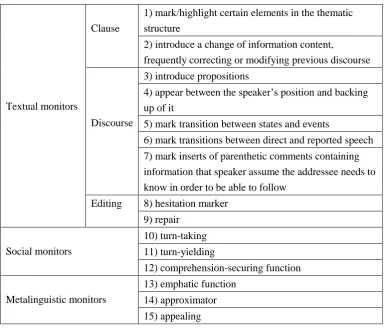
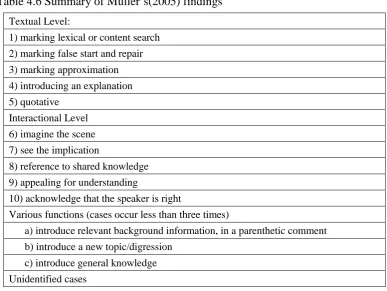
Table 4.6 Summary of Müller’s (2005) findings 97
Table 4.7 Classification of pragmatic functions of you know in this study 100 Table 4.8 Overall frequencies of I mean and you know in the native speaker data 134 Table 4.9 Pragmatic functions of I mean and you know identified in the native
speaker data 135
Table 4.10 Distributions of turn positions of I mean and you know in the native
speaker data 143
Table 4.11 Distributions of proposition positions of I mean and you know in the
native speaker data 144
Table 5.1 Overall frequencies of I mean in the British speakers’ data and the Chinese
EFL learners’ data 147
Table 5.2 Distributions of the pragmatic functions of I mean in the British speakers’
data and the Chinese EFL learners’ data 151
Table 5.3.Distributions of turn positions of I mean in the British speakers’ data and
the Chinese EFL learners’ data 154
Table 5.4 Distributions of medial and non-medial positions of I mean in the British
speakers’ data and the Chinese EFL learners’ data 154
Table 5.5 Distributions of proposition positions of I mean in the British speakers’
data and the Chinese EFL learners’ data 159
Table 5.6 Overall frequencies of you know in the British speakers’ data and the
Chinese EFL learners’ data 160
Table 5.7 Distributions of the pragmatic functions of you know in the British
speakers’ data and the Chinese EFL learners’ data 163
Table 5.8 Distributions of turn positions of you know in the British speakers’ data and
the Chinese EFL learners’ data 165
Table 5.9 Distributions of proposition positions of you know in the British speakers’
data and the Chinese EFL learners’ data 168
viii
the native Chinese data 189
Table 6.5 Distributions of subfunctions of nizhidao identified in the native Chinese
data 193
Table 6.6 Distributions of turn positions of you know in the Chinese EFL learners’
data and nizhidao in the native Chinese data 193
Table 6.7 Distributions of proposition positions of you know in the Chinese EFL
learners’ data and nizhidao in the native Chinese data 194
1 Chapter One
Introduction
This thesis will investigate how two English expressions – I mean and you know – are used by Chinese EFL learners as compared to native speakers of English. These two expressions belong to a group of linguistic items which currently are most frequently termed either ‘pragmatic markers’ (adopted in this study) or ‘discourse markers’. Other typical members of this group include expressions such as oh, well, like,actually, because, and, but and so.
One main motivation for choosing an investigation of pragmatic markers as the topic of this study is that linguistic expressions of this group are full of contrasts. On the one hand, they are just simple-looking words or constructions i.e. they are very poor in semantic meaning and are syntactically peripheral. Therefore, traditional grammar cannot say much about them. For example, in Quirk et al.’s (1972) description of English grammar oh is classified as an interjection which is regarded as a minor category describing “something of a museum of oddments” (Quirk et al., 1972: 411). Moreover, because of the trivialness of their appearances, they have acquired titles such as fillers, verbal fillers and gambits and are often stigmatized by native speakers. For instance, Watts (1989) carries out a study which investigates how native speakers perceive the use of pragmatic markers such as you know, right, well and like. His evidence shows that these markers are negatively evaluated. One of the speakers in his data thinks that you know has association with people from the north of Britain although he himself uses you know to preface his comment on the footballers.
2 On the other hand, pragmatic markers are ubiquitous in conversation and a substantial number of linguistic studies on English pragmatic markers that have been conducted since 1980s have shown that in contrast to their simple appearances and social stigma, they are, in fact, pragmatically indispensible in spoken discourse.
Acting as signposts in real time communication, pragmatic markers can facilitate the hearer’s understanding. According to Fox Tree and Schrock (1999), oh can help native speakers of English interpret information in spontaneous talk. Their findings show that recognition of words was faster after oh than when the oh was either excised and replaced by a pause or entirely excised, and semantic verification of words heard earlier in the discourse was faster after oh than when the oh was either excised and replaced by a pause or excised entirely. Flowerdew and Tauroza’s (1995) test of the effect of discourse markers such as so, right, well, ok and now on Cantonese speakers’ comprehension of English lectures shows a similar result that the subjects understood the lecture with discourse markers better than the lecture without them. Not surprisingly, a spoken discourse which lacks such markers would be detrimental to listeners’ comprehension. Tyler (1992) finds that native speakers of English perceived the lecture delivered by the Chinese teaching assistant as incoherent and difficult to comprehend because it lacked discourse markers.
In addition to the function of helping the hearer process the information conveyed by utterances, Crystal (1988: 48) claims that pragmatic expressions such as you know can be seen as the oil which helps us “perform the complex task of spontaneous speech production and interaction smoothly and efficiently”.
3 low frequency. The result shows that more pragmatic markers were used by the high fluency group.
Similar findings are reported by Sankoff et al. (1997) who investigate how speakers of English use pragmatic markers in their L2 French. Their results indicate that “very low-frequency use of discourse markers is a signal of lesser overall linguistic competence, whereas higher frequency is the hallmark of the fluent speaker” (Sankoff et al., 1997: 204). The overall picture that emerges from their analysis suggests that “the ability to express oneself fluently and confidently in a second language entails the use of those discourse markers that native speakers produce so effortlessly” (Sankoff et al., 1997: 214).
Given the essential roles that pragmatic makers play in spontaneous talk in English and their contribution to fluency, it is self-evident that for learners of English mastering the use of them should be equally important to their acquisition of grammatical competence. Wierzbicka (1976:327) posits that learners’ communicative competence would be greatly impaired if they did not understand the meaning of pragmatic markers. Svartvik (1980) even points out that learners’ errors in pragmatic markers could be more problematic than their grammatical mistakes in oral communication because “if a foreign language learner says five sheeps or he goed, he can be corrected by practically every native speaker. If, on the other hand, he omits a well, the likely reaction will be that he is dogmatic, impolite, boring, awkward to talk to, etc., but a native speaker cannot pinpoint an ‘error’” (Svartvik, 1980:171).
4 Chen, Ye, & Zhang, 1995; Du, 1995; Liao & Bresnahan, 1996; Takahashi, 1996; Spencer-Oatey, 2000) have been almost exclusively about identifying strategies employed by learners when performing “certain functions, in particular interpersonal functions such as apologies, requests, or complaints” (Ellis, 1994: 159). The lack of studies on the use of pragmatic markers in learners’ language is another important reason for carrying out the current study, which will compare the learners’ performance with native speaker’s, because it can be assumed that the higher pragmatic ability learners have, the closer their performance to native-speakers’.
Previous studies on learners’ use of pragmatic markers also show that more in-depth studies are needed because most of them (Hays, 1992; Nikula, 1996; Romero Trillo, 2002; He, 2002; Hellermann & Vergun, 2007; Fung & Carter, 2007; Liao, 2009) only present a rather general picture of how pragmatic markers are used by learners, although learners with various L1 backgrounds are investigated. They mainly look at what pragmatic markers occur in their data and their overall frequencies. So their major findings include: compared to native speakers non-native speakers tend to 1) use pragmatic markers less frequently; 2) use a smaller number of pragmatic markers; 3) use pragmatic markers in more restricted contexts; and 4) use pragmatically transparent markers such as and, because, but and so. However, Müller’s (2005) study is an exception. Instead of looking at all occurring pragmatic markers in her data, her study narrows down to four markers and her comparison between native speaker data and non-native speaker data is made on the basis of the specific pragmatic functions played by each marker. But she does not make an attempt to account for the characteristics of the non-native speakers’ uses of the four pragmatic markers.
5 first investigate what exactly these two markers do in the baseline data i.e. the native speaker data, because a thorough investigation of the baseline data is essential for the following comparison between the Chinese EFL learners’ data and the native speakers’ data. To depict a more comprehensive picture of how I mean and you know are used by Chinese EFL learners, the comparison between the two data sets will be made not only in terms of pragmatic functions that I mean and you know play but also their positioning and co-occurring linguistic items. Although the description of the two markers will be mainly qualitative, statistical tests will be carried out where applicable. To take a step further than Müller (2005), this study will also attempt to account for the similarities and differences shown between the two groups.
There are four reasons why this study has chosen to investigate these two particular markers: I mean and you know. Firstly, they are among the most frequent pragmatic markers in English spoken discourse and they have been extensively discussed in previous studies. Secondly, they also frequently occur in the Chinese learners’ data chosen by this study. Thirdly, as shown by previous studies, they are extremely elusive and to pin down their functions is very difficult because they can occur in a wide range of contexts. According to Müller (2005: 165), you know has been argued to play almost thirty functions in the literature and more than half of them are supported by at least two authors. In her data twelve functions have been identified.
6 When comparing their functions, Schiffrin (1987: 309) briefly mentions that “I mean focuses on the speaker’s own adjustments in the production of his/her own talk” while “y’know proposes that a hearer adjust his/her orientation (specially knowledge and attention) toward the reception of another’s talk”. Although Fox Tree and Schrock (2002) present a systematic comparison of I mean and you know by referring to the main functions that played by them in previous research, their comparison is carried out in only five categories: interpersonal, turn management, repair, monitoring and organizational. Since this study aims to give each marker an in-depth description, it would be a good opportunity to take a further step in their comparison i.e. to make an in-depth comparison of their pragmatic functions so as to show in what ways they are pragmatically complementary to each other. For instance, an attempt will be made to account for why there are contexts where both markers can occur. With respect to those contexts where only one of them can apply, explanations as to why I mean not you know or vice versa will be sought.
7 As the most recent study on you know available when the present study started, Müller’s(2005) analysis uses a much bigger database, which comes from Gissen-Long Beach Chaplin Corpus. Her native speaker data consists of 53,023 words from 34 speakers while her non-native speaker data consists of 95,555 words from 77 German EFL learners. All speakers are university students. But her data only include one activity: students are asked to retell and discuss the film “Chaplin”, which is seen as the limitation of the data by Müller herself as she points out that “it could not be expected that all discourse markers would be used, nor that those which occurred would be used in all their functions” (Müller, 2005: 34). Compared to Müller’s data, the data for this study are not only bigger but also cover a wider range of topics. For example, the native speaker data of this study consist of 90 direct recorded conversations which took place in various venues such as homes, offices, parties and restaurants and were produced by not only university students (although majority of the speakers are) but also university staff, writer, journalist, musician, dentist, accountant, carpenter and housewife. Although it could not be expected that all functions of I mean and you know would occur in the native speaker data of this study either, different or more functions of them can be expected to emerge.
To achieve the goal of revealing how I mean and you know are used by Chinese EFL learners as compared to native speakers, the present study will address the following questions :
1) What pragmatic functions do I mean and you know play in L1 English conversation?
2) What are the similarities and differences between I mean and you know with regard to their pragmatic functions and why? What are the similarities and differences between them in terms of distributions and positioning?
8 factors that could contribute to the similarities and differences between them and why?
4) What are the characteristics of the Chinese EFL learners’ use of you know as compared to the native speakers of English? What are the potential factors that could contribute to the similarities and differences between them and why?
The remaining chapters of this thesis will be organized as follows. Chapter 2 will aim to present a general picture of research in the field of pragmatic markers or discourse markers by giving an account of its historical development, main theoretical and methodological issues such as its terminology, classifications, linguistic theories and analytical models that have been used. Since this study, which is purely descriptive, has chosen two linguistic expressions which have the least contention as to their membership status, it will not attempt to make contributions in the discussion of theoretical issues. However, explanations will be given as to why certain positions on relevant theoretical and methodological issues have been taken in this study. In chapter 3, detailed information of the data used in this study will be provided. Also, analytical terms used in the analysis will be defined or clarified.
Chapter 4 will give a detailed account of how the pragmatic functions of I mean and you know are identified and how a modified analytical framework came into being by drawing upon previous findings including a pre-existing framework and by adapting this to cover all the instances which are found in my native speaker data. This chapter will, then, end up with an in-depth comparison between I mean and you know, which are analyzed under the same framework and on the basis of the same data set.
9 distributions of positioning between the non-native speaker data and the native speaker data.
10 Chapter Two
Literature review
This chapter consists of three main sections. The first section will aim to give an overview of the historical development of the research on pragmatic markers/discourse markers. In section 2.2 theoretical and methodological issues in this research area will be reviewed. Since this study is purely descriptive and there is a general agreement among researchers as to the membership status of the two pragmatic markers chosen by this study, this study will not attempt to make contributions to theoretical issues such as definition and classification or to propose a new method of analysis. The main purpose of section 2.2 is to provide relevant background information so as to explain why certain theoretical or methodological positions have been taken in this study. Finally, section 2.3 will give a review of previous studies on L2 learners’ use of pragmatic markers.
2.1. A panoramic view of research on pragmatic markers
11 2.1
Q What time is it? A: Three o’clock.
My stomach says that it is nearly lunch time. The sun just came up
(Lakoff, 1973: 455, but the list of answers is shortened)
1980s appears to be a very important period for research of pragmatic markers because it witnesses not only increasingly more attention from researchers but also a number of influential publications, which have paved the way for this subfield of linguistic research to flourish from the 1990s onwards. Schourup (1985) gives a book-length description of pragmatic markers such as well, oh, like, well, you know, I mean, mind you and sort of by applying his “tripartite model” (Schourup 1985:7). Schiffrin’s (1987) study, another book-length account of oh, well, and, but, or, so, because, now, you know and I mean, has become one of the most often cited studies. Her model of five planes of talk has been applied by later studies (e.g. Salmons, 1990; Hays, 1992; Demirci & Kleiner, 1997; Kyratzis & Ervin-Tripp, 1999; Fung & Carter, 2007).
12 The booming of research on pragmatic markers since 1990s can be shown in the following aspects. Firstly, interest in this group of linguistic expressions has spread from the English language to a number of other languages such as Italian (Bazzanella, 1990), French (Olynak et al., 1990; Lamiroy, 1994; Sankoff et al., 1997; Hansen, 1998; Andersen et al. 1999), Spanish (De Fina, 1997), German (Meng & Schrabback, 1999), Latin (Kroon, 1995), Japanese (Takahara, 1999; Park, 1998), Korean (Park, 1998) and Chinese (Chen & He, 2001; Lee-Wong, 2001; Feng, 2008; Liu, 2009) although the English language is still the one that has received the most attention from researchers. As a result, the later discussion on theoretical issues of pragmatic markers will be mainly based on studies on English pragmatic markers.
Secondly, a range of variables that can affect the use of pragmatic markers have been investigated. Among them, age seems to be the one which has attracted the most attention. For instance, Stenström (1990) carries out a corpus-based comparative study of pragmatic markers used by teenagers and adults in London. Meng & Schrabback (1999) compare how children and adults use two German interjections – hm and na. Romero Trillo (2002) compares children and adults’ use of English discourse markers. Hasund (2002) conducts a corpus-based comparative study of like used by teenagers between English and Norwegian.
13 Other variables that have been explored include social class and gender. For example, Huspek (1989) analyzes you know and I think variation in some American industrial workers’ speech which tends to be associated with very high frequency of you know and relatively low frequency of I think. Stubbe and Holmes (1995) compare pragmatic markers between middle class and working class. Holmes’ (1986) studies characteristics of women’s use of you know, which tends to be regarded as a “women's language” form as compared to men’s. Erman (1992) makes her
comparison between female and male in two different interactions: same-sex and mixed-sex interactions.
Finally, pragmatic markers have become a platform where researchers from different research fields converge. One group that has been attracted by pragmatic markers is researchers whose interest is in language change. Their research on pragmatic markers has become a very important part of study of grammaticalization. The question they aim to address is what changes have taken place between pragmatic markers and their homomorphous forms. Thompson & Mulac (1991) carry out a study on the epistemic parenthetical – I think. They argue that since I think has taken on the pragmatic function of “expressing the degree of speaker commitment, functionally roughly as an epistemic adverb such as maybe with respect to the clause it is associated with” (Thompson & Mulac 199l: 313), I think should not be viewed as the “that-deletion” alternation of the construction I think that where I is the subject
and think is the main verb. Traugott (1995) also observes that expressions such as I think, even, actually, and really have gone through “a pragmatic-semantic process whereby ‘meanings’ become increasingly based in the speaker’s subjective belief state/attitude toward the proposition, in other words towards what the speaker is talking about” (Traugott, 1989: 35).
14 looking for evidence of when a lexical item begins to take on pragmatic meanings from Old English to Modern English. For instance, Brinton (1998) presents diachronic evidence of grammaticalization of only from free adverb to adversative conjunction in English while Brinton (2007) gives evidence of the historical development of the pragmatic marker – I mean.
Researchers who are specialized in language contact also show their interest in pragmatic markers. What they aim to reveal is how pragmatic markers are used by bilingual speakers. There are quite a few studies (Salmons, 1990; Goss & Salmons, 2000; Fuller, 2001) which are about German-English bilinguals. They seem to have rather similar findings i.e. in German discourse the system of German discourse markers appears to have been replaced by the English system (Salmons, 1990). The English discourse markers seem to be first borrowed into the German language and then replace the German markers (Goss & Salmons, 2001; Fuller, 2001).
Maschler’s (1994) investigation of Hebrew-English bilinguals shows a different and interesting picture. She notes that a recurring pattern in the English conversations of the Hebrew-English bilingual speakers i.e. they often switched to Hebrew when they needed to use discourse markers. Sankoff et al. (1997) also reports that the French-English bilingual speakers switched to English discourse markers in French discourse, though to a very slight degree.
15 particularly revealing” rather than “a random selection of isolated features of grammatical and lexical systems”.
Ariel (1994: 3252) also contends that the subsystem of pragmatic markers appear to be universal because even unrelated languages can have rather similar pragmatic markers. But their universality differs in different functional levels. Markers, which mainly function as discourse organizers, will occur universally, “although their formalization as well as frequency of use may vary” while markers functioning on the interpersonal level will show more social or cultural variations, hence will be less universal.
English has been compared with quite a few other languages such as German (Fischer & Drescher, 1996), Scandinavian dialects (Andersen, 1997), Korean (Park 1998), Japanese (Takahara, 1998) and Chinese (Zhang, 2007; Chen, 2011). Fischer & Drescher (1996) conduct their comparison between two of Woody Allen’s dramas – Death and God – and their German translations. The English pragmatic marker well has been found to have 10 equivalents (also, naja, na, komm, ach, na also, ja, tja, schon, gut) in German. This finding echoes Kroon’s (1995:17) discussion of the English discourse marker because, which is again a multifunctional marker because it can occur in three types of utterance relations: cause, evidence and justification. But French needs to use three different markers i.e. the English marker because has three French equivalents: parce que, puisque and car. Fischer & Drescher’s (1996) findings show that contrastive analysis, i.e. translation, is very helpful in terms of revealing functions of pragmatic markers.
16 languages do exist. For instance, the English pragmatic like has a parallel in all the three Scandinavian dialects (liksom/typ in Stockholm and Bergen, lissom/ligesom in Aarhus). All the equivalents have similar and pragmatic meanings of like.
As can be seen from the above contrastive studies of pragmatic markers, translation is a very useful technique. So it is not surprising that experts of translation have also noticed this linguistic phenomenon. Bazzanella & Morra (2000) consider the translation of pragmatic markers as a crucial and stimulating area for translation theory. They suggest that the priority of translation of pragmatic markers should be to preserve the functionality of the marker in question. Therefore, translators have to assign temporary and context-specific translations. Sometimes even mutually exclusive translations can be used for the same marker, for example, well can be used in either agreement or disagreement.
17 higher frequencies.
Montes (1999) reports a longitudinal case study of how a Spanish-speaking child (1;7 to 3;0) acquires discourse markers such as ah, oh, ay, oy, uy and eh. The observation shows that the child started from the more literal, contextual uses to the more elaborated discursive functions which emerged later. For example, the meaning of I see as I understand emerged later than did the literal meaning of I see (an object).
Kyratzis & Ervin-Tripp (1999) investigate the development of acquisition of discourse markers by having four- and seven-year children paired in best friend dyads perform role play and story-telling. One of the differences between the two age groups suggests that different functions of discourse markers may be acquired at different ages. The following two examples show that function of justification of because may be acquired earlier than cause.
2.2
(4-year-old girl) Jan
12 okay [puts the other human figure aside] 13 this is me. so I’m supposed to act her 14 and you’re supposed to act her
15 because you’re the mom/[hums] (p1333)
(Kyratzis and Ervin-Tripp 1999: 1333, quoted as example (12)) 2.3
(7-year-old girl) Lyn
5 you know, she cries
6 because her brother turned into a little bear (p1331) (Kyratzis and Ervin-Tripp 1999:1331, quoted as example (11))
Lastly, even forensic linguistics has shown its interest in pragmatic makers. Blackwell’s (2000) analysis shows that discourse markers can play a role in forensic purposes which heavily depend on analysis of content words. She points out that “discourse markers such as well, honest and look are an essential feature of natural
18 police interview) may aid the forensic linguist in evaluating conflicting claims about the text’s origin” (Blackwell, 2000: 13).
2.2 Theoretical and methodological issues in the research of pragmatic markers This section consists of 4 subsections. Section 2.1 will look at the issue of terminology, which “presents a particular difficulty” (Schourup, 1999:228). A review of the various proposals as to which term should be used in the literature will be presented and explanation as to why the term “pragmatic marker” has been chosen by the current study will be given. Section 2.2 will discuss the main features and functions of pragmatic markers and classification of pragmatic markers. Section 2.3 will be a review of the main theories or models used previous studies of pragmatic markers. Section 2.4 will review various methods used to establish pragmatic functions of pragmatic markers in previous research and explain how this study has made its decision as to what methods should be used.
2.2.1 Terminology
By searching the references of pragmatic markers for this study more than 10 candidates have been found, but currently only a number of them have remained in use. Those terms that seem to have died out include gambit (Keller, 1979), speech marker (Olynak et al., 1990), pragmatic particle (Őstman, 1981, 1982, 1995; Foolen, 1997), phatic connective (Bazzanella, 1990), pragmatic connective (Lamiroy, 1994), discourse connective (Blakemore, 1987; Unger, 1996), discourse item (Stenström, 1990); pragmatic force modifier (Nikula, 1996); discourse operator (Redeker, 1991) and pragmatic operator (Ariel, 1994). One main reason for these terms being abandoned might be that they are either too general or too narrow. For example “speech marker” sounds a very general term because it does not necessarily have to
19 only one of the main functions of these small words. The word ‘operator’ in ‘discourse operator’ or ‘pragmatic operator’ can be associated with conjunctions,
which are represented by logical truth-tables such as &, V, >, →, : and in formal semantics. The reason for dropping the term “gambit” is obviously due to its negative connotation, which suggests that this group of expressions does not have any important function and is not worth studying.
The most frequently used terms are discourse marker (Schiffrin, 1985, 1987; Watts, 1989; Brinton, 1990; Salmons, 1990, Blakemore, 2002; Fuller, 2003; Müller, 2005; Fung & Carter, 2007), pragmatic marker (Watts, 1988; Redeker, 1990; Andersen, 1997, 1998, 2000, 2001; Aijmer & Simon-Vandenbergen, 2004; Feng, 2008; Norrick, 2009) and discourse particle/particle (Wierzbicka, 1976; Svartvik, 1980; Blass, 1990; Abraham, 1991; Kryk, 1992; Fischer & Drescher 1996; Van Barr, 1996; Schourup, 1985; Bolinger, 1989; Hasen, 1998; Lee-Wong, 2001; Aijmer, 2002). Among them ‘discourse marker’ is the most preferred candidate while ‘discourse particle/particle’
and ‘pragmatic marker’ show a similar frequency. However, discourse particle/particle shows a tendency of dying out. The main reason for objections to ‘discourse particle/ particle’ is because ‘particle’ has traditionally been used to refer
to a unified grammatical category (e.g. modal particles in German and Chinese) while the linguistic expressions under study in this group either cannot fit into any well-established category i.e. they tend to be put in a waste basket or come from various categories such verbs, conjunctions, prepositions, adverbials and interjections. Most researchers who use ‘discourse particle/particle’ tend to study those languages which are rich in particles such as German (Abraham, 1991; Fischer & Drescher, 1996), Polish (Kryk, 1992), Latin (Kroon, 1995); French (Hasen, 1998) and Chinese (Chappell, 1991; Lee-Wong, 2001).
20 use different terms while the same term used by different authors may not refer to the same group of linguistic items. For instance in her earlier studies (Erman, 1986, 1987, 1992) Erman uses ‘pragmatic expression’ but changes to ‘pragmatic marker’ in her later study in 2001. Schourup (1985) first uses ‘discourse particle’ and switches to ‘discourse marker’ in 1999. Aijmer changes her term from ‘discourse particle’
(Aijmer, 2002) to ‘pragmatic marker’ (Aijmer & Simon-Vandenbergen, 2004). Although ‘discourse marker’ has become the most popular term, it does not always have the same reference. Some researchers follow Fraser’s (1988, 1990, 1996, 1998, 1999) definition which treats ‘pragmatic marker’ as the cover term and ‘discourse marker’ is one type of ‘pragmatic marker’ while many more others follow Schiffrin (1985, 1987) who uses ‘discourse marker’ to cover a wide range of linguistic expressions including you know and I mean, which are not considered as discourse markers but another subcategory of pragmatic markers – parallel markers (for details of Fraser’s classification of pragmatic markers, see section 2.2).
Despite the fact that discourse marker is the most preferred term, this study has chosen pragmatic marker because firstly this study aims to reveal the pragmatic functions of I mean and you know and secondly it best catches the main features of I mean and you know, which do not contribute to propositions they work with either semantically or syntactically. Like Erman (1986, 1987), I take the view that discourse marker has the problem of confining I mean and you know to a single function i.e. organizing discourse. Using the term pragmatic marker will allow me to examine their functions from as many angles as possible.
2.2.2 Features, functions and classification of pragmatic markers
21 discussed pragmatic markers include actually, anyway, I mean, now, so, then, well, you know and you see. To define pragmatic markers, two questions need to be answered: 1) what characteristics do pragmatic markers have? 2) what functions do pragmatic markers play? Section 2.2.2.1 and section 2.2.2.2 will look at the answers to the above two questions proposed in the literature respectively. Section 2.2.2.3 will review the issue of the classification of pragmatic markers.
2.2.2.1 Features of pragmatic markers
A number of researchers have contributed to the description of characteristics of pragmatic markers. Svartvik (1980) summarizes the features of well as a pragmatic marker as compared to well as a manner adverb or as a degree word.
1) it is very difficult to decide which function or word class it should belong to 2) it is very difficult for lexicographers to pin down what it means
3) it is very difficult to translate it idiomatically into another language. 4) it only occurs in spoken language with a very high frequency
(A summary of the features of well as a pragmatic marker based on Svartvik (1980: 168-169))
Őstman (1982, 1995) proposes features of pragmatic markers on the basis of
structural and functional criteria. Unlike Svartvik (1980) whose observation is made on one English marker, well, Őstman (1982:149) has a group of cross-linguistic expressions in mind because he believes that pragmatic markers are a universal phenomenon.
1) they are short
2) they are prosodically subordinated to another word
3) they do not contribute to the propositional content of the sentence
22 observation that describing what well as a pragmatic marker means is a difficult job.
Brinton (1990: 46-47) presents a longer list of the features of pragmatic markers. She includes features of high frequency, orality and akwardness of fitting into any word-class on Svartvik’s (1980) list and features of being phonologically short and unstressed, semantically empty and syntactically optional in Őstman’s (1982, 1995) proposal. An additional feature in her list is the positioning of pragmatic markers: they are very flexible although sentence-initial is the preferred position.
1) they predominantly occur in spoken discourse 2) they are very frequent
3) they are short
4) they are phonologically reduced or unstressed
5) they occur either outside the syntactic structure or loosely attached to it 6) they are very flexible in terms of positioning but generally sentence-initial 7) they are difficult to place within a traditional word class
(A summary of features of pragmatic markers based on Brinton (1990: 46-47))
As can be seen from the following list proposed by Hansen (1998), the additional feature is the observation that pragmatic markers tend to cluster. By comparing with the above lists, we can conclude that researchers seem to agree that being semantically empty and syntactically optional are the two key characteristics of pragmatic markers.
1) they take the entire host sentences, proposition, or utterance in their scope 2) they normally do not carry stress
3) they cannot be coordinated but can and often do cluster 4) they do not contribute to propositional meaning
5) they are grammatically optional
23 Like Őstman (1982, 1995) and Jucker & Ziv (1998), these features are viewed as prototypical rather than defining in this study. Those expressions which display more of the features can be considered as prototypical members while those which show fewer characteristics may be considered more peripheral. According to Jucker & Ziv (1998:3), one advantage of this scalar conception is that it can better account for “the range of items displaying partially overlapping characteristics across a variety of languages.” For instance, Őstman (1982: 99) notes that English pragmatic markers do not follow his criterion 2) (“pragmatic markers are prosodically subordinate to another word”).
Semantic emptiness and syntactical optionality are considered as the most essential features of pragmatic markers in this study. They are used as the key criteria to distinguish pragmatic use from non-pragmatic of I mean and you know by this study.
2.2.2.2 Functions of pragmatic markers
From the following review of the functions of pragmatic markers in the literature, we can see another feature of pragmatic markers emerge: they are multifunctional. Őstman (1982: 152) claims that pragmatic markers perform two types of tasks:
24 1) initiate discourse
2) to mark a boundary in discourse, i.e. to indicate a shift or partial shift in topic 3) to preface a response or a reaction
4) to serve as a filler or delaying tactic 5) to aid the speaker in holding the floor
6) to effect an interaction or sharing between speaker and hearer 7) to bracket the discourse either cataphorically or anaphorically 8) to mark either foregrounded or backgrounded information
(A summary of functions of pragmatic markers based on Brinton (1990: 47-48))
Brinton (1998) makes another proposal of functions of pragmatic makers. Compared to her earlier list (Brinton, 1990), this proposal includes even more specific functions, which are classified into two broad categories in Halliday & Hasan’s (1976: 26-28) terms – textual and interpersonal.
Textual functions
1) getting the hearer’s attention, 2) initiating and ending discourse,
3) sustaining discourse, marking boundaries (topic shifts and episode boundaries), 4) constraining the relevance of adjoining clauses,
5) repairing discourse Interpersonal functions
1) subjective functions such as expressing response, reactions, attitudes, understanding, tentativeness, or continued attention
2) interactive functions such as expressing intimacy, cooperation, shared knowledge, deference, or face-saving (politeness).
25 2.2.2.3 Classification of pragmatic markers
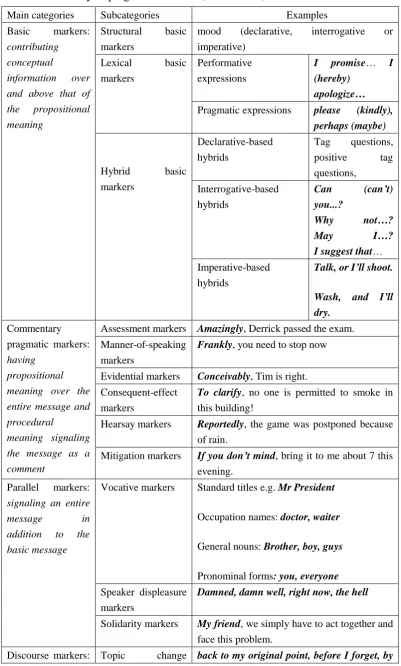
26 Table 2.1 Taxonomy of pragmatic markers (Fraser 1996)
Main categories Subcategories Examples Basic markers:
contributing conceptual
information over and above that of the propositional
meaning
Structural basic markers
mood (declarative, interrogative or imperative)
Lexical basic markers
Performative expressions
I promise… I (hereby)
apologize…
Pragmatic expressions please (kindly), perhaps (maybe)
Hybrid basic markers
Declarative-based hybrids
Tag questions, positive tag questions,
Interrogative-based hybrids
Can (can’t) you...? Why not…?
May I…? I suggest that… Imperative-based
hybrids
Talk, or I’ll shoot.
Wash, and I’ll dry.
Commentary pragmatic markers: having
propositional
meaning over the entire message and
procedural
meaning signaling the message as a
comment
Assessment markers Amazingly, Derrick passed the exam. Manner-of-speaking
markers
Frankly, you need to stop now
Evidential markers Conceivably, Tim is right. Consequent-effect
markers
To clarify, no one is permitted to smoke in this building!
Hearsay markers Reportedly, the game was postponed because of rain.
Mitigation markers If you don’t mind, bring it to me about 7 this evening.
Parallel markers: signaling an entire
message in
addition to the basic message
Vocative markers Standard titles e.g. Mr President
Occupation names: doctor, waiter
General nouns: Brother, boy, guys
Pronominal forms: you, everyone Speaker displeasure
markers
Damned, damn well, right now, the hell
Solidarity markers My friend, we simply have to act together and face this problem.
27 signaling the
relationship of the basic message to the foregoing
discourse and providing
instructions to the addressee on how the utterance to
which the
discourse marker is
attached is to be interpreted.
markers the way
Contrastive markers Anyway, but, however, on the other hand Elaborative markers above all, in other words, what is more, in
addition…
Inferential markers after all, so, as a consequence, therefore, as a result, because of this/that …
Obviously discourse marker is a very important category among the four types of pragmatic markers in Fraser’s classification because most of his publications focus on discourse markers e.g. how to define discourse markers (Fraser, 1999), how to approach discourse markers (Fraser, 1990), and how to classify English discourse markers (Fraser, 1998). Although discourse marker is only one group of pragmatic markers in Fraser’s classification, there is a key overlapping between the main features of Fraser’s discourse markers and those of pragmatic makers or discourse markers discussed in section 2.2.1 where discourse markers, pragmatic markers or many other terms are seen as competing candidates for the same group of linguistic expressions. Fraser (1990: 387-390) lists the following features of discourse markers when discussing how to study them. Among them, characteristic 4), i.e. zero semantic and syntactic participation, is among the most frequently proposed features in the literature, hence the most essential characteristic.
1) they are very difficult to analyze by traditional grammatical categories
2) they will not serve both roles (discourse marker and its homophonous form) in the same sentence.
3) they typically occur only in utterance-initial position but they do occur in utterance-internal or utterance-final position.
28 Instead of grouping pragmatic markers on the basis of the functions they play as Fraser (1990) does, Ariel’s (1994: 3251) classification is made on the correlation between form and function. The first category is termed ‘transparent operators’ (‘pragmatic operator’ is used instead of ‘pragmatic marker’ by Ariel) because their pragmatic meaning can be directly inferred from their semantic meaning. Examples of this category include but, or, so and because. The second category is called ‘intermediate operators’ because although their function can be related to their
semantic import, it cannot be derived automatically. Pragmatic markers such as you know, I mean, after all, of course, and or something are under this category. The last category is labeled ‘opaque operators’ because there is almost no link shown between their function and semantic meaning. Pragmatic markers such as oh and well can be seen as members of this group. Ariel (1994) claims that most pragmatic markers are in “somewhere on a continuum ranging from transparent linguistic expressions to completely opaque expressions interpreted by reference to their idiosyncratic rules of use” (Ariel 1994: 3251).
29 study will look at the correlation between the specific functions and the semantic meaning when accounting for the characteristics of learners’ use of these two markers. However, a similar continuum of the congruence between pragmatic meaning and semantic meaning is used.
2.2.3 Main theories or models used in previous studies of pragmatic markers
In this section, Schourup’s (1985) Tripartite Model, Schiffrin’s (1987) Discourse Coherence Model – Five Planes of Talk, Blakemore’s (1987, 1992) Relevance Model and Brown and Levinson’s (1987) Politeness Theory will be discussed. As can be seen from the following review, Schourup’s and Schiffrin’s models are designed for analyzing functions of pragmatic markers while the Relevance Model and Politeness Theory are not. The Relevance Model is a pragmatic model developed to “account for the psychological constraints that govern the hearer’s choice of context for the interpretation of a given utterance” (Blakemore, 1987: 12). It has been applied to this research field because pragmatic markers used by the speaker can help accommodate the hearer’s cognitive need of real time processing of the utterance. Politeness
Theory is developed to account for the redressing strategies used by the speaker in performing face-threatening acts so as to minimize the detriment to both speaker and hearer’s face in social interaction. It has been applied in studies of pragmatic markers because it can account for the speaker’s social motivation in using pragmatic markers in conversation.
2.2.3.1 Schourup’s (1985) Tripartite Model
30 Schourup (1985:4) posits that unexpressed thinking is a very important aspect of conversation because conversants do not say everything that crosses their mind “but judiciously retain, shape, and sequentially place them in ways that often display considerable gamesmanship”. Given the importance of the unexpressed thinking of conversants in conversation, he proposes that the situation of a participant in a conversation should consist of three worlds:
The covert thinking of the speaker, what that speaker has presently in mind but has not disclosed, will be referred to below as the private world; what is on display as talk and other behavior on the part of conversants and is thus available to both the speaker and any other(s) will be called the shared world; and the covert thinking of other conversants, which is inaccessible to the speaker, will be called the other world.
(Schourup, 1985: 7)
Schourup (1985:3) also proposes that the role played by pragmatic markers (discourse particle is used in Schourup’s study) is mediating in a specific way between the private world, the other world and the shared world.
31 misunderstanding of the intended meaning while I mean indicates a substantial nonequivalence which requires correction or would lead to misunderstanding. Such a difference does provide a plausible explanation as to why I mean is often used to preface corrections while like is not.
The core function of you know in this Tripartite Model is to indicate that “the speaker expects that there is no communicatively significant discrepancy between what is now in the private world and what is now in the other world, with respect to what is now in the shared world” (Schourup, 1985:102). So one obvious difference between I mean and you know under this framework is that you know involves the hearer while I mean does not, which does match to the general impression described by other researchers i.e. I mean is more speaker-oriented while you know is more hearer-oriented. But the core meanings of I mean and you know identified by this model do not seem to fit into the description that the pragmatic functions of these two markers are complementary. In addition, this model does not seem to be able to reveal any more specific differences between I mean and you know. Since one main aim of this study is to reveal the specific contexts of these two markers, Schourup's Tripartite Model will not be applied in this study.
2.2.3.2 Schiffrin’s (1987) Discourse Coherence Model
Schiffrin’s (1987) investigation of a number of pragmatic markers is one of the most important studies in the literature. Redeker (1991:1139) points out that Schiffrin’s (1987) study is “an ambitious and valuable attempt to integrate meticulous empirical
analysis of the functions of discourse markers with a theory of discourse coherence”.
32 to her analysis are: language always has a context, is context sensitive, always communicative and designed for communication. She continues to propose that discourse has three main properties: structure, meaning and action. Structure and meaning are more about discourse “as extended sequences of smaller units, e.g. sentences, propositions and utterances while action is “more concerned with language as it is used in a social interaction” (Schiffrin, 1987: 7). These three properties of discourse interact with each other because language has structure, conveys meaning, and is used to perform actions.
Schiffrin (1987) sees coherence as crucial to discourse for it distinguishes discourse from random collections of smaller units. Like speakers and hearers who make great efforts to construct coherence in conversation, discourse analysts strive for a description of how coherence is constructed. She (Schiffrin, 1987:24) points out that her coherence model focuses on local coherence, which is constructed through relations between adjacent units in discourse but can be expanded to more global coherence. She further proposes that discourse markers in her model are viewed as “indicators of the location of utterances within the emerging structures, meanings,
and actions of discourse” (Schiffrin, 1987: 24).
The main idea of Schiffrin’s Coherence Model (“five planes of talk” in Schiffrin’s term) is that discourse markers can function in five different components of coherence, namely exchange structure, action structure, ideational structure, participation framework and information state. Each discourse marker has one primary plane but can function on more than one level, either separately or simultaneously. The following is the definitions of the five planes summarized by Fraser (1999).
Exchange Structure, which reflects the mechanics of the conversational
interchange (ethnomethodology) and shows the result of the participant turn-taking and how these alternations are related to each other;
33 Ideational Structure, which reflects certain relationships between the ideas
(propositions) found within the discourse, including cohesive relations, topic relations, and functional relations;
Participation Framework, which reflects the ways in which the speakers and hearers can relate to one another as well as orientation toward utterances; and Information State, which reflects the ongoing organization and management of
knowledge and metaknowledge as it evolves over the course of the discourse. (Fraser, 1999: 934)
As mentioned in the earlier review, Schiffrin’s model has influenced a number of later studies of pragmatic markers. Not surprising, her model has received a lot of criticism (e.g. Jucker, 1988; Redeker, 1991). The main criticism seems to be about whether it is necessary to propose five different planes. For example, Jucker (1988) criticizes the five planes model by pointing out that the “information state” would actually include all the other levels. Redeker (1991) proposes a three-component coherence model instead, namely ideational structure, rhetorical structure, and sequential structure, which are roughly equivalent to ideational, action and an extended variant of exchange structures in Schiffrin’s model. Another problem with this model is its applicability. Jucker (1988:221) points out well is classified as a marker which primarily functions at the plane of participation framework, which reflects speaker and hearer relationship and orientation towards utterances, but the core function of well proposed by Schiffrin does not seem to be influenced by her five planes of talk. Schiffrin (1987: 126) defines well as “one device used by speakers in their attempts to build coherence in the face of multiple options: well anchors the speaker into a conversation precisely at those points where upcoming coherence is not guaranteed”. Jucker (1988: 224) further points out that Schiffrin’s model “makes it almost impossible to discern the common core underlying all the seemingly disparate uses of well.”
34 starting point in this study, presents a more detailed description of I mean.
2.2.3.3 Blakemore’s (1987, 1992) Relevance Model
Blakemore’s Relevance Model is another influential theory in research of pragmatic markers. As mentioned in the earlier review, there seem to be more advocates of this theory than those of Schiffrin’s Coherence Model. As just mentioned in the above subsection, Jucker (1988) points out that Schiffrin’s Coherence Model has failed to account for the use of well. In his later study, he even claims that Blakemore’s Relevance Theory is “the only theory that can account for all the uses of well on the basis of a general theory of human communication on cognitive principle” (Jucker, 1993: 438).
Blakemore’s Relevance Model can be seen as a product of the interaction between the assumptions she has formed on what makes successful communication and Sperber & Wilson’s (1986) Relevance Theory. Blakemore (1992:27) claims that Sperber & Wilson’s Relevance Theory could be regarded as an attempt to develop the notion of relevance, which is left undefined in Grice’s (1975, 1989) account of the Co-operative Principle.
35 processing efforts.
Since success of communication is achieved by cooperation between the speaker and hearer, what the speaker should aim to do is to make the interpretation of his/her utterance easier. For example, the speaker can help to constrain the interpretation recovered by the hearer by constraining the hearer’s choice of context. Pragmatic markers (‘discourse connective’ is used by Blakemore) used by the speaker in conversation can be a very useful device, signaling to the hearer the most likely way that the speaker wishes his/her utterances to be interpreted.
There are three ways identified by Blakemore in which information conveyed by an utterance can be relevant:
1)It may allow the derivation of a contextual implication
2)It may strengthen an existing assumption (by providing better evidence for it)
3)It may contradict an existing assumption
(Blakemore, 1992:138)
Accordingly, three types of discourse connectives have been identified (Blakemore 1992: 138-142):
1) discourse connectives which introduce contextual implications (so, therefore) 2) discourse connectives concerned with strengthening (after all, besides, moreover,
furthermore, utterance-initial also, indeed)
3) discourse connectives which introduce denials (however, still, nevertheless, but)
36 Instead, context is defined as a subset of the hearer's beliefs and assumptions about the world. In coherence-based accounts of utterance interpretation the role of context is restricted to establishing coherence relations (Blakemore, 1987: 110). But it is very common to see discourse consisting of utterances that do not show coherence relations but can still be comprehensible as shown by example (2.5).
(2.5)
A What did Susan say? B You’ve dropped your purse.
(Blakemore 1987: 110 quoted as example (6))
The relevance-based account also claims that the right context for interpretation of an utterance will not be given to the hearer in advance of the utterance, but will be constructed in the course of interpreting the utterance by the hearer. Therefore, shared knowledge is viewed as “a result of, rather than a prerequisite for, successful communication” (Blakemore 1992: 21).
Unlike the coherence-based model, which views coherence as the evidence or characteristic which distinguishes discourse from a random collection of sentences, a relevance-based account sees coherence “as a result of the way in which hearers use contextual information in their search for relevance” (Blakemore, 1992:2). Therefore, the same utterance can be perceived as coherent by some hearers but incoherent by others.
Blakemore's Model will not be followed in this study because its advantage does not lie in revealing how pragmatic markers behave in specific contexts. As shown in Andersen's (1998: 148) study of the pragmatic marker like, the advantage of the framework of relevance theory is that it can provide a unitary account of like.
2.2.3.4 Brown and Levinson’s (1987) Politeness Theory