Secret Shared Random Access Machine
(Preliminary Version)Shlomi Dolev∗ Yin Li†
March 28, 2015
Abstract
Secure and private computations over RAM are preferred over computations with circuits or Turing machines. Secure and private RAM executions become more and more important in the scope avoiding information leakage when executing programs over a single computer as well as over the clouds. In this paper, we propose a distributed scheme for evaluating RAM programs without revealing any information on the computation including the program the data and the result. We use the Shamir secret sharing to share all the program instructions and private string matching technique to ensure the execution of the right instruction sequence. We stress that our scheme obtains information theoretic security and does not rely on any computational hardness assumptions, therefore, gaining indefinite private and secure RAM execution of perfectly unrevealed programs.
∗
Department of Computer Science, Ben-Gurion University of the Negev, Israel. Email: [email protected]. Partially supported by Kamin grant of the Israeli economy ministry, and the Rita Altura Trust Chair in Computer Sciences.
†
1
Introduction
Cloud computing provides cost-efficient and flexible shared infrastructure and computational services on de-mand for various customers who need to store and operate on a huge amount of data. Until now, there are various services providers such as Amazon [1] and Google [13] offering platforms, software, and storage outsourcing applications. Much attention has been paid to them due to the potential benefits and business opportunities that clouds could bring [9].
However, cloud computing also introduces security and privacy risks for the clients. For example, some of the cloud providers are not perfectly reliable and are vulnerable to network attacks and data leakage. Further-more, even a single computer with the same cloud organization is untrustworthy. There are possible attacks on a single computer during which information is copied from the bus of the computer and sent to an adver-sary. Thus, it is vitally important that server processes unrevealed programs over unrevealed data, unrevealed in information theoretical secure manner.
One of the most important requirements of the cloud clients is to process their data in a confidential way. Several techniques are applied to address data storage privacy [18, 19, 20, 26] and security computation on clouds [17, 29]. Among these studies, security in evaluating random access machine (RAM) program is an important task [22, 2], since many modern algorithms are operating on the von Neumann RAM architecture. Until now, there are mainly two ways for secure computation of RAM programs, the first is to convert a RAM program into circuits and the second is to use oblivious RAM, introduced by Goldreich and Ostrovsky [19]. Oblivious RAM schemes are preferred as there is no need to convert the program into a binary circuit which leads to a huge blowup in program size and its running time.
Even though the propositions for secure RAM evaluation can address various privacy challenges including two-party [22], multiparty [5, 10] or large-scale computation [6] against semi-honest or malicious adversaries, they all assume that the processors used by clouds are trustworthy. Thus, in these proposals, the CPU has to decrypt the input data before processing and then encrypt the output data again. During these years, the semi-conductor design and fabrication process became global, integrated circuits tend to be increasingly vulnerable to malicious activities and alterations. An adversary can introduce a special hardware Trojan [28] designed to disable or destroy a system in the future, or leak confidential information. Similar attack has already been demonstrated in [3], where a specially designed Trojan in the CPU revealed sensitive information to the adver-sary.
We assume that there is a client that wants to run a program on the clouds. But the client does not want to reveal any information about both the program and the data. The cloud with untrusted hardware, that say, listens to the bus, may extract information on the internal activity of the processor.
Unfortunately, none of the protocols that decrypt data prior to processing and manipulating the data can avoid information leakage when the adversary acts within the hardware. Thus, one may wish to execute an encrypted program on encrypted data without decrypting neither the program nor the data. In order to protect privacy, a straightforward approach is to execute the encrypted instructions in the clouds processors directly. Fully homomorphic encryption [14, 15] (FHE) is a way to achieve this goal. Several schemes are proposed to implemented secret program execution over FHE (e.g., [7] [8] [31]). However, the main problem is that the proposed schemes have high overhead of computation [16] which make FHE more theoretical result than practical. Moreover, Gentrys scheme and later FHE schemes relied on the hardness assumptions such that of the ideal lattices, which are only computationally secure, rather than key-less information theoretical secure. Our Contribution. In this paper, an alternative architecture is proposed with security and privacy that are based on theoretically security promises. The main technique is a combination of Shamir Secret Sharing [25] and the recently proposed Accumulating Automata [12].
there exists a compiler from high-level programming languages to Subleq [23]. The Accumulating Automata allows us to perform string matching secretly without revealing any information, which is the key to achieving the security requirement. As a result, our scheme has the following significant characteristics
• Information theoretic security.Until now, most of the secure RAM evaluation protocols assume that there exists a one-way function which makes them only computationally secure. We use Shamir secret sharing which could provide information theoretic security for clients. In our scheme, the user’s program is secret shared and run on independent machines and clouds. Each cloud only needs to perform computation without communicating with other clouds. Moreover, note that we use the instruction Subleq proven to be complete in terms of Turing-complete computation. Thus, our model can execute any RAM programs privately and securely.
• Program protection. During the whole execution of the program, for every instruction, the processors have to “touch” all the instructions in the memory. Moreover, for every data access, the processors also have to access all of the data items. The execution mode and access pattern make the client program “oblivious” to the clouds, thus ensuring both data and program privacy. Still, the operations can be delegated by the users to powerful machines in the clouds, which perform these linear access to all items for executing operations without revealing their nature and sequence.
• Error correcting.Notice that the clients run their programs inE independent machines/clouds. Accord-ing to the conclusion of Ben-Or et al. [4], as long as less than one-third of clouds are malicious (do not follow the protocol possibly returning wrong results), the client can detect their actions by reconstructing the final result using Lagrange interpolation.
The rest of the paper is organized as follows: in Section 2, we briefly introduce the settings used in our paper. Section 3 describes the basic primitives we use in our construction. Explicit application and its security analysis are given in Section 4. Finally, conclusions are drawn in Section 5.
2
Preliminary
In this section, we briefly introduce the basic ingredients used in the sequel.
Shamir Secret Sharing.Shamir secret sharing (SSS) is an information theoretic secure protocol, which allows
a dealer to secret share a values samongE players. There is a threshold δ for the scheme, such that, the
knowledge of δ or fewer player secrets make the adversary learn no information abouts, but if more thanδ
players communicate their shares to each other, they can easily recover the secret.
Distribution: The dealer picks a random polynomialf ∈Fp[x]of degreeδ < Esuch thatf(0) =s∈Fp. The dealer also choosesE arbitrary non-zero indicesα1,· · · , αE, computes f(αi) for1 ≤ i ≤ E and send
(αi, f(αi))to each corresponding players.
Reconstruction: Anyδ+ 1players can reconstruct the polynomialfby applying Lagrange interpolation to the tuples(αi, f(αi)). They recover the secret by computingf(0) modp=s.
Shamir secret sharing is additively homomorphic but is not multiplicatively homomorphic. Namely, if we want to perform multiplication using Shamir secret shares, a special “degree reduction step” is required. We will discuss this problem more explicitly in the following section.
Private String Matching. Recently, Dolev et al. proposed a secret string matching algorithm using Accumu-lating Automata [12]. The algorithm runs on several cloud servers. The strings to be compared are originally secret shared using Shamir secret sharing scheme and therefore stay unknown to the processing servers. During the whole algorithm, the participating clouds do not communicate with each other.
Unary representation: The comparison of two strings represented in secret shares is different from the comparison of strings in a plaintext format, as each of the participants cannot judge the compare result inde-pendently. The authors of [12] demonstrated their scheme over unary letter representation, where each letter is
represented by a binary number with hamming weight 1. For example, lettera-z are expressed by the binary
strings: a = [100· · ·00], b = [010· · ·00], c = [001· · ·00],· · · , z = [000· · ·01]with each representation
consists of 26 bits. We use the expressionS =Pr
[v0v1· · ·vr]are two unary representations. It is clear that whenever the two representations are identical,S is equal to 1, otherwiseSis equal to 0. Assume that each cloud has the secret shares of these two representations, i.e., (α, fi(α))and(α, gi(α)), wherefi(0) = ui andgi(0) = vi. It can compute the following equation to identify whether the two letters are identical:
r X
i=1
(fi(α)×gi(α)). (1)
We have following lemma.
Lemma 1. If the two letters are identical, then the result of Equation (1) is the secret share of 1, otherwise the result of this equation is a secret share of 0.
Proof. Note thatui, vi are the secret bit and would be either 1 or 0. Letfi0(α)andg0i(α)denote the evaluation off(x)andg(x)at pointαwithout the constant termui, vi, respectively. We can see
fi(α)×gi(α)
= (fi0(α) +ui)×(g0i(α) +vi)
=fi0(α)gi0(α) +uig0i(α) +vifi0(α) +uivi
=F(α) +uivi,
whereF(α) =fi0(α)g0i(α) +uigi0(α) +vifi0(α). Therefore,fi(α)×gi(α)can be seen as a secret share ofuivi. It is clear that only whenui =vi = 1,fi(α)×gi(α)is a secret share of 1, and otherwise it is a secret share of 0. Note that the hamming weight of unary representation is only 1, one can directly find the finial summation is at most 1 which conclude the result.
Based on Lemma 1, it is easy to compare a string using Accumulating Automata, which is a type of finite automata. Only when the string letters are exactly the same, the last node will be set to 1, otherwise this node will stay 0. One can reconstruct the values of this node to identify whether the string matching is successful or not.
Binary representation: The main drawback of unary representation is that it has too many redundant bits. For example if we want to represent the numbers 1 to 1000, we have to use 1000 bits. An alternative method is to use binary representation. However, comparing two letters in binary form secretly is similar to string matching and slightly more complicated.
Assume that there are two letters represented as[u0u1· · ·ur]2and[v0v1· · ·vr]2, whereui, vi ∈ {0,1}. We compare these letters using the Algorithm 1.
Algorithm 1Secret comparison of two letters using bi-nary representation
1: fori= 1tordo
2: si = [ui−vi]2
3: end for
4: S = 0
5: fori= 1tordo
6: S=S+si−S×si
7: end for
8: return1−S .Compatible with unary
As a simple example, we consider two binary strings [1010]2 and [1101]2. According to previous
description, we perform the following computations:
• Bitwise subtract,[1,0,1,0]−[1,1,0,1] = [1− 1,0−1,1−0,0−1] = [0,−1,1,−1]; • Bitwise squaring, [02,(−1)2,12,(−1)2] =
[0,1,1,1];
• Bitwise OR,S= 0|1|1|1 = 1;1
It is easy to check that if the two strings are equal,S
is equal to 0 and otherwise to 1. In this example, the value ofSis 1. In order to return the same value as the unary representation, we prefer to return1−Srather thanS. Note that we only use the subtraction/addition and multiplication in the above algorithm, similarly to the unary case, these operations can also be implemented using Shamir secret sharing, in particular representing 1 by secret shares as well. However, compared with unary representation, it requires either more participants or (more) degree reduction operations.
1
One Instruction Computer Set.As we previously mentioned, the classic RISC or CISC command list consists of hundreds of different instructions. If we employ these instructions using the Shamir Secret sharing, we have to do extra calculations to identify different instructions which may reveal information on the executed program. Therefore, single instruction architecture (also called One Instruction Set Computer, OISC) is applied here.
OISC is an abstract machine that uses only one instruction. It is proven that OISC is capable of being a universal computer in the same manner as traditional computers with multiple instructions [23]. This indicates that one instruction set computers are very powerful despite the simplicity of the design, and can achieve high throughput under certain configurations [23].
Since there is only one instruction in the system, it needs no identification to determine which instruction to execute. Thus, we only need to design the implementation of one instruction. Actually, there are several options for choosing the OISC instruction, such assubtract and branch if not equal to zero(SBNZ),subtract and branch if less than or equal to zero (Subleq), add and branch unless positive (Addleq). Among these instructions, Subleq is the most commonly used. Nowadays, there are Subleq complier and Subleq-based processor [27] which make Subleq a practical and efficient choice. Therefore, in this paper, we focus on how to simulate Subleq privately and secretly. Comparing the values of two memory words that are represented by secret shares, is hard to implement, hence we secret share the words bit by bit, perform the arithmetic over secret shared bits and then branch according to the sign bit of the result. This leads to a novel scheme for executing secret shared Subleq (SSS-Subleq) programs. The details are presented in Section 3.
3
SSS-Subleq Programs and their Execution
Since our architecture is built on Subleq, for any client programs written by high-level languages, it needs to be compiled into Subleq codes at first [27]. Then the client executes the set of Subleqs over the system. In the following, we will investigate the implementation details of Subleq using Shamir secret sharing.
The SSS-Subleq Format and Architecture Overview. According to the definition of Subleq, it has three
parametersA, B, C where the contents at addressB are subtracted from the contents at addressA, and the
result is stored at addressB, and then, if the result is not greater than 0, the execution jumps to the memory
address C, otherwise it continues to the next instruction in the sequence. The pseudo code of Subleq is as
follows:
Procedure SUBLEQ(A, B, C)
1: Mem[B] = Mem[B]−Mem[A]
2: ifMem[B]≤0then
3: gotoC
4: else
5: gotoP C+ 1
6: end if Here, theP C (program counter) is a pointer that
indicates the address of next instruction.
Note that the Subleq contains some importan-t operaimportan-tions: load, simportan-tore, subimportan-tracimportan-tion and condiimportan-tion- condition-al branch. Thus, in order to execute Subleq using Shamir secret sharing, we have to simulate the fol-lowing operations using secret shares:
• LOAD(H): Load the instruction in addressHto the processor.
• JUMP(C): Transfers control to indexC, implement the branching operation. • READ(X): Read the data at addressX.
• WRITE(X, Y): Write the dataY in addressX.
Here, please note that the operation gotoP C + 1and gotoCcan be implemented by the operation JUMPwith
index A B C P C+ 1
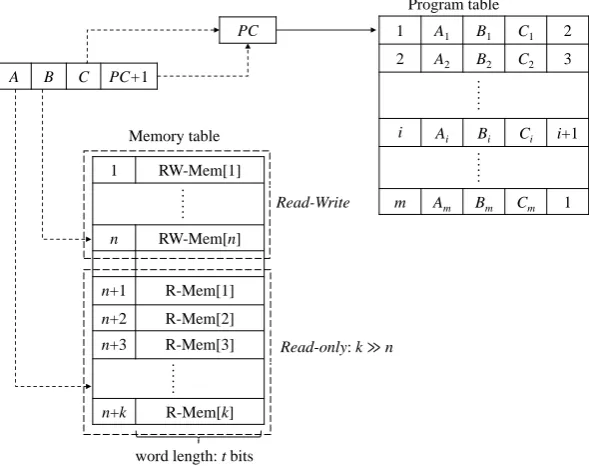
Figure 1: Format of SSS-Subleq The first block stores the instruction index
num-ber which is equivalent to the instruction address, the second and the third blocks store the operand ad-dresses and the fourth to fifth blocks store the branch indexCand the index of next instruction, respective-ly.
Besides the former operations, there is a need to implement the subtraction between two operands and determine the next instruction address according to the subtraction result. Therefore, we choose to represent every operand as a signed number. In order to perform subtraction in an easy way, we use two’s complement representation where subtraction can be transformed into addition. The most significant bit (MSB) is the sign bit. Analogous with the address, each bit of the operands is secret shared.
1 A1 B1 C1 2
2 A2 B2 C2 3
……
i Ai B…… i Ci i+1
m Am Bm Cm 1
Program table
Memory table PC
A B C PC+1
Read-Write
Read-only:k ≫n
1 RW-Mem[1]
……
n RW-Mem[n]
n+1 R-Mem[1]
n+2 R-Mem[2]
n+3 R-Mem[3]
……
n+k R-Mem[k]
word length: t bits
Figure 2: Architecture
The outline of our RAM architecture is presented Fig. 2. In our architecture, we use a modified Harvard architecture which not only physically separates storage and signal pathways for instructions and data, but also separates the read-only and read/write part of data. Note that since Shamir secret sharing is not multiplicatively homomorphic, degree reduction is needed after several multiplications. This special structure allows us to implement read and write operations in relatively efficient manner. In particular, the degree of the polynomials used for the read-only part (possibly big-data corpus) is unchanged throughout the execution(s).
The parameters of our architecture are presented in Table 1.
Table 1: The parameters of a program
Parameter Description
m The number of instructions of the user program
n The number of data items that can be accessed for read and write
k The number of data items that can be accessed for read only
t The bit length of the data stored in the memory
Here, we assume that the client program reads a large number of data items compared with the data items
the program writes to, thus we havek n. In the following, we will show how to simulate the four basic
Operation Details. We start describing the implementation of a function called: compare(U, V, r), whereU andV are secret shares of the unary address consisting ofr elements. For example, letU = u1, u2,· · ·, ur, V =v1, v2,· · ·, vrdenote the secret shares of two such parameters, we compute
compare(U, V, r) =
r X
i=1
(ui×vi) (2)
Analogous to Equation (1), the above expression testifies whetherU, V are identical or not. Based on Lemma
1, it is clear that the result ofcompare(U, V, r)is a secret share of 1 ifU =V, and otherwise, ifU 6=V, is 0. Procedure LOAD(H)
1: fori= 1tomdo
2: N umi ←compare(H, ηi, m)
3: S1←S1+N umi×Ai
4: S2←S2+N umi×Bi
5: S3←S3+N umi×Ci
6: S4←S4+N umi×(P Ci+ 1)
7: end for
8: returnS1kS2kS3kS4
Now we describe the details of the four opera-tions:
Description of LOAD: The initial values of Si are set to 0, and the symbolkmeans concatenation of all values fromS1 toS4. H represents the secret shares
of the instruction address which we want to load and ηi represents secret shares of thei-th instruction ad-dress. Based on Lemma 1, one can check that on-ly when the two address are identical, the result of
functioncompareis 1, otherwise 0. Thus, the value
returned is the right instruction we want to load.
Procedure JUMP(C) 1: P C ←C
2: LOAD(P C)
Description of JUMP: The operation JUMP is
near-ly the same as the operation LOAD. If the program
needs to execute theC-th instruction in the program table, it just assigns the last part of current instruc-tion to theP C. Then the program will “jump” to the destination.
Procedure READ(X)
1: fori= 1ton+kdo
2: N umi ←compare(X, i, n+k)
3: S←S+N umi×θi
4: end for 5: returnS
Description of READ: According to Fig. 2, the for-mat of the memory table consists of two parts: the address numberiand dataθi. Analogous to the
cor-responding analysis for the LOADoperation, we can
easily check thatSis the data whose index number is equal toX.
Procedure WRITE(X, Y)
1: fori= 1tondo
2: N umi ←compare(X, i, n+k)
3: θi←θi+N umi×(Y −θi)
4: end for
Description of WRITE: The operation implements
writing the data Y in the address X using secret
shares. Note that only wheni equalsX, theN umi is the secret shares of 1, and then the dataY can sub-stitute the former data item, otherwise the data will not be changed.
Implementation of SSS-Subleq.Until now, we have illustrated the necessary operations needed to
Two’s complement subtraction. The advantage of using two’s complement is the elimination of examining the signs of the operands to determine if addition or subtraction is needed. Therefore, to compute subtraction β−α, it only need to perform following steps:
• Convertα: Invert every bit ofαand add one, denoted byα¯+ 1.
• Addition: Perform binary addition and discard any overflowing bit, denoted byβ+ ¯α+ 1.
Note that we also need the sign bit ofβ−α−1. As described above, using two’s complement representation, the subtractionβ−αis converted toβ+ ¯α+ 1. Similarly, the subtractionβ−α−1is implemented as
β−α−1 =β+ ¯α+ 1−1 =β+ ¯α. The similarity allows us to implement these two subtractions together.
Algorithm 2The two’s complement subtraction using Shamir secret sharing
1: procedureSSS-SUB(A, B)
2: Input:A= [at−1at−2· · ·a1a0], B= [bt−1bt−2· · ·b1b0]whereai, biare secret shares of bits of two’s complement represented number.
3: Output:R= [rt−1rt−2· · ·r1r0]whereR=B−A, and the sign bit ofB−A−1
4: a0 = 1−a0 .Invert of the least significant bit
5: carry[0] =a0·b0
6: r0=a0+b0−2·carry[0] .Addition of the least significant bit
7: fori= 1totdo
8: ai= 1−ai .invert each bitA→A¯
9: ri =ai+bi−2aibi
10: carry[i] =aibi+carry[i−1]·ri .The carry bit
11: ri =ri+carry[i−1]−2·carry[i−1]·ri .The result bit
12: end for
13: sign=rt−1 .The sign bit ofB−A−1, used for branch
14: carry[0] =r0 .Add 1 to the result obtainB−A
15: r0= 1−r0
16: fori= 1totdo
17: carry[i] =ri·carry[i−1]
18: ri =ri+carry[i−1]−2·carry[i]
19: end for
20: return(Rksign)
21: end procedure
The algorithm for two’s complement subtraction using Shamir secret sharing is given in Algorithm 2. According to the proof of Lemma 1, we know the multiplications and additions/subtractions of the shares cor-respond to those of the secrets. Thus one can easily check that Algorithm 2 implements the two’s complement subtraction.
Algorithm 3The Shamir secret sharing based Subleq
1: procedureSSS-SUBLEQ(A, B, C)
2: R1 ←READ(A)
3: R2 ←READ(B)
4: RkN um=SSS-SUB(R1, R2)
5: WRITE(B, R)
6: JUMP(N um·C+ (1−N um)·(P C + 1)) 7: end procedure
Subleq can be implemented with secret shares
by Algorithm 3. In step 6, we can check that if
the value represented by R2 is less than R1, then
N um= 1, P C=C, elseN um= 0, P C=P C+1. Therefore, the expression of Step 6 implement the conditional branch of Subleq.
Degree Reduction. The main bottleneck of our scheme is the multiplication with shares used in the basic operations, as the Shamir secret sharing is
Algorithm 4Polynomial degree reduction for secret shares
1: procedureDECREASE(P(x), d, d∗)
2: Letu1,· · · , uE beEparticipants,Dbe therandomizerandRbe thereducer.
3: LetP(x)∈Fp[x]of degreedis the polynomial for secrets.
4: Drandomly selects polynomialf(x)of degreedandg(x)of degreed∗, wheref(x)andg(x)have the same constant term.
5: fori= 1toEdo
6: Dsends (f(ui), g(ui)) toui.
7: uicomputesP(ui) +f(ui)and sends it toR.
8: end for
9: Rinterpolates and computes a polynomialQ(x) =P(x) +f(x).
10: fori= 1toEdo
11: Rsends touithe coefficientsqj ofQ(x)with degree more thand∗.
12: uicomputesS =P(ui) +f(ui)−Pdj=d∗+1qjuj−g(ui).
13: returnS.
14: end for
15: end procedure
We observe that the READ, JUMPand LOADincrease the polynomial degrees related to each secret shared bit stored in the registers, the subtraction and WRITEincrease the degrees related to the data items stored in
the memory. Therefore, we have to process the degree reduction for these data items at a certain time. In [11], Dolev et al. proposed a method for reducing the polynomial degree without revealing the original secret. In our model, we define areducerthat is in charge of reducing the polynomial degrees and arandomizerin charge of generating random polynomials for all the participants. Note that the codes of thereducerand therandomizer
should be executed independently in order to protect the secrets, but either of them can be executed by the
dealer machine. The polynomial degree reduction algorithm appears in Algorithm 4.2
Different from the original algorithm presented in [11], we use the random polynomials f(x) of degree dinstead ofd∗. It is clear that addingf(x) toP(x)can hide all the coefficients of P(x) which prevent the
reducerfrom obtaining any information about the secret s. We also use another random polynomialg(x)of degree d∗, where the constant term of f(x) andg(x) are identical. In the end of Algorithm 4, each cloud subtracts g(ui) from the result which will keep the secret s unchanged (the change in the values of other coefficients of the polynomial does not influence the secret value). To protect the secrets, for every degree reduction, the random polynomialf(x), g(x)should be updated. In practical implementation, the dealer (with no randomizer) can secret share these polynomials to the clouds in advance or let clouds interact with the
randomizer, thus supplies on-line thesef(x)andg(x)pairs upon requests and the degree reduction process is performed with no involvement of the dealer during the execution.
Algorithm 5The SSS-Subleq plus degree reduction
1: procedureSSS-SUBLEQ-DR(A, B, C)
2: Decrease(AkBkCkP C+ 1,3`, `) 3: R1 ←READ(A)
4: R2 ←READ(B)
5: RkN um=SSS-SUB(R1, R2)
6: DECREASE(RkN um,∗, `)
7: WRITE(B, R)
8: JUMP(N um·C+ (1−N um)·(P C + 1)) 9: end procedure
In our proposed architecture, the read/write mem-ory is separated from the read-only memmem-ory. This design is more convenient for degree reduction com-pared with the classic architecture. Here, we perform
the reduction step before the WRITE and JUMP
op-erations. Compared with the whole memory space, the read/write registers are very small, thus, the num-ber of items for which we need to reduce the degree is relatively small. Assume that both the addresses and data items are secret shared using the polynomi-als of the same degree`, plus degree reduction step,
the Subleq can be implemented as in Algorithm 5. In step 6, we use∗instead of the exact degree parameter, as each secret shared bit ofRhas different polynomial degree.
2
4
Applications
In our model, we assume that a client wants to outsource a program in clouds and the program is compiled into Subleq-based program. The address is encoded using unary representation and the data item is encoded using two’s complement representation. The dealer picks random polynomials of degree`to share every bit of
the address and data. Then the dealer sends the secret shared program toE clouds. The integerE should be
greater than the highest polynomial degree generated during Algorithm 5. Note that the participating clouds do not communicate with each other and are possibly not aware concerning the number and identity of the other participants.
Initial stage. The P C of each cloud is initially set by the dealer. The values of the P C are the secret shares of the first address of the client’s program. In case there is no randomizer in the system, the dealer can guarantee that each cloud has enough precomputed values of polynomials to be used for degree reductions during the execution.
Execution stage.In this stage, the clouds have to perform the following works:
• Program Execution: Each cloud executes the secret shared program independently and does not
commu-nicate with other clouds.
• Degree Reduction: Each cloud performs Algorithm 4 to reduce the polynomial degree of the shares which
increased during the Subleq procedure. Furthermore, every cloud may record the communication with therandomizerandreducerfor audit, revealing possible maliciousreducers. A possible strategy is to use
severalreducers simultaneously. After each cloud received the answers from thereducers, they could
compare these results and notified the client/dealer whether thereducerswere malicious or not. Similarly the actions of therandomizercan be monitored, say by forwarding the values sent by therandomizerto thereducer, requesting to thereducersto reveal all coefficients, and not use these values, requesting new values from therandomizer.
Memory refresh. Although we decreased the polynomial degree of the shared secret before write, the
operation WRITEdoes increase the polynomial degree by`each time. Thus, the read/write part of memory
needs to be refreshed at intervals (e.g., every ten WRITEoperations). Note that this part of memory can be
relatively small compared with the whole memory, so it will not lead to too much bandwidth usage.
Dealer
Cloud 1
Cloud 2
Cloud E
Reducer
Randomizer
Figure 3: The outline of Our RAM model In Fig. 3, we give the outline of the
pro-gram execution. The communication between the clouds and the dealer, and the communi-cation between the clouds and the reducer(s) are all bidirectional. The dealer sends the se-cret shares of the client program and receives and reconstructs the program results executed by clouds. Moreover, we can use more than onereducer in order to check the integrity of the results and identify whichreduceris mali-cious.
Storage and Bandwidth. The storage of each cloud consists of the secret shares of the pro-gram instructions and the data. Notice that
se-cret share of one bit needs one or multi-word size storage which is denoted byω(1).
Data table. Each row of the data table consists of the index and data item, it totally requires(n+k)(n+ k+t)ω(1)words storage. As we previously assumed that the size of read-only table is much bigger than that of the read/write table, i.e.,kn, the storage requires roughlyO(k2)ω(1)words.
Instruction table. The cloud stores an instruction table of sizem, and each instruction consists of five parts. This requiresO(m)blocks storage with each block requiresO(3m+ 2n+ 2k)ω(1)words.
Otherwise every cloud needs to store a certain amount of shares which are pre-computed and dispatched by the dealer. These values could be generated and managed by a special database. The size of this database is dependent on the execution length of the program.
Bandwidth. For each Subleq, the clouds need to reduce the polynomial degrees of their data twice via
communication with thereducer (and therandomizer). For each degree reduction fromdtod∗, every cloud
first obtains two shared evaluations from the randomizer, and then sends thereducer one word and receive
d−d∗ coefficients from it, resulting in a total of approximatelyO(k+m+t)ω(1) words bandwidth used per cloud for one Subleq. In addition, the read/write memory needs to be refreshed at interval, it will result in O(kt)ω(1)words bandwidth usage. Therefore, in the worst case, the bandwidth of each cloud isO(kt)ω(1). Security Analysis Sketch. We note that during the whole procedure of our model, all of the information are secret shared inEclouds and no original information will be leaked to the cloud itself. Besides this, our model has two characteristics:
Security against adversary eavesdropping. For every LOADoperation, we had to compare the values stored inP C with all the indices in program table. It “touches” every position in the program table. Even through the adversary could eavesdrop on all the contents ofP C, registers, etc., the adversary could not know which instruction in the table was executed. The same thing also happens in read/write operations. The characteristic is similar to the schemes that are based on fully homomorphic encryption, but is information-theoretically secure.
Security against malicious clouds. Informally, a malicious server can corrupt data in storage; and devi-ate from the prescribed protocol, particularly, not performing execution correctly. However, the program is
outsourced toE clouds. Even if some of them output the wrong answers, the client can compare the results
interpolated from different set of answers and obtain the correct result, or better off, use [30].
Unary vs. Binary. In our scheme, we use the unary representation for the instruction and data addresses. This type of representation is inappropriate if the clients program is very large because of its redundant bits.
In a secret shared form, we have to usenwords to represent thesenbit which will lead to many operations
overFp. As described in Section 2, we can use binary representation as a substitution. Compared with unary representation, binary representation can express exponentially more numbers with the same number of bits. However, using binary representation to perform secret string matching is more complicated and will require more degree reduction operations. In practical implementation, one can choose the representation based on the consideration of their memory and computation capacity.
5
Conclusions
We discussed a novel model for outsourcing arbitrary computations that provide confidentiality, integrity, and verifiability. Unlike the former RAM-based secure computation models, our scheme hides the client program and data all the time and manipulates the secrets directly. Therefore, no confidential information would be revealed. The setting is particularly interesting in the scope of big data that is stored in secret sharing fashion over the clouds, and there is a need to repeatedly compute functions over the data without reconstructing the data from the shares.
An important observation is that the dealer (andreducer(s)) may share common roots of all polynomials, unknown to the participating clouds, where addition and multiplications keep the roots unchanged. These unknown roots can serve as additional keys, the number of possible roots grows exponentially with the degree of the polynomials.
References
[1] Amazon Elastic Compute Cloud (EC2),http://aws.amazon.com/ec2
[2] A. Afshar, Z. Hu, P. Mohassel and M. Rosulek, “How to Efficiently Evaluate RAM Programs with
Malicious Security”, Cryptology ePrint Archive, Report 2014/759, 2014
[3] G.T. Becker, F. Regazzoni, C. Paar, and W.P. Burleson, “Stealthy Dopant-Level Hardware Trojans”, Cryp-tographic Hardware and Embedded Systems - CHES 2013 Lecture Notes in Computer Science, Volume 8086, 2013, pp 197–214.
[4] M. Ben-Or, S. Goldwasser and A. Wigderson. “Completeness theorems for non-cryptographic
fault-tolerant distributed computation”, In Proceedings of the twentieth annual ACM symposium on Theory of
computing (STOC ’88), ACM, New York, NY, USA, 1-10.
[5] E. Boyle, S. Goldwasser, and S. Tessaro, “Communication locality in secure multiparty computation -how to run sublinear algorithms in a distributed setting”, In TCC, pages 356–376, 2013
[6] E. Boyle, K.M. Chung, R.Pass, “Large-Scale Secure Computation”, Cryptology ePrint Archive, Report
2014/404, 2014
[7] M. Brenner, J. Wiebelitz, G. von Voigt, M. Smith, “Secret program execution in the cloud applying
homomorphic encryption”, Proceedings of the 5th IEEE International Conference on Digital Ecosystems
and Technologies Conference (DEST), pp.114–119, May 2011
[8] M. Brenner, H. Perl, M. Smith, “How Practical is Homomorphically Encrypted Program Execution? An
Implementation and Performance Evaluation”, IEEE 11th International Conference on Trust, Security
and Privacy in Computing and Communications (TrustCom), pp.375–382, June 2012
[9] Clash of the clouds. The Economist. Online version available. http://www.economist.com/
displaystory.cfm?story_id=14637206;2009.
[10] I. Damgard, S. Meldgaard, and J.B. Nielsen, “Perfectly secure oblivious ram without random oracles”,In
TCC, pages 144–163, 2011.
[11] S. Dolev, J. Garay , N. Gilboa, V. Kolesnikov “Swarming Secrets”, In 47th Annual Allerton Conference,
1438–1445, 2009
[12] S. Dolev, N. Gilboa and X. Li, “Accumulating Automata and Cascaded Equations Automata for
Com-municationless Information Theoretically Secure Multi-Party Computation”, Cryptology ePrint Archive,
Report 2014/611, 2014
[13] Google Cloud Platform,https://cloud.google.com/storage/
[14] C. Gentry, “Fully homomorphic encryption using ideal lattices,” Proceedings of the 41st annual ACM
symposium on Theory of computing, ACM, 2009, pp. 169C178.
[15] C. Gentry, “A fully homomorphic encryption scheme”, Ph.D. dissertation, Stanford University, 2009
[16] C. Gentry, S. Halevi, “Implementing Gentrys fully-homomorphic encryption scheme,” Advances in
CryptologyCEUROCRYPT 2011, 2011, pp.129–148.
[17] C. Gentry, K.A. Goldman, S. Halevi, C. Julta, M. Raykova, D. Wichs, “Optimizing ORAM and Using
It Efficiently for Secure Computation”, Privacy Enhancing Technologies, Lecture Notes in Computer
Science, Volume 7981, 2013, pp 1–18.
[18] O. Goldreich, “Towards a theory of software protection and simulation by oblivious RAMs”.In STOC,
[19] O. Goldreich and R. Ostrovsky, “Software protection and simulation on oblivious RAMs”.J. ACM, 1996
[20] M.T. Goodrich, M. Mitzenmacher, O. Ohrimenko, and R. Tamassia, “Oblivious RAM simulation with
efficient worst-case access overhead”, In ACM Cloud Computing Security Workshop (CCSW), 2011
[21] HOMOMORPHIC ENCRYPTION,http://sites.nyuad.nyu.edu/moma/projects.html
[22] S. Lu, R. Ostrovsky, “How to Garble RAM Programs?”, Advances in Cryptology–EUROCRYPT 2013,
Lecture Notes in Computer Science, Volume 7881, 2013, pp 719–734.
[23] O. Mazonka, A. Kolodin, “A simple multi-processor computer based on subleq”, arXiv preprint
arX-iv:1106.2593, 2011.http://da.vidr.cc/projects/subleq/
[24] One instruction set computer, http://en.wikipedia.org/wiki/One_instruction_set_
computer
[25] A. Shamir, “How to share a secret”, Communications of the ACM, vol.22, no.11, pp.612–613, Nov. 1979
[26] E. Stefanov and E. Shi, “Multi-cloud oblivious storage”, In Proceedings of the 2013 ACM SIGSAC
conference on Computer & communications security (CCS’13), ACM, New York, NY, USA, pp.247–258, 2013
[27] SUBLEQ http://mazonka.com/subleq/
[28] M. Tehranipoor, F. Koushanfar, “A Survey of Hardware Trojan Taxonomy and Detection”,Design & Test
of Computers, IEEE, vol.27, no.1, pp.10–25, Jan.-Feb. 2010
[29] X. Wang, Y. Huang, T-H.H. Chan, A. Shelat, E. Shi, “SCORAM: Oblivious RAM for Secure
Computa-tion”,The 21st ACM Conference on Computer and Communications Security (CCS), Scottsdale, Arizona,
USA, November, 2014
[30] L. Welch, E.R. Berlekamp, Error correction for algebraic block codes, US Patent, 4 633 470, 1983.
[31] D. Zhuravlev, I. Samoilovych, R. Orlovskyi, I. Bondarenko, Y. Lavrenyuk, Yaroslav, “Encrypted
Pro-gram Execution”, IEEE 13th International Conference on Trust, Security and Privacy in Computing and