Reasoning with Neural Networks
Thesis by
David S. Babcock
In
Partial Fulfillment of the Requirements for the Degree ofDoctor of Philosophy
California Institute of Technology Pasadena, California
2000
Acknowledgements
Abstract
One model of human learning involves choosing an action based on past experiences in similar situations. The chosen action is typically modified to compensate for any dis-crepancies with the current situation. After sufficient experience has been obtained,
at least in a particular regime, the experiences are conceptualized into a general response mechanism. This thesis presents an algorithm that formalizes this hybrid reasoning process and applies it to control of a nonlinear physical system. Experiences are stored as vectors of variables known as cases in a set called a casebase. Vector
norms are used to select an appropriate case from the casebase which is then modified
using an adaptation routine. Once the modified action is applied to the system and the resulting outcome is observed, the casebase is augmented to include the new expe-rience for improved future performance. A gated expert neural network is eventually trained on subsets of the casebase to create local inverse model approximations for
regions of the input space where sufficient data is available to support generalization.
The gate network selects one of the experts if appropriate or otherwise defaults back to case-based reasoning. The applicability of the hybrid algorithm is demonstrated
Contents
Acknowledgements
Abstract
1 Introduction
2 Background
2.1 Casr- based Reasoning . . . . 2.1.1 Mathematical Analysis of ID Function Approximation 2.2 -:\eural -:\etworks . . . .
2.2.1
2.2.2 2.2.3
Basic Computational Elements Feedforward Networks . . .
Competitive ~etworks (\Vinner-Take-All) . 2.2.4 Mixture of Experts Networks
2.2.5 Learning \1odels 2.3 Control Theory . . .
2.3.1 System Identification 2.3.2 Linear System Analysis. 2.3.3 Nonlinear System Analysis 2.3.4 )ieural :\letwork Control 2.4 Related \Vork . . . .
3 Hybrid Reasoning System 3.1 Case-based Reasoning Iv! odel .
3.1.1 Case Structure . 3.1.2 Input Acquisition 3.1.3 Case Selection . .
3.1.4 Case Modification . 3.1.5 Case Application 3.1.6 Result Evaluation . 3.1.7 Casebase Augmentation 3.2 Neural Network Generalization 3.3 Hybrid Algorithm.
3.4 1D Case-based Reasoning Example 3.4.1 Input Acquisition
3.4.2 Case Selection . 3.4.3 Case Modification . 3.4.4 Case Application 3.4.5 Result Evaluation. 3.4.6 Casebase Augmentation
4 Experimental Setup
4.1 Description of Experimental Systems
4.1.1 Mathematical Equations for the System 4.1.2 Simulated Systems . . . .
4.1.3 Physical System Construction 4.2 Case-based Reasoning System .
4.2.1 Case Structure Variables 4.2.2 Input Acquisition Procedure 4.2.3 Case Selection Procedure. . 4.2.4 Case Modification Procedure. 4.2.5 Case Application Procedure . 4.2.6 Result Evaluation Procedure . 4.2.7 Casebase Augmentation Procedure
4.2.8 Neural Network Generalization Procedure
5 Results
5.1 Initial Cases
5.2 Analytic Control - Hand Tuned PD Controller 5.3 Full State Simulation . . .
5.4 Position Only Simulation. 5.5 Noisy Simulation . . . 5.6 Physical Hardware System 5.7 Neural Network Generalization 5.8 Hybrid System . . . .
6 Discussion and Conclusions 6.1 Discussion of Results . . .
6.2 Advantages and Disadvantages of the Hybrid Algorithm 6.3 Further Extensions
Bibliography
39
41
43 43
44
46 46
48 49 49
50
List of Figures
2.1 Pictorial representation of an artificial threshold neuron computational element. . . . . 8 2.2 Pictorial representation of a radial basis artificial neuron computational
element . . . .
2.3 Schematic diagram of a threshold element feedforward network. 2.4 Schematic diagram of a (discrete) mixture of experts network
architec-2.5 2.6 2.7 3.1 3.2 3.3 4.1
ture . . . .
Schematic diagram of inverse model control. Schematic diagram of forward model control.
Schematic diagram of perturbative model control.
Schematic diagram of the case-based reasoning algorithm ..
Schematic diagram of the hybrid case-based reasoning and gated expert algorithm . . . .
Case-based reasoning example ..
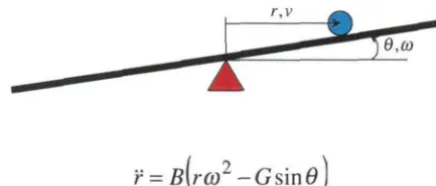
Diagram of the ball and beam system.
8 9
10
15 17 1720
25 2728
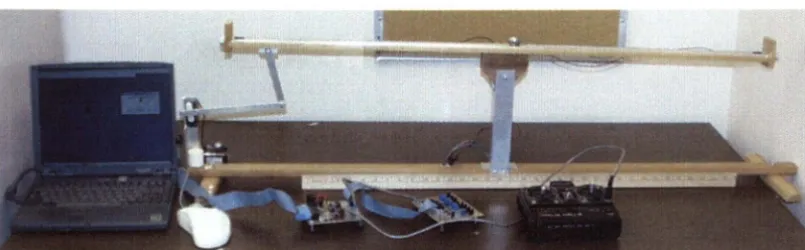
4.2 Picture of the experimental ball and beam system. . 31 4.3 Graphical representation of input sequence. . . 32
5.1 Hand tuned PD controller full state simulation results. 40 0.2 Hand tuned PD controller noisy simulation results. 40 5.3 Error convergence for the case-based reasoning algorithm. . 41 5.4 Full state simulation results. . . 42
5.5 Absolute error results for a full state simulation run with Vd
= 0.05.
425.6 Position only simulation results. . . 43
5.8 Noisy simulation results using a noise level of 0.005. 5.9 Physical hardware experimental system results.
Chapter 1
Introduction
Being members of the animal kingdom, we as human beings have certain basic biolog-ical responses built into our makeup. Often they are referred to as instincts or reflexes and they occur involuntarily whenever the external environment triggers them. We have no control over them and often cannot modify those behaviors. In most situa-tions that we encounter, however, we must decide on an appropriate action to take based on the outcome we desire.
One basic learning model simply involves rote memorization of action-result pairs. This type of reasoning is modeled using some type of reference, for example a lookup table or decision tree. The reference dictates the appropriate action to perform to achieve the desired result based on the current state of the system, hence the decision process consists of merely searching the reference. Learning only involves organizing the reference to expedite the searching, i.e., frequently encountered situations are located more quickly. Clearly this form of learning is constrained to tasks where there is only a limited number of discrete results and system states so that generalization is unnecessary. Furthermore, the system must be time invariant so that the same actions will be applicable at any time, i.e., the only relevant decision variables are the current state and the desired result.
number of examples from which to draw. In so doing, performance can be improved in subsequent situations by basing the decisions on experiences that are more similar to the current situation.
A third method of producing an action is using concepts. The concepts are gen-eralizations derived from extensive experience. Neural networks are often used to model this type of learning by approximating a mathematical function from a given
set of experiences (input-output data pairs). One condition for this type of learning to be successful is the training data set must be sufficient to adequately represent the
underlying function. Furthermore, the network model must be complex enough to approximate the function but not excessively complex to overfit the data.
The contribution of this thesis is to formalize a synthesis of the above decision processes using a hybrid case-based reasoning and neural network algorithm and
apply it to a nonlinear control problem. Case-based reasoning provides an inference
scheme to make reasonable decisions when only a limited amount of information is available. As more experiences are acquired, storage and retrieval of these experiences
becomes an issue. This problem is overcome by training neural networks on subsets of
these experiences reducing the storage and retrieval concerns. Therefore, the hybrid
system utilizes case-based reasoning to generate data sets that are then generalized
using neural networks when appropriate.
In the implementation of the case-based module, experiences arc stored as vectors
of variables known as cases in a set called a caseba8e. Vector norms are used to select
an appropriate case from the case base which is then modified using an adaptation
Chapter 2
Background
2.1
Case-based Reasoning
As Riesbeck and Schank [33] describe case-based reasoning, "input a problem, find a relevant old solution, adapt it." Barletta [4] subsequently lists five issues in case-based system development:
*
representation*
indexing*
storage and retrieval*
adaptation*
learning.Simply put, given the desired result and the current system state, the algorithm will select an action from a similar prior experience. Unless the desired result and current situation are identical to the prior experience, the selected action may be modified to compensate for these differences. After executing the new action, the al-gorithm observes the actual results and compares these results to what was expected. The errors provide additional experience that can be used in subsequent trials to improve future performance [10]. In this way, the algorithm increases the proficiency of performing a task through repeatedly acquiring more experiences upon which to draw in the decision process.
Case-based reasoning is typically used in expert systems for planning and di-agnostic tasks, e.g., medical treatment [2, 23] and fault analysis [21]. It has also been successfully applied to robot navigational control. Ram et al. improve reactive robot performance by utilizing case-based reasoning to discretely select and adapt the control parameters [30]. Ram and Santamaria further develop a technique for implementing case-based reasoning in a continuous fashion and also apply it to the task of robot navigation [31].
2.1.1
Mathematical Analysis of 1D Function Approximation
The rational behind case-based reasoning is to develop an algorithm which "learns"
to improve its performance in subsequent trials through the expansion of the set of experiences, i.e., the casebase. This means that as the casebase grows in size, the error
between the predicted outputs based on case modification and the actual resulting outputs should decrease. The following section gives a result to justify this procedure
in the case of a scalar function.
Assume there is an unknown, twice differentiable function Y
f(x)
such that1f'(X)1 ::; ,.
Let YI =f(XI)
andY2
=f(X2).
Furthermore, letY A(
x)
=
(Y2 -
Yl)
(x - xd
+
YI=
k(x - xd
+
YIX2 -
Xlwhich defines the secant line between
(Xl, YI)
and(X2' Y2)
with slope k, and define a functionE(X)=y-fj
Since
E(X)
is continuous on[Xl, X2]
and differentiable on(Xl, X2),
by the Mean Value Theorem from calculusE(X)
will achieve an extrema either atE(XI),
E(X2),
orwhere
E'(X)
=
O. SinceE(XI)
=
E(X2)
=
0, eitherE(X)
=
0 =}Y
=
fj
over the intervalSince
E(X:2)
=
r
X2 E'(x)dx+
E(xd=
r
E'(x)dx+
~X
2
E'(x)dx + E(xdl XI l XI l i ;
applying the boundary conditions and defining the value at the extrema as
fJ
givesI
i;lx2
E' ( X ) d.7:
=
-
_
E' (.7: ) dx=
,/JXI X
Considering the unknown function
!(J
:)
,
the Mean Value Theorem also states that kS ,
over the interval (Xl, X2)' Therefore E'(X) = f'(x) - k must satisfy, - 1 k 1
s
jE'
(x) 1s
,
+
1 k I· Wi thou t loss of generality, if we assume that the function is increasing in the interval (.1:[, x) with maximal slope,+
Ikl,
then over the interval(x, X:2) the maximal magnitude for the slope is , -
Ikl.
Hence we can bound themagnitude of the extrema by the following two inequalities
Combining these two inequalities gives
I
fJl
s
2,(x - Xd(X2 - x) (:[,2 - Xl)Since Xl
<
:1:<
:J:2, the maximum of (x - Xd(X2 - x) occurs whered _ _ _ _ _ X2
+
.7:)Hence
The last equation says that the maximal error is proportional to the size of the input interval. Therefore, the approximation error decreases as the number of input space intervals is increased, i.e., as more cases are generated. Conversely, a maximal input interval size can be computed for a desired error level assuming an upper bound
on the derivative of the underlying function can be approximated.
2.2
Neural Networks
The human brain operates based on a large distributed array of simple computational
elements called neurons. These neurons are interconnected by a network of axon
and dendrites. Information is passed from neuron to neuron through a series of
electrical impulses which travel along the initiating neuron's axon to the various
synaptic junctions with dendrites of receiving neurons. The signals are coded by the
sequential timing of the impulses (frequency) along with loss based on the location
of the synapse in relation to the receiving neuron's soma (amplitude).
2.2.1
Basic Computational Elements
Artificial neural networks attempt to simplistically model the biological system in a
similar fashion using basic interconnected computational elements. One common
ele-ment consists of a soft thresholding function, often the hyperbolic tangent or logistic function. The inputs to the neuron, Xi, are multiplied by weights, Wi, and offset by
a bias, b. The output of the threshold function is then multiplied by a second gain,
dements produce a soft thresholding of the weighted inputs. Hence the equation for
a hyperbolic tangent artificial neuron is given below with the corresponding picture in Figure 2.1.
y =
W
tanh(L
WiXi -b) - B
l
x •
l
x,:"
Figure 2.1: Pictorial representation of an artificial threshold neuron computational element.
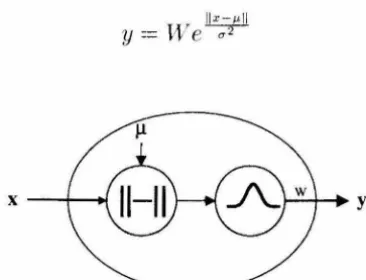
A second commonly used computational element is the radial basis neuron. The
output of this element is a measure of the distance (norm) between the input and the
center (mean) of the basis function. Typically an l2 vector norm is used as the distance
metric and the basis function is some form of gaussian. Such elements produce a
response in a local region of input space around the element's center. In the case of gaussian elements, the degree of localization is controlled by the variance. These
elements are mathematically represented by the following equation and pictorially shown in Figure 2.2.
IIX-/LII Y = J;Ve--;;'l
~+-·Y
Figure 2.2: Pictorial representation of a radial basis artificial neuron computational
[image:17.581.214.391.138.267.2] [image:17.581.210.393.501.641.2]2.2.2
Feedforward Networks
To perform useful computations, combinations of the above simple elements are con
-nected in various patterns to form networks. One common connection pattern consists
of organizing the neurons into layers such that the outputs of one layer are fed into
the inputs of subsequent layers. If the connections are only between adjacent layers
with no feedback, the network is called a feedforward network [13] pictorially shown
below in Figure 2.3. Such networks are commonly used with thresholding elements
for model-free function approximation problems.
Wll'
X Y
•
win,
•
•
Figure 2.3: Schematic diagram of a threshold element feed forward network.
2.2.3
Competitive Networks (Winner-Take-All)
Another type of network, which is often used for input classification problems, is
a competitive or winner-take-all network [13]. These networks consist of uniquely
indexed (usually radial basis) neurons which compute the distance, typically the
Euclidean vector norm, between the input and the neuron's center (mean). The index
of the neuron with the minimum distance, i.e., the "winner," is the output value of the
network. Such networks partition the input space into discrete (perhaps overlapping)
regions. The partitioning is useful when clustering or discrete classification of the
[image:18.579.196.411.245.388.2]2.2.4
Mixture of Experts Networks
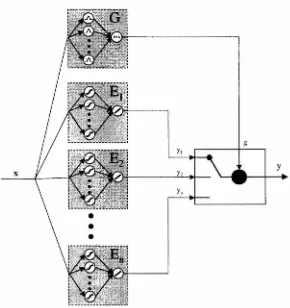
A hybrid network which combines feedforward and competitive networks is known
as a mixture of experts network [34]. This type of network uses several simple
feed-forward networks (experts) whose output is valid for particular regions of the input space (regions of expertise). The input is simultaneously processed by a
competi-tive network (gate) which generates a ranking for each expert. The final output of
the hybrid network is then a combination of the outputs from the experts based on
the gate's rankings. Two common combination techniques involve normalizing the
rankings and applying them as a weighted sum of the experts' outputs (continuous),
or simply selecting the highest ranking expert's output (discrete). The mixture of
experts structure is shown in Figure 2.4.
[image:19.575.152.442.295.603.2]y x
Figure 2.4: Schematic diagram of a (discrete) mixture of experts network architecture.
These networks avoid the need for a large single network to accurately model input
spaces that are only sparsely populated by locally dense pockets of data. Instead,
subsets of the data. The gate then only needs to be trained to select the corresponding expert instead of approximate the actual output value. A subsequent advantage of such an architecture is the capacity to add or expand experts to cover new data as it becomes available without retraining the entire network. Only the new expert and the gate networks need to be updated, significantly reducing retraining time.
2.2.5
Learning Models
Backpropagation
An efficient algorithm for training feedforward networks is backpropagation (see [13, 35] for a complete formalization of the algorithm). This method consists of pass-ing the input signals forward through the network to generate the network outputs. These outputs are then compared with the desired outputs to compute an error sig-nal. The weight updates are computed by propagating the error backwards through the network. The backward propagation step is performed using gradient decent to update the weights based on the derivative of the error function with respect to each weight. Weight updates are computed layer by layer since the updates for the (i - 1 )th layer can be computed directly from the updates for the ith layer, hence the
term backpropagation.
Competitive Learning
Training of competitive networks is dependent on the type of problem under
con-sideration. If the output classification is given for the training data, i.e., supervised learning, the network can be trained using backpropagation since the error signal is available. The input space is subsequently partitioned into regions that have pre-defined classifications.
likelihood metric is the training objective [16]. This procedure involves processing the training examples with the network to produce an initial classification. The mean of the examples in each class is then used to adjust the center of the classifying neuron closer to the mean of the cluster. The network then repeats the reclassification and neuron center updating until a stopping criteria is achieved. This type of learning clusters the data by distributing neurons within densely populated regions of the input space.
Mixture of Experts Training
Since mixture of experts networks are hybrids of both types of networks, both back-propagation and competitive learning are used to train the hybrid network. Initially the gate network (typically a radial basis network) is trained using unsupervised competitive learning. This step separates the training examples into subsets. These
subsets are then used as individual training sets for the expert networks which ap-proximate a local input-output function based on the data. The expert networks (usually standard feedforward networks) are trained using backpropagation. There-fore, the gate network is trained to select the appropriate expert based on the input and then the selected expert is trained to predict the output from the given inputs within its region of expertise.
Perturbative Learning
2.3
Control Theory
2.3.1
System Identification
The first step in any control design is to model the system to be controlled. This
iden-tification can either be done from physical first principles, empirically from collected
data, or from a combination of both. Such models are inherently incomplete for any
physical system since no model will capture all the dynamics, particularly induced
by noise, of the system. Furthermore, generally the models are linear in nature since
there is a rich set of analysis and design tools available for such systems [19]. If the
system is fairly linear with reasonable noise levels, such a linear model is often
suffi-cient to design a robust controller that achieves the desired performance level when
applied to the real system [8]. However, the model will only be as accurate as the
data used to generate the model. Hence any noise present in either the applied input
signals or in the output sensor measurements will limit the precision to which the
system can be modeled. Furthermore, if aspects of the physical system change over
time, for example due to wear or changes in components, then a new data set must
be obtained to derive a new model.
Model free identification systems, such as neural networks, provide a tool for
generically approximating the input-output map of the underlying physical system (at
least locally) without any a priori knowledge of the dynamics [20, 25]. Such models,
however, generally give no information about the structure of the system, particularly
in operating regimes where no training data is available. Therefore, caution must be
exercised when these models are used for controller design or validation since the
controller may drive the system into regions where the model is not valid. Since the
model can be continuously updated over time as necessary to compensate for changes
in the physical system, however, the controller can simultaneously be adjusted to
2.3.2
Linear System Analysis
Many powerful techniques for designing robust controllers for linear systems exist [8].
Often times for non-critical applications, a standard PID controller is used. The
controller gains are tuned by hand until acceptable performance is obtained.
Algo-rithms also exist to allow the controllers to be self-tuning where the parameters are
adjusted automatically based on the deviation of the desired output from the actual
output [28]. Such controllers avoid the need for system identification on a
quanti-tative level but have limitations to the systems they are able to adequately control.
More complex systems, either high order linear or nonlinear, require system
identifi-cation before more advanced techniques, such as I-l-synthesis, can be used. Moreover
some systems have nonlinearities, present in any physical system, that are sufficiently
large such that any robust controller designed using linear techniques cannot provide
acceptable performance.
2.3.3
Nonlinear System Analysis
Due to the wide range of possible nonlinear systems, a general controller synthesis
technique does not yet exist. There are techniques which are useful for designing
con-trollers for particular classes of nonlinear systems that satisfy certain conditions [27].
For example, the approximate linearization technique attempts to input-output
lin-earize a system about an operating point and then apply linear control theory to
design a controller [12]. The technique can be repeated for several operating points
and a scheduler implemented to select the appropriate controller depending on the
particular operating point of the system. This technique is effective only if the system
has a significant linear range about the selected operating points. Furthermore, such
a design requires a system identification step for each operating point.
Other techniques exist to design nonlinear controllers that remove the nonlinear
dynamics of the system thus making the extended system linear [15]. The rich set of
linear control techniques can then be applied to the new system to derive a robust
controller. Such procedures again require a fairly accurate system identification,
2.3.4
Neural
Network
Control
Recently neural networks have been employed in both system identification and
con-troller design [9, 20, 24, 25, 29]. The advantage of neural controllers is their inherent
model-free representation, thus avoiding system identification (although if done may
provide a good initial starting point for training the controller). One disadvantage is
the complexity of the controller must be high enough to model the underlying system
dynamics but not too high that the data is overfit producing poor generalization. Also
the controller must first be trained, either on-line or off-line, before being employed,
which may not be feasible on certain critical or unstable systems. Three neural
con-trol schemes that will be briefly discussed are inverse model control, forward model
control, and perturbative control.
Inverse Model Control
This controller model uses a neural network to approximate the inverse input-output
map of the system [37] and has been applied to many control problems including robot
control [38]. The inputs to the inverse model neural network are the actual outputs
of the system. The desired output of the neural network is the actual applied input
to the system. Hence, the error signal used for training is the difference between the
actual applied input and the input the model network would predict given the actual
system output. A copy of the inverse model network is then used as a feedforward
controller. The desired plant output is input to the controller which then predicts an
appropriate plant input to achieve that output. This scheme is shown in Figure 2.5.
weight copy
[image:24.575.188.404.549.640.2]Initially, a rich set of system inputs and resulting outputs needs to be gathered
In order to train a reasonable starting model and corresponding controller. After the initial training, the predicted system inputs from the controller and the resulting
system outputs provide new training examples which are used to continually update
the inverse model and controller. Thus control can be performed successfully even on
systems which change over time (assuming the changes occur on a slower time scale than is required to sufficiently adapt the network). Furthermore, the general function
approximation capabilities of neural networks allow this technique to be applied to both linear and nonlinear systems. One limitation of this technique, however, is that it cannot be used for systems which either do not have an inverse or with an unstable
inverse, since the network will be unable to converge to a stable set of weights.
Forward Model Control
To avoid the problem of the existence of an inverse plant, a second neural control
scheme, known as forward model control, can be used [24, pages 216-217]. This setup
employs two distinct networks, one for the model and one for the controller. The
in-put to the model network is the actual input to the plant (which is also the output of
the controller network). The desired output of the model network is the co rrespond-ing output from the plant. The error signal is the discrepancy between the predicted
output from the model and the actual output. This error signal is backpropagated
through the forward model to update the model weights. Then further bac
kpropaga-tion from the model is applied to update the controller weights. Figure 2.6 shows a
schematic representation of this setup.
Both networks are trained as if they are a single larger multi-layer network. Prac
-tically, two networks are typically used so that they can be updated at different rates, for example updating the weights of the model more frequently than those of the
controller. The advantage of this technique is that the forward model can always be
trained to provide at least a locally accurate model of the plant, hence a local co
n-troller can theoretically also be trained. The disadvantage is that since both networks
controller weight update
model weight update
[image:26.577.187.402.53.184.2] [image:26.577.191.407.478.577.2]y
Figure 2.6: Schematic diagram of forward model control.
particularly initially. Hence, if the system is rapidly changing, the networks (the
forward model in particular) may never converge adequately.
Perturbative Control
A third neural control technique involves using only a controller network. The
net-work is trained using perturbative methods [1] where the applied perturbations are
influenced by the performance of the controller. Clearly this technique is of limited
utility due to the slower convergence rates of perturbative learning. However, for
cer-tain systems that have very slow dynamics, such a technique provides for a physically
implement able controller due to the simplicity of the learning algorithm. This simple
scheme is shown in Figure 2.7.
+ on troller weight update
2.4 Related Work
Many hybrid schemes have been developed combining case-based reasoning with neu-ral networks and other techniques in various applications. Neural networks have been
combined with case-based reasoning in the medical field for congenital heart disease diagnosis [32J. The hybrid system attempts to circumvent the deficiencies inherent in the two approaches when implemented separately, namely storage and retrieval issues for case-based reasoning and output explanation and interpretation for neural networks. Another hybrid algorithm has been successfully implemented for the design of mixing systems where fuzzy logic and neural networks are used to perform case
adaptation [18J.
Many hybrid schemes have also been implemented in control applications. A combination of a rule-based expert system with fuzzy logic and neural networks was
applied to the truck and trailer backer-upper control problem [14]. Associative
mem-ories, a technique similar to case-based reasoning, has also proven useful for control problems [11]. For example, Atkeson et al. have successfully applied this approach to
train a robot to perform a juggling task [3].
A wide range of controllers have been designed for the ball and beam problem. Hauser, et al. design a nonlinear controller by approximating the ball and beam system with one that is input-output linearizable [12]. Several different variations of fuzzy logic controllers have likewise been successfully applied to ball and beam control [6, 22, 36]. A recurrent neural network solution has been developed by Chu, et al. [7] Finally, Ng and Trivedi present a hybrid fuzzy logic and neural network controller
Chapter 3
Hybrid Reasoning System
The motivation behind this thesis is to combine case-based reasoning with neural networks to realize the advantages of both methods. Case-based reasoning is used to intelligently generate an initial set of data (the casebase). This data set is then partitioned into local clusters using a radial basis competitive learning network (the
gate). Separate simple threshold neuron feedforward networks (the experts) are then trained to approximate the underlying local input-output functions represented by the local subsets of cases. Whenever the desired output lies sufficiently close to the center of one of the experts, the gate will select that expert to generate the predicted input. Otherwise if no expert is close, the gate will pass the decision to the case-based reasoning module to determine the action to implement. As more cases are generated, the system can retrain or add new experts (and concurrently modify the gate) to incorporate the new information. Furthermore, if the experts no longer produce acceptable results, for example due to changes in the underlying system, they can be removed until a new set of cases is created in that region of input space.
3.1
Case-based Reasoning Model
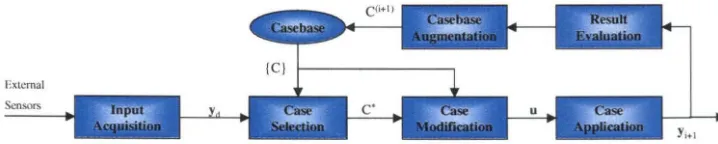
ex-ternal system. The resulting output is analyzed by the result evaluation module to determine whether some type of unusual or anomalous event occurred during the execution of the input. If the output is reasonable, the casebase is expanded using
case augmentation to construct a new experience based on the applied input/resulting
output pair allowing the system to learn from the experience. The entire procedure is shown schematically in Figure 3.1. The remainder of this section describes each of these routines in more detail.
External
[image:29.579.116.475.208.280.2]Sensors
Figure 3.1: Schematic diagram of the case-based reasoning algorithm.
3.1.1
Case Structure
Each case consists of a number of variables which contain information about the resulting output (and usually the initial state) and the applied input. Hence, a case
is generically defined as a vector C consisting of two subvectors y and
u
c
= [ :1
where y contains the initial and final states of the system, i.e., the resulting output,
and u contains the applied input. Other values, such as time for execution or expended
energy, may also be included for use in case selection.
3.1.2
Input Acquisition
The starting point of any reasoning system involves acquiring data describing the current state of the system. Human beings use their five senses to collect information
about the environment in which they are operating. Machine systems obtain this
data can be noisy and cluttered with extraneous information. Hence some form of signal preprocessing, i.e., a filter, is applied so that only the important information is passed on. This preprocessing step is important in improving the efficiency of the
reasoning engine.
For any algorithm to work, the input data must sufficiently describe the current
state of the system. Additionally, the algorithm must also be provided with the
desired result to be obtained. Compiling these two pieces of information in the desired
result vector, Y d, a decision can be made as to what action is necessary to achieve
the desired result given the current state.
3.1.3
Case Selection
Once the desired result vector is constructed, the second step in the reasoning process involves selecting the basis case, denoted by C*, which represents the past experience
that is most similar to the current situation. This selection is done by choosing a
distance metric (typically the l2 vector norm) as a measure of the distance between
the desired result vector, Yd, and the output vector from each case, y(i). A weighting
matrix,
rv
,
can be used to bias the metric in favor of certain important componentswithin the output vector. Assuming discretely numbered sequential cases indexed by
i, the selection criteria is given by
A useful extension is often to apply a temporal weighting factor to the metric so
that the most recently generated cases are favored more heavily. This technique allows
for the casebase to dynamically adapt to a system that may be changing over time,
for example due to mechanical wear. Since the recent cases represent examples of the
input-output map at the current time, they may be more appropriate for determining
a proper action than distant past experiences, even if the more recent output vector
Sometimes due to natural symmetry within the system, additional cases can be inferred from the existing ones. In particular, if the system is time invariant, then an
"inverse" case can be created by applying the inputs backwards in time and reversing
the initial and final states.
3.1.4
Case Modification
The input vector from the basis case provides the initial input "guess" denoted by u*.
In general, however, the selected basis case will not be an exact match to the desired result vector. Hence, the system can either directly apply the basis case (u = u*)
thus accepting that significant error may exist in the output, or modify the input
vector from the basis case in an attempt to produce a better output. A common
method of modifying the basis case is to use first order gradient information within a local neighborhood. By numerically approximating the gradient using cases close
to the basis case, a first order linear correction factor can be computed. Depending
on the dimensionality of the system and the density of the cases within the local
neighborhood, higher order corrections can also be computed.
3.1.5
Case Application
After modification of the inputs from the basis case, the final input,
u,
is then applied to the system. The algorithm monitors the state of the system to watch for anomalous behavior. Once the input sequence has completed, the resulting outputs are measuredand passed on to the result evaluation routine.
3.1.6
Result Evaluation
Before constructing a new case, the results must be validated to avoid corrupting the
casebase. The validation step often checks if something anomalous occurred during
inputs. However, t.he anomalous cases are often stored in a separate casebase so
that modified cases can be compared with them in order to prevent the system from
performing a similar mistake.
3.1. 7
Casebase Augmentation
Assuming nothing anomalous occurred during the execution of the case, the initial
state and resulting output is stored in a vector y(i+I). Combining this vector with
the applied input vector, il, a new case is constructed as
[
(i+I)
1
C(i+I) = Y ilThe case base is augmented with this new case which is then used in subsequent case
selection and modification steps.
3.2
Neural Network Generalization
Since each case in the casebase represents an input-output pair from the underlying
system's transfer function, a natural extension is to generalize a sufficiently dense
case-base into a mathematical function. This procedure reduces the storage and retrieval
requirements of the case-based algorithm by directly computing the appropriate
sys-tem input given the desired output. Any function approximation technique can be
employed to generalize the data. For specific systems, it may be beneficial to tailor
the functional form in order to take advantage of physical principles or other known
relationships inherent in the underlying system. Otherwise, model-free
approxima-tion techniques, such as neural networks, can be used for more generic generalization.
Typically these techniques will require more data to avoid overfitting and insure good
generalization performance. The benefit is that they are not restricted to any
As discussed in Section 2.2.4, mixture of experts networks are often used for problems that have clusters of data. The advantage of this technique is that several simple networks can be quickly trained to cover the important regions of the state space rather than attempting to cover the entire state space with a single complex network. Expert networks are only created in regions where enough experience has been gained to support generalization. Outside these regions, the computed output can either be an interpolated value between experts or an extrapolated one based on the nearest expert. Each expert can be viewed as implementing a local version of inverse model control (refer to Section 2.3.4) and updated whenever it is selected to
generate the system output.
3.3 Hybrid Algorithm
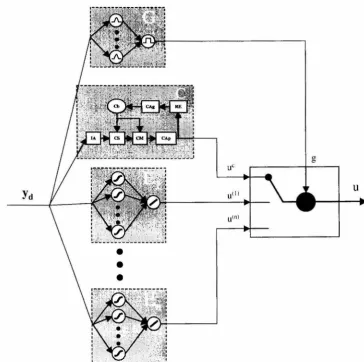
The purpose of this work is to combine a discrete variation of the mixture of experts technique, known as a gated expert network, with case-based reasoning. In this implementation, the gate network produces a winner-take-all decision rather than a vector of mixing coefficients. Hence, each data point is allocated to one and only one
expert, dividing the input space into mutually exclusive regions. The center of each
region, i.e., the mean of the corresponding gate network neuron, is denoted by p,. The algorithm used in this work additionally bounds the regions of expertise of the expert networks to a local area where there is data by setting a threshold, denoted by
f, around the expert centers. This bounding allows the gate to default the decision to the case-based reasoning module if the desired result is not within the regions of expertise of any of the expert networks. Formally the output of the hybrid algorithm
is given by
{ UC u=
u(il minllYd - p,(illl otherwise
z
A schematic diagram of the hybrid algorithm is given below in Figure 3.2.
g
u"
u
U(IIFigure 3.2: Schematic diagram of the hybrid case-based reasoning and gated expert
algorithm.
3.4
ID Case-based Reasoning Example
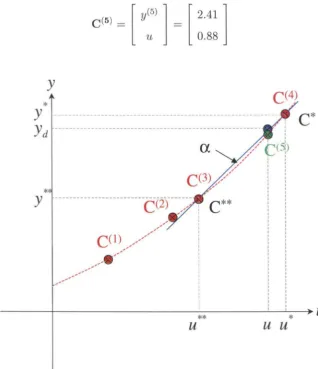
The case-based reasoning procedure will now be demonstrated through a simple 1D function approximation problem. Assume the underlying function is given by
f (u)
= eUover the interval 0 ::; u ::; 1. Furthermore, take as initial cases the four data points
given by
c
=
[
y ]=
{ [
1.26 ] , [ 1.63] , [ 1.84] , [2
.
5~
] } u 0.23 0.49 0.61 0.90 [image:34.576.111.475.77.439.2]3.4.1
Input Acquisition
For this simple example, the desired result vector is only the desired output value
Yd = 2.44.
3.4.2
Case Selection
L~sing the ahsolute difference as the metric, the distances are computed as follows
IIYd - y(i)
II
=
IYd -y(i)1
=
{1.18, 0.81, 0.60, 0.15}Hence, the selected basis case is
C*
=
{C(i)I
min IIYd - y(i)II}
=
c(4)1
3.4.3
Case Modification
In this 10 example, simple first-order linear interpolation will be used to modify 11,*,
refer to Figure 3.3. The nearest case in input space to C*, which shall be denoted by C**, is clearly C(3). Formally,
Therefore, a correction factor, a, is computed as
Yd - y* 2.44 - 2.59
n
=
=
=
0.20y** - y* 1.84 - 2.59
Applying this correction factor gives a predicted input of
3.4.4
Case Application
Applying the predicted input
u
= 0.88 produces the actual output y =f(u)
= 2.41giving an error of
Iy -
Ydl=
12.41 - 2.441=
0.03.3.4.5
Result Evaluation
Since the predicted input is within the interval for which the underlying function is
defined, the output is valid. Therefore, y(5) = 2.41.
3.4.6
Casebase Augmentation
Hence, the case base can be updated to include the new case
C(5) = [ y(5)
1 [
2.411
u 0.88
y
*
y
---
- -
--y
d --- ,ex
,
//
td)
C
*
C(3) ,/ ,/
,/
*
y
---
---
---
---C (1) / / / /
.
,-,-,-... '
,-... .,. ... , ...
---+---~**---~~-*~u
[image:36.576.136.454.307.675.2]u
u
u
Chapter 4
Experimental Setup
4.1
Descript
i
o
n
of Experimental Systems
The experimental system selected to demonstrate the hybrid algorithm is the standard
ball and beam control problem [12]. The objective of the control is to rotate the
beam in such a way that the ball position follows a desired trajectory. For the
experiments, three distinct setpoints are defined along the beam and the control
algorithm produces inputs that transition the ball position between these setpoints,
i.e., a setpoint regulation task. The system with corresponding variables is pictorially
given below in Figure 4.1.
-
.
)
8.W
[image:37.584.187.405.346.439.2]
-r
=B(rm
2 -Gsin8)Figure 4.1: Diagram of the ball and beam system.
4.1.1
M
athe
matical
Equations for the Sy
stem
Given the moment of inertia for the beam Jb; the mass, radius, and moment of
inertia of the ball
M,
R,
and J respectively; and the acceleration due to gravity G;the equations of motion for the system are given by
o
=
(~~
+
M)
r
+
MGsinB -
MriP
where T is the ball position, () is the beam angle, and T is the applied torque on the
beam. Furthermore, setting the input u = () gives
T =
2MTiiJ
+
MGrcos{)+
(Mr2
+
J
+
J
b) UDefining a constant
B
asM
B
= 0-1&+M
the equations of motion can be rewritten in state-space form as
Xl
.T2
X3
:£4
y
where
X2
B(
x
\
:
d
-
G sin X3)X4
U
Xl
r
T
X=
()
()
y=T
However, for the experimental systems under consideration, only the desired beam
angle, X3, can be commanded. Thus the actual dynamics of the beam servo in
4.1.2
Simulated Systems
The computer simulation computes the dynamics of the equations given above using a fourth order Runge-Kutta method. Constraints are placed on the ball position to account for the ball reaching the end of the beam. If this situation occurs, the ball position is clipped to the beam end and the velocity is set to zero (simulating a stop at each end of the beam). Furthermore, the beam transition dynamics are modeled using a constant angular velocity resulting in a linear angular change from the current
angle to the commanded angle. The program is written such that the simulation runs in real-time with the update time user definable. This setup allows for accurate prediction of the performance of the hybrid control algorithm when applied to the physical system.
The computer simulation allows for three different simulation modes. The first
mode is a full state mode in which the reasoning algorithm is provided with the exact position and velocity of the ball at each update time. The second mode is a position
only mode where the algorithm is given just the exact ball position. In this mode, the controller must approximate the ball velocity thus introducing a time lag into
the velocity measurement. The final mode is a noisy position mode which introduces additive, uniformly distributed noise into each ball position measurement. The noise level is set to roughly correspond with the noise level present in the physical system. For this mode the algorithm is again required to approximate the velocity from the
noisy position measurements.
4.1.3
Physical System Construction
The physical system consists of a beam that is 4 ft. in length and utilizes a steel
pinball. The beam is constructed from two parallel rods attached via a mechanical linkage to a standard RC servo. A PC is connected to the system using a custom built
I/O board which attaches through the parallel port. The board consists of buffered analog inputs that are converted to discrete lO-bit integers using a Maxim 186 A/D chip. The board also provides analog output channels with lO-bit resolution using a
One of the beam's rods is constructed of threaded nylon wrapped with resistive
Ni-chrome wire giving an end to end resistance of approximately 100 ohms. The
second rod is made of aluminum. A fixed voltage from the I/O board (5V) is applied
to the ends of the resistive rod. The ball then acts as a contact between the resistive
wire and the aluminum rod. Hence, the ball's position on the beam is sensed as the
voltage on the aluminum rod. This signal is passed through a simple low pass filter in
order to smooth out the signal before being fed into one of the analog input channels
on the I/O board.
The beam angle is set using an analog output channel on the I/O board. The
analog voltage is fed into a standard RC transmitter which performs the necessary
signal conversion and transmission to a standard RC receiver attached to the beam
support. A servo is then connected to the receiver and mechanically linked to the
beam. This setup provides a generic interface for the computer to control any system
utilizing RC servos. A photograph of the complete system is shown below in Figure
4.2.
[image:40.578.107.510.427.552.2]4.2
Case-based Reasoning System
The details of the implemented case-based control algorithm using the structure
pre-sented in chapter three will now be prepre-sented.
4.
2
.1
Case Structu
r
e Variables
The input sequence consists of tilting the beam to a particular angle, Ul, until the
ball passes a particular reference position on the beam, Ym. The beam is then tilted
to another angle, U2, until the ball achieves a particular velocity, Vm , at which point
the beam is returned to level. This sequence produces a corresponding roughly linear
velocity change and subsequent quadratic positional change in ball position as shown
in Figure 4.3.
e
• t
y",
[image:41.573.222.367.310.544.2]Yo -1--"'--- - - .
Figure 4.3: Graphical representation of input sequence.
The input sequence variables are stored in a vector, u, defined as
Ul
Ym
U =
U2
The initial state variables of the system and the resulting output variables are stored
in a vector, y, defined as
b.y
YI - Yo.6. V VI - Vo
y=
Yo Yo
710 Vo
Combining the above two vectors, the ith case is defined as a vector C(i) as follows
y(i)
C(i) = u(i) .6.t(i)
where .6.t = t I -
to
is the total case execution time.4.2.2
Input Acquisition Procedure
The reasoning algorithm is given the measured (possibly noisy) ball position, Yo·
For the full state simulations, the algorithm is also given the measured velocity, vo,
otherwise the velocity is approximated by a simple linear regression fit within a sliding
window of positional data. The desired final setpoint, Yd, and desired final velocity,
Vd, are also provided. Thus the desired result vector is constructed as
Yd - Yo
Yd =
Yo
Vo
4.2.3
Case Selection
Procedure
Case selection is based on a weighted 12 norm for both the actual case and the inverse
1 0
o o
o
0.5 0 0W=
o
0 0.5 0o
0 0 0.1This matrix emphasizes the positional change variable and to a lesser extent the
velocity change and initial position variables. Hence, the basis case, C*, is found by
4.2.4
Case Modification Procedure
Case modification is performed using a simple linear interpolation/extrapolation rou-tine. The casebase is searched to find the adaptation case, C**, that has minimum
distance in input space (again using the l2 norm) from the basis case, C*, selected in the previous step.
A linear correction factor, a, is then computed using the positional change variable as
6.Yd - 6.y* a = -6.y** - 6.y*
The correction factor is used to compute the actual input, u, to be applied to the beam as follows
Additionally, the transition velocity,
Vrn ,
is modified based on the final velocity of the basis case, the desired final velocity, and the ratio of the second beam angles byVrn
(v~
-
(vj -Vd))
~~
(v;n -
(~v*
+
v~
- Vd)) u:
1L24.2.5
Case Application Procedure
The input vector, u, is then applied to the system from the initial conditions, Yo and
va, using the sequence of beam angle transitions described in Section 4.2.1. If at any time during the execution of the case the ball reaches the end of the beam, an invalid
flag is set to indicate this anomalous situation.
4.2.6
Result Evaluation Procedure
If the invalid flag was not set during case execution, then the measured final ball position, Yf, and ball velocity, vf, are used to form the resulting output subvector
Yf - Yo
Vf - Va Yo
Va
4.2.7
Case base
Augmentation Procedure
This resulting output subvector is then combined with the applied input vector to
generate the new case
4.2.8
Neural Network Generalization Procedure
After a substantial number of cases have been generated, generalization using a gated
expert neural network is performed. The cases are first clustered based on the
po-sitional change variable, boy, and the initial position variable, Yo. This clustering
is done using a simple radial basis network (the
gate)
trained using EMunsuper-vised competitive learning as described in Section 2.2.5. The number of radial basis
neurons in the gate network (and correspondingly the number of expert feed forward
networks) is chosen based on the number of possible set point transitions. One neuron
(and expert) is allocated for each distinct combination of positional change and initial
position. The center of each neuron, denoted by J1-{i), represents the mean of the class
corresponding to the particular combination.
Once the gate network is trained, the original case base is segmented into individual
casebases based on the classification from the gate. Individual feedforward threshold
neuron networks (the
ex
perts)
are trained using backpropagation for each subset ofcases using y(i) as inputs and u(i) as the corresponding target output. Each expert
network essentially approximates a local inverse plant model from its training set.
The network function for the ith expert is denoted by
A threshold, denoted by t, is set for the output of the gate network neurons to
insure that the regions of expertise for the experts are bounded and mutually
exclu-sive, i.e., produce distinct classes for all inputs. As subsequent desired result vectors,
Yd, are presented to the gate network, the outputs of the gate neurons are compared to the threshold. If the output of a neuron is less than the threshold (meaning the
desired result vector lies within the region of expertise of the corresponding expert),
then the final output of the hybrid algorithm, u, is the output of that expert given the
desired result vector. Otherwise, if the output of all the neurons exceeds the
thresh-old, the gate defaults back to case-based reasoning to determine the final output,
Formally, the final output of the hybrid algorithm is given by
{
c of
II
_
(i)11
\.-10-1u 1 Yd J.L >Ev~- ,ooo,n
U = U(i) = E(i)(Yd) minllYd -
J.L(i)11
otherwiseEach new resulting output/applied input pair,
(y,
u), is then used as either a trainingpoint for the selected (inverse model) expert as discussed in Section 203.4 or as a new
Chapter 5
Results
For all the simulation experiments, except the hybrid run, there are three fixed
set-points located at 25%, 50%, and 75% of the total beam length and will be referred to
as 8}, 82, and 83, respectively. The update time for the simulation is set to oms, the
lumped constant in the state space equations given in Section 4.1.1 is B = 0.7, and
the gravitational constant is set as G = 9.81. All ball positions are given as a
nor-malized fraction of total beam length, i.e., zero representing the left end of the beam
and one representing the right end. Velocity values are correspondingly fractions of
beam length per second. Finally, unless otherwise stated, the desired final velocity is
assumed to be zero (Vd = 0), i.e., the ball is stopped at the setpoint.
5.1
Initial Cases
Two paradigm cases are given to the algorithm to create the initial casebase. The first
case consists of applying beam angles of approximately half the maximum angular
displacement in an attempt to transition from the initial position, Yo, to 83 with a
final velocity Vd. The transition point, Ym, is given as 40% of the distance to the finish
position. Hence after applying the initial inputs the first case is given by
(1)
Yf - Yo
(1) Vf
Yo
o
:!!:..zruu:. 2
From the ending state of the first case, (yj1),
v?»)
,
the second case attempts to return the ball back to Yo using beam angles of approximately one quarter maximum,again with final velocity Vd. The final transition velocity is computed based on the
final velocity after the completion of the previous case (refer to Section 4.2.4) as
Hence, the second case is given by
(2) (1)
Yf - Yf
(2) (1)
Vf - Vf
(1)
Yf (1)
C(2) = Vf
where the final position after applying the case is yj2) and the final velocity is vj2).
5.2
Analytic Control- Hand Tuned PD Controller
The first controller implemented for baseline comparison is a simple PD (Proportional-Derivative) linear controller. The control law is given by
u = Py
+
Dy
= Py+
DvThe values for the constants were empirically chosen as
P
= -1.0 andD
=-1.5 to give a slightly overdamped response with good performance. The results
[image:48.573.76.505.80.453.2]of implementing this controller in the full state simulation is shown in Figure 5.1.
Figure 5.2 shows the performance of the same PD controller when random uniform
additive noise perturbations (with a level of 0.005, refer to Section 5.5) are applied
0.9 0.8 0.7 0.6
<=
0
~05
..
&>0.4 0.3 0.2 0.1
a a
10 20 30 40 50
time (sec)
60 70 80 90 100
Figure 5.1: Hand tuned PD controller full state simulation results.
0.9 0.8 0.7 0.6
<= 0 ~
~0.5
..
&>0.4
0.3 0.2 0.1
a
a 10 20 30 40 50 60 70 80 90 100
[image:49.575.163.424.48.262.2] [image:49.575.164.425.346.562.2]time (sec)
5.3
Full State Simulation
As described in Section 4.1.2, the reasoning algorithm in this simulation mode is
provided with both the exact position and velocity. These variables are used to
create the desired result vector as well as determine the transition points during case
execution. In order to demonstrate the feasibility of case-based reasoning, ten trial
runs using random initial conditions were conducted. Each trial consisted of a random
sequence of transitions between the three setpoints. The positional error after the
completion of each case was measured. Figure 5.3 shows a plot of the rms, minimum,
and maximum error versus case iteration. Clearly the algorithm successfully learns to
perform the task after only a few iterations by converging to within a small residual
error. It should also be noted that the velocity at the completion of nearly all the
transitions was negligible, i.e., the algorithm was able to stop the ball at its final
position.
e
Q;
0.25 r.-~---.---.---r---.,---r---'
0.2
0.15
0.1
"
,
"
,
",
0.05 "
,
,
10 20 30
iteration
40
error range
- rmserror - - min error
- - max error
50 60
[image:50.575.120.470.353.635.2]Figure 5.4 illustrates the transition sequence for one of the trial runs showing the
rapid convergence of the algorithm. After a few initial transitions which show
appre-ciable error, the algorithm is able to accurately predict inputs that allow successful
transitions between any two setpoints.
0.9
0.8
0.7
0.6
<=
g ·~O.5
~
0.4
0.3
0.2
0.1
0 0
. . ~
.
10 20 30
I
Aclual position I. . Desired selpolnl I
40 50 60
lime (sec)
.
..,
.
.
..,
70 80 90 100
Figure 5.4: Full state simulation results.
To demonstrate the flexibility of the algorithm, another simulation was run with
a non-zero final velocity (Vd = 0.05). The absolute errors as a function of iteration
are shown in Figure 5.5. The algorithm achieves the desired final velocity while
maintaining final position accuracy.
O.05r-r.---- , - - - . , - - -- - , - - -- - - . - - - , - - - - . ,O.OS
- Absolule position error
0.04 - Absoluteveloatyerror 0.04
[image:51.573.162.422.139.346.2] [image:51.573.158.423.465.663.2]0.03