The Logic of Fast and Slow Thinking
Anthia Solaki
∗, Francesco Berto
†, Sonja Smets
‡Abstract
We present a framework for epistemic logic, modeling the logical aspects of System 1 (“fast”) and System 2 (“slow”) cognitive processes, as per dual process theories of reasoning. The framework combines non-normal worlds semantics with the techniques of Dynamic Epistemic Logic. It models non-logically-omniscient, but moderately rational agents: their System 1 makes fast sense of incoming information by integrating it on the basis of their background knowledge and beliefs. Their System 2 allows them to slowly, step-wise unpack some of the logical consequences of such knowledge and beliefs, by paying a cognitive cost. The framework is applied to three instances of limited rationality, widely discussed in cognitive
psychology: Stereotypical Thinking, the Framing E↵ect, and the Anchoring E↵ect.
Keywords: Dual-Process Theories of Reasoning; System 1 and System 2; Belief Revision; Logical Omniscience; Dynamic Epistemic Logic; Non-Normal Worlds Semantics; Rule-Based Epistemic Agents.
1
Econs, Logons, and Humans
2017 Nobel laureate in economics Richard Thaler dubbed “Econs” and “Humans” two di↵erent species studied, respectively, by mainstream economists and by behavioral and cognitive scientists (Thaler and Sunstein, 2008).1 Econs are the agents of classical economic theory: fully consistent and endowed with well-ordered preferences as per Bernoulli’s expected utility theory. Of course, the terminology implies that Humans, unlike Econs, are the real thing. The discrepancies between the two kinds of agents have sparked a well-known “rationality debate” (Cohen, 1981; Kahneman and Tversky, 1983; Cherniak, 1986; Evans and Over, 1996; Gigerenzer, 1996; Kahneman and Tversky, 1996; Stein, 1996; Stanovich and West, 2000; Stenning and van Lambalgen, 2008). As 2002 Nobel laureate in economics Daniel Kahneman has it:
[Assume] rationality is logical coherence – reasonable or not. Econs are rational by this definition, but there is overwhelming evidence that Humans cannot be. [...] The definition of rationality as coherence is impossibly restrictive; it demands adherence
∗Institute for Logic, Language and Computation, University of Amsterdam, The Netherlands, [email protected].
†Department of Philosophy, University of St Andrews, UK, and Institute for Logic, Language and Computation,
University of Amsterdam, The Netherlands, [email protected].
‡Institute for Logic, Language and Computation, University of Amsterdam, The Netherlands, and University
of Bergen, Norway, [email protected].
1Material relevant for this paper was presented at the Logic in the Wild workshop in Gent, at the Logic and
Interactive Rationality seminar and at the Logic of Conceivability seminar in Amsterdam. We are grateful to the audiences as well as to two anonymous referees of this Journal for helpful comments and remarks. Anthia Solaki’s research is funded by the Netherlands Organisation for Scientific Research (NWO) ‘PhD in the Humanities’ programme, grant n. 322-20-018. Franz Berto’s research is funded by the European Research Council (ERC CoG) ‘The Logic of Conceivability’ project, grant n. 681404.
to rules of logic that a finite mind is not able to implement. Reasonable people cannot be rational by that definition, but they should not be branded as irrational for that reason. (Kahneman, 2011, p. 411)
Now just as mainstream economics has forgotten Humans to focus on Econs, so has main-stream logic forgotten them to focus on Logons. We name this way the ideal agents studied in ‘static’ epistemic logic with possible worlds semantics (Hintikka, 1962) and in AGM belief revision theory (Alchourr´on et al., 1985). These agents are logically omniscient: perfectly con-sistent, closed under classical logical consequence in their beliefs, and free from framing e↵ects in their belief revision policies (Hintikka, 1975; Fagin and Halpern, 1987; Moses, 1988; Parikh, 2008; Halpern and Pucella, 2011). In fact, Econs may just be Logons engaged in rational choice. The focus on Logons has opened a rift between logic and cognition, similar to the one between the latter and economics. Experiments like the Wason Selection Task (Wason, 1968) or the Sup-pression Task (Byrne, 1983) have had in deductive reasoning roles similar to the Framing E↵ect and Anchoring Bias (Tversky and Kahneman, 1974, 1985): they have exhibited widespread, per-sistent fallacies leading various cognitive scientists to conclude that logic is utterly peripheral to Humans’ reasoning (Cosmides, 1989).
We think that such a conclusion has been distorted by the interpreters’ understanding of “logic” as normal, static modal logic. The goal of this paper is to present a system of epistemic logic that does more justice to Humans by modeling the logical aspects of a distinction, which has played a key role in the rationality debate: the one between System 1 and System 2 or, in Kahneman’s more colorful terminology, fast and slow thinking. We briefly present this distinc-tion, and explain the sense in which we claim tologicallymodel it, in the following Section. The Section after that recaps the logical foundation of this paper, namely the worlds semantics of normal modal-epistemic logics and its development into Dynamic Epistemic Logic (DEL). These will serve as the background for our model of the two Systems’ logic, in Section 4. In Section 5, the framework is put to work in the modeling of three kinds of phenomena: Stereotypical Thinking, the Framing E↵ect, and the Anchoring E↵ect. We close with a philosophical coda in Section 6, where we wonder whether our model is normative. We answer that it is, but its rational “ought”, unlike the “ought” of normal, static epistemic logic, implies “can”.
2
Dual Process Theories of Reasoning
The talk of System 1 and System 2, introduced by Stanovich and West in their dual process view, had a key role in countering the picture of agents as Econs in economics.2 It may have
a key role in countering the picture of agents as Logons in static epistemic logic. Systematic errors in reasoning and choice are not to be taken as corruption of rationality. Rather, they are grounded in the ordinary workings of the machinery of cognition – specifically, in a combination of mistakes due to System 1 – which, however, conforms to logic most of the time: (Bago and De Neys, 2017) – and System 2 – which can run out of cognitive resources, or be lazy when it should take over from System 1.
Dual process theories characterize the operations of System 1 as fast, automatic, and asso-ciative, governed by habit, biases, and evolutionary heuristics. They typically have no cognitive cost. System 1’s task is to make sense of the continuously incoming new information, integrating
2There are concerns regarding the use of the term “system”, raised by Stanovich himself. Kahneman (2011),
it with our background beliefs and building a coherent picture starting from minimal clues (Paul is French: does he like red wine?). In Kahneman’s words:
The main function of System 1 is to maintain and update a model of your personal world, which represents what is normal in it. [...] System 1 excels at constructing the best possible story that incorporates ideas currently activated, but it cannot allow for information it does not (cannot) have. (Kahneman, 2011, p. 71 and p. 85)
The operations of System 2 are slower, stepwise, rule-based, deliberately controlled, and have cognitive costs (What is 19×26=?). System 2 exploits the workings of System 1 to generate its own outputs, following an orderly application of steps:
I describe System 1 as e↵ortlessly originating impressions and feelings that are the main sources of the explicit beliefs and deliberate choices of System 2. The automatic operations of System 1 generate surprisingly complex patterns of ideas, but only the slower System 2 can construct thoughts in an orderly series of steps. (Kahneman, 2011, p. 21)
When System 2 takes over, it engages in reasoning processes, of which deductive reasoning is a key example, based on the available information. Its slow, step-wise and rule-adhering workings generate our – now explicit – knowledge and beliefs. To unpack information, System 2 breaks larger tasks into parts:
We normally avoid mental overload by dividing our tasks into multiple easy steps, committing intermediate results to long-term memory or to paper rather than to an easily overloaded working memory. We cover long distances by taking our time and conduct our mental lives by the law of least e↵ort. (Kahneman, 2011, p. 38)
Given that the process is e↵ortful, and our resources are bounded, it must eventually halt, whether it succeeds or not. This is in accordance with our experience of occasionally failing in demanding tasks due to cognitive overload.
As clarified in (Evans, 2018), one should not take System 1 as merely descriptively repre-senting what people, as a matter of fact, do most of the time, and System 2 as embedding the normative standards of rationality. On the contrary, System 2 can occasionally fail to do its job in correcting the mistaken outputs of System 1, which, on the other hand, can display good logical intuitions and get things right on most occasions: see (Bago and De Neys, 2017).
Dual process theories have been mostly neglected by formal modelers in logic (relevant ex-ceptions are Stenning and van Lambalgen (2008), Balbiani et al. (2016)). We aim to contribute to filling the gap by modeling the logical aspects of System 1 and System 2 reasoning activities: those that are connected to logical inferences – a most classical topic of logical investigation – and the formation and revision of beliefs – a core topic of doxastic-epistemic logic and belief revision theory.3
3The official dual process doctrine has it that the two systems engage in a range of further activities: System 1
3
Background: Dynamic Epistemic Logic
3.1
Epistemic Logic
Possible-worlds semantics has been used in epistemic logic since Hintikka (1962). Epistemic logic is here conceived as a propositional logic, supplemented with two modal operatorsK and B where K reads “the agent knows that ” andB , “the agent believes that ”. In knowing or believing something, one obtains a way of determining which among a range of possibilities is the way things actually are, i.e., the actual world. In this representation, possible worlds represent the alternative ways things could be. The semantic interpretations are then given in terms of these possible worlds: an agent knows(/believes) that if and only if, in all possible worlds compatible with what the agent knows(/believes), it is the case that . More concretely, the modeler captures the compatibility among the agent’s epistemic or doxastic alternatives via binary relations on a set of possible worlds, that represent the agent’s epistemic or doxastic accessibility. The set of worlds and the accessibility relations, augmented by avaluation function to indicate which propositional atoms are true at each world, provide us with the formal model in which every sentence of the new language is interpreted recursively with respect to a world. As standard, a formula is said to be valid in a model whenever it is true at each world of the model. Algebraic properties of the accessibility relations are associated with the validity of certain formulas that capture epistemologically desirable properties of knowledge and belief. Requiring that a model satisfies these properties leads to the definitions of epistemic and doxastic models as in the received view (e.g., Fagin et al. (1995); van Ditmarsch et al. (2007)).
The standard epistemic logical system is static: it doesn’t represent the constant changes in our knowledge and beliefs triggered by both our internal mental processes (e.g., performing inferences) and our external interactions (e.g., the integration of information provided by an interlocutor). To capture such processes, we have to move to a dynamic setting.
3.2
Tools of Dynamic Epistemic Logic
Dynamic Epistemic Logic (DEL) (Baltag et al., 1998; Baltag and Moss, 2004; van Ditmarsch et al., 2007; van Benthem, 2011) is the name for a class of logical systems enriching the language of static epistemic logic by modal operators that encode actions capable of altering an agent’s epistemic or doxastic state. Such actions are understood as triggering model transformations: they take us from a model representing one’s epistemic/doxastic state to a new model representing the updated epistemic/doxastic state. Given action↵, a formula of the form[↵] , where [↵]is a dynamic operator, is then evaluated in a model by examining what the truth value of is at the model obtained by transforming the original model when carrying out the action encoded by ↵.
While the first logical systems within DEL were designed to model epistemic updates, more sophisticated theories have been developed to represent a variety of informational changes in-cluding epistemic updates, doxastic changes, preference change, etc. The tools that we need to represent an agent’s beliefs are calledplausibility models (Grove, 1988; van Benthem, 2007; Bal-tag and Smets, 2008b). Such models allow the study of nuanced epistemic and doxastic attitudes and facilitate the introduction of a repertoire of epistemic and doxastic actions. They will be the background for our representation of fast and slow thinking, and we provide the definition here:
Definition 3.1 (Plausibility model). A plausibility model M is a structure�W,≥, V�where:
• ≥ is a locally well-preordered (plausibility) relation on W, such that w ≥ u reads “w is considered no more plausible thanu”.
• V is a valuation such that each propositional atom from a given set is assigned to the set of worlds where it is true.
Between any two possible worlds entertained by the agent as ways things could be, there is a (relative) plausibility ordering. The ordering is a local well-preordering, which means that ≥ is reflexive, transitive, locally connected, and converse wellfounded, i.e., there is no infinite ascending ≥-chain, thus a set of most plausible worlds can always be retrieved (Baltag and Renne, 2016). A pair (M, w)consisting of a model M and a designated worldw of the model, taken as the actual world from the perspective of the modeler, is called apointed model.4
Plausibility models allow us to characterize a variety of epistemic and doxastic attitudes (Baltag and Smets, 2011, 2013) including, besides the strong concept of Knowledge mentioned above in the context of static epistemic logic (i.e., knowledge as truth in all possible worlds), also weaker epistemic attitudes. In Baltag and Smets (2008b), one such weaker attitude is coined “safe belief” or “ (in)defeasible knowledge” referring to the epistemic concept described in (Lehrer and Paxson, 1969; Lehrer, 2000; Stalnaker, 2006). If we explain defeasible knowledge in terms of the extra ingredients one needs to add to belief, the most straighforward way is to refer to a ‘stability’-account (Rott, 2004): defeasible knowledge is justified true belief stable when new true information is received.5 We follow in this paper the literature of DEL in Baltag and Smets
(2008b) and represent Defeasible knowledge by a modal operator �. The truth conditions for
� , when evaluated at a world in a plausibility model, ask for to hold at all worlds that are at least as plausible as the point of evaluation. The truth conditions for B require that holds at the set of most plausible worlds of the model, denoted bymin(W).6
The cognitive workings of System 1 and System 2 are aligned with this more graded outlook of di↵erent attitudes. Our attitude towards a piece of information uncovered by one of the two systems is oftentimes not as strong as the strong concept of infallible knowledge requires, nor as weak as plain belief.
As for the dynamic operators in this plausibility setting, Baltag and Smets (2008b); van Ben-them (2007, 2011) introduce a number of di↵erent ones, transforming a given plausibility model into a new one. Three specific operators can be matched to three di↵erent policies of integrating external information, depending on the level of trust one has over the information source (van Benthem, 2011). Aradical upgrade with , denoted by[ ⇑], stands for a communicative action whereby the source is mostly, but not entirely, trusted; the updated model triggered by [ ⇑] is one where the -satisfying worlds are prioritized in terms of plausibility over the non- ones, leaving the ordering intact in the two zones. The ways the two cognitive systems shape our epistemic/doxastic state will be expressed precisely as model-changing actions on plausibility models.
4Plausibility orderings make for a qualitative representation of belief entrenchment and dispositions to belief
revision. However, the DEL framework can also be extended to a quantitative setting, representing degrees of belief and embedding probabilistic insights: see (van Benthem, 2003; Kooi, 2003; Baltag and Smets, 2008a; van Benthem et al., 2009). Such a framework makes for a plausible basis for the aforementioned promised extension of our logic of fast and slow thinking to a probabilistic setting.
5If, as Floridi (2005) claims, information is factive, then there cannot be false information. Works on belief
revision, however, generally adopt a weaker sense of information, whereby (declarative) information is taken to be meaningful data, not perforce truthful: see e.g. van Benthem (2011).
6One can further define conditional belief in terms of the two forms of knowledge we discussed, i.e., both
3.3
The Problem of Logical Omniscience
The described DEL models use onlypossible worlds, which are closed under logical consequence: if a world makes true, it makes true any logical consequence of . Since the interpretations for formulas involving propositional attitudes quantify over sets of possible worlds, the corresponding agents know or believe everything that follows from what they already know or believe. In logic and Artificial Intelligence (AI), this situation is labeled as the problem of logical omniscience (Fagin et al., 1995, Chapter 9): such agents will not be susceptible to the logical errors that might have been generated by System 1, and they are not subjected to the cognitive limitations of System 2.
To deal with the problem of logical omniscience, the logic and AI literature contains a number of di↵erent proposals (Halpern and Pucella, 2011). We will focus on one in particular. Starting with (Hintikka, 1975), a number of authors (Rantala, 1982; Wansing, 1990; Priest, 2001; Kiourti, 2010; Berto, 2012; Nolan, 2013; Jago, 2014; Rasmussen and Bjerring, 2018) have suggested to supplement the usual possible-worlds models withnon-normal orimpossible worlds: worlds that represent logical impossibilities, i.e., that are not closed under logical consequence. If these worlds are epistemically accessible by the agent, the closure properties of knowledge and belief that generate the problem are invalidated. But a naive impossible worlds approach faces an issue of ‘bounded rationality’: how should one constrain the accessible worlds, so as to model a moderately rational, though not omniscient, agent, which manages to unpacksome, though not all, of the logical consequences of its beliefs or knowledge? The model we present below answers the question by combining non-normal worlds semantics with DEL techniques.7
4
Modeling Fast and Slow Thinking
In this section we introduce a new logical system, define its syntax and semantics in order to use them to represent and model agents capable of fast and slow thinking. Overall our logic-technical aims are to:
• Enrich the standard possible worlds semantics of epistemic logic with non-normal worlds to encode the beliefs of a Human, logically competent but not omniscient, agent.
• Use tools from DEL to model how incoming information is automatically incorporated by System 1 into the currently held beliefs.
• Use tools from DEL to capture the agent’s stepwise deductive reasoning via System 2. • Allow for the interaction of the two systems.
• Account for how the two systems di↵er in terms of cognitive resource consumption.
4.1
Language
Besides operators for (defeasible) knowledge, �, and belief, B, our language has dynamic op-erators to express (1) System 1’s fast upgrades in the arrangement of our beliefs – policies of
7Jago (2009) already used insights from AI for a logic of rule-based agents, whose beliefs expand via transitions
between states obtained whenever a logical inference rule is fired. Vel´azquez-Quesada (2011) discernsimplicitand
automatic integration of new information – and (2) System 2’s cognitively costly choices and applications of logical inference rules.
Definition 4.1. (Language) Given a set P of propositional atoms and a set of inference rules Ravailable to the agent, the languageL is inductively defined from:
∶∶= p � ¬ � ∧ � � � B � [↵]
where:
● p∈P
● � reads “the agent defeasibly knows that ”.
● B reads “the agent believes that ”.
● [↵]is schematic for a model-changing action performed in thought. These can be of the two aforementioned kinds:
(1) [ ⇑], where is a propositional formula, denotes a fast upgrade with : given incom-ing information , the agent automatically makes plausible sense of the situation in the light of its background knowledge and beliefs. Then[ ⇑] reads “after upgrading with , is true”.
(2) �Rk�, whereRk ∈R, that is, an inference rule available to the agent.8 The agent can
deliberately choose one of them, apply it to some available information and, as we shall see, pay some cognitive cost for it. Then�Rk� reads “after some application of
inference ruleRk, is true”.9
4.2
Semantics
We supplement the possible worlds apparatus with non-normal or impossible worlds, but we don’t aim at a modeling of thought where anything goes. In particular, we adopt the principle of Minimal Rationality, put forward by Cherniak (Cherniak, 1986) as a realistic alternative to the notions of perfect rationality. According to Minimal Rationality, the agent undertakessome, but not necessarily all, of those actions that are apparently appropriate. This, in turn, translates to the ability of the agent to eliminate inconsistencies: the agent eliminates some, but not necessarily all, of the inconsistencies arising in her belief set. As a result, our agent is fallible and entertains inconsistencies, for example due to inputs of System 1; this fallibility is witnessed by the impossible worlds of the model. On the other hand, the agent should be endowed with the ability to eliminatesomeof them. To start with, we introduce aMinimal Consistency (MC) requirement on our model: none of the impossible worlds accessible to an agent will at least represent a blatant contradiction of the form , ¬ . An implicit contradiction arising in her belief set can be eliminated, e.g. because the agent resorts to System 2, but only provided that certain conditions are met.
8One can, in principle, build dynamic models with rules representing various kinds of rule-based System 2
reasoning. For the purposes of this paper, however, we will takeRas comprising just rules of elementary logic, such asModus Ponens orConjunction Introduction.
9The idea of such operators comes from Rasmussen (2015); Rasmussen and Bjerring (2018), themselves drawing
We further impose a plausibility ordering on worlds, encoding the agent’s background be-liefs: the more plausible a world looks given the agent’s experience, biases, etc., the better it is ranked (the ordering is qualitative, mirroring belief entrenchment). Plausibility is instrumental in modeling, as we will see, the changes induced by both (1) the fast incorporation of external information by System 1, (2) the slow reasoning processes of System 2.
We need ways to represent which cognitive resources are explicitly depleted during System 2 reasoning (time, memory, etc.), what each reasoning step costs, and what the agent can a↵ord with respect to them. Each step corresponds to an application of an inference rule. Yet not all inference rules require equal cognitive e↵ort, as indicated by experimental evidence. For example, Johnson-Laird et al. (1992); Rips (1994); Stenning and van Lambalgen (2008) claim that the asymmetry in performance observed when a subject uses Modus Ponens and Modus Tollensis suggestive of an increased difficulty to apply the latter. Similarly, Rijmen and De Boeck (2001) also provide experimental evidence to support the claim that di↵erent costs should be assigned to di↵erent basic rules. Cherniak (1986) also argues for a “well-ordering of inferences” in terms of their difficulty. Concrete assignments of the di↵erent cognitive costs and capacity rely on empirical research that sheds light on the units that best describe resources, the values corresponding to each inference rule, etc. We adopt a simple numerical approach to the values of resources because this seems convenient in terms of capturing the availability and cost oftime, and it is also supported by psychologists’ research onmemory(Miller, 1956; Cowan, 2001).10
Definition 4.2 (Dual-process plausibility model). FixR, the set of inference rules available to the agent, and Res, a finite set of resources, such asmemory, time etc. Letr∶=�Res�, i.e., the number of resources. A dual-process plausibility model is a tuple M =�WP, WI, ord, V, C,cp� where:
● WP, WI are countable non-empty sets of possible and impossible worlds respectively. ● ord∶W →⌦is a function fromW ∶=(WP∪WI)to the class of ordinals⌦, assigning one
to each world. Intuitively: the smaller the ordinal is, the more plausible the world.
● V ∶W → P(L)is a function assigning to each world in W a set of sentences in L. The function assigns to each w∈WP the set of atomic formulas true atw. It assigns to each w∈WI all formulas, atomic or composite, true atw.11 Thus, V maps logically complex formulas to truth values directly at impossible worlds, in a non-recursive fashion: this allows such worlds to break any (non-trivial, i.e., di↵erent from ‘If , then ’) logical principle (they can, e.g., be such that is true at them while ∨ isn’t, or they can make both and true without making true their conjunction.) However, according to our (MC), we stipulate that{ ,¬ }⊆�V(w)for allw∈WI.
● C ∶R → Nr is a function such that every inference rule R
k ∈ R is assigned a particular
cognitive cost for each resource.
● cp denotes the agent’s cognitive capacity, i.e., cp ∈Nr, intuitively standing for what the
agent is able to a↵ord with regard to each resource.
We will work with pointed plausibility models(M, w), whereM is a dual-process plausibility model andwa designated-base world in it. Theordextracts a plausibility ordering in the usual
10Numerical assignments might be connected to the use of pupil assessment and eye-tracking as measures of
attention and indicators of cognitive e↵ort (Kahneman and Beatty, 1967; Kahneman, 1973; R Sears and Pylyshyn, 2000; Xu and Chun, 2009).
11We will assume that worlds are unique valuation-wise: the valuation function can be taken asV ∶=Vp∪Vi,
sense, i.e., a binary relation onW: w≥uif and only iford(w)≥ord(u). The ranking of worlds is reflected in the ordering of ordinals. The intended reading is “wis no more plausible thanu”. The ordering satisfies reflexivity, transitivity, connectedness, and converse wellfoundedness.
Fast and slow thinking will be reflected in the interpretation of the sentences involving the operators for upgrades and inference rule application. We thus have to define how the model changes through these actions.
4.3
Model Transformations, Fast and Slow
4.3.1 The Fast Updater
Each transformation is governed by its corresponding system: thus, System 1’s actions of inte-grating new information will be a↵ected by the agent’s stereotypes, biases, experience, etc., as these are hardwired in the initial plausibility ordering. Based on this, the system incorporates new information by prioritizing the worlds satisfying it. That is, an upgrade with changes the plausibility ordering as follows: -worlds become more plausible than non- ones (i.e., those that do not satisfy ) keeping the previous ordering intact within the two zones. Moreover, as fast thinking, this activity requires no e↵ort; therefore the relevant components of the model should be una↵ected by the upgrade.
Definition 4.3(Plausibility model transformation by a System 1 upgrade). Given a modelM =
�WP, WI, ord, V, C,cp�, its transformation by ⇑ is a modelM ⇑=�WP, WI, ord ⇑, V, C,cp�
whereord ⇑ can be any function from the set12 {f ∶W →⌦� for anyw, u∈W ∶f(w)≥f(u)if
and only ifw≥ ⇑u}.
The characterization via ordinals does not interfere with radical upgrades. We will not be interested in the assigned numberper se, but in the action-induced re-arrangement (i.e., plausi-bility of worlds relative to other worlds). Thus, all functions from{f ∶W →⌦� for anyw, u∈ W ∶f(w)≥f(u)if and only if w≥ ⇑u}work for our purposes.
4.3.2 The Slow Controller
We account for the step-wise, deliberate and cognitively costly workings of System 2 via our rule-application operators. To define the transformation induced by these operators, we will employ the notion ofRk-accessibility. For a pointed plausibility model(M′, w)to beRk-accessible from
a given pointed plausibility model (M, w), the setP≥(w)∶={u∈W �w≥u} of worlds at least as plausible as w is replaced by a choice of worlds reachable by an application of Rk from the
elements of P≥(w), while the remaining ordering is adapted accordingly. We focus on the more or equally plausible worlds, as these would be prioritized whenever one applies an inference rule. By specifying the e↵ect of each rule separately, it is possible to trace back a sequence of slow reasoning, unravel it and verify its order-sensitivity. In addition, the agent’s cognitive capacity should be reduced by the cost of applying this particular inference step.
To capture the change induced by applications of inference rules, we first have to encode their e↵ect on the structure of our models. The e↵ect of applying a rule is an expansion of the agent’s factual information. We first introduce the following, assuming that propositional formulas are assessed as usual in possible worlds:
12To determineord ⇑, first consider the relation≥ that can be derived from it. As an auxiliary step take:
≥ ⇑=(≥∩(W×[[ ]]))∪(≥∩([[ ]]×W))∪(∼∩([[ ]]×[[ ]])), that is the familiar re-arrangement due to a
Definition 4.4(Propositional truths). LetM be a model,w∈W a world of the model andLP
the standard propositional language. Ifw∈WP, its set ofpropositional truths isV∗(w)={ ∈
LP �M, w� }. Ifw∈WI,V∗(w)={ ∈LP � ∈V(w)}.
V∗ is in fact determined by V. Next, we fix a particular instance of the inference rule Rk.
This has a set of (propositional) premises, denoted by pr(Rk), and a conclusion, denoted by
con(Rk). Then we impose the condition ofSuccession:
For every w∈W, if:
1. pr(Rk)⊆V∗(w)
2. ¬con(Rk)�∈V∗(w)
3. con(Rk)≠¬ for all ∈V∗(w)
then there is u∈W such thatV∗(u)=V∗(w)∪{con(Rk)}.
We useV∗(w)�RkV∗(u)to say that for some instance ofRk, uexpands win terms of this
condition. Ifpr(Rk)⊆V∗(w)for no instance of Rk, we take the only Rk-expansion ofw to be
itself. This is because, in that case, an application of Rk would trigger no further expansion on
w. Ifpr(Rk)⊆V∗(w)for an instance ofRk, but condition 2 or 3 is violated, then there is simply
noRk-expansion with regard to this instance. This is because, in that case, the application ofRk
would uncover an inconsistency in the composition ofw.13 Notice that by conjoining successive
rules, such asR1, . . . , Rn, the notation can be generalized to�R1,...,Rn.
Definition 4.5(Rule-specific radius). Given an inference ruleRk∈R, theRk-radius of a world
w∈W iswRk={u�V∗(w)�RkV∗(u)}.
A member of wRk is therefore an Rk-expansion of w. Note that wRk = {w} for w ∈ WP
due to the deductive closure of possible worlds, while the Rk-radius of impossible worlds can
contain di↵erentRk-expansions. Under the conditions,�Rk is such thatV∗(u)preservesV∗(w)
and extends it just by a conclusion of Rk. This is how we obtain a monotonicity feature:
Rk-expansions (as per the name) enrich the state from which they originate, in terms of Rk;
inferences are not defeated as reasoning steps are taken, to the extent that MC is respected. Granting a sort of monotonicity that is restricted by MC is in line with the workings of System 2 and the criterion of informational economy (Board, 2004), adapted to our framework: belief change in light of new information should be no greater than is necessary to incorporate that new information. As a result, applications of rules should refine the state of the agent, not only by allowing her to know or believe more, but also by eliminating inconsistencies when spotted. However, in light of an application of a ruleRk, an expansion should involve just the conclusion
of some instance ofRk.
Not all instances of a rule are equally informative. Compare an application of Conjunction Introduction that allows the agent to conclude that ∧ , from and , and an application that generates ∧ from . In Rips (1994), rules are classified intoself-constraining and self-promoting. Self-constraining rules, such as Modus Ponens, generate a limited number of new sentences from their premises. Self-promoting rules, such asConjunction Introduction, generate an infinite number of conclusions from their premises. It is natural to aim at reducing the space WI from the (possibly infinite) worlds corresponding to non-informative applications of
self-promoting rules. This is not to say that the conclusions of these applications should not
13Conditions 2 and 3 guarantee that there is no expansion that violates MC. In other words, “refining” a world
that violates 2 or 3 amounts not to finding an expanded world in terms ofRk, but to eliminating it altogether
be available to the agent. In principle, the setting should allow for applications leading to the agent knowing/believing such conclusions. In order to do justice to both points, the modeler might simply assume that a world’s expansion corresponding to a non-informative instance is the world itself. However, we abstain from imposing this as a strict condition on the general class of our models, in order to allow for the modeling of a variety of types of agents that may require di↵erent readings of informativeness, thus di↵erent compositions of a world’s radius.
Definition 4.6 (Choice function). Let C ∶ P(P(W)) → P(P(W)) be a choice function that takes a set W = {W1, . . . , Wn} of sets of worlds as input and returns the set C(W) of sets of
worlds which results from all the ways in which exactly one element can be picked from each non-emptyWi∈W. A member ofC(W)is called a choice ofW.
A choice function on a set consisting of the radii of worlds will capture how System 2 can deliberate and choose its next step of slow thinking. Given the aforementioned remark on informative and non-informative instances, the several choices that the function yields correspond to the di↵erent e↵ects of applying a particular rule.
Now we can explain the e↵ect of System 2’s applications of an inference rule Rk: if a world
uwas considered at least as plausible as w before an application of the rule Rk, but does not
survive such application, then the agent can ruleuout as a doxastic or epistemic possibility. This world must have been an impossible world: a possible world will always survive applications of inference rules, as its radius amounts to itself. What was taken as an epistemic possibility has been spotted as impossible by a slow computation of System 2. Once we rule out such worlds, we preserve the previous ordering to the extent that it is una↵ected by the application of the inference rule, again in agreement with informational economy. That is, there might be parts of the model still independent of this particular application of deductive reasoning, remaining influenced by System 1 alone.
To make this precise, we use the ordinal function and the notion of rule-specific radius. Let M =�WP, WI, ord, V, C,cp�a plausibility model. We spell out the transformation in steps:
Step 1 Let(M, w)be a pointed model. Then, given an inference ruleRk, letPRk(w)∶=cwhere
cis some choice inC({vRk�v∈P
≥(w)}). In words, a choice ofRk-expansions of the worlds
initially considered at least as plausible asw.
Step 2 Based on the argument used above, if u ∈ P≥(w) but u �∈ PRk(w), then u must be excluded from the new model. So in any case, the Rk-accessible pointed model (M′, w)
should be such that its set of worlds is WRk = W �{u ∈ P
≥(w) � u �∈ PRk(w)}. The
elimination in fact a↵ectsWI.
Step 3 We now develop the new orderingordRk following the application of the inference rule.
Letu∈WRk:
1. Ifu�∈P≥(w)∪PRk(w), thenordRk(u)=ord(u), i.e., the assigned ranking remains the same, for worlds that were less plausible thanwand are not contained in the choice. 2. Next consideru∈PRk(w). This means that there is at least onev∈P
≥(w)such that
u∈vRk for the particular choice c that gave rise to PRk(w). Denote the set of such
v’s byT. ThenordRk(u)=ord(z)forz∈min(T). Therefore, if a world is inPRk(w),
then it takes the position of the most plausible of the worlds from which it originated.
14
14As emphasized before, in certain cases there are noRk-expansions, so it might be that a world is eliminated
Step 4 Finally, for worlds u, v ∈ WRk: u≥Rk v if and only if ordRk(u)≥ordRk(v), therefore
again all the required properties are preserved.
Step 5 The other components of the model remain unchanged, except fromV which is restricted to the worlds in WRk and cpRk ∶=cp−C(R
k). Reducing the value of cognitive capacity
models slow thinking as resource-consuming.15
Here’s an example to get a feel of how this model transformation works:
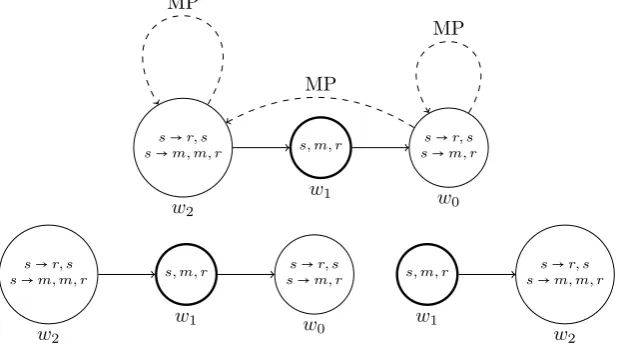
Example 1. Let s stand for “the odds of survival one month after surgery are 90%”, m for “mortality within one month of surgery is 10%”,rfor “the surgery is safe”. Suppose Jill entertains the worlds depicted in the modelM below, whereWP ={w1}andWI ={w2, w0}. Letord(w2)=
2, ord(w1)=1, ord(w0)=0. For the possible world w1, we list only the propositional atoms it
satisfies, since all the rest can be computed recursively. For the impossible worlds, we write down all the propositional formulas satisfied there (and only those) to illustrate Succession and the definitions involved in the model transformation. All worlds validates→r,s,rand s→m, but m does not hold in the most plausible worldw0: the most plausible world is such to represent
that Jill has not inferred thatm follows from s16 although she has inferredr from s. Finally,
given that we focus on the resources of time and memory, we take the cost of applying Modus Ponens to beC(M P)=(3,2), and the capacity of the agent to becp=(15,9).
We then unravel step-by-step the model transformations due to applications ofM P (once we give our semantic clauses, we will see how these transformations a↵ect the development of Jill’s epistemic and doxastic state). In search of all the ways the pointed model(M, w1)can change
following an application of the ruleM P, we follow the procedure sketched above:
Step 1 First, we compute{vM P �v∈P≥(w1)}. It amounts to{{w1},{w0, w2}}.
As a result, C({{w1},{w0, w2}})={{w1, w0},{w1, w2}}.
SoPM P(w
1)={w1, w0}or PM P(w1)={w1, w2}.
1. In casePM P(w
1)={w1, w0}:
Step 2 WM P =W
Step 3 Sincew2�∈PM P(w1)∪P≥(w1), ordM P(w2)=ord(w2)=2. Next,w1∈PM P(w1)
and w1 ∈ wM P1 , so ordM P(w1) = ord(w1) = 1. Finally, w0 ∈ PM P(w1) and
w0∈wM P0 , soordM P(w0)=ord(w0)=0.
TheM P-transformed model is in this case identified with the initial model because it was generated by an application ofM P that yielded no new information.
2. In casePM P(w1)={w1, w2}:
Step 2 WM P =W�{u∈{w
1, w0}�u�∈{w1, w2}}={w1, w2}.
Step 3 As above, ordM P(w
1) = ord(w1) = 1. Then, w2 ∈ PM P(w1) and, checking
from which world(s) it originated in the particular choice, we find w2 ∈ wM P0 ,
soordM P(w
2)=ord(w0)=0.
15Agents can, of course, use methods like note-taking, or resort to other external devices, for the o✏oading of
cognitive resources such as memory. In terms of our quantitative assignments, this would entail an increase in capacity. This can be easily achieved by the introduction of actions that increase the value ofcp. It does not a↵ect the crucial aspect hereby captured: the resource-consumption caused by System 2.
16This is in fact just an example offraming as discussed in (Kahneman, 2011). More specifically, it has been
The M P-transformed model is in this case di↵erent; the impossible world that did not satisfy m, despite satisfying both s→m and s, was uncovered by Jill, precisely because she used an application of M P that generated new information. The e↵ect of taking this slow inferential step is now reflected in the new model.
Step 4 The new plausibility ordering is depicted in the figure.
Step 5 The new valuation is obviously restricted to the worlds that survive the application ofM P. The cognitive capacity of both M P-accessible models is reduced by the cognitive cost of applyingM P, thereforecp=(12,7).
s→r, s s→m, m, r
w2
MP
s, m, r
w1
s→r, s s→m, r
w0
MP
MP
s→r, s s→m, m, r
w2
s, m, r
w1
s→r, s s→m, r
w0
s, m, r
w1
s→r, s s→m, m, r
[image:13.595.144.455.242.421.2]w2
Figure 1: The first figure depicts the modelM, with anM P-dashed arrow fromwtoudenoting that uis an M P-expansion of w. The node ofw1 is thicker to show that this world is in WP.
Then, we obtain two potential transformations of the pointed model (M, w1), i.e., two M P
-accessible pointed models, based on the two ways the set of w1’s more (or equally) plausible
worlds can change due toM P.
4.4
Semantic Clauses
We have explained how the original model changes after fast upgrades and slow applications of inference rules. Now come the truth conditions:
Definition 4.7 (Semantics). The following inductively define when a formula istrue at win M (notation: M, w� ) and when isfalse at win M (notation: M, w� ).
Forw∈WP:
● M, w�pif and only ifp∈V(w), wherep∈
● M, w�¬ if and only if M, w��
● M, w� ∧ if and only ifM, w� andM, w�
● M, w�B if and only ifM, w′� for allw′∈min(W)
● M, w�[ ⇑] if and only ifM⇑ , w�
● M, w��Rk� if and only ifM′, w� for some(M′, w)which isRk-accessible from(M, w) ● M, w� if and only if M, w��
Forw∈WI:
● M, w� if and only if ∈V(w)
● M, w� if and only if ¬ ∈V(w)
Logical validity is defined in terms ofpossible worlds only: a sentence is valid in a model if and only if it is true at every possible world.
In accordance to what the dual-process theories prescribe, our System 1 actions a↵ect what is (defeasibly) known or believed without checking whether there is valid reasoning supporting the piece of information.17 This fits manifestations of System 1 being in charge. For example,
experiments on the belief bias (Evans, 1989, 2003) demonstrate that subjects are reluctant to believe “unbelievable” (given their prior conceptions) statements even when they logically follow from a set of premises. They also tend to believe “believable” conclusions, even though the underlying reasoning is problematic, due to the influence of pre-existing impressions and biases. These are hardwired in the model’s plausibility ordering, while the fast upgrades integrate infor-mation based on them, thus forming the agent’s epistemic or doxastic state without engaging in the e↵ortful task of assessing what is valid. This falls under the responsibility of System 2; if the agent comes to know or believe something new following an action of System 2, this must follow logically from what is already known or believed.
Now we can develop our initial example into:
Example 2. Recall the scenario of Example 1. It is now easy to see that, based on our semantics,
¬�m,¬Bm,�s,Bs,�r,Brare all valid; initially, Jill does not know, nor believes thatm, despite knowing and believing thats. In addition, �M P��m, �M P�Bm, �M P�¬�m, �M P�¬Bm are all valid. That is, there is some application ofM P that provides Jill with knowledge and belief ofm (because she inferred it froms→mand s) and another application ofM P that does not provide her with any new information (because she merely useds→r andsas premises, which only comes as a confirmation of her already held belief and knowledge ofr).
The example shows how di↵erent applications of a rule, captured as di↵erent choices of expansions, may lead to di↵erent developments of the agent’s knowledge and beliefs. Notice that the reading of�Rk� is existential: it asks that there be some application of Rk leading to .
Di↵erent choices allow both informative and uninformative applications by a competent agent with sufficient resources. One can have a dual[Rk] ∶=¬�Rk�¬ , read as “after all applications of
Rk, is true”. This is satisfied whenever allRk-accessible pointed models validate . Using the
universal operator, the modeler may express the overall e↵ect of a rule to the agent’s reasoning. The previous example illustrated a simple case where slow thinking is a↵ordable and the reasoning step ofModus Ponens is performed. In the next example, we model afailure to apply Conjunction Introduction(CI), following an application ofDouble Negation Elimination(DN E)
17But, recall the aforementioned capacity of System 1, of automatically appreciating simple logical forms of
andModus Ponens. This is illustrative of a depletion of resources that would halt the reasoning processes of System 2 and make the agent fall back to System 1. It corresponds to a series of examples o↵ered by (Kahneman, 2011, ch.2): whenever the mental e↵ort that System 2 requires wears the agent out completely, then she retreats to default System 1 activity.
Example 3.
- Let modelM =�WP, WI, ord, V, C,cp�withR={DN E, M P, CI},Res={time,memory}.
Also take C(M P)=CI =(2,2), C(DN E)=(3,1)whilecp=(5,10). In addition, suppose that for world w∈WP: M, w��¬¬ ∧ �( → ).
- Then,M, u�¬¬ andM, u� → for allusuch thatw≥u. Because ofSuccession, there is a modelM′ withcp′=cp−C(DN E)=(2,9)such thatM′, w�� .
- Following the same procedure for M P, we get a model M′′ with cp′′ = cp′−C(M P)=
(2,9)−(2,2)=(0,7)such that M′′, w�� .
- But then there cannot be any CI-accessible pointed model as the step is not a↵ordable (compareC(CI)andcp′′).
- So finally,M′′, w���CI��( ∧ ), thereforeM′′, w�¬�CI��( ∧ ). But this means that M′, w��M P�¬�CI��( ∧ ).
- In turnM, w��DN E��M P�¬�CI��( ∧ ).
- As a result, indeedM, w��[DN E][M P]�CI��( ∧ ).
Before moving on to applications of the model, we introduce the following two Theorems. These cast light on reasoning processes involving both inference rules used by System 2,provided that they are a↵ordable, and fast upgrades by System 1. They can be generalized for more upgrades, applications of rules, and thus number of premises. Theorem 4.2 also exemplifies the order-sensitivity of a reasoning process that is orchestrated by both systems.
Theorem 4.1 (Reasoning from rules).
If logically follows from{ 1, . . . , k}by applying the rulesR1, . . . , Rn∈Rand�‡�mi� i
is valid for 1≤i≤k, where each �‡�mi is a sequence of m
i-many inference rules available
to the agent, then �‡�m1. . .�‡�mk�R
1�. . .�Rn�� is valid.
Proof. Let arbitrary modelMand worldw∈WP of the model. SupposeM, w��‡�mi� i, for 1≤
i≤k. For each i, there is a model Mi such thatMi, w�� i which hasWi=W�{u∈P≥(w)�
u�∈Pi(w)}where
- Pi(w)=cwhere cis some choice inC({vi�v∈P≥(w)})
- vi={u�V∗(v)�
�‡�mi V∗(u)}
- V∗(v) ��‡�mi V∗(u) denotes that u is a Ri1, . . . , Rimi-expansion of v for Ri1, . . . , Rimi
composing the sequence �‡�mi.
This means that for allu∈Wi such thatw≥u,Mi, u�
i. Due toSuccession, there is some
modelM∗ such that for allu∈P∗(w): M∗, u� i, for all 1≤i≤k, whereW∗=W�{u∈P≥(w)�
u�∈P∗(w)}with:
- v∗={u�V∗(v)��‡�mi...�‡�mkV∗(u)}
- V∗(v)��‡�m1...�‡�mk V∗(u)denotes thatuis aR11, . . . , R1m1, . . . , Rk1, . . . , Rkmk-expansion
ofv.
Next, from the fact that logically follows from{ 1, . . . , k}through applyingR1, . . . , Rn∈R,
andSuccession, we get that there is a modelM�such that for all u∈P�(w): M�, u� , which hasW�=W�{u∈P≥(w)�u�∈P�(w)} where
- P�(w)=cwherec is some choice inC({v��v∈P≥(w)})
- v�={u�V∗(v)��‡�mi...�‡�mk,R1,...,RnV∗(u)}
- V∗(v)��‡�m1...�‡�mk,R1,...,RnV∗(u)denotes thatuis aR11, . . . , R1m1, . . . , Rk1, . . . , Rkmk, R1, . . . , Rn
-expansion of v.
But then clearlyM�, w�� , and overallM, w��‡�m1. . .�‡�mk�R
1�. . .�Rn�� .
Theorem 4.2 (Reasoning from upgrades and rules).
If logically follows from{ 1, 2}by applying the rulesR1, . . . , Rn∈R and [ ⇑](� 1∧
�‡�m�
2)is valid, then[ ⇑]�‡�m�R1�. . .�Rn�� is valid.
Proof. Let arbitrary modelM and world w∈WP of the model. Suppose M, w �[ ⇑](� 1∧
�‡�m�
2). This amounts toM ⇑, w�(� 1∧�‡�m� 2), i.e.,M ⇑, u� 1 for allu∈P ⇑(w)[1]
and there is a modelM∗ such that M∗, w�� 2 which hasW∗=W�{u∈P ⇑(w)�u�∈P∗(w)}
where
- P∗(w)=cwhere cis some choice inC({v∗�v∈P ⇑(w)})
- v∗={u�V∗(v)��‡�mV∗(u)}
Then,M∗, u� 2, for allu∈P∗(w). Due toSuccession and [1],M∗, u� 1, for allu∈P∗(w).
Due to following from{ 1, 2}andSuccession, there is a modelM� such thatM�, u� , for
allu∈P�(w)where
- P�(w)=cwherec is some choice inC({v��v∈P ⇑(w)})
- v�={u�V∗(v)��‡�m,R1,...,RnV∗(u)}
But then clearlyM�, w�� , and overallM, w�[ ⇑]�‡�m�R1�. . .�Rn�� .
By making the semantic interpretations of propositional attitudes quantify over impossible worlds, it is guaranteed that some consequences of the agent’s knowledge or beliefs are not known or believed: logical omniscience is thus avoided. Unlike other approaches though, the problem is escaped in a balanced manner, committed to the idea that competent agents would come to know and believe consequences lying within a↵ordable applications of rules.
5
Three Case Studies
Interaction between System 1 and System 2 (or, stereotypes gone wrong): System 1 provides its – sometimes incorrect – impressions to System 2. These impressions exemplify biases that are often attributed to our experience, the so-called familiarity heuristic. System 2 can then unpack their logical consequences. It is not uncommon for System 2 to eventually override System 1. To demonstrate this, we introduce and analyze a variant of the restaurant scenario:18
Jack (agent 1) and Jill (agent 2) have entered a restaurant. They are joined by John (agent 3) shortly after. Waiter A takes their order, which includes three dishes: Vegan, Meat and Fish. Waiter B is supposed to serve them. Waiter B is acquainted with Jack: he knows that Jack is a passionate animal rights activist, often arguing against the consumption of any animal product. He has not met Jill but he has the impression that she is pretty close to Jack and implicitly assumes that she shares his opinion and lifestyle. On the other hand, John is a frequent customer: almost every time he orders the same meat-based dish. As the meals are prepared, Waiter B has an intuitive, yet incomplete, idea on their distribution. System 1 is at work. Influenced by his stereotypes and experience, he thinks that Jack will definitely get the vegan dish, and John the meat. For someone carefully and consciously reading the story, this would mean that Jill ordered fish. Not for waiter B, though: due to Jill’s closeness to Jack, he has trouble inferring this conclusion. He is also willing to consider, albeit reluctantly, that John gets fish. Again he is subconsciously confused enough to take a stance on Jill’s option. Finally scenarios in which Jack orders meat or fish are ruled out by the waiter.
Denote by vi, mi, fi (i=1,2,3) the atoms expressing which dish goes to which agent. Let
Rbe the set of rules containingConjunction Introduction (CI) andModus Ponens (M P). The following figure depicts the plausibility model19 for waiter B, and according to our semantics,
bothBv1andBm3are valid.
v1, f3, v1∧f3, v1∧f3→m2, m2
w5
CI
v1, f3, m2
w4
v1, f3, v1∧f3, v1∧f3→m2
w3
CI MP
v1, m3, v1∧m3, v1∧m3→f2, f2
w2
CI
v1, m3, f2
w1
v1, m3, v1∧m3, v1∧m3→f2
w0
CI MP
“John got fish this time!”, says Waiter A. Waiter B overhears the comment and instantly incorporates this new piece of information.
18“You are in a restaurant with your parents, and you have ordered three dishes: Fish, Meat, and Vegetarian.
Now a new waiter comes back from the kitchen with three dishes. What will happen?” (van Benthem, 2008a).
19Thicker borders of nodes are used to denote possible worlds. Here, we tookCI arrows to be reflexive and
The new model, following the upgrade with f3, is depicted below and is the outcome of
combining the already held opinions of the waiter and incoming information. System 1 deals with what is believed, on the basis of incoming information and biases generated by familiarity, experience etc., and it does not investigate what follows logically.
v1, m3, v1∧m3, v1∧m3→f2, f2
w2
CI
v1, m3, f2
w1
v1, m3, v1∧m3, v1∧m3→f2
w0
CI MP
v1, f3, v1∧f3, v1∧f3→m2, m2
w5
CI
v1, f3, m2
w4
v1, f3, v1∧f3, v1∧f3→m2
w3
CI MP
As Waiter B prepares to serve our three agents and prompted by his curiousness, he takes a moment to figure out what Jill actually ordered, contrary to what he would have expected. In particular, he realizes that he should not let her relationship with Jack interfere with his beliefs, but instead infer what follows from what he already believes, i.e., that Jill got the meat-based dish after all! This is due to a conscious procedure of System 2.
Following an application of CI and M P, in that order, it is easy to verify that overall
[f3 ⇑]�CI��M P�Bm2 (as well as [f3 ⇑]�M P�Bm2) is valid. For example, the final pointed
plausibility model based onw1 has worlds eliminated as epistemic possibilities by slow thinking:
it exemplifies how System 2 took over System 1.
v1, m3, f2
w1
v1, m3, v1∧f2, v1∧m3→f2, f2
w2
v1, m2, f3
w4
v1, f3, v1∧f3,
v1∧f3→m2, m2
w5
Framing e↵ect: Decision-making by Humans is heavily influenced by the mode of presentation of options (Kahneman, 2011, Part 4). For instance, di↵erent responses are evoked whenever a question on the outcome of a surgery is presented in terms of survival or in terms of mortality. The statements “the odds of survival one month after surgery are 90%” and “mortality within one month of surgery is 10%” are equivalent: they have the same truth conditions. But under the first frame or mode of presentation, the situation seems somewhat more reassuring.
one’s beliefs after being informed that p gives the same outcome as revising them after being informed thatq. This too disregards the influence of the mode of presentation on Humans, as opposed to Logons.
We will now show that framing can fit into our logical framework.20 Letsandmdenote the
two statements discussed earlier (odds of survival/mortality rate). Let s↔ m be valid in our dual-process semantics. Suppose that the initial plausibility model for our agent is as follows, i.e.,¬Bmand¬Bs:
m, m→s, s
w4
MP
s, s→m, m
w3
MP
s, m
w2
m, m→s
w1
MP
s, s→m
w0
MP
Following an upgrade withm, based on something the agent heard at the patients’ waiting room, we obtain the model below. Therefore [m⇑]Bm. As a result of framing, the agent has upgraded withmand believed in it, without simultaneously believing ins.
s, s→m
w0
m, m→s, s
w4
MP
s, s→m, m
w3
MP
MP
s, m
w2
m, m→s
w1
MP
Again, some slow reasoning performed by System 2 will help the agent overcome framing: by performing an inference usingModus Ponens (assuming, as we have done so far, that the agent believes thatm→s), the agent can come to believe thatstoo.
s, s→m
w0
m, m→s, s
w4
s, m
w2
s, s→m, m
w3
Anchoring e↵ect: Theanchoring e↵ect(Tversky and Kahneman, 1974) is a cognitive bias that makes Humans rely heavily on the first piece of information they receive: this piece works as an “anchor”, and even if it is clearly arbitrary and irrelevant, it can over-influence the formation of subsequent beliefs. For example, suppose that an agent is interested in a new edition of a high-end smartphone but has not made up her mind on whether to purchase it. The agent considers three options:
20Note that in the context of this paper we model framing in an epistemic-doxastic setting but that our tools
● r1: the new edition falls in the price range [1000-1100). ● r2: the new edition falls in the price range [1100-1200). ● r3: the new edition falls in the price range [1200-1300).
Suppose that the agent visits a store. She entertains the following options:
● q1: the store’s o↵er is in the price range [1000-1100). ● q2: the store’s o↵er is in the price range [1100-1200). ● q3: the store’s o↵er is in the price range [1200-1300).
In the store, there is a tag indicating that the original price of the desired item is 1200, but the store o↵ers it for 1100. As a result, the agent performs a fast System 1 upgrade with the formula[(r3∧q2)⇑]. The value 1200 works as the anchor, because it is indicated by the store’s
tag as the market price of the new phone. As a result the formula [(r3∧q2)⇑]B(r3∧q2) is
verified.
Next, the agent activates System 2, which performs a reasoning step that allows her to believe that she saves a certain amount of money, which makes the bargain good (denote “good bargain” byb; also note that wheneverri∧qi, we consider the di↵erence of prices negligible and
thus not substantial enough to make the agent consider it a bargain). Therefore, we obtain a new validity: [(r3∧q2)⇑]�M P�Bb. Based on that belief, she eventually acts accordingly and
buys the smartphone. If there was no indication of an original market price of the smartphone or if the anchor was an initial value that the agent had set (i.e., deciding that only prices in the range [1000-1100) are acceptable/a↵ordable), the evolution of the scenario would have been di↵erent and no purchase would have been made. Below, there is a depiction of the initial model, succeeded by the model following the anchoring upgrade, and one final model after the application ofModus Ponens.
r1, q1,¬b
w0
r2, q1, r2∧q1,
r2∧q1→b
w1
r2, q1, r2∧q1,
r2∧q1→b, b
w2
MP r3, q1,
r3∧q1,
r3∧q1→b
w3
r3, q1, r3∧q1,
r3∧q1→b, b
w4
MP
r1, q2, r1∧q2, r1∧q2→¬b
w5
r1, q2, r1∧q2, r1∧q2→¬b,¬b
w6
MP
r2, q2,¬b
w7
r3, q2, r3∧q2, r3∧q2→b
w8
r3, q2, r3∧q2, r3∧q2→b, b
w9
MP
r1, q3, r1∧q3, r1∧q3→¬b
w10
r1, q3, r1∧q3, r1∧q3→¬b,¬b
w11
MP r2, q3,
r2∧q3, r2∧q3→¬b
w12
r2, q3, r2∧q3, r2∧q3→¬b,¬b
w13
MP
r3, q3,¬b
r1, q1,¬b
w0
r2, q1, r2∧q1,
r2∧q1→b
w1
r2, q1, r2∧q1,
r2∧q1→b, b
w2
MP r3, q1,
r3∧q1,
r3∧q1→b
w3
r3, q1, r3∧q1,
r3∧q1→b, b
w4
MP
r1, q2, r1∧q2, r1∧q2→¬b
w5
r1, q2, r1∧q2, r1∧q2→¬b,¬b
w6
MP
r2, q2,¬b
w7
r1, q3, r1∧q3, r1∧q3→¬b
w10
r1, q3, r1∧q3, r1∧q3→¬b,¬b
w11
MP
r2, q3, r2∧q3, r2∧q3→¬b
w12
r2, q3, r2∧q3, r2∧q3→¬b,¬b
w13
MP
r3, q3,¬b
w14
r3, q2, r3∧q2, r3∧q2→b
w8
r3, q2, r3∧q2, r3∧q2→b, b
w9
MP
r1, q1,¬b
w0
r2, q1, r2∧q1, r2∧q1→b, b
w2
r3, q1, r3∧q1, r3∧q1→b, b
w4
r1, q2, r1∧q2, r1∧q2→¬b,¬b
w6
r2, q2,¬b
w7
r1, q3, r1∧q3, r1∧q3→¬b,¬b
w11
r2, q3, r2∧q3, r2∧q3→¬b,¬b
w13
r3, q3,¬b
w14
r3, q2, r3∧q2, r3∧q2→b, b
w9
6
Coda: “Ought Implies Can”
We conclude with a general philosophical issue: is our model merely descriptive of some of the cognitive workings of Humans, or rather normative? In the latter case, how so, since it aims to avoid the idealisation of agents as logically omniscient?
pre-scription. Prospect theory was justified as a descriptive theory of rational decision, in opposition to the normative status of classical expected utility theory. We have a more nuanced stance with respect to the logic proposed above. We aim at anormative logical theory; but, one whose rational “ought”, unlike the “ought” of static epistemic logic, implies “can”.
To unpack: the mainstream approach in both static (S5) epistemic logic and choice theory is most commonly defended on the basis of its normative status. It tells us how rational agentsought to reason and act. The experimental deviations don’t threaten the e↵ectiveness of this normative model; they do not, according to its apologists, contradict the claims on human rationality. They are merely attributed to unsystematic performance errors, momentary failures that do not say much about the rational behavior agents are actually capable of achieving (Cohen, 1981; Stein, 1996). This view is at times defended by drawing analogies with other disciplines, such as the use of frictionless planes in physics. With respect to the idealized models, the observed fallibility of agents is merely a kind of negligible cognitive friction. Besides, such models are claimed to serve an evaluative purpose with respect to the performance of imperfect human agents. However Humans fail, their ultimate goal should be to approximate the standard predicted by the mainstream proposals: the closer, the better.
We find these arguments unsatisfactory. The internal coherence of Human subjects (Stanovich and West, 2000; Stenning and van Lambalgen, 2008) shows that the errors are not just random and unsystematic slips in one’s reasoning. Nor are the idealized models of other disciplines suitable for an accurate analogy. Once scientists manage to account for more realistic assumptions and complex elements, their new models are often considered more reliable. This is not in agreement with the “as good as it gets” campaign adopted by proponents of the traditional “ought”. Even when Humans are asked to approximate the predictions of mainstream models of reasoning, the indeterminacy involved inwhat counts as a good approximation weakens the e↵ectiveness of such choices of normative standards (Pollock, 2006).21
Forcing one to commit to models that are either merely descriptive, or representing omni-scient agents, may be a false dilemma. Whereas the mainstream logical “ought” fails to imply “can”, one may be interested in investigating an “ought” that does: “it seems simply perverse to judge that subjects are doing a bad job of reasoning because they are not using a strategy that requires a brain the size of a blimp” (Stich, 1990, p. 26). Actually, even a blimp may not be enough: Logons know or believe the infinitely many logical consequences of what they know or believe. But Humans’ available resources are not infinite (Cherniak, 1986), and “become infinite” is a strange thing to ask of a finite mind.
In our approach, factual evidence can contribute in picking the appropriate normative model. Limitations in terms of time, memory, computational power, etc., are important in adjusting the rationality standard expected from the agents. Empirical data should be utilized in constructing the right normative model, e.g., by filling in the right parameters for how di↵erent logical inference rules can be resource-consuming. So we put forth our logic above as a better normative model: one delivering a can-implying “ought”. A finite and fallible, but rational agent ought to reason to the extent that,ceteris paribus, its limited time, memory, and computational power resources allow. No more can be asked without violating that implication, but also no less: “Be rational
21We notice that Hintikka, who introduced standard epistemic and doxastic logics, did not presuppose a defense
until,ceteris paribus, you run out of cognitive steam”.22
7
Conclusions and Further Work
To sum up, we have built a system of dynamic epistemic logic that avoids the problem of log-ical omniscience, which has plagued standard static loglog-ical systems. Most importantly, it does so by taking on board a popular line of research in psychology of reasoning: dual-process the-ories. Our system includes two di↵erent kinds of dynamic operators, one responsible for the fast and e↵ortless integration of information and one accounting for the slow and costly steps of deductive reasoning. In order to accommodate the respective actions, tools from DEL (plau-sibility models, more nuanced propositional attitudes) were combined with non-normal worlds semantics. We demonstrated that this framework successfully captures desirable properties of reasoning processes composed by both systems. In particular, we showed that phenomena that have been studied multiple times in the literature of various disciplines can be now formally treated in logical terms. Our exposition was finally furnished with a philosophical discussion on the contribution of this attempt, and more specifically, on its normative nature.
The model deals only with a fragment of the activities undertaken by the two systems. Apart from adding probabilistic reasoning for a more elaborate modeling of System 2, other directions of further work can be envisaged. First, the policy of upgrading with incoming information need not be unique. More conservative System 1 actions can be modeled, sensitive to the reliability of the source (van Benthem, 2011). Second, one may combine our work with the ideas of van Benthem (2008b) and Vel´azquez-Quesada (2009), who discern implicit acts of observation (“bare seeing”) and explicit acts of observation (“conscious realization”). This distinction can fit in our framework by introducing additional actions representative of the two systems: the former kind is e↵ortless and corresponds to System 1’s fast processing of incoming information. The latter kind is resource-consuming and corresponds to System 2 activities. Third, one may model higher-order reasoning, accounting for how the agent thinks over its own reasoning processes, learns or forgets inference rules, that in turn a↵ect her deductive inferences. So far, we have focused on how the agent expands her factual information without delving into the progress of metareasoning. It seems that, in order to enrich the picture of reasoning run by System 2, we need to impose additional constraints on the model’s structure and define suitable actions of rule-based and e↵ortful higher-order reasoning.
22Theceteris paribusparameter matters. What amount of cognitive resources ought to be allocated to reasoning