Robust self-testing of (almost) all pure two-qubit states
MSc Thesis (Afstudeerscriptie) written by
Tim Coopmans
under the supervision of Dr J¦drzej Kaniewski and Dr Christian Schaner, and submitted to the Board of Examiners in partial fulllment of the requirements for the degree of
MSc in Logic
at the Universiteit van Amsterdam.
Date of the public defense: Members of the Thesis Committee: April 25, 2017 Dr Serge Fehr
Dr J¦drzej Kaniewski Dr Christian Schaner Prof Sonja Smets
Abstract
In a nonlocal scenario, physically isolated players each have a device that inputs and outputs classical information. Certain correlations between the joint input and output of the devices almost uniquely identify the quantum state that they share. This phenomenon is known as self-testing and has ap-plications in quantum cryptography with untrusted devices. It was for example shown that for every pure two-qubit state, there exists a two-player Bell experiment whose correlations, or rather the Bell value that is computed from the correlations, can be used here to self-test that state; the Bell value that is used stems from a family of Bell inequalities called tilted CHSH inequalities. A special case is the regular CHSH inequality, which is used to self-test the singlet, a maximally entangled state of two qubits. For practical applications, estimation errors and the presence of external noise require self-testing statements to be robust to errors.
In this thesis, we extend previous work on self-testing of the singlet with the CHSH game. First, we use tilted CHSH inequalities to improve the robustness of previously found self-testing statements for (almost) all pure partially entangled states. Our result consists of the explicit construction of lo-cal quantum channels for the two players, from which we derive operator inequalities that we verify numerically. Using a recently developed method [Kan16], the improved bounds can be inferred. Fur-thermore, we construct a state that violates the CHSH inequality but for which there exist no local quantum channels that achieve greater delity than a trivial lower bound (i.e. achieve delity with the singlet greater than what is achievable using a separable state). This result implies that CHSH violation is not sucient for the two players to `extract' a singlet from their actual state by just local operations. Future research could focus on extending our results to dierent self-testable states such as the GHZ-states and on self-testing in the scenario where only one of the two players has a potentially untrusted device (quantum steering).
Acknowledgments
First and foremost, I would like to thank my supervisor Jed Kaniewski, who spent a great deal of his time on me - someone said that it must have been 75% - to teach, help and pave the way for me to get a better grasp of the strange world of quantum information theory. Regardless of the nature of my questions (elementary, repetitive, or about academia in general), Jed made time to answer them, even early in the morning or late at night. Thank you for the good times in Copenhagen, Jed; I enjoyed working together and I hope that many students after me will be able to enjoy your enthusiastic, relaxed and especially very friendly character, not to mention your music lyrics jokes.
A lot of thanks also to Christian Schaner, who in the rst place gave me the opportunity to go and work under supervision of a fellow researcher. Even though I was abroad, he kept spending time to listen to what Jed and I were doing. Now and then he asked how things were going non-researchwise, which is indicative of his quality as a supervisor.
It has been a wonderful experience to stay in Copenhagen. I would like to thank the members of the QMath group for making me feel part of the group in the very rst week (which started with climb-ing trees). Many thanks also to Matthias Christandl, the head of the group, for fundclimb-ing part of my stay.
I would also like to thank the thesis committee members, Serge Fehr, Sonja Smets, and Ronald de Wolf, for taking the time to read this thesis.
Many thanks to the international friends who kept my mind o research questions when needed, and to my friends at home for keeping in touch with me while I was abroad.
Contents
1 Introduction . . . 1
1.1 Bell nonlocality . . . 1
1.2 From Bell experiments to device-independence and self-testing . . . 3
1.3 Our contributions . . . 4
1.4 Organisation of the thesis . . . 5
2 Preliminaries . . . 6
2.1 Quantum states and quantum operations . . . 6
2.2 From Bell inequalities to self-testing . . . 11
2.3 Preliminaries to Chapter 4 . . . 17
3 Self-testing: a brief overview . . . 23
3.1 The emergence of the device-independence paradigm . . . 23
3.2 Formalization of the self-testing problem of state certication . . . 25
3.3 Measures for robust state certication . . . 27
3.4 Self-testable states and methods to prove their self-testability . . . 31
3.5 Self-testing from operator inequalities . . . 33
4 CHSH violation does not imply nontrivial singlet extractability . . . 36
4.1 The target state . . . 37
4.2 The observables . . . 37
4.3 The input state ρTE . . . 38
4.4 Amplitude-damping channel . . . 39
4.5 Main result and proof outline . . . 39
4.6 Notation . . . 40
4.7 Upper bounding the extractability in the center as a function of εwav . . . 41
4.8 Upper bounding the singlet extractability of ρTE . . . 47
5 The tilted CHSH inequality . . . 49
5.1 Self-testing using the tilted CHSH inequality . . . 49
5.2 Self-testing bounds from operator inequalities for (almost) all pure two-qubit states 50 6 Discussion and conclusion . . . 58
1 Introduction
The rst ideas about `quantum computers' were developed in the 1980s [Fey82, Ben82]; such computers could exploit properties that are exclusive to quantum systems, such as quantum entanglement -the property that generally, -the components of quantum systems cannot be described independently. Since then, many applications of quantum computers have been found. The most promising of such applications are arguably the integer factorization algorithm by Shor [Sho94], which can break today's widely-used RSA encryption algorithm, the database search algorithm which was originally designed by Grover and later improved by Boyer et al. [Gro96, BBHT98], and the development of quantum-key-distribution (QKD) protocols, which started with the work of Bennett and Brassard [BB84] and Ekert [Eke91].
In the latter of these branches, the central question is how to establish a random bit string (the key) that is known only to the two parties who wish to communicate. QKD schemes heavily rely on the quantum-mechanical properties of the devices used for their execution, such as entanglement. Indeed, it has been shown that an eavesdropper can use imperfections in the devices in order to break security [SK14]. In practice, however, quantum entanglement is dicult to maintain due to interference of external noise with the entangled system. Additionally, the security proofs of several QKD protocols such as the protocol by Bennett and Brassard [BB84] only work when the dimension of the Hilbert space of the communicating parties is known [AGM06, MMMO06]. Finally, in the cryptographic scenario of malicious adversaries, one needs to take into account the possibility that the manufacturer of the devices has intentionally tampered with the devices in order to eavesdrop on the communicated information. Eavesdropping on communication devices is not just a hypothetical situation: recently, a series of documents were published that showed that for the Central Intelligence Agency (CIA) of the U.S.A., large-scale hacking of mobile phones and smart TVs is standard practice [Wik]. Reasons such as these led researchers to consider device-independence, the paradigm in which properties of the devices are no longer assumed to operate as specied. Let us rst dive into the main tool for executing protocols in a device-independent fashion: Bell nonlocality.
1.1 Bell nonlocality
In a Bell experiment, several parties are physically isolated so that classical communication between the parties is impossible1, and each party is regarded as a black box which takes input and gives
out-put. After a long line of research that started with the criticism on quantum physics with the famous paper of Einstein, Podolsky and Rosen [EPR35], the rst to correctly realize the implications of Bell experiments for this discussion was John Bell [Bel64]. We briey go into the topic of Bell nonlocality. For a recent review on Bell tests and applications, see the work of Brunner et al. [BCP+14].
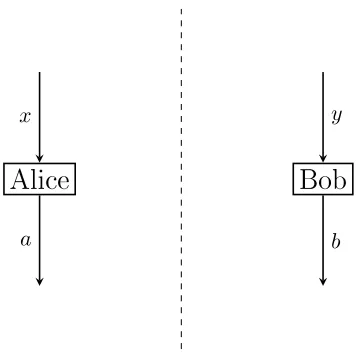
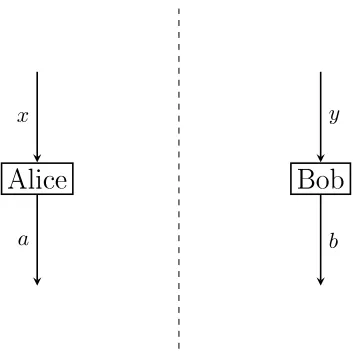
As an example of a Bell experiment, we consider the bipartite scenario with two players, usually called Alice and Bob (see Figure 1). Alice and Bob each have a device which takes inputx, yand gives output a, b, respectively. In a real-world experiment, the devices could for example have a series of knobs
(one for each possible input setting), each of which corresponds to a measurement on some physical state inside the device. The experiment consists of multiple runs; in each run, Alice and Bob each select an input at random and record the outcome. After a large number of runs, Alice and Bob come together and compute their joint statistics: the conditional probability distribution Pr(a, b|x, y). We assume that the rounds are identical and independently distributed (the `i.i.d. assumption'), i.e. the
1In theory, this can be established by spatially separating the parties over a long distance and obtaining the required
probability distribution underlying the observed statistics is well-dened.
Alice
Bob
x y
[image:6.612.215.396.97.274.2]a b
Figure 1: A Bell experiment with two players, Alice and Bob, who each have a device. In a single run of the Bell experiment, each of the two players' devices takes binary input, picked uniformly at random. Alice and Bob record the binary output of the device. After many runs, the two players come together and compute their joint probability distribution Pr(a, b|x, y). The two players are physically isolated, as indicated by the dashed vertical line.
If we assume that the devices are adequately described by classical physics, then the behaviour of the devices can be assumed to be local: that is, whatever operations the devices apply internally, the behaviour of a device can only be determined by anything that is spatially close to the device. In particular, since Alice and Bob are physically isolated, the behaviour of the two devices can only be correlated to each other if the devices were somehow connected before the experiment. In physics, such pre-established connections are referred to as local variables.
In the simplest case, the output of each device is a deterministic function of its input. For example, if Alice's device has two knobs, labeled0and1, it could be that the device outputs the label of the knob that was pushed. In this case, we say that the behaviour of the device corresponds to a deterministic response function.
It has been shown [Fin82] that any local behaviour of the devices can be explained by choosing in each run a deterministic response function, where the choice of response function is made according to some probability distribution. However, if the knobs of the devices correspond to measurements on entangled quantum states, the devices' behaviour generally cannot be expressed by such a probabilistic mixture of deterministic functions. For this reason, Bell experiments have taken a prominent position in the de-bate on the validity of quantum mechanics. Throughout the past decades, many Bell experiments have been performed. It was only recently that the two main `loopholes' in these experiments were closed simultaneously2 [HBD+15, HKB+16, GVW+15, SMSC+15]. The experimentally observed correlations indeed could not be explained by local variables, which shows that, on the most fundamental level, the real world cannot be explained by any local-variable theory such as classical physics.
2First, there is the locality loophole, the prohibition of classical communication between the boxes. Second, there is
the detection loophole: for any behaviour of the devices, Alice and Bob could change the observed statistics Pr(a, b|x, y)
In practice, it is more convenient to work with a single number that `measures' the degree of nonlocality than with the entire conditional probability distribution Pr(a, b|x, y). Such a number is found in the Bell value, a linear combination of the probabilities Pr(a, b|x, y). In case the Bell value is greater than what can be achieved by distributions produced by local variable theories, we speak of a Bell violation of a Bell inequality.
Since entangled quantum states can yield a Bell violation while classical devices cannot, Alice and Bob can nd out if their devices contain some kind of quantum state on the sole basis of the correlations. Although this fact is quite remarkable already, the connection between the behaviour of the devices and the observed statistics goes even further: if we assume quantum mechanics to be the underlying theory governing the behaviour of the devices, then certain statistics allow us to uniquely identify the quantum state and the measurements of the boxes (up to some well-understood equivalences). This was rst explicitly shown by Mayers and Yao [MY98, MY04], but already implicit in earlier work [Cir80, PR92, SW88]. It is exactly this feature of Bell nonlocality that is useful in the context of cryptography.
1.2 From Bell experiments to device-independence and self-testing
The rst ideas on the use of nonlocal correlations in order to test for a nosy eavesdropper in the context of key distribution were already implicit in the celebrated QKD scheme by Ekert [Eke91]. The rst device-independent quantum key distribution protocol (DI-QKD) was developed by Bar-rett et al. [BHK05], who showed how two parties can generate a single random shared bit, secure against any post-quantum eavesdropper. Later work in DI-QKD mainly focused on developing similar protocols that generate more shared key bits with fewer device uses, and on proving their security [AMP06, MW06, AGM06, MPA11, VV14, DFR16, AFRV16]. For an overview of the eld, we refer to two reviews [BCP+14, ER14].
Related to DI-QKD is the eld of device-independent randomness generation, where the central ques-tion is: how can we generate truly random bits with the use of potentially untrusted devices? This is a simpler task than device-independent key distribution, since one can always execute a DI-QKD protocol locally to generate a random key and subsequently use the key as a random bit string. The generation of randomness naturally points toward Bell inequalities, since it can be shown that Bell violation implies the presence of intrinsic randomness (for a comprehensive derivation, see the lecture notes by Scarani [Sca12]). The rst work on device-independent randomness generation used Bell-violating devices [Col07]. Later work has mainly focused on nding protocols that are secure under relaxed assumptions and on proving their limitations [PAM+10, CK11, SCA+11, BPPP14, MS16]. For a more elaborate overview, we again refer to Brunner et al. [BCP+14].
A third branch of the device-independent approach to quantum information theory is the eld of self-testing: device-independent characterization of the quantum state and measurements. The central question in self-testing of quantum states is: given the observed correlations of several parties in a Bell experiment, what knowledge can be inferred about the quantum state that the parties possess? This knowledge is usually expressed as a self-testing statement: a bound on a measure that compares the optimal state and the actual state, where the bound is a function of a Bell value. A similar question can be asked for self-testing of measurements.
this connection for cryptographic purposes. Indeed, it is most remarkable that classical players (in our example: Alice and Bob) can determine which quantum state is shared by the devices, solely on the basis of correlations.
As already mentioned, Mayers and Yao were the rst to explicitly note the usefulness of empirical correlations for practical applications [MY98, MY04]. In their work, the object under study was a maximally entangled state of two qubits, to which we will refer as the singlet in this thesis. It was already shown before for a particular Bell inequality, the CHSH inequality [CHSH69], that particular correlations are only reproduced by devices sharing a singlet (again, up to some well-understood equiv-alences) [PR92, BMR92]. By connecting the practical usefulness and the theoretical work, the singlet state was the rst state to be shown to be self-testable. Since then, many other states and measurements have been shown to be `identiable' from certain Bell inequalities and observed correlations (where a precise meaning of `identiable' is given in Chapter 3) [McK14, MYS12, YN13, BP15, CGS16, McK16].
In practice, the observed statistics cannot be expected to yield the perfect correlations. The reason for this is twofold; rst, since the correlations are estimated only from a nite numbers of runs of the Bell test, they are subject to statistical errors. The presence of external noise is another factor that contributes to the failure of Bell experiments to achieve perfect correlations in real-life experiments. It is for this reason that in order to relate observed correlations to the states and measurements that the devices could possibly share, we need self-testing statements that are robust to errors.
1.3 Our contributions
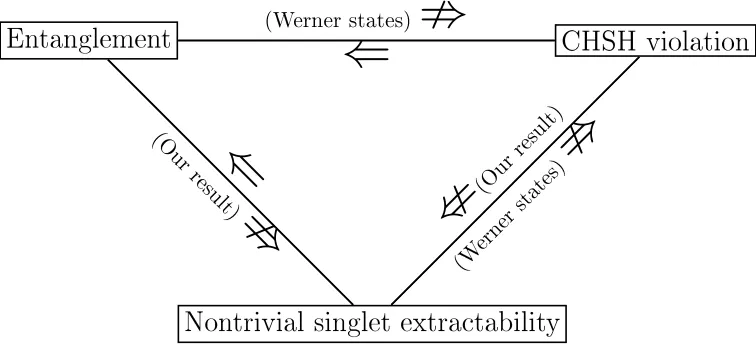
In this thesis, we improve the previously known robustness of self-testing statements for almost all pure partially entangled two-qubit states. Also, we prove that a violation of the CHSH inequality by a particular quantum state does not imply that a singlet can be `extracted' from that state (see below).
Pure two-qubit states can be self-tested with a family of Bell inequalities which go by the name of tilted CHSH inequalities. That is, for every pure two-qubit state, there exists a tilted CHSH inequality for which particular correlations Pr(a, b|x, y) can only be obtained if the players share that particular state, up to some equivalences. Self-testing statements for pure two-qubit states are expressed in terms of bounds on the delity of the ideal two-qubit state and the actual state after Alice and Bob have applied quantum operations locally: the maximal delity that can be obtained in this way is referred to as the extractability. By generalizing the approach of Kaniewski [Kan16], we improve upon all pre-viously known self-testing bounds for the extractability [YN13, BP15, BNS+15].
In the method we used, the quantum operations that Alice and Bob apply locally are called extraction channels, since the two players attempt to `extract' the optimal state from the state they actually pos-sess. By constructing local extraction channels for each tilted CHSH inequality, we reduce the problem of proving a self-testing statement to proving a particular operator inequality. We numerically veried this operator inequality for (almost) every tilted CHSH inequality, which results in new improved self-testing statements for (almost) all pure two-qubit states.
A result of the same avor was already known for bound entangled states. Entanglement distillation refers to the process of creating a maximally entangled state out of several copies of a less entangled state by LOCC (local operations and classical communication) [BBPS96]. Bound entangled states are entangled but undistillable (i.e. it is not possible to distill entanglement from them). Since classical communication and the use of several copies is not included in the denition of `extractability', distil-lability is a stronger notion than extractability. Vértesi and Brunner constructed a bound entangled state which violates a Bell inequality that is dierent from the CHSH one [VB14]; in fact, their state does not violate the CHSH inequality. The stateρTEwe constructed, however, does violate the CHSH
inequality but it is not possible to extract even a fraction of a maximally violating state (the singlet) from ρTE using local operations.
This result is remarkable: although one needs entanglement for CHSH violation and maximal violation implies that the shared state is equivalent to a singlet, it is in general not possible to create more overlap with a maximally entangled two-qubit state from any entangled state using local operations only.
As a corollary to our result, there exist no self-testing statements, formulated in terms of the extractabil-ity, that yield nontrivial information about the actual state whenever the CHSH violation is very small.
The state we constructed is a classical-quantum state and can be written as a probabilistic mixture of, on each side, a classical three-outcome register and a qubit. Intuitively, one has to apply very dierent local extraction maps in order to maximize the singlet delity with a product state or a maximally entangled state. By tweaking the probabilistic weights of our state, we obtain a state which violates the CHSH inequality but still has trivial singlet extractability.
1.4 Organisation of the thesis
2 Preliminaries
In this section, we rst review very briey some notions from the quantum information formalism that are relevant to this thesis (Section 2.1). Then, in Section 2.2, we give an overview of Bell inequalities. In the last part of this chapter, Section 2.3, several lemmas are proven that are needed for our main result in Chapter 4.
For a more complete review of quantum information theory, we refer to the book by Nielsen and Chuang [NC00] and to John Preskill's lecture notes [Pre15]. A mathematically more rigorous introduction to quantum information theory can be found in the lecture notes by John Watrous [Wat16].
2.1 Quantum states and quantum operations
We review several notions from quantum information theory that are relevant to this thesis. All Hilbert spaces in this thesis are of nite dimension, and all operators are linear operators acting on Hilbert spaces of nite dimension.
2.1.1 Some properties and operations on matrices
A Hilbert space, a vector space over the complex numbers, will be denoted by H. We will denote the standard Euclidean inner product on a Hilbert spaceHbyh~v|~wi:=Piviwi with~v, ~w∈H. Any vector
~
v∈Hhas norm||~v||:=ph~v|~vi.
The notationXandY will denote linear operators (matrices) that act on vectors from a Hilbert space.
A linear operatorX:H1 →H2is said to have input dimensiondim(H1)and output dimensiondim(H2).
We start with some notation. The complex conjugate of a complex number z is denoted by z. The
transpose of the representation of an operatorXin a particular basis is written asXT and its conjugate
transpose, dened as its transpose where every entry is replaced by its complex conjugate, is written as X†. If X satises XX† =X†X, then X is called normal. The tensor product of X and Y will be
written asX⊗Y. The identity matrix of ann-dimensional vector space will be written as11n, or simply
11 when the dimension of the space that it acts on is clear from the context.
A unitary matrix is a matrix U that satises U U† =U†U = 11. Equivalently, a unitary operator is a
bijection that preserves inner products. Since a basis of a Hilbert space consists of pairwise orthonor-mal vectors, we infer that unitaries correspond to changes of basis. We refer toU XU† as the unitary
conjugation of a matrixX withU.
IfX =X†, then we callXhermitian. Any hermitian matrix can be decomposed asX=P
jλj|jihj|for
real eigenvalues λj and orthogonal eigenstates {|ji}j. This decomposition is the `eigendecomposition
ofX'. A functionf on hermitian operators is dened as f(X) =P
jf(λj)|jihj|. For example, for
her-mitian matrices with nonnegative eigenvalues, the square root of X is given by √X =P j
p
λj|jihj|.
The modulus of a normal matrixX is dened as|X|:=√X†X.
The set of 2×2matrices is spanned by 112 together with the Pauli matrices, dened as
X:=
0 1 1 0
, Y:=
0 −i
i 0
, Z:=
1 0 0 −1
For convenience, we write
• Herm(H)for the set of hermitian operators H→H;
• Pos(H)⊆Herm(H)for the set of hermitian operatorsH→Hwith nonnegative eigenvalues. Such operators are called positive semidenite. Hermitian operators with strictly positive eigenvalues are called positive denite.
LetH be a Hilbert space of dimensiond. The trace of a matrix X∈Herm(H) is the sum of its eigen-values and can be computed as Tr(X) := Pd
j=1hj|X|ji where {|ji}dj=1 is an arbitrary basis of H. The determinant of X, which is the product of its eigenvalues, is denoted by det(X). If a matrix X
acts on composite system HA⊗HB, then we denote its partial trace, where `system A is traced out',
as TrA(X) := PdkA=1(hk| ⊗11HB)X(|ki ⊗11HB), where dA is the dimension of HA and {|ki}
dA
k=1 is an arbitrary basis of HA.
LetX, Y ∈Herm(H). We say that the operator inequality X≥Y holds ifX−Y is positive semide-nite. Similarly, X > Y holds whenX−Y is positive denite.
For any real number p≥1, the Schattenp-norm ofX :H1 →H2 is dened as
||X||p :=
Tr
(X†X)p2
1
p
.
We mention three commonly used special cases of the Schatten-p-norms:
• The case p= 1 corresponds to the trace norm:||X||tr:=||X||1 = Tr
√
X†X
.
• The Frobenius norm is the special case forp= 2:||X||2=
q
Tr X†X
.
• The limit of p→ ∞yields the spectral norm:
||X||∞= max{||Xu|| |u∈H1,||u||= 1}.
2.1.2 Quantum states
In quantum mechanics, a physical system is represented as a complex Hilbert space. The state of a physical system is represented by a vector of unit length in that Hilbert space and is denoted in Dirac's ket notation, e.g. |ϕi.
The state of a qubit is a vector in a complex Hilbert space of dimension 2; in general, the state of a qudit of dimensiondis given by a vector in a complex Hilbert space of dimension d. The vector(1,0) is abbreviated as |0i and we write(0,1)as|1i. We also dene |±i:= (|0i ± |1i)/√2.
A composite system made up out ofm components, each represented by complex Hilbert spaceHj for
1≤j≤m, is represented by the complex Hilbert space Nm
j=1Hj. If the state of componentj is given
by |ϕji, then the state of the composite system isNmj=1|ϕji ∈Nmj=1Hj.
In reality, the precise state of a quantum system is usually not known. To deal with such partial knowledge, density matrices are a helpful tool. Let H be a Hilbert space that represents a certain quantum system. A density matrix is dened as ρ ≡ Pn
k=1pk|ϕkihϕk|, where n ∈ N≥1 is a strictly positive integer, p is an n-dimensional probability vector and the |ϕki ∈ H for all 1 ≤ k ≤ n. This
by D(H) := {ρ∈Pos(H)|Tr(ρ) = 1}. From now on, density matrices will be referred to as `quantum states' or simply `states'. States that have an eigenvalue equal to 1 are referred to as `pure states', otherwise we call them `mixed'. The density matrix that describes the state of a composite system of
m components, where the j-th component is represented by the Hilbert spaceHj for 1≤j≤m, is an
element of D Nm j=1Hj
.
For two linear operators A:H1→H2 and B :H1→H2, the Hilbert-Schmidt inner product is dened as
hA, Bi= Tr
A†B
(2.1) Forρ, σ∈D(H), this inner product is the trace inner producthρ, σi:= Tr(ρσ). Note that ifρ=|ϕihϕ| and σ=|ψihψ|are pure states, thenTr(ρσ) =|hϕ|ψi|2.
Other than the trace inner product, there are dierent measures of closeness on D(H), such as the `delity'.
Denition 2.1. The delity of two quantum states ρ, σ is given by F(ρ, σ) =||√ρ√σ||2
tr.
We state a few properties of the delity that will be useful in the formalization of the self-testing problem, as given in Chapter 3.
Lemma 2.2. Let ρ, σ be density matrices. The delity F(ρ, σ) has the following properties: 1. Symmetry:F(ρ, σ) =F(σ, ρ);
2. 0≤F(ρ, σ)≤1, and F(ρ, σ) = 1 if and only ifρ=σ;
3. If at least one ofρ, σ is pure, then F(ρ, σ) = Tr(ρσ) =hρ, σi.
For the proof of this lemma, we refer to John Watrous' lecture notes, proof of Proposition 3.12 [Wat16].
2.1.3 Entanglement
A product state is a state of the formρ⊗σ. A separable state is a state that can be written as
n X
j=1
pj ρj⊗σj
with p an n-dimensional probability vector. Any state that cannot be written as a separable state is
called entangled. For Hilbert space dimension d, the `maximally mixed state' is 11d
d . A bipartite pure
stateρAB ∈D(H1⊗H2)is called `maximally entangled' ifTrA(ρAB)andTrB(ρAB)are both maximally
mixed states.
In this thesis, we refer to a maximally-entangled state of two qubits as `a singlet'. The particular maximally-entangled state |01i−|√ 10i
2 will be denoted by|φi.
In order to characterize all maximally entangled two-qubit states, we need the following lemma. Lemma 2.3. (Schmidt decomposition)
orthonormal in the Hilbert space of player A, and a set of states|jBi, orthonormal in the Hilbert space
of player B, such that
|ϕi=X
j
λj|jAi ⊗ |jBi
where the λj ∈R≥0 satisfyPjλ2j = 1. The λj are referred to as the Schmidt coecients of |ϕi.
Furthermore, the Schmidt coecients are unique. If the Schmidt coecient λj is nondegenerate for
some j, then the states |jAi and|jBi are also unique.
For a concise proof of the lemma, we refer to the book by Nielsen and Chuang, Theorem 2.7 [NC00]. The argument for the uniqueness in given in Preskill's lecture notes, Section 2.4 [Pre15].
It is not hard to compute that every maximally entangled two-qubit state has two equal Schmidt coecients √1
2. Using the Schmidt decomposition, we obtain a parametrization of such states. Corollary 2.4. All maximally entangled two-qubit states can be written as
|a0i ⊗ |b0i+|a1i ⊗ |b1i
√
2
where {|a0i,|a1i} and{|b0i,|b1i}are orthonormal bases for the single-qubit Hilbert space.
Since unitary matrices correspond to changes of bases, we see that we can obtain any maximally entangled two-qubit state from another by application of local unitaries.
2.1.4 Measurements and observables
By a POVM (Positive Operator-Value Measure) measurement on a quantum system, represented by Hilbert space H, with possible outcomes m ∈ M for M some nite set, we mean a set of operators {Em}m∈M that satisfyPm∈MEm= 11H, where each Em is a positive linear mapH→H. If the state of the system immediately before measurement is ρ, then the probability of measuring m is given by p(m) = Tr(Emρ).
POVM measurements are the most general type of measurements allowed in quantum mechanics. We will thus refer to a POVM measurement as simply `measurement'.
A measurement with two outcomes, with measurement operators E+1 and E−1, can be described by giving the observable Q=E+1 −E−1. Note that given Q, we can compute E±1 = (11±Q)/2; hence the observable Qcontains all the information needed to retrieve the measurement operators E+1 and
E−1.
Projective measurements form a special class of measurements, where the set of operators are pro-jectors: all Em satisfy Em2 = Em. Any measurement can be made into a projective measurement by
embedding the state that is measured into a larger Hilbert space.
Let α ∈ [0,2π) and let |ϕi ∈ H. Since the pure density matrices of |ϕi and eiα|ϕi are the same,
2.1.5 Bloch ball
The space of matrices of size2×2is spanned by112,X,YandZ. Since density matrices have unit trace, any single-qubit density matrixρ can be written as
ρ= 1
2(112+xX+yY+zZ)
withx, y, z ∈Rsince ρ is hermitian. It is a straightforward exercise to prove that the eigenvalues ofρ are nonnegative if and only ifx2+y2+z2 ≤1. Thus we can represent any single-qubit density matrix as an element (x, y, z) of a three-dimensional unit ball. This visualization is commonly referred to as the Bloch ball.
2.1.6 Unitaries and isometries
We already mentioned unitary operators, which are bijective inner-product preserving operators. More generally, an isometry is an inner-product preserving map which is not necessarily bijective. An isometry
V acting onHsatisesV†V = 11dim(H)sincehϕ|ψi=hϕ|V
†V |ψifor all|ϕi,|ψi ∈H. IfV is an isometry
acting onH, then the mapρ→V ρV† is an isometry on D(H). Any unitary is an isometry; an example of an isometry that is not a unitary is e.g. adding an ancilla qubit in a pure state.
2.1.7 Quantum channels
The most general evolution of quantum states is described by quantum channels. By denition, a quantum channelΛ :D(H1)→D(H2) is a completely-positive trace-preserving map. There are several ways to argue that this denition captures all physically possible transformations that a quantum state could be subject to. Three of such derivations are given in the book of Nielsen and Chuang [NC00]; we present two of the resulting denitions here.
The rst equivalent denition for Λto be a quantum channel is as follows.
Lemma 2.5. The map Λ : D(H1) → D(H2) is a quantum channel precisely if there exist operators Γk :H1 →H2 for 1≤k≤n for some number n∈N≥1 such that Pnk=1 Γk
†
Γk = 11H1 and
Λ(ρ) =
m X
k=1
Γkρ Γk †
. (2.2)
The operators Γk are denoted as the `Kraus operators' ofΛ. In general, the set of Kraus operators of
a quantum channel is not uniquely dened.
The second denition has to do with another decomposition of quantum channels.
Lemma 2.6. The map Λ : D(H1) → D(H2) is a quantum channel if and only if there exists a pure state σ ∈D(H3) and a unitary U such that for every ρ∈D(H1), we have
Λ(ρ) = TrS U(ρ⊗σ)U†
(2.3)
where S is a subsystem ofH1⊗H3.
channel of Λ. It is not hard to see that whenΛ is decomposed as in Equation (2.2), then Λ† can be written as
Λ†(ρ) =
m X
k=1 Γk
† ρΓk.
In general, the dual of a quantum channel is not necessarily trace-preserving and thus need not be a quantum channel itself.
2.1.8 Dephasing channels and amplitude-damping channels
Two particular classes of qubit-to-qubit channels will be frequently used throughout the thesis: dephas-ing channels and amplitude-dampdephas-ing channels. We state the general form of these channels here.
A dephasing channel or phase-damping channel contracts the Bloch ball to an ellipsoid. Formally, we dene the Kraus operators E0:= (1−p2)112 and E1:= p2U, where U is some unitary and 0≤p≤1 is the dephasing parameter. If we choose U =X, for example, then the dephasing channel contracts the
Bloch ball to an ellipsoid with as major axis the line through 11
2 and X. Setting p = 1 corresponds to full dephasing.
Let |ϕi be a single-qubit state and let |ψi be a state orthogonal to it. The qubit-to-qubit
amplitude-damping channel that damps towards |ϕi has Kraus operators |ϕihϕ|+√1−γ|ψihψ| and √γ|ϕihψ|
where0≤γ ≤1is the damping parameter. By settingγ = 0, the amplitude-damping channel reduces to identity. Setting γ = 1yields full damping: when applied to the Bloch ball, the entire Bloch ball is contracted to the pure state |ϕihϕ|, represented as a point on the boundary of the ball.
2.2 From Bell inequalities to self-testing
In this section, we review the mathematics behind Bell nonlocality as briey introduced in Chapter 1. For a thorough review of Bell nonlocality, we refer to Brunner et al. [BCP+14]. For a deeper under-standing of the connection between Bell nonlocality on the one hand and device-independence and self-testing on the other, see the lecture notes by Scarani [Sca12].
In a famous paper of Einstein, Podolsky and Rosen [EPR35], the authors describe a paradox that leads them to the conclusion that quantum mechanics cannot be a complete theory and that hidden variables must be added to the theory in order to predict all properties of a physical system with certainty. Einstein, Podolsky and Rosen describe two entangled systems3 The authors reason that,
depending on which measurement on the rst of the two systems we apply, there are dierent wave functions that describe the state of the second system. Hence there are physical properties of the sec-ond system that we cannot predict with certainty. This observation leads the authors, who believe that two dierent properties cannot be realized in a same system simultaneously, to the conclusion that quantum mechanics is incomplete.
Bohm reformulated the thought experiment of Einstein, Podolsky and Rosen with two atoms, whose spin is the physical property under consideration [Boh51, p.614]. It is this formulation that led John Bell to prove [Bel64] that the quantum mechanical predictions of an entangled system of two spin-1 2 particles cannot be reproduced using any theory that assumes that the physical properties of the atoms are only inuenced by anything spatially close; such a theory is called local. Alternatively, we say that the predictions of local theories can be explained by local variables. We usually refer to Bell's result
that no local theory yields the same statistical predictions as quantum mechanics, as Bell's theorem. In the next section, we describe what it means for a theory to be local and outline the general framework of Bell inequalities, which can be used to experimentally falsify any local theory of physics.
2.2.1 Bell games and local variables
We give a review of Bell experiments or Bell games. The basic setup is the same as described in the introduction, Chapter 1, although in this case the questions to the players in the game are generated randomly by a third party, a referee, rather than by the players themselves. This setup is suited to the cryptographic setting where a customer (the referee) bought a source that produces entangled particles and attempts to verify this claim by having two friends (Alice and Bob) play a Bell game. In the setting as described in this section, the player-device pair is what is considered as a black box, rather than the device on its own.
In a Bell game, we have several players who receive input from a referee and return classical output. For simplicity, we describe the two-player setup here, with players Alice and Bob; the generalization to an arbitrary number of players is straightforward. Alice (Bob) receives input x(y) and returns output a (b). For both players, the referee chooses the input uniformly at random from a nite set; the sizes
of Alice's input set and Bob's input set need not be equal. The same holds for their output sets. The players are physically isolated to prevent classical signaling between them; this could for example be implemented by separating them in space and requiring them to answer so quickly to the referee, that they would need superluminal signaling in order to receive information from the other players.
After playing several rounds of the game, the referee computes the joint statistics Pr(a, b|x, y). Since in real-life, the number of rounds is nite, the referee can only estimate the actual correlation using standard statistical methods; but in theory, by playing suciently many rounds, the real correlations can be approximated with arbitrary precision.
The goal of the referee is to describe the possible behaviors of the players using only the observed statistics Pr(a, b|x, y). The framework for obtaining information from the observed statistics is struc-tured as follows. Consider the set of all explanations that we consider possible for the behaviour of Alice and Bob. Suppose that to each pair of such possible behaviors, we associate some numberλ. At
each run of the Bell game, a pair of behaviors λis chosen according to some probability distribution ρ(λ). The probability distribution that the referee in a Bell game obtains can now be written as
Pr(a, b|x, y) =
Z
dλ ρ(λ|x, y)Pr(a, b|x, y, λ). (2.4)
For example, suppose that the input and output of all the players are single bits, and that moreover the output of an individual player can be computed by some deterministic function of the player's input. In that case, eachλcorresponds to a pair of deterministic functions{0,1} → {0,1}; there are16pairs in total.
Now let us impose some conditions on Pr(a, b|x, y)for the players' behaviour to be explainable by local variables. First, the practice of science is based upon the possibility to generate copies of a system, to which we then perform dierent measurements. This corresponds to the fact that the choice of λ in
each run does not depend on the inputsx and y:
ρ(λ|x, y) =ρ(λ). (2.5)
Secondly, after xing λ, the behaviour of each player cannot depend on the other's input since Alice
and Bob are physically isolated. Formally, this becomes
Pr(a, b|x, y, λ) =Pr(a|x, λ)Pr(b|y, λ) (2.6)
Combining Equations (2.4), (2.5) and (2.6) yields the following description for a probability distribution to be explainable by a local theory:
Prlocal(a, b|x, y) =
Z
dλ ρ(λ)Pr(a|x, λ)Pr(b|y, λ). (2.7)
It was shown by Fine [Fin82] that a probability distribution Pr(a, b|x, y) can be explained by local variables if and only if it can be explained by deterministic local variables; that is, when a players' output is a deterministic function of λand his/her input only. Note that even for local variables, the
output of the parties may still be obtained via a stochastic process: the element of chance is then absorbed into the choice ofλin each run.
2.2.2 The local polytope and Bell inequalities
Let us x the sizes of the input set and output set of each of the players. Using the formalization above, it is not hard to show the family of probability distributions of the form Pr(a, b|x, y) that are allowed by local variables is a convex set. Indeed, suppose that P1 and P2 are such probability distributions
which can both be explained by a local theory; then qP1+ (1−q)P2 for some q ∈ [0,1] is explained by assuming that before every round of the Bell game, a coin with bias qis ipped, and, depending on
the outcome, a set of possible behaviors of the players ofP1 or of P2 is picked.
The extremal points are given by the possible combinations of deterministic strategies that the players could apply. Because each number of possible inputs and outputs is nite (by denition of a Bell game), the number of extremal points is nite too. Hence the convex set is a polytope: this is the local polytope for given input and output set sizes.
A facet is one of the hyperplanes that delimits the local polytope. A hyperplane can be expressed as
{~n·P~ =c|P}~ (2.8)
where~nis a normal vector orthogonal to the hyperplane and oriented to the outside of the polytope, c
is some real constant and for a particular probability distribution Pr(a, b|x, y), the vectorP~ represents {Pr(a, b|x, y)|a, b, x, y}. A facet of the local polytope is a hyperplane of dimensiond−1 (where dis
the dimension of the local polytope) that satises the following two conditions. First, the intersection of the local polytope with the facet must be nonempty. Moreover, since the polytope lies on one side of the facet, all elements P~ of the local polytope satisfy
~
n·P ≤~ c. (2.9)
Some facets correspond to trivial constraints, such as the requirement that probabilities sum up to one. Other facets impose non-trivial constraints on the probability distribution, however: there exist quantum states Alice and Bob can share such that Equation (2.9) is violated. If a facet is not trivial, we refer to Equation (2.9) as its corresponding Bell inequality. The maximal constantcfor which Equation
(2.9) is satised for a quantum state and measurements yielding probability distribution P~, is called
distributions that can be produced by quantum realizations, is strictly larger than the local polytope. If we drop the condition that Alice and Bob are restricted by quantum realizations, the resulting family of probability distributions is even larger than the quantum set; this is the nonsignaling set.
It is straightforward to compute that measurements on separable states yield a probability distribution that can be explained by local variables. By taking the contraposition of this statement, we see that entanglement is necessary for Bell violation.
We now zoom in on a particular Bell experiment, the CHSH game [CHSH69].
2.2.3 The CHSH game and self-testing of the singlet
In a single round of the CHSH game, two physically isolated players, Alice and Bob, are given single-bit questions x and y by a third party, the referee. The questions are picked uniformly at random. Alice
and Bob share a bipartite state ρAB that they may use. After receiving their questions, they perform
their local measurements and return single-bit answers, a and b, respectively. Alice and Bob are said
to win the game ifa+b(mod2)≡x∧y and lose otherwise.
Denote the set of measurement operators that Alice applies to her part of the state by{Px
0, P1x}. Simi-larly, Bob's measurement operators can be denoted by{Qy0, Qy1}. According to the quantum formalism,
the conditional probabilities are
Pr(a, b|x, y) = Tr
(Pax⊗Qyb)ρAB
(2.10)
Now write
Ax:=P0x−P1x , By :=Qy0−Q
y
1
One could think of Ax and By as observables, but this is not needed for what follows; one could also
think of these as denitions that are mathematically convenient.
By summing up the expressions as in Equation (2.10) for Pr(a, b|x, y)that refer to the winning condi-tions of the CHSH game, one can show that the probability that Alice and Bob win the game equals
Pr(win) = 1 2+
β
8
whereβ := Tr[W ρAB]is the Bell value andW is the CHSH operator:
W := 1
X
x,y=0
(−1)x·yAx⊗By. (2.11)
The referee collects statistics by letting Alice and Bob play multiple rounds. During each round they are physically isolated, but they are allowed to refresh their state and to communicate in between the rounds. This could for example be implemented by letting Alice and Bob set up their state through a quantum channel that is controlled by the referee.
It is not hard to show that if ρAB is classical or separable, then β ≤ 2. For quantum states, it has
been shown that the Bell value β cannot exceed2√2: this is known as Cirel'son's bound [Cir80]. This upper bound is achieved exactly when Alice and Bob share the singlet state |φi= |01i−|√ 10i
operators such that the state ρviolates the CHSH inequality maximally, if and only if there exist local
unitariesUA, UB and a stateσ such that
ρ= (UA⊗UB)(|φihφ| ⊗σ)(UA† ⊗UB†) (2.12)
where|φiis the singlet state. We will refer to a bipartite stateρAB as an ideal state if and only if there
exist local measurement operators such that the CHSH inequality is violated maximally. The latter condition is the case precisely if ρAB can be written in the form of Equation (2.12).
Here, it is important to mention that the `i.i.d assumption'. To be precise: in each round, a random variable underlies the observed outcomes given the incomes. These random variables are identical and independently distributed over the dierent rounds. With this assumption, we can estimate the actual probabilities with arbitrary precision by playing suciently many rounds. Without the i.i.d. assump-tion, Alice and Bob could prepare dierent states and apply dierent measurements during the rounds; thus the probabilities need not converge. In particular, without this assumption, Alice and Bob could be classical players and achieve CHSH violation in the limit of innitely many rounds with nonzero probability. The i.i.d. assumption makes our model clear and reasonable.
It is crucial here that we do not allow for classical communication between Alice and Bob; doing so would enlarge the set of ideal states. To see this, consider the state (|00i+|11i+|22i)/√3. It is not hard to see that this state does not violate CHSH maximally since it cannot be written in the form (UA⊗UB)(|φihφ| ⊗σ)(UA†⊗UB†), whereUA, UBare unitaries,|φiis the singlet andσ an arbitrary state.
However, such a transformation is possible under local operations with classical communication (see Theorem (1) in [Nie99]).
Consider the cryptographic setting where a customer bought two quantum-cryptographic devices from a vendor, who claims that his devices produce singlets, and that each device receives a qubit from each maximally-entangled pair when we connect the two devices with a quantum channel. Then the CHSH game can be used to verify this claim: the customer asks two friends, Alice and Bob, to come help testing the devices. The testing setup is evident: Alice and Bob connect the devices to let them share a singlet, then physically isolate themselves from each other and subsequently play a single round of the CHSH game, where the customer acts as a referee. They repeat the process to collect statistics. If the resulting Bell violation is2√2, the claim that the devices share the singlet state has been veried. Using the CHSH game, the customer can thus self-test the singlet. It is worthwhile to emphasize that the customer can be classical, and moreover does not need to possess any knowledge of quantum physics.
In reality, due to experimental noise and the niteness of the number of rounds that can be played, the Bell violation cannot be expected to equal2√2even when Alice and Bob do share a singlet state. This practical aspect requires self-testing statements to be robust to errors, which is the main topic of this thesis. We will get into further details on robust self-testing and the formalization of the self-testing problem in general in Chapter 3.
2.2.4 Jordan's lemma
In the device-independent scenario, there are no limitations on the dimension of the observables of Alice and Bob. The CHSH operator, which can be written in terms of the observables, is therefore dicult to analyze in general. Fortunately, the following lemma greatly simplies the analysis.
Lemma 2.7. (Jordan's lemma)
For the proof, we refer to Scarani's lecture notes [Sca12, p.32].
Jordan's lemma is useful in the context of obtaining self-testing statements from operator inequalities, as explained in Section 3.5.
2.2.5 Werner states
Many results have been proven on the relations between observed statistics, Bell inequalities and the quantum states and measurements achieving maximal violation, both for specic Bell inequalities as well as general results (we again refer to the work of Brunner et al. for an overview [BCP+14]). We wish to emphasize a specic result by Werner [Wer89], who proved that there exist bipartite mixed states (later called Werner states) that do not violate any Bell inequality, despite the fact that they are entangled. The Werner states where both parties have a qubit can be written as a convex combination of the singlet and the maximally mixed state:
ρ=p|φihφ|+ (1−p)114 4
where |φi := (|01i − |10i)/√2 is the singlet state and p ∈ [0,1] is the visibility parameter. It can be shown that for p > 13, the Werner states are entangled. However, the correlation statistics that Alice
and Bob can achieve with this state can be described by local variables for p ≤ 125 when any POVM
measurements are allowed [Bar02] (for just projective measurements, the statistics can be explained by local variables for p ≤ 12 [Wer89]). Therefore all Werner states with 13 < p≤ 12 are entangled, but
nonetheless cannot violate any Bell inequality.
Thus although entanglement is needed to violate a Bell inequality, it is not sucient. In Chapter 4, we show a result that has, in the context of self-testing, a similar avor: there exists a bipartite state that is entangled, but there are no quantum operations that Alice and Bob could apply locally to achieve the delity of this state with the singlet to more than some trivial lower bound. For details, we refer to Chapter 4.
Classical communication is prohibited in Bell experiments. In order to relate our result from Chapter 4 to similar results in the LOCC setting (local operations with classical communication), we need the notions of entanglement distillation and bound entanglement.
2.2.6 Entanglement distillation and the partial transpose
Two separated parties can send quantum information to each other using just local operations and classical communication (LOCC) through a process called `teleportation', which requires the presence of highly entangled bipartite states. In order to obtain such states, one uses `entanglement distillation', which refers to the use of several copies of (slightly) entangled bipartite states in order to create a sin-gle maximally entansin-gled state between two players using LOCC operations. A bipartite state is called `undistillable' if it is not possible to distill entanglement from any number of copies of this state. A state is called `bound entangled' if it is entangled but nevertheless undistillable. For a more thorough introduction to entanglement distillation, we refer to Horodecki et al. [HHHH09].
A useful tool to test for distillability is the partial transpose of a density matrix. LetρAB ∈D(HA⊗HB)
be a density matrix, which can be written as
ρAB = dA
X
i=1,j=1
dB
X
k=1,l=1
with coecientspijkl ∈C, wheredA(dB) is the dimension of HA(HB). The partial transpose of ρAB is
dened as
dA
X
i=1,j=1
dB
X
k=1,l=1
pijlk|iihj| ⊗ |kihl|.
In order to test whether a bipartite state is separable, one could use the `Peres-Horodecki criterion', also known as the `PPT criterion' [Per96] (`PPT' stands for `positive partial transpose'). The PPT criterion states that ifρAB is separable, then its partial transpose is positive semidenite. The converse
does not hold in general. However, PPT entangled states are weakly entangled in the sense that they are not distillable.
If a state is not PPT, it is called NPT (which stands for `nonpositive partial transpose'). It was shown by Werner and Wolf that nonpositivity of the partial transpose is necessary for CHSH violation [WW01]. The only known criterion for proving a state to be undistillable, is to show that it is PPT. It is still an open question whether states exist which are both bound entangled and NPT.
2.3 Preliminaries to Chapter 4
This section contains a number of auxiliary lemmas for our proof that CHSH violation does not imply nontrivial singlet extractability (see Chapter 4).
All the lemmas in this section state properties of quantum states or quantum channels. First we show that applying the modulus to a hermitian operator can never decrease inner products with positive matrices.
Lemma 2.8. Let X∈Herm(H) and let Y ∈Pos(H). Then hX, Yi ≤ h|X|, Yi, whereh., .i denotes the Hilbert-Schmidt inner product as dened in Equation (2.1).
Proof. Note that the operator inequality X ≤ |X| holds trivially. From this, we derive that, in
par-ticular, for every eigenvector |ji of Y, we have hj|X|ji ≤ hj| |X| |ji. Now write Y in its eigenbasis: Y = Pd
j=1λj|jihj|, with λj ≥0 for all 1 ≤j ≤ d, where dis the dimension of the Hilbert space H.
Then we compute
h|X|, Yi − hX, Yi=h|X| −X, Yi= Tr((|X| −X)Y) =
d X
j=1
λj hj| |X| |ji − hj|X|ji
which is positive sinceλj ≥0 and hj| |X| |ji ≥ hj|X|ji for all 1≤j≤d.
Throughout our proofs in the thesis, we will use the fact that the trace inner product of two positive operators is nonnegative, as shown in the next lemma.
Lemma 2.9. Let X, Y ∈Pos(H). Then Tr(XY)≥0. Proof. Write Y in its eigenbasis as Y =Pd
j=1λj|jihj| with1≤j ≤d=dim(H). Since X is positive, we have hj|X|ji ≥0 for allj. HenceTr(XY) =Pd
j=1λjhj|X|ji ≥0.
Lemma 2.10. Let ρ, σ andτ be density matrices of single qubits. Suppose that
Tr(ρσ)≥1−δ1
Tr(στ)≥1−δ2 for 0≤δ1, δ2 ≤ 12.
Then Tr(ρτ)≥(1−2δ1)(1−2δ2). This bound is tight for some single-qubit density matrices.
Proof. Since ρ is a density matrix of a single qubit, we can write ρ = 12(112+rXX+rYY+rZZ) with
||~r||2 = (r
X)2+ (rY)2+ (rZ)2 ≤1, for a three-vector of coecients~r = (rX, rY, rZ). Similarly forσ and
τ, with vectors~s and~t, respectively.
It is straightforward to calculate Tr(ρσ) = 12(1 +~r·~s), where~r·~s:=rXsX+rYsY+rZsZ is the stan-dard inner product on Euclidean spaces. The expressions for Tr(ρτ) andTr(στ)follow by appropriate substitution of the direction vector. With these expression for the trace of the products of ρ,σ and τ,
the lower bounds become (~r·~s)≥1−2δ1 and (~s·~t)≥1−2δ2.
We distinguish two cases:
• Case~s=~0. Then σ = 112
2 , so Tr(ρσ) = Tr(στ) = 1
2, hence δ1 =δ2 = 1
2 (since we have assumed that δ1, δ2 ≤ 12). Hence the bound Tr(ρτ) ≥ (1−2δ1)(1−2δ2) reduces to Tr(ρτ) ≥ 0, which indeed holds by Lemma 2.9.
• Case~s6=~0. Dragomir proved an inequality between three inner products [Dra05, p.47]:
(~r·~s)·(~s·~t)
||~s||2 − (~r·~t)
2
≤
||~r||2||~t||2
2 for~s6=~0.
Since ||~r||,||~t|| ≤1for our problem, this reduces to
(~r·~s)·(~s·~t)
||~s||2 − (~r·~t)
2
≤
1
2 for~s6=~0
In particular, we can remove the modulus-symbols to obtain
(~r·~s)·(~s·~t)
||~s||2 − (~r·~t)
2 ≤
1
2 for~s6=~0 Reordering results in
(~r·~s)·(~s·~t)
||~s||2 ≤
1 + (~r·~t)
2 for~s6=~0 Since ||~s|| ≤1 and (~r·~s)≥1−2δ1≥0and (~s·~t)≥1−2δ2 ≥0, we get
(~r·~s)·(~s·~t)≤ (~r·~s)·(~s·~t) ||~s||2 ≤
1
2(1 + (~r·~t)) = Tr(ρτ) for ~s6=~0
Tightness. Let
ρ= 112+X
2 , σ=
112+X√+2Z
2 , τ =
112+Z 2 be pure density matrices. Setδ = 12 − 1
2√2. Then we verify that
Tr(ρσ) = 1 4Tr
112+ 1
√
2112
= 1 2 +
1
2√2 = 1−δ and by symmetry, Tr(στ) = 1−δ too. Also,
Tr(ρτ) = 1
4Tr(112) = 1 2 =
1
√
2
2
=
1−h1−√1
2
i2
=
1−2
h1
2− 1 2√2
i2
= (1−2δ)2
hence the bound is tight forρ, σ, τ.
The bipartite state that we constructed (see Chapter 4) is a `classical-quantum state', which is dened as follows.
Denition 2.11. Let Hc and Hq be Hilbert spaces of dimensions dc and dq, respectively. A state
ρcq ∈D(Hc⊗Hq) is called classical-quantum if it can be written in the form
ρcq = dc
X
j=1
pj|jihj| ⊗σj
where the set {|ji}dc
j=1 forms an orthonormal basis of Hc, p is a probability vector and σj ∈D(Hq) for
all 1≤j ≤dc.
Let Bc={|ji}dc
j=1 be an orthonormal basis for Hc. We refer to the set
SBc :=
nXdc
j=1
pj|jihj| ⊗σj
σj ∈D(Hq) andp a probability vector of dimensiondc o
as the `set of classical-quantum states on Hc⊗Hq given basis Bc'.
Quantum channels acting on classical-quantum states allow for a special decomposition; we can think that the channel reads the value of the classical register and applies a channel fromHq which depends
on this value.
Lemma 2.12. Let Hc,Hq and Hout be Hilbert spaces of dimensions dc, dq and dout, respectively. Let
Bc={|ji}dc
j=1 be an orthonormal basis for Hc and denote bySBc the set of classical-quantum states on Hc⊗Hq given basisBc.
Let Λ :D(Hc⊗Hq)→D(Hout) be a quantum channel. Then there exists a set of dc quantum channels
{Λj :D(Hq)→D(Hout)}jd=1c such that for every state ρCQ :=Pdj=1c pj|jihj| ⊗σj ∈SBc, we have
Λ(ρCQ) = dc
X
j=1
Proof. Extend the basisBcto a basis ofHc⊗Hq, denoted byBcq :={|ji⊗|j0i |1≤j≤d
c,1≤j0≤dq},
where{|j0i}dq
j0=1 is an arbitrary basis ofHq.
WriteΛ in terms of its Krauss operators:
Λ(ρ) :=
N X
i=1
Γiρ(Γi)† with X
i
(Γi)†Γi= 11dc·dq.
Now write each Krauss operator asΓi =Pdkc=1hk| ⊗Γi,k, where |ki ∈ Bc and Γi,k :Hq → Hout. One
can do this, for example, by writing each Γi, which can be represented as a matrix withdout rows and
dc·dqcolumns, in the basis Bcq. Then partition the matrix intodcblocks ofdout rows anddq columns;
each such a block is denoted byΓi,k, for 1≤k≤dc.
Now we rewrite
Λ(ρCQ) = dc X j=1 pj N X i=1
Γi(|jihj| ⊗σj)(Γi)†
= dc X j=1 pj N X i=1 dc X k=1 dc X
k0=1
hk| ⊗Γi,k
|jihj| ⊗σj
k0
⊗(Γi,k0)†
= dc X j=1 pj N X i=1 dc X k=1 dc X
k0=1
δk,jδj,k0Γi,kσj(Γi,k0)†
= dc X j=1 pj N X i=1
Γi,jσj(Γi,j)†
where δ denotes the Kronecker-delta-function. We complete the proof by showing that the maps
Λj : D(Hq) → D(Hout), σ 7→ PNi=1Γi,jσ(Γi,j)† are quantum channels. For this, we only need to
prove thatPN i=1(Γi,j)
†Γ
i,j = 11dq for allj ∈ {1, . . . , dc}.
Fixj ∈ {1, . . . , dc}. Let|ai,|bi ∈Hq and let|jibe the j-th basis vector inBdc. Then we derive
ha|
N X
i=1
(Γi,j)†Γi,j|bi = dc
X
k=1
dc
X
k0=1
hj| ⊗ ha|
N X
i=1
|ki ⊗(Γi,k)†
k0⊗Γi,k0
|ji ⊗ |bi
=
N X
i=1
hj| ⊗ ha|
dc
X
k=1
dc
X
k0=1
|ki ⊗(Γi,k)†
k0⊗Γi,k0
|ji ⊗ |bi.
Now, using the fact that PN i=1(Γi)
†Γ
i = 11m and Γi = Pkdc=1hk| ⊗Γi,k for every i ∈ {1, . . . , N}, we
obtain
ha|
N X
i=1
(Γi,j)†Γi,j|bi = (hj| ⊗ ha|)11m(|ji ⊗ |bi)
= hj|ji · ha|bi
= ha|bi
hencePN
The following lemma captures the fact that if a qubit-to-qubit quantum channel moves the maximally mixed state 112
2 to a certain point close to the surface of the Bloch ball, then the entire Bloch ball is mapped to a small region close to this point.
Lemma 2.13. Let P =cXX+cYY+cZZ, wherecX, cY, cZare real-valued coecients obeyingc2X+c2Y+
c2Z= 1. Furthermore, letΛ be a quantum channel, such that the eigenvalues of Λ(112
2 ) are δ and 1−δ, with 0≤δ ≤ 1
2.
Then the matrix modulus of Λ(P) can be upper bounded by |Λ(P)| ≤2√δ112.
Proof. By positivity of quantum channels we have Λ
112±P
2
≥ 0. Denote ω := Λ(112
2 ), so that we obtain −2ω≤Λ(P)≤2ω.
Every matrix in this proof of which the entries are written explicitly, is written in the eigenbasis of ω.
This is straightforward for the matrix ω:
ω =
δ 0
0 1−δ
.
In order to writeΛ(P)in the eigenbasis ofω, we note the following facts. SinceΛis a quantum channel, it sends hermitian operators to hermitian operators. Also,Λis trace-preserving. Combining these two, we see that Λ(P) can be written in the eigenbasis ofω as
Λ(P) =
t y
y∗ −t
for some t∈R, y∈C.
NowΛ(P)≥ −2ω translates into
2δ+t y y∗ 2−2δ−t
≥0
which implies that the determinant of Λ(P) + 2ω is greater than or equal to zero:
(2δ+t)·(2−2δ−t)− |y|2≥0.
Similarly, from Λ(P)≤2ω, we obtain
(2δ−t)·(2−2δ+t)− |y|2≥0.
Adding the two equalities gives
(2δ+t)(2−2δ−t) + (2δ−t)(2−2δ+t)−2|y|2≥0.
Expanding the left hand side yields
8δ−8δ2−2t2−2|y|2 ≥0.
Dividing by 2 on each side yields
4δ−4δ2−t2− |y|2 ≥0 from which we obtain
t2+|y|2 ≤4δ−4δ2 = 4δ(1−δ)≤4δ·1 = 4δ (2.13)
We use Equation (2.13) to show that 2√δ− |Λ(P)| ≥0. We compute (in the eigenbasis ofω):
2
√
δ112− |Λ(P)| = 2
√ δ112−
p
Λ(P)2
= 2
√ δ112−
s
t2+|y|2 0 0 t2+|y|2
=
2√δ−p
t2+|y|2 0
0 2√δ−pt2+|y|2
.
Using Equation (2.13), we now conclude that 2√δ112− |Λ(P)|is a positive matrix.
The delity of any separable bipartite state with another state is bounded as in the following lemma. Lemma 2.14. Let ρ be a separable bipartite state. The delity of ρ with a pure bipartite state ϕ is
upper bounded as
F(ρ, ϕ)≤λmax(ϕ)2
whereλmax(ϕ) denotes the largest Schmidt coecient of the stateϕ. Furthermore, if λmax is nondegen-erate, then the bound is saturated if and only if ρequals the unique pure product state that corresponds
to λmax(ϕ) in the Schmidt decomposition of ϕ.
Proof. We prove the case where ρ is a pure product state. Since a separable state can be written as
convex combination of product states and any product state can be written as convex combination of pure product states, considering pure product states is sucient for proving the lemma.
Writeρ=ψA⊗ψB withψA=|ψAihψA|andψB =|ψBihψB|pure states. Furthermore, let
|ϕi=P
jλj|jAi ⊗ |jBi
be a Schmidt decomposition ofϕ=|ϕihϕ|. Using Lemma 2.2 and the fact thatϕ is pure, we have
F(ρ, ϕ) =F(ψA⊗ψB, ϕ) = Tr((ψA⊗ψB)ϕ)
hence
F(ρ, ϕ) = Tr((ψA⊗ψB)ϕ)
= (hψA| ⊗ hψB|)|ϕi
2
= X
j
λj(hψA|jAi · hψB|jBi)
2
≤ X
j
λ2j| hψA|jAi · hψB|jBi |2
≤ λ2jmax·1 (2.14)
whereλjmax =λmax(ϕ) denotes the largest Schmidt coecient of ϕ.
Ifλjmaxis nondegenerate, then Inequality (2.14) is saturated if and only if|ϕAi⊗|ϕBi=|jmax
A i⊗|jBmaxi.
3 Self-testing: a brief overview
One of the most promising branches of quantum cryptography is arguably the eld of Quantum Key Distribution (QKD), where the main task is to use quantum states and measurements to generate a random bit string (the key) known only to the two communicating parties and no-one else. Surpris-ingly, QKD protocols were constructed that remained secure even if they are executed using untrusted devices. Such protocols are now called `device-independent' quantum-key-distribution (DI-QKD) pro-tocols. Bell nonlocality is a key tool for DI-QKD, since observed statistics can allow us to rule out any classical correlations and moreover can in some extremal cases almost uniquely identify the state and measurements.
The development of the eld of self-testing, which refers to device-independent certication of the state and measurements, cannot be seen independently from its applications in quantum cryptography. We rst give a brief overview of the development of the device-independent perspective on QKD and randomness generation, before formalizing the self-testing problem. As already mentioned in Chapter 2, in the entire thesis the term `singlet' will be used to refer to a maximally entangled pair of two qubits.
3.1 The emergence of the device-independence paradigm
In the celebrated QKD protocol by Ekert [Eke91], Alice and Bob receive qubits from a singlet source, so that each of them ends up with one qubit from each maximally entangled pair. The two parties apply measurements to their part of the states and subsequently use the CHSH inequality to test for eavesdropping: suppose that an eavesdropper had intercepted one or more qubits and measured them before sending them on. Then the resulting two-qubit state that the intercepted qubits were part of is not entangled. Hence the presence of an eavesdropper decreases the CHSH valueβ to at most the
clas-sical value 2. The case of an imperfect source that does not send maximally entangled states, thereby seriously compromising the security of this protocol, will also yield strictly smaller CHSH violation. Ekert was the rst to show that Bell nonlocality can be useful for quantum cryptographic purposes.
Later, Bennett et al. [BBM92] proposed a simpler QKD scheme (called `BBM' afterwards), based on maximally entangled pairs of qubits too but without the need to invoke Bell nonlocality. This protocol is an entanglement-based version of the BB84 scheme [BB84].
Such entanglement-based protocols were the initial motivation behind the research of Mayers and Yao, who were the rst to explicitly notice the usefulness of certifying state and measurements using observed correlations [MY98, MY04] (although the ideas were implicit in earlier papers [Cir80, PR92, SW88]). They remark that imperfect sources can be constructed that undermine the security of the protocol while it requires thorough investigation to detect the imperfection of the source; therefore, a `self-checking source' is needed, and we can `self-test' the underlying state and measurements. At the time, it was already known that all states that violate the CHSH inequality maximally can be written in the form
(UAA0⊗UBB0)(|ϕABihϕAB| ⊗τA0B0)(U†
AA0 ⊗U
†
BB0) (3.1)