Disposition Ascriptions as Suppositions
Tony Kerr
Submitted in fulfilment of the requirements for the degree of Doctor of Philosophy
University of Tasmania
Declaration of Originality
This thesis contains no material which has been accepted for a degree or diploma by the University or any other institution, except by way of background information and duly acknowledged in the thesis, and to the best of my knowledge and belief no material previously published or written by another person except where due acknowledgement is made in the text of the thesis, nor does the thesis contain any material that infringes copyright.
Authority of Access
Acknowledgements.
I wish to thank my supervisors, James Chase and Richard Corry. I am particularly grateful to James, from whom I received far more support, encouragement, and guidance than anyone has any right to expect from a supervisor.
Thanks also to my friends, colleagues, and fellow PhD candidates, in no particular order, Jason Whatley, Bonnie Britton, Miriam Roser, Mike Kidd, Eve Croeser, Matthew Springer, Damien Collins, Graham Wood, and Suzy Bliss.
It may be unconventional but I want to acknowledge my dog, Indy, who was my constant friend and companion throughout this project and who died only weeks before its completion. Writing a PhD thesis is a task that requires no small amount of dedication and love. Indy freely gave both of these things. and for that I am grateful.
I thank Hayley for her patience, support, and love. As the burden of this project was as much hers as mine, so too is the achievement of its completion.
Contents.
1 INTRODUCTION. 1
2 DISPOSITIONS AND BEHAVIORS. 7
2.1 INTRODUCTION. 7
2.2 BEHAVIORS AND BEHAVIORISM. 8
2.3 PROBLEMS WITH THE BEHAVIORIST APPROACH. 15
2.4 THE STANDARD ANALYTIC PROBLEMS. 17
2.5 EPISTEMIC PROBLEMS. 23
2.6 SUMMARY. 28
3 DISPOSITIONS AND CONDITIONALS. 30
3.1 INTRODUCTION. 30
3.2 DISPOSITIONS AND THE CONDITIONAL. 32
3.3 COUNTEREXAMPLES TO CONDITIONAL ANALYSES. 37
3.4 MIMICS. 47
3.5 CONFOUNDERS. 55
3.6 SPONTANEOUS MANIFESTATION. 59
3.7 UNMANIFESTED DISPOSITIONS. 65
3.8 SUMMARY. 67
4 A SUPPOSITIONAL ACCOUNT OF DISPOSITIONS. 70
4.1 INTRODUCTION. 70
4.2 OVERT AND COVERT DISPOSITIONS. 76
4.3 SUPPOSITIONALS OUTLINED. 80
4.4 SUPPOSITIONALS APPLIED. 87
4.5 PREDICTION. 96
4.7 INFERENCE TO THE BEST EXPLANATION. 108
4.8 MANIFESTATION WITHOUT STIMULUS. 112
4.9 SUMMARY. 114
5 DISPOSITIONS AND FUNCTIONALISM. 116
5.1 INTRODUCTION. 116
5.2 FUNCTIONALISM. 117
5.3 THE GENERAL APPROACH TO A FUNCTIONAL ANALYSIS OF DISPOSITIONS. 119
5.4 THE ROLES OF DISPOSITIONS. 126
5.5 THE REALIZERS OF DISPOSITIONS. 129
5.6 ROLES VS REALIZERS. 131
5.7 REJECTING ROLE IDENTITY. 132
5.8 ADOPTING REALIZER IDENTITY. 135
5.9 MULTIPLE REALIZABILITY. 143
5.10 SUMMARY. 147
6 NORMAL CONDITIONS. 148
6.1 INTRODUCTION. 148
6.2 FARA AND ‘FUNNY CONDITIONALS’. 150
6.4 FUNNY CONDITIONALS AND IDEALIZATION STRATEGIES. 153
6.5 IDEALIZATION AND SPECIFICITY. 160
6.6 COUNTEREXAMPLES AND SPECIFICITY. 165
6.7 SUMMARY. 168
7 SUMMARY. 171
1
Introduction.
Dispositions involve an apparent conditionality, where this conditionality somehow
relates behaviors with dispositional properties. That is, when describing dispositions, it is
common to use ‘if, then’ type constructs. These conditional expressions usually involve
the manifestation of a behavior in response to an associated stimulus.
These conditional and behavioral features, while seemingly indispensable to our
understanding of dispositionality have proven difficult to account for. There are well
known objections to extant analyses of dispositions in terms of conditionals. What’s
more, any account of dispositions appealing to counterfactuals is subject to familiar
objections to counterfactual conditionals and their associated metaphysical costs. The
metaphysical costs associated with analyses of dispositions in terms of counterfactual
conditionals are particularly unattractive to those who endorse a certain strong kind of
positivist empiricism.
In this thesis I explore the possibility of giving an account of dispositions in terms of
Dorothy Edgington’s (1986) suppositionals, rather than in terms of standard material and
counterfactual conditionals which are usually involved in conditional analyses of
dispositions. The result is an account that captures the apparent conditionality of
dispositions and their behaviors while avoiding both the standard counterexamples to
suppositional account of dispositions may be of interest to those who endorse a certain
strong kind of positivist empiricism.
The structure of the thesis is as follows:
In Chapter 2 I present a selective review of the relevant literature. I outline the way in
which dispositions are related to, or perhaps imply, behaviors, and describe the origin of
attempts at capturing this relationship in terms of conditionals. I present this overview in
a way that suggests there is an interesting analogy between attempts at understanding the
conditionality of dispositions in terms of observable behaviors and behaviorist approach
to mental states.
I begin with Rudolf Carnap’s (1936, 1956) early attempts at accounting for dispositions
in observational, extensional terms and argue that while there is something obviously
correct about understanding dispositions in terms of observable behaviors, this
straightforward, empirically robust behaviorist approach to dispositions generates a
number of serious problems, both analytic and epistemic.
In Chapter 3 I set out the standard modes in which evidence of observable behavior is
taken to motivate conditional accounts of dispositions.
I outline the now commonly discussed Simple Conditional Analysis of dispositions; a
framework that analyses dispositionality in terms of material and counterfactual
related analyses, in order to motivate a rejection of, or at very least a healthy suspicion
of, the Simple Conditional Analysis, its variants and sophistications.
I then introduce Edgington’s (1986) arguments against indicative conditionals in
capturing the way in which we make use of apparently conditional (if, then) structures in
natural language. I demonstrate that the four assumptions that Edgington argues must be
adopted by anyone who claims that indicative conditionals capture common conditional
locutions are especially representative of the reasoning involved in the standard
counterexamples to conditional analyses of dispositions.
Given that Edgington’s arguments are mostly against indicative conditionals as a means
of capturing natural language conditional locutions, and that the Simple Conditional
Analysis crucially departs from Carnap’s analysis insofar as it incorporates a
counterfactual conditional, (a semantics for which was not available to Carnap), my claim
is not that Edgington’s arguments constitute a good reason for rejecting the Simple
Conditional Analysis. Rather, I argue that each of the four assumptions discussed by
Edgington are presupposed by any account that is subject to the standard counterexamples
to the Simple Conditional Analysis. If these assumptions are not made, regardless of the
type of conditional involved in the analysis, the standard counterexamples will not follow.
I conclude that an account not presupposing these assumptions could, by contrast, present
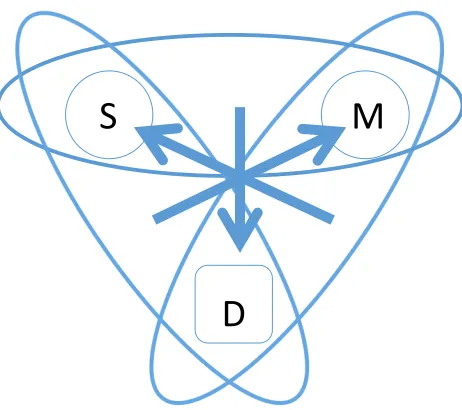
In Chapter 4 I advance an account of dispositions in terms of Edgington’s suppositionals.
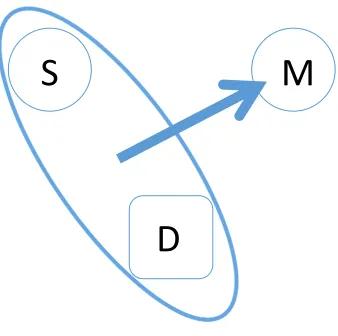
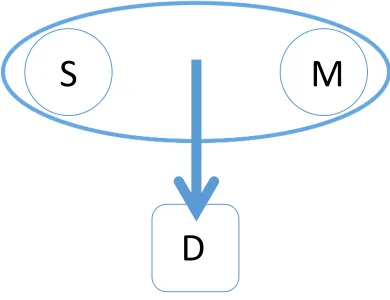
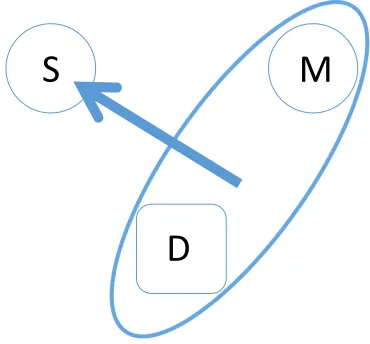
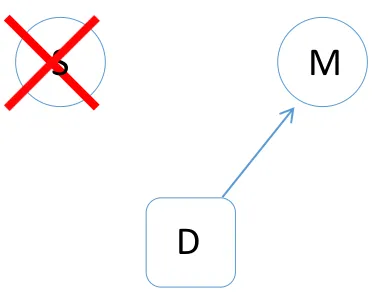
In doing so I propose that a conditional analysis actually implies at least 3 distinct
conditional claims. The Simple Conditional Analysis incorporates 3 elements: a stimulus
condition S, a manifestation condition M, and what Bird (2009) calls a covert disposition
ascription D. I argue that upon the supposition of any pairing of these three elements, an
inference is licensed to the third, and that these inferences capture the bulk of our ordinary
use of dispositional language.
The three inferences, and so the three activities we carry out with dispositional language,
are a predictive inference, an evidential inference, and an inference to the best
explanation. This explains our normal reasoning involving dispositions, the intuition that
dispositions involve some sort of conditionality, and the intuition that dispositions
somehow involve, imply, or are implied by behaviors, without also appealing to
counterfactual conditionals, and so without taking on their metaphysical costs.
In Chapter 5, having presented the suppositional account, I turn from the subject of how
we get from our folk practices involving dispositions, to the sorts of metaphysical
commitments that beliefs in dispositions entail. I do this by presenting a variety of
functionalism about dispositions.
In doing so, I largely follow the sort of ‘Canberra Plan’ approach that is endorsed by
David Lewis (1970, 1972). I argue that the ordinary platitudes, delivered by our folk
understanding of physical objects and phenomena associated with a certain disposition,
disciplines, such as the sciences or even our common interactions with the physical world,
to determine whether or not the thing to which those platitudes have referred, actually
exists or not. This can be understood as a sort of realizer functionalism, according to
which the dispositional property is identified with its realizer, rather than its role, but
differs from some other accounts insofar as the realizer is a token property, in virtue of
which it plays the functional role, and that similar token properties are of the same
dispositional type (whether this can actually be called functionalism is open to debate.
Just as Lewis (1999, p.307) is unsure as to whether or not he is a functionalist, so too am
I).
In Chapter 6 I provide both a defense and an elaboration of my suppositional account,
partly using Michael Fara’s (2005) account of dispositions in terms of what he calls
‘habituals’ as something of a foil. I respond to the potential criticism that in dispensing
with counterfactual conditionals, and the possible world semantics with which they are
associated, my account is not able to accommodate the sorts of antecedent assumptions
of ‘normal conditions’ which often accompany disposition ascriptions. In response, I
argue that the suppositional account allows for the inclusion of whatever antecedent
suppositions one wishes to include in their suppositions concerning dispositions. These
antecedent suppositions will be largely determined by the beliefs that one has concerning
the disposition in question, combined with relevant context and circumstances
surrounding the dispositional behavior.
This suppositional account has the advantage of retaining the empirical attractiveness of
power of the later counterfactual accounts. In addition, it better captures our folk
understanding of and use of dispositional concepts, and avoids the standard
2
Dispositions and Behaviors.
2.1 Introduction.
Dispositions involve behaviors. If I were to ask you what it means for something to be
fragile, you will presumably respond, at least partly, in terms of the ways in which objects
behave; ‘to be fragile is to be easily damaged’ for instance. Being damaged is a behavior
potentially exhibited by something that is fragile. A similar response will be provided for
any disposition. Involving some sort of behavior is what it is for something to be a
dispositional property and not some other sort of non-dispositional, perhaps categorical,
property 1
.
In this chapter I will provide a selective overview of the literature concerning dispositions.
My main goal is to provide context and background for the discussion that follows
throughout this thesis. I briefly outline and assess the claim that dispositions can be
1
This entailment between dispositions and behaviors is usually expressed as an
entailment between dispositional ascriptions and some sort of conditional. Upon this
view, dispositional ascriptions entail conditionals while categorical ascriptions do not.
There is, of course, a great deal of discussion and disagreement concerning this claim. To
deny that there is any such entailment is essentially to deny that there are any dispositional
properties. For an interesting discussion on the nature of any entailment between property
ascriptions and conditionals, see Mellor (1972) who holds the view that both dispositional
and categorical properties entail conditionals. For a dissenting view see Prior’s (1982),
accounted for entirely in terms of their behaviors, in the sense that behaviors exhaust their
existence. In doing so, I present the chapter in terms of an interesting analogy between
attempts at accounting for dispositions in terms of their associated behaviors, and the
approach that is known in the philosophy of mind as behaviorism.
2.2 Behaviors and Behaviorism.
A behaviorist approach to dispositions is most consistent with a particular
characterization of dispositions that I will refer to as ‘pure dispositions’. A Pure
Dispositions Thesis states that:
(Pure Dispositions Thesis) Some dispositions do not have an underlying causal
base that is non-dispositional 2
.
By ‘underlying causal base’ I follow the account of Prior, Pargetter, and Jackson (1982,
p.251) which states that:
2
This sort of claim is sometimes called a ‘pure powers’ thesis (Bird 2009). I follow Bauer
(2012) in the use of the terminology ‘pure disposition’ because I take a power to be a type
The property or property-complex of the object that, together with the… -
the antecedent circumstances - is the causally operative sufficient
condition for the manifestation ‘ of that disposition.3
A ‘non-dispositional’ causal basis would be a categorical property. Categorical properties
are contrasted with dispositional properties in that they are not usually understood as
entailing any sort of behavior or conditional. According to Ellis and Lierse (1994, p.28),
categorical properties ‘don’t do anything; they merely characterise’.
Physical dispositions, including pure dispositions, are not readily observable. In this way,
they are rather like the mental states of other people or animals 4
. By simply looking at
an object, I cannot immediately know, ordinarily, what dispositions it possesses.
Likewise, by simply observing another person or animal, I cannot immediately know,
ordinarily, anything about what, if any, internal mental state or states it is in. This lack of
direct empirical access to mental states has led some, such as Armstrong (1968), Ryle
3
Prior, Pargetter, and Jackson include in their account what they call ‘surefire’ and
‘probabilistic’ dispositions. I have omitted these features from their claim, as they are not
relevant to my following discussion. If that is not satisfactory, consider my use of their
account to be of the ‘surefire’ variety.
4
Where there may be ambiguity, I will distinguish between physical and mental
dispositions by using the term ‘physical disposition’. Otherwise, it should generally be
(1980), and Wittgenstein (1953), to understand them in terms of the behaviors associated
with them 5
.
According to the behaviorist account of mind, to be in a certain mental state is just to
exhibit, or to be disposed to exhibit, the behaviors that we associate with that mental state
(Armstrong 1968, pp.57-58; Ryle 1980, ch. V). Armstrong (1968, p.57) points out that
‘the Behaviorists emphasized the tremendous importance of dispositions in unfolding the
nature of the mental concepts’. For example, by simply looking at someone who is not
swimming, I cannot know whether or not this person knows how to swim. To know how
to swim is to be disposed to exhibit a certain set of behaviors under certain conditions
(Ryle 1980, pp.33-34). We generally associate with the mental state of knowing how to
swim, such behaviors as actually swimming when falling into a sufficiently deep body of
water. So, if I want to learn whether you know how to swim, all I need to do is throw you
off a boat and see what happens.
A similar approach has been taken towards physical dispositions. This lack of direct
empirical access to dispositions led to attempts at analyzing away this troubling feature.
According to this approach to dispositions, something has a particular disposition just if
it exhibits the behaviors we associate with that disposition. For example, we generally
5
I am not attributing to Armstrong, Ryle, Wittgenstein, or anyone else, any particular
version of behaviorism. Indeed Armstrong (1968, p.55) points out that whether or not
Wittgenstein is indeed a behaviorist at all is ‘hotly debated’ and that both Wittgenstein
and Ryle ‘deny that they hold this doctrine’. Ryle (1980, p.308) states of his work that it
associate with the disposition of fragility, such behaviors as cracking, breaking, smashing
or similar behaviors, in response to being dropped or struck, or similar stimuli. I cannot,
ordinarily, know, simply by looking at it, and without appeal to experience, whether or
not the glass that I was provided at lunch is fragile. To know whether or not it is fragile,
I would need to throw it off a table and see if it breaks.
This is the sort of approach famously taken by Carnap (1956). Distinguishing between an
‘observation language’ and a ‘theoretical language’, (1956 p.38), Carnap states of the
observation language (LO) that:
All primitive predicates in this language designate directly observable properties
or relations of observable things or events; and a non-primitive term is admitted
in LO only if it can be defined on the basis of the primitive terms by an explicit
definition in an extensional form, that is, not involving either logical or causal
modalities(1956 p.63).
Carnap carries out this form of extensional definition in terms of the stimulus and
manifestation, or what he calls stimulus and response, conditions, that we associate with
a disposition. For example, we might say that something x is fragile iff, if x is struck, x
breaks. Carnap refers to this sort of extensional definition as a ‘reduction sentence’ (1936,
1956 p.41). If a disposition can be captured by a reduction sentence, then a new predicate
attributing it can be admitted to the observation language. Carnap points out that the
Behaviorism… led often to the requirement that all psychological concepts must
be defined in terms of behavior or behavior dispositions. A psychological concept
ascribed to a person X by the investigator Y either as a momentary state or process
or as a continuing trait or ability, was thus interpreted as a pure disposition DSR of
such a kind that S was a process affecting the sensory organ of X but observable
also by Y, and R was a specified kind of behavior, also observable by Y (1956
p.71).
Physical dispositions and mental states or mental dispositions can both be understood in
terms of the behaviors that they produce under certain conditions. That is, any theoretical
term, be it physical or mental, should be describable in terms of its behaviors, actual or
potential.
This behaviorist approach provides a strategy for learning about the dispositions that a
thing possesses. If I want to know whether a certain ball is bouncy, all I need to do is drop
it and see if it bounces. If indeed it does bounce, then the ball is bouncy, and if it does not
bounce, then it is not bouncy. When understood in this way, behaviorism can be used as
a methodology in various sciences. Methodological Behaviorism is usually understood
as a doctrine concerning the appropriate methodology of psychology 6
. According to
methodological behaviorism, psychological sciences ‘as a purely objective and
6
Skinner, who states that ‘terms like “mind,” “will,” and “thought” are often simply
synonyms of “behavior”’ (1977, p.2) is often cited as an example of someone who applies
experimental branch of natural science’ should retain empirical respectability by being
concerned not with unobservable internal mental states but with observable behaviors
(Watson 1913, p.158). By analogy, a behaviorist approach to physics would amount to
the claim that physics, or whatever other science one might wish to take a behaviorist
approach to, should be concerned with the observed behaviors of its subject matter. If so,
sciences that involve dispositional terms in general, like mass, charge, soluble, durable,
flammable and so on, will be concerned with the behaviors exhibited by the things that
are said to possess those properties, and not with the unobservable internal states of those
things. Carnap seems to endorse, or is at the very least aware of, something like this sort
of procedural or methodological approach, holding that a disposition predicate is
admissible into the observation language just if an observer is able, through
experimentation, to produce the stimulus and manifestation conditions (1956, p.64) 7
.
Methodological behaviorism is standardly distinguished from what might be called
philosophical or analytic behaviorism. This is not a claim about how to practice science,
but rather about the meanings of the terms that we employ. To say that a particular person
knows how to swim is to say that person will, ceteris paribus, exhibit the behaviors
consistent with knowing how to swim 8
. That is, claims that we make about mental states
are, on the whole, claims about certain behavioral states and not about unobservable,
7
These testing procedures will be discussed later in this thesis, primarily in chapters 4
and 5.
8
internal mental states. Analogously, analytic behaviorism as applied to dispositions more
generally, amounts to a claim about the meanings of the disposition term and not about
how science should approach or treat something said to possess that disposition. By
‘soluble’ we mean ‘dissolves when placed in water’, or something along those lines.
On a pure behaviorist approach to the mind and on the analogous approach to dispositions
in general that I have sketched above, no reference is necessarily made to internal mental
or dispositional states. Throwing you off a boat does not, on the behaviorist approach,
grant me empirical access to your internal mental states. By observing you swimming, or
not, I do not somehow observe that you possess a certain internal mental state; knowing,
or not, how to swim. Rather, the behavior of swimming, or not, just is knowing, or not,
how to swim 9
. Likewise, if I state that a certain glass is fragile, what I mean is that it will
break when struck. I am not necessarily making some extra claim about some
unobservable, perhaps microstructural state of the glass. Rather, in saying that the glass
is fragile, what I mean, and all that I mean, is that it will exhibit certain behaviors (like
breaking) under certain conditions (like being struck). No extra claim about unobservable
states is implied.
9
This amounts to a very pure or perhaps idealized and naïve form of behaviorism that, to
my knowledge, has not been adopted, or at the very least, has not been espoused in the
literature. I have in mind Ryle’s stress on the distinction between ‘know how’ and
‘knowledge that’; but as acknowledged in a previous footnote, even Ryle is not a
2.3 Problems with the behaviorist approach.
Despite having some intuitive appeal, to an empiricist, there are a number of well-known
problems with behaviorism. Some of the standard problems behaviorism faces tend to
involve explicitly mental phenomena without a dispositional analogue 10
. Given that my
focus is on physical dispositions, and not on the philosophy of mind, I will largely ignore
those problems that apply specifically to the philosophy of mind.
One problem with Behaviorism is that it seems possible for someone to be in a certain
mental state while not exhibiting the associated behaviors. For example, we generally
associate certain behaviors with being afraid (fleeing, screaming, panicking, shaking, and
so on). Consider someone who is faced with a situation in which they are genuinely afraid,
but do not wish to appear afraid, for whatever reason. Perhaps this person is being
harassed by a wild animal and, while frightened, believes that giving the appearance of
not being frightened might prevent an attack. The pure behaviorist, like the animal, will
observe that this person is not exhibiting the behaviors associated with fear and infer that
they are not afraid. In this case, the person is in the mental state of being afraid but is in
10
An example of such a thing is qualia. Qualia are the qualitative characters that certain
experiences are said to have. That is, while someone is in a state of pain, there is an extra
qualitative experience of what it is like to be in pain (Nagel 1974). Behaviorism is
sometimes criticized as not being able to account for qualia (Place 2000). Qualia,
however, seem to have no analogue in physical dispositions. They are uniquely mental
the behavioral state of being unafraid. I will refer to this class of problem collectively as
‘confounders’ or ‘confounding conditions’ 11
.
Secondly, a person might be in the behavioral state of being afraid while being in the
mental state of being unafraid. Consider an actor in a play or film. This actor, while
unafraid, believes that giving the appearance of being afraid might entertain their
audience or provide them with some other benefit. This belief, combined with the desire
to achieve whatever it is that they believe can be achieved, motivates the actor to exhibit
the behaviors associated with being frightened, even though they are not actually
frightened. Following Johnson (1992, p.232) these sorts of problems are generally
referred to as ‘mimics’ or ‘mimicking conditions’. I will follow this convention.
11
There are a number of distinct types of confounders that each present their own
problems for analysis of physical dispositions. Use of the terms ‘mask’ seems to have
originated in Johnson (1992). Bird is the originator of the antidote counterexample (1998,
2004, 2009). Bird’s antidotes are a sophistication of the masking counterexample and are
designed to block Lewis’s (1997) Reformed Conditional Analysis. Martin’s (1994)
special case of a confounder is a variety of what he calls a ‘fink’. The discussion in this
section does not need to be sensitive to this distinction between different varieties of
2.4 The Standard Analytic Problems.
These two problems with behaviorism are directly analogous to a set of well-known
problems for analyses of dispositions, the canonical presentations of which can be found
in Martin (1994), Johnson (1992) and much discussed and elaborated upon throughout
the literature 12
. Just as it is possible for someone to be in a certain behavioral state while
not being in the associated mental state, so too is it possible for something to behave a
certain way while not possessing the properties that we generally associate with those
behaviors (in mimicking cases), or, to possess the properties that we associate with a
certain behavior while not exhibiting that behavior (in confounding cases). To be in a
behavioral state of fear is to exhibit behaviors such as fleeing and screaming. To be in an
analogous dispositional state of fragility, for example, is to exhibit behaviors such as
breaking upon being gently struck. Examples of these sorts of problems are confounding
conditions, such as masks and antidotes, and mimicking conditions.
Recall that dispositions, according to Carnap, are to be accounted for in entirely
extensional terms and as such are to involve neither logical nor causal modalities (1956
p.63). Carnap outlines this as follows:
12
Counterexamples to conditional analyses of dispositions are so discussed in the
literature that providing anything like a comprehensive list of such discussions is
impractical for the purpose of this thesis. For a highly selective and limited overview, see,
for example, Bird (2009, ch.2), Choi (2006, 2008, 2011, 2012), Manly and Wasserman
Suppose that there is a general regularity in the behavior of a given thing of such
a kind that, whenever the condition S holds for the thing or its environment, the
event R occurs at the thing. In this case we shall say that the thing has the
disposition to react to S by R, or for short, that it has the property DSR (1956, p.63).
Carnap makes the further claim that the regularity that holds between the stimulus and
manifestation conditions associated with some disposition must hold without exception
(1956 p.66). From this claim, Carnap derives two consequences (1956 p.67):
1. ‘If the thing b has the disposition DSR and the condition S is fulfilled for b, then it
follows logically that the result R holds for b.
Therefore:
2. If S holds for b, but R does not, then b cannot have the disposition DSR.’
What Carnap does not explicitly state, but what requires explicit statement here, is that
there is a third derivable consequence. That is:
3. If S holds for b and R also holds for b, then b must have the disposition DSR.
Claims 1 and 3, having been explicated, can be restated in informal terms as the
4. The thing b has the disposition DSR, if and only if, if the condition S holds for b
then the condition R holds for b.
This being the case, if some disposition is stimulated, then it ‘follows logically’ that the
disposition will manifest (1956 p.67). So, if the disposition possessed by some object is
stimulated, but does not manifest, then it follows logically that the object does not possess
the disposition (1956 p.67). This is the confounder problem.
To illustrate this problem, consider the type of fragility that we associate with such
behaviors as breaking, cracking, or shattering, in response to the application of an
appropriate manner of force, such as being struck or dropped. Now suppose that some
object is genuinely fragile and is struck with sufficient force that it should break. Like the
frightened person who did not display their fear due to some extra mental state, the fragile
object may not break due to the presence of some extra state, such as being surrounded
by a protective wrapping 13
. This shows that it is possible for something to be in a certain
physical state while not being in the associated dispositional state.
The above-mentioned claim 3 is subject to the mimicking problem. To illustrate this sort
of problem, notice that it is also possible for something to behave as though it possesses
13
This particular example of a confounding condition is usually referred to as a ‘mask’.
Some, such as Fara (2005) hold that masks are the most problematic of the
a certain physical disposition when in fact it does not. Consider an object that is not at all
fragile. This highly durable item is rigged with extremely powerful explosives such that
if it is struck with even a very small amount of force, the explosives will detonate and the
object will break (Bird 2009, p.29) 14
. This object exhibits the behaviors that characterize
fragility - breaking when gently struck – even though it does not possess the associated
disposition. This example is analogous to the actor who, despite being unafraid, behaves
as though they are. That is, it shows that it is possible for something to manifest
dispositional behaviors while not possessing the associated dispositional property 15
.
The confounder and mimicker problems are usually presented as problems for analyses
of dispositions. That is, if what we mean by ‘fragile’ is something like ‘breaks when
struck’, then if we adopt rules as outlined by Carnap (1956), we also mean first, that if
something does not break when struck, it is not fragile, and second, that if something does
break when struck, then it is fragile. Purely in virtue of the meaning of the term ‘fragile’
we are then forced to attribute fragility to objects that we might not otherwise believe are
fragile, and may in actual fact not be fragile, and we are likewise forced not to attribute
fragility to objects that we might otherwise believe are fragile, and may in actual fact be
fragile.
14
In Johnson’s (1992, p.232) example of mimicking the extrinsic condition that caused
the breaking of the durable object was an angel who had taken a dislike to the object.
15
In a previous version of this thesis, I used language that was unclear, here and
elsewhere. I think one of my examiners for pointing this out and suggesting the clearer
The following example captures the potential for misattribution of dispositions to objects.
Suppose there are two glasses. One is fragile while the other is not. Each is wrapped in a
protective film that would prevent a fragile glass from being broken when struck or
dropped. Both glasses are dropped, and neither breaks. In this case, both glasses exhibit
the dispositional state of being durable even though only one of the glasses is genuinely
durable. According to rule 3 that was derived from Carnap’s other rules, neither glass,
even though one is actually fragile, can be said to be fragile.
Problems such as those that have been discussed above have led many to attempt similar
analyses using counterfactual, rather than material, conditionals 16
. Ryle, for example,
states that:
When we describe glass as brittle, or sugar as soluble, we are using dispositional
concepts, the logical force of which is this. The brittleness of glass does not consist
in the fact that it is at a given moment actually being shivered. It may be brittle
without ever being shivered. To say that it is brittle is to say that if it ever is, or
ever had been, struck or strained, it would fly, or have flown, into fragments. To
say that sugar is soluble is to say that it would dissolve, or would have dissolved,
if immersed in water (1980, p.43).
16
A relatively early discussion of this approach appears in Goodman (1954 (reprinted
1983, p. 33)) who states that ‘the interrelated problems of dispositions, counterfactuals,
More formally, such an account would say something like:
Something is fragile iff, if it were to be struck, then it would break.
Again, this does indeed seem to capture much of the intuitive meaning of what it is for
something be or to have a disposition. Indeed, as I look at the mug on my desk, I do tend
to believe that if it were to be dropped to the ground, even though it has not been and
hopefully will not be, then it would break.
The main problem with this approach is that it unfortunately takes something of a
backward step. Carnap’s original reason for providing the reductive account that he did
was to secure empirical respectability by eliminating unobservables from our account of
dispositions. This is in keeping with the general, empirical, behaviorist attitude. The
major reason for providing any sort of behaviorist account of some phenomenon, as
people have done with mental states and as Carnap outlined with dispositional states, is
to replace reference to unobservable internal states in favor of observable behaviors. But
the use of counterfactual conditionals reintroduces exactly the feature that behaviorists
attempt to eliminate. Notice that in the counterfactual version of the analysis of fragility
that I provided above, it was stated that something would come about if something else
were to happen. But what is observable about states that will or even might come about
in response to states that explicitly have not actually come about? The notion of
possibility has been introduced here. Merely possible events or states of affairs are not
observable at all. This is one of the general problems with behaviorism that seems
provide an accurate account of dispositional or mental terms without reference to
dispositional or mental states.
The line of criticism here might be thought unduly realist about the existence of the
allegedly confounded disposition, and thus begging the question against the behaviorist
approach. A very strict behaviorist might disagree with my assertion that one of the
glasses in my above example was fragile and that the other was not. They might respond
that in exhibiting the behaviors that they did, neither glass is genuinely fragile, as I have
asserted. I respond to these sorts of criticisms in later chapters. Essentially I attempt to
reconcile the empiricist appeal of behaviorism with the realist intuition that a physical
disposition may exist even when it is not manifested, and that a disposition may not exist,
even when behaviors associated with that disposition are manifested.
2.5 Epistemic Problems.
While the standard problems are generally treated as analytic, there are also a number of
very closely related epistemological issues mirroring them. Consider an epistemological
interpretation of the mimicking problem. How can the behaviorist towards mental states
distinguish between, on one hand the state of being unafraid, and on the other the state of
being afraid while also desiring to appear unafraid and possessing the skills to exhibit the
behaviors associated with being unafraid? Arguably, without positing further beliefs, they
cannot. Given that both the unafraid person, and the frightened person who acts unafraid
afraid or unafraid. That is, there is no apparent means of knowing whether or not they
possess the property that is associated with these behaviors. The mimicker problem, and
also the set of confounder problems, is not just a problem for the meaning of the terms
that we employ to refer to things, but also for how we know what things are and are not
in the world, and the properties that they do and do not have.
A further problem, and a problem that really goes to the core of the realist/empiricist
tension that often characterizes attempts at accounting for dispositions, is that there is no
way of knowing whether or not a thing possesses a certain disposition when that thing is
not exhibiting or manifesting the behavior that we associate with that disposition. Recall
the examples given above. The only way for us to know if someone knows how to, or is
disposed to, swim is to place the subject in an environment that would bring about
swimming behaviors, and see if they do actually swim. In terms of physical dispositions,
the only way for me to know if my mug is fragile is to throw it to the ground and see if it
breaks. Of course I am disinclined to throw people from boats or to throw mugs from
desks in order to subject them to these sorts of tests. As such, simply by looking at them,
I cannot know if my office mate knows how to swim, and I cannot know if my mug is
fragile. This, in itself, seems reason enough to reject a straightforward behaviorist
approach to dispositions. While there is something obviously correct about relating
behaviors to dispositions, something is missing17
.
17
The something that is missing is largely the topic of the following chapters, particularly
Just as there is arguably no way of telling what disposition someone or something
possesses when they, or it, are not manifesting that disposition, nor is there, arguably, a
way of telling what disposition someone, or something, possesses, even when that person
or object is exhibiting that disposition. In order to express this point, I will rely upon the
now famous Kripkenstein problem (Kripke 1982). In his interpretation of Wittgenstein’s
rule-following problem, Kripke interprets the following statement by Wittgenstein to be
of significance: ‘This was our paradox: no course of action could be determined by a
rule, because every course of action can be made out to accord with the rule’
(Wittgenstein, in Kripke 1982, p.7). The example used by Kripke is that of the addition
rule in arithmetic (1982, p.7). Consider the statement, 50 + 40 = 90. The ‘+’ in this
statement we generally understand to mean the addition function or the ‘plus’ rule. In
carrying out the calculation, 50 + 40 = 90, I can be judged to have followed the plus rule.
Yet following the ‘plus’ rule is indistinguishable from following any number of other
rules, because, to re-use Wittgenstein’s expression, ‘any course of action can be made out
to accord with the rule’. For example, in carrying out the calculation 50 + 40 = 90, suppose
I was not in fact following the plus rule at all. Rather, I was following the ‘quus rule’
(Kripke 1985, p.9). The quus rule states that x quus y, is the same as x plus y, where x
and y are both below 51, and if x or y are above 51 then the answer is always 5. The
calculation 51 + 40 = 5, would be correct according to the quus rule because it satisfied
the requirement of the quus rule that either x or y or both is greater than 51 18
.
18
While not relevant to my objective treatment of the problem, it should be noted that the
Kripkenstein problem is also a subjective problem. That is, even when I carry out the
calculation 50 + 40 = 90, there is no way for me to be sure that the rule that I followed
The particular issue that I will use the Kripkenstein problem to draw attention to is that
regardless of the behavior that a person or object exhibits, we cannot tell which behavior
someone, or something, is manifesting, even when they are in fact manifesting it. Suppose
I witness someone carrying out the calculation 50 + 40 = 90. Given that this behavior is
consistent with both plus and with quus, I cannot tell which of these rules has been
followed. As such, I cannot tell whether I have observed the application of quus, or the
application of plus. The behavior could be consistent with the application of the plus rule,
the quus rule, or a potentially infinite number of other rules that one might imagine.
As it is with the behaviors of people, so it is with the behaviors of objects. Kripke’s
problem was presented in terms of rule following. In order to present the analogy with
physical dispositions, I will speak not in terms of the following of rules but of the
undergoing of processes.
The manner of the behavior, or the process by which the behavior occurs, is important.
The manifestation of some disposition following the stimulus of that disposition could be
considered a process. This seems to be the approach taken by Carnap (1956, p.63).
Characterizing a disposition solely in terms of stimulus and manifestation conditions
excludes a very important component of the behaviors that are actually occurring, which
attention to the manner of manifestation is intended to pick up upon.
Consider an example. Two magicians are performing on stage. Both claim to be able to
a charlatan and merely appears to levitate through clever use of wires and such. Despite
both magicians outwardly manifesting the behaviors associated with levitation, only one
actually possesses the ability while the other does not. If we do not, or are not able to, pay
sufficient attention to the manner of the manifestation of these behaviors, we will be
misled as to what dispositions are actually manifesting. Both magicians have the outward
appearance of rising from the ground. They do so, however, by totally different processes
or means. To call both ‘levitation’ is at best misleading and at worst an ontological error.
When sufficient attention is paid to the process by which they exhibit their behaviors,
intuitively, they are manifesting different dispositions, even though their behaviors are
identical. The point here is twofold. Mere behavior, at least at a more superficial level, is
not sufficient to characterize or analyze the dispositional state of some object. But
moreover, unless we pay sufficient attention to the manner of the manifestation of some
disposition, we cannot know which disposition it is, the manifestation of which has been
witnessed.
Kripke supposed that after completing a calculation involving the plus rule, a ‘bizarre
skeptic’ might question Kripke’s certainty as to his answer (1982, p.8). So it is with
physical dispositions. In observing the manifestation of any disposition whatsoever, a
bizarre skeptic, or indeed any perfectly sane person, might question the nature of the
process by which this manifestation occurred. One does not need to be a ‘bizarre skeptic’
to question the nature of the processes by which certain behaviors are manifested. Just by
observing a superficial behavior, then, we cannot know what disposition we have actually
2.6 Summary.
I have argued above that someone who adopts a Pure Dispositions Thesis is committed
to something interestingly, though not completely accurately, analogous to a behaviorist
approach to the mind. I have also argued that there are a number of problems associated
with taking such an approach. This does not mean, however, that someone is not able to
adopt either a Pure Dispositions Thesis or perhaps a modified conception of dispositions.
Indeed, there seems to be two possible directions one might take in response to this set of
problems.
The first of these is to retain the strict empiricist underpinning of the behaviorist approach
and assume that the manifested behaviors represent the dispositional properties of the
object in question. That is, if we drop a seemingly fragile glass and the manifestation of
the fragility behavior is somehow confounded, then the object is clearly not fragile.
Indeed, Johnston (1992, p.234) points out that ‘because pure dispositions by definition
lack a constituting basis there seems little to the idea of a pure disposition being masked,
altered or mimicked’. As such, there seems little reason for a behaviorist towards pure
dispositions to even find problematic many of the things that I have argued above are
problematic. This approach, in defiance of the arguments that I have provided above,
retains empirical respectability but at great cost.
The second of these directions is to assume that the manifested behaviors do not
drop a seemingly fragile glass and the manifestation of the glass is somehow confounded,
then the glass can still be assumed to be fragile, if we know enough about the confounding
circumstances and underlying qualities of the glass that make it fragile. This attitude is
3
Dispositions and Conditionals.
3.1 Introduction.
In this chapter, I more closely examine the relationship between dispositions and
conditionals. I argue that Edgington’s (1986) argument against certain conditionals
capturing our common practices and use of conditional language is particularly applicable
to the special case of the apparent conditionality of dispositions. Edgington proposes, as
an alternative to truth-functional analyses of conditionals, a ‘suppositional’ account 19
. I
do not intend to establish the claim that Edgington’s account provides a semantics for
conditionals, or ‘if, then’ statements, in general. Rather, I intend to argue, primarily in the
next chapter, that Edgington’s suppositionals can account for the apparent conditionality
of dispositions, or ‘is disposed to’ language 20
.
Edgington’s discussion is primarily concerned with the indicative conditional, which has
the same truth functionality as the material conditional. This being the case, I might be
reasonably criticized on the grounds that even if Edgington’s arguments – and hence my
arguments – hold in the case of indicative conditionals, they fall short of addressing the
full scope of the Simple Conditional Analysis, as it crucially involves a counterfactual
19
How Edgington’s alternative suppositional account applies to dispositions is the subject
of the following chapter.
20
I thank an examiner of a previous version of this thesis for comments that helped to
conditional 21
. Importantly, my target is not the same as Edgington’s, however. Though I
will briefly discuss some independent reasons for rejecting both the truth conditional and
metaphysically committal nature of the counterfactual conditional, my goal is instead to
demonstrate that each of the four assumptions that Edgington argues are made by those
who endorse certain types of conditionals, account for the standard problems with
conditional analyses of dispositions. That is, problems associated with the apparent
conditionality of dispositions may be avoided by rejecting these assumptions in the
manner that Edgington recommends while discussing indicative conditionals. Yet to do
this is to avoid a counterfactual analysis. Again, I do not attempt to establish the claim
that the resulting view, which is developed in the next chapter, is superior to extant
conditional analyses. Instead, the goal of this thesis is to demonstrate the possibility and
plausibility of an account of the apparent conditionality of dispositions without appealing
to possible world semantics or other such devices.
In this chapter I will argue that the values of the conditionals that comprise the Simple
Conditional Analysis of dispositions are, for those who endorse such an analysis, not
independent. This presupposition of interdependence between the elements of the Simple
Conditional Analysis is what generates the assumptions discussed by Edgington; and in
this chapter applied to dispositions. These assumptions are the source of the apparently
21
I should point out, however, that Edgington states that while ‘the main argument of the
paper concerns indicative conditionals… this thesis extends to subjunctive or
counterfactual conditionals’ (1986, p.5). While counterfactuals are generally thought of
as being truth conditional, the standard analysis of their truth conditions introduces the
framework of possible world semantics, which Edgington’s arguments do not directly
problematic nature of the standard counterexamples to conditional analyses of
dispositions. If this presupposition of interdependence, and hence the four assumptions
that follow from it, are not made, then the counterexamples do not result.
I conclude this chapter with the claim that the assumption of interdependence between a
dispositional property and its associated stimulus and manifestation conditions can be
maintained while avoiding the standard counterexamples if the nature of that relationship
is more consistent with that captured by Edgington’s suppositional. Essentially, I am
claiming that the relationship between a disposition ascription and its stimulus and
manifestation conditions is not analytic, in the sense that true sentences asserting
relationships of this kind are not true in virtue of meaning facts. It is this assumption of
analyticity that generates the standard counterexamples. If the assumption of analyticity
is rejected, the assumption of interdependence can be maintained in a way that avoids the
standard counterexamples.
3.2 Dispositions and the Conditional.
A material conditional is false just when the antecedent is true and the consequent is false,
and true otherwise. This has immediate implications for the analysis of conditional
statements in natural language in terms of this connective. The view that the material
natural reasoning is highly contentious 22
. Given that ordinary locutions and reasoning
often involve dispositional claims, so too is it contentious that analyses of dispositions
should involve material or indicative conditionals.
For example, if I want to assess the truth of the conditional “if I look in my pocket, then
I will find $1000”, presumably I would look in my pocket. If I look and I do find $1000,
then the conditional is true. If I look and I do not find $1000, then the conditional is false.
However, given that the material conditional is true whenever the antecedent is false, the
conditional statement “if I look in my pocket, then I will find $1000” is true if I do not
look in my pocket; assuming that it is a material conditional that is being expressed. It is
true regardless of whether or not there is in fact $1000 in my pocket, assuming I did not
look in my pocket.
Now suppose that I want to assess the truth of conditionals that have a false antecedent.
For example, I hold my pen up in the air and I say ‘if I had let go of the pen, it would
have fallen to the ground’. I do not let go of my pen, so the antecedent is false and yet the
conditional seems to be true.
Conditional claims involving dispositions are often of this sort. For example, I might say
of the glass upon my desk that if the glass were thrown against the wall, then it would
break. I do not throw my mug against the wall, so the antecedent is false, and yet the
conditional seems to be true. It is for this reason that counterfactual conditionals, rather
22
The view that such conditionals capture commonly used ‘if, then’ locutions is largely
than material conditionals, are usually taken to link the stimulus and manifestation
conditions of a disposition.
Upon the Lewis-Stalnaker account of counterfactual conditionals, a counterfactual is true
just if the consequent is true at the nearest possible world in which the antecedent is true
(Stalnaker 1968, Lewis 1973). So my statement, “if I had let go of the pen, it would have
fallen to the ground” is true, just if at the nearest possible world to the situation of
evaluation in whichI do drop the pen, it falls to the ground.
Dispositions seem to involve some sort of conditionality and they are often analyzed in
terms of conditionals. The common, so-called, Simple Conditional Analysis of
dispositions has the following structure:
Simple Conditional Analysis: D ↔ (S ¨→ M) 23
23
The S ¨→ M conditional is usually taken to be a counterfactual conditional (Bird 2009,
p.24) 24
. Consider fragility as an example. Something is said to be fragile, iff if it is struck,
it would break 25.
So, the Simple Conditional Analysis contains three separate conditionals, one of which is
a counterfactual conditional. The first of these conditionals is the conditional that links
the stimulus and manifestation conditions. I will refer to this as the SM conditional. This
states that if some stimulus event occurs then the associated manifestation event also
occurs:
SM: S ¨→ M
The second and third conditionals are those that comprise the biconditional. The
biconditional (↔) asserts that the implication between D and S ¨→ M, and holds in both
24
There is a large body of literature surrounding various attempts at analyzing
dispositions in terms of conditionals. For an excellent overview on conditional analyses
of dispositions, their problems and attempted solutions and reformations, see Bird (2009
pp.18-42).
25
This is an oversimplification. Strictly speaking the above is better thought of as an
analysis of breakability rather than of fragility. Fragility seems to imply a number of other
conditions. For example, a fragile object, in order to manifest its fragility, must be struck
with sufficient force for it to actually break but that force must not be so great as to break
a non-fragile object. Fragile objects, as opposed to breakable objects, break when struck
directions of implication. We say of something fragile that if it is struck, it would break,
and we also say that of something that if it is struck, it would break, then it is fragile. That
is, a biconditional p ↔ q is true, just if the conditional p → q is true and the conditional
q → p is also true. So, the biconditional in the Simple Conditional Analysis is a
conjunction of the conditional D → (S ¨→ M) and the conditional (S ¨→ M) → D.
The first of the conditionals which conjoin as the biconditional of the Simple Conditional
Analysis states that if some disposition exists, then it will manifest its associated behavior
in response to an appropriate stimulus. Bird (2009, pp.24-25) refers to this conditional as
CA→.
CA→: D → (S ¨→ M)
The second of these conditionals states that if a particular behavior is manifested in
response to an appropriate stimulus, then an associated disposition exists. Bird (2009,
pp.24-25) refers to this conditional as CA←.
CA←: (S ¨→ M) → D
So the Simple Conditional Analysis is committed to each of these conditionals holding
when the relevant dispositional relationship obtains.
Having outlined each of the conditionals that comprise the Simple Conditional Analysis,
analysis. I should note here that sophistications of the Simple Conditional Analysis have
been advanced, notably by Lewis (1997). Further counterexamples to these
sophistications have since been advanced in response 26
. I will not attempt to discuss the
sophistications of the Simple Conditional Analysis or the counterexamples to its
sophistications.
3.3 Counterexamples to Conditional Analyses.
These conditional analyses of dispositions are problematic insofar as they face two
primary types of counterexamples; confounding counterexamples, and mimicking
counterexamples 27
.
Choi and Fara (2012) point out that each of these is a special case of what Shope (1978)
calls ‘The Conditional Fallacy in Contemporary Philosophy’. Shope points out that these
26
See Choi and Fara 2012; Fara 2005; Choi 2006, 2009; and Bird 1998, for further
discussion of and objections to Lewis’s Reformed Conditional Analysis.
27
There have also been numerous attempts at addressing these sorts of problems. Some
argue that despite these problems, the Simple Conditional Analysis can be accepted (Choi
2006, 2008, 2009). Others have attempted to reform the Simple Conditional Analysis in
order to address these problems (Lewis 1997). Mumford and Anjum (2011, 2012) take a
different approach altogether and ‘model’ dispositions in terms of vectors. Another
approach has been to attempt to account for the conditional nature of dispositions but
sorts of problems emerge because the truth of a conditional is dependent upon the
truth-value of the antecedent. As such, Shope characterizes the problem as:
A mistake one makes in analyzing or defining a statement p by presenting its truth
as dependent, in at least some specified situations, upon the truth (falsity) of a
subjunctive conditional Ø of the form: 'If state of affairs a were to occur, then
state of affairs b would occur', when
(Version 1) one has failed to notice that the truth value of p sometimes depends
on whether a actually occurs and does not depend merely upon the truth value of
the analysans or definiens; moreover, one has failed to notice this because one has
overlooked the fact that in some of the specified situations… if a were to occur
then the occurrence of a or the occurrence of b or their combination (the
occurrence of a or the absence of b or their combination) would be at least part of
the cause of something that would make p true, although p is actually false (Shope
1978, p.399).
And/or:
(Version 2) one has overlooked the fact that, in some of the specified situations,
statement p is actually true, but, if a were to occur, then it would be at least a
Version 1 of Shope’s problem expresses a general form of the problems represented by
mimicking type scenarios. Version 2 expresses a general form of the problems
represented by confounding type scenarios.
Confounding conditions prevent a disposition from manifesting in response to its
stimulus, thus rendering false the associated counterfactual conditional S ¨→M. That is,
S will be true but M will be false. As such S ¨→M will be false in a circumstance in
which we are inclined to judge that D holds. Because S ¨→M is false D → (S ¨→M) is
also false. As such, a confounder renders false the Simple Conditional Analysis.
Suppose, for example, I have a glass that I consider to be fragile and I knock it from my
desk. We might say that this glass is fragile if and only if, if I knock it from my desk, it
will break when it hits the floor. However, if the glass is wrapped in a bubble wrap, or
my carpet is especially thick and soft, the glass will not break even though it is dropped.
So the conditional is false but many of us are motivated to say that the glass is nonetheless
fragile. Hence, the Simple Conditional Analysis appears incorrect.
A special type of confounder is the fink 28
. Notice that in the example that I provided
above, an extra condition, the protective nature of the bubble wrap or the softness of the
carpet, confounded the manifestation of the disposition. In the case of a fink, the
confounding condition is also the stimulus condition. For example, consider a live wire.
28
Martin (1994, p.2) originally referred to his example as an ‘electro-fink’. The term
Given a conditional analysis of what it is for a wire to be live, it might be held that ‘if the
wire is touched by a conductor then electrical current flows from the wire to the
conductor’ (Martin 1994, p.2). However, Martin has us consider the following:
The wire… is connected to a machine…. which can provide itself with reliable
information as to exactly when a wire connected to it is touched by a conductor.
When such contact occurs, the [reverse] electro-fink reacts (instantaneously, we
are supposing) by making the wire [dead] for the duration of the contact. In the
absence of contact the wire is [live]. For example, at t1 the wire is untouched by
any conductor, at t2
a conductor touches it, at t3
it is untouched again. The wire is
[live] at t1
, [dead] at t2
, and [live] again at t3
(Martin 1994, pp. 2-3).29
We say that the wire is live at t1
, but due to the mechanism, it is false that if the wire is
touched by a conductor, then electrical current flows from the wire to the conductor. Once
again CA→, and hence the simple conditional analysis, is false.
To be clear, in the case of Martin’s electro-fink, the confounding condition was, as it was
in the more general case of fragility, still an ‘outside’ condition. Martin explicitly states
29
Martin’s electro-fink was actually the reverse of what has been presented here. The
electro fink made an otherwise dead wire live when touched. What has been presented
here is what Martin referred to as an electro-fink on a ‘reverse cycle’ (1994, p.3). I have
used his presentation of the electro-fink with ‘live’ and ‘dead’ mutually substituted
because his description of the electro-fink was clearer, more explicit and more elegant