A Whole of System Approach to Analysis
of Security in RFID Systems Using an
Integrated Layered and Partitioned
Reference Model
by
Luke Thomas Mirowski, BComp. (Hons)
Submitted in fulfilment of the
requirements for the Degree of
Doctor of Philosophy
University of Tasmania
I
S
TATEMENT OF
O
RIGINALITY
This thesis contains no material which has been accepted for a degree or diploma by
the University or any other institution, except by way of background information and
duly acknowledged in the thesis, and to the best of my knowledge and belief no
material previously published or written by another person except where due
acknowledgement is made in the text of the thesis, nor does the thesis contain any
material that infringes copyright.
II
S
TATEMENT OF
A
UTHORITY OF
A
CCESS
This thesis could be made available for loan and limited copying in accordance with
the Copyright Act 1968.
III
S
TATEMENT OF
C
O
-A
UTHORSHIP
The publications of the work undertaken in the course of this research are the
following:
Mirowski, L., J. Hartnett and R. Williams (2009). "An RFID Attacker Behavior
Taxonomy." IEEE Pervasive Computing 8(4), pp. 79-84.
• Mr. Luke Mirowski (80%) is the primary author.
• Mrs. Jacqueline Hartnett (10%) and Dr. Raymond Williams (10%) of the School of Computing and Information Systems, University of Tasmania,
provided general guidance and editing advice as supervisors.
Mirowski, L., J. Hartnett and R. Williams (2009). How RFID Attacks are Expressed
in Output Data. Proceedings of the 10th International Symposium on Pervasive
Systems, Algorithms and Networks (I-SPAN 2009), Kaohsiung, Taiwan, pp.
794-799.
• Mr. Luke Mirowski (80%) is the primary author.
• Mrs. Jacqueline Hartnett (10%) and Dr. Raymond Williams (10%) of the School of Computing and Information Systems, University of Tasmania,
Mirowski, L., J. Hartnett and R. Williams (2009). Tyrell: an RFID Simulation
Platform. Proceedings of the Fifth International Conference on Intelligent Sensors,
Sensor Networks and Information Processing (ISSNIP 2009), Melbourne, Australia,
pp. 325-330.
• Mr. Luke Mirowski (80%) is the primary author.
• Mrs. Jacqueline Hartnett (10%) and Dr. Raymond Williams (10%) of the School of Computing and Information Systems, University of Tasmania,
provided general guidance and editing advice as supervisor.
Mirowski, L., J. Hartnett, R. Williams and T. Gray (2008). A RFID Proximity Card
Data Set: Technical Report, School of Computing and Information Systems,
University of Tasmania.
• Mr. Luke Mirowski (70%) is the primary author.
• Mrs. Jacqueline Hartnett (10%), Dr. Raymond Williams (10%), and Mr. Tony Gray (10%) of the School of Computing and Information Systems,
University of Tasmania, provided general guidance and editing advice as
We the undersigned agree with the above stated proportion of work undertaken for
each of the above published manuscripts contributing to this thesis.
Signed: ………..
Date: ………..
Mrs. Jacqueline Hartnett
Supervisor
School of Computing and Information Systems
University of Tasmania
Signed: ………..
Date: ………..
Dr. Raymond Williams
Supervisor
School of Computing and Information Systems
University of Tasmania
Signed: ………..
Date: ………..
Mr. Anthony Gray
Consultant
School of Computing and Information Systems
IV
A
BSTRACT
This thesis proposes the use of a ‘whole of system’ approach to the analysis of
security in Radio Frequency Identification (RFID) systems and introduces a
reference model for this purpose. It illustrates the advantages of this approach in the
context of detecting clone tags within RFID systems, including the specific example
of a pharmaceutical supply chain. It compares the results from using the proposed
model with those from previous work that adopted a more localised approach (Rotter
2008; Mitrokotsa et al. 2010). In order to enable the ‘whole of system’ approach, a
domain model for RFID systems is introduced and a simulator based on this is
implemented. Interesting insights arising from simulator results are confirmed
through laboratory experiments.
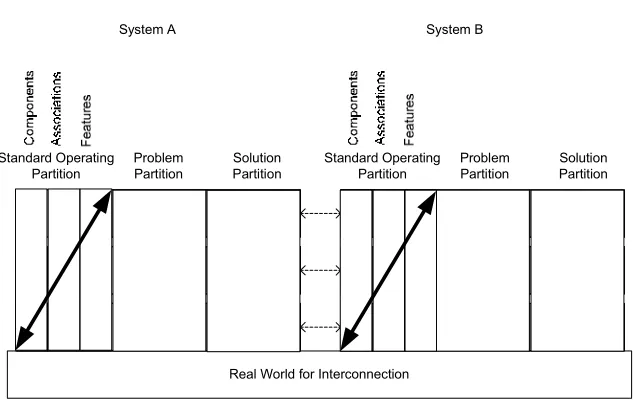
The reference model proposed consists of the three horizontal layers suggested by
previous authors: real world, RFID and strategic (Mitrokotsa et al. 2008, 2009), but
adds vertical security partitions for such things as the problem context. This
provides a structure that allows existing analysis methods from any appropriate
source to be applied systematically, such that their results are integrated across the
whole system. It is shown that this provides for the analysis of not only the security
requirements of the whole system but also, where in the system it is practicable to
place measures that achieve these requirements.
The domain model introduced comprises a logical view of RFID components and a
data view of the associations and features that characterise the component
interactions. The model’s controlled vocabulary allows the domain constructs in
RFID systems to be identified and described. A simulator, which has been validated
for preliminary ‘whole of system’ analysis and is based on this domain model, allows
experimentation with systems via an application programming interface (API).
Work suggested by the reference model is reported as simulation results, and
confirmed by laboratory experimentation using Class-One Generation-Two RFID
equipment. Whereas Juels (2005) showed that tags of this standard can be
reprogrammed so that they can be authenticated by a reader, the results in this thesis
illustrate how readers can be reprogrammed to expose clone tags, thereby
This thesis addresses an analysis gap in the RFID security field by introducing a
‘whole of system’ approach made possible by the proposed reference model. The
results illustrate that the effectiveness of security in RFID systems can be improved
V
A
CKNOWLEDGEMENTS
I am grateful for the help provided by a number of people during the completion of
this thesis.
I would like to acknowledge my PhD supervisors, Jacqueline Hartnett and Mike
Cameron-Jones. Jacky’s knowledge, insights, and enthusiasm over the years were
instrumental to the completion of this thesis. Mike’s rigorous form of analysis and
guidance ensured this thesis reached its full potential.
I would also like to acknowledge my former PhD supervisors, Raymond Williams
and Christopher Lueg. Ray’s approach to problem solving resulted in a number of
interesting discoveries throughout this thesis. Christopher’s early influences ensured
this thesis took on a broader focus.
I am grateful for the assistance provided by Mark Anderson and Ian Whitehouse,
whose insights into the RFID field, as well as provision of data and equipment, were
much appreciated.
Without the support of my fellow PhD’s from the School of Computing and
Information Systems, this work would have been far more challenging to complete.
I am especially grateful to Joel Scanlan, Ivan Bindoff, Tristan Ling, and Matthew
Armsby for their time and effort in providing research advice.
Countless others have influenced this work in many ways. To those people I am
truly appreciative.
Finally, this thesis would not have been possible without the love and support of my
VI
T
ABLE OF
C
ONTENTS
1
Introduction
1
1.1 Introduction 2
1.2 Motivation 5
1.3 Key Contributions 6
1.4 Thesis Outline 7
2
Duplicate Tags in RFID Systems
10
2.1 Introduction 11
2.2 Cloning 11
2.2.1 Tag Cloning 12
2.2.2 Pseudo-Cloning 14
2.2.3 Cloning by Theft 16
2.3 Constraints For RFID and Security 18
2.3.1 Cost 18
2.3.2 Frequency 21
2.4 Summary 23
3
Current RFID Security Solutions
25
3.1 Introduction 26
3.2 RFID System Analysis Approaches 26
3.2.1 RFID Systematisations 26
3.3 RFID Security Analysis Approaches 34
3.3.1 Security Assessments 35
3.3.2 Model Based Analysis Approaches 37
3.4 Summary 45
4
Methods for Reference Model Construction
47
4.1 Introduction 48
4.2 Defining A System’s Architecture 48
4.2.1 Reference Models 49
4.2.1.1 Constructing Reference Models 50
4.2.1.2 Comparing Reference Models 51
4.3 Analysing Facets of a System 52
4.3.1 Domain Analysis 53
4.3.1.1 Object Oriented Analysis 54
4.3.1.2 Entity-Relationship Modelling 55
4.3.1.3 Feature Construction 56
4.3.2 Threat Analysis 58
4.3.2.1 Attack Trees 58
4.3.3 Solution Analysis 60
4.3.3.1 Agent Based Modelling and Simulation (ABMS) 60
4.4 Summary 62
5
An Integrated Layered and Partitioned Reference Model 64
5.1 Introduction 65
5.2.1 Layers 66
5.2.1.1 Real World For Interconnection 68
5.2.1.2 Real World Layer 69
5.2.1.3 RFID Layer 69
5.2.1.4 Strategic Layer 70
5.2.2 Partitions 72
5.2.2.1 Standard Operating Partition 74
5.2.2.2 Problem Partition 74
5.2.2.3 Solution Partition 75
5.2.2.4 Minor Partitions 76
5.2.2.5 Abstraction Principles Of The Model In Minor Partition Ordering 77
5.2.3 Integrating Layers and Partitions 79
5.3 Summary 81
6 The Standard Operating Partition and a Domain Model 84
6.1 Introduction 85
6.2 Components Partition 86
6.2.1 Components 88
6.2.1.1 Zone 88
6.2.1.2 Physical Entity 90
6.2.1.3 RFID Tag 91
6.2.1.4 RFID Reader 93
6.2.1.5 Database 95
6.3 Associations Partition 97
6.3.1 One-to-One (1:1) Association 98
6.3.2 One-to-Many (1:M) Association 98
6.3.3 Many-to-One (M:1) Association 99
6.3.4 Many-to-Many (M:M) Association 100
6.4 Feature Partition 102
6.4.1 One-to-One Features 102
6.4.2 One-to-Many Features 104
6.4.3 Many-to-One Features 105
6.4.4 Many-to-Many Features 105
6.5 Summary 106
7
The Problem Partition
108
7.1 Introduction 109
7.2 An RFID Attacker Behaviour Taxonomy 110
7.2.1 Authorisation System Attacker Behaviour 112
7.2.1.1 Original Tag 115
7.2.1.2 Clone Tag 115
7.2.2 Monitoring System Attacker Behaviour 117
7.2.2.1 Deny Tag Identification 119
7.2.2.2 Deny Reader 119
7.2.2.3 Deny Middleware Database 120
7.3 Discussion 121
8
The Solution Partition
125
8.1 Introduction 126
8.2 Exposing Attacks in Systems 127
8.3 Analysing A Solution ‘Whole of System’ 128
8.3.1 RFID Simulator 129
8.3.2 Simulated Scenario: Overview and Settings of Tag Cloning Attack130
8.3.3 Scenario Analysis 136
8.4 Discussion 139
8.5 Summary 140
9
Experiments Facilitated by the Reference Model
141
9.1 Introduction 142
9.1.1 Actual System Context 143
9.2 Background to Class-One Generation-Two Anti-Collision Protocol 144
9.2.1 Slotted Random Anti-Collision (SRAC) 145
9.3 Exposing Clone Tags 147
9.4 Experimental Setup and Method 148
9.4.1 Experimental Setup 149
9.4.1.1 Equipment 149
9.4.1.2 Laboratory Environment 149
9.4.1.3 Equipment Usage 150
9.4.2 Experimental Method 151
9.5 Results 153
9.5.1 Results Suggesting Responses in an Inventory Cycle Correspond to
Physical Tags 154
9.5.2 Results Supporting the Exposure of Clone Tags in an Inventory Cycle 156
9.6 Discussion 158
9.7 Summary 160
10
An Application of the Reference Model: A Case Study
162
10.1 Introduction 163
10.2 Analysis of the Pharmaceutical Supply Chain 165
10.2.1 Standard Operating Partition 166
10.2.1.1 Strategic Layer 169
10.2.1.2 RFID Layer 171
10.2.1.3 Real World Layer 176
10.2.2 Summary 179
10.2.3 Problem Partition 179
10.2.3.1 Authorisation System Attacker Behaviour 181
10.2.3.2 Monitoring System Attacker Behaviour 186
10.2.3.3 Summary 191
10.2.4 Solution Partition 191
10.2.4.1 Summary 199
10.3 Overall Summary 200
11
Conclusions and Further Work
202
11.1 Conclusions 203
11.1.2 Reference Model Considerations 205
11.1.3 General Considerations 207
11.2 Future Directions 207
11.3 Summing Up 209
References
210
Appendix A - RFID Simulator
217
A.1 Overview 218
A.2 Motivation for Developing An RFID Simulator 218
A.3 Development 219
A.3.1 Phase One: conceptual modelling 221
A.3.2 Phase Two: implementation in software 223
A.3.3 Phase Three: verification and validation 228
A.3.4 Phase Four: Exploring the Solution Space 241
A.4 Summary 241
Appendix B - Source Code for Experiments
243
B.1 Overview 244
Appendix C - Experiment Results
245
VII
L
IST OF
T
ABLES
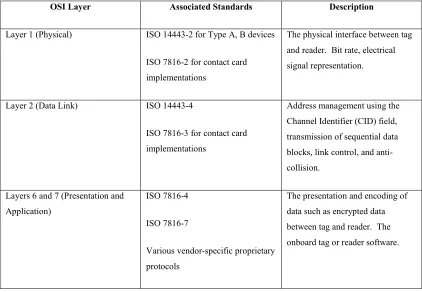
Table 1 – OSI Layers and ISO RFID standards ...29
Table 2 – Elementary features of a 1:1 association...103
Table 3 – Features of a 1:1 association ...103
Table 4 - Features of a 1:M association ...104
Table 5 - Features of a M:1 association ...105
Table 6 - Features of a M:M association ...106
Table 7 – RFID output data from the simulated cloning scenario ...135
Table 8 – Application Programming Interface (API)...226
Table 9 - Simulator output data ...238
VIII
L
IST OF
F
IGURES
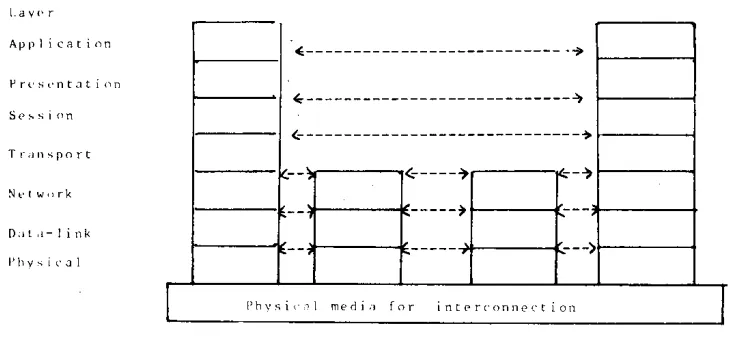
Figure 1 - Original (low-quality) depiction of the OSI reference model ... 28
Figure 2 - Communication model ... 30
Figure 3 –Layers beyond the RFID technology... 31
Figure 4 – The physical class... 32
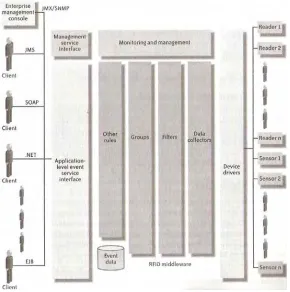
Figure 5 - Conceptual architecture for an RFID middleware ... 33
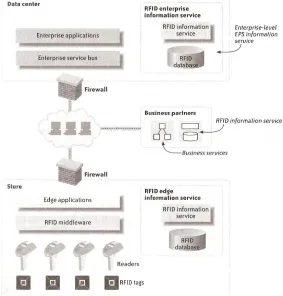
Figure 6 – RFID system in a retail application environment... 34
Figure 7 - Attack Tree for assessing objects ... 38
Figure 8 - Classification of RFID attacks at layers... 39
Figure 9 – Edge Hardware Layer threats and countermeasures ... 40
Figure 10 - Privacy and security risk assessment framework... 43
Figure 11 - Object Management Group (OMG) reference model for electronic commerce ... 49
Figure 12 - Attack tree for opening a safe ... 59
Figure 13 - The integrated layered and partitioned reference model... 66
Figure 14 – The reference model depicting the major layers ... 67
Figure 15 – The reference model depicting the major partitions... 73
Figure 16 - The reference model showing minor partitions ... 76
Figure 17 - The inclusion of minor-partitions follows an abstraction paradigm ... 78
Figure 18 - The integrated layered and partitioned reference model... 80
Figure 19 – Analysis of the standard operating partition... 85
Figure 20 – UML class diagram of the major components ... 87
Figure 21 - Zone component... 89
Figure 22 - Physical entity component ... 90
Figure 23 - Tag component... 92
Figure 24 - Reader component... 94
Figure 25 - Database component ... 96
Figure 26 - RFID tag and reader associations... 97
Figure 27 - One-to-one (1:1) association ... 98
Figure 28 - One-to-many (1:M) association ... 99
Figure 29 - Many-to-one (M:1) association... 100
Figure 30 - Many-to-many (M:M) association ... 100
Figure 31 - Analysis of the problem partition... 109
Figure 32 - RFID authorisation system attack tree ... 114
Figure 33 - RFID monitoring system attack tree ... 118
Figure 34 - Analysis of the solution partition ... 126
Figure 35 – Simulation Step 0 ... 132
Figure 36 – Simulation Step 2 ... 132
Figure 37 – Simulation Step 4 ... 133
Figure 38 – Simulation Step 8 ... 133
Figure 39 – Simulation Step 10 ... 134
Figure 40 – Simulation Step 38 ... 134
Figure 41 - Experimentation facilitated by the reference model ... 142
Figure 42 - Reader and tag interactions, and tag states... 146
Figure 43 – The ‘reply’ state for a tag ... 147
Figure 44 – A single inventory cycle where tags are supply clone EPC values ... 148
Figure 45 –Laboratory and Faraday enclosure ... 150
Figure 48 – Response from one physical tag in the field with a unique EPC ...154
Figure 49 – Response from ten physical tags in the field with unique EPC’s ...155
Figure 50 – Responses from ten physical tags in the field ...157
Figure 51 - Ten more physical tags in the field as clones ...158
Figure 52 - Validation of the complete reference model via a case study ...163
Figure 53 – Standard operating partition of pharmaceutical supply chains ...168
Figure 54 – RFID authorisation system attack tree ...182
Figure 55 - RFID monitoring system attack tree...187
Figure 56 - The solution partition of pharmaceutical supply chains ...193
Figure 57 - Development lifecycle of the simulator...219
Figure 58 – Simulator’s system boundary...224
Figure 59 – Analysing RFID systems via a simulation model...225
Figure 60 - The doorway monitoring system ...231
Figure 61 - The reader and tags mounted in the environment...232
Figure 62 – Step 0 illustrates the reader at the start position of -2...233
Figure 63 – Step illustrates the reader interacting with tag ‘01023c1baa’ ...234
Figure 64 – Step illustrates the reader approaching the end of a ‘run’ ...235
Figure 65 - The API script for the simulated 'doorway monitoring scenario...236
1
Introduction
1
1.1
I
NTRODUCTION
Radio Frequency Identification (RFID) has been used to identify objects for over 50
years (Garfinkel and Holtzman 2005). During World War Two, the Identification
Friend or Foe (IFF) system allowed for Allied aircraft to be distinguished from the
enemy on the basis of coded radio signals sent from transponders to a base station.
Years later, advances in electronics led to commercial adoption (Landt 2005).
Electronic Article Surveillance (EAS), developed by Sensormatic, Checkpoint, and
Knogo in the 1960’s was an early commercial RFID system, used to counter the theft
of merchandise. Rapid growth in commercial use of RFID occurred in the late
1980’s when electronic toll collection was introduced in Europe and then the United
States. Since then RFID has undergone significant developments.
Nowadays, the basic premise of RFID is that objects are marked with tags which
emit serial numbers obtainable by readers using radio signals (Weinstein 2005).
When compared with barcode technology, RFID identifies objects without requiring
line of sight. Once a tag’s serial number has been obtained, a reader retrieves
information about the serial number from a database, and acts upon it accordingly.
Tags fall into two general categories: active or passive. Active tags contain their
own battery power making them physically large and expensive. Conversely,
passive tags obtain their power from the signal of a RFID reader, and are therefore,
usually small and low cost. Consequently, passive tags are expected to be more
widely adopted then active tags and will dominate the widespread adoption of RFID
into the future. (Weinstein 2005)
Electronic Product Code (EPC) technology, developed by the Auto-ID Center,
established at MIT in 1999 and now managed by EPCglobal, is leading the
widespread adoption of RFID technology into various operations (Garfinkel and
Rosenberg 2005). Electronic Product Code (EPC) technology was introduced as an
extensible range of tag standards, of which, the Class-One standard represented a
cost effective and widely accepted design. It was mandated for use as a Supply
Chain Management (SCM) technology by Wal-Mart and the United States
Department of Defence (DoD), and its later standard, Class-One Generation-Two
industry, has led to a surge in EPC Generation-Two integrated circuit (IC) sales
volume, which is expected to exceed one billion units in 2010 (Swedberg 2010b).
This has led Bill Colleran, chief executive officer of Impinj, among the first
companies to introduce products based on the EPCglobal UHF Generation-Two
standard (O'Connor and Roberti 2005), to speculate that the widespread use of these
tags in the clothing industry is only a few years away, leading the way for its
widespread adoption in other industries.
A recent study by ODIN Technologies, reported by news sources (Swedberg 2010a),
has indicated that EPC Class-One Generation-Two tags remain at a price of around
15 cents apiece for quantities of 10,000 and 11 cents each when ordered in quantities
of one million or more, however; years ago Sarma (2001) speculated that tags would
need to cost as little as five cents each before they could begin to become widely
adopted. He speculated that to achieve this cost, such tags would be nothing more
than integrated circuits equipped with a radio antenna and a serial number. If we
follow the argument of Sarma (2001), it may mean that tags undergo some
reductions in functionality to achieve a cost of five cents. Therefore, tags which may
become widespread would be relatively simple devices, with a minimum level of
functionality for such things as security.
Widespread adoption of RFID will bring many benefits to industry, but at the same
time, the need for security can be seen in the following application examples, which
highlight a variety of RFID uses, but illustrate the varying security requirements of
different systems:
• Since the United States Federal Drug Administration (FDA) recommended the use of RFID (FDA 2004), news sources have reported trials of ISO-15693
tags by GlaxoSmithKline on bottles of Trizivir (O'Connor 2006), (a Human
Immunodeficiency Virus (HIV) medicine), for preventing the introduction of
counterfeit drugs. However, Hancke (2005) demonstrated ISO-15693 tags
are vulnerable to relay attacks, implying the possibility that even with RFID,
counterfeit Trizivir could still be introduced into the system.
Dutch OV-Chipkaart system. The MiFare Classic’s encryption algorithm and
authentication protocol can be reverse engineered, revealing ways an attacker
can read a card, clone a card, or restore a card to a previous state to commit
payment fraud (Garcia et al. 2008).
• Finally, the Texas Instruments Digital Signal Transponder (TI-DST), used in over 150 million vehicle immobiliser keys and the ExxonMobil Speedpass
system, has been cloned by a research team from John Hopkins University.
A cloned tag was used to purchase petrol in the Speedpass system, and to
spoof the immobiliser authentication system of a 2005-model Ford Escape
sport utility vehicle (SUV). (Bono et al. 2005)
Fundamentally, the link between the object, the tag, and the reader is one based on
surrogacy. As radio frequency communication is non-contact and non-line-of-sight,
it is more difficult for the owner of a tag to validate this relationship (Sarma et al.
2003). Trust in this system could be achieved if cryptography could fit into a label’s
functionality without dramatically increasing the cost of the label (Ranasinghe et al.
2004). However this seems unlikely for the tags which are envisaged to become
widespread, as the number of gates available in these tags is 4000 gates or less.
Unfortunately, for private key cryptosystems such as the Advanced Encryption
Standard (AES), a commercial implementation of AES typically requires 20,000 to
30,000 gates (Sarma et al. 2003). While other onboard options for cryptography
have been suggested for authentication of tags or readers, such as modified hashing
algorithms, these do not meet the cost requirements of these tags.
The examples above expose the need for structured analysis of security issues in the
widespread adoption of RFID technology. This has led to the research topic
explored in this thesis: the use of a ‘whole of system’ approach to the analysis of
security in RFID systems.
Methods for analysis of security in RFID systems currently exist; however these take
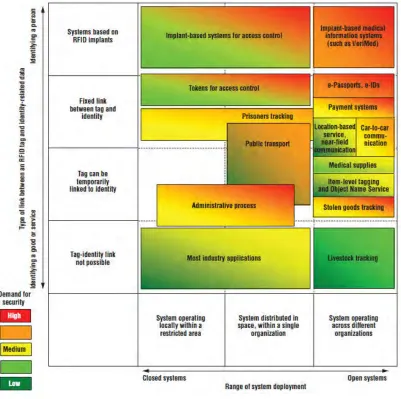
a relatively localised view of security. Rotter (2008) proposed a privacy and security
risk assessment framework which was used to assess domain risks using three
criteria: the system’s deployment range; the link between the RFID tag and
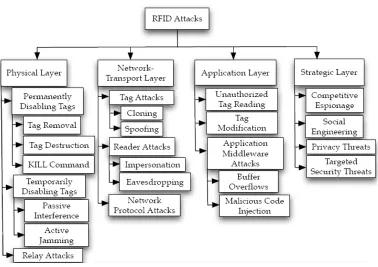
(2008, 2009) structured threats into system layers, enumerating the threats as well as
offering potential defences for each layer. The model they introduced for this
purpose discriminates attacks by layers: physical, network-transport, application, and
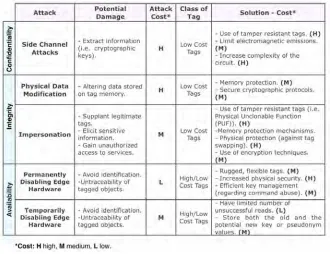
strategic. Finally, work by Mitrokotsa et al. (2010) extended the concept of
assessing security using layers, introducing the concept of security principles at each
system layer in addition to attribute columns for such things as cost and potential
damage. When considering these examples, it seems likely that an improvement to
be made is the capacity for capturing sufficient system information which would
enable the derivation of security requirements which consider the ‘whole system’.
Consequently, this thesis addresses an analysis gap in the RFID security field by
introducing a ‘whole of system’ approach to analysis, made possible by way of a
reference model. This model consists of the three horizontal layers suggested by
previous authors: real world, RFID and strategic (Mitrokotsa et al. 2008, 2009), but
adds vertical security partitions for such things as the problem context. This
provides a structure that allows existing analysis methods from any appropriate
source to be applied systematically, such that their results are integrated across the
‘whole system’.
Throughout this thesis a central theme will be challenging the established analysis
approaches which currently exist in the field. Using the model together with various
analysis techniques (for example: domain modelling, entity-relationship modelling,
and attack trees) illustrates the advantages of the proposed approach in the context of
detecting clones within RFID systems, including the specific example of a
pharmaceutical supply chain. Results from using the proposed model are compared
with those from previous work that adopted a more localised approach. Overall, the
results illustrate that the effectiveness of security in RFID systems can be improved
by employing a range of individual analysis methods integrated into this model,
which is not facilitated by existing approaches.
1.2
M
OTIVATION
The work reported in this thesis has emerged out of the need to develop practicable
security to prevent or detect tag cloning. Tag cloning, one problem explored
clone tag can be assigned to an unauthorised entity, thereby allowing the tag to
derive an authorised entity’s privileges in a system (Juels 2005). For systems which
rely on tags for authentication, like the system reportedly in use by GlaxoSmithKline
on bottles of Trizivir (O'Connor 2006), the ability to clone tags, implies counterfeit
Trizivir could enter the system and remain undetected even though an RFID system
is in use.
Early research on developing an intrusion detection system capable of detecting
clone tags illustrated the advantages of placing security in the middleware - where
security is usually more cost effective than on the tag. The system used statistical
profiling of tag data to identify instances which represented when a tag had change
ownership between entities (Mirowski 2006). Considered as ‘state of the art’ by
Lehtonen et al. (2007b), it was proposed to be used in places where cryptography on
tags was not practical. The derivation of practicable solutions, however, demands
knowledge of a system’s security requirements.
1.3
K
EY
C
ONTRIBUTIONS
The key contributions made by this thesis are as follows:
• Illustrating the advantages of taking a ‘whole of system’ approach to analysis of security in RFID systems by employing a range of individual analysis
methods which are integrated into a reference model. (Chapter 6 - Chapter
10).
• Introducing a model for security analysis which provides a structure that allows existing analysis methods from any appropriate source to be applied
systematically, such that their results are integrated across the whole system.
(Chapter 5).
• Presenting a domain model which comprises a logical view of RFID components, in addition to a data view of the associations and features that
characterise the component interactions. The domain model’s controlled
vocabulary allows the domain constructs in RFID systems to be identified
• Enumerating RFID threats over system layers which illustrates that a systematic approach to threat analysis can assist in identifying attacks, and
where it is more effective to address threats in a system. (Chapter 7).
• Contributing a simulator, validated for preliminary ‘whole of system’ analysis, which has been based on a domain model. It also implements the
model’s controlled vocabulary via its application programming interface
(API) allowing for repeatable systems modelling. (Chapter 8).
• Suggesting that a reference model based approach gives impetus to interesting simulation results, and confirming these through laboratory
experimentation using Class-One Generation-Two RFID equipment.
Laboratory work also illustrates how readers can be reprogrammed to expose
clone tags, thereby contributing an additional security solution (Chapter 9).
• Illustrating the advantages of a ‘whole of system’ approach in the context of the specific example of a pharmaceutical supply chain. When results from
using the proposed model are compared with those from previous work that
adopted a more localised approach, the effectiveness of the approach is
illustrated. (Chapter 10).
1.4
T
HESIS
O
UTLINE
What follows is the structure of this thesis.
• Chapter 2 reviews previous work on Radio Frequency Identification (RFID) security in the context of cloning attacks and system constraints. Considering
that cloning has system-wide consequences and various methods for
enactment, and because of system constraints, it seems likely that achieving
practicable security for cloning requires systematic analysis of security
requirements.
• Chapter 3 reviews previous work on approaches to security analysis in RFID beginning with a review of standard-system models. The properties common
to systems are discussed, and these are used to consider the closeness of
models, it seems that existing work has focussed on a relatively localised
view of security. Consequently, it seems likely that these examples have a
limited capacity to distil more relevant information that contributes to more
explicit security requirements in actual systems.
• Chapter 4 reviews a range of individual analysis methods suitable for proposing an alternative model for the proposed ‘whole of system’ analysis
approach. These methods come from a variety of backgrounds, but are
focussed on systematic analysis. The reference model paradigm suggests a
method for model derivation, whereas other methods are envisaged as useful,
when integrated into a reference model, for the purpose of specific modelling
tasks in RFID security analysis.
• Chapter 5 introduces an alternative model for security analysis in RFID systems, based on the reference model approach. When considering the
examples of previous work, this model is distinguished on the basis of
integrated layer and partition properties, and is therefore entitled, An
Integrated Layered and Partitioned Reference Model. Its qualities are
discussed along with its intended use to enable a ‘whole of system’ approach
to analysis using existing analysis methods.
• Chapter 6 illustrates how analysis using the standard operating partition of the reference model facilitates the enumeration of system elements into a
domain model. Various domain analysis methods are integrated to define a
logical view of components and these are modelled using the Unified
Modelling Language (UML). Following this, a data view of the system
associations is derived using Entity-Relationship Diagramming (ERD) and
from this, new features are constructed. What emerges is a domain model
and controlled vocabulary which allow for domain constructs to be identified
and described. This forms the basis for security analysis in a systems
context.
• Chapter 7 illustrates how analysis using the problem partition of the reference model, enables the systematisation of attacks. The attack tree method is
broadly matches RFID system layers. The chapter makes practical use of the
taxonomy to identify good locations for solutions in the example problem of
the Trizivir pharmaceutical system. As the taxonomy is relatively generic, its
broader potential for use is discussed.
• Chapter 8 introduces a software simulator based on the domain model, which has been validated for ‘whole of system’ analysis. It is applied to the analysis
of solutions in the reference model’s solution partition. The simulator is used
to explore the example solution of tag and reader associations for attack
exposure. The benefits of taking a systems approach to solution analysis are
discussed using this example, while impetus for exploring some of the results
further with EPC Class-One Generation-Two equipment is identified.
• Chapter 9 demonstrates, through experimentation with EPC Class-One Generation-Two equipment, how results obtained following a ‘whole of
system’ analysis, first explored conceptually through the model, and then in
simulation, can be realised in a system. The results of simple
experimentation, confirm the results of simulation, while illustrating the
possibility, in systems which use the Slotted Random Anti-Collision (SRAC)
protocol, of exposing clone tags through the reprogramming of an RFID
reader. The findings are discussed in relation to the need for appropriate
systems analysis prior to solution deployment.
• Chapter 10 validates the ‘whole of system’ approach in the context of the specific example of a pharmaceutical supply chain. The validation takes
place in each partition, while the results are integrated across the whole
model. It compares the results from using the proposed model with those
from previous work that adopted a more localised approach. These results
suggest that a ‘whole of system’ approach made possible by the proposed
reference model leads to more effective security requirements.
• Chapter 11 summarises the conclusions that can be drawn from the work presented within this thesis and ends by describing several promising
2
Duplicate Tags in
RFID Systems
2.1
I
NTRODUCTION
This chapter reviews some of the issues which surround the use of security in Radio
Frequency Identification (RFID) systems. It is not intended as a complete
exploration, and therefore, many tangential issues are not covered; however, a good
overview of these can be found in Juels (2006). This review examines the extent to
which security is relevant to the operational goal of ensuring every tag in an RFID
system is unique. Unlike barcodes which usually identify a class of products, in
comparison, RFID is distinguished by its ability to identify entities to the item level.
However, in order to achieve this, each tag needs to be unique (Glover and Bhatt
2006). In considering how this operational principle can be invalidated, this chapter
will establish a rationale for approaching security on a ‘whole of system’ basis.
To this end, two issues will be considered which are influential in ensuring tags in a
system remain unique. The first issue is cloning, which allows the principle to be
invalidated by an attacker (Bono et al. 2005). This attack is presented in various
forms which illustrate that cloning is a problem which is not localised to a part of a
system and is therefore difficult to prevent if security is approached at that part in
isolation. The second issue is the constraints on functionality which determine how
security can be implemented in various parts of a system to deal with the cloning
problem. The review of constraints mainly focuses on the tag and reader as these are
the more important parts of an RFID system. Having examined these issues, it will
be apparent that structured analysis of at least these issues, across the whole system,
is needed for the operational principle to be maintained.
2.2
C
LONING
Cloning is a threat to system operations as it allows unauthorised entities to claim the
privileges of authorised entities via tag credentials (Bono et al. 2005). This often
occurs when the serial number of an authorised tag has been obtained and encoded
onto a reprogrammable tag - there are also other ways this can occur. This
unauthorised tag is in the possession of the unauthorised entity, and as the tag is a
surrogate, cloning makes it challenging to distinguish entities based on tag data.
Thus, security in RFID systems is needed to ensure that cloning does not prevent the
various forms of cloning, based on where in a system attacks occur and how the
attack is used.
2.2.1
T
AGC
LONINGThis section reviews what will be referred to here as “tag cloning,” which represents
the more direct form of cloning as a system contains physical tags which share the
same identification data. Serial-number-only systems are highly vulnerable to
cloning of this form. These systems rely solely on a tag’s serial number for
identification purposes.
Obtaining a clone tag is no more difficult than the introduction of physical tags
which contain duplicate serial numbers. A simple attack of this form is when an
attacker introduces a tag which they have obtained from another system. In both
systems, the tag serial number is valid, but in the latter system, the tag clashes with a
serial number which is already activated. This attack is called cross contamination
(Heydt-Benjamin et al. 2006). Similarly, the data from an Electronic Product Code
(EPC) tag can be skimmed: read by an attacker’s RFID reader and encoded onto a
reprogrammable tag, to produce a clone tag (Juels 2005). As tags are validated on
their serial number, these attacks are relatively easy to perform.
The following examples focus on cloning of cryptographically enabled contactless
smart cards. These cards use RFID technology to identify themselves and
communicate with readers, but also use cryptography for more robust identification.
The review of these attacks illustrates that even RFID technology thought to be
secure, when deployed in a commercial application, is little more secure than serial
number only tags.
To begin with, the most commercially widespread contactless smart card, the MiFare
Classic is vulnerable to cloning. The MiFare Classic has mutual authentication and
data secrecy capabilities implemented using a proprietary stream cipher called
Crypto-1 which relies on a 48-bit secret key. Garcia et al. (2008) have demonstrated
that, by recording and studying traces from transmissions between cards and readers,
the encryption algorithm and authentication protocol can be reverse engineered -
revealing two attacks which enabled the secret keys of cards to be determined. With
card to a previous state. As these cards use RFID technology, contact between the
attacker and target card occurs without the knowledge of the card holder, allowing
the attacker to commit payment fraud surreptitiously.
Attacks against the MiFare Classic have been demonstrated in the London Oyster
Card system, and the Dutch OV-Chipkaart system (Garcia et al. 2008). While the
losses which could occur in these systems are financial, as the attacker obtains
ticketing at no cost, when one considers that the manufacturer, NXP Semiconductors,
estimated in 2008, that 200 million cards were in use, a global recall to correct the
problem would come at a significant cost to the manufacturer.
Work by Courtois (2009) illustrated that with a few enhancements, the attack against
the MiFare Classic can be improved so that the number of queries required is around
300. This enables the attack to be performed very quickly and suggests the ease with
which the assumption that every tag in a system is unique, even when security on the
tag exists, can be invalidated. As will be seen in the section on tag constraints, most
low-cost passive tags have less functionality than the MiFare Classic for onboard
security, so these types of attacks should be easier to perform against these tags.
Recent work by Kasper et al. (2010) on attacking the ‘ID-Card,’ used widely in
Germany, which they report as a MiFare Classic card, reveals obvious vulnerabilities
using inexpensive custom-built equipment (which costs less than 40 euros to build).
The vulnerabilities enable cloning which can then enable the theft of up to 150 euros
of stored value from cards in this system. While the possibility of conducting such
threats is widely acknowledged in literature, because this system allows for large
currency values to be stored on cards, it surprising to learn that this system does not
employ additional security checks to prevent attacks from occurring.
While work on attacking the MiFare Classic by Garcia et al. (2008) has demonstrated
that reverse engineering enables cloning wirelessly, work by Nohl et al. (2008) has
demonstrated that card ciphers can be reverse engineered at the silicon level, using a
combination of image analysis of circuits and protocol analysis. Using this type of
attack, it was revealed that several weakness in the cipher exist in addition to its short
key size. As the process to attack was largely automated, it could be applied to
This work demonstrates that finding an algorithm set in hardware is within reach of
an attacker, and thus, security at the protocol layers, there to prevent cloning, can be
largely bypassed.
When considering the above examples, this form of cloning illustrates that the
assumption that every physical tag is unique can be invalidated. When considering
that more powerful RFID-enabled smartcards which use cryptography, deployed in
commercial environments, fail to prevent cloning, the expectation that tags could be
secured to prevent cloning in lower cost systems seems unlikely.
2.2.2
P
SEUDO-C
LONINGWhat will be referred to here as “pseudo-cloning,” covers methods largely
independent of a physical tag such as simulation or spoofing of an authorised
identifier. As most of these attacks use simulator devices, these attacks bypass
security meant to authenticate a tag.
The first example is found in the VeriChip, a commercially deployable RFID tag for
use as a human implant. Halamka et al. (2006) demonstrated that a VeriChip could
be cloned when an attacker uses a device to scans its data, eavesdrop on its signal, or
learns its serial number. In the case of signal eavesdropping, an attacker can use the
Prox Mark II - an RFID tag reading and simulation device developed by Westhues
(2005), to obtain and replay VeriChip data. Alternatively, an existential cloning
attack – when the tag serial number is already known by the attacker – allows the
attacker’s device to simulate a tag’s identity without actually engaging the original
tag (Halamka et al. 2006). These attacks are of the pseudo-cloning form as they
occur when a replaying device is used.
Relay attacks between contactless smartcards, which use RFID technology, are
another example of pseudo-cloning. These were predicted as an effective way of
spoofing tag signals to a reader over long distances by Kfir and Wool (2005). In a
basic relay attack, a ghost device simulates a card to the reader, and a leech device
simulates a reader to the card. A channel is established between the ghost and leech,
and as these have more powerful transmission capabilities than the tags or readers,
these increase the range at which attacks take place. Using this type of attack, an
This attack was demonstrated by Kirschenbaum and Wool (2006) when they built the
leech device as a portable and extended-range RFID skimmer.
Relaying can also be a way of avoiding protocol based security between the tag and
reader as the next example illustrates. Relay attacks at 13.56Mhz using the
ISO-14443A standard were demonstrated by Hancke (2005). To enable relaying, similar
to that proposed by Kfir and Wool (2005), two devices were used: a mole and a
proxy. The mole interfaced with the user’s card and appeared as a valid reader,
whereas the proxy appeared as a valid card to the reader, and passed instructions to
the mole, which responded with tag information. In systems that do not measure
added time delay – a possible way of detecting relay attacks (Reid et al. 2007) - it
would be possible to circumvent cryptographic protocols using this method as they
are routed through the attacker’s devices.
Finally, the next example illustrates the consequences of pseudo-cloning, and what
can happen when clones exist in a commercial system.
Cryptographically enabled tags have been spoofed - recording and replaying tag data
- by a research team from John Hopkins University (Bono et al. 2005). The
researchers reverse engineered the cryptographic cipher underpinning the challenge
response-protocol which is used to authenticate the Texas Instruments Digital Signal
Transponder (TI-DST). In this system, the key was 40-bits long (a relatively weak
encryption key), and was recovered using an array of sixteen Field-Programmable
Gate Array (FPGA) integrated circuits, operating in parallel in less than one hour.
Given the secret key and tag serial number, this allowed the researchers to reproduce
the tag’s radio signals. (Bono et al. 2005).
The consequences of such attacks were demonstrated. The researchers used their
simulated TI-DST to purchase petrol in the Speed Pass petrol payment system and to
spoof the immobiliser authentication system of a 2005 model Ford Escape sports
utility vehicle (SUV), starting it with a bare ignition key (Bono et al. 2005). In 2005,
this type of tag was in use in more than 150 million vehicle immobiliser keys and
also in the ExxonMobil SpeedPass system which than contained seven million units.
Although the SpeedPass system employs additional fraud checking constraints in the
vehicle immobiliser is relatively vulnerable, as usually there is no additional security
at the ignition, except for the key. Thus, once such attacks are performed, a
simulator device is now the attacking device, and security based on the tag which
was targeted, is rendered ineffective.
The attacks discussed above, constitute pseudo-cloning as they result in another
entity claiming the privileges of an authorised entity via tag credentials but not
necessarily using a physical tag. The difference from cloning of the first form is that
the original tag is usually bypassed during the attack, such as when a simulator
device is used. This invalidates the assumption that every tag is unique, as actually,
simulator devices are claiming to be the tag. This means tag based security is
relatively ineffective when it comes to reusing the cloned data.
2.2.3
C
LONING BYT
HEFTWhat will be referred to here as “cloning by theft,” allows an unauthorised entity to
assume the privileges of an authorised entity by stealing a tag (not actual cloning as
such) or by cloning it. However, the nature of attack is not clear from the system’s
perspective. In these attacks, an attacker takes advantage of systems which do not
verify the associations between tags and physical entities. An attacker can remove
an authorised tag from an authorised physical entity, for example, without this
change being noticed by the system, until the point at which the physical entity is
examined – if this occurs at all for security. In cases where tag theft occurs, even if
there are physical entity authentication methods in place, such as holograms or
watermarks, these do not assist an RFID system as typically these are not conveyed
at the time the tag serial number enters the system (Ranasinghe and Cole 2008).
The examples now reviewed illustrate that tag or reader based security is rendered
ineffective as most attacks are not definable at the tag or reader. Unless physical
inspection of the entity occurs, usually solutions in the middleware such as intrusion
detection are the only means of protection, as these can look for anomalies in entity
behaviour by analysing the data produced by tags attached to entities.
From a system’s perspective, it may be difficult to ascertain whether the identifier is
coming from an authorised source. To this end, the concept of a change-of-tag
characterises how a system could perceive the use of stolen or clone tags by an
unauthorised entity. As an unauthorised physical entity using an authorised tag may
exhibit different behaviour from the authorised entity, it may be possible to detect
misuse when analysis of RFID data is performed. Using statistical methods,
Mirowski and Hartnett (2007) were the first to demonstrate that if the behaviour
associated with a tag serial number does not appear to be authorised, it could be
evidence to suggest that the associated physical entity is not genuine. In this case,
changes in behaviour may be indicative of cloning by theft.
A different way of defining and detecting identity misuse in systems is using
synchronised secrets. A synchronised secret is a way for a system to expose the use
of duplicate tag serial numbers on different tags (Lehtonen et al. 2007c). It works on
the basis that each time a tag is read, the reader writes a piece of data to the tag based
on its serial number. Each time the tag is re-read, the tag conveys its serial number
and its synchronised secret, and if both are valid, when compared to the records
maintained by the system for the tag serial number, a new synchronised secret is
written to the tag. As the authorised tag and clone tag are separate devices, the
assumption is that a clone is exposed when a tag has out-of-synch data, as data is
changed each time the tag serial number appears. In this case, the classification of a
tag as clone is based on behaviour arising in the system being implausible. Clearly,
the use of synchronised secrets must exist in the system in order for this type of
implausibility to be identified. Its use, however, involves security in different parts
of the system. It also relies on the original and clone being active in the system; if an
attacker clones a tag and discards the original then although the clone is used, the
synchronised secret would fail to detect clone tags – which is why it is classified as
cloning by theft.
Similarly, the solution of a heuristic classification to define cloning was explored by
Lehtonen et al. (2009). They characterised cloning as having occurred in a system
when entity behaviour, analysed in RFID data, was deemed to be likely to have been
produced by clone tags as it did not fit within a probabilistic behavioural threshold.
Under the classification, this approach is detecting cloning by theft as entities may be
Whether or not implausibilities are due to clones in this third form is less well
defined from a system’s perspective. As such, these may only become apparent if
more parts of a system are included in attack detection. The detection of the attack
as a cloning attack does not necessarily occur at the source of attack, such as the tag
or cloning device. The detection of the attack involves the analysis of the event data
generated by tag usage. Including other parts of the system in RFID security to
detect these attacks illustrates that the problem of cloning is not localised to one part
of a system.
To summarise, when considering the forms of cloning (tag cloning, pseudo-cloning,
cloning by theft), it seems likely that threats from clones can not be defined, nor
dealt with in a single part of a system. These attacks may involve an attacker
claiming an identity which has associated privileges, but these claims do not always
originate from a tag. Also, exposing them through detection methods, does not
always clearly define what form the attack has taken, and can involve different parts
of a system such as RFID data. Attacks against cryptographically enabled smart
cards; which use RFID technology but are themselves more powerful than low-cost
RFID, illustrate that security on the tag is largely tenuous in commercial
applications. When considering these examples, it seems likely that a broader
analysis of attacks in RFID systems, in the case of cloning at least, needs to be
undertaken to maintain a system’s operational goal of tag uniqueness. Conversely, if
this class of problems was considered in isolation of the whole system, one may miss
other forms of cloning which occur.
2.3
C
ONSTRAINTS
F
OR
RFID
AND
S
ECURITY
In exploring why solutions on the tag have failed to prevent cloning, this section
considers some of the challenges surrounding security in RFID systems. It focuses
on the tag, as the tag is the cornerstone of identification in these systems. In
reviewing these constraints, an overview of some of the limitations on addressing
security at a single point in isolation is provided.
2.3.1
C
OSTCost is a major influencing factor in achieving security in RFID systems. This
such as tags. It should be noted that these analyses do not consider the variable
financial aspects of cost in RFID systems such as fluctuations in currency.
In order for an RFID tag to compete with the barcode, and achieve widespread
deployment, it was predicted years ago that a tag would need to cost five cents
(Sarma 2001). The five cent tag cost model speculated that such a tag, at this cost,
could be developed. However, this tag would be severely limited in terms of
hardware resources. It would be a packaged tag, containing an integrated circuit
(IC), 64 bits of memory, passive powering, with around 400 to 4000 logic gates and
a read range of a few feet. As will be discussed, these constraints pose severe
challenges for normal operations as well as for security at the tag.
If we follow the argument of Sarma (2001), it may mean that tags undergo
reductions in functionality to achieve a cost of five cents; as a recent survey by
ODIN Technologies, reported by news sources (Swedberg 2010a), has indicated that
EPC Class-One Generation-Two tags remain at a price of around 15 cents apiece
when ordered in quantities of 10,000 and 11 cents each when ordered in quantities of
one million or more.
To cost five cents, most of the modifications required would be made to the IC – the
most expensive part of the tag (Sarma 2001). To reduce the cost, the size of the IC
needs to be reduced to less than 0.25mm2. There are three major contributors to the area on an IC, and consequently, these would need to be reduced: memory, logic, and
power circuitry. The memory would be reduced by using read-only memory rather
than non-volatile memory, and by storing only an Electronic Product Code (EPC) - a
tag’s serial number. The EPC is used as an index into a database where additional
information about the entity can be found. The logic on the chip would be
minimised by using efficient anti-collision protocols such as the Tree Walking
protocol (Glover and Bhatt 2006). Finally, the power circuitry would be minimised,
a ‘synergistic effect’ of minimising the other areas of the tag (Sarma 2001).
Considering these limitations, this costing model places severe limitations on what
would normally be operationally achievable for tags, let alone, what could hoped to
As will be discussed, the implications of constraining the cost of a tag, and hence its
capabilities, mean security on the tag is weak, and this has consequences for the
entire system. This was briefly alluded to in the previous section when the Texas
Instruments Digital Signal Transponder (TI-DST) was mentioned (Bono et al. 2005)
- if security cannot be addressed at the tag, then additional security measures like
fraud checking need to be put in place. Such solutions are themselves, not without
system implications. This was illustrated when Mirowski and Hartnett (2007)
demonstrated that incorrect classification of attacks causes false positive alarms,
meaning entities may be prevented from accessing the system. Thus, security in
RFID systems involves system-wide considerations.
The concept of low-cost tags was largely formalised by the Auto-ID Centre when
they developed EPC technology and a related class hierarchy for RFID labels
(Ranasinghe et al. 2004). This hierarchy specifies the amount of functionality
prescribed to tags that conform to this cost model. Class-One and Class Two
represent low-cost tags and contain simple EPC read-only labels and read-write
memory, respectively. In 2004, Class-One labels consisted of around 1000 to 4000
logic gates while Class Two labels contain several thousand more logic gates. The
IC memory had a few hundred bits available for data storage. The memory use
between these two classes was distinguished between read only memory for
Class-One tags, whereas Class Two tags have read-write memory. The logic on board
these tags was designed to only execute reader commands and implement an
anti-collision scheme. In terms of power, at the time it was estimated 150 microwatts of
power would be needed to operate such a tag. As this specification was developed
with the intent of standardising basic tag operations, it seems likely that any security
would be constrained by this specification. Thus, proposed security features may
need to be backwards compatible.
For cryptography, the predominant tag based solution to cloning attacks (Juels 2006),
the implication of constraints influenced by cost, are essentially this: given the
limitations on the number of logic gates, private key cryptosystems such as the
Advanced Encryption Standard (AES) are not suitable in commercial
implementations as AES typically requires upwards of 20,000 gates (Ranasinghe et
secure in a commercial implementation. The John Hopkins example described above
(Bono et al. 2005) demonstrates this, as the asymmetric nature of computing
resources available to the attacker and on the tag means that tags will nearly always
be at a security disadvantage.
When considering these costing models, the constraints which exist on low-cost tags
are rigid. The development of security solutions, would come as an addition to the
normal operating conditions of tags, and would therefore be subject to not only the
constraints which are imposed on the whole tag, but also the constraints imposed on
competition for resources between the security solution and the tag’s normal
operations.
2.3.2
F
REQUENCYThe radio frequencies at which tags and readers operate is another constraint on
achieving security in RFID systems at the tags and readers. The regulations
surrounding each frequency place constraints on power emissions, which in turn
influence: read distance, transaction time and anti-collision methods. These issues,
amongst many others surrounding the use of certain frequencies for RFID security
are now briefly discussed.
Most RFID systems operate in the Industrial, Scientific and Medical (ISM) bands
designated by the ITU (Ranasinghe et al. 2004). The most commonly used
High-Frequency (HF) ISM band in Europe and America is centred at 13.56 MHz and the
Ultra High-Frequency (UHF) band in the US is 902-928 MHz. Each frequency band
places regulations on the isotropic radiated power at certain distances; thus, tags have
different types of constraints according to frequency.
For passive tags these place severe restrictions on what can feasibly be achieved on
the tag. These regulations place an upper limit on the power available at a given tag
distance from a reader (Ranasinghe et al. 2004) and these place limits on the type of
security scheme and cryptographic hardware. As power emissions are limited, if
cryptographic hardware is used, it will use the available power or it will require
additional power.
As it stands, tags which operate at 13.56 MHz have typical reading ranges of 30
longest communication, 902-928 Megahertz (MHz), passive Ultra High Frequency
(UHF) RFID tags have reading distances of around 3m to 5m. Any onboard
addition, such as cryptography, therefore, may be detrimental to these estimated read
distances. If cryptography uses the available power sent from the reader, it will
severely diminish the tag reading distances and degrade the performance of the
whole RFID system (Ranasinghe et al. 2004). When considering this consequence,
diminished read range may place low-cost tags on par with barcodes, making the
perceived benefit of longer read distances less attractive. Conversely, the depth at
which tags embedded in objects could be read may be influenced; tagged objects
inside packages may not be as readable requiring the packages to be unpacked
impacting on a tag’s non-line of sight feature.
Frequency also places limitations on communication time (Ranasinghe et al. 2004).
In the United States, for example, UHF regulations for frequency hopping specify a
maximum time limit of 400 milliseconds (ms) on the use of a frequency channel.
This means a tag cannot be assumed to be in continuous communications across a
frequency hop, further limiting security transaction time. For readers, the ability to
read a minimum number of tags within a given time period - such as 300 tags per
second - may be diminished as any increase in transaction time, which would come
from security protocols, will inevitably reduce maximum read rate. Consequently,
this may mean that fewer tagged entities are identified within a time period, in which
case, the total number of entities in the whole system may take longer to identify.
There are also limitations on bandwidth. According to work done by Sarma et al.
(2003), a tag at 13.56 MHz must use far less signalling between readers and tags
when compared to what can be achieved at the 915 MHz. Consequently,
implementations for anti-collision protocols vary accordingly, to account for this
lack of bandwidth. For example, Aloha-based anti-collision algorithms are more
common in systems that operate in the 13.56 MHz band, whereas deterministic
anti-collision algorithms are more common in the 915 MHz band. Similarly, protocols to
secure the tag at 13.56 MHz must use far less signalling from reader-to-tag than at
915 MHz. Thus, the decision to use a certain frequency has ramifications for what