Leaf hydraulics: implications for
understanding leaf structure and
function, drought resistance and
community assembly
By
Christopher John Blackman (B.Sc. Hons.)
Submitted in fulfilment of the requirements for the
Degree of Doctor of Philosophy
(Plant Science)
University of Tasmania
This thesis contains no material which has been accepted for a degree or diploma by the University of Tasmania or any other institution, and to the best of my knowledge and belief, this thesis contains no material previously published or written by another person, except where due acknowledgement is made in the text of this thesis.
Signed: ________________ (Chris Blackman)
Date: ________________
Authority of Access
This thesis may be made available for loan and limited copying in accordance with the
Copyright Act, 1968.
Signed: ________________ (Chris Blackman)
Statement regarding published work contained in thesis
The publishers of the papers comprising Chapters 2 and 3 hold the copyright for that content, and access to the material should be sought from the respective journals. The remaining non published content of the thesis may be made available for loan and limited copying in accordance with the Copyright Act 1968.
Statement regarding published work contained in thesis
i The leaf hydraulic system in plants is charged with supplying water to the sites of evaporation in order to facilitate photosynthesis and growth, while simultaneously resisting negative pressure generated under tension induced by water stress. These processes contribute substantially to the enormous variation in leaf structure and function found across vascular plants and may contribute in fundamental ways to plant function and differences in species ecological strategy.
In this dissertation I examined the leaf hydraulic properties of a phylogenetically, morphologically and ecologically diverse group of woody angiosperm species in order to better understand how leaf hydraulics defines plant function under drought, is integrated with leaf structure and function, and drives differences in species ecological strategy and drought resistance. My results strongly indicate that leaf hydraulics underlie many important aspects of plant function and leaf structure. They also
enhance our understanding of the function and assembly of ecological communities, as well as the evolution of plant drought resistance. Furthermore, they provide a
potentially crucial tool for predicting the potential impacts of climate change and increasing aridity on plant function and community dynamics.
In drought-stressed seedlings, the recovery of gas exchange following re-watering was strongly correlated with the relatively slow recovery of leaf hydraulic conductance (Kleaf) in three ecologically disparate species. This hydraulic-stomatal limitation model of gas exchange recovery observed in these species indicates that leaf hydraulics is a key driver of plant functional recovery from drought. Variation in the hydraulic
vulnerability of leaves to water-stress-induced tension (P50leaf) was intimately linked to drought survival in the experimental species. Furthermore, variation in P50leaf across a larger group of species was significantly correlated with a suite of leaf structural and functional traits that confer increased drought resistance.
ii Variation in leaf hydraulic vulnerability was strongly correlated with the xylem
dimensions in the leaf minor veins that predict the vulnerability of conduits to collapse under negative pressure ((t/b)3) . While this result does not necessarily indicate a direct link between hydraulic dysfunction and conduit collapse, the relationship between P50leaf and (t/b)3 suggests evolved coordination in leaves between xylem structural strength and hydraulic vulnerability that will have major implications for understanding leaf-carbon economy.
Leaf hydraulic vulnerability was also shown to define the bioclimatic limits of species. Species with low P50leaf extended into drier regions, while species with high P50leaf were restricted to areas of high rainfall. Furthermore, the adaptive significance of
P50leaf was demonstrated using phylogenetically independent comparisons of species pairs from wet and dry forests. Across these pairings, wet forest species were
consistently more vulnerable to water-stress-induced hydraulic dysfunction, despite their generic ecological affinity in both wet and dry forests. This indicates that the evolution of leaf hydraulic vulnerability is bi-directional and adaptive across the rainfall spectrum.
Despite the adaptive significance of leaf hydraulic vulnerability, within-site variability in P50leaf differed between two high-rainfall communities that contrast in species diversity and historical ecology. This suggests that the functional composition of modern-day plant communities are not only influenced by current climate but by processes related to long-term climate variability and/or parochial historical constraints.
iii My deepest gratitude is extended to my supervisors Tim Brodribb and Greg Jordan. Thank you both for your mentorship, support and friendship throughout my
candidature. Combined, your knowledge and expertise has contributed in making this thesis both functional and ecological in its focus. Thank you Tim, your enthusiasm for and expertise of leaf hydraulics and plant physiology has been invaluable and instilled in me a great and ongoing passion for the subject. And thanks Greg, your profound knowledge of and passion for plants and their ecology is truly inspiring.
I am also grateful to my supervisors for allowing me to pursue a six-month research stint in the cloud forests of Peru. This trip was highly rewarding and important to my development as a research scientist. I’m deeply indebted to a number of people in Peru. To Damien Catchpole and Yoshie Yoshioka, thank you both for your support and
friendship, and for welcoming me into your home in Lima and Oxapampa. Damien, your logistical support and knowledge of the cloud forest environment was invaluable. Mate, I look forward to continuing our shared passion for research in the tropics in the future. A big thank you also goes out to my friend Guido Casimiro for his assistance both in the field and on the football pitch. Thanks also to Percy Summers for giving me access to a number of pieces of lab equipment. Finally, thanks to Pedro and Quicho and the people of Oxapampa for making my time in your beautiful town unforgettable.
In Tasmania, I am deeply grateful to a number of people who have provided support to and assisted with the research project. Thanks to Mark Hovenden for his support in dealing with issues surrounding my candidature and assisting with access to important research equipment. Thanks also to Tony O’Grady for the opportunity to discuss leaf hydraulics and giving me access to lab equipment from CSIRO. Thank you Ian
Cummings and Tracey Winterbottom for maintaining controlled conditions during the glasshouse drought experiment. My thanks also go out to Mick Oates for his assistance in the Plant Science workshop, and to Catherine Jones, Clancy Carver and Jodi Noble for their assistance with administrative procedures.
iv helping me assay leaf nitrogen, and Grant Williamson for his assistance with spatial data conversion.
A big thank you to all the people at the School of Plant Science, especially my fellow post-grads. Also, to Scott, Meisha and everyone who has passed through the lab – thanks for all the fun and good work.
v i Abstract
iii Acknowledgments v Table of contents 1 Chapter 1
General introduction
10 Chapter 2
Leaf hydraulics and drought stress: response, recovery and survivorship in four woody temperate plant species
(Plant Cell and Environment, 2009, 32: 1584-1595) 32 Chapter 3
Leaf hydraulic vulnerability is related to conduit dimensions and drought resistance across a diverse range of woody angiosperms
(New Phytologist, 2010, 188: 1113-1123)
59 Chapter 4
The adaptive significance of leaf hydraulic vulnerability and its implications for community assembly
82 Chapter 5
Two measures of leaf capacitance: insights into the water transport pathway and hydraulic conductance in leaves
101 Chapter 6
Chapter 1 – General introduction
1
Chapter 1
General introduction
Leaf hydraulics
Because leaves represent the interface between liquid and vapour-phase processes in plants, they are crucial to understanding whole-plant function. Hydraulically, leaves are designed to supply water to the sites of evaporation in order to facilitate
photosynthesis and plant growth. However, until recently, the importance of the hydraulic properties of leaves in defining plant function and driving differences in species ecological strategy has remained largely unrecognised. Recent studies indicate that the pathways for water movement in the leaf can represent more than 30% of the whole-plant hydraulic resistance (Sack & Holbrook, 2006). This hydraulic bottleneck places a significant constraint on plant functional processes, which is reflected by a good correlation between maximum leaf hydraulic conductance (Kleaf) and both stomatal conductance (Aasamaa et al., 2001) and maximum photosynthetic capacity (Brodribb et al. 2005). Across species, the hydraulic properties of leaves contribute substantially to the enormous variation in leaf structure, venation architecture and hydraulic design across different plant groups. Furthermore, Kleaf varies 65-fold across species (Sack & Holbrook, 2006), indicating that the leaf water transport capacity in plants has potentially strong ecological importance.
While water transport capacity strongly influences plant performance, the hydraulic pathway in plants is vulnerable to dysfunction under tension. Hydraulic tension is generated by the process of transpiration, which effectively pulls water from the roots through the xylem to the sites of evaporation in the leaf mesophyll (Zimmermann, 1983). As leaf water potentials decline under drought conditions, this tension
increases, and can reach levels that compromise the transport system and reduce the hydraulic conductance. The mechanism for this reduced conductance is widely thought to be xylem cavitation caused by air-bubbles entering the water column via pit
hydraulic dysfunction by closing their stomata, thus recovering water potential and avoiding potentially catastrophic hydraulic failure (Brodribb & Holbrook, 2003, Cochard et al., 2002, Nardini & Salleo, 2000). However, it is now accepted that some plants in the field regularly operate at water potentials associated with hydraulic dysfunction (Brodribb & Holbrook, 2004a, Johnson et al., 2009, Lo Gullo et al., 2003) and furthermore, are capable of rapid and complete hydraulic recovery (Brodribb & Holbrook, 2004a, Nardini et al., 2008, Trifilo et al., 2003).
The ability of plants to maintain hydraulic conductance under water-tension influences the range of water potentials within which plants remain functional (Brodribb & Holbrook, 2007, Hubbard et al., 2001) and shapes species distribution patterns along environmental gradients of moisture availability (Engelbrecht et al., 2007). The vulnerability of the water transport pathway to water-stress-induced tension is typically assessed as P50, or the water potential causing a 50% reduction in hydraulic conductance. The functional and ecological significance of hydraulic vulnerability has been widely demonstrated in stems (Hacke et al., 2001, Tyree et al., 1998), where it has been shown to vary across broad taxonomic groups in relation to gradients in rainfall (Brodribb & Hill, 1999, Maherali et al., 2004, Pockman & Sperry, 2000). However, there is growing evidence that the hydraulic constraints in leaves are equally if not more important in defining plant function and driving differences in species ecological strategy. The hydraulic properties in leaves are distinct from those in stems and, due to their relatively high hydraulic resistance (Sack & Holbrook, 2006), impose significant constraints on plant function. Compared to stems, leaves are often more vulnerable to hydraulic dysfunction (Brodribb et al., 2003, Choat et al., 2005, Hao et al., 2008, Salleo
et al., 2000). Based on a close correspondence between reduced Kleaf and stomatal closure, leaf hydraulic vulnerability may also underlie plant functional responses to short-term water stress (Brodribb & Holbrook, 2003).
Chapter 1 – General introduction
3 understand the adaptive significance of leaf hydraulics across the rainfall spectrum and determine how leaf hydraulics relates to processes of community assembly.
Leaf hydraulics and drought
Drought is a major environmental stress that adversely affects plant growth (Kramer & Boyer, 1995) and strongly influences plant distribution patterns (Engelbrecht et al., 2007, Kursar et al., 2009). Given that climate change models predict drought to
increase in frequency and severity in many parts of the world (IPCC, 2007), there is an increasingly urgent need to better understand the potential impacts of drought on plant function. An essential step in this process will be to identify plant attributes that drive plant functional responses in relation to drought and directly reflect adaptation to increasing aridity. Because varying degrees of drought-stress effectively reduce the ability of plants to maintain hydraulic conductance, which in turn influences plant function, these attributes are likely to be linked to the water transport properties in plants. Indeed, increased resistance to water-stress-induced hydraulic dysfunction in stems has already been shown to influence species’ drought tolerance (Jacobsen et al., 2007, Pockman & Sperry, 2000). However, this functional correlation has yet to be comprehensively tested in leaves. Despite this, recent studies have not only shown that leaf hydraulics influence plant functional responses during drought, but have also identified leaf hydraulics as important drivers of plant functional recovery from drought following re-watering (Brodribb & Cochard, 2009, Resco et al., 2009).
Furthermore, reports that leaf hydraulic dysfunction is intimately linked with drought survival in a number of conifer species (Brodribb & Cochard, 2009) indicates that leaf hydraulic vulnerability may be adaptive across different species in determining their drought resistance.
Leaf hydraulics and plant functional traits
1999). However, the mechanism that underlies variation in LMA across environments is not necessarily specific and may relate to increasing aridity (Niinemets, 2001) and/or the protection of long-lived leaves from a diverse array of damage types, especially under resource poor conditions (Jordan et al., 2005, Turner, 1994, Wright et al., 2002). Therefore, identifying key functional traits that reflect direct adaptation to specific environmental stress will be highly informative to studies of land-plant ecology and enhance our understanding of plant ecological strategy (McGill et al., 2006).
Because leaf hydraulic vulnerability relates to the ability of plants to maintain function under conditions of water-stress, variation in P50leaf is likely to be a strong candidate of a functional trait that directly reflects plant adaptation to drought. As a result, greater understanding of the hydraulic constraints in leaves might allow us to develop a predictive tool for assessing the likely impacts of increasing aridity on species distribution patterns and community dynamics. Furthermore, such a trait that has a known mechanistic association with an environmental gradient will be highly valuable in understanding the assembly and function of ecological communities.
Objectives and thesis outline
In this dissertation I examine and characterise the leaf hydraulics of a phylogenetically, morphologically and ecologically diverse group of woody angiosperm species.
Particular emphasis is placed on examining how key leaf hydraulic traits in these species determine plant functional responses in relation to drought, and relate to leaf structure and function. I also test the adaptive significance of leaf hydraulic
vulnerability in defining species bioclimatic limits in terms of minimum rainfall and explore the idea that variation in P50leaf can be used to enhance our understanding of the potential impacts of climate change and increasing aridity on plant function and community dynamics, as well as the processes that shape community assembly and influence community functional composition. The following research questions are addressed:
1) What is the functional significance of leaf hydraulics?
2) What is the adaptive significance and evolutionary basis of variation in leaf hydraulic vulnerability?
Chapter 1 – General introduction
5 4) Are leaf hydraulic traits useful indicators of drought resistance?
In Chapter 2, I assess the importance of leaf hydraulics in influencing plant functional responses during drought and in subsequent recovery following re-watering. I also examine whether variation in leaf hydraulic vulnerability (P50leaf) corresponds to species’ absolute drought tolerance in terms of drought survivorship.
In Chapter 3, I examine how inter-specific variation in P50leaf is coordinated with leaf structure and function. Specifically, I test whether the structural properties of the leaf xylem that predicts the capacity of xylem conduits to resist implosion under water-stress is related to leaf hydraulic vulnerability. I also test for relationships between
P50leaf and other functional traits related to drought tolerance.
In Chapter 4, I test the adaptive significance of variation in P50leaf in defining species bioclimatic limits in terms of minimum rainfall. Here, I also compare the within-site variability in P50leaf of two high-rainfall communities that contrast in species diversity and historical ecology in order to test whether plant functional traits can enhance our understanding of the assembly and function of ecological communities.
In Chapter 5, I examine how different measures of leaf capacitance (Cleaf) relate to the water transport pathway and influence the determination of absolute hydraulic conductance in leaves using the rehydration kinetics of water potential relaxation.
Finally, in Chapter 6 I combine the major findings of the different chapters in a synthesis aimed at addressing the four research questions outlined above.
Preface
This PhD thesis is composed of two published papers in peer-reviewed international journals (Chapters 2 and 3), and two chapters which are formatted as papers (Chapters 4 and 5). To enhance the structure of this thesis, I have removed the author addresses, keywords and acknowledgements from each paper, but have maintained the reference list for each.
REFERENCES
Ackerly DD. (2003) Community assembly, niche conservatism, and adaptive evolution in changing environments. International Journal of Plant Sciences, 164: S165-S184.
Brodribb TJ, Hill RS. (1999) The importance of xylem constraints in the distribution of conifer species. New Phytologist, 143: 365-372.
Brodribb TJ, Cochard H. (2009) Hydraulic failure defines the recovery and point of death in water-stressed conifers. Plant Physiology, 149: 575-584.
Brodribb TJ, Feild TS, Jordan GJ. (2007) Leaf maximum photosynthetic rate and venation are linked by hydraulics. Plant Physiology, 144: 1890-1898. Brodribb TJ, Holbrook NM. (2003) Stomatal closure during leaf dehydration,
correlation with other leaf physiological traits. Plant Physiology, 132: 2166-2173.
Brodribb TJ, Holbrook NM. (2004a) Diurnal depression of leaf hydraulic conductance in a tropical tree species. Plant Cell and Environment, 27: 820-827.
Brodribb TJ, Holbrook NM. (2004b) Stomatal protection against hydraulic failure: a comparison of coexisting ferns and angiosperms. New Phytologist, 162: 663-670.
Brodribb TJ, Holbrook NM. (2005) Water stress deforms tracheids peripheral to the leaf vein of a tropical conifer. Plant Physiology, 137: 1139-1146.
Brodribb TJ, Holbrook NM. (2007) Forced depression of leaf hydraulic conductance in situ: effects on the leaf gas exchange of forest trees. Functional Ecology, 21: 705-712.
Brodribb TJ, Holbrook NM, Edwards EJ, Gutierrez MV. (2003) Relations between stomatal closure, leaf turgor and xylem vulnerability in eight tropical dry forest trees. Plant Cell and Environment, 26: 443-450.
Brodribb TJ, Holbrook NM, Zwieniecki MA, Palma B. (2005) Leaf hydraulic capacity in ferns, conifers and angiosperms: impacts on photosynthetic maxima. New Phytologist, 165: 839-846.
Cavender-Bares J, Kitajima K, Bazzaz FA. (2004) Multiple trait associations in relation to habitat differentiation among 17 Floridian oak species. Ecological
Monographs, 74: 635-662.
Choat B, Lahr EC, Melcher PJ, Zwieniecki MA, Holbrook NM. (2005) The spatial pattern of air seeding thresholds in mature sugar maple trees. Plant Cell and
Chapter 1 – General introduction
7 Cochard H, Coll L, Le Roux X, Ameglio T. (2002) Unraveling the effects of plant
hydraulics on stomatal closure during water stress in walnut. Plant Physiology, 128: 282-290.
Cochard H, Froux F, Mayr FFS, Coutand C. (2004) Xylem wall collapse in water-stressed pine needles. Plant Physiology, 134: 401-408.
Engelbrecht BMJ, Comita LS, Condit R, Kursar TA, Tyree MT, Turner BL, Hubbell SP. (2007) Drought sensitivity shapes species distribution patterns in tropical forests. Nature, 447: 80-U82.
Hacke UG, Sperry JS, Pockman WT, Davis SD, McCulloh KA. (2001) Trends in wood density and structure are linked to prevention of xylem implosion by negative pressure. Oecologia, 126: 457-461.
Hao GY, Hoffmann WA, Scholz FG, Bucci SJ, Meinzer FC, Franco AC, Cao KF, Goldstein G. (2008) Stem and leaf hydraulics of congeneric tree species from adjacent tropical savanna and forest ecosystems. Oecologia, 155: 405-415.
Hubbard RM, Ryan MG, Stiller V, Sperry JS. (2001) Stomatal conductance and photosynthesis vary linearly with plant hydraulic conductance in ponderosa pine. Plant Cell and Environment, 24: 113-121.
IPCC (2007) Climate change 2007: the physical science basis (vol. 1009). Cambridge University Press, Cambridge, UK.
Jacobsen AL, Pratt RB, Ewers FW, Davis SD. (2007) Cavitation resistance among 26 chaparral species of southern California. Ecological Monographs, 77: 99-115. Johnson DM, Woodruff DR, McCulloh KA, Meinzer FC. (2009) Leaf hydraulic
conductance, measured in situ, declines and recovers daily: leaf hydraulics, water potential and stomatal conductance in four temperate and three tropical tree species. Tree Physiology, 29: 879-887.
Jordan GJ, Dillon RA, Weston PH. (2005) Solar radiation as a factor in the evolution of scleromorphic leaf anatomy in Proteaceae. American Journal of Botany, 92: 789-796.
Kramer PJ, Boyer JS. (1995) Water Relations of Plants and Soils. Academic Press, San Diego.
Kursar TA, Engelbrecht BMJ, Burke A, Tyree MT, El Omari B, Giraldo JP. (2009) Tolerance to low leaf water status of tropical tree seedlings is related to drought performance and distribution. Functional Ecology, 23: 93-102. Lo Gullo MA, Nardini A, Trifilo P, Salleo S. (2003) Changes in leaf hydraulics and
Maherali H, Pockman WT, Jackson RB. (2004) Adaptive variation in the vulnerability of woody plants to xylem cavitation. Ecology, 85: 2184-2199.
McGill BJ, Enquist BJ, Weiher E, Westoby M. (2006) Rebuilding community ecology from functional traits. Trends in Ecology & Evolution, 21: 178-185.
Nardini ., Ramani M, Gortan E, Salleo S. (2008) Vein recovery from embolism occurs under negative pressure in leaves of sunflower (Helianthus annuus). Physiologia Plantarum, 133: 755-764.
Nardini A, Salleo S. (2000) Limitation of stomatal conductance by hydraulic traits: sensing or preventing xylem cavitation? Trees-Structure and Function, 15: 14-24.
Niinemets U. (2001) Global-scale climatic controls of leaf dry mass per area, density, and thickness in trees and shrubs. Ecology, 82: 453-469.
Pockman WT, Sperry JS. (2000) Vulnerability to xylem cavitation and the distribution of Sonoran Desert vegetation. American Journal of Botany, 87: 1287-1299.
Poorter H, Niinemets U, Poorter L, Wright IJ, Villar R. (2009) Causes and consequences of variation in leaf mass per area (LMA): a meta-analysis. New Phytologist, 182: 565-588.
Reich PB, Ellsworth DS, Walters MB, Vose JM, Gresham C, Volin JC, Bowman WD. (1999) Generality of leaf trait relationships: a test across six biomes. Ecology, 80: 1955-1969.
Resco V, Ewers BE, Sun W, Huxman TE, Weltzin JF, Williams DG. (2009) Drought-induced hydraulic limitations constrain leaf gas exchange recovery after precipitation pulses in the C-3 woody legume, Prosopis velutina. New Phytologist, 181: 672-682.
Sack L, Cowan PD, Jaikumar N, Holbrook NM. (2003) The 'hydrology' of leaves: co-ordination of structure and function in temperate woody species. Plant Cell and Environment, 26: 1343-1356.
Sack L, Holbrook NM. (2006) Leaf hydraulics. Annual Review of Plant Biology, 57: 361-381.
Salleo S, Nardini A, Pitt F, Lo Gullo MA. (2000) Xylem cavitation and hydraulic control of stomatal conductance in Laurel (Laurus nobilis L.). Plant Cell and Environment, 23: 71-79.
Chapter 1 – General introduction
9 Tyree MT, Patino S, Becker P. (1998) Vulnerability to drought-induced embolism of
Bornean heath and dipterocarp forest trees. Tree Physiology, 18: 583-588. Tyree MT, Sperry JS. (1989) Vulnerability of xylem to cavitation and embolism. Annual
Review of Plant Physiology and Plant Molecular Biology, 40: 19-38.
Wright IJ, Reich PB, Westoby M, Ackerly DD, Baruch Z, Bongers F, Cavender-Bares J, Chapin T, Cornelissen JHC, Diemer M, Flexas J, Garnier E, Groom PK, Gulias J, Hikosaka K, Lamont BB, Lee T, Lee W, Lusk C, Midgley JJ, Navas ML, Niinemets U, Oleksyn J, Osada N, Poorter H, Poot P, Prior L, Pyankov VI, Roumet C, Thomas SC, Tjoelker MG, Veneklaas EJ, Villar R. (2004) The worldwide leaf economics spectrum. Nature, 428: 821-827.
Wright IJ, Westoby M, Reich PB. (2002) Convergence towards higher leaf mass per area in dry and nutrient-poor habitats has different consequences for leaf life span.
Journal of Ecology, 90: 534-543.
Chapter 4
The adaptive significance of leaf hydraulic vulnerability
and its implications for community assembly
Blackman CJ, Brodribb TJ, Jordan, GJ
ABSTRACT
The ability of plants to maintain water flow through leaves under increasing water-stress-induced tension (defined as the leaf hydraulic vulnerability; P50leaf) is intimately linked with survival. However, our knowledge of the extent to which inter-specific variation in P50leaf influences species’ ecological tolerances and defines their
distributional climatic limits remains limited. Here, we tested the adaptive significance of leaf hydraulic vulnerability in woody angiosperms using paired species from
montane rainforest and dry-sclerophyll forest communities in Tasmania, Australia, and exploring the relationship between P50leaf and each species’ climatic limits in terms of minimum water availability. We also compared the within-site variability in P50leaf between two ever-wet montane rainforest communities in Western Tasmania and the Central Peruvian Cordillera that contrast in species diversity and historical constraints in order to investigate the role of physiology in community assembly. P50leaf was strongly and significantly correlated with the minimum rainfall availability for species pairs in wet and dry communities in Tasmania, thus pointing to the adaptive
significance of this key functional trait. However, within-site variability in P50leaf was found to be significantly different between the two montane rainforest communities. Because P50leaf was shown to be functionally adaptive across a broad range of environments, this divergence in trait variability between two high-rainfall
Chapter 4 – Adaptive significance of P50leaf
60 INTRODUCTION
The habitat preferences of species are often explained by invoking functional characteristics or traits that provide competitive advantages under certain
environmental conditions. Functional traits are attributes that positively influence establishment, survival and/or reproduction, and are usually considered adaptive if the expression of trait-states correlates with variation in natural environments (Ackerly 2003). While many morphological and physiological traits change systematically along global and regional environmental gradients (Cavender-Bares et al., 2004; Wright et al., 2004), these traits are often secondary correlative indicators of function; they are broadly adaptive but do not necessarily reflect direct adaptation to specific
environmental stress. As a result, identifying key functional traits that reflect direct adaptation to specific, identifiable environmental stress will be highly informative to studies of land-plant ecology and enhance our ability to both understand plant ecological strategy and predict the likely impact of changes in environmental conditions on plant function and community dynamics (McGill et al., 2006). In particular, traits that have a known mechanistic association with environmental gradients will be of more value in understanding both the relationships of individual species to their environment and the assembly and function of ecological communities than traits with solely correlative associations.
Recent advances in plant hydraulic research suggest that inter-specific variation in the vulnerability of the hydraulic pathway to drought-induced dysfunction is directly linked to the ability of different species to withstand drought-stress. Hydraulic
dysfunction commonly arises once negative water potentials associated with increased tension in the xylem transgress species-specific thresholds, leading to cavitation (Tyree and Sperry 1989) or xylem cell-wall collapse {Blackman, 2010 #1634; Brodribb, 2005 #582; Cochard, 2004 #94}. This process is associated with reduced plant
photosynthesis and growth (Brodribb & Holbrook 2007; Meinzer et al., 2001) and, without relief, ultimately leads to plant death. Therefore, it is not surprising that strong evidence points to the adaptive significance of hydraulic vulnerability to dysfunction in numerous plant groups across broad geographic ranges and habitats (Brodribb & Hill 1999; Choat et al., 2007; Maherali et al., 2004; Pockman & Sperry 2000).
Despite consistency in the patterns of association between hydraulic vulnerability and environment, significant variation among species in functional traits related to
drought-induced dysfunction, for example, has been shown to be highly variable among species co-occurring in Mediterranean-type environments (Jacobsen et al., 2007; Pockman & Sperry 2000). This within-site trait variability has been explained by differences in rooting depth, supporting the idea that within-site functional trait variability is enhanced by differences in ecological strategy that reflect spatial and/or temporal environmental heterogeneity and allow species co-existence (Tilman 1988). However, within-site trait variability is also influenced by the phylogenetic structure of the regional species pool (Webb et al., 2002), which in turn is highly contingent on historical and biogeographic processes (Donoghue 2008). Throughout history, different regions have been open to colonisation from different lineages, while regional variation in rates of speciation and extinction has caused divergence in community structure (McGlone 1996), even among areas sharing similar contemporary environmental conditions (Qian & Ricklefs 2000). As a result, functional trait variability within plant communities that have similar climates but contrasting histories might also be expected to diverge.
In this paper we assess the adaptive significance of a key functional trait related to drought resistance in a phylogenetically and ecologically diverse group of woody cool-temperate angiosperm species. The core functional trait used here is the vulnerability of the leaf hydraulic pathway to water stress-induced dysfunction (defined as the water potential responsible for a 50% loss in maximum leaf hydraulic conductance; P50leaf). We measure P50leaf on the basis that early evidence points to the functional significance of this trait in terms of plant survival under drought conditions in a number of
Chapter 4 – Adaptive significance of P50leaf
62 MATERIALS AND METHODS
Community characteristics and species
In Tasmania, we sampled foliage from a phylogenetically diverse range of species co-occurring in montane rainforest below Lake Fenton (42˚40’S, 146˚37’E) at 900 m within the Mount Field National Park, Tasmania, Australia. The montane rainforest community at Mount Field is characteristic of moist, low fire-frequency sites in sub-alpine regions on relatively fertile soil throughout much of the central and western half of the state (Crowden 1999). These communities are typically cool and wet receiving a range of annual rainfall from ~3700 mm on the western mountains to ~1500 mm on drier mountains where montane rainforest is often restricted to relatively cool and wet micro-sites such as south facing slopes (Crowden 1999). Fifteen woody angiosperm species from Tasmania were chosen, based on their high abundance and structural dominance within the montane rainforest community (Table 4.1). All species show geographic distributions extending into very wet mountainous regions towards the west coast (e.g. Mount Read), as reflected by the 95th percentile of mean annual rainfall across each species’ distribution (see Table A4.1 in Appendix 4). Monthly average temperatures for a representative high-rainfall montane rainforest site range from a minimum of 2.03˚C to a maximum of 16.31˚C (data for Mount Read sourced from the Australian Bureau of Meteorology and adjusted to allow for a 300 m altitude difference between the climate station and montane rainforest, assuming a local lapse rate of 6.3˚C km-1).
To perform phylogenetic independent comparisons between leaf vulnerability and species’ climatic limits (see adaptive significance of P50leaf below), data was collected from five dry sclerophyll forest species with close relatives among the sample of Tasmanian montane rainforest species (Table 4.1). Compared to montane rainforest, these dry forest species occur at lower elevations and in much drier climatic conditions (Table A4.1).
In Peru, we sampled plant material from 14 tree species that phylogenetically
floristically diverse within Peru, with estimates of around 5000 species, mostly in montane forests that contain a high proportion of epiphytes (Vasquez et al., 2005). The forest is characterised by dominant tree species ranging in height from 12 to 35 m depending on altitude. The upper montane rainforest is typical of forest stands on mountains passes or steep ridges between 2000 and 3200 m throughout the Eastern Peruvian Andes. This forest often develops on young and poorly developed soils that are often waterlogged throughout the year. The lower montane rainforest is typical of forest stands in narrow mountain valleys between 1800 and 2800 m, often forming on highly variable, yet relatively fertile and better drained soils. Annual rainfall within the upper montane rainforest is approximately 3170 mm, with a moderate dry season during the austral winter, while monthly average temperatures range from a minimum of 7.92˚C to a maximum of 14.35˚C (data based on seven years of measurements, D Catchpole unpublished).
Although the two communities sampled differ in some aspects of climate, they show particular similarities in climatic parameters related to the functional trait studied here, particularly in being more-or-less ever-wet. Both communities are also characterised by cool temperatures, high rainfall all year round and frequent mist (especially in Peru). The montane rainforest in Tasmania is generally exposed to slightly lower winter minimum temperature as well as higher summer maximum temperatures than the Peruvian forest, but the lower minimum temperatures recorded in the Tasmanian community are insufficient to cause freeze-induced drought by soil freezing or xylem embolism (Feild & Brodribb 2001).
The most striking difference between the communities is that the Tasmanian forest has much lower species richness than the Peruvian forest. For example, the Lake Johnston Nature Reserve at Mount Read is one of the most diverse Tasmanian montane
rainforest sites, but has only 174 vascular plant species (including 16 tree species) in 138 ha (Parks and Wildlife Service 1999). In contrast, 649 species with 137 species of canopy trees have been recorded in a 1 ha plot within the Yanachaga-Chemillén National Park, Peru (D Catchpole unpublished).
Although these differences in diversity are broadly consistent with well known global latitudinal trends that are often explained in terms of broad-scale climate gradients (Currie & Francis 2004), there is clear evidence for contrasting historical constraints on the diversity of these systems. Palaeobotanical evidence shows that Tasmania’s
Chapter 4 – Adaptive significance of P50leaf
64 physiognomic similarity to modern subtropical-tropical lower montane rainforest (Carpenter et al., 1994). However, increasingly cool and dry conditions during the Neogene (Hill 2004), reduced the diversity of mesic species significantly (Carpenter et al., 1994; Jordan 1997), culminating in extensive extinction without replacement of rainforest species during the early climate cycles of the Pleistocene (Jordan 1997) which involved repeated episodes of cold and dry climates (Hope 1994). The Neogene and Pleistocene also saw a proliferation of sclerophyllous taxa with adaptations for dealing with drier climates (Jordan et al., 2008). This is in marked contrast with Peru, where continuous cloud forest cover within the Andean foothills suggests that moist montane rainforest vegetation remained intact and diverse throughout the last glacial cycle (Urrego et al., 2005).
Leaf hydraulic vulnerability
For each species, leaf vulnerability curves were constructed by measuring leaf hydraulic conductivity (Kleaf) in leaves rehydrated from a range of initial leaf water potentials (Ψleaf). Kleaf was measured by assessing the kinetics of Ψleaf relaxation upon leaf rehydration, as described by Brodribb and Holbrook (2003). Leaf vulnerability curves for the Tasmanian species were drawn from previous work (Blackman et al., In press). Branches from three individuals of each species were cut early in the morning while Ψleaf was high, and immediately double-bagged to arrest water loss. Branches in Peru were sampled the previous evening due to the remoteness of the field sites. Using data for the vessel length of each species (CJ Blackman, unpublished), branches were cut to a length sufficient to prevent emboli from extending into the sample leaves. Branches were transferred to the laboratory and allowed to desiccate slowly for up to 48 hrs, before being carefully bagged to arrest water loss and ensure water potential equilibrium throughout the branch. For each species, this resulted in a set of branches covering a range of water potentials of approximately –0.4 to –3.0 MPa for drought sensitive species and –0.4 to –5.0 MPa for drought resistant species. Initial Ψleaf was determined by measuring leaves neighbouring the sample leaf in a Scholander pressure chamber (PMS, Albany, OR, USA). The sample leaf was then cut under water and
and Kleaf calculated from the ratio of the initial to final Ψleaf and the capacitance of the leaf:
K
leaf=
C
leafln[
Ψ
o/
Ψ
f]/T
(4.1)
where Ψo = initial leaf water potential (MPa); Ψf = final leaf water potential (MPa); T = duration of rehydration (s); Cleaf = leaf capacitance (mmol m-2 MPa-1).
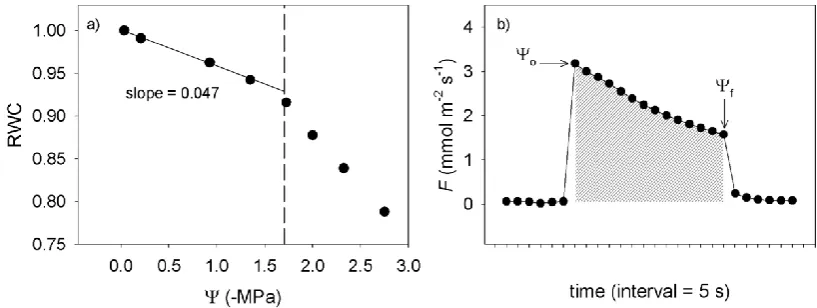
Mean leaf capacitance (Cleaf) was measured from six leaves of each species using the slope of the pressure-volume relationship for each species (Tyree & Hammel 1972). Branches were cut underwater in the morning and rehydrated until Ψleaf was >–0.05 MPa, after which leaves were detached for pressure-volume analysis. Leaf weight and water potential were measured periodically during slow desiccation of sample leaves in the laboratory. Because cell walls in the leaf are elastic, leaf capacitance pre- and post-turgor loss are often quite different. The capacitance function was defined by
measuring the turgor loss point from the inflection point of the graph of 1/Ψleaf verses relative water content (RWC), and then using this value as the intersection of linear regressions fitted through data either side of the turgor loss point. These slopes yielded pre- and post turgor leaf capacitance in terms of RWC.
Determination of Kleaf (mmol m-2 s-1 MPa-1) requires that leaf capacitance, as determined by the pressure-volume curve, be calculated in absolute terms and normalised by leaf area. To do this, leaf capacitance was multiplied by the saturated mass of water in the leaf and then divided by leaf area (Brodribb & Holbrook 2003). Leaf areas were measured as projected areas with a flatbed scanner and image analysis software (Image J, National Institutes of Health, Bethesda, MD, USA).
The vulnerability of leaf hydraulic conductance to decreasing water potential for individual species was defined as the negative Ψleaf at which point Kleaf had declined by 50% from maximum (P50leaf). P50leaf was calculated by fitting a three-parameter sigmoidal regression function of the form y = 100/(1+ea(Ψleaf – b)), where y = % loss of
Chapter 4 – Adaptive significance of P50leaf
66
Adaptive significance of P50leaf
We tested the adaptive significance of leaf vulnerability to cavitation using five phylogenetically independent species pairs in Tasmania (Table 4.1) from across a taxonomically diverse sample range. Each pairing contrasted a species from the dry sclerophyll forest with a closely related species from the Tasmanian montane
rainforest. To allow for difference in ecological tolerances of the species, we estimated the climatic limit for each species by calculating the 5th percentile of mean annual rainfall across each species distribution. Species observation data within Tasmania and southeast Australia was compiled using the Natural Values Atlas database (Department of Primary Industries and Water, Tasmania, http://www.naturalvaluesatlas.tas.gov.au) and Australia’s Virtual Herbarium database (Centre of Plant Biodiversity Research, http://www.anbg.gov.au/avh), respectively. Because of more intensive sampling in the Natural Values Atlas, the data from this source was randomly downsampled to give the same sampling intensity (as determined by comparison of data for the same areas from the two sources). Climate data for each observation was calculated using a fine-scale climate model BIOCLIM (Houlder et al., 2003), which uses a three dimensional spline to estimate climate for latitude, longitude and altitude. The relationship between rainfall and vulnerability was expected to be non-linear because the tensile strength of water constrains minimum P50leaf to –22 MPa (Cochard et al., 2007) at the dry end of the spectrum whereas maximum P50leaf will not exceed the turgor loss point of ever-wet cloud forest species at around –0.5 MPa (Feild et al., 2009). Hence we fitted a sigmoidal curve of the form y = a*x/(b+x)+c*x/(d+x) through the vulnerability verses climate data for all Tasmanian species having defined the water potential at zero rainfall as –22 MPa. To linearise the vulnerability data, we predicted the expected rainfall from the observed vulnerability according to the fitted curve for each of the species in dry sclerophyll/montane rainforest pairs. We then tested for a phylogenetically
independent relationship between vulnerability and climate by estimating the ratio of the change in vulnerability (linearised) to the change in rainfall for each species, and then used a t-test to assess whether the average value of this ratio was greater than zero.
P50leaf variability
ancestry (Table A4.1) and the Peruvian species were compared using a type 2 Student’s t-Test.
RESULTS
[image:26.595.129.517.240.524.2]For all Tasmanian and Peruvian species, the response of leaf hydraulic conductivity to decreasing water potential was sigmoidal, with an initial plateau followed by a decline in Kleaf to a minimum value close to zero as Ψleaf declined (Fig. 4.1 shows four typical species’ vulnerability curves).
Figure 4.1 Responses of leaf hydraulic conductance (Kleaf) to decreasing leaf water potential for a
subset of species sampled from Peru and Tasmania. Licaria subsessilis and Eugenia pubescens from Peruvian montane cloud forest; Atherosperma moschatum and Eucalyptus coccifera from Tasmanian montane rainforest. Curves fitted are sigmoidal functions. Solid vertical lines indicate the water potential at 50% loss of Kleaf (P50leaf).
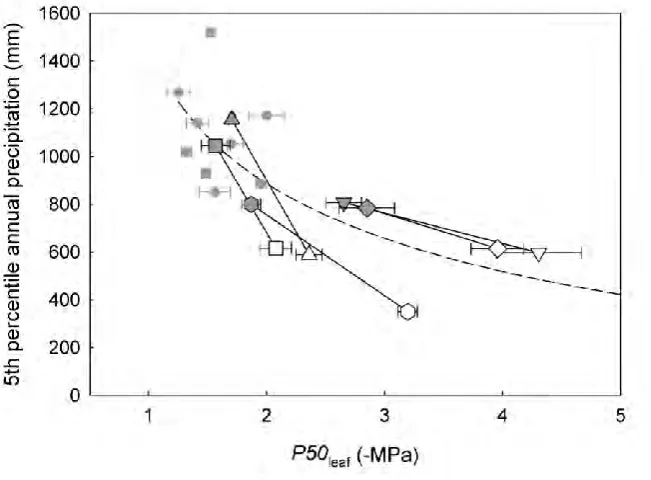
Across the Tasmanian species sample, including the dry forest species, a significant relationship was found between P50leaf and the 5th percentile of mean annual rainfall across each species geographic distribution (Fig. 4.2). Species with low leaf
Chapter 4 – Adaptive significance of P50leaf
[image:27.595.132.535.213.766.2]68 regardless of its generic ecological affinity (Table A4.1). A test of the phylogenetically independent relationship between vulnerability and climate for the species pairs was highly significant (P < 0.01; Fig. 4.2).
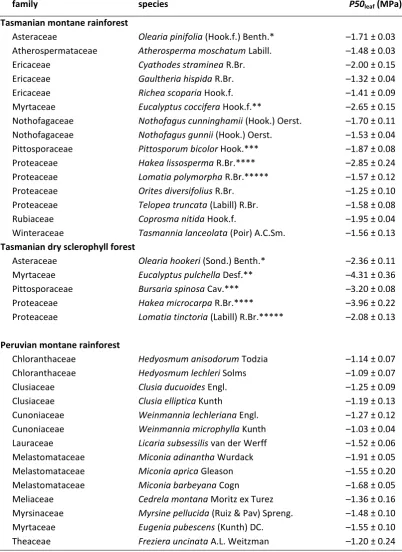
Table 4.1 Compiled data of leaf hydraulic vulnerability (P50leaf) for all species sampled in the study.
P50leaf values for the Tasmanian species are drawn from previous work by our laboratory group
(Blackman et al., In press). Dry forest species paired with closely related montane rainforest species within Tasmania are denoted by asterisks.
family species P50leaf (MPa)
Tasmanian montane rainforest
Asteraceae Olearia pinifolia (Hook.f.) Benth.* –1.71 ± 0.03 Atherospermataceae Atherosperma moschatum Labill. –1.48 ± 0.03 Ericaceae Cyathodes straminea R.Br. –2.00 ± 0.15 Ericaceae Gaultheria hispida R.Br. –1.32 ± 0.04 Ericaceae Richea scoparia Hook.f. –1.41 ± 0.09 Myrtaceae Eucalyptus coccifera Hook.f.** –2.65 ± 0.15 Nothofagaceae Nothofagus cunninghamii (Hook.) Oerst. –1.70 ± 0.11 Nothofagaceae Nothofagus gunnii (Hook.) Oerst. –1.53 ± 0.04 Pittosporaceae Pittosporum bicolor Hook.*** –1.87 ± 0.08 Proteaceae Hakea lissosperma R.Br.**** –2.85 ± 0.24 Proteaceae Lomatia polymorpha R.Br.***** –1.57 ± 0.12 Proteaceae Orites diversifolius R.Br. –1.25 ± 0.10 Proteaceae Telopea truncata (Labill) R.Br. –1.58 ± 0.08 Rubiaceae Coprosma nitida Hook.f. –1.95 ± 0.04 Winteraceae Tasmannia lanceolata (Poir) A.C.Sm. –1.56 ± 0.13
Tasmanian dry sclerophyll forest
Asteraceae Olearia hookeri (Sond.) Benth.* –2.36 ± 0.11 Myrtaceae Eucalyptus pulchella Desf.** –4.31 ± 0.36 Pittosporaceae Bursaria spinosa Cav.*** –3.20 ± 0.08 Proteaceae Hakea microcarpa R.Br.**** –3.96 ± 0.22 Proteaceae Lomatia tinctoria (Labill) R.Br.***** –2.08 ± 0.13
Peruvian montane rainforest
The range of within-site leaf vulnerability to decreasing water potential was significantly different between the Peruvian and Tasmanian montane rainforest communities. In Peru, P50leaf ranged from –1.03 MPa in Weinmannia microphylla to the least vulnerable Peruvian species Miconia adinantha, with P50leaf recorded at –1.91 MPa (Table 4.1). In comparison, the distribution of P50leaf for Tasmanian montane rainforest species overlapped with that of Peru at the most vulnerable end of the range but showed a markedly longer tail at the less vulnerable end of the range: it thus ranged from –1.25 MPa in Orites diversifolius to the most drought resistant species Hakea lissosperma, with P50leaf recorded at –2.85 MPa (Table 4.1). The significant overlap of Tasmanian species at the most vulnerable end of the range was largely comprised of species with unequivocal rainforest ancestry whereas the tail at the less vulnerable end was represented by species from dry forest clades (Table A4.1). Mean vulnerability for the component of the Tasmanian community with true rainforest ancestry (mean = – 1.49 MPa ± 0.14) was not significantly different (t-test, P < 0.23) to the Peruvian species (mean = –1.38 MPa ± 0.25).
Figure 4.2 The relationship between leaf vulnerability to cavitation (P50leaf) and the 5th percentile of
mean annual rainfall across each of the Tasmanian species' geographic distribution. Solid grey symbols represent montane rainforest species while open symbols represent dry sclerophyll species. A hyperbolic curve was fitted through all the Tasmanian species data based on a theoretical
Chapter 4 – Adaptive significance of P50leaf
[image:29.595.146.508.220.507.2]70 A greater range of P50leaf in the Tasmanian montane rainforest sample compared with the Peruvian community was confirmed by a significant inequality of variance in P50leaf between the two sites (Bartlett’s test for homogeneity of variance: P ≤ 0.03; Fig. 4.3). Box plots in Figure 4.3 illustrate the distributions of P50leaf values among species within each community and imply greater functional convergence of leaf vulnerability among species of montane cloud forest in Peru (mean = –1.38 MPa ± 0.25) compared to those of montane rainforest in Tasmania (mean = –1.76 MPa ± 0.46).
Figure 4.3 Frequency distribution of the leaf vulnerability (P50leaf) across all species within each
community. Black columns, Tasmanian montane rainforest species; grey columns, Peruvian montane rainforest; open columns, Tasmanian dry sclerophyll forest. Corresponding box plots indicate the median (central vertical bar), upper and lower quartiles (boxes), 5th and 95th percentiles (outer vertical bars) and extreme values (dots) across species within each community. Bartlett’s test of homogeneity showed the range P50leaf values to be significantly different (P ≤ 0.03) between
montane rainforest species from Tasmania and Peru.
DISCUSSION
Adaptive significance of P50leaf
dry sclerophyll forest produced leaves that were consistently less vulnerable to drought induced hydraulic dysfunction than their wetter montane rainforest species pairs (Fig. 4.2). This analysis contained species pairs with generic ecological affinities based in both wet and dry forests. This implies bidirectional evolution, with evolution of both increased drought resistant leaves under drying climate and reduced drought resistance in response to more moist conditions. As shown in stems, this suggests that the trade-off associated with drought resistance in leaves might come at the cost of extra investment in xylem reinforcement and reduced growth rate (Hacke et al., 2001; Poorter et al., 2010). This concept is re-enforced by evidence that leaf hydraulic vulnerability is strongly correlated with anatomical properties of the xylem that relate to water stress-induced conduit collapse {Blackman, 2010 #1634}. Overall, the
consistency of these relationships adds to growing evidence that xylem resistance to hydraulic failure is subject to strong selection across the rainfall spectrum (Brodribb & Hill 1999; Maherali et al., 2004; Pockman & Sperry 2000).
The current study is the first to show a direct link between leaf hydraulic vulnerability to dysfunction and species’ distributions in angiosperms, and is among the first to investigate the adaptive significance of hydraulic dysfunction in leaves (Blackman et al., 2009; Brodribb & Cochard 2009; Hao et al., 2008). This is surprising considering that leaf hydraulic systems tend to be relatively vulnerable and rate limiting in the whole-plant hydraulic continuum (Sack & Holbrook 2006). These results extend recent observations that leaf vulnerability is intimately linked to seedling survivorship in response to drought in a number of conifer (Brodribb & Cochard 2009) and woody angiosperm species (Blackman et al., 2009). Taken together, these results point to leaf hydraulic vulnerability as a measurable and fundamental indictor of plant performance in relation to increasing aridity.
Ecological implications of contrasting diversity in P50leaf
Chapter 4 – Adaptive significance of P50leaf
72
al., 2008). Our data from the tropics supports the former, suggesting that the relatively small range of leaf vulnerabilities in Peruvian cloud forest is evidence of convergent evolution of this key adaptive trait. Indeed, the ever-wet climate in these montane rainforest communities, combined with the effects of regular cloud immersion, leaves little latitude for niche differentiation based on variation in drought resistance. Hence the long-term stability and high species diversity of the Peruvian cloud forest (Urrego
et al., 2005) may have helped drive convergence in P50leaf.
Further evidence of convergent evolution of high leaf hydraulic vulnerability among rainforest species is provided by the strong overlap in P50leaf between the Peruvian species and the Tasmanian species with true rainforest ancestry. However, the overall greater variability in leaf hydraulic vulnerability values shown in Tasmanian montane rainforest suggests that additional processes to those related to ecological determinism and habitat filtering have had an effect on the phylogenetic and functional composition of the regional flora. One plausible explanation is that the Tasmanian montane
rainforest may have greater spatial heterogeneity in seasonal water availability, thus permitting occupation by species with different water-stress physiologies. Such spatial heterogeneity has been linked to substantial variability in stem hydraulic vulnerability that reflects differences in rooting depth among co-occurring species in Mediterranean-type climates (Jacobsen et al., 2007; Pockman & Sperry 2000). However, considering that montane rainforest in Tasmania can receive more than 3000 mm of rainfall spread uniformly throughout the year, the almost ever-wet conditions in these communities should leave little latitude for the development of strong seasonal moisture gradients in the soil profile. Greater seasonal water-stress in montane rainforest in Tasmania may result from slightly higher summer temperatures leading to higher evaporative demand than in Peru, where montane rainforest is regularly immersed in cloud, resulting in low transpiration rates (Motzer et al., 2005) and reduced risk of water deficit (Cavelier 1990). However, although these processes may induce lower vulnerability in the Tasmanian plants, they provide a poor explanation for the large differences in variability.
The greater variability in P50leaf among co-occurring species in Tasmanian montane rainforest may also be related to climate variability over longer time-scales. Indeed, Tasmania experiences regular drought during El Niño events, and, in addition, a
number of multi-year dry episodes have occurred in south-eastern Australia within the last 10 000 years (Hunt 2009). In contrast, the persistent cloudiness of tropical
variability. Taken together, these climatic conditions suggest that montane rainforest in Tasmanian may experience more severe drought episodes than the Peruvian forest studied here. As a result, Tasmanian montane rainforest is likely to occur within a more complex temporal landscape of water availability, which as a result promotes the co-existence of species with a variety of ecological strategies. In particular, this temporal climate variability may influence each species’ regeneration niche (Grubb 1977) whereby episodic drought favours the recruitment and establishment of more drought tolerant species in otherwise high rainfall environments.
An alternative explanation of the high variability of P50leaf among Tasmanian montane rainforest species centres on the idea that community assembly is partly shaped by parochial historical constraints (Ricklefs 2008). The lowest leaf vulnerabilities observed in the Tasmanian montane rainforest were in species from clades that apparently evolved in response to drier climatic conditions. Thus, phylogenetic
ancestral state reconstruction of bioclimatic traits provides independent evidence that the least vulnerable species, Hakea lissosperma, was derived from dry climate lineages (Jordan et al., 2008). The same is likely to be true for the second least vulnerable species, Eucalyptus coccifera, which is phylogenetically nested within a clade
Chapter 4 – Adaptive significance of P50leaf
74 Our results have potential implications for plant community responses to current climate change. Because the Tasmanian montane rainforest contains a high number of generalist species, the community is likely to be more resilient to extinction than habitat specialists. Thus, we propose that if current climate change results in more frequent and severe drought (IPCC 2007), tropical plant communities that exhibit narrow ranges of drought related trait variation may be more susceptible to extinction than mid-high latitude plant communities that retain strong ecological signals of long-term climate variability and/or drought induced Pleistocene extinctions. This process may be exacerbated in tropical mountain forests by predictions of reduced cloudiness and humidity (Foster 2001). Thus, diverse plant communities where excessively drought tolerant species are competitively excluded are potentially at risk from local extinction if the regional climate perturbation proves to be dry and hostile.
Conclusion
We highlight leaf hydraulic vulnerability to water-stress-induced dysfunction as a key adaptive trait that plays a central role in defining species’ climatic limits in terms of water availability. However, our results suggest that the distribution of adaptive trait values within local communities may be influenced not only by local ecological
processes but also by long-term climate variability and/or historical constraints unique to different regional floras. Any attempt to predict community-scale impacts of the current major climatic perturbation will require careful consideration of within-site functional trait distributions in relation to the influence of both historical as well as contemporary ecology.
REFERENCES
Ackerly DD. (2003) Community assembly, niche conservatism, and adaptive evolution in changing environments. International Journal of Plant Sciences, 164: S165-S184.
Blackman CJ, Brodribb TJ, Jordan GJ. (2010) Leaf hydraulic vulnerability is related to conduit dimensions and drought resistance across a diverse range of woody angiosperms. New Phytologist, 188: 1113-1123.
Blackman CJ, Brodribb TJ, Jordan GJ. (2009) Leaf hydraulics and drought stress: response, recovery and survivorship in four woody temperate plant species.
Plant, Cell and Environment, 32: 1584-1595.
Brodribb TJ, Cochard H. (2009) Hydraulic failure defines the recovery and point of death in water-stressed conifers. Plant Physiology, 149: 575-584.
Brodribb TJ, Holbrook NM. (2003) Stomatal closure during leaf dehydration, correlation with other leaf physiological traits. Plant Physiology, 132: 2166-2173.
Brodribb TJ, Holbrook NM. (2005) Water stress deforms tracheids peripheral to the leaf vein of a tropical conifer. Plant Physiology, 137: 1139-1146.
Brodribb TJ, Holbrook NM. (2007) Forced depression of leaf hydraulic conductance in situ: effects on the leaf gas exchange of forest trees. Functional Ecology, 21: 705-712.
Brodribb TJ, Holbrook NM, Edwards EJ, Gutierrez MV. (2003) Relations between stomatal closure, leaf turgor and xylem vulnerability in eight tropical dry forest trees. Plant Cell and Environment, 26: 443-450.
Carpenter RJ, Hill RS, Jordan GJ. (1994) Cenozoic vegetation in Tasmania: macrofossil evidence. In: History of the Australian Vegetation: Cretaceous to Recent (ed RS Hill). Cambridge University Press, Cambridge.
Cavelier J. (1990) Tissue water relations in elfin cloud forest tree species of Serrania de Macuira, Guajira, Colombia. Trees-Structure and Function, 4: 155-163.
Cavender-Bares J, Kitajima K, Bazzaz FA. (2004) Multiple trait associations in relation to habitat differentiation among 17 Floridian oak species. Ecological
Monographs, 74: 635-662.
Choat B, Sack L, Holbrook NM. (2007) Diversity of hydraulic traits in nine Cordia species growing in tropical forests with contrasting precipitation. New Phytologist, 175: 686-698.
Cochard H, Barigah TS, Herbert E, Caupin F. (2007) Cavitation in plants at low temperature: is sap transport limited by the tensile strength of water as expected from Briggs' Z-tube experiment? New Phytologist, 173: 571-575. Cochard H, Froux F, Mayr FFS, Coutand C. (2004) Xylem wall collapse in water-stressed
pine needles. Plant Physiology, 134: 401-408.
Crowden RK. (1999) Alpine Vegetation. In: Vegetation of Tasmania (eds JB Reid, RS Hill, MJ Brown, MJ Hovenden), pp. 333-356. Australian Biological Resources Study, Canberra.
Chapter 4 – Adaptive significance of P50leaf
76 Diaz S, Cabido M, Casanoves F. (1998) Plant functional traits and environmental filters
at a regional scale. Journal of Vegetation Science, 9: 113-122.
Donoghue MJ (2008) A phylogenetic perspective on the distribution of plant diversity.
Proceedings of the National Academy of Sciences of the United States of America, 105: 11549-11555.
Dynesius M, Jansson R. (2000) Evolutionary consequences of changes in species' geographical distributions driven by Milankovitch climate oscillations.
Proceedings of the National Academy of Sciences of the United States of America, 97: 9115-9120.
Feild TS, Brodribb T. (2001) Stem water transport and freeze-thaw xylem embolism in conifers and angiosperms in a Tasmanian treeline heath. Oecologia, 127: 314-320.
Feild TS, Chatelet DS, Brodribb T.J. (2009) Ancestral xerophobia: a hypothesis of the whole plant ecophysiology of early angiosperms. Geobiology, 7: 237-264. Foster P. (2001) The potential negative impacts of global climate change on tropical
montane cloud forests. Earth-Science Reviews, 55, 73-106.
Grubb PJ. (1977) The maintenance of species richness in plant communities: the importance of the regeneration niche. Biological Review, 52: 107-145. Hacke UG, Sperry JS, Pockman WT, Davis SD, McCulloh KA. (2001) Trends in wood
density and structure are linked to prevention of xylem implosion by negative pressure. Oecologia, 126: 457-461.
Hao GY, Hoffmann WA, Scholz FG, Bucci SJ, Meinzer FC, Franco AC, Cao KF, Goldstein G. (2008) Stem and leaf hydraulics of congeneric tree species from adjacent tropical savanna and forest ecosystems. Oecologia, 155: 405-415.
Hill RS. (2004) The origins of the southeastern Australian vegetation. Philosophical Transactions of the Royal Society B-Biological Sciences, 359: 1537-1549. Hope G. (1994) Quaternary Vegetation. In: History of the Australian Vegetation:
Cretaceous to Recent (ed R.S. Hill). Cambridge University Press, Cambridge. Houlder D, Hutchinson M, Nix H, McMahon J. (2003) Anuclim user's guide. Australian
National University, Canberra.
Hunt BG. (2009) Multi-annual dry episodes in Australian climatic variability.
International Journal of Climatology, 29: 1715-1730.
IPCC (2007) Climate change 2007: the physical science basis (vol. 1009). Cambridge University Press, Cambridge, UK.
Jarman SJ, Kantvilas G, Brown MJ. (1999) Floristic Composition of Cool Temperate Rainforest. In: Vegetation of Tasmania (eds JB Reid, RS Hill, MJ Brown, MJ Hovenden), pp. 145-159. Australian Biological Resources Study, Canberra. Jordan G.J. (1997) Evidence of Pleistocene plant extinction and diversity from Regatta
Point, western Tasmania, Australia. Botanical Journal of the Linnean Society, 123: 45-71.
Jordan GJ, Weston PH, Carpenter RJ, Dillon RA, Brodribb TJ (2008) The evolutionary relations of sunken covered, and encrypted stomata to dry habitats in Proteaceae. American Journal of Botany, 95: 521-530.
Keddy PA. (1992) Assembly and response rules: two goals for predictive community ecology. Journal of Vegetation Science, 3: 157-164.
Kraft NJB, Valencia R, Ackerly DD. (2008) Functional traits and niche-based tree community assembly in an Amazonian forest. Science, 322: 580-582.
Lebrija-Trejos E, Perez-Garcia EA, Meave JA, Bongers F, Poorter L. (2010) Functional traits and environmental filtering drive community assembly in a species-rich tropical system. Ecology, 91: 386-398.
Maherali H, Pockman WT, Jackson RB. (2004) Adaptive variation in the vulnerability of woody plants to xylem cavitation. Ecology, 85: 2184-2199.
McGill BJ, Enquist BJ, Weiher E, Westoby M. (2006) Rebuilding community ecology from functional traits. Trends in Ecology & Evolution, 21: 178-185.
McGlone MS. (1996) When history matters: scale, time, climate and tree diversity.
Global Ecology and Biogeography Letters, 5: 309-314.
Meinzer FC, Clearwater MJ, Goldstein G. (2001) Water transport in trees: current perspectives, new insights and some controversies. Environmental and Experimental Botany, 45: 239-262.
Motzer T, Munz N, Kuppers M, Schmitt D, Anhuf D. (2005) Stomatal conductance, transpiration and sap flow of tropical montane rain forest trees in the southern Ecuadorian Andes. Tree Physiology, 25: 1283-1293.
Pockman WT, Sperry JS. (2000) Vulnerability to xylem cavitation and the distribution of Sonoran Desert vegetation. American Journal of Botany, 87: 1287-1299.
Poorter L, McDonald I, Alarcon A, Fichtler E, Licona JC, Pena-Claros M, Sterck F, Villegas Z, Sass-Klaassen U. (2010) The importance of wood traits and hydraulic
conductance for the performance and life history strategies of 42 rainforest tree species. New Phytologist, 185: 481-492.
Chapter 4 – Adaptive significance of P50leaf
78 Ricklefs RE. (2008) Disintegration of the ecological community. American Naturalist,
172: 741-750.
Sack L, Holbrook NM. (2006) Leaf hydraulics. Annual Review of Plant Biology, 57: 361-381.
Parks and Wildlife Service (1999) Lake Johnston Nature Reserve Management Plan. Department of Primary Industries, Water and Environment, Tasmania, Australia.
Steane DA, McKinnon GE, Vaillancourt RE, Potts BM. (1999) ITS sequence data resolve higher level relationships among the eucalypts. Molecular Phylogenetics and Evolution, 12: 215-223.
Tilman D. (1988) Plant Strategies and the Dynamics and Structure of Plant Communities. Princeton University Press, Princeton, NJ, USA.
Tyree MT, Hammel HT. (1972) Measurement of turgor pressure and water relations of plants by pressure-bomb technique. Journal of Experimental Botany, 23 :267-282.
Tyree MT, Sperry JS. (1989) Vulnerability of xylem to cavitation and embolism. Annual Review of Plant Physiology and Plant Molecular Biology, 40: 19-38.
Urrego DH, Silman MR, Bush MB. (2005) The last glacial maximum: stability and change in a western Amazonian cloud forest. Journal of Quaternary Science, 20: 693-701.
Vasquez R, Rojas R, Monteagudo A, Meza K, van der Werf H, Ortiz-Gentry R, Catchpole D. (2005) Flora vascular de la selva central del peru: una aproximacion de la composicion floristica de tres areas naturales protegidas. Arnaldoa, 12: 112-125.
Webb CO, Ackerly DD, McPeek MA, Donoghue MJ. (2002) Phylogenies and community ecology. Annual Review of Ecology and Systematics, 33: 475-505.
Weiher E, Keddy PA. (1995) Assembly rules, null models, and trait dispersion - new questions front old patterns. Oikos, 74: 159-164.