Constituentless Compositionality:
A Compositional Account of Dependency Grammar
MSc Thesis
(Afstudeerscriptie)
written by
Ryan Nefdt Master of Logic University of Amsterdam
(born 8th September, 1987 in Cape Town, South Africa)
under the supervision of Dr Henk Zeevat, and submitted to the Board of Examiners in partial fulfillment of the requirements for the degree of
MSc in Logic
at theUniversiteit van Amsterdam.
Date of the public defense: Members of the Thesis Committee:
Contents
I
Compositionality and Natural Language
4
1.1 Introduction . . . 5
1.2 Disambiguating Compositionality . . . 6
1.3 (Bad) Reasons for compositionality . . . 8
1.3.1 Productivity . . . 8
1.3.2 Systematicity . . . 10
1.3.3 Novelty and Learnability . . . 13
1.3.4 Infinity . . . 14
1.4 Conclusion . . . 20
II
Compositionality and Formal Language
22
2.1 Introduction . . . 232.2 Formal Language Theory . . . 24
2.2.1 Regular Languages (Type 3) . . . 25
2.2.2 Context-free Languages (Type 2) . . . 26
2.2.3 Context-Sensitive Languages (Type 1) and Unrestricted Languages (Type 0) . . . 28
2.2.4 Beyond the Chomsky Hierarchy: Mildly context-sensitive Languages . 28 2.2.5 A Computational Caveat . . . 29
2.3 (Good) Reasons for Compositionality . . . 30
2.3.1 Computational Complexity . . . 30
2.3.2 Infinity as a design choice . . . 31
2.3.3 Subconclusion . . . 32
2.4 Formal Definition of Compositionality . . . 33
2.4.1 Formal Preliminaries . . . 33
2.4.2 Standard Compositionality . . . 34
2.4.3 Strong Compositionality . . . 36
2.4.4 Direct Compositionality . . . 37
2.4.5 A Formal Description of Constituency . . . 39
2.4.6 The Principle of Syntactic Integrity . . . 42
III
A Compositional Semantics for Dependency Grammar
45
3.1 Dependency Grammar . . . 46
3.1.1 Elementary Structures and Constituency . . . 46
3.1.2 Lexicalization and Dependency Grammar . . . 48
3.1.3 Dependency Structures . . . 50
3.1.4 Projective and Non-projective structures . . . 51
3.1.5 Why Dependency Grammar? . . . 52
3.2 Compositionality applied . . . 53
3.2.1 Dependency Algebra . . . 53
3.3 Challenges for a Type Semantics of Dependency Grammar . . . 56
3.3.1 Extensional Montague Grammar . . . 56
3.3.2 Scope Ambiguity . . . 58
3.3.3 Problems for Type-theoretic Dependency Semantics . . . 59
3.4 A Resolved Montague Grammar for Dependency Structures . . . 62
3.4.1 F-Structures in Lexical-Functional Grammar . . . 62
3.4.2 The Semantics . . . 63
3.4.3 Montague Semantics for Dependency Grammar . . . 65
3.4.4 DSs as Semantic Structures . . . 66
3.4.5 Translation Procedure . . . 70
3.4.6 Resolving Scope Ambiguity . . . 74
3.4.7 Compositionality and Underspecification . . . 83
3.4.8 Advantages of this Framework . . . 85
3.4.9 Other Frameworks . . . 86
Acknowledgements
I would like to thank my parents for their infinite support of my academic career, without them this would not have been possible. I would also like to thank Ms Anastacia Saliukova for her assistance with the verification of the cross-linguistic data used in this thesis. And many thanks to my supervisor Dr. Henk Zeevat who ushered me into the previously unknown territory of formal linguistics from my background in philosophy research.
Preface
The problem of compositionality in linguistics and philosophy has become a prominent issue in contemporary scholarship concerning natural language. The debate usually takes two (not unrelated) forms, (1) what are the correct formal descriptions of the principle of compositionality and (2) whether or not such a principle is indeed consonant with linguistic data. In this thesis, I offer no new comment on either of these points. Instead, I plan to argue that notwithstanding the lack of a definitive answer to (2), there is reason to incorporate a compositional semantics for a given syntactic formalism. The first parts of this thesis both offer these reasons and attempt to define more precisely what type of relationship syntax needs to have with semantics to achieve the coveted title of compositional, i.e. an answer to (1). In the second part, I attempt to provide a compositional semantics for dependency grammar, a formalism which has historically been recalcitrant to such description, by means of a modified type-theoretic treatment of its semantics.
In part I, I briefly introduce some background and set up the controversy surrounding compositionality. Some of these issues will be relevant for forthcoming sections, others are meant to serve as foregrounding for the debate in general.
Part II will focus on formal definitions of compositionality with relation to formal language theory and motivations for the principle in terms of these definitions. I will also discuss the central matter of constituency and its role in the formal definition of the principle of compositionality.
Finally, part III offers a novel compositional account of dependency grammar in terms of Montague Grammar. Importantly, this analysis aims to respect the structures generated by the dependency syntax. The final part also tests this account on recalcitrant natural language phenomena.
Part I
1.1
Introduction
The genesis of the principle of compositionality has most often been linked to the writings of Gottleb Frege, hence the term “Frege’s principle” (sometimes used synonymously). In ’Sinn und Bedeutung’, Frege challenges a simple notion of compositional meaning in terms of co-reference due to Mill by testing the substitution thesis (which has been shown to be equivalent to a version of compositionality which we will be using, Hodges (1998)). Yet his distinction between sense (Sinn) and reference (Bedeutung) aims to rescue a compositional account of meaning in some form. The modern idea of the principle can be found in Partee (2004) and Montague (1974) among others and it is can be summed up as:
The meaning of a complex expression is determined by the meaning of its component parts and the way in which they are combined.
Janssen (2012) argues that Frege was not the source (nor an adherent) of the concept of compositionality. In fact, he prescribed to a quite different principle for natural language semantics. He argues that its true origins can actually be traced further back than Frege to Lotze, Wundt and Trendelenburg. Furthermore, he claims that there is no evidence to suggest that Frege ever truly abandoned the context principle (given below) which is also referred to as Frege’s principle:
Never ask for the meaning of a word in isolation, but only in the context of a sentence (1884, xe).
In Pagin and Westerstahl (2010a) these two principles are reconciled. The context principle is interpreted as a constraint on compositional meaning.1 In addition, they trace the principle
of compositionality back to 4th century indian thought, others to Aristotle. The exact beginnings of the principle and Frege’s exact position on it are somewhat irrelevant for the present discussion. It is important, however, to note that it has held sway with formal logicians and philosophers such as Montague where it derived one of its most influential incarnations. Clearly, the principle has been assumed to be susceptible to formal description and we will follow that assumption in this paper.
In the methodology of logic and computer science, it has been considered the standard way of interpreting formal or programming languages (although alternatives do exist). Tarski’s (1933) definition of truth for formal languages has a natural compositional interpretation (Janssen 2012). Davidson (1967) used what he called Tarski’s T-theorem as a basis for a compositional semantics for natural language. In the 20th century the principle was widely adopted in the philosophy of language and logic, through Carnap, Quine, Davidson and various others. Now, it has become an essential part of most linguistic theories including generative theories. The connectionist debate has brought this issue to the fore in the cognitive scientific arena and in the philosophy of mind. There are many issues which connect the compositionality debate in language and mind, in fact Fodor (2001) argues that only one of these can be compositional and since language seems not to be in certain cases, concepts
must be. For the most part, neither the compositionality of mind nor natural language will directly concern us here. In this part, however, we investigate the debate surrounding the principle as it is applied to natural language.
1.2
Disambiguating Compositionality
Unfortunately, there is no consensus on the correct definition of compositionality (see section 2.4 for details). Furthermore, it is not clear if it is exclusively a methodological principle or can be empirically tested (Dowty 2007). For the purposes of this thesis, we will assume some preliminaries. For one, compositionality will not be thought of as a property of a given semantics or syntax for that matter. We will follow Montague in defining it as a relationship between a certain syntax and a certain semantics. Consider the expression above again:
The meaning of a complex expression is determined by the meaning of its component parts and the way in which they are combined.
This statement is vague and in need of clarification. The problem is that there doesn’t seem to be a neutral way of going about this clarification. In this section, I attempt to stay as neutral as possible. Starting with the term “complex expression” which will be characterised as a syntactic object, as will its components. We will remain characteristically reticent about meanings and what they are precisely.
“Determined by” is usually interpreted functionally, which suggests that given a syntactic object as an input it produces a semantic object as an output. The immediate problem with this naive functional analysis is that it generates a unique semantic output for every syntactic expression but in natural language this tends to overgenerate as there are distinct expressions which arguably should be assigned the same meanings. This is a strong constraint on meaning. Consider the sentences below:
(1.2.1) Jimmy threw the ball
(1.2.2) The ball was thrown by Jimmy
A worry one might have from a syntactic perspective is that a ban on identical syntactic expressions with unidentical meaning follows from the simple notion of compositionality.2 “If
a language is compositional, it cannot contain a pair of non-synonymous complex expressions with identical structure and pairwise synonymous constituents (Szabo, 2007). This amounts to a ban on ambiguity. Pseudo-conditionals appear to conflict with this condition. Consider the (1.2.3) and (1.2.4) below from Kay and Michaelis (2011):
(1.2.3) If you’re George W. Bush, you’re now allowed to lie in the faces of trusting young voters.
(1.2.4) If you’re pleased with outcome, you may feel like celebrating.
(1.2.3) and (1.2.4) seem to have the same syntactic structure and yet (1.2.3) does not express a hypothetical statement of any kind while (1.2.4) is a conventional conditional which does. The semantics of these constructions seems to be quite different. “[N]o hypothetical situation is posed; it appears that a categorical judgement is expressed...and the subject of that judgement is not the addressee but the person identified as x [George Bush]” (Kay and Michaelis, 2011:2).
A semantic worry is brought out by scope ambiguity. Consider the example below:
(1.2.5) Every boy loves some girl.
There are at least two possible readings for this sentence. The first is that every boy loves some girl in the sense that each boy loves a distinct girl. The second is that there is one girl who is extremely popular. Given our definition of compositionality, this seems in complete violation since the components and method of combination are the same and yet the resulting semantic analyses differ.
In terms of the former problem, this can easily be solved. By instead interpreting the statement about method of combination as involving the meanings of the components and not the syntactic components themselves.
[This] permits the existence of non-synonymous complex expressions with identical syntactic structure and pairwise synonymous constituents, as long as we have different semantic rules associated with the same syntactic rules (Szabo, 2012: 70).
The latter problem of scope ambiguity has been addressed in many ways ranging from alternative syntactic combination and type shifting to Cooper Storage (Cooper, 1975). We shall address this issue in a more substantial way in section 3.4.
Lastly, what is meant by “component” as I have used it here. The convention in the literature is to take this to mean constituent. In linguistics, this is a loaded term. Usually, it refers to sets of linguistic items which act as a structural units in given expressions. There are various tests for constituency such as coordination, deletion, modification etc. Constituents are the items that appear in the hierarchical tree diagrams of phrase structure grammar. Consider the sentence (1.2.6):
(1.2.6) The host speaks to the caterer after the ceremony.
This sentence can be separated into distinct constituents. For example, the verb or predicate speaks to and its two arguments the host (subject) and the caterer (complement). Items such as After the ceremony are sometimes called adjuncts and can float independently of the other constituents. Linguists often interpret compositionality and “components” as not only involving constituents but immediate constituents. “In assigning meaning to a complex expression [the principle of compositionality] allows us to look at the meanings of constituents deep down the tree representing its syntactic structure, while (Λ) [the alternative with immediate constituency] permits looking down only one level (Szabo, 2012: 79). As we will see later, certain grammar formalisms do not involve the sort of hierarchy which incorporates multiple layers of syntactic structure and thus do not differentiate between immediate and deep constituency, in particular dependency grammars. Bloomberg defines constituents as linguistic objects which can be found in different expressions. And immediate constituents “appear at the first level in the analysis of the form into ultimate constituents” (Hodges, 2012:
249).3
Therefore, our tentative definition can be modified to incorporate the clarifications mentioned in this section.
The meaning of a complex syntactic expression is a function of the meanings of its constituents and the syntactic rule used to combine these constituents.
Although, I have attempted to disambiguate certain vague notions in the basic definition of compositionality found in the literature, this task is far from over and will be picked up below. The next attempt at unpacking this concept will be concerned with the ubiquitous and most oft cited reasons expressed in favour of the principle. By grasping what is it that the principle is thought to explain, we may be able to grasp a little more of its nature. I will also briefly show why these reasons fail to establish the principle.
1.3
(Bad) Reasons for compositionality
There are three main arguments in favour of compositionality. Although, these arguments have undeniable intuitive appeal they do not establish the principle of compositionality for natural language. I will present each in turn and show why they are defective. In addition, I will argue against an assumption which is common to most of these types of arguments, namely linguistic infinity.
1.3.1
Productivity
This argument starts by observing the phenomenon of productivity in language (this is also sometimes called creativity). As language users we are able to produce an infinite number of sentences. One clear component of this type of argument (when it is argued), is that of
recursion or iteration. This is one way of generating an infinite set of expressions. Another way is recombination. In everyday parlance we encounter variations of sentences often composed of the same vocabulary. And yet as Chomsky (1971: 74) puts it:
The most striking aspect of linguistic competence is what may call the ’cre-ativity of language’, that is, the speaker’s ability to produce new sentences that are immediately understood by other speakers although they bear no physical resemblance to sentences that are ’familiar’.
Natural language affords us many examples of the productivity property, from iterative constructions to our ability to generate unfamiliar yet perfectly intelligible expressions. Presumably there is something at the heart of this possibility. The best explanation is that compositionality is at the base of the productive nature of language. It is a corollary of the principle.
There are a number of problems with this argument. For the most part it is too weak. According to Pagin and Westerstahl, all that is needed to account for this phenomenon is that there is an infinite set of assignments of propositions to sentences and furthermore it “does not have to be systematic in any way, and all the syntax that is needed for the infinity
itself is simple concatenation” (2010b:4).
In addition, this does not account for all natural language phenomena, for instance idioms tend to be completely unproductive. Of course, as long as we admit only a finite set of idioms into each language, this problem can be contained.4A more serious concern is described in
Szabo (2012). If productivity is explained by compositionality, then two related things are implied. Firstly, there are infinitely many complex expressions which have been heard by no-one before. Secondly, are we committed to a view that we already understand these unheard sentences?
This is not just the general Humean worry about induction - we have good reasons to doubt that the complex expressions we hear form an unbiased sample of all complex expressions (Szabo, 2012).
I think that this objection is baseless. It assumes that productivity is the ability to produce as actual infinity of sentences. If, however, we follow the intuitionistic conception of a constructive or potential infinity, we are not committed to the existence of unheard sentences. The problems suggested by Szabo imply that natural language constitutes an actual infinite set in terms of a completed mathematical set with infinite expressions. On the contrary, a finite syntax with a lexicon (compositionality) only implies that we have an infinite procedure for producing expressions not that we have an actual infinity of them. I think that this blocks both arguments since the potential we have to produce and understand unheard expressions is a far less controversial claim upon which to base compositionality than the claim that there is an actual set of all of these expressions.
4It becomes a difficulty when we consider arguments which take noncompositional “constructions” to be
There is a much more serious worry for adherents of this argument, namely the possibility of productivity without compositionality. If compositionality can be shown to not be a necessary condition for productivity then even if we accept that language is productive we needn’t accept that it is compositional.
Werning (2005) claims that a simple language with a productive rule of holophrastic quotation and a meaning function which allows for synonymy can be proven to be non-compositional5. First we specify the syntactic operation of quotation
if q :E →E and s7→ s0 such that the corresponding semantic operation yields
µ(q(s)) =s
A language which contains this rule is automatically productive since quotation can be iterated. “This account of quotation might be called holophrastic quotation because it takes well-formed phrases as unanalyzed wholes and sets them in quotation marks. The meaning of a quotation is the quoted expressions (Werning, 2005: 296). From this, we can show that this simple language is not compositional. Let compositionality be defined as a rule (C) such that for any semantic function µq for the syntactic operation q, µ(q(θ)) = µq(µ(θ))
(a) Take two sentences pφq andpψqsuch that µ(pφq) =µ(pψq) butpφq6=pψq,where pq denotes metaquotation.
(b) From the quotation rule the following holds: µ(pφq) =µ(q(pφq)) =pφqand µ(pψq) =
µ(q(pψq)) =pψq.
(c) Given (a) and (b), we know that µ(q(pφq))6=µ(q(pψq)) sincepφq6=pψq.
(e) Compositionality (C) entails that µ(q(pφq)) = µq(µ(pφq)) and substitution of identicals
into (a) gives us µ(q(pφq)) = µq(µ(pψq))
(f) By (C) again, we getµ(q(pφq)) = µ(q(pψq)) which is a contradiction, given (c).6
The above argument shows that productivity does not imply compositionality. In addition, there are no good arguments to show that it does.
1.3.2
Systematicity
Systematicity is supposedly another underlying property of natural language upon which compositionality is based. The idea is that there are certain patterns that we encounter which allow for recombination in such a way that it implies compositional meaning. For instance, if we understand xRy then we can understand yRx merely by understanding the meanings of the components of the relation and the way in which they are combined. A concrete example of this phenomenon is that given a certain sentence ’The man loves the woman’ we can deduce the meaning of ’The woman loves the man’. If it were not for the systematic nature of language, it is argued, then we could not account for patterns like these.
5The property which allows for synonymy is called non-hyper-distinction. I will formally define this
property in section 2.4.3
6There are compositional accounts of quotation on the market. However, the possibility of a compositional
Another way to put this is that there is a nomological connection between these sentences and this connection is best explained by compositionality.
Fodor is especially fond of this property of natural language understanding and cites the inability of connectionist cognitive architectures to capture it as one of their fatal failures. However, it seems that the property is more convincing from a cognitive point of view than from a linguistic one.7 Consider the concept of a red circle inside of a blue square. It seems reasonable to claim that an individual who understands the concept of a red circle and the concept of a blue square can understand both the initial concept and the derived concept of a blue circle inside of a red square. There seems to be a systematic relationship between concepts which may or may not be based on compositionality of thought but the case for language is less obvious. The conventional examples of systematicity in natural language are often misleading. Consider the examples below:
(1.3.1) The woman loves the man ⇔ the man loves the woman
(1.3.2) The woman loves the car< the car loves the woman
In the pair (1.3.1) the systemic link between the sentences is clear but from (1.3.2) we see that this pattern is not generalizable, i.e. the systematic interpretation is blocked. There are many examples of such substitution failure for systematic links between sentences and this serves to indicate that there is something about the meaning of the specific units of such pairs at work. Werning claims that the “systematic correlation is warranted only if the permuted words belong to the same Bedeutungskategorie - semantic category or simply category - as defined by Husserl” (2005: 302). Thus, the property of systematicity is limited in scope and hence rather weak.
Secondly, the argument against the compositionality of adjectives provides an interesting (and novel) extension against the systematicity. Standardly, we think of adjectives
com-positionally. For example, the semantic contribution that the adjective ’red’ makes to an expression, or rather noun x, is thought to be the same the one it makes to a noun y. The adjective makes the same contribution semantically to the adjective-noun pair ’red table’ as it does to the pair ’red bookshelf’. The claim here is that even in the cases which are paradigmatic or assumed to be trivial, this compositionality assumption does not hold. In addition, to understand a novel adjective-noun expression is to appreciate linguistic and world knowledge beyond the mere composition of already understood semantic units.
The first thing to do is to reformulate the principle of compositionality in terms of adjectives. Lahav accomplishes this task by attempting a theory neutral definition of the ’applicability conditions’ of an adjective:
The conditions that have to be satisfied by any object under any (correctly ascribed) noun in order for the adjective to correctly apply to that object; for example, the conditions under which an object is describable by ’red N’, for any noun N (1989:262).
7We would favour Fodor’s argument that compositionality holds for thought as opposed to natural language,
Thus, an extension of the principle of compositionality is possible for adjectives
(C”) Every adjective a has uniform applicability conditions across all compound expressions in which it is embedded.
The idea behind this is that if two adjectives have different applicability conditions then clearly they also possess different meanings. The principle requires that adjectives have uniform applicability conditions in all the standard complex expressions in which they occur. Thus, the conditions that have to be met for something to be appropriately described ’red table’ should be the same set of conditions that are to be met for ’red bookshelf’ or ’red fish’. Of course context dependence should be allowed for, “hence, by requiring that the applicability conditions of an adjective be uniform across all linguistic contexts, the principle should be understood as requiring that for every adjective there is a general function from contexts to applicability conditions” (Lahav, 1989: 262).
The problem arises when we appreciate the different types of conditions which determine the applicability of a given adjective. The conditions for which a person is said to be ’good’ is different to those for a computer, similarly for other adjectives. This is a trivial fact. A good person is virtuous and kind while a good computer is one with a large hard-drive and fast processing speed which has nothing to do with personality or virtue. Lahav claims that “virtually all” adjectives behave in this way such that there is no fixed set of conditions which determine their applicability to different objects. In other words, the applicability conditions of adjectives is largely a noun-dependent matter. This problem arises even if we consider only the simplest colour predicates. The conditions for a bird to be red or blue are different than for a car or a crystal to be these colours. Arguably, the former only have to have red feathers or body surface apart from its feet and beak etc. while a car need only be red on the outside and a crystal needs to be red all over. “In short, what counts for one type of thing to be red is not what counts for another” (Lahav, 1989: 264). Similarly for almost every other adjective.
The main point to be drawn from this is that the applicability conditions of adjectives vary in such a way from one noun to another that one cannot speak of a general function from contexts to applicability conditions. Therefore, the semantics of adjectives must be non-compositional in nature. The absence of applicability conditions for some adjectives to certain objects corroborates this conclusion. The unintelligibility of adjective-noun pairs such as ’the loud tree’, ’an orange thought’, ’annoyed building’ etc. does not mean that the meanings of these expressions area priori or inherently unintelligible (cf. ’the true falsehood’ or the ’round square’). We could imagine circumstances in which it would be felicitous to use these expressions. Thus, argues Lahav, the applicability conditions of adjectives develops piecemeal and not uniformly.
It is not clear that adjectival composition cannot be accommodated in a composition semantics (in terms of constraints or parameters on the meaning function). However, the reasoning that led to this counterargument provides a more sound basis for criticizing systematicity. It suggests that the following pairs of more obviously linked sentences are not even as systematic as we would expect
(1.3.4) The thin man and the lame excuse < the lame man and the thin excuse
Therefore, not only is the property of systematicity rather weak in that it doesn’t seem to support more than certain obvious cases of semantically linked phrases but it doesn’t seem to support even these simple cases upon closer inspection.
1.3.3
Novelty and Learnability
The novelty and learnability arguments are related to both systematicity and productivity mentioned above in some ways. Novelty can be summed up as “speakers are able to understand sentences they have never heard before, which is possible only if the language is compositional” (Pagin & Westerstahl, 2010: 3). Very often as speakers of a language, we hear sentences which we have not heard before, according to the latter reasoning the only way in which we can understand these sentences is on the basis of their component parts and a finite set of composition rules. For a hearer to attach a meaning to a completely new sentence, she has to compute this from the meanings of previous fragments of language which she has already encountered.
This argument is inherently related to the argument from learnability, mostly famously presented by Davidson (1967:17):
It is conceded by most philosophers of language, and recently by some linguists, that a satisfactory theory of meaning must give an account of how the meanings of sentences depend upon the meanings of words. Unless such an account could be supplied for a particular language, it is argued, there would be no explaining the fact that we can learn the language: no explaining the fact that, on mastering a finite vocabulary and a finite set of rules, we are prepared to produce and understand any of a potential infinitude of sentences.
This ’infinity’ of natural language which Davidson takes for granted is challenged by Groe-nendijk and Stokhof (2004). They ask exactly what sort of infinity is supposed to be captured by natural languages. Surely it cannot be the same as the infinity of formal languages since these are defined to be infinite. The matter is different for natural languages, “for natural languages the issue of its finiteness or infiniteness must be an empirical one, and hence of a completely different order?” (Groenendijk & Stokhof, 2004:8). Furthermore, the type of evidence Davidson had in mind will not do. For example, the claim that a simple sentence can be extended ad infinitum by means of conjunction/disjunction or embeddings of various sorts is not empirically valid. This debate then turns on the Chomskyan distinction between competence and performance. Natural language as it is performed is fraught with limitations, limitations which Groenendijk and Stokhof argue are not contingent but necessary corollaries of our finite cognitive capacities, i.e. our competence. This will be further argued in the next section.
information already present in the human brain at birth. Fodor takes it a step further with the Language of Thought (LOT) hypothesis (1975) positing that you need to know a language to learn one. Thus, our linguistic experiences fit neatly into preordained categories and compositional rules, whether in the form of the phrase structure rules of generative grammar or otherwise. The basic idea behind LOT is that the process of thought is conducted in a ”mentalese” or a symbolic mental language which is somehow realised in the physical brain. This mental language is essentially compositional in nature.
An empirical objection to this account of learning comes from the work of Tomasello on language acquisition. In arguing for a usage-based account of language acquisition, Tomasello puts forward the ’Verb Island Hypothesis’. Essentially, what this hypothesis claims is that evidence points to the fact that during the early acquisition period, children isolate each of the newly acquired verb forms in terms of its own idiosyncratic linguistic space that does not correspond to the syntactic categories posited by generative grammar. More specifically, “children’s earliest language is based on the specific linguistic items and expressions they
comprehend and produce” (Tomasello, 2000: 161).
This evidence would serve as a powerful objection to the Innateness Hypothesis, if it proves correct. Furthermore, there is some evidence to suggest that certain linguistic constructions are stored as individual units (see Bybee and Scheibman 1999) and not as part of larger rules and compositional hierarchies. “[I]t is obvious to all empirically orientated students of language acquisition that children operate with different psycholinguistic units than adults (Tomasello, 2000: 62).
Pagin and Westerstahl argue further that even if the infinity premise is granted, it would only mean that the semantics of NL is computable. And computability does not entail compositionality by itself. These considerations all point to the realization that the principle of compositionality is theoretical in nature and not empirically transparent. This, of course, does not mean that the principle is false just that it is not obviously true. And some of the premises of the usual arguments in its favour are in need of more justification.
1.3.4
Infinity
All of these arguments, except for the systematicity argument, rely on a fundamental assumption about natural language, namely that it constitutes a countably infinite set of expressions. This assumption is in serious need of justification in order to do the work for which is it used in these arguments.
NL as recursively enumerable: An Argument in favour
In this section, I investigate the standard argument for infinity in NL. One of the major concerns in the literature on infinity in NL is that there is a patent lack of a positive argument, I attempt to offer one such argument here. I will then show that there is reason to doubt the validity of such arguments in general.
for in precise terms. One clear component of this type of argument (when it is argued), is that of recursion or iteration. In other words, they are usually centered around the idea that there is no longest expression in natural language. If the sentence I am hungry and the sentence I am very hungry are distinct sentences and there is no upper bounds on the amount of modifiers very we can attach, then presumably we can have an infinite number of sentences capable of such modification. Pullum and Scholz (2010: 3) offer other syntactic facts to capture this:
I exist is a declarative clause, and so is I know that I exist, and so is I know that I know that I exist...;very nice is a adjective phrase, and so is very nice, and so is very nice; and so on for many other examples and types of examples.
The intuition is that at no obvious point do these sentences become ungrammatical. From this, they derive the No Maximal Length claim (NML), i.e. that for every English sentence there is a longer one. Notice, that this denotes a constructive set or rather this does not amount to a claim that there is an actual set containing all such sentences. The claim is that from a given sentence such a sequence can always be constructed.
Infinitude is generally assumed to be a consequence of NML or similar observations. As we can see from Stabler (1999:321) when he states that:
There seems to be no longest sentence, and consequently no maximally complex linguistic structure, and we can conclude that human languages are infinite.
In the next sections, following Pullum and Scholz, we investigate how we get from NML to infinitude by mathematical means.
Problems for the standard argument
Although, the intuition behind the above argument seems clear, the actual mathematics is much harder to establish. It is not at all clear that inductive generalisation or mathematical induction is at work here. When we argue for the infinity of the natural numbers, we first have to characterise N in terms of Peano’s axioms, then we run a mathematical induction argument to show that a certain property is inherited under succession. But this only works if we have Peano’s successor and unique successor axioms. “That is, we must assume both that every English expression length has a successor, and that no two English expressions lengths share a successor. But to assume this is to assume the NML claim” (Pullum & Scholz, 2010: 7). Obviously, this will not do.
means of representing the syntactic facts under discussion. We consider only the second problem since the first is not very general.8
There are three alternative ways of representing the facts of multiple iteration which does not involve recursion or any size claims, through transducers, category theory based transformational grammar and constraint-based grammars such as HPSG, GPSG, LFG etc. All of these options are completely neutral with respect to infinity. Thus, generative grammars with recursive rules are only sufficient but not necessary for infinity (and perhaps not even sufficient if we do consider the generative grammars that do not produce infinite expressions).
For example, suppose the grammar of English includes statements requiring (i) that adverb modifiers in adjective phrases precede the head adjective; (ii) that an internal complement of know must be a finite clause or NP or PP headed by of or about; (iii) that all content-clause complements follow the lexical heads of their immediately containing phrases; and (iv) that the subject of a clause precedes the predicate (Pullum and Scholz, 2010: 11).
(i) to (iv) above are able to capture all of the linguistic facts that led to NML but are perfectly compatible with different answers to the infinity question, i.e. with a finite collection too.
An Argument from N to NL
I do, however, think that there is a better argument lurking in the claims of generative linguistics. Consider this passage from Pinker (1994: 86):
By the same logic that shows that there are an infinite number of integers - if you ever think you have the largest integer, just add 1 to it and you will have another - there must be an infinite number of sentences.
Clearly, the above reasoning falls prey to the problems of the subsection above but there is an interesting notion of the relationship between NL and the natural numbers here, picked up in Chomsky (2010) when he says:
That brings up a problem posed by Alfred Russell Wallace 125 years ago: in his words, the “gigantic development of the mathematical capacity is wholly unexplained by the theory of natural selection, and must be due to some altogether distinct cause,” if only because it remained unused. One possibility is that it is derivative from language. It is not hard to show that if the lexicon is reduced to a single element, then unbounded Merge will yield arithmetic.
The Merge operation takes two syntactic objects and merges them into one such object. According to Chomsky, unbounded Merge yields a discrete infinity of expressions in NL. The idea in this paper is that recursion (which is a form of unbounded Merge, according to
8It could be argued that such grammars can be ruled out in the stipulation of a linguistic theory. Cf
Chomsky) in the language faculty or rather our “cognitive organ” itself, is responsible for infinity in both NL and N.
I will first present his argument and then a mathematical proof loosely based on it.
Firstly, (a) the successor function for Nis recursive in nature,
(2) arithmetical computations can be made by humans given enough time etc. (3) Therefore, recursion is neurally implemented forN computations.
The reason for this is the infinity present in NL and N and since N is generated by the language faculty, recursion is neural component of our cognitive organ. The above argument is fraught with problems. As with the standard argument, it seems to assume infinity and use neural recursion to explain it, “the concept of neurally implemented recursion is largely motivated by the ’discrete infinity’ property of natural language” (Luuk & Luuk, 2011: 1945).9
Furthermore, it is not clear that we have to posit neural recursion to account for our ability to compute N, iteration might work just as well. But importantly, almost any means of calculation could replace recursion. Consider the example from Luuk and Luuk (2011):
We can conceive that all natural numbers are derived from the number 20098 by ±1 operations, i.e. each time we conceptualize a natural number x that is less than 20098, we subtract 1 from 20098 until we get x and each time we conceptualize a natural number y that is greater than 20098, we add 1 from 20098 until we get to y (1946).
The point is that this principle is equally conceivable and yet it is unlikely that it is neurally implemented. Of course, the recursion principle can account for the discrete infinity of expressions but as we concluded above, this infinity was assumed and not proven.
A Proof of the Countable Infinity of NL
From the relationship suggested in the previous section, one can construct a better argument in favour of the ’discrete infinity’ of NL.
Proof: Claim - NLs are countably infinite.
a. Let N Lbe the set of all the expressions of a given natural language.
b. Now, letNN be the set containing all the names of the natural numbers such that
NN⊂N L. We can see that NML holds for NN since there is no largest number name. We also know that there is a bijection π:NN 7−→N.
c. Thus, NN is countably infinite since Nis.
d. Now, we define a function f such that ∀x∈N L, where xis a well-formed formula of
N L (i.e. a grammatical sentence), f(x) =ni where n∈NN andi∈N. Thus, there is a
bijectionπ0 :N L7−→NN.
e. Since we know thatNN ⊂N L and that NN is countably infinite, we can conclude
9Tiede and Stout (2010) explain this question begging behaviour as a modeling choice not derivable from
thatN L is countably infinite since there is a bijection between it and one of its proper subsets.
Therefore, given (a)-(e) the claim is true.
For now, the above proof can serve as an explicit statement of the claim that NL is countably infinite and thus recursively enumerable.10This proof has not been represented in the literature
thus far (as far as I am aware) and it mathematically captures the nature of our intuition about infinity in natural language in a straightforward way. It relies on the connection between natural language and the natural numbers brought out by Chomsky above. However, it represents this connection in a benign manner as a claim that the names of the natural numbers are a part of natural language. A claim with which most people would agree.
The next step is also relatively uncontroversial, namely that there exists a one-to-one mapping between these names and the numbers they denote.
The last step involves labeling each element of the natural language in question with a natural number name. This step tacitly assumes a countable infinity otherwise this labeling would not work. Furthermore, it presupposes that certain natural language structures can be captured by discrete mathematics. In the next section, we question this assumption.
Well-Definition vs ill-Definition
In Hockett’s book,The State of the Art (1968), he criticizes the generative tradition from many perspectives. The main challenge seems to be rooted in the idea of NL as a well-defined system. He argues that it is this assumption that has led to numerous mischaracterisations of natural language. He starts by differentiating between two definitions, well-definedness and ill-definedness respectively in terms of one another. The important definition is given below:
Well-defined system: one which can be characterised completely in terms of deterministic functions (in terms of Turing machines and the like).
The assumption here is that if a given set is infinite, it can be expressed by a finite device which serves to enumerate the set. In terms of NL, the grammar would serve as this finite device. Of course, if indeed NL is charactizable by such devices, then this would mean that NL is denumerably infinite. For Chomsky, NL grammars are just types of Turing machines, “the weakest condition that can significantly be placed on grammars is that F be included in the class of general, unrestricted Turing machines” (1959: 138). Importantly though, Turing machines are based on iteration as opposed to recursion which is the mechanism Chomsky believes is at the heart of NL grammars.11
10There is an argument due to Langendoen and Postal (1984) in which it is argued that NL is strictly
larger thanℵ0 and thus equal in size to the set/class of all sets, i.e. non-denumerable. It is, however, beyond
the scope of the current paper to deal with this possibility. Suffice to say, the Vastness proof (as it is called by Langendoen and Postal) is a well-argued formal result which is not to be as easily disregarded as it has been.
11Recursion involves self-reference while iteration does not and thus requires control flow loops to define
So, like a Turing machine, a grammar can supposedly enumerate all the members of NL through a fixed number of operations and a finite number of steps. The appeal of such characterisations can be seen in arguments from learnability and novelty, ubiquitous in philosophy and linguistics. As Hockett, correctly notes, holding that NL is a type of Turing machine or any such device presupposes that NL is a well-defined system. Let us consider a less controversial well-defined set, namely the set of n-place decimal approximations of π.Not only does this constitute an infinite set but “there is an algorithm which enables us, given any positive integer n, to compute the n-place approximation” (Hockett, 1968: 46). Thus, we have a well-defined set since there is a finistic procedure for enumerating the objects of the infinite domain of π approximations.
What of the concept of an ill-defined set/system? Simply enough, this is defined as a system or set which cannot be characterised by the computable functions of the sorts we have been discussing (important to note is that these sets are neither computable nor noncomputable (Hockett, 1966, 47)). Consider the set of possible cricket scores in a given game (assume a one day international). Since there are possible scores from 1 to 6, thus the final score can be given by the expressiona+ 2b+ 3c+ 4d+ 5e+ 6f where a, b, c, d, e, f ∈Zu.
Given the set of rules of cricket (which is quite a large set by comparison to other sports), and the limit of one day for a game, certain scores are not possible. For instance, scoring 100 000 runs (points) in a given game should be ruled out. But surely, the highest score on record (of 872 runs) could have been higher than it is. Thus the set of possible scores does not have a precise upperbound but it does have limits such as a score of 100 000 runs. Attributing precise upperbounds to this set is not possible since we are not dealing with a well-defined system. Even to attribute finitude (in the mathematical sense) would be strictly inappropriate. The problem is that cricket has factors such as player fatigue, talent and skill which contribute to the potential score of a given game and these cannot be characterised by discrete mathematical means.
This is a general problem with physical systems, Hockett argues. It is hard to see how any physical system could be defined in terms of deterministic functions since they are subject to eventual decay and “thermodynamic indeterminacy” only characterisable in terms of the tools of continuous mathematics. These systems are outside of the purview of computability theory.
The ill-definition of NL
From the previous section, we know a set can only be considered infinite if it is well-defined. It remains to be shown that NL is not well-defined. Furthermore, in some sense, if a set is not infinite then it is finite. For instance, the possible score of a cricket game is finite in this sense even if not in the purely set theoretic one.
If we consider the first option, we fall into the previous problems of physical systems. The biological system that is responsible for our organism is certainly not a well-defined system in the way that we have been discussing. The system of biology or neurobiology (since language is probably more related to this field) is not characterisable by computable or deterministic functions.
This leaves the cultural transmission of language as a candidate for a well-defined system. Clearly, this will not do either. Historical linguistics has shown that this process is anything but mathematically precise. Language evolution is subject to language contact, change and myriad environmental factors. If NL is well-defined, then it cannot be due to its cultural transmission.
Therefore, one can either accept the above or deny the Law of Conservation of Well-definition. Chomsky opts for the former, but maintains that NL is a well-defined system.
The speed and precision of vocabulary acquisition leaves no real alternative to the conclusion that the child somehow has the concepts available before experience with language and is basically learning labels for concepts that are already part of his or her conceptual apparatus. This is why dictionary definitions can be sufficient for their purpose, though they are so imprecise. The rough approximation suffices because the basic principles of the word meaning (whatever they are) are known to the dictionary user, as they are to the language learner, independent of any instruction or experience (1987).
This innate conceptual system is a well-defined system of linguistic universals which are then instantiated for particular languages by experience. The difference between competence and performance rests in the distinction between capacity and experience. Ultimately, the goal of Government & Binding and Minimalism is to discover the characteristics of this innate grammar. This is the reason behind the methodology of utilising introspective linguistic intuitions as opposed to corpus data. Unfortunately, we do not have any other insight into this innate grammar besides evidence from generative linguistics which is compatible with other explanations.
It is at this point that the structuralist opposition enters the fray. Hockett claims that the distinction between competence and performance is an illusion and to assume an underlying structure to performance which meets the criteria of well-definition simply begs the question.
These matters have been argued at length (and more recently from the computational linguistics perspectives)12 and I do not see any point in rehashing the debate here. The main
point is that infinity cannot be the basis for compositionality since it has never truly been shown that natural language is in fact infinite in the formal sense of the word.
1.4
Conclusion
From the above sections, it seems clear that the appeal to compositionality for natural language is an appeal to the best explanation. Furthermore, a central assumption, namely the
countable infinity of natural language, upon which many of these arguments are based turns out to be unjustified. In addition, there are a plethora of linguistic examples which apparently force noncompositional analyses of language (I mentioned a few above, conditionals, adjectives, idioms etc.).
Part II
2.1
Introduction
The concept of a formal language is familiar from logic and mathematics. It is a useful tool in identifying mathematical structures as well as modelling various phenomena from metaphysical entities to natural languages. For the most part, the principle of compositionality is taken for granted in formal logic. Propositional logic syntax is defined recursively and for each syntactic rule there is a corresponding semantic interpretation. Consider the rules for conjunction and disjunction. LetP L be the language of propositional logic with the usual individuals, variables and connectives.
(1) If φ∈P L and ψ ∈P Lthen φ∧ψ ∈P L. (2) If φ∈P L and ψ ∈P Lthen φ∨ψ ∈P L.
For semantics, we have a two-valued interpretation functionI that maps sentences of P L to either 0 or 1. I assigns to all 2-place logical constants a fixed function from{0,1} × {0,1}into
{0,1} (this is just another way to write a truth-table). So the valuation VI(φ) for complex
sentences under the interpretation I is compositionally defined as
Ifφ = (ψχ), then VI(φ) = I()(VI(ψ),(χ))
Thus the meaning of conjoined or disjoined sentences is given as
(1’) VI(φ∧ψ) = 1 iff VI(φ) = 1 and VI(ψ) = 1
(2’) VI(φ∨ψ) = 1 iff VI(φ) = 1 or VI(ψ) = 1
Propositional logic is a good example of a formal language with a simple compositional semantics. The meaning of a formula is a truth value and the meaning of a complex formula is a function of the meanings/truth values of its components. Predicate logic is not as simple a matter. Following Pratt (1979), we know that “there is no function such that meaning of
∀xφ can be specified with a constraint of the form M(∀xφ) =F(M(φ))” (Janssen, 1997). In other words, the meaning of a universally quantified formula is not straightforwardly given in terms of a function from the meaning of its parts, at least not by means of the standard Tarskian interpretation. However, the situation is resolvable
The standard (Tarskian) interpretation of predicate logic is not a meaning assignment but a recursive, parameterized definition of truth for predicate logic. It can easily be turned into a compositional meaning assignment by incorporating the parameter (viz. the assignment to variables) into the concept of meaning. Then meaning becomes a function with assignments as domain (Janssen, 1997).
Interpretation of programming languages and Discourse Representation Theory (DRT) (Kamp 1981) informed the dynamic turn in semantics. In DRT, meanings are considered to be discourse representation structures or DRSs which are similar to databases. This theory both offers an account of mental representation (in terms of DRSs) and anaphora resolution. However, due the nature of discourse referents, the theory failed to be completely compositional in the strict sense given its method of pronoun resolution.13 Dynamic Semantics was developed as a compositional treatment of dynamic meaning which aimed at representing discourse phenomena and anaphora resolution (Groenendijk and Stokhof 1991a). Dynamic logic incorporates a theory which takes meaning not as truth-conditions but rather as potential information change. “Dynamic semanticists do hold that compositional meanings have the nature of functions or relations, while the classical meanings have the status of projections of the compositional meanings” (van Eijck and Visser, 2012).
Semantics and its compositional development has been largely divorced from the devel-opment of formal syntax. Where semantics was primarily informed by the philosophy of language and the principle of compositionality, formal syntax took inspiration from formal language theory and linguistics. The result has been that formal semanticists and formal syntacticians have not been directly involved with each other’s research and advances in either field have not always been translated into the other. Thus a central research question has become concerned with the syntax-semantics interface. Essentially, this is wherein the compositionality question lies. And the purpose of the next part is to review the syntactic side of the compositionality debate and to formally define the relevant notions needed to describe the principle.
2.2
Formal Language Theory
Formal language theory is concerned with natural language syntax, primarily its descriptive adequacy and parsing complexity. Through the use of various abstractions, the syntactic structure of natural languages are characterised using mathematical tools. The components of formal language theory are expressions which are viewed as (finite) strings of symbols and languages which are sets of these strings. The famous ’Chomsky Hierarchy’ is a means of representing these languages in a sequence of ascending nested complexity. There are four traditional levels of the hierarchy, but in this section we will introduce another level. I will briefly describe each level below. Before I do that, I will provide some details which characterise the formal system of formal language theory.
Firstly, a formal language is a set of sequences of strings over a finite vocabulary which we will call T. The members of this set vary according the field to which we apply formal language theory, i.e. words if we are talking about natural languages or states if we are talking about programming languages etc. Furthermore, in formal language theory we are concerned with the finite ways in which these languages can be described, “FLT deals with formal languages (= sets of strings) that can be defined by finite means, even if the language
13Although, there are a number of compositional versions of DRT, see Zeevat (1989), van Eijck and Kamp
itself is infinite” (J¨ager and Rogers, 2012). This is done by means of grammars. In essence, grammars are just sets of rules by which we construct well-formed sentences
A grammar G = hT, N T, S, Ri where T is a set of terminals (the vocabulary),
N T is the set of nonterminals (the alphabet isT ∪N T such that T ∩N T = ∅), S
which is a unique start symbol and R is the set of production rules.
This is all very abstract and the specific types of production rules will distinguish the different languages in the hierarchy. In general rules look like α→β where the arrow denotes “replace
α with β” and α andβ are sets of stings from the alphabet (either terminal or nonterminal).
G will be said togenerate a string w consisting of symbols from Σ if and only if it is possible to start with S and produce w through some finite sequence of rule applications. The sequence of modified strings that proceeds from S to w is called a derivation of w. The set of all strings thatG can generate is called the language of G, and is notated L(G) (J¨ager and Rogers, 2012).
Another important component of formal language theory is decidability. Given a string w
and a formal language L(G), there is a finite procedure for deciding whether w ∈ L(G), i.e. a Turing machine which outputs “yes” or “no” in finite time. In other words, a language L(G) is decidable if G is a decidable grammar. This is called the membership problem. In what follows, I will briefly describe each level of the Chomsky Hierarchy guided by the question of which formal language best captures the syntax of natural language.
Fig 1.
2.2.1
Regular Languages (Type 3)
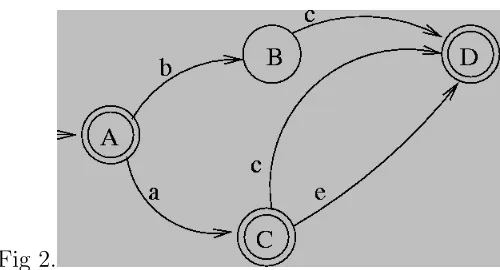
Regular languages have the most restricted type of generating grammar in terms of the nested hierarchy (it contains none of the other grammars) and in most cases is the simplest to parse since it lacks recursive structures. The production rules for regular languages are
Fig 2.
It can be shown that natural language is not regular in this way or in other words, that there is no FSA that can represent certain structures. This result was famously shown by Chomsky in ’Three Models for the Description of Language’ (1956). I will provide an outline of it here.
We know that patterns such as anbn are not analysable on a FSA since (informally) it
would have to remember this number n while waiting for the end of the b’s.14The argument goes that certain English constructions can be modelled on anbn. The claim is that paired dependencies such as either...or,if...then and certain agreement relations can nest within one another to an arbitrary depth.
Anyone1 who feels that if2 so-many3 more4 students5whom we6 haven’t6
actually admitted are5sitting in on the course than4ones we have that3 the room
had to be changed, then2 probably auditors will have to be excluded, is1 likely to
agree that the curriculum needs revision (Chomsky and Miller, 1963).
The above example illustrates that English may have structures that go beyond the bounds of regular languages. Thus central embedding15 is a common natural language phenomenon which cannot be captured by FSA and consequently regular grammars. These examples are enough to suggest that if English is not a regular language then other natural languages probably are not either. At the next level of the hierarchy we find languages which can capture these phenomena and more.
2.2.2
Context-free Languages (Type 2)
Context-free languages (CFG) were believed to contain the grammars that can capture the syntax of natural languages. The production rules for CFGs are one of two possibilities, either S →ab orS → aSb. As we can glean from the latter rule, CFGs allow for recursive structures. We can also see that CFGs contain regular languages. Furthermore, CFGs are
14Another way of putting this is that regular languages can count up to a certain point but there is a upper
bound on this number and no regular language is able to count two sets of symbols and compare this size if it is potentially infinite.
15Constructions which allow for two non-adjacent elements which may contain further instances of the
[image:28.612.91.341.67.202.2]intimately related to phrase-structure grammars. If we take the non-terminals to be syntactic categories and read the arrow as “consists of”:
Therefore the derivation of a string x in such a grammar implicitly imposes a hierarchical structure ofx into ever larger sub-phrases. For this reason, context-free grammars/languages are sometimes referred to as phrase structure gram-mars/languages, and it is assumed that such languages have an intrinsic hierar-chical structure (J¨ager and Rogers, 2012).
The generating grammar of the class of context-free languages is
L(G) ={w∈T|S ⇒∗
G w}such thatαAβ ⇒G αγβ iffA→γ ∈R(⇒∗G means derivable in
a finite set of steps). The class of FSAs associated with context-free languages is push-down automata. The push-down automaton (or stack) incorporates “memory” in a way that the previous FSA could not. The way in which this is executed is that the machine has more options than just state-changing, i.e. an item can be added to or removed from the stack. As we saw in the previous section, patterns such as anbn are not regular but they can be
accommodated by context-free grammars/languages as evinced by this push-down mechanism. Furthermore, in terms of complexity, we still have a manageable resolution of the member-ship problem. Of course, since the hierarchy is organised in terms of increasing complexity, context-free languages cannot be processed in linear time as regular languages can but rather in cubic time.
The guiding question resurfaces at this point, is this where natural languages are located in the formal language hierarchy? Chomsky seemed to think so. However, there are reasons to think that natural languages are not context-free. It was shown in Shieber (1985), that Swiss German contains cross serial dependencies between verbs and objects which are potentially unbounded in length.16 Consider the sentence from Shieber:
(2.2.1) dass mer d’chind em Hans es Huus l¨ond h¨alfe aanstriiche that we the children-acc Hans-dat the house-acc let help paint
that we let the children help Hans paint the house
The noun phrase “d’chind” is the argument of “l¨ond”, “em Hans” is the argument of “h¨alfe” and lastly “es Huus” is the argument of “aanstriiche”.17 The claim is that for a language
to satisfy such structures, it would have to allow expressions such as anbmcndm (where
m, n > 0). Context-free languages cannot accommodate this pattern since they can only capture unboundednested dependencies not serial ones. There is a stronger claim lurking here, namely that context-free grammar cannot generate inflected languages (languages with case) since they can reproduce this pattern. The copy language also has this property. This is the (nonnatural) language generated byL(G) =wwR|S⇒∗
G w which states that each string of
the language has the form ww. The same pattern of dependencies are generatable in this formal language. Clearly, a less restricted grammar is needed to capture serial dependencies and thus natural language data.
16Similar results have been shown for Dutch by Bresnan et al (1982), but these results relied somewhat on
formal syntactic theories.
2.2.3
Context-Sensitive Languages (Type 1) and Unrestricted
Lan-guages (Type 0)
Although in principle these languages are decidable in finite time, they are often PSPACE hard which renders some of them intractable in practice. Thus, I will not focus on them in much detail here, as it is unlikely that natural language falls within these rings of the hierarchy.
Context-Sensitive grammars have rules of the following typeα→β whereα, β∈(T∪N T) and |α| ≤ |β|. Thus, if we start with a string w, we can apply the rule backwards finitely many times. The strings that we attain through this procedure are never longer than w
itself. This is why context-sensitive grammars specify that the left-hand side of the rule is never longer than the right hand side since if we repeat the procedure of applying the rule backwards we either get shorter strings or loops which are inconsequential for present purposes.
The automata associated with these languages are linearly bounded automata. These are similar to Turing machines, however, they are not infinite. Technically, the finite state automaton contains a tape that is unbounded in length, although only a finite part of the tape, whose length is a linear function of the length of the initial input, can be accessed by the operations during the state transitions.
Given the computational intractability of these grammars, natural language is often assumed to be located somewhere between context-sensitive and context-free. We return to this issue below.
The last ring of the hierarchy is just the set of all formal languages or the computably enumerable languages. Moreover, “it can be shown that any kind of formal, algorithmic procedure that can be precisely defined can also be expressed by some grammar” (J¨ager and Rogers, 2012). This is the essence of the “well-definition” of Hockett. Any system that can be defined precisely such as the rules of chess or the derivations of logic or all of the other types of formal languages fall within this ring of the hierarchy. Thus, it is not very useful or interesting for a description of natural language syntax to locate it within the computably enumerable languages. In addition, these languages represent the last level of complexity and are often hard to parse. They can be decided by Turing machines but they are only semi-decidable which means that a machine could run on forever before it decides if a given string is generated by the grammar. Thus, natural language syntax still needs to be located and if it can be located, it is not to be found in the Chomsky Hierarchy.
2.2.4
Beyond the Chomsky Hierarchy: Mildly context-sensitive
Languages
prominent examples are Tree Adjoining Grammar (to be discussed in Part 3), Combinatory Categorial Grammar (Steedman 2000) and the various forms of Head Grammars (Sag and Pollard 1984). These formalisms have been shown to be equivalent and capable of describing cross serial dependencies in an efficient way (O(n6) or in the time of the 6th power to the
length of a given string). Thus, these languages are parsable in polynomial time.
It is easy to see why these languages go beyond context-freeness as they are able to capture cross-serial dependencies and even languages such as the copy language. It is only when we consider a certain property of mildly context-sensitive languages that we can appreciate why they are not quite context-sensitive. The property in question is known as the “constant growth property” (cf Joshi 1985). This property states that if we order all the strings of a language according to their length, then the length will grow in a linear fashion. This property also captures the NML property of section 1.3.4. since each sentence can be extended to another grammatical one by adding a single symbol/word. Thus, we have eliminated the context-sensitive languages which lack this property, e.g. the set of square numbers, the set of powers of two and the set of prime numbers.
In summation, we can define this set of languages precisely as
A set of languages L is mildly context-sensitive iff (1) L contains all the context-free languages, (2) L can describe the copy language and certain cross-serial dependencies of that sort, (3) L is parsable in polynomial time and (4) L has the constant growth property.
In part III, we aim to provide a compositional semantic account of a formal language which falls under this purview, namely nonprojective Dependency Grammar. For for moment, however, we will move on to a discussion about why compositionality may be a favourable characteristic for the semantics of a formal language in the first place. But before that, an important clarification.
2.2.5
A Computational Caveat
The above progression through and beyond the Chomsky Hierarchy could be somewhat misleading. It suggests that by producing examples of certain constructions the complexity of which exceed the bounds of a specific ring of the hierarchy, we are forced to move to another more inclusive type of formal language. The claim is then made that natural language could not possibly be contained in that ring of the hierarchy and we should search outside of it. Such claims, although convincing (and ubiquitous), are not necessarily true. The illusion of mathematical certainty in these cases is just that, an illusion. Most of these types of arguments are usually based on a fallacy. However, despite the fact that they may be technically flawed the conclusions drawn are often unchanged (notwithstanding the weaker foundation).
Generally speaking, these arguments are presented in the following way. A construction of complexity pis proffered as part of language N L such thatL0 is generated where L0 ⊆N L