Distributed Information and its Dynamics
MSc Thesis written by
Floris Roelofsen
(born July 25, 1980 in Amsterdam, the Netherlands)
under the supervision of Prof Dr Johan van Benthem, and submitted to the Board of Examiners in partial fulfillment of the requirements for the
degree of
MSc in Logic
at theUniversity of Amsterdam.
Date of the public defense: Members of the Thesis Committee:
Acknowledgments v
Overview vi
I Epistemic Logic 1
1 Expressive Power and Full Communication 2
1.1 Epistemic Logic . . . 3
1.2 Full Communication . . . 5
1.2.1 Distributed Knowledge and Full Communication . . . 6
1.2.2 Tightness and Saturation . . . 8
1.2.3 Tight & Saturated versus Finite & Distinguishing . . 8
1.2.4 A Complete Characterization of Full Communication . 10 1.2.5 Conclusion . . . 12
1.3 Expressive Power . . . 13
1.3.1 Collective Bisimulation . . . 15
1.3.2 Model Comparison Games . . . 17
1.3.3 Saturation and Fullness . . . 20
1.3.4 Conclusion . . . 22
2 Distributed Knowledge in Dynamic Epistemic Logic 23 2.1 Propositional Dynamic Logic . . . 23
2.2 Update Models . . . 24
2.3 The Logic of Communication and Change . . . 25
2.4 Expressive Power and Reduction Axioms . . . 26
2.5 Specific Communication Types . . . 27
2.6 Summary . . . 30
3 Communication Networks 31
3.1 Networks . . . 31
3.2 A Logic of Communication Networks . . . 32
3.3 Communication . . . 32
3.4 Reconfiguration . . . 34
3.5 Summary . . . 35
4 Communicative Power 36 4.1 Communicative Power . . . 36
4.2 Specific Network Types . . . 37
4.3 Potential Knowledge and Public Broadcast . . . 37
4.4 Potential Knowledge and Private Messages . . . 38
4.5 Knowledge over Time . . . 39
4.6 Summary . . . 40
II Multi-context Systems 41 5 Introduction 42 5.1 Multi-Context Systems . . . 43
6 Minimality 46 6.1 Minimal Solution Chain Semantics . . . 46
6.2 Computing the Minimal Solution Chain . . . 48
6.3 Summary . . . 51
7 Non-Determinism 52 7.1 Non-Deterministic Multi-Context Systems . . . 52
7.2 Minimal Solution Chain Semantics . . . 54
7.3 Summary . . . 56
8 Absent Information 57 8.1 Normal Multi-Context Systems . . . 57
8.2 Anti-Chain Semantics . . . 62
8.3 Summary . . . 69
9 Conclusions 71
At the 2004 European Summer School for Logic, Language, and Information in Nancy I first met Johan van Benthem. His presentation was magical, by far the most impressive scientific presentation I had ever attended. Two weeks later I started the Master of Logic programme in Amsterdam, and asked Johan to supervise my thesis work. I am very grateful for his agreeing to do so, and his very instructive and enjoyable guidance along the way.
I have worked on two different topics this year. First, I became interested in non-monotonic reasoning and semantics based on minimal models. To get to grips with these ideas, I studied their possible applications to a framework I was already familiar with, namely, that of multi-context systems. I am very grateful to Michiel van Lambalgen for his initial encouragements, to Luciano Serafini and Gerhard Brewka for comments on my writings, and to the University of Amsterdam for sponsoring my visit to Trento in January, during which most of the work reported here was accomplished.
When I started working on dynamic epistemic logic in February, I hardly knew anything about it. Discussions with Michael Franke, Paul Harrenstein, Fenrong Liu, Maricarmen Martinez, Siewert van Otterloo, Olivier Roy, and especially with Yanjing Wang helped me on my way. Later on, Hans van Ditmarsch, Jan van Eijck, Jelle Gerbrandy, Wiebe van der Hoek, Barteld Kooi, Tomasz Sadzik, and Josh Snyder provided very useful feedback. David Pearce very attentively arranged my stay in Madrid in April and May.
Parts of this thesis will be presented at various conferences [29, 30, 32]. I would like to thank the ILLC and IJCAI for generously providing the scholarships necessary to attend these events, and Johan van Benthem, Dick de Jongh, and Benedikt L¨owe for their help in obtaining these scholarships. On a more personal note, it was a great pleasure to spend a year “back home”. I especially enjoyed spending time with my parents and sister again. I found a great dance partner, new friends, and. . . lost my heart. Gracias!
This thesis is divided into two parts. Each part explores a particular logical perspective on distributed information and its dynamics.
The first part takes the perspective of epistemic and dynamic epistemic logic. We first explain why distributed knowledge does not always comply with the principle of full communication, as observed by van der Hoek, van Linder, and Meyer [43] and Gerbrandy [16], and give a complete character-ization of the class of models in which distributed knowledge does comply with the principle of full communication. Then, we address an issue raised by van Benthem [40]: is there a natural extended notion of bisimulation that matches the expressive power of distributed knowledge operators in epistemic logic. Next, we show that distributed knowledge operators (or more generally, intersection modalities) can be incorporated into the logic of communication and change, recently proposed by van Benthem, van Ei-jck, and Kooi [42]. At last, we discuss a more conceptual point. Distributed knowledge is what can be established by a group of agents through a partic-ular kind of communication: everyone writes down everything he knows, all that is put together, and what follows from the accumulated facts is distrib-uted knowledge. Other, arguably more interactive kinds of communication may be considered as well. Van Benthem [39], for example, is interested in the information that can be established by a group of agents throughpublic announcements. We discuss the information that can be established by a group of agents given a certaincommunication network.
The second part of the thesis takes the perspective of multi-context sys-tems. These systems describe the distribution and flow of information among a number of contexts (people, databases, etc.). We provide a simplified se-mantics for the basic systems and define generalizations of this sese-mantics for various extended systems.
Epistemic Logic
Expressive Power and Full
Communication
Distributed knowledge is a standard notion in epistemic logic [13, 23]. In-tuitively, a formula ϕis distributed knowledge among a group of agents B
iffϕ follows from the knowledge of all individual agents inB put together. Semantically,ϕis distributed knowledge amongB iff ϕis true in all worlds thatevery agent inB considers possible. This chapter addresses two issues concerning distributed knowledge.
Full communication. Van der Hoek, van Linder, and Meyer [43] argued that, to be of any use at all, a notion of group knowledge should comply with what they call theprinciple of full communication: wheneverϕis con-sidered group knowledge, it should be possible for the members of the group to establishϕ through communication (this will be made more precise be-low). Van der Hoek, van Linder, and Meyer [43] and Gerbrandy [16] showed that distributed knowledge does not generally comply with the principle of full communication, but does in certain special model classes. It is not clear, however, why distributed knowledge does not generally comply with the principle of full communication, and why it does in these special model classes. Moreover, it is not known whether these model classes arecomplete, that is, whether they comprise all models in which distributed knowledge complies with the principle of full communication. We will provide a sim-ple analysis of the problem and a comsim-plete characterization of the class of models in which distributed knowledge complies with the principle of full communication.
Expressive power. A standard notion of structural equivalence between epistemic models is that of bisimilarity. This notion (to be defined below)
perfectly matches the expressive power of basic epistemic formulas (formu-las without distributed knowledge operators): if two models are bisimilar, then they satisfy exactly the same basic formulas. But adding distributed knowledge to the basic language yields a more expressive language, whose formulas may be able to distinguish bisimilar models. Is there a natural extended notion of bisimulation that matches the expressive power of the language with distributed knowledge? This question is the first of a list of open problems in a recent survey by van Benthem [40]. We will de-fine and analyze a suitable extended notion of bisimulation, corresponding model comparison games, and a closely related extended notion of modal saturation.
The chapter is organized as follows. Section 1.1 reviews some basic notions from epistemic logic. Section 1.2 is concerned with the extent to which distributed knowledge complies with the principle of full communica-tion, and section 1.3 introduces notions of bisimulation and saturacommunica-tion, as well as related model comparison games, to capture the expressive power of distributed knowledge operators. Sections 1.2 and 1.3 each conclude with a short summary and pointers to related work.
1.1
Epistemic Logic
The following notions are all standard in epistemic logic [13, 23]. A countable set of proposition lettersP and a finite set of agentsAis assumed to be given throughout our general discussion and clear from the context in particular examples.
Languages. The basic epistemic language consists of all formulas that can be built from proposition letters in P using conjunction, negation, and a modal operator Ka for every agent a ∈ A. Kaϕ stands for agent a knows
that ϕis true. The basic epistemic language is denoted byLK:
ϕ ::= p| ¬ϕ|ϕ∧ψ|Kaϕ
One standard way to extend the basic language is to add a modal operator
DB for every group of agents B ⊆ A. DBϕ stands for ϕ is distributed
knowledge among B. The resulting language is denoted byLD:
ϕ ::= p| ¬ϕ|ϕ∧ψ|Kaϕ|DBϕ
• W is a non-empty set of worlds,
• R :A →℘(W ×W)
• V :W →℘(P)
R assigns to every agent a∈ A a so-called accessibility relation on W. In-tuitively, (w, v) ∈ R(a) means that in world w, agent a considers world v
possible. Accessibility relations are often assumed to be equivalence rela-tions, or to have other less restrictive properties, but for sake of generality we do not commit ourselves to any such specific assumptions here. V asso-ciates every world w ∈W with a subset of P, the proposition letters that are true inw. If M = (W, R, V) is a model and w is a particular world in
W, then (M, w) is called a pointed model, and wis called its actual world. We will often simply refer to pointed models as models. The information state [M, w]a of an agenta in (M, w) is the set of worlds that a considers possible in (M, w). Similarly, the information state [M, w]B of a group of agents B in (M, w) is the set of worlds that every agent a ∈ B considers possible in (M, w):
[M, w]a = {v∈W |(w, v)∈Ra}
[M, w]B = {v∈W |(w, v)∈Ra for all a∈B}
Semantics. The satisfaction relation between pointed models and for-mulas inLK orLD is recursively defined as follows:
M, wp iff p∈V(w)
M, w¬ϕ iff M, wϕ
M, wϕ∧ψ iff M, wϕ andM, wψ M, wKaϕ iff M, vϕfor all v∈[M, w]a
M, wDBϕ iff M, vϕfor all v∈[M, w]B
Intuitively, the Kaϕ clause says that an agent knows ϕ to be true just in
1.2
Full Communication
Van der Hoek, van Linder, and Meyer [43] argue that, to be of any use at all, a notion of group knowledge should comply with what they call the principle of full communication: wheneverϕis considered group knowledge, it should be possible for the members of the group to establish ϕ through communication. To make this more precise, they define the knowledge set of a group of agents B in a model (M, w) to be the set of all LK-formulas that at least one agent in B knows to be true in (M, w):
KSB(M, w) ={ψ∈ LK |M, wKaψ for somea∈B}
Then they take it that a formula can be established through communication by a group of agents iff that formula is entailed by the knowledge set of that group. So distributed knowledge complies with the principle of full communication iff for all ϕ∈ LK:
M, wDBϕ ⇒ KSB(M, w)ϕ (1.1)
Van der Hoek, van Linder, and Meyer [43] as well as Gerbrandy [16] show that (1.1) does not generally hold. To see this, consider the model depicted below (all accessibility relations are equivalence relations here). Take B =
{a, b}. Then,pis distributed knowledge amongB inw, butpis not entailed by B’s knowledge set inw.
w
x y
z
a b
b a p
p
¬p ¬p
In [43] and [16] various classes of models are identified in which distributed knowledge does comply with the principle of full communication. Van der Hoek, van Linder, and Meyer define a model M to be distinguishing iff for every world w in M there is an LK-formula that is true in w and no-where else M. They show that distributed knowledge complies with the principle of full communication in finite, distinguishing models. Gerbrandy generalizes this result. He definesM to belocally distinguishing iff for every
ϕasuch thatM, vϕaiffv∈[M, w]a. He shows that distributed knowledge
complies with the principle of full communication in locally distinguishing models. Gerbrandy also defines a model M to be full iff for every group
B ⊆ A and every w∈W, every set of LD-formulas that is consistent with KSB(M, w) is satisfiable in [M, w]B. He proves that distributed knowledge complies with the principle of full communication in full models.
It is not clear, however, why distributed knowledge does not generally comply with the principle of full communication, and why it does in mod-els that are finite, (locally) distinguishing and/or full. Moreover, it is not clear whetherall models in which distributed knowledge complies with the principle of full communication are finite, (locally) distinguishing and/or full. And if not, whether a complete characterization of such models can be given.
Section 1.2.1 gives a simple analysis of why distributed knowledge does not always comply with the principle of full communication. This analysis yields a rather general class of models in which distributed knowledgedoes comply with the principle. Section 1.2.2 relates the defining properties of this class, calledtightness and epistemic saturation, with notions familiar from modal logic. In particular, epistemic saturation is shown to be equivalent with modal saturation. In section 1.2.3 we compare our model class with the model class defined by van der Hoek, van Linder, and Meyer. We show that every finite, distinguishing model is tight and saturated, and moreover, that there is an interesting intermediate model class consisting of generated submodels of the canonical model. In section 1.2.4 we show that our model class can be generalized in various ways, which finally leads to a complete characterization of models in which distributed knowledge complies with the principle of full communication. Interestingly, the characteristic property of such models turns out to be a weak version of Gerbrandy’s fullness property.
1.2.1 Distributed Knowledge and Full Communication Why does distributed knowledge not comply with the principle of communi-cation? One answer to this question is that in generalan agent’s information state may not contain every world that is consistent with her knowledge set. Consider, for example, the model depicted above: everythingaknows inw
informa-tion than the union of the corresponding knowledge sets. To continue the above example, a and b’s knowledge sets in w are identical. Thus, taking their union does not yield any new information. However, a and b’s infor-mation states in w are different, and their intersection yields a new, more informative state. As a result,p is distributed knowledge among aandb in
w, even though it is not entailed by the union of their knowledge sets. This explanation, trivial as it may seem, leads us to the characterization of a rather general class of models in which distributed knowledge does comply with the principle of full communication, namely, the class of models in which every agent’s information state does contain every world that is consistent with her knowledge set.
This requirement can be split into two sub-requirements. First, every set of formulas that is consistent with an agent’s knowledge set must be sat-isfiable in the agent’s information state. We call this requirement epistemic saturation.
Definition 1.1 (Epistemic Saturation) A modelM = (W, R, V)is epis-temically saturatediff for allw∈W and alla∈ A, every set ofLK-formulas that is consistent with KSa(M, w) is satisfiable in [M, w]a.
Second, every world that is consistent with an agent’s knowledge set must be contained in the agent’s information state. We call this requirement tightness.
Definition 1.2 (Tightness) A model M = (W, R, V) is tight iff for all
w∈W and all a∈ A, every world in M that is consistent with KSa(M, w) is in [M, w]a.
Notice that epistemic saturation and tightness are complementary require-ments: the former requires that a model contains enough worlds; the latter requires that a model provides forenough access.
We now show that distributed knowledge complies with the principle of full communication in tight and epistemically saturated models.
Proposition 1.3 In tight and epistemically saturated models distributed knowledge complies with the principle of full communication.
Proof. LetM = (W, R, V) be tight and epistemically saturated. To prove:
Suppose that KSB(M, w)ϕ. Then {¬ϕ} ∪KSB(M, w) is consistent. Let
a∈B. Then {¬ϕ} ∪KSB(M, w) is consistent with KSa(M, w) so, by epis-temic saturation of M, [M, w]a contains a worldwa satisfying all formulas in{¬ϕ} ∪KSB(M, w). Thus,wa is consistent with KSb(M, w) for allb∈B,
and by tightness ofM, we must havewa∈[M, w]b for allb∈B. This means
thatwa∈[M, w]B, and thus, that M, wDBϕ, as desired. 2
1.2.2 Tightness and Saturation
Tightness is familiar from modal logic (see, for example, [14]). Epistemic saturation seems new, but turns out to be equivalent with another very fa-miliar notion from modal logic, namely, modal saturation (see, for example, [7]). A model M = (W, R, V) is modally saturated iff for every w ∈ W, everya∈ A, and every set of LK-formulas Σ, if every finite subset of Σ is satisfiable in [M, w]a, then Σ itself is satisfiable in [M, w]a.
Proposition 1.4 A model is epistemically saturated iff it is modally satu-rated.
Proof. LetM = (W, R, V) be a model, a∈ A, and w∈W.
(⇒) SupposeM is epistemically saturated. Let Σ be a set ofLK-formulas such that every finite subset of Σ is satisfiable in [M, w]a. Then every finite subset of Σ = Σ∪ KSa(M, w) is also satisfiable in [M, w]a. It follows, by compactness, that Σ is satisfiable and therefore consistent. Then, by epistemic saturation of M, Σ must be satisfiable in [M, w]a. This means that Σ is satisfiable in [M, w]a, and thus thatM is modally saturated.
(⇐) Suppose M is modally saturated. Let Σ be a set of LK-formulas that is consistent with KSa(M, w). Then every finite subset of Σ is satisfiable in [M, w]a. To see this, let Σ be a finite subset of Σ and suppose that Σ is not satisfiable in [M, w]a. Then¬Σ ∈KSa(M, w), which contradicts the assumption that Σ is consistent with KSa(M, w). So every finite subset of Σ is satisfiable in [M, w]a. By modal saturation, it follows that Σ is satisfiable in [M, w]a, and thus that M is epistemically saturated. 2 Henceforth, we will simply refer to modal and epistemic saturation as satu-ration.
every finite, distinguishing model is tight and saturated, and also identify an interesting intermediate class of models.
Proposition 1.5 Finite, distinguishing models are saturated and tight.
Proof. Finite models are always saturated [7]. Now suppose a model M
is finite and therefore saturated, butnot tight. Then for some agentathere must be two worldswandvinM such that everythingaknows inwis true inv, butv is not contained in [M, w]a. Let Γ be the set of formulas true in
v. Clearly, Γ is consistent with KSa(M, w). M is saturated so there must be a worldu in [M, w]athat satisfies all formulas in Γ. But this means that
u and v satisfy exactly the same formulas. So M is not distinguishing. We conclude that, if M is finite and distinguishing, then it must be saturated
and tight. 2
The class of saturated and distinguishing models clearly subsumes the class of finite and distinguishing models, but is itself subsumed by the class of tight and saturated models. Interestingly, a model is saturated and distin-guishing if and only if it is a generated submodel of the so-called canonical model. To show this, let us first recall the relevant definitions, which are all standard in modal logic [7].
A set of LK-formulas Σ is maximally consistent iff it is consistent and for all ϕ∈ LK, either ϕ∈Σ or ¬ϕ∈Σ. Note that the theory of a pointed
model is always maximally consistent. The canonical model Mc is a triple (Wc, Rc, Vc) where:
Wc = {wΣ |Σ is a maximally consistent set ofLK-formulas}
Rc(a) = {(wΣ, wΔ)|Kaϕ∈Σ implies ϕ∈Δ}
Vc(wΓ) = {p∈ P |p∈Σ}
It is a well-known result that for everyϕ∈ LK,Mc, wΣϕiffϕ∈Σ. Given a model M = (W, R, V) and a set of worlds X ⊆ W, the model
M|X = (X, R|X, V|X) is called the restriction of M to X. M|X is a generated submodel of M iff, whenever w ∈ X and v ∈ [M, w]a for some
a ∈ A, then also v ∈ X. So a generated submodel is a submodel that preserves information states.
Finally, two models (M, w) and (M, w) are isomorphic,M, w∼=M, w, iff there is a bijective bisimulation (i.e., an isomorphism) Z between M and
M such thatwZw.
Proof. LetM = (W, R, V) be a model.
(⇒) Suppose M is saturated and distinguishing. Then, every world in M has a unique, maximally consistent theory, and therefore uniquely corresponds to a world inMc. LetW be the set of all worldsw inMc that correspond to a worldwinM, and let M = (W, R, V) be the restriction ofMc toW. We show (1) that M is a generated submodel ofMc and (2) thatM and M are isomorphic.
For (1), suppose thatw ∈W and (w, v)∈Rc(a) for some a∈ A and somev ∈Wc. We must show that v ∈W. By definition of the canonical model v satisfies every formula in KSa(Mc, w). So Γ(Mc, v) is consistent with KSa(Mc, w), and therefore also with KSa(M, w). Then, by epistemic saturation of M, Γ(Mc, v) must be satisfiable in [M, w]a. But this means that [M, w]a must contain a worldv with Γ(Mc, v) as its theory. It follows thatv is in W, and thus, thatM is a generated submodel ofMA,P.
For (2), let Z be the bijection that relates every world w ∈W with its corresponding worldw ∈W. Clearly,wandwsatisfy the same proposition letters. It remains to check the back and forth clauses. We do the forth clause; the back clause is completely analogous. Leta∈ Aand v∈[M, w]a. Clearly, Γ(M, v) is consistent with KSa(M, w), and therefore Γ(M, v) is also consistent with KSa(M, w). But then, by definition of the canonical model,v ∈[M, w]a, as desired.
(⇐) SupposeMis isomorphic to a generated submodelM = (W, R, V) ofMc. It is clear that no two worlds inM can have the same theory, soM
must be distinguishing. To show thatM is saturated it suffices to show that
M is saturated. Mc is well-known to be saturated [7]. Moreover, generated submodels it preserve information states and saturation thereof. SoM and
M are saturated. 2
We are not aware of any earlier statements of this result, although Fine [14] made several observations in this direction, and we would not be surprised if others had proven similar results, be it for different purposes and presumably in terms of modal saturation rather than epistemic saturation.
princi-ple of full communication are saturated and tight. The answer is no. To see this, reconsider the proof of proposition 1.3. The role of saturation here is to ensure that everyLK-formulaϕthat is consistent with the knowledge set of a group of agents is satisfiable in the information state of every agent in the group. Saturation is sufficient here, but not necessary: it is concerned with sets of formulas, where it could equally well just be concerned with single formulas. Then, once it has been established that ϕis satisfiable in the information state of every agent in the group, the role of tightness is to ensure that there is at least one world satisfyingϕwhich is contained in the information state of all agents in the group. Again, tightness is sufficient to fulfil this role, but not necessary. These observations give rise to the following definition:
Definition 1.7 (Full Communication Model) A model M = (W, R, V) is a full communication model iff for all w ∈ W and all B ⊆ A, every
LK-formula that is consistent with KSB(M, w) is satisfiable in[M, w]B. Notice that full models, as defined by Gerbrandy, are full communication models: where Gerbrandy quantifies over sets of LD-formulas, we quantify over single LK-formulas. The following proposition establishes that tight and saturated models are full communication models as well.
Proposition 1.8 Tight and saturated models are full communication mod-els.
Proof. Let M be tight and saturated, w in M, B ∈ A, and Σ a set of
LK-formulas that is consistent with KSB(M, w). We must show that Σ is satisfiable in [M, w]B. Let a ∈ B. Then Σ∪KSB(M, w) is consistent with KSa(M, w), so by saturation of M, [M, w]a must contain a world wa
that satisfies all formulas in Σ∪KSB(M, w). Thus, wa is consistent with KSb(M, w) for allb∈B, and by tightness ofM, we must havewa∈[M, w]b
for all b∈B. This means thatwa∈[M, w]B. So Σ is satisfiable in [M, w]B
which means that M is a full communication model. 2 Now we prove that distributed knowledge complies with the principle of full communication in full communication models, and moreover, that full communication models are theonly models in which distributed knowledge complies with the principle of full communication.
Proof. Theif part was, implicitly, already established by Gerbrandy [16]: suppose M is a full communication model, w a world in M, B a group of agents, andϕa formula inLK that isnot entailed by KSB(M, w). Then¬ϕ
is consistent with KSB(M, w), and therefore, as M is a full communication model, ¬ϕis satisfiable in [M, w]B. But this means that ϕ cannot be dis-tributed knowledge amongB in (M, w). So distributed knowledge complies with the principle of full communication inM.
For theonly if part, suppose thatM isnot a full communication model. Then, for somewinM and someB ⊆ A, there is a formulaϕinLK that is consistent with KSB(M, w) but not satisfiable in [M, w]B. For this to be the case,¬ϕmust not be entailed by KSB(M, w). On the other hand, ¬ϕmust hold throughout [M, w]B and therefore be distributed knowledge amongB
in (M, w). So distributed knowledge does not comply with the principle of
full communication inM. 2
1.2.5 Conclusion
Van der Hoek, van Linder, and Meyer [43] as well as Gerbrandy [16] observed that distributed knowledge does not always comply with the principle of full communication. They also observed that distributed knowledgedoescomply with the principle in finite, distinguishing models, in locally distinguishing models, and in full models. It was not clear, however, why these properties were sufficient and whether they were necessary for compliance with the principle of full communication.
We established the following hierarchy of models in which distributed knowledge complies with the principle of full communication:
full communication models
saturated and tight
saturated and distinguishing
Our point of departure was the class of saturated and tight models, in which every agent’s information state contains all worlds that are consistent with her knowledge set. We established that this class contains all finite and dis-tinguishing models and all canonical (saturated and disdis-tinguishing) models. On the other hand, it is subsumed by the class of full communication mod-els, which was shown to consist of all models in which distributed knowledge complies with the principle of full communication. Interestingly, the char-acteristic property of full communication models turned out to be a weak version of Gerbrandy’s fullness property. One more thing to notice about the hierarchy above is that less restrictive properties are concerned with more fine-grained structural aspects of a model. Finiteness and distinguishabil-ity are concerned with the structure of a model as a whole, saturation and tightness are concerned with information states of individual agents, and full communication models impose restrictions on the information states of groups of agents. Distributed knowledge itself is defined in terms of infor-mation states of groups of agents. In the light of this observation it is not so surprising that finiteness, distinguishability, tightness, and saturation only led to a partial characterization of the class of full communication models.
As a final remark we would like to point out that the principle of full communication considered here presupposes a particular kind of communi-cation, namelyprivate communication. Other kinds of communication may be considered as well. Van Benthem [39], for example, is interested in the information that can be obtained by a group of agents throughpublic com-munication. Parikh and Pacuit [25] are interested in the information that can be established by a group of agents relative to a restricted communica-tion network. Chapter 4 and 5 of [28] are also relevant in this respect. In general, a dynamic view on epistemic logic [46] gives rise to many interesting notions of group knowledge, most of which remain to be explored. We leave such explorations for another occasion, however, and now turn to the second topic of the chapter.
1.3
Expressive Power
Bisimulation, which was introduced in a general modal setting by van Ben-them [37], is a standard measure of structural equivalence between epistemic models. Intuitively, two pointed models are bisimilar iff (1) they assign the same truth values to all proposition letters and (2) they assign equivalent information states to all agents.
be two epistemic models. A non-empty relationZ ⊆W ×W is a bisimula-tion between M and M iff for every w ∈W and w ∈W such that wZw
we have:
1. V(w) =V(w)
2. For every agent a∈ A:
forth ∀v∈[M, w]a :∃v ∈[M, w]a :vZv
back ∀v ∈[M, w]a :∃v∈[M, w]a :vZv
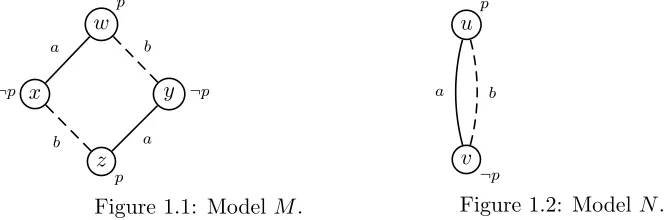
Two pointed models (M, w) and (M, w) are bisimilar, (M, w) (M, w), if and only if there is a bisimulationZ betweenM and M such that wZw. Bisimilarity matches the expressive power of the basic epistemic language: if (M, w)(M, w) then (M, w) and (M, w) satisfy the same LK-formulas. The language with distributed knowledge operators, however, is more ex-pressive. To see this, consider the models depicted in figure 1.1 and 1.2 (where all accessibility relations are equivalence relations).
w
x y
z
a b
b a p
p
¬p ¬p
Figure 1.1: ModelM.
u
v
a b p
[image:20.612.142.476.341.451.2]¬p
Figure 1.2: ModelN.
(M, w) and (N, u) are bisimilar, but do not satisfy the same formulas inLD. For example, withB ={a, b} we have:
M, w DBp
N, u DBp
1.3.1 Collective Bisimulation
Bisimilarity requires two models to associate equivalent information states with every single agent. But distributed knowledge involves information states of groups of agents. Thus, in order to obtain a suitable notion of bisimulation, it seems natural to require two models to associate equivalent information states not just with every individual agent, but with everygroup of agents.
Definition 1.11 (Collective Bisimulation) LetM = (W, R, V)andM= (W, R, V) be two models. A non-empty relation Z ⊆W ×W is a collec-tive bisimulation between M and M iff for every w∈W and w ∈W such that wZw:
1. V(w) =V(w)
2. For every groupof agents B ⊆ A:
forth ∀v∈[M, w]B :∃v ∈[M, w]B :vZv
back ∀v∈[M, w]B :∃v ∈[M, w]B :vZv
Two models(M, w)and(M, w)are collectively bisimilar,(M, w)c (M, w), iff there is a collective bisimulation Z between M and M such that wZw.
Collective bisimilarity generalizes ordinary bisimilarity. The latter only requires the back and forth conditions to hold for singleton groups of agents. So if two models are collectively bisimilar, then they are also bisimilar, but not vice versa: the models depicted in figure 1.1 and 1.2, for example, are bisimilar, but not collectively bisimilar.
We now show that collective bisimulation indeed matches the expressive power of LD and establish some of its basic properties.
Proposition 1.12 (Adequacy) If two pointed models are collectively bisim-ilar, then they satisfy exactly the same formulas in LD.
Proof. LetM = (W, R, V) andM = (W, R, V) be two models and let
w∈W and w ∈W be such that (M, w)c (M, w). We must prove that for every ϕ∈ LD:
M, wϕ iff M, w ϕ
induction steps for negation, conjunction and individual knowledge opera-tors are standard [7]. Here is the induction step for distributed knowledge operators. Letϕbe of the formDBψand suppose thatM, wDBψ. Then
M, v ¬ψ for some v ∈[M, w]B. As (M, w) c (M, w), there is a world
v ∈ [M, w]B such that (M, v) c (M, v). By the induction hypothesis, then,M, v ¬ψ, and thus M, wDBψ. 2
Proposition 1.13 Collective bisimulation is an equivalence relation.
Proof. Reflexivity and symmetry are clear. Transitivity amounts to: (M, w)c (M, w) and (M, w)c (M, w) imply (M, w)c (M, w) Let Z be a collective bisimulation between (M, w) and (M, v), and let
Z be a collective bisimulation between (M, w) and (M, v). Then the
relation Z between worlds in M and worlds in M given by {(w, w) |
∃w ∈M :wZw and wZw} is a collective bisimulation between (M, w) and (M, v). To see this, first observe that (M, w) and (M, v) should satisfy the same proposition letters, by (M, w)c(M, w) and (M, w)c (M, w). Now let v be a world in [M, w]B for some arbitrary group of agents B. Then, by (M, w) c (M, w), there is a world v in [M, w]B such that vZv. Moreover, by (M, w) c (M, w), there is a world v in [M, w]Bsuch thatvZv. Then, by definition ofZ, we havevZv. This establishes the forth clause. The back clause can be proven analogously. So we may conclude that Z is a collective bisimulation between (M, w) and
(M, w). 2
Proposition 1.14 The set of collective bisimulations between any two mod-els is closed under taking arbitrary (finite or infinite) unions.
Proof. Let {Zi | i ∈ I} be a non-empty set of collective bisimulations between two models M and M. To show that Z = i∈IZi is again a collective bisimulation betweenM andM, letwinM and w inM be any two worlds such thatwZw. Then we must havewZiw for somei∈I. Now
let v be a world in [M, w]B for some arbitrary group of agents B. Then, there must be a worldv in [M, w]B such thatvZiv. ButvZivmeans that
vZv holds as well. This establishes the forth clause, and the back clause can be proven analogously. We conclude thatZ is a collective bisimulation
Corollary 1.15 If there is a collective bisimulation between two models M
and M, then there is always a maximal collective bisimulation between M
and M: one that includes all other collective bisimulations between M and
M.
Proof. Take the union of all collective bisimulations betweenM and M. By proposition 1.14, this is again a collective bisimulation between M and
M and clearly, it includes all others. 2
1.3.2 Model Comparison Games
If two models are bisimilar, then they satisfy exactly the same formulas in LK. The opposite is only true for certain special classes of models. If two finite models, for example, satisfy the same formulas in LK, then they are bisimilar. However, infinite models may very well satisfy exactly the same formulas inLK even though they are not bisimilar. Intuitively, this is because whether or not a model (M, w) satisfies a formula ϕonly depends on worlds inM that can be reached fromwin a finite number of steps along the accessibility relations in M. This number of relevant steps is bounded by the so-called modal depth of ϕ.
Definition 1.16 (Modal Depth) The modal depthd(ϕ)of a formulaϕ∈
LK is defined recursively as follows:
d(p) = 0 for all p∈ P d(¬ϕ) = d(ϕ)
d(ϕ∧ψ) = max(d(ϕ), d(ψ))
d(Kaϕ) = d(ϕ) + 1 for all a∈ A
Now, for two models (M, w) and (M, w) to satisfy the same formulas in
LK it is sufficient that (M, w) and (M, w) satisfy the same proposition
letters and that for every finite path starting from w in M, we can find a corresponding path starting from w inM (and vice versa). Bisimulation requires something stronger, namely that (M, w) and (M, w) satisfy the same proposition letters and that for every (possiblyinfinite) path starting fromwinM, we can find a corresponding path starting fromw inM (and vice versa). This is why two infinite models that satisfy the same formulas inLK are not necessarily bisimilar.
(M, w), by two players called spoiler and duplicator, and consists of a fixed number of rounds. Spoiler tries to establish that (M, w) and (M, w) satisfy different formulas; duplicator tries to show that they satisfy exactly the same formulas. The number of rounds of the game yields a bound on the length of the paths starting fromw inM and from w in M that are available to spoiler as possible evidence for a structural difference betweenM and M. If spoiler cannot win the n-round model comparison game on (M, w) and (M, w), then these models satisfy exactly the same formulas in LK up to depth n. So if duplicator has a winning strategy for all model comparison games on (M, w) and (M, w), then (M, w) and (M, w) satisfy the same
LK-formulas of arbitrary depth. And now the converse also holds: if (M, w)
and (M, w) satisfy the same LK-formulas, then duplicator has a winning strategy for all model comparison games on (M, w) and (M, w). This works out because games themselves have a finite number of rounds (just like for-mulas have finite modal depth), but for every n, there is a game with n
rounds (just as for everyn, there are formulas with modal depthn). Model comparison games characteristic forLK are standard and can be found, for example, in [46]. Here, we define model comparison games characteristic for
LD, called LD-games, and show that duplicator has a winning strategy in
all LD-games on two models iff those two models satisfy exactly the same
LD-formulas. Just as LK-games can be seen as finite approximations of a bisimulation,LD-games can be seen as finite approximations of a collective bisimulation.
Definition 1.17 (LD-games) Let M = (W, R, V) and M = (W, R, V) be two models, let w ∈ W and let w ∈ W. The rules of the n-round
LD-game on (M, w) and (M, w) are as follows:
1. If n= 0 then duplicator wins iff V(w) =V(w).
2. If nnot = 0 then spoiler can do either one of the following moves: forth-move Spoiler picks a group of agents B ⊆ A and a world v ∈
[M, w]B. Duplicator responds by picking a world v ∈[M, w]B. The rest of the game is the (n−1)-roundLD-game on(M, v) and (M, v).
back-move Spoiler picks a group of agents B ⊆ A and a world v ∈
3. If a player cannot make any further move, she loses the game.
Proposition 1.18 Let (M, w) and (M, w) be two models, and let P be finite. Then (M, w) and (M, w) satisfy exactly the same LD-formulas iff for all n ≥ 0, duplicator has a winning strategy for the n-round LD-game on (M, w) and(M, w).
Proof. Define the depthd(ϕ) of a formula ϕ∈ LD just as for formulas in
LK (see definition 1.16) with the following additional clause:
d(DBϕ) =d(ϕ) + 1 for all B ⊆ A
Write (M, w) ≡n (M, w) iff (M, w) and (M, w) satisfy exactly the same formulas in LD with depth n. Observe that, asP andA are both assumed to be finite, for every n ≥ 0, there are only finitely many formulas with depth n, up to logical equivalence. Now we prove, by induction on n, that duplicator has a winning strategy for the n-roundLD-game on (M, w) and (M, w) iff (M, w)≡n(M, w).
The base case (n= 0) follows directly from the definitions.
The induction step involves two directions, which we treat separately: (⇒) Suppose duplicator has a winning strategy for the (n+1)-roundLD -game on (M, w) and (M, w). Then we must show that for allϕ∈ LD such that d(ϕ) =n+ 1, we haveM, wϕiffM, wϕ. We do so by induction on ϕ, and only treat the non-standard case in whichϕis of the form DBφ,
where d(φ) =n. SupposeM, wDBφ. We show that M, w DBφmust
hold as well: let v be any world in [M, w]B. Suppose spoiler chooses v
in a first back-move of the (n+ 1)-roundLD-game on (M, w) and (M, w). Then, by assumption, duplicator can pick a world v in [M, w]B such that she (duplicator) has a winning strategy for the remainingn-roundLD-game on (M, v) and (M, v). By the induction hypothesis, (M, v) ≡n (M, v). In particular, we have that M, v φ, and as v was an arbitrary world in [M, w]B, we may conclude thatM, w DBφ.
(⇐) Now suppose that (M, w)≡n+1(M, w). We must show that dupli-cator has a winning strategy in the (n+ 1)-round LD-game on (M, w) and (M, w). Suppose spoiler starts with a back-move and picks a world v in [M, w]B. Now, toward a contradiction, suppose that there is no worldv in [M, w]B such that (M, v)≡n(M, v) (which is what duplicator needs for a winning strategy). Then, for everyvin [M, w]B, there is a formulaψv ∈ LD
of depthn such thatM, vψv butM, vψv. Define:
ψw=
v∈[M,w]B
We observed that there are only finitely many formulas with depthn, up to logical equivalence. Soψwcorresponds to a finite disjunction, again of depth
n. We have M, w DBψw, but M, w DBψw, even though d(DBψw) =
n+ 1. This contradicts our assumption that (M, w)≡n+1 (M, w). So we may conclude that duplicator has a winning strategy for the (n+ 1)-round
LD-game on (M, w) and (M, w). 2
1.3.3 Saturation and Fullness
Recall the notions of saturation and fullness from section 1.2. A model is saturated iff every set of LK-formulas that is consistent with the knowl-edge set of a single agent is satisfiable in the information state of that sin-gle agent. A model is full iff every set of LD-formulas that is consistent with the knowledge set of a group of agents is satisfiable in the information state of that group of agents. Notice that fullness generalizes saturation just like collective bisimulation generalizes ordinary bisimulation and distributed knowledge operators generalize individual knowledge operators: where satu-ration, bisimulation, and individual knowledge operators are concerned with the information states of individual agents, fullness, collective bisimulation and distributed knowledge operators are concerned with the information states ofgroups of agents.
There is an important and well-known connection between saturation, bisimilarity, and the expressive power ofLK: saturated models are bisimilar iff they satisfy the sameLK-formulas [7]. The following proposition estab-lishes a similar connection between fullness, collective bisimilarity, and the expressive power ofLD.
Proposition 1.19 Full models are collectively bisimilar iff they satisfy the sameLD-formulas.
Proof. Proposition 1.12 already established that, in general, collectively bisimilar models satisfy the same formulas inLD. Here, we show that full models which satisfy the same formulas inLD are collectively bisimilar. Let
M and M be full, and let w inM and w inM be such that (M, w) and (M, w) satisfy the same formulas in LD. Let Z be the relation between
v. Then Γ is consistent with KSB(M, w), and therefore also consistent with KSB(M, w). As M is full, Γ must be satisfiable in [M, w]B. But this means that there must be a world v in [M, w]B that satisfies exactly the same LD-formulas as v. So we havevZv, which means that Z is indeed a collective bisimulation between M and M. 2 This can be taken a bit further. The following propositions establish that full models are collectively bisimilar iff they are bisimilar and that with respect to full models, LD has no more expressive power than LK.
Proposition 1.20 Full models are bisimilar iff they are collectively bisimi-lar.
Proof. Clearly, collectively bisimilar models are always bisimilar. We must show that full, bisimilar models are always collectively bisimilar. To do so, let M and M be full and let w in M and w in M be such that (M, w) and (M, w) are bisimilar. Let Z be the maximal bisimulation between (M, w) and (M, w) (the existence of which is established in [7]). We will show that Z is also a collective bisimulation between (M, w) and (M, w). To do so, let B be an arbitrary group of agents and let v be any world in [M, w]B. Let Γ be the set of LD-formulas true in v. Then Γ is consistent with KSB(M, w). (M, w) and (M, w) are bisimilar, so they satisfy the same formulas in LK. Therefore, Γ is also consistent with KSB(M, w). M is full, so Γ must be satisfiable in [M, w]B. This means that there must be a world v in [M, w]B that satisfies exactly the sameLD-formulas asv. In particular, v and v satisfy exactly the same LK-formulas. M and M are both saturated, so (M, v) and (M, v) must be bisimilar. But then, as Z was assumed to be maximal, we must have vZv, and this establishes that
Z is indeed a collective bisimulation. 2
Proposition 1.21 Full models satisfy the same formulas in LK iff they satisfy the same formulas in LD.
Proof. Clearly, it is enough to prove the only if part. Let (M, w) and (M, w) be full. Suppose (M, w) and (M, w) satisfy the same formulas in
LK. Since both models are saturated, they must be bisimilar [7]. Then,
by proposition 1.20, they must be collectively bisimilar. But then it follows from proposition 1.12 that they must satisfy exactly the same formulas in
1.3.4 Conclusion
We have proposed an extended notion of bisimulation that matches the expressive power of the basic epistemic language extended with distributed knowledge operators. We have also defined related model comparison games and established their adequacy. Finally, we showed that fullness generalizes saturation just as collective bisimulation generalizes ordinary bisimulation and established that full models are collectively bisimilar iff they are bisim-ilar iff they satisfy exactly the sameLK-formulas iff they satisfy exactly the sameLD-formulas. In particular, LD and LK have equal expressive power with respect to full models.
Distributed Knowledge in
Dynamic Epistemic Logic
Dynamic epistemic logic deals with information change. It is the subject of a lively field of research, with key contributions by Gerbrandy [16], Baltag, Moss, and Solecki [3, 4], and van Ditmarsch [44]. A particularly attractive system, called the logic of communication and change, LCC, has recently been proposed by van Benthem, van Eijck, and Kooi in [42]. It takes propo-sitional dynamic logic as its static point of departure, but does not consider intersection modalities, which are needed to define distributed knowledge. In this chapter, we show that intersection modalities can be incorporated into the logic of communication and change in a straightforward way. We will define LCC as in [42], merely highlighting the slight modifications in-volved in adding intersection modalities. This chapter is meant to be read along with [42]. The underlying intuitions provided there are not repeated here.
2.1
Propositional Dynamic Logic
Language The basic language of propositional dynamic logic, PDL, con-sists of formulas ϕand relational symbolsπ:
ϕ := |p| ¬ϕ|ϕ1∧ϕ2|[π]ϕ
π := a|?ϕ|π1;π2 |π1∪π2 |π∗
This language can be extended with so-called intersection modalities. That is, ifπ1andπ2are relational symbols, thenπ1∩π2is also a relational symbol. The resulting language is denoted as PDL∩.
Semantics. The semantics of formulas inPDLandPDL∩ is given in terms of the models defined in the previous chapter, which are hereafter called epistemic models. Formulas are interpreted as subsets ofW, and relational symbols are interpreted as binary relations onW:
[[]]M = W
[[p]]M = {w∈W |p∈V(w)} [[¬ϕ]]M = W \[[ϕ]]M
[[ϕ1∧ϕ2]]M = [[ϕ1]]M ∩[[ϕ2]]M
[[[π]ϕ]]M = {w∈W |(w, v)∈[[π]]M implies v∈[[ϕ]]M} [[a]]M = R(a)
[[?ϕ]]M = {(w, w)∈W ×W |w∈[[ϕ]]M} [[π1;π2]]M = [[π1]]M ◦[[π2]]M
[[π1∪π2]]M = [[π1]]M ∪[[π2]]M [[π1∩π2]]M = [[π1]]M ∩[[π2]]M [[π∗]]M = ([[π]]M)∗
[[π1]]M ◦[[π2]]M is the composition of [[π1]]M and [[π2]]M, and ([[π]]M)∗ is the reflexive transitive closure of [[π]]M. PDL∩ is decidable [10] and has a complete axiomatization [2].
It is possible to describe various kinds of group knowledge in PDL∩. [a∈Ba]ϕ, for example, means thatϕholds in all worlds that any agent inB
considers possible, i.e., that every agent inB knowsϕ. This is traditionally written asEBϕ. [(a∈Ba)∗]ϕ means that every agent in B knows ϕ, that every agent inB knows that every agent inB knowsϕ, and so on, i.e., that
ϕ is common knowledge among B. This is traditionally written as CBϕ.
Finally, [a∈Ba]ϕ means that ϕ holds in every world thatall agents in B
consider possible, i.e., thatϕisdistributed knowledgeamongB. This, as we saw in the previous chapter, is traditionally written asDBϕ.
2.2
Update Models
InLCC,epistemic models are used to represent the agents’ information, and so-called update models are used to represent information bearing events. To define update models we need the following notion:
Substitutions. A substitution for a language L is a function of type
finite number of proposition letters to themselves. Let denote the empty substitution, and let SubL denote the set of all substitutions forL.
Update Models. An update model for a finite set of agents A and a languageLis a quadrupleU= (E,R,pre,sub), whereEis a finite non-empty set of events, R is a family of accessibility relations, one for every agent
a ∈ A, pre associates every event with a precondition, and sub associates every event with a substitution for L:
E = {e0, . . . ,en−1}
R = {R(a)⊆E×E|a∈ A}
pre = {pre(e)∈ L |e∈E}
sub = {sub(e)∈SubL|e∈E}
If U = (E,R,pre,sub) is an update model ande ∈E, then (U,e) is called a pointed update model, ande is called itsactual event.
Executability. Let M = (W, R, V) be an epistemic model for A and P, and let w∈W. Let U= (E,R,pre,sub) be an update model for A and any languageL that can be interpreted in epistemic models for Aand P. Then an event e∈Eis called executable in (M, w) if and only if M, wpre(e).
Execution. LetM,w, and Ube as above, and let e∈Ebe executable in (M, w). Then the result ofexecuting (U,e) in (M, w) is the epistemic model
M ⊗U= (W, R, V) where:
W = {(w,e)∈W ×E| M, wpre(e)}
R(a) = {((w,e),(w,e))|(w, w)∈R(a) and (e,e)∈R(a)}
V(p) = {(w,e)∈W |M, wsub(e)(p)} and which has (w,e) as its actual world.
2.3
The Logic of Communication and Change
Semantics. The semantics of LCCand LCC∩ is obtained from the seman-tics ofPDLandPDL∩, respectively, by adding the following clause for update execution:
[[ [U,e]ϕ]]M ={w∈W |M, wpre(e) implies (w,e)∈[[ϕ]]M⊗U}
2.4
Expressive Power and Reduction Axioms
A truth-preserving translation from formulas in LCC to formulas in PDL is provided in [42]. The existence of this translation establishes that these two languages are equally expressive. We will show how to extend this translation to one fromLCC∩ toPDL∩.
The main challenge is to translate formulas of the form [U,ei][π]ϕ to
equivalent formulas of the formnj=0−1[TijU(π)][U,ej]ϕ, where theTijUoperators transform everyπ-path inM⊗U that starts in (w,ei) and ends in (v,ej) to
a corresponding path fromw tov in the original epistemic model M. We define theTijU transformers as in [42], with an extra clause for intersection modalities:
TijU(a) =
?pre(ei);a if (ei,ej)∈R(a)
?⊥ otherwise
TijU(?φ) =
?(pre(ei)∧[U,ei]φ) ifi=j,
?⊥ otherwise
TijU(π1;π2) =
n−1
k=0
(TikU(π1);TkjU(π2))
TijU(π1∪π2) = TijU(π1)∪TijU(π2)
TijU(π1∩π2) = TijU(π1)∩TijU(π2)
TijU(π∗) = KijnU (π)
whereKijnU (π) is exactly as in [42], definition 26. To prove that:
M, w[U,ei][π]ϕ ⇔ M, w n−1
j=0
[TijU(π)][U,ej]ϕ
it is sufficient to show that:
(w, v)∈[[TijU(π); ?pre(ej)]]M ⇔ ((w,ei),(v,ej))∈[[π]]M⊗U
for intersection modalities (which is analogous to the induction step for union modalities in [42]). Assume that (#) holds for π1 and π2. Then:
(w, v)∈[[TijU(π1∩π2); ?pre(ej)]]M
⇔ (w, v)∈[[(TijU(π1)∩TijU(π2)); ?pre(ej)]]M
⇔ (w, v)∈[[(TijU(π1); ?pre(ej))∩(TijU(π2); ?pre(ej))]]M
⇔ (w, v)∈[[TijU(π1); ?pre(ej)]]M and (w, v)∈[[TijU(π2); ?pre(ej)]]M
⇔(IH) ((w,ei),(v,ej))∈[[π1]]M⊗U and ((w,ei),(v,ej))∈[[π2]]M⊗U
⇔ ((w,ei),(v,ej))∈[[π1∩π2]]M⊗U
This establishes that LCC∩ and PDL∩ are equally expressive. Moreover, it leads to a sound and complete proof system for LCC∩ consisting of the proof system for PDL∩ provided in [2] plus a number of so-called reduction axioms. The reduction axioms forLCC∩ are exactly the same axioms that can be found in [42] for LCC:
[U,e] ↔
[U,e]p ↔ (pre(e)→sub(e)(p)) [U,e]¬ϕ ↔ (pre(e)→ ¬[U,e]ϕ) [U,e](ϕ1∧ϕ2) ↔ ([U,e]ϕ1∧[U,e]ϕ2) [U,ei][π]ϕ ↔ jn=0−1[TijU(π)][U,ej]ϕ
2.5
Specific Communication Types
Some specific types of communication, such as public announcements and private messages to subgroups, are of special interest in dynamic epistemic logic. Every specific communication type corresponds to a specific kind of update model, which, in turn, gives rise to specific reduction axioms, in which the general TijU operators do not appear anymore. Explicit reduction axioms for common knowledge were derived in [42]. Here, we give explicit reduction axioms for distributed knowledge. We treat two major communi-cation types, that will also play a role in chapter 4.
Public announcements. A public announcement that ϕ is represented by an update model ϕ! consisting of just one event e0 with precondition ϕ
e0
A
[image:34.612.241.422.228.342.2]ϕ
Figure 2.1: Public announcement that ϕ.
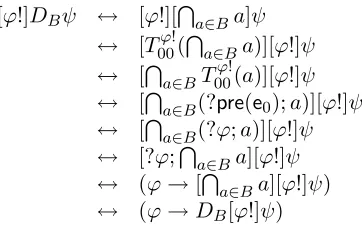
amongB, can be derived as follows:
[ϕ!]DBψ ↔ [ϕ!][a∈Ba]ψ
↔ [T00ϕ!(a∈Ba)][ϕ!]ψ
↔ [a∈BT00ϕ!(a)][ϕ!]ψ
↔ [a∈B(?pre(e0);a)][ϕ!]ψ
↔ [a∈B(?ϕ;a)][ϕ!]ψ
↔ [?ϕ;a∈Ba][ϕ!]ψ
↔ (ϕ→[a∈Ba][ϕ!]ψ)
↔ (ϕ→DB[ϕ!]ψ)
As was already conjectured in [42], this reduction axiom is just like the fa-miliar reduction axiom for individual knowledge: [ϕ!][a]ψ↔(ϕ→[a][ϕ!]ψ).
Private messages to subgroups. A private message to subgroupGthat
ϕis the case is represented by an update model consisting of two eventse0 ande1 with precondition ϕand, respectively. Intuitively, e0 is the actual event, whereas e1 is the event “nothing happens”. Agents in G know that
e0 is taking place, while all the other agents think that nothing happens.
e0 e1
G
A\G
A
ϕ