A Problem Based/Experiential Learning
Approach to Teaching Maintenance
Engineering
Yasir M. Al-Abdeli and Frank Bullen
School of Engineering, University of Tasmania, Hobart, TAS 7001, Australia
1. Abstract
Good maintenance practice lies at the heart of a manufacturing industry being able to retain its production capabilities and to ensure the integrity of increasingly complex systems.
Consequences of system failure can exceed mere monetary penalties to include the well being of staff. From an engineering education perspective, rapid development in technology in parallel with the evolution of traditional engineering disciplines, necessitates the utilization of innovative ways to teach non-traditional or interdisciplinary topics like maintenance. Another challenge in this context, is the ability to allocate time and physical resources in ever more condensed engineering curricula whilst making the learning process engaging for students.
This paper details a recent trial to teach a short undergraduate course on maintenance within a mechanical engineering degree where students also look at some safety considerations
associated with maintenance practice. A combined Problem Based Learning/Experiential Learning approach applied to machine tool maintenance was adopted using resources readily available in most engineering schools.
2. Introduction
Maintenance has a significant influence on the success of modern day manufacturing1, 2. In recent years, some research has noted that
‘the next major revolution in industrial productivity will be the result of preventive
maintenance in manufacturing facilities’3.
Whilst the incorporation of maintenance education has been recognized through some (postgraduate) engineering programs4 and professional development courses, there remains a need for some inclusion of maintenance via (undergraduate) engineering curricula3, 5. The reasoning behind this is that most graduate engineers will not go onto postgraduate study but will move directly into the profession. It is here that new engineers will need some basics to relate to while they are provided with professional training. Recognizing the roles that
including some degree of safety consideration into undergraduate engineering coursework9, 10, this is not always possible due to limited curricula space11. One way to address this ‘space’ challenge is through the infusion of OHS coverage within existing curricula12.
The present investigation outlines a teaching approach using PBL and EL applied to a short course on maintenance engineering, in a manufacturing setting. In the case study discussed, students are also required to (actively) demonstrate and integrate elements of OHS in their maintenance reports.
3. Course Setting
‘Manufacturing, Maintenance and Quality’ (KNE353) is a thirteen-week Unit of Study (UoS) taught at the University of Tasmania in the 3rd year of its mechanical engineering degree. The UoS builds on 1st year basic (hands-on) Workshop Practice and leads into Advanced
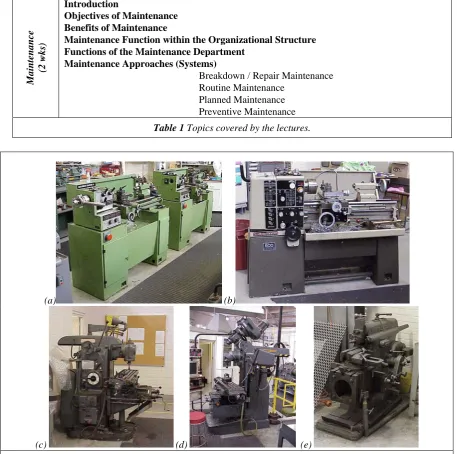
Manufacturing in 4th year. The maintenance component covers about two weeks of class hours, some of which is also allocated to out-of class reading. Table 1 shows an outline of the topics covered by the lectures. During this theoretical coverage students are also introduced to some practical aspects relevant to routine machine tool maintenance. After this coverage on basic maintenance concepts, students are then provided with a case study based assignment of approximately three weeks duration.
4. The Case Study
It is extremely challenging to convey the experiential aspects of maintenance planning using lecture notes alone to undergraduate students with little or no industrial experience. This situation is not encountered in professional development courses or even postgraduate coursework (on maintenance) since most attendees would have some prior professional experience. The content of any undergraduate work on maintenance should be familiar to students both in their workplace (environment) and available machinery. This setting allows for improved learning through PBL and EL. This must all be balanced with time table
allocations (study hours) and the availability of maintenance related resources. In this regard, the topic of machine tool / workshop maintenance represents a good learning platform since most engineering schools include a mechanical workshop. Students in mechanical
engineering disciplines also (traditionally) undergo use of basic machine tools in 1st or 2nd years which imparts some degree of familiarization.
Six machine tools were selected within the mechanical workshop for the ‘routine
• Inspection Service: This includes checks on overall machine integrity (e.g., drive belts and safety interlocks on removable covers). Inspection services could also extend to include quizzing the machinist over any concerns regarding the machine. Inspections had to be done on a fortnightly basis and cover no more than 4 hours on a single day. This was to limit machine downtime during visits by maintenance crews.
• Lubrication Service: An operation dedicated to lubrication (e.g., slideways and
headstock gearbox) was also needed. This could be done on all six machines once a fortnight (if necessary). Time constraints stipulated that the maintenance crews could only spend 4 hours on each of two consecutive days to cover all machines.
• Additional tasks: If the maintenance crews had any spare time available during
the inspection or lubrication services, additional tasks could also be bundled with these two services (e.g., disassembly of lathe chucks and cleaning-out chips).
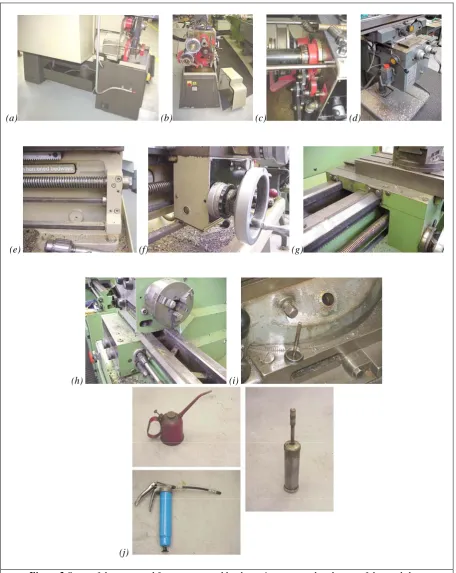
Students had the option of deciding whether the lubrication and inspection services should be done on three consecutive days or staggered across different weeks (done in tandem). There were also additional challenges since some machine tool manuals recommended the use of unavailable commercial oils/greases and so equivalent materials needed to be specified. The fact that each machine was supplied with only one copy of manuals also meant that these manuals could only be borrowed on a limited basis. To facilitate site access, multiple tours of the workshop were conducted to allow students to familiarize themselves with relevant parts on the machines. Figure 2 presents some machine parts and tools highlighted during
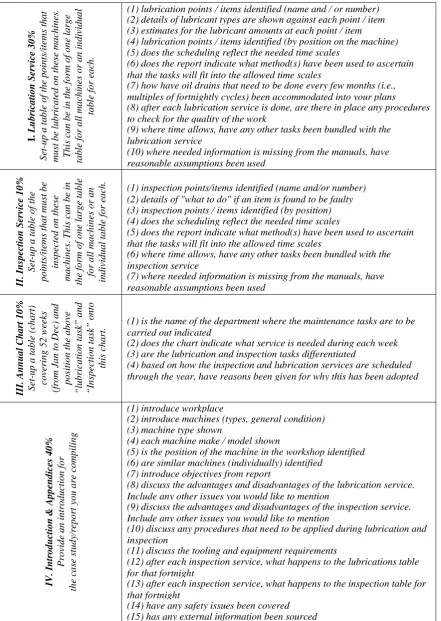
workshop tours. To assist the students with their project work and identify (later) assessment criteria, a clear set of guidelines was drafted. These guidelines are shown in Table 2 and indicate five main considerations (Table 2, left column) of content and assessment. Additionally, to increase the level of detail in the work required, several contributing
(individual) indicators (Table 2, left column) were listed under each of the five main
considerations. This open ended, but detailed, approach of ‘what to do’ allowed students to converge towards their goals.
The final maintenance schedules drafted also had to consider the following:
• Planning: The setting up of a 52 week (annual) chart to cover the whole
maintenance schedule where the lubrication and inspection services for each machine are clearly indicated for planning purposes.
• Execution: The preparation of fortnightly servicing sheets to cover the inspection
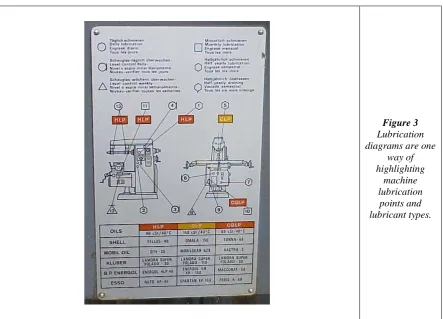
and lubrication services required. Adequate inclusion of instructions to maintenance crews was required to ensure that all points/components on the machines were covered. This could be done, for example, using a combination of tabular and graphical format. One way of achieving this is through the use of lubrication diagrams. As indicated in Figure 3, these diagrams show the various lubrication points along with the types of lubricants needed. Students were encouraged to allocate approximate time scales for all servicing tasks to meet specified time limitations.
• Material Selection: Identification of lubricant and grease types used at different
points on machines, with indications of quantity. This would allow the estimation of annual lubrication needs and stock (e.g., how many litres of oil in the headstock gearbox).
• Tooling and Equipment Requirements: Listing of all tools and equipment
• Administrative: Procedures to follow up the quality of the tasks performed and what happens to the completed servicing sheets. Other considerations were any administrative actions (to be initiated by the inspection service/crews) when faulty parts/machines are identified?
• Safety: Consideration of OHS issues such as the specification of any protective
wear needed during maintenance and the inclusion of Material Safety Data Sheets (MSDS) for lubricants and greases.
• Writing Skills: A final group report to present the case study and maintenance
schedule.
The scope of work required in the case study was also intended to promote multi-layered learning (at individual as well as team level). This was accomplished through dividing
students into 12 maintenance planning ‘teams’ (of about 5-6 students per team) and voluntary team ‘leaders’. For this reason, the number of machines covered in the maintenance schedule was selected such that each team member had the opportunity to work on at least one
machine. However, because a single maintenance scheme covering all machines was required, all maintenance team members still needed to effectively communicate and integrate their works to achieve the overall task, thereby promoting teamwork and communication skills.
5. Outcomes & Discussion
PBL and EL approaches have often been used to link hands-on activities to abstract
conceptualization7. In this case study they have been applied to a short maintenance course for undergraduates. These approaches have encouraged students to plan realistic maintenance activities and simultaneously link those activities to theory and real life engineering practices.
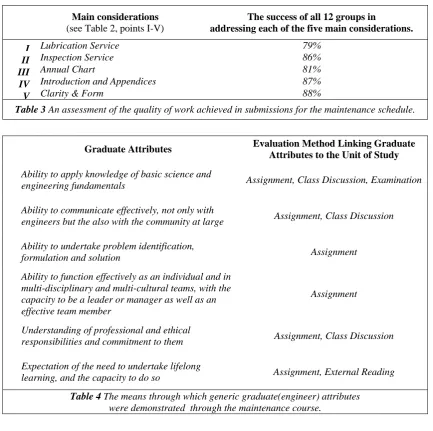
Table 3 presents indicative statistics summarizing the rates of success in applying the
requirements set out in the devised maintenance schedule. To derive these numeric measures, the proportion of maintenance teams (12 in all) addressing each contributing (individual)
indicator (Table 2) is first assessed. This process results in a single (percentile) score for each
contributing (individual) indicator. The scores of achievement under each one of the five
main considerations are then averaged together to yield a (single) representative percentile
score (indicated in Table 3). These quantitative results indicate a relatively high level of achievement across the requirements of this case study.
From a qualitative perspective, the data in Table 4 shows how the maintenance course
(overall) was able to address some of the graduate attributes espoused by Engineers Australia as being relevant to today’s engineering practice. In this regard, it is believed that a range of characteristics inherent in the teaching approach adopted contributed to this level of
achievement. These factors may be summarized as:
• Appreciation of the subject matter using a two step approach: initial
introduction to the basic principles of engineering maintenance followed by a detailed (hands-on) case study concentrating on routine maintenance.
• Enhancement of personal and interpersonal skills through: the designation of
virtual 'maintenance teams' and the allocation of multiple machines (to each team) also meant that individual members (preferentially) specialized in a single
• Ability to analyze, plan and solve solutions to engineering problems through:
the use of open ended, detailed, but guided nature of tasks.
• Appreciation of wider responsibilities through: the inclusion of some OHS
considerations.
• Willingness to undertake the initiative to collate relevant information: as
evidenced by the need to source MSDS sheets for applicable or equivalent lubricating products.
6. Conclusions
A PBL/EL approach has been applied to a short course on maintenance for mechanical engineering undergraduates. The teaching method applied facilitated the compilation of the required routine maintenance schedule by canvassing a range of considerations. This resulted in an apparent improvement of student learning as indicated by summative assessments and anecdotal evidence via student study surveys. This success has been attributed to the students’ experiences in planning maintenance activities and generalizing those activities through the theory given during formal lectures. While the exercise was very time demanding on teaching staff, the benefits accruing to students through development of new learning styles and skills mean that the approach will very likely be continued into the future.
7. Acknowledgements
The assistance of workshop staff, particularly Ray LeFevre, in facilitating success of the practical part of this study is acknowledged.
8. References
1 McCullough, L., “Centering on Maintenance”, ASEE Prism, Vol. 7, 1998, pg. 32.
2 Yamashina, H., “Japanese Manufacturing Strategy and the Role of Total Productive Maintenance”, J. Quality in Maintenance Engineering, Vol. 1, 1995, pg. 27.
3 Nachlas, J. A. and Cassady, C. R., “Preventive Maintenance Study: A Key Component in Engineering Education to Enhance Industrial Productivity and Competitiveness”, European J. of Engineering Education, Vol. 24, 1999, pp. 299-309.
4 Knezevic, J., “Industry Driven Postgraduate Maintenance Education”, J. Quality in Maintenance Engineering, Vol. 3, 1997, pg. 302.
5 Inozu, B. and Ayyub, B. M., “Reliability, Maintenance and Risk Assessment in Naval Architecture and Marine Engineering Education in the US”, European J. of Engineering Education, Vol. 24, 1999, pp. 333-338.
6 Stouffer, W. B., Russell, J. S. and Olivia, M. G., “Making the Strange Familiar: Creativity and the Future of Engineering Education”, Proc. 2004 American Society for Engineering Education (ASEE) Annual Conference & Exposition, Utah (USA), 2004 (session 1615).
7 Lesko, J., Duke, J., Holzer, S. and Auchey, F., "Hands-on-Statics Integration into an Engineering Mechanics-Statics Course: Development and Scaling", Proc. 1999 American Society for Engineering Education (ASEE) Annual Conference & Exposition, Charlotte, NC (USA), 1999 (session 1368). 8 Bignell, V., “Methods and Case Studies for Teaching and Learning about Failure and Safety”,
European J. of Engineering Education, Vol. 24, 1999, pp. 311-321.
9 Bethea, R. M., “Engineers Encourage Universities to Emphasize Safety in Curriculum”, Occupational Health and Safety, Vol. 61, 1992, pp. 22-25.
10 Bryan, L. A., “Educating Engineers on Safety”, J. Management in Engineering, Vol. 15, 1999, pp. 30-33.
12 Murphy, D. L., “Building Safety Education into Engineering Curriculum”, Proc. 2004 American Society for Engineering Education (ASEE) Annual Conference & Exposition, Utah (USA), 2004 (session 1648).
YASIR AL-ABDELI holds a PhD from The University of Sydney (Turbulent Swirling Flames and Isothermal
Flows, 2004) in addition to MSc (Production Eng, 1994) and BSc (Production Eng, 1990) degrees from the University of Technology (Baghdad). Yasir has been teaching since 1994 across both mechanical and manufacturing engineering and has supervised undergraduate theses on machine tool maintenance.
FRANK BULLEN is Professor and Head of Engineering at the University of Tasmania. He has over 25 years
experience in teaching engineering, has lectured and practiced in 3 universities, 5 countries and has an extensive international and national publication record. His enthusiasm for teaching is centred around problem based learning and encouraging staff to be innovative and daring in their teaching.
Introduction
Objectives of Maintenance Benefits of Maintenance
Maintenance Function within the Organizational Structure Functions of the Maintenance Department
Maintenance Approaches (Systems)
Breakdown / Repair Maintenance Routine Maintenance
Planned Maintenance
M
a
intenance (2 wks
)
[image:6.595.65.523.269.723.2]Preventive Maintenance
Table 1 Topics covered by the lectures.
(a) (b)
(c) (d) (e)
(a) (b) (c) (d)
(e) (f) (g)
(h) (i)
[image:7.595.65.522.82.656.2](j)
Figure 2 Some of the parts and features covered by the maintenance related tours of the workshop. Concepts explained: (a) inspection of belts, (b) need to switch off machines before covers are taken off, (c)
safety interlocks need to be inspected and filling/emptying points in the headstock were shown, (d) some machines included hand-operated pumps to deliver lubricating oil to selected machine parts, (e) lubrication of lead screw supports and the feed rod, (f) monitoring point for apron (gearbox) oil level and the hand pump used to lubricate the carriage slideways, (g) inspection of slideways and wear on chip guards, (h) monitoring
point for headstock (gearbox) oil level and points where the oil for the feedbox could be replenished and drained, (i) an oil level dipstick and filling point on a milling machine knee and (j) tools used for lubricating
Figure 3 Lubrication diagrams are one
way of highlighting
machine lubrication
(1) lubrication points / items identified (name and / or number) (2) details of lubricant types are shown against each point / item (3) estimates for the lubricant amounts at each point / item
(4) lubrication points / items identified (by position on the machine) (5) does the scheduling reflect the needed time scales
(6) does the report indicate what method(s) have been used to ascertain that the tasks will fit into the allowed time scales
(7) how have oil drains that need to be done every few months (i.e., multiples of fortnightly cycles) been accommodated into your plans
(8) after each lubrication service is done, are there in place any procedures to check for the quality of the work
(9) where time allows, have any other tasks been bundled with the lubrication service I. Lub rica tio n Service 30 % S et-u p a tab le o f th e po in ts/items t h a t mu st b e lub rica ted on th ese ma ch in es. Th is can b e in th e fo rm o f o n e la rg e tabl e fo r al l m a chi n
es or a
n i ndi vi d u a l
table for e
a
ch.
(10) where needed information is missing from the manuals, have reasonable assumptions been used
(1) inspection points/items identified (name and/or number) (2) details of "what to do" if an item is found to be faulty (3) inspection points / items identified (by position) (4) does the scheduling reflect the needed time scales
(5) does the report indicate what method(s) have been used to ascertain that the tasks will fit into the allowed time scales
(6) where time allows, have any other tasks been bundled with the inspection service II. In spection Service 10% Set -up a t a bl e of t h e p o in ts/items tha t mu st b e inspecte d on these ma ch in es. Th is can b e in th e fo rm o f o n e la rg e tab le fo r a ll ma ch in es o r an indi vi d ual t a bl e f o r e a ch .
(7) where needed information is missing from the manuals, have reasonable assumptions been used
(1) is the name of the department where the maintenance tasks are to be carried out indicated
(2) does the chart indicate what service is needed during each week (3) are the lubrication and inspection tasks differentiated
(4) based on how the inspection and lubrication services are scheduled through the year, have reasons been given for why this has been adopted
III. An nu al Chart 10% Set -up a t a bl e ( cha rt ) covering 52 we eks (f ro m J a n t o D ec) an d p o sition t h e a b o ve “lu b rica tion task” and “Insp ection t a sk” on to th is cha rt.
(1) introduce workplace
(2) introduce machines (types, general condition) (3) machine type shown
(4) each machine make / model shown
(5) is the position of the machine in the workshop identified (6) are similar machines (individually) identified
(7) introduce objectives from report
(8) discuss the advantages and disadvantages of the lubrication service. Include any other issues you would like to mention
(9) discuss the advantages and disadvantages of the inspection service. Include any other issues you would like to mention
(10) discuss any procedures that need to be applied during lubrication and inspection
(11) discuss the tooling and equipment requirements
(12) after each inspection service, what happens to the lubrications table for that fortnight
(13) after each inspection service, what happens to the inspection table for that fortnight
(14) have any safety issues been covered
IV. Intr oduction & A ppe ndi ces 40% Pro vid e an i n tro d u ction for th
e case stud
y/ repo rt you a re co mp ilin g
(15) has any external information been sourced
(1) is the information easily understood
(2) can the information needed be quickly appreciated
V. Cla rity & For m 10 %
[image:9.595.66.508.73.695.2]Main considerations
(see Table 2, points I-V)
The success of all 12 groups in
addressing each of the five main considerations.
I Lubrication Service 79%
II Inspection Service 86%
III Annual Chart 81%
IV Introduction and Appendices 87%
[image:10.595.82.516.82.513.2]V Clarity & Form 88%
Table 3 An assessment of the quality of work achieved in submissions for the maintenance schedule.
Graduate Attributes Evaluation Method Linking Graduate
Attributes to the Unit of Study
Ability to apply knowledge of basic science and
engineering fundamentals Assignment, Class Discussion, Examination Ability to communicate effectively, not only with
engineers but the also with the community at large Assignment, Class Discussion Ability to undertake problem identification,
formulation and solution Assignment
Ability to function effectively as an individual and in multi-disciplinary and multi-cultural teams, with the capacity to be a leader or manager as well as an effective team member
Assignment
Understanding of professional and ethical
responsibilities and commitment to them Assignment, Class Discussion Expectation of the need to undertake lifelong
[image:10.595.89.513.87.183.2]learning, and the capacity to do so Assignment, External Reading Table 4 The means through which generic graduate(engineer) attributes