LADDER GAME ON KNOWLEDGE AND PRACTICE
REGARDING HEALTHY HABITS AMONG
SCHOOL CHILDREN IN SELECTED
SCHOOL IN COIMBATORE
By
Reg. No: 301216101
A DISSERTATION SUBMITTED TO THE TAMIL NADU
Dr. M. G. R. MEDICAL UNIVERSITY, CHENNAI IN
PARTIAL FULFILLMENT OF REQUIREMENT
FOR THE DEGREE OF MASTER OF
SCIENCE IN NURSING
LADDER GAME ON KNOWLEDGE AND PRACTICE
REGARDING HEALTHY HABITS AMONG
SCHOOL CHILDREN IN SELECTED
SCHOOL IN COIMBATORE
By
Reg. No: 301216101
Approved by
_______________
_______________
EXTERNAL
INTERNAL
A DISSERTATION SUBMITTED TO THE TAMIL NADU
Dr. M. G. R. MEDICAL UNIVERSITY, CHENNAI IN
PARTIAL FULFILLMENT OF REQUIREMENT
FOR THE DEGREE OF MASTER OF
SCIENCE IN NURSING
LADDER GAME ON KNOWLEDGE AND PRACTICE
REGARDING HEALTHY HABITS AMONG
SCHOOL CHILDREN IN SELECTED
SCHOOL IN COIMBATORE
CERTIFIED THAT THIS IS THE BONAFIDE WORK OF
Reg. No: 301216101
PPG College of Nursing
Coimbatore
SIGNATURE :
________________________ COLLEGE SEAL
Dr. P. MUTHULAKSHMI, M.Sc(N)., M.Phil., Ph.D.,
Principal,
PPG College of Nursing,
Coimbatore - 35.
A DISSERTATION SUBMITTED TO THE TAMIL NADU
Dr. M. G. R. MEDICAL UNIVERSITY, CHENNAI IN
PARTIAL FULFILLMENT OF REQUIREMENT
FOR THE DEGREE OF MASTER OF
SCIENCE IN NURSING
LADDER GAME ON KNOWLEDGE AND PRACTICE
REGARDING HEALTHY HABITS AMONG
SCHOOL CHILDREN IN SELECTED
SCHOOL IN COIMBATORE
APPROVED BY THE DISSERTATION COMMITTEE ON MARCH 2013
RESEARCH GUIDE :
Dr. P. MUTHULAKSHMI, M.Sc (N)., M.Phil, Ph.D.,
Principal,
PPG College of Nursing, Coimbatore - 35.
SUBJECT GUIDE :
Prof. K. JEYABARATHI, M.Sc(N)., Ph.D,
HOD, Department of Child Health Nursing, PPG College of Nursing,
Coimbatore - 35.
MEDICAL GUIDE :
Dr. THIRUVALLUVA THENDRAL,M.B.B.S.,M.D,
Consultant Pediatrician, Coimbatore.
A DISSERTATION SUBMITTED TO THE TAMIL NADU
Dr. M. G. R. MEDICAL UNIVERSITY, CHENNAI IN
PARTIAL FULFILLMENT OF REQUIREMENT
FOR THE DEGREE OF MASTER OF
SCIENCE IN NURSING
Dedicated to
Almighty God,
Lovable Wife,
Parents, Sister,
Relatives, Friends
With heartfelt thanks to Lord Almighty for his abiding elegance, love, compassion and immense deluges of blessings on me, which gave me the strength and courage to overcome all difficulties and whose salutary benison enabled me to achieve this target.
I sincerely acknowledge my indebtedness to my wife Mrs. Kalludas, my parents
Mr. P. Vipinachandran, Mrs. Shani. K, my sister Mrs.Panchami, my brother in law
Mr. Manu. S.S, Relatives and Friends for their love, sustenance, entreaty, encouragement and help throughout my study.
I extend my deep sagacity of gratitude uncut heartedly to
Dr. L. P. Thangavelu, M.S., F.R.C.S., Chairman and Mrs. Shanthi Thangavelu, M.A., Correspondent P.P.G Group of Institutions, Coimbatore, who abetted me in making the project a great triumph.
sustenance of Prof. K. Jeyabarathi, M.Sc(N)., Ph.D, HOD, Child Health Nursing. If not my guide, the present study would have squandered much of its existence and affluence. Her ardent support, cherished guidance, alleged provoking stimulation, timely help, relentless encouragement, valuable suggestions and constrictive evaluation have enabled me to contour up this research as a pedestrian contribution to the field.
I express my sincere thanks to Dr. THIRUVALLUVA THENDRAL, M.B.B.S., M.D, Consultant Pediatrician, for his relentless support, treasured suggestions and guidance.
I express my sincere thanks to Mrs. D. Revathy Selvaraj, Head Mistress, Government Primary School, Kalapatti, Coimbatore, for her support to conduct the study in school, suggestions in research and tremendous co-operation for completing my work successfully.
I extend my sincere thanks to Prof. B. Rajalakshmi, M.Sc(N)., Ph.D, Prof. L. Kalaivani, M.Sc(N)., Ph.D, and all other Faculty Members of P.P.G College of Nursing.
It is my long felt desire to express thanks to Mrs. Manibharathi, M.Sc(N)., Ph.D, Mrs. Seema Maheswari, M.Sc(N)., and Mrs. Blessy Pramila, M.Sc(N).,
help in research and biostatistics without which the course of work would have been futile.
My truthful thanks to all the Experts who have done the content validity and valuable suggestions in the modification of tool.
I protracted my thanks to the Dissertation Committee Members for their healthy condemnation, compassionate suggestions which molded the research.
I would like to thank The Library Staffs for extending help in research for the reference material for the study.
I express my thanks to Mr. N. Sivakumar of Nawal Comtech Solutions,
Saravanampatti, Coimbatore for his serenity and timely co-operation in typing and aligning the manuscript.
I extended my thanks to all The Participants in the study.
My fondest thanks are expressed from my heart to my Dear Most Colleagues
CHAPTER CONTENTS PAGE No.
I INTRODUCTION
Need for the Study
Statement of the Problem
Objectives Hypothesis Operational Definitions Assumptions 1 3 7 7 7 8 9
II REVIEW OF LITERATURE
Conceptual Frame Work
10
20
III METHODOLOGY
Research Approach
Research Design
Setting of the Study
Variables
Population
Sample Size
Sampling Technique
Criteria for Selection of Samples
Description of the Tool
Testing of the Tool
Pilot Study
Data Collection Procedure
Plan for Data Analysis
CHAPTER CONTENTS PAGE No.
IV DATA ANALYSIS AND INTERPRETATION 30
V RESULTS AND DISCUSSION 60
VI SUMMARY, CONCLUSION,
NURSING IMPLICATIONS, LIMITATIONS AND
RECOMMENDATIONS
63
REFERENCES
ABSTRACT
S.No. CONTENT PAGE No.
1. Distribution of Demographic Variables of the School Children 31
2. Distribution of Statistical Value of Pretest and Post Test
Knowledge on Healthy Habits Among School Children
50
3. Distribution of Statistical Value of Pretest and Post Test
Practice on Healthy Habits Among School Children
52
4. Association of Selected Demographic Variables with Pretest
Score of Knowledge on Healthy Habits Among School
Children
54
5. Association of Selected Demographic Variables with Pretest
Score of Practice on Healthy Habits Among School Children
S. No. CONTENTS PAGE No.
1. Modified Conceptual Frame Work Based on Von Bertalanffy
General System Model (1968)
22
2. The Schematic Representation of the Research Design 23
3. The Schematic Representation of the Variables 24
4. The Overall View of Research Methodology 29
5. Distribution of Demographic Variables According to the Age 36
6. Distribution of Demographic Variables According to Sex 37
7. Distribution of Demographic Variables According to
Education
38
8. Distribution of Demographic Variables According to Religion 39
9. Distribution of Demographic Variables According to
Education of Father
40
10. Distribution of Demographic Variables According to
Education of Mother
41
11. Distribution of Demographic Variables According to
Occupation of Father
42
12. Distribution of Demographic Variables According to Family
Income
43
13. Distribution of Demographic Variables According to Number
of Children
44
14. Distribution of Demographic Variables According to Birth
Order
S. No. CONTENTS PAGE No.
15. Distribution of Demographic Variables According to Area of
Residence
46
16. Distribution of Demographic Variables According to Type of
Family
47
17. Distribution of Demographic Variables According to Water
Supply
48
18. Distribution of Demographic Variables According to
Sanitation
49
19. Distribution of Pretest and Post Test Knowledge Values on
Healthy Habits Among School Children
51
20. Distribution of Pretest and Post Test Practice Values on
Healthy Habits Among School Children
APPENDIX
TITLE
1. Letter seeking permission for conducting the study
2. Letter seeking permission from Experts for content validity of the
tool
3. Format for the content validity
4. Questionnaire
English
Tamil
5. Health Education
English
Tamil
LADDER GAME ON KNOWLEDGE AND PRACTICE
REGARDING HEALTHY HABITS AMONG
SCHOOL CHILDREN IN SELECTED
CHAPTER - I
Introduction
Healthy Child; Healthy Nation; Healthy World
- WHO (2009)
A child is precious not only to the parents, to the family, community and nation but also to the world and thus it becomes the responsibility of the wide population of the whole universe to look after the interest of the children all over. Children are the asset of our country.
Hygiene is the science of health and its maintenance. It is highly personal determined by individual values and practices. Hygiene status of children is an index of national investment in the development of its man power. It is influenced by social, familial and individual factors as well as the children‟s knowledge of health on
personal hygiene, comfort and basic needs, characteristics associated with child such as their natural and lack of knowledge are aggregating factors (UNICEF, 2009).
India is the second most populous country in the world, with over 1.21 billion people. The children age 0-15 yrs constitute about 31.1% (Male 190,075,426 and Female 172, 799,553) about 15% consist of school going children (Government of India Census, 2011).
exclusion in other hand, Disease are leading by unhygienic and the families are almost unbearable, especially in the rural areas. It has been estimated that 0.02% of children has proper hygienic practices among 180 children.
Vankoppen (2010) explained that the children are eager to learn and schools are important places of learning for children. Promotion of personal hygiene and sanitation in schools therefore help the students to adopt good hygiene and habits during their childhood. Children learn in school they can and often do pass on in their families and communities.
Hockenberry and Wilson (2011) defined that a safe home, safe road and freedom from violence constitute fundamental rights for every child and referred to as school age or school years. This period begins with entrance in to the school environment, which has significance on development and relationship.
Life is a bit like the game of snakes and ladders, you would agree. Self defeating habits or beliefs are snakes those take you down, whereas the self-empowering ones are ladders those take you up. But in life, it‟s not the throw of the dice that determines your movement and it‟s your conscious choices (Compwel,
2011).
from each other regarding daily life activities which are oriented hygiene practices (WHO, 2010).
The personal hygiene habits developed by child can be taught in a fun way. Make up games to see if the child can remember what steps are needed to accomplish a specific hygiene goal. Use creativity and imagination to help the child to maintain an interest in personal hygiene. Charts, graphs, humor, stickers, puppets, games or songs are some ideas are used to motivate child. Be careful not to make personal hygiene too much work for child. Keep it light and fun as the child transitions in to owning these habits for life time (Renate and Van Wijk, 2010).
The utility of games is as a teaching strategy of health professional. There is a need of additional high quality research to explore the impact of educational games on patients and performance outcome (Sacket. K and Fiander. M, 2013).
Need for the Study
The health of children is a vital importance of all societies because children are basic sources of the future of mankind. Today the trend has changed and the nature of care of children is based on their developmental needs. Now children‟s care
is more children centered (UNICEF, 2011).
international organizations such as UNICEF. Through this effort make the development of knowledge, attitudes, values and the life skills needed to make appropriate decisions and act up on them.
Arno Halberger (2010) stated that school going period is a relatively safe period from health point of view. However supervision of health of school children is important. Sound health and its care picked up during these years have a great bearing in the individuals, his family and community for years to come.
National Wide Survey (2011) on health status of school children in India by WHO, revealed that the evidence of morbidity was found 52.85% in boys and 67.4% in girls. “Cleanliness is next to godliness” keeping one‟s body clean is an important part of keeping oneself healthy and helping one feel good. Caring about the way one looks in important to one‟s self esteem. Motivation for personal hygiene practices
among children can cause reduction in personal illness. This can be done mainly through schools by educating and reinforcing students regarding personal health and hygienic practices such as hand washing, proper brushing and flossing of teeth, personal grooming etc., (Dili and Timor Leste UN Volunteers, 2011).
Henderson (2010) defined that part of the nurses role is to improve the patient level of understanding and there by promote health. The nurse as teacher should identify the needs by asking questions and determining the variables, affecting the hygienic needs of the children.
Integrated Research Care (2009) had cooperated with school sanitation and hygiene, through life skills based education, it focuses on the development of knowledge, attitudes and practices that support children in taking a greater responsibility for their own lives. It helps the children to acquire and practice good health behaviors along with knowledge and attitudes.
Andrew Watkins (2013) stated that personal hygiene is a very important factor for healthy life. Young children need to bath regularly. Frequency of bath depends upon the each child individual needs. Tooth brushing should be integrated into the morning and bed time routine to avoid periodontal diseases and dental caries. If they don‟t wash their hands, skin, mouth, hair, nails and foot frequently there is a strong
chance of getting infection to themselves and to others. Some infectious diseases which spread through poor hygiene are common cold, flu, and gastrointestinal diseases. However good hygiene teaches them to understand the importance of personal hygiene and to take care of their body from health hazards such as diarrhea, dysentery, intestinal worm infestation of lice and skin disease.
collected by school examination. The results showed 45.5% (91 cases) prevalence of Ascaris lumbricoides, less than 8 % (16 cases) of enterobious vermicularis, less than 3% (7 cases) of whip worm, and less than 7% (3 cases) prevalence of tape worm. The researcher concluded that there was a high percent of primary school children in need of health education on promotion of personal hygiene and possibly mass treatment.
UNESCO (2011) conducted a pilot study project in “games and other experimental activities for the teaching of science of children”. Toys and games are
synonymous with play. Almost every one like to play and such a desire continues throughout an individual‟s life. Psychologist says that play is not just a filling in of an
empty period or just a relaxation of leisure activity, but it is an important learning experience.
Pavani Rinhart (2013) explained that snake and ladder is a popular broad game for children in many countries of the world. It is easy to make from the basic material and can be adopted to suit many learning situation. Snake and ladder can assist in developing basic arithmetic‟s such as counting, addition, and subtraction,
communication etc. Snake and ladder can be used to teach the healthy habits, growth and development, nutrition, personal hygiene, sex education etc.
researcher to do a study to assess the effectiveness of snake and ladder game on knowledge and practice regarding healthy habits among school children in selected school in Coimbatore.
Statement of the Problem
A study to assess the effectiveness of snake and ladder game on knowledge and practice regarding healthy habits among school children in selected school at Coimbatore.
Objectives
To assess the knowledge and practice regarding healthy habits among school
children.
To provide snake and ladder game on healthy habits among school children. To assess the effectiveness of snake and ladder game on knowledge and
practice regarding healthy habits among school children.
To find out the association between the knowledge and practice regarding
healthy habits with selected demographic variables.
Hypothesis
H1: There is a significant difference between pre and post test knowledge score regarding healthy habits among school children.
Operational Definitions Assess
The act of estimation of knowledge regarding healthy habits by structured pretest questionnaire.
Effectiveness
It refers to producing the intended result. In this study, it refers to the extent to which the snake and ladder game has achieved the desired effect in improving knowledge on healthy habits among school children.
Snake and Ladder Game
Snake and ladder game is a broad game where up to six players compete to reach the square first. In this study it refers to a game used for educating the school children about healthy habits.
Healthy Habits
A behavior that is beneficial to one‟s physical or mental health, including
personal hygiene, nutrition, sleep and rest, often linked to a high level of discipline and self control.
Knowledge
Practice
It refers to the activities which execute in daily living.
School Children
The children of 7 – 12 years old, who are studying in 2nd to 4th standard of government primary school, Kalapatti.
Assumption
School children have inadequate knowledge about healthy habits.
Snake and ladder game on healthy habits enhances the knowledge and practice
CHAPTER - II
Review of Literature
The review of literature is a broad, comprehensive, in depth systematic and critical review of scholarly publications, unpublished scholarly printed materials, audio visual materials and personal communication.
A literature review is a written summary of the state of existing knowledge on a research problem. The task of reviewing research involves the identification, selection, critical analysis and written description of existing information on a topic (Polit and Hungler, 2009).
The review of literature entails systematic identification, selection and critical analysis and reporting of existing information in relation to the problem of interest.
The Review of Literature in this Study is Organized Under the Following Headings
Literature related to healthy habits and its importance. Literature related to care of various aspects in healthy habits. Literature related to effectiveness of game method on children. Literature related to snake and ladder game.
Literature Related to Healthy Habits and its Importance
problems due to lack of healthy habits and hygiene when compared with urban school children and it was about 5.3% higher than urban school children.
Park (2009) stated that healthy practices and hygiene aims to promote standards of personal cleanliness within the setting of the condition where people live. Training of healthy practices should begin at a very early age and must be carried through school age.
Awate (2010) conducted a study on improvement of school sanitation, personal hygiene status of children dictation, modification and strengthening school health services, and awareness building is the key strategies recommended.
Naresh (2010) conducted an experimental study on the impact of school health education program on personal hygiene and related morbidities in tribal school children of Wardha district Maharashtra. The sample of the study was 145 primary school children from 6-8 years. Data was collected using a structured knowledge questionnaire and health check up. Health education was done with flip books, demonstration activities and planned health education program sessions. Results showed that proportion of children with clean teeth increased from 33.8% to 50% and prevalence of dental decay reduced from 8% to 5%. The researcher concluded that the school education program improved personal hygiene and reduced related morbidities.
participants in a health promotion partnership project. A convenience sample of 161 urban middle school students has participated in the study. Finding from the study indicated that urban middle school students have a major interest in finding out more about hair care, and prevention of infection.
Bundy (2010) explained that due to poor personal hygiene between 25 to 35 percent of school age children are estimated to be infected with one or more of the major species of worm.
Study attempted to assess the impact of personal hygiene on the knowledge, attitude and practices of school children aged 8-14 years in two secondary schools situated in Burdvan, district of west Bengal. This result indicated that the health knowledge of the student significantly improved after education. The practice of personal hygiene improved significantly as well (Biswas, 2012).
Nutritional Foundation of India, New Delhi (2011) conducted a longitudinal study among 100 school children through a nutritional survey revealed that more than 70% of children were consuming less than 50% of RDA of micronutrients such as iron, vitamin A, folic acid and riboflavin. About 70% of school children suffer from anemia and 60% from vitamin deficiency. The study concluded the need of strengthening nutritional interventional programs enhancing the nutritional status of school children.
The Australian Children‟s Education and Care Quality Authority (ACECQA)
others initiating plays. Children always attempt to gain new skills and knowledge through play, allowing children to direct their own play and leisure experience with their peers creating possibilities for peer scaffolding.
Literature Related to Care of Various Aspects in Healthy Habits
Leug (2009) stated that Atopic dermatitis, a chronic inflammatory skin disorder that affects up to 20% of school aged children, can profoundly influence quality of life. Topical immuno-modulators (tacrolimus and pimecrolinurs) are beneficial and safe for adults and children are representing a major new alternative to improper skin care, especially in children.
Hemmincher (2011) conducted a study regarding the knowledge of skin care including knowledge of sun protection and acne among students of different grades, sexes, ages, ethnicities and races sought to examine whether the skin sun-acne tutorial, an hour long, long hands. In all, 1214 middle and high school students were taught, tested and surveyed. Outcomes were determined based on comparing performance on a pretest and post test. Results shows all students regardless of sex, ethnicity, age or race, improved significantly from their pretest to post test score (p< 0.001).This study only used one health educator and was restricted to public schools in central New Jercy.
mental, intellectual, social and emotional wellbeing and not merely the absence of disease or infirmity. Healthy children live in families, environment, and communities that provide them with the opportunity to reach fullest developmental potential. Children cannot achieve optimal health alone. They are dependent upon adults in their family and community to provide them with an environment in which they can learn and grow successfully.
UNICEF (2011) Conducted a study in Ethiopia found that less than one – third of school had water points and only 5% had hand washing facilities, none of which had soap. The low frequency of hand washing with soap (36.2%) may be attributed to the lack of soap in school and at home. Soap, water and latrines are essential for proper hygienic practices in schools, but previous studies have cited inadequate resources. A study conducted among Cambodian school children reported that only 7% of students had clean water and soap regularly at school.
Thakur (2010) conducted a study on hand washing techniques for the school children and the study revealed that the method of hand washing in after and before food, after playing and defecation had improved significantly from 14.3% and 4.7% in the baseline survey to 35.2%(p<0.001) and 16.2%(p<0.01) respectively.
prevalent among teenage children, and gingival and periodontal conditions are highly prevalent among children and adults.
Meinking (2013) stated that health authorities in USA, Canada and Australia recommended a “No Nit” policy it means the immediate dismissal of all children who have head lice, eggs or nits on their hair from school camp or child care setting. The no nit policy assumes that all nit seen when examining the scalp are viable and therefore the infested individual should be treated for lice, and all nits must be removed from the scalp. Accordingly in USA alone 4-8 million children‟s are treated unnecessarily for head lice annually, which amounts to 64% of all lice treatments. In addition 12-24 million school days are lost annually.
Altag (2009) stated that worm infestation was a major problem in children from developing countries due to bad feet care conditions it produces nutritional deficiencies and anemia in children, especially when hookworm infestation is present.
Barbara (2010) conducted a study on care of hair had revealed that the hair should be washed well with good soap, shampoo and warm water, after it should be rinsed well and very small amount of fresh pure oil may be applied, shampooing removes the dirt and prevent odour.
Swaminathan (2009) conducted a study and revealed that balanced diet for skin care must include carbohydrate, protein, fat, minerals, vitamins and yellow colored fruits and green leafy vegetables.
Joan Almon (2010) stated that “ability of play is one of the principal criteria of mental health”. In over 30 years of working with children, families and teachers of
Waldorf school all over the world, he had observed one consistent feature of childhood; creative play is a central activity in the lives of a healthy children. Play helps children weave together all the elements of life as they experience it. It allows them to digest life and make it their own.
Literature Related to Effectiveness of Game Method
Richard Blunt (2010) stated that health education of the school children is an important part in prevention of health problems. Though, health problems depend upon the geographical area and demographic aspects. Health problems are occurring due to lack of healthy habits and personal hygiene common among school children. Education is three fold process of imparting knowledge, developing skills and interest, attitude and life values.
Milos Milanovich (2013) with a view of making learning effectives as well as interesting, various Medias and materials should be used in schools. They should be less expensive and easily available. Education and entertainment can be well integrated through their use and children‟s learning can be joyful activity.
UNESCO (2010) stated that development of children and quality of their learning depends on a number of factors, including their own health status. Health promoting behavior inculcated by the school not only contributes in physical development and health care of students, its spin-off improves awareness about health issues among the parents and local community as well. Strong relationship between health of students and their learning had inspired planners and educators to hundred years ago in developed countries to launch health related interventions in schools. Gradually, developing countries are also realizing importance of school health programme for quality education and over health of the society, and are introducing its various components in their education systems.
Castillo (2010) explained games are an innovative and challenging educational method. They have long been used as a teaching strategy in both and adult education. They have been also used in teaching healthy habits, personal hygiene, nutrition, sex education in school children.
Children‟s Hygiene and Sanitation Training (CHAST) is an approach for
Literature Related to Snake and ladder games
Anand. M. K (2010) explained community health education is an important part of primary health care. Learning about how illnesses such as diarrhea are caused and what can be done to prevent them can help to improve community health. Community health education should build on local beliefs and practices and should use teaching methods and techniques which are actually appropriate and relevant. Many health workers don‟t have training in these. Another way of using visual images is with games. These could be either board games such as „snakes and ladders‟, or
pictures and games. Games are a good way to involve people in active learning which is always the most effective kind. Taking part in a game is far more interesting than listening to a talk and the messages are more likely to remember. The board game illustrated shows how certain practices will results in illness and other practices in health and growth.
Christina Maria (2011) conducted a study was to assess the effectiveness of snake and ladder game on ailments of children and the results revealed that regarding the existing knowledge of the children there was a lack of knowledge in all selected common ailments. Knowledge was highest in the areas of dental caries (13.3%) and the lowest in the area of worm infestation (42.5%). Regarding the effectiveness of snake and ladder on „knowledge of common ailments‟ it was found to be effective in
effective method of imparting information to the children regarding common ailments.
Haa Shitiq (2010) conducted a study, the snakes and ladders board game concept was chosen because it facilitates small group interactivity among learners. Twenty two multiple choice and true or false questions were developed from the material adapted from a nationally accreditated educational workshop, “changing dynamics of stroke prevention and management”. These questions were read and
discussed by each team of participants. Each game involved three teams (pairs) of physician, and one trained moderator who facilitated the game. Kept time and had the answers to the game‟s questions. At the conclusion of the CME session, and after
completing the immediate post test of knowledge, all but one of the participants completed the session - evaluation questionnaire. Game based participants more frequently choose “strongly agree” (5 on the 5 points scale) for many of the
statements. A higher proportion of game based versus case based participants strongly agreed that the event was enjoyable, that their attention was high throughout the event.
Kairoz (2012) conducted an experimental study to determine, the teaching of basic health concepts of school age children, the effectiveness of an educational strategy based on the traditional children games among children from 9-11 years old. The children were randomly divided into two groups. The children in group A used a modified version of a Mexican popular game “snakes and ladders” that included
Conceptual Framework
The conceptual model provides a certain frame of reference for clinical practice, research and education. The quality of the conceptual model comes from the organization. They provide for thinking for observations and for interpreting what is seen. They also give direction for relevant questions on phenomena, and point out solution to practical problems (Faweett, 1984).
Conceptual frame work used for this study is based on General System Theory. The basic concepts of general system theory were proposed in the 1950‟s.
One of its major proponents; Ludwig Von Bertalanffy (1980) introduced system theory as a universal theory that could be applied to many fields of nursing.
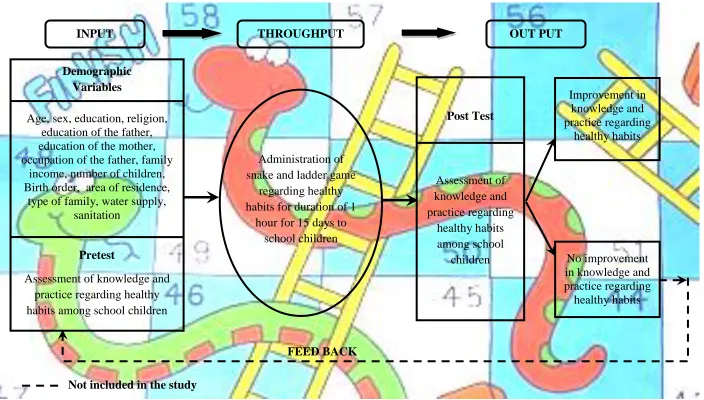
A system is a set of interacting identifiable parts or components and it depends in the quality and quantity of its input, through put, output and feedback. The system has a specific purpose or goal and uses a process to achieve the goal.
Input
The first component of the system is input consists of information, material, or energy that enters the system.
Throughput
Throughput is the activity phase. After the input is absorbed by the system, it is processed in a way useful to the system.
Administration of snake and ladder game regarding healthy habits for duration of 1 hour for15 days acts as throughput in this present study.
Output
The information are continually processed through the system and released as output in an altered state.
The improvement in the level of knowledge and practice regarding healthy habits after snake and ladder game, acts as the output in this present study.
Feed Back
Feed back is the mechanism by which some of the output of a system regulates itself by redirecting the output of the system back in to the system as input, thus forming a feedback loop. This is a continuous process that takes place in the system.
Figure. 1Modified Conceptual Frame Work Based on Von Bertalanffy General System Model (1968) FEED BACK
Demographic Variables
Age, sex, education, religion, education of the father, education of the mother, occupation of the father, family
income, number of children, Birth order, area of residence,
type of family, water supply, sanitation
Pretest
Assessment of knowledge and practice regarding healthy habits among school children
Administration of snake and ladder game
regarding healthy habits for duration of 1
hour for 15 days to school children Post Test Assessment of knowledge and practice regarding healthy habits among school children Improvement in knowledge and practice regarding healthy habits INPUT THROUGHPUT No improvement in knowledge and practice regarding
healthy habits
OUT PUT
CHAPTER - III
Methodology
It included research approach, research design, setting of the study, population, sample size, sampling technique, criteria for the selection of sample, description of the tool, content validity, reliability, pilot study, procedure of data collection and plan for data analysis.
Research Approach
Experimental approach, a subtype of quantitative approach was used for the present study.
Research Design
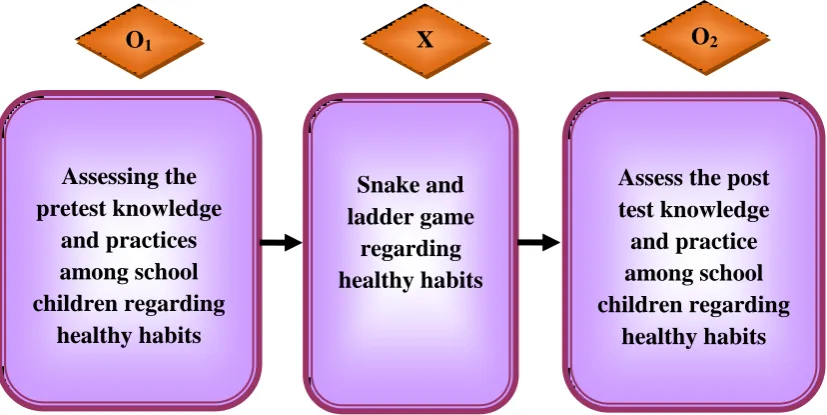
The research design adopted for this study is Pre experimental one group – pretest post test design. O1 is pretest assessment, O2 is the post test assessment and X
[image:38.595.110.524.522.729.2]is the intervention (snake and ladder game regarding the healthy habits).
Figure. 2 The Schematic Representation of Research Design Assessing the
pretest knowledge and practices among school children regarding
healthy habits
Snake and ladder game
regarding healthy habits
Assess the post test knowledge and practice among school children regarding
healthy habits
Setting of the Study
The study will be conducted among school children who are studying at Government Primary School, Kalapatti, 15 Km away from Coimbatore city. It is a school consisting 500 students.
Variables
Independent variable is snake and ladder game regarding healthy habits among school children. The dependent variable is knowledge and practice of children regarding healthy habits. The influencing variables are demographic variables.
Figure. 3 The Schematic Representation of the Variables
Population
The population of present study is of children who are studying in 2nd to 4th standard children at Government Primary School, Kalapatti during the period of data collection.
Influencing Variables Dependent Variables
Independent Variables
Demographic Variables like age, sex, education, religion, education of
father, education of mother, occupation of father, family income, No. of children, birth order, area of residence,
family type, water supply, sanitation
Knowledge and Practices regarding
Healthy habits
Snake and ladder Game regarding
Sample Size
The sample size included for the study consists of 60 school children.
Sampling Technique
Simple random sampling technique was used to select the samples for the present study.
Criteria for the Selection of Sample Inclusive Criteria
Children studying in Government Primary school, Kalapatti, Coimbatore. Children who were willing to participate.
Children those who were present at the time of data collection. Children who are able to read and write Tamil/English.
Exclusive Criteria
Children who are selected during pilot study.
Children who are not interested in snake and ladder game. Children those who were having sensory problems.
Description of Tool
Section – A Distribution of Demographic Variables
Demographic data of the participants include age in years, sex, education, religion, education of father, education of mother, occupation of father, family income, numbers of children, birth order, type of family, water supply and sanitation.
Section – B Questions Regarding Knowledge on Healthy Habits
It consists of 30 questions for the assessment of knowledge of school children regarding healthy habits.
Interpretation of Questionnaire
Each question has 4 options in which the correct answer carries one mark and the wrong answer carries zero mark. Maximum score for this section is 30 marks and minimum score is zero marks.
Section – C Questions Regarding Practices of Healthy Habits
It consists of 20 questions related to assessment of the practice of school children regarding healthy habits.
Interpretation of Questionnaire
Each question can be answered by the students in three categories like regularly, occasionally and never.
Positive Questions
Negative Questions
„Yes, regularly‟ carries zero marks; „Yes, occasionally‟ carries one mark and „No, never‟ carries two mark. The maximum score is allotted for this section
is 40 and minimum score is zero.
Testing of Tool Content Validity
The tool was given to five experts in the field of nursing and medicine for content validity. All comments and suggestions was given by the experts were duly considered and corrections were made.
Reliability of Instrument
The reliability of the tool was determined by Spearman Brown‟s Split Half Technique. The value of „r‟ = +0.9 for knowledge questionnaire and „r‟ = +0.9 for practice questionnaire. So the tool was considered as highly reliable.
Pilot Study
Data Collection Procedure
The data collection was done from 01-01-2014 to 31-01-2014 by using structured questionnaire method. Prior permission was obtained from School Headmistress and class coordinators, samples were selected by simple random sampling technique. On the first to sixth day of the study pretest was conducted for 60 school children by administering the questionnaire. On seventh to seventeenth day the planned game based teaching was delivered to the school children for about 1 hour, to 12 children per day regarding healthy habits by using snake and ladder game on healthy habits. The post test was conducted for these 60 students on the 25th to 30th day, to find out the effectiveness of snake and ladder game on healthy habits by administering the same questionnaire.
Plan for Data Analysis
The researcher adapted descriptive and inferential statistics to analyze the data. The demographic variables were analyzed by using frequency and percentage. The effectiveness of snake and ladder game regarding healthy habits was analyzed by using paired „t‟ test, association between demographic variables was analyzed by 2
test. Demographic variable of school children.
Knowledge regarding healthy habits. Practice regarding healthy habits.
Inferential statistics were used to determine the relationship and comparison to
identify the differences.
„t‟ test was used to compare the knowledge and practice regarding healthy habits. Chi–Square test was computed to find out the association between knowledge
Figure. 4 The Overall Review of Research Methodology Research Approach
Quantitative Approach
Population
Children studying in Government Primary School at Kalapatti, Coimbatore
Sampling Technique
Simple Random Sampling Technique
Sample Size
N =60
Pretest
Assessment of knowledge and practice on healthy habits
Implementation of game based teaching program by snake and ladder game regarding healthy habits
Post Test
Assessment of knowledge and practice
Data Analysis
Inferential and descriptive statistics
Interpretations and Conclusion Research Design
CHAPTER - IV
Data Analysis and Interpretation
This chapter deals with the analysis and interpretation of the data collected from the school children, who are studying Government Primary School, Kalapatti, to assess the knowledge and practice regarding the healthy habits.
The findings based on the descriptive and inferential statistical analysis tabulated as follows
Section - I : Distribution of demographic data
Section - II : Distribution of statistical value of pretest and post test knowledge and practice on healthy habits among school children.
SECTION - I
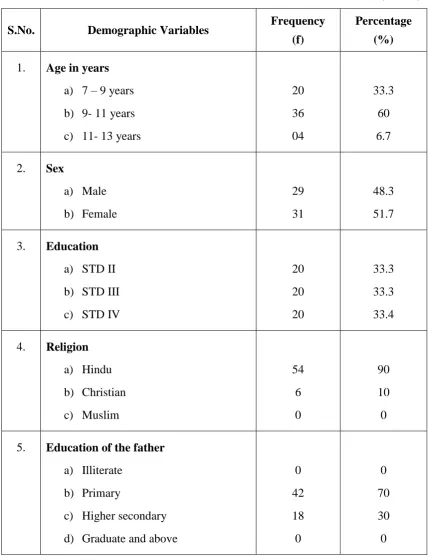
Table. 1 Distribution of Demographic Variables of the School Children
(N = 60)
S.No. Demographic Variables Frequency (f)
Percentage (%)
1. Age in years
a) 7 – 9 years b) 9- 11 years c) 11- 13 years
20 36 04 33.3 60 6.7
2. Sex
a) Male b) Female
29 31
48.3 51.7
3. Education
a) STD II b) STD III c) STD IV
20 20 20 33.3 33.3 33.4
4. Religion
a) Hindu b) Christian c) Muslim
54 6 0 90 10 0
5. Education of the father
a) Illiterate b) Primary
c) Higher secondary d) Graduate and above
0 42 18 0 0 70 30 0
(Table 1 continued)
S.No. Demographic Variables Frequency (f)
Percentage (%)
6. Education of the mother
a) Illiterate b) Primary
c) Higher secondary d) Graduate and above
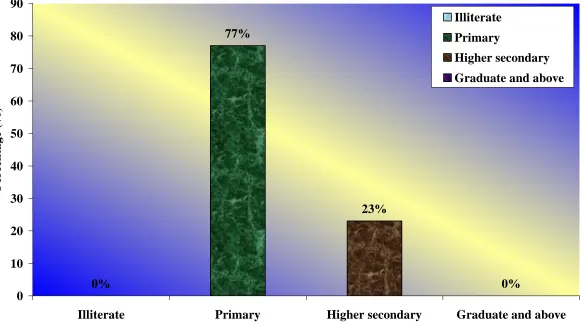
0 46 14 0 0 77 23 0
7. Occupation of the father
a) Government employee b) Private employee c) Business
d) Coolie
0 3 53 4 0 5 88.3 6.7
8. Family income (₨)
a) Below ₨. 5000/- b) ₨. 5001 - 10,000/- c) ₨. 10,001 -20,000/- d) ₨. 20,001/- and above
10 50 0 0 16.7 83.3 0 0
9. Number of children
a) 1 b) 2
c) 3 and above
14 37 9 23.3 61.7 15
(Table 1 continued)
S.No. Demographic Variables Frequency (f)
Percentage (%)
10. Birth order
a) I b) II
c) III and others
21 36 3 35 60 5
11. Area of residence
a) Urban b) Rural c) Semi urban
57 0 3 95 0 5
12. Type of family
a) Joint b) Nuclear
3 57
5 95
13. Water supply
a) Public tap b) Pond c) Well
60 0 0 100 0 0
14. Sanitation
a) Open b) Closed
0 60
Table 1 reveals the distribution of the demographic variables of the school children.
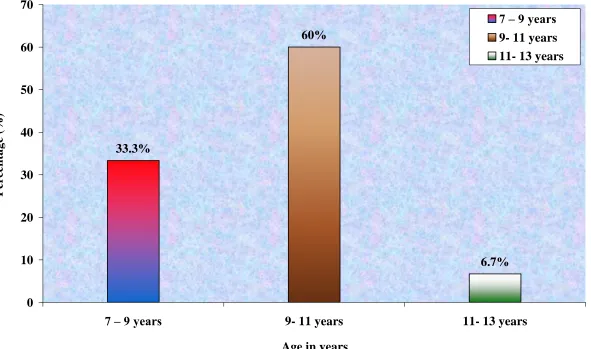
Considering the distribution of age of school children, 33.33% were coming
under 6 – 8 yrs, 50% were coming under 8 – 10 yrs and 6.7% were coming under 10 – 12 yrs.
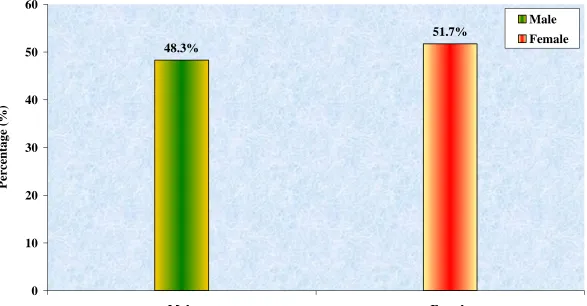
Regarding sex of school children out of 60 samples, 48.3% males and females
51.7%.
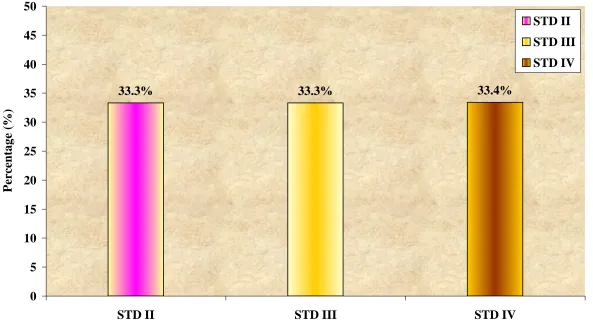
Regarding education of school children, 33.33% were studying in 2nd standard,
33.33% were studying in 3rd standard and 33.4% were studying in 4th standards.
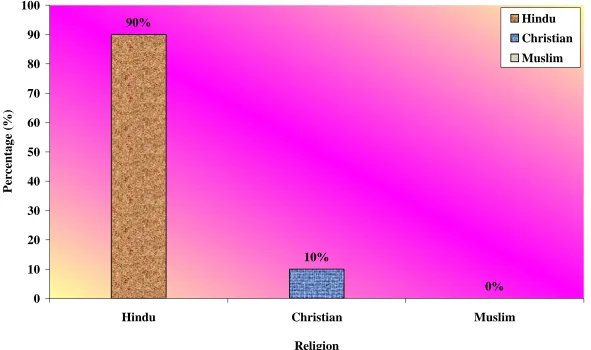
Based on the religion of the family, 90% of students were Hindus and 10%
were Christians.
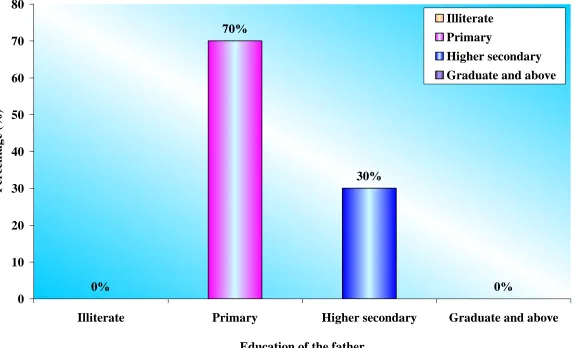
Considering the education of the father, 70% were primary educated and 30%
were secondary educated.
With regard to the education of the mother, 76.7% were primary educated and
23.3% were secondary educated.
Considering the occupation of the father, 88.3% were come under coolies,
Regarding family income, 83.3% were having between ₨. 5000–10,000 and
16.7% were having below ₨. 5000.
With regard to the birth order, 35% were I, 60% were II and 5% were III and
others.
Regarding number of children in the family, 23.3% were coming under 1,
61.7% were coming under 2 and 15% were coming under 3 and above.
Among the respondents, 95% were living in rural area and 5% were living in
semi urban area.
Regarding type of family, 95% were the member of nuclear family and 5%
were the member of joint family.
With regard to the water supply, 100% were using public tap.
Figure. 5 Distribution of Demographic Variables According to the Age
6.7% 60%
33.3%
0 10 20 30 40 50 60 70
7 – 9 years 9- 11 years 11- 13 years Age in years
P
ercenta
g
e
(%)
Figure. 6 Distribution of Demographic Variables According to Sex 51.7% 48.3%
0 10 20 30 40 50 60
Male Female
Sex
P
ercenta
g
e
(%)
Figure. 7 Distribution of Demographic Variables According to Education
33.3% 33.3% 33.4%
0 5 10 15 20 25 30 35 40 45 50
STD II STD III STD IV
Education
P
ercenta
g
e
(%)
Figure. 8 Distribution of Demographic Variables According to Religion 0% 10%
90%
0 10 20 30 40 50 60 70 80 90 100
Hindu Christian Muslim
Religion
P
ercenta
g
e
(%)
Figure. 9 Distribution of Demographic Variables According to Education of Father 0%
70%
30%
0% 0
10 20 30 40 50 60 70 80
Illiterate Primary Higher secondary Graduate and above Education of the father
P
ercenta
g
e
(%)
Illiterate Primary
Figure. 10 Distribution of Demographic Variables According to Education of Mother 0% 23%
77%
0% 0
10 20 30 40 50 60 70 80 90
Illiterate Primary Higher secondary Graduate and above Education of the mother
P
ercenta
g
e
(%)
Illiterate Primary
Figure. 11 Distribution of Demographic Variables According to Occupation of Father 6.7% 88.3%
5% 0%
0 20 40 60 80 100
Government employee Private employee Business Coolie Occupation of the father
P
ercenta
g
e
(%)
Government employee Private employee Business
Figure. 12 Distribution of Demographic Variables According to Family Income 16.7%
83.3%
0% 0%
0 10 20 30 40 50 60 70 80 90 100
Below ₨. 5000/- ₨. 5001 - 10,000/- ₨. 10,001 -20,000/- ₨. 20,001/- and above Family income
P
ercenta
g
e
(%)
Below ₨.
5000/-₨. 5001 -
10,000/-₨. 10,001
-20,000/-₨. 20,001/- and above
₨. ₨. ₨. ₨.
₨.
₨.
₨.
Figure. 13 Distribution of Demographic Variables According to Number of Children 23.3%
61.7%
15%
0 10 20 30 40 50 60 70
1 2 3 and above
Number of children
P
ercenta
g
e
(%)
1 2
Figure. 14 Distribution of Demographic Variables According to Birth Order 35%
60%
5%
0 10 20 30 40 50 60 70
I II III and others
Birth order
P
ercenta
g
e
(%)
I II
Figure. 15 Distribution of Demographic Variables According to Area of Residence 5% 95%
0% 0
20 40 60 80 100 120
Urban Rural Semi urban
Area of residence
P
ercenta
g
e
(%)
Figure. 16 Distribution of Demographic Variables According to Type of Family 5%
95%
0 20 40 60 80 100 120
Joint Nuclear
Type of family
P
er
ce
n
ta
g
e (%)
Figure. 17 Distribution of Demographic Variables According to Water Supply 0% 100%
0% 0
20 40 60 80 100 120
Public tap Pond Well
Water supply
P
ercenta
g
e
(%)
Figure. 18 Distribution of Demographic Variables According to Sanitation 100%
0% 0
20 40 60 80 100 120
Open Closed
Sanitation
P
ercenta
g
e
(%)
SECTION - II
Table. 2 Distribution of Statistical Value of Pretest and Post Test Knowledge on Healthy Habits Among School Children
(N = 60)
S.No. Knowledge Mean SD ‘t’ value
1. Pre test 13.83 1.07
21.24*
2. Post test 18.63 1.60
*significant at 0.05 level
Table 2 shows that the mean pretest knowledge score was 13.83 and that of post test was 18.63. The calculated „t‟ value 21.24 at 59 degree of freedom was
[image:65.595.102.531.207.349.2]Figure. 19 Distribution of Pretest and Post Test Knowledge Values on Healthy Habits Among School Children 13.83
18.63
0 2 4 6 8 10 12 14 16 18 20
Pre test Post test
Knowledge
M
ea
n
Table. 3 Distribution of Statistical Value of Pretest and Post Test Practice on Healthy Habits Among School Children
(N = 60)
S.No. Practice Mean SD ‘t’ value
1. Pretest 19.30 3.16
18.40*
2. Post test 25.96 4.59
* significant at 0.05 level
Table 2 shows that the mean pretest practice score was 19.30 and that of post test was 25.96. The calculated „t‟ value 18.40 at 59 degree of freedom was significant
Figure. 20 Distribution of Pretest and Post Test Practice Values on Healthy Habits Among School Children 19.3
25.96
0 5 10 15 20 25 30
Pretest Post test
Practice
M
ea
n
SECTION - III
Table. 4 Association of Selected Demographic Variables with Pretest Score of Knowledge on Healthy Habits Among School Children
(N = 60)
S.No. Demographic Variables Below Mean
Above
Mean 2
1. Age in years
a) 6 – 8 b) 8- 10 c) 10- 12
8 12 3 12 24 1 2.66
2. Sex
a) Male b) Female
14 9
15 22
2.33
3. Education
a) STD II b) STD III c) STD IV
8 7 8 12 13 12 0.137
4. Religion
a) Hindu b) Christian c) Muslim
20 3 0 34 3 0 0.192
5. Education of the father
a) Illiterate b) Primary
c) Higher secondary d) Graduate and above
0 17 6 0 0 25 12 0 0.27
[image:69.595.101.532.196.731.2](Table 4 continued)
S.No. Demographic Variables Below Mean
Above
Mean 2
6. Education of the mother
a) Illiterate b) Primary
c) Higher secondary d) Graduate and above
0 21 2 0 0 25 12 0 4.45
7. Occupation of the father
a) Government employee b) Private employee c) Business
d) Coolie
0 1 0 22 0 2 4 31 2.907
8. Family income
a) Below ₨. 5000/- b) ₨. 5001 - 10,000/- c) ₨. 10,001 -20,000/- d) ₨. 20,001/- and above
5 18 0 0 5 32 0 0 0.673
9. Number of children
a) 1 b) 2
c) 3 and above
5 14 4 9 23 5 0.189
10. Birth order
a) I b) II
c) III and others
9 13 1 12 23 2 0.419
(Table 4 continued)
S.No. Demographic Variables Below Mean
Above
Mean 2
11. Area of residence
a) Urban b) Rural c) Semi urban
0 22 1 0 35 2 0.032
12. Type of family
a) Joint b) Nuclear
1 22
2 35
0.123
13. Water supply
a) Public tap b) Pond c) Well
28 0 0 32 0 0 0
14. Sanitation
a) Open b) Closed
0 28
0 32
0
[image:71.595.103.532.85.484.2]Table. 5 Association of Selected Demographic Variables with Pretest Score of Practice on Healthy Habits Among School Children
(N = 60)
S.No. Demographic Variables Below Mean
Above
Mean 2
1. Age in years
a) 6 – 8 b) 8- 10 c) 10- 12
15 18 3 5 18 1 3.75
2. Sex
a) Male b) Female
17 19
12 12
0.042
3. Education
a) STD II b) STD III c) STD IV
15 12 9 5 8 11 3.75
4. Religion
a) Hindu b) Christian c) Muslim
32 4 0 22 2 0 0.123
5. Education of the father
a) Illiterate b) Primary
c) Higher secondary d) Graduate and above
0 26 10 0 0 16 8 0 0.20
[image:72.595.101.535.133.730.2](Table 5 continued)
S.No. Demographic Variables Below Mean
Above
Mean 2
6. Education of the mother
a) Illiterate b) Primary
c) Higher secondary d) Graduate and above
0 27 9 0 0 19 5 0 0.138
7. Occupation of the father
a) Government employee b) Private employee c) Business
d) Coolie
0 1 32 2 0 2 20 2 1.158
8. Family income
a) Below ₨. 5000/- b) ₨. 5001 - 10,000/- c) ₨. 10,001 -20,000/- d) ₨. 20,001/- and above
8 28 0 0 2 22 0 0 2.04
9. Birth order
a) I b) II
c) III and others
12 22 2 9 14 1 0.165
10. Number of children
a) 1 b) 2
c) 3 and above
8 25 3 6 12 6 3.58
(Table 5 continued)
S.No. Demographic Variables Below Mean
Above
Mean 2
11. Area of residence
a) Urban b) Rural c) Semi urban
0 36 0 0 21 3 4.436
12. Type of family
a) Joint b) Nuclear
2 34
1
23 0.055
13. Water supply
a) Public tap b) Pond c) Well
36 0 0 24 0 0 0
14. Sanitation
a) Open b) Closed
0 24
0 36
0
[image:74.595.103.531.85.518.2]CHAPTER - V
Results and Discussion
The purpose of the study was to find out the effectiveness of snake and ladder game on knowledge and practice regarding healthy habits among school children. The results and discussions of the study are based on the findings obtained from the statistical analysis and interpretation of the data.
The First Objective of the Study was to Assess the Knowledge and Practice Regarding Healthy Habits Among School Children
The samples for the present study comprise 60 children. The prepared questionnaires were used to assess knowledge and practice regarding healthy habits. The present study findings revealed that the pretest mean score of knowledge regarding healthy habits was 13.83 and practice regarding healthy habits was 18.63.
The mean post test knowledge and practice score obtained were significantly higher than the mean pretest score. This indicates that there is an improvement in knowledge and practice regarding healthy habits by delivering game based health education.
Thus the findings of the present study are similar to other findings. This fact confirmed that the game based teaching program by snake and ladder game on healthy habits had an impact in improving the knowledge of the school children.
The present study findings revealed that the pretest mean score for knowledge is 13.83 and for practice are 18.63. This reveals that there was inadequate knowledge and unfavorable practice about healthy habits among school children.
The Second Objective of the Study was to Deliver Game Based Teaching Program by Snake and Ladder Game on Healthy Habits
The Game Based Teaching Program was given by using Snake and Ladder Game Regarding Healthy Habits for the children who were selected by using simple random sampling technique. The game based teaching was given for 1 hour and it was found to be effective as they were communicating and clarifying their doubts related to healthy habits.
Third Objective of the Study was to find out the Effectiveness of Game Based Teaching Program by Snake and Ladder Game Regarding Healthy Habits Among School Children
The pretest mean score for knowledge was 13.83 and post test mean score was 18.63. Thereby the „t‟ value for knowledge was 21.24. The pretest mean score for
practice was 19.30 and post test mean score was 25.96. There by the „t‟ value for practice was 18.40.
Both the „t‟ values obtained for knowledge and practice were higher than the
This in turn reveals that the game based teaching program by snake and ladder game regarding healthy habits was effective.
The similar study conducted by Poonam Devi Sreshtha (2010) stated in her study to improve the knowledge and practice regarding healthy life style among school children and motivating the children to get good practices and habits. The findings showed that the planned game based teaching program was effective in improving children‟s knowledge and practice.
Thus the findings of the present study are similar to other findings. This fact confirmed that the game based teaching program by snake and ladder game on healthy habits had an impact in improving the knowledge and practice of the school children.
The Fourth Objective of the Study was to Find Out the Association of the Knowledge and Regarding Healthy Habits with Selected Demographic Variables
There was no significant association between selected demographic variables such as age in years, sex, education, religion, education of father, education of mother, occupation of father, family income, number of children, birth order, area of residence, type of family, water supply, and sanitation with pretest knowledge score of primary school children regarding healthy habits.
CHAPTER - VI
Summary, Conclusion, Nursing Implications,
Limitation and Recommendation
Summary
The main focus of the study was to assess the knowledge and