The Impact of Quality Assurance Certification on
Australian Software Developers
Aileen P Cater-Steel & Edmond P Fitzgerald
Department of Information Systems Faculty of Business
The University of Southern Queensland Toowoomba, Australia
Email: [email protected] [email protected]
Abstract
This paper draws on existing literature and research on software development process improvement, and related fields, to explore the impact of quality assurance (QA) certification on the Australian software development industry. Recently, many developers have committed resources to achieve certification in response to government purchasing policies favouring standards-certified suppliers, but cynics suggest the ‘piece of paper’ does little to improve the processes and subsequent product. This paper details a research project undertaken to assess the extent of Australian software developers’ adoption of QA certification, their capability maturity and perceptions regarding certification costs and benefits.
1 INTRODUCTION
Organisations are investing heavily in information systems, seeking improvements in efficiency, effectiveness and competitive advantage. Although many systems have been successfully implemented and organisations are reaping the rewards, the software industry in Australia has been plagued by similar quality problems to those experienced in other countries. For example, as reported recently in Computerworld (Bryan 1996), the NSW RTA has frozen work on all current application development projects due to concerns about the performance and costs of internally built systems. A survey conducted by KPMG found nearly 80% of surveyed Asian/Pacific companies said in-house development took longer and was more difficult than they originally expected (Prodromou 1996). Software professionals were rated poorly by CEOs in a survey about outsourced services (Birmingham 1996a).
In an attempt to address these problems, the concept of Quality Assurance (QA), widely accepted by the manufacturing industry for many years, is now being adopted by the software development industry (Chmiel & Wilson 1993; Davis, Thompson & Smith 1992; Dunn & Ullman 1994). In 1991, the Australian Labor Government heralded its requirement for minimum quality assurance standards in its purchasing policy as a strategy to encourage Australian industries to become internationally competitive. In order to protect their considerable investment in software, large commercial customers also increasingly show preference for vendors who adhere to recognised standards. “Du Pont, General Electric, Eastman Kodak, British Telecom and Phillips Electronics are among the large companies urging suppliers to adopt ISO 9000” (Dawood 1994, p.110). In Australia, Federal and all State governments’ purchasing policies specify preference for minimum quality standards such as the international standard for quality management systems, ISO 9000.
motivation of Australian software developers to seek QA certification (Robinson & Simmons 1995), there has been little into the effects of this trend on the industry.
Therefore, in order to thoroughly assess the extent of QA certification and the maturity of Australian software developers, a large survey of specialist and in-house developers was undertaken as part of this research project. The study focussed on organisations’ progress towards achieving certification to either ISO 9001 or AS 3563 standards, which will be subsequently referred to as QA certification. This paper provides firstly a background to the study, then develops hypotheses based on recent surveys and literature relating to diffusion of innovation, and concludes with preliminary findings from the study.
2 BACKGROUND AND OVERVIEW
With the increasing functionality and decreasing cost of computer hardware, there is a significant trend for organisations to implement new computer systems, and to redevelop legacy systems (Fried 1995). Despite the growing importance of software, most software projects are completed over schedule and over budget (Ashton 1996). Many are cancelled, often after a significant investment, eg. the Commonwealth Bank’s $110 million Mainstream project (Maiden 1996). The delivered product is often plagued with bugs, or falls short of the expectation of the client, eg. Telstra has spent $300 million on its Flexcab core billing system and “... all the code will now have to be re-examined, changed where necessary and retested from scratch for year 2000 compliance” (Birmingham 1996b, p.1).
These continuing problems constitute what has been referred to as the ‘software crisis’ (Boehm 1988). Thus for large, complex software projects, it is important that the purchasers be able to assess the capability of would-be developers. However, professional qualifications are not required to practise as a software developer, so a potential client has no formal way of judging the competence of would-be developers. The growing trend towards QA certification may alleviate this problem.
2.1 The Capability Maturity Concept
Capability maturity refers to the ability of software developers to meet goals of cost, schedule, functionality, and product quality. The Software Engineering Institute (SEI) at Carnegie Mellon University has developed a five-level Capability Maturity Model (CMM) that provides organisations with guidance for measuring software process maturity and establishing process improvement plans. The CMM describes the key elements of an evolutionary improvement path for software organisations from an ad-hoc, immature process to a mature disciplined one. The CMM covers practices for planning, engineering, and managing software development and maintenance (Paulk 1995). A more detailed explanation of the CMM is provided in section 3.1.
2.2 The Australian Software Development Industry
For this study, we interpret the term ‘software development industry’ to include all organisations undertaking software development activities (eg. analysis, programming, program maintenance, testing). We differentiate between ‘specialist’ developers - organisations which produce software for use by clients external to their organisation, and ‘in-house’ developers who produce software for use by their own organisations.
businesses in the computer services industry. “In terms of the number of businesses, the computer services industry was dominated by small businesses, with 97% of businesses employing fewer than 20 people. These small businesses accounted for 42% of industry employment and 28% of industry operating profit before tax. In contrast, the 29 businesses in the industry employing 100 or more persons (representing <1%) accounted for 42% of employment and 58% of operating profit before tax” (Madden 1995, p.1). These statistics understate the actual extent of software development activity by excluding two significant groups: in-house developers in both the public and private sectors; and specialist organisations for which software development is not the primary activity.
If the industry is to grow and to export, rather than get swamped by overseas imports, then the quality of Australian software must reflect world best practice. Australia has a competitive advantage in the Asia-Pacific region in terms of communications and services infrastructure and education. This has been recognised, for example by Motorola, and more multinationals may invest in establishing software ‘factories’ if the industry can demonstrate capability to produce high quality software on-time and on-budget.
2.3 Research Questions
The purpose of this study is to investigate the extent of adoption of QA certification, the maturity of Australian software developers, and their perceptions regarding certification costs and benefits. To achieve these aims, this research determines and compares progress to QA certification with capability maturity, and examines organisational factors which may be associated with the certified organisations choosing to become certified.
Four questions were used to explore QA certification:
(i) What is the extent of adoption of third-party certified QA standards by the Australian software development industry?
(ii) Is adoption of QA certification associated with higher capability maturity?
(iii) Do QA certified developers share common organisational characteristics (such as business size, ownership, type of client base)?
(iv) How do developers perceive the value and effects of QA certification in relation to its costs and benefits?
2.4 Relevance of the Study
This research is important for a number of reasons. Firstly, it surveys the Australian software development industry to measure the response of developers to the introduction of QA certification and to identify the organisational characteristics of developers with respect to their certification status. Secondly, it compares two recognised process improvement interventions, ISO 9001/AS 3563 and CMM, to see if QA standards adoption is associated with improved capability maturity. Thirdly, it assesses the perceptions of developers towards the value and costs of certification.
2.5 Previous Surveys
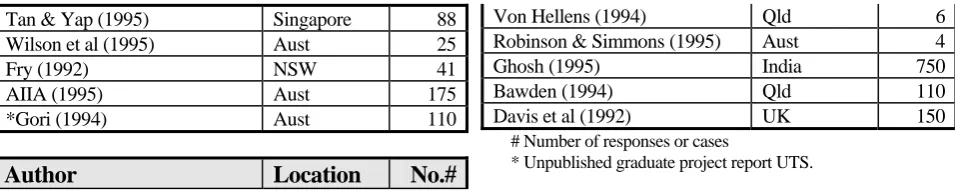
The impact of QA certification has attracted the interest of IS researchers. There has been a considerable number of studies both in Australia and overseas (table 1) addressing various aspects of QA adoption. However, none of the Australian surveys has addressed the relationship between certification and capability maturity, which is the focus of this study.
Tan & Yap (1995) Singapore 88 Wilson et al (1995) Aust 25
Fry (1992) NSW 41
AIIA (1995) Aust 175
*Gori (1994) Aust 110
Author Location No.#
Von Hellens (1994) Qld 6 Robinson & Simmons (1995) Aust 4 Ghosh (1995) India 750 Bawden (1994) Qld 110 Davis et al (1992) UK 150
# Number of responses or cases
[image:4.595.60.538.69.165.2]* Unpublished graduate project report UTS.
Table 1: Summary of selected QA studies in the software industry
3 THEORETICAL DEVELOPMENT
Diffusion of innovation theory can assist our understanding of the way developers adopt or resist innovations such as QA standards. For instance, in examining the diffusion of structured systems analysis Leonard-Barton (1987) found a strong, positive association between client preference and adoption. So the preferences of powerful clients (eg. governments and large companies) may be expected to influence the trend towards QA certification. In their consideration of diffusion theory, Bayer and Malone (1989) argue that ‘mandated’ software engineering innovations first introduced to a government contractor population will transfer to the commercial sector as members of one population interact with, and in fact may jointly belong to, the other population. So, again, government preference for QA certification may cause a flow-on effect throughout the software development industry. Thus the following hypothesis is proposed:
H1a There is increasing adoption of QA certification by the Australian software industry.
In addition, rather than a traditional measure such as time of adoption, Fichman (1994) urges consideration of ‘assimilation stages’ for innovations which are still early in the diffusion cycle. Thus developers who have taken the first steps towards QA certification adoption should also be considered, leading to the following hypothesis:
H1b Many developers are planning to adopt, or are in the process of adopting QA
certification.
3.1 Capability Maturity
1. Initial:
chaotic process
2. Repeatable:
disciplined process
3. Defined:
standard, consistent
process
4. Managed:
predictable process
5. Optimising:
continuously improving
[image:5.595.72.527.68.207.2]process
Figure 1: The five levels of the capability maturity model (adapted from Humphrey 1988) As development process maturity is strongly linked to the success or failure of software projects (Billings et al 1994), the SEI CMM model has been applied in the USA to many organisations and projects to assess their software processes and recommend improvements. Industry-wide CMM-based assessments have been conducted in Hong Kong, Singapore, Japan and Europe, but not in Australia. Although the content of the ISO 9001 and CMM have been compared (Bamford & Deibler 1993; Paulk 1995) there has not been any industry research in Australia to compare QA certification with capability maturity. This research undertakes that comparison by testing the following hypothesis:
H2a The greater the progress towards QA certification the higher will be the CMM level.
3.2 Improvement to the SEI Model
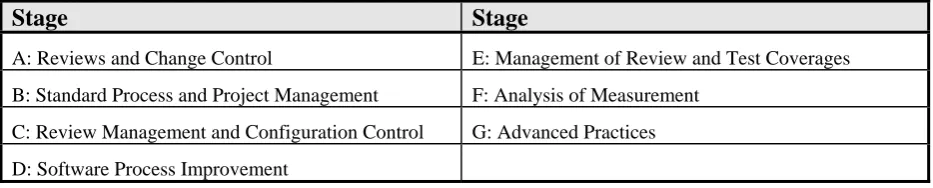
Drehmer and Dekleva (1993) offer an improvement to the SEI model, claiming that it does not perform in the cumulative discrete way that its authors believed it would. They claim their ‘maturity stage’ measure not only makes conceptual sense but is supported by empirical data. Its seven stages are depicted in table 2.
Stage Stage
A: Reviews and Change Control E: Management of Review and Test Coverages B: Standard Process and Project Management F: Analysis of Measurement
C: Review Management and Configuration Control G: Advanced Practices D: Software Process Improvement
Table 2: Seven stages of maturity (Drehmer & Dekleva 1993)
In recognising that Drehmer and Dekleva’s maturity stage measure may be a more accurate model of maturity evolution than the CMM, the following hypothesis is suggested to enable comparison of certification progress with maturity stages:
H2b Progress towards QA certification will be positively associated with the maturity
stages.
3.3 Organisational Factors
Overseas studies (Davis et al. 1992; Ko 1995; Tan & Yap 1995) have revealed that certain organisational factors (size, foreign ownership, competitive forces) may be associated with software companies adopting formal QA certification.
3.3.1 Size of Organisation
[image:5.595.65.532.446.540.2]development companies seeking certification has been for the larger ... companies to achieve AS 3901/AS 3563 certification” (Smillie 1993, p.38). This suggests the following hypothesis: H3 Large organisations are more likely than small organisations to seek QA certification.
3.3.2 Foreign Ownership
In examining the QA practices of foreign-owned companies in Singapore, Tan and Yap (1995, p.234) found that “... foreign-equity companies are more conscious of the increasing importance of quality management for competitive advantage.” The following hypothesis is included to check if a similar effect exists in Australia:
H4a Companies financed by overseas capital are more likely to seek QA certification.
On a different tack, Ireland (1996) in discussing the takeovers of Australian software companies, demonstrates how well-intentioned Federal and State Government IT policies frequently work in favour of the very large, and therefore often foreign-owned, companies rather than the Australian companies for which they supposedly were intended. Hence, the following hypothesis:
H4b Developers have the perception that the government QA policy favours multinationals
at the expense of local developers.
3.3.3 Competitive Forces
Competitive forces also appear to influence developers to invest in certification. QA certification helps control the risks of software development contracts by providing confirmation by an independent auditor that the developer follows documented processes. It is expected that for large commercial contracts, the clients of specialist developers may prefer to do business with those who are certified. However, in-house developers may not be under that sort of competitive pressure. It is therefore hypothesised that:
H5a Specialist developers are more likely than in-house developers to have QA
certification.
Considering the competitive force resulting from government purchasing policies requiring QA certification, it is predicted that many organisations are seeking certification to facilitate their competitive position in government contracts. Thus:
H5b QA certification will be associated with developers targeting the Public Sector
market.
Also, as over 60 per cent of respondents to an Australian Information Industry Survey (AIIA 1995) reported pressure from export market customers for formal quality programs, the following hypothesis is suggested:
H5c QA certification will be associated with developers targeting the export market.
4 DATA COLLECTION & ANALYSIS
4.1 Sample Selection
the selected organisations undertake software development, organisations which had not indicated usage of CASE or 4GL tools were eliminated. 500 Australian organisations were then selected at random from the remaining 1690 records.
4.2 Survey Design
A questionnaire was designed to collect information based on the variables identified in the hypotheses. The questionnaire was pilot tested in two stages with suggested modifications from the first stage incorporated in the questionnaire for the second stage of testing. The composition of the questionnaire is shown in table 3.
Part No. of Questions Purpose of Questions 1 12 Demographic characteristics
2 5 Progress towards QA certification
3 13 Perceptions regarding the value of QA certification and government QA policy 4 33 Software engineering practices based on the SEI maturity questionnaire
Table 3: Composition of questionnaire
4.3 Survey Execution
1000 surveys were mailed with a cover letter and reply-paid envelope. After three weeks, a follow up to non-respondents was mailed. As expected, a significant number (90) of surveys were returned as undeliverable. Just over 10 per cent of respondents (109) indicated that they did not develop software and so were excluded from the analysis.
4.4 Data Analysis
At the submission deadline (12 July 1996) for ACIS ‘96, responses were still being returned, so only a preliminary analysis has been undertaken at this stage. To achieve this, the 290 responses from developers were keyed into SPSS. As all the variables were either nominal or ordinal levels of measurement, nonparametric statistical tests (chi-square) and measures of correlation (Spearman rank-correlation coefficient) were calculated, depending on the expected cell frequencies and number of rows and columns. A probability level of p<0.05 was used to test the significance of test results. One-tail tests were used. Note that responses relating to ISO 9001 and AS 3563 were combined for this preliminary analysis.
5 PRELIMINARY FINDINGS
The preliminary findings presented here provide an insight into what promise to be important and interesting final results of the study.
5.1 Hypothesis 1: Extent of adoption of QA certification
Support for our first hypothesis (increasing adoption of QA certification) is provided both by secondary data (JAS-ANZ records: see figure 2) and our own survey results.
Overall, the survey reveals reasonably high levels (34%) of adoption, and commitment to adopt QA certification by Australian software developers (11% already certified; 7% certification in progress; 17% planning to certify).
0 20 40 60 80
[image:8.595.73.525.91.225.2]1989 1990 1991 1992 1993 1994 1995
Figure 2: Number of Australian organisations certified to ISO 9001 or AS 3563
5.2 Hypothesis 2: Capability Maturity
An assessment of respondents’ capability maturity was determined from their answers to 33 software engineering practices questions adapted from the SEI maturity questionnaire (Drehmer & Dekleva 1993). A ‘raw’ capability measure was calculated by assigning a value of 2 for each practice applied to all projects, 1 if applied to some projects and 0 if not practised. The mean resultant ‘raw’ capability maturity for each group of respondents (by certification progress) is shown in figure 3. The CMM levels and Drehmer & Dekleva stages were not calculated for these preliminary findings.
15 20 25 30 35 40
Certified In Progress Planned No Plans
Mean Raw Matur
ity
Figure 3: Comparison of Maturity and Certification Progress
As can be seen in figure 3, the average ‘raw’ capability maturity of certified organisations is higher than in organisations for which certification is in progress, planned, etc. Measures of correlation confirmed the association between certification and ‘raw’ capability maturity (one-tailed test of Spearman rank-correlation coefficient: rs=-.3557, n=272, p<.001).
Interestingly, organisations for which certification is ‘planned’ have much higher ‘raw’ capability maturity than those with ‘no plans’. Does this indicate the existence of a quality culture in the former? This speculation gains some support when organisations practising total quality management (TQM) are considered. Even though the respondent population was evenly split on corporate TQM involvement, 33 per cent of organisations practising TQM were certified or in progress compared to only 3 per cent for those without TQM.
5.3 Organisation Factors
5.3.1 Hypothesis 3: Size of Organisation
[image:8.595.79.527.367.497.2]This is hardly surprising as the cost of certification may be prohibitive for many small developers in terms of engaging consultants, staff time, etc. It suggests that clients select small developers on reputation, not on certification, and perhaps have lower risk/cost projects. There are many reasons that can be advanced as to why large developers are more likely to be certified. They are more likely: to be able to afford certification; to be developing large and perhaps more mission-critical systems which require the assurance of certification; to already have formalised procedures making it easier for them to adapt to certification requirements; to have government and overseas clients demanding certification.
Collins (1994) agrees with this line of reasoning and concludes, “Unless a simpler, more cost-effective process of accreditation is found, the system will remain skewed in favour of major organisations - and that’s not healthy for the industry in general” (p.41).
5.3.2 Hypothesis 4: Foreign Ownership
Results were cross-tabulated and the chi-square test statistically confirmed a relationship between foreign ownership and certification progress: (χ2=9.36305, df=2, p<.01). In what could be viewed as a damning indictment of the Australian approach to business, the survey revealed nearly twice as many part-or-wholly-foreign-owned organisations (27.6%) are certified or in progress compared to the wholly Australian-owned (14.5%). Possible explanations for this disparity include: Australian developers may be too small to justify the cost of certification; standards may assist foreign-owned developers in meeting goals such as international trade, compatibility between international divisions, etc. Whatever the reason, given the positive relationship between certification and maturity, the finding does not augur well for the future of Australian developers. It is especially worrying given the current trend for the larger successful Australian developers to be acquired by overseas interests: “Idaps became Praxus became Continuum. Ferntree becomes part of General Electric. Computer Power Group relinquishes its services business to US Compuware” (Coleman 1996, p.34).
0 20 40 60 80
<5M $5-9M $10-49M
$50-149M
>$150M
No. of Respondents
Australian Owned
[image:9.595.71.533.446.573.2]Foreign Owned (all or part)
[image:9.595.72.532.626.744.2]Figure 4: Distribution of specialist developers by turnover
Figure 4 illustrates the large number of small Australian-owned developers compared to the small number of large foreign-owned organisations.
0 2 0 4 0 6 0 8 0 1 0 0
A g re e S tro n g ly
A g re e N e u tra l D is a g re e D is a g re e S tro n g ly
No. of Respondents
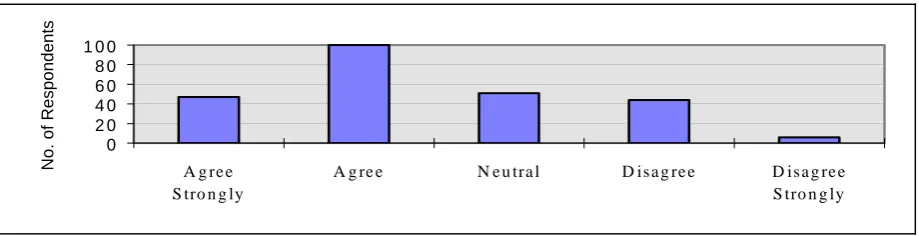
Adding to this concern is the strong support (51%), as shown in figure 5, that was found for the hypothesis that Government policy favouring certification will benefit multinationals at the expense of local developers.
5.3.3 Hypothesis 5: Competitive Forces
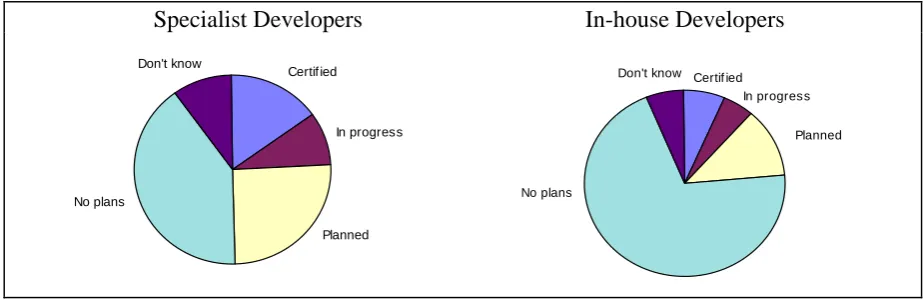
In comparing the certification progress of specialist and in-house developers, a chi-square test showed very significant association between certification progress and the specialist/in-house variable: χ2=21.66135, df=2, p<.001 (17 organisations reported an even distribution between external and internal clients and were omitted from this part of the analysis). As shown in figure 6, within 12 months a significant proportion of specialist developers (24%) will be certified (15% already certified; 9% in progress). As expected, a smaller but still significant proportion of in-house developers (12%) will reach this goal in 12 months (7% already certified; 5% in progress).
Specialist Developers In-house Developers
No plans
Planned In progress Don't know
Certif ied
Planned In progress Certif ied
No plans
[image:10.595.66.528.257.407.2]Don't know
Figure 6: Comparison of adoption rates: specialist vs. in-house developers
It was not surprising to find that specialist developers are twice as likely to be certified as the in-house developers. The latter, having a potentially ‘captive’ client, may not be subjected to the same competitive pressures as the former. Among the specialist developers, early adopters may gain a temporary competitive advantage from their QA certification, however this is unlikely to be sustainable as it is expected that in due course certification will be a competitive necessity for this market segment.
To determine if a relationship exists between certification progress and client type, the sample was split into 2 groups, group A with overseas and/or government clients and group B with Australian private sector clients. The relationship was confirmed: χ2=15.94573, df=2, p<.001. Only one specialist developer, of the 27 certified or in progress, does not have government and/or overseas clients.
This provides strong evidence that government policy and international trade demand certification. It suggests that while reputation may be sufficient in circles where everyone knows each other, in international trade formal standards are sought. This is supported by Bawden (1994, p.51): “The client-developer relationship can become more distant ... when the size of the software market ... grows or when geographic separation between them grows ... the client’s ability to utilise past experience or references decreases, and the value of independent assessment increases.”
5.4 Further Analysis
• CMM levels and maturity stages compared with certification progress
• Effect of organisational factors separately for specialist and in-house developers
• Perceptions towards value of certification and government policy by client type, size, ownership
• Profiles for certification progress and maturity by State
• Respondents’ written comments
• Diffusion of software engineering practices
• Mortality rate in industry based on undeliverable questionnaires
• International comparison on extent of certification, maturity, perceptions
• Industry sector of in-house developers.
6 CONCLUSION
As demonstrated in the discussion of preliminary findings above, this study has important implications for IS research, management practice and government policy. As well as confirming the increasing adoption of QA certification by Australian software developers, it has provided preliminary empirical evidence linking certification to improved capability maturity. The findings also suggest that certified organisations are more likely to be large, foreign-owned specialist developers with government or overseas clients. Further research is needed to address the issue of government purchasing policy mandating certification, and the impact of this policy on the local software development industry.
REFERENCES
AIIA (1995) Membership Quality Survey Report, Mar.
Ashton S. (1996) “The Value of User Evaluation”, Computerworld, Sept 27, 44.
Bamford R. C. & Deibler W. J. (1993) “Comparing, Contrasting ISO 9001 and the SEI Capability Maturity Model”, Computer, Oct, 68-70.
Bawden V. (1994) Software Quality Certification: A Rational Client's Perspective, Bris: UQ, Nov.
Bayer J. & Melone N. (1989) “A Critique of Diffusion Theory as a Managerial Framework for Understanding Adoption of Software Engineering Innovations”, Journal of Systems & Software, Feb.
Billings C., Clifton J., Kolkhorst B., Lee E. & Wingert W. B. (1994) “Journey to a Mature Software Process”, IBM Systems Journal, 33(1).
Birmingham A. (1996a) “Users Slam Computer Cowboys”, Computerworld, Feb 23, 4.
Birmingham A. (1996b) “Telstra Time Bomb Ticks to $100m”, Computerworld, Jun 21, 1.
Boehm B. W. (1988) “Understanding and Controlling Software Costs”, IEEE Transactions on
Software Engineering, Oct, 14:10.
Bryan L. (1996) “RTA Battles Internal IS Crisis”, Computerworld, 1 Mar; 18(30), 1,6.
Chmiel W. F. & Wilson D. N. (1993) “Software Quality Assurance: Now Is the Time Australia”,
Australian Computer Journal, Aug, 25(3), 94-97.
Coleman S. (1996) “Whatever Happened to all the Little Fishes?”, Computerworld, Apr 12, 34.
Collins J. (1994) “We Need Cheaper Quality Accreditation”, Computerworld, May 13; 16(40):41.
Davis C. J., Thompson J. B. & Smith P. (1992) “A Survey of Approaches to Software Quality within the United Kingdom”, Occasional Paper, University of Sunderland, 92(5).
Dawood M. (1994) “Companies, Agencies Should Seek ISO 9000 Certification”, Computer, Mar,
110-111.
Drehmer D. & Dekleva S. (1993) “Measuring Software Engineering Maturity: a Rasch Calibration”,
Proceedings of ICIS, Dec.
Dunn R. H. & Ullman R. S. (1994) TQM for Computer Software, McGraw-Hill, New York.
Fichman R.G. (1994) “The Assimilation and Diffusion of Software Process Innovations”, ICIS
Doctorial Consortium, Vancouver.
Fried L. (1995) Managing Information Technology in Turbulent Times, Wiley-QED, New York.
Fry M. (1992) “The Information Technology Industry in New South Wales: A Report to the National Industry Extension Service”, University of Technology, Sydney, Aug.
Ghosh H. (1995) “An Approach to Software Process Assessment in India”, Proceedings of 2nd
International SPICE Symposium, Jun.
Humphrey Watts S. (1988) “Characterizing the Software Process: A Maturity Framework”, IEEE
Software, Mar.
Ireland S. (1996) “Ferntree Flies a New Flag”, Computerworld, Mar 29, 30.
Ko R. (1995) “Status and Approaches of Software Process Improvement in Hong Kong”, Proceedings
of 2nd International SPICE Symposium, Jun.
Leonard-Barton D. (1987) “Implementing Structured Software Methodologies: A Case of Innovation in Process Technology”, Interfaces, May-Jun.
Madden R. (1995) Computing Services Industry, Australia 1992-93 Canberra: ABS.
Maiden M. (1996) “Revealed: How CBA Fell into Techno-Trap”, Sydney Morning Herald, May 3,
21-22.
McLennan W. (1995) Information Technology in Australia 1992-93, Canberra: ABS.
Paulk M. C. (1995) Capability Maturity Model: Guidelines for Improving the Software Process,
Addison-Wesley, Reading.
Prodromou A. (1996) “In-house Apps Too Costly”, Computerworld, Feb 23, 18(29), 4.
Robinson K. & Simmons P. (1995) “The Perception of Internal Developers Towards the Value of a
Certified Quality Management System”, ACIS 95 Proceedings, September.
Rogers E. M. (1995) Diffusion of Innovations, 4th ed. Free Press, New York.
Rout T. (1992) “Software Quality and Maturity of the Software Process”, The Source, June.
Smillie E. (1993) “Standards for Australia”, Informatics, Aug.
Tan M. & Yap C. Y. (1995) Impact of Organisational Maturity on Software Quality, Chapman & Hall for IFIP, London.
Von Hellens L. A. (1994) “Quality Management Systems in Australian Software Houses: Some
Problems of Sustaining Creativity in the Software Process”, ACIS 94 Proceedings; Sept, Monash
University Melbourne, 479-492.