Copyright © 2004, American Society for Microbiology. All Rights Reserved.
Human Immunodeficiency Virus Type 1 Escapes from RNA
Interference-Mediated Inhibition
Atze T. Das,
1† Thijn R. Brummelkamp,
2† Ellen M. Westerhout,
1Monique Vink,
1Mandy Madiredjo,
2Rene´ Bernards,
2and Ben Berkhout
1*
Department of Human Retrovirology, Academic Medical Center, University of Amsterdam,1and Division
of Molecular Carcinogenesis, The Netherlands Cancer Institute,2Amsterdam, The Netherlands
Received 3 September 2003/Accepted 14 October 2003
Short-term assays have suggested that RNA interference (RNAi) may be a powerful new method for intra-cellular immunization against human immunodeficiency virus type 1 (HIV-1) infection. However, RNAi has not yet been shown to protect cells against HIV-1 in long-term virus replication assays. We stably introduced vectors expressing small interfering RNAs (siRNAs) directed against the HIV-1 genome into human T cells by retroviral transduction. We report here that an siRNA directed against the viral Nef gene (siRNA-Nef) confers resistance to HIV-1 replication. This block in replication is not absolute, and HIV-1 escape variants that were no longer inhibited by siRNA-Nef appeared after several weeks of culture. These RNAi-resistant viruses con-tained nucleotide substitutions or deletions in the Nef gene that modified or deleted the siRNA-Nef target sequence. These results demonstrate that efficient inhibition of HIV-1 replication through RNAi is possible in stably transduced cells. Therefore, RNAi could become a realistic gene therapy approach with which to over-come the devastating effect of HIV-1 on the immune system. However, as is known for antiviral drug therapy against HIV-1, antiviral approaches involving RNAi should be used in a combined fashion to prevent the emer-gence of resistant viruses.
The introduction of small interfering RNA (siRNA) into mammalian cells can activate RNA interference (RNAi), re-sulting in sequence-specific degradation of the targeted RNA. RNAi may be a powerful new method for intracellular immu-nization against human immunodeficiency virus type 1 (HIV-1) infection. It has been demonstrated in short-term assays that HIV-1 replication can be inhibited by siRNAs directed against viral or cellular targets (1, 6, 10, 11, 14, 15, 17, 19, 20). To demonstrate that RNAi can protect cells against HIV-1 in long-term virus replication assays and to study the evolution of the inhibited virus, we stably introduced vectors expressing siRNAs directed against eight HIV-1 targets into human T cells (Fig. 1A). We selected target sequences in the infectious HIVLAImolecular clone that are highly conserved among virus
isolates (13), which warrants a widespread application of the potential RNAi therapy. Furthermore, we selected targets with-in the structured HIV-1 RNA genome that are highly accessi-ble as determined with antisense DNA oligonucleotide arrays (2, 19a). There is recent evidence that the efficacy of siRNAs is similarly influenced by secondary structure in the target tran-script (3, 12). These two selection criteria forced us in some cases to accept a suboptimal design of the siRNA molecule. The selected targets included essential replication signals such as the primer-binding site (Fig. 1A, PBS-A and PBS-B) and the polypurine tract (PPT), a segment in the overlap between the Tat and the Rev genes (TatRevA and TatRevB), and part of the 5⬘untranslated leader region (UTR-A and UTR-B). Furthermore, we selected an siRNA targeting the viral Nef
gene (siRNA-Nef) that was previously demonstrated to pro-vide efficient silencing in a transient-transfection system (10).
The pRETRO-SUPER vector (5) expresses the siRNAs from the human H1 polymerase III promoter as a small hair-pin. These vectors were stably transduced into the human T-cell line SupT1. This cell line allows the rapid and massive spread of HIVLAI, as is apparent for the control SupT1 cells
transduced with the empty pRETRO-SUPER vector (Fig. 1B). SupT1 T cells expressing a specific siRNA were infected with equal amounts of HIVLAI. Fast virus replication was observed
in all SupT1 cultures except those with cells expressing the siRNA against Nef (Fig. 1C). The replication of HIVLAIwas
profoundly reduced in cells expressing siRNA-Nef compared with that in the control cells transduced with the empty vector. We did not observe any growth retardation of the siRNA-Nef cells, indicating that the decrease in HIV-1 replication in these cells is not due to a nonspecific cell toxicity problem.
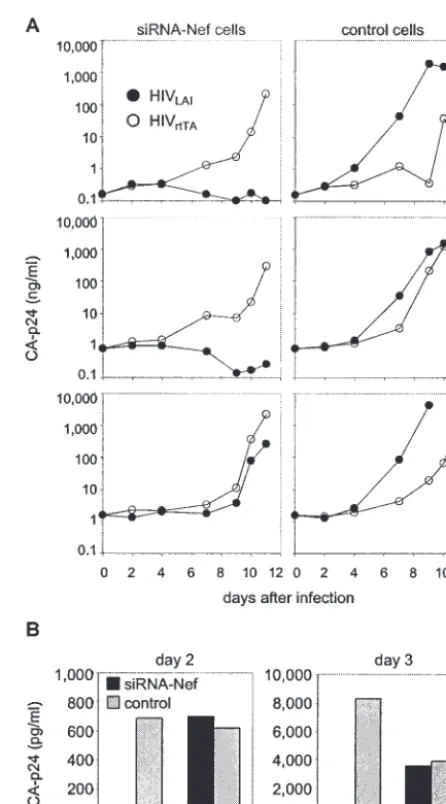
A second independently prepared batch of siRNA-Nef-transduced cells showed the same resistance phenotype against both low and intermediate doses of HIVLAI(Fig. 2A, top and
middle panels, respectively). However, the block in viral rep-lication was not absolute, and a high dose of input virus al-lowed a low level of replication (Fig. 2A, bottom panels). We demonstrated efficient replication of HIVLAIon a new batch of
control cells transduced with the empty vector (Fig. 2A, right panels). As a further control for the specificity of the observed inhibition, we used an HIV-1 variant in which the Nef gene is replaced by the rtTA gene (HIVrtTA) (18, 21). HIVrtTAlacks
the Nef target sequence and replicated efficiently in both the control cells and the cells that express the siRNA against Nef (Fig. 2A). These results demonstrate the sequence-specific in-hibition of HIV-1 replication by the RNAi targeting of Nef
* Corresponding author. Mailing address: Department of Human Retrovirology, Academic Medical Center, University of Amsterdam, Meibergdreef 15, 1105 AZ Amsterdam, The Netherlands. Phone: 31 20 566 4822. Fax: 31 20 691 6531. E-mail: [email protected].
† A.T.D. and T.R.B. contributed equally to this work.
2601
on November 8, 2019 by guest
http://jvi.asm.org/
gene sequences that are present in the unspliced viral RNA genome and all spliced subgenomic HIV-1 transcripts.
siRNA-mediated gene silencing may inhibit virus replication at a number of stages of the HIV-1 replication cycle. It is most likely that siRNA-Nef is able to target the newly synthesized viral transcripts in HIV-infected cells. To directly test this possibility, we transfected the set of SupT1 cells with the pro-viral HIVLAIDNA and measured virus production after 2 and
3 days (Fig. 2B). The cells that actively produce siRNA-Nef showed a ⬎10-fold reduction in virus production compared with that in the control cells. Furthermore, this inhibition of
gene expression was specific for wild-type HIV-1, because no such effect was observed for the HIVrtTAvariant with the Nef
gene deleted.
Only one out of eight siRNA constructs tested can effectively control a spreading HIV-1 infection. This siRNA against Nef was also effective when transfected as an oligonucleotide in a transient-transfection assay (10). The other siRNAs tested did not inhibit HIVLAI, even though the sequences perfectly
[image:2.603.49.280.64.459.2]matched the viral transcript. Presently, we do not know why siRNA-Nef is such an effective inhibitor of HIV-1 replication. One reason may be that this siRNA targets both the unspliced
FIG. 1. siRNA targeting of HIV-1. (A) SupT1 cells were stably transduced with the empty pRETRO-SUPER retroviral vector (4, 5) (control) or with vectors expressing siRNAs against eight target se-quences in the HIV genome: PBS-A, GTGGCGCCCGAACAGGGA CTT; PBS-B, TGGCGCCCGAACAGGGACTT; PPT, GGGGGGA CTGGAAGGGCTA; TatRev-A, GCCTTAGGCATCTCCTATG; TatRev-B, CCTATGGCAGGAAGAAGCG; UTR-A, GCGGAGGC TAGAAGGAGAG; UTR-B, GGCTAGAAGGAGAGAGATG; and Nef, GTGCCTGGCTAGAAGCACA. (B) Cells were infected with HIVLAI(800 pg of CA-p24 in a 5-ml culture), and virus replication was
monitored by determining the CA-p24 level in the culture supernatant. (C) Predicted structure of the siRNA-Nef transcript. The sequence targeting the Nef gene is shown in bold.
FIG. 2. Sequence-specific inhibition of HIV-1 replication. (A) SupT1 cells stably transduced with the siRNA-Nef vector (left panels) or the empty vector (right panels) were infected with wild-type HIVLAI
(closed circles) or HIVrtTAwith the Nef gene deleted (open circles).
The virus input levels were 800 pg of CA-p24 (top panels), 4,000 pg of CA-p24 (middle panels), and 8,000 pg of CA-p24 (bottom panels) in 5-ml cultures. Virus spread was monitored by determining the CA-p24 level in the culture supernatant. (B) siRNA-Nef and control cells were transfected with 10g of DNA encoding wild-type HIVLAIor HIVrtTA
with the Nef gene deleted as described previously (7). Virus produc-tion in the culture supernatant at 2 and 3 days after transfecproduc-tion was measured by a CA-p24 enzyme-linked immunosorbent assay.
on November 8, 2019 by guest
http://jvi.asm.org/
[image:2.603.309.532.210.612.2]and all spliced forms of HIV-1 RNA. However, the inactive siRNA-PBS and siRNA-PPT constructs also have this prop-erty. Thus, there may be additional features of the siRNA (e.g., expression level and intracellular location) or the target RNA (e.g., masking by viral and/or cellular proteins within the cell or virion particle) that determine the overall efficiency of inhibi-tion. We have already mentioned that the selection of highly conserved and highly accessible target sites within the HIV-1 RNA genome had a negative impact on the design of some siRNAs. More-detailed studies are needed to resolve some of these issues.
We cultured the siRNA-Nef-transduced cells for more than 8 months and frequently assayed HIVLAIand HIVrtTA
repli-cation. The cells maintained a constant level of resistance to HIVLAIreplication, demonstrating the stable expression of the
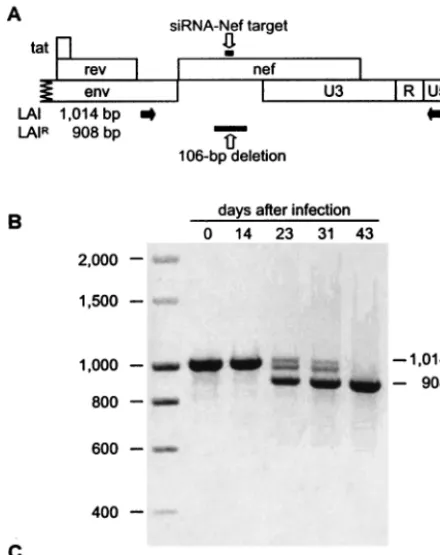
siRNA-Nef gene. The nearly complete resistance of these T cells to HIV-1 replication allowed the selection of HIV-1 es-cape mutants that are no longer sensitive to RNAi against the Nef target sequence. To select an escape virus, we massively infected the nonpermissive cells that express siRNA-Nef, and a relatively fast replicating variant was obtained after 23 days. The targeted Nef gene was PCR amplified (Fig. 3A) at each passage, and DNA gel analysis of the PCR product indicated the loss of viral sequences around day 23 (Fig. 3B). Sequence analysis revealed a deletion of 106 bp within the Nef gene that removes the siRNA-Nef target sequence (Fig. 3C). The dele-tion of the target sequence provides a simple explanadele-tion for the observed resistance phenotype. To verify this explanation, we used equal amounts of the evolved HIVLAI(LAIR1) and
the wild-type virus (LAI) to infect control SupT1 cells and cells that express siRNA-Nef. Whereas LAI is selectively inhibited in the siRNA-Nef-expressing cells (Fig. 3D, left panel), no such effect is apparent for the resistant LAIR1variant (Fig. 3D, right
panel).
We selected six additional resistant HIV-1 variants in inde-pendent cultures of HIVLAI on siRNA-Nef-expressing cells
(Fig. 4). In four of these escape variants, the siRNA-Nef target sequence was completely or partially deleted (Fig. 4, variants LAIR2, LAIR4, LAIR5, and LAIR7). These deletions did not
affect genes other than the Nef gene and did not affect impor-tant regulatory elements such as the 3⬘ polypurine tract or long terminal repeat sequences. For two variants (LAIR3
and LAIR6), we observed nucleotide substitutions within the
siRNA-Nef target sequence. These results show that resistance to RNAi can result from both the deletion and the mutation of the siRNA-targeted sequence. In one of the cultures (LAIR3),
the RNAi-resistant virus contained one nucleotide substitution after 27 days of culture, and a second mutation was acquired after 62 days. These results suggest that one nucleotide
mis-FIG. 3. HIVLAIdevelops resistance against siRNA-Nef by deleting
the Nef target sequence. SupT1 cells expressing siRNA-Nef were mas-sively infected with HIVLAIto overcome the siRNA-mediated
inhibi-tion of replicainhibi-tion. The virus was passaged repeatedly onto fresh SupT1–siRNA-Nef cells. Cells were initially infected with a high virus dose that could be reduced gradually. (A) Schematic of the 3⬘end of the HIVLAIproviral genome. Indicated are the positions of the
siRNA-Nef-targeted sequence, the PCR primers (black arrows), and the 106-bp deletion observed after prolonged virus culture. (B) At each pas-sage, the proviral DNA present in infected cells was PCR amplified
with primers that amplify the complete Nef gene as a 1,014-bp frag-ment. At 23 days after infection, a fast-replicating variant containing a 106-bp deletion in the Nef gene was observed. At 43 days after infec-tion, this siRNA-Nef-resistant virus dominated the virus population. (C) Sequences of the Nef gene in the HIVLAIvirus and in the evolved
siRNA-Nef-resistant virus (LAIR1) with the 106-bp deletion
encom-passing the siRNA-Nef target sequence. (D) Infection of SupT1 con-trol cells and siRNA-Nef-expressing cells with wild-type LAI (left panel) or the evolved LAIR1variant harvested at day 43 (right panel).
We used equal virus input levels (400 pg of CA-p24 in a 5-ml culture).
on November 8, 2019 by guest
http://jvi.asm.org/
[image:3.603.55.275.71.348.2]match between the siRNA and its target sequence provides only partial RNAi resistance.
Antiviral therapy based on siRNA has been proposed pre-viously (9) for the rapidly replicating and highly cytolytic po-liovirus, and this study also reported an escape virus with a point mutation in the middle of the targeted sequence. This RNAi-resistant poliovirus variant was likely present in the ini-tial virus population (9). In contrast, the HIV-1 experiments in the present study were initiated with a molecularly cloned viral genome. Furthermore, we observed diverse deletions and sub-stitutions in the resistant viruses. Therefore, we can conclude that the selected RNAi-resistant HIV-1 variants emerged de novo. The combined analysis of siRNA escape viruses in both studies confirms that the antiviral effect is potent and sequence specific.
LAIR6is the only RNAi-resistant HIV-1 variant with a silent
codon change and thus produces the wild-type Nef protein. Nonsilent nucleotide substitutions in LAIR3 result in two
amino acid changes (A56T and L58R). The LAIR1and LAIR2
variants have a deletion that results in a frameshift and a large C-terminal truncation of the Nef protein. The in-frame dele-tions in LAIR4, LAIR5, and LAIR7result in the absence of 2,
31, and 75 amino acids in the Nef protein, respectively. The complete inactivation of the accessory Nef gene has a relatively
minor impact on the replication fitness of HIV-1 in vitro but significantly attenuates replication in vivo (8). It therefore seems less likely that HIV-1 will acquire resistance in vivo by the deletion of the Nef sequence. The virus may instead evolve resistance by accumulating silent point mutations in the Nef target sequence. Also, when targeting essential viral genes, the virus may become resistant as a result of silent mutations. The targeting of cellular genes could therefore be advantageous. Obvious cellular targets that have an immediate impact on HIV-1 replication are the CD4 receptor and the CCR5/ CXCR4 coreceptors. As was recently demonstrated, siRNAs specific for these receptors do indeed inhibit HIV-1 replication (17, 19, 20). Although the suppression of CD4 and CXCR4 may be restricted by their normal role in the immune system and cell migration, respectively, CCR5 seems dispensable for normal life (16). Unfortunately, not all HIV strains require CCR5, and the inhibition of CCR5 may result in the selec-tion of HIV-1 variants that use CXCR4 as a coreceptor. We therefore propose that HIV-1 should be targeted by multiple siRNAs against essential HIV-1 elements, either genes or reg-ulatory sequences. Although the targeting of a single HIV-1 sequence can result in the strong inhibition of viral replication, it is likely followed by viral escape. Analogous to the current clinical use of combinations of antiviral drugs that target the reverse transcriptase and protease enzymes, antiviral approaches using RNAi should also be administered in a com-bined fashion to prevent viral escape.
We thank S. P. Heynen for the CA-p24 enzyme-linked immunosor-bent assay.
This work was supported by grants from the Technology Foundation STW, the NWO-VICI program, and the Center for Biomedical Ge-netics.
REFERENCES
1. Arteaga, H. J., J. Hinkula, I. Dijk-Hard, M. S. Dilber, B. Wahren, B. Chris-tensson, A. J. Mohamed, and C. I. Edvard Smith.2003. Choosing CCR5 or
Rev siRNA in HIV-1. Nat. Biotechnol.21:230–231.
2. Berkhout, B., M. Ooms, N. Beerens, H. Huthoff, E. Southern, and K. Ver-hoef.2002. In vitro evidence that the untranslated leader of the HIV-1 genome is an RNA checkpoint that regulates multiple functions through
conformational changes. J. Biol. Chem.277:19967–19975.
3. Bohula, E. A., A. J. Salisbury, M. Sohail, M. P. Playford, J. Riedemann, E. M. Southern, and V. M. Macaulay.2003. The efficacy of small interfering RNAs targeted to the type 1 insulin-like growth factor receptor (IGF1R) is influenced by secondary structure in the IGF1R transcript. J. Biol. Chem.
278:15991–15997.
4. Brummelkamp, T. R., R. Bernards, and R. Agami.2002. A system for stable
expression of short interfering RNAs in mammalian cells. Science296:550–
553.
5. Brummelkamp, T. R., R. Bernards, and R. Agami.2002. Stable suppression
of tumorigenicity by virus-mediated RNA interference. Cancer Cells2:243–
247.
6. Coburn, G. A., and B. R. Cullen.2002. Potent and specific inhibition of human immunodeficiency virus type 1 replication by RNA interference.
J. Virol.76:9225–9231.
7. Das, A. T., B. Klaver, B. I. F. Klasens, J. L. B. van Wamel, and B. Berkhout.
1997. A conserved hairpin motif in the R-U5 region of the human immu-nodeficiency virus type 1 RNA genome is essential for replication. J. Virol.
71:2346–2356.
8. Deacon, N. J., A. Tsykin, A. Solomon, K. Smith, M. Ludford-Menting, D. J. Hooker, D. A. McPhee, A. L. Greenway, A. Ellett, C. Chatfield, V. A. Lawson, S. Crowe, A. Maerz, S. Sonza, J. Learmont, J. S. Sullivan, A. Cunningham, D. Dwyer, D. Dowton, and J. Mills.1995. Genomic structure of an attenuated quasi species of HIV-1 from blood transfusion donor and recipients. Science
270:988–991.
9. Gitlin, L., S. Karelsky, and R. Andino.2002. Short interfering RNA confers
intracellular antiviral immunity in human cells. Nature418:430–434.
10. Jacque, J. M., K. Triques, and M. Stevenson.2002. Modulation of HIV-1
[image:4.603.50.276.73.351.2]replication by RNA interference. Nature418:435–438.
FIG. 4. RNAi-resistant HIV-1 variants. HIVLAIvariants resistant
to siRNA-Nef were selected in independent cultures and analyzed as described in the legend to Fig. 3. (A) PCR amplification of the Nef gene on the indicated day (LAI, input HIVLAIvirus; R1, LAIR1escape
virus shown in Fig. 3 at day 43; R2 to R7, independent HIVLAIescape
variants); (B) Nef target sequence in the evolved RNAi-resistant vi-ruses. In LAIR5, nucleotides 179 to 241 of the Nef gene are deleted. In
LAIR7, we observed the deletion of nucleotides 44 to 268 and a T269A
substitution.
on November 8, 2019 by guest
http://jvi.asm.org/
11. Joost Haasnoot, P. C., D. Cupac, and B. Berkhout.2003. Inhibition of virus
replication by RNA interference. J. Biomed. Sci.10:607–616.
12. Kretschmer-Kazemi, F. R., and G. Sczakiel.2003. The activity of siRNA in mammalian cells is related to structural target accessibility: a comparison
with antisense oligonucleotides. Nucleic Acids Res.31:4417–4424.
13. Kuiken, C., B. Foley, E. Freed, B. Hahn, P. A. Marx, F. McCutchan, J. W. Mellors, S. Wolinsky, and B. Korber.2002. HIV sequence compendium. LA-UR no. 03-3564. Theoretical Biology and Biophysics Group, Los Alamos National Laboratory, Los Alamos, N.Mex.
14. Lee, N. S., T. Dohjima, G. Bauer, H. Li, M. J. Li, A. Ehsani, P. Salvaterra, and J. Rossi.2002. Expression of small interfering RNAs targeted against
HIV-1 rev transcripts in human cells. Nat. Biotechnol.20:500–505.
15. Li, M. J., G. Bauer, A. Michienzi, J. K. Yee, N. S. Lee, J. Kim, S. Li, D. Castanotto, J. Zaia, and J. J. Rossi.2003. Inhibition of HIV-1 infection by lentiviral vectors expressing Pol III-promoted anti-HIV RNAs. Mol. Ther.
8:196–206.
16. Liu, R., W. A. Paxton, S. Choe, D. Ceradini, S. R. Martin, R. Horuk, M. E. MacDonald, H. Stuhlmann, R. A. Koup, and N. R. Landau.1996.
Homozy-gous defect in HIV-1 coreceptor accounts for resistance of some multiply
exposed individuals to HIV-1 infection. Cell86:367–377.
17. Martinez, M. A., B. Clotet, and J. A. Este.2002. RNA interference of HIV
replication. Trends Immunol.23:559–561.
18. Marzio, G., K. Verhoef, M. Vink, and B. Berkhout.2001.In vitroevolution of a highly replicating, doxycycline-dependent HIV for applications in vaccine
studies. Proc. Natl. Acad. Sci. USA98:6342–6347.
19. Novina, C. D., M. F. Murray, D. M. Dykxhoorn, P. J. Beresford, J. Riess, S. K. Lee, R. G. Collman, J. Lieberman, P. Shankar, and P. A. Sharp.2002.
siRNA-directed inhibition of HIV-1 infection. Nat. Med.8:681–686.
19a.Ooms, M., K. Verhoef, E. Southern, H. Huthoff, and B. Berkhout.Probing alternative foldings of the HIV-1 leader RNA by antisense oligonucleotide scanning arrays. Nucleic Acids Res., in press.
20. Qin, X. F., D. S. An, I. S. Y. Chen, and D. Baltimore.2003. Inhibiting HIV-1 infection in human T cells by lentiviral-mediated delivery of small interfering
RNA against CCR5. Proc. Natl. Acad. Sci. USA100:183–188.
21. Verhoef, K., G. Marzio, W. Hillen, H. Bujard, and B. Berkhout.2001. Strict control of human immunodeficiency virus type 1 replication by a genetic
switch: Tet for Tat. J. Virol.75:979–987.