This is a repository copy of
Solvent responsive catalyst improves NMR sensitivity via
efficient magnetisation transfer
.
White Rose Research Online URL for this paper:
http://eprints.whiterose.ac.uk/100852/
Version: Published Version
Article:
Duckett, Simon orcid.org/0000-0002-9788-6615 and Ruddlesden, Amy Jane (2016)
Solvent responsive catalyst improves NMR sensitivity via efficient magnetisation transfer.
Chemical communications. ISSN 1364-548X
https://doi.org/10.1039/C6CC03185D
[email protected]
https://eprints.whiterose.ac.uk/
Reuse
This article is distributed under the terms of the Creative Commons Attribution (CC BY) licence. This licence
allows you to distribute, remix, tweak, and build upon the work, even commercially, as long as you credit the
authors for the original work. More information and the full terms of the licence here:
https://creativecommons.org/licenses/
Takedown
If you consider content in White Rose Research Online to be in breach of UK law, please notify us by
Cite this:Chem. Commun.,2016,
52, 8467
Solvent responsive catalyst improves NMR
sensitivity
via
efficient magnetisation transfer
†
Amy J. Ruddlesden and Simon B. Duckett*
A bidentate iridium carbene complex, Ir(jC,O-L1)(COD), has been synthesised which contains a strongly electron donating carbene ligand that is functionalised by a cis-spanning phenolate group. This complex acts as a precursor to effective magnetisation transfer catalysts which form after reaction with H2and a suitable two electron donor. In solvents such as benzene, containing pyridine, they are exemplified by neutral, chiral Ir(H)2(jC,O-L1)(py)2 with inequivalent hydride ligands and Ir–O bond retention, whilst in methanol, Ir–O bond cleavage leads to zwitterionic [Ir(H)2(jC,O -L1)(py)3]+, with chemically equivalent hydride ligands. The active catalyst’s form is therefore solvent dependent. Both these complexes break the magnetic symmetry of the hydride ligands and are active in the catalytic transfer of polarisation fromparahydrogen to a loosely bound ligand. Test results on pyridine, nicotinaldehyde and nicotine reveal up toE1.2% single spin proton polarisation levels in their
1H NMR signals which compare to the normal 0.003% level at 9.4 Tesla. These results exemplify how rational catalyst design yields a solvent dependent catalyst with good SABRE activity.
The use of hyperpolarisation methods to overcome the inherent insensitivity of NMR spectroscopy reflects an area of research whereParahydrogen Induced Polarisation (PHIP) features heavily.1 The incorporation ofparahydrogen (p-H2), a nuclear singlet, into a molecule was first shown to produce an enhanced NMR signal in 1987.2The increase in signal intensity for resonances arising from, or coupled to,p-H2derived protons, has since been the subject of intense investigation. Recently a p-H2 technique that does not chemically change a molecule, called Signal Amplification By Reversible Exchange (SABRE), has been developed.3Polarisation is transferred throughJ-coupling between thep-H2derived hydride
ligands and the substrate ligands.3Exchange with free substrate and freshp-H2enables the build-up of polarisation in the substrate pool through multiple visits to the catalyst. The most commonly used catalysts are cationic species which contain either phos-phine4,5or N-heterocyclic carbene (NHC) ligands.6,7
In fact, one of the most effective magnetisation transfer catalysts is Ir(COD)(IMes)Cl7 [where IMes = 1,3-bis(2,4,6-trimethylphenyl)imidazole-2-ylidene, COD = cyclooctadiene] which forms the charged complex, [Ir(H)2(IMes)(substrate)3]Cl once activated with H2and a substrate. This SABRE catalyst contains chemically equivalent but magnetically inequivalent hydride ligands and polarisation transfer has proven particularly efficient in polar protic solvents such as methanol. Furthermore, using this catalyst a wide range of substrates including nicotinamide,8–10 isoniazid11 and pyrazole12have been shown to become hyper-polarised. This type of approach has been exemplified for 1H,13C,31P,19F and15N nuclei.5,13–15However, due to the charged
nature of such a species, it has proven less efficient in the range of low polarity solvents commonly used in NMR analysis.
It has also been shown that species with chemically inequi-valent hydride ligands can act as SABRE catalysts. One reported example of this class of catalyst is given by [Ir(H)2(CH3 CN)(IMes)-(PCy3)(pyridine)]Cl.16 Recently, a system that exhibits a wider solvent tolerance has been developed. It contains a bidentate ligand which binds through carbene and phenolate centres, resulting in a neutral catalyst in all solvents tested. While it was found to exhibit greater activity in non-polar solvents such as benzene,17 it was not efficient in methanol due to much slower ligand exchange.
In this study, the related neutral iridium complex, Ir(kC,O-L1 )-(COD),1, [where L1= 3-(2-methylene-phenolate)-1-(2,4,6-trimethyl-phenyl)imidazolylidene], has been synthesised starting from salicylaldehyde. It contains acis-spanning phenolate-substituted bidentate NHC (see Scheme 1). Benzyl protection of the phenol18 allowed conversion of the aldehyde to the bromide19 via the alcohol.20Addition of 1-(2,4,6-trimethylphenyl)-1H-imidazole then formed the imidazolium bromide salt.21Deprotection followed by silver carbene formation and subsequent transmetallation22 Centre for Hyperpolarisation in Magnetic Resonance (CHyM), York Science Park,
University of York, Heslington, York, YO10 5NY, UK. E-mail: [email protected]; Tel:+44 (0)1904 322564
†Electronic supplementary information (ESI) available: Experimental details; synthesis and characterisation of compounds, SABRE experiments, kinetic data, activation parameters, UV-vis data. The underlying research data for this paper is available in accordance with EPSRC open data policy from DOI: 10.15124/ cdaf969f-ba47-401e-876b-512c0cece55c. See DOI: 10.1039/c6cc03185d
Received 15th April 2016, Accepted 2nd June 2016
DOI: 10.1039/c6cc03185d
www.rsc.org/chemcomm
COMMUNICATION
Open Access Article. Published on 02 June 2016. Downloaded on 10/02/2017 12:45:19.
This article is licensed under a
Creative Commons Attribution-NonCommercial 3.0 Unported Licence.
View Article Online
afforded the product, the phenoxide iridium carbene complex,1. Key compounds have been characterised by NMR and MS as illustrated in the ESI.†
In solution, complex 1 appears yellow/orange in colour. UV-Vis analysis in DCM showed it exhibits three absorption bands in the visible region of the spectrum (373, 425 and 490 nm) with absorption coefficients in the range of charge transfer transitions (1017, 1326 and 249 dm3mol 1cm 1). Work by Perutz
et al.23–26has assigned similar bands in related square planar metal complexes to metal d–p transitions although earlier assignments suggested they were metal-to-ligand charge transfer bands.27–29
At room temperature, the1H NMR spectrum of complex1in CD2Cl2yields well resolved resonances (see Fig. 1). Two doublets atd6.53 and 5.17 are observed for the CH2linker protons which have a common2J(HH) coupling of 14.9 Hz. These two protons are diastereotopic due to the seven-membered metallocycle which is indicative of the retention of the Ir–O bond.30Complex 1is air/moisture sensitive but stable as a solid and in solution
under N2. It also forms stable complexes once fully reacted with substrate and hydrogen as detailed in the following reactions.
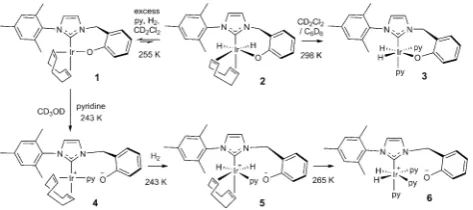
Upon cooling a CD2Cl2solution of complex1to 243 K all of its NMR signals become broad and undefined due to fluxional behaviour and when pyridine is added to this solution no reaction is evident. If, however, H2 gas is added at 255 K, a limited reaction occurs as two pairs of hydride signals are now seen atd 12.35 and 18.25 (1.7% conversion) and atd 12.39
and 17.64 (0.6%). These minor hydride containing products are conformational isomers of compound 2 (see Scheme 3) which arise due to differing metallocycle orientations;30 analo-gous behaviour has been reported.17
Whenp-H2is used in this reaction, these hydride ligand signals do not show any significant1H NMR signal enhancement. How-ever, the free H2 signal in these spectra is substantial which suggests that1undergoes rapid and reversible oxidative addition of H2to form2which consumes thep-H2. There is no indication of the hydrogenation of COD at 255 K and upon warming to 298 K, these hydride signals broaden into the baseline of the corres-ponding NMR spectra and strong signals for1are always visible. When a CD2Cl2solution of1reacts with both pyridine and H2at 298 K a new neutral iridium species, Ir(H)2(kC,O-L1)(py)2, 3 is observed to slowly form containing two bound pyridine
environments in a ratio of 1 : 1 (see ESI† for details). This species is also formed in C6D6. The mutually coupled inequi-valent hydride signals appear in CD2Cl2atd 22.55 and 25.49 (2J(HH) = 8.1 Hz) and in C
6D6atd 21.94 and 24.52 (2J(HH) = 7.7 Hz). Their inequivalence suggests Ir–O bond retention, a fact which is further supported by the diastereotopic nature of the CH2 linker protons which appear as doublets in both CD2Cl2 and C6D6. Both complexes undergo pyridine and H2 exchange as highlighted in Scheme 2, although only the pyridine ligand trans to hydride dissociates. The use of EXSY NMR31 experiments enabled determination of experimental rate con-stants for pyridine loss in3at 294 K of 3.740.06 s 1in CD2Cl2 and 13.50.6 s 1in C6D6. The corresponding H2loss rates were 0.800.01 s 1and 3.020.07 s 1respectively and are therefore much slower than those of pyridine loss.
This behaviour changes significantly upon moving to protic methanol. Now, the addition of H2 to a CD3OD solution of complex1at 250 K, results in a very limited reaction to form a dihydride (o1%, with resonances atd 12.65 and 18.27 and the low concentration presumably prevents observation of its conformational isomer) but upon warming further, rapid and total decomposition of1 follows. In contrast, the addition of pyridine to a CD3OD solution of complex1at 243 K forms the
Scheme 1 Synthetic route to1.
Fig. 1 1H NMR spectrum of1showing evidence for the diastereotopic CH2linker protons with key CH resonances labelled.
Scheme 2 Transfer of hydride polarisation into the indicated pyridine ligand is followed by ligand exchange to build-up hyperpolarised pyridine in solution.
Communication ChemComm
Open Access Article. Published on 02 June 2016. Downloaded on 10/02/2017 12:45:19.
This article is licensed under a
Creative Commons Attribution-NonCommercial 3.0 Unported Licence.
[image:3.595.47.286.515.695.2]phenolate dissociation product, square planar4quantitatively (see Scheme 3 and ESI†) where the COD ligand yields four inequivalent alkene proton resonances.
Upon the addition ofp-H2 and pyridine to4at 243 K, two PHIP enhanced hydride signals become immediately visible at
d 12.34 and 17.50 that are shown to coupleviaCOSY. They
arise from H2 addition to 4 which initially forms the alkene dihydride complex, 5. The CH2 linker protons of 5 remain diastereotopic on phenolate rotation due to the absence of a mirror plane. Upon warming to 265 K, this system evolves further and a single hydride signal becomes visible atd 22.18 due to the
formation of [Ir(H)2(kC,O -L1)(py)3]+,6; the COD is converted to cyclooctene. Further NMR analysis confirms that6contains two bound pyridine ligand environments, in a 2 : 1 ratio, two hydride ligands and an iridium–carbene bond. Its CH2linker protons are now equivalent, appearing as a singlet at d 4.83 due to the existence of a mirror plane as detailed in Scheme 3.
Complex 6 is zwitterionic, and its cationic Ir(III) centre is balanced by phenoxide ion formation. Hence the final reaction product formed from1with pyridine and H2is solvent dependent. The two pyridine ligands of6that lietransto hydride are shown to dissociate with an experimental rate constant of 1.350.03 s 1at 294 K, although no exchange of the pyridinetransto the carbene is observed. In CD3OD, rapid H/D exchange, accompanied by HD formation, is observed which prevents the quantification of the H2 loss rate in this solvent. At 294 K, the ligand exchange rates of species3in C6D6are therefore much faster than those in CD2Cl2, but both are faster than those of6in CD3OD as shown in the ESI.† The ligand exchange rates of6in CD3OH were examined as a function of temperature and activation parameters for these processes were calculated (see ESI†). The activation enthalpy values for both pyridine and hydride loss are very similar to each other (90.7 1.6 kJ mol 1 and 88.3 9.1 kJ mol 1 respectively). The entropy of activation values of 71.3 5.3 J K 1and 56.130.6 J K 1for pyridine and hydride loss respectively are also similar and positive thereby confirming the dissociative character of these steps.7 Similar ligand exchange processes, in a series of related complexes, yield values of similar size.7,32 A ligand exchange mechanism featuring reversible pyridine dissociation with H2lossvia[Ir(kC,O -L1)(H)2(H2)(py)2]+ is therefore indicated.33
Both catalysts3and6therefore exhibit the substrate and H2 exchange characteristics required for them to act as SABRE
catalysts. To test their substrate signal enhancing performance, samples were prepared containing catalyst 1 and a chosen substrate in the desired NMR solvent. These were rigorously degassed before the addition of 3 bars of H2. Samples were tested by reintroducing p-H2 into the headspace of the NMR tube, shaking the sample in the low field outside of the spectrometer and then rapidly transferring the sample into the spectrometer for examination. This resulted in the observa-tion of enhanced signals in the corresponding single scan 1H NMR spectra for the hydride ligands, bound substrate and
free substrate in solution as exemplified by Fig. 2. The total enhancement value seen for the five protons of pyridine in C6D6 proved to be 1850-fold under the conditions detailed. For CD2Cl2 this enhancement level was reduced to ca. 1660-fold whilst for CD3OD solution it became 710-fold. Given the corres-ponding gain in signal-to-noise levels that these enhancements Scheme 3 Species formed during the reaction of1with H2and pyridine
in CD3OD (4,5and6) and CD2Cl2(2and3) or C6D6(3) solution.
[image:4.595.50.287.49.154.2]Fig. 2 Thermally polarised and hyperpolarised 1H NMR spectra of a CD2Cl2solution containing 0.06 M pyridine, 11 mol%1and 3 barsp-H2. The enhanced signals for free and bound pyridine (in3) and the corres-ponding hydride ligands are indicated.
Table 1 Maximum 1H NMR SABRE enhancements (fold) observed for solutions containing pyridine (0.06 M and 11 mol%1), nicotinaldehyde (0.05 M and 14 mol%1) and nicotine (0.04 M and 16 mol%1) in CD2Cl2, C6D6and CD3OD under 3 barsp-H2
Solvent
Pyridine1H NMR SABRE enhancement (fold)
ortho meta para
C6D6 84327 60030 40413
CD2Cl2 87732 33757 45022
CD3OD 4265 4728 2433
Solvent
Nicotinaldehyde1H NMR SABRE enhancement (fold)
HA HB HC HD
C6D6 25917 20922 11822 24418
CD2Cl2 48636 40032 14834 39665
CD3OD 627 5910 267 656
Solvent
Nicotine1H NMR SABRE enhancement (fold)
HA HB HC HD
C6D6 40054 31548 8830 33880
CD2Cl2 41951 38148 14644 38655
CD3OD 294 283 33 313
Open Access Article. Published on 02 June 2016. Downloaded on 10/02/2017 12:45:19.
This article is licensed under a
[image:4.595.312.546.49.200.2]provide, the resulting time savings are substantial in all solvents. For comparison purposes, the site specific enhancement values for the substrates pyridine, nicotinaldehyde and nicotine are summarised in Table 1. The performance of1as a SABRE catalyst for pyridine like substrates has therefore been established.
It is known that the amount of signal enhancement observed in the1H NMR spectrum of a substrate under SABRE is signifi-cantly affected by the ligand exchange rates, as previously explained by Greenet al.34For comparison, [Ir(H)2(IMes)(py)3]Cl, is commonly used as the catalyst benchmark for SABRE and its pyridine dissociation rate32 was found to be 23 s 1. While the ligand dissociation rates for3and 6are much lower, they still achieve good hyperpolarisation levels. In fact, these data show that one pyridine substratetransto hydride in CD2Cl2or C6D6is more efficient at receiving SABRE than the two equivalent pyridine ligands of 6 in CD3OD. Furthermore, the concept of an active solvent responsive catalyst is illustrated.
In summary, the iridium precatalyst Ir(kC,O-L1)(COD), 1 con-taining a phenolate substituted NHC has been synthesised and shown to act as an efficient SABRE catalyst precursor. The active catalytic species is solvent dependent. Complex1contains an Ir–O bond which is affected by solvent polarity and proton availability; in non-polar C6D6and polar aprotic CD2Cl2, this bond is strong and substitution resistant with1forming Ir(kC,O-L1)(H)2(py)2(3) on reaction with H2and pyridine. In contrast, on changing to polar protic methanol, the Ir–O bond becomes labile and the phenolate easily dissociates from the iridium centre, such that zwitterionic [Ir(kC,O -L1)(H)2(py)3]+ (6) forms.6 is directly analogous to the efficient SABRE catalyst [Ir(H)2(IMes)(py)3]Cl which performs well in CD3OD but has lower activity in non-polar CD2Cl2 and C6D6. Both3and6undergo pyridine and H2exchange thereby enabling them to act as SABRE catalysts. Whilst6works well in CD3OD, catalyst neutrality in the non-polar solvents CD2Cl2 and C6D6 results in the formation of3 which is highly active for SABRE catalysis. This study therefore shows that catalyst design and control can lead to improved magnetisation transfer in a range of solvents, a requirement for future studies that seek to identify low concentration analytes35–37 and to produce hyperpolarised MRI contrast agents.
We acknowledge Bruker Biospin and the EPSRC for a student-ship (1359398) and the Wellcome Trust and Wolfson Foundation (092506 and 098335) for their generous funding. We thank Dr Jason Lynam, Prof. Gary Green and Dr Ryan Mewis for helpful comments.
References
1 T. C. Eisenschmid, R. U. Kirss, P. P. Deutsch, S. I. Hommeltoft, R. Eisenberg, J. Bargon, R. G. Lawler and A. L. Balch,J. Am. Chem. Soc., 1987,109, 8089.
2 C. R. Bowers and D. P. Weitekamp,J. Am. Chem. Soc., 1987,109, 5541. 3 R. W. Adams, S. B. Duckett, R. A. Green, D. C. Williamson and
G. G. R. Green,J. Chem. Phys., 2009,131, 194505.
4 K. D. Atkinson, M. J. Cowley, S. B. Duckett, P. I. P. Elliott, G. G. R. Green, J. Lopez-Serrano, I. G. Khazal and A. C. Whitwood,
Inorg. Chem., 2009,48, 663.
5 K. D. Atkinson, M. J. Cowley, P. I. P. Elliott, S. B. Duckett, G. G. R. Green, J. Lopez-Serrano and A. C. Whitwood,J. Am. Chem. Soc., 2009, 131, 13362.
6 B. J. A. van Weerdenburg, S. Gloggler, N. Eshuis, A. H. J. Engwerda, J. M. M. Smits, R. de Gelder, S. Appelt, S. S. Wymenga, M. Tessari, M. C. Feiters, B. Blumich and F. P. J. T. Rutjes,Chem. Commun., 2013,49, 7388.
7 M. J. Cowley, R. W. Adams, K. D. Atkinson, M. C. R. Cockett, S. B. Duckett, G. G. R. Green, J. A. B. Lohman, R. Kerssebaum, D. Kilgour and R. E. Mewis,J. Am. Chem. Soc., 2011,133, 6134.
8 J.-B. Hoevener, N. Schwaderlapp, R. Borowiak, T. Lickert, S. B. Duckett, R. E. Mewis, R. W. Adams, M. J. Burns, L. A. R. Highton, G. G. R. Green, A. Olaru, J. Hennig and D. von Elverfeldtt,Anal. Chem., 2014,86, 1767. 9 R. E. Mewis, K. D. Atkinson, M. J. Cowley, S. B. Duckett, G. G. R. Green,
R. A. Green, L. A. R. Highton, D. Kilgour, L. S. Lloyd, J. A. B. Lohman and D. C. Williamson,Magn. Reson. Chem., 2014,52, 358.
10 M. L. Truong, F. Shi, P. He, B. Yuan, K. N. Plunkett, A. M. Coffey, R. V. Shchepin, D. A. Barskiy, K. V. Kovtunov, I. V. Koptyug, K. W. Waddell, B. M. Goodson and E. Y. Chekmenev,J. Phys. Chem. B, 2014,118, 13882.
11 H. Zeng, J. Xu, J. Gillen, M. T. McMahon, D. Artemov, J.-M. Tyburn, J. A. B. Lohman, R. E. Mewis, K. D. Atkinson, G. G. R. Green, S. B. Duckett and P. C. M. van Zijl,J. Magn. Reson., 2013,237, 73. 12 E. B. Du¨cker, L. T. Kuhn, K. Mu¨nnemann and C. Griesinger,J. Magn.
Reson., 2012,214, 159.
13 A. N. Pravdivtsev, A. V. Yurkovskaya, H. Zimmermann, H.-M. Vieth and K. L. Ivanov,RSC Adv., 2015,5, 63615.
14 L. T. Kuhn, U. Bommerich and J. Bargon,J. Phys. Chem. A, 2006,110, 3521. 15 V. V. Zhivonitko, I. V. Skovpin and I. V. Koptyug,Chem. Commun.,
2015,51, 2506.
16 M. Fekete, O. Bayfield, S. B. Duckett, S. Hart, R. E. Mewis, N. Pridmore, P. J. Rayner and A. Whitwood,Inorg. Chem., 2013,52, 13453.
17 A. J. Ruddlesden, R. E. Mewis, G. G. R. Green, A. C. Whitwood and S. B. Duckett,Organometallics, 2015,34, 2997.
18 V. L. Schuster, Y. Chi, A. S. Wasmuth and R. S. Pottorf, G. L. Olson and W. I. P. Organisation,WO2011/37610 A1, Albert Einstein College Of Medicine Of Yeshiva University, US, 2011.
19 G. Sagrera and G. Seoane,Synthesis, 2009, 4190.
20 R. V. Somu, H. Boshoff, C. Qiao, E. M. Bennett, C. E. Barry and C. C. Aldrich,J. Med. Chem., 2005,49, 31.
21 G. Occhipinti, V. R. Jensen, K. W. Tornroos, N. A. Froystein and H. R. Bjorsvik,Tetrahedron, 2009,65, 7186.
22 J. L. Herde, J. C. Lambert and C. V. Senoff and M. A. Cushing,Inorg. Syn., John Wiley & Sons, Inc., 2007.
23 M. V. Campian, R. N. Perutz, B. Procacci, R. J. Thatcher, O. Torres and A. C. Whitwood,J. Am. Chem. Soc., 2012,134, 3480.
24 M. C. Nicasio, R. N. Perutz and A. Tekkaya,Organometallics, 1998,17, 5557. 25 L. Cronin, M. C. Nicasio, R. N. Perutz, R. G. Peters, D. M. Roddick
and M. K. Whittlesey,J. Am. Chem. Soc., 1995,117, 10047. 26 C. Hall, W. D. Jones, R. J. Mawby, R. Osman, R. N. Perutz and
M. K. Whittlesey,J. Am. Chem. Soc., 1992,114, 7425.
27 G. L. Geoffroy, H. Isci, J. Litrenti and W. R. Mason,Inorg. Chem., 1977,16, 1950.
28 R. Brady, B. R. Flynn, G. L. Geoffroy, H. B. Gray, J. Peone and L. Vaska,Inorg. Chem., 1976,15, 1485.
29 G. L. Geoffroy, G. S. Hammond and H. B. Gray,J. Am. Chem. Soc., 1975,97, 3933.
30 H. M. Peng, R. D. Webster and X. Li,Organometallics, 2008,27, 4484. 31 K. Stott, J. Keeler, Q. N. Van and A. J. Shaka,J. Magn. Reson., 1997,125, 302. 32 L. S. Lloyd, A. Asghar, M. J. Burns, A. Charlton, S. Coombes, M. J. Cowley, G. J. Dear, S. B. Duckett, G. R. Genov, G. G. R. Green, L. A. R. Highton, A. J. J. Hooper, M. Khan, I. G. Khazal, R. J. Lewis, R. E. Mewis, A. D. Roberts and A. J. Ruddlesden,Catal. Sci. Technol., 2014,4, 3544.
33 D. A. Barskiy, A. N. Pravdivtsev, K. L. Ivanov, K. V. Kovtunov and I. V. Koptyug,Phys. Chem. Chem. Phys., 2016,18, 89.
34 R. A. Green, R. W. Adams, S. B. Duckett, R. E. Mewis, D. C. Williamson and G. G. R. Green,Prog. Nucl. Magn. Reson. Spectrosc., 2012,67, 1. 35 N. Eshuis, N. Hermkens, B. J. A. van Weerdenburg, M. C. Feiters,
F. P. J. T. Rutjes, S. S. Wijmenga and M. Tessari,J. Am. Chem. Soc., 2014,136, 2695.
36 N. Eshuis, R. L. E. G. Aspers, B. J. A. van Weerdenburg, M. C. Feiters, F. P. J. T. Rutjes, S. S. Wijmenga and M. Tessari,Angew. Chem., Int. Ed., 2015,54, 14527.
37 N. Eshuis, B. J. A. van Weerdenburg, M. C. Feiters, F. P. J. T. Rutjes, S. S. Wijmenga and M. Tessari, Angew. Chem., Int. Ed., 2015, 54, 1481.
Communication ChemComm
Open Access Article. Published on 02 June 2016. Downloaded on 10/02/2017 12:45:19.
This article is licensed under a
Creative Commons Attribution-NonCommercial 3.0 Unported Licence.