.•
r ,, ·,
l ~ i
r
:•---CCM\IISSION OF THE EUROPEAN C<MVIDNITIES
---
----COM(89) 607 final - SYN 229/230/231 Brussels, 26 January 1990
Proposal for a COUNCIL DIRECTIVE
- SYN 229
on the wholesale distribution of medicinal products for human use
Proposal for a COUNCIL DIRECTIVE
- SYN 230 concerning the legal status for the supply of
medicinal products for human use
Proposal for a COUNCIL DIRECTIVE
- SYN 231 on the label I lng of medicinal products for human
use and on package leaflets
;2., 3
-EXPLANATORY MEMORANDUM AND REPORT TO THE COUNCIL
GENERAL CONSIDERATIONS
commission proposals for three of the legislative measures
Identified In the 1985 White Paper as being necessary for the
completion of the Internal Market In the pharmaceutical sector
remain outstanding. The first of these three proposals, "the
completion of work eliminating obstacles to the tree circulation of
pharmaceutical products", relates to the wholesale distribution of
medicinal products.
In addition, the White Paper refers to two further measures which
were Initially scheduled for presentation to the Council In 1990,
namely:
harmonization of conditions of distribution to patients;
Information of doctors and patients.
2 Following the entry Into force of the Single European Act, and In
particular the Introduction of the Cooperation Procedure with the
European Pari lament, It has become apparant that the presentation of
these proposals In 1990 wll I allow very 1 lttle time for their
discussion by the European Pari lament and the Councl I and their
Implementation by Member States before 1 January 1993. For this
reason the Commission has decided that al 1 outstanding White Paper
proposals should be submitted to the Councl 1.
3 The references to the three proposals on the rational use of
medicines were del lberately Included at the end of the White Paper
programme In order to enable the services of the Commission to take
Into account the progress achieved during the earlier stages of the
Implementation of the White Paper programme. This lnc~ud~s not only
the removal of technical barriers to the free movement of medicinal
products resulting from different national requirements on the
provision of Information on or In the packaging of medicinal
products, but also the removal of physical barriers to the tree
movement of persons who may wish to take their medication with them
or obtain certain medication trom other Member States and other
:~
....
~---·--·-··---··--···--~ ..
-
.. ---·-·---~·-·· .. ---·- ---·--·-·- ··-····--·-·-·---·4
-I -I CONTROLS ON THE WHOLESALE DISTRIBUTION
4 Traditionally, the distribution systems for pharmaceuticals within
Member States have been organised along national I lnes with
relatively simple structures; manufacturers, wholesalers, retailers.
Cross frontier distribution systems have been rare. As the Community
further progresses towards the real lzatlon of the Internal market,
this situation Is I lkely to change; Indeed It Is already beginning
to do so. First there Is the phenomen of paral lei Imports. Secondly,
It Is possible that after 1992, transfrontler distribution systems
wll I emerge. In cases 87 and 88/85, Legla et al. v; Luxembourg,
Judgement of 27 May 1986, the Court of Justice ruled that a Member
State may not prevent a wholesaler establ !shed In another Member
State from directly supplying pharmacies In Its territory.
5 The development of such arrangements may present several problems
for the Member States. First, they will Inevitably make the
operation of the traditional supervision of the distribution system
and the operation of the batch recal I system more difficult. Second,
It may be difficult for the authorities, or customers, to check on
the status of suppl lers from other Member States. Third, such new
arrangements may threaten security of supply and the capacity of
the distribution system to supply medicinal products rapidly to
patients.
6 Following the Commission's recent proposals to Introduce certain
controls on distribution Into the directives relating to veterinary
medicinal products (COM (88) 779), It Is therefore necessary to
Introduce further controls In relation to the distribution of
medicinal products for human use.
· ..
5
-7 In principle, there should be only three types of person Involved In
the distribution of medicinal products; manufacturers, wholesalers,
and retailers. Any person who deals In a medicinal product within
the territory of the·Communtty, but does not manufacture It and who
Is not permitted to sell It to the publ lc should be asslml lated to a
wholesaler. This would cover para! let Importers, and other
Intermediate dealers, Including persons holding medicinal products
In stock for export. In addition, of course, wholesalers who
undertake any manufacturing operation, lncludtng ie-packaglng,
reQuire a manufacturing authorization In accordance with Directive
75/319/EEC.
8 A specific authorization for wholesalers should be Introduced Into
the legislation, to be reQuired In each Member State In which the
wholesaler has storage fact titles. The granting of such an
authorization should be dependant upon the wholesaler having
suitable premises, to be verified by Inspection, having available
the services of a Qualified person and maintaining adequate
distribution records. The record-keeping requirement may also be
necessary for manufacturers, and to the extent necessary, for retail
l.~ .'· l
6
-II I "HARMONIZATION OF CONDITIONS OF DISTRIBUTION TO PATIENTS"
9 Medicines for self-medication are sold prlmarl ly with the Intention
that they be used by consumers on their own responslbl 1 lty when they
consider such use appropriate. The package size, labelling and
leaflet wl II generally be chosen with this purpose in view, and In
many countries these medicines, which are also often referred to as
over the counter medicines (OTCs), may also be promoted to the
general public. Nevertheless, there Is a large group of products
which can only be obtained on prescrlptlqn from a health
profess lena I.
10 In the opinion of the Commission, persons moving within the
Community have a right to bring with them reasonable quantities of
medicinal products lawfully obtained for their own personal use. A
recent judgement of the Court of Justice suggests that this right
may exist not only In the case of medicinal products which are
carried with a person, but also that In certain circumstances a
person may be able to Import by post reasonable quantities of a
medicinal product which Is obtained lawfully In another Member State
for his personal use (Case 215/87, Schumacher, judgement of 7 March
1989).
11 In order to facilitate the exercise of these rights and to provide
member States with a guarantee against any abuse, the Commission
con~.lders that urgent consideration should be given to the
harmonization of the criteria to be used In future In order to
classify medicines as prescription only (legal status for the supply
of medicinal products).
Reference should be made, In this aspect, to the United Nations
Conventions on narcotic and psychotropic drugs.
In addltloni medicines which should only be aval lable·on
prescription are the subject of a Councl I of Europe Resolution AP
(88) 2, which Is already accepted by 10 Member States; Belgium,
Denmark, Spain, Germany, France, Ireland, Italy, Luxembourg, the
Netherlands and the United Kingdom.
7
-12 The following criteria. whoch would appear to cover those most
commonly used by the Member States when they authorize the marketing
of products, are prop~sed for consideration:
the nature of the product, Including Its toxicity, the
Indications for which It Is presented, precautions, warnings and
contra-Indications, tolerance and dependancy, Inter-actions and
potential lzatlon.
the need for cl lnlcal diagnosis
the need for special Instruction for the patient
parenteral use
the novelty of the product.
IV INFORMATION FOR PATIENTS
13 Before discussing In detail the various measures proposed under this
heading, It Is maybe useful to consider briefly the role of the
Community In respect of the regulation of the provision of
Information about medicinal products. It Is clear that differences
In the requirements on the Information Included with a medicinal
product (labels, package Inserts) may create a barrier to the free
movement of the medicinal products concerned. As a result of the
consultations which have been held so far, the Commission has come
to the conclusion that, as a general principle, the Information
provided on or In the packaging of a medicinal product In Its final
sales presentation should be exclusively addressed to the user of
the product. The Inclusion of Information Intended exclusively for
the doctor no longer appears appropriate.
14 However, the role of the Community on the Information about
medicines Is not limited to Information which Is actually Included
with the medicinal product. Since the adoption of the misleading
advertlsln~dlrectlve (Directive 84/450/EEC, O.J. N° L 250, 19.9.84,
p. 17) It has been recognised that the Community has a role In
ensuring that the deceptive advertising of products does affect the
economic behaviour of the persons to whom It Is addressed In a
manner which may be harmful to the economic Interests of a
8
-In an area as complex as the control of the provision of -Information
about medicinal products, It Is difficult to draw rigid distinctions
between economic and publ lc health considerations. The question of
pharmaceutical advertising Is under consideration In the services of
the Commission.
15 As far as factual Information about medicinal products Is concerned,
a special working party on patient Information, comprising
representatives from the Industry, consumer groups, the pharmacist
and medlclal professions, has been considering the complex Issue of
the provision of package Inserts. Four meetings of the group took
place several suggestions for the amendement of Articles 6 and 7 of
Directive 75/319/EEC resulting from the conclusions of that group,
sl lghtly amended to take account of further discussions with Member
States, are set out In the proposal.
In addition, It appears also necessary to amend the detailed
requirements for the label I lng of medicinal products.
It Is envisaged that the requirements for patient package contained
In the directive should remain general In scope, and that the
Commission will Issue further notes for guidance on t.he detailed
preparation of such leaflets, possibly distinguishing between
9
-V CONCLUSIONS
16 These three proposals have been the subJect of several successive
rounds of consultations, since July 1989, with the national
directors for pharmacy within the pharmaceutical Committee (July and
October 1989), with European associations representing the Interest
of pharmaceutical Industry, consumer organizations and the medical
and pharmaceutical profession. The objectives and content of these
proposals relating to the national use of medicinal products seen
globaly acceptable to the Interested parties.
17 In accordance with the provisions of Articles SA and SC of the
Treaty establishing the European Economic Community, the Commission
requests the Member States to take the measures necessary to comply
with this package of proposals by 1 January 1992.
The Commission has taken Into account the requirements of Article
ac
of the Treaty and has concluded that no special provision seems to
be justified at this stage.
The Commission has also studied the question of the high levels of
health, safety, environmental and consumer protection equlred by the
terms of Article 100 A, paragraph 3. It has done so following
consultation of the Industrial and social partners concerned, and In
the I lght of an analysis of the current technical capabl lltles of
the.European Industry. The proposals take ful 1 account of these
considerations In the light of the overal I objectives of this
10
-Proposal for a COUNCIL DIRECTIVE
on the wholesale distribution of medlcl"nal products for human use
THE COUNCIL OF THE EUROPEAN COMMUNITIES,
Having regard to the Treaty establ lshlng the European Economic
Community, and In particular Article 100a thereof,
Having regard to the proposal from the Commlsslon<1>,
In cooperation with the European Parllament<2>,
Having regard to the opinion of the Economic and Social Commlttee<3>,
Whereas It Is Important to adopt measures with the aim of progressively establishing the Internal market over a period expiring on
31 December 1992; whereas the Internal market Is to comprise an area
without Internal frontiers In w.hlch the free movement of goods, persons, services and capital Is ensured;
Whereas the wholesale distribution of medicinal products for human use Is at present subject to different provisions In the various Member States; whereas many operations Involving the wholesale distribution of medicinal products may cover simultaneously several Member States;
( 1 )
(2)
(3)
- 11
-Whereas It Is necessary to exercIse cont ro I over the entIre chaIn of
distribution of medicinal products, from their manufacture or Import Into the Community through to supply to the public, so as to guarantee that such products are stored, transported and hand led In suItable conditions; Whereas the requirements which must be adopted for this purpose will considerably faclllte the withdrawal of defective products from the market and allow more effective efforts against counterfeit products;
Whereas any person Involved In the wholesale distribution of medicinal products should be In possession of a special authorization; whereas
pharmacists and persons authorized to supply medicinal products directly to the public, and who confine themselves to this activity, should be exempt from obtaining this authorization; Whereas It Is always necessary In order to control the complete chain of distribution of medicinal products, that pharmacists and persons authorized to deliver medicinal products to the public keep records showing entry transactions.
Whereas authorization must be subJect to certain essential conditions and It Is the responslbll lty of the Member State concerned to ensure that such conditions are met; whereas all Member States must recognize authorizations granted by other Member States,
12
-Article 1
1. This Directive covers the wholesale distribution of medicinal
products for human use In the Community.
2. For the purposes of this Directive, the definition of "medicinal product" set out In Article 1 of Council Directive 65/65/EEc(1) shal 1 apply. In addition "wholesale distribution of medicinal
products" shal I mean alI activities consisting of procuring, holding, supplying, Importing or exporting medicinal products.
Article 2
Member States shal I take alI appropriate action to ensure that only medicinal products In respect of which a marketing authorization has been granted In accordance with Community law shall be distributed on
their territory.
Article 3
1. Member States shall take all appropriate measures to ensure that the distribution of medicinal products Is subJect to the possession of an authorization to engage In activity as a wholesaler In medicinal products.
2. Pharmacists and persons expressly authorized to supply medicinal products to the public shall be exempt from obtaining the
authorisation referred to In paragraph 1, provided that they do not engage, principally or secondarl ly, In any activity as wholesaler of medicinal products.
..;.. 13
-3. The possession of an authorisation to carry out the activity of a
wholesaler of medicinal products shal I not dispense from the
obligation to possess
a
manufacturing ·authorisation or an authorisation for Importation from third countries In accordance with Article 16 of Council Directive 75/319/EEcC4>, and to comply with the conditions set out In that respect, even when themanufacturing activity Is secondary.
4. A I I Member States sha II draw up a I I st' of the persons whIch 1 t has authorized to engage In the activity of wholesaler In medicinal
-~roducts. It shal I send this I 1st, and details of ~ny changes to It,
to the other Member States and to the Commission.
5. Checks on the persons and establishments authorized to engage In the activity of wholesaler In medicinal products and the Inspection of their premises shall be carried out under the responsibility of the Member State which granted the authorization.
6. The Member State which granted the authorization referred to In paragraph 1 shall. suspend or revoke this authorization If the conditions of authorization cease· to be met. It shall forthwith
Inform the other Member States and the Commission thereof.
7. If a Member State considers that, In respect of a person holding an authorIzatIon granted by another Member State under the terms of paragraph 1, the conditions of authorization are not or are no longer
met, It shall lmme·dlately Inform the Commission arid the other Member State Involved. The latter shall take the measures necessary and Inform the Commission and the first Member State of the decisions taken and the reasons for these decisions.
. 14
-Article 4
1. Member States shall ensure that the time taken for the procedure for granting the authorization referred to In Article 3(1) does not exceed 90 days from the day on whIch the competent authorIty of the Member State concerned receives the appl lcatlon.
2. All decisions to refuse, suspend or revoke the authorization referred to In Article 3(1) shal I state In detail the reasons on which they are based. A decision shall be notified to the party concerned who
shall at the same time be Informed of the remedies aval lable to him under the laws In force and of the t lme limit allowed for the exercise of such remedies.
Article 5
In order to obtain the authorization referred to In Article 3(1), appl !cants must fulfl I the following minimum requirements:
(a) they must have suitable and adequate premises, such as to ensure good conservation of the medicinal products warehoused;
(b) they must have a qualified personnel meeting the conditions provided for by the legislation of the Member State concerned;
(c) they must undertake to fulfil the obligations Incumbent on them under the terms of Article 6.
Article 6
Holders of the authorization referred to In Article 3(1) shal 1 be requl red:
15
-(b) to obtain medicinal products only from persons who are themselves In possession of the authorization referred to In Article 3(1) or who are exempt from obtaining this authorization
under the terms of Article 3(2);
(c) .to .supply medicinal products only to persons who are themselves In
possession of the authorization referred to In Article 3(1) or who are exempt from obtaining this author lzat lon ·under· the terms of Article 3(2);
(d) to have an emergency plan which allows participation In any action of withdrawal from the market ordered by the competent authorities or Initiated by the manufacturer of the medicinal product concerned;
(e) to keep detailed records, possibly computerised, stating for each transaction In medicinal products received or dispatched, the following Information:
- date,
-name of the medicinal product,
-production batch number,
-quantity received or suppl led,
- name and address of the supplier or consignee;
when the delivery Is destined for a retailer, the production batch number Is not required;
(f) to carry out, at least once a year, an exact check on the records referred to under (e), comparlng·the list of products received and dispatched with the products In stock and Indicating any discrepancies In a report;
16
-Article 7
With regard to the supply of medicinal products to pharmacists and persons author I zed to supply medicinal products to the public, Member States shall not Impose upon the holder of an authorization referred to
In Article 3(1}, which has been granted by another Member State, any obligation stricter than those they Impose on persons which they have
themselves authorized to carry out equivalent activities.
Article 8
1. All pharmacists, as well as all persons authorized to supply medicinal products to the public, shall be requ!red to keep accurate records, possibly computerised, giving the following details at least for each transaction of medicinal products received:
- date
-name and pharmaceutical form of the medicinal product, -quantity received,
-name and address of the supplier.
2. The records referred to In paragraph 1 shall be kept available to the competent authorities, for Inspection purposes, for a period of three years.
Article 9
This· Directive shall not prevent the application of stricter
17
-Article 10
If appropriate, the Commission shall publish guidelines on good distribution practices. In that case the pharmaceutical committee
1 nst I tu ted by Counc I I DecIsIon 75/320/EEc<5 > sha I I be consu I ted.
Article 11
Member States shall take the measures necessary to comply with this Directive before
Commission thereof.
January 1992. They shall forthwith Inform the
The provisions adopted pursuant to the first paragraph shall make express reference to this Directive.
Article 12
This Directive Is addressed to the Uember States.
Done at Brussels For the Counc I I
- 18
-Proposal for a COUNCIL DIRECTIVE
concerning the legal status for the supply of medicinal products for human use
THE COUNCIL OF THE EUROPEAN COMMUNITIES
Having regard to the Treaty establ lshlng the European Economic Community and In particular Article 100a thereof,
Having regard to the proposal from the Commlsslon<1>,
In cooperation with the European Parllament<2>,
Having regard to the opinion of the Economic and Social Commlttee<3>,
Whereas measures aimed at progressively establishing the Internal market during the period up to 31 December 1992 need to be taken; whereas the
Internal market Is to comprise an area without Internal frontiers In which the free movement of goods, persons, services and capital Is ensured;
Whereas the conditions for supply of medicines for human use to the publ lc vary appreciably from one Member State to the another; whereas
medicines on free sale In certain Member States can only be obtained only on medical prescription In other Member States;
(1)
(2)
19
-Whereas under the terms of Council Directive (4), the
advertising and promotion to the general publ lc of medicinal products
which are only aval table on prescription Is prohibited; whereas, In view of the development of means of communication, the conditions of del Ivery
of medicinal products to the pub I lc should be harmonized;
Whereas, moreover, persons moving around within the Community have the right to carry a reasonable quantity of medicinal products legitimately obtained for their personal use; whereas It must also be possible for a person establ !shed In one Member State to receive from another Member State a reasonable quantity of medicinal p~oducts Intended for his personal use; whereas It Is Important therefore to harmonize the conditions of delivery of medicinal products to the publ lc;
Whereas, In addition, under the new system of registration of medicinal products In the Community, ~ertaln medicinal products will be the
subject of a Community marketing authorization; In this context, the legal status for the supply of medicinal products covered by a Community marketing authorization needs to be fixed; whereas, It Is Important to
fix the criteria on basis of which Community decisions wl I I be taken;
Whereas It Is therefore appropriate, In a first stage, to harmonize the basic principles appl lcable to the legal status for the supply of
medicinal products In the Community or In the Member State concerned, whl le taking as a starting point the the principles already establ !shed on this subject by the Councl I of Europe as wei l as the work of
harmonisation completed within the framework of the United Nations, concerning narcotics and psychotroplcs,
HAS ADOPTED THIS DIRECTIVE:
· 20
-Article 1
1. This Directive concerns the legal status for the supply of medicinal
products for human use In the Community.
2. For the purpose of this Council Directive, the definition of.
"medicinal product" In Article 1 of Councl I Directive 65/65/EEc(1) sha I I app 1 y.
In addition,
-"legal status for supply" shal I mean : the conditions under which a
medicinal product may be supplied to the public,
-"medical prescription" shal I mean : any prescription emanating from a doctor qual I fled to prescribe medicinal products In the Community or from a health professional qualified to prescribe medicinal products under the terms of the legislation of the Member State where the medicinal product Is del lvered.
Article 2
Medicinal products which may only be aval !able on medical prescription
shal 1 be classified, at the time of granting the authorization for marketing, In one of the fol lowlr.g categories :
a) medicinal products on prescription. which may be renewed during a period of six months from the date of the prescription, unless otherwise specified;
b) medicinal products on prescription, which may not be renewed without the prescriber's express consent;
c) medicinal products on special prescription, containing a substance
classified as a psychotropic or a narcotic substance within the meaning of the International conventions In force (conventions of the United Nations of 1961 and 1971);
d) medicinal products on restricted prescription, reserved - for use In hospitals,
-to certain specialists.
.., 21
-Article 3
1. When a marketing authorization Is granted, the competent authority shal 1 specJfy the legal status for the supply of the medicinal
product:
-medicinal product not subJect to medical prescription,
-medicinal product subject to medical prescription, mentioning one of the categories referred to In Article 2.
To this end, the criteria laid down In Article 4 shal I apply.
2. All medical products containing a new chemical entity shall be
subJect to medical prescription, and classed In one of the categories referred to In Article 2.
3. The competent authoritY. shal I pub! Ish at least annually the I Jst of medicinal products subJect to medical prescription, specifying the category of classification.
4. On the occasion of the 5-yearly renewal of the marketing
authorisation or when new scientific elements are communicated to them, the competent authorities shal I examine and, as appropriate, may amend the legal status for the supply of a medicinal products, by applying the criteria listed In Article 4.
Article 4
1. Medicinal products which contain substances which are 1 lkely to present a direct or Indirect danger to human health. even under
22
-a) potential risks appearing during the preclinical and clinical
tests and trials,
b) novelty of the active principle, as stated In Article 3, paragraph 2,
c) possibility of serious side effects In normal conditions of use
d) serious risks associated with contra-Indications and precautions
for use
e) Indications requiring a medical diagnosis or special medical
supervision
f) harmfulness of constituents under normal conditions of use, taking Into account posology, pack size or possible excessively extended
treatment;
g) parenteral administration, except when very long term II lness requires an active participation by the patient In the treatment
(for example: diabetes)
h) Important risk of abuse, addiction or misuse for criminal purposes,
2. Moreover, medical products which may be aval lable without
prescription shal I show a substantial safety In use In the treatment of minor al lments or symptoms, usually capable of rapid and
spontaneous relief, which are easily Identifiable by users and do not
Justify a medical consultation.
i \
\
I
\
23
-Article 5
1. Within two years of adoption of this Directive, the Member States
shal I communicate to the Commission and to the other Member States,
the I 1st of medicines which are aval lable only on medical
prescription on their territory, mentioning the category of
classification.
2. Each year, Member States shal I communicate to the Commission and to the other Member States the changes that have been made to the list
referred to in paragraph 1.
3. Within four years of adoption of this Directive, the Commission shal I submit a report to the Councl I on the appl lcatlon of this Directive. This report wl I I be accompanied, If necessary, by appropriate
proposals.
Article 6
Member States shall take the measures necessary to comply with this Directive before 1 January 1992. They shall forthwith Inform the Commission thereof.
The provisions adopted pursuant to the first paragraph shal 1 make express reference to this Directive.
Article 7
This Directive Is adressed to the Member States.
24
-Proposal for a COUNCIL DIRECTIVE
on the label I lng of medicinal products for human use and on package leaflets
THE COUNCIL OF THE EUROPEAN COMMUNITIES,
Having regard to the Treaty establ lshlng the European Economic Community and In particular Article 100a thereof,
Having regard to the proposal from the Commlsslon<1>,
In cooperation with the European Pari lament<2>,
Having regard to the opinion of the Economic and Social Commlttee<3>,
Whereas measures aimed at progressively establ lshlng the Internal market during the period up to 31 December 1992 need to be taken; whereas the
internal market Is to comprise an area without Internal frontiers In
which the free movement of goods, persons, services and capital Is ensured;
Whereas Councl I Directive 65/65/EEC of 26 January 1965 on the approximation of provisions laid down by law, regulation or administrative action relating to medicinal products<4>, as last amended by Directive 89/341/EEc<5>, establishes a list of
(1)
(2)
(3)
25
-particulars to be given on the Immediate packaging and 'the outer
packaging of medicinal products for human use; whereas this I 1st should be supplemented and detal Is given of how label I lng Is to be presented;
Whereas the Second Councl I Directive 75/319/EEC of 20 May 1975 on the approximation of provisions laid down by law, regulation or
administrative action relating to proprietary medicinal products<S), as
last amended by Directive 89/341/EEC, establishes a non-Inclusive list of particulars to be Included In package Insert leaflets; whereas this
I 1st should be supplemented and detal Is given of how such leaflets are to be presented;
Whereas the provisions on label I lng and on package Insert leaflets should be united In a single legislative text;
Whereas the provisions governing the Information suppl led to users should provide a high degree of consumer protection, In order that medicinal products be used correctly on the basis of complete and comprehensive Information;
Whereas the marketing of medicinal products whose label I lng and package leaflets comply with the provisions of this Directive should not be prohibited or Impeded on grounds connected with the label 1 lng or package
leaflet,
HAS ADOPTED THIS DIRECTIVE:
(6) OJ No L 147, 9.6.1975, p. 13.
\ '·
'\.
'r
\.,
t
26
-Chapter I
Scope and definitions
Article 1
1. This Directive deals with the labelling of medicinal products for human use and leaflets Inserted In packages of such products.
2. For the purposes of this Directive, the definition of "medicinal
product" laid down In Article 1 of Directive 65/65/EEC shal 1 apply. In addition to this,
- •name of the medicinal product• shal I mean the name given to a medicinal product, which may be an Invented name, a common name
together with a trademark or the name of the manufacturer, or a scientific name together with a trade mark or the name of the manufacturer;
- •conrnon name• shall mean the International non-proprietary name recommended by the World Health Organization, or, If one does not exist, the usual common name;
- •Immediate packaging• shal I mean the container or other form of packaging Immediately In contact with the medicinal product;
- •outer packaging• shal I mean the packaging Into which Is placed the Immediate packaging;
- •package leaflet• shal I mean a leaflet containing Information for the user which accompanies the medicinal product to which It refers.
Article 2
No part of this Directive shall be taken to authorize the marketing of a
27
-Chapter II
Labelling of medl~lna·l products
Article 3
The following particulars shal I appear on the outer packaging of
medicinal products or, where there Is no outer packaging, on the Immediate packaging.
a) the name of the medicinal product, Including or followed by the common name If the product contains only one active Ingredient;
b) a statement of the active Ingredients expressed qual ltatlvely and quantitatively per dosage unit or according to the form of
administration for a given volume or weight, using their common names;.
c) the pharmaceutical form and the contents by weight, by volume or number of doses of the product;
d) a I 1st of the exclplents,
e) the route and method of administration;
f) a special warning that.the product must be stored out of reach.of children;
g) the expiry date In clear terms (month/year),
h) special storage precautions, If any;
28
-I) special precautions for disposal of unused medicinal products or waste materials derived from such products, If appropriate;
J) the name and address of the person responsible for placing the
medicinal product on the market and, where different, of the manufacturer;
k) the number of the authorization to put the medicinal product on the market;
I) the manufacturer's batch number.
Article 4
1. The following particulars shall appear on Immediate packaglngs placed In an outer packaging which complies with the reQuirements laid down In Article 3:
-name of the medicinal product;
-Quantity of active constituents, using common names;
-route and method of administration; -expiry date;
-batch number.
2. Paragraph 1 shall not apply to Immediate packaglngs containing a
,_-;:
- 29
-Article 5
1. The particulars referred to In Articles 3 and 4 shal I be easl ly visible, clearly comprehensible and lndel lble.
2. The particulars I lsted In Article 3(a) to (f) on the one hand, and (g) to (I) on the other hand, shall as far as possible appear In the same field of vision.
3. The particulars listed In Article 3 shall appear In the official language or languages of the Member State where the product Is put
on the market. This provision shal I not prevent these particulars from being Indicated In various languages, provided the Information given Is the same In all languages used.
Article 6
1. Member States shall not prohibit or Impede the placing on the market of medicinal products within their territory on the grounds that the
labelling Is Incorrect, If such labelling complies with this Chapter.
2. Notwithstanding paragraph 1, Member States may require the following Information to be provided on the outer packaging or, In the absence of such, on the Immediate packaging:
-price of the medicinal product,
-reimbursement conditions by social security organisations,
30
-Chapter Ill User leaflet
Article 7
The Inclusion In the packaging of medicinal products of a package
leaflet for the Information of users shal I be obi lgatory unless alI the Information required by Article 8 Is directly conveyed on the outer packaging or on the Immediate packaging.
Article 8
1. The leaflet shall Include, usually In the following order:
a) for the Identification of the medicinal product: -name of the medicinal product,
-quantitative and qualitative composition In terms of active Ingredients, using the common names,
-pharmaco-therapeutic group, If there exists a term easl ly
comprehensible for the patient,
-name and address of the holder of the marketing authorization, and, where different, of the manufacturer;
b) the therapeutic Indications;
c) a list of Information which Is useful before taking a medicinal product:
-contra-Indications,
-appropriate precautions for use,
- Interactions with other medicinal products and other forms of Interaction (for example, alcohol, tobacco) which may affect the use of the medicine,
- 31
thIs I I st must :
- take Into account the particular condition of certain categories of users (e.g. children, pregnant or breastfeedlng women, the elderly, persons with specific pathological conditions), -mention, If appropriate, potential effects on the ability to
drive vehicles or to operate machinery;
- refer to the exclplents knowledge of which Is Important for a safe and effective use of the medicinal product;
d) the necessary Instructions for proper use,. In particular -the usual dose and the maximum dose,
-the method and route of administration,
- the frequency of administration, specifying If necessary the appropriate time at which the medicinal product should or must be administered;
and, as appropriate, depending on the nature of the product
-the duration of treatment, when It should be I lmlted, -the action to undertake In the case of overdose (symptoms,
emergency procedures. antidotes),
-the course of action to take when a dosa has not been taken, - the way the treatment should stopped, If stopping the treatment
may lead to withdrawal effects;
e) a description of
the undesirable effects which can occur under normal use of the medicinal product, with Indication If possible of their
Importance, and If necessary the action to be taken In such case; when the medicinal product Is new, the patient should be expressly
Invited to communicate any undesirable effect which Is not mentlonned In the leaflet to his doctor or to his pharmacist;
f) a reference to the expiry date Indicated on the label, with - a warning against using the product after this date, -where appropriate, special storage precautions,
32
-g) alI other Information compatible with the summary of product characteristics of the product, useful for health education, and
on condition that It Is not of a promotional nature.
2. Notwithstanding point 1 b), the competent authorities may decide that certain therapeutic Indications wl I I not be mentlonned In the package
jeaflet, when the dissemination of such Information might have serious disadvantages for the patient.
3. The leaflet may Include symbols· or plctograms designed to elaborate certain Information mentlonned In paragraph 1,
Article 9
The package leaflet must be written In clear and understandable terms for the patient, In the official language or languages of the Uember State where the medicinal product Is put on the market. This provision does not prevent the leaflet being printed In several languages,
provided that the same Information Is given In all the languages used.
Article 10
uember States shall not prohibit or Impede the placing on the market of medicinal products within their territory on the grounds that the
33
-Chapter IV
General and final provisions
Article 11
1. One or more specimens or mock-ups of the outer packaging and the
Immediate packaging of a medicinal product, together with the draft
package leaflet, shal I be submitted to the competent authorities of
the Member State concerned.
2. AI 1 proposed modifications to the outer packaging, to the Immediate
packaging or to the package leaflet shal I be submitted to the
competent authorities of the Member State concerned. If the competent
authorities have not opposed a draft modification within 90 days
following the Introduction of the request, the appl lcant may proceed
to put the modification Into effect.
3. The competent authorities shal I notal low·a medicinal product to be
placed on the market, If the packaging or the package leaflet do not
comply with the provisions of this Directive or If they are not
compatible with the particulars listed In the summary of the product
characteristics referred to In Article 4b of Directive 65/65/EEC.
4. The fact that the competent authorities do not refuse a marketing
authorization for a reason associated with the labelling or the
package Insert, does not alter the general legal I labl I lty of the
34
-Artlcla 12
1. When the provisions of this Directive are not observed, and an order addressed to the person concerned has remained without effect, the competent authorities of a Member State may suspend or revoke the authorization to place the medicinal product on the market, until the
label I lng and leaflet of the medicinal product In question has compl led with the requirements of this Directive.
2. AI I decisions taken pursuant to paragraph 1 shal I state In detal 1 the reasons on which they are based. They shall be notified to the party concerned, who shall at the same time be Informed of the remedies available to him under the laws In force and of the time limit allowed for the exercise of such remedies.
Article 13
As necessary, the Commission shal I publIsh guldel Jnes concerning:
-the formulation of certain warnings for certain categories of medicinal products;
-the particular Information needs relative to self-medication; -the readabl llty of particulars on the label I lng and leaflet; -utilization of bar codes for the Identification of medicinal
products.
35
-Article 14
1. Articles 13 to 20 of Directive 65/65/EEC and Articles 6 and 7 of
Directive 75/319/EEC are hereby repealed.
2. References made to provisions which have been repealed shal I be
understood to refer to the present Directive, In accordance with the
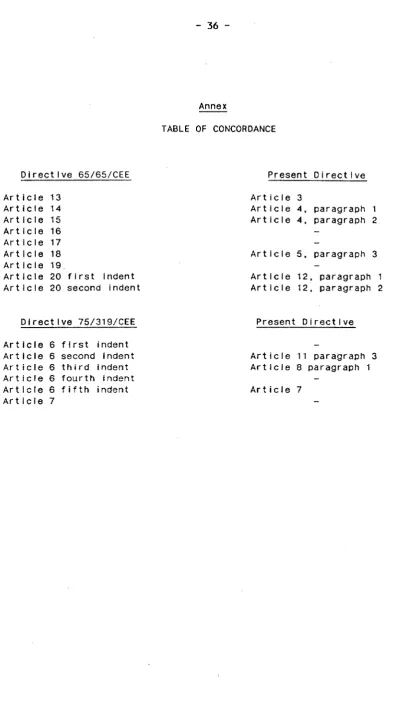
table of concordance given In the Annex.
Article 15
1. Member States shal I take the measures necessary to comply with this
Directive before 1 January 1992. They shal I forthwith Inform the
Commission thereof.
The provisions adopted pursuant to the first subparagraph shal I make
express reference to this Directive.
2. From 1 January 1993, Member States shall refuse an appl lcatlon for
marketing authorisation or for the renewal of an existing
authorisation, when the label I lng and the leaflet do not conform to
the requirements of this Directive.
Article 16
This Directive Is addressed to the Member States.
36
-Annex
TABLE OF CONCORDANCE
Directive 65/65/CEE Present Directive
Article 13 Article 3
Article 14 Article 4, paragraph 1
Article 15 Article 4, paragraph 2
Article 16 Article 17
Article 18 Article 5, paragraph 3
Article 19.
Article 20 first Indent Article 12, paragraph 1
Article 20 second indent Article 12, paragraph 2
Directive 75/319/CEE Present Directive
Article 6 first indent
Article 6 second Indent Article 11 paragraph 3
Article 6 third indent Article 8 paragraph 1
Article 6 fourth indent
Article 6 fifth indent Article 7
[image:35.591.98.493.30.753.2]..
37
-1n regpeot
of
tbe p:opoe&l.IJ I~ D1MotiftBem
the re.tione.lu.ee
of
J1811n1»JFCJC1UOtS
~~ :tlmiiDuse
No A 1100 S&l&ries
of o.ftio1e's
am~ st&ffNo A 1300 MiBsicm expenses
No A 2!510 Bx:pea11 ture an meetillp of OCDL1 ttees who8e OCIDINl t&t1cm 1B
oanpulso:y in tbe prooed.ure for
c1raft1lC
CCJnrmm1ty
lAg1sl&t1an
No A a&el Cost
ot
the 1lllrt1tut1an'a :part1a1pa.t.1an in oontcemoes,opqrren•
.m
meeti.zCs
3 .1. CJ1!me.reJ. objeotiWIII
38
-3.
a .
Speoi.fio obJeoti vesa) 1ntroduot1on of & ~·
ot
ocmtrcl.8 in ral&t1cm to tbewholesale diatril:ution of medio.1DII.l. ~
t=
h1mllzl WM:b) l:l&rDI:miz&t!cm of the ar1tar1& tor~ the 1lg&1
natus
tar
the supply cl met11o1na'
~far
:tiUm&nuae:
o) ~ Oc:aalunity ~ on 'abel 1 1~ &n1 peokage le&.f'lets ~ :mediai.nSl ~tor lnml&n
uae. eo u
to 8D8Ul'e tba.t such'l1IS3j
oines are
properly usedem
the bJs1s of tu.U m1 read1ly~e 1ntarmat1cm:
4.
peygne
for t;be OQticm4. .1. RA-socs
tor
tbe typeot
aoticm p:-apoeei1bs oampletion ol tbe internal market in the pb&rmaoeutia&l aeotor DJSt be aooompa.nie:i :t:Jy meuures ~ to pra110te tbe rational
use
ot
med.io.Um. SiDJe tbe intern&l :ms.rket Will ete.U~tier operatic;ms 1DYol~ mrketiq, c11stril:uticm &n1
oorrmun1a&t1on, 1t
u.
Deeeanry
to ea~Nre OCIIIpl..1aDoe with tbe .senti&l ~ts 1n reapeot of tbe prov1s1.cmot
izltor-.ticmto oo:D8Ill'D8nl an:1 the oontrol
ot
tbe c!iatr1h1t1.cm ~ maUO' MJprc:d11ots
tor
huma.nuse.
'.the impleiDI!Intat1on of tbe pz'OpCIIIIeC1 41Nativea will
eaoou.rege
tbebee ~DCM~m~mt ot JDecU01nes
tor
l:uDe:1 Ulle 1D tbe Qmmm1tf, mue att'be
ama
t1Jie ~a
ll1Qh
leYa1. of proteot.1.aDu
~plhl1o bellth aD:1 oon8UIDm' intoration. Purtbermore, tb18
0Qamm1ty ~t1Cm, Wh1oh WUl. 1IID
u a
:tue a~ 1eYel. of39
-1A Art1ole 100!1.(")
ot
the 11!0 Treaty,wUi
ae:r'V8u a
:Nf8l'CX)e1ntmmticmally
&n:1 be & valuahlea.et
tar
Ocmarlm1ty fi:llla 1eak1ngto
ezport.
e. !1mm'
e.1:tmaot
e
.1. GaDanll----·
'rbe ma.1n f1 ra-ncxt aJ .1.mpe.ot of these ~ 1 will
taJ.J.
1n the follO'tlil:lg &rea8:- ooll&tion
e.m
o.1roulat1on of 1ntoraatian suppliedl7i
tbe Kember St& tee (pa.1"ti.CW.arof autbcrizet1
wh.Oleaa.le:rs and tbe l1Btof
_ 81 01
nes for
'Wh1aha
pl'880%'1ptioD i.e HqU.i.red)- ~ up of ,,,,., 1 nes Ccm
'abe',',..
em
peotege 1zarrtaem
cm1oex1
c1:1.striblt1cm ~)am
of a zoeportto tbe COimoU ontbe impl.aDant&ticm
ot
tbe O:!..Not1w an t.be leg&l at&twltor
the supply of ms110.1nal proc1U.ot.s for bmr:llm use.e. a.
Speo1t1o :t1M.n01&1 ilnpB.Ot&) Sta.ff
'rb8 llte.t'f1Dg requ.iraDent ~~
CJ&n"YizC
out ~ apeo1.t1o tuks CSeaaribed abOve &re Ol.l.CNl&ted M tollOWII:- fz'clll 1S91 : 1 ..s.at&ut (Be)
- 1992-lSII3 : 1 adm1D1.etrt.to:r (A7)
l~(OD)
'1M
lrt&:t:ti:C
~ta llbcwn above IIU8t l:le let e1 t'ber by1ntern&J. 1"S58ploymant
or
md.er tbe ~ praoed\l.l'et=
the40
-cell&t1on, o1roul&tion am ._.,818nt of tbe infcmraticm
supplis! by tbe Manter Ste.tee in relation to:
• tile
per80t18
&ll1 estah',.,_,ta
autb.o%1.zedto
Cl&1'ry an tbeaotJ.vity of a vboleelle:r
ot
_.1Q1MJ ~:• tb.e list
ot
liaS'crt
Dee tb&tam
cml.y be ~on
MSj-C)fll~1ptian;
- d.:raw1ng up of
t-'1
"e11 DefJ withZ"efa1'd
to• the , ebe'l] 1
qr
ani package le&fleta ol :medi01m.l. ~• gocx1 c!.1stribut1on pre.otioe i
- c1r&w1qf up
ot
a report to tbe ~ an tb8 implalllanta.ticnof the D1Mot1ve on the legal status for the wpp:Ly of
M11o:lnal prcd.uots aD1 dre.t~
ot
&ppropr-i&te
prop:we,l•;- A
aeoo
· Ftn.ll'
meetit'C•
per lea:' of tbe Jd. BooWoni!C
Pat1ly an COnsumerInformation Crepxea1!11nt&tivee of
1D::1Uol'try, bealthproteeaiaca
an:1 ocm8UIII!J1"8), beld. jOintlybi
ra m am tbeQ:msume:r
Pol.1oi
~t:1990
1~1
41
-- A 2510:
!hree edt11 ticml meetings a ~
ot
work.ing ~ of tbeOcm1 ttee on Propri.et&ry M&Uaj D&l Pro:1uote (~ d.elegate per
)'ante State). ('l'be OU1"rSlt
ocst
01a
meert.1.qtot
=e
0! tbase~ i81D7
e
.CO):igg()
1991
l;;a
l~Total
- ~ems (A 1300): 1990
lQ;l
19Q2
jQ) 18 fAX)
107 16 BOO JID18
2CtJ
Jib 15 :ial
lC1 M 8CXl
wp
e ooo
- Pa.rt1o1pat1cm in
oonfe.reaoea,
~·· aa1Jll88t:llC8
(A 2851)
. l;a:l IDl'
aeoo
1991 ID1
a eoo
lQQ2 B:X7
a eoo
JCQI:II Bm JIW'I
42
-COMPETITIVENESS AND EMPLOYMENT IMPACT STATEMENT
relating to the proposals
for a rational use of medicines
I. What Is the main reason for Introducing the measures?
Completion of the Internal market; Improvement of the protection of
pub! lc health; promotion of a rational use of medicinal products;
consumer Information.
11. Features of the businesses In question
The measures Involve pharmaceutical manufacturers as wei 1 as
wholesalers In medicinal products.
Because of the high costs of developing new products,
pharmaceutical enterprises are often large companies (multinational
or national). There are, however, some smaller and medium sized
manufacturers geared at the national market.
Distribution companies (wholesalers) are generally large sized
companies, following restructuratlon operations and mergers In the
past ten years.
Ill. What direct obligations does this measure Impose on businesses?
Manufacturers of medicinal products
-obi lgatlon to conform with new regulations on Iabeii lng and
package leaflets : many companies are already adapting their
43
-and package leaflets to the principles proposed (no additional
costs for businesses - economies of scales stemming from the
harmonisation of rules on label ling and package leaflets).
Wholesalers In medicinal products
-obi lgatlon to have appropriate premises and a qual I fled
personnel : this obi lgatlon Is already laid down In most Member
States and Is necessary In order to guarantee the safety and
Identity of medicinal products distributed;
-obi lgatlon to maintain distribution records and to verify them
every year : this provision should allow to trace batches of
medicinal products through the distribution chain and facilitate
recal I operations In the case of accidents, as wet 1 as the
struggle against counterfeiting.
IV. What Indirect obligations are local authorities likely to Impose on
businesses 7
None foreseen.
V. Are there any special measures In respect of SMEs 7
II
44
-VI. What Is the likely effect on
a) tho competitiveness of business 7
The proposed measures wl I I facf I I tate marketing, communication
and distribution through the Internal frontiers of the
Community. Some companies wl I I thus have to make efforts In
order to maintain their competitiveness vis-A-vis companies
establ !shed elsewhere In the Community.
b) employment 7
No significant effect Is anticipated.
VII. H<lvo both sldtl::> of Industry boon consulted on tho::>o proposals 7
Following Interested parties were consulted :
associations of the pharmaceutical Industry,
-associations of wholesalers In medicinal products,
-associations ot consumers,
associations of pharmacists,
ISSN 0254-1475
COM(89) 607 final
•
DOCUMENTS
EN
15
Catalogue number :
CB-co· ..
go-017-
EN -C
ISBN 92 .. 77-56718-X
·Office for Official Publications of the European Communities .