COMMISSION OF THE EUROPEAN COMMUNITIES SCIENCE
RESEARCH AND DEVELOPMENT
IIIOIITOR
SPEAR
Economic Quantitative Methods for
the Evaluation of the Impact
of R&D Programmes
A State-of-the-A·rt
!
Commission of the European Communities
Economic Quantitative Methods for
~
the Evaluation of the Impact
of R&D Programmes
-A State-of-the--Art
Author H. CAPRON
,,
~ ~ 1 MONITOR/SPEAR}Coordinators
C. DE LA TORRE A. DUMORT
The opinions contained in this report are the sole responsability of the authors and do not necessarily reflect the official position of the Commission of the European Community
Published by the
COMMISSION OF THE EUROPEAN COMMUNITIES
Directorate-General
Information Technologies and Industries, and Telecommunications
L-2920 LUXEMBOURG
LEGAL NOTICE
Neither the Commission of the European Communities nor any person acting on behalf of the Commission is responsible for the use which might be made of the following
information
Cataloguing data can be found at the end of this publication
Luxembourg: Office for Official Publications of the European Communities, 1993
ISBN 92-826-5646-2
© ECSC-EEC-EAEC Brussels • Luxembourg, 1993
Table of Contents
Executive SuilllllalY ... · · ·
v
lntr<:xiuction ... . 1
Chapter 1. Technology Assessment : An Overview ... .
5
1.1. How Can One Assess ? • . • . • . • . • • • • • • • . . . • • • • . • • • • • • . . • . . . • . . . 6
1. 2. Overview of Methods . . . 12
1.2.1. Assessment by peers, questionnaires, interviews . . . 12
1.2.2. Scoring methods . . . .. . . .. . . 14
1. 2. 3. Systemic approaches . . . 17
1.2.4. Financial methoos . . . .. . . .. . . .. . . .. . . 18
1.2.5. Technological forecasting methods . . .. .. . .. . . .. . . ... . .. . . .. . . .. . . .. . . .. . . 21
1.2.6. Quantitative indicators . . .. . . .. . . .. . .. . . .. . . .. . . 22
1. 2. 7. Econometric methoo . . . 23
Chapter 2. The Economic Analysis of Technological Change . . . 29
2.1. Technological Change and R & D. . . . • . . . 30
2.2. The Measurement of Technical Progress ... ... .. ... ... . 33
2. 3. The Applied Economics of Technical Change . . . 41
2. 3 .1. The exogenous disembodied technical change . . . 41
2.3.2. The exogenous embodied technical change . . . .. . . .. . . . .. . . . .. . . . .. . . .. . . . .. . . 51
2.3.3. The induced technical change .. . .. ... .. . . .. . . .. . . .. . . .. . . .. . . .. . . 58
2.3.4. The endogenous technical change ... . . .. .. .. . . .. . . .. . . .. . . . .. . 60
Chapter 3. The Applied Economics of R & D . . . 63
3.1. The Economics of R & D... 64
3.2. Econometric Studies in Retrospect .. . ... . .. . . .. . . .. . . .. . . .. .. . . .. . . .. . . .. . . .. . . .. 75
3. 2. 1. Micro level studies . . . 7 6 3.2.2. Meso level studies . . . .. . . .. . . .. . . .. . . .. . . 88
3. 2. 3. Macro level studies . . . 90
3.3. An Assessment of Econometric Studies ... .. ... ... ... ... . . .. . . .. . ... . . 91
Chapter 4. The Spillovers from R & D Investment .. .•.•... .. . ... .. .. . . . ... .. ... . . 105
4.1. About Sonte Case Studies . . . 1 06
4.2. The Inter-Industry Technology Flows Approaches . . . 1 OS
4.3. The Spillovers in the Technology Space... 112
4.4. The Econontetric Measurement of Total Spillovers by Industry ... 115 117
4. 5. Tracing the Sources of Spillovers ... . 4. 6. More on the input -output approach . . . . • . • . . . 1 29
4. 6 .1. Decomposition of growth in real output . . • . . . l 2 9
4.6.2. The treatment of R & Din input-output tables . . . .. . . . .. .. ... . . .. . . 132
Chapter 5. The Impact of Government-Financed R & D ... 139
5 .1. Why to Evaluate the Economic Impact of Publicly-Funded R & D ? . . . _140
5.2. How Productive is the Publicly-Financed R & D? .. .. ... . . ... ... ... . . ... . . .. . . 14.4
5.3. How Stimulating is the Publicly-Financed R & D? ... 15-5
5.4. How Effective is the Public Support toR & D Projects? ... 1 71
Chapter 6. Publicly-Funded R & D in a Competitive Environntent . . . 1 ~ 1.
6.1. Technological Rivahy and Public Incentive Policies . . . 182
6.2. Mooels of R & D Strategy . . . 191
6.3. Imitation, Purchase or Inducement: The Search for an Optimal Strategy ... 203 6.4. Centres of Excellence and Agglomeration Economies ... 20'3
6.5. Technological Competition and R & D Policy in Oligopoly ... 21-2
Conclusion . . . 223
References . . . 2 2 9
Executive Summary
1. The Findings
The bases on which a nation can acquire competitive advantages in order to in-crease its material welfare are manifold· and depend on its endowment with resources, its stock of total capital and its institutional infrastructure. The stock of total capital is com-posed of physical capital, knowledge capital and human capital. For a long time, know-ledge capital and human capital have been treated by governments, at most, as second-hand targets in the economic policy formation. Physical investment and labor were the focus targets around which it was thought an efficient economic policy could be de-signed. In the late seventies, the flagrant inefficiency of economic policies showed policy makers that knowledge and human capital were really the active sources of economic growth and competitiveness. This led them to review their conception of science and technology policy as well as education and training policy and to adapt their institutional system accordingly. In the search for a higher efficiency of the science and technology policy, public managers increasingly view science and technology assessment as an inte-gral component of policy management At the roots of the present science and technology policies, there is the objective to stimulate innovative activities as a means of fostering economic growth and strengthening competitiveness. Therefore, the ultimate question of the policy evaluation process should be : what are the economic impacts of the science and technology policy ? This questioning then leads them to try and find how to measure these economic impacts and, in a further stage, when searching the toolbox of policy makers, these wonder whether using econometric methods and models might be advis-able.
advantages and disadvantages. The modalities of their use are varied. They should be simultaneously used in some cases in order to improve the reliability of observations and, when the results are divergent, to reinforce the evaluation process by learning about sources of divergence. Besides, they could be separately used depending on specific ob-jectives. Yet, some criticisms against econometric methods are grounded. Hence, the problems econometric techniques of impact evaluation are faced with are threefold : the methodological drawbacks, the measurement issue and data availability.
The methodological drawbacks essentially follow from the treatment of technical change in economic analysis. Indeed, technical change is conceived as an intrinsically exogepous process in economic theory and, consequently, in economic models. It is exogenous because assumed to depend exclusively on technical constraints. The empi-rical consequence is that it is rudimentarily measured through a time trend. It is intrin-sically exogenous because any attempts to grasp how it operates, as is the case for the inducement and embodiment hypotheses, have not removed the exogeneity, and hence the time dependence. Yet, in the past thirty years, a great amount of research has been devoted to relaxing this hypothesis by introducing research and development (R & D) in production functions. As long as R & D investment is only integrated as a production factor without being itself, at least partially explained, by economic mechanisms, we have only identified but not endogenized one of the sources of technical change. Nevertheless, we may agree that it is a ftrSt important step towards endogenization.
Despite its limitations, the production function approach is presently the only operational way of assessing the economic impact of R & D. This impact is measured by estimating the relationship between R & D and productivity. The main attempts to measure the impact of R & D on economic growth rely on the Cob)?: Douglas production function and make use of two alternative theoretical frameworks. The first one is based on the estimation of the R & D capital elasticity with respect to the output and the second one on the estimation of the rate of return on R & D investment It is worth noting that the interpretation of the estimated coefficients will differ depending on the level of data aggregation. Indeed, empirical analyses can be performed at three levels: micro (i.e. on firm data), meso (i.e. on industry data), macro (i.e. on nationwide data). At the micro level, both coefficients only deal with the private effect of R & D. At the meso level, both coefficients can be assumed to measure the intra-industry social effect of R & D. At the macro level, both coefficients should provide an estimate of the nationwide social effect of R & D. Furthermore, regression analyses can be alternatively petformed on time-series data, cross-section data or both. The high variability observed in the estimates can, to a large extent, be explained by data characteristics. When firm sales are used as output measure the mean value of R & D elasticity is .05 for time-series data against .10 for
cross-sections and the mean value of the rate of return is 15 percent. The use of value added as output measure provides weaker estimates which often tum to be non-signifi-cant. The estimates are higher when data are corrected for double counting and expensing and in scientific sectors. At the industry level, the mean value of the rate of return is 22 percent and amounts to 35 percent when the fall observed in the rates of return during the sixties is taken into account. At the nationwide level, the R & D elasticity noticeably differs from one country to the other. The mean value is about .40. In recent years, dynamic disequilibrium models have been applied to measure the contribution of R & D to the changes in output. These adjustment cost models consider R & D as a quasi-fixed factor which does not adjust instantaneously to its optimal level and which is endo-genously determined by demand, input prices and inputs. At the nationwide level, the estimates short-run elasticity ofR & D for the manufacturing sector is about .15 and the net internal rate of return on R & D investment is about 13 percent. There is no major contradiction between these estimates and the latter are strikingly compatible with results obtained from case studies. So, these studies undoubtedly put forward the influence of R
& D activity on productivity. Nevertheless, this contribution varies from one sector to an other.
In
the scientific sector, the R & D elasticity is higher than in other sectors, its mean value being .13 for time-series against .18 for cross-sections. Regarding its rate of return, it is 10 percent higher than in other sectors. Furthermore, as shown by case studies, its impact changes over time and occurs with a variable lag depending ot:t the orientation of research. Finally, econometric studies are faced with ·two categories of problems : conceptual fuzziness and methodological drawbacks. The former principally concerns the interpretation of estimates and data to be used and the latter, econometric techniques implemented and data measurement.There is a general agreement that the social return to R & D is higher than the private return because the effects of R & D go beyond the fmn, the industry and the country which perform the investment. Indeed, the returns to R & D may not be com-pletely appropriable because knowledge produced by R & D investment performed in a fmn is a public good which allows other fmns to develop new innovations with less R &
to enter separately into the production function the R & D stock of each potential source of spillover. According to the inter-industry technology flow approaches, the rate of return on external R & D should be around 50 percent Yet, the relationship between external R & D and productivity varies across industry and over time. The use of inter-mediate input purchases, patents or innovations in order to identify technology flows is not free from criticisms. If intermediate input purchases may be assumed to be a good proxy of embodied R & D, it is not necessarily a good measure of technological op-portunities. On the other hand, when patents or innovations are used, they are assumed to be equally important, which is far from being right. When technological proximity is measured by characterizing the fmn's position in the technological space, patents are made use of to distribute firms according to their research interests across technological areas. The results obtained from this approach show that fmns in R & D intensive areas have, on average, relatively more patents and a higher return toR & D though low R & D intensity finns have lower return if their neighbors are R & D intensive. Further, firms adjust their technological positions in response to technological opportunities. In the approach considering the unweighted outside pool of R & D knowledge, the spillover effects are measured by estimating a cost function which includes intraindustry and inter-industry spillover variables. The empirical evidence based on this approach is very limited. The findings suggest that interindustry spillovers cause unit costs to decline substantially more than intra-industry spillovers. However, the contribution of the inter-industry spillover to the social rate of return appears to be lower than the intrainter-industry spillover effect. The latter contributes of about 10 percent against 2 percent for the former. Not only is there a substantial difference between the social and private rates of return but the spillover effects, to a large extent, differ across sectors. The latter ap-proach, which separately enters the R & D stock of each potential source of spillover into the cost function empirically demonstrates that tracing the sources and beneficiaries of spillovers is econometrically feasible. However, only main spillover sources can be significantly identified because of multicollinearity. Each producer is treated as a distinct spillover source and the direction and magnitude of the interindustry spillovers can vary across receiving industries so that the spillover network of senders and receivers can be traced. The results obtained for the few empirical investigations show that all industries are influenced by spillovers but not all are sender industries. All industries are charac-terized by very high private rates of return, which, on average, amount to 25 percent. Besides, the social rate of return greatly varies across industries and can be three to four times as big as the private rate of return, as seems to be the case in the sectors of scientific instruments, nonelectrical machinery and chemical products. R & D spillovers do not only affect production characteristics but both output supply and input demand decisions. Moreovet," spillovers are intertemporal externalities because they result from present and past decisions about R & D investment process. Such features can be taken into account
by considering simultaneously cost and product demand functions in which R & D stocks are defined as quasi-fixed factors of production which, because of adjustment costs, do not adjust instantaneously. A last point is that it would be useful to extend the input-output by treating R & D activities as an independent activity in the input-output structure. As R & D investment is a strategic policy variable which increases the future production potential and not principally the current production, it should be regarded as a final de-mand component. Then, an R & D input-output matrix should be constructed in order to have a disaggregation of R & D final demand between consumer sectors and producer sectors.
effectiveness of public support depends on the characteristics of public intervention. Furthermore, the impact largely differs from one country to the other. Unfortunately, like the productivity approach, most of the evidence comes from the United States and shows that the relationship between government-financed and company-fmanced R & D is more subtle than suggested by global approaches. Although results are highly variable, the studies support the complementary hypothesis. In other words, government R & D al-locations to industry should not substitute for privately-financed R & D. This observation is confmned by other approaches. All these approaches suffer from the same drawbacks
than studies on the impact of R & D on productivity. Moreover, a striking feature of these studies is their lack of grounded theoretical framework. So, what are the theoretical links between the productivity and investment approaches ? What is the behavior of the fmn regarding public support ? How to explain the apparent divergence of results obtained from alternative approaches ? Why should the impact of public support on productivity be less effective than private R & D ? If the accumulated empirical evidence proves that eco-nometric methods can be usefully used for policy evaluation, the theoretical background of models should be improved and any analysis should be grounded on a reliable specifi-cation of both causal relationships and the economic environment.
A fundamental distinction between science and technology policy and a large part of other economic policies is that the former is largely motivated by strategic issues and is designed to deal with a highly competitive technological environment. While, in recent years, there has been an important literature dealing with both technological rivalry and public R & D-incentive policies, in the present state-of-the-art, it has not led to clear-cut recommendations on how to implement an efficient R & D policy. When a potential strategic public policy is being designed, the endogenous characteristics of each industry must be taken into account to use the most appropriate instruments. An effective policy in an industry might be totally ineffective in another. So, it should be fruitful to learn about how different industries might react to different instruments. The public policy should also take into account the fact that its effectiveness is to a large extent conditioned by the existence of critical mass. Technological opportunities, cumulativeness and the degree of appropriability are characteristics which underlie sectoral and national technological per-formances and may lead R & D to agglomerate. This phenomenon is also an important component for the policy design. Coming back to a more general viewpoint, it is worth emphasizing that R & D public policy is increasingly viewed as a strategic activity imple-mented as a response to external challenges. R & D is a major determinant of non-price competition and a primary means of gaining market shares. So, besides the productivity approach, a demand approach might be suggested to study how successful R & D is in generating greater demand and to what extent rivals are able to annihilate this demand increase through R & D efforts.
In oligopolistic situations, firms are thought to react to rivals' decisions in order to preserve and increase their market shares. Therefore, on the one hand, market share models are well-suited to capture the interdependence among firms and, on the other hand, reaction functions are able to provide evidence on how fmns move in response to strategic actions undertaken by rivals. This approach could give information on the magnitude of asymmetries firms are faced with and on the extent of submissive multiple reactions which underlie the fmn's behavior. Furthermore, public policy considerations might be integrated into the model to measure how R & D subsidies influence firms' reac-tions and market shares and how strategic partnership affects economic performance. While such a model still has to be developed, its advantage in comparison with the pre-ceding ones""is to introduce the strategic component into the model and to evaluate how both fmns' and governments' strategic behaviors are effective to increase market share.
2. The Appraisal
1. The economic quantitative methods, particularly econometric models, should be viewed as an ex post quantitative evaluation tool of the economic impacts of science and technology policy. They have their shortcomings and limits. They are an instru-ment in the toolbox of policy evaluation which can be used for structured quantitative analyses of the economic impact of R & D policy.
2. The economic analysis of technological change remains a fallow field impounded by the neo-classical paradigm of exogenous technical change. Over the last thirty years, empirical evidence has been accumulated on the economic impact of technical change and recently new promising avenues have been opened for future research.
3. The applied economics of R & D has emphasized the link between R & D and pro-ductivity. The experiments cover the micro-, meso- and macro-levels and the esti-mates bear on the R & D elasticity with respect to output and the rate of return on R & D. A large part of divergences observed in results can be explained by data character-istics. Nevertheless, this approach is still faced with measurement problems and conceptual inaccuracies.
receivers of spillovers was feasible and that the social rate of return on R &
D greatly
varies across industries.
5. The economic impact of government-financed R &
D might
beevaluated by using
simultaneously existing pinpoint methods and extended macroeconometric models.
While existing pinpoint methods are numerous, the most commonly used ones are the
productivity and the investment approaches. Extended macroeconometric models
might
beconceived by adapting present macromodels or developing adequate
mo-dules.
6. Public R
&D policy is designed in a competitive environment so that the strategic
grounding of science and teChnology policy needs to view the evaluation process of
the economic impacts of R & D programmes as a strategic activity. To deal with this
issue, competitive interaction models could
befruitfully used as a complement to the
preceding approaches.
7. Econometric methods are suitable for policy evaluation but several techniques can be
used. The choice of a measurement method depends on four criteria : the objective of
the evaluation, the data availability, the time devoted
tothe evaluation and the
imple-mentation cost.
8. The evaluation of the economic impact of R & D programmes provides an ultimate
objective judgment of the science and technology policy and, to some extent, of the
complex, subjective and interactive technology assessment process. Its results should
serve as a discussion basis to improve policy design.
Introduction
The economic turbulences of the seventies have disrupted the technological
tra-jectories on which the industrialized countries had built their prosperity. The traditional
instruments of economic policy have proved to
beineffective to overcome the slackness
which Western economies are faced with. The process of creative destruction which goes
together with it reminds the industrial·countries that investment and employment are not
the only sources of growth. Indeed, they observe that any policy aiming at promoting
either of these variables only gives paltry results
ifit is not mixed with technological
mastery. The latter will be the real motor of growth. So, although investment and
em-ployment are conducive to growth, they are themselves boosted by technological change.
But technological change is not manna from heavens and requires some types of
invest-ment, namely, investment in research and development but also investment in education
and on-the-job training, which are the main factors through which economic growth can
be restored.
The sudden awareness of the central role played by technological change has led
governments to review their conception of science and technological policy and pay
particular attention to its interconnexion with economic policy. Yet, in lots of countries,
science and technology policies are implemented
ina context of budgetary austerity which
obliges them to define priorities to look out for the efficiency of the system set up. Since
its resources are strongly limited, the Commission of European Communities is faced
with the same problem. In view of the lack of resources to finance R & D activities on the
one hand, and of the increasing importance of these activities, on the other hand, a great
number of countries have become aware of the necessity of implementing procedures in
order to improve the efficiency of their science and technology system. To do that, public
authorities are incorporating evaluation into their research programmes. If the practice of
evaluation is not a new issue, its generalization
iscertainly a recent phenomenon.
Research on the state-of-the-art of economic quantitative methods for the assess-ment of the impact of R & D programmes can be conducted in two ways. The first one is to write a synthesis on quantitative methods and to think about their potential use in a field such as the evaluation of science and technology policy. The second one is to review how quantitative methods, particularly econometrics, are used to evaluate the economic impact of R & D and to show what their results are. It is this alternative approach which has been adopted here because, to a large extent, these methods speak by themselves and the reader can easily deduce their advantages and disadvantages as well as the limits for their use.
In their analytical synthesis on evaluation methods in use at the Commission of European Communities, Bobe and Viala (1990) point out that substantial progress in methodologies and instruments necessary for the evaluation of the socio-economic im-pacts of R & D programmes should be made during the nineties. Despite the efforts undertaken in the past forty years to highlight the mechanisms which underlie the rela-tions between economic growth and technical change, the relative weakness of the ac-cumulated knowledge in this field will lead anyone to consider such an agenda as an im-possible challenge. Credibility and usefulness of economic quantitative methods in the field of technology assessment is often questioned. Yet, the use of econometric tech-niques in economic policy formation has become common place. Policy decisions in the field of macroeconomic policy are now largely checked against a macroeconometric model. While models are only an imperfect representation of economic reality, it is generally admitted that it is more rational to test a potential policy decision by experiment-ing through a model rather than to subject the real economy to the experience, which may turn out to be a crash. Besides, the pervasive handling of the economic process by public authorities and the questioning about its results have enhanced the need for a systematic
-~
evaluation of their interventions. So, econometric methods are extensively used as a policy evaluation tool for economic matters. To the extent that science and technology policy deals with economic matters, technical expertise based on econometric modelling may be considered to be a helpful guide in science and technology policy formation. For example, econometric techniques are the only way to give information on the global eco-nomic effects of a science and technology policy. They may also be used as a comple-ment or an alternative to other methods when economic issues are under scrutiny.
The first chapter gives an overview of the main technology assessment methods presently used. Its object is to emphasize that all these methods have their advantages and their drawbacks and to position econometric methods in the tool box of evaluation tech-niques. Lots of methods are directly concerned with scientific and technological matters. The issue of the economic impacts of R & D policy often remains uncovered by
tion exercises because of methodological drawbacks and limits of economic quantitative methods. As evaluation is a trial and error process, any method has its own deficiencies and each of them contributes something to the evaluation process.
The economic analysis of technical change is the focus of the second chapter. After defming main concepts and notions, we describe how technical change is taken into account in production functions. In economic textbooks, technical change is regarded as a black box in which no component except output is faced with economic rules. But even the way in which this output is appraised, i.e. time, is ridiculously rudimentary when compared with the high sophistication of economic theory and models.
Yet, over the past thirty years, experiments have been performed in order to sub-stitute a better candidate as a proxy for technological change. Given the methodological difficulties to define a clear output variable of the science and technology process, re-searchers turned to an input variable to measure technological change, i.e. research and development investment. The latter has then been introduced in models aiming at ex-plaining productivity growth. It is to a review of this literature that chapter three has been devoted.
While the R & D investment performed by a frrm, an industry or a country will ftrstly benefit to its originator, the new knowledge so created may not be fully secured by the innovator but spills over in the economy through improved equipment and new pro-ducts. In recent years, there have been substantial efforts to measure these spillover ef-fects. As these effects are not uniformly distributed among industries, some methods have been developed to trace technology flows among industries. In chapter four, we summarize the main attempts to measure these spillovers at the aggregate level as well as when receiving industries are separately identified.
Some strategic considerations are discussed in the last chapter. Contrary to the traditional economic policy, the design of an efficient science and technology policy is directly conceived to help firms to adapt to technological competition. In the past few years, several nonnative models of technological competitive behavior have been deve-loped. After a rapid glance at these models regarding their possible empirical implementa-tion, some empirical studies grappling with some strategic aspects are discussed. Finally, a multiple competitive reaction model is considered. This approach, although exploratory, might serve as an analytical framework to analyze the nature of technological competition when both enterprises and governments are regarded as strategic oligopolists.
Chapter 1. Technology Assessment : An Overview
In a world in which capital, work, and technology determine the national produc-tion limits, advanced economies resolutely attempt to organize the research process in order to gain competitive edge, especially on the NIC's. Technological knowledge proves to be the ultimate constraint of growth.
As research and development expenditures in the industrialized countries are sub-stantial, as both the European Community and the member States are implementing re-search and development programmes, which mobilize considerable resources, the time is ripe for assessing their impact on the economy so as to justify the investments, direct later choices, and define the productive potential of a technology. This is why a quantitative analysis is useful.
Besides, the positive and negative effects of research on society and the environ-ment have raised questions about how they can be anticipated. Besides, too budgetary restrictions due to the crisis have required the definition of primary objectives and projects. The staggeringly fast development of scientific and technical activities also accounts for the interest taken in technology assessment methods.
As we have pointed out already, research finds its justification in the advantages expected for the community. This same economic justification is required to buttress pro-jects and programmes.
Actually, the question is what the economic performance would have been, if there had not been any technological change. And in this respect, besides the research and de-velopment expenditures made by enterprises, and the patenting costs, one should not for-get the importance of the transfer of technological know-how between enterprises and in-dustries through the market mechanisms or industrial liaisons.
technical progress. Obviously, it is at the diffusion stage that those impacts are
materiali-zed. That is why, regarding that particular stage, numerous assessing methods have been
developed.
1.1. How Can One Assess
?The idea of assessing technology first came up in the United States to comply with
the will to guide choices regarding R & D programmes. Value systems, technical and
eco-nomic approaches were to be taken into account
How can the profit actually derived from R & D investments be measured ? How
can the degree of accuracy of the measurement be defined if one cannot define the object
to be measured (some even speak of measurement of the intangible) ? How can one
ex-periment in this field ? Which model should be chosen ? How abstract is it realistic to be ?
Is a "closed" system relevant to represent an "open" system? These are a few questions
that arise when one analyzes the techniques and methods of technological assessment
A major feature of R & D investments is that, compared with traditional
invest-ments, they are mainly made up-stream. Although R & D expenditures are preeminently
creative investments, since they are aimed at generating products, technical procedures,
and new services, or at improving those already existing on the market, yet, they also
mean considerably lenghtening the production process. The average ripening time of an R
& D investment, even though it varies from one sector to another, is about one to three
years and even more in some industries (e.g. drugs and medecine) and some research
fields (e.g. basic research)l. So, in some cases, the decision to invest must therefore
often be taken some 10 years earlier, which does not always allow for letting oneself be
suitably guided by market reactions. Hence, the forecasts are long-term ones. The low
success rate of R & D projects, and the risk involved in them account for the fact that a
part of the R & D investments are financed with public funds. However, even though the
risk is high, this type of investment remains a strategic weapon in the competitive climate
that reigns between enterprises and countries.
1 The R & D gestation lag would be about 2 years [Pakes and Schankerman (1984a) Ravenscraft and Scherer (1982) ]. Mansfield (1991) reports an average time lag of 7 years between an academic research finding and its first commercial exploitation. It is also well-known that the lag between the discovery of a new potential product and its launching out to the market can reach fifteen years in the pharmaceutical industry.
As a concept, research assessment may mean quite different things : it may be a simple observation, a systematic analysis, or a global examination of the extent to which results meet earlier defined objectives, or even an assessment of the impacts of research on the economic and social world. According to Gibbons (1984), the term "assessment" should be reserved to the measurement of the extent to which activities have been modi-fied following the adoption of a measure or a policy.
However this may be, several levels of assessment can be envisaged :
- assessment of individual projects; - assessment of programmes;
- assessment of the national research and of it~ efficiency, which is, of course, the high-est aggregation level. It is the macroeconomic level;
- assessment of research sectors such as university research or industrial research; - , assessment of individual researchers;
- assessment of research institutions.
The last two points are beyond the scope of this analysis and will not further be dealt with.
Finally, the evaluation process can also cover the different stages of research. Generally, the three following phases are distinguished:
- ex ante evaluation : before launching the project; - on going evaluation : during the research process;
- ex post evaluation : when the project has been completed;
The ex ante evaluation (done during the planning period) is closely linked to the selection and implementation of the orientations of the research, and proves useful to de-fine the research priorities, and, in some cases, alternatives (except at university level). It can also allow to set standards for resources and outputs, and determine how resources will be allocated. So, it proves necessary to assess and select innovation strategies.
The on going evaluation allows a permanent assessment of the situation which may lead to re-calibrate the project or programme under way.
standards estimated during the planning period. So, the performance is assessed, which enables to take corrective actions, and to appreciate the impacts of technical progress on the economic variables.
As Luukkonen-Gronow (1987) points out, the United States has mainly developed the ex-ante approach, while Great-Britain and the EEC have favoured the ex-post one1.
R. Cordero (1990) suggests a systematic model to measure the performance of the
fmns' R & D investments. The fmns are to define exactly what Lltey want to measure (outputs or inputs) as well as at which organizational level measuring is to take place (global, technical (in the case of fundamental research) or commercial performance). Measuring outputs allows to assess how effective R & D investments are, i.e. to what extent they can meet objectives, while input evaluation is more particularly aimed at as-sessing how efficient they are, i.e. whether minimum quantities of inputs are used.
The evaluation procedures are quite different from each other depending on the field covered, the objective to be attained, and the criteria applied. As the social function of science and the structure of the national research system have to be taken into account, it seems a priori little feasible or irrelevant to draw lessons from experiments made in other countries in order to sift out "the best technique". According to Luukkonen-Gronow again, the choice of a method for a particular purpose or circumstance cannot be guided with assurance.
Indeed, when assessing the effects of research, one is faced with several difficul-ties :
1) The positive effects of research ~e uncertain and cannot always be measured (this mainly hampers ex ante evaluation, but also ex post evaluation (especially with re-gard to the consequences on society and on the environment).
2) The time-lags for effects to appear are often long.
3) For research to have positive effects on the economy, it has to result in innova-tions. Yet, implementing the knowledge derived from research for product innovation purposes is a complex process. So, if a scenario of this process is not integrated into the input-output models, and one simply attempts to define the correlation between research
1 For a review of methods being used in several countries, cf. Auben (1989) as well as the special issue of Research Policy in 1989 (vol. 18, n°4) devoted to this subject
investment levels and other macro-economic results, the results obtained are unlikely to
be convincing [Gibbons and Georghiou (1987)].
Hence, economic effects can not easily be spotted effectively, which is why
resort-ing to evaluation by the user has to be considered.
For some years, the EEC has been trying to work out a strategy for the important
research fields. An ex-post evaluation by peers, carried out over a 6- to 8- month period,
is made about the technical and scientific results, the economic and social contribution of
actions whose costs are shared, i.e. undertaken by national or private laboratories and
substantially funded by the EEC. When the EEC's financial participation is smaller, a
simple evaluation on the basis of a three-day interview is made.
Let us again draw the attention to how important it is for an evaluation that the
scientific and socio-economic objectives of the programmes should be clearly defined
be-forehand. It is the evaluation of the socio-economic incidence that raises the biggest
methodological problems. With a view to remedying them, and in order to define the
in-cidence of R & D on the national variables, the EEC has ensured the collaboration of
users and specialists of the cost- effectiveness analysis to the evaluation groups.
Al-though this cannot but improve the quality of the assessment, one may wonder whether
this move can meet the requirements of quantification.
The issues are :
- determining the amount of funds to be devoted to R & D investment.
- choosing between the different R & D programmes.
- forecasting technological evolution. In this respect, two types of methods are usually
distinguished :
*
the exploratory method, which is ill-adapted because it consists in an extrapolationof the past trend, which implies some continuity, while technical progress is in
es-sence discontinuous.
*
the normative methods which consist in setting a future objective to be attained at agiven term, and in finding the "critical path" to attain it.
- the impact of research and development expenditures on the economy. The aim is in
fact to evaluate to what extent the invested means meet the objectives defined, and
Consequently, a systematic evaluation is a key element of an effective, common re-search policy. It is a retroaction circuit for the decisions regarding future management policies [Bobe and Viala, (1990)].
The methods developed hereunder are more particularly, or, sometimes, more ade-quately suitable for one of these issues. This review of the literature is the obvious thing to do in so far as a judicious combination of qualitative and quantitative methods would allow to achieve an optimum quantitative evaluation. So, for instance, exogeneous modifications of the parameters in a quantitative method could be introduced on the basis of results provided by qualitative analyses.
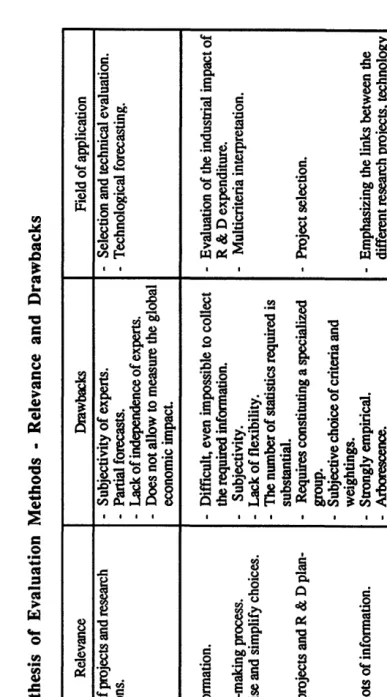
Further in this chapter we will give a synthetic overview of the different techniques for evaluating research activities, their advantages and drawbacks, as well as the fields in which they can be applied.
Let us first notice that qualitative and quantitative methods can be more or less accu-rately distinguished. The former are often aimed at selecting and sorting out the different projects but prove to be little useful to evaluate the economic impact of investments in re-search and development. The latter, fairly heterogeneous, are aimed at developing quanti-tative analyses and measurements of evaluation. Their degree of quantification varies. Most of these studies deal with the evaluation of R & D in terms of economic profits. They are mainly indicators. Subjective evaluation methods have indeed been developed to supplement the quantitative ones because, among other reasons, technical progress being discontinuous, the quantitative methods did not seem suitable for making reliable techno-logical forecasts I, which makes them less interesting for a long-term perspective. Yet, the "subjective" methods do not seem to be more reliable for long-term evaluation. But qualitative methods are above all used for more pragmatic objectives, particularly, operational and strategic management of research. Both methods, qualitative and quantitative, have their own advantages and drawbacks and are more complementary than substitutable.
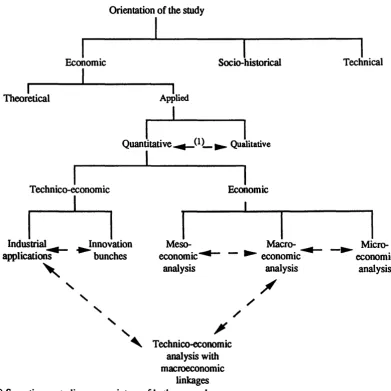
Figure 1 classifies the different types of studies which can be made. Let us specify right away that socio-historical, technical, and theoretical economic studies are not co-vered in this work. Yet, as it is difficult to remove all theoretical substratum from any ap-proach made in terms of applied economics, some incursions into the theoretical econo-mic foundations will prove necessary for a critical analysis of some methods. Among the
1 In this respect, let us, however, note that technical progress is unlikely to show sudden ruptures. Be-sides, to what extent don't the observed discontinuities partly result from economic fluctuations?
applied quantitative studies, a distinction can be made between the economic approach, mainly centred on the intrinsically economic relations and the technico-economic ap-proach in which technological structures (e.g. identification of innovation clusters and de-velopment of industrial applications) are assigned a predominant part. The economic ap-proach itself can be decomposed on the basis of the analytical levels considered :
- micro-economic analysis if one considers studying the phenomena of industrial or-ganisation;
- meso-economic analysis if the formalisation of the inter-industrial links is of major im-portance for the envisaged research;
- macro-economic analysis which allows to build a complete scale model of the econo-mic circuit.
Obviously, there are interconnections between the three approaches and technico-economic information can turn out to be quite useful to achieve a macro-economic loop.
Figure I - The Analysis of Technical Change
Orientation of the study
I
I
I
Economic Socio-historical
I
I
Theoretical
I
I
Quantitative~OL ... Qualitative
I
I
Technico-economic
n
Industrial._ ._!nnovation
applications bunches
'
I
Economic
I
I
Meso-economic~
analysis
Macro-~
- ... economic
~ Technico-economic
analysis with macroeconomic
linkages
/
/
analysis
(1) Sometimes, studies are a mixture of both approaches.
I
Technical
I
_...,. Micro-economic
[image:24.585.79.471.341.733.2]1.2. Overview of Methods
The literature reports plentiful methods of research evaluation but only a very small part of them are really in use. This overview of the main methods does not deal with the technical aspects of methods but with their more prominent characteristics in order to emphasize their strengths and weaknesses and, hence, show that econometrics, rarely referred as a research evaluation tool - and when, it is treated with suspicion - is certainly no less credible than other methods. There is now an extensive literature reviewing and surveying research evaluation methods to which we refer the interested readerl.
1.2.1. Assessment
byPeers, Questionnaires, Interviews
a. Direct Assessment
byPeers -
This is an evaluation made by one or more specialists of the same discipline to appreciate in particular the scientific value of the research [Gibbons and Georghiou (1987)]. The drawbacks of this method are the following:- the subjectivity of the experts and of their diagnoses. This can be put down to :
*
(intellectual or scientific) fashions which can be found both in the answers and in the questions and prove difficult to get rid of. The solution to this problem is to re-peat the assessment operation periodically. (Besides, the fashion bias can be evalua-ted). However, there still is a risk that the experts may take the political and socio-political objectives of the moment as forecasts;*
the experts being insufficiently trained to reason in the prospective mode;*
a lack of rigour,*
the fact that the maturation times required by some ideas are not sufficiently taken into account;*
the desire to conform which impels into self-censorship;*
the experts not being independent, which makes it necessary to have recourse to an anonymous questionnaire;*
the fact that researchers are involved in the evaluation which entails the risk that their willingness to participate may be linked to the benefits they can derive from it That is why some precautions have to be taken regarding the choice of experts, which is a decisive criterion for the method to be valid. So, for instance, too close1 Among others, see Saint-Paul and Teniere-Buchot (1974) and Vinck (1991) for a description of techniques and Luukkonen-Gronow (1987), Gibbons and Georghiou (1987) and Danila (1989) for a critical review of methods.
cooperative or polemical relations should be avoided, and experts should be chosen that are as open-minded as possible with regard to their schools of thought and their orientations.
- The partial character of the forecasts. Using cross-impact matrices somewhat allows to remedy this problem.
- When the evaluation criteria bear upon the socio-economic impacts, non-scientific members have to be included into the group of experts (for instance, clients or potential users of the research, industrialists, economists, public authorities). This working method, used by the EEC, is what is called assessment modified by peers.
- Assessing the social and economic effects of research activities is a challenge for expert appraisements because their assessments are based on science-oriented criteria, which are not appropriate to make an assessment of this kind.
- This method does not provide a sufficiently reliable basis to determine the global eco-nomic impact of R & D expenditures.
b. Direct Assessment Modified
byPeers -
This is a direct assessment but whose object is not only the scientific value of the research. So, other criteria, such as the economic and social influence are taken into account. This type of evaluation requires completing the group of experts for it to cover domains in which scientific competence is not sufficient. Apart from this improvement, the advantages and drawbacks of this approach are the same as for the preceding method.c. Questionnaire Method and Interviews -
This is a kind of assessment by peers but more systematic, based on standardized questionnaires. This method allows to work out quantitative indices provided the questions are phrased so that the answers can be marked.This method has the drawbacks of its advantages, i.e. :
- a reduced quantity of information since the prephrased questions limit the number of possible answers, which can result in trivial information.
d. Direct-Systematic-Assesstnent-by-Peers Method -
It cqnsists in sending a closed questionnaire to a number of experts. A median opinion with an error margin and quartiles is deduced from the answers. This result is returned to the specialists who are to confirm or invalidate their estimates. After a number of iterations, the convergence gets clearer, the objective being to reduce the interquartile interval while making the median clearer [Schroeder, (1988)]. This method is often used to make technological forecasts and select projects. The Delphi method has so far been one of the most used methods. Among the methods based on consensus, we also find the Ringi method, used by the Japanese decision-makers, and the Rule of Thumb method, with which managers are to assess and estimate the risks and advantages of projects [Danila, (1989)].The indirect-assessment-by-peers method is often used as well. It adds to the direct assessment by peers a quantitative dimension and rests on the analysis of indicators. Be-sides, it is a further systematization of the assessment-by-peers method.
The drawbacks of the method are the following :
- the method is not valid for comprehensive domains for it provides partial and incorrect results.
The results are sensitive to radical changes.
- The Delphi method gives quite a satisfactory answer to the occurrence question, but quite an unsatisfactory one to those bearing upon relevance (desirability for the enter-prise or for the users), impact, and feasibility. The Probe and Soon techniques are an attempt to improve on this method.
All the drawbacks mentioned earlier with regard to direct assessment by peers hold in this case as well.
1.2.2. Scoring methods
a. Matrix Approaches
-~There can be two kinds:a.l. Analysis Matrices-
They are applied for selecting and decision making. This approach is closer to economic analysis. They help put into shape "research-re-search" and "research-industry" matrices similar to the input-output tables of interindus-trial relations per branch or sector.Several stages can be distinguished, each of them leading to a matrix :
- evaluation of the economic impact of the researches on the other researches (research-research matrix);
- evaluation of the economic impact of the researches on the industrial sectors (research-industry matrix);
- multiplication of these two matrices, the product of which will give the impact of re-search decisions on the rise of industries. Let us notice that by reversing this matrix, one can determine which researches should be chosen to maximise industrial develop-ment.
The main drawback of this method is that it is difficult, if not impossible, to collect the data required to make a matrix of the interdependences between researches.
The BIPE (Bureau d'Information et de Prevision Economique), specialized in technological "filieres", has oriented its researches towards isolating the motor vectors in order to determine and quantify the consequences of technological innovations on the dif-ferent industrial branches. It has thus developed channels comparable to relevance trees whose different levels are the following : different research centres
-->
innovation-->
functional sub-set
-->
basic technologies-->
interested production enterprises. This method can be supplemented with a preliminary qualitative analysis.Among other methods, let us mention the Quest method, which is half-way bet-ween analysis and decision-making matrices as it combines both subjectivity and matrix calculation through the following stages :
- evaluating how much the technologies have contributed to achieving previously fixed objectives by means of ordinal scales. Multiplying these scales by the weighted values ·of the missions involved provides a value index of the technologies.
- evaluating, by means of a similar process, how much the various scientific researches made upstream (fundamental and applied) have contributed to the technologies. Questar (Quantitative Utility Evaluation Suggesting Targets for the Allocation of Resources) allows for instance to determine how much the R & D project has contributed to the commercial value of the product.
An extension of this method which incorporates the notion of budget constraint has been suggested, the Macro-R & D method. So, the research lump sum can be determined, and the obtained selection can be j~stified.
multicriteria appraisal grids (for instance, the Profile method 1 ). The stages of the method are:
- detennining criteria and sub-criteria;
- marking the projects in function of those criteria;
- evaluating the correlation between the experts' answers with Spearman's formula and showing off the experts whose answers diverge from the "standard ones".
Its advantages are that it systematizes decision making, rationalizes and simplifies choosing. In this category let us also mention the Seer method (besides Proftle) and the Trimatrix method (which combines Macro-Quest and Profile) which considers the socio-political, technological, and economic viewpoints).
Its drawbacks are that it is subjective, lacks flexibility, and uses a substantial
num-ber of statistical information.
b.
Multicriteria Analysis •
This method consists in ranking and selecting the projects according to several criteria weighted against each other. So, it can be used to select projects under financial constraints.The different stages of the method are the following :
- listing the criteria;
- formalizing the criteria : so, at each stage, the qualitative goals and the quantified ob-jectives are inquired about;
- the different criteria are weighted.
Some methods allow to perform tests about the sensitiveness to one criterion or another, or to iterate the procedure according to how far advanced the project is. This is, for instance, the case of the Marsan-Electre method whose drawbacks are, on the one hand, the necessity to have recourse to a specialized coordination and execution group, and, on the other hand, the subjectivity involved in choosing the criteria and weighting them. Its application field is mainly sorting out and selecting projects. When the projects are characterized by a high dependence degree, the Electre-Oreste method proves more appropriate.
1 The Profile method (Programmed Functional Indices for Laboratory Evaluation) is an example which attempts to sttucture the selection of R & D projects and to help manage them.
c. Relevance Trees •
This is a combination of the decision theory and of the operational research techniques. The aim of the method is not so much selecting projects, but rather emphasizing the links between the different research projects, technology, and the economy in order to detennine to what extent the project is relevant. The drawbacks of this method are that it is very empirical, that working out a good tree is not an easy matter, the fact that it is heavy, and that it is difficult to assign relative quantitative values to how important it is to carry out those R & D projects. The advantage of this method is basically that it provides lots of information to those who manage to implement it.l1.2.3. Systemic Approaches
a.
Systemic Analyses· They combine the advanJges of the multicriteria analysis andof the relevance trees, and are the most advanced form of the methods providing aid to decision making. The resulting information is very rich.
Regarding this type of analysis, two complementary methods can be mentioned :
1. the factor analysis whose purpose is to identify which elements form a system, and, hence, select criteria to evaluate arid select research programs;
2. the structural analysis whose aim is to define the schedule and the control of the research process.
System dynamics, which, among other things, studies the stability of systems, could, according to some, be regarded as belonging to this category. Yet, because of its specific characteristics, it has been classified separately.
b. Dynamic Modelling·
According to Allen (1986), economics better agrees with a concept of evolution than with one of equilibrium. Given the complexity and the permanent evolution of the system in which we are living, innovation creation, acceptation, diffusion cannot, according to him, be envisaged in purely economic terms without taking elements into account such as history, culture, social and environmental structures. Economic decisions as a whole must therefore be made within a broader framework. Any action will have effects on different elements and feedback phenomenona will develop as well. That is how a complex chain of actions and reactions is formed which little fits in with a simple and intuitive assessment. Hence,understanding technical change can only come from a better knowledge of the problem as a whole.
The system theory is based on the idea that big aggregates evolve towards a state of desequilibrium, phenomenon which alters the structures and induces qualitative changes. Yet, with a view to discussing the concepts of a system, a classification and an aggre-gation on that basis prove necessary in order to reduce its complexity. Allen also shows that evolution does not necessarily lead to an optimal behaviour. Enterprises are thought to be prompted to make new discoveries only because their present production planning is imperfect. Besides, competition between fmns will lead to pro-active and retro-active moves on their part in reply to technical and organizational changes. Obviously, this con-stant evolution advantages individuals or fmns that can easily adapt and understand new situations.
The advantage of this approach is that the whole process is taken into account. Although the method may at ftrst seem very interesting because it considers all the aspects of a system, the practical applications, however, are much less obvious. These works are along the lines of the analysis of evolution processes [Prygogine and Stengers (1979)] and of the dynamics of systems [Forrester (1973)]. The evolutionist approach with regard to technical progress has been developed by Nelson and Winter (1982). Its object is to identify and formalize the links between the elements which make up a dynamic system in order to study its stability properties.
1.2.4. Financial Methods
This general name encompasses lots of methods worked out to define and quantify the social and economic consequences of projects and their financial return as well as their profitability and net social profit.
a. The Cost Benefit • Cost Effectiveness Analysis •
It deals with the study of the advantages and drawbacks of a project. This method provides, besides the net present value, an estimate of the impact of the investment made on the annual profit of the com-panies which have made it. Any modification while the project is under way is taken into account in the form of sensitivity factors. The method usually consists in calculating the ratio between the expected profit and the cost. With regard to the economic index, the cal-culation of the profit includes the probability of obtaining one, and the cost sometimes includes the capital; the most commonly used financial indices are the NPV (Net PresentValue) and the ROI (Return on Investment). The relative perfonnance is evaluated on the basis of the past industrial research and development expenditure and sales. This measu-rement, R. Cordero (1990) reminds us, is not that of a profit for it does not include the resources used by the commercial units. Besides, it does not link the sales to the present research and development expenses but to those of the past year. In this respect, it is rather surprising, though that, usually, only the most recent information should be used, while the maturation times
are
longer. Let us note as well that "average delays"are
usual-ly worked with; as investments in development usualusual-ly involve more substantial amounts of money than those in fundamental research, the average delay in question turns out to be shorter. To determine the relative force of the "commercializable" outputs, one can simply use market shares. Other measurements which allow to compare the output to industrial means, to past outputs or to those of another firm are the number of new pro-ducts developed in the past few years in the percentage of current sales, the number ofI .. I
significant innovations during that period, the innovation output weighted by its impor-tance as well as the success rate of a new product.
Besides this, there are the methods of return on investment which are suitable for the selection of projects. A return index has to be determined, i.e. an interest rate so that the actualized value of the monetary incomings should be equal to the outgoings (in terms of mathematical expectation). One deduces thus the interest rate by equalizing the .incom-ing and outgo.incom-ing flows.
H
it is higher than the interest rate of the market, the ·project in question is carried out.Many methods of maximising the present net value of projects (internal profitability rate, actualized self-financing) have been proposed in the literature (e.g. Disman, Hess, Dean-Segupta, Daude methods). The advantage of these methods is that they take expenses and receipts into account as they occur. Yet, their drawbacks are :
- the substantial number of statistical data required; - the fact that strategical conditions
are
ignored; - the fact that technical constraintsare
not analyzed; - the fact that competition is not analyzed;- evaluation difficulties similar to those encountered with the ratio method.
measured and evaluated in financial terms. This difficulty mainly arises as far as outputs are concerned. One can of course consider giving them an arbitrary value, but, in this case, the method is not more relevant than an~ qualitative evaluation.
This problem affects almost all quantitative methods in so far as they require mak-ing hypotheses, since some data on the research activities are not available. As for the re-covering time method, inspired by similar concerns as those previously set out, it con-sists in taking into account a compensation for the profits expected from research and de-velopment and its costs, as well as those of production, commercialization, and capital. Hence, an actualization rate, a success probability as well as the firm's level of experience in the field have to be determined.
b. The Ratio Method - It deals with the evaluation of the value of the investment compared to other items. The objective is not only to determine the financial lump sum to be devoted to R & D investment but also to measure the ex-post profitability of the pro-granunes. The numerous ratios considered usually establish the link between profit (sav-ings, incomes, profits, cash flow) and cost ofR & D.
The drawbacks of this method are the following :
- the time-lag between the research and development expenditures and their economic re-sults is difficult to quantify (the econometric method could help clarify this problem); - it is not clear how many periods have to be taken into account;
- the results can be quite different depending on the periods considered; - the result can be extremely hazardous.
The most obvious advantage is the simplicity of the instruments used.
The ratios have been generalized, using a technical or commercial criterion which evaluates how likely the project is to be successful. These are the score or desirability in-dexes. The most commonly used indices are the Olsen, Pacifico, Teal, and Texas Instru-ments ones. This method has its own limits as well, among which :
- subjectivity when determining how likely success is: it is in fact a simple reduction co-efficient and not a probability;
- the fact that the estimating error is unknown;
- sujectivity in the choice of criteria (simplistic and mechanistic aggregation);
- the traditional financial aspect of the mehod (at the expense of the technical or com-mercial aspect or of the study of the economic impact as a whole).
Besides, the ratio method provides us with purely descriptive information. The economic impact it describes is only expressed in financial terms and is an evaluation
cri-terion inside the firm or sector only. Neither the impact on the economic variables, nor the indirect effects, nor the spillover effects, nor the relations between frrms are taken into account. The ratio for a firm may be very good in spite of an eviction effect on the other firms, which cancels the positive effect at sectorial level.
The method can prove useful, though, since it provides a valuable analysis tool at firm level, and could, provided a few modifications are made, be integrated with the range of management tools for public projects.
c. The Hazard Profiles- It is a process by which projects are selected on the basis of the investor's aversion to risk. They simultaneously take into a~count the hazards linked to carrying out a project and the expected profitability.
d. Programming Models - These models maximise, for the whole set of evaluated projects, the expected gross value in order to distribute the budget optimally between the different projects selected. Others deal with the selection of R & D projects and the allocation of manpower.
e. Portfolio Selection Models - Very developed in the financial world, they are based on the definition of the usefulness of a project and on the expected value of the same project as well as on estimates regarding occurrence probabilities.
1.2.5. Technological Forecasting Methods
a.
Scenario Method -
It is both a qualitative and quantitative analysis of heavy trends, which consists in building coherent and complete scenarios. Compared to the Delphi method, this method allows to reverse the "innovation-technology" causality chain and takes social changes into account. It also allows to show how the different research fields fit into one another. The drawbacks mentioned with regard to expert committees hold here as well.b.