The SENSEI Annotated Corpus: Human Summaries of Reader Comment
Conversations in On-line News
Emma Barker, Monica Paramita, Ahmet Aker, Emina Kurtic, Mark Hepple and Robert Gaizauskas
University of Sheffield, UK
e.barker@ m.paramita@ ahmet.aker@ e.kurtic@ m.r.hepple@ r.gaizauskas@ sheffield.ac.uk
Abstract
Researchers are beginning to explore how to generate summaries of extended argu-mentative conversations in social media, such as those found in reader comments in on-line news. To date, however, there has been little discussion of what these sum-maries should be like and a lack of human-authored exemplars, quite likely because writing summaries of this kind of inter-change is so difficult. In this paper we propose one type of reader comment sum-mary – the conversation overview sum-mary – that aims to capture the key ar-gumentative content of a reader comment conversation. We describe a method we have developed to support humans in au-thoring conversation overview summaries and present a publicly available corpus – the first of its kind – of news articles plus comment sets, each multiply annotated, according to our method, with conversa-tion overview summaries.
1 Introduction
In the past fifteen years there has been a tremen-dous growth in on-line news and, associated with it, the new social media phenomenon of on-line reader comments. Virtually all major newspa-pers and news broadcasters now support a reader comment facility, which allows readers to partic-ipate in multi-party conversations in which they exchange views and opinion on issues in the news. One problem with such conversations is that they can rapidly grow to hundreds or even thou-sands of comments. Few readers have the patience to wade through this much content. One poten-tial solution is to develop methods to summarize
comment automatically, allowing readers to gain an overview of the conversation.
In recent years researchers have begun to ad-dress the problem of summarising reader com-ment. Broadly speaking, two main approaches to the problem have been pursued. In the first ap-proach, which might be described as technology-driven, researchers have proposed methods to au-tomatically generate summaries of reader com-ment based on combining existing technologies (Khabiri et al., 2011; Ma et al., 2012; Llewellyn et al., 2014). These authors adopt broadly sim-ilar approaches: first reader comments are topi-cally clustered, then comments within clusters are ranked and finally one or more top-ranked com-ments are selected from each cluster, yielding an extractive summary. A significant weakness of such summaries is that they fail to capture the es-sential argument-oriented nature of these multi-way conversations, since single comments taken from topically distinct clusters do not reflect the argumentative structure of the conversation.
In the second approach, which might be char-acterised as argument-theory-driven, researchers working on argument mining from social media have articulated various schemes defining argu-ment eleargu-ments and relations in arguargu-mentative dis-course and in some cases begun work on compu-tational methods to identify them in text (Ghosh et al., 2014; Habernal et al., 2014; Swanson et al., 2015; Misra et al., 2015). If such elements and relations can be automatically extracted then they could serve as the basis for generating a summary that better reflects the argumentative content of reader comment. Indeed, several of these authors have cited summarization as a motivating applica-tion for their work. To the best of our knowledge, however, none have proposed how, given an anal-ysis in terms of their theory, one might produce a summary of a full reader comment set.
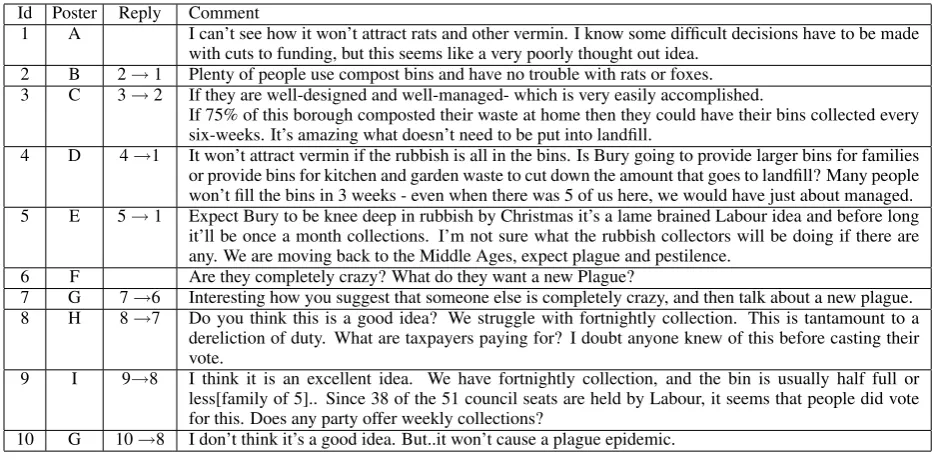
Id Poster Reply Comment
1 A I can’t see how it won’t attract rats and other vermin. I know some difficult decisions have to be made with cuts to funding, but this seems like a very poorly thought out idea.
2 B 2→1 Plenty of people use compost bins and have no trouble with rats or foxes. 3 C 3→2 If they are well-designed and well-managed- which is very easily accomplished.
If 75% of this borough composted their waste at home then they could have their bins collected every six-weeks. It’s amazing what doesn’t need to be put into landfill.
4 D 4→1 It won’t attract vermin if the rubbish is all in the bins. Is Bury going to provide larger bins for families or provide bins for kitchen and garden waste to cut down the amount that goes to landfill? Many people won’t fill the bins in 3 weeks - even when there was 5 of us here, we would have just about managed. 5 E 5→1 Expect Bury to be knee deep in rubbish by Christmas it’s a lame brained Labour idea and before long
it’ll be once a month collections. I’m not sure what the rubbish collectors will be doing if there are any. We are moving back to the Middle Ages, expect plague and pestilence.
6 F Are they completely crazy? What do they want a new Plague?
7 G 7→6 Interesting how you suggest that someone else is completely crazy, and then talk about a new plague. 8 H 8→7 Do you think this is a good idea? We struggle with fortnightly collection. This is tantamount to a
dereliction of duty. What are taxpayers paying for? I doubt anyone knew of this before casting their vote.
9 I 9→8 I think it is an excellent idea. We have fortnightly collection, and the bin is usually half full or less[family of 5].. Since 38 of the 51 council seats are held by Labour, it seems that people did vote for this. Does any party offer weekly collections?
[image:2.595.70.537.62.292.2]10 G 10→8 I don’t think it’s a good idea. But..it won’t cause a plague epidemic.
Figure 1: Comments responding to a news article announcing reduced bin collection in Bury. Full article and comments at: http://gu.com/p/4v2pb/sbl.
In our view, what has been lacking so far is a discussion of and proposed answer to the fun-damental question of what a summary of reader comments should be like and human-generated ex-emplars of such summaries for real sets of reader comments. A better idea of the target for summari-sation and a resource exemplifying it would put the community in a better position to choose meth-ods for summarisation of reader comment and to develop and evaluate their systems.
In this paper we make three principal contribu-tions. First, after a brief discussion of the nature of reader comment we make a proposal about one type of informative reader comment summary that we believe would have wide utility. Second, we present a three stage method for manually creating reference summaries of the sort we propose. This method is significant since the absence to date of human-authored reader comment summaries is no doubt due to the very serious challenge of produc-ing them, somethproduc-ing our method alleviates to no small degree. Third, we report the construction and analysis of a corpus of human-authored ref-erence summaries, built using our method – the first publicly available corpus of human-authored reader comment summaries.
2 Summaries of Reader Comments
What should a summary of reader comment con-tain? As Sp¨arck-Jones (2007) has observed, what a summary should contain is primarily dependent on the nature of the content to be summarised and
the use to which the summary is to be put. In this section we first make a number of observations about the character of reader comments and offer a specification for a general informative summary.
2.1 The Character of Reader Comments
Figure 1 shows a fragment of a typical comment stream, taken from reader comment responses to a Guardianarticle announcing the decision by Bury town council to reduce bin collection to once every three weeks. While not illustrating all aspects of reader comment interchanges, it serves as a good example of many of their core features.
Comment sets are typically organised into threads. Every comment is in exactly one thread and either initiates a new thread or replies to ex-actly one comment earlier in a thread. This gives the conversations the formal character of a set of trees, with each thread-initial comment being the root node of a separate tree and all other comments being either intermediate or leaf nodes, whose par-ent is the commpar-ent to which they reply. While threads may be topically cohesive, in practice they rarely are, with the same topic appearing in mul-tiple threads and threads drifting from one topic onto another (see, e.g. comments 5 and 6 in Fig-ure 1 both of which cite plague as a likely outcome of the new policy but are in different threads).
stance) on an issue raised in the original article or by an earlier commenter, or (2) provide evi-denceor grounds for believing a viewpoint or as-sertion already expressed. Issues are questions on which multiple viewpoints are possible; e.g., the issue of whether reducing bin collection to once every three weeks is a good idea, or whether re-ducing bin collection will lead to an increase in vermin. Issues are very often implicit, i.e not di-rectly expressed in the comments (e.g., the issue of whether reducing bin collection will lead to an in-crease in vermin is never explicitly mentioned yet this is clearly what comments 1-4 are addressing). A fuller account of this issue-based framework for analysing reader comment is given in Barker and Gaizauskas (2016).
Aside from argumentative content, reader com-ments exhibit other features as well. For exam-ple, commenters may seek clarification about facts (e.g. comment 4 where the commenter asks Is Bury going to provide larger bins for families . . . ?). But these clarifications are typically car-ried out in the broader context of making an argu-ment, i.e. advancing evidence to support a view-point. Comments may also express jokes or emo-tion, though these too are often in the service of advancing some viewpoint (e.g. sarcasm or as in comments 4 and 6 emotive terms like lame-brained and crazy clearly indicating the com-menters’ stances, as well as their emotional atti-tude).
2.2 A Conversation Overview Summary
Given the fundamentally argumentative nature of reader comments as sketched above, one type of summary of wide potential use is a generic infor-mative summary that aims to provide an overview of the argument in the comments. Ideally, such a summary should:
1. Identify and articulate the main issues in the comments. Main issues are those receiv-ing proportionally the most comments. They should be prioritized for inclusion in a space-limited summary.
2. Characterise opinion on the main issues. To characterise opinion on an issue typically in-volves: identifying alternative viewpoints; indi-cating the grounds given to support viewpoints; aggregating – indicating how opinion was dis-tributed across different issues, viewpoints and
grounds, using quantifiers or qualitative expres-sions e.g. “the majority discussed x”; indicat-ing where there was consensus or agreement among the comment; indicating where there was disagreement among the comment.
We presented this proposed summary type to a range of reader comment users, including com-ment readers, posters, journalists and news editors and received very positive feedback via a question-naire1. Based on this, we developed a set of
guide-lines to inform the process of summary authoring. Whilst clear about what the general nature of the target summary should be, the guidelines avoid be-ing too prescriptive, leavbe-ing authors some freedom to include what feels intuitively correct to include in the summary for any given conversation.
3 A Method for Human Authoring of Reader Comment Summaries
To help people write overview summaries of reader comments, we have developed a 4-stage method, which is described below2. Summary
writers are provided with an interface, which guides annotators through the 4-stage process, presenting texts in a form convenient for annota-tion, and collecting the annotations. The inter-face has been designed to be easily configurable for different languages, with versions for English, French and Italian already in issue. Key details of the methodology, guidelines and example annota-tions follow. Screenshots of the interfaces support-ing stages 1 and 3 can be found in the Appendix.
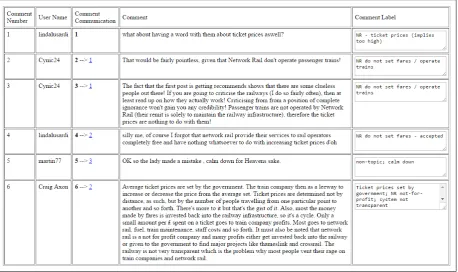
Stage 1: Comment Labeling In this stage, an-notators are shown an article in the interface, plus its comments (including the online name of the
1Further details on the summary specification and the
end-user survey on it can be found in SENSEI deliver-able D1.2 “Report on Use Case Design and User Require-ments” at: http://www.sensei-conversation. eu/deliverables/.
2The method described here is not unlike the general
1. Comment: “Smart machines now collect our highway tolls, check us out at stores, take our blood pressure . . . ” And yet unemployment re-mains low.
Label: smart machines now carry out many jobs for us (collect tolls; checkout shopping; take blood pressure), but unemployment stays low. 2. Comment:Not compared to the 70s, only relative
to the 80s/90s.
Label: disagrees with 1; unemployment is not low compared to the 70’s; is low relative to the 80’s/90’s
Figure 2: Two comments with labels (source: www.theguardian.com/commentisfree/2016/ apr/07/robots-replacing-jobs-luddites-economics-labor).
poster, and reply-to information). Annotators are asked to write a ‘label’ for each comment, which is a short, free text annotation, capturing its es-sential content. A label should record the main “points, arguments or propositions” expressed in a comment, in effect providing a mini-summary. Two example labels are shown in Figure 2.
We do not insist on a precise notation for labels, but we advise annotators to:
1. record when a comment agrees or disagrees with something/someone
2. note grounds given in support of a position 3. note jokes, strong feeling, emotional content 4. use common keywords/abbreviations to
de-scribe similar content in different comments 5. return regularly to review/revise previous
la-bels, when proceeding through the comments 6. make explicit any implicit content that is im-portant to the meaning, e.g. “unemployment” in the second label of the figure (note: this process can yield labels that are longer than the original comment).
The label annotation process helps annotators to gain a good understanding of key content of the comments, whilst the labels themselves facilitate the grouping task of the next stage.
Stage 2: Label Grouping In stage 2, we ask an-notators to sort through the Stage 1 labels, and to group together those which are similar or related. Annotators then provide a “Group Label” to de-scribe the common theme of the group in terms of e.g. topic, propositions, contradicting viewpoints, humour, etc. Annotators may also split the labels in a group into Groups” and assign a “Sub-Group Label”. This exercise helps annotators to
make better sense of the broad content of the com-ments, before writing a summary.
The annotation interface re-displays the labels created in Stage 1 in an edit window, so the anno-tator can cut/paste the labels (each with its com-ment id and poster name) into their groups, add Group Labels, and so on. Here, annotators work mainly with the label text, but can refer to the source comment text (shown in context in the comment stream) if they so wish. When the anno-tator feels they have sorted and characterised the data sufficiently, they can proceed to stage 3.
Stage 3: Summary Generation Annotators write summaries based on their Label-Grouping analysis. The interface (Figure 5) displays the Grouping annotation from Stage 2, alongside a text box where the summary is written in two phases. Annotators first write an ‘unconstrained summary’, with no word-length requirement, and then (with the first summary still visible) write a ‘constrained-length summary’ of 150–250 words. Further analysis may take place as a person de-cides on what sentences to include in the summary. For example, an annotator may:
• develop a group label, e.g. producing a pol-ished or complete sentence;
• carry out further abstraction over the groups, e.g. using a new high-level statement to sum-marise content from two separate groups;
• exemplify, clarify or provide grounds for a summary sentence, using details from labels or comments within a group, etc.
We encourage the use of phrases such as “many/ several/few comments said. . . ”, “opinion was di-vided on. . . ”, “the consensus was. . . ”, etc, to quantify the proportion of comments/posters ad-dressing various topics/issues, and the strength/ polarisation of opinion/feeling on different issues.
oflabels, the labels have associated comment ids, so indirectly summary sentences are linked back to the source comments that support them. This last stage goes beyond the summary creation pro-cess, but captures information valuable for system development and evaluation.
4 Corpus Creation
4.1 Annotators and training
We recruited 15 annotators to carry out the sum-mary writing task. They included: final year jour-nalism students, graduates with expertise in lan-guage and writing, and academics. The majority of annotators were native English speakers; all had excellent skills in written English. We provided a training session taking 1.5-2 hours for all annota-tors. This included an introduction to our guide-lines for writing summaries.
4.2 Source Data
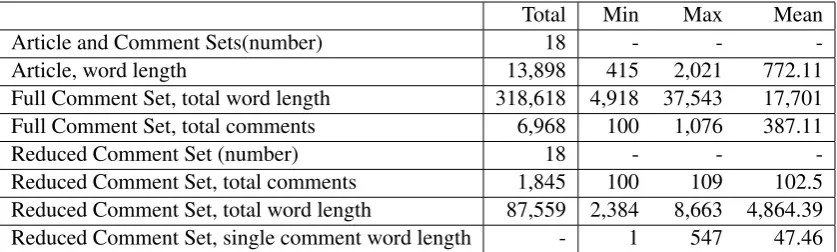
From an initial collection of 3,362Guardiannews articles published in June-July 2014 and asso-ciated comment sets, we selected a small sub-set for use in the summary corpus. Articles were drawn from theGuardian-designated topic-domains: politics, sport, health, environment, business, Scotland-news and science. Table 1 shows the summary statistics for the 18 selected sets of source texts (articles and comments). The average article length is 772 words. The ment sets ranged in size from 100 to 1,076 com-ments. For the annotation task, we selected a subset of each full comment set, by first order-ing threads into chronological order (i.e. oldest first), and then selecting the first 100 comments. If the thread containing the 100th comment had further comments, we continued including com-ments until the last comment in that thread. This produced a collection of reduced comment sets to-talling 87,559 words in 1,845 comments. Reduced summary comment sets vary in length from 2,384 words to 8,663 words.
5 Results and Analysis
The SENSEI Social Media Corpus, comprising the full text of the originalGuardianarticles and reader comments as well as all annotations gen-erated in the four stage summary writing method described in Section 3 above – comment labels, groups, summaries and backlinks – is freely avail-able at:nlp.shef.ac.uk/sensei/.
5.1 Overview of Corpus Annotations
There were 18 articles and comment sets, of which 15 were double annotated and 3 were triple anno-tated, giving a total of 39 sets of complete annota-tions. Annotators took 3.5-6 hours to complete the task for an article and comment set.
Table 2 shows a summary of corpus annota-tions counts. The corpus includes 3,879 com-ment labels, an average of 99.46 per annotation set (av. 99.46/AS). There are, in total, 329group annotations(av. 8.44/AS) and 218subgroups(av. 5.59/AS). Each of the 547 groups/subgroups has a shortgroup labelto characterise its content. Such labels range from keywords (“midges”, “UK cli-mate”, “fining directors”, “Air conditioning/fans”) to full propositions/questions (“Not fair that SE gets the investment”, “Why use the fine on wifi?”). Each of the 39 annotation sets has two summaries, of which theunconstrained summarieshave aver-age length 321.41 words, and theconstrained sum-maries, 237.74 (a 26% decrease). Each summary sentence is back-linked to one or more groups comment labels that informed it.
5.2 Observations
Variation in Grouping There is considerable variation between annotators in use of the option to group/sub-group comment labels. Whilst the average of groups per annotation set was 9.0, for the annotator who grouped the least this was 4.0, and the maximum average 14.5. For sub-groups, the average per annotation set was 5.0. 14 of 15 annotators used the sub-group option in at least one annotation set, and only 5 of the 39 sets in-cluded no sub-groups. A closer look shows a di-vide between annotators who use sub-groups quite frequently (7 having an average of≥6.5/AS) and those who do not (with av.≤2/AS).
Other variations in annotator style include the fact that around a third of them did most of their grouping at the sub-group level (4 of the 6 who fre-quently used subgroups were amongst those hav-ing the lowest average number of groups). Also, whilst a fifth of annotators preferred to use mainly a single level of grouping (i.e. had a high average of groups, and a low average of sub-groups, per annotation set), another fifth of annotators liked to create both a high number of groups and of sub-groups, i.e. used a more fine-grained analysis.
Total Min Max Mean
Article and Comment Sets(number) 18 - -
-Article, word length 13,898 415 2,021 772.11
Full Comment Set, total word length 318,618 4,918 37,543 17,701
Full Comment Set, total comments 6,968 100 1,076 387.11
Reduced Comment Set (number) 18 - -
-Reduced Comment Set, total comments 1,845 100 109 102.5
Reduced Comment Set, total word length 87,559 2,384 8,663 4,864.39
[image:6.595.90.509.62.188.2]Reduced Comment Set, single comment word length - 1 547 47.46
Table 1: Summary Statistics for Corpus Source Texts
Total Min Max Mean
Annotated Comment Set (number) 18 - -
-Completed Annotation Sets (number) 39 - -
-Stage 1 Labels (number) 3,879 69 109 99.46
Length of Unconstrained Summaries (words) 12,535 131 664 321.41
Length of Constrained Summaries (words) 9,272 152 249 237.74
Number of Groups / Group Labels 329 4 17 8.44
Number of Sub-Groups / Sub-Group Labels 218 0 15 5.59
Number of Labels in Groups 4,050 1 84 12.31
Number of Labels in Sub-groups 1,435 1 27 6.58
Note: Total count, min, max and mean are drawn from across the full set of corpus annotations Table 2: Annotation Statistics
groups/subgroups created by the annotators, but surprisingly, there was no obvious correlation.
Reader Comment Summaries We carried out a preliminary qualitative analysis to establish the character of the summaries produced, which shows that they are in general all coherent and grammatical, and that the majority of summary sentences characterise views on issues. Some ob-servations on summary content follow:
1. All summaries contain sentences reporting differentviewson issues. Figure 2 shows two typi-cal summaries, which describe a range of views on two main issues: “whether or not citizens can cope with reductions in bin collection” (Summary 1), and “whether or not new taxes on the rich should be introduced to pay for the NHS” (Summary 2).
2. Summaries frequently indicate points of con-tention or counter arguments, e.g. sentences(S2) and(S5)of Summary 2.
3. Summaries often provide examples of the rea-sons people gave in support of a viewpoint: e.g. (S2) of Summary 1 explains that people thought a reduced bin collection would attract vermin be-cause the bins will overflow with rubbish.
4. Annotators often indicate the propor-tion/amount of comment addressing a particular topic/issue or supporting a particular viewpoint, e.g. see(S6)of Summary 2;(S3)of Summary 1.
5. While the majority of annotators abstracted across groups of comments to describe views on issues, there were a few outliers who did not. For example, for an article about a heatwave in the UK, the two annotators grouped the same 8 comments, but summarised the content very dif-ferently. Annotator 1 generalised over the com-ments: “A small group of comments discussed how the heat brings about the nuisance of midges and how to deal with them”. Annotator 2 listed the points made in successive comments: “One person said how midges were a problem in this weather, another said they should shut the win-dows or get a screen. One person told an anecdote about the use of a citronella candle . . . another said they were surprised the candle worked as they had been severely bitten after using citronella oil”.
6. Very few summary sentences describe a dis-cussion topic without indicating views on it (e.g. “Many comments discuss the disposal of fat”).
Summary 1
(S1)Opinions throughout the comments were divided regarding whether residents could cope with Bury’s de-cision to collect grey household bins every three weeks rather than every two, and the impact this could have on households and the environment. (S2) Some ar-gued how the reduction in bin collection would at-tract vermin as bins overflow with rubbish, while oth-ers gave suggestions of how waste could be reduced.
(S3)The largest group of commenters reflected on how successful (or not) their specific bin collection scheme was at reducing waste and increasing recycling. (S4)
Throughout the comments there appeared to be some confusion on what waste could be recycled in the grey household bin in Bury.(S5)It also appeared unclear if Bury currently provides a food waste bin and if not one commenter suggested that the borough should provide one in the effort to reduce grey bin waste.(S6)A large number of comments suggested how residents could reduce the amount of waste going into the grey house-hold bin by improving their recycling behaviour. (S7)
This led to a deeper discussion regarding the pros and cons of reusable and disposable nappies...
Summary 2
(S1)The majority of people agreed that businesses and the rich should pay more tax to fund the NHS, rather than those on low in-comes.(S2)Some said income tax should be raised for the highest earners and others suggested a ’mansion tax’. (S3)Some com-menters suggested that the top one percent of earners should pay up to 95 in income tax. (S4)Although, there was a debate as to how ’rich’ can be defined fairly. (S5)Other commenters pointed out that raising taxes would damage the economy and drive the most talented minds and business to different countries with lower taxes.(S6)A large proportion of commenters said the government should do more to tackle tax evasion and avoidance by big busi-nesses and the rich. (S7)But some said the extent of tax evasion was exaggerated by the press. (S8)A strong number of people criticised the coalition for cutting taxes for the rich and placing the burden on lower-paid workers.(S9)They said that income tax has been cut for the very rich, while benefits have been slashed and VAT has increased, making life for low-paid workers more diffi-cult. (S10)Many criticised the Liberal Democrats for going into a coalition with the Conservatives and failing to keep promises.
(S11)Many said they had failed to curb Tory excesses and had abandoned their core principles and pledges. (S12)A small mi-nority said that the NHS is too expensive and needs reform.
Figure 3: Two human authored summaries of comment sets. These summaries and the source articles and comments are in the SENSEI Corpus available at:nlp.shef.ac.uk/sensei.
practice or person, to clarify an aspect of the debate, e.g. see (S5) of Summary 1, Humour; FeelingsandComplaints, about e.g. commenters and reporters.
5.3 Similarity of Summary Content
We investigated the extent to which summaries of the same set of comments by different annotators have the same summary content, by performing a content comparison assessment on 10 randomly selected summary pairs, using a method similar to the manual evaluation method of DUC 2001 (Lin and Hovy, 2002).
Given summaries A and B, for each sentence s in A, a subject judges the extent to which the meaning of s is evidenced (anywhere) in B, as-signing a score on a 5-point scale (5=all meaning evidenced; 1=none is). Any score above 1 requires evidence ofcommon propositional content(i.e., a common entity reference alone would not suffice). After A is compared to B, B is compared to A.
Comparison of the 10 random summary pairs required 300 sentence judgements, which were each done twice by two judges and averaged. In these results, 17% of summary sentences received a score of 5 (indicating all meaning evidenced) and 40% a score between 3 and 4.5 (suggesting some or most of their meaning was evidenced). Only 15% of sentences received a score of 1.
Looking at the content overlap per individual summary pair (by averaging the sentence overlap
scores for that pair), we find values for the 10 pairs that range from 2.56 up to 3.65 (with overall aver-age 3.06). Scores may be affected by the length of comment sets (as longer sets give more scope for variation and complexity), and we observe that the two lowest scores are for long comment sets.
We assessed the agreement between judges on this task, by comparing their scores for each sen-tence. Scores differ by 0 in 46% of cases, and by 1 in 33%, giving a combined 79% with ‘near agree-ment’. Scores differ by>2 in only 6% of cases. These results suggest that average sentence simi-larity is a reliable measure of summary overlap.
6 Related Work
Such an approach is straightforward and pro-vides useful feedback for extractive summariza-tion systems. While the gold standard is extrac-tive, the selected content may have an abstrac-tive flavour if annotators are instructed to favour “meta-level” source units that contain overview content. But the comment domain has few obvious examples of meta-level sentences; explicit refer-ences to the issues under discussion are few, as are reflective comments that sum up a preceding series of comments. Moreover, extractive approaches to writing comment summaries will almost certainly fall short of indicating aggregation over views and opinion. In sum, this is not an ideal approach to creating reference summaries from comment.
A more abstractive approach to writing sum-maries of multi-party conversations was used in the creation of the AMI corpus annotations, based on 100 hours of recorded meetings dialogues (Car-letta et al., 2006). There are some similarities and differences between the AMI approach and our own. First, AMI summary writers first completed a topic segmentation task to prepare them for the task of writing a summary. While segmenta-tion might appear to resemble ourgroupingstage, these are very different tasks. Key differences are that segmentation was carried on AMI dialogues using a pre-specified list of topic descriptions. This would be difficult to provide for comment summary writers, since we cannot predict every-thing the comments will talk about. Secondly, the AMI abstractive summaries are linked to dialogue acts (DAs) in their manual extractive summaries (a link is made if a DA is judged to “support” a sentence in the abstractive summary). Similar to our back-links, their links provide indices from the abstractive summary to source text units. How-ever, our back-links are from a summary sentence togroupsof comment labels that the summary au-thor has judged to have informed his sentence. Fi-nally, the AMI abstractive summaries comprise an overview summary of the meeting, and list “de-cisions”, “problems/issues” and “actions”. How-ever, while a very small number of non-scenario corpus summaries included reports of alternative views in a meeting (e.g. on which film to choose for a film club), the AMI scenario summaries in-clude very few examples of differences in opinion. Misra et al. (2015) have created manual sum-maries of short dialogue sequences, extracted from different conversations on similar issues on
debat-ing websites. They then collected summaries to-gether, and applied the Pyramid method (Nenkova et al., 2007) to identify common, central propo-sitions, which, they describe as “abstract objects” that represent facets of an argument on an issue, e.g. gay marriage. Indeed the task of identify-ing central propositions across multiple conversa-tions is a key aim in their work and one they point out is central to others working in argumentation mining. They use the Pyramid annotations to pro-vide indices from the central proposition to the summary and underlying comment, with a view to learning how to recognize similar argument facets automatically. Note their task differs from ours in that we aim to generate a summary of a single reader comment conversation, while they aim to identify (and then possibly summarize) all facets of a single argument, gleaned from multiple dis-tinct conversations.
Barker and Gaizauskas (2016) elaborate the issue-viewpoint-evidence framework introduced in Section 2.1 above and show how an argument graph representing an analysis in this framework may be created for a set of comments. They show how the content in a single reference sum-mary, created using the informal label and group method described above, corresponds closely to a subgraph in the more formally specified argument graph for the article and comment set.
7 Concluding Remarks and Future Work
We have presented a proposal for a form of in-formative summary that aims to capture the key content of multi-party, argument-oriented conver-sations, such as those found in reader comment. We have developed a method to help humans au-thor such summaries, and used it to build a cor-pus of reader comment multiply annotated with summaries and other information. We believe the method of labeling and grouping has wide applica-tion, i.e. in creating reference summaries of com-plex, multi-party dialogues in other domains.
Our summary corpus has already proved use-ful in providing insights for system development, and for training and evaluation. We have used group annotations to evaluate a clustering algo-rithm (Aker et al., 2016a); used back-links to in-form the training of a cluster labeling algorithm (Aker et al., 2016b); used the summaries as refer-ences in evaluating system outputs (with ROUGE as metric), and to inform human assessors in a task-based system evaluation (Barker et al., 2016). Even so, there are limitations to the work done which give pointers to further work. The current corpus is limited in size, and would ideally contain annotations for more comment sets, with more an-notations per set. One possibility is to break the summary creation method into smaller tasks suit-able for crowd-sourcing. Another issue is scala-bility: annotators can write summaries for ∼100 comments, but this is time-consuming and tax-ing, casting doubt on whether the method could scale to 1000 comments. Results from a pilot sug-gest annotators find it much easier to work on sets of 30–50 comments, so we are investigating how annotations for smaller subsets of a comment set might be merged into a single annotation.
Many of our annotators found the option to have groups and sub-groups useful, but this feature presents problems for some practical uses of the annotations, such as evaluation of some clustering methods. Hence, we have investigated methods to flatten the group-subgroup structure into one level, including the following two methods: (1) simple flattening, where all sub-groups merge into their parent groups (but this loses much of the analysis of some annotators), and (2) promoting subgroups to full group status (which has proved useful for generating useful group labels). More research is needed to establish the most effective flattening to best capture the consensus between annotators.
Finally, there is the open question of how to au-tomatically evaluate system-generated summaries against the reference summaries proposed here. In particular, is ROUGE (Lin, 2004), the most widely used metric for automatic summary eval-uation, an appropriate metric for use in this con-text? ROUGE, which calculates n-gram overlap between system and reference summaries, may not deal well with the abstractive nature of our sum-maries, and in particular with statements quanti-fying the distribution of support for various view-points. Its utility needs to be established by
cor-relating it with human judgements on system out-put quality. If it cannot be validated, the challenge arises to develop a metric better suited to this eval-uation need.
Acknowledgments
The authors would like to thank the European Commission for supporting this work, carried out as part of the FP7 SENSEI project, grant ref-erence: FP7-ICT-610916. We would also like to thank all the annotators without whose work the SENSEI corpus would not have been created, Jonathan Foster for his help in recruiting annota-tors and The Guardian for allowing us access to their materials. Finally, thanks to our anonymous reviewers whose comments and suggestions have helped us to improve the paper.
References
Ahmet Aker, Emina Kurtic, AR Balamurali, Monica Paramita, Emma Barker, Mark Hepple, and Rob Gaizauskas. 2016a. A graph-based approach to topic clustering for online comments to news. In
Advances in Information Retrieval, pages 15–29. Springer.
Ahmet Aker, Monica Paramita, Emina Kurtic, Adam Funk, Emma Barker, Mark Hepple, and Rob Gaizauskas. 2016b. Automatic label generation
for news comment clusters. In Proceedings of the
9th International Conference on Natural Language Generation Conference (INLG), Edinburgh, UK.
Emma Barker and Robert Gaizauskas. 2016. Sum-marizing multi-party argumentative conversations in
reader comment on news. InProceedings of the 3rd
Workshop on Argument Mining, Berlin.
Emma Barker, Monica Paramita, Adam Funk, Emina Kurtic, Ahmet Aker, Jonathan Foster, Mark Hep-ple, and Robert Gaizauskas. 2016. What’s the is-sue here?: Task-based evaluation of reader comment
summarization systems. In Proceedings of LREC
2016.
Jean Carletta, Simone Ashby, Sebastien Bourban, Mike Flynn, Mael Guillemot, Thomas Hain, Jaroslav Kadlec, Vasilis Karaiskos, Wessel Kraaij, Melissa Kronenthal, Guillaume Lathoud, Mike Lincoln, Agnes Lisowska, Iain McCowan, Wilfried Post, Dennis Reidsma, and Pierre Wellner. 2006. The AMI meeting corpus: A pre-announcement. In
Proceedings of the Second International Confer-ence on Machine Learning for Multimodal
Interac-tion, MLMI’05, pages 28–39, Berlin, Heidelberg.
Debanjan Ghosh, Smaranda Muresan, Nina Wacholder, Mark Aakhus, and Matthew Mitsui. 2014. Analyz-ing argumentative discourse units in online interac-tions. InProc. of the First Workshop on Argumenta-tion Mining, pages 39–48.
Ivan Habernal, Judith Eckle-Kohler, and Iryna Gurevych. 2014. Argumentation mining on the web
from information seeking perspective. In Proc. of
the Workshop on Frontiers and Connections between Argumentation Theory and Natural Language Pro-cessing, pages 26–39.
Elham Khabiri, James Caverlee, and Chiao-Fang Hsu. 2011. Summarizing user-contributed comments. In
Proceedings of The Fifth International AAAI Con-ference on Weblogs and Social Media (ICWSM-11), pages 534–537, Barcelona.
Chin-Yew Lin and Eduard Hovy. 2002. Manual and
automatic evaluation of summaries. InProceedings
of the ACL-02 Workshop on Automatic Summariza-tion - Volume 4, AS ’02, pages 45–51, Stroudsburg, PA, USA. Association for Computational Linguis-tics.
Chin-Yew Lin. 2004. Rouge: a package for
au-tomatic evaluation of summaries. In Proceedings
of the ACL 2004 Workshop on Text Summarization Branches Out, jul.
Clare Llewellyn, Claire Grover, and Jon Oberlander.
2014. Summarizing newspaper comments. In
Pro-ceedings of the Eighth International Conference on Weblogs and Social Media, ICWSM 2014, Ann Ar-bor, Michigan, USA, June 1-4, 2014.
Zongyang Ma, Aixin Sun, Quan Yuan, and Gao Cong. 2012. Topic-driven reader comments
summariza-tion. InProceedings of the 21st ACM international
conference on Information and knowledge
manage-ment, CIKM ’12, pages 265–274, New York, NY,
USA. ACM.
Amita Misra, Pranav Anand, Jean E. Fox Tree, and Marilyn Walker. 2015. Using summarization to dis-cover argument facets in online idealogical dialog. InProceedings of the 2015 Conference of the North American Chapter of the Association for Computa-tional Linguistics: Human Language Technologies, pages 430–440, Denver, Colorado, May–June. As-sociation for Computational Linguistics.
Gabriel Murray and Giuseppe Carenini. 2008.
Sum-marizing spoken and written conversations. In
Pro-ceedings of the Conference on Empirical Methods in Natural Language Processing, EMNLP ’08, pages 773–782, Stroudsburg, PA, USA. Association for Computational Linguistics.
Ani Nenkova, Rebecca Passonneau, and Kathleen McKeown. 2007. The Pyramid method: Incorporat-ing human content selection variation in summariza-tion evaluasummariza-tion. ACM Trans. Speech Lang. Process., 4, May.
Johnny Saldana. 2015. The Coding Manual for
Quali-tative Researchers. Sage Publications Ltd, 3 edition. Karen Sp¨arck Jones. 2007. Automatic summarising: The state of the art. Information Processing & Man-agement, 43(6):1449–1481.
Reid Swanson, Brian Ecker, and Marilyn Walker. 2015. Argument mining: Extracting arguments
from online dialogue. InProc. of the SIGDIAL 2015
Appendix
Figure 4: Stage 1 interface. The first 4 columns are created automatically from the source reader com-ments. The last column is a label supplied by the annotator.
[image:11.595.72.537.468.663.2]