
Review of Technologies for DC Grids -
Power Conversion, Flow Control and Protection
Grain Philip Adam
1, Til Kristian Vrana
2, Rui Li
1, Peng Li
3, Graeme Burt
1and Stephen Finney
41University of Strathclyde, Department of Electronics and Electrical Engineering, Glasgow, UK 2SINTEF Energi, Norway
3University of Aberdeen, School of Engineering, Aberdeen, UK 4University of Edinburgh, School of Engineering, Edinburgh, UK
Abstract: This article reviews dc transmission technologies for future power grids. The article emphasizes the attributes that each technology offers in terms of enhance controllability and stability, resiliency to ac and dc faults, and encourage increased exploitations of renewable energy resources (RERs) for electricity generation. Discussions of ac/dc and dc/dc converters reveal that the self-commutated dc transmission technologies are critical for better utilization of large RERs which tend to be dispersed over wide geographical areas, and offer needed controllability for operation of centralized and decentralized power grids. It is concluded that the series power flow controllers have potential to restrict the expensive isolated dc/dc converters to few applications, in which the prevention of dc fault propagation is paramount. Cheaper non-isolated dc/dc converters offer dc voltage tapping and matching and power regulation but they are unable to prevent pole-shifting during pole-to-ground dc fault. To date hybrid dc circuit breakers target dc fault isolation times ranging from 3ms to 5ms; while the resonance-based dc circuit breakers with forced current zeros target dc fault clearance times from 8ms to 12.5ms.
1.
INTRODUCTIONRenewable power generation has increased substantially in all major developed and developing countries, presenting significant challenges to grid operators at generation, transmission and distribution levels. Some of these challenges can be summarised as follows [1-6]
• Wide spread uses of HVDC links and wind generators with fully rated back-to-back converters deprive ac grids from the contribution of the generators’ rotating inertias to damping of low frequency power oscillations following major ac network disturbances.
• Intermittent nature of renewable energy resources exacerbates the problems of power balance and poor utilization of the ac lines due to undesirable power flow in ac power systems with high penetration of renewable power generation. • Operation of power electronic based solar and
wind generators, which are less sensitive to frequency variation (±2.5Hz) alongside the frequency sensitive large conventional synchronous generators, render most existing protection philosophies inadequate. This is because the stability margins of the latter dictate the overall stability of the entire power system, leading to unnecessary loss of generation or tripping of conventional power plants due to loss of synchronism.
Some of these challenges could be addressed with well-designed smart grids that employ both ac and dc transmission systems with state-of-arts control and communication systems, where the vast energy stored in the dc lines and converters’ cell capacitors of the
asynchronous connections could be manipulated to mitigate the effect of renewable energy resources variability on power quality, and improve transient stability by splitting large ac power systems into several independent asynchronous ac protection zones in order to prevent ac fault propagation throughout the system [4, 5, 7]. In this manner, conventional synchronous and doubly fed induction generators can contribute to power oscillation damping (POD) in their respective zone alongside the synthetic inertia from the capacitors of asynchronous links. The trend of data driven power consumption at lower distribution systems of smart grids (380~415V) may require agile generation and transmission system infrastructures which are able to cope with rapid change in power demand, mainly driven by electricity prices, consumer behaviour, and other autonomous smart devices for demand side management [8-11]. To avoid poor utilization of the generation and transmission infrastructures in data driven smart grids, fast and secure communication systems capable of dealing with large data and a number of high level controllers will be required to optimize the power flow at the transmission level. This flow optimisation can be done with:
• converter terminals of the HVDC interconnectors • embedded HVDC links within some of the ac
protection zones
• flexible ac transmission system (FACTS) devices • high-voltage dc-dc converters, which manage the
renewable energy resources across different regions; thus, leading to provision of cheap, reliable and sustainable power throughout all four seasons of the year. In this manner, power plant types which are operated with fixed output power such as nuclear and other fossil fuel based plants could be reduced [10, 12-17]. In contrast, the planned transition of smart grids from centralised to decentralised operation could be executed during major network faults or outages of the critical power corridors, with no or minimum loss of power supply, provided the said ac protection zones are designed to be self-contained (each must be able to satisfy the grid code as an independent ac network). In being able to operate in centralised and decentralised modes, smart grids have potential to avoid the problem of total system blackout.
The multi-terminal HVDC transmission network concept is attractive to many transmission system operators, and for future smart grids because of the following reasons:
• real power can be exchanged over a wide geographical area at reduced transmission power loss
• increased control flexibility over power flow (magnitude and direction) using a reduced number of converters and dc cables (hence, offers cost-effective solution)
• dc line conductor cross-section areas are fully utilized for carrying real power (no parasitic current or reactive current)
• dc line loadability is not limited by its surge impedance loading (SIL) as in equivalent ac lines, and dc lines are magnetic field neutral (less harmful to nearby wildlife and sea creatures) However, because of low resistance and rapidly diminishing effect of the line inductance during a dc short circuit fault, the speed of dc fault propagation is much faster than an ac fault. Also, because the dc fault current increases rapidly within the first 3ms of the fault initiation, the dc short circuit fault has to be interrupted within an ac sub-fundamental cycle to avoid irreparable damage to expensive and vulnerable part of the dc network, such as power converters. Recently, significant effort has been invested in the development of new types of power converters that do not increase the fault level in the dc network and can survive dc faults for extended periods (several milliseconds without the risk of damage). This has been done in an attempt to relax dc circuit breakers requirements (in terms of let-through current, current breaking capacity, and operating speed). Although some of the emerged converters and dc circuit breakers are designed to cope with the high demands of dc faults, most of these circuit breakers require a number of sizable extra dc inductors to be incorporated into the dc-link or converter control modification to slow down the rate of rise of the dc fault current at the dc-link of each converter and rate of fall of the dc-link voltage or actively control the fault current [1, 3, 10, 18, 19]. Research is needed into protection aspects related to fault detection and
discrimination and in coordination between ac and dc side protection to avoid catastrophic outcomes of miss-operation.
This discussion shows that besides complex control and communication systems, line and self-commutated FACTS devices and HVDC transmission systems and high-voltage dc-dc converters are all critical in achieving the increased control flexibility expected from smart grids. Besides increased controllability, smart grids provide platforms to facilitate a cheap way to integrate many renewable power plants into power grids, without the need for energy storage systems, benefiting from the diversity of renewable energy resources in different regions. Therefore, this paper presents a comprehensive review of the transmission system technologies for smart grids, with particular focus on components of dc transmission systems. Although a qualitative discussion is used as the main tool to articulate the attributes and limitations of different components or solutions in general and from a smart grid prospective, quantitative substantiation is used in a limited number of cases.
2. MODULAR MULTILEVEL AC-DC
CONVERTERS
Fig. 1 shows the modular multilevel converter [20-27]. Each phase-leg of the MMC comprises of upper and lower arms, and each arm consists of ‘N’ cascaded cells such as in Fig. 1, and must support the full dc-link voltage ‘Vdc’. The voltage across each cell capacitor
must be regulated around Vcell=Vdc/N or Vcell=Vcref/N,
dependingon the control method employed. Correct operation of the MMC is achieved when each of phase-leg inserts a sufficient number of cell capacitors into conduction path to counter the input dc-link voltage, and this imposes complementary operation of the upper and lower arms of the same phase-leg according to the
following insertion functions:
[
]
1
1( ) 2 1 sin( )
a d
n t = N α −m ωt+δ and
[
]
1
2( ) 2 1 sin( )
a d
n t = N α +m ωt+δ ; where,
1
d Vdc Vcref
α = is the dc modulation index, m is the ac amplitude modulation index, δ is arbitrary load angle,
cr ef
V is the desired set-point for the sum of the cell capacitor voltages of each arm, and na1 and na2 are the
number of cells to be inserted into the power path from the upper and lower arms at each instant. Instantaneous voltage across the upper and lower MMC arms are:
[
]
1
1 1( ) 2 sin( )
a a cell cref d
v =n t ×V = V α −m ωt+δ and
[
]
1
2 2( ) 2 sin( )
a a c ell c ref d
v =n t ×V = V α +m ωt+δ [28].
Considering phase ‘a’ as an example, MMC terminal phase voltage (vao) at output ‘ao’ relative to ground (O1)
represents the different-mode voltage of phase-leg ‘a’
and is given by: 1
1 2 1 2 sin( )
ao a a cref
v =v −v = m V ωt+δ .
During normal operation, Vcref is regulated around Vdc;
(Vdc1), while maintaining a small voltage mismatch
between the two voltages to allow the dc current flow; thus, power exchange between the ac and dc sides. The arm inductor Ld in Fig. 1 limits the inrush current due
to mismatch between common-mode voltage and input dc-link voltage. This operation means the MMC is the only VSC where the upper and lower arms of the same phase leg conduct simultaneously; with arms containing continuous ac and dc currents. The fundamental components of the arm currents are used to exchange active power between the converter and ac sides, while the dc components of the arm currents provide power transfer from the converter to the dc side [29]. When ia1 and ia2 are phase ‘a’ upper and lower arm
currents as defined in Fig. 1, phase ‘a’ output current (iao) represents the differential-mode current (iao=ia1
-ia2). The current component that circulates between the
upper and lower arm of phase ‘a’, without reaching the output circuit, is denoted as common-mode current ‘icom’ and is given by: icom=½(ia1+ia2). Without
dedicated active or passive countermeasure, the MMC arm or common-mode currents may contain some parasitic components such as 2nd order harmonic current that could increase semiconductor losses and cell capacitor voltage ripple. The main attributes and drawbacks of MMCs are [20-27]:
• The MMC generates sinusoidal output voltages, with near zero harmonics and extremely low voltage stresses (dv/dt) on the interfacing transformer; thus, ac filters and phase interfacing reactors are not needed.
• Beside the known attributes of conventional voltage source converters, the circuit structure of the MMC permits the power rated and dc operating voltage of VSC-HVDC links to be increased to a level comparable to that of conventional of LCC-HVDC links; and internal fault management, which is necessary for continued operation during cell failure (cell capacitors or switching devices). Moreover, the use of distributed cell capacitors in MMCs reduces the first peak (or transient component) of the let-though currents that may flow in the dc circuit breaker before its opening; thus, allowing dc circuit breaker design requirements to be relaxed.
However, the large footprint of the MMC due to the use of a large number of cell capacitors, represents a major drawback from the scenery point of view and costs of right-of-way. The ratings for MMCs have reached 1000 MW and 525 kV [30].
The properties of the MMC highly depend on the internal structure of the utilised cells. The following subsections give an overview on the most prominent proposed cell types.
Fig. 1: Schematic diagrams of the generic MMC
2.1 Half-bridge cell MMC (HB-MMC)
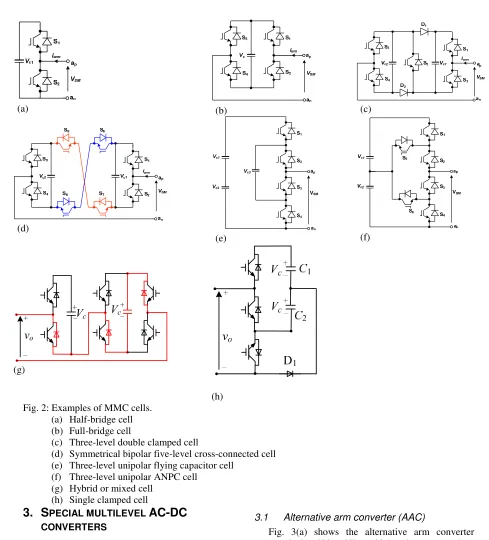
Fig. 2 (a) shows a half-bridge cell [23, 25, 26]. The HB-MMC offers low semiconductor losses, which is in line with the decarbonisation efforts of transmission networks; but is subject to the same constraints of conventional VSCs such as operation with unipolar dc-link voltage and vulnerability to dc faults. All existing MMC-type HVDC links currently operational are HB-MMCs.
2.2 Full-bridge cell MMC (FB-MMC)
Fig. 2 (b) shows a full-bridge cell. Although the FB-MMC has high semiconductor losses, it offers dc fault reverse blocking capability; and operation with variable and bipolar dc-link voltage, including zero dc voltage, while retaining full control over active and reactive power exchange between converter ac and dc sides [31-33]. This feature means the FB-MMC handles dc faults without the need to block the converter, while full control over the ac current in-feed from the ac side is retained. Additionally, bipolar dc voltage operation allows the FB-MMC to operate in a generic dc grid, side by side to line commutated converters (as the FB-MMC can change power flow direction with the change of dc current or dc voltage polarities). These attributes are expected to be invaluable in the delivery of increased control flexibility needed in smart grids.
FB-MMC technology has been proposed for a HVDC link with overhead lines in Germany: the ULTRANET project (±380 kV, 2 GW) [34]. The main reason for applying full-bridge technology was better fault handling ability, since the project uses overhead lines, where the likelihoods of DC faults are much higher compared to its counterpart with cables.
2.3 Doubled clamped cell MMC (DCL-MMC)
Fig. 2 (c) shows a three-level double clamped cell. Each cell of the DCL-MMC is equivalent to two HB cells as it uses two capacitors and generates three viable voltage levels (2Vc, Vc and 0) provided the cell
capacitor (C1 and C2) voltages are maintained such that
Vc1≈Vc2≈Vc (this is contrary to that explained in [35]).
[image:3.595.355.491.78.247.2]Fig. 2(c) inserts three semiconductor switching devices in conduction path, instead of two switches with equivalent HB cells but offers dc fault reverse voltage blocking capability, lacked in the HB-MMC. The main weakness of the DCL-MMC that uses the DCL cell is inability to generate a negative voltage level for both polarities of arm current, which restricts its operation to unipolar dc-link voltages. Thus, making it unable to facilitate operation with reduced dc-link voltage, unlike the MC-MMC.
2.4 Five-level cross-connected cell MMC
(5LCC-MMC)
Fig. 2 (d) shows a symmetrical five-level cross-connected cell that can generate voltage levels 2Vc, Vc,
0, -Vc and -2Vc, provided the cell capacitor voltages are
regulated such that Vc1≈Vc2≈Vc[35]. The five-level
cross-connected cell in Fig. 2 (d) is equivalent to two symmetrical full-bridge cells (four devices in conduction path, generate the same voltage levels); thus, its loss performance and control range and flexibility is expected to be similar to that of the FB-MMC, including operation with positive and negative dc-link voltages.
2.5 Flying capacitor cell MMC (FC-MMC)
Fig. 2 (e) shows a half-bridge flying capacitor unipolar cell, where each cell generates three voltage levels 0, Vc and 2Vc [35]. This flying capacitor cell is
equivalent to two half-bridges, where both insert two switches in the conduction path, but uses two capacitors rated at different voltages (2Vc and Vc), compared to Vc
in the equivalent HB cells. Therefore, the FC-MMC is expected to be subject to the same control range limitations as the HB-MMC and unipolar dc-link voltage operation and lack of dc reverse blocking. Capacitors with different rated voltages compromises power circuit modularity, thus is less attractive in terms of cell manufacture and maintenance. Although the FC cell can be configured as a symmetrical bipolar cell, similar to FB and five-level cross-connected cells described previously, this possibility is unattractive due to large number of cell capacitors required.
2.6 Active neutral-point clamped unipolar cell
MMC (ANPC-MMC)
Fig. 2 (f) displays the modular multilevel converter that uses an active neutral-point-clamped unipolar cell to generate three voltage levels per cell (0, Vc and 2Vc)
[35]. Operationally, the control range of an ANPC-MMC is limited to unipolar positive dc-link voltages as with the HB-MMC, where power reversal is only achieved by changing the polarity of the dc-link current, and it is unable to block dc faults or decouple cell capacitor regulation from the dc-link voltage (Vdc)
over a wide range; especially, when Vdc falls below the
peak of the line-to-line voltage the interfacing transformer imposes at the converter terminals. Because of the lack of redundant switch states at cell level, which restricts the selection of the upper capacitor (C1), cell capacitor voltages of the
ANPC-MMC may exhibit larger capacitor voltage ripple than HB-MMC and FC-MMC of similar rating and energy content. Although all the devices of the ANPC structure have the same voltage rating, two more IGBTs S5 and S6 are required, resulting in higher capital cost. Hence, they are not preferable in the practical application, compared with the HB cells.
2.7 Mixed cells MMC (MC-MMC)
It is possible to employ a combination of different cells within an MMC, with Fig. 2 (g) depicts an example of mixed cell. A lot of combinations are theoretically possible, but most commonly referred to is a combination of half- and full-bridge cells in order to reduce semiconductor losses to less than that of the FB-MMC[35, 36], while retaining some of control flexibility of the FB-MMC such as:
a) Resiliency to dc network faults, including dc fault reverse blocking capability and controlled operation with reduced and zero dc-link voltage. b) Bipolar dc-link voltage operation can be achieved
over a limited range, determined by the ratio
γ=NFB/NHB; where NFB= Nγ/(γ+1), NHB=N/(γ+1),
N is the total number of cells per arm (N=NFB+NHB), and NFB and NHB are the number of
full and half bridge cells per arm. This feature is necessary for arc extinction following a dc fault. c) The tributes and flexibilities in a) and b) show that
the mixed cell MMC could be used to deliver customised features for a given level of semiconductor losses.
Theoretically, the MC-MMC operates using a similar principle as the FB and HB MMC and adheres to the same insertion functions described in section 2. However, its operation limits, including bipolar dc voltage operation are determined by the ratio ‘γ’ that defines the control range for ‘αd’. For example, when
γ=1, NFB=NHB=½N, which implies that the control
range for dc modulation index ‘αd’ is:0≤αd≤1; thus,
each MC-MMC arm is able to synthesize any voltage level between Vdc0 and -½Vdc0. Within this envelope,
each MC-MMC arm can generated the necessary negative voltage to enable operation with any dc-link voltage from rated positive dc voltage (Vdco) to Vdc=0,
without jeopardizing the converter ability to synthesize the rated ac voltage. The combination of half and full bridge cells as depicted in Fig. 2 (g) generates two positive voltage levels (2Vc and Vc) and one negative
voltage (-Vc) and zero; therefore, it belongs to family of
asymmetric cells (or simply refer to as asymmetric cell).
2.8 Single-clamped cell MMC (SC-MMC)
cell capacitor voltage per cell is utilized to block dc faults, and the unidirectional conduction of clamping diode D1 makes the single-clamped cell unable to generate negative voltage when the MMC under active control, resulting in restricted control range and flexibility
2.9 Other cell topologies
Besides the aforementioned cells, more unipolar, asymmetric and symmetric bipolar cells can be found in [37, 38]
.
(a) (b) (c)
(d)
(e) (f)
(g)
[image:5.595.49.538.168.708.2](h) Fig. 2: Examples of MMC cells.
(a) Half-bridge cell (b) Full-bridge cell
(c) Three-level double clamped cell
(d) Symmetrical bipolar five-level cross-connected cell (e) Three-level unipolar flying capacitor cell
(f) Three-level unipolar ANPC cell (g) Hybrid or mixed cell
(h) Single clamped cell
3. SPECIAL MULTILEVEL AC-DC
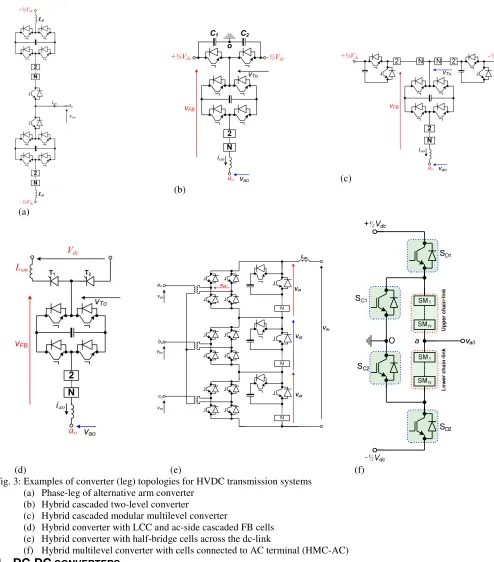
CONVERTERSFig. 3 shows the phase legs of some common modular and hybrid multilevel converters. The following subsections discussions the attributes and shortcomings of these converters, and potential relevance to smart transmission systems.
3.1 Alternative arm converter (AAC)
Fig. 3(a) shows the alternative arm converter proposed in [39, 40], which aims to reduce semiconductor losses and converter footprint (size and weight by reducing the number of cells per arm) compared to the FB-MMC, while retaining some of the attributes of the FB-MMC, such as dc fault reverse
S1
S2
S3
S4
ap
an
VSM
Vc1
Vc2
Vc3
v
o +–
+
–
V
c+
–
voltage blocking ability and reduced dc-link voltage operation. However, in retaining these attributes, the FB cells in each arm of the AAC must be able to block a dc voltage greater than ½Vdc, as originally envisaged
( 1
2 1
N FB
cj dc
j
v V
= >
). Unlike MMC type converters with
concurrent conduction in the upper and lower arms of the same phase leg, each arm of the AAC conducts for 180o with the director switch in each arm used to commutate currents between arms and ensure that each arm is able to block the full dc-link voltage (Vdc). With
the aid of a brief overlap period at the ‘0’ voltage level, where both upper and lower arms of the AAC conduct simultaneously, the director switch of each arm is used to facilitate current commutation between the upper and lower arms. Thus, seamless current commutation is achievable for a limited range of power factors, and beyond which large inrush current occurs in the AAC arms. Its input dc-link capacitors may increase the peak of dc fault current transient component [41].
In an effort to address the aforementioned problems and ensure satisfactory operation over full modulation index linear range and all power factors, extended overlap operation of AAC was proposed [42].
In summary, this discussion shows that the AAC is inferior to MC-MMC in terms of performance, flexibility and control.
3.2 Hybrid cascaded two-level converter
(HC2LC)
Fig. 3 (b) presents the hybrid cascaded two-level converter which uses a two-level converter as the main power stage that manipulates the phase and magnitude of fundamental voltage of the switched voltage (VTo) to
control the converter output active and reactive powers[43]. The ac-side cascaded FB chain link of each phase operates as a series active power filter (wave shaping circuit) to inject the necessary voltage harmonics (VFB) to cancel the inherent harmonics in the
switched output voltage of the two-level converter stage (VTo), thus a pure sinusoidal output voltage (vao)
is generated at output pole ‘ao’ relative to dc-link
mid-point ‘o’. If the orthogonality relationship between vFB
and iao is maintained, the linear range for modulation
index control of the HC2LC can be extended to 1.27 without compromise to cell capacitor voltage balancing. This means the P-Q envelope of the HC2LC will be larger than all MMC type converters. In the case of reactive power applications, the modulation index control range can be extended further, to 2. The HC2LC is expected to be smaller than all MMC type converters as the number of cell capacitors required per phase, is a quarter that of the HB and FB MMC. The main shortcomings of the HC2LC are[44]:
• DC fault reverse blocking capability if achieved at the expense of high semiconductor losses as the number of devices in the conduction path, carrying full load current, is higher that the AAC and MC-MMC.
• Its input dc-link capacitors contribute substantial discharge current into a dc fault, and this increases the current stresses on the dc switchgear connected to its positive and negative dc poles.
• Ensuring synchronization between the switching of the two-level converter and the chain link is challenging, and it may expose the converter transformer to high-voltage spikes of ±2Vdc in the
worst-case, and with period corresponding to miss-synchronization period. These spikes tend to introduce low-order harmonics into the baseband and need filtering using ac tuned filters.
• Its operation is limited to positive dc-link voltages, and reduced dc voltage operation is possible should the number of FB cells in the chain link be increased to be able to synthesize the nominal terminal ac voltage when the dc-link is suppressed to zero; thus, operating as a typical cascaded multilevel converter.
3.3 Hybrid cascaded modular multilevel
converter (HC-MMC)
Fig. 3 (c) displays one-phase-leg of a hybrid converter that employs a HB-MMC in the main stage (instead of a two-level converter as in the HC2LC described in subsection 3.2) to control the fundamental voltage and power exchange between the converter ac and dc sides [45]. The operation of the ac-side FB chain link of each phase leg is as explained for the HC2LC. The low dv/dt of the staircase multilevel voltage waveform ‘VTo’ at its terminal means switching
synchronization to the FB chain link involves a maximum voltage error of one cell capacitor voltage. The HB-MMC in the main stage allows the FB chain links of the HC-MMC to be used as ac circuit breakers, while the cell capacitors of the HB-MMC facilitate controlled recharge of the dc-link following dc fault clearance [45]. The HC-MMC has a large footprint, high semiconductor losses, and high cost due to its larger semiconductor area and large number of capacitors.
3.4 Line commutated converter with ac-side
cascaded full-bridge chain link (LCC-ACFBCL)
Fig. 3 (d) shows a phase-leg of a line commutating converter that uses cascaded FB cells in its ac side as a series active power filter to ensure that the LCC stage receives a distortion free (or pure sinusoidal) commutation voltage, independent of the system operating condition at the point of common coupling[46]. Thus LCC commutation failure is avoided [46], and the entire LCC reactive power needs can be provided by manipulating the magnitude of the commutation voltage (vTo) relative to the magnitude of
the grid voltage (vao) at the point of common coupling.
• Lower semiconductor loss than hybrid counterparts such as the HC2LC and HC-MMC. • Increased the power handling of LCC type HVDC
links, without extra equipment dedicated for provision of reactive power support.
• LCC limitations related to power flow direction and reversal remain.
3.5 Hybrid converter with half-bridge cells
across the dc-link
Fig. 3 (e) shows a three-phase hybrid converter with three limbs of cascaded half-bridge cells connected across the dc link (one limb per phase)[47]. Each limb comprises of N half-bridge cells, supports ½Vdc (where
Vdc is the dc link voltage) and presents a rectified dc
voltage (Vd1=½Vdc|sin(ωt+θ)|) at the input dc terminals
of the high-voltage full-bridge cell of each phase that synthesises an output ac voltage such as (va1) to be
imposed on each isolated winding of the interfacing transformer (thus, switching devices of the high-voltage full-bridge cell must be rated for ½Vdc). At each
instant, ‘2N’ half-bridge cells are selected from the ‘3N’ available cells in the three limbs of the three-phase converter to be used to synthesize rectified dc voltages Vd1, Vd2 and Vd3 to be presented at dc terminals of the
high-voltage full-bridge cell of each phase-leg. The high-voltage full-bridge cell connected to output circuit of each phase-leg exploits its bi-polar switching capability to generate positive and negative halves of the output phase voltages (such as va1for phase a) from
the rectified dc voltages (such as Vd1 for phase ‘a’)
being presented by the cascaded half-bridge cells of the three limbs. To avoid uncontrolled inrush current, the half-bridge cells to be inserted into the power path at each instant must be selected all three limbs and must be sufficient to match the input dc link voltage (Vdc),
i.e., Vd1+Vd2+Vd3≈Vdc. Thus, a large dc inductor (Ldc) is
needed in the dc link in order to supress any potential inrush current that may arise due to any voltage mismatch between (Vd1+Vd2+Vd3) and the input dc link
voltage (Vdc). This constraint makes the hybrid
converter in Fig. 3 (e) unable to generate an ac voltage with variability magnitude, and this is the main weakness of this hybrid converter.
3.6 Other hybrid multilevel converters
The authors in [48, 49] proposed a controlled transition bridge (CTB) converter that avoids high dv/dt and excessive switching losses of the conventional two-level converter by employing FB chain-links rated for half of the dc voltage (Vdc) and trapezoidal type
modulation to facilitate stepped transitions of the output voltage between two extrema of +½Vdc and -½Vdc, with
each voltage step is defined by the voltage of one cell capacitor of the FB chain-link. The director switches of CTB converter experience slow and gradual build-up of the voltage and switch at zero voltage; director switches do not require stringent series connection of IGBTs and incur zero switching losses. But trapezoidal modulation imposes limited control range and high ac side filtering.
Extensive discussions of sinusoidal operation of CTB proposed in [50, 51] show that it generates high quality multilevel ac voltage as MMCs, and requires large dc side filtering which increases dc fault level.
Reference [52] has proposed a hybrid multilevel converter that represents a modified version of an AAC, but with the node between the director swicth (SD1or, SD2) and cascaded half or full bridge chain-link of each arm is clamped to ground (O) through additional director swicth (SC1 or SC2), see Fig. 3 (f). The chain-links of upper and arms of each phase leg are utilized to shape the output ac voltage (vao), with the director switches operate alternately every half fundamental cycle. It has been claimed in [52] that the proposed converter requires fewer cells and reduced energy storage requirement over full power factor range. As in an AAC, its director switches operate at zero voltage switching, hence, leading to reduced switching losses. However, the director switches of the proposed converter must be designed to withstand voltage stresses amount to half of the rated DC voltage; thus, a large number of series-connected IGBTs are required.
In [53]an improved alternate arm converter (IAAC) was presented, in which the director switches of each phase leg are realized by flying capacitor cell. The proposed IAAC addresses the problem of current commutation between the arms and eliminate the dependency on power factor and modulation depth, and no sizable input capacitors or inductors are required for filtering as in conventional AAC.
In [54, 55]a compact mixed cell modular multilevel converter (CMC-MMC) which is created by realizing the director switch in each arm of conventional AAC by high-voltage half-bridge cell is proposed. The proposed CMC-MMC offers all the attributes of conventional MC-MMC described earlier.
Recently, an hybrid converter based on active forced commutated bridge (AFC-B) is proposed for UHVDC transmission systems with rated powers and voltages up to 3000MW and 800kV per converter[55, 56]. The proposed hybrid converter requires large ac and dc side filtering, and apart from that it offers many of the features of the FB-MMC at reduced semiconductor losses, thanks to the use of symmetrical thyristors in the main conduction paths. Moreover, it employs the FB chain-links in its limbs to actively commutate the current between the upper and lower arms of the same phase-leg; with no risk of commutation failure. The proposed converter can block dc fault, operate with positive and negative dc voltages, reverse active power with change of polarity of dc current or voltage polarity, generate leading and lagging reactive powers and resilient to both ac and dc faults.
upper and lower arms similar to that of the conventional FB-MMC. In this way, it nearly doubles the current capability of each arm, hence, the power rating, while
retaining the power quality of the ac and dc sides as that of the MMCs.
(a)
(b)
(c)
[image:8.595.77.571.124.686.2](d) (e) (f)
Fig. 3: Examples of converter (leg) topologies for HVDC transmission systems (a) Phase-leg of alternative arm converter
(b) Hybrid cascaded two-level converter
(c) Hybrid cascaded modular multilevel converter
(d) Hybrid converter with LCC and ac-side cascaded FB cells (e) Hybrid converter with half-bridge cells across the dc-link
(f) Hybrid multilevel converter with cells connected to AC terminal (HMC-AC)
4. DC-DC CONVERTERS
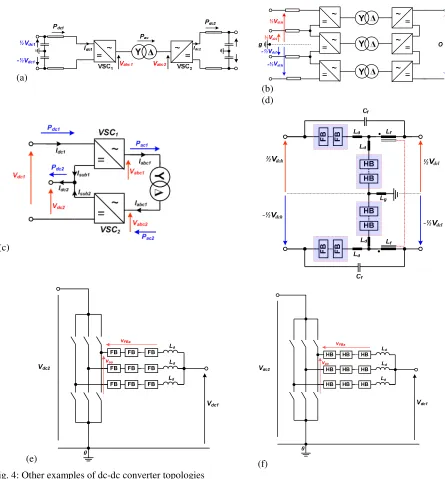
Fig 4. shows examples of dc-dc converter topologies with potential to be applied in large-scale HVDC transmission networks to perform voltage matching or tapping, and can act as flexible dc controllers to regulate power in highly meshed dc networks [58].
4.1 Front-to-front dc-dc converter topology
The front-to-front (F2F) dc-dc converter is described in [59-61]. The converter terminals VSC1 and VSC2 can employ any of the converter topologies summarised in Fig. 1 and Fig. 3, with one converter acts as reference that defines the ac voltage and frequency in the internal ac-link, and other converter controls dc
N
N N
Ldc
co
bo
ao
vco
vbo
vao
Vdc
Vd1
va1
Vd2
power or dc voltage. Although high-frequency square waveform voltage operation of VSC1 and VSC2 has been adopted in low and medium voltage applications for many years [59-64], sinusoidal or trapezoidal (quasi-two-level) voltage waveform in the ac-link with fundamental frequency ranging from 200Hz to 500Hz is likely to be adopted in HVDC applications, with dc operating voltages up to 800kV [58, 65, 66].
Besides dc voltage matching, power regulation and dc voltage regulation, the F2F dc-dc converter decouples the dc systems as it can block dc fault propagation from the faulty system to the healthy system. Therefore, the F2F dc-dc converter is suitable for splitting large dc networks into several protection zones to contain the impact of dc fault within a well-defined zone. The main shortcomings of the F2F dc-dc converter are:
• Both converter terminals must be fully rated (1 per unit); thus, its semiconductor losses resemble that of the two-terminal HVDC link.
• Its dc voltage matching range is limited by the current stresses in the converter switches of the low-voltage side.
The isolated front-to-front dc-dc converter is shown in Fig 4(a). The provided galvanic isolation is necessary for connection of dc system with a separate dc ground. The F2F converter can also be realised without isolation. In this case, the transformer is replaced by a simple inductor. Although a non-isolated F2F dc-dc converter in HVDC applications can reduce costs, there are major drawbacks of not having isolation. The implication of under-modulation in the non-isolated F2F dc-dc converter is that the switching devices of its high-voltage converter are subjected to the same ac currents as that of the low-voltage converter, which are higher than its isolated counterpart. Thus, high semiconductor losses are incurred in the high-voltage side.
4.2 Multi-pole multi-module front-to-front dc-dc
converter topology
Fig. 4(b) shows a configuration that employs series-input and series output to connect a symmetrical mono-pole dc system to a symmetrical multi-mono-pole dc system, with each sub-converter in Fig. 4 (a) realized with modular type converters, or two-level or NPC converters, with each rated at a higher dc voltage and power than in traditional medium-voltage applications. With the multipole side being limited to tri-pole, the voltage stresses on the upper and lower transformers in the ac-link could be limited to slightly higher than that of conventional bipolar HVDC link[67].
4.3 Partially isolated dc-dc converter topology
Fig. 4(c) shows schematic diagram of an efficient partially isolated dc-dc converter that can be used for voltage matching and tapping in dc systems with a common dc ground [68, 69]. The total dc power at the high-voltage dc terminal (Pdc1) transfers to the
low-voltage dc terminal (Pdc2), without the need for the
switching devices of any of the sub-converters to be
rated for full power. The power flow between the two dc terminals of dc-dc converter topology in Fig. 4 (b) is explained, assuming the power flow is from the high to low voltage dc terminals as follows:
• The total dc power Pdc2splits into ac power Pac and dc power Pdc12.
• Pac represents the component transferred through
the ac side and it determines the magnitudes of ac and dc currents in the arms of VSC1 and VSC2 for a
given transformer voltage ratio. This component can be approximated by: Pac≈(Vdc1
-Vdc2)Idc1≈Pdc1(n-1)/n, where n=Vdc1/Vdc2.
• Pdc12 represents the power component transferred
directly to the low-voltage dc terminal using dc components of the arm currents, without passing through the switching devices of VSC2; and can be
approximated by: Pdc12≈Idc1Vdc2≈Pdc1/n.
In this manner, the switching devices of VSC1 and VSC2 must be rated to handle the current stresses corresponding to ac power of Pdc1(n-1)/n, and dc
operating voltage of Vdc1(n-1)/n and Vdc1/n respectively.
4.4 Non-isolated MMC-based dc-dc converter
The converter in Fig. 4(d) is formed by series connection of two MMCs (HB or mixed cells type); however, the mixed cells approach is preferred because it blocks dc fault propagation from the faulty side to the healthy side, due its FB dc fault blocking capability [60]. Although this dc-dc converter does not use an isolation transformer, the coupling inductor being employed in the positive and negative poles of the low-voltage dc terminal must be insulated to withstand the high dc voltage stress corresponding to the dc-link voltage of the low-voltage dc terminal, Vdcl. Additional
weakness of this topology is that the fundamental ac component being used to exchange power between converter arms needs to be filtered using large passive filters (Lf and Cf). Based on this discussion, this
non-isolated dc-dc converter topology is inferior to the partially isolated topology, as described in the previous section.
4.5 Full-bridge-based Non-isolated hybrid
cascaded two-level dc-dc converter
Fig. 4(e) shows a full-bridge-based non-isolated hybrid cascaded two-level dc-dc converter, where the dc-link of the two-level converter stage represents the high-voltage side (Vdc2>Vdc1)[70]. The submodules of
each limb at the low-voltage side must be of the full-bridge type so that it can inject the necessary bipolar ac voltage waveform to cancel some of the generated voltage by the two-level converter stage. In this way, a ripple-free fully-controlled dc voltage with magnitude Vdc1 will be generated at the low-voltage dc terminal.
This means the series connected switching devices of the two-level converter stage must be rated for high-voltage side high-voltage (Vdc2). Inhibiting the gating signals
system shutdown during a pole-to-ground dc fault to prevent exposure of the healthy pole to excessive dc voltage stresses. In this topology, the number of semiconductor devices in the conduction path (thus, conversion loss) is the same as in F2F dc-dc two-level converter, but its overall losses and semiconductor area remain lower than F2F dc-dc converter topologies.
4.6 Half-bridge-based non-isolated hybrid
cascaded two-level dc-dc converter
Fig. 4(f) shows a half-bridge-based non-isolated hybrid cascaded two-level dc-dc converter, where the
dc-link of the two-level converter stage represents the low-voltage dc terminal (Vdc1>Vdc2), and cascaded HB
cells are used (instead of the FB cells) as each limb only needs to inject a unipolar voltage waveform to boost the output dc voltage[70]. In this scenario, the chain link of each limb must be able to support the full dc voltage of the high-voltage side.
(a)
(b)
(c)
(d)
[image:10.595.79.524.236.715.2](e) (f)
Fig. 4: Other examples of dc-dc converter topologies (a) Front-to front dc-dc converter
(b) Isolated front-to-front dc-dc converter with one side connected to multi-pole dc system (c) Partially isolated dc-dc converter
(d) Non-isolated MMC based dc-dc converter
F
B
F
B
F
B
F
B
Vdc1
Vdc2
Ld
Ld
Ld
FB FB FB
FB FB FB
FB FB FB
0
vao
vFBa
Vdc1
Vdc2
Ld
Ld
Ld
HB HB HB
HB HB HB
HB HB HB
0
vao
(e) Non-isolated hybrid cascaded two-level dc-dc converter
(f) Half-bridge-based non-isolated hybrid cascaded two-level dc-dc converter
5. SERIES-TYPE DC FLOW CONTROLLING
DEVICES
Besides dc fault ride-through challenges highlighted in previous sections, full utilization of dc lines in meshed multi-terminal HVDC transmission networks that contain a number of floating dc nodes is extremely important for efficient operation of dc grid. However, control of the dc power flows on the individual dc lines that form a mesh is technically challenging [71] as the current split between parallel paths is solely determined by the Ohm and Kirchoff laws. Unlike in an ac system, a dc system does not have a phase angle or reactive power, giving less degree of freedom to control the power flow. To realise better utilization of dc cables in a meshed multi-terminal high-voltage direct current (MT-HVDC) network, the dc equivalent of the FACTS devices, such as power shifters, are beneficial to optimize the power flow within the dc network.
This task can be performed by incorporating appropriate dc/dc converters or interline series type current controlling devices [72, 73]. Although series type power controlling devices appear effective and cost effective, their ability to survive dc short circuit faults are yet to be demonstrated. Apart from isolating transformers, all the power electronic parts are fractionally rated. In addition to dc-dc converter discussed in section (e), some of the proposed methods for power flow control in MT-HVDC networks are discussed briefly in the following subsections
5.1 Controlled Series Resistor
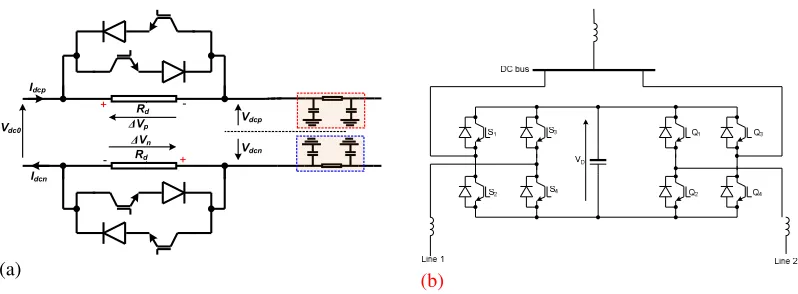
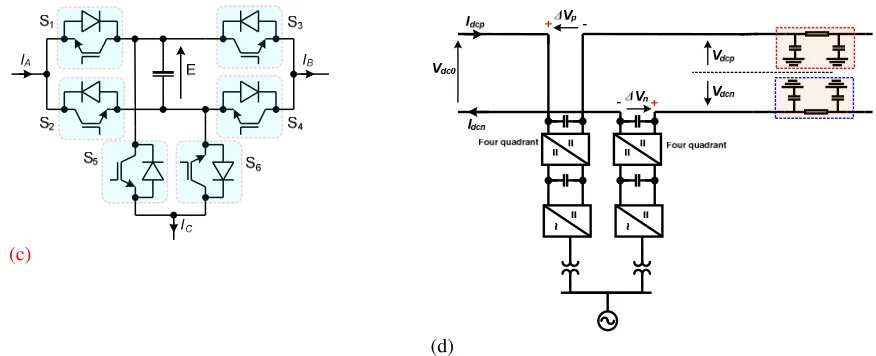
Fig. 5(a) show a dc power controller that uses a series switched resistor to regulate the power flow between two dc nodes by manipulating the dc voltage drop of the line that connects these dc nodes[72]. Although this solution seems to be simple and effective, it has a limited control range.
5.2 Series Current Flow Controllers
Amongst several series current flow controllers proposed in [72, 74-77], Fig. 5(b) and (c) show examples of series connected bi-directional dc current or power flow controllers capable of controlling power flow in individual dc lines by inserting small positive or negative dc voltage in series with a given dc line, depending on the power flow direction
[72, 75-77]
. These power flow controllers incur low on-state losses as they present small number of semiconductor devices in conduction path. Extensive studies performed in[72,
75-77]
show these series controllers are able to operatesatisfactorily over wide range of operating conditions and can survive dc faults.
5.3 Series Voltage Injection
The solution in Fig. 5(d) can control dc power in a given dc line from zero to the rated power and in a reverse direction due to its ability to inject positive or negative dc voltage in series with the line [72]. This device is equivalent to a unified power flow controller in an ac system.
(a)
(b)
Vdcp
Vdcn
Rd
Rd
Vdc0
Idcn
Idcp
+
-- +
ΔVp
[image:11.595.92.491.516.663.2](c)
[image:12.595.87.525.70.248.2](d)
Fig. 5: Examples of examples fractionally rated dc series power flow controllers for meshed multi-terminal HVDC network:
(a) Resistive unidirectional dc series power flow controller. (b) Inter-bus bidirectional dc power flow controller
(c) Inter-bus bidirectional dc series power flow controller with reduced switching devices (d) dc voltage injection dc series power flow controllers.
The current absence of a cost-effective high-voltage dc circuit breaker (DCCB) is the main missing element prevent bringing dc grids in line with ac counterpart. Its absence denies the ability to isolate the faulty dc part while allowing the remaining healthy parts of the dc grid to operate normally. Being able to continuously exchange power is paramount from a supply reliability and security point of view. Although the technology for solid-state dc circuit breakers has existed since the 1990s and is improving, they incur excessive semiconductor losses and cost [78-84]. Fig. 6and Fig. 7 summarise some of the main dc circuit breakers being suggested for dc fault current interruption in multi-terminal dc networks, targeting different fault clearance times.
5.4 Hybrid DC Circuit Breakers
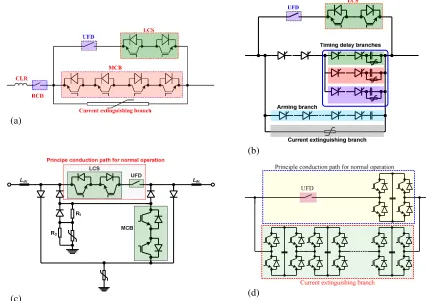
Fig. 6(a) and (b) show types ‘1’ and ‘2’ hybrid dc circuit breakers that exploit a voltage injection method to force the fault current to zero, where the injected dc voltage must be larger and oppose that being presented by the faulty line [84, 85]. During normal operation, the main conduction path for the dc current is through a low-voltage rated semiconductor switch known as a load commutation switch (LCS) and low-resistance mechanical ultra-fast disconnector (UFD) with Sulphur Hexafluoride (SF6) as insulation media and a 2ms opening time. The mechanical UFD must be designed to support the prospective dc voltage when opened. When the dc fault is detected in the type ‘1’ DCCB, the LCS is turned off to initiate commutation of the dc fault
current from the principle conduction path to the main circuit breaker (MCB), which is a typical high-voltage semiconductor switch, capable of carrying high current for short period (<10ms) [86, 87]. After the entire dc fault current is commutated to the MCB, the mechanical UFD is opened at near zero current and voltage, and during this period the fault current continues to flow in the MCB, and then, the MCB is opened to interrupt the dc fault current. More details on Fig. 6(a) are presented in [84].
The type ‘2’ DCCB in Fig. 6(b) turns off LCS when a dc fault is detected and triggers the switching delay branches in a progressive manner in order to commutate the fault current from the main conduction path to the arming branch. The current in each switching delay branch drops to zero when its capacitor charges to the blocking voltage across the LCS. After the entire fault current is transferred to the arming branch and all thyristors of the switching delay branches are off and carry zero current, the mechanical UFD is turned off. This is followed by gating-off the composite thyristor of the arming branch to interrupt the fault current to force the surge arrester across the arming branch to absorb the entire inductive energy of the faulty line and to force the fault current to zero [85]. The hybrid dc circuit breakers in Fig. 6(a) and (b) are intended for faster current interruption, ranging from 3ms to 5ms.
The hybrid DCCB in Fig. 6(c) and (d) [83, 88] have similar on-state losses and operating speed as the counterparts in Fig. 6(a) and (b).
=
=
=
~
=
=
=
(a)
(b)
[image:13.595.85.511.76.377.2](c) (d)
Fig. 6: Some hybrid dc circuit breakers being proposed for use for dc fault isolation in dc grids (a) Type 1 hybrid dc circuit breaker
(b) Type 2 hybrid circuit breaker (c) Type 3 hybrid dc circuit breaker
(d) Type 4 hybrid dc circuit breaker
5.5 Resonant DC Circuit Breakers
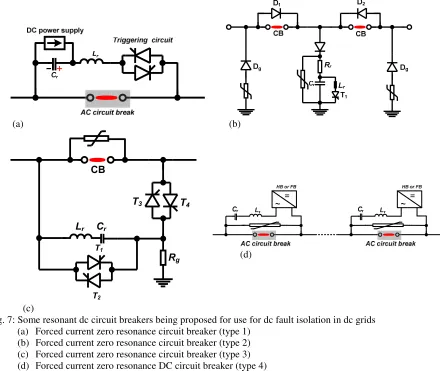
Fig. 7 (a) shows a forced current zero resonance dc circuit breaker that uses a pre-charge capacitor to initiate resonance with the aim of creating a speedy current zero when the negative peak of the resonant current component larger than the dc component of the fault current [81]. In [81], this approach interrupts a dc fault current up to 21kA, within 8ms to 10ms.
Fig. 7 (b) and (c) show other versions of low-loss active resonance based dc circuit breakers [80]. The versions of the active resonance DCCBs displayed in Fig. 7 (b) and (c) are expected to have similar performance (on-state loss, current breaking capability and operating speed) as that presented in Fig. 7 (a), where the options in Fig. 7 (a) and (b) permit easy incorporation of additional resonance branches that facilitate execution of several successive fault clearance attempts.
Besides relatively slow resonant DC circuit breakers discussed above, reference [89] presented a
(a) (b)
(c)
[image:14.595.83.523.76.447.2](d)
Fig. 7: Some resonant dc circuit breakers being proposed for use for dc fault isolation in dc grids (a) Forced current zero resonance circuit breaker (type 1)
(b) Forced current zero resonance circuit breaker (type 2) (c) Forced current zero resonance circuit breaker (type 3) (d) Forced current zero resonance DC circuit breaker (type 4)
6. DISCUSSIONS
Based on critical review of the open literature, the main findings of this work are highlighted as follows: 1) Modular multilevel converters: It is established
that the MMCs with asymmetrical and symmetrical bipolar cells can block and control dc fault current, and remain controllable for a wide range of dc voltages, and these features are useful for pole restraining during pole-to-ground dc fault. Therefore, MC-MMC as a representative of the MMCs with asymmetric bipolar cells offers all flexibilities needed for efficient, reliable and fault-tolerant operation of VSC based dc grids. Nonetheless, extra control range offered by the MMCs with symmetrical bipolar cells such as the FB-MMC are well-suited for generic dc grids that employ both VSCs and LCCs (thanks to the ability to operate with positive and negative dc voltages, and reverse power flow direction by change of dc current or voltage polarities).
2) Hybrid multilevel converters: Section 1 establishes that the AFC-B converter and hybrid converter with alternate common arm and director switches in [55-57] offer most of the features of the FB-MMC at much lower semiconductor losses. The former increases the power capability at reduced semiconductor losses but requires
substantial ac and dc filtering. Whilst the latter increases the power capability with no filtering requirements at ac and dc sides, thanks to additional current path provided by the thyristor based director switches which conduct alternately, i.e., upper director switch conducts for half fundamental cycle with the upper arm of the FB-MMC and vice versa. The latter hybrid converter resolves the current commutation problem of the conventional AAC and its variants [39, 40, 42, 53, 54, 57, 90]. These hybrid converters are well-suited for generic and large dc grids, , where the LCCs are expected to operate alongside VSCs. On other hand, hybrid converters in [53, 54] are viable alternative to conventional AAC and MC-MMC and most of the MMCs with asymmetric bipolar cells, particularly in applications with confined space as they offer all features of MC-MMC with arguably reduced footprint and power circuit and control complexity.
3) DC-DC converters: Isolated F2F dc-dc converters offer many desirable features for reliable operation of dc grids such as prevention of dc fault propagation and pole shifting in the healthy side during pole and pole-to-ground dc faults respectively, and dc voltage matching and power control (it worth stressing that these features are essential for partial selective dc
Rg
Lr Cr
T1
T2
T3 T4
grid protection strategies that employ the zoning concept). However, high capital cost and semiconductor losses may hinder their acceptance as economic solution. Non-isolated F2F dc-dc converters are unable to prevent pole-shifting during pole-to-ground dc fault and suffer from high losses and poor utilization of the semiconductor of the high-voltage converter, therefore, not viable for dc grids. Partially isolated dc-dc converter in [68, 69, 91] is attractive economically as it permits the transformer in its ac link and sub-converters to be fractionally rated. Its multi-port version that generates multiple and independent dc and ac voltages is attractive for complex hub that facilitates dc and ac voltage tapping and matching and power control, with bespoke ability to precisely define the route of the power flow from a given input to a given output[91, 92]. The non-isolated MMC and hybrid cascaded two-level dc-dc converters in [70, 93] offer cost-effective solution for dc voltage matching between two dc systems with common ground.
4) Series current flow controllers: Fractionally rated bidirectional interline current or power flow controllers in [72, 74-77, 94] offer low cost solutions for controlling and rerouting dc currents or dc powers within the dc grids away from the bottlenecks and over-loaded dc cables; thus, these devices are expected to play major roles in large dc grids that include floating dc nodes.
5) DC circuit breakers: Section Error! Reference source not found. reviews a number of basic dc circuit breaker technologies, covering fault
isolation time-scales ranging from 2ms to 15ms. It is found that although the hybrid dc circuit breakers offer faster fault clearance times (2ms to 5ms) which is critical for continued operation of dc grids, their large semiconductor areas make them expensive and vulnerable to rapid rise of fault current, particularly, in large dc grids that operate at dc voltages above 640kV and contain a number of long dc cables. Resonance based mechanical dc circuit breakers offer slower fault clearance time (up to 15ms) and require large dc inductances to be installed strategically across the dc grid to slowdown the rate of rise of fault currents and fault propagation through the dc grid. Nevertheless, mechanical dc circuit breakers remain practically attractive because of their relatively low cost and small semiconductor areas, primarily, in the resonant branch. Active resonance dc circuit breaker with reduced semiconductor area proposed in [89] offers the best overall trade-offs between performance (fault clearance times in order of 3ms to 5ms) and cost. However, an economic mechanism for sustaining the dc voltage of the fractionally rated VSC that responsible for initiation of high frequency resonant as soon as dc fault is detected remains to be solved. The concept of multiline dc circuit breaker proposed in [95, 96] represents an economic way to protect multiple dc cables connected to a single dc node using one current breaking branch. In this way, the overall cost of the dc grid protection can be reduced substantially.
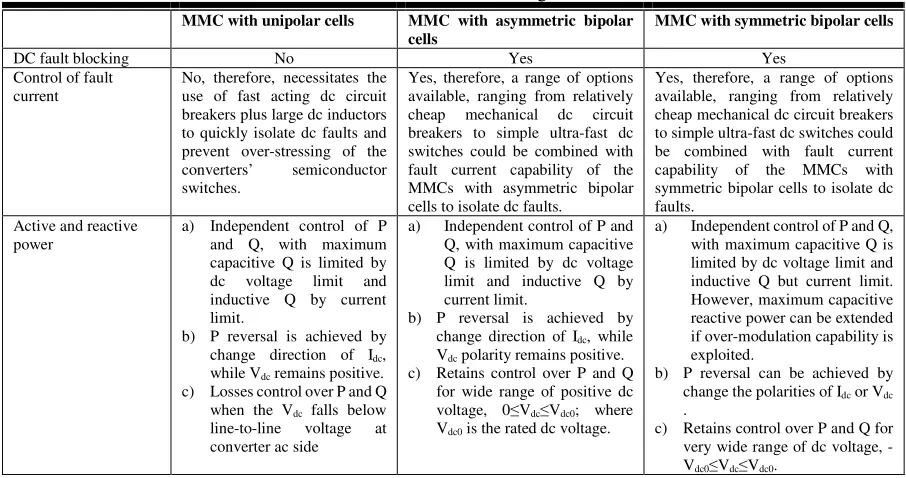
[image:15.595.71.524.531.770.2]In summary, Table 6-1 to Table 6-5 provide high-level summary of the main aspects discussed earlier.
Table 6-1: High-level comparison MMCs the employ unipolar cells, and asymmetric and symmetric bipolar cells [42, 50, 54, 97-109], where P and Q stand for active and reactive powers, Vdc is the dc voltage, and Vdc0
stands for rated dc voltage.
MMC with unipolar cells MMC with asymmetric bipolar cells
MMC with symmetric bipolar cells
DC fault blocking No Yes Yes
Control of fault current
No, therefore, necessitates the use of fast acting dc circuit breakers plus large dc inductors to quickly isolate dc faults and prevent over-stressing of the converters’ semiconductor switches.
Yes, therefore, a range of options available, ranging from relatively cheap mechanical dc circuit breakers to simple ultra-fast dc switches could be combined with fault current capability of the MMCs with asymmetric bipolar cells to isolate dc faults.
Yes, therefore, a range of options available, ranging from relatively cheap mechanical dc circuit breakers to simple ultra-fast dc switches could be combined with fault current capability of the MMCs with symmetric bipolar cells to isolate dc faults.
Active and reactive
power a) Independent control of P and Q, with maximum capacitive Q is limited by dc voltage limit and inductive Q by current limit.
b) P reversal is achieved by change direction of Idc,
while Vdc remains positive.
c) Losses control over P and Q when the Vdc falls below
line-to-line voltage at converter ac side
a) Independent control of P and Q, with maximum capacitive Q is limited by dc voltage limit and inductive Q by current limit.
b) P reversal is achieved by change direction of Idc, while
Vdc polarity remains positive.
c) Retains control over P and Q for wide range of positive dc voltage, 0≤Vdc≤Vdc0; where
Vdc0 is the rated dc voltage.
a) Independent control of P and Q, with maximum capacitive Q is limited by dc voltage limit and inductive Q but current limit. However, maximum capacitive reactive power can be extended if over-modulation capability is exploited.
b) P reversal can be achieved by change the polarities of Idc or Vdc
.
DC voltage polarity and range
Remain controllable for narrow range of positive dc voltages which are greater than the peak of the line-to-line voltages the interfacing transformers impose at MMCs ac terminals. Therefore, MMCs with unipolar cells only applicable to VSC based dc grids.
Remain controllable for wide range of positive dc voltages, 0≤Vdc≤Vdc0.
Therefore, MMCs with asymmetric bipolar cells applicable to VSC dc grids, and hybrid dc grids with combinations of VSCs and LCCs provided that unidirectional power flows are contemplated in all LCC terminals.
Remain controllable for very wide range of positive and negative dc voltages, -Vdc0≤Vdc≤ Vdc0. This
feature permits operation in generic dc grids alongside LCCs, without compromising bidirectional power flow at LCC terminals.
Internal fault management
Yes, and realized by bypassing of faulty cells; hence, simpler cell structures such as HB are preferred for ease of identification of the faulty cells.
Yes, and realized by bypassing of faulty cells; hence, simpler cell structures such as HB and FB are preferred for ease of identification of faulty cells.
Yes, and it is realized by bypassing of faulty cells; hence, simpler cell structures such as FB are preferred for ease of identification of faulty cells. Five-level cross-connected cell is an alternative for FB cell that delivers MMC with similar features as FB-MMC, but its complex structure increases the complexity of internal fault management. Over-modulation No, even though the MMCs
with unipolar cells include redundant cells to facilitate continued operation during internal faults, these cells remain unusable for extension of modulation index linear beyond 1.155; this limit is due to single polarity of the voltages that the unipolar cells generate.
Yes, should the MMCs with asymmetric bipolar cells include redundant cells to facilitate continued operation during internal faults, and these cells could be used to extend modulation index linear range beyond 1.155; thus, the maximum achievable ac voltage, exploiting limited bipolar capability of the asymmetric bipolar cells.
Yes, should the MMCs with asymmetric bipolar cells include redundant cells to facilitate continued operation during internal faults, and these cells could be used to extend modulation index linear range beyond 1.155; thus, the magnitude of the maximum achievable ac voltage, exploiting full bipolar capability of the symmetric bipolar cells.
[image:16.595.74.530.70.371.2]Semiconductor losses low medium high
Table 6-2: High-level comparison selected hybrid converters (A≡ AAC, B≡ CMC-MMC, C≡ AFC-B converter, and D≡
hybrid converter with alternate common arm and director switches)[42, 54, 55, 57, 110-116]
A B C D
DC fault blocking Yes, Yes Yes Yes
Resiliency to ac faults Resilient to symmetrical ac fault, but unsatisfactory
performances during severe unbalanced ac grids and asymmetrical ac faults.
Yes, resilient to symmetrical and asymmetrical ac faults.
Yes, resilient to symmetrical and asymmetrical ac faults.
Yes, resilient to symmetrical and asymmetrical ac faults.
control of fault current Yes, therefore, a range of options available, ranging from relatively cheap and slow mechanical dc circuit breakers to simple ultra-fast dc switches could be used to ride-through dc faults.
Yes, therefore, a range of options available, ranging from relatively cheap and slow mechanical dc circuit breakers to simple ultra-fast dc switches could be used to ride-through dc faults.
Yes, therefore, a range of options available, ranging from relatively cheap and slow mechanical dc circuit breakers to simple ultra-fast dc switches could be used to ride-through dc.
Yes, therefore, a range of options available, ranging from relatively cheap and slow mechanical dc circuit breakers to simple ultra-fast dc switches could be used to ride-through dc faults, including fault clearance.
Active and reactive
power control a) Independent control of P and Q, but with very limited reactive power.
b) P reversal is achieved by change polarity of Idc, while
Vdc polarity remains
positive.
c) Retains control over P and Q for wide range of positive dc voltage,
0≤Vdc≤Vdc0.
a) Independent control of P and Q b) P reversal is
achieved by change polarity of Idc, while
Vdc polarity remains
positive.
c) Retains control over P and Q for wide range of positive dc voltage, 0≤Vdc≤Vdc0
a) Independent control of P and Q. b) P reversal is achieved by change of polarities of Idc or
Vdc.
c) Retains control over P and Q for very wide range of positive and negative dc voltages, -Vdc0≤Vdc≤Vdc0.
a) Independent control of P and Q. b) P reversal is achieved by change of polarities of Idc or
Vdc.
c) Retains control over P and Q for very wide range of positive and negative dc voltages, -Vdc0≤Vdc≤Vdc0.
DC voltage polarity and control range
Remain controllable for wide range of positive dc voltages, 0≤Vdc≤Vdc0.
Despite the above
Remain controllable for wide range of positive dc voltages, 0≤Vdc≤Vdc0.
Therefore, CMC-MMC
Remain controllable for very wide range of positive and negative dc voltages, -Vdc0≤Vdc≤
![Fig. 2 (a) shows a half-bridge cell [23, 25, 26]. The](https://thumb-us.123doks.com/thumbv2/123dok_us/1328471.86755/3.595.355.491.78.247/fig-shows-half-bridge-cell.webp)
![Table 6-2: High-level comparison selected hybrid converters (A≡ AAC, B≡ CMC-MMC, C≡ AFC-B converter, and D≡ hybrid converter with alternate common arm and director switches)[42, 54, 55, 57, 110-116]](https://thumb-us.123doks.com/thumbv2/123dok_us/1328471.86755/16.595.74.530.70.371/comparison-selected-converters-converter-converter-alternate-director-switches.webp)
