
Int. J. Electrochem. Sci., 11 (2016) 7576 – 7583, doi: 10.20964/2016.09.42
International Journal of
ELECTROCHEMICAL
SCIENCE
www.electrochemsci.orgElectrocoagulation/electroflotation Process Applied to
Decolourization of a Solution Containing the Dye Yellow Sirius
K-CF
Manoel V. B. Gonçalves, Stela C. De Oliveira, Bruna M. P. N. Abreu, Elidia M. Guerra and Dane T. Cestarolli*
Universidade Federal de São João del Rei, Campus Alto Paraopeba, Rod. Mg 443, Km 7, Ouro Branco, MG, Brazil
*
E-mail: [email protected]
Received: 14 March 2016 / Accepted: 16 June 2016 / Published: 7 August 2016
In the present work, the electrocoagulation/electroflotation process using aluminum electrode was applied for decolourization of solutions containing the dye yellow Sirius K-CF in aqueous media. The experiments were performed for synthetic solutions focusing the effect of following operational parameters on the efficiency dye coloration removal: electrocoagulation time process, applied potential, initial pH, initial dye concentration and initial concentration of NaCl used as supporting electrolyte in aqueous media. The main results were: increasing time results in increasing of efficiency of dye yellow Sirius K-CF color removal; the best initial pHs are 3 and 5; the better applied potential is 7.0 V, beyond which no effective improvement may be achieved. It was also observed that lower dye concentrations provide better color removal rates. It was verified an increase in concentration of the electrolyte did not provide better efficiency on the EC process. In the best parameters investigated, high efficiency was observed, reaching more than 95% of decolourization,
Keywords: electrocoagulation ˙ dye ˙ textile industry ˙ wastewater treatment
1. INTRODUCTION
water, but the cost of these methods are relatively high. For the same reasons, the use of adsorption using activated carbon is not suitable [4-7]. Electrocoagulation (EC) is a water treatment process that uses electrical energy to dissolve metals, such as aluminum and iron, creating metallic hydroxides within the wastewater resulting in the coagulation/flocculation of contaminants [8]. The main reactions involved are well known and the various formed hydroxides can act as ligands to bind the pollutant molecule [9, 10].
The electrodes can be arranged in a mono-polar or bi-polar mode. Finally, all the electrocoagulated substances can be removed either by precipitation or by flotation. In fact, this method is efficient for many kynds of effluents [11], such as potable water [12], food and protein wastes [13], textile wastewater and colored wastewater [1, 14, 15, 16], heavy metals [17], industrial wastewater [18], oil wastes [19, 20 ] and fluoride and polyvinyl alcohol [21, 22].
In this study, experiments were performed to examine the effects of the several parameters of EC process, such as initial concentration, applied potential, pH, time of electrocoagulation and the amount of NaCl. The best conditions were then combined to optimize the process of electrocoagulation for complete dye removal.
2. EXPERIMENTAL
Samples of solutions were produced in order to simulate a textile industrial wastewater. For this porpoise, it was prepared samples containing the dye yellow Sirius K-CF from Guarany Brazilian industry. These synthetic wastewaters were experimentally investigated, in order to determine the suitable operating conditions for treatment. The molecular formula of the compound yellow Sirius K-CF, as well as it molar mass are confidential and protected by industrial patent. This way all experiments were performed in order to evaluate the color removal efficiency R (%) using the formula:
R (%) = {Abs0 – Abs / Abs} x 100 (9)
were Abs0 is the initial absorbance of dye and Abs is the absorbance after the electrochemical
treatment. The absorbance was monitored by an UV/VIS spectrophotometer Shimadzu model UV-3600, at a wavelength with the best absorbance of yellow Sirius KC-F (maximum absorbance = 367 nm). The pH of the solutions were measured by an Hanna pH meter model 21 (0.05 precision). Solutions of HCl and NaOH (0.1 mol dm-3) were used to change the pH of the solutions.
[image:2.596.200.403.607.734.2]
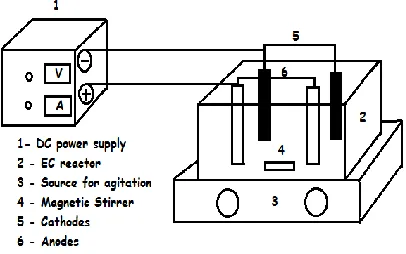
The electrocoagulation scheme is shown in Fig. 1. The electrocoagulation system consisted of an rectangular glass bath cell with 1.0 L capacity. Four aluminum electrodes (two anodes and two cathodes) with dimension of 30 cm2 each one (3.0 cm wide and 10.0 cm long) were used for the experiments. These electrodes were interconnected by bi-polar mode. A digital DC power supply (ICEL model) providing 0-15 V (0-5 A) with potentiostatic operational option was used for potential control.
3. RESULTS AND DISCUSSION
3.1. Efficiency of dye removal as a function of time effect
Is well known that an increase in the electrocoagulation time provides a larger amount of cations from the anode and hence the hydroxides species [23-25]. The effect of time of electrocoagulation was investigated at constant potential of 4.0 V and initial pH 3. As shown in Fig. 2, an increase in the time of electrocoagulation from 10 to 120 min produces an increase in the dye decolourization. At this initial condition, the efficiency removal was 20% (10 min) to 45.5% (120 min).
Figure 2. Effect of time of electrocoagulation process on the removal efficiency of yellow Sirius K-CF; applied potential, 4.0 V; [NaCl] = 1.0 g L-1; initial dye concentration 3.5 g L-1; initial pH 3.
3.2. Efficiency of dye removal as a function of applied potential effect
[image:3.596.178.418.378.598.2]
Figure 3. Effect of applied potential on the removal efficiency of yellow Sirius K-CF; [NaCl] = 1.0 g L-1; initial dye concentration 3.5 g L-1; initial pH 3; Electrolysis time, 60 min.
The decolourization, measured in terms of removal efficiency percentage, increased from 22% at 0.5 V to 96% at 7.0 V and 98.0% at 10.0 V. More dissolved species of aluminum are electrogenerated at higher potentials and formation rate of Al(OH)3 and Aln(OH)3n increased. It is
important to note that higher potential (such as 12.0 V) obtained lower value of dye removal (78%). For this reason, and considering the excess of electrical energy consumption for higher potentials, the value of 7.0 V is considered as optimal in the present study.
3.3. Efficiency of dye removal as a function of initial pH
Figure 4. Effect of initial pH on the removal efficiency of yellow Sirius K-CF; applied potential, 7.0 V ; [NaCl] = 1.0 g L-1; initial dye concentration 3.5 g L-1; Electrolysis time, 60 min.
[image:4.596.169.431.72.258.2] [image:4.596.172.419.488.674.2]
pH is responsable for the aluminum speciation and consequently It is one of the most important parameters which determines the efficiency of dye removal. The influence of pH in the EC process was investigated by adjusting the initial pH in the interval from 3 to 11. These results are presented in Fig. 4.
The results showed that the dye decolourization was optimal with a maximum at pH 3, with efficiency removal 88.3 %. For the basic zones (pH = 9 and 11) a significant drop in the efficiency was observed. In low values of pH (from 2 to 3) the aluminum cationic specie is converted into soluble species such as Al(OH)2+, Al(OH)2+ and Al(OH)3 [30]. At pH between 5 and 7 these monomeric
cations can be converted into polymeric species such as Al2(OH)24+ and Al6(OH)153+. Flocs formed by
Al(OH)3 can also be obtained by a complex precipitation kinetics [16, 31, 32]. In fact, It is well known
that aluminum hydroxide dissolves at high pH and has a lowest solubility at pH between 5 and 8.
3.4. Efficiency of dye removal as a function of initial concentration of Sirius K-CF
In textile wastewater is common to observe variation in dye concentration. For this reason, the effect of the initial dye concentration on the EC process was investigated, from 1 to 5 g L-1 under constant potential intensity. The results are shown on Fig. 5.
[image:5.596.138.458.394.668.2]
According to these results (Fig. 5), it was observed that the efficiency decreases when there is a higher initial concentrations of dye. At 1.0 g L-1 the efficiency removal was 80.0%, while the others concentrations studied (2.0; 3.0; 4.0 and 5.0 g L-1) obtained efficiency of 50%, approximately.
The removal pathway of the dye is the adsorption on aluminum hydroxide. So, as the applied potential was maintained, the same amount of aluminum hydroxide species were generated by the EC process. Consequently, the same amount of coagulating species were available to treat the effluent [32-34]. The main consequence is that there was less coagulating species to capture dye molecules.
3.5. Efficiency of dye removal as a function of concentration of supporting electrolyte
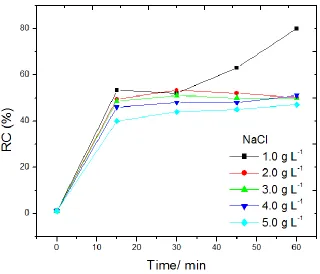
It is known that NaCl is used as dye auxiliaries, and this is the case of yellow Sirius k-CF dye. In fact, the NaCl favors the absorption of dye molecules in the fibers [35]. The effect of concentration of NaCl as supporting electrolyte on dye removal efficiency was studied using concentration range from 0.5 to 5.0 g L-1. The results are reported on Fig. 6.
Figure 6. Effect of initial dye concentration on the removal efficiency of yellow Sirius K-CF; applied potential, 7.0 V; [NaCl] = 1.0 g L-1; initial pH 3; Electrolysis time, 60 min.
The best efficiency was obtained with NaCl 3.0 g L-1 (46.5%) but it is important to note that there is no significant gain when the concentration of NaCl is enhanced. In fact, it was found in the literature that the efficiency removal remained the same with increasing of the NaCl concentration. [16].
[image:6.596.157.435.334.525.2]
4. CONCLUSIONS
Electroflotation is a very effective process to treat effluent containing dyes yellow Sirius K-CF. In fact, a high efficiency was obtained, with values of 95%. The investigated parameters resulted in the following conclusions:
The electroflotation time process is a very important parameter for electrocoagulation process. The pH has a great influence on the EC efficiency. It was not observed, at higher values of pH, satisfactory results with respect to decolourization. The optimal investigated values of pH are 3 and 5. With respect to the applied potential, the better EC results were obtained with 7.0 V, beyond which no real improvement may be achieved. The lower is the dye concentration the better is the decolourization efficiency. When the concentration of NaCl was increased it was not noted an improvement on the performance of the electrocoagulation treatment.
References
1. J. Vidal, L. Villegas, J. M. Peralta-Hernandez, M. Juan and R.S. Gonzalez, J. Environ. Sci. and Health Part A, 51(2016) 289.
2. S. A. Mirbagheri and A. Charkhestani, Desalination and water treat., 57 (2016) 9082.
3. G. G. Sonai, S. M. A. G. U. de Souza, D. Oliveira and A. A. U. de Souza, J. Environ. Manag., 168 (2016) 149.
4. M. Abbas and M. Trari, Process Saf. And Environ. Protec., 98 (2015) 424.
5. J. Rincon, S. Rincon, P. Guevara, D. Ballén, J. C. Morales and N. Monroy, Rev. Acad. Colm. Cienc. Ex. Fis. Y Nat., 39 (2015) 171.
6. SH Lin and CH Lai, Water Res., 34 (2000) 763.
7. G. Sun and X. Xu, Ind. Eng. Chem. Res., 36 (1997) 808.
8. M. Mechelhoff, G. H. Kelsall and N. J. D. Graham, Chemical Eng. Science, 95 (2013) 301. 9. I. Heidmann and W. Calmano, Hazard materials, 152 (2008) 934.
10. N. Daneshvar, A. Oladegaragoze and N. Djafarzadeh, J. Hazard. Mater., 129 (2006) 116. 11. G. Chen, Sep. Purif. Technol., 38 (2004) 11.
12. H. Sarkka, M. Vepsalainen and M. Sillanpaa, J. Electroanal Chem., 755 (2015) 100.
13. C. Tsioptsias, D. Petridis, N. Athanasakis, I. Lemonidis, A. Deligiannis and P. Samaras, J. Environ. Manag., 164 (2015) 104.
14. S. H. Lin and M. L. Chen, Water Res., 31 (1997) 868. 15. S. H. Lin and C. F. Peng, Water Res., 28 (1994) 277.
16. E. Pajootan, M. Arami and N. M. Mahmoodi, J. Taiwan Inst. of Chem. Eng., 43 (2012) 282. 17. A. Assadi, M. M. Fazli, M. M. Emamjomh and M. Ghasemi, Desal. And Water Treat., 57 (2016)
9375.
18. M. A. Aghdam, H-R. Kariminia and S. Safari, Desal. And Water treat., 57 (2016) 9698. 19. K. Bensadok, S. Benammar, F. Lapicque and G. Nezzal, J. Hazard. Mater., 152 (2008) 423. 20. P. Canizares, F. Martınez, C. Jimenez, C. Saez and M. A. Rodrigo, J. Hazard. Mater., 151 (2008)
44.
21. W. L. Chou, C. T. Wang and K. Y. Huang, Desalination, 251 (2010) 12.
22. N. Drouiche, S. Aoudj, M. Hecini and T. Ouslimane, Chem. Eng. Trans., 24 (2011) 1207. 23. N. Daneshvar, A. R. Khataee and N. Djafarzadeh, J. Hazard. Mater., B137 (2006) 1788. 24. N. Daneshvar, A. R. Khataee, A. R. A. Ghadim and M. H. Rasoulifard, J. Hazard. Mater., 148
(2007) 566.
26. A. E. Yılmaz, R. Boncukcuo-Glu, M. M. Kocakerim and E. Kocada-Gistan, Desalination, 230 (2008) 288.
27. N. Daneshvar, H. Ashassi-Sorkhabi and A. Tizpar, Sep. Purif. Technol., 31 (2003) 153. 28. T. Kim, C. Park, E. Shin and S. Kim, Desalination, 150 (2002) 165.
29. M. M. Emamjomeh and M. Sivakumar, J. Environ. Manag., 90 (2008) 1204.
30. A. H. Essadki, M. Bennajah, B. Gourich, C. Vial, M. Azzi and H. Delmas, Chem. Eng. Process, 47 (2008) 1211.
31. M. Bayramoglu, M. Kobya, O. T. Can and M. Sozbir, Sep. Purif. Technol., 37 (2004) 117.
32. S. Aoudj, A. Khelifa, N. Drouiche, M. Hecini and H. Hamitouche, Chem. Eng. Process, 49 (2010) 1176.
33. N. Daneshvar, H. A. Sorkhabi and M. B. Kasiri, J. Hazard Mater., B112 (2004) 55. 34. N. Modirshahla, M. A. Behnajady and S. Kooshaiian, Dyes Pigm., 74 (2007) 249. 35. I. Kabdaslı, B. Vardar, I. Arslan-Alaton and O. Tunay, Chem. Eng. J., 148 (2009) 89. 36. A. K. Golder, A. N. Samanta and S. Ray, Chem. Eng. J., 122 (2006) 107.
37. W. Chou, C. Wang and S. Chang, J. Hazard. Mater., 168 (2009)1200. 38. W. J. Lee and S. I. Pyun, Electrochim. Acta, 44 (1999) 4041.
39. G. Chen, J. Hazard. Mater., 141 (2007) 653.
![Figure 2. Effect of time of electrocoagulation process on the removal efficiency of yellow Sirius K-CF; applied potential, 4.0 V; [NaCl] = 1.0 g L-1; initial dye concentration 3.5 g L-1; initial pH 3](https://thumb-us.123doks.com/thumbv2/123dok_us/1845540.140944/3.596.178.418.378.598/effect-electrocoagulation-efficiency-applied-potential-initial-concentration-initial.webp)
![Figure 3. Effect of applied potential on the removal efficiency of yellow Sirius K-CF; [NaCl] = 1.0 g L-1; initial dye concentration 3.5 g L-1; initial pH 3; Electrolysis time, 60 min](https://thumb-us.123doks.com/thumbv2/123dok_us/1845540.140944/4.596.172.419.488.674/figure-applied-potential-removal-efficiency-sirius-concentration-electrolysis.webp)
![Figure 6. Effect of initial dye concentration on the removal efficiency of yellow Sirius K-CF; applied potential, 7.0 V; [NaCl] = 1.0 g L-1; initial pH 3; Electrolysis time, 60 min](https://thumb-us.123doks.com/thumbv2/123dok_us/1845540.140944/6.596.157.435.334.525/figure-effect-concentration-efficiency-applied-potential-initial-electrolysis.webp)
