Looking for a Sign
T he A cq u isitio n of D iscourse in A u stra lian Sign L a n g u a g e
Peita Littleton BA (Hons)
A thesis submitted
for the degree of Doctor of Philosophy of The Australian National University
Except where due acknowledgement has been made, this thesis represents the original research of the author
Publications
Work-in-progress toward this thesis has been published in:
Littleton, P. (1998). Protoconversation: Early development of conversational skills
in Auslan as a first language. Paper presented at the Australasian
Deaf Studies Research Symposium, Ren wick College, August 22-23, 1998, Renwick College, Sydney.
Littleton, P. (1998). Attention-directing strategies in Australian Sign Language. Australian Journal of Education of the Deaf, 4,: 20-34.
Littleton, P. (2000) Early development of conversational skills in a signed language: Protoconversation in Australian Sign Language (Auslan). In A. Schembri, J. Napier, R. Beatie & G. Leigh (eds), Deaf Studies, Sydney, 1998: Selected papers from the Australasian Deaf Studies
Research Symposium, Renwick College, August 22-23, 1998. Renwick
College Monograph (4). Sydney: North Rocks Press.
Work-in-progress toward this thesis is currently under consideration for publication in:
1 would initially like to express m y gratitude for the Australian Post Graduate Scholarship
that awarded me the opportunity to do this thesis, and to the Linguistics Department and
the Australian National U niversity for providing an enlightening and challenging
environment in which to learn.
Special thanks to Dr A nthony Liddicoat and Dr Des Power for their support and
encouragement in the supervision of this thesis.
To those whose patient perusal of my thesis, dotting my i's and crossing my t's, ensured it
was at least an attempt at grammatical English, Marian Hill, Maurice Neville, and Clem
Littleton, thank you.
A special thank you to Trevor Johnston, for his seminal research of Auslan and graciously
given permission to reproduce the images from his Auslan Dictionary (1989a) to illustrate
this work.
M any thanks to those associated with the Auslan Deaf community who at various times
during this process have renewed m y zest and encouraged m y research, especially Marianne
Acknowledgemen ts
A special note of thanks to those who never failed to put up with my reticence and many a
slip of the hands in teaching me Auslan, Mandy Dolejsi, Deb Hayes, Robin Kerr, and Anne
Madden, and my ever-patient and humorous class-mates.
Thank you to my linguistic friends Marian, Maurice, Tim, Joanna, Tony, Angela, Michael,
Verna, and Patti who over the many years and unmentionable quantities of coffee, have
listened to me, sympathised with me, and laughed with me.
I would particularly like to thank my family, not only for their ever present support and
patience, but also for their unfailing belief in me. M y love and thanks to my darling
Benjamin for always telling me to "be brilliant" and believing it.
With sincere gratitude to the Deaf families who participated in this research, for their
willingness to open their lives, for without them this thesis could never have come to
fruition...
Finally, in the creation of a thesis there are many people involved. There are those who
provide support, those who provide encouragement, and those who provide insight. There
are too 'many' to adequately thank for their contribution. The product of your involvement,
encouragement, and assistance is now complete, and so to the 'many' I have not been able to
Research on the ways that parents interact with their children has shown that parents talk with their children long before the children themselves have learned to communicate. Early interactions have been shown to be an important part of children’s language acquisition because they model basic behaviours which are vital for successful communication.
The study of the organisation of communicative interaction, or language in use, in general, has been firmly based on the analysis of spoken language. In contrast, this study provides the first examination of the developmental acquisition of a native signed language, that of Australian Sign Language (Auslan). This study investigates the language socialisation process of deaf children with deaf parents, in particular, how children acquire the appropriate structures for discourse.
Abstract
The findings of this study indicate that deaf children are socialised to the nature and structure of signed language from the earliest stages of interaction. The development of discourse competence by deaf children shows comparable stages and sequences of discourse development to those previously found for hearing children acquiring spoken language. Further, deaf maternal fine-tuning of signed language, similar to that of spoken language, shows developmental progression accommodated to the developmental phases of the children. Early interactive experiences for deaf and hearing infants alike, provide introduction to fundamental behaviour patterns for language use, and are an important basis for social language development.
Statement
Publications
Acknowledgements
Abstract
Table of Contents
Chapter 1 Introduction 1
1.0 The Thesis 1
1.1 Literature Perspective
1.1.1 Child Language Acquisition 1.1.2 Discourse Analysis
1.1.3 Signed Language Acquisition
2 3 7
10
1.2 Thesis Perspective 1.2.1 Thesis Outline
14 17
Chapter 2 Australian Sign Language 19
2.0 Introduction 19
2.1 Auslan 20
ii ♦ Contents
Chapter 2 (cont...)
2.3 Sign Structure 22
2.3.1 Handshape 23
2.3.2 Location 25
2.3.3 Orientation 28
2.3.4 Movement 29
2.3.5 Expression 31
2.4 Signed Grammar 33
2.4.1 Sign Modification 33
2.4.2 Sign Vocabulary 34
2.4.3 Sign Order 37
2.4.4 Fingerspelling 38
2.5 Summary 40
Chapter 3 Methodology 41
3.0 Collection and Analysis of the Data 41
3.0. 1 Subjects 41
3.0. 2 Data Collection 42
3.0. 3 Data Transcription 44
3.0. 4 Data Analysis 45
3.1 Methodological Considerations 49
3.1.1 Collection Constraints 49
3.1.2 Ethical Constraints 50
3.1.3 Transcription Constraints 50
Chapter 4 Protoconversation 57
4.0 Introduction 57
4.1 Protoconversation 59
4.2 Signed Protoconversation 61
4.3 Analysis of Auslan Protoconversation 64
Chapter 5 Motherese 87
5.0 Introduction 87
5.1 Spoken Language Motherese 89
5.2 Signed Motherese 90
5.3 Analysis of Auslan Motherese 93
5.4 Discussion 117
Chapter 6 Initiation 125
6.0 Introduction 125
6.1 Initiating a Conversation 126
6.2 Spoken Initiation 128
6.3 Signed Initiation 129
6.4 Analysis of Auslan Initiation 134
6.4.1 Attention-Getting 134
6.4.1.1 Touch 134
6.4.1.2 Vibration 138
6.4.1.3 Waving 141
6.4.1.4 Reorientation 144
6.4.1.5 Waiting 145
6.4.2 Attention-Directing 147
6.4.2.1 Pointing 147
6.4.2.2 Showing 151
6.4.2.3 Sign 154
6.5 Discussion 158
Chapter 7 Exchange System 169
7.0 Introduction 169
iv ♦ Contents
Chapter 7 (cont...)
7.2 Conversational Exchange in Sign Language 173
7.3 Analysis of Auslan Conversational Exchange 177
7.3.1 Games and Rhymes 177
7.3.2 Picture Book Reading 182
7.3.3 Questions 189
7.3.4 Eye Gaze 196
7.4 Discussion 206
Chapter 8 Conclusion 217
8.0 Introduction 217
8.1 Prelinguistic Discourse 218
8.1.1 The Discourse Pattern 219
8.1.2 The Role of Mother 220
8.1.3 The Role of the Infant 223
8.1.4 The Role of Structure 225
8.1.5 Summary of Prelingual Discourse 227
8.2 Continuity in Prelinguistic and Linguistic Discourse 228
8.2.1 The Fine-Tuning of Language 228
8.2.2 The Conventional Link to Language 231
8.2.3 The Structural Link to Language 236
8.2.4 Summary of a Continuum 239
8.3 Linguistic Discourse 240
8.3.1 Conventional Language 241
8.3.2 Sequential Language 244
8.3.3 Structural Language 248
8.3.4 Summary of Linguistic Discourse 252
Appendices 259
A ppendix 1 Letters to Participants 261
A ppendix 2 Notation Conventions 267
Bibliography 273
List of Diagrams:
Diagram 5.3.1 The Production Pattern 102
List of Figures:
Figure 2.1 "Spoon" H andshape Base Form 23
Figure 2.2 "Spoon" H andshape Variant Form 23
Figure 2.3 SMELL 25
Figure 2.4 EGG 25
Figure 2.5 SIGN 25
Figure 2.6 WEIGH 28
Figure 2.7 BALANCE 28
Figure 2.8 WEIGH 28
Figure 2.9 DOUBT 28
Figure 2.10 THANK 29
Figure 2.11 SHARK 29
Figure 2.12 TABLE 29
Figure 2.13 CAR 30
Figure 2.14 RUN 30
Figure 2.15 DEEP 30
Figure 2.16 MIRROR 30
Figure 2.17 SPEND 30
Figure 2.18 HAVE 30
Figure 2.19 MELT 30
Figure 2.20 HOME 30
Figure 2.21 RECENTLY 31
Figure 2.22 JUST THEN 31
vi ♦ Contents
List of Figures (cont...)
Figure 2.24 WINDOW right 33
Figure 2.25 W INDOW left 33
Figure 2.26 IRON (Nominal) 35
Figure 2.27 IRON (Verbal) 35
Figure 2.28 CI/me) 36
Figure 2.29 (you) 36
Figure 2.30 (he/she/it/there) 36
Figure 2.31 (we/us) 36
Figure 2.32 (they/them) 36
Figure 4.1 DOLL 68
Figure 5.1 WATER 94
Figure 5.2 FINISH 94
Figure 5.3 MUMMY 97
Figure 5.4 WHERE 100
Figure 5.5 RED 100
Figure 5.6 BALL 100
Figure 5.7 MONKEY 103
Figure 5.8 CROCODILE 103
Figure 5.9 WHERE 107
Figure 5.10 WHAT 107
Figure 5.11 WHO 107
Figure 5.12 WHY 107
Figure 5.13 HOW 107
Figure 5.14 MAN 111
Figure 5.15 ARM 111
Figure 5.16 FACE 113
Figure 5.17 DIRTY 113
Figure 5.18 BALL 115
Figure 5.19 FINISH 115
Figure 5.20 "G" or "Point" H andshape Base Form 116 Figure 5.21 "G" or "Point" H andshape Variant Form 116
Figure 5.22 FAT 121
Figure 5.23 OBESE 121
Figure 6.1 LOOK 156
Figure 6.2 HEY 156
Figure 7.1 BIRD 183
List of Tables
Table 2.1 Major Handshapes in Auslan 24
Table 2.2 Sign Location in Auslan 26
Table 2.3 The Function of Sign Location in Auslan 27
Table 2.4 Non-Manual Features in Auslan 32
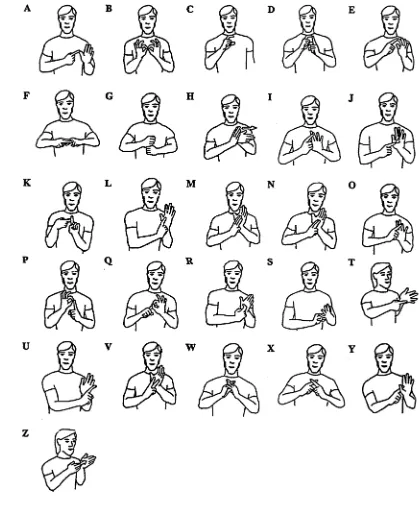
Table 2.5 The Two-Handed Alphabet in Auslan 39
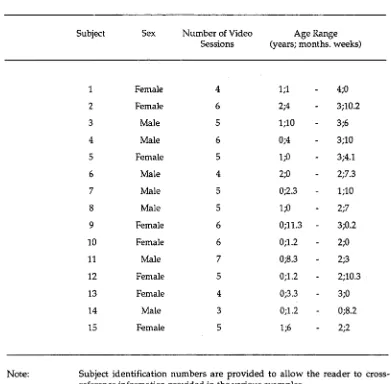
Table 3.1 Subject Characteristics, Number of Observations 43 Table 3.2 Coding of Literal Markers within Episodes 46 Table 3.3 Coding of Conventional Markers within Episodes 48
1
Introduction
Men are created, not with a God-given language, but with a God-given capacity to make signs and sounds, and by the use of these to form a language. No child comes into the world with a language; that is an acquisition, and the child always acquires the language of its parents, or of those by whom it is surrounded.
(Kendall 1864)
The Thesis
Language is the ability to use symbols and to combine these symbols in order to communicate. The symbolic representation of the parts of the world in communication is not restricted to spoken language, for language may be also be signed. To develop an ability to communicate a newborn infant must progressively learn to separate different aspects or parts of its world, and then make direct reference to such parts in order to communicate that reality. The child must then learn to use appropriate referential symbols for these different parts in order to develop towards achieving the goal of communication.
predominantly considered the child's acquisition of spoken language. With the acknowledgment of visual-manual, or signed communication systems as 'true' languages, extension of the search for the basic characteristics defining language development has led research toward examining children’s acquisition of signed language.
This thesis will consider the development of deaf children's discourse skills in the acquisition of Australian Sign Language. In order to view the development of the deaf child's interactional competency, this thesis will concentrate on everyday conversational interaction between parent and child. It will particularly examine the aspects of development which have previously been found suggestive of what is involved in the child’s acquisition of socially-skilled language use.
The focus of this thesis, language for the purpose of social interaction, or discourse, can be seen as part of the wider field of child language acquisition. The purpose of this chapter is to provide a review of the literature of child language acquisition pertinent to the current perspective of children acquiring language within the context of discourse interaction.
1.1 Literature Perspective
Introduction ♦ 3
1.1.1 Child Language Acquisition
Child language research in the 1960s was dominated by the view that the child was endowed with an innate ability to acquire language, and that learning was determined by general cognitive capacity alone (Chomsky 1965). According to this
view the problem for linguistic research was one of the ontogenesis of the mental
representations of grammar (Ritchie & Bhatia 1999). Research focussed almost exclusively on the internal organisation of grammatical structures in the different
developmental stages of a child's language acquisition. Exploration of the child’s grammatical competence focussed on the productive language, the first words,
meaningful units, simple syntactic patterns, and two-word combinations, while excluding the period prior to the first words, viewing it simply as a period of preparation. The attempts of this research to characterise precisely 'what is learned’ by the child led investigation to turn from simply examining the linguistic rules that were learned, towards examining the contexts of interaction in which language was learned (Cook-Gumperz 1986; Harris 1992; McTear 1985).
This more dynamic view of language based its theory of language development on
interactional principles which focussed on language as action, language as communication, language in use. Rather than actively working out the rules of
language in isolation the child was now seen as acquiring language contextually,
through interacting with others. Further, children’s utterances, previously viewed as communicatively inefficient "inadequate adult sentences", were viewed as both
rich and communicatively efficient, a supportive resource for understanding the
processes and developmental aspects of the child's acquisition of language (Foster 1981:268). As a consequence of viewing the language development of the child as
children have emerged over the past two decades (Foster 1981; Harris 1992;
MacLure 1981; McTear 1985)
One approach has been to examine the nature of linguistic input and the role of adult-child interaction in the acquisition of language. The initial findings on the nature of adult speech, to children, showed that adult speech, particularly maternal speech, to children had certain characteristics that distinguished it from speech addressed to other adults (Harris 1992). The characteristics which distinguished this speech, termed 'motherese', were, in essence, simplicity, brevity and redundancy (Harris 1992; Snow 1994). Research revealed that motherese was syntactically and morphologically simple, shorter in utterance length, highly repetitive, and, as a consequence of this simplified style, invariably grammatical. It also revealed that utterances to older children were longer and more grammatically complex than those to younger children, suggesting that motherese varied in complexity as a function of the child’s age and productive capabilities (Cross 1977; Snow 1977; Snow & Ferguson 1977). Subsequent investigation of the unique register found in child-directed speech led to various investigations on the effects of motherese on language development. Correlating variables in adult speech with measures of the child's rate of language development, research established that there was little evidence of maternal adjustment at the level of sentence structure (e.g., Newport, Gleitman & Gleitman 1977); there was, however, strong evidence of such adjustment to the child's ability at a discourse level (e.g., Cross 1977).
Interest in interactional maternal styles, and the finding that children differed in
both pattern and rate of language acquisition, led to a second approach examining
the suggestion that certain styles might be more facilitative to a child's language development than others. Studies focussing on investigating variation in the
Introduction ♦ 5
referential' in nature, and the other 'expressive' (Nelson 1973). The referential style
of language development is characterised by an initial bias toward the use of nouns, particularly toward object-naming, and variety and flexibility within lexical
categories. The expressive style is characterised by greater heterogeneity in vocabulary, use of formulaic expressions, and with a propensity toward imitation.
Systematic research showed the differing styles to be evident in both the child's
productive and perceptive capabilities, and related differentially to aspects of grammatical development. Each style favoured primary means to enter language, situation-specific application of language, and different rates of acquisition overall
(Bates, Bretherton & Snyder 1988; Hampson & Nelson 1993).
Concurrent investigation, which was focussed on the role of variation in maternal style of interaction, revealed that: brevity and simplicity of maternal utterances; supportive and positive function of utterances (e.g., suggestions, confirmations, explanations); and quantity of maternal speech in contexts of shared activity (e.g., play, picture-book reading); all evidenced a facilitative effect on language growth
and development (Furrow, Nelson & Benedict 1979; Ellis & Wells 1980). The principal finding from this dual-focus investigation of style variation was that
accelerated language development was predominantly associated with interactive contexts, resulting in the understanding that "(t)he existence of child-to-mother
influence does not weaken ...the position that parental modelling of functions
contributes to individual difference. ... (and) are no more likely to reflect exclusively child-to-mother than they are mother-to-child influences" (Furrow & Nelson
1984:533).
Convergence in the areas of early social communication and language development
linguistic structure within the context of interaction. Social communication studies examining the nature of pre-speech behaviours found that infant behaviours such
as eye gaze, facial expression, hand, arm and body movements functioned to
promote the infant's communication with others (Bullowa 1977; Lock 1978). Non verbal elements were viewed as providing the infant the means to participate in
communication before the development of conventional verbal elements. This view
of non-verbal elements as intrinsic to language development added impetus to potential explanations for the ontogenesis of language being found in early mother-
infant interactions.
Studies considering language in relation to behaviour found that not only did
infants use these movements to communicate, but, in many aspects, the manner in which they were used resembled conversational interactions between adults (Collis 1977; Scrogg 1983). These early interactions, or protoconversations, appeared heavily embedded with rhythmic patterns, repetition of behaviour on the part of both mother and infant, joint and shared attention, and mutual action (Bateson
1975; Bruner 1975; Snow 1977). Further, research into the aspects of preverbal behaviour speculated that early dialogues and interactive features found in social
contexts (e.g., play, games, picture-book reading) enabled the infant to learn language skills in the process of interacting with others in patterned ways (Bruner
1975; Garvey 1984).
Prelinguistic interactions were conceptualised, not as communication per se, but as
structures used by mothers to compensate for the infant’s inability to convey meaning through verbal means (Bloom, Russell & Wassenberg 1987). The most
important insight of these studies was that infants learn about language in highly
Introduction ♦ 7
1983; Harris 1992). The understanding that the social context of language acquisition was not, as previously viewed, a separate topic from language
acquisition was central to the emergence of a holistic approach to the study of
children's language acquisition.
Early research on child language acquisition focussed on language as an autonomous formal system. Movement toward the systematic practices of language in use led to growing recognition that children learn basic communicative
skills and acquire competence to communicate within social interactions (Blount &c
Kempton 1976; Camaioni 1979; Ochs 1979). Further, with the considerable evidence that certain kinds of social interactive events facilitated language development, and emphasis on the social contexts of language acquisition, attention began to focus more and more on characteristics of conversation with children (McTear 1985).
1.1.2 Discourse Analysis
The interactionalist approach to child language acquisition gave new impetus to
studies of naturally-occurring, conversational speech. Subsequent study of child discourse focussed further on the creation of meaning in actual social contexts in mother-child interaction. Research in this area focussed on defining the properties
of speech acts (e.g., requests, promises) by proposing sets of conditions for the appropriate performance of these acts, enabling one speech act to be distinguished
from another (Cook-Gumperz 1986; McTear 1985). Various studies of speech acts in both adult-child and child-child conversation focussed on different aspects of production and comprehension by children, form and function of speech acts, and
the potential effects of speech acts on language development (cf. Ervin-Tripp 1977;
theoretical problems of interpretation of context, which, as a central principle of the
approach, was imperative to its direction (cf. Streeck 1980; Wells 1981). In essence,
"(l)inguistic rules, as context-free abstractions from an everyday performance reality, are not able to provide us with the categories we seek to understand the
situated activity of speaking” (Cook-Gumperz 1986: 49).
The situated activity of the speaker was central in a new approach to discourse
analysis, described as the first step to "a naturalistic observational discipline to deal with details of social interaction in a rigorous, empirical and formal way"
(Coulthard 1977: 52). Discourse analysis sought to understand the structures and
practices of conversation, with emphasis on the systematic organisation of sequences of conversation encompassing multiple participants and their actions (Goodwin 1979,1981).
Analyses of general conversational rules have since provided useful insights into
the common exchanges and procedures of: opening exchanges (Schegloff 1968); closing exchanges (Schegloff & Sacks 1973); turn-taking (Sacks, Schegloff & Jefferson 1974); digressing or side-sequencing (e.g., Jefferson 1972); and repair (Schegloff, Sacks & Jefferson 1977). Mainstream work within discourse analysis
continues to reveal that particular types of sequences of speech are organised in
ways which are structured (Psathas 1995). Discourse analysis has proven an
approach that "describes methods persons use in doing social life ...(and shows) the detailed ways in which actual, naturally occurring social activities occur and are
subjectable to formal description" (Psathas 1995:53). The confirmation of order in language interaction, and the acknowledgment that close examination of actual
occurrences enabled description and analysis, have proved of great interest to the
Introduction ♦ 9
The confluence of the new interactional approach to child language acquisition, and the analytical approach to discourse, led to research concerned with the
development of discourse and conversational abilities in children. The explicit
concern of studies of children's conversation was to use discourse analysis as a way
of extending knowledge of the child's linguistic competence, and the ways that such interaction facilitated the development of skills or abilities of children in social interaction (Corsaro & Streeck 1986; McTear 1985).
Although most work in discourse analysis has examined adults rather than children, attempts to show the development of communicative competence have
found that: children produce discourse which is primarily socially adapted (Garvey & Horgan 1973; Keenan 1974); children progressively develop from an inability to sustain topic or produce contingent talk, to an age where they produce extended sequences of contingent discourse (Garvey 1977); and, children's basic awareness of, and ability to respond to discourse obligations (e.g., questions) develops with age
(McTear 1981). Further, analyses of children's discourse have begun examination of: turn-taking and cohesion of turns (Keenan & Klein 1975); turn completion (Gearhart & Newman 1977); gaining and directing attention (Carter 1978); discourse
co-operativeness (Wells, Montgomery & MacLure 1978); conversational repair mechanisms (Garvey & Berninger 1981); contextual influence on structures of
conversation (Wells, MacLure & Montgomery 1981); and, the developmental
acquisition of discourse skills (McTear 1985).
Examination of the detailed forms within sequences of child language interaction,
and in some cases the general forms of organisation of interaction, has shown that, to some extent, the organisation of children's discourse is similar to that found in
access to social interaction with peers (Corsaro 1979), in determining peer
acceptance (Hemphill & Siperstein 1990), and in making positive impression of
adults in positions of power (e.g., teachers) (Evans 1987). Discourse analysis has so
far provided child language acquisition research with an important basis for specifying in more detail the features of communicative skills by which children
develop an ability to interact with others through language (McTear 1985; Schley & Snow 1992; Wootton 1981).
Most work in discourse analysis has examined interaction among adults rather than among children, and the main thrust of child discourse interaction has been more concerned with enlarging the understanding of children’s communicative
competence. An awareness is, however, emerging that discourse analysis may be of more than marginal interest to those working on child language, given the increasing concern with systematic and interactional matters within the area of child language research (Cook-Gumperz 1986; McTear 1985).
1.1.3 Signed Language Acquisition
Investigation in the 1960s, detailing the structure of signed language (Stokoe 1960),
led to repudiation of the view that signed languages were little more than "primitive communication systems lacking the properties required for classification
as languages" (Siple 1982:313). Early linguistic research on signed languages1, influenced by the structuralist approach and focussed on 'legitimising' signed
languages, concentrated on showing parallels to spoken languages (Johnston 1996).
Introduction ♦ 11
Impetus for research in child language to focus attention on signed language was provided by the convergence of a number of factors: the reorientation of linguistics
to the role of mode, whether auditory-vocal or visual-manual, in defining the form
and functions of language; the search for basic characteristics of language structure and processing, and in defining characteristics of language that hold for all
languages (i.e., 'universals') (Woll, Kyle & Deucher 1981); and, the extension of child language acquisition research into less conventional communication systems for
possible "valuable insights into normal linguistic functioning" (Konstantarea,
Oxman & Webster 1978:213). In essence, the area of signed language provided "unique" opportunities for research of language acquisition to broaden "knowledge of language and its use", and verify the universality and resilience of the ability of
children to acquire language (Siple 1978: 8; Spencer & Lederberg 1997).
The study of signed language acquisition, although tending to "lag behind”
developments in child spoken language research, has generally followed the trends of spoken language research (Kyle & Woll 1985:68). Initial signed language acquisition research tended to concentrate almost entirely on the comparative
acquisition of phonologic, grammatic and semantic functions. Research on the early stages of signed language acquisition has shown deaf children tend toward:
use of one sign to denote several functions, or one-sign utterances to serve as whole
sentences (Holmes & Holmes 1980; Lillo-Martin 1991); lexical bias toward action and motion verbs, and a paucity of items expressing mental and bodily states (Feldman, Goldin-Meadow & Gleitman 1978); use of meaning toward
understanding and interpreting syntactic forms (Snitzer-Reilly, Mclntire & Bellugi
1991); and, preference for simpler syntax over more complex structures (Prinz &
Prinz 1985; Schlesinger & Meadow 1972). Research has also shown that the range
emergence, closely map that of hearing children (Hoffmeister 1982; Newport & Ashbrook 1977). Comparative studies have shown, overall, that deaf children
learning signed languages show stages and sequences of language acquisition analogous to those of hearing children learning spoken languages (Wilbur & Petitto 1983; Volterra & Erting 1990).
Other investigations of signed language acquisition have concentrated on the
development of manual language skills in deaf children of deaf parents, providing
distinct opportunities to examine aspects of development of language with a visual-manual emphasis. Research of the visual-manual mode of language
evidences the use of different sensory modalities in development of communicative strategies (i.e. vision, touch) (Maestas y Moores 1980), increased responsiveness
toward visual attention in infants, children and adults (Erting, Prezioso & O'Grady- Hynes 1990), communicative behaviours designed to attract and direct visual behaviours (Waxman & Spencer 1997), and, modifications to ensure simplicity, clarity, and brevity in language addressed to young children (Spencer & Lederberg 1997).
In conjunction, investigation of social interaction and early language development
of deaf children has similarly shown the essential role of visual attention in signed
language interaction (Jamieson 1994), and the necessity of simultaneous attention to language and the non-verbal context for that language for lexical acquisition
(Mohay, Milton & Hindmarsh 1996). Examination in the areas of signed social interaction and language acquisition is still underway in an effort to understand the
modality constraints and resources of signed language, and the subsequent
Introduction ♦ 13
Lagging slightly behind spoken language acquisition studies, signed language acquisition study has only recently begun to analyse signed language interaction
from a discourse perspective. As yet "very little is known about the development of conversational interaction" in signed languages (Marschark, Siple, Lillo-Martin, Campbell & Everhart 1997:53). Initial forays examining signed discourse interaction, primarily of American Sign Language, have shown that: deaf children
develop appropriate tactics for conventional turn-taking (Prinz & Prinz 1985); the
structure of child discourse in signed language appears similar to that of adult sign
discourse structure (Prinz & Prinz 1985; Wilbur & Petitto 1983); deaf children acquire competence in strategies specific to signed language, early in their development, that enable them to engage in discourse with their siblings, peers,
parents and other adults (Prinz & Prinz 1985); and, the constraints and resources of the visual-manual modality influence the organisation and structures of signed discourse (Baker 1977; Hall 1983; Mcllvenny 1995).
In general, the aspects of signed discourse that have been described are only suggestive of what is involved in socially-skilled discourse interaction in signed language. Study of signed discourse interaction does, however, suggest that deaf
children do acquire discourse skills in a manner parallel to hearing children (Prinz
& Prinz 1985; Wilbur & Petitto 1983).
Admittedly, in the examination of discourse analysis child signed language
research has not yet 'caught up' with child spoken language research (Gallaway &
Woll 1994; Schley & Snow 1993). Discourse analysis may, irrespective of language modality, prove to be the most important future development toward a holistic
understanding of the process and development involved in the child acquiring
1.2 Thesis Perspective
The review of literature presents the recent changes of orientation in child language
acquisition studies towards the now dominant perspective that input and
interaction provide the necessary contexts in which language develops. Research attention has been directed to the facilitative aspects of interaction with children for
learning about the function of social interaction in organising human attention and
action (e.g., Bruner 1983; Harris 1992), about construction of integrated sequences or routines (e.g., Garvey 1984; Ochs & Schieffelin 1995), and the basic structure of discourse (e.g., Snow 1977; Schley & Snow 1992). Much of the value attributed to
the early interactions described derives from their provision of the framework for language, and through their introduction of aspects of communicative exchange
(Bruner 1983; Garvey 1984; Snow 1989).
A reconsideration of the general findings found to be facilitative for child language
acquisition generated within previous frameworks will look to: the importance of caretaker speech to young children (e.g., motherese, protoconversation); the
suggested relationship between early interactive sequences or routines/formats and
later linguistic development (e.g., games, rhymes); the development of understanding and use of conventional language skills provided by general structures within interactive episodes (e.g., picture-book reading, question-answer);
and, the interactive strategies that the child learns in the process and context of
interacting with significant others (i.e., mother/father). As previously suggested, the facility children show with later language may lie in the establishment of
prelinguistic communication skills (Bruner 1985). Alternatively, it may be the structure of the interactional episode itself that enables understanding of the
Introduction ♦ 15
In line with the orientation of viewing child language acquisition within interactional episodes, and movement towards more naturalistic and interpretive
approaches, discourse analysis will be used in this thesis to examine interactional exchanges between adult and child from a developmental perspective. Studies
restricted to discourse analysis are primarily concerned with interaction as a basis
for researching the development of attributes among participants. Discourse
analysis is concerned with tracing systematics in the management of interactional matters, examining the detail, the format and positioning of features within sequences, with the aim of disclosing general forms or organisation. (Wootton
1981). Viewing language acquisition from a premise of interaction and discourse as a basic procedure for establishing and maintaining interactional exchange allows
the child to be viewed as learning or acquiring language not in isolation, but within the context of interaction (Schley & Snow 1992). Further, viewing discourse sequences as interactive units, jointly constructed by participants, discourse analysis looks equally to all participants, allowing examination of conversational interaction which is neither speaker, nor situation specific (Sacks et al. 1974; McTear 1985). Analysis of children's discourse using this approach further provides for
additional social information on the context of learning, and of the ways in which interaction is structured in the language.
Most children have been found to develop discourse skills with relative ease and automaticity (Schley & Snow 1992). As cited earlier, however, most of the available
research rests on the findings of studies of spoken language acquisition. Recent
investigations of young children's acquisition of signed language as a first language, though generally based on small samples, tend to indicate that the acquisition of signed language is remarkably consonant with spoken language, in
however, has focussed on specific linguistic skills, as opposed to the composite of linguistic and non-linguistic skills involved in successful communication. The
available investigation of aspects of signed communicative interaction suggests that
the development and function of social interaction between deaf mothers and deaf
children parallel that of hearing children (Harris 2000; Spencer & Lederberg 1997). As cited in the available literature, data from the acquisition of signed language
discourse allows research a unique opportunity to ascertain the universality and resilience of the child’s ability to acquire language (Snitzer-Reilly et al. 1991).
Further, it allows comparative examination between the visual-manual mode of communication and the aural-auditory mode for possible insights into general
linguistic functioning, and broader knowledge of language and how it is used.
Investigation of signed language from a linguistic perspective, and, in particular, child signed language acquisition, is still in the process of 'catching up’ to spoken language research. Most studies concerned with the acquisition of signed language
by children have examined various dyadic combinations of deaf/hearing adults interacting with deaf/hearing children. More than ninety percent of prelingually
deaf children are born to hearing parents, and only a small percentage (five to ten percent) of deaf children are born to deaf parents (Gallaway & Woll 1994; Meier
1991). Research has established that deaf children born to deaf parents are exposed to conventional signed language from birth (cf. Caselli 1983; Meier & Newport
1990). Deafness is not the impediment to language development per se; it is the
visual accessibility that is the critical factor affecting language acquisition (Mohay, Milton & Hindmarsh 1997). For these reasons the focus of the current thesis will be
deaf children with deaf parents, as an essential subgroup within the deaf
population in which archetypal language and behavioural development occurs
Introduction ♦ 17
This thesis, pursuant to the notion that interaction and input provide the basis for child language acquisition, will examine aspects of discourse proposed to be
involved in socially-skilled, conversational interaction. Within the framework of discourse analysis this examination will focus on the dyadic interaction of deaf
m other-infant/child discourse interaction in Australian Signed Language.
Beginning in the prelinguistic period this thesis will look to the areas of protoconversation, motherese, initiation of conversation, and the general exchange
structure of conversation. Attention will be given to the interactive exchanges
found in the dyadic behaviours of mother and child, the linguistic and non-linguistic behaviours of each participant in the exchange, and the contributions
of modality to the structure and acquisition of language within the exchange. Moving through interaction and communication in early infancy, to the development of interactive conversational skills, this thesis aims to extend the general knowledge of the contribution of discourse to the developmental path of the deaf child's acquisition of language.
1.2.1 Thesis Outline
The following chapter presents an overview of Australian Sign Language
(Chapter 2), the language focus of this dissertation. The purpose of this chapter is to establish the nature of the language being acquired by deaf children, prior to
examination of deaf mother-infant/child interactions in the language and the
processes involved in the acquisition of the language. This chapter therefore presents a brief background of signed language as 'language', the social group who
use this language, and the unique linguistic aspects of this language. The
The following chapters examine aspects of discourse proposed to be involved in
socially-skilled, conversational interaction: Protoconversation (Chapter 4);
Motherese (Chapter 5); Initiation (Chapter 6); and Exchange Structure (Chapter 7).
Each of these chapters introduces the particular aspect under examination, outlines conventions of the particular aspect, and reviews the available literature pertaining to the aspect. Following this, analysis of data examples of the aspect under
consideration, found in deaf mother-infant/child interactions in Auslan, are
presented and discussed. Each chapter concludes with a discussion of the main
issues raised in the analysis of the given aspect in Auslan.
The thesis Conclusion (Chapter 8) presents an overview of the general findings from this study. It concentrates on the developmental course of discourse, tracing
the processes of acquisition by deaf children, from prelinguistic through to linguistic discourse. Conclusions review the role that interactional exchanges between deaf mothers and deaf children play in the development of deaf children's signed discourse skills. Specifically, it concentrates on the role of the structure of exchange in the development of such abilities. This chapter closes with the
conclusions of this dissertation concerning the acquisition of discourse in Australian
2
Australian Sign Language
Speech has only one dimension - its extension in time; writing has two dimensions; models have three but only signed languages have at their disposal four dimensions - the three spatial dimensions accessible to a signer's body, as well as the dimension of time. And Sign fully exploits the syntactic possibilities in its four-dimensional channel of expression.
(Stokoe 1979)
Introduction
Further, it has been found that various signed languages used throughout the world (e.g., American, Finnish, Japanese) are not mutually intelligible, and differ both in the construction of individual signs and in the structure of their sign sentences. In short, signed language defines itself to be a 'natural' language (cf. Johnston 1989a; Snitzer-Reilly, Mclntire & Bellugi 1990; Sacks 1991; Yule 1985).
This chapter provides an overview of the signed language that is the focus of this dissertation, that of Australian Sign Language (Auslan). The purpose of this chapter is to establish the general nature of the language being acquired, between embarking on the examination of the processes involved in acquiring the language. This chapter therefore presents a brief background of Auslan as a language, the community of people who use this language, and the linguistic aspects unique to this language. It must be noted, prior to this overview, that the recentness of investigation of Auslan is reflected in the paucity of available literature concerning the linguistic properties of the language. Research, did not, in fact occur until the late 1980s with Johnston's (1987,1989a, 1989b) initial descriptive, linguistic outline of the grammatical structures of the language. This work, along with the more recent investigation by Schembri (1996) of the lexical structure, continues to be seminal to any linguistic investigation of Auslan. The current overview of Auslan thus draws heavily on Johnston's1 earlier work as the basis for description of the language.
2.1 Auslan
Australian Sign Language, known as Auslan, is the native sign language used by the people in the Australian Deaf community (Ozolins & Bridge 1999). Whilst
1 For a more comprehensive description of the grammatical structure of Auslan see Auslan dictionary: A dictionary of the sign language of the Australian deaf community, Johnston (1989a) and
Auslan ♦ 21
Auslan is superficially distinct from other 'English' signed languages there are fundamental common properties observed in Auslan, American Sign Language (ASL) and British Sign Language (BSL) (Deucher 1984; Johnston 1989a; Mclntire 1982). Indeed, historically, Auslan emerged from BSL and may still engender enough mutual intelligibility for the claim to be made that the two languages exhibit a dialect relationship2 (Johnston 1991; Tunbridge 1994).
Auslan has only recently been acknowledged as a viable and independent indigenous Australian language, as stated by the Federal Government in its national languages policy:
"It is now increasingly recognised that signing deaf people constitute a group like any
other non-English-speaking language group in Australia, with a distinct sub-culture recognised by shared history, social life and sense of identity, united and symbolised by
fluency in Auslan, the principal means of communication within the Australian deaf
community. Auslan is an indigenous Australian language..."
(Department of Employment, Education & Training 1991:20)
The Australian Deaf3 Community is a national 'community' of people estimated to
number between 5,000 and 15,000 (Hyde & Power 1992; Ozolins & Bridge 1999). Members of the Deaf community include the profoundly deaf, the prelingually and
postlingually deaf, the hard of hearing, and some hearing individuals. The defining
criteria for membership is not degree of deafness, but the language of the minority community, Auslan (Johnston 1989a).
Research indicates that there is over 50% of shared signs (Johnston 1991:3). Consequently, due to the limitations of available research on Auslan, this investigation of Australian Sign Language will avail itself of the literature available on American Sign Language and British Sign Language.
2.2 Auslan as a Linguistic System
In its deepest and most interesting respects Auslan is a language in its own right,
with its own formal devices for relating visual form with meaning (Johnston 1989a).
Like spoken languages, Auslan exhibits formal structuring at two levels: sign or
word internally (i.e., equivalent to phonology in spoken language); and the
sentence level which specifies the way signs are bound grammatically. Auslan has
complex organisational properties similar to those of spoken languages, but also
has grammatical devices of its own that are unlike those of spoken languages
(Johnston 1989a; Schembri 1996). The surface forms of signed languages are, at all
structural levels, influenced by the modality in which they are produced. This is
apparent in the use of spatial contrasts and spatial manipulations at all linguistic
levels, and in the language's tendency to rely on simultaneous layers of
organisation (Snitzer-Reilly et al. 1990; Wilson 1991; Yule 1985).
2.3 Sign Structure
In Auslan the sublexical structure is made up of components which combine to
form signs. These components are comparable to the parameters of spoken language that provide for phonological distinction. In constructing the base lexical
unit, of the 'sign', it is the combinations of the elements of handshape, location,
palm and hand orientation, movement, and facial expression which produce the
linguistic form. Each sign is thus constructed through different combinations of these elements which may be produced simultaneously throughout the sign. A
Auslan ♦ 23
meaning, or change the grammatical function of the resulting sign (Johnston
1989a:485; Snitzer-Reilly et al. 1990; Wilson 1991).
2.3.1 Handshape
Handshape refers to the shape of the hand used to produce a sign. According to
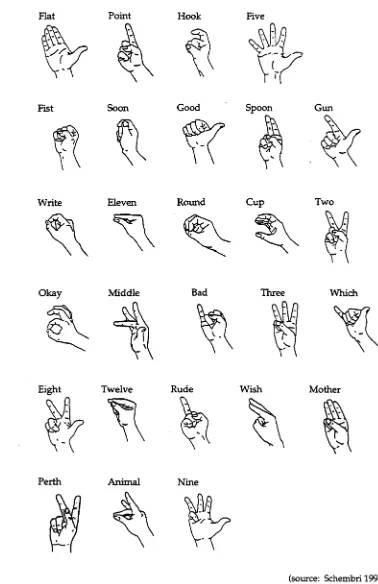
Johnston (1989a) there are sixty three handshapes in Auslan: thirty one of these are
major distinctive handshapes, and thirty two are regular variants of these (see Table 2.1 Major Handshapes in Auslan, following). Variants in handshape involve small, non-contrastive differences in hand configuration which are considered non-
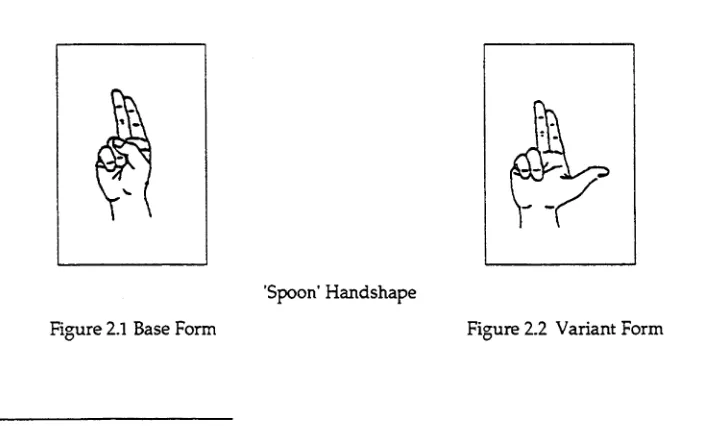
distinctive variations of the language (Schembri 1996). For example, the "Spoon”4 handshape in Figure 2.1 is the major handshape, and the 'Spoon' handshape in Figure 2.2 is a variant of that handshape. The distinguishing difference between the major handshape and its variant is simply that the variant has the thumb extended rather than retracted. They are grouped together because "there are no minimal
pairs in which either handshape is opposed to the other" (Johnston 1989a:486).
’Spoon’ Handshape
Figure 2.1 Base Form Figure 2.2 Variant Form
[image:37.526.100.452.525.738.2]Table 2.1 Maj or Handshapes in Auslan
Flat Point Hook Five
Fist Soon Good Spoon Gun
Okay M iddle Bad Three Which
Eight Twelve Rude W ish M other
Perth Anim al Nine
[image:38.526.68.446.161.745.2]Auslan ♦ 25
There are three categories of manual sign production, based on types of hand combinations, such that signs with one hand are termed one-handed signs (e.g., SMELL, Figure 2.3 below), with two hands of different handshape are termed two-handed signs (e.g., EGG, Figure 2.4 below), and with two hands with the same handshape are termed double-handed signs (e.g., SIGN, Figure 2.5 below) (Johnston 1989a; Schembri 1996).
Figure 2.3 SMELL Figure 2.4 EGG Figure 2.5 SIGN
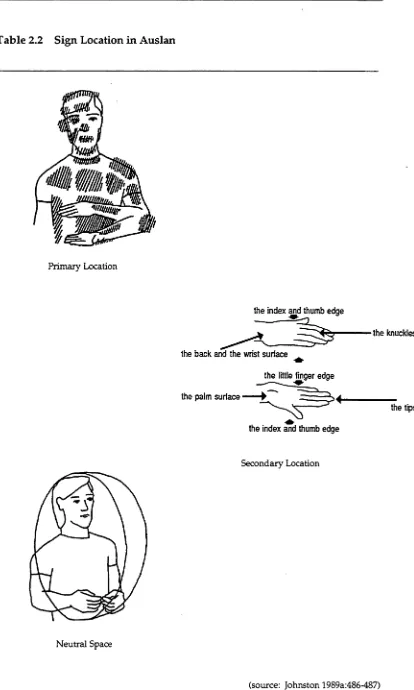
2.3.2 L ocation
Table 2.2 Sign Location in Auslan
Primary Location
“ nr
• the knuckles the back and the wrist surfacethe little finger edge
the palm surface
-the tips
the index and thumb edge
Neutral Space
Secondary Location
[image:40.526.85.499.58.748.2]Auslan ♦ 27
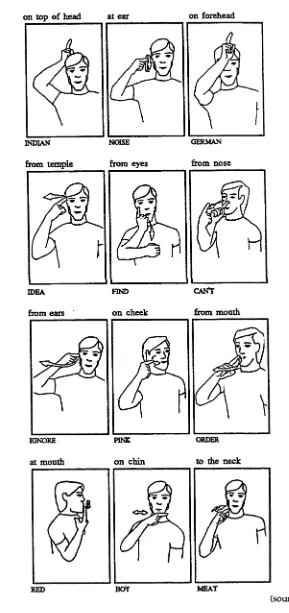
Table 2.3 The Function of Sign Location in Auslan
on forehead
on top of head at ear
INDIAN NOISE GERMAN
from temple from eyes from nose
CAN'T
FIND
IDEA
from ears on cheek from mouth
FINK IGNORE
to the neck on chin
at mouth
RED BOY MEAT
[image:41.526.97.386.144.757.2]2.3.3 O rientation
O rientation is the th ird com ponent of a sign, and refers to the direction of the fingers and palm of a hand during the production of a sign. The orientation of fingers and palm of the hand may be upw ard, dow nw ard, right, left, tow ards or aw ay from the signer's body. In order to produce a sign correctly, particularly a sign which shares other formational elements (i.e., handshape, location, movement), it is im p o rtan t to know the orientation (Johnston 1989a; Schembri 1996). For example, the signs WEIGH and BALANCE (see Figures 2.6 and 2.7 respectively) are distinguishable only by the orientation of the palms. In WEIGH the palm s of the hands are oriented upw ard, and in BALANCE the palms are oriented dowmw'ard.
Figure 2.6 WEIGH Figure 2.7 BALANCE
[image:42.526.324.404.620.745.2]Further, consider WEIGH and DOUBT (see Figures 2.8 and 2.9 respectively) in which the hands for WEIGH are oriented outw ard aw ay from the signer’s body, and for DOUBT the hands are oriented to face one another.
Auslan ♦ 29
Although a number of linguists examining the phonology of signs believe
orientation is a redundant feature (e.g. Klima & Bellugi 1979; Valli & Lucas 1995),
Johnston (1989b) and Schembri (1996) have noted of Auslan that orientation is a fundamental feature for the description of sign structure.
2.3.4 Movement
Movement, the fourth component of a sign, refers to a sign’s movement through
space. Movements in sign formation are categorised as either primary or secondary movements. Primary movements are large scale movements and consist of two
sub-categories: path movement, which are the movements of a sign from one location to another; and local movement, which are the changes in handshape and orientation. Secondary movement refers to the small scale movements which are rapidly repeated movements that change the orientation of the hand, or the handshape of a sign (i.e., local movement) (Johnston 1989a; Schembri 1996).
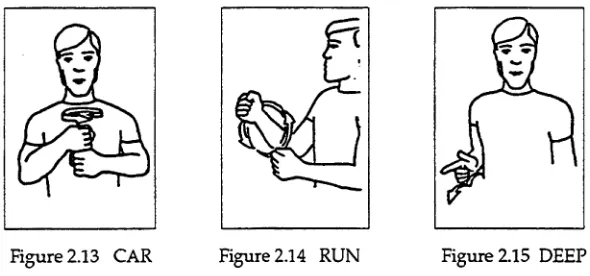
Primary movements, for example, may simply use path movements which can be made in a single straight line or a series of straight lines, and arcs or circles, as illustrated in Figures 2.10 through to 2.12 below and 2.13 through to 2.15 on the
following page:
Signs may also be made using only local movement, such as twists of the hand, opening and closing the hand, wiggling the fingers, and bending the fingers and wrists, again illustrated in Figures 2.16 through to 2.20 below:
Figure 2.16 MIRROR Figure 2.17 SPEND Figure 2.18 HAVE
Or, signs may be made using a combination of both primary and secondary movements, involving path movement combined with changes in handshape and orientation , illustrated by Figures 2.19 and 2.20 below:
Figure 2.20 HOME Figure 2.19 MELT
[image:44.526.110.405.317.455.2]Auslan ♦ 31
2.3.5 Expression
Expression is the non-manual component of a sign. The non-manual features of signs include the movement of the eyes, head and body, various facial expressions, head movements and mouth patterns. The range of facial expression types, subdivided into movement and action of parts of the face, head and body available in Auslan, are presented in the following Table 2.4 Non-Manual Features in Auslan. These non-manual features may often be made at the same time (e.g., pursing the lips and narrowing the eyes). Predominantly, non-manual signs co-occur with manual signs, however, in some cases signs may be distinguished from one another only in respect of the non-manual component. For example, the sign RECENTLY
with the addition of a grimace and tilting the head to the right changes to the sign
JUST THEN, as illustrated by Figures 2.21 and 2.22:
Figure 2.21 RECENTLY Figure 2.22 JUST THEN
Although only a small number of signs are believed to include an obligatory non-manual component, non-manual features are fundamental to the construction of phrase structure in Auslan (cf. Johnston 1989a; Schembri 1996). For example, if a sentence is to function as a question it is typically accompanied by a raising of the eyebrows, and an optional, forward head tilt (Johnston 1989a). It has been suggested that grammatical facial behaviours in sign language may share
/
Table 2.4 Non-Manual Features in Auslan
Head M outh
Shaking the head Opening the mouth
N odding the head Closing the mouth
Turning the head to the left Poking out the tongue
Turning the head to the right Protruding the lips
Tilting the head to the left Rounding the lips
Tiling the head to the right Vibrating the lips
Tilting the head backwards Pressing the lips together
Tiling the head forwards Drawing the lips back
Moving the head backwards Stretching the lips
Moving the head forwards Turning up the com ers of the lips
Moving the head from side to side Turning down the corners of the lips
Pushing the tongue into the cheek
Eyebrows Pushing the tongue dow n behind the
Raising the eyebrows lower lip
Lowering the eyebrows Biting the lips
Sucking in air
Eyes Blowing out air
Blinking
Closing the eyes Cheeks
Opening the eyes Puffing out the cheeks
Opening the eyes wide Sucking in the cheeks
N arrow ing the eyes
Directing the eye gaze to the right Shoulders
Directing the eye gaze to the left Hunching the shoulders
Directing the eye gaze forward and up Moving the shoulders forward
Directing the eye gaze forwards and down Moving the shoulders backward
Turning the shoulders to the left
Body Turning the shoulders to the right
Moving the body forward
Moving the body backward N ose
Turning the body Wrinkling the nose
Auslan ♦ 33
2.4 Signed Grammar
Recent research has shown that signed languages have highly-articulated grammars (Poizner, Klima & Bellugi 1990). Grammatical processes of signed language have been found to be conditioned in important ways by the modality, with many grammatical mechanisms exploiting the possibilities of both the spatial medium and multi-layered structure of production (Poizner, et al. 1990). The main areas in which Auslan differs significantly from English have been detailed in recent research, and are presented briefly, below (cf. Johnston 1989a, 1996; Schembri 1996).
2.4.1 Sign Modification
A striking feature of signed language is the internal modification of signs. Internal modification is the process of changing the way a sign is produced, in order to convey a variety of meanings. Modification of a sign can occur through a change in one of the internal components of that sign, i.e., handshape, location, orientation, movement or facial expression (Johnston 1989a). For example, the orientation of a sign can be internally modified by the direction of its production to incorporate the relative orientation of an object to the signer. For example, Figure 2.23 below refers to a WINDOW, while Figure 2.34 refers to a WINDOW to the right of the signer, and Figure 2.34 refers to a WINDOW to the left of the signer.
One of the more important internal modifications has to do with movement. Movement modification can involve: the direction in which a sign is made (e.g., allowing a sign to move from the speaker, to an addressee, to a third person in a conversation); the actual or relative movement of a sign (e.g., WALK produced in a slow zig-zag movement to show 'walk in a zig-zag'); a change or reversal of a 'time sign' to indicate time frames for events (e.g., movement forward generally indicates future time, and movement backward represents past time); or the quality and number (e.g., the number of repetition of the sign CAT indicates the quantity of cats) (Johnston 1989a:498). Internal modification of one component of a sign, however, often requires modification of other components within that sign.
2.4.2 Sign Vocabulary
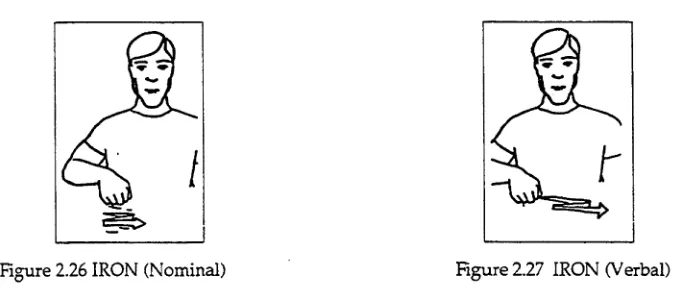
Classes of signs in Auslan do not differ from the function of the grammatical devices found in some spoken languages, but they do differ in form (Poizner et al. 1990; Johnston 1989a). As noted by Johnston (1989a:503), "it is not easy to transfer the grammatical classes of words in a spoken language like English on to the signs of Auslan". While nominal and verbal classes in Auslan function similarly to nouns and verbs in spoken English, they differ predominantly in their formational properties. A nominal class sign in Auslan is typically made with short, sharp, restrained movement, as illustrated in Figure 2.26 IRON on the facing page. Verbal class signs are made with longer, more fluid movement than nominal signs, as comparatively illustrated with IRON in Figure 2.27, facing (Johnston 1989a).
Auslan ♦ 35
Figure 2.26 IRON (Nominal) Figure 2.27 IRON (Verbal)
Classifier signs in Auslan function to classify objects according to size and shape. Formationally the signs are able to express and encode meanings in ways different
to spoken language. The class of classifier signs classifies objects using handshapes, and the signs are often ambiguous and context dependent. There are two kinds of
classifier signs: descriptive and proform. Descriptive classifiers, in which the hands represent themselves within the handshapes, are used to describe the size and shape of object. More simply the hands, as classifiers themselves, are moved over, traced around or grasp an object. Descriptive classifiers, in this manner, are dependent on context for precise interpretation, for out of context the handshape
reverts to only broad possible meaning. Proform classifiers specifically use handshapes (i.e., not the hands themselves) to represent the location, movement
and orientation of objects, as that object itself is located, moves or turns in space. Proform classifiers are also highly dependent on context for specification. Both
descriptive and proform classifiers have a base, or ’default' meaning which will change according to context. A clear context for classifier use is essential for clear
definition of meaning (Johnston 1989a).
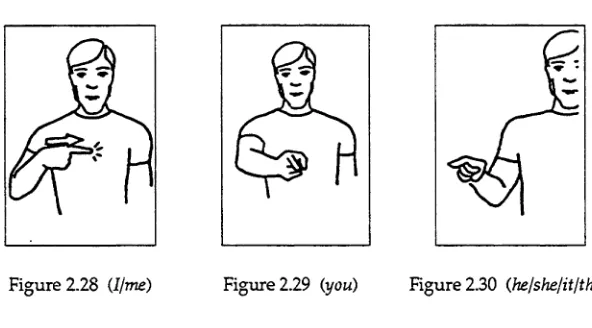
A very important class of signs in Auslan is "pointing" signs (Johnston 1989a: 504).
signing space. The class of pointing signs is highly context-dependent for meaning; that is, who is pointing, where they are pointing, what they are pointing at, and
how and when they are pointing. For example, to indicate lime one points to
oneself, and for you or he/she/it/there one points to the addressee, as illustrated in
Figures 2.28, 2.29 and 2.30 below, respectively (Johnston 1989a).
Figure 2.28 {I/me) Figure 2.29 (you) Figure 2.30 (he/she/it/there)
Plurality is represented by movement of the point, such that sweeping the point in an arc toward the referent(s) can represent we/us, and they/them, as illustrated in Figures 2.31 and 2.32 respectively (Johnston 1989a).
F igure 2.31 (we/us) F igure 2.32 (they/them)
[image:50.526.109.405.237.401.2]Auslan ♦ 37
2.4.3 Sign Order
Unlike spoken languages, which require special morphemes or word order to encode the relationship of object and subject relations, signed language relies
primarily upon the manipulation of sign forms in space. The horizontal plane in
front of the signer's torso, termed the "signing space" (Poizner et al. 1990:16), has an important role in the structure of signed language. Not only is this space the
articulatory space which accommodates both hand and arm movements, it is also
the space which carries linguistic meaning (Poizner et al. 1990; Johnston 1989a). This ability for spatial relationships allows Auslan to encode information about word order in ways which differ from the reliance of spoken English on particular words or word order to encode this information. For example, the relationship
between subject and object in a signed sentence can be conveyed through the direction of a sign, or by the semantics of the sign involved. However, in the
instances that signs in the sentence do not easily disambiguate potential subject- object relations, spoken English word order (i.e., subject, verb, object) is usually used (cf. Johnston 1989a).
Most sentences in Auslan, however, have a topic-comment structure with the signer
establishing topic or subject first, followed by more information or a comment.
Perhaps this is the main reason for the rare usage of word order alone to distinguish subject and object in Auslan sentences. Since signed languages unfold in a linear
manner the topic-comment structure make sense as a discourse strategy (Johnston
1989a; Poizner et al. 1990). Essentially spatial in nature, the appropriate 'scene' or 'framework' is set by the topic, allowing the interpretation or commentary to follow
(Johnston 1989a). The visual-manual modality constrains the speaker to establish
them. Very simply, the signer cannot speak about something that has not been
established, and therefore is, in essence, not there.
2.4.4 Fingerspelling
Although technically not part of Auslan grammar per se, fingerspelling plays an important role in Auslan. Fingerspelling, or manual alphabets as these systems are known, is made up of hand configurations and movements which represent alphabetic symbols. These symbols are produced using the hands, and many of the resulting handshapes look similar to the shapes of letters in printed form (Annabel 1998; Johnston 1989a; Schembri 1996).
Auslan ♦ 39
Table 2.5 The Tw o-Handed A lphabet in A uslan
[image:53.526.69.488.162.689.2]