Int. J. Electrochem. Sci., 7 (2012) 11827 - 11833
International Journal of
ELECTROCHEMICAL
SCIENCE
www.electrochemsci.org
Short Communication
Rate Performance of LiMnPO
4Based Materials from Different
Carbon Source Addition Process
Haisheng Fang*, Enrui Dai, Kun Yang, Bin Yang, Yaochun Yao, Wenhui Ma, Yongnian Dai
National Engineering Laboratory for Vacuum Metallurgy, Kunming University of Science and Technology, Kunming 650093, China
Faculty of Metallurgical and Energy Engineering, Kunming University of Science and Technology, Kunming 650093, China
State Key Laboratory Breeding Base of Complex Nonferrous Metal Resources Clear Utilization in Yunnan Province, Kunming University of Science and Technology, Kunming 650093, China *
E-mail: [email protected]
Received: 3 November 2012 / Accepted: 22 November 2012 / Published: 1 December 2012
In the present work, two types of cation doped LiMnPO4 based materials, LiMn0.9Fe0.09Mg0.01PO4/C and LiMn0.98Mg0.02PO4/C, are synthesized by a solid-state reaction method with different carbon source addition process and characterized to investigate the effect of carbon source addition process on the quality of carbon coating and rate performance. The result shows that the LiMnPO4 based cathode materials synthesized by adding carbon source via one-step process have better carbon coating than those synthesized by adding carbon source via two-step process, which leads to faster electron transport across the surface and thus better rate performance. This observation on LiMnPO4 based materials is different from that previously reported for LiFePO4.
Keywords: Lithium ion batteries; Cathode; LiMnPO4; Carbon coating
1. INTRODUCTION
of carbon coating on LiFePO4 was highly influenced by carbon-coating method, and their available data indicated that the LiFePO4/C composite synthesized by adding carbon source via two-step process had better carbon coating and rate capability as compared to that synthesized by adding carbon source via one-step process. However, whether this experience is applicable to LiMnPO4 still remains unknown and needs further study.
To address the effect of carbon source addition process on the quality of carbon coating and rate performance, LiMnPO4 based materials synthesized with different carbon source addition process were investigated in the present work. The result revealed that the LiMnPO4 based cathode materials synthesized by adding carbon source via one-step process showed better carbon coating and rate performance, which is different from that observed for LiFePO4.
2. EXPERIMENTAL
Two types of cation doped LiMnPO4 based materials, LiMn0.9Fe0.09Mg0.01PO4/C and LiMn0.98Mg0.02PO4/C, were synthesized by a solid-state reaction method with different carbon source addition process. LiMn0.9Fe0.09Mg0.01PO4/C composites: (1) one-step process: Chemicals of LiH2PO4, MnC4H6O4·4H2O, MgC4H6O4·4H2O, H2C2O4·2H2O and FeC2O4·2H2O were mixed with sucrose (14 wt.%) by ball-milling for 6h. The milled mixture was dried and then heated at 800 °C for 10 h under an Ar atmosphere; (2) two-step process: Chemicals of LiH2PO4, MnC4H6O4·4H2O, MgC4H6O4·4H2O, H2C2O4·2H2O and FeC2O4·2H2O were mixed with sucrose (7 wt.%) by ball-milling for 6h. The milled mixture was dried and then heated at 800 °C for 5 h under an Ar atmosphere. Subsequently, the cooled powders were added into the aqueous solution of sucrose (7 wt.%) and fully mixed by magnetic stirring. Finally, the obtained mixture was dried and heated at 800 °C for 5 h under an Ar atmosphere. The same procedures used for LiMn0.9Fe0.09Mg0.01PO4/C were adopted to prepare LiMn0.98Mg0.02PO4/C composites.
The crystalline phase was identified by powder X-ray diffraction (XRD). The morphology and particle size were observed by scanning electron microscopy (SEM). Raman spectroscopy was measured using a Reinshaw inVia Raman microscope at room temperature with an Ar 514.5 nm laser as excitation source. The carbon content was measured by the VarioEL III (elementar, Germany).
Electrochemical measurement was conducted by assembly of 2025 coin-type cell with a lithium metal anode. The cathode was made by mixing active material, Super P and polyvinylidene fluoride (PVDF) in a weight ratio of 8: 1: 1. The electrolyte was 1 M LiPF6 in EC/DMC (1/1) solution. All cells were assembled in an Ar-filled glove box. For rate test, cells were charged at 0.1 C to 4.5 V, held at 4.5 V until the current decreased to 0.01 C, and then discharged at various rates to 2.0 V. at 25 o
C. Electrochemical impedance spectroscopy (EIS) was carried out in a frequency range from 0.1 Hz to 100 kHz with an AC signal of 5 mV.
3. RESULTS AND DISSCUSSION
structure with a space group of Pmnb, and the carbon source addition process did not influence lattice parameters and bulk structure of the LiMn0.9Fe0.09Mg0.01PO4. Moreover, no carbon peak is observed in the XRD patterns, indicating the amorphous nature of the carbon pyrolyzed from sucrose in the
[image:3.596.171.422.163.363.2]samples, but the presence of carbon could be easily observed by Raman spectroscopy.
Figure 1. XRD patterns of LiMn0.9Fe0.09Mg0.01PO4/C with different carbon source addition process: (a) one-step, (b) two-step.
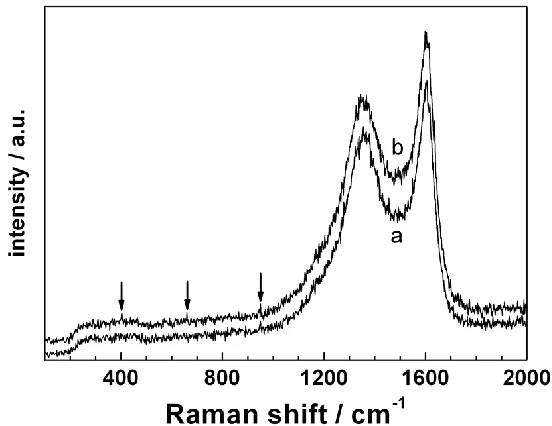
Figure 2. Raman spectra of LiMn0.9Fe0.09Mg0.01PO4/C with different carbon source addition process: (a) one-step, (b) two-step.
[image:3.596.159.435.432.645.2][image:4.596.74.520.217.358.2] [image:4.596.65.533.523.700.2]
indicating that the carbon source addition process did not affect the structure of the pyrolyzed carbon. Moreover, due to the screening effect of carbon [24], only few bands of LiMn0.9Fe0.05Mg0.05PO4 (indicated by arrows) faintly appear, but these extremely weak bands are more visible in the spectrum for the two-step sample, suggesting a more uniform carbon coating on the surface of LiMn0.9Fe0.05Mg0.05PO4 synthesized by adding carbon source via one-step process. In addition, the carbon content is 6.78 wt.% for the one-step LiMn0.9Fe0.09Mg0.01PO4/C sample and 7.61 wt.% for the two-step one.
Figure 3. SEM images of LiMn0.9Fe0.09Mg0.01PO4/C with different carbon source addition process: (a) one-step, (b) two-step.
Figure 3 shows SEM images of the LiMn0.9Fe0.09Mg0.01PO4/C with different carbon source addition process. In general, the two samples have a similar morphology, and the micron particles are the aggregate of a large number of submicron primary crystals. However, it is noted that the primary crystals for the one-step sample is slightly larger than those for the two-step one.
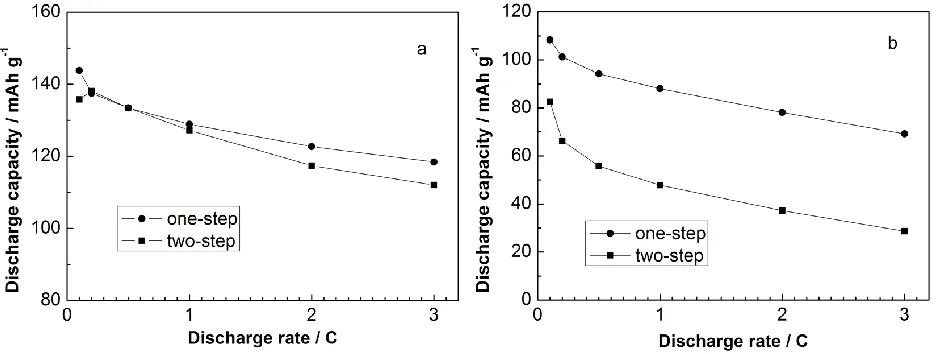
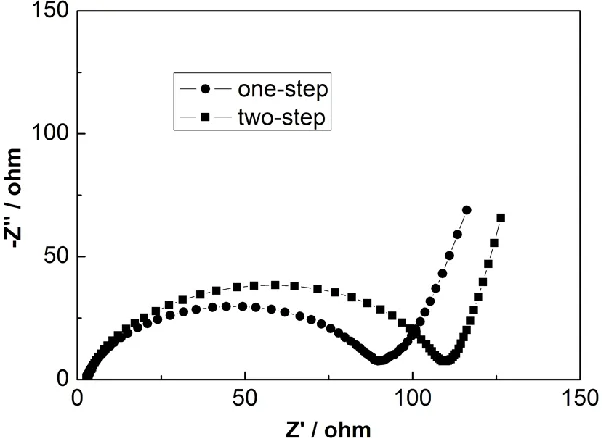
Figure 4a shows rate capability of the LiMn0.9Fe0.09Mg0.01PO4/C with different carbon source addition process. It is seen that the one-step LiMn0.9Fe0.09Mg0.01PO4/C sample has a better rate performance, though the two-step sample has relatively higher carbon content and smaller crystal size. We thought that the quality of carbon coating should be responsible for this result. As indicated in Figure 2, better carbon coating could be achieved on the surface of LiMn0.9Fe0.09Mg0.01PO4 by adding carbon source via one-step process, which would lead to faster electron conduction across the surface. This was demonstrated by EIS test as shown in Figure 5. The spectra of the two samples have a similar profile, but smaller semicircle was observed for the one-step sample, which means a smaller charge transfer resistance. Since the bulk property of the two LiMn0.8Fe0.19Mg0.01PO4 samples is unaffected by carbon source addition process and the components except the active material of the cathode for cells are the same, this charge transfer resistance difference should mainly arise from the different surface resistance. Hence, the one-step sample has a smaller surface resistance than the two-step one because of the better carbon coating, which results in better rate performance.
Figure 5. EIS plots of LiMn0.9Fe0.09Mg0.01PO4/C with different carbon source addition process recorded in a discharged state after 5 cycles. Cells were charged at 0.1 C to 4.5 V, held at 4.5 V until the current decreased to 0.01 C, and then discharged at 0.1 C to 2.5 V.
[image:5.596.148.449.310.529.2]
4. CONCLUSIONS
LiMnPO4 based materials with different carbon source addition process were prepared and the effect of carbon source addition process on the properties was investigated. The result demonstrates that the carbon source added in one step is more effective for creating better carbon coating on the surface of the LiMnPO4 based material, which leads to accelerated electron transport across the surface and improved rate performance.
ACKNOWLEDGEMENTS
This work was supported by the Natural Science Foundation of Yunnan Province (No. 2009ZC001X) and the Jinchuan Pre-Research Foundation (No. Jinchuan201112).
References
1. A.K. Padhi, K.S. Nanjundaswamy and J.B. Goodenough, J. Electrochem. Soc., 144 (1997) 1188. 2. M. Yonemura, A. Yamada, Y. Takei, N. Sonoyama and R. Kanno, J. Electrochem. Soc., 151
(2004) A1352.
3. C. Delacourt, L. Laffont, R. Bouchet, C. Wurm, J.B. Leriche, M. Morcrette, J. M. Tarascon and C. Masquelier, J. Electrochem. Soc., 152 (2005) A913.
4. G. Li, H. Azuma and M. Tohda, Electrochem. Solid-State. Lett., 5 (2002) A1357. 5. Z. Bakenov and I. Taniguchi, J. Power Sources, 195 (2010) 7445.
6. B. Kang and G. Ceder, J. Electrochem. Soc., 157 (2010) A808.
7. S.M. Oh, S.W. Oh, C.S. Yoon, B. Scrosati, K. Amine and Y.K. Sun, Adv. Funct. Mater., 20 (2010) 32605.
8. H. Wang, Y. Yang, Y. Liang, L.F. Cui, H. Sanchez Casalongue, Y. Li, G. Hong, Y. Cui and H. Dai, Angew. Chem. Int. Ed., 50 (2011) 7364.
9. T. Drezen, N. H. Kwon, P. Bowen, I. Teerlinck, M. Isono and I. Exnar, J. Power Sources, 174 (2007) 949
10.D. Choi, D. Wang, I. T. Bae, J. Xiao, Z. Nie, W. Wang, V.V. Viswanathan, Y.J. Lee, J.G. Zhang, G.L. Graff, Z. Yang and J. Liu, Nano Lett., 10 (2010) 2799.
11.G. Chen, J.D. Wilcox and T.J. Richardson, Electrochem. Solid-State. Lett., 11 (2008) A190. 12.S.K. Martha, J. Grinblat, O. Haik, E. Zinigrad, T. Drezen, J.H. Miners, I. Exnar, A. Kay, B.
Markovsky and D. Aurbach, Angew. Chem. Int. Ed., 48 (2009) 8559.
13.T. Shiratsuchi, S. Okada, T. Doi and J.I. Yamaki, Electrochim. Acta, 54 (2009) 3145. 14.J. Kim, D.H. Seo, S.W. Kim, Y.U. Park and K. Kang, Chem. Commun., 46 (2010) 1305.
15.J.W. Lee, M.S. Park, B. Anass, J.H. Park, M.S. Paik and S.G. Doo, Electrochim. Acta, 55 (2010) 4162.
16.D. Wang, C. Ouyang, T. Drezen, I. Exnar, A. Kay, N.H. Kwon, P. Gouerec, J.H. Miners, M. Wang and M. Grätzel, J. Electrochem. Soc., 157 (2010) A225.
17.G. Yang, H. Ni, H. Liu, P. Gao, H. Ji, S. Roy, J. Pinto and X. Jiang, J. Power Sources, 196 (2011) 4747.
18.C. Hu, H. Yi, H. Fang, B. Yang, Y. Yao, W. Ma and Y. Dai, Electrochem. Commun., 12 (2010) 1784.
19.H. Fang, H. Yi, C. Hu, B. Yang, Y. Yao, W. Ma and Y. Dai, Electrochim. Acta, 71 (2012) 266. 20.T. Doi, S. Yatomi, T. Kida, S. Okada and J.I. Yamaki, Cryst. Growth Des., 9 (2009) 4990. 21.H. Yi, C. Hu, H. Fang, B. Yang, Y. Yao, W. Ma and Y. Dai, Electrochim. Acta, 56 (2011) 4052. 22.K. Zaghib, M. Trudeau, A. Guerfi, J. Trottier, A. Mauger, R. Veillette and C.M. Julien, J. Power
23.Z Chen and J.R. Dahn, J. Electrochem. Soc., 149 (2002) A1184.
24.A. Ait Salah, A. Mauger, K. Zaghib, J.B. Goodenough, N. Ravet, M. Gauthier, F. Gendron and C.M. Julien, J. Electrochem. Soc., 153 (2006) A1692.