i
REAL TIME VIDEO PROCESSING FOR DRONE-BASED
LIGHTNING SENSOR
MUHAMMAD FIKRI BIN AZIZ
This Report Is Submitted In Partial Fulfillment Of Requirements For The Bachelor Degree of Electronic Engineering (Computer Engineering) (Hons.)
Fakulti Kejuruteraan Elektronik dan Kejuruteraan Komputer Universiti Teknikal Malaysia Melaka
ii
UNIVERSTI TEKNIKAL MALAYSIA MELAKA
FAKULTI KEJURUTERAAN ELEKTRONIK DAN KEJURUTERAAN KOMPUTER
BORANG PENGESAHAN STATUS LAPORAN
PROJEK SARJANA MUDA II
Tajuk Projek : REAL TIME VIDEO PROCESSING FOR DRONE-BASED LIGHTNING SENSOR
Sesi Pengajian : 1 6 / 1 7
Saya MUHAMMAD FIKRI BIN AZIZ mengaku membenarkan Laporan Projek Sarjana Muda ini disimpan di Perpustakaan dengan syarat-syarat kegunaan seperti berikut:
1. Laporan adalah hakmilik Universiti Teknikal Malaysia Melaka.
2. Perpustakaan dibenarkan membuat salinan untuk tujuan pengajian sahaja.
3. Perpustakaan dibenarkan membuat salinan laporan ini sebagai bahan pertukaran antara institusi pengajian tinggi.
4. Sila tandakan ( √ ) :
SULIT* *(Mengandungi maklumat yang berdarjah keselamatan atau
kepentingan Malaysia seperti yang termaktub di dalam AKTA RAHSIA RASMI 1972)
TERHAD**
**(Mengandungi maklumat terhad yang telah ditentukan oleh organisasi/badan di mana penyelidikan dijalankan)
TIDAK TERHAD
Disahkan oleh:
MUHAMMAD FIKRI BIN AZIZ
Tarikh : ………..
DR. MOHD RIDUAN B. AHMAD
Tarikh : ………..……
Tarikh: ……….. Tarikh: ………..
iii
DECLARATION
I hereby, declared this report entitled
REAL TIME VIDEO PROCESSING FOR DRONE-BASED LIGHTNING SENSOR
is the results of my own research except as cited in references.
Signature : ……….
Author‟s Name : MUHAMMAD FIKRI BIN AZIZ
iv
APPROVAL
This report is submitted to the Faculty of Electronic Engineering and Computer Engineering of UTeM as a partial fulfillment of the requirements for the degree of Bachelor of Electronic Engineering (Computer Engineering) (Hons.). The member of the supervisory is as follow:
Signature : ……….
Supervisor‟s Name : DR. MOHD. RIDUAN B. AHMAD
v
vi
ACKNOWLEDGEMENT
First, foremost and most importantly, I express my most thankful to The Most Merciful, The Most Powerful and The Most Beneficent, Allah Subhanahu wa Ta'ala that has provided for me with the opportunity to finish this final year project.
I also would like to express my sincere gratitude to my supervisor Dr. Mohd. Riduan bin Ahmad for the continuous support for my Bachelor Degree study and research, for her patience, motivation, enthusiasm, and immense knowledge. His guidance helped me in all the time of research and writing of this thesis. I could not have imagined having a better supervisor for my Bachelor Degree study
vii
ABSTRACT
viii
ABSTRAK
ix
TABLE OF CONTENTS
CHAPTER SUBJECT PAGE
TITLE PAGE i
VERIFICATION FORM ii
DECLARATION iii
APPROVAL iv
DEDICATION v
ACKNOWLEDGEMENT vi
ABSTRACT vii
ABSTRAK viii
TABLE OF CONTENTS ix
LIST OF TABLES xiii
LIST OF FIGURES xiv
LIST OF ABBREVIATIONS xvi
CHAPTER I INTRODUCTION
1.0 INTRODUCTION 1
1.1 PROJECT BACKGROUND 2
1.2 PROBLEM STATEMENTS 3
x
1.4 SCOPES 5
1.4.1 Data 3
1.4.2 Study Area 5
1.4.3 Hardware 6
1.4.4 Algorithm 6
1.4.5 Time for data collection 7
1.5 PROJECT SIGNIFICANCE 7
1.6 SUMMARY 8
CHAPTER II LITERATURE REVIEW
2.0 INTRODUCTION 9
2.1 FACTS AND FINDINGS 10
2.2 VIDEO PROCESSING 10
2.2.1 Raspberry Pi 10
2.3 OVERVIEW OF TECHNIQUES 13
2.3.1 Otsu‟s Method 13
2.3.2 Canny Edge Detection 17
2.3.3 Binary Threshold 18
2.4 HARDWARE IMPLEMENTATION 19
2.5 PROGRAMMING PROCEDURE 21
2.6 NOISE 21
2.7 MEMORY STORAGE 23
xi
CHAPTER III METHODOLOGY
3.0 INTRODUCTION 25
3.1 PROJECT METHODOLOGY 26
3.1.1 Planning 26
3.1.2 Implementation 29
3.1.3 Analysis 35
3.2 PROJECT SCHEDULE & GANTT CHART 36
3.3 CONCLUSION 41
CHAPTER IV RESULT, ANALYSIS AND DISCUSSION
4.0 INTRODUCTION 42
4.1 PRE-PROCESSING 44
4.1.1 Converting to Grayscale 45
4.2 PROCESSING 47
4.2.1 Edge Detection 47
4.2.1.1 Canny 48
4.2.1.2 Laplacian of Gaussian 50 4.2.2 Segmentation Threshold 52
4.2.3 Finding Maximum Value 54
4.3 POST-PROCESSING 57
4.3.1 Adding Timestamp 57
4.3.2 Store Image in SD Card 58
4.4 ANALYSIS AND DISCUSSION 61
4.4.1 Analysis on Time-Delay of
xii
4.4.2 Relationship of Electromagnetic
Field and Pattern of Lightning 63
4.4 CONCLUSION 66
CHAPTER V CONCLUSION
6.0 INTRODUCTION 67
6.1 DISCUSSION 68
6.2 OBSERVATIONS ON WEAKNESSES
AND STRENGTHS 68
6.3 RECOMMENDATION FOR FUTURE
IMPROVEMENT 69
6.4 CONTRIBUTION 70
6.5 CONCLUSION 70
REFERENCES xvii
xiii
LIST OF TABLES
TABLE TITLE PAGE
3.1 Software Requirements 27
3.2 Hardware Requirements 28
3.3 Project schedule PSM 1 36
xiv
LIST OF FIGURES
FIGURES TITLE PAGE
1.0 1.1
The image of intra-cloud lightning UAV Drone
2 5
1.2 Overview of UTeM night scene 6
2.0 Author setup of the proposed model 11
2.1 Binarization 15
2.2 Histogram of Otsu 16
2.3 Block diagram of an edge detector 17
2.4 Histogram of normal image 22
2.5 Histogram of high reflection image 22
2.6 Micro Secure Digital (SD) card 23
3.1 Steps of methodology 26
3.4 Flowchart of project development process 31
3.5 Testing environment 34
3.6 Radar image at 2 km obtained from webpage of Malaysian
Meteorological Department (MMD). 36
3.7 Gant Chart PSM 1 39
3.8 Gant Chart PSM 2. 40
4.0 Flowchart of steps for detecting lightning 43
4.1 Original sample image of lightning 45
4.2 After converting to grey scale 46
xv
LIST OF FIGURES
FIGURES TITLE PAGE
4.4 Steps for edge detection 47
4.5 Canny Edge Detection 49
4.6 Command for display Canny Edge‟s histogram 49
4.7 Histogram of Canny Edge Detection 50
4.8 Laplacian of Gaussian Edge Detection 51
4.9 Histogram of Laplace 52
4.10 Otsu‟s Method 53
xvi
LIST OF ABBREVIATIONS
NOIR - No Infrared
RPI - Raspberry Pi
NBE - Narrow Bipolar Event
CV - Computer Vision
EM - Electromagnetic
I/O - Input / Output
UAV - Unmanned Aerial Vehicle
UTeM - Universiti Teknikal Malaysia Melaka MNF - Minimizing Noise Fraction
PSM - Projek Sarjana Muda PNG - Portable Network Graphic JPEG - Joint Photographic Expert Group GIF - Graphic Interchange Format UTC - Universal Time Coordinated
GMT - Greenwich Mean Time
SD - Secure Digital
FPS - Frame per second
RGB - Red, Green, Blue
HSI - Hue, Saturation, Intensity
2D - 2-Dimension
3D - 3-Dimension
QVGA - Quarter Video Graphic Array PIC - Peripheral Interface Controller
CMOS - Complementary Metal-oxide Semiconductor
OS - Operating System
LCD - Liquid Crystal Display USB - Universal Serial Bus
FKEKK - Fakulti Kejuteraan Elektronik dan Kejuteraan Komputer DSLR
1
CHAPTER I
INTRODUCTION
1.0 INTRODUCTION
2
1.1 PROJECT BACKGROUND
[image:18.612.111.545.264.551.2]Lightning is not a common thing that happens in our life. It is the occurrence of a sudden electrical discharge in a very short duration. There are two types of lightning that can be captured, cloud-to-ground and inter-cloud. A ground-based lightning network often leads to rejection of cloud-to-cloud lightning. One of the most mystery lightning is intra-cloud lightning. Our project mostly will cover this lightning type.
Figure 1.0: The image of intra-cloud lightning [1]
3
lack the hot channel temperatures of tropospheric lightning, so they are more akin to fluorescent tube discharges than to lightning discharges.
Optical imaging using a 10,000 frame-per-second high speed camera shows that sprites are actually clusters of small, decameter-sized (10–100 m or 33–328 ft) balls of ionization that are launched at an altitude of about 80 km and then move downward at speeds of up to ten percent the speed of light, followed a few milliseconds later by a separate set of upward moving balls of ionization.
Lightning can strike in a variety of colours. The most common colour of lightning is white, but lightning can actually appear red, yellow, green, even blue or purple. Commonly people use flash sensor to do photograph lightning by using DSLR camera [2]. However, this method required expensive equipment and too heavy to carry on drone. Besides, the camera alone do not has any processor to do real time video processing to get satisfy output. The Raspberry Pi is a tiny and affordable computer that can use OpenCV (Open Source Computer Vision) to run video processing script. OpenCV is a library of programming functions mainly aimed at real-time computer vision.
1.2 PROBLEM STATEMENTS
4
1.3 OBJECTIVES
The objectives of the project are:
1. To investigate suitable algorithm to be implemented on video processing for lightning detection in harsh environment.
2. To program a low-cost camera to a higher frame rate per second (target is 1000 fps) for lightning sensor.
3. To evaluate and test the performance of the developed technique.
1.4SCOPES
1.4.1 Data
5
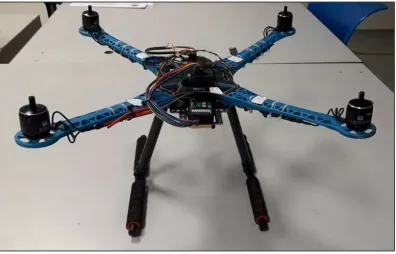
Figure 1.1: UAV Drone
1.4.2 Study area
6
Figure 1.2: Overview of UTEM night scene.
1.4.3 Hardware
The project is free from any external sensor on raspberry pi except pi camera sensor. In this thesis, we only focus on the maximum usage and capability of the camera sensor alone compare to other specific hardware sensor like flash sensor.
1.4.4 Algorithm
7
1.4.5 Time for data collection
The project is focusing only at night. This is because the most suitable time to collect data is when there is no sunlight appears on the UTeM scene. The sunlight can produce noise to the project system. Thus, the data captured during day may lead to produce wrong data.
1.5 PROJECT SIGNIFICANCE
Nowadays, the image of lightning can only be captured mainly by depending on high speed camera using a programmed lightning detection feature. Obviously, the traditional method use is really costly and almost unaffordable for every researcher to buy the equipment. Furthermore, the camera able to capture only at ground and is not compatible to bring it up to the cloud. Therefore, this project attempts to duplicate a high speed camera that is able to capture lightning and improving it flexibility to bring it everywhere.
8
1.6 SUMMARY
This project purpose is to build new algorithm for real time video processing for drone-based lightning detection. The project makes use of remote capturing data to detect and store the image of lightning in the storage. Hence, this project can give an alternative solution for the researcher to capture the image of intra cloud lightning instead of just capturing cloud to ground lightning. They also can save their budget by not buying an expensive high speed camera to capture lightning image.
![Figure 1.0: The image of intra-cloud lightning [1]](https://thumb-us.123doks.com/thumbv2/123dok_us/66694.6300/18.612.111.545.264.551/figure-the-image-of-intra-cloud-lightning.webp)