An Implementation of Real Time Based Fire&
Smoke Detection without Sensor by Video
Processing
Prerna B. Pagar, Prof. Popat R. ThoratDepartment of Electronics & Telecommunication L.E.C.T.’s Savitribai Phule Women’s Engineering College Aurangabad, India
ABSTRACT: Fire and smoke is necessary and profitable to humankind life, but it also causes many environmental disasters, creating economical and ecological damage, as well as endangering people's lives. So, fire and smoke detection systems are one of the most important components in surveillance systems used to monitor buildings and environment as part of an early warning mechanism that reports preferably the early presence of fire. This paper gives an implementation & performance evaluation of real time based indoor fire and smoke detection without sensor by video processing technique. The goal of fire and smoke detection system is to detect smoke and fires before it becomes out of control by providing earlier warning through sending message to authorities This system is mainly divided into following parts – fire detection, smoke detection, data fusion, control module The system proposes algorithm for RGB and YCbCr color space for fire detection with classification of pixels and Gaussian mixture model (GMM) in HSV color space for smoke detection. In addition, separation of smoke and fire pixels using color information (within
appropriate spaces, specifically chosen in order to enhance specific chromatic features) is performed. In parallel, a pixel selection based on the dynamics of the area is carried out in order to reduce false detection. The outputs of the three parallel algorithms are eventually fused by means of a multi-layer perceptron (MLP) by using neural network to filter false alarms caused by moving objects in the video. For the output the proposed method uses cell phone messages for the control action. The system is implemented in MATLAB version 7.10.0.499(R2010a). The system is trained with on the spot own created database of selected videos & is tested for fire and smoke detection features. As well as, we tested it for seven database of selected video & it gives test results. For real time system for captured video gives the accuracy of 80% to 90% respectively in noisy environment. The proposed method for real time has higher detection rate and lower false alarm rate.
KEYWORDS: Fire detection, Smoke detection, Video processing Generic color model, Gaussian mixture model, Smoke dynamic features.
I. INTRODUCTION
Mobile Ad Hoc Networks (MANETs) consists of a collection of mobile nodes which are not bounded in any infrastructure.Nodes in MANET can communicate with each other and can move anywhere without restriction. This non-restricted mobility and easy deployment characteristics of MANETs make them very popular and highly suitable for emergencies, natural disaster and military operations.
Fire and smoke has always threatened properties and people’s lives. Most conventional fire and smoke detection technologies are based on particle sampling, temperature sampling, and smoke analysis, but fire and smoke detection systems using these technologies have limited effectiveness due to high false alarm rates. Optical approaches are increasingly appropriate alternatives to conventional methods.
Fire and smoke detection systems are one of the most important components in surveillance systems used to monitor buildings and environment as part of an early warning mechanism that reports preferably the start of fire i.e.
smoke or fire. Therefore, not surprisingly, the fire and smoke detection is from several centuries the subject of research. Though a few communities have required some type of fire and smoke detection system in homes as long ago as the 1950s, it was not until 1970 that the first single-station battery-powered smoke alarm was invented (then referred to as early-warning fire detectors or smoke detectors) [1] [2]. Fire and smoke detection systems have a long history of being a difficult problem-the first papers date from about 1950. In the mid-1970s, smoke alarms for the home became widely available in the United States [3]. The initial push to get smoke alarms installed in every home was spurred by the landmark America Burning report of the National Commission on Fire Prevention and Control (1973), which urged Americans to protect their homes with smoke alarms; recommended that insurance, tax and other incentives be provided for Americans who protected their homes with early warning detection; and for improvements to be made to the technology of home fire detection. A report in the early 1980s by the International Association of Fire Chiefs Foundation [3] confirmed anecdotal reports that a disconnected power source was a major reason behind smoke detectors that failed to alarm in a fire. Therefore, in the mid-1990s, smoke alarm manufacturers began to offer 10-year lithium batteries for use in conventional ionization-type detectors, to address both the issues of battery replacement and of smoke alarm replacement.
Currently, almost all fire and smoke detection systems use built-in sensors that primarily depend on the reliability and the positional distribution of the sensors. The sensors should be distributed densely for a high precision fire
detector system. In a sensor-based fire detection system, coverage of large areas in outdoor applications is impractical
due to the requirement of regular distribution of sensors in close proximity. Conventional point smoke and fire detectors are widely used in buildings. They typically detect the presence of certain particles generated by smoke and fire by ionization or photometry. Alarm is not issued unless particles reach the sensors to activate them. Therefore, they cannot be used in open spaces and large covered areas.
There is example of commercial system is proposed by Wolfgang Krull, Ingolf Willms, Radoslaw R Zakrzewski, Mokhtar Sadok, Jeff Shirer, and Bob Zeliff in the paper “Design and test methods for a video-based cargo fire
verification system for commercial aircraft,” [4] they used low-cost CCD cameras to detect fire in the cargo bay of long
range passenger aircraft. That paper shows the method uses statistical features, based on gray scale video frames, including mean pixel intensity, standard deviation, and second-order moments, along with non-image features such as humidity and temperature to detect fire in the cargo compartment to reduce the false alarm of smoke detector.
More vision-based fire and smoke detectors have been introduced in the last few years; due to biggest achievement in video processing and camera technology. Video analysis is used for detection, basically makes use of numerical analysis to model the scene and automatically detect and set apart usual events from dangerous ones. System based on computer vision is relentlessly replacing those based on conventional sensors.
Fire and smoke detection shows only a few algorithms which are able to classify smoke and fire pixels and different detection modules with color feature extraction.
Classification of pixels can be based on colour features, since the use of grayscale implies an obvious outstanding loss of information. In paper “An early fire-detection Method based on image processing”, Chen et al. [5] make use of the RGB levels information and create rules for the three channels separately. To improve detection performance Tȍreyin et al. [6] explains a GMM to model fire pixels in “Flame detection in video using hidden Markov models”. In this paper, Gaussian model is obtained through Expectation Maximization from training pixels of previously acquired events. More recent papers showed how to improve the Chen’s detector [5] by considering fire motion, modeled as Markovian process. As in thereafter research paper “Automatic fire detection in video sequences” by author T. Celik,
H. Demirel, H. Ozkaramanli [7], make use of fire detection rules after extracting foreground pixels by means of a change detection algorithm. Nevertheless, the system outputs a lot of false detections, suffering heavily from changing in illumination and hence needs a very fine tuning of the change detection algorithm parameters.
In 2006, in Fire Safety Journal G. Marbach, M. Loepfe, T. Brupbacher given a paper on “An image processing technique for fire detection in videos” [9] proposes a model where data are represented and analyzed in a YUV space. Here, the features used to detect fire are the time derivative of the luminance component Y for a first reduction of the candidate fire pixel; then the chrominance components U and V are used for classification. Finally, they reduce false alarms, a simple motion algorithm is used to narrow the areas classified as fire. According to their results, the whole system is capable of less than a false alarm per week. However, they do not give any information on the testing set-up used. Wen-Bıng Homg, Jım-Wen Peng, Chıh-Yuan Chen, explained in his research paper “A new image-based real- time flame detection method using color analysis” [10] they in tented the HSI colour space to segment fire pixels into
bright and dark regions. A simple initial segmentation is followed by an even simpler thresholding of those pixels with low intensity and saturation, in order to wash away spurious regions. A metric based on the binary distance from images is then introduced to measure the distance of the candidate pixels form the centre of the classes; this gives the possibility of classifying each pixels into no fire, small fire, medium fire and big fire. Performances of such a method approach 97%. Unfortunately no information on false detection rates is given.
Philips et al. [11] invented a very complicated method in which they create a correspondence between fire/smoke pixels and the motion extracted frame by frame. To this end, they create a LUT to establish such a relation. In order to create the LUT the system needs a learning phase. This method unfortunately does not meet real-time requirements. Celik [10] proposes the CIE L*a*b colour space for the detection of fire pixels. This space turns out to be very interesting since it is perceptually uniform and the colour tone are better grouped here than in any other space. In this paper YCbCr color space for extracting the features and for classification of a fire pixel.
In 2006 Chen, propose a Color-Based method for smoke detection composed by two decision rules: a chromaticity-based static decision rule and diffusion chromaticity-based dynamic decision rule; the former rule is deduced by grayish color of smoke and the latter is dependent on the spreading attributes of smoke. Kopilovic et. al. in [12] propose to analyze the motion irregularities of grayish region using the optical flow. Although these approaches are effective in most simple cases they produce many false positives when grayish moving objects are present in the scene.
In the night, when it is very dark, the smoke will be very difficult to distinguish from non-smoke sources, such as flashlight beams, people, and so on. This problem is addressed by Liu et al. [13]. They introduce an infrared camera method to detect the smoke in the nighttime. Due to the rapid developments in digital camera technology and video processing techniques, there is a big trend to replace conventional fire and smoke detection techniques with computer
vision-based systems.
Video based fire and smoke detection technology is becoming the focal point of research with its advantages of high intuitive, speed and anti-jamming capability. This paper reviewed the fire and smoke detection methods based on video images in recent yVideo based fire and smoke detection technology is becoming the focal point of research with its advantages of high intuitive, speed and anti-jamming capability. This paper reviewed the fire and smoke detection methods based on video images in recent years. Through the review, it is clear to see that video based fire and smoke detection technology can be divided into two main areas: the characteristics detection of fire and smoke. This fire and smoke detection method can improve the accuracy of the fire alarm, real-time and robustness. If the optimal algorithms can be adopted for each part of detecting motion area and extracting fire characteristics, the system performance will be further improved.
In this paper a real time based fire and smoke detection systems is implemented and its performance is evaluated
using real time created database based on correct acceptance and correct rejection rate. This system gives fire and
specifically chosen in order to enhance specific chromatic features) is performed. These separated frames extracted with features, to locate those pixels different from normal statistics we use change and motion detection algorithm as shown in fig.(2)(3)[(f),(h)]. Then we have to concentrate only on fire and smoke pixels by region growing algorithm by comparing with threshold value. The variation in shape and dimension of fire and smoke pixels due to air current and convection chaotic motion generated, from this motion detection histogram must be plotted as shown in fig.(3)[l]. The chances of false alarm caused by moving objects in video pixels by using neural networks can be removed and pre alarm for fire and smoke must be given. The pre alarm text will send to respective authorities through the modem connected to the system. The testing is carried out using real time videos. Then word wise correct acceptance and correct rejection rate is found. Section II demonstrates proposed fire and smoke detection System & Methodology,
Section III gives Experimental Results & Section IV gives conclusion and future work.
II. PROPOSED FIRE & SMOKE DETECTION SYSTEM
In proposed method the input video captured by the webcam as an input we process over the video and perform action against it.The system implemented here consists of following main phases- Acquisition, Pre-processing, colour and feature extraction, change and motion Detection, Region growing, Chaotic Motion, Data Fusion and Alert Module. In proposed method the input video captured by the Amkette true view HD webcam as an input, then we process over the video and perform action against it, as shown in figure(1).
The section III explains the proposed system block diagram and methodology step by step with results.
Fig. (1) Fire and smoke detection system
III.EXPERIMENTAL RESULTS
i) Acquisition
For detection of fire and smoke we use real time captured video in our proposed method with camera. So, this module covers everything to do with camera and system. For e.g. camera type, camera light, camera setting, optics and light source. It shows how camera can capture light and convert it into image and Video.
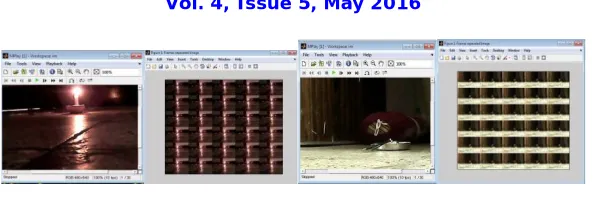
In this proposed method here, we use Amkette True view HD camera of 24 Mega pixels for real time video and for the videos capture by cam in database as shown in Fig.2(a).
For real time: Name of video: (im.avi) Video duration: 30seconds Frame size: 480 x 640 Color format: RGB/ YCbCr Source rate: 10 fps
Frame count: 30
Camera capture
Acquisition Pre-processing
Colour and Feature extraction
Change and motion detection
Region growing Chaotic
motion Data
fusion Alert
Fig.2 (a) (b)
(a)(i)Workspace im (ii) Frame separated image(for fire) (b)(i) Workspace im (ii)Frame separated image(for smoke) ii) Pre- processing
This module shows how we can do something with video before the actual programming commences.
In order to create a colour model for fire and smoke, we have analyzed the videos which consist of fire or smoke samples for which we required two separate color spaces for each. We choose YCbCr colour model for fire detection and HSV colour model for smoke detection in this paper as shown in Table 1.
From To
Fire RGB YCbCr
Smoke RGB HSV
Table 1 For e.g. convert the video from one colour model to another. By converting from RGB colour model.(as shown in Fig.3 (a)(b))
Fig.3 (a) (b)
(a)Image of selected frame (for fire) (b) Image of selected frame(for smoke) iii) Colour and features extraction
The YCbCr colour space is used here for extracting the features and for classification of a fire pixel as shown
in Fig.4 (a). The preprocessing and feature extraction stages of a pattern recognition system serves as an interface between the real world and a classifier operating on an idealized model of reality. Then GMM is used to train these features into static and dynamic features and used to detect the smoke colour pixel in HSV colour space and to detect the fire colour pixel in YCbCr colour space of the given effects of variations in illumination, further improvement can be achieved if one uses YCbCr color space which makes it possible to separate luminance/illumination from chrominance. Thus, YCbCr model used.
Fig.4 (a) (b)
(i) YCbCr image of selected frame (ii) Fire pixel classification image (i) HSV image of selected frame (ii) Smoke pixel classification image iv) Change and motion detection
The color and feature information is used as a pre-processing step in the detection of possible fire or smoke. This module performs a separation between hypothetical fire pixel and smoke pixels from other pixels as shown in Fig.5and 6 unlike change and motion detection videos, which show any change in the scene indiscriminately, it tries to select pixels whose features are smoke or fire-like. So, according to that change and motion detection algorithms are proposed from color information.
It gives the instant changes in shape and motion in fire and smoke by proposed algorithm. This algorithm gives a well-known background subtraction algorithm to locate those pixels which behave differently from the normal statistics of the background image. Each pixel is modelled as Gaussian distribution, with mean and variance.
For Fire:
Fig.5 (a) (b)
(a) (i) Change detection image for all frames (ii)Actual change detection image (b) (i))Motion detection image in all frames (ii)Actual motion detection image For Smoke:
Fig.6 (a) (b)
(a) (i) Change detection image for all frames (ii)Actual change detection image (b) (i))Motion detection image in all frames (ii)Actual motion detection image v) Region growing
Fig.7 (a) (b)
(a)Bounded box subimage for motion blobs of the frames for fire (b)Bounded box subimage for motion blobs of the frames for smoke
vi) Chaotic motion
Fire and smoke vary frame by frame in both shape and dimension, because of air currents and convection flows.
Such variations can be certainly regarded as chaotic for our purposes. Starting from the motion detection image, an histogram of the (x, y) position of each white pixel, with respect to the bounding box of its blob, is generated s shown in Fig.8 Such an histogram is updated for a given time lapse with the data coming from the motion detection module. The higher the entropy, the more uniform the histogram. This property can be taken into account by means of the Kurtosis, in formulae:
Where σ4 is the fourth order momentum of the distribution. Equals three for Gaussians and approaches zero for
uniform distributions; its value is given to the next modules to filter false alarms caused by uniformly moving objects in
the scene.
Fig.8 vii) Data Fusion
In order to filter false alarms caused by short-lasting targets, a very simple tracking algorithm has been developed To perform the data fusion task, i.e. to classify the pre-alarm rectangles, a multi-layer perceptron (MLP) [11] is used, which consists in multi-layered network organized in an input layer, some hidden layers and an output layer. This approach relies on the assumption that neural networks systems have very good performance as classifiers. In this
module, five input neurons are considered, which just propagate input features to the next (hidden) layer, made of four
neurons. The output layer is composed of three neurons. Each of them computes a simple weighted summation over the responses of the hidden neurons for a given input pattern. A sigmoid function has been chosen as activation function and the conventional back propagation learning rule has been employed for training (i.e. to set the weights).Inputs of the network are the Kurtosis extracted from the motion histogram in the previous section and the four momenta (first to
Fig.9(a)(b) (a) Fire detected (b) Smoke detected viii) Alert module
For the alert, proposed system uses the text messages for the control action on the cell phones of respective authority through MMX310G 3G USB Manager connected to the system. The pre alarm text “FIRE” OR “SMOKE” will send on particular numbers provided in system.
IV.CONCLUSION AND FUTURE WORK
In this paper, a new video-based real-time fire and smoke detection method is proposed which is based on computer vision techniques. The proposed method consists of three main stages: fire and smoke pixel detection using colour, moving pixel detection, and analyzing fire or smoke-coloured moving pixels in consecutive frames to raise an alarm.
In this research work a rule based colour model for fire and smoke pixel classification is proposed. The proposed colour model makes use of YCbCr color space and HSV colour space. The performance of the proposed algorithm is tested on two sets of videos; one containing fire and the other with smoke. The proposed model achieves 99% flame detection rate and 14% false alarm rate. The arithmetic operations of this model are linear with the mage size. Also, the algorithm is cheap in computational complexity. This makes it suitable to use in real time fire and smoke monitoring system. For instance, the system might not be able to detect a fire caused by a sudden explosion. In order to alleviate such cases, the proposed system will be further improved to include different scenarios with high definition cameras and for night also.
Furthermore, texture and shape information of fire regions will also be investigated to improve the system’s fire and smoke detection performance.
REFERENCES
1. National Association of State Fire Marshals Science Advisory Committee Recommendation on Updates to the NASFM Smoke Alarm Guidance Document (April 2012
2. Dorothy Bruck, “The Who, What, Where and Why of Waking to Fire Alarms: A Review, “Fire Safety Journal, Volume 36(2001), pages 623-639. 3. “White Paper: Home Smoke Alarms and Other Fire Detection and Alarm Equipment,” Public/Private Fire Safety Council, (April 2006)
4. W. Krull, I. Wıllms, R.R. Zakrzewskı, M. Sadok, J. Shırer, B. Zelıff, “Design and test methods for a video-based cargo fire verification system for
commercial aircraft,” Fire Safety. J. 41 (4) (2006) 290–300
5. T. Chen, P. Wu, Y. Chiou, “An early fire-detection Method based on image processing”, in: Proceedings of IEEE International on Image Processing, 2004, pp. 1707–1710.
6. B.U. Tȍreyin, Y. Dedeoĝlu, U. Güdükbay, A.E. Cetin, “ Computer vision based method for real-time fire and flame detection”, Pattern Recognition Letts. 27
(1) (2006) 49–58.
7. T. Celik, H. Demirel, H. Ozkaramanli, Automatic fire detection in video sequences, in: Proceedings of European Signal Processing Conference (EUSIPCO 2006), Florence, Italy, September 2006
8. G. Marbach, M. Loepfe, T. Brupbacher, An image processing technique for fire detection in video videos, Fire Safety. J. 41 (4) (2006) 285–289. 9. Wen-Bıng Homg, Jım-Wen Peng, Chıh-Yuan Chen, “A new image-based real- time flame detection method using color analysis”, in: Proceedings of IEEE
Networking, Sensing and Control, ICNSC, 2005, pp. 100–105.
10. III Phillips, W., M. Shah, and N. Da Vitoria Lobo, “Flame recognition in video,” in Applications of Computer Vision, 2000, Fifth IEEE Workshop on., 2000, pp. 224 –229
11. CELIK Turkey, “Fast and efficient method for fire detection using image processing,” ETRI journal, vol. 32, no. 6, pp. 881–890, 2010, eng.I.
12. Kopilovic, B. Vagvolgyi, and T. Sziranyi, “Application of panoramic annular lens for motion analysis tasks: surveillance and smoke detection”, Proceedings of 15th International Conference on Pattern Recognition, 2000, Volume 4, 3-7 Sept. 2000 Page(s):714 – 717