An Operational Semantics for DFM, a Formal Notation
for Modelling Asynchronous Web Services Coordination
Jingtao Yang, Corina Cîrstea, Peter Henderson
School of Electronics and Computer Science
University of Southampton, U.K.
{jy02r, cc2, ph}@ecs.soton.ac.uk
Abstract
This paper presents the DFM notation and its operational semantics. DFM (Document Flow Model) is a message-based workflow notation for modelling asynchronous web services communication, which uses coordination mechanisms to support dynamic configurations and long-running business processes. The operational semantics of a DFM specification describes the possible behaviours of a system of inter-related web services, in terms of the messages that can be exchanged during the execution of one or more business processes, and the effect each message execution has on the business process state.
1. Introduction
Web Services technology enables modern applications implemented over heterogeneous web environments. A web service publishes its interfaces in an XML document, WSDL, and is invoked through an XML-based messaging protocol, SOAP [1]. Using platform independent and standard XML documents, a service consumer can invoke a service following this shared understanding, without being concerned with how the service is implemented.
A service-oriented application is composed of dynamic web services orchestrated using asynchronous messages. The web services are owned and managed by several business partners. This architecture provides benefits over traditional applications on interoperability, flexibility and dynamic configuration. However, it also adds considerable complexity to the implementation and verification [2].
2. Motivation
The aim of our work is to investigate service-oriented system environments, and use formal
modelling to capture a business process as a workflow specification, in order to facilitate service-oriented system automation and validation [3, 4].
Business Process Execution Language for Web Services (BPEL4WS) has been positioned as the standard for specifying web service workflows. Other workflow definition languages [5, 6] leverage the concepts from BPEL4WS, and focus on workflow patterns. BPEL4WS separates a workflow from the web services involved in its execution, by using a pre-defined workflow instance with full interaction states communicating with stateless services [7]. However, BPEL4WS provides limited support for long-running interactions, where failures are more likely to happen, and where services might require reconfiguration while some of their interactions are still active: on the one hand, failure of the workflow instance can result in the interaction state being lost; on the other hand, business process workflows can not be updated while processes are still running [8]. A mechanism for coordinating complex services and for managing long-running transactions is therefore required.
The requirements for dynamic web services that use asynchronous messaging were investigated in [9]. A formal notation for describing the flow of documents in such systems, DFM, was also introduced in loc. cit. (see also [10]). The most important features of DFM are summarized below:
• DFM uses an XML-like tree data structure to specify documents in a concise notation.
• DFM models asynchronous communication, and supports two kinds of communication patterns: one-way communication, which amounts to a service receiving a message, and notification, which amounts to a service sending a message. Request-response and solicit-response [11] conversations are modelled in DFM as a one-way plus a notification communication.
configurations. This includes the use of contexts to identify process states, of a decentralized context propagation mechanism to structure process-related data, and of a persistent component, a ContextStore, to maintain process states.
The syntax and informal semantics of DFM are summarized in Section 3. (Further details can be found in [10].) An operational semantics for DFM is then presented in Section 4.
3. The DFM notation
DFM is a message-based workflow notation, used to specify systems of independent web services, coordinated via asynchronous messages. Since messages are essentially XML documents, we call this notation Document Flow Model.
The systems specified in DFM are concurrent: multiple process sessions are carried out at the same time. Unique identities are used to distinguish between different processes or sub-processes. These identities are generated by a service following some request (incoming message), and are passed as parameters to outgoing messages. To ensure process integrity, the actual process state is maintained in a persistent component, ContextStore, and the process identity is used to access and update this state.
Web services interact with each other by messages. Since we are not interested in the detailed functionality of each service, we model a service as a collection of outgoing messages generated in response to an incoming message. The outgoing messages are independent, and can be sent out in any order. Prior to sending these messages, a service may perform an update of relevant process states, as maintained in the ContextStore. Also, in determining the messages to be
sent, the service may rely on an evaluation of certain process states (subsequent to any state updates).
A web service is described in DFM using a set of message definitions. Each message definition,
messagedef, specifies the actions taken by the service
when executing a particular message. This includes actions for generating new process identities, actions for storing process data into the ContextStore, and actions for sending messages, either unconditionally or upon certain conditions being satisfied. A condition is a ContextStore evaluation expression, possibly containing logical operators. Simple conditions evaluate to true when certain entries, containing process data, are present in the ContextStore under a specified process identity, id. The three types of actions, i.e. generating process identities, storing process data and sending messages, are performed in this particular order. The storebody specifies the store actions to be carried out concurrently, after the process identities described in idaction have been generated, and before the message sending actions described in
sendbody are carried out (also concurrently).
A document record data structure is used to specify the properties of an object, in an XML-like fashion. A document record consists of a list of property name/value pairs, or simply of a list of values, enclosed within square brackets. The values can themselves be document records, thus allowing for an arbitrary degree of nesting in a document record. For example, a message is a document record with property names to:,query: andfunction:, and with the corresponding property values describing the message receiver, the message data (or parameters), and the requested operation.
We use a travel booking example to illustrate the DFM notation.
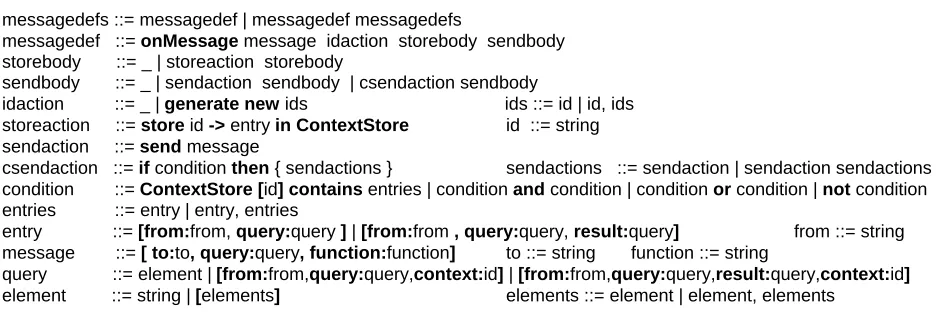
messagedefs ::= messagedef | messagedef messagedefs
messagedef ::= onMessage message idaction storebody sendbody
storebody ::= _ | storeaction storebody
sendbody ::= _ | sendaction sendbody | csendaction sendbody
idaction ::= _ | generate new ids ids ::= id | id, ids
storeaction ::= store id -> entry inContextStore id ::= string
sendaction ::= send message
csendaction ::= if condition then { sendactions } sendactions ::= sendaction | sendaction sendactions
condition ::= ContextStore [id]contains entries | condition and condition | condition or condition | not condition
entries ::= entry | entry, entries
entry ::= [from:from, query:query ] | [from:from , query:query, result:query] from ::= string
message ::= [ to:to, query:query, function:function] to ::= string function ::= string
query ::= element | [from:from,query:query,context:id] | [from:from,query:query,result:query,context:id]
[image:2.612.71.539.526.686.2]element ::= string | [elements] elements ::= element | element, elements
onMessage[to:a,query:[from:u,query:[f,h],context:c], function:bookTravel] generatenew id
store id->[from:u, query:[f,h], context:c] in ContextStore send[to:fs,query:[from:a,query:f,context:id],
function:bookFlight] send[to:hs,query:[from:a,query:h,context:id],
function:bookHotel]
Figure 2. Travel agent spec-I
Upon receiving a user request, the TravelAgent, a, creates a new process identity, id. It then stores the user query into the ContextStore. In this example, the TravelAgent decomposes the query into two new queries, to be sent to the FlightShop, fs, and the HotelShop, hs, using then new process identity. The two messages are parallel messages, i.e. they could be sent out in any order.
onMessage[to:a,query:[from:s,query:f,result:r, context:id], function:shopReply] store id -> [from:s, query:f, result:r] in ContextStore if ContextStore[id] contains
[from:a, query:[from:u,query:[f,h],context:c]], [from:fs,query:f,result:r1],[from:hs,query:h,result:r2] then { send[to:u,
query:[from:a,query:[from:u,query:[f,h],context:c], result:[r1,r2], context:id],
function:bookReply] }
Figure 3. Travel agent spec-II
When the TravelAgent receives a reply from a shop service, it reads the context of the query and saves the other parts of the query into the ContextStore under that process identity. Since the systems specified in DFM are asynchronous, the two shop replies can arrive in any order. Therefore, each time the agent receives a reply, it will check the process state, and if the process has been completed a reply message will be sent to the user, otherwise no action will be taken.
4. Operational Semantics
We now present an operational semantics for DFM. The semantics describes the possible behaviours of a system consisting of a number of related services, in terms of the messages that can be executed in particular states of the system, and the effect such message executions have on the system state. The execution of a message is handled by the web service
to which the message was sent. Since communication is asynchronous, the sequence of message executions is undetermined.
The environment within which the communications are taking place is modelled using a virtual daemon. The daemon uses a message pool to manage the sending and receiving of messages by the services, and at the same time maintains service configurations.
The execution of a message is carried out in the following key steps: the message is matched to a message pattern; the actions which need to be carried out are determined, based on information generated from the system specification and on the current process state; and finally, the resulting message patterns are evaluated, and the result is added to the message pool.
Our operational semantics supports dynamic configurations, by allowing the service names used in system specifications to be mapped to actual services at runtime. This is achieved using the configuration tables dynamically provided by the environment.
Formally, the operational semantics associates, to each DFM specification, a labelled transition system whose states correspond to possible states of the system (defined by the messages awaiting execution and by the current state of the ContextStore), and whose labels correspond to message executions. Defining this transition system requires several auxiliary functions, which we now describe.
4.1. Specification functions
The following information can be extracted from a given DFM specification.
4.1.1. ServiceId. The set ServiceId contains all the service identifiers present in the specification:
ServiceId = {s | to:s appears inside a message}
4.1.2. Message. The set Message contains all message patterns present in the specification:
Message = {m |
onMessagem appears inside a messagedef}
4.1.3. The ids, context and vars functions. As part of executing a message, new process identities can be created, in order to identify specific sub-processes. The ids function gives, for each message m, the process identities generated upon the execution of m:
ids: Message →P (String)
Similarly, the context and vars function give, for each message m, the process identities passed as parameters to m using the context: property, and the names of all the other variables used as parameters in definition of m, respectively:
context, vars : Message →P (String)
context(m) = { id |context:id appears inside m}
vars(m) = {var | var appears as an element inside m}
4.1.4. Store action function. The function storeactions gives, for each message m, the set of storeactions to be carried out upon the execution of m.
StoreAction = {storeA | storeA is generated by storeaction}
storeactions: Message →P (StoreAction) storeactions(m) = {storeA∈StoreAction |
storeA appears inside onMessagem}
4.1.5. Send action functions. The function sendactions gives, for each message m, the set of sendactions to be carried out unconditionally upon the execution of m:
SendAction = {sendA | sendA is generated by sendaction} sendactions: Message →P (SendAction)
sendactions(m) = {sendA∈SendAction |
sendA appears inside onMessage m}
For each message m, the set conds(m) gives the
conditions which must be evaluated as part of the
execution of m:
Condition = {c | c is generated by condition}
conds(m) = {c∈Condition| c appears inside onMessage m}
while the function csendactions(m) gives the actions associated to each such condition:
csendactions(m) : conds(m) →P (SendAction)
csendations(m)(c) = {sendA∈SendAction | sendA appears inside if c then {…}, inside onMessagem }
4.2. Semantic Functions
A number of semantic functions will be used to describe the effect of message executions, both on the message pool (where new messages will typically be added), and on the current state of the ContexStore (where some process states will be updated).
[image:4.612.321.537.108.293.2] [image:4.612.369.488.468.524.2]4.2.1. Context Store. The ContextStore stores business process states using entries, and organizes them using process identities.
Entry = {e | e is generated by entry} ContextStore = string →P(Entry)
Figure 4.A message pool
4.2.2. Service. The set Service contains the names of all services relevant to a particular specification. In the following, we assume Service = {S1,S2,…Sn}. For each
service, Si, a message-set, MSi, gives the pending
messages of Si., as found in the message pool (see also
Figure 4). In addition, for each service Si, a
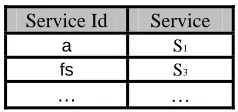
configuration table links the service identifiers used in the definition of Si to actual services (elements of
Service). This is captured by the function:
configi : ServiceId → Service
Table 1. A TravelAgent service configuration
Service Id Service
a S1
fs S3
… …
4.2.3. MessageVal. The message pool is the container for messages awaiting execution. The set MessageVal contains all possible such messages.
MessageVal = {[to:t, query:q, function:f] | t, q, f ∈ string}
4.2.4. Matching function. For each service Si, the
matchesi function gives the message pattern m that
corresponds to a message M from the message pool.
matchesi: MessageVal → Message
matchesi([to:t, query:q, function:f]) =
4.2.5. Evaluation of a document. The evaluation function evalM,i defines how to evaluate document
expressions appearing inside a message definition m, based on the values provided by a corresponding actual message M waiting to be executed by Si, and on
the values generated from the environment upon the execution of M. The function evalM,i is defined
inductively on the structure of document expressions. The base cases correspond to service names, message parameters/contexts and process identities:
evalM,i(t) = config i(t) if m=matchesi(M)
and to:t or from:t inside m evalM,i(v) = value obtained from m=matchesi(M),
if v ∈ vars(m) ∪ context(m)
evalM,i (id) = new value generated from the environment,
if m=matchesi(M) and id ∈ ids(m)
while the induction cases correspond to messages, queries and entries:
evalM,i ([to:t,query:q,function:f])
= [to:evalM,i(t), query:evalM,i(q), function:f]
evalM,i([var1,..,varn]) = [evalM,i(var1),..,evalM,i(var2)]
evalM,i([from:f, query:q, context:c])
= [from:evalM,i(f),query:evalM,i(q),context:evalM,i(c)]
evalM,i([from:f, query:q, result:r, context:c])
= [from:evalM,i(f), query:evalM,i(q),result:evalM,i(r),
context:evalM,i(c)]
evalM,i([from:f, query:q])
= [from:evalM,i(f), query:evalM,i(q)]
evalM,i([from:f, query:q, result:r])
= [from:evalM,i(f), query:evalM,i(q), result:evalM,i(r)]
4.2.6. Evaluation of a condition. An additional function needs to be defined for evaluating the conditions appearing inside message definitions, given an actual message M waiting to be executed by service Si, and a particular state of the ContextStore, CS:
evalM,i : conds(m) × ContextStore → {true, false}
evalM,i (ContextStore[id] containse1,…,en , CS)
= true if each evalM,i(ej) ∈ CS[evalM,i(id)]
= false otherwise
The boolean operators are evaluated in the usual way.
4.2.7. Send function. For each message M waiting to be executed by a service Si, and each state CS of the
ContextStore, the function send_funM,CS,i gives, for each
service, Sj, the messages to be sent to Sj as a result of
executing M:
send_funM,CS,i : Service →P(MessageVal)
send_funM,CS,i (Sj) = {M’∈MessageVal | m=matchesi(M)
and send m’ ∈ sendactions(m) ∪
(csendactions(m)(c) where evalM,i(c,CS)=true)
and to:t in m’ and evalM,i(t)=Sj
and M’=evalM,i(m’)}
4.3. System configurations and transitions
The operational semantics of a DFM specification is defined in terms of transitions between system configurations, where a configuration describes the messages waiting to be executed by each service, together with the current state of the ContextStore. Formally, a configuration is tuple:
(MS1,...,MSn,CS) ∈P(MessageVal)×…×P(MessageVal)
×ContextStore
and transitions between configurations have the form:
execute(M)
(MS1,...,MSn,CS) ⎯⎯⎯⎯⎯→ (MS1’,…,MSn’,CS’)
where the latter configuration is completely determined by executing M in the former configuration. A single operational rule, given in Figure 5, describes when such a transition is possible, and what the outcome of the transition is. Specifically, the message M being executed must belong to some message-set MSi; its execution (by service Si) results in
M being taken out from the message-set, in some process states being updated, and in new messages being added to some of the message-sets. The matchesi
execute(M)
(MS1,…,MSn, CS ) ⎯⎯⎯⎯⎯⎯⎯→ (MS1’, …,MSn’, CS’) if ( M ∈ MSi )
where:
matchesi(M) = m
for id ∈ ids(m)∪context(m), CS’[evalM,i(id)] = CS[evalM,i(id)] ∪ {evalM,i(e) | storeid → e ∈ storeactions(m)}
MSi’ = MSi \ {M} ∪ send_funM,CS’,i(Ni), and for j ≠ i, MSj’ = MSj∪ send_funM,CS’,i(Nj)
function (of service Si) is used to determine the
message pattern m that matches the message M, and subsequently the evalM,i and send_funM,CS,i functions are
used to compute the required state updates (as specified in the storeactions of m), and the new messages to be added to the message-sets (as specified in the sendactions of m).
This operational rule can be used to generate a transition system, whose states are configurations, and whose transitions are all possible instances of the given rule. Any configuration containing at least one message in one of the message-sets can, in principle, be chosen as an initial state. Unfolding the transition system starting from this state yields all the behaviours which can be exhibited by the services S1,...,Sn, while
they cooperate towards the execution of the messages in the initial configuration.
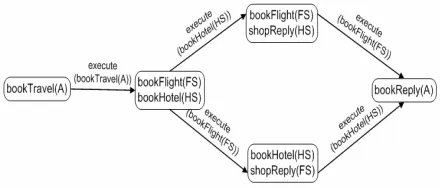
[image:6.612.72.292.348.442.2]For the travel booking example of Section 3, letting the initial state consist of a single message bookTravel(A) yields the transition system in Figure 6 (where only the message part of configurations is shown).
Figure 6.A TravelAgent process flow
4.4. Discussion
Web services are independent entities in a service-oriented system. As a result, the sending of a message should not rely on the availability of other web services. A web service should be able to pick up a message after it has recovered from a failure, or immediately after its addition to a web service system. The operational semantics presented here conforms to this asynchronous communication behaviour which also supports dynamic configurations.
Earlier in this section we discussed the use of configuration tables in mapping system prototypes to actual services. Transition rules for changing system configuration (e.g. by adding or removing a service) have not been discussed here due to lack of space, but it is relatively straightforward to extend our operational semantics to also account for the dynamic aspect of web service systems.
5. Conclusion
We have described a message-based workflow notation for modelling asynchronous web services communication, with the capability to support long-running interactions and dynamic configurations. A formal operational semantics for this notation has also been presented. Future work includes the use of this operational semantics to develop a simulation tool for asynchronous web services coordination.
6. References
[1] “Web Services Architecture”, http://www.w3.org, W3C Working Group Note 11 February 2004.
[2] C. Peltz, “Web services orchestration and choreography”,
Computer, vol. 36, 2003, pp. 46-52.
[3] D. Hollingsworth, “The Workflow Reference Model Workflow Management Coalition”, WFMC org, 1995.
[4] M. H. D. Georgakopoulos, A. Sheth, “An Overview of workflow management: From process modeling to workflow automation infrastructure”, Distributed and Parallel
Databases, vol. 3, 1995, pp. 119-153.
[5] D. Cybok, “A Grid Workflow Infrastructure”, presented
at GGF 10, Berlin, March 2004.
[6] T. Fahringer, J. Qin and S. Hainzer, “Specification of Grid Workflow Applications with AGWL: An Abstract Grid Workflow language”, IEEE International Symposium on
Cluster Computing and the Grid 2005, Cardiff, UK, 2005.
[7] “Business Process Execution Language for Web Service”, BEA, IBM, Microsoft, 2002.
ftp://www6.software.ibm.com/software/developer/library/
[8] ”BPWS4J - A platform for creating and executing BPEL4WS processes”, IBM alphaWorks,
http://www.alphaworks.ibm.com/tech/bpws4j,2004.
[9] P. Henderson. and J. Yang, “Reusable Web Services”,
Proceedings of 8th International Conference, ICSR 2004,
Madrid, Spain, 2004, pp. 185-194.
[10] J. Yang, C. Cîrstea and P. Henderson, “Document Flow Model: A Formal Notation for Modelling Asynchronous Web Services Composition”, submitted to AWeSOMe'05, 2005.