to compensable flow composition
Roberto Bruni1, Michael Butler2, Carla Ferreira3, Tony Hoare4, Hern´an Melgratti1, and Ugo Montanari1
1 Dipartimento di Informatica, Universit`a di Pisa, Italy
2 School of Electronics and Computer Science, University of Southamptom, UK 3 Department of Computer Science, Technical University of Lisbon, Portugal
4 Microsoft Research Cambridge, UK
Abstract. Web services composition is an emerging paradigm for the integra-tion of long running business processes, attracting the interest of both Industry, in terms of XML-based standards for business description, and Academy, ex-ploiting process description languages. The key challenging aspects to model are orchestration workflows, choreography of exchanged messages, fault handling, and transactional integrity with compensation mechanisms. Few recent proposals attempted to mitigate the explosion of XML-constructs in ad hoc standards by a careful selection of a small set of primitives related to the above aspects. This papers clarifies analogies and differences between two such recent process de-scription languages: one based on interleaving trace semantics and the other on concurrent traces. We take advantage of their comparison to characterise and re-late four different coordination policies for compensating parallel processes. Such policies differ on the way in which the abort of a process influences the execution of sibling processes, and whether compensation is distributed or centralised.
1
Introduction
Orchestration and choreography languages are tailored to the definition of web service composition. Typically, these languages provide, among others, programming primi-tives for the definition of business transactions, i.e., transactions that may require long periods of time to complete, also called Long-Running Transactions (LRTs). Moreover, they may be interactive and hence not able to be check-pointed. Consequently,LRTs cannot be based on locking (as usual for database transactions), but instead they rely on a weaker notion of atomicity based on compensations [8]. Compensations are activities programmed ad hoc to recover partial executions of transactional processes.
(ii) interaction based compensations [1,4,9,11], as suitable extensions of well-known name passing calculi, like theπ-calculus and join-calculus, for describing transactional choreographies, where each service describes its possible interactions, and the actual composition takes place dynamically, i.e. when services interact.
In this paper we pursue the first approach, i.e., to study the abstract composition of services according to basic workflow shapes (sequential and parallel) and compens-able transaction mechanisms (compenscompens-able activities, compensation scope, transaction scope, nesting). Nevertheless, we are not aimed at designing a new language but at comparing two main proposals, namely compensatingCSP(cCSP) [7] andSagas cal-culi[5]. Apart from stylistic differences (e.g., the trace semantics ofcCSPand the big step SOS semantics ofSagas calculi), this comparison highlights the fact that such pro-posals account for different compensation policies when handling concurrent processes. First of all, we characterise such policies as the combination of two orthogonal strate-gies: (i) whether parallel flows are forced to interrupt their executions when a sibling process aborts; and (ii) whether compensation handling is centralised or distributed. The combination of such strategies gives rise to the following four policies:
1. No interruption and centralised compensation. All concurrent processes execute until completion, and only then they are compensated for if some abort.
2. No interruption and distributed compensation. All parallel flows execute until com-pletion but, if needed, they compensate without waiting the comcom-pletion of siblings. 3. Coordinated interruption. Parallel branches may be stopped when one flow aborts, but the activation of the compensation procedure is handled in a centralised way, i.e., all component flows have to be stopped, and only then the corresponding com-pensations are executed.
4. Distributed interruption. Flows, if needed, are interrupted and then their compen-sation procedures can be activated independently from the rest of the flows. We show that all these policies can be defined by following either thecCSP ap-proach or theSagasstyle. Moreover, we note that the semantics of originalcCSP cor-responds to policy (3), while the two original semantics ofSagas Calculi, calledNa¨ıve andRevised, follow respectively policies (2) and (4). Finally, we compare the four alter-natives (and hence the original semantics of both proposals) by relating the set of traces that each policy associates to a process. In particular, we show that these policies form a partial order of traces, where originalcCSPandNa¨ıve Sagasare more restrictive than Revised Sagas, but originalcCSPis unrelated toNa¨ıve Sagas.
2
Background
In this section we summarise the basics of CompensatingCSP(cCSP) proposed in [7] and ofSagascalculi from [5]. We focus on simplified versions by leaving out several features present in both proposals, like exception handling and nesting.
2.1 CompensatingCSP
The set ofcCSPprocesses is defined by the following grammar: (STANDARDPROCESSES)
P,Q ::= A | P; Q | P|Q | SKIP | THROW | YIELD | [PP]
(COMPENSABLE PROCESSES)
PP,QQ ::= P÷Q | PP; QQ | PP|QQ | SKIPP | THROWW | YIELDD
A standard process is either a basic activity A from an alphabetΣ, the sequential composition P; Q of processes, the parallel composition P|Q, the empty process SKIP,
the raise of an interruption THROW, the yield to an interruption YIELD, or a transac-tion block[PP]. A basic compensable process is a compensation pair P÷Q where P
is an atomic process and Q is its compensation. Compensable processes can be com-posed either in sequence PP; QQ or in parallel PP|QQ. The remaining processes are the
compensable counterpart of the standard ones.
Figure 1 summarises the trace semantics ofcCSP. A trace for a standard process is a string shωi, where s∈Σ∗is said the observable flow andω∈Ωis the final event, withΩ={X,!,?}, withΣ∩Ω=/0(Xstands for success, ! for fail, and ? for yield). The sequential composition p; q concatenates the observable flows of p and q only when p terminates with success, otherwise it is p. The composition of two concurrent traces
phωi||qhω0icorresponds to the set p|||q of all possible interleavings of the observable
flows, with final eventω&ω0, where & is associative and commutative.
The definition for the traces of standard processes is straightforward. The most in-teresting one is that of a transaction block[PP]. Note that any trace of a compensable process PP is a pair(phωi,p0), where phωiis the forward trace and p0is a compensa-tion trace for p. Then,[PP]selects all successful traces phXiof PP, and the traces pp0, corresponding to failed forward flows ph!ifollowed by their compensations p0.
When composing compensable traces in series, the forward trace corresponds to the sequential composition of the original forward traces, while the compensation trace starts by the second compensation followed by the first one. The parallel composition is defined as all possible interleavings of the forward and the backward flows, separately.
2.2 SagasCalculi
COMPOSITION OF STANDARD TRACES Sequential
½
phXi; q=pq
phωi; q=phωiwhenω6=X
Parallel phωi||qhω0i={rhω&ω0i|r∈(p|||q)}, where
ω ! ! ! ? ? X ω0 ! ?X?X X ω&ω0! ! ! ? ? X
and
p|||hi={p} hi|||q={q}
hxip|||hyiq={hxir|r∈(p|||hyiq)} ∪ {hyir|r∈(hxip|||q)}
TRACES OF STANDARD PROCESSES
A=traces{hA,Xi} for A∈Σ SKIP=traces{hXi} P; Q=traces{p; q|p∈P∧q∈Q} THROW=traces{h!i}
P|Q=traces{r|r∈(p||q)∧p∈P∧q∈Q} YIELD=traces{h?i}
[PP] =traces{pp0|(ph!i,p0)∈PP} ∪ {phXi|(phXi,p0)∈PP}
COMPOSITION OF COMPENSABLE TRACES Sequential
½
(phXi,p0);(q,q0) = (pq,q0; p0)
(phωi,p0);(q,q0) = (phωi,p0)whenω6=X
Parallel (p,p0)||(q,q0) ={(r,r0)|r∈(p||q)∧r0∈(p0||q0)}
Compensation pair
½
phXi ÷q= (phXi,q)
phωi ÷q= (phωi,hXi)whenω6=X
TRACES OF COMPENSABLE PROCESSES
P÷Q=traces{(h?i,hXi)} ∪ {p÷q|p∈P∧q∈Q} PP; QQ=traces{pp; qq|pp∈PP∧qq∈QQ}
PP|QQ=traces{rr|rr∈(pp||qq)∧pp∈PP∧qq∈QQ} SKIPP=tracesSKIP÷SKIP =traces {(h?i,hXi),(hXi,hXi)} THROWW=tracesTHROW÷SKIP =traces {(h?i,hXi),(h!i,hXi)}
YIELDD=tracesYIELD÷SKIP =traces {(h?i,hXi)}
Fig. 1. Trace semantics ofcCSP
(STEP) X ::=0 | A | A÷B
(PROCESS) P ::=X | P; P | P|P (SAGA) S ::={[P]}
A saga S encloses a process P in a transaction scope. Each step in P corresponds either to an activity A or a compensated activity A÷B, where A is the activity of the
normal flow and B its compensation. The term 0 represents the inert process, P; P stands for the sequential composition of processes, and P|P for the parallel composition.
To reduce the number of rules, the semantics ofSagasis defined up-to structural congruence over processes given by the following axioms:
A÷0 ≡ A 0; P ≡ P; 0 ≡ P (P; Q); R ≡ P;(Q; R)
Moreover, activities are assumed to be named differently. The set of possible results for the execution of a saga is
R
={,£,}, wherestands for commit,£for (com-pensated) abort, andfor abnormal termination (when the compensation procedure fails). We let ¤to range overR
. The execution of a sequential saga is described in terms of a contextΓ, i.e., a partial functionΓ:A
→ {£,}that maps any activity to the result obtained with its execution. Activities can only commit or abort (they do not terminate abnormally). A particular functionΓis written A17→¤1, . . . ,An7→¤n, where Ai6=Ajfor all i6=j. (Note that ’,’ stands for the disjoint union of partial functions).The semantics of a saga S is given by a relationΓ`S−→α ¤, which denotes that the
execution of S produces¤when the atomic activities behave likeΓ. The observation αdescribes the actual flow of control occurring when executing S under the contextΓ. The flowαis a process whose activities have no compensations. The auxiliary relation Γ` hP,βi−→ hα ¤,β0idescribes the behaviour of a process P within a saga that already installed the compensationβ(butβitself contains no compensation). When P is exe-cuted inside a saga, it can either commit, abort, or fail, but additionally, it can change the compensations toβ0, for instance by installing new activities.
Na¨ıve semantics. The na¨ıve semantics for a parallel saga is shown in Figure 2(a).
Rule (S-ACT) stands for the successful execution of the compensated activity A÷B that
installs B in front ofβ. Rules (S-CMP) and (F-CMP) describe the execution of A÷B when A fails. Both rules activate the compensationβ(premises of the rules). In particular, (S -CMP) stands for the successful compensation, while rule (F-CMP) handles the failure of the compensation procedure. Rule (S-STEP) describes the behaviour of a process P; Q when the step P commits. In such case, Q is executed with the compensation installed by P. Rule (A-STEP) handles the case in which P; Q is stopped because P aborts or ends abnormally. Rule (SAGA) states that the execution of a saga{[P]} runs P in a thread that initially has no compensations. The rules described above give the semantics for the sequential case, while the remaining rules define the na¨ıve semantics of parallel composition. Rule (S-PAR) deals with the successful execution of both branches, while the remaining rules handle the cases in which at least one branch fails.
Revised semantics. The revised semantics avoids the unnecessary execution of
activ-ities in the foward flow when the saga fails. This is achieved by stopping the execution of the forward flow when some activity fails. For this reason, the execution of a process may also finish with: (i) £, i.e. the execution is forced to compensate and the com-pensation is successful, and (ii), i.e., the execution is forced to compensate and the compensation procedure fails. The associative and commutative operator∧expresses the result obtained by combining the execution of two parallel branches (see Figure 3). Note that∧is not defined when one operand is and the other is not. In fact, it is not possible for a branch to commit when the other aborts or fails: in P|Q when P can
commit but Q aborts, then P is forced to compensate.
(ZERO)
Γ` h0,βi−→ h0 ,βi
(S-ACT)
A7→,Γ` hA÷B,βi−→ hA ,B;βi
(S-CMP)
Γ` hβ,0i−→ hα ,0i A7→£,Γ` hA÷B,βi−→ hα £,0i
(F-CMP)
Γ` hβ,0i−→ hα £,0i A7→£,Γ` hA÷B,βi−→ hα ,0i
(S-STEP)
Γ` hP,βi−→ hα ,β00i Γ` hQ,β00i−→ hα0 ¤,β0i
Γ` hP; Q,βi−→ hα;α0 ¤,β0i
(A-STEP)
Γ` hP,βi−→ hα σ,0i Γ` hP; Q,βi−→ hα σ,0i
σ∈ {£,}
(SAGA)
Γ` hP,0i−→ hα ¤,βi
Γ` {[P]}−→α ¤
(S-PAR)
Γ` hP,0i−→ hα ,β0i Γ` hQ,0i−→ hα0 ,β00i Γ` hP|Q,βi−→ hα|α0 ,(β0|β00);βi
(F-PAR-NA¨IVE-1)
Γ` hP,0i−→ hα £,0i Γ` hQ,0i α
0
−→ h£,0i Γ` hβ,0i α
00 −→ h¤1,0i Γ` hP|Q,βi(α−→ h|α0);α00 ¤2,0i
¤2=
½
£if¤1=
otherwise
(F-PAR-NA¨IVE-2)
Γ` hP,0i−→ hα ,0i Γ` hQ,0i−→ hα0 ,β0i Γ` hβ0,0i−→ hα00 ¤,0i Γ` hP|Q,βiα|−→ h(α0;α00) ,0i
(F-PAR-NA¨IVE-3)
Γ` hP,0i−→ hα ,0i Γ` hQ,0i−→ hα0 σ,0i
Γ` hP|Q,βi(−→ hα|α0) ,0i
withσ∈ {£,}
(F-PAR-NA¨IVE-4A)
Γ` hP,0i−→ hα ,β0i Γ` hQ,0i α
0
−→ h£,0i Γ` hβ0,0i α
00 −→ h£,0i
Γ` hP|Q,βi(α−→ h;α00)|α0 ,0i
(F-PAR-NA¨IVE-4B)
Γ` hP,0i−→ hα ,β0i Γ` hQ,0i α
0
−→ h£,0i Γ` hβ0,0i α
00
−→ h,0i Γ` hβ,0i α
000 −→ h¤1,0i Γ` hP|Q,βi((α;α−→00)|α0);α000h¤2,0i ¤
2=
½
£if¤1=
otherwise
(a) Na¨ıve semantics of parallelSagas.
(FORCED-ABT)
Γ` hβ,0i−→ hα ¤1,0i
Γ` hP,βi−→ hα ¤2,0i ¤2=
½
£if¤1= otherwise
(S-PAR)
Γ` hP,0i−→ hα ,β0i Γ` hQ,0i−→ hα0 ,β00i
Γ` hP|Q,βiα|α
0
−→ h,(β0|β00);βi (F-PAR)
Γ` hP,0i−→ hα σ1,0i Γ` hQ,0i−→ hα σ2,0i Γ` hP|Q,βi−→ hα|α0 σ1∧σ2,0i
½
σ1∈ {,} σ2∈ {£,,£,} (C-PAR)
Γ` hP,0i−→ hα σ1,0i Γ` hQ,0i−→ hα0 σ2,0i Γ` hβ,0i−→ hγ ¤1,0i
Γ` hP|Q,βi(α|α
0);γ
−→ hσ1∧σ2∧¤2,0i
σ1,σ2∈ {£,£} and ¤2=
½
£if¤1=
otherwise
[image:6.595.136.505.95.674.2](b) Revised semantics of parallelSagas.
∧ £ £
− − − −
£ − £ £
−
£ − £ £
−
Fig. 3. The operator∧.
compensation before executing P, which will produce a forced termination£or. Rule (S-PAR) is the same as in the na¨ıve semantics, while the rollback of a branch is handled by (F-PAR) and (C-PAR). Rule (C-PAR) handles the case in which both P and Q are successfully compensated for, while (F-PAR) handles the failure of the compensation procedure.
An interesting aspect on the revised semantics is that rule (SAGA) requires P to end with,£or, but not with forced termination. This implies that a saga aborts if and only if (at least) one activity aborts.
3
cCSP
vs
Sagas
Calculi
In this section we try to enucleate the main conceptual differences between the two approaches and to give an informal account of the underlying different policies for business process design and execution.
Executions of activities. An activity A is always successful incCSP. Instead, the ex-ecution of activities inSagasdepends on a particular execution contextΓ, which allows to evaluate the semantics of a process according to different scenarios.
Aborted activities vs Programmable abort. In cCSP the special primitive THROW introduces programmable aborts. Instead, the abort of a saga is caused by the abort of an activity in the scenarioΓ. Thus, the primitive THROW roughly corresponds to aSagasactivity that always fails in anyΓ.
Yielding to interrupt. IncCSPthe yielding to interrupt is explicitly programmed by using the special primitive YIELD. Instead, inSagas the yielding to interrupt is wired in the semantics rules and cannot be programmed.
Failed compensations. Different fromSagascalculi, the abort of and the successful compensation of a transaction block incCSPis silent to the parent process, i.e., there is no possibility to distinguish this case from the situation in which the for-ward flow complete successfully. Although not reported in § 2,Sagascalculi pro-vide the primitive try S or P in [5], which allows to activates P when S aborts and it is compensated successfully.
Interleaving vs concurrent traces. The semantics of acCSPprocess is given by list-ing all possible executions that differ on the interleavlist-ing of their concurrent activ-ities. Instead, in theSagascalculi computations are described up-to interleavings. Note that any labelαin a reduction denotes a set of possible executions.
Compensation of parallel processes. As described in § 1, the most important
distinc-tion of both proposal is when defining the compensadistinc-tion for P|Q, since they use
Nesting. The primitive P÷Q ofcCSPallow for the nesting of transactions. TheSagas counterpart is called nestedSagasand it is presented in [5], which provides two different kinds of compensations called default compensations and programmed
compensation. The latter is equivalent to thecCSP primitive. The common frag-ment tocCSP andSagaswe shall discuss does not allow nesting, and therefore only compensable activities A÷B will be considered.
Adequacy of the semantics. Although not described here, correctness of cCSP se-mantics is stated in terms of self-cancelling properties. That is, when assuming compensations to be perfect, it is shown that the execution of a transaction is equiv-alent to its forward flow or to SKIP. InSagas, the meaning of the execution of a transaction is shown by suitable adequacy theorems, which are more precise but less intuitive and more complex to express than the self-cancelling properties. In the rest of the paper we shall focus on the formal comparison of the sequential and parallel fragments of the two calculi, leaving to future work the treatment of the last two items from the above list (nesting and adequacy). The yielding modality and parallel compensations are discussed in detail in § 5, while all the remaining items are relevant also for the sequential fragment in § 4.
4
The sequential case
In this section we focus on the subset of sequential processes and we show that both semantics coincide by giving two encodings. SequentialcCSPis obtained by restricting the syntax of compensable processes as follow.
PP,QQ ::= A÷B | PP; QQ | SKIPP | THROWW | YIELDD
Note that instead of having P÷Q, we only allow basic activities to be compensated
by basic activities. SequentialSagasis obtained by forbidding the parallel composition of processes P|P. We denote bycCSPseqthe set of sequentialcCSPprocesses, and by
Sagasseqthe set of sequentialSagasprocesses.
4.1 EncodingcCSPseqintoSagasseq
The main idea is that any process PP∈cCSPseqis associated with both a saga process
P∈Sagasseqand a particular environmentΓ∈∇in which all activities of P commits (∇stands for the set of all possible environments). Moreover, the THROWW primitive is represented by a fresh activity that aborts inΓ. The last subtlety is that all activities in P have to be named differently, for this reason the encoding assures activities in P to have different names. Formally, the encoding is given by the following function
J K:cCSPseq→Sagasseq×∇
which is defined in terms of the auxiliary function (used to assure activity names to be different)
The encoding is defined by lettingJPPK = JPPK0, with: JA÷BKσ = Aσ÷Bσ,{Aσ7→,Bσ7→}
JPP1; PP2Kσ = P1; P2,Γ1]Γ2 s.t.JPPiKσ.i=Pi,Γi for i=1,2
JSKIPPKσ = JYIELDDKσ = 0,/0 JTHROWWKσ = Tσ,{Tσ7→£}
Notation 1 We letxαybe obtained fromαby removing all the subscriptsσfrom activ-ities and by considering 0 as SKIP. Given a saga S, we let
A
(S) ={A|A occurs in S}be the set of its activities and|S|be its forward flow, which is obtained by replacing the pattern A÷B by A everywhere in S (i.e., removing all compensations).
Theorem 4.1. LetJPPK=P,Γ. IfΓ` {[P]}−→α ¤, thenxαy=traces[PP].
Proof (Sketch). The proof is by induction on the structure of PP, showing that one of
the following conditions holds (for anyβandΓ0s.t.Γ0` hβ,0i−→ hβ ,0i):
– Γ,Γ0` hP,βi−→ hα ,β0;βiand PP={(phXi,p0)|phXi ∈xαy∧p0∈xβ0y} ∪T ,
where T is the set of all yielding traces(qh?i,q0hXi)s.t. q and q0 have the same length and q is a prefix of a trace inxαyand q0is prefix of a trace inxβy.
– Γ,Γ0 ` hP,βiα−→ h;α0;β £,0i s.t.
A
(α)⊆A
(|P|)∧A
(α0)∩A
(|P|) = /0, and PP={(ph!i,p0)|phXi ∈xαy∧p0∈xα0y} ∪T , where T is defined as before. ut
4.2 EncodingSagasseqintocCSPseq
Any process P∈Sagasseq represents a set of processes PP∈cCSPseq, one for any possible environmentΓ∈∇. Hence, the encoding is defined as follow:
J K :Sagasseq×∇→cCSPseq
J0KΓ = SKIPP JP; QKΓ = JPKΓ;JQKΓ
JAKA7→,Γ = A JAKA7→£,Γ = THROWW
JA÷BKA7→,B7→,Γ = A÷B JA÷BKA7→£,Γ = THROWW
Note that the encoding for a compensation pair is defined only when the compen-sation B is an activity that commits, because the fragment ofcCSPwe are considering does not allow THROW in compensation pairs. Hence, we shall account only for con-textsΓthat never make a saga to terminate abnormally (by adequacy results in [12,5]).
Theorem 4.2. LetΓbe an environment, P∈Sagasseq, andJPKΓ=PP. IfΓ` {[P]}−→α ¤,
thenxαy=traces[PP].
5
Alternative semantics for parallel compensations
In this section we formally characterise the four compensation policies mentioned in § 1.
In all remaining sections assume the encoding functions extended as follow JPP1|PP2Kσ = P1|P2,Γ1]Γ2 s.t.JPPiKσ.i=Pi,Γi for i=1,2
JP|QKΓ = JPKΓ|JQKΓ
5.1 No interruption and centralised compensation
The desired behaviour for a parallel transaction when assuming no interruption and centralised compensation can be illustrated with the following law forcCSPpar1:
[A÷A0|B÷B0|THROWW] =traces(A|B);(A0|B0)
The forward flow A|B is executed completely before the compensation A0|B0. More-over, all activities in the forward flow are observed even though their execution could be avoided in a clever system (since the transaction will fail anyway).
Trace semantics. The trace semantics for this case is obtained by redefining the traces
of compensation pairs and parallel composition. Since parallel branches do not yield to an interrupt, the definition for a compensation pair is simplified as follow:
A÷B =traces {p÷q|p∈A∧q∈B} =traces {(hA,Xi,hB,Xi)}
We remove from the original definition the possibility for a compensation pair to yield to an interrupt before executing the forward flow A. On the other hand, the traces for parallel composition P|Q consider only the traces of P and Q that have finished
either successfully or with a failure, but not those yielding to an interruption, i.e.,
phωi||qhω0i={rhω&ω0i|r∈(p|||q)∧ω,ω0∈ {X,!}}
Since we do not allow interruption, YIELDD has no effects and, hence, we let
YIELDD=tracesSKIPP=traces{(hXi,hXi)}. Moreover, THROWW=traces{(h!i,hXi)}.
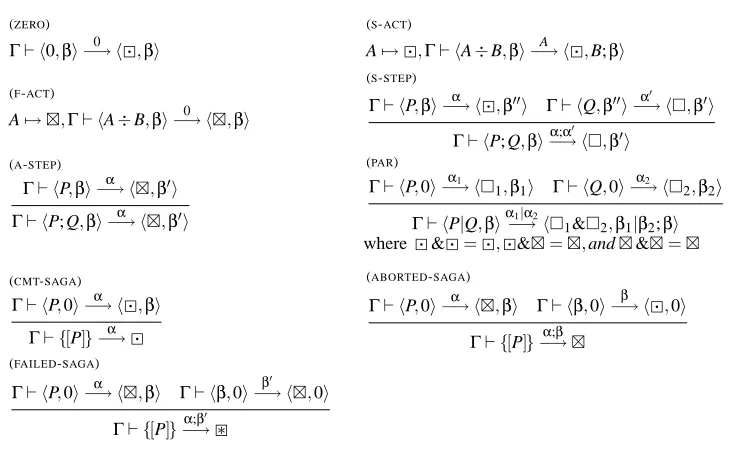
SOS semantics. The SOS semantics for the case of no interruption and centralised
compensation is in Figure 4. The main differences with the rules in Figure 2(a) is that the activation of the compensation procedure is left to the rule (SAGA) and not to (F -ACT). Note also that the result for P|Q is given by & (not by∧as in § 2.2), which is analogous to the trace semantics.
Correspondence. The following results assure the correspondence between the two
semantics.
Theorem 5.1. Let PP∈cCSPpar1andJPPK=P,Γ, with P∈Sagaspar1. IfΓ` {[P]}−→α ¤,
thenxαy=traces[PP].
Theorem 5.2. Let Γbe an environment, P∈Sagaspar1, and JPKΓ=PP, with PP∈
(ZERO)
Γ` h0,βi−→ h0 ,βi
(S-ACT)
A7→,Γ` hA÷B,βi−→ hA ,B;βi
(F-ACT)
A7→£,Γ` hA÷B,βi−→ h0 £,βi
(S-STEP)
Γ` hP,βi−→ hα ,β00i Γ` hQ,β00i α
0 −→ h¤,β0i
Γ` hP; Q,βi−→ hα;α0 ¤,β0i (A-STEP)
Γ` hP,βi−→ hα £,β0i
Γ` hP; Q,βi−→ hα £,β0i
(PAR)
Γ` hP,0i−→ hα1 ¤
1,β1i Γ` hQ,0i−→ hα2 ¤2,β2i Γ` hP|Q,βiα1|α2
−→ h¤1&¤2,β1|β2;βi where&=,&£=£,and£&£=£
(CMT-SAGA)
Γ` hP,0i−→ hα ,βi
Γ` {[P]}−→α
(ABORTED-SAGA)
Γ` hP,0i−→ hα £,βi Γ` hβ,0i−→ hβ ,0i
Γ` {[P]}−→α;β £ (FAILED-SAGA)
Γ` hP,0i−→ hα £,βi Γ` hβ,0i−→ hβ0 £,0i
Γ` {[P]}−→α;β0
Fig. 4. SOS for no interruption and centralised compensation.
5.2 No interruption and distributed compensation
As aforementioned, a distributed procedure for compensating parallel branches may allow the execution of activities of the backward flow even when parts of the forward flow are still in execution. As an example, the following law should hold incCSPpar2 (i.e., by assuming no interruption and distributed compensation):
[A÷A0|B÷B0|THROWW] =tracesA; A0|B; B0
Note that the forward flows A and B are executed entirely, but parallel branches are independently compensated for. For example, A0can be executed even before B.
Trace semantics. As for the previous case, the traces of a compensation pair do not
have yielding behaviours, and SKIPP, YIELDD and THROWW are defined analogously. Instead, the parallel composition of traces is as follow
(phXi,p0)||(qhXi,q0) ={(rhXi,r0hXi)|r∈(p|||q)∧r0hXi ∈(p0||q0)}
∪{(rh?i,hXi)|rhXi ∈(pp0||qq0)}
(phωi,p0)||(qhω0i,q0) ={(rhω&ω0i,hXi)|rhXi ∈(pp0||qq0)} if ω&ω0∈ {!,?}
[image:11.595.133.500.119.345.2]PP|QQ in case they are composed in parallel with a process that fails, for instance PP|QQ|THROWW. Finally, the parallel composition when at least one trace ends with
? or ! is defined as the interleavings of the original compensated flows.
SOS semantics. This case corresponds to the na¨ıve semantics described in § 2.2.
Correspondence. Different from previous cases, for a saga{[P]}and an environment Γthere can be severalαis.t.Γ` {[P]}
αi
−→¤. For instance, consider P=A1÷B1|A2÷
B2|F1andΓ=A17→,A27→,B17→,B27→,F17→£. Then, it is easy to check thatΓ` {[P]} αi
−→£forα1=A1; B1|A2; B2andα2= (A1|A2);(B1|B2), depending on whether P is considered either as (A1÷B1|A2÷B2)|F1 or as A1÷B1|(A2÷B2|F1). Nevertheless, note that the result¤is always unique by results in [5].
We noteΓ` {[P]}−→κ ¤, whereκ={αi|Γ` {[P]}
αi
−→¤}and let xκy=traces∪αi∈κxαiy
Theorem 5.3. Let PP∈cCSPpar2andJPPK=P,Γ, with P∈Sagaspar2. IfΓ` {[P]}−→κ ¤,
thenxκy=traces[PP].
Theorem 5.4. Let Γbe an environment, P∈Sagaspar2, and JPKΓ=PP, with PP∈
cCSPpar2. IfΓ` {[P]}−→κ ¤, thenxκy=traces[PP].
5.3 Interruption and centralised compensation
When considering interruption, the main idea is to avoid the execution of steps by stop-ping the forward flow as soon as an activity fails. Nevertheless, in a distributed setting we cannot expect processes to be stopped immediately. The law we would like to prove when using this strategy is the following.
[A÷A0|B÷B0|THROWW] =tracesSKIP∪(A; A0)∪ (B; B0) ∪(A|B);(A0|B0) The first three terms show that parallel branches can be aborted even before starting their execution when one process fails (i.e., THROWW). Instead, the last term of the right hand side means that compensation is centralised.
Trace semantics. The case of interruption and centralised compensation corresponds
to the original proposal of the trace semantics summarised in § 2.1.
SOS semantics. The SOS semantics for this strategy is obtained by adding forced
termination to the rules corresponding to the policy of no interruption and centralised compensation (shown in Figure 4). In order to achieve that, rules in Figure 4 are ex-tended with the additional rule
(FORCED-ABT) Γ` hP,βi−→ h0 ,βi
Correspondence. As for the previous cases, we have the following correspondence
results forcCSPpar3andSagaspar3
Theorem 5.5. Let PP∈cCSPpar3andJPPK=P,Γ, with P∈Sagaspar3. IfΓ` {[P]}−→κ ¤,
thenxκy=traces[PP].
Theorem 5.6. Let Γbe an environment, P∈Sagaspar3, and JPKΓ=PP, with PP∈
cCSPpar3. IfΓ` {[P]}−→κ ¤, thenxκy=traces[PP].
5.4 Interruption and distributed compensation
This policy can be illustrated by the following equality incCSPpar4:
[A÷A0|B÷B0|THROWW] =tracesSKIP∪(A; A0)∪(B; B0)∪(A; A0)|(B; B0)
The difference with the policy reported in § 5.3 relies in the last term of the sum-mation in the right hand side of the equality. In fact, the last term of the above equality shows that the compensation is handled in a distributed way. The remaining terms stand for the cases in which the forward flow is stopped before completion.
Trace semantics. The trace semantics for this policy is obtained from the original
one (see Figure 1) by changing the definition for the parallel composition of traces as in § 5.2, i.e.,
(phXi,p0)||(qhXi,q0) ={(rhXi,r0hXi)|r∈(p|||q)∧r0hXi ∈(p0||q0)} ∪{(rh?i,hXi)|rhXi ∈(pp0||qq0)}
(phωi,p0)||(qhω0i,q0) ={(rhω&ω0i,hXi)|rhXi ∈(pp0||qq0)} if ω&ω0∈ {!,?}
SOS semantics. This strategy corresponds to the original revised semantics of parallel
Sagas(Figure 2(b)).
Correspondence. The following results state the correspondence between the trace
and SOS semantics for this policy.
Theorem 5.7. Let PP∈cCSPpar4andJPPK=P,Γ, with P∈Sagaspar4. IfΓ` {[P]}−→κ ¤,
thenxκy=traces[PP].
Theorem 5.8. Let Γbe an environment, P∈Sagaspar3, and JPKΓ=PP, with PP∈
cCSPpar3. IfΓ` {[P]}−→κ ¤, thenxκy=traces[PP].
6
Relation of the proposed semantics
Theorem 6.1. Let [PP] be a parallel cCSP process, and let [PP]cCSPpari denote the traces of[PP] when considering the strategy i=1, ...,4. Then, the four trace
seman-tics satisfy the following diagram
[PP]cCSPpar1
⊆ //
⊆
²
²
[PP]cCSPpar2
⊆
²
²
Na¨ıve Sagas
[PP]cCSPpar3
⊆ //
Original cCSP [PP]cCSPpar4 Revised Sagas
Proof (Sketch). The proof for any inclusion follows by showing (by induction on the
structure of PP) that any trace in PPcCSPpari corresponds with a trace in PPcCSPparj. For
instance, that
– (phXi,p0)∈PPcCSPpar1 ⇒ (phXi,p0)∈PPcCSPpar2
– (ph!i,p0p00)∈PPcCSPpar1 ⇒ (pp0h!i,p00)∈PPcCSPpar2. ut Note that the above diagram does not include [PP]cCSPpar2 ⊆ [PP]cCSPpar3 nor
[PP]cCSPpar3⊆[PP]cCSPpar2. In fact, it is easy to check that there are processes[PP]for which none of them holds. For instance, consider P= [A÷A0; B÷B0|C÷C0|THROWW]. Note that p=hA,B,B0,A0,C,C0,Xi ∈PcCSPpar2, but p6∈PcCSPpar3, since compensations
A0 and B0 take place before C. On the other hand, note that q=hXi ∈PcCSPpar3, but
q6∈PcCSPpar2 since the forward flow is required to execute until termination.
The above result makes incomparable the semantics of originalcCSP and na¨ıve Sagas. On the other hand, it shows that the revised version of Sagas allows more traces thancCSP, and hence it is less restrictive on which are the acceptable execu-tions of processes. Nevertheless, the distributed compensation mechanism ofcCSPpar4 includes a “guessing mechanisms” that allows branches on the forward flow to compen-sate even before an activity aborts. For instance,[A÷A0; THROWW|B÷B0]has the trace
p=hB; B0; A; A0i. Since A is executed after B, p stands for an execution in which the branch B÷B0starts its compensation before THROWW is reached. Although this is an acceptable and valid execution of the above transaction, it is hard to imagine a plausible implementation of such a mechanism, which suggests that a more realistic policy relies in betweencCSPand revisedSagas.
7
Final Remarks
We have compared two recent formal approaches to the modelling of compensable flow composition, that have been proposed independently in [5,7]. For the sequential case we have shown that the two frameworks essentially coincide by providing fully abstract encodings. For the parallel case we have observed that the two approaches followed different compensation policies, and that up to four different choices were possible for activating compensations in parallel branches. We have shown that each alternative can be formalised by adjusting the semantics of the two calculi. Finally we have related all different policies by showing that they form a partial order of trace models.
refinement. To this end, the research presented here has been valuable in deepening our understanding of the phenomenon of a compensable parallel transaction and the range of available design options.
Acknowledgements Research supported by the project HPRN-CT-2002-00275 SEG -RAVIS. We thank Microsoft Research (Cambridge) for hosting two workshops at which the ideas behind the paper were initiated and discussed. We also thank the anonymous referees for their helpful comments.
References
1. L. Bocchi, C. Laneve, and G. Zavattaro. A calculus for long-running transactions. In E. Najm, U. Nestmann, and P. Stevens, editors, Proceedings of FMOODS 2003, 6th IFIP International Conference on Formal Methods for Open-Object Based Distributed Systems, volume 2884 of Lect. Notes in Comput. Sci., pages 124–138. Springer Verlag, 2003. 2. BPELSpecification (v.1.1).http://www.ibm.com/developerworks/library/ws-bpel. 3. Business Process Modeling Language (BPML).http://www.bpmi.org/BPML.htm. 4. R. Bruni, H. Melgratti, and U. Montanari. Nested commits for mobile calculi: extending Join.
In J.-J. L´evy, E. Mayr, and J. Mitchell, editors, Proceedings of the 3rd IFIP-TCS 2004, 3rd IFIP Intl. Conference on Theoretical Computer Science, pages 569–582. Kluwer Academic Publishers, 2004.
5. R. Bruni, H. Melgratti, and U. Montanari. Theoretical foundations for compensations in flow composition languages. In Proceedings of POPL 2005, 32nd ACM SIGPLAN-SIGACT Symposium on Principles of Programming Languages, pages 209–220. ACM Press, 2005. 6. M. Butler and C. Ferreira. An operational semantics for StAC, a language for modelling
long-running business transactions. In R. De Nicola, G. Ferrari, and G. Meredith, editors, Proceedings of Coordination 2004, volume 2949 of Lect. Notes in Comput. Sci., pages 87– 104. Springer Verlag, 2004.
7. M. Butler, T. Hoare, and C. Ferreira. A trace semantics for long-running transactions. In A. Abdallah, C.B. Jones, and J. Sanders, editors, Proceedings of 25 Years of CSP, volume 3525 of Lect. Notes in Comput. Sci., pages 133–150. Springer Verlag, 2005.
8. H. Garcia-Molina and K. Salem. Sagas. In U. Dayal and I.L. Traiger, editors, Proceedings of the ACM Special Interest Group on Management of Data Annual Conference, pages 249– 259. ACM Press, 1987.
9. C. Laneve and G. Zavattaro. Foundations of web transactions. In V. Sassone, editor, Pro-ceedings of FoSSaCS 2005, 8th International Conference on Foundations of Software Science and Computational Structures, volume 3441 of Lect. Notes in Comput. Sci., pages 282–298. Springer Verlag, 2005.
10. F. Leymann. WSFL Specification (v.1.0). http://www-306.ibm.com/software/ solutions/webservices/pdf/WSFL.pdf, May 2001.
11. M. Mazzara and R. Lucchi. A framework for generic error handling in business processes. In M. Bravetti and G. Zavattaro, editors, Proceedings of WS-FM 2004, 1st International Workshop on Web Services and Formal Methods, 2004. To appear as ENTCS.
12. H. Melgratti. Models and Languages for Global Computing Transaction. PhD thesis, Com-puter Science Department, University of Pisa, 2005. Submitted.
13. Web Service Choreography Interface (WSCI) 1.0.http://www.w3.org/TR/wsci. 14. Web Services Conversation Language (WSCL) 1.0.http://www.w3.org/TR/wscl10/. 15. Web Service Description Language (WSDL).http://www.w3.org/TR/wsdl.