Gas in the Cavernous Sinus
David Rubinstein and David Symonds
PURPOSE: To evaluate the significance of cavernous sinus gas identified on head CT scans. METHODS: Head CT scans were viewed prospectively for a period of 3 years. The charts of patients who demonstrated cavernous sinus gas were reviewed. RESULTS: Seventeen patients without head trauma and 10 patients with head trauma demonstrated gas in the cavernous sinus. None of the patients had symptoms or developed symptoms originating in the cavernous sinus. All of the patients without trauma had an intravenous line in place. Sphenoid fractures or basilar skull fractures were not a constant finding in trauma patients with cavernous sinus gas. CONCLU-SIONS: In patients without symptoms referable to the cavernous sinus, gas in the cavernous sinus does not appear to be a significant finding. The gas is most likely the result of venous air emboli from intravenous lines or penetrating trauma.
Index terms: Cavernous sinus, computed tomography; Head, trauma
AJNR Am J Neuroradiol 15:561-566, Mar 1994
Previously reported cases of cavernous sinus gas identified on head computed tomography (CT) scans have been associated with septic thrombosis of the cavernous sinus (1), sphenoid fracture (2), barotrauma (3), and injection of in-travenous contrast through a scalp vein (4). The paucity of reports of cavernous sinus gas may reflect the fact that the finding is rare or is rarely recognized. Gas in the cavernous sinus can be easily mistaken for fat (5), and thick sections may miss the finding because of partial volume aver-aging of small bubbles with surrounding tissue.
In addition, gas in the cavernous sinus may be mistaken for pneumatization of the anterior cli-noid processes or the dorsum sellae.
Before the start of this study, the cases of septic thrombosis ( 1) and sphenoid fracture (2) had been reported. We discovered gas in the cavernous sinus in patients without symptoms
Received December 22, 1992; accepted pending revision March 2, 1993; revision received April 20.
Presented in part at the annual meeting of the American Society of Neuroradiology, May 30-June 6, 1992, StLouis, Mo.
From the University of Colorado Health Sciences Center (D.R.), D
e-partment of Radiology, Section of Neuroradiology, and Denver General Hospital (D.S.), Denver, Colo.
Address reprint requests to David Rubinstein, MD, University of Colorado Health Sciences Center, Department of Radiology, Section of Neuroradiology, 4200 East Ninth Ave, A-034, Denver, CO 80204.
AJNR 15:561-566, Mar 1994 0195-6108/94/1503-0561 © American Society of Neuroradiology
561
that could be related to the cavernous sinus and in whom no obvious cause for the gas was found. Reports of the association of gas in the cavernous sinus with rather serious conditions raised con-cerns for these patients despite their lack of symptoms, which suggested that the gas was an incidental finding. This study was undertaken to determine whether gas in the cavernous sinus is always a significant finding.
Materials and Methods
Head CT scans were prospectively evaluated for gas in
the cavernous sinus for a period of 3 years. A scan was
considered positive for gas in the cavernous sinus if a
region within the cavernous sinus had a CT number less
than orbital fat. Twenty-seven scans of the approximately
16 100 head CT scans performed during that time period demonstrated gas in the cavernous sinus. Cavernous sinus
gas was not identified on any of the approximately 1 200
CT scans performed of the paranasal sinuses. One head CT scan that may have shown cavernous sinus gas was
not included because of the possibility that the gas was in the aerated dorsum sellae. Positive scans were divided into two groups, those with a history of head trauma and those without. The locations of other gas collections were noted
on all positive scans.
The charts of the patients with gas in the cavernous sinus and no history of trauma were reviewed to determine
whether these patients had or developed symptoms refer-able to the cavernous sinus. The charts were also reviewed for the indication for obtaining the head CT scan and for
562 RUBINSTEIN
In the patients with head trauma and cavernous sinus gas, the type of trauma sustained and the location of fractures and other gas collections were recorded.
Results
Of the 17 patients without trauma, nine were female and eight were male; their ages ranged
from 25 to 78 years. The indications for CT scans
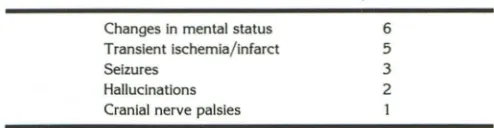
in the patients without trauma were varied; only one had symptoms potentially referable to the cavernous sinus (Table 1). This patient had a left sixth cranial nerve palsy, but he also had a left seventh cranial nerve palsy; both were felt to be the result of a diabetic neuropathy. None of the patients developed new symptoms referable to the cavernous sinus.
Nine of the patients without trauma had
sub-sequent scans ranging from 5 hours to 1 year after the detection of cavernous sinus gas. One scan performed 6 hours after the detection of
cavernous sinus gas demonstrated resolution of
gas that had been in the right cavernous sinus and the presence of a small bubble of gas in the left cavernous sinus which had not been there previously. The remaining eight cases with sub-sequent scans showed resolution of the gas. These scans were performed at 5 hours, 2 days, 4 days, 5 days, 1.5 months, and 1 year after the initial scan in one patient each and 1 day after the initial scan in two cases.
One patient had gas in the infratemporal fossa and around the left vertebral artery and in the epidural space at the level of C-1.
All 17 patients without trauma had intravenous lines in place at the time of their CT scans, but only five had contrast-enhanced CT scans. Of the five patients with contrast-enhanced scans, two had noncontrast scans immediately before con-trast administration. The cavernous sinus gas was unchanged between the noncontrast and contrast scans in both of these patients. All of the intra-venous lines were placed before the patient ar-rived in the CT department, and 15 of the 17 were placed by paramedics or emergency de-partment personnel shortly before the CT scans. All of the intravenous lines were placed in the
TABLE 1: Indications for CT scans
Changes in mental status Transient ischemia/infarct Seizures
Hallucinations Cranial nerve palsies
6
5
3 2
AJNR: 15, March 1994
antecubital fossa, forearm, wrist, or hand, except
one subclavian line. The size of the peripheral
intravenous lines was not documented in two
cases and ranged from 16 gauge to 20 gauge in
the other 14 patients. The exact fraction of the
approximately 16 1 00 head CT scans that were
performed on patients with intravenous lines is
unknown, but we estimate that approximately
80% of the patients scanned had intravenous
lines. In contrast, only about 10% of approxi-mately 1 200 paranasal sinus CT patients had intravenous lines.
Only one patient had a lumbar puncture before
the scan, and that was 6 days before the scan.
One patient had an attempted arterial puncture
to evaluate oxygenation on the day of the scan,
but venous blood was obtained. No other patient
had an arterial puncture attempted within 3 days
of the CT scan.
Of the 10 trauma patients, seven were male and three were female. They ranged from 27 to
72 years of age. Five had basilar skull fractures;
only two of these involved the sphenoid bone. In
three patients, penetration of the skull was sec-ondary to surgery; for one of these the CT was
obtained 6 days after surgery. Two patients had
no skull fracture that could be identified on the bone windows of the routine head CT: one of these had a superficial forehead laceration; one
had been hit on the head and then developed a
parietal scalp abscess which was drained. The
degree of trauma sustained in these two cases
made clinical suspicion of skull fracture low, so no further search for fractures was conducted. In
the setting of trauma, gas was also identified in
the scalp (two patients), subarachnoid space
(three patients), the right transverse sinus and the superior sagittal sinus (one patient), and in the infratemporal fossa and around the vertebral ar-teries (one patient). Only one of the trauma pa-tients received intravenous contrast material.
Discussion
[image:2.612.51.298.673.737.2]AJNR: 15, March 1994
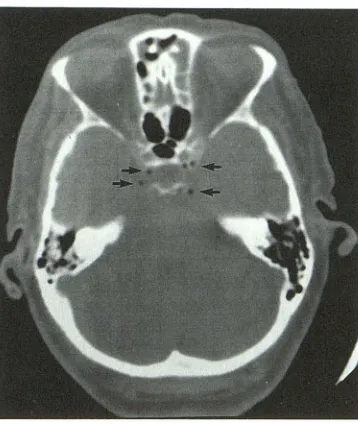
Fig. 1. Typical appearance of gas bubbles (arrows) in the cavernous sinus in a patient with decreased mental status and a right subclavian line. The contrast scan after this noncontrast scan showed no change in the cavernous sinus gas.
unlikely to be in or around the nerves, connective tissue, or fat that fills the nonvascular portions of the cavernous sinus. In patients with the most marked amount of gas, the bubbles appeared to outline the carotid artery (Fig 2). In addition, none
of the patients had recent procedures involving
arterial puncture or had evidence of right to left,
shunts making location of gas in the carotid artery
unlikely. In addition, only five of the patients
without trauma had ischemic symptoms, which
would be the expected sequela of gas within the
carotid artery. Of these five, three had cardiac
disease and one had carotid bulb disease respon-sible for the symptoms. The remaining patient, whose symptoms resolved after 2 hours, refused further evaluation.
All of the patients with cavernous sinus gas did have intravenous lines, and we feel that the gas most likely lies in the trabeculated venous spaces of the cavernous sinus. Although the majority of patients scanned had intravenous lines in place, we estimate that more than 4000 head and par-anasal sinus CT scans were performed on patients without intravenous lines. If there were another source for cavernous sinus gas, we would have expected to see at least one patient with cavern-ous sinus gas and no intravencavern-ous line. The vencavern-ous location of gas is also supported by the move-ment of gas from the right cavernous sinus to the left in one patient, by the resolution of the
gas in less than 5 hours in one patient, and by
the association of cavernous sinus gas in one
CAVERNOUS SINUS GAS 563
patient with gas in the infratemporal fossa, the
epidural space, and around the vertebral arteries
where venous plexuses exist (Fig 3).
We considered repositioning patients to see
whether the location of the gas would change, as
might be expected with intravenous gas, but this
turned out to be impractical. In all but a very few of the cases, the gas was not discovered until the patient had left the CT suite. In those few cases, the clinical condition of the patient precluded
repositioning the patient. Additionally, in all but
one of the patients that returned for a follow-up scan the gas had resolved.
Intravenous lines causing air emboli and the
movement of intravascular gas from the upper
extremity to the neck have been documented.
Two reports have demonstrated that injection of contrast material for chest and neck CT scans can result in intravenous or intracardiac air
be-cause of venous air emboli (6, 7). One of these
reports included two cases of air emboli in the
internal jugular vein (6). We, too, have identified
air in veins in the region of the clavicle, the internal jugular vein, and an anterior neck vein at
the level of the hypopharynx in a supine patient
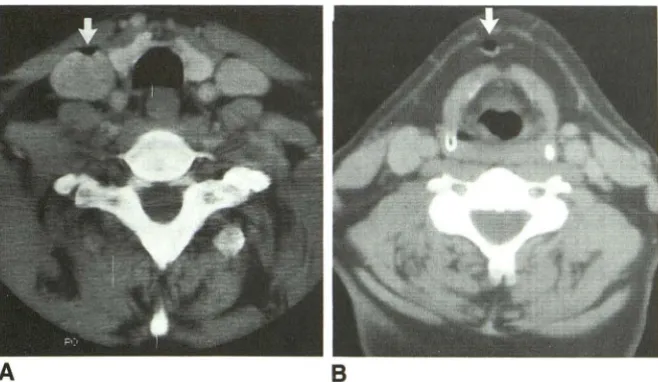
who received intravenous contrast material for a neck CT scan (Fig 4). We also have seen three cases of retrograde flow of radioactive materials into the jugular vein (in one case up to the transverse sinus) on brain flow studies. Not only has the orthograde flow of intravenous gas in the arm been documented, but the retrograde flow
of gas has been demonstrated from the radial
artery to the subclavian artery (8, 9). The retro-grade movement of air in the jugular veins into the head is, therefore, also possible and would be aided by buoyancy in an upright or partially upright patient.
The most likely route for air to course from the arm to the cavernous sinus is through the
internal jugular vein and inferior petrosal sinus.
On this route the gas would pass through the largest vessels with the most vertical course, which would maximize the chance of air reaching the cavernous sinus because of buoyancy and minimize the chance of the air being trapped in a
small lumen. Once the air has passed through the
inferior petrosal sinus, an air bubble may lodge within the trabeculated venous spaces which
comprise one of the cavernous sinuses. The air
bubble also could be trapped in the anterior or
posterior intercavernous sinus, which together
[image:3.612.88.267.77.290.2]564 RUBINSTEIN
Fig. 2. A, Gas in the cavernous sinuses (black arrows) and anterior intercavernous sinus (white arrow) in a patient with de-creased mental status and a peripheral intra-venous line started by the paramedics.
B, Some of the gas (curved white arrow)
outlines the medial and anterior border of the partially calcified left internal carotid artery. Only a noncontrast scan was per-formed.
Fig. 3. Gas (arrows) in the cavernous sinuses (A and B) in a patient who also had gas (arrows) in the right infratemporal fossa (C) and near the left vertebral artery and in the C-1 epidural space on the right (D). This patient had left arm weakness and a periph-eral intravenous line started by the paramed-ics. No contrast material was given.
AJNR: 15, March 1994
A B
[image:4.612.228.559.73.729.2]AJNR: 15, March 1994
A
8
than the internal jugular vein or which leaves the internal jugular vein before reaching the inferior petrosal sinus may become lodged in small-cali-ber veins including the pterygoid plexus, the plexus of veins around the vertebral arteries, and the plexus of veins in the epidural space of the spinal canal (Fig 3).
The location of the gas in the trauma patients is less clear. The potential for confusion with subarachnoid gas exists, and the possibility of extravascular gas exists in the two patients with sphenoid fractures. In the patients with penetra-tion of the skull distant from the sphenoid bone and in the patients without fractures, the gas is most likely in the venous spaces. Identification of gas, near the vertebral arteries and infratemporal fossa in one patient with parietal burr holes and in the superior sagittal sinus and transverse sinus in a patient with a sphenoid fracture, supports an intravenous location of the gas. Intravenous cav-ernous sinus gas in trauma patients may originate from penetrating trauma or intravenous lines.
Only one of our 27 patients and only one of four previously reported cases (1-4) had symp-toms referable to the cavernous sinus. In our patient, the symptoms were attributable to a diabetic neuropathy which affected the patient's sixth and seventh cranial nerves. In the reported case of septic thrombosis (1), the patient's symp-toms were most likely caused by septic throm-bosis of the cavernous sinus and not the presence of gas. Therefore in none of our cases and in none of four previously reported cases did gas in the cavernous sinus cause symptoms.
In the reported cases of septic thrombosis ( 1) and barotrauma (3) associated with cavernous sinus gas, the gas may have been introduced through intravenous lines and may not have been
CAVERNOUS SINUS GAS 565
Fig. 4. Gas (arrows) in the right internal jugular vein (A) and in an anterior neck vein
(B) after the injection of intravenous contrast
through a peripheral intravenous line started for this neck CT. The scan was performed to evaluate a suspected neck mass.
related to the patients' underlying conditions. If the gas in those cases was caused by intravenous lines then all of the known cases of cavernous sinus gas in patients without trauma are incidental findings. If the gas in those two cases was truly caused by the septic thrombosis and barotrauma, then the finding of cavernous sinus gas was not incidental in only two of the 20 cases reported with cavernous sinus gas and without trauma. The diagnosis of septic thrombosis of the cavern-ous sinus was made from other findings, and the presumed barotrauma was not treated. So in none of the cases was the finding of cavernous sinus gas significant in influencing the treatment of a patient. Cavernous sinus gas in a trauma patient, however, may be significant as a sign of skull fracture.
Although previous reports have stressed the injection of intravenous contrast material as a source of venous air emboli (4, 6, 7), only five of the 17 non trauma patients and one of the 10 trauma patients received contrast material for their CT scans. In two of these patients the gas was present on a precontrast scan, leaving only four cases in which the injection of intravenous contrast material may have been responsible for the cavernous sinus gas. Our data indicate that contrast injection is not the major cause of cav-ernous sinus gas and that any intravenous line may be responsible for venous air emboli. Fur-thermore, 15 of the 17 nontrauma patients had intravenous lines that were started shortly before the CT scans, suggesting that venous air emboli may be more likely to occur when an intravenous line is being established.
[image:5.615.55.384.76.267.2]566 RUBINSTEIN
and without symptoms referable to the cavernous sinus, gas in the cavernous sinus is most likely an incidental finding caused by venous air emboli from intravenous lines. In trauma patients the gas
in the cavernous sinus region may be
extravas-cular, caused by a sphenoid fracture, or
intrave-nous, caused by venous air emboli from pene-trating head trauma or an intravenous line.
Acknowledgment
We thank Deb Reardon for her help in preparation of
this manuscript.
References
1. Curnes JT, Creasy JL, Whaley RL, Scatliff JH. Air in the cavernous sinus: a new sign of septic cavernous sinus thrombosis. AJNR Am J
Neuroradio/1987;8: 176-177
AJNR: 15, March 1994
2. Bartynski WS, Wang AM. Case report. Cavernous sinus air in a patient with basilar skull fracture: CT identification. J Comput Assist Tomogr 1988;1:141-142
3. Canavan L, Osborn RE. Dural sinus air without head trauma or surgery: CT demonstration. J Comput Assist Tomogr 1991;3: 526-527
4. Adams M, Quint DJ, Eldevik OP. Iatrogenic air in the cavernous sinus. AJR Am J Roentgenol 1992; 159:189-190
5. Hosoya R, Kera M, Suzuke T, Yamaguchi K. Fat in the normal cavernous sinus. Neuroradiology 1986;28:264-266
6. Woodring JH, Fried AM. Nonfatal venous air embolism after contrast-enhanced CT. Radiology 1988;167:405-407
7. Price DB, Nardi P, Teitcher J. Venous air embolization as a compli-cation of pressure injection of contrast media: CT findings. J Comput
Assist Tomogr 1987;2:294-295
8. Lowenstein E, Little JW, Hing HL. Prevention of cerebral embolization from flushing radial-artery cannulas. N Eng/ J Med 1971 ;25:
1414-1415