A probabilistic framework for mismatch and
profile string kernels
Alexei Vinokourov1, Andrei N. Soklakov2 and Craig Saunders1 ∗ 1- University of Southampton - School of Electronics and Computer Science
Southampton, Hants, SO17 1BJ - UK
2- Royal Holloway, University of London - Department of Mathematics Egham, Surrey, TW20 0EX - UK
Abstract. There has recently been numerous applications of kernel methods in the field of bioinformatics. In particular, the problem of protein homology has served as a benchmark for the performance of many new kernels which operate directly on strings (such as amino-acid sequences). Several new kernels have been developed and successfully applied to this type of data, including spectrum, string, mismatch, and profile kernels. In this paper we introduce a general probabilistic framework for string-type kernels which uses the fisher-kernel approach and includes spectrum, mismatch and profile kernels, among others, as special cases. The use of a probabilistic model however provides additional flexibility both in definition and for the re-weighting of features through feature selection methods, prior knowledge or semi-supervised approaches which use data repositories such as BLAST. We give details of the framework, place well-known kernels in the framework and give preliminary experimental results which show some effects of using the probabilistic approach.
1
Introduction
In this paper we focus on the protein homology problem, which has become a benchmark for the application of string-type kernels. The model we present, however, has a wider range of applications to other sequence data, as the prob-abilistic framework allows for many tailored kernels to be produced, each with a clear method for introducing prior knowledge. In particular, the profile-based kernel [4]and mismatch kernel [5]have been shown to achieve state of the art performance on the protein sequence homology detection problem, while retain-ing efficiency due to possibility of implementation through a modification of fast string kernel algorithm. In this work both of this kernels are obtained from our attempt to derive an efficient kernel from a generative probabilistic model under very general assumptions about input sequences.
We first give some general definitions that will be useful later on. Letαbe a string of symbols from a fixed alphabetA, i.e. α∈ A*. In what follows we will use the notationα[i]to mean theith symbol inα(i= 1,2, . . . ,|α|). Furthermore,
∗The first and third author thank the EPSRC for their support through grant no
byα[i:j], wherej > i, we will mean a section of the string beginning with the
ith symbol and ending with thejth symbol: α[i:j] =α[i]α[i+ 1]. . . α[j] . Let Φ(α) be a feature vector with componentsφβ(α). The corresponding kernel is then defined as a dot product in the feature space
k(α1, α2)
β
φβ(α1)φβ(α2). (1)
Our statistical methods will be based on counts of fixed length substringsβ∈ Ak of strings α ∈ A|α| denoted as #(β|α), when the fact that string β occurred
in string α will be denoted as β α. Wherever square brackets surround a boolean expression they will mean an indicator function: [A] = 1 if A is true and 0 otherwise.
We shall mostly be concerned with ’all contiguous substrings’ type of kernels for which the feature mappingφβ(α) is simply
φβ(α) = #(β|α)
|α|−k
i=1
[α[i:i+k−1]=β]. (2)
TheFisher kernel [3]for a generative modelP(α|Θ),α∈ A*, with parame-ters Θ ={θβ}β is a kernel defined by the following mapping:
φF isher β (α)
∂logP(α|Θ)
∂θβ
,
where a common assumption of approximation of the Fisher information matrix by identity matrix is used, sometimes referred to as the na¨ıve Fisher kernel.
A mismatch kernel [5]is a step further to account for possible mutations in input strings. A (k,m)-mismatch neighbourhood of a k-length string α is denoted N(k,m)(α) and is a set of all suchk-length strings that differ fromαin
no more than k symbols. The mismatch kernel feature mapping of a stringαis then defined in the following way:
φmismatch β (α)
|α|−k+1
i=1
[β ∈N(k,m)(α[i:i+k−1])]. (3)
This kernel can be efficiently computed, see [5]for details.
Astring profileP(α) of a stringαis a sequence of distributionspi(a) over the
alphabetA: P(α) =pi(a) : a∈ A, i= 1. . .|α|,
a∈Api(a) = 1, pi(a)0
. A k-length profile segment at position i is then simply P(α[i : i+k−1]). A profile can be obtained, for example, as a result of running a commonly known PSI-BLAST program [1]. One can define a neighbourhood similar to a (k,m )-mismatch neighbourhood but in a ’profile sense’ as follows. LetP(α) be a profile defined over a string α. A profile neighbourhood P N(k,σ)(P(α[i : i+k−1])),
with a log-probability not greater thanσ:
P N(k,σ)(P(α[i:i+k−1])) =
β ∈ Ak:−
k
j=1
logpi+j−1(β[j])< σ
,
Aprofile kernel [4]is then defined by the feature vector
φprof ile β (α)
|α|−k
i=1
[β∈N(pk,σ)(P(α[i:i+k−1])]. (4)
This can be implemented by a minor modification of the fast string kernel al-gorithm leading to the same computational complexity. At the same time it incorporates a widely tested PSI-BLAST model. It has been also reported ex-perimentally superior to the mismatch kernel [4]. We shall rewrite (4) in proba-bilistic terms. Since we are given a profileP(α[i:i+k−1]) it would be natural to weight each component with the corresponding probability:
φweight−prof ile β (α)
|α|−k
i=1
[β∈P N(k,σ)(P(α[i:i+k−1]))]Pα(β@i), (5)
wherePα(β@i)
k
j=1pi+j−1(β[j]).
2
The Model
Let Mα be the set of all possible mutations of string α. For every mutation
µ ∈ Mα we assume to know its probability Pµ|α and the effect it has on
the original string α → µ(α). The effect and the importance of each muta-tion can be visualized using the concept of an extended string D as follows.
Let D = α1, α2, . . . , αN be a sequence of strings obtained from the original
string α by drawing randomly a sequence of mutually independent mutations
µ1, µ2, . . . , µN ∈ Mαaccording to the distributionPµ|αand definingαi=µi(α),
i= 1,2, . . . , N. By definition,D contains the entire ensemble of strings
gener-ated from the originalα by mutations. We can estimate the probability of an element inDas the average
PN(D) =
N
i=1
P(αi)
1/N
, (6)
where the values of P(αi) are given by a k-stage Markov model. Let Bα =
β1, β2, . . . , β|α|−k+1be a sequence of all contiguousk-length substrings generated
from α, i.e. βj = α[j : j +k−1]. Then we have according to the model
P(α) =β∈B
αpβ. Substituting this into (6) and taking the logarithm gives
lnPN(D) =
1
N
N
i=1
β∈Bαi
In order to calculate derivatives correctly we now parameterize our model using arbitrary real numbersτ such thatpβ= τβ
βτβ. This gives ∂lnPN(D)
∂pβ
= 1
N
N
i=1
#(β|αi)
τβ −
1
Nβτβ
N
i=1
|αi| −k+ 1. (8)
If all documents are of equal length, then the second term in the equation is constant. We can easily extend a document by a set of extra symbols that do not appear in any corpus so that all documents are of equal length. We can therefore ignore the second term and just use the first one directly. In the following we use pβ rather than τβ as the two models can be made equivalent.
Let #(γ|D) be the number of times the stringγ appears inD, and letDbe the set of all (different) strings that constituteD. Then one can find that
∂lnPN(D)
∂pβ
= 1
N
γ∈D
#(β|γ) #(γ|D)
pβ
. (9)
For large values ofNone can replace the ratio #(γ|D)/Nby the probabilityPµ|α
of the mutation that corresponds toγ, i.e. γ=µ(α). Similarly, for largeN, the setDcontains strings resulted from all possible mutationsMd, and therefore
∂lnPN(D)
∂pβ
N−→→∞φprof ker−f isher β (α) =
1
pβ
µ∈Md
#(β|µ(α))Pµ|α. (10)
Equation (10) defines a kernel which, within our model, accounts for all pos-sible mutations {Mα} of the original strings {α}. However, the direct use of
(10) demands large computational resources: in the most general case one has no alternative apart from using Monte-Carlo sampling over all possible muta-tions. Let us now develop approximations that result in a much more efficient algorithm. As a byproduct of our analysis we derive the profile kernel.
Let Pα(β@i) be the probability of finding β as a substring of µ(α) at the
ith position. Then, the probability,Pα(β), that β was found inµ(α) regardless
of the position can be calculated as
Pα(β) =Pα(β@ 1) +Pα( ¯β@ 1)Pα(β@ 2) +Pα( ¯β@ 1,2)Pα(β@ 3)
+. . .+Pα( ¯β@ 1,2, . . . ,(|α| −k))Pα(β@(|α| −k+ 1)), (11)
where Pα( ¯β@r, s, t, . . .) denotes the probability that β was not found as a
substring of µ(α) at any of the positions r, s, t, . . .. In (11) we have written out a decomposition of Pα(β) starting with the position 1. It is clear that
one can write similar expressions for Pα(β) starting with any position i, i.e.,
Pα(β) =Pα(β@i) +Pα( ¯β@i)Pα(β@(i+ 1)) +. . ., where we assume that after
the position |α| −k we proceed with the position 1,2, . . . to go through all the positions as in (11). ForPα(β) we have|α| −kpossible decompositions of this
type, and since all such decompositions are equivalent we can write
Pα(β) =
1 |α| −k
|α|−k
i=1
Pα(β@i) +Pα( ¯β@i)Pα(β@ (i+ 1)) +. . .
It is easy to see that the component sums in (12) are decreasing. LetNk
αbe the total number of different strings of lengthkthat can be derived
as substrings of all possible versions{µ(α)}µ∈Mα of the original stringα. Then
the expected number of times that a string β appears as a substring in µ(α) is µ∈M
α#(β|µ(α))Pµ|α = Pα(β)N
k
α. Substituting this into (10) we obtain
φprof ker−f isher β (α) =
Nαk
pβPα(β) . Ignoring the higher order terms in (12) we thus
obtain from (10)
φprof ker−f isher β (α) =
Nk
α
pβPα
(β)≈ N
k α
(|α| −k)pβ
|α|−k
i=1
Pα(β@i). (13)
One can ignore small terms in the sum above by introducing a thresholdσ:
φprof ker−f isher β (α) =
Nk
α
(|α| −k)pβ
|α|−k
i=1
[β∈N(k,σ)(P(α@i))]Pα(β@i). (14)
Apart from the prefactor this coincides with the weighted profile kernel (5). It can be observed also that the mismatch kernel (3) can be recovered from (14) by setting all profiles Pα(β[j] @i) to a constant value, in which case profile
neighbourhoodsP N(k,σ)turn into mismatch neighbourhoods N(k,m).
3
Experiments
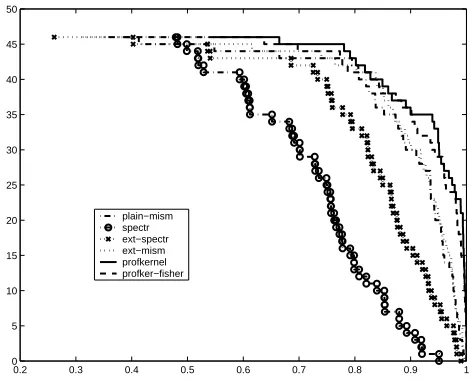
The experimental setting was similar to one described in [6][5]and [4]for SCOP dataset. For the mismatch kernel (plain-mism) the parameter setting was (k= 5, m = 1) (for the spectrum kernel [6] k = 5 too) and for the profile kernel (profkernel) - (k= 4 andσ = 6). To test Monte Carlo approach to (10) we have generated N = 20 mutations of each training example. The FSA model was trained as described in [7]with the Markov process memory k= 3 to get parameter estimates pβ that were also used in kernel (14) (profker-fisher).
The extended examples were subsequently used in both spectrum (ext-spectr) and mismatch (ext-mism) kernels. We noticed that results are much improved if one adds a 0.5 prior to the probability of ’non-mutation’. Higher values did not affect much the output.
For our experiments we chose a subset collected by Liao et al. [2]which has been described as lacking positive training examples and therefore more challenging. We plotted the number of protein families with performance above given ROC score vs. ROC score each method in Figure 1. One can observe that even the first approximation of (12) achieves the state-of-the-art performance of the profile kernel.
4
Conclusions
0.2 0.3 0.4 0.5 0.6 0.7 0.8 0.9 1 0
5 10 15 20 25 30 35 40 45 50
[image:6.595.182.417.146.336.2]plain−mism spectr ext−spectr ext−mism profkernel profker−fisher
Fig. 1: The number of protein families with performance above given ROC score vs. ROC score for each method.
caseN → ∞. Having made rather weak assumptions we obtained a computable version of (10) given by formula (14) which includes state of the art performing profile kernel as well as mismatch and spectrum kernels as special cases. This result opens wide prospectives for further theoretical analysis of all-contiguous-substrings type of kernels along with possible modifications and extensions.
References
[1] S. F. Altschul, T. L. Madden, A. A. Schaffer, J. Zhang, Z. Zhang, W. Miller, and D. J. Lipman. Gapped BLAST and PSI–BLAST: a new generation of protein database search programs. Nucleic Acids Res., 25:3389–3402, 1997.
[2] C.Liao and W.C. Noble. Combining pairwise sequence similarity and support vector ma-chines for remote protein homology detection. InProceedings of the Sixth Annual Inter-national Conference on Research in Computational Molecular Biology, 2002.
[3] T. Jaakkola, M. Diekhaus, and D. Haussler. Using the fisher kernel method to detect remote protein homologies. Journal of Computational Biology, 7(1,2):95–114, 2000. [4] Rui Kuang, Eugene Ie, Ke Wang, Kai Wang, Mahira Siddiqi, YoavFreund, and Christina S.
Leslie. Profile-based string kernels for remote homology detection and motif extraction. In
3rd International IEEE Computer Society Computational Systems Bioinformatics Con-ference (CSB 2004), pages 152–160. IEEE Computer Society, 2004.
[5] Christina Leslie, Eleazar Eskin, Adiel Cohen, Jason Weston, and William Stafford No-ble. Mismatch string kernels for discriminative protein classification. Bioinformatics, 20(4):467–76, 2004.
[6] Christina S. Leslie, Eleazar Eskin, and William Stafford Noble. The spectrum kernel: A string kernel for svm protein classification. InPacific Symposium on Biocomputing, pages 566–575, 2002.