Evaluative Comparison of Routing Protocols
with Effective Performance Metrics in
Heterogeneous VANET Configuration
Pankaj Joshi
1, Jaswinder Kaur
2M.Tech Scholar, ECE SBSSTC, Moga Road Ferozepur, Punjab, India1
Assistant Professor, ECE SBSSTC, Moga Road Ferozepur, Punjab, India2
ABSTRACT: Vehicular Ad Hoc Networks (VANETs) have emerged as a new influential technology with a purpose to provide vehicle, road and public safety. VANET is a well coordinated network that provides continuous connectivity between vehicle and RSUs through efficient vehicle-to-vehicle or vehicle-to-infrastructure communication. In this paper, we compare performances of reactive and proactive routing protocols named Dynamic Source Routing (DSR), Dynamic MANET On-Demand (DYMO), Destination Sequenced Distance Vector (DSDV) and Optimized Link State Routing Protocol (OLSR) in VANET using OMNET++ and INET framework. The protocols are compared in heterogeneous configuration in terms of SNIR, end to end delay, throughput, number of collisions and loss rate based on different vehicle density.
KEYWORDS:DSR, DYMO, DSDV, OLSR, VANET, OMNET++ and INET.
I. INTRODUCTION
Vehicular Ad hoc Network (VANET) is considered as a special type of Mobile Ad hoc Network (MANET), in which vehicles act as nodes and each vehicle is equipped with transmission capabilities and act as router to exchange information between vehicles and road side units. The essential part of VANET is to improve road and public safety, to increase the comfort level of passengers and to reduce the congestion of traffic. VANET has unique characteristics like high mobility modeling with vehicle predictions, extreme dynamic topology, low power issues, unbounded network size, infrastructure support and high computing power that differentiate it from MANET. These networks are used in traffic control applications, collision avoidance, accident alert services, safety applications, driver assistance and location based services [1-3]. Due to the highly dynamic nature and inherent characteristics of VANET, Many researchers have concentrated on proposing the suitable routing protocols.
II. RELATED WORK
VANET and defines the current trends and challenges for efficient routing. A lot of projects related to VANET are practically implemented in countries such as FleetNet [11], PReVENT [12], SeVeCom [13], Network on Wheels (NOW) [14], Car talk 2000 [15] etc.
III.ROUTING PROTOCOLS
PROACTIVE PROTOCOLS
The proactive protocols are also recognized as table driven routing protocols. Proactive protocols allow a node to use the routing table to store the routing information of all other nodes. The table is updated periodically by exchanging the knowledge of topology changes among all the nodes of the network. Proactive schemes maintain new lists of destinations and their routes will be chosen using shortest path algorithms.
Destination Sequence Distance Vector (DSDV): In DSDV protocol, each vehicle advertises its own routing table to all its neighbors. The routing table contains the list of addresses of all other nodes in network which may change dynamically with time, so advertisement must be send by each vehicle frequently to locate the other vehicles. DSDV is a proactive routing protocol which maintains the route to the destination using destination seq uence numbers. The two routing tables are maintained at each node namely routing table and setting time table which contains the address of next hop, route metric, destination sequence number, time for update advertisement etc. DSDV ensures loop free routes. The DSDV mechanism incurs large volume of traffic in highly dynamic networks due to which more bandwidth is consumed. In order to overcome the mentioned shortcoming, two update strategy in proposed: full dump and incremental update. In full dump, the full routing table is send to the neighbors where as in incremental update, only the entries which changes from the last update are sent [16].
Optimized Link State Routing (OLSR) : OLSR protocol employ link state strategy ; it maintains a routing table which has information about all possible routes to network. Once the network topology changed each vehicle send the modified information to some selective nodes which further retransmit the updated information to other selective nodes. However the nodes which are not in the selected list can only read and process the packet. OLSR is a proactive routing strategy which involves periodic flooding of control information using special nodes that act as Multi Point Relays (MPRs). In this scheme, the status of the links is immediately updated which allow the hosts to identify the network routes earlier. OLSR routing protocol has simple done procedure which allows it to integrate in different operating systems. OLSR is appropriate for high density networks, dynamic topology and applications with short transmission delays (safety warning applications) [17].
REACTIVE PROTOCOLS
These protocols are recognized as on-demand routing protocols as they periodically update the routing table only when a vehicle have some data to be send. These protocols help in reducing the burden in the network. But these protocols use flooding process for route discovery, which causes more routing overhead.
or their link status since there is no periodic updating of packet exchanged between nodes. So applying cache route mechanism in DSR may cause failure due to invalid or expired links.
Dynamic MANET on Demand Routing Protocol (DYMO): DYMO is a new reactive routing protocol that specially designed for use in multi-hop wireless network by IETF’s MANET working group. DYMO aims at a simpler design and easy protocol implementation, helping to reduce the system requirements of working nodes. DYMO retains mechanisms of earlier routing protocols like implementing sequence numbers and some better features like internet gateway, implementing path accumulation. A node will not have route information about the destination but will also receive additional information about all transitional nodes of a newly recognized path. DYMO also involves Route Discovery and Route Maintenance as its basic operations [19].
IV.EXPERIMENTAL SETUP AND RESULTS
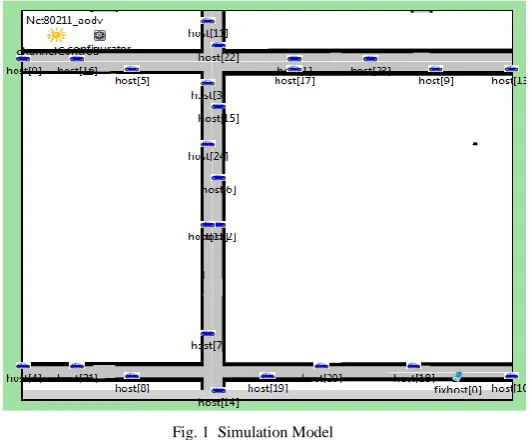
The simulation set up consists of variable number of nodes between source and destination in heterogeneous configuration in which the vehicles are moving with different speeds (15-25 mps).We prefer to execute the simulation of the network with OMNET++ with INET framework as OMNeT++ is an open, modular, testbed-based on C++ which provides support for sensor networks, wireless ad hoc networks, Internet protocols, network modeling, photonic networks etc with excellent graphical runtime environment and INET Framework extension provides OMNeT++ modules that represents Internet protocol suite, models for wireless and mobile communication, MAC protocols with mobility framework . we evaluate the performance of proactive protocols (DSDV and OLSR) and reactive protocols (DSR and DYMO) in heterogeneous configuration by investigating the performance parameters such as SNIR, average throughput, End to End Delay, loss rate and number of collisions based on varying vehicle density.
Fig. 1 Simulation Model
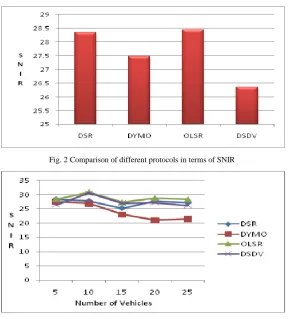
the DSR and DSDV have almost same SNIR value variations. But OLSR have best SNIR values at different vehicle densities.
Fig. 2 Comparison of different protocols in terms of SNIR
Fig. 3 Variations in SNIR of protocols with varying vehicle density
Fig. 5 Variations in End to End Delay of protocols with varying vehicle density
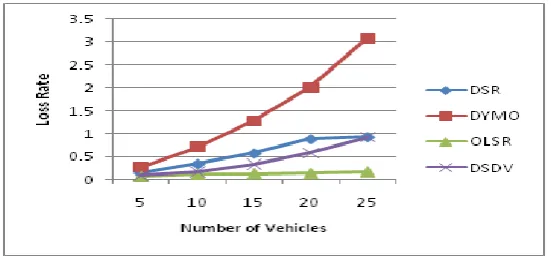
Average Loss Rate: The loss rate is calculated as a fraction of packets lost at the MAC layer. Certain conditions may cause packet loss like corrupted packets, buffer overloading, link failure, inadequate bandwidth and some security issues. This is an important performance metric for the networks where packet loss is not acceptable. Figure 6 and figure 7 represent the related diagrams of loss rate (time averaged) for 5 vehicles and different vehicle densities associated with four routing protocols, respectively. OLSR has the lowest loss rate while DYMO has highest loss rate.
Fig. 6 Comparison of different protocols in terms of Loss Rate
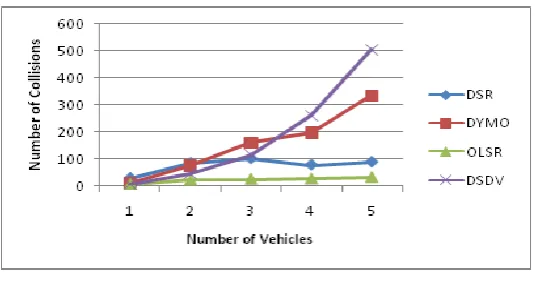
Number of Collisions: When two or more packets enter the same path at the same time, it causes interference which may damage one or either of the packets and make it unusable. The number of collisions defines the number of packets lost or corrupted during the transmission due to the mutual interference. If the number of packet collisions is low the network will have enhanced performance. Figure 8 and figure 9 shows statistics related to the number of collisions in the network of all four protocols for 5 vehicles and different vehicle densities respectively. Initially DSR has the highest number of collisions, but as the number of vehicles increases the number of collisions decreases due to efficient source routing procedure while DSDV have highest number of collisions. However OLSR has the lowest number of collisions.
Fig. 8 Comparison of different protocols in terms of Number of Collisions
Fig. 9 Variations in Number of Collisions of protocols with varying vehicle density
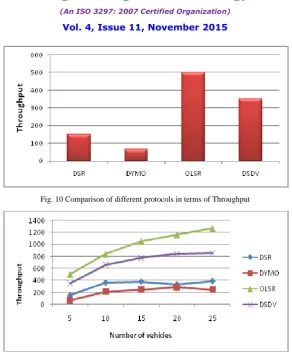
Fig. 10 Comparison of different protocols in terms of Throughput
Fig. 11 Variations in Throughput of protocols with varying vehicle density
V. CONCLUSION
The performance of reactive routing protocols [Dynamic Source Routing (DSR), Dynamic MANET On-Demand (DYMO)] and proactive routing protocols [Destination Sequenced Distance Vector (DSDV) and Optimized Link State Routing Protocol (OLSR)] in heterogeneous VANET Configuration has been compared. These protocols are compared in terms of Signal to Noise plus Interference Ratio (SNIR), end to end delay, throughput, number of collisions and loss rate by varying vehicle density. DYMO protocol is seen to have lowest SNIR value, high end to end delay, high loss rate and minimum throughput. We concluded that OLSR achieve best results in terms of all the performance parameters considered i.e. high SNIR value, lowest end to end delay, maximum throughput, less number of collisions and low loss rate among all the protocols.
REFERENCES
[1] Saif Al-Sultann, Moath M. Al-Doori, Ali H. Al-Bayatti, Hussien Zedan, “ A comprehensive survey on vehicular Ad Hoc network”, Journal of Network and Computer Applications Elsevier, pp. 380-392, 2013.
[2] Moustafa, H. & Zhang, Y. , “Vehicular networks: Techniques, standards, and applications”, Auerbach Publications Boston, MA, USA, ISBN 9781420085716, 2009.
[3] Sherali Zeadally·Ray Hunt·Yuh-Shyan Chen·Angela Irwin·Aamir Hassan,“Vehicular ad hoc networks (VANETS): status, results,and challenges” Springer, Vol. 50, No. 4, pp 217-241, 2010.
[4] Dallas,TX, Josh Broch , David A. Maltz , David B. Johnson , Yih-chun Hu , Jorjeta Jetcheva , “A Performance Comparison of Multi-Hop Wireless AdHoc Network Routing Protocols”, In Proc. ACM international conference on Mobile computing and networking, pp. 85-97, 1998. [5] S. R. Das et al., “Comparative Performance Evaluation of Routing Protocols for Mobile Ad-Hoc Networks”, In 7th Int. Conf. on Comp.
Communication and Networks, pp. 153-161, 1998.
[7] Fan Li and Yu Wang, “Routing in Vehicular Ad Hoc Networks: A Survey” University of North Carolina at Charlotte IEEE VEHICULAR TECHNOLOGY MAGAZINE, Vol. 2, No. 2, pp. 12-22, 2007.
[8] Valery Naumov, Thomas Gross, Rainer Baumann, “An Evaluation of Inter-Vehicle Ad Hoc Networks Based on Realistic Vehicular Traces” Florence, Italy.ACM international symposium on Mobile ad hoc networking and computing, pp. 108-119, 2006.
[9] R.A. Santos, A. Edwards, R.M. Edwards, N.L. Seed, “Performance Evaluation of Routing Protocols in Vehicular Ad Hoc Networks”, International Journal of Ad Hoc and Ubiquitous Computing Vol. 1, No.1/2, pp. 80 – 91, 2005.
[10] Altayeb, M. and I. Mahgoub, “A Survey of Vehicular Ad hoc Networks Routing Protocols” International Journal of Innovation and Applied Studies, pp. 829-846, 2013.
[11] Ranz, W., Eberhardt, R. & Luckenbach, T. , “Fleetnet-internet on the road”, Proc. 8th World Congress on Intelligent Transport Systems, 2001.
[12] Schulze, M., Nocker, G. & Bohm, K. , “PReVENT: A European program to improve active safety”, Proc. of 5th International Conference on Intelligent Transportation Systems Telecommunications, France, 2005.
[13] Leinmüller, T., Buttyan, L., Hubaux, J., Kargl, F., Kroh, R., Papadimitratos, P., Raya, M. & Schoch, E., “ SeVeCOM – secure vehicle communication”, Proceedings of IST Mobile Summit, 2006.
[14] Festag, A., Noecker, G., Strassberger, M., Lübke, A., Bochow, B., Torrent-Moreno, M., Schnaufer, S., Eigner, R., Catrinescu, C. & Kunisch, J., “Now-network on wheels: Project objectives, technology and achievements”, Proceedings of 6th International Workshop on Intelligent Transportations (WIT), Hamburg, Germany, 2008.
[15] Reichardt, D., Dairnler Chrysler AG, Germany, Miglietta, M., Moretti, L. , Morsink, P. “CARTALK 2000 safe and comfortable driving based upon inter-vehicle-communication”. In Proceedings of IEEE intelligent vehicle symposium , Vol. 2, pp. 545-550, 2002.
[16] C.E.Perkins, P. Bhagwat, “Highly dynamic destination sequence distance-vector routing (DSDV) for mobile computers” Proceedings of Conference on Communications Architectures, Protocols and Applications (SIGCOMM ’94), NewYork, USA, pp. 234-244, 1994.
[17] J. Toutouh, J.G. Nieto, E. Alba, “Intelligent OLSR routing protocol optimization for VANETs” IEEE Trans. Veh. Technolgy, Vol. 61, No.4, pp.1884–1894, 2012.
[18] David B. Johnson, David A. Maltz,, “Dynamic Source Routing in Ad Hoc Wireless Networks Mobile Computing, The Kluwer International Series in Engineering and Computer Science, Vol. 353, pp 153-181, 1996
[19] I. Chakeres and C. Perkins, “Dynamic MANET On-Demand (DYMO) Routing,” Internet-Draft, draft-ietf-manet-dymo-06.txt, 2006. [20] Varga.OMNeT++DiscreteEventSimulationSystem.Available:http://www.omnetpp.org/doc/manual/usman.html. and INET Framework