Educating for a Systems Design Approach to Complex Societal
Problems
Jairo da Costa Junior (Corresponding Author)
PhD Candidate, Department of Design Engineering and Product Innovation Management, Delft University of Technology, Delft, The Netherlands
Landbergstraat 15, 2628 CE, Delft, The Netherlands +31 (0)15 278 2738, [email protected]
Assistant Professor, Department of Mechanical, Materials and Manufacturing Engineering, The University of Nottingham Ningbo China, Ningbo, China
199 Taikang East Road, Office SEB341-2D, 315100, Ningbo, China +86 (0) 574 8818 8670, [email protected]
ORCID: 0000-0003-0260-6340
Jan Carel Diehl
Associate Professor, Department of Design Engineering, Delft University of Technology, Delft, The Netherlands
Landbergstraat 15, 2628 CE, Delft, The Netherlands +31 (0) 15 278 9807, [email protected]
ORCID: 0000-0002-4007-2282
Fernando Secomandi
Adjunct Professor, Department of Industrial Design, State University of Rio de Janeiro, Rio de Janeiro, Brazil
Educating for a Systems Design Approach to Complex Societal
Problems
Design education has devoted little attention to the topic of societal systems
transformation in the context of sustainable development. This paper reports on a
master’s-level course that aims to build the capacity for design engineering
students to adopt a Systems Design Approach comprised of the integration of
Product-Service System (PSS) and Systems Thinking, in order to develop
sustainable energy systems concepts. We identify key factors for skilful
performance when designing solutions for complex societal problems. The
findings suggest that design approaches grounded in systems thinking are
promising for dealing with the increasing complexity of the societal problems
which future generations of design professionals are expected to solve. An Open
Learning E-Package (OLEP) was offered to support Higher Education
Institutions (HEIs) to introduce Product-Services Systems and Distributed
Renewable Energy (DRE) models into their design curricula. We argue that
capacity building for a systems design approach to complex societal problems,
such as those faced in low-income energy markets, can support future generations
of design engineers to take an active role in the development and widespread
implementation of sustainable energy systems.
Keywords: capacity building; systems design approach; sustainable
product-service system; distributed renewable energy; complex societal problem.
1. Introduction
Societal challenges faced globally by civil society, governments, humanitarian
organisations, private companies and non-governmental organisations (NGOs) continue to grow in complexity and scope (Conklin et al., 2007a; Lopes et al., 2012). In
that do not repeat the environmental or social mistakes witnessed over the last decade in more developed economies (Kaygusuz, 2007).
Key societal problems, such as global warming, resource depletion, and poverty alleviation, pose unfamiliar constraints and a high level of complexity for problem solvers, including design engineers. These challenges can be even harder to overcome in the context of low-income markets, where financial and infrastructural resources are often lacking. Education is generally regarded as a way of properly equipping design engineers to successfully handle the complexity of complex societal problems (Adams et al., 2003; Sevaldson, 2009). This paper addresses the question of how to build the capacity for design students to respond to the complexity of societal problems, such as those found in many emerging economies.
To meet this challenge, we introduce systems design approaches which build on systems thinking as a way to handle complex societal problems (see Blizzard and Klotz, 2012; Charnley et al., 2011; Jones, 2014; Nelson and Stolterman, 2012; Sevaldson, 2011). Despite the acknowledged relevance of systems thinking in dealing with
complexity in technology and engineering education, thus far issues relating to capacity building in design education have received little attention (Barak and Williams, 2007). Our study is based on a pilot course, conducted in 2015 with master’s students from a technical university in Uganda, which explored complex societal problems in low-income energy markets of East Africa. This pilot was part of a broader project, called LeNSes, whose objective is to support Higher Education Institutions (HEIs) to
this includes a detailed description of the educational experiment, the procedures for data collection, and their interpretation. In the subsequent sections, the main findings are presented and discussed. First, key cognitive aspects for capacity building for a systems design approach is provided for educators. Next, we explore the contributions made by embedding system thinking into the pilot course’s curriculum to support students in the development of sustainable solutions for low-income energy markets in East Africa. We conclude with a summary of the findings and their impact on design education and practice.
2. Complex societal problems, systems design approach, and capacity building in design education
In recent years, HEIs have acknowledged the need, and the potential, for new approaches to design theory and practice. According to Conklin et al. (2007b) and Raduma (2011), complex societal problems pose strategic opportunities and challenges for design education, calling for an expansion of current curricula. Raduma (2011), for example, points out that many young professionals may be properly equipped to create new products and services in traditional settings, however, when faced with projects requiring more pervasive societal change their competence begins to falter. In fact, current complex societal problems are not easily understood within traditional problem-solving and decision-making techniques (Jones, 2014). Therefore, the integration of systems theory into design theory and practice has been advocated as a promising approach for addressing the increasing complexity of societal problems over the years (Blizzard et al., 2012; Blizzard and Klotz, 2012; Jones, 2014; Sevaldson, 2013; Vanpatter and Jones, 2009).
problem-solving approach for the analysis and synthesis of the entities and their relations in complex phenomena (DeTombe, 2015a, 2015b; Sevaldson et al., 2010). A systems design approach guides problem solvers in how to interpret and embed the following into design thinking and practice to handle complex problems situations and design better systems: a systems mindset (e.g., radical holism); systems approaches (e.g., Hard Systems, Soft Systems, and Critical systems approaches); systems methodologies (e.g., Soft Systems Methodology [Checkland, 1981], Systems Engineering [Hall, 1962], and Critical Systems Heuristics [Ulrich, 1983]); systems skills (e.g., complexity-handling and human centred perspective); and systems tools (e.g., systems maps, rich picture, and causal loop diagrams).
Complex societal problems, following DeTombe’s (2015) definition, represent real-world problems, mostly ill-defined, ill-described, and ill-structured, in which human and institutional relations create high levels of complexity, and solutions to problems can exert an impact on multiple aggregation levels of society. When addressing this class of problems, young design engineers realise that the know-how and skill set they acquired during traditional education does not align with the nature of the challenges that they are expected to tackle (Raduma, 2011). Thus, to better support future generations of design engineers, design education needs to build the capacity in students for addressing the increasingly challenging requirements of professional practice (Sevaldson, 2011, 2013; Vanpatter and Jones, 2009).
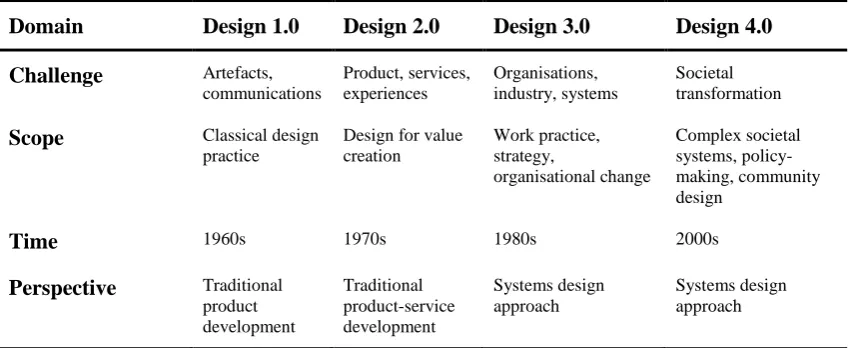
When viewed from a historical perspective, the development of design education can be said to undergo paradigm shifts in response to structural changes happening in society (O’Rafferty et al., 2014). Vanpatter and Jones (2009) advance a useful
Table 1. Design domains
Domain Design 1.0 Design 2.0 Design 3.0 Design 4.0
Challenge Artefacts, communications Product, services, experiences Organisations, industry, systems Societal transformation
Scope Classical design practice
Design for value creation Work practice, strategy, organisational change Complex societal systems, policy-making, community design
Time 1960s 1970s 1980s 2000s
Perspective Traditional product development Traditional product-service development Systems design approach Systems design approach
Based on Vanpatter and Jones (2009) and Jones (2014).
In addition to the factors mentioned above, design domains from 1.0 to 4.0 can also differ in terms of scale, adaptability, design process, stakeholders’ involvement, team composition, and supporting tools (Jones, 2014; Vanpatter, 2014; Vanpatter and Jones, 2009). These factors are not intended as universal or absolute, but rather as useful markers for assessing whether design performance is sufficient to address the particular problems of different design domains (Jones, 2014). Also, according to this model, design competence is transferable from higher domains to lower ones, but not the other way around. In other words, Designs 3.0 and 4.0 require competences that cannot be simply acquired from Designs 1.0 and 2.0. More importantly, lower level domains are subordinate to higher ones, in the sense that the successful developed of solutions for Designs 1.0 or 2.0 can be powerfully influenced by aspects such as policy instruments and culture, which are systemic components of Designs 3.0 and 4.0 (Jones, 2014; Vanpatter and Jones, 2009).
which focused on traditional product or product-service development, had drawbacks in terms of addressing complex societal problems (Jones, 2014). That is because
traditional approaches generally aim at creating transformation at lower aggregation levels (see examples of micro and meso aggregation levels in Section 2.1), whereas addressing complex problems requires a systems design approach which includes elements that are characteristic of Design 4.0, such as societal systems, public policy making, and community design (Jones, 2014).
Educators and institutions should explore and embrace broader possibilities for design practice and acknowledge the need for paradigm change in design education (Raduma 2011). Systems thinking, more particularly, has been largely neglected as a potential approach to update design education (Sevaldson, 2009). These are important concerns considering that institutions exert a crucial influence in determining the constraints and opportunities associated with capacity building (Baser and Morgan, 2008).
points-of-view, and expertise (ibid). Competences and capabilities are essential parts of the broader concept of capacity building.
We contend that design education helps to develop collective capabilities in students and that these are involved in the capacity building of future professionals. Following Baser and Morgan (2008), there are five core collective capabilities. They are the capability to: commit and engage; carry out technical, service delivery, and logical tasks; relate and attract; balance diversity and coherence; and finally, adapt and self-renew.
In addition, we hold that with time and practice, design education helps students to develop general core capabilities into core design competences. Conley (2004) proposes the following seven core competences of design: understand the context or circumstances and frame the problem; define the situation’s appropriate level of abstraction; model and visualise solutions, even with ill-defined information; simultaneously create and evaluate multiple alternatives to the problem; add and maintain value as the process of problem solving unfolds; establish purposeful relationships among solution elements and between the solution and its context; and finally, use form to embody ideas and to communicate their values.
To enlighten the issue of capacity building for a systems design approach, we gained theoretical insights into how to introduce systems thinking into design
which build on systems thinking that align with Conley’s (2004) core design competences.
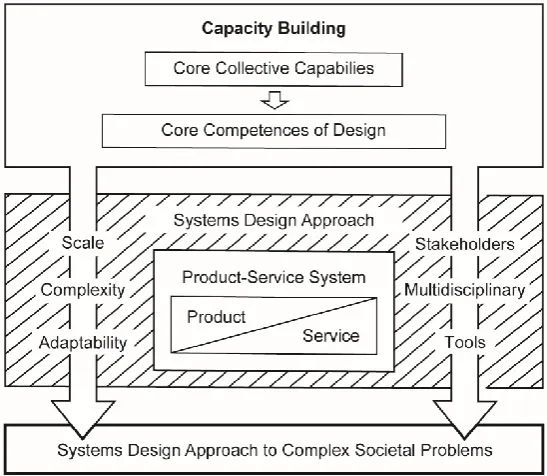
Figure 1. Capacity building framework for a Systems Design Approach to Complex Societal Problems
The capacity building framework emerging from this literature review is comprised of key factors that stand out as necessary for skilful performance at Design domains 3.0 and 4.0: scale; complexity; adaptability; multiple stakeholders; multidisciplinary teams; and systems-oriented tools. As explained below, these key factors aim to enhance the design competences – thus, the capacity building of students – to support the
development of appropriate solutions for complex societal problems.
2.1 Scale
and society problem scale level). The meso level focuses on system infrastructures and institutional arrangements (e.g., at industry, organisation, and subsystems level). Problem solutions at this level often aim at organisational transformation. At the micro level, specific technologies and market offerings are explored to result in product-service and individual transformations (e.g., at experience, product-service, product, and communication level). In summary, the development and implementation of solutions for complex societal problems can occur at multiple aggregation levels: at the micro level of product-related interventions; at the meso level of organisational
rearrangements; and at the macro level of policy redesign (Elzen et al., 2004). Depending on their capacity building, design engineers can be more or less empowered to adjust the scale of the outcomes they intend to create. In other words, the outcomes of design solutions can aim to introduce changes in system dynamics from the level of user behaviours and infrastructure development to the level of regulatory
instruments and system transitions. For instance, it is unlikely that a sustainable innovation at the micro and meso levels (e.g., new technologies and market offerings) will be able to replace existing systems without changes at the macro level (e.g., support from economic instruments and regulatory frameworks). In summary, the capacity to analyse a complex system at different aggregation levels (problem scale) using systems thinking and a multilevel perspective is of paramount importance (Joore and Brezet, 2015; Mulder et al., 2012).
2.2 Complexity
Gershenson and Heylighen (2004) conducted a comprehensive study of the basic tenets of complexity. According to the authors, throughout the years, scholars and
practitioners have relied on a classical model of thinking, one which emphasises
has provided the basis for scientific models over time and has been highly effective in explaining complex natural phenomena, it also has some inherent drawbacks when dealing with complexity of a societal kind (Gershenson and Heylighen, 2004; Nelson, 2008). Classical thinking assumes invariant, fixed distinctions, whereas complex
societal systems are comprised of intertwined components and properties that cannot be separated or distinguished absolutely (Gershenson and Heylighen 2004). The role of systems thinking is to offer a broader perspective that complements the more
fragmented, fact-oriented, and controlling aspects of classical thinking (Sevaldson, 2009).
Recent interdisciplinary research has corroborated the adoption of systems thinking as a problem-solving approach capable of handling the inherent complexity of societal problems (DeTombe, 2015a, 2015b; Gaziulusoy, 2015; Gaziulusoy and Boyle, 2013). Generally speaking, a problem can be classified as simple, complicated, or complex, depending on the number, types, and interactions of its components, as well as the characteristics of a problem situation (DeTombe, 2015a; Valckenaers and Van Brussel, 2016). Complex societal problems are comprised of interconnected components affected by multi-causes, multi-effects, and, therefore, multi-solutions (Baser and Morgan, 2008). Moreover, as with other problems tackled by the field of design engineering, complex problems are social and technical in nature. Hence, we can describe complex societal problems in terms of the balance between two major
In this sense, the first step to deal with complex systems is to acknowledge the dynamic complexity of its multi-causal problems and the cognitive factors involved in understanding the relations embedded in the problem complexity (Jones, 2014). As clarified by Gershenson and Heylighen (2004), an analytical method that takes apart the components of a given complex system will destroy the connections between
components, making it difficult to understand and describe the behaviour of the system as a whole. This notion is particularly relevant to design practice since design solutions are the result of the interplay between various components of the socio-technical system. According to Buchanan et al. (1992), design solutions aimed at complex systems can produce innumerable possible outcomes. Therefore, the design orientation should remain flexible and intuitive, rather than analytical and procedural.
2.3 Adaptability
A system design approach advocates an open-framing approach1 to complex problems rather than product-service presumptions (Conklin et al., 2007b). To cope with the unpredictability of complex systems, problems solvers can rely on multiple problem definitions (Conklin et al., 2007b) and alternative futures (scenarios) consistent with long-term strategic goals or visions (Jones, 2014). In such an approach, the
problem definition evolves in parallel with the solution formulation and emerges from a nonlinear process that emphasises problem understanding (Conklin et al., 2007b). Ultimately, a systems design approach disputes the effectiveness of controlled, planned, engineering solutions, since the tight design and control of outcomes may cloud
unexpected opportunities for innovation (Morgan, 2006).
Another factor responsible for increasing complexity in systems is self-organisation. Self-organising systems search for solutions by themselves, without the need for intervention. This behaviour occurs as a result of coping mechanisms that emerge from the need to self-maintain the functionality of the system (Gershenson and Heylighen, 2004), and it poses additional challenges to design engineering intervention.
2.4 Multiple stakeholders
Complex systems are comprised of multiple stakeholders, which include private companies, government, clients, end-users, knowledge producers, community
representatives, and NGOs. In resource-limited contexts (e.g., low-income markets and
1 An open-framing approach refers to a problem definition and framing that focuses on the final
function, utility, or user satisfaction, rather than on a specific solution (e.g., product or
technology). The goal of open framing is to accommodate shared meaning and
understanding among stakeholders so that reframing is possible at any stage of the design
developing economies), the complexity and ambiguity of the interests within the network of stakeholders are higher than in traditional systems (Matos and Silvestre, 2013). Conklin et al. (2007a, 2007b) refer to the distinctive trait shared by complex problems or systems which makes it almost inconceivable to completely understand, control, predict, or determine their behaviours. Scholars acknowledge that addressing a complex societal problem requires engaging in conversation with multiple stakeholders (Conklin et al., 2007a, 2007b; Sevaldson, 2008; Sevaldson et al., 2010). In this process, problem solvers must acknowledge that each stakeholder may have a distinct perception of the functionality of the system and a particular motivation to engage.
2.5 Multidisciplinary teams
Complex societal problems, in particular ones concerned with sustainable development, imply that competences required to achieve effective solutions are interdisciplinary (Mulder et al., 2012), transdisciplinary, and diverse (O’Rafferty et al., 2014). According to Jones (2014), in a complex system it is nearly impossible for any single expert to understand the entire system, and thereby, it is not possible to achieve optimal problem solving and decision making based on sufficient individual knowledge. A design project team can conceive solutions at a lower level design domain. On the other hand, societal and organisational transformations (concerning higher design domains) are likely to be achieved by multidisciplinary project teams (Vanpatter, 2014).
2.6 Systems-oriented tools
emerge while problem solvers understand the dynamics of the components of the socio-technical system embedded in the problem. A major challenge is to translate contextual information into useful insights for the design process. Supporting tools applied in a systems design approach provide the means to explore and develop capabilities into design competences, and to facilitate collaborative inquiring, reasoning, visualising, modelling, simulating, and making (Jones, 2014; Skyttner, 2006).
System-oriented tools as applied in systems methodologies can help gain knowledge of the real world and capture the logic of the problem situation, to deepen understanding of the real world and promote debate about feasible and desirable actions for change, and focus on creating awareness among marginalised groups about their situation and suggest improvements in their problem situation (Jackson, 2001).
3. Educational experiment
3.1 Contextualization
Renewable Energy2 (DRE) (Vezzoli et al., 2007; Vezzoli and Ceschin, 2011). Distributed Renewable Energy (DRE) refers to the combination of a
decentralised and distributed generation of renewable energy sources, such as solar, biomass, and hydro (Emili et al., 2016). Product-Service Systems (PSS), in turn, is a design approach that has been extensively described in the sustainability literature as suitable to address complex societal problems, such as those encountered in the application of DRE in low-income energy markets (Bandinelli and Gamberi, 2011; Bartolomeo et al., 2003; Emili et al., 2016; Friebe et al., 2013; Vezzoli et al., 2014; Vezzoli et al., 2015a; Vezzoli et al., 2015b). An example that illustrates a sustainable energy PSS is the ‘Solar Heat Service’ provided by AMG. The company shifted its business model from selling heating equipment and distributing methane to selling heat as a finished product. In other words, rather than selling products (heating systems) or charging the client for the methane consumed, AMG offered a performance-based contract for heat produced (thermal kilowatts consumed for heating water). AMG remains the owner of the heating systems and uses different energy sources, such as methane, electrical and solar energy, to achieve higher levels of energy efficiency. Several authors (Manzini and Vezzoli, 2003; UNEP, 2001, 2002) agree that result-oriented solutions, such as the ‘Solar Heat Service’, can stimulate major changes in current production and consumption patterns for an environmentally sound path leading towards socioeconomic development.
2 According to the LENSes project , the DRE can be defined as follows: ‘A small-scale
generation plant sourced by renewable energy resources (such as sun, wind, water,
biomass and geothermal energy), at or near the point of use, where the user is the
producer, whether an individual, a small businesses and/or a local community, and the
In the literature on sustainable design, the application of PSS models to DRE has been advocated as a suitable approach for the development of sustainable energy
solutions in low-income and emerging economies (Costa Junior and Diehl, 2013; Emili et al., 2016; Vezzoli et al., 2015; Costa Junior et al., 2017). For the purposes of this study, the intention of the pilot course was to test the integration of systems thinking and PSS design as a way to build capacity for design engineering students at that Ugandan university. The course took place in the academic year of 2015; it required 70 hours of study from students, including time spent attending and completing teamwork sessions, lectures, mentoring sessions, practical assignments, and fieldwork.
3.2 Sample
The initial sample consisted of 14 students who voluntarily participated in the experiment. As the course progressed, a convenience sample of one female and nine male students (N=10) who successfully completed the course were analysed. The sample comprised participants with no significant difference in age. The participants in the course were divided into two multidisciplinary teams with backgrounds in Master’s programmes in Power Systems Engineering, Renewable Energy, and Technology Innovation and Industrial Development. They were analysed as both individuals (e.g., performing individual tasks) and as individuals as part of a team (e.g., collaborating with others and performing the task as a group).
Moreover, most of the participants (six) confirmed previous or current experience in student projects adopting systems-oriented approaches.
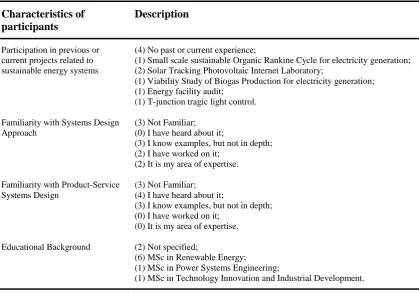
Table 2. Participants and their main characteristics (number of participants in parentheses)
Characteristics of participants
Description
Participation in previous or current projects related to sustainable energy systems
(4) No past or current experience;
(1) Small scale sustainable Organic Rankine Cycle for electricity generation; (2) Solar Tracking Photovoltaic Internet Laboratory;
(1) Viability Study of Biogas Production for electricity generation; (1) Energy facility audit;
(1) T-junction tragic light control. Familiarity with Systems Design
Approach
(3) Not Familiar; (0) I have heard about it;
(3) I know examples, but not in depth; (2) I have worked on it;
(2) It is my area of expertise. Familiarity with Product-Service
Systems Design
(3) Not Familiar; (4) I have heard about it;
(3) I know examples, but not in depth; (0) I have worked on it;
(0) It is my area of expertise. Educational Background (2) Not specified;
(6) MSc in Renewable Energy; (1) MSc in Power Systems Engineering;
(1) MSc in Technology Innovation and Industrial Development.
3.4 Data collection and analysis
In this study, we used the technique of Protocol Analysis to analyse the design activities carried out by students. This empirical, observational research method relies on verbal accounts (i.e., recalling what one was thinking while performing a design task) given by individual students and individuals within student teams regarding their own cognitive activities (see Adams et al., 2003; Günther and Ehrlenspiel, 1999). This research
method is used to analyse design activities, particularly for capturing the cognitive skills and abilities of designers and understanding the interrelation of different factors
collected in the form of audio-visual recordings, questionnaires, and transcripts made of student team work. From the data retrieved, we gained insights into how participants collected, generated, and transformed information, and finally went about developing the solutions for the design problem.
A series of observations were performed in order to understand the implications of systems thinking in the design process and the performance of the design tasks. Design tasks were undertaken by means of design assignments and hands-on workshops. Examples of design tasks performed by students were: evaluating best practices in energy-related products from a human centred design perspective (Assignment 2); generating and selecting promising PSS ideas (Assignment 3); generating business models for energy access (Assignment 4); and evaluating and visualising PSS concepts (Assignment 5). Guidance was provided in the classroom by the authors, and occasionally by invited experts, to assist students by employing teaching and learning resources grounded in systems thinking. The use of verbal accounts occurred in two ways. In design tasks carried out in groups, we limited the intervention (e.g. remind student to recall what they were thinking during the task) to avoid interference in the dynamics within student teams. Hence, the analysis of individual students within student’s teams was based on the observation of the
communication between them while performing the design tasks. On the other hand, in design tasks carried out individually by students, when necessary, students were
3.5 Course materials and pedagogical strategy
The course was structured around ten learning sessions comprised of traditional classroom sessions, hands-on workshops, and a field trip to the company SolarNow Uganda. Classroom sessions focused on introductory lectures, presentations of case studies (e.g., bio-gasification and electricity distribution on islands, and energy needs in the Ugandan healthcare sector), and inspiring lectures by professionals (experts) with experience in sustainable energy projects (e.g., Design without Borders and Energy Kiosks). The hands-on workshops were aimed at the use of systems-oriented tools to support students in carrying out design assignments.
Lectures were given on six major subjects: (I) Sustainable Energy for All; (II) Sustainable Product-Service System (S.PSS) Design; (III) Systems Design for
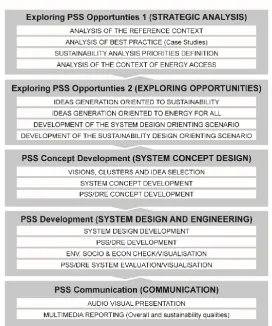
Figure 2. Product Service Systems Design
Source: Adapted from the teaching resources available at the LeNSes website3.
The (major) design assignment for the course, Assignment 1, addressed two real problems faced by local communities in Uganda. That is, students were asked to: (I) develop an off-grid biogas-based energy distribution system for the small communities on the Ssese Islands; or (II) design a distributed (renewable) energy system for one or more levels of the Ugandan Rural Healthcare System.
The course’s major learning objectives were that students should be able to successfully address complex societal problems, such as those experienced in
3 LeNSes | The Learning Network for Sustainable Energy Systems, available at
income energy markets by: (I) having a basic knowledge of theory, concepts,
approaches, methods, and tools for systems-oriented PSS Design; (II) gaining insights into conditions, drivers, and obstacles for PSS and DRE implementation in practice; acquiring knowledge and skills in the development and assessment of business models that support the successful introduction of innovative and sustainable energy delivery systems; (III) and finally, developing an understanding of and the skills required to design in multi-stakeholder environments.
Active learning, by means of a project-based approach, was emphasised during the full-time two-week course programme. This pedagogical approach is highly
effective for learning systems thinking, and interdisciplinary skills (Barak and Williams, 2007; Segalàs et al., 2010; Sevaldson, 2008, 2013). Two of the authors of this paper participated as course tutors, employing both formative assessments (e.g., observation, visual mapping, and questioning), to monitor student learning, and summative
assessment (e.g., final project and questionnaire), to measure the effectiveness of the proposed design approach. For instance, to measure learning, students were asked to reflect upon their tasks and use verbal accounts to express their understanding of the topic during classroom presentations or design assignment submissions. Moreover, at the end of the course students were asked to reflect on their experiences with traditional design approaches and to respond to an evaluation questionnaire about their current experience with the systems design approach adopted by the course.
During the course we introduced real life assignments, hands-on activities, and external stakeholder mentors. Learning systems and interdisciplinary skills required for capacity building for a systems design approach are better achieved by active and participatory learning processes, such as project-based and
inquiry-based education (Barak and Williams, 2007; Segalàs et al., 2010; Sevaldson, 2008, 2013).
We attempted to shift the students’ attention from artefacts and entities (technical systems) to the relations and interactions between them (socio-technical systems). A systems design approach was adopted as a general philosophy that guided the overall goal of the design tasks. It was seen as a mental model (systems mindset) through which students could contextualise and frame problems.
We encouraged a certain level of tolerance to uncertainty. By using an open-framed problem definition, and open-ended solutions development, we provided students the opportunity to adapt and reconfigure solutions to better fit the needs of the system during the project development. However, we emphasise that adopting such a nonlinear process can lead to unpredictable patterns, disorder, and messes as the design task unfolds.
We clearly communicated that the information gathered by students regarding the context should be used to understand, explain, and adapt the solutions to system’s events, rather than to try to control, predict, or determine the system’s behaviour.
appropriate manner to address complex societal problems is unfolding the design problem in the context of the whole system, rather than reducing it to the system’s components.
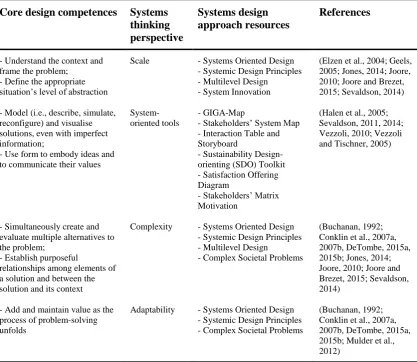
[image:24.595.91.509.386.748.2]More specifically, tutors explored the following key factors which lead to a skilful performance when facing complex societal problems: scale; system-oriented tools; complexity; and, adaptability. Due to the limitations of this experiment, multiple stakeholders and multidisciplinary teams could not be incorporated into the course’s pedagogical approach. Table 3 describes the approach used for embedding systems thinking as a way to build capacity in participants of the course.
Table 3. Embedding a systems design approach in the course curriculum and students’ core design competences
Core design competences Systems thinking perspective
Systems design approach resources
References
- Understand the context and frame the problem;
- Define the appropriate situation’s level of abstraction
Scale - Systems Oriented Design - Systemic Design Principles - Multilevel Design
- System Innovation
(Elzen et al., 2004; Geels, 2005; Jones, 2014; Joore, 2010; Joore and Brezet, 2015; Sevaldson, 2014) - Model (i.e., describe, simulate,
reconfigure) and visualise solutions, even with imperfect information;
- Use form to embody ideas and to communicate their values
System-oriented tools
- GIGA-Map
- Stakeholders’ System Map - Interaction Table and Storyboard
- Sustainability Design-orienting (SDO) Toolkit - Satisfaction Offering Diagram
- Stakeholders’ Matrix Motivation
(Halen et al., 2005; Sevaldson, 2011, 2014; Vezzoli, 2010; Vezzoli and Tischner, 2005)
- Simultaneously create and evaluate multiple alternatives to the problem;
- Establish purposeful
relationships among elements of a solution and between the solution and its context
Complexity - Systems Oriented Design - Systemic Design Principles - Multilevel Design
- Complex Societal Problems
(Buchanan, 1992; Conklin et al., 2007a, 2007b, DeTombe, 2015a, 2015b; Jones, 2014; Joore, 2010; Joore and Brezet, 2015; Sevaldson, 2014)
- Add and maintain value as the process of problem-solving unfolds
Adaptability - Systems Oriented Design - Systemic Design Principles - Complex Societal Problems
4. Results
The course led to two comprehensive sustainable energy PSS concepts, which are briefly presented in Boxes 1 and 2. In addition to the results described here, other immediate results were achieved, including the provision of academic training for 10 design engineering students and the delivery of appropriate learning strategies by means of an Open Learning E-Package (OLEP). The OLEP is comprised of learning resources, such as slide shows, texts, audios, and videos, which were made available online to support HEIs in the decentralised and collaborative production and widespread application of Sustainable PSS and DRE projects.
Box 1 Electricity generation from a hydropower plant for the Rwagimba Health Centre III and rural community
In rural areas of Uganda, access to the government grid is limited to 28% of the health
facilities and only to 11% of the rural population. In light of this issue, the project carried out
by Group 1 aimed to develop a pico hydropower plant (<5 kW) to generate and distribute
electricity for the Rwagimba Health Centre III (HC III) and nearby communities located in
the rural area of the Rwenzori Mountains. The energy requirements of the HC III are mainly
for lighting, refrigeration, and storage. In addition to supplying the HC III and nearby
communities, the project aimed to support the development of income-generating activities by
establishing the health facility as a customer service point for selling solar products, renting
solar PV systems, and charging equipment and devices, such as solar lights and cell phones.
The service point offers solutions for local business by providing energy for lighting and
communication and provides affordable products and services for the poorest households of
the community.
Box 2 Electricity generation from biomass gasification for the Lutoboka Village
This project aimed to develop an off-grid biogas-based energy distribution system for
Lutoboka Village. Lutoboka is a small village with a population of approximately 500
are the mainstays of the economy. Lutoboka energy supply is not connected to the mainland
electricity grid, and therefore the village has very limited access to energy. Electricity is often
supplied by expensive and unclean sources of energy, such as diesel generators, even though
biomass is widely available. Group 2’s goal was to generate electricity from biomass
gasification of water hyacinth, fish wastes, agro wastes, and biowastes, and distribute to
households and fishermen. The energy will be distributed mainly by battery charging stations
geographically distributed throughout the village.
During the educational experiment, we observed that the mindset and reasoning model followed by students determined the way in which individual students and student teams discussed and solved conflicts, and how they made decisions aimed at solving complex problems. Therefore, we argue that the design approach used by students influenced the outcomes of the design tasks. Since complex societal problems are intrinsically unpredictable, in this educational experiment we trained students to accept that they would not be able to completely control or predict the behaviour of the system. The adoption of a systems perspective supported students in understanding the need for tolerance to uncertainty and promoted a holistic approach to dealing with complex problems. Below, we provide more detail about the process of capacity building for a systems design approach observed throughout the course.
4.1 Problem scale and complexity
political lobbying, market, and culture). The challenge was to promote systems thinking during the sense making stage (Exploring PSS Opportunities), and then to promote change by taking advantage of technical skills and technological knowledge of the students. ‘We, first of all, begin to look at the energy requirements […], but there is a [water] stream […]; this is what we decided to look at when it comes to systems requirements. So, we decide to go with a Pico Hydro Scheme.’ (Student 4).
In a later stage (PSS concept development), the students demonstrated
satisfactory progress in approaching PSS concept ideas in a more comprehensive way while still applying their technological skills. Some students reported that while the design assignments posed many technical challenges in their conceptualisation, the adoption of systems thinking has facilitated the identification of a number of unfamiliar regulatory and socio-cultural challenges embedded in the societal context. ‘[The] Integration of different aspects was mind blowing to me; really found it practically [sic] very applicable in our communities.’ (Student 1).
The awareness of contextual factors prompted students to understand (and question) how the components of the socio-technical systems actually work, as opposed to the participants’ perceptions of how these factors should work. ‘This concept
[Product-Service System] can help me to design a more people-centred project ensuring that all parties involved are equally satisfied.’ (Student 2).
Additionally, they gained awareness that the interplay between artefacts and environment affects both environment and design. ‘[The value of a Systems Design Approach and PSS are] Design considerations for products that eliminate the
4.2 Increasing adaptability
The student teams showed considerable technological knowledge and technical skills suitable for the creation of solutions for the design assignments. However, students reported that relying solely on technical skills and technological solutions created limitations during the performance of the design task. For instance, both student teams started the design process by predicting energy demand and making calculations about the energy outputs of the system (e.g., biodigester size and generator’s power) before taking the step to make sense of the problem situation.
As a result of their strong technical orientation, students tended to approach the design problem by working directly on detailed (sub)solutions. Such a premature approach resulted in faulty conceptual development and limited the opportunity to form open-ended solutions from which new analyses and reflections could be drawn to formulate a better solution. As the course unfolded, the system thinking perspective discouraged this behaviour. ‘The concept [Systems Design Approach] is especially useful when dealing with cross-cutting issues like social, economic, environmental, and technical.’ (Student 2).
4.3 Using systems-oriented tools
The systems design approach offered students a range of tools and strategies which allowed them to consider the complexity of the socio-technical system. In the context of highly complex socio-technical systems, there is a need to create significant
understanding before promoting transformation. The increasing need for
context-specific knowledge and understanding has significant implications for the final solution. Therefore, students used tools such as the Stakeholders’ Motivation Matrix and the Sustainability Design-Orienting Toolkit (SDO toolkit) to gain a better understanding of the system in place and support the design process. Stakeholders’ Motivation Matrix is a reflective tool that aims at understanding relationships among stakeholders of the system, and identifying motivations, benefits and contributions that each one of them may have or make while participating in the system (Morelli and Tollestrup, 2006). Sustainability Design-Orienting Toolkit (SDO toolkit) is a visualisation tool that assists evaluating how different concept ideas score in sustainability impact (social,
environmental and economic) (Vezzoli and Tischner, 2005).
creation of multiple future scenarios or predictions. ‘Being able to include current and future predictions that may have an effect on the system is very mind opening.’ (Student 6).
Making use of visualisation tools, such as the Stakeholders’ Systems Map (Halen et al., 2005; Vezzoli, 2010) and Giga-map (Sevaldson, 2011, 2014), students created large maps that were capable of describing multiple layers and scales as well as relations and interconnections of the systems. ‘Systems maps are also very useful in helping us understand the way the entire system with materials, stakeholders, and partners interact with each other.’ (Student 4). In the course, visualisation became a powerful tool for analysing, understanding, and communicating complex problems. ‘We will use the systems map to help us understand the entirely [sic] of our systems.’
(Student 1).
5. Conclusion
Problem solvers often apply traditional approaches and classical thinking to deal with complex societal problems. The literature presented in this paper shows that a
traditional design approach often overlooks the complexities of societal problems, such as those found in the energy markets of low-income and emerging economies. Low-income energy markets face complex societal problems where a systems design
approach can be at it most fruitful, and therefore, most needed. In this context, we argue the need for enhancing students’ competences to better deal with complexity. In
integrating systems thinking into a traditional PSS design method can enhance students core design competences, and thereby the chances that these professionals will be ready to tackle the challenges when faced with complex societal problems, and so help to implement more sustainable energy systems.
This paper provides general recommendations for building capacity in future generations of designers, as opposed to proposing specific teaching resources. It is important to emphasise that the findings of this study present limitations due to
restrictive factors, such as the course structure, design assignments, and the size of the student sample. Generalisation could be enhanced by using a larger sample of students drawn from different low-income countries, and by carrying out different archetypal models of PSS applied to DRE. Although these factors limit the generalizability of the results, the study provides valuable insights into the process of capacity building for a systems design approach. The authors acknowledge that paradigm shifting of mental models and developing capacities can take years. Moreover, the success of initiatives, such as the LeNSes project, depends on the implementation and evaluation of these recourses by the academic community. However, training programmes similar to LeNSes and other more immediate actions aimed at capacity building can encourage those involved in design education to draw attention to the development of design competencies beyond product and service creation, and which are suitable to deal with highly complex societal problems.
6. Acknowledgments
Makerere University, Cape Peninsula University of Technology, Design without borders, Energy Kiosk and SolarNow. Furthermore, we also thank, Corbin Raymond, Elmar Stroomer, Venny Nakazibwe, Mary Suzan Abbo and Mackay Okure for their contributions in this study. This work was supported by the National Council for Scientific and Technological Development – Brazil (CNPq) under Grant number 202527/2011-5; and ACP-EU Cooperation Programme in Higher Education under Grant 2013-2016, Edulink Programme.
7. References
Adams, R. S., Turns, J., and Atman, C. J. (2003). Educating effective engineering designers: the role of reflective practice. Design Studies, 24(3), 275–294. doi:10.1016/S0142-694X(02)00056-X.
Bandinelli, R., and Gamberi, V. (2011). Servitization in oil and gas sector: outcomes of a case study research. Journal of Manufacturing Technology Management, 23(1), 87–102. doi:10.1108/17410381211196302.
Barak, M., and Williams, P. (2007). Learning elemental structures and dynamic
processes in technological systems: a cognitive framework. International Journal of Technology and Design Education, 17(3), 323–340. doi:10.1007/s10798-006-9006-0.
Bartolomeo, M., dal Maso, D., de Jong, P., Eder, P., Groenewegen, P., Hopkinson, P., James, P., Nijhuis, L., Örninge, M., Scholl, G., et al. (2003). Eco-efficient producer services—what are they, how do they benefit customers and the environment and how likely are they to develop and be extensively utilised? Journal of Cleaner Production, 11(8), 829–837.
doi:10.1016/S0959-6526(02)00157-9.
Baser, H., and Morgan, P. (2008). Capacity, Change and Performance: Study Report. Brussels.
Blizzard, J. L., and Klotz, L. E. (2012). A framework for sustainable whole systems design. Design Studies, 33(5), 456–479. doi:10.1016/j.destud.2012.03.001. Blizzard, J. L., Klotz, L., Pradhan, A., and Dukes, M. (2012). Introducing whole‐
Journal of Sustainability in Higher Education, 13(2), 177–196. doi:10.1108/14676371211211854.
Buchanan, R. (1992). Wicked Problems in Design Thinking. Design Issues, 8(2), 5. doi:10.2307/1511637.
Charnley, F., Lemon, M., and Evans, S. (2011). Exploring the process of whole system design. Design Studies, 32(2), 156–179. doi:10.1016/j.destud.2010.08.002. Checkland, P. (1981). Systems thinking, systems practice. Wiley.
Conklin, J., Basadur, M., and Vanpatter, G. K. (2007a). Rethinking Wicked Problems (Part 1). Next Design Leadership Institute Journal, 10(10.3), 31.
Conklin, J., Basadur, M., and Vanpatter, G. K. (2007b). Rethinking Wicked Problems (Part 2). Next Design Leadership Institute Journal, 10(10.3), 31.
Conley, C. (2010). Leveraging Design’s Core Competencies. Design Management Review, 15(3), 45–51. doi:10.1111/j.1948-7169.2004.tb00171.x.
Costa Junior, J. da, and Diehl, J. C. (2013). Product-Service System Design Approach for the Base of the Pyramid Markets: Practical Evidence from the Energy Sector in the Brazilian Context. In M. Schaefer, N. Kebir, and D. Philipp (Eds.),
Proceeding of International Conference on Micro Perspectives for Decentralized Energy Supply (pp. 48–51). Berlin: Technische Universität Berlin.
Costa Junior, J. da, Santos, A. L. R. dos, and Diehl, J. C. (2017). Introducing systems-oriented design for complex societal contexts in design engineering education. Form Akademisk - Forskningstidsskrift for Design Og Designdidaktikk, 10(1), 1–20. doi: https://doi.org/10.7577/formakademisk.1460
Cross, N., Christiaans, H., and Dorst, K. (1996). Introduction: The Delft Protocols Workshop. In N. Cross, H. Christiaans, and K. Dorst (Eds.), Analysing Design Activity (pp. 1–16). John Wiley & Sons.
DeTombe, D. (2015a). Complex Societal Problems. In Handling Societal Complexity (pp. 35–79). Berlin, Heidelberg: Springer Berlin Heidelberg. doi:10.1007/978-3-662-43917-3_3.
DeTombe, D. (2015b). Human Problem Handling. In Handling Societal Complexity (pp. 81–154). Berlin, Heidelberg: Springer Berlin Heidelberg. doi:10.1007/978-3-662-43917-3_4.
Emili, S., Ceschin, F., and Harrison, D. (2016). Energy for Sustainable Development Product – Service System applied to Distributed Renewable Energy: A classifi cation system, 15 archetypal models and a strategic design tool. Energy for Sustainable Development, 32, 71–98. doi:10.1016/j.esd.2016.03.004. Friebe, C. A., Flotow, P. Von, and Täube, F. A. (2013). Exploring the link between
products and services in low-income markets—Evidence from solar home systems. Energy Policy, 52, 760–769. doi:10.1016/j.enpol.2012.10.038. Gaziulusoy, A. İ. (2015). A critical review of approaches available for design and
innovation teams through the perspective of sustainability science and system innovation theories. Journal of Cleaner Production, 107, 366–377.
doi:10.1016/j.jclepro.2015.01.012.
Gaziulusoy, A. İ., and Boyle, C. (2013). Proposing a heuristic reflective tool for reviewing literature in transdisciplinary research for sustainability. Journal of Cleaner Production, 48, 139–147. doi:10.1016/j.jclepro.2012.04.013.
Geels, F. W. (2005). Technological transitions and system innovations: a co-evolutionary and socio-technical analysis. Cheltenham, UK: Edward Elgar Publishing.
Geels, F. W. (2011). The multi-level perspective on sustainability transitions: Responses to seven criticisms. Environmental Innovation and Societal Transitions, 1(1), 24–40. doi:10.1016/j.eist.2011.02.002.
Gershenson, C., and Heylighen, F. (2004). How can we think the complex? Managing the Complex Vol.1: Philosophy, Theory and Application., 47–62.
Günther, J., and Ehrlenspiel, K. (1999). Comparing designers from practice and designers with systematic design education. Design Studies, 20(5), 439–451. doi:10.1016/S0142-694X(99)00019-8.
Günther, J., Frankenberger, E., and Auer, P. (1996). Investigation of individual and team design processes. In N. Cross, H. Christiaans, and K. Dorst (Eds.), Analysing design activity (pp. 112–117). John Wiley & Sons.
Halen, C. van, Vezzoli, C., and Wimmer, R. (2005). Methodology for Product Service System Innovation: How to implement clean, clevera and competitive strategies in European industries. Assen, Netherlands: Royal Van Gorcum.
Hammond, A. L., Kramer, W. J., Katz, R. S., Tran, J. T., and Walker, C. (2007). The Next 4 Billion: Market size and business strategy at the base of the pyramid. Washington. Retrieved from http://www.wri.org/publication/the-next-4-billion Jackson, M. C. (2001). Critical systems thinking and practice. European Journal of Operational Research, 128(2), 233–244. doi:10.1016/S0377-2217(00)00067-9 Johnson, J. (2005). Complexity science in collaborative design. CoDesign, 1(4), 223–
242. doi:10.1080/15710880500478346.
Jones, P. H. (2014). Systemic Design Principles for Complex Social Systems. In G. S. Metcalf (Ed.), Social Systems and Design (Vol. 1, pp. 91–128). Tokyo: Springer Japan. doi:10.1007/978-4-431-54478-4_4.
Joore, P. (2010). New to Improve-The Mutual Influence between New Products and Societal Change Processes. Delft University of Technology.
Joore, P., and Brezet, H. (2015). A Multilevel Design Model: the mutual relationship between product-service system development and societal change processes. Journal of Cleaner Production, 97, 92–105. doi:10.1016/j.jclepro.2014.06.043. Kaygusuz, K. (2007). Energy for Sustainable Development: Key Issues and Challenges.
Energy Sources, Part B: Economics, Planning, and Policy, 2(1), 73–83. doi:10.1080/15567240500402560.
Lemons, G., Carberry, A., Swan, C., Jarvin, L., and Rogers, C. (2010). The benefits of model building in teaching engineering design. Design Studies, 31(3), 288–309. doi:10.1016/j.destud.2010.02.001.
Lopes, A. M., Fam, D., and Williams, J. (2012). Designing sustainable sanitation: Involving design in innovative, transdisciplinary research. Design Studies, 33(3), 298–317. doi:10.1016/j.destud.2011.08.005.
Manzini, E., and Vezzoli, C. (2003). A strategic design approach to develop sustainable product service systems: examples taken from the ‘environmentally friendly innovation’ Italian prize. Journal of Cleaner Production, 11(8), 851–857. doi:10.1016/S0959-6526(02)00153-1.
Morelli, N., & Tollestrup, C. (2006). New representation techniques for designing in a systemic perspective. In Proceedings of the Engineering and Product Design Education Conference. Salzburg University of Applied Sciences, Salzburg. Morgan, P. (2006). Ways of Thinking About Capacity Issue. Maastrich.
Mulder, K. F., Segalàs, J., and Ferrer‐Balas, D. (2012). How to educate engineers for/in sustainable development. International Journal of Sustainability in Higher Education, 13(3), 211–218. doi:10.1108/14676371211242535.
Nelson, H. G. (2008). Simply Complex by Design. Performance Improvement Quarterly, 20(2), 97–115. doi:10.1111/j.1937-8327.2007.tb00443.x.
Nelson, H. G., and Stolterman, E. (2012). The Design Way: Intentional change in an unpredictable world. Cambridge, UK: MIT PRESS.
O’Rafferty, S., Curtis, H., and O’Connor, F. (2014). Mainstreaming sustainability in design education – a capacity building framework. International Journal of Sustainability in Higher Education, 15(2), 169–187. doi:10.1108/IJSHE-05-2012-0044.
Raduma, W. (2011). Occupy Reimagining Design. The ReReThinking Series.
Segalàs, J., Ferrer-Balas, D., and Mulder, K. F. (2010). What do engineering students learn in sustainability courses? The effect of the pedagogical approach. Journal of Cleaner Production, 18(3), 275–284. doi:10.1016/j.jclepro.2009.09.012. Sevaldson, B. (2008). A system approach to design learning. In A. Menges (Ed.),
System thinking and Integral Design. Offenbach: Hochschulverlag HFG Offenbach.
Sevaldson, B. (2009). Why should we and how can we make the design process more complex ? In M. L. Berg (Ed.), Shaping Futures (pp. 274–281). Oslo: Oslo School of Architecture.
Sevaldson, B. (2011). Giga-mapping: Visualisation for complexity and systems thinking in design. Nordes ’11: The 4th Nordic Design Research Conference, 137–156. Sevaldson, B. (2013). Systems Oriented Design: The emergence and development of a
designerly approach to address complexity. In 2nd International Conference for Design Education Researchers (pp. 14–17). Olslo.
Sevaldson, B. (2014). System Oriented Design (Webpage). Retrieved January 1, 2014, from http://www.systemsorienteddesign.net/
Design - Now! Challenges and Opportunities for Design Research, Education and Practice in the XXI Century (pp. 465–474). Bangalore: Greenleave Publishers.
Skyttner, L. (2006). General Systems Theory - Problems, Perspectives, Practice. General Systems Theory: Problems, Perspectives, Practice. World Scientific Publishing Co. Pte. Ltd. doi:10.1142/9789812774750.
Ulrich, W. (1983). Critical Heuristics of Social Planning: A New Approach to Practical Philosophy. Wiley.
UNEP. (2001). The Role Of Product Service Systems in a Sustainable Society. Paris. UNEP. (2002). Product-Service Systems and Sustainability: Opportunities for
sustainable solutions. Paris.
Valckenaers, P., and Van Brussel, H. (2016). On the Design of Complex Systems. In Design for the Unexpected (pp. 9–18). Elsevier. doi:10.1016/B978-0-12-803662-4.00002-3.
Vanpatter, G. K. (2014). Making Sense of Next Design Frontiers. Humantific, 1–13. Vanpatter, G. K., and Jones, P. (2009). Design 1.0, 2.0, 3.0, 4.0; The Rise of Visual
SenseMaking. NextD Journal, (March), 1–12.
Vezzoli, C. (2010). System Design for Sustainability: Theory, Methods and Tools for a Sustainable ‘satisfaction-system’ Design (2nd ed.). Maggioli Editore.
Vezzoli, C., and Ceschin, F. (2011). The Learning Network on Sustainability: an e-mechanism for the development and diffusion of teaching materials and tools on design for sustainability in an open-source and copy left ethos. International Journal of Management in Education, 5(1), 22.
doi:10.1504/IJMIE.2011.037753.
Vezzoli, C., Ceschin, F., and Diehl, J. C. (2015). Sustainable Product-Service System Design applied to Distributed Renewable Energy fostering the goal of
sustainable energy for all. Journal of Cleaner Production, 97, 134–136. doi:10.1016/j.jclepro.2015.02.069.
Vezzoli, C., Ceschin, F., Osanjo, L., Moalosi, R., Nakazibwe, V., and Diehl, J. C. (2015). An african-european network of design universities fostering the goal of sustainable energy for all: An innovative teaching approach based on the
Vezzoli, C., Ceschin, F., and Rithaa, M. M. (2007). LeNS _ AFRICA An African Learning Network on Sustainability for the development and diffusion of teaching materials and tools on Design for Sustainability in an open-source and copyleft ethos. Design, 5(December), 22–43. doi:10.1504/IJMIE.2011.037753. Vezzoli, C., Delfino, E., and Ambole, L. A. (2014). System Design for Sustainable
Energy for all. A new challenging role for design to foster sustainable
development. FORMakademisk, 7(3), 1–27. doi:10.7577/formakademisk.791 Vezzoli, C., and Tischner, U. (2005). Sustainability design-orienting toolkit