Cite as: Jones, K., Fujita, T. and Ding, L. (2004) Structuring mathematics lessons to develop geometrical reasoning: comparing lower secondary school practices in China, Japan and the UK. Paper presented at the British Educational Research Association annual conference 2004 (BERA2004), Manchester, UK, 15-18 September 2004.
Structuring Mathematics Lessons to Develop Geometrical Reasoning:
comparing lower secondary school practices in China, Japan and the UK
Keith Jones, School of Education, University of Southampton
Taro Fujita, Curriculum Studies, University of Glasgow
Liping Ding, School of Education, University of Southampton
Achievement in mathematics continues to be a crucial factor in the success of school systems around the world. As a result, this area of the curriculum has been the subject of considerable international comparative research, mostly focussed on pupil achievement but also examining teaching methods, curricula, and so on. In all this, and perhaps unsurprisingly, the central role of teachers, and how they structure their lessons, has emerged as a key factor in pupil learning. A number of projects have examined the structure of mathematics lessons, either to typify individual lessons in specified countries, or as an attempt to describe the variety of lesson structures used by particular teachers in particular countries over a sequence of lessons. To date there has been little comparative work specifically on how teachers structure mathematics lessons to develop geometrical reasoning despite the issue of how to improve geometry teaching being of considerable international concern. This paper reports early data from a larger comparative study that includes the analysis of classroom teaching materials. This paper compares suggestions about how teachers might structure geometry lessons in lower secondary school in three countries, China, Japan, and the UK (specifically England), chosen because they represent some interesting similarities and contrasts. The analysis focuses on the background to the suggestions available to teachers, in particular where approaches are similar and where they diverge. What the implications might be for student achievement in geometry in the three countries is identified as an area for future research.
Given the goal of improving educational systems around the world, questions about how the educational systems of different countries might most usefully be compared remain central to international comparative research in education. In mathematics education, an area of the curriculum that plays a critical role in the success of schools, many countries have embarked, or are embarking, on far-reaching reforms. Influential in many of these reforms is the (recently renamed) Trends in International Mathematics and Science Study (TIMSS), which is investigating pupil achievement, the mathematics curricula, teaching methods, and so on, across almost 50 countries (see, for example, Mullis et al, 2000; Robitaille at al, 2000; Schmidt et al, 1997).
(Schmidt et al, 1996; Valverde et al, 2002).
As part of TIMSS, or related to it, a number of projects have examined the teaching methods that teachers (typically) use in various countries and, related to this, how teachers structure their lessons (see, for example, Jones, 1997; Shimizu, 2002; Stigler and Hiebert, 1999). In examining how teachers structure their mathematics lessons, the aim of such work has generally been either to typify individual lessons in specified countries, or attempt to describe the variety in structures used by particular teachers in particular countries over a sequence of lessons.
To date there has been little comparative work specifically on how teachers structure mathematics lessons to develop geometrical reasoning. This is despite the issue of geometry teaching being of considerable international concern, especially its role in developing students’ powers of reasoning (see, for example, Mammana and Villani, 1998; Royal Society, 2001).
This paper reports early small-scale data from a larger comparative study that is also examining teaching materials (see, for example, Fujita & Jones, 2003a & 2003b). The analysis presented in this paper compares suggestions about how teachers might structure geometry lessons in lower secondary school in three countries: China, Japan and the UK (specifically England), countries taken in alphabetic order and selected as they represent an interesting sample of countries (see methodology section for more on the choice of countries).
In particular, the paper reports on the range of influences on the ways lessons can be structured, and in particular where approaches are similar and where they diverge. What the implications might be for student achievement in geometry in the three countries under consideration is identified, in the final section of the paper, as an area for future research.
International Comparative Research in Mathematics Education
The mathematics area of the curriculum, and its teaching, have been the subject of considerable international comparative research - including being the subject of the first ever large-scale international comparative study FIMS, the First International Mathematics Study
in 1964. TIMSS, the third, and recently renamed, Trends in International Mathematics and Science Study is the largest to date and is investigating pupil achievement, mathematics curricula, teaching methods, and so on, across almost 50 countries. A major focus of these types of large-scale international comparative studies is on relative pupil achievement but data is also available on curricula, teaching methods, and so on. In what follows we examine the findings of the latest TMISS survey for lower secondary school (specifically Grade 8 – UK Year 9 - students aged 13-14), carried out in 1999. In particular, we focus on the curriculum specification (the “intended” curriculum), the topics that teachers say they emphasise in their teaching, and the teaching methods they say they use. We consider relative pupil achievement later in the paper.
Curriculum and topics taught
Internationally, on average, the greatest percentage of topics intended to be taught to almost all Grade 8 students concern fractions and number sense (on average, 86 percent of the topics in these areas are taught to almost all students) and measurement (83 percent of topics are taught) - see Mullis et al, 2000, chapter 5). In geometry and in algebra, about two-thirds of the topics are expected to be taught to nearly all students. The least agreement, internationally, involves the choice of topics to be taught within data representation, analysis, and probability.
considerable variation amongst countries, ranging from all students in England being given the combined emphasis to none in the Russian Federation (in the latter, 100 percent of the students are taught combined algebra and geometry). Internationally on average, about 20% of students receive combined algebra and geometry, while in eight countries (Canada, Chile, Finland, Lithuania, Malaysia, the Philippines, Thailand, and the United States) more than a quarter of students receive instruction that emphasises mainly number. Very few students are given a major emphasis in geometry (three percent, on average, internationally), with Tunisia the only country where 20 percent or more of the students are in classes that emphasise geometry over other areas of the mathematics curriculum.
According to their teachers, nearly all Grade 8 students in all of the countries surveyed (around 50 countries) are taught topics in fractions and number sense. Similarly, instructional coverage is high for the measurement topics. Teachers report a range of instructional coverage across topics in geometry. For example, the topic “Simple two dimensional geometry – angles on a straight line, parallel lines, triangles and quadrilaterals” is reportedly taught internationally, on average, to 95 percent of students, while “visualization of three-dimensional shapes” is taught to only 57 percent (with a variation across countries from 7-99% of students). Another geometrical topic that shows a large variation across countries is “symmetry and transformations” (varying from being taught to 11-98% of students). According to their teachers, most students in Grade 8 receive moderate emphasis on geometry topics during their eighth grade. On average internationally, 22 percent of students are yet to be taught 50 percent or more of the geometry topics by the end of their eighth grade.
Teaching methods
The TIMSS data suggest that the two predominant teaching methods, accounting for nearly half of class time on average internationally, appear to be teacher lecture (23 percent of class time) and teacher-guided student practice (22 percent)- see Mullis (2000, chapter 6). In the TIMSS data, most students (86 percent on average internationally) agree with the teacher reports, saying that their teachers frequently show them how to do mathematics problems. Just under 60% of students say that discussing homework and working independently on worksheets or textbooks are also frequent activities in class.
Thus, and perhaps unsurprisingly, the central role of teachers, and how they structure their lessons, emerges as key factors in pupil learning. A number of projects, some related to TIMSS, others not so directly, are examining the way teachers structure their mathematics lessons. In the TIMSS Video Studies (Stigler et al, 1999; Stigler and Hiebert, 1999; Hiebert et al, 2003) the aim has been either to see the range of approaches used by teachers and/or, if appropriate, to try to typify individual lessons in specified countries. In other studies it is an attempt to describe the variety of structures used by particular teachers in particular countries over perhaps a sequence of lessons.
The latest TIMSS research related to lesson structures is the TIMSS 1999 Video Study
Notwithstanding these shared general features, there was discernible variation across the countries studies. Distinctions included how new content was introduced, the coherence across mathematical problems and within their presentation (ie the interrelation, both implicit and explicit, of the mathematical components of the lesson), the number and form of topics covered, the procedural complexity of the mathematical problems tackled, and classroom practices regarding individual student work and homework in class. For example, and considering the countries that are the topic of this paper, eighth-grade mathematics lessons in Japan appear to place a greater emphasis on introducing new content than those in the other six countries studied, while lessons in Hong Kong SAR placed a greater emphasis on practicing new content. In terms of procedural complexity, defined in terms of the number of steps it takes to solve a problem using a common solution method, 39% of the mathematics problems studied per lesson in Japanese classrooms were of high procedural complexity (defined as requiring more than four decisions by a student, and at least two sub-problems, to solve it, using conventional procedures), a greater percentage than in any of the other six countries studied. The UK was not included in the TIMSS Video Studies, neither was the bulk of the People’s Republic of China (and note that Hong Kong SAR, perhaps due in part to its western colonial history, may be a special case and be unlike the bulk of mainland China).
Nevertheless, as Hiebert et al (2003, p149-50) emphasise, in the data from the TIMSS 1999 Video Study the countries that show high levels of student achievement (in the TIMSS achievement tests) do not all employ teaching methods that combine and emphasise features in the same way. What the TIMSS video studies do suggest is that mathematics lessons within some countries do show some similarity of structure. In the seven countries studies for the
TIMSS 1999 Video Study, mathematics lessons in Japan, for example, show “some convergence [some similarity of structure] along the purpose dimension [whether the purpose of the lesson segment was reviewing previous content, introducing new content, or practicing new content]” (Hiebert et al, 2003, p147). Mathematics lessons in Hong Kong SAR also show convergence of purpose, although the purpose (and hence the structure) of the “typical” lesson is not the same as that of Japan.
Compared with the TIMSS Video Studies, a distinguishing characteristic of the Learner’s Perspective Study (Clarke, n.d.) is its attempt to document the teaching of sequences of lessons, rather than just single lessons. In addition, and, according to Clarke, unlike any previous international study, the project is trying to relate “identified culturally specific teacher practices to antecedent student behaviors and to consequent student outcomes”.
Of the work published to date from this project (and specifically related to the countries that are being considered in this paper), it seems that what can be characterized as a Japanese lesson pattern (see below, and Stigler & Hiebert, 1999, pp.79-80) does occur with sequences of lessons in Japan. Nevertheless, the data suggests that experienced teachers may be more flexible in following the lesson structure, depending on the phase of the entire unit of work or on the states of students’ understanding of the topic being taught (see Shimizu, 2002 & 2003). For example, the teacher may break with the structure in order to incorporate homework as the main point or use it as a building block for the next lesson.
lesson time) or in small groups (10.3% of lesson time). In the whole class interaction segments, the teacher frequently asked questions and expected the students to answer them. According to Mok, there were hardly any instances of students raising their own questions. The segments of pupil work, either individual or as groups, were all very short (about 1 to 3 minutes long each) but quite frequent.
Commentary on comparing teaching methods
In terms of accounting for teaching methods, the Learner’s Perspective Study aims to try to identify culturally specific teacher practices. As yet, however, papers on this aspect of the study are yet to emerge. In any event, the lessons so far examined for the study cover various topics in mathematics and may not necessarily be able to look in detail at geometry lessons. This suggests that the analysis of the structure of geometry lessons remains of significant interest.
What is more, as Hiebert et al (2003) conclude in terms of the TIMSS study:
“The results of this study make it clear that an international comparison of teaching, even among mostly high-achieving countries, cannot, by itself, yield a clear answer to the question of which method of mathematics teaching may be best to implement in a given country”.
Hiebert et al (2003, p150) This confirms that further research is needed to shed light on how teachers might best structure their lessons to develop geometrical reasoning.
Methodology
The focus of this study is on the structure of geometry lessons in lower secondary schools (students aged 11-14, or thereabouts). The reason for the focus is because the issue of geometry teaching continues to be an area of considerable international concern, especially given its role in developing students’ powers of reasoning (see, for example, Mammana and Villani, 1998; Royal Society, 2001). While the deductive method is central to mathematics and intimately involved in the development of geometry, providing a meaningful experience of deductive reasoning for students at school appears to be difficult. Research invariably shows that students fail to see a need for proof and are unable to distinguish between different forms of mathematical reasoning such as explanation, argument, verification and proof (for a recent review of this research, see Yackel and Hanna, 2003). Lower secondary school provides a vital step in the learning process in geometry, when students begin to develop more sophisticated ideas of shape and learn to reason about angles and lines, probably in terms of short chains of deduction. Thus suitable research questions include what aspects (routine procedures, mathematical thinking, learning precise mathematical words, etc.) are important in geometry for teachers in different countries; what problems for students do teacher pose (to develop reasoning), and why; what approaches (individual or group) are used, and why (to develop reasoning).
The principle aims of the research reported in this paper are two-fold:
• To determine the influences on how teachers structure their mathematics lessons in the three selected countries;
• To analyse selected suggestions that are available to teachers in the three countries to guide them in structuring geometry lessons for lower secondary school students.
topics. Yet, for teachers in the three countries there are different traditions and different ways in which they have responded to international developments over the years.
The sources of primary data selected for analysis in this research include:
• Government guidelines and other official documents
• Guidance documents and /or books for teachers
The specific sources of data providing suggested lessons are as follows:
• China: the data are mainly from the national teaching references (The Compulsory Education Nine-Year Secondary School Mathematical References, 1995-1996) and a popular teaching reference, Master teachers’ lessons records (Lower secondary school mathematics), 1992. Such items are currently used by secondary school mathematics teachers throughout China. The books provide teachers with details of how to prepare effectively for a special lesson, and provide such guidance as 1) the teaching and learning objectives; 2) the content (the topics involved in the lesson); 3) key factors of teaching and learning in the lesson; 4) the difficulties of teaching and learning in the lesson; 5) lesson procedure (the connection between different part of the lesson, what learning activities and how they were organised by the teacher; the students’ responses to expect).
• Japan: the data are of two types - suggested lesson plans by experienced teachers and university researchers (each with more than 10 years experiences, in general), and lesson plans which were actually implemented in classrooms. The plans include information of aims of lessons, problems for students, suggested activities for both teachers and students, time allocations, etc. Some of data from the latter type also include teachers’ reflective notes on the lesson, the worksheets used in lessons, students’ work, students’ comments on lessons, etc (note that these data are not the focus of analysis in this paper).
• UK (specifically England): the data source is the lesson plans provided for teachers as part of the National Strategy for Mathematics for Key Stage 3 (ie for lower secondary school mathematics). Although details of authorship are not given for the plans, it is likely that they have been produced by experts employed within the national strategy team and/or experienced teachers. For each lesson plan, the guidance generally includes 1) the teaching and learning objectives; 2) the content (the topics involved in the lesson); 3) key aspects of teaching and learning in the lesson; 4) the lesson structure (teacher activity and pupil activity).
It is important to stress that the research reported in this paper focuses on the suggestions given to teachers, not necessarily what teachers actually do. The reason for examining these suggestions is that these suggestions form part of the context in which teachers work and hence it is important to examine what is being suggested to them. Within the larger-scale project, of which this current paper is part, the intention is, in a subsequent part of the project, to examine what teachers actually do in their lessons to see if any of these suggestions filter into the classroom.
The analysis of the lesson suggestions is framed by the following procedure, derived in part from the study of textbook ‘lessons’ by Valverde et al (2002, Appendix A):
• Division of the suggested lesson into ‘blocks’ in terms of content, focus, and purpose;
• Identification of key features of geometry teaching, especially that focusing on the development of geometrical reasoning.
Analysis
Influences on lesson structure
It goes without saying that a range of things are likely to influence the ways in which mathematics lessons can be structured. As with some many aspects of education, particularly influential are likely to be examinations, curriculum, textbooks, etc. All these factors are likely to have a bearing on the way in which teachers might structure their lessons.
China: As a country with an extensive teaching tradition, teaching practices in China continue to be influenced by the ideas of Confucius (551-479 BCE) and by texts written in subsequent centuries. For example, the distinctive character of Confucianism in respect of learning is to ask questions constantly and to review previous knowledge frequently. Thus, as Ashmore and Zhen (1997) demonstrate, review and conclusion are indispensable in lessons in classrooms in China.
In terms of mathematics teaching in particular, the Arithmetic of Nine Chapters, a classic Chinese mathematics work of the Tang dynasty (618-907 CE), has greatly affected mathematics teaching and learning in China over centuries. This text laid down rules for solving problems and a sequencing of questions, answers and principles that continues to play an important role in the centre of the instructional model of teaching (An et al., 2002, p 106). Traditionally, therefore, questioning is a key part in mathematics learning and teachers are likely to use good questions to motivate students’ pioneer spirits in exploring new problems.
Moreover, the National Standard Examination plays a critical role in school mathematics curriculum (Chongqing [China] Conference, 2002). ‘Two basics’, specifically basic knowledge and basic skill, are emphasised in the national examination and curriculum. Thus, according to Li (2002), mathematics teachers are likely to carefully select a considerable quality of exercises as one of class teaching strategies. Consequently, completing exercise is a main feature of mathematics lessons. In addition, national textbooks are the most essential teaching and learning materials. Teachers usually plan lessons by referring to the textbooks. The current textbooks in Shanghai, for instance, are spirally edited by referring to the content of mathematics. This means that the textbooks are divided into chapters and there are usually several units in each chapter. Generally, in the lower secondary school grades (sixth and seventh), each unit takes one lesson. However, in the upper grades (eighth and ninth), there are a considerable number of examples and exercises in just one unit, consequently, a unit could be divided into several lessons. In such spirally-edited textbooks, only new theorems, rules and formulae appear in each unit. Consequently, mathematical terms and methods, which have already been taught, have to be frequently repeated through review, conclusion and exercises made by teachers in the lessons. Subsequently, in each chapter, new knowledge often follows introduction or experiment, which often requires students to review previous knowledge. New definitions, theorems and study examples often appear in the main body of the chapter. In each unit of the chapter, a certain quantity of exercises is always attached. Such kind of design shows that teachers could organise their lessons by directly following the design in each unit of the national textbooks.
Given the above, mathematics lessons in China are likely to comprise the following segments:
1. Introduction/review/experiment (about 5 minutes)
2. The teaching of new content (about 25 minutes)
3. Exercises on the content introduced (about 10 minutes)
Japan: The specification of the mathematics curriculum for lower secondary schools (aged from 13 to 15), the ‘Course of Study’, can be found in Mathematics Programme in Japan (English edition published by the Japanese Society of Mathematics Education, 2000). The ‘Course of Study’ only specifies the mathematical content that should be taught, and there is no official document that recommends a preferable lesson structure. Rather, the design of textbooks, the occurrence of ‘Lesson Studies’, plus research into the learning and teaching of mathematics have all influenced how teachers structure mathematics lessons in Japan.
Japanese textbooks are written by experienced teachers, university researchers in mathematics education, and professional mathematicians, and they need to be approved by the Japanese Ministry of Education, Culture, Sports, Science and Technology. In general, the design of mathematics textbooks is that the mathematical facts studied in lessons often do not come first, but they are shown after students fully understand them through various problem solving situations (for a comparative analysis, see Fujita and Jones, 2003). This design has influences on how teachers structure their lessons. As Shimizu (2002) reports, the goals of mathematics instructions described by teachers are similar to those in teachers’ editions of textbooks.
‘Lesson study’, practiced in Japan for the last several decades, is one of the most common forms of professional development in Japan. It occurs in all subjects, primarily at the middle school and elementary level. Teachers work in small teams, carefully and collaboratively crafting lesson plans through the following cycle (Yoshida 1999; Lewis & Tsuchida, 1998):
• Formulate goals for student learning and long-term development.
• Collaboratively plan a “research lesson” designed to bring to life these goals.
• Conduct the lesson, with one team member teaching and others gathering evidence on student learning and development.
• Discuss the evidence gathered during the lesson, using it to improve the lesson, the unit, and instruction more generally.
• If desired, teach the revised lesson in another classroom, and study and improve it again
Through this process, Japanese teachers develop collaboratively a view about ‘good lessons of mathematics’. Such a good lesson structure is described, for example, in the TIMSS video study (Stigler and Hiebert, 1999, pp.79-80) as:
• Reviewing the previous lesson;
• Presenting the problems for the day;
• Students working individually or in groups;
• Discussing solution methods;
• Highlighting and summarising the main point.
Research in the learning and teaching of mathematics is another factor that influences how teachers structure lessons. One such research is the “Open-ended approach” in which ‘the teacher gives the students a problem situation in which the solutions or answers are not necessary determined in only one way’ (Sawada, 1997, p. 23). The approach aims to encourage and help students to engage in mathematical thinking such as finding properties and patterns, generalisation or reasoning through the open-ended problems. The problem below is one of such problems in which students will discover many properties in parallel lines (Matsui, 1997, pp. 113-6):
While considerable time is therefore devoted to design problems which will achieve the aim of the approach, Sawada lists the points teachers must consider when they organise the lessons in accordance with the open-ended approach (derived from Sawada, 1997, pp. 33-4).
• Posing problem: encourage students to focus on the same issue, add more data for generalisation by introducing variety in the problem situation, etc., give examples, that do not restrict the students’ way of thinking about the problem, make good use of such concrete materials as models
• Students working on the problem: since the open-ended approach places special emphasis on the mathematical thinking of individual students, the teacher must be careful not to impose a particular orientation on all students by adopting the opinions of particular students. The style of teaching consists of two things: (a) individual work, and (b) discussion by whole class. It is crucial to proceed from individual learning to group learning.
• Recording students’ responses: It is important to have a written record of the responses, approaches, or solutions to the problem that are taken by each individual and group for later study. Thus, using a notebook or worksheet may be a convenient way for students to record this information.
• Summarising what students have learned: The teacher or students should write their individual or group work on the chalkboard for all to see. Further, the teacher should include all student propositions even though some may be similar to, or duplicates of, others. Students should be encouraged to confirm whether their work is consistent or can be reduced to a single proposition together with other students.
Of course, lesson structures in Japan still vary and depend on teachers, students, material used, and so on (for example, Shimizu, 2002 & 2003). The characteristics of each area of mathematics also affect on the ways teachers organise their lessons. For example, lessons in geometry might be quite different from those in numbers or data handling, Nevertheless, it seems that Japanese teachers have a common view that the ‘summing up’ stage, which summarises facts learnt in a lesson, is very important, and by the time that students reach this stage, they have spent considerable time investigating or thinking through the facts for themselves and that often this is through, for example, undertaking problems, discussions and so on, rather than performing routine procedures. Considering the influences described above, in summary, Japanese teachers tend to structure mathematics lessons as follows:
1. Presenting the problem(s) for the day:
a) The problem(s) is carefully designed to make students engage mathematical activities and thinking in challenging (or sometimes open-ended) situations
b) Reviews of the previous lessons are sometimes included before the problem(s)
2. Development:
a) Students work the problem(s) individually or in groups b) Discussion and presentations of solutions are often included
c) Teachers polish up mathematical activities and thinking of students
d) New problems which are related to the problems for the day are sometimes introduced
3. Highlighting and summarising the main point(s):
a) Students’ ideas are often used, and sometimes students are asked to explain their solutions
c) By the end of lessons students would grasp mathematical concepts and deepen their mathematical thinking which are often main goals of the lessons
UK (specifically England): According to Watkins and Mortimore (1999, p1), “the term pedagogy [taken as the art or science of teaching] is seldom used in English writing about education”. In contrast to the development of theories of didactics in a number of other countries, pedagogy seems, historically to have been a relatively undeveloped area of education theory in England (Simon, 1981 & 1994). In the 1990s, it even became a site of political argument (as an example, see Millett, 1996). Perhaps as a consequence of this lack of attention to pedagogy (although such a line of argument can be contested as there are other reasons), it was only relatively recently in England there has been ‘official’ guidance for teachers of lower secondary school mathematics about how they might structure their lessons.
As Simon (1981 & 1994) contends, but while it cannot be verified with any certainty, it is likely that predominant practice in lesson format was influenced by tradition emanating from practices established in England in select private schools of the 19th Century. Subsequently, ‘process-product’ research, carried out over a period of time beginning in the late sixties and early seventies (mostly in the USA, and mostly via large-scale classroom observation studies, the majority of which, but not all, were carried out amongst primary age students) came to be influential. Overall, this research suggested that certain teacher behaviours, and certain ways of structuring lessons, appear to correlate with higher pupil achievement, in mathematics as well as in other subjects (Rosenshine & Stevens, 1986).
One influential example of this form of research carried out in mathematics classrooms was the Missouri Mathematics Effectiveness Project conducted by Good and associates in the late 1970s (Good and Grouws, 1977, 1979; Good, Grouws and Ebmeier, 1983). In this project a lesson format was designed, based of research findings, which elementary schoolteachers were trained to implement. Lessons were structured for the teachers in four parts as follows:
1. Daily Review (approx. 10 minutes)
a) Review concepts and skills associated with previous day’s homework b) Collect and deal with homework assignments
c) Ask several mental computation exercises
2. Development (approx. 20 minutes) (introducing new concepts, developing understanding) a) Briefly focus on prerequisite skills and concepts
b) Focus on meaning and promote student understanding by lively explanations, demonstrations etc.
c) Assess student competence
i. Using process and product questions (active interaction) ii. Using controlled practice
d) Repeat and elaborate on the meaning portion as necessary 3. Individual Work (approx. 15 minutes)
a) Provide uninterrupted successful practice
b) Momentum - keep the ball rolling - get everyone involved, then sustain involvement
c) Alerting - let students know their work will be checked at the end of each period d) Accountability - check the student’s work
4. Set homework assignment (approx. 5 minutes)
Reynolds and Muijs (1999) highlight this model as providing an example of particularly effective teaching. Indeed, it is Reynolds’ view that a technology of teaching, independent of the teacher, can be identified pragmatically through research evidence (Reynolds, 1998). As such, it is perhaps no surprise that when, in 1996, Government Ministers in the UK asked a working group to make recommendations about the teaching and learning of mathematics at the elementary school level, and given that Reynolds was the Chair of the group and Muijs one of the researchers, the recommendation about teaching methods (DfEE, 1998a and 1998b) was for a lesson structure resembling that given above. As Reynolds and Muijs (1999) note:
“Based on this [product-process] research, a number of ‘active teaching’ models were developed that were tested in a number intervention programmes, the most well known being the Missouri Mathematics programme in the late seventies…. These models approximate to the whole class ‘interactive’ model of mathematics teaching that is currently the focus of British national policy (DfEE, 1998a and b) ……
Reynolds and Muijs, 1999, p274
In this model of “whole class ‘interactive’ teaching”, echoes can also be found of the ‘direct instruction’ model of teaching originated by Engelmann in the 1960s (see, for example, Engelmann, 1968; Engelmann & Madigan, 1996; Rosenshine, 1987) that features scripted lesson plans, rapid-paced interaction with students, correcting mistakes immediately, achievement-based grouping, frequent assessments.
In 2001 in England, a ‘national strategy’ was launched for key subjects for lower secondary school, including mathematics (see DfEE, 2001). In the guidance to the mathematics strategy a model is provided of a “typical mathematics lesson” (DfEE, 2001, section 1, p28). This consists of
1. An oral and mental starter (about 5 to 10 minutes)
Defined as “whole-class work to rehearse, sharpen and develop mental skills, including recall skills, and visualisation, thinking and communication skills”;
2. The main teaching activity (about 25 to 40 minutes)
Defined as “combinations of teaching input and pupil activities work as a whole class, in pairs or groups, or as individuals; interventions to identify and sort out misconceptions, clarify points and give immediate feedback”;
3. A final plenary to round off the lesson (from 5 to 15 minutes)
Defined as “whole-class work to summarise key facts and ideas and what to remember, to identify progress, make links to other work, discuss the next steps, set homework”.
Case studies of suggested lesson structures in China, Japan and UK (England)
The case studies detailed below are selected to illustrate the sort of lesson structures suggested to teachers in each of the three selected countries. They are not necessarily representative.
China: The case study presented in this section (see below) is a lesson record of a master teacher’s lesson (the teacher has more than 30 years teaching experience).
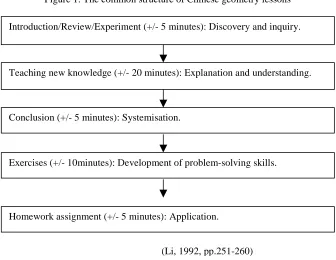
Figure 1. The common structure of Chinese geometry lessons
Introduction/Review/Experiment (+/- 5 minutes): Discovery and inquiry.
Teaching new knowledge (+/- 20 minutes): Explanation and understanding.
Conclusion (+/- 5 minutes): Systemisation.
Exercises (+/- 10minutes): Development of problem-solving skills.
Homework assignment (+/- 5 minutes): Application.
(Li, 1992, pp.251-260)
Objectives of teaching and learning of this lesson:
a) To clearly understand the concepts of corresponding angles, alternative angles and interior angles at the same side of a line.
b) To correctly recognise these angles in complex figures;
c) To be fully prepared for further studying about the properties of parallel lines
Introduction (+/- 5 minutes):
Discuss the location relationship of three lines on a plane
by the third line and review the concepts of vertically Focus on a figure in which two unparallel lines are crossed
opposite angles and neighbour complementary angles;
a b
l
Figure 1
l
a b
Figure 2
a
b l
Figure 3
Teaching new knowledge (+/- 20 minutes):
) Teach the concepts of ‘Corresponding Angles, Alt 1
th
ernate Angles, Interior Angles at the same side of a line’ rough observing figures as follows:
A E
B
D
F C
8 7 5 6
4 3
1 2 Figure 4
E
F C D B
A 1 2
3 4
Figure 5
A
B
D
C
1 2 3
4 5 6 7
8
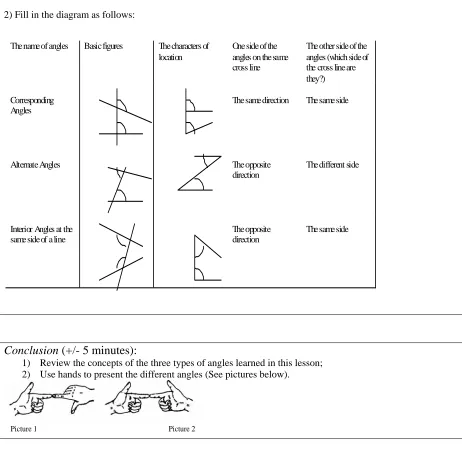
[image:12.595.133.469.97.357.2] [image:12.595.71.526.681.759.2]2) Fill in the diagram as follows:
Conclusion (+/- 5 minutes):
1) Review the concepts of the three types of angles learned in this lesson; 2) Use hands to present the different angles (See pictures below).
Picture 1 Picture 2
Exercis
[image:13.595.67.529.88.542.2]1) a) To recognise corresponding angles, alternate angles and interior angles at the same side of a line in figure 7;
b) To discuss whether a pair of alternate angles is equal and the sum of degree of a pair of interior angles at the same side of a line is 180° a pair of corresponding angles is equal? Why?
es (+/- 10 minutes):
, when
D
A
E
C
1
2 3
B
4
Figure 7
The name of angles Basic figures The characters of location
One side of the angles on the same cross line
The other side of the angles (which side of the cross line are they?)
Corresponding Angles
The same direction The same side
Alternate Angles The opposite direction
The different side
Interior Angles at the same side of a line
The opposite direction
2) To recognise vertically opposite angles, corresponding angles, alternate angles and interior angles at the same side of a line in figure 8.
A B
C D
E
F
G H
I M
K
Figure 8
In the ‘introduction’ segment of this lesson, observation and thinking, as well as whole class discussion, are involved. Questions are asked and a review is given. Students’ learning interests are stimulated. In the main segment of the lesson, when new knowledge is introduced, a considerable number of short tasks are included in each learning example and its figure. Observation is required, with questions carefully sequenced, and special vocabulary introduced. Students are gradually involved in the investigation of the characteristics of each definition, and they are expected to articulate their thinking through explanation. The language they use is corrected by the teacher. Overall, the basic characteristics of each definition and its figure are highlighted, and students’ geometrical intuitive skills are focused. An overview of the lesson is then given and students can see the new set of knowledge. In the ‘exercises’ segment, students explore more complicated tasks and their problem-solving and reasoning skills are developed. They are expected to explain what they think in class. They learn precisely the connections and are told exactly the distinctions between the definitions. The lesson concludes with the setting of homework, when students consolidate what they learnt in the lesson and are fully prepared for the next lesson
Japan: The case study presented in this section (see below) is a lesson record taken from Kunimune, et al (2002), following the format described in the section on Japan above.
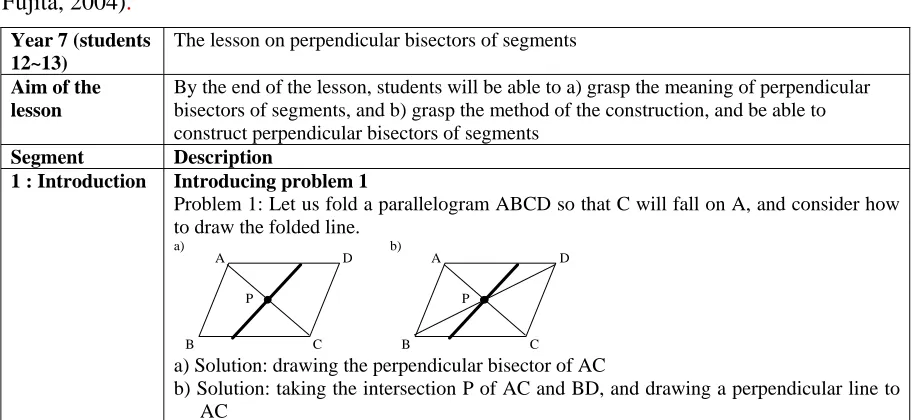
Perpendicular bisectors of segments; students aged 12-13 (Haneda, 2002, p. 38, translated by Fujita, 2004).
Year 7 (students 12~13)
The lesson on perpendicular bisectors of segments Aim of the
lesson
By the end of the lesson, students will be able to a) grasp the meaning of perpendicular bisectors of segments, and b) grasp the method of the construction, and be able to construct perpendicular bisectors of segments
Segment Description 1 : Introduction Introducing problem 1
Problem 1: Let us fold a parallelogram ABCD so that C will fall on A, and consider how to draw the folded line.
A
B C
D
P a)
A
B C
D
P b)
a) Solution: drawing the perpendicular bisector of AC
[image:14.595.70.529.552.762.2]Undertaking the construction by students
elograms and worksheet
- Encourage students to try various ways of solutions
- It is expected that students would notice the solutions a) or b) by looking at the facts that APC, 180 degree, is bisected when they actually fold paper parallelograms
- In addition to the solutions a) and b), it is expected that students would use congruent quadrilaterals or angle bisectors which they have learnt to draw the line.
Notes for teachers - Give paper parall
Introducing similar problems
Problem 2: Also consider how to draw folded lines in the following case
A
B
C D
E
2. Fold the shape so that B falls on E
A
B C
D
1. Fold the shape so that C falls on P
P
3. Fold the shape so that P falls on Q
A
B
C
P Q
Undertaking the constructions by students 2: Development
Notes for teachers
- Give worksheet for students
- Give further tasks to students who finished the three problems
- It is expected that students would use the construction of angle bisectors Summary
Knowing the lines which students drew are perpendicular bisectors of the segments Clarifying how to draw perpendicular bisectors of segments
3: Summary
Notes for teachers
- Explain clearly and precisely the words such as the - Clarify the simplest methods of the construction
mid-point or perpendicular bisectors
The structure of this lesson follows the basic format described in the section above on Japan; introduction, development, and summary. In the first grade of secondary school, Japanese students learn geometrical constructions (their proof are studied in the second grade). Instead of teaching the algorithms of the construction, the lesson starts from a practical problem that
i w t learnt about the bisector. Paper
parallelograms and worksheets are used to make the activities accessible for students. By
u this lar
bisector would b d help
s o solve ctivities in problem 1 are developed
f o At this stage, students would notice that drawing
perpendicular bis
make them think approach is always successful. It is not
specified in the recommended lesson whether discussions or presentations would be used, but it is expected that teachers should be flexible when they organise lesson plans. Finally, the mathematical terms are introduced and the algorithm of the construction is explained by the teacher. Through these activities, the students learn not only how to draw perpendicular
bisectors of segm oning behind the construction
which will be the
s not straightfor ard to solve for students who have not ye
ndertaking task, they would consider various ways of constructions, and perpendicu
e gradually recognised. The teacher is expected to encourage an . Then the mathematical a
tudents t the problem
urther by intr ducing problem 2.
ectors is a common approach to solve this form of question, which might ‘why’ - for example, why this
ents, but also start wondering about the reas
UK, specifically n this section (see below) is a lesson
record adapted fr 9 - geometrical reasoning (DfES,
2002).
Solve problems u six (DfES, 2002 -County Council)
S
England: The case study presented i om Interacting with mathematics in Year
sing properties of angles; students aged 13-14, lesson 5 out of a sequence of Year 9 geometrical reasoning: mini-pack p26-27 & 30, adapted by Norfolk
tarter Activity:
Objectives: Visual through 2-D
projections, including plans and elevations;
Present a concise, reasoned argument, using symbols, diagrams and related explanatory text Activities: pose the following problem to the students
This cube has been sliced to give a square cross-section.
Is it possible to slice a cube so that the cross-section is:
a) a rectangle? b) a triangle? c) a pentagon? d) a hexagon?
If so, describe how it can be done.
ise and use 2-D representations of 3-D objects; analyse 3-D shapes
Main Activity:
Objectives: Solve p ines, and of
triangles and other polygons, justifying inferences and explaining reasoning with diagrams and text.
Follow the modelli Prove that the ext two vertices. Alternative wordi
roblems using properties of angles, of parallel and intersecting l
ng process by first posing the problem:
erior angle of a triangle is equal to the sum of the interior angles at the other
ng:
Draw triangle ABC. Extend side AB beyond vertex B to point D. Prove that angle CBD = angle ACB + angle CAB
• The ‘formal’ question is read out, brief thinking time allowed and visualisation encouraged. • Students use whiteboards to sketch the diagram as the alternative wording is read out. • Diagrams are compared and ‘tidied up’ (they will not all be identical).
• A pupil draws a diagram on the board or OHP. Labels are agreed and added. • Students discuss and explain their reasoning orally or using jottings.
• Steps in the argument are presented in writing: – each step on a separate line;
Tackle the following problem in a similar way:
A is a vertex of an isosceles triangle ABC in which AB = AC. BA is extended to D, so that AD
BCD = 90°
is equal to BA. If DC is drawn, prove that BCD is a right angle. Alternative wording:
Draw an isosceles triangle ABC with AB = AC. Extend side BA beyond vertex A to a point D so that BA = AD. Join D to C. Prove that
Plenary
Show the start of the following flowchart:
op and working
duce that (a) vertically opposite angles are equal
placed in the chart? Ask students to explain the chart by posing questions such as:
• Why are the geometrical facts organised in this particular order, starting at the t down the chart?
• What are the links and arrows intended to show? • Can you explain how to use the given facts to de
(b) alternate angles are equal?
• Are the facts about triangles and polygons correctly
Point out that there are some unattached links.
than on content, as much of this should be familiar to the students. The approach encourages lishing familiar definitions and properties into a
l tion
o built
up. The lesson develops tated as
j facts
a that students begin to gain a sense of a
upporting students’ explanations, the teacher is clarify, build up, deduce, and conclude:
Support strategies greater rigour to be developed by re-estab
ogical hierarchy. The idea is to apply properties established in earlier lessons to the solu f problems that involve constructing geometrical diagrams and analysing how these are
written solutions, where the ‘given’ facts (assumptions) are s ustification in logically ordered explanations and proofs. The lesson reviews established
nd properties and the connections between them, so logical hierarchy. In modelling the task and s
advised to use a four-stage process of
Stages in the process Clarify the task. Draw a diagram.
State what is to be proved.
e in terms of simple labels on diagram. Restat
Diagram provided. Teacher clarifies.
Pupils restate in terms of labels.
Build up the chain of reasoning. ake statements of facts.
ons for the facts.
Teacher provides facts
Pupils add reasons for the facts or, in shorter chains, order a set of jumbled statements.
M Give reas
Deduce some information.
Calculate or solve where needed. Teacher constructs the calculation.
Pupils conclude calculation.
Conclude the argument.
Refer back to original task statement.
A Comparison of how these lessons develop geo
In each of the countries, the lesson structure fo (this is not surprising). Thus in the lesson considerable number of short tasks and questions In the lesson from Japan, the three-part struct first part and developed in the seco
third. In the UK (England) lesson, to that in Japan. In the first
continuing to be about geometry, is not really the teacher with the opportuni
Discussion
Each of the three case study lessons would cl mathematics teachers of the other co
terms of developing students’ mathematical
metrical reasoning
llowed the pattern expected for that country from China, new content is introduced and a are included in each segment of the lesson. ure is followed with a problem introduced in the nd before the main teacher explanation is given in the a three-part structure is followed, although this is different part, visualisation is the focus. The second (and main) part, while about visualisation. It is more about providing ty to model how to prove suitable geometrical statements.
early be recognised as a geometry lesson by untries. Each of the lessons has considerable strengths in reasoning by focussing on geometrical properties
s was found in the TIMSS video studies (Stigler et al, 1999; Stigler and Hiebert, 1999; is variation across nt is teacher asking many questions, in the Japanese
K ion sson (ie the interrelation,
tackled. There was also variation in the type of individual student work and the sort of homework set (if any).
and relationships.
A
Hiebert et al, 2003), notwithstanding these shared general features, there
the three countries studies. For example, there is some variation in how new conte introduced – in the Chinese lesson through the
lesson through the teacher posing fewer, but perhaps more substantial problems, while the U lesson the new content was introduced by the teacher modelling the process. Variat occurred, as in the TIMSS video studies, in the coherence of the le
oth implicit and explicit, of the mathematical components of the lesson) and the procedural b
Concluding Comments
What this study has not been able to ascertain are what the implications might be for student achievement in geometry in the three countries under consideration. This is as an area for future research. Further research also needs to focus on what teachers actually do in lessons and whether, if, or how, they may make use of the advice that is available on how they might structure their geometry lessons.
Acknowledgement
We would like to thank all teachers who kindly provided us with their lesson plans in geometry. We also thank Prof. Kunimune (Shizuoka University, Japan), Prof. Uemura ity, Japan), and Prof. Yam to University, Japan) who ith our data collection.
by Liping Ding
Wu, Zh., Ma, F. and ral
e School Mathematics Teachers’ Beliefs in the U.S. and China. In:
(Supplement) Conference,
20 -25 October, 2002, Hong Kong. Hong Kong: The University of Hong Kong, Faculty 7) Teacher Education in the People’s Republic of China.
Bloomington: Phi Delta Kappa Educational Foundation.
elbourne: University of
ional
. London: HMSO.
for Education and Employment (2001), Key Stage 3 National Strategy:
8), The Effectiveness of Direct Verbal Instruction on IQ Performance and
(Kagoshima Univers amoto (Kumamo
kindly helped w
Translations from Chinese
Translations from Japanese by Taro Fujita
References
An, Sh.H., Kulm, G., Wang L. (2002), The Impact of Cultu Differences on Middl
Pre-conference Proceedings
th th
of the ICMI Comparative Study
of Education.
Ashmore, R.A. and Zhen, C. (199
Clarke, D. (n.d.), Learner’s Perspective Study: Research Design. M Melbourne.
Chongqing [China] Conference (2002), An Overview of the Mathematics Curricula in the West and East - summary of findings at the Chongqing conference in 2002. In: Pre-conference Proceedings (Supplement) of the ICMI Comparative Study Conference, 20th -25th October, 2002, Hong Kong. Hong Kong: Faculty of Education, The University of Hong Kong.
Department for Education and Employment (1998a), Numeracy Matters: The Preliminary Report of the Numeracy Task Force. London: HMSO.
Department for Education and Employment (1998b), The Implementation of the Nat Numeracy Strategy (Final Report of the Numeracy Task Force)
Department
Framework for Teaching Mathematics, Years 7, 8 and 9. London: DfEE.
Department for Education and Skills (2002), Interacting with Mathematics in Year 9 - geometrical reasoning. London: DfES.
Engelmann, S. (196
Achievement in Reading and Arithmetic. In: J. Hellmuth (Ed.), Disadvantaged child (Vol. 3). New York: Brunner/Mazel.
Engelmann, Z., & Madigan, K. (1996), Direct Instruction coaching manual. Eugene, OR: Engelmann-Becker Corporation.
Fujita, T. and Jones, K. (2003b), Interpretations of National Curricula: the case of geometry in Japan and the UK. Paper presented at the British Educational Research Association Annual Conference 2003, Heriot-Watt University, 10-13 September 2003.
, D. A. (1979), The Missouri Mathematics Effectiveness Project: An n Fourth-Grade Classrooms, Journal of Educational Psychology,
s, D. A. and Ebmeier, H. (1983) Active Mathematics Teaching. New
ogard Giwin, K., Hollingsworth, H., Jacobs, J., Kersting, N., Manaster, A., Tseng, E., Etterbeek, igler, J. (2003), Teaching Mathematics in Seven Countries: Results From the TIMSS 1999 Video Study (NCES 2003-013). United States
ent of Education, National Center for Education Statistics. Washington, DC. ciety of Mathematics Education: 2000, Mathematics Programme in Japan. Jon
Ku
ty of Mathematics Education, 82(3), 66-76 [in Japanese]. panese).
ovement of Japanese education. American Educator (Winter 1998), 14-17 & Li,
nghai Education Press. Lower Secondary School Edition [in Chinese].
ce, 20 -25 October, 2002, Hong
Ma for the
Ma a, S. (Eds.), The
thematics.
Miy f Proof in the Geometry Curriculum of Lower Secondary
t ICMI-East Asia Regional Conference on Mathematics Education. Cheongju, Korea: Korea National University of Education. Vol. 2, 135-152. Good, T. L., and Grouws
Experimental Study i 71(3), 355-362.
Good, T. L., and Grouws, D. A. (1977), Teaching Effects: a process-product study in fourth-grade mathematics classrooms, Journal of Teacher Education, 28(3), 49-54.
Good, T. L., and Grouws, D. A. (1979), Teaching and Mathematics Learning, Educational Leadership, 37(1), 39-45.
Good, T. L., Grouw York: Longman.
Haneda, A. (2002), Chapter 3 Lesson plans in geometry in the 1st grade. In: S. Kunimune et al. (Eds.), A Collection of Lesson Plans for Lower Secondary Schools, Geometry 2, Tokyo Meiji Tosho publisher [in Japanese].
Hiebert, J., Gallimore, R., Garnier, H., B Ying Chui, A., Wearne, D., Smith, M., W., Manaster, C., Gonzales, P., & St
Departm Japanese So
Tokyo, JSME.
es, K. (1997), Some Lessons in Mathematics: a comparison of mathematics teaching in Japan and America, Mathematics Teaching, 159, 6-9.
nimune, S. (2000), A Change in Understanding with Demonstration in Geometry, Journal of Japan Socie
Kunimune, S. et al. (Eds.), (2002), A Collection of Lesson Plans for Lower Secondary Schools, Geometry 2, Tokyo Meiji Tosho publisher (in Ja
Lewis, C. & Tsuchida, I. (1998), A Lesson is like a Swiftly Flowing River: research lessons and the impr
50-52.
R. (1992) Corresponding Angles, Alternate Angles, Interior Angles at the same side of a line. In: Master teachers’ lessons records (Secondary school mathematics) editors association (Eds), Master Teachers’ Lessons Records (secondary school mathematics). Shanghai: Sha
Li, Sh.Q. (2002) Practice Makes Perfect: a key belief in China. In: Pre-conference Proceedings of the ICMI Comparative Study Conferen th th
Kong. Hong Kong: The University of Hong Kong, Faculty of Education.
mmana, C. and Villani, V. (Eds.), 1998, Perspective on the Teaching of Geometry 21st Century. Dordrecht: Kluwer.
tsui, O. (1997), A Problem about Parallel Lines. In: Becker, J. & Shimad
Open-Ended Approach: a new proposal for teaching mathematics (pp.113-122). Reston, VA: National Council of Teachers of Ma
Millett, A. (1996), Pedagogy: last corner of the secret garden. Invitation lecture, Kings College, London.
azaki, M. (1999), The Status o
Mok, I. A. C. (2003), The Story of a “Teacher-Dominating” Lesson in Shanghai. Paper presented as part of the symposium Social Interaction and Learning in Mathematics Classrooms in Australia, Germany, Hong Kong, Japan, the Philippines, Sweden, and the
Mu ’Connor, K.M.,
. Chestnut Hill, MA: Boston College.
and Management,19(3), 273-288.
ning of Mathematics & Science. Vancouver, BC: Pacific Educational
Ros
rd ed. (pp. 376-391). New York: Macmillan.
Roy
Saw
en-cil of Teachers of Mathematics.
R. S., Wiley, D. E., Raizen, S. A.,
ordrecht: Kluwer
Sch ey, D. E. (1997), Many
Shi . (2002), Capturing the Structure of Japanese Mathematics Lessons: some findings
rsity in Structure
Sim sited. In: Simon, B., The State and
United States at the 10th Biennial Conference of the European Association for Research on Learning and Instruction, Padova, Italy - August 26 - 30, 2003.
llis, I.V.S., Martin, M.O., Gonzales, E.J., Gregory, K.D., Garden, R.A., O
Chrostowski, S.J., & Smith, T.A. (2000), TIMSS 1999 International Mathematics Report: Findings from IEA’s Repeat of the Third International Mathematics and Science Study at the Eighth Grade
Reynolds, D. (1998) Teacher Effectiveness: better teachers, better schools. (Annual TTA Lecture), BERA Research Intelligence, 66, 26-29.
Reynolds, D. & Muijs, D. (1999), The Effective Teaching of Mathematics: a review of research, School Leadership
Robitaille, D.F., Beaton, A.E., & Plomp, T. (Eds.). (2000), The Impact of TIMSS on the Teaching & Lear
Press.
enshine, B., & Stevens, R. (1986). Teaching Functions. In: M. C. Wittrock (Ed.), Handbook of Research on Teaching, 3
Rosenshine, B. (1987), Direct Instruction. In: M. Dunkin (Ed.) Teaching and Teacher Education. Oxford: Pergamon.
al Society/Joint Mathematical Council: 2001, Teaching and Learning Geometry 11-19, London, Royal Society/Joint Mathematical Council.
ada, T. (1997), Developing Lesson Plans. In: Becker, J. & Shimada, S. (Eds.), The Op Ended Approach: a new proposal for teaching mathematics (pp.1-9). Reston, VA: National Coun
Schmidt, W. H., Jorde, D., Cogan, L. S., Barrier, E., Gonzalo, I., Moser, U., Shimizu, K., Sawada, T., Valverde, G. A., McKnight, C., Prawat,
Brotton, E. D., & Wolfe, R. G. (1996). Characterizing Pedagogical Flow: an investigation of mathematics and science teaching in six countries. D
Academic Publishers.
midt, W. H., McKnight, C., Valverde, G. A., Houang, R. T., & Wil
Visions, Many Aims: a cross-national investigation of curricular intentions in school mathematics. Dordrecht: Kluwer Academic Publishers.
mizu, Y
of the international comparative studies. Paper presented at the ICMI-Second East Asia Regional Conference on Mathematics Education and Ninth Southeast Asian Conference on Mathematics Education, May 27-31, 2002, National Institute of Education, Nanyang Technological University, Singapore.
Shimizu, Y. (2003), Capturing the Structure of Japanese Mathematics Lessons as Embedded in the Teaching Unit. Paper presented as part of the symposium Mathematics Lessons in Germany, Japan, the USA and Australia: Structure in Diversity and Dive
at the Annual Meeting of the American Educational Research Association, Chicago, April 21-25, 2003.
Simon, B. (1981), Why no Pedagogy in England? In: B. Simon & W. Taylor (Eds), Education in the Eighties. London: Batsford.
on, B. (1994), Some Problem of Pedagogy Revi
Educational Change: essays in the history of education and pedagogy. London: Lawrence & Wishart.
eighth-grade mathematics instruction in Germany, Japan and the United States.
Washington D.C: U.S. Government Printing Office.
Stigler, J. W. & Hiebert, J. (1999), The Teaching Gap: best ideas from the world's teachers for improving education in the classroom. New York: Free Press.
verde, G. A. Bianchi, L. J., Wolfe, R. G., Schmidt, W. H., & Houang, R. T. (2002),
According to the Book: using TIMSS to investigate the translation of policy into practice through the world of textbooks. Dordrecht: Kluwer Academic Press
Val
.
Yac
M’s Principles and Standards for
Yoshida, M. (1999), Lesson study [Jugyokenkyu] in elementary school mathematics in Japan: Watkins, C & Mortimore, P (1999), Pedagogy: What do we know? In: P. Mortimore (Ed),
Understanding Pedagogy and its Impact on Learning. London: Paul Chapman.
kel, E. and Hanna, G. (2003), Reasoning and Proof, In: J. Kilpatrick, W. G. Martin, and D. Schifter (Eds), A Research Companion to the NCT
School Mathematics. Reston, Va.: National Council of Teachers of Mathematics.