High Performance
Reference Counting and
Conservative Garbage Collection
Rifat Shahriyar
A thesis submitted for the degree of
Doctor of Philosophy
The Australian National University
Except where otherwise indicated, this thesis is my own original work.
Acknowledgments
This work would not have been possible without the generous support and assistance of many individuals and organizations. I only hope that I have remembered to give all of them the credit they deserve.
First and foremost I offer my sincerest gratitude to my supervisor, Professor Steve Blackburn. This thesis would not have been possible without his immense support, knowledge, guidance and patience. Thanks Steve for helping me happily sail through this academic journey. I feel very lucky to have such an awesome supervisor like Steve.
I would also like to thank my other supervisor, Professor Kathryn McKinley for helping me throughout my doctoral study. Her informative discussions, feedback and cooperative nature has always motivated and guided me. Her curiosity for proper and thorough understanding always inspired me and makes my thesis much richer.
I would also like to thank Dr. Daniel Frampton for helping me during the ini-tial phase of my doctoral study. He made things understand very easily and his informative discussions were very helpful.
I would also like to thank the Australian National University for helping me financially throughout the duration of my studies and stay in Australia.
I would also like to express my gratitude to all my fellow students for rendering their friendliness and support, which made my stay in Australia very pleasant. Thank you Vivek Kumar, Ting Cao, Xi Yang, James Bornholt, Tiejun Gao, Yi Lin, Kunshan Wang, and Luke Angove for the helpful discussions. I feel very lucky to be able to work with these excellent and friendly fellows.
I would also like to thank my friends in Australia especially Wayes Tushar, Saikat Islam, Shaila Pervin, Md Mohsin Ali, Shakila Khan Rumi, Swakkhar Shatabda, Kh. Mahmudul Alam, Masaba Adneen, Mirza Adnan Hossain, Ashika Basher, Abdullah Al Mamun, Samia Israt Ronee, little Aaeedah, Fazlul Hasan Siddiqui, Nevis Wadia, little Afeef, Rakib Ahmed, Tofazzal Hossain, Masud Rahman, and last but not the least cute little Ehan. They care about me and are always there to provide assistance when I need it. My life in Australia is much more colorful with their company.
My thesis would be incomplete without acknowledging the love and support of my family members, my mother Ferdous Kabir, my grandmother Fakrujjahan, my sister Shampa Shahriyar and my brother in law S M Abdullah. Finally, I would like to acknowledge my late father, Mohammad Shahriyar, who is my ideal.
Abstract
Garbage collection is an integral part of modern programming languages. It auto-matically reclaims memory occupied by objects that are no longer in use. Garbage collection began in 1960 with two algorithmic branches —tracingandreference count-ing. Tracing identifies live objects by performing a transitive closure over the object graph starting with the stacks, registers, and global variables as roots. Objects not reached by the trace are implicitly dead, so the collector reclaims them. In contrast, reference counting explicitly identifies dead objects by counting the number of incom-ing references to each object. When an object’s count goes to zero, it is unreachable and the collector may reclaim it.
Garbage collectors require knowledge of every reference to each object, whether the reference is from another object or from within the runtime. The runtime provides this knowledge either by continuously keeping track ofeverychange to each reference or by periodically enumerating all references. The collector implementation faces two broad choices —exactandconservative. In exact garbage collection, the compiler and runtime system precisely identify all references held within the runtime including those held within stacks, registers, and objects. To exactly identify references, the runtime must introspect these references during execution, which requires support from the compiler and significant engineering effort. On the contrary, conservative garbage collection does not require introspection of these references, but instead treats each value ambiguously as a potential reference.
Highly engineered, high performance systems conventionally use tracing and
exactgarbage collection. However, other well-established but less performant systems use eitherreference countingorconservativegarbage collection. Reference counting has some advantages over tracing such as: a) it is easier implement, b) it reclaims memory immediately, and c) it has a local scope of operation. Conservative garbage collection is easier to implement compared to exact garbage collection because it does not require compiler cooperation. Because of these advantages, both reference counting and conservative garbage collection are widely used in practice. Because both suffer significant performance overheads, they are generally not used in performance critical settings. This dissertation carefully examines reference counting and conservative garbage collection to understand their behavior and improve their performance.
My thesis is that reference counting and conservative garbage collection can per-form as well or better than the best perper-forming garbage collectors.
The key contributions of my thesis are: 1) An in-depth analysis of the key design choices for reference counting. 2) Novel optimizations guided by that analysis that significantly improve reference counting performance and make it competitive with a well tuned tracing garbage collector. 3) A new collector, RC Immix, that replaces the traditional free-list heap organization of reference counting with a line and block
heap structure, which improves locality, and adds copying to mitigate fragmentation. The result is a collector that outperforms a highly tuned production generational collector. 4) A conservative garbage collector based on RC Immix that matches the performance of a highly tuned production generational collector.
Contents
Acknowledgments vii
Abstract ix
1 Introduction 1
1.1 Problem Statement . . . 1
1.2 Scope and Contributions . . . 3
1.3 Meaning . . . 5
1.4 Thesis Outline . . . 6
2 Background 7 2.1 Overview of Garbage Collection . . . 7
2.2 Terminology . . . 8
2.3 Garbage Collection Algorithms . . . 8
2.3.1 Object Allocation . . . 8
2.3.2 Garbage Identification . . . 9
2.3.3 Garbage Reclamation . . . 10
2.4 Canonical Garbage Collectors . . . 10
2.4.1 Mark-Sweep . . . 10
2.4.2 Reference Counting . . . 11
2.4.3 Semi-Space . . . 11
2.4.4 Mark-Compact . . . 12
2.4.5 Mark-Region . . . 13
2.4.6 Generational . . . 13
2.5 Reference Counting Garbage Collection . . . 14
2.5.1 Naive Reference Counting . . . 14
2.5.2 Deferral . . . 14
2.5.3 Coalescing . . . 15
2.5.4 Ulterior . . . 16
2.5.5 Age-Oriented . . . 16
2.5.6 Collecting Cyclic Objects . . . 16
2.5.6.1 Backup Tracing . . . 17
2.5.6.2 Trial Deletion . . . 17
2.5.7 Reference Counting and the Free List . . . 17
2.6 Immix Garbage Collection . . . 18
2.6.1 Heap Organization: Lines and Blocks . . . 18
2.6.2 Opportunistic Copying . . . 19
2.7 Conservative Garbage Collection . . . 19
2.7.1 Requirements and Complexities of Exact Garbage Collection . . 20
2.7.2 Ambiguous References . . . 21
2.7.3 Non-Moving Conservative Collectors . . . 22
2.7.4 Mostly Copying Collectors . . . 22
2.8 Summary . . . 24
3 Experimental Methodology 25 3.1 Benchmarks . . . 25
3.2 Software Platform . . . 25
3.2.1 Jikes RVM and MMTk . . . 25
3.2.2 Performance Analysis . . . 26
3.2.3 Program and Collector Analyses and Statistics . . . 26
3.3 Operating System . . . 27
3.4 Hardware Platform . . . 27
4 Optimizing Reference Counting 29 4.1 Introduction . . . 29
4.2 Design Space . . . 31
4.2.1 Storing the Count . . . 31
4.2.2 Maintaining the Count . . . 31
4.2.3 Collecting Cyclic Objects . . . 32
4.3 Analysis of Reference Counting Intrinsics . . . 32
4.3.1 Analysis Methodology . . . 32
4.3.2 Distribution of Maximum Reference Counts . . . 33
4.3.3 Limited Reference Count Bits and Overflow . . . 35
4.3.4 Sources of Reference Counting Operations . . . 38
4.3.5 Efficacy of Coalescing . . . 41
4.3.6 Cyclic Garbage . . . 41
4.4 Limited Bit Reference Counting . . . 41
4.4.1 Hash Table on Overflow . . . 44
4.4.2 Stuck on Overflow and Ignored . . . 44
4.4.3 Stuck on Overflow and Restored by Backup Trace . . . 44
4.4.4 Evaluation . . . 44
4.5 Improving Reference Counting . . . 46
4.5.1 Exploiting the Weak Generational Hypothesis . . . 46
4.5.1.1 Lazy Mod-Buf Insertion Optimization . . . 48
4.5.1.2 Born Dead Optimization . . . 48
4.5.1.3 Reducing Cyclic Objects . . . 50
4.5.2 Bringing It All Together . . . 50
4.6 Results . . . 50
Contents xiii
5 Reference Counting Immix 55
5.1 Introduction . . . 55
5.2 Motivation . . . 57
5.2.1 Motivating Performance Analysis . . . 57
5.2.1.1 Free-List and Contiguous Allocation . . . 57
5.2.1.2 Analyzing RC Overheads . . . 59
5.3 Design of RC Immix . . . 59
5.3.1 RC and the Immix Heap . . . 60
5.3.1.1 RC Immix Line and Block Reclamation . . . 60
5.3.1.2 Limited Bit Count . . . 60
5.3.2 Cycle Collection and Defragmentation . . . 62
5.3.2.1 Cycle Collection . . . 62
5.3.2.2 Defragmentation with Opportunistic Copying . . . 63
5.3.2.3 Proactive Defragmentation . . . 63
5.3.2.4 Reactive Defragmentation . . . 65
5.3.3 Reference versus Object Level Coalescing . . . 66
5.3.4 Optimized Root Scanning . . . 67
5.4 Results . . . 67
5.4.1 RC Immix Performance Overview . . . 67
5.4.2 Variable Heap Size Analysis . . . 71
5.4.3 Pinning . . . 71
5.4.4 Benchmark Analysis . . . 73
5.5 Summary . . . 74
6 Fast Conservative Garbage Collection 75 6.1 Introduction . . . 75
6.2 Design . . . 78
6.2.1 Object Map Filtering . . . 78
6.2.2 Conservative Immix and Sticky Immix . . . 79
6.2.3 Conservative Reference Counting . . . 80
6.2.4 Conservative RC Immix . . . 80
6.3 Impact of Conservatism . . . 81
6.3.1 Ambiguous Pointers . . . 83
6.3.2 Excess Retention . . . 84
6.3.3 Pointer Filtering . . . 84
6.3.4 Pinning Granularity . . . 86
6.4 Performance Evaluation . . . 87
6.4.1 Conservative versus Exact Variants . . . 87
6.4.2 Total, Mutator, and Collection Time . . . 89
6.4.3 Sensitivity to Heap Size . . . 93
6.4.4 Discussion and Wider Applicability . . . 93
7 Conclusion 97
7.1 Future Work . . . 98
7.1.1 Root Elision in Reference Counting . . . 98
7.1.2 Concurrent Reference Counting and RC Immix . . . 99
7.1.3 Reference Counting in Soft Real Time Systems . . . 99
7.1.4 Applicability to Non-Java Languages . . . 99
7.2 Final Words . . . 100
List of Figures
2.1 Immix Heap Organization [Blackburn and McKinley, 2008] . . . 19
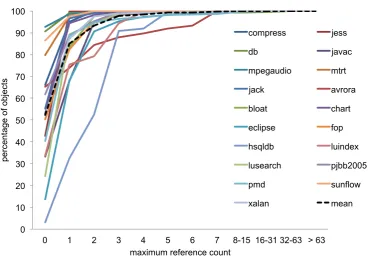
4.1 Most objects have very low maximum reference counts. This graph plots the cumulative frequency distribution of maximum reference counts among objects in each benchmark. . . 33 4.2 The number of objects which suffer overflowed reference counts drops
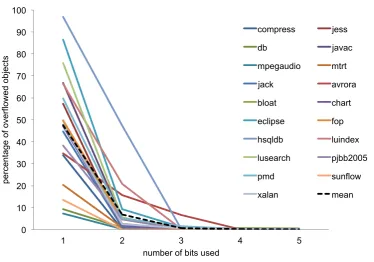
off rapidly as the number of available bits grows from two to five. . . . 35 4.3 New objects are responsible for the majority of reference counting
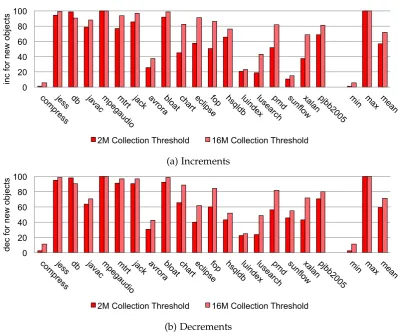
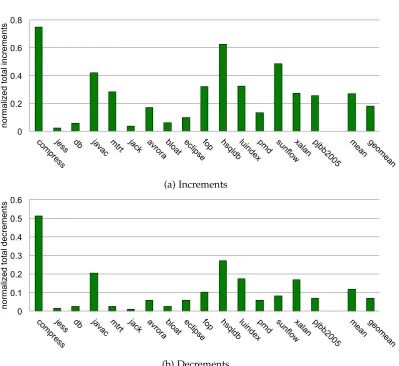
operations. We show here the percentage of (a) increments and (b) decrements that are due to objects allocated within the most recent 2 MB and 16 MB of allocation. . . 38 4.4 Most benchmarks have very low object survival ratios. This graph
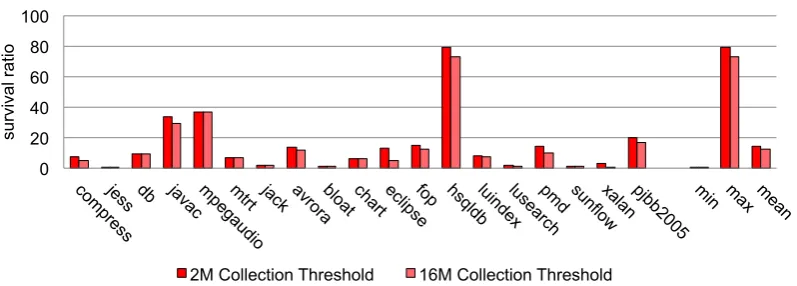
shows the percentage of objects that survive beyond 2 MB and 16 MB of allocation. . . 39 4.5 These graphs show three strategies for dealing with overflow. Results
vary greatly among benchmarks. . . 45 4.6 Lazy mod-buf insertion and born dead optimizations for new objects
greatly reduce the number of reference counting operations necessary compared toStandard RC. The effectiveness varies substantially among the benchmarks. On average over 80% of increments and 90% of decre-ments are eliminated. . . 47 4.7 Lazy mod-buf insertion and born dead optimizations for new objects
reduce total time by around 18% compared toStandard RC. The com-bined effect of our optimizations is a 23% improvement in total time compared toStandard RC. . . 49 4.8 Our optimized reference counting closely matches mark-sweep, while
standard reference counting performs 30% worse. . . 51 4.9 Sticky Immix outperforms our optimized reference counting collector
by 10%. The combination of the optimized reference counter and the Immix heap layout appears to be promising. . . 52
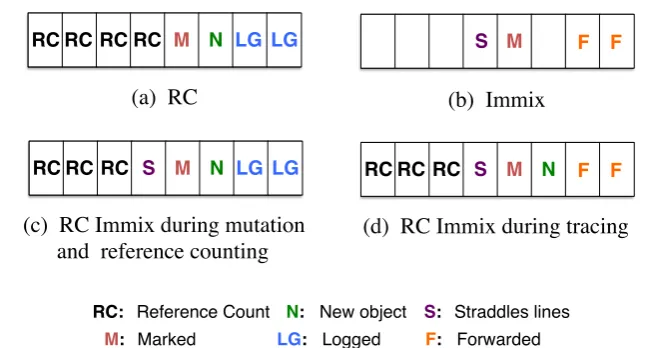
5.1 How RC, Immix, and the different phases of RC Immix use the eight header bits. . . 61 5.2 RC Immix performs 3% better than Gen Immix, the highest
5.3 The performance of Gen Immix, RC, RC with no boot image scanning, RC Immix, and RC Immix with no proactive copying as a function of heap size. . . 72
6.1 Performance of exact semi-space (SS), conservative MCC, exact mark-sweep (MS), conservative BDW, exact RC Immix, and conservative RC Immixcons normalized to exact Gen Immix at a moderate heap size.
Lower is better. Prior conservative collectors sacrifice performance. RC Immixcons performs similarly to Gen Immix and RC Immix, the best
exact collectors. . . 77 6.2 Conservative filtering total, mutator, and collection time overheads
in mark-sweep. BDW is cheapest, requiring no additional space or allocation work. The smaller object map in MSOM improves over object
map filtering in both mutator and collection time. . . 85 6.3 Geometric means of total performance for exact and conservative
col-lectors at 2×minimum heap size. Lower is better. . . 88 6.4 RC Immixconsmatches two exact high performance collectors, RC Immix
and Gen Immix, at 2× minimum heap size. . . 90 6.5 The performance of MCC, BDW, Gen Immix, RC Immix, and RC Immixcons
as a function of heap size. . . 94
List of Tables
4.1 Most objects have very low maximum reference counts. Here we show the cumulative frequency distribution of maximum reference counts among objects in each benchmark. For many benchmarks, 99% of objects have maximum counts of 2 or less. . . 34 4.2 Reference count overflow is infrequent when a modest number of bits
are used. The top third of this table shows the number of objects which ever suffer overflow when 1, 2, 3, 4, or 5 bits are used for reference counts. The middle third shows how many increments are applied to overflowed objects. The bottom third shows how many decrements are applied to overflowed objects. . . 36 4.3 New objects account for a large percentage of increment and
decre-ment operations. This table shows the sources of incredecre-ment (top) and decrement (bottom) operations when collections are forced at 2 MB and 16 MB intervals. In all cases new objects dominate. . . 37 4.4 49% of increment and decrement operations occur on objects with
maximum reference counts of just one or two. This table shows how increment operations are distributed as a function of the maximum reference count of the object the increment is applied to. . . 40 4.5 Coalescing elides around 64% of pointer field changes on average,
and around 90% for old objects. This table shows the percentage of mutations that areseen by coalescing given three different collection windows. The top third shows the overall average. The middle third shows results for new objects. The bottom third shows old objects. . . . 42 4.6 References are mutated around 10 million times per second on
aver-age. This graph shows the rate of mutations per millisecond for each benchmark, broken down by scalars, arrays and bulk copy operations. . 43 4.7 The importance of cycle collection. This table shows that on average
84% of objects can be collected by reference counting without a cycle collector, and that about half of these, on average 38% of all objects are inherently acyclic. These results vary considerably among the bench-marks. . . 43 4.8 Exploiting the weak generational hypothesis results in a 37%
reduc-tion in dead cyclic objects, from 16% to 10% on average, when cycle collection is triggered every 4 MB of allocation. These results vary con-siderably among the benchmarks, and is as high as 92% for eclipse and 90% for xalan. . . 50
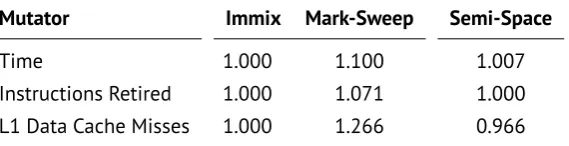
5.1 Themutatorcharacteristics of mark-sweep relative to Immix using the geometric mean of the benchmarks. GC time is excluded. Free-list allocation increases the number of instructions retired and L1 data
cache misses. Semi-space serves as an additional point of comparison. . 58
5.2 Themutatorcharacteristics of RC and Sticky Immix, which except for heap layout have similar features. GC time is excluded. RC’s free-list allocator increases instructions retired and L1 cache misses. Immix serves as a point of comparison. . . 59
5.3 Benchmark characteristics. Bytes allocated into the RC Immix heap and minimum heap, in MB. The average survival rate as a percentage of bytes, objects, lines, and blocks measured in an instrumentation run at 1.5× the minimum heap size. Block survival rate is too coarse to predict byte survival rates. Line survival rate is fairly accurate and adds no measurable overhead. . . 64
5.4 Two proactive copying heuristics and their performance at 1.2, 1.5 and 2 times the minimum heap size, averaged over all benchmarks. Time is normalized relative to Gen Immix. Lower is better. . . 65
5.5 Sensitivity to frequency of cycle detection and reactive defragmenta-tion at 1.2, 1.5 and 2 times the minimum heap size, averaged over all benchmarks. Time is normalized relative to Gen Immix. Lower is better. 66 5.6 Total, mutator, and collection performance at 2×minimum heap size with confidence intervals. Figure 5.2 graphs these results. We report milliseconds for Gen Immix and normalize the others to Gen Immix. (We exclude mpegaudio and lusearch from averages.) RC Immix per-forms 3% better than production Gen Immix. . . 69
5.7 Mutator performance counters show RC Immix solves the instruction overhead and poor locality problems in RC. Applications executing RC Immix compared with Gen Immix in a moderate heap size of 2× the minimum execute the same number of retired instructions and see only a slightly higher L1 data cache miss rate. Comparing RC to RC Immix, RC Immix reduces cache miss rates by around 20%. . . 70
5.8 Performance sensitivity of RC Immix with pinning bit at 1.2, 1.5 and 2 times the minimum heap size, averaged over all benchmarks. Time is normalized relative to Gen Immix. Lower is better. . . 73
6.1 Individual benchmark statistics on live heap size, exact roots, conser-vative roots, excess retention, and pinning. . . 82
6.2 Ambiguous Pointers . . . 83
6.3 Excess Retention . . . 84
LIST OF TABLES xix
6.5 Total, mutator, and collection performance at 2× minimum heap size with confidence intervals. Figure 6.4 graphs these results. We report milliseconds for Gen Immix and normalize the others to Gen Immix. (We exclude mpegaudioand lusearch from averages.) RC Immixcons is
2% slower than RC Immix andstillslightly faster than production exact Gen Immix. . . 91 6.6 Performance effect of increasing pinning of objects by factors of 2×
to 32× compared to RC Immixcons with 0.2% average pinned. The
Chapter1
Introduction
This thesis addresses the challenges and opportunities of achieving high performance for two areas of memory management that have historically suffered from poor performance, but are still widely used — reference counting and conservative garbage collection.
1
.
1
Problem Statement
Today garbage collection is ubiquitous; almost every managed programming lan-guage has support for garbage collection. It automatically reclaims memory occupied by objects that are no longer in use. It frees the programmer from manually dealing with memory deallocation. The benefits of garbage collection are increased reliability, a decoupling of memory management from other software engineering concerns, and less developer time spent chasing memory management errors. The memory manager is key to overall performance of managed applications because it includes the direct cost of garbage collection as well as the indirect cost of locality due to its layout of objects in memory.
Garbage collection algorithms have been built upon two branches since 1960 —
tracingandreference counting. Tracing indirectly identifies garbage, and directly iden-tifies live objects by performing a transitive closure over the object graph starting with the stacks, registers, and global variables as roots [McCarthy, 1960]. Reference count-ing directly identifies garbage by maintaincount-ing a count of incomcount-ing references to each object [Collins, 1960]. It has immediacy of reclamation and simple implementation and is thus used in well-established systems for PHP, Perl, and Objective-C.
Garbage collector implementations have two choices —exactandconservative. In exact garbage collection, the runtime precisely identifies all references, including those in stacks, registers, and objects, which requires support from the compiler and a significant engineering effort. A conservative garbage collector does not exactly identify these references, instead it inspects all values held within the runtime and dynamically tests whether they point to a valid object [Bartlett, 1988; Boehm and Weiser, 1988; Demers et al., 1990; Smith and Morrisett, 1998; WebKit, 2014]. Although conservatism forces some restrictions upon the runtime, the compiler and runtime are free of the onerous implementation issues of exactly tracking references in all code.
Conservative garbage collection is used to provide automatic memory management support for unmanaged languages such as C/C++, and managed languages such as JavaScript.
Highly engineered systems, such as HotSpot, J9, and .NET, conventionally use trac-ing and exact garbage collection for high performance. Many other well-established systems use either reference counting or conservative garbage collection implemen-tations, such as PHP and Chakra for JavaScript. These systems are widely used, but suffer significant performance overheads compared to exact generational tracing garbage collection. This thesis addresses this problem.
In the following, we briefly describe reference counting and conservative garbage collection. They are described in more detail in Section 2.5 and 2.7.
Reference Counting The two algorithmic roots of the garbage collection family tree were born within months of each other in 1960 [McCarthy, 1960; Collins, 1960]. Reference counting works by keeping a count of incoming references to each object and collecting objects when their count falls to zero [Collins, 1960]. Therefore all that is required of its implementation is to notice each pointer change, increment the target object’s count whenever a pointer to it is created and decrement the target object’s count when a pointer to it is overwritten. The collector reclaims objects when their count reaches zero and then decrements all of their descendants’ counts. This algorithm is simple, immediate, and requires no global computation. The simplicity of this naive implementation is particularly attractive and thus widely used in well-established systems such as PHP, Perl and Objective-C. By contrast, tracing collectors start with a set of roots, which requires the runtime to enumerate all references into the heap held within the runtime such as, global variables, stacks, and registers. The collector performs a transitive closure from these roots, marking each reachable object as live. The collector then reclaims unmarked objects.
§1.2 Scope and Contributions 3
to produce high performance garbage collection alongside tracing. By bringing one of the two major algorithmic branches back into contention, language implementers will be presented with a much richer choice of implementation alternatives.
Conservative Garbage Collection Managed language semantics guarantee that the runtime can exactly identify references held within heap objects because type of each heap object is known by the runtime. However, exactly identifying references held within dynamic runtime state such as stacks and registers requires compiler coopera-tion. Modern managed languages such as Java and C# use exact garbage collection by enforcing a strict compiler disciple and runtime interface. Many implementations of other popular languages, including PHP, Perl, JavaScript, and Objective-C, avoid the engineering headache of exact garbage collection by using conservative garbage collection or naive reference counting.
A conservative garbage collector is constrained by its reliance on ambiguous references [Bartlett, 1988; Boehm and Weiser, 1988; Demers et al., 1990; Smith and Morrisett, 1998; WebKit, 2014]. The collector must (1) retain the referent since the ambiguous reference may actually be a pointer, and (2) pin (not move) the referent (object held by the reference) since the ambiguous reference may actually be a value and therefore cannot be modified. These constraints prevented previous conserva-tive collectors for managed languages from achieving performance competiconserva-tive to generational tracing because either (1) they forgo moving objects altogether, which is essential to the best performing collectors, or (2) they pin any page targeted by an ambiguous root, incurring significant overheads. Conservative root identification treats every value in the stacks, registers, and statics as a potential ambiguous root. The collector first checks whether the value falls within the range of valid heap ad-dresses and if so, applies filtering to determine whether it points to a valid object. Conservative garbage collection is widely used but current implementations incur significant performance overheads compared to the high performance exact tracing collectors that move objects.
1
.
2
Scope and Contributions
contribu-tions, for the first time, the performance of both reference counting and conservative garbage collection are competitive with the best copying generational tracing collec-tors.
This thesis uses Java as a representative of modern high-level languages and the Jikes RVM virtual machine as the managed runtime implementation [Alpern et al., 2000, 2005]. Java is, as of 2014, one of the most popular programming languages in use [TIOBE, 2014a,b] and Jikes RVM won 2012 SIGPLAN Software Award because of its high quality and modular design that made it easy for researchers to develop, share, and compare advances in programming language implementation [Jikes, 2012]. To evaluate different garbage collectors, we implemented them in Jikes RVM. The methodology and insights developed here should be applicable beyond this specific context. The analyses and optimizations we introduce throughout the thesis are general and can be implemented in other JVMs as well as in non-Java managed languages.
Optimizing Reference Counting We first show that a prior state-of-the-art reference counting implementation using a free list lags the performance of a highly tuned tracing collector by more than 30% on average. We perform an in-depth analysis of the key design choices of reference counting with a free list: a) how to store the count, b) how to correctly maintain the count, and c) how to collect cycles of garbage. We confirm that limited bit reference counting is a good idea because the vast majority of objects have a maximum count of seven or less [Jones et al., 2011]. We identify that young objects are responsible for more than 70% of increments and decrements and that on average only 10% of them survive. We introduce two novel optimizations that eliminate reference counting operations for non-surviving young objects, significantly reduce the workload for the cycle detector, and use limited bit reference counting to significantly improve performance. The ultimate outcome is the first reference counting implementation with performance competitive with a well tuned tracing collector. However because it uses a free list, its performance still lags the best performing generational collectors.
§1.3 Meaning 5
into regions of contiguous memory where objects may span lines in a block, but not blocks. RC Immix also integrates Immix’s opportunistic copying with reference counting to mitigate fragmentation. This is the first collector to perform copying with pure reference counting. The ultimate outcome is that RC Immix outperforms the highly tuned production generational Immix collector in Jikes RVM [Blackburn and McKinley, 2008].
Fast Conservative Garbage Collection We next examine conservative garbage col-lection for safe languages in a modern context and surprisingly find that two sources of overhead associated with conservatism — excess retention and the number of pinned objects — are normally very low (less than 1%). We show that these modest overheads are dominated by the consequences of the prior work’s reliance on non-copying free list and page grained pinning, and that for significant use cases, such as in managed languages, these designs are needlessly pessimistic. We identify Immix’s line and block structure and opportunistic copying as a good match for conservative collection. Most of the existing conservative collectors use a non-moving free list, or pin at page granularity [Bartlett, 1988; Smith and Morrisett, 1998; WebKit, 2014] whereas Immix can pin at line granularity, reducing the amount of pinned heap space by an order of magnitude. We use a low overhead object map to determine the va-lidity of ambiguous references. We introduce the design and implementation of the conservative variants of existing garbage collectors that leverage these mechanisms. We implemented conservative reference counting and conservative variants of Immix collectors with very low performance penalty compared to their exact counterparts. We also introduce the design and implementation of a high performance conservative collector, RC Immixcons, that combines RC Immix with conservative root scanning.
RC Immixcons matches the performance of a highly optimized generational copying
collector. As far as we know, this is the first conservative reference counting collector and the first conservative collector to match the performance of a high performance generational copying collector.
1
.
3
Meaning
1
.
4
Thesis Outline
The body of this thesis is structured around the three key contributions outlined above. Chapter 2 provides an overview of garbage collection and surveys relevant garbage collection literature. It provides more detailed background on previous reference counting optimizations and conservative garbage collectors. Chapter 3 discusses our experimental methodology.
Chapters 4, 5, and 6 comprise the main body of the thesis, covering the three key contributions. Chapter 4 identifies the key design choices for reference counting, provides a detailed quantitative analysis with respect to those design points, intro-duces novel optimizations guided by the analysis that eliminates reference counting operations for short lived young objects, and makes its performance competitive with full heap mark-sweep tracing collector. Chapter 5 identifies the free-list heap organization as the remaining major performance bottleneck for reference counting and introduces a new collector, RC Immix, that replaces the free list with the line and block organization of Immix, performs copying to mitigate fragmentation and as a result outperforms a highly tuned production generational collector. Chapter 6 first computes the direct cost of conservativeness, finding that conservative roots do not induce very much excess retention, 1% or less for our Java benchmarks. It then identifies the line and block heap organization and opportunistic copying mechanism in the Immix collector as a good match for conservative collection, and introduces a low overhead object map to validate ambiguous references. It introduces conser-vative reference counting and conserconser-vative Immix collector using these mechanisms with very low performance penalty, and develops a high performance conservative garbage collector, RC Immixcons, that matches performance of a generational copying
collector.
Chapter2
Background
This chapter provides background information on garbage collection basics, reference counting, Immix garbage collection, and conservative garbage collection to place the research contributions in context.
This chapter starts with a brief introduction to the field of garbage collection in Section 2.1. Section 2.2 outlines the garbage collection terminology, Section 2.3 outlines the key components of garbage collection, and Section 2.4 describes the canonical garbage collectors. Section 2.5 provides a detailed background on reference counting with different optimizations over the last 50 years or so. Section 2.6 provides an overview of the Immix collector. Section 2.7 provides background on conservative garbage collection.
2
.
1
Overview of Garbage Collection
Garbage collection is an integral part of modern programming languages. It frees the programmer from manually dealing with memory deallocation for every object they create. Garbage collection was introduced in LISP [McCarthy, 1960] and it has gained popularity through Java and .NET. It is also included in languages such as Haskell, JavaScript, PHP, Perl, Python, and Smalltalk. For a more complete discussion of the fundamentals of garbage collection see [Jones et al., 2011; Wilson, 1992].
Programs require data to execute and this data is typically stored in memory. Memory can be allocated: a) statically where memory requirements for the data are fixed ahead-of-time, b) on the stack where the lifetime of the data is tightly bound with the currently executing method, and c) dynamically, where memory require-ments are determined during execution – potentially changing between individual executions of the same program. Dynamically allocated memory can be managed either explicitly or automatically by the program. Popular programming languages, such as C/C++ require the programmer to explicitly manage memory through primi-tives such as the C function mallocandfree, which is tedious and error-prone. Man-aged languages, such as Java/.NET use a garbage collector to automatically free memory.
The purpose of garbage collection is to reclaim memory that is no longer in use by the program. Determining precisely when an object will no longer be accessed is
difficult in general, so garbage collectors usually rely on reachability to conservatively approximate liveness. An object is reachable if it is transitively reachable from the running program state. Objects that are not reachable are garbage. A garbage collector differentiates between objects in the program that are no longer reachable and thus the program is guaranteed never to access (garbage/dead) and objects that are reachable (non-garbage/live). The collector then frees the memory that garbage objects are occupying.
2
.
2
Terminology
The area of memory used for dynamic object allocation is known as the heap. The process of reclaiming unused memory is known asgarbage collection, a term coined by McCarthy [1960]. Following Dijkstra et al. [1976], from the point of view of the garbage collector, the termmutatorrefers the application or program that mutates the heap. Collectors that must stop the mutator to perform collection work are known as stop the worldcollectors, as compared toconcurrentoron-the-flycollectors which reclaim objects while the application continues to execute. Collectors that employ more than one thread to do the collection work are parallel collectors. A parallel collector can either be stop the world or concurrent. The termmutator timeis used to denote the time when the mutator is running and the termGC timeis used to denote the time when the garbage collector is running. A garbage collector that checks the liveness of all objects in the heap at each collection is known as afull heapcollector, as compared to agenerationalorincrementalcollector which may collect only part of the heap. Some garbage collectors require interaction with the running mutator. These interactions are generally implemented withbarriers. A barrier is inserted by the compiler on every read or write to track reference read or mutation. The most common form of barrier is awrite barrier, which is invoked whenever the mutator writes to a reference in the heap. Some collectors require knowledge of theruntime roots, all references into the heap held by runtime including stacks, registers, statics, and JNI.
2
.
3
Garbage Collection Algorithms
Automatic memory management consists of three key components: a) object al-location, b) garbage identification, and c) garbage reclamation. Different garbage collection algorithms employ different approaches to handle each of the components.
2.3.1 Object Allocation
§2.3 Garbage Collection Algorithms 9
Contiguous Allocation Contiguous memory allocation appends new objects by in-crementing a pointer by the size of the new object [Cheney, 1970]. The allocator places objects contiguously in memory in allocation order. Such allocators are simple and fast at allocation time and provide excellent locality to the mutator because objects allocated together in time are generally used together [Blackburn et al., 2004a]. Allo-cating them contiguously thus provides spatial cache line and page reuse. Contiguous allocation generally performs synchronized allocation of larger chunks [Garthwaite and White, 1998; Alpern et al., 1999; Berger et al., 2000], which are then assigned to a single allocation thread that performs fast and unsynchronized contiguous allocation within the chunk.
Free-list Allocation Free-list allocation divides memory into cells of various fixed sizes [Wilson et al., 1995], known as a free list. Each free list is unique to a size and is composed from blocks of contiguous memory. Free-list allocation allocates an object into a free cell in the smallest size class that accommodates the object. So it places objects in memory based on their size and free memory availability rather than allocation order. When an object becomes free, the allocator returns the cell containing the object to the free list for reuse. Free-list allocation suffers two notable shortcomings. First, it is vulnerable to fragmentation of two kinds. It suffers from internal fragmentation when objects are not perfectly matched to the size of their containing cell, and it suffers external fragmentation when free cells of particular sizes exist, but the allocator requires cells of another size. Second, it suffers from poor locality because it often positions contemporaneously allocated objects in spatially disjoint memory [Blackburn et al., 2004a].
2.3.2 Garbage Identification
There are two techniques for identifying garbage — reference counting and tracing. All garbage collection algorithms in the literature use one of these techniques for garbage identification.
Reference Counting Reference counting directly identifies garbage. It keeps track for each object a count of the number of incoming references to it held by other objects, known as areference count. When a reference count falls to zero, the associated object is garbage. It is incomplete because it cannot detect cycle of garbage.
2.3.3 Garbage Reclamation
Once the collector identifies the garbage objects there are several techniques that reclaim the space.
Direct to free list With reference counting, the collector may directly return the space used by garbage objects to a free list when an objects reference count falls to zero.
Sweep A sweep traverses over all the allocated objects in the heap, freeing the space associated with dead objects. For tracing garbage collection approaches that indirectly identify garbage, some form of sweep is required to free the space of the garbage objects. A sweep may operate over individual free list cells and larger regions of memory.
Compaction Compaction rearranges live objects within a region to create larger regions of free memory for future allocation. A classic example is sliding compaction where all live objects are compressed into a contiguous region of used memory, leaving a contiguous region of memory free for future allocation [Styger, 1967].
Evacuation Live objects can be evacuated from a region of memory and copied into another, to create an entire evacuated free region for future allocation. Evacuation re-quires two different regions of memory. Evacuation can be particularly effective when there are very few survivors since the cost is proportional to moving the survivors, and naturally aligns itself with tracing as the identification approach.
2
.
4
Canonical Garbage Collectors
The canonical garbage collectors use the above approaches for object allocation, garbage identification, and object reclamation.
2.4.1 Mark-Sweep
§2.4 Canonical Garbage Collectors 11
Mark-sweep is very efficient at collection time, the fastest and simplest full heap garbage collection mechanism available. This advantage is offset by slow downs it imposes on the mutator. Its free-list allocator forces the mutator to allocate objects in the discovered holes surrounding live objects. This policy often results in lower allocation performance, but the dominant effect is poor locality of reference due to objects being spread over the heap. Mark-sweep also suffers from fragmentation, where the total available memory may be sufficient to support an allocation request, but an empty, contiguous region of sufficient size may not be available.
2.4.2 Reference Counting
Reference counting was the second garbage collection algorithm published, also for the LISP system [Collins, 1960]. Reference counting operates under a fundamentally different strategy from that of tracing garbage collectors. Reference counting tracks for each object a count of the number of incoming references to it held by other objects, termed as thereference count. Whenever a reference is created or copied, the collector increments the reference count of the object it references, and whenever a reference is destroyed or overwritten, the collector decrements the reference count of the object it references. Write barriers implement counting. If an object’s reference count reaches zero, the object has become inaccessible, and the collector reclaims the object and decrements the reference count of all objects referenced by that reclaimed object. Removing a single reference can potentially lead to many objects being freed. A common variation of the algorithm allows reference counting to be made incremental; instead of freeing an object as soon as its reference count becomes zero, it is added to a list of unreferenced objects, and periodically one or more items from this list are freed [Weizenbaum, 1969]. This naive algorithm is simple, inherently incremental, and requires no global computation. The simplicity of this naive implementation is particularly attractive and thus widely used, including in well-established systems such as PHP, Perl, and Python.
Reference counting has two clear limitations. It is unable to collect cycles of garbage because a cycle of references will self-sustain non-zero reference counts. Moreover, naive implementation of reference counting performs increment and decre-ment operations on every reference operation, including those to variables in stacks and registers. This overhead is further increased on multi-threaded systems, because the collector must perform reference count updates atomically to maintain correct counts. Prior optimizations overcome some of these limitations (see Section 2.5), and this thesis overcomes the remaining performance limitations.
2.4.3 Semi-Space
containing objects is labeled asfrom-spaceand the empty region is labeled asto-space. The garbage collector performs a transitive closure over the object graph as in a mark-sweep collector. But instead of simply marking the object, each live object is copied when it is first encountered from the from-space to the to-space. It leaves a forwarding pointer to the new location in the old location. The collector then updates all references to the old location so that they point to the copied objects in the to-space. At the end of the collection, all reachable objects now reside in the to-space and the collector reclaims the whole from-space. At the start of each collection, roles of the spaces are switched. Initial implementations of semi-space collectors used a recursive algorithm [Minsky, 1963; Fenichel and Yochelson, 1969], which has unbound depth, but Cheney [1970] later implemented a simple iterative algorithm.
Semi-space collection makes less efficient use of memory because it must reserve half of the total memory to ensure there is space to copy all objects in the worst case. It can be expensive in collection time when all live objects need to be copied, but if very few objects survive it is efficient. It has good allocation performance and induces good mutator locality because contemporaneously allocated objects are allocated contiguously. During copying, the semi-space collector automatically compacts the heap, so it does not suffer from fragmentation.
2.4.4 Mark-Compact
Mark-compact collection aims to combine the benefits of both semi-space and mark-sweep collection. It addresses the fragmentation often seen in the mark-mark-sweep collec-tion by compacting objects into contiguous regions of memory. But it does so in place rather than relying on the large reserved space required by the semi-space collection. While this in-place transition saves space, it involves significant additional collection effort because it must traverse objects many times. The simplest form is sliding com-paction, originally implemented in LISP-2 as a four phase algorithm [Styger, 1967]. In the first phase, the collector performs a transitive closure over the object graph, marking objects as they are visited. In the second phase, the collector calculates the future location of each marked object and remembers that location for each object. In the third phase, the collector updates all references to reflect the addresses calculated in the second phase. In the fourth and final phase, the collector copies objects to their new locations. Copying is done in strict address order to ensure that no live data is overwritten.
§2.4 Canonical Garbage Collectors 13
2.4.5 Mark-Region
Mark-region collection combines contiguous allocation of semi-space with the collec-tion strategy of mark-sweep. The motivacollec-tion is to achieve the mutator performance of semi-space and the collection performance of mark-sweep. In terms of allocation, mark-region is similar to semi-space, with objects allocated into contiguous regions of memory. In terms of collection, mark-region is similar to mark-sweep, but instead of sweeping individual objects it sweeps regions; regions with no reachable objects are made available for allocation. A mark-region collection consists of two phases. Themarkphase performs a transitive closure over the object graph, it marks objects as well their regions as they are visited. Thesweepphase scans all the regions, and regions that were not marked in the mark phase are made available for future allo-cation. Immix provides the first detailed analysis and description of a mark-region collector [Blackburn and McKinley, 2008], although a mark-region approach was previously used in Oracle’s JRockit and IBM’s production virtual machines.
Mark-region collection combines excellent allocation performance and good col-lection performance, with good mutator locality. But it is susceptible to issues with fragmentation, because a single live object may keep an entire region alive and un-available for reuse. To combat this problem, mark-region collectors often employ techniques to relocate objects in memory to reduce fragmentation. The JRockit collec-tor performs compaction of the heap at each collection, the IBM colleccollec-tor performs whole heap compaction when necessary. Immix combats this problem by defining hierarchy of two regions (blocks divided into lines) and then adds lightweight defrag-mentation as required when memory is in demand. Immix is described further in Section 2.6.
2.4.6 Generational
Generational garbage collection is based on the weak generational hypothesis that ‘most object dies young’ [Ungar, 1984; Lieberman and Hewitt, 1983] and was at that time the most important advancement in garbage collection since the first collectors were developed in 1960. Generational collectors divide the heap into regions for objects of different ages, and perform more frequent collections on more recently allocated objects and less frequent collections on the oldest objects. The youngest generation is generally known as thenurseryand aminorcollection collects only the nursery. The space containing the oldest objects is known as the mature space. A full heapmajor collection collects both young and old generation. During a minor collection, generational collectors must remember all references from the mature space into the nursery and assume they are live. A generational write barrier takes note of references from older generations to younger generations, keeping them in a
because only a small fraction of nursery objects survive and must be copied into the mature space. Various mature space strategies are possible.
In generational collection, objects are allocated in the nursery contiguously, pro-viding good allocation performance and better mutator locality. The collection per-formance is also very good compared to full heap collectors. The majority of high performance collectors (e.g., HotSpot, J9, and .NET) are generational collectors.
In the next section, we describe prior work on reference counting with different optimizations on which we build.
2
.
5
Reference Counting Garbage Collection
The first account of reference counting was published by George Collins in 1960, just months after John McCarthy described tracing garbage collection [McCarthy, 1960]. Reference counting directly identifies dead objects by keeping a count of the number of references to each object, freeing the object when its count reaches zero.
2.5.1 Naive Reference Counting
Collins’ simple,immediatereference counters countallreferences, in the heap, stacks, registers and local variables. The compiler inserts increments and decrements on referents where ever references are created, copied, destroyed, or overwritten. Because such references are very frequently mutated, immediate reference counting has a high overhead. However, immediate reference counting needs very minimal runtime support, so is a popular implementation choice due to its low implementation burden. The algorithm requires just barriers on every pointer mutation and the capacity to identify all pointers within an object when the object dies. The former is easy to implement, for example compilers for statically and dynamically typed languages directly and easily identify pointer references, as dosmart pointersin C++; while the latter can be implemented through a destructor. Objective-C, Perl, Delphi, PHP, and Swift [Stein, 2003; Thomas et al., 2013; Apple Inc., 2013, 2014] use naive reference counting.
Collins’ reference counting algorithm suffers from significant drawbacks includ-ing: a) an inability to collect cycles of garbage, b) overheads due to tracking frequent stack pointer mutations, c) overheads due to storing the reference count, and d) over-heads due to maintaining counts for short lived objects. We now briefly outline five important optimizations developed over the past fifty years to improve over Collins’ original algorithm.
2.5.2 Deferral
reg-§2.5 Reference Counting Garbage Collection 15
isters and on the stacks. Deferral requires a two phase approach, dividing execution into distinct mutation and collection phases. This tradeoff reduces reference count-ing work significantly, but delays reclamation. Since deferred references are not accounted for during the mutator phase, the collector counts other references and places zero count objects in a zero count table (ZCT), deferring their reclamation. Periodically in a GC reference counting phase, the collector enumerates all deferred references from the stacks and registers into a root set and then reclaims any object in the ZCT that is not a referent of the root set.
Bacon et al. [2001] eliminate the zero count table by buffering decrements between collections. Initially the buffered decrement set is empty. At collection time, the collector temporarily increments a reference count to each object in the root set and then processes all of the buffered decrements. Deferred reference counting performs all increments and decrements at collection time. At the end of the collection, it adds a buffered decrement for every root. Although much faster than naive immediate reference counting, deferred reference counting typically uses stack maps [2.7.1] to enumerate all live pointers from the stacks. Stack maps are an engineering impedi-ment, which discourages many reference counting implementations from including deferral [Jibaja et al., 2011].
2.5.3 Coalescing
Levanoni and Petrank [2001, 2006] observed that all but the first and last in any chain of mutations to a reference within a given window can be coalesced. Only the initial and final states of the reference are necessary to calculate correct reference counts. Intervening mutations generate increments and decrements that cancel each other out. This observation is exploited by remembering (logging) only the initial value of a reference field when the program mutates it between periodic reference counting collections. At each collection, the collector need only apply a decrement to the initial value of any overwritten reference (the value that was logged), and an increment to the latest value of the reference (the current value of the reference).
Levanoni and Petrank implemented coalescing using object remembering. The first time the program mutates an object reference after a collection phase: a) a write barrier logsallof the outgoing references of the mutated object and marks the object as logged; b) all subsequent reference mutations in this mutator phase to the (now logged) object are ignored; and c) during the next collection, the collector scans the remembered object, increments all of its outgoing pointers, decrements all of its remembered outgoing references, and clears the logged flag. This optimization uses two buffers called the mod-buf and dec-buf. The allocator logs all new objects, ensuring that outgoing references are incremented at the next collection. The allocator does not record old values for new objects because all outgoing references start as
2.5.4 Ulterior
Blackburn and McKinley [2003] introducedulterior reference counting, a hybrid collec-tor that combines copying generational collection for the young objects and reference counting for the old objects. They observe that most mutations are to the nursery objects. Ulterior reference counting extends deferral to include all nursery objects. It restricts copying to nursery object and reference counting to old objects, the object demographics for which they perform well. It safely ignores mutations to select heap objects. Ulterior reference counting is not difficult to implement, but the implemen-tation is a hybrid, and thus manifests the implemenimplemen-tation complexities of both a standard copying nursery and a reference counted heap. Azatchi and Petrank [2003] independently proposed the use of reference counting for the old generation and tracing for the young generation. During a nursery collection, their collector marks all live nursery objects, and sweeps the rest. Their reclamation is thus proportional to the entire nursery size, rather than the survivors as in a copying nursery. They also explored the use of the reference counting buffers of update coalescing as a source of inter-generational pointers. This collector is also hybrid, so manifests the implementation complexities of two orthodox collectors.
2.5.5 Age-Oriented
Paz et al. [2005] introduced age orientedcollection, which aimed to exploit the gen-erational hypothesis that most objects die young. Their age-oriented collector uses a reference counting collection for the old generation and a tracing collection for the young generation that establishes reference counts during tracing. This collector provides a significant benefit as it avoids performing expensive reference counting operations for the many young objects that die. It does not perform copying. Like ulterior reference counting, this collector is a hybrid, so manifests the implementation complexities of two orthodox collectors.
2.5.6 Collecting Cyclic Objects
§2.5 Reference Counting Garbage Collection 17
2.5.6.1 Backup Tracing
Backup tracing performs a mark-sweep style trace of the entire heap to eliminate cyclic garbage. The only key difference to a classical mark-sweep is that during the sweep phase, decrements must be performed from objects found to be garbage for their descendants into the live part of the heap. To support backup tracing, each object needs to be able to store a mark state during tracing. Backup tracing can also be used to restorestuckreference counts due to use of limited bits to store the count. Backup tracing must enumerate live root references from the stacks and registers, which requires stack maps. For this reason, naive reference counting implementations usually do not perform backup tracing.
2.5.6.2 Trial Deletion
Trial deletion collects cycles by identifying groups of self-sustaining objects using a partial trace of the heap in three phases. In the first phase, the sub-graph rooted from a selected candidate object is traversed, with reference counts for all outgoing pointers (temporarily) decremented. Once this process is complete, reference counts reflect only external references into the sub-graph. If any object’s reference count is zero then that object is only reachable from within the sub-graph. In the second phase, the sub-graph is traversed again, and outgoing references are incremented from each object whose reference count did not drop to zero. Finally, the third phase traverses the sub-graph again, sweeping all objects that still have a reference count of zero. The original implementation was due to Christopher [1984] and has been optimized over time [Martinez et al., 1990; Lins, 1992; Bacon and Rajan, 2001; Paz et al., 2007].
Lins [1992] performed cycle detection lazily, periodically targeting the set of can-didate objects whose counts experienced decrements to non-zero values. Bacon and Rajan [2001] performed each phase over all candidates in a group after observing that performing the three phases for each candidate sequentially like Lins could exhibit quadratic complexity. Bacon and Rajan also used simple static analysis to exclude the processing of objects they could identify as inherently acyclic. Paz et al. [2007] com-bines the work of Bacon and Rajan [2001] with update coalescing that significantly reduces the set of candidate objects. They also develop new filtering techniques to filter out a large fraction of the candidate objects. They also integrate their cycle collector with the age oriented collector [2.5.5] that greatly reduces the load on the cycle collector.
2.5.7 Reference Counting and the Free List
counters. Free lists are easy tosweep because they encode free and occupied mem-ory in separate metadata. The sweep identifies and retains live objects and returns memory occupied by dead objects to the free list.
Blackburn et al. [2004a] show that contiguous allocation in a copying collector delivers significantly better locality than free-list allocation in a mark-sweep collector. When contiguous allocation is coupled with copying collection, the collector must update all references to each moved object [Cheney, 1970], a requirement that is at odds with reference counting’s local scope of operation. Because reference counting does not perform a closure over the live objects, in general, a reference counting collector does not know of and therefore cannot update all pointers to an object it might otherwise move. Thus far, this prevented reference counting from copying and using a contiguous allocator.
This section provided a detailed overview on how reference counting works, its shortcomings, and different optimizations to overcome some of them. This section also explained why reference counting uses a free list for allocation. These are the necessary background for Chapter 4. In the next section, we describe Immix garbage collection.
2
.
6
Immix Garbage Collection
As introduced in Section 2.4.5, mark-region memory managers use a simple bump pointer to allocate objects into regions of contiguous memory [Blackburn and McKin-ley, 2008]. A tracing collection marks each object and marks its containing region. Once all live objects have been traced, it reclaims unmarked regions. This design ad-dresses the locality problem in free-list allocators. A mark-region memory manager can choose whether to move surviving objects or not. By contrast, evacuating and compacting collectors must copy, leading them to have expensive space (semi-space) or time (mark-compact) collection overheads compared to mark-sweep collectors. Mark-region collectors are vulnerable to fragmentation because a single live object may keep an entire region alive and unavailable for reuse, and thus must copy some objects to attain space efficiency and thus performance.
2.6.1 Heap Organization: Lines and Blocks
§2.7 Conservative Garbage Collection 19
Bump Pointer Limit
Recycled Allocation Start Recycled Allocation Limit
Legend Global Free Block Allocator
Live: marked in previous collection Freshly allocated Free: unmarked in previous collection
[image:39.595.113.526.108.191.2]Bump Pointer Cursor
Figure 2.1: Immix Heap Organization [Blackburn and McKinley, 2008]
2.6.2 Opportunistic Copying
Immix tackles fragmentation usingopportunisticdefragmentation, which mixes mark-ing with copymark-ing. At the beginnmark-ing of a collection, Immix determines whether to defragment, e.g., based on fragmentation levels. Blocks with free lines at the start of a collection indicate fragmentation because although available, the memory was not usable by the mutator. Furthermore, the live/free status for these blocks is up-to-date from the prior collection. During a defragmenting collection, Immix uses two bits in the object header to differentiate between marked and forwarded objects. At the beginning of a defragmenting collection, Immix identifies source and target blocks based on the statistics from the previous collection. During the mark trace, when Im-mix first encounters an object that resides on a source block and there is still available memory for it on a target block, Immix copies the object to a target block, leaving a forwarding pointer. Otherwise Immix simply marks the object as usual. When Immix encounters forwarded objects while tracing, it updates the reference accordingly. This process is opportunistic, since it performs copying until it exhausts free memory to defragment the heap. The result is a collector that combines the locality of a copying collector and the collection efficiency of a mark-sweep collector with resilience to fragmentation. The best performing production collector in Jikes RVM is generational Immix (Gen Immix), which consists of a copying nursery space and an Immix old space [Blackburn and McKinley, 2008].
This section provided a detailed overview of the Immix garbage collection. It de-scribed the line and block heap organization of Immix with contiguous allocation and the opportunistic copying mechanism to mitigate fragmentation. These are the necessary background for Chapter 5. In the next section, we describe conservative garbage collection.
2
.
7
Conservative Garbage Collection
ref-erences and refref-erences between objects while a conservative collector must handle
ambiguous references— values that may or may not be valid pointers. Three broad ap-proaches exist to enumerate references: a) compiler supported exact, b) uncooperative exact, and c) conservative.
2.7.1 Requirements and Complexities of Exact Garbage Collection
Exact garbage collection for managed languages requires cooperation from the com-piler and language runtime. The language runtime must identify references from roots and references within the heap (between heap objects). The type system iden-tifies references in heap objects at allocation time. The runtime must dynamically examine the stacks, registers, statics, and any other source of references into the heap to identify root references. Dynamically tracking roots is more challenging if the runtime uses aggressive optimizations, for example, with a just-in-time (JIT) compiler.
Compiler-supported exact The compiler for an exact collector generates and main-tainsstack maps— data structures that, for every point in execution where collection may ensue, report the precise location of every live reference stored by local variables in stacks, or registers. Engineering accurate stack maps is challenging [Agesen et al., 1998; Hirzel et al., 2002]. Precise pointer tracking burdens the compiler with signif-icant bookkeeping in optimizations and intermediate representations [Diwan et al., 1992]. It also inhibits some optimizations, such as code motion.
Nonetheless, many mature high performance managed runtimes use exact root enumeration, such as .NET for C#, and HotSpot, Jikes RVM, and J9 VMs for Java. The interpreter and/or JIT compilers in these systems maintain precise stack maps for every point in execution where a garbage collection may occur. The garbage collector walks each thread’s stack frame-by-frame, consulting pre-generated stack maps to enumerate the location of all live references. Because these systems are exact, the collector is free to move objects and redirect program references. All of these systems implement exact copying generational collectors, which are the best performing collectors [Blackburn et al., 2004a; Blackburn and McKinley, 2008].
§2.7 Conservative Garbage Collection 21
2.7.2 Ambiguous References
A conservative collector must reason aboutambiguous references— values that may or may not be valid pointers. To ensure correctness, a conservative collector must retain and not move the referent of an ambiguous reference and must retain any transitively reachable objects. The collector must retain the referent in case the ambiguous ref-erence is a valid pointer. The collector must not change the ambiguous refref-erence in case it is a value, not a pointer. In addition, it must carefully manage object metadata. For example, if the collector stores metadata on liveness in an object header, it must guarantee that the referent is a valid object before updating its metadata in order to guarantee that it does not corrupt visible program state. Ambiguous references thus constrain conservative collectors in the following ways.
• Because ambiguous references may be valid pointers, the collector must retain their referents and transitively reachable objects.
• Because ambiguous references may be values, the collector may not modify them, pinning the referents.
• In order to avoid corrupting the heap, the collector must guarantee that referents are valid objects before it updates per-object metadata.
The above constraints lead to three consequences. Conservative collectors a) incur excess retention due to their liveness assumptions; b) cannot move (must pin) ob-jects that are targets of ambiguous references; and c) must either filter ambiguous references to assure the validity of the target, or maintain metadata in side structures.
Excess retention Constraint a) leads to a direct space overhead (excess retention), because the collector will conservatively mark a dead object as live, as well as all of its transitively reachable descendants.
Pinning Pinning leads to fragmentation and constrains algorithm design. Because reference types in unsafe languages are ambiguous, all references, regardless of whether in the runtime or heap, are ambiguous, and therefore all objects must be pinned. For safe languages, such as Java, C#, JavaScript, PHP, Python, and safe C and C++ variants, the only references that are not well typed are those whose type the compiler does not track, such as local variables in stacks and registers. Therefore, conservative collectors for these languages may move objects that are only the target of well typed references. They will need only to pin objects that are the target of ambiguous roots. Below we describe how pinning influences the design of the two prior classes of conservative collection algorithms in more detail.
temporarily use pointers, including interior pointers, that are not object references. c) The stack discipline invariably leads to values, including valid references, remaining on the stack well beyond their live range. The collector therefore filters ambiguous references, discarding those that do not point tovalidobjects. Valid objects were either determined live at the last collection or allocated since then. The particular filtering mechanism depends on the collector and we describe them below.
2.7.3 Non-Moving Conservative Collectors
The most mature, widely used, and adopted conservative garbage collector is the Boehm-Demers-Weiser (BDW) collector [Boehm and Weiser, 1988]. The BDW collec-tor is a non-moving colleccollec-tor that uses a free-list allocacollec-tor and a mark-sweep trace to reclaim unused objects. The allocator maintains separate free lists for each size of object. For unsafe C, the collector is conservative with respect to roots and pointers within the heap. The BDW collector includes a non-moving generational configura-tion [Demers et al., 1990].
BDW filters ambiguous references by testing whether they point to a valid, allo-cated, free-list cell. It first identifies the free-list block into which the reference points and then it establishes the size class for the cells within that block. It tests whether the reference points to the start of a valid cell for that particular block, and finally tests whether that cell is allocated (live and not free). Only references to the start of live cells are treated as valid object references.
The BDW collector can be configured to exploit type information when available, so that it is conservative only with respect to stacks and registers, and precise with respect to the heap and other roots. These qualities make the BDW collector suitable for other language implementations, particularly initial implementations of managed languages that use C as an intermediate language.
The problem with a non-moving free list in a managed language setting is that mutator time suffers. Allocating objects by size spreads contemporaneously allocated objects out in memory and induces more cache misses than contiguous bump pointer allocators, such as those used by copying collectors and the Immix collector [Black-burn et al., 2004a; Black[Black-burn and McKinley, 2008].
For languages with object type precision, a non-moving collector design is overly restrictive since, as we will show in Chapter 6, most heap objects will not be the target of ambiguous references.
2.7.4 Mostly Copying Collectors
![Figure 2.1: Immix Heap Organization [Blackburn and McKinley, 2008]](https://thumb-us.123doks.com/thumbv2/123dok_us/8038051.220525/39.595.113.526.108.191/figure-immix-heap-organization-blackburn-mckinley.webp)