This is a repository copy of
Observations for Assertion-based Scenarios in the context of
Model Validation and Extension to Test Case Generation
.
White Rose Research Online URL for this paper:
http://eprints.whiterose.ac.uk/94560/
Version: Submitted Version
Proceedings Paper:
Aydal, Emine G., Paige, Richard F. orcid.org/0000-0002-1978-9852 and Woodcock, Jim
orcid.org/0000-0001-7955-2702 (2008) Observations for Assertion-based Scenarios in the
context of Model Validation and Extension to Test Case Generation. In: First International
Conference on Software Testing Verification and Validation, ICST 2008, Lillehammer,
Norway, April 9-11, 2008, Workshops Proceedings. IEEE Computer Society Press , pp.
11-20.
https://doi.org/10.1109/ICSTW.2008.29
[email protected] https://eprints.whiterose.ac.uk/
Reuse
Items deposited in White Rose Research Online are protected by copyright, with all rights reserved unless indicated otherwise. They may be downloaded and/or printed for private study, or other acts as permitted by national copyright laws. The publisher or other rights holders may allow further reproduction and re-use of the full text version. This is indicated by the licence information on the White Rose Research Online record for the item.
Takedown
If you consider content in White Rose Research Online to be in breach of UK law, please notify us by
Observations for Assertion-based Scenarios in the context of Model Validation
and Extension to Test Case Generation
Emine G. Aydal, Richard F. Paige, Jim Woodcock
University of York
YO10 5DD York, UK
{aydal,paige,jim}@cs.york.ac.uk
Abstract
Some approaches to Model-Based Testing focus on test case generation from assertions (operation pre- and post-conditions) and invariants, e.g., written in the Object Con-straint Language. In such a setting, assertions must be val-idated. Validation is often carried out via executing scenar-ios wherein system operations are applied, to detect unsat-isfied invariants or failed preconditions. This paper aims to improve the understanding of how to write useful vali-dation scenarios for assertions in OCL. To do so, we re-port on our experiences during the creation and execution of 237 scenarios for validating assertions for the Mondex Smart Card application, and describe several observations that can help to improve the process of writing these sce-narios. We also describe the important factors that must be considered in transforming these scenarios into abstract test cases.
1
Introduction
Model-Driven Development (MDD) is based on the idea of making models – abstract, rigorous descriptions, e.g., in UML – of software systems first-class artefacts in the de-velopment process. In MDD, software and systems models can be used for automatically and semi-automatically deriv-ing other artefacts needed within the engineerderiv-ing process, such as code and test cases. Applying MDD in practice re-quires well-defined modelling languages, scalable and prac-tical tools for constructing models, as well as means for val-idating models before they are used in downstream activi-ties, such as testing and run-time systems management.
In this paper, we analyse the applicability and suitability of using UML and the Object Constraint Language (OCL) together for creating scenarios in order to validate the as-sertions of the operations within the model and to gener-ate abstract test cases. We focus particularly on the use of
OCL preconditions, postconditions, and invariants in test case generation. A critical issue in using assertions and in-variants in test case generation is how to validate the asser-tions. This is often done by creatingscenariosthat exercise the assertions [8, 1] and show that the assertions are satisfi-able (i.e., that there is at least one instance of the model that allows an operation to execute successfully). The benefit of this approach to validation is that, potentially, the scenarios can also be used directly for abstract test case generation.
In this study, instead of following the traditional ap-proach in object oriented software development where a scenario is a linear sequence of interactions between the system and the actor (e.g. a user) in a particular use case, we created scenarios that exercise the system by targeting assertions. In other words, each scenario verifies that a par-ticular assertion is satisfiable or falsifiable.
Thedisciplineof writing scenarios that allow both to val-idate models from this perspective and generate test cases from the scenarios is not yet fully understood. Thus, this paper aims at improving the understanding of how to val-idate assertions by reporting on the results of a large-scale experiment in which validation scenarios were written and used to check assertions. By doing so, we aim to provide a structured set of observations from this set of experiments that provide advice on how to go about validating assertions in a scenario-based way and to use them as a basis for test case generation.
In the rest of this section, we give a brief overview of the system that was investigated in the aforementioned ex-periment, and the contribution of this paper is explained more precisely. In Section 2, the observations made during the creation and execution of scenarios are categorised and discussed. Finally, Section 3 outlines our plans for future work.
1.1
Mondex Smart Card Application
Appli-cation. Mondex is a global electronic payment scheme that provides digital form of cash [2]. The card holds values in several different currencies and provides direct money transfer without signature, PIN or transaction authorization between card holders [3].
Mondex was the first case study carried out in the imple-mentation of the Grand Challenge program that aims to pop-ulate a repository of formally specified and verified codes that are useful in practice and serve as examples for the fu-ture applications [4]. Various groups have been focusing on this goal and have based their research on the mono-graph that outlined the specifications, refinement and proof details of Mondex in Z [5]. As mentioned in our earlier work [11], our efforts follow a different path in the sense that we created the model of the system from the informal requirements detailed in [3]. In doing so, we covered some of the functional requirements omitted in [5] and in all the other studies that have been based on this monograph.
In our experiment, we modelled the system using UML and OCL in USE tool. USE allows users to specify sys-tem models, invariants, and pre- and postconditions tex-tually, and allows assertions to be checked. It provides a multi-level platform where the model is defined in a .use file, the generation of an instance of the model is managed by an .assl file, the extra optional invariants are imposed in a .invs file and all these files as well as other USE-related commands are executed by calling .cmd files in command prompt of the tool.
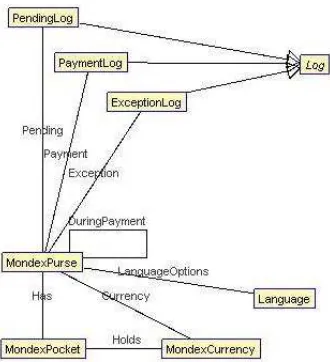
[image:3.612.86.251.493.674.2]A version of the class diagram of the Mondex Smart Card application is given in Figure 1. The system has 30 invariants, the classes given in Figure 1 have 31 operations and 197 assertions were written in order to cover these oper-ations. These numbers exclude utility classes such asDate and their associated operations.
Figure 1. Class Diagram - Mondex
1.2
Validation of Assertions and
Genera-tion of Abstract Test Cases
Validation is a crucial phase of the software development process in demonstrating that the system under investi-gation meets the requirements set. Assertion validation ensures that pre and postconditions of operations within the system are set as they are intended, i.e., they do not allow operations to function outside of their range. There are three ways of tackling this issue:
1. checking that the preconditions, state invariants and postconditions of the operation under investigation (OpuI) are satisfied at least once.
2. ensuring that the OpuI does not run when at least one of the preconditions is failed.
3. checking that at least one of the postconditions of the OpuI fails when a mutant is inserted into the operation provided that the preconditions and the state invariants are satisfied.
The first item above guarantees that the postconditions of the operation are not too strong and that there is at least one case where preconditions and state invariants are satisfied. The second item aims to check the response of the system for when the preconditions are not satisfied. Finally, the last item verifies that the harmful modifications to the operation are caught by the postconditions and that the postconditions are not too weak.
Note that in the context of test case generation, the scenarios created for the first item may be used to generate positive test cases, and the scenarios for the second item generate negative test cases in the sense that they test the system to observe its behaviour for unexpected situations. These two items are similar in the sense that they can both be classified under black-box testing. The third item, however, needs mutants to be generated and inserted into the system, and therefore the type of testing performed at this stage is white-box testing.
Step No.
Step Description
1 Initial loading of object model
An instance of the model is loaded at this stage.
2 Environment Set-ting (Preamble)
- Determ. of frame vars. - Creation of objects - Setting attribute values 3 Access to
opera-tion
The preconditions are checked.
4 Modification of the model
- Creation of objects - Deletion of objects - Setting attribute values - Modifying attribute val. - Coverage of frame vars. 5 Exit from the
oper-ation
[image:4.612.310.550.71.280.2]The postconditions are checked.
Table 1. The steps of a basic scenario
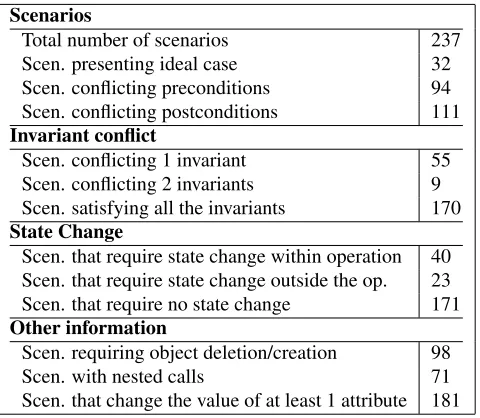
preconditions of the operation are checked. Step 4 is the step that the actions handled by the operation are carried out. Creation/Deletion of objects, modifying attribute val-ues are examples to these actions. If the value of an attribute in the set of frame variables should not change, it is also important to explicitly state this at this step. Note that if we aim to create a scenario that creates a conflict with one of the postconditions of the operation under investigation, as mentioned in the third item above, it is Step 4 where we need to form this conflict, i.e., mutant. In the final step, we exit the operation and the postconditions are checked if the preconditions were satisfied (note that the wordsoperation andfunction are used interchangeably throughout the pa-per). Table 2 summarises the statistics for all the scenarios we created in our experiment. As given in the table, 237 scenarios are created of which 32 presents the ideal cases, 94 violate a precondition, 104 violate one postcondition and 7 violate more than one postcondition. Of these 237 scenar-ios, 64 also conflict with an invariant. This means if this scenario were to catch an error in the system, invariant fail-ure would provide an alert as well. In addition to these, 98 scenarios require creation/deletion of objects and 71 sce-narios are involved in nested calls. The importance of these numbers will become more clear in the rest of this paper.
1.3
Contribution
There have been studies concentrating on the generation of scenarios by using the USE tool for the validation of models [9, 8, 1]. Although these studies indirectly suggest the use of assertions, they mainly focus on the satisfaction of invariants whilst creating the scenarios.
In our approach, we implement both invariants and
Scenarios
Total number of scenarios 237 Scen. presenting ideal case 32 Scen. conflicting preconditions 94 Scen. conflicting postconditions 111
Invariant conflict
Scen. conflicting 1 invariant 55 Scen. conflicting 2 invariants 9 Scen. satisfying all the invariants 170
State Change
Scen. that require state change within operation 40 Scen. that require state change outside the op. 23 Scen. that require no state change 171
Other information
Scen. requiring object deletion/creation 98 Scen. with nested calls 71 Scen. that change the value of at least 1 attribute 181
Table 2. The statistics about the scenarios created in this study
pre/postconditions, but we base our scenarios on the satis-faction/dissatisfaction of the assertions. By explaining our experiences during the creation and execution of such sce-narios, we aim not only to contribute to the overall disci-pline in creating validation scenarios, but also to present:
• the complementary roles of assertions and invariants in modelling a system
• the role of assertion-based scenarios in terms of model validation
• the role of assertion-based scenarios in the generation of abstract test cases
• the obstacles in creating and running independent sce-narios
The importance of our work comes from the fact that we can use models (including system models and scenarios) to both carry out validation and generate test cases for the ac-tual system. A challenge with this approach is in working with abstract models. Because models are abstractions of a real system, the scenarios we construct must also be ab-stract; in particular, they must be general enough to apply to different instances of the model with little or no modifi-cation. By achieving this, it should be easier to transform these scenarios into test cases. We discuss this, and other observations in Section 2.
[image:4.612.51.287.71.268.2]postconditions needs mutants to be inserted into the opera-tion (unless the operaopera-tion is modeled incorrectly), thus, this type of scenario creation can only be done if white-box test-ing is considered to be applied on the system since right type of mutants must be created and inserted into the oper-ation under investigoper-ation. MBT is considered to be black-box testing, therefore, the third type of scenarios may not be of valuable for this purpose, however, as described in the further sections, we find them useful in terms of assertion validation.
2
Observations on Scenario Creation in the
context of Model-Based Testing
In this section, we report our experiences in creating the scenarios described above. We structure our observations into three categories: tool-related observations, assertion-related observations, general scenario formation-assertion-related observations. The tool-related observations aim to reveal the drawbacks and advantages of using the toolUSE. The assertion-related observations address the usage of the pre/postconditions as well as the invariants in the process of scenario creation. The observations in this category mainly focus on how to detect some of the errors related to assertions and how to write better assertions. The final category outlines the observations regarding the scenarios that either show the ideal execution of an operation or violate a pre/postcondition. For each observation, we follow the template given below.
Short description of the observation
Aim:the aim of the action that produced the observation.
Context:in which environment the observation is made
Issue encountered:the unexpected behaviour
Detailed observation:the clear explanation of the issue
Conclusion:the effects of the problem
Extra notes:extra comments about the issue and its impacts
2.1
Tool-related observations
In this section, tool-related observations during the vali-dation of assertions are discussed in detail.
Observation1: How is the call stack
man-aged in USE?
Aim: The aim here is to find a scenario that would conflict with a certain precondition of an operation.
Context: In USE, the preconditions of an operation are checked when the command for the operation call -!openter-is executed. If the preconditions of the operation are sat-!openter-is- satis-fied, then the operation is put into thecall stack. If the oper-ation is defined by OCL expressions, these are executed and
the expected value is returned when the !opexit command is run. The postconditions of the operation are also verified at this point.
Issue encountered: If the operation is not defined by us-ing OCL expressions, i.e. when the operation changes the value of some variables, creates/deletes some objects, etc., then these sort of changes are performed via the commands introduced in USEbetween the !openter and !opexit com-mands. !set, !create, !destroy are some examples to such commands.
The problematic situation occurs if the operation is de-fined byUSEcommands and the preconditions of the oper-ation are not satisfied. In such a case, the operoper-ation is not put into thecall stackdue to precondition failure, however, the commands after the operation call are still executed, i.e. the changes that the operation would do are still performed. Then, when the !opexit command is called, the tool states that the call stack is empty and do not check the postcon-ditions assuming that the operation is not executed anyway. The concern here is that the system may be in a different state than it was in the beginning although the operation is not executed according to the tool.
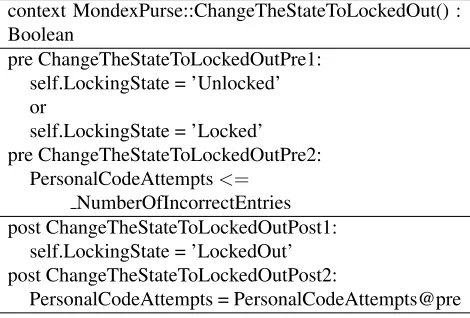
Observations: One of the operations in which we observed this behaviour of the tool is given in Table 3. This op-eration is called when the personal code is entered more than the number of times stated by the attribute Personal-CodeAttempts. The attribute NumberofIncorrectEntriesis increased each time the user enters an incorrect personal code.
context MondexPurse::ChangeTheStateToLockedOut() : Boolean
pre ChangeTheStateToLockedOutPre1: self.LockingState = ’Unlocked’ or
self.LockingState = ’Locked’ pre ChangeTheStateToLockedOutPre2:
PersonalCodeAttempts<=
NumberOfIncorrectEntries post ChangeTheStateToLockedOutPost1:
self.LockingState = ’LockedOut’ post ChangeTheStateToLockedOutPost2:
[image:5.612.311.546.431.590.2]PersonalCodeAttempts = PersonalCodeAttempts@pre
Table 3. ChangeTheStateToLockedOut
Following code is the scenario that conflicts with the second precondition of this operation.
<ChangeTheStateToLockedOut_Pre2.cmd> read basemodel.cmd
--Conflict Creation
!set P1._NumberOfIncorrectEntries := 1 !set P1.PersonalCodeAttempts := 4 --Enter the operation\\
!openter P1 ChangeTheStateToLockedOut() --Modification of Frame Variables !set P1.LockingState := ’LockedOut’ --Exit the operation
!opexit true
Conclusion: In this example, we managed to reach our aim in the sense that we found a scenario where the second precondition fails, however, the system is now in a differ-ent state than it was and this may cause unexpected results when the next scenario is run.
Extra notes: The workaround we followed for this prob-lem is that we executed the commands that neutralise the modifications occurred during the execution of such a sce-nario. Observation8 in Section 2.3 explains the process of neutralisationin more detail.
Observation2: The reflection of the UML
syntactic rules onto
USEAim: The aim is to find a scenario that would conflict with a postcondition of an operation that creates/deletes objects.
Issue encountered: In some of the scenarios, we cre-ated/deleted extra objects. The rationale behind this has been to observe whether the system is able to recog-nise/react if an operation duplicates a creation/deletion. In some cases, the tool USE throw the exception Multiplic-ity Violation Erroralthough the system after the execution of the scenario satisfied all the invariants.
Observations: There are situations where the multiplicity rules are not necessarily transformed into invariant form. Especially, for 1 to 0..1 and 0..1 to 1 cases, the model may only show the multiplicity rules by using UML syntax and may not have an invariant stating that the number of certain objects linked to certain other object can be at most one.
Conclusion: The restrictions modeled on UML diagrams, the OCL invariants and pre/postconditions are complemen-tary units. Their definitions can overlap and they may ad-dress similar issues through different channels, but they all contribute in their own way. In other words, the existence of one does not make another redundant. The fact that USE complies with the restrictions imposed by UML and that it performs the syntactic checks for these rules is definitely a feature that all the OCL-compliant tools must have.
Observation3: Decreasing the dependency
of scenarios to the instance of the model
Aim: In the creation of the scenarios, one of the rules we need to follow is that we need to bereasonably independent
from the instance of the model we created. What we mean by this is that the instance of the model created for the test environment is just one of the many possible instances of our model and the objects that exist in one instance may not exist in another one. In other words, the number of objects, the number of links, the name of the objects, the attribute values may all be different. Since the scenarios in our ap-proach are based on the instance of the model, it is true that they are somewhat dependent on the instance chosen. Hav-ing said that, the level of this dependency can be decreased by using more general statements in the scenarios.
Context: If deleting an object is one of the operations han-dled by an operation, some of the postconditions of this op-eration must make sure that the deletion really occurs. The observation that is explained in this section is made whilst trying to find a scenario that is related to one of these post-conditions and that deletes an object.
Issue encountered: We realised that some of our at-tempts to write more general statements in our scenarios have caused exceptions in USE especially during the dele-tion of an object.
Observations: The EnquireCurrencyInfo() function de-fined in our system provides information about a given cur-rency. This information includes ISO Currency Code, the number of digits hold for that currency, etc. One of the postconditions of this function states that that the operation should not modify currency objects. In our approach, as explained in Section 1.2, we created scenarios that present the ideal functioning of an operation and that also conflicts with each different pre/postcondition of the operation. The scenario that targets the postcondition mentioned above, deletes a currency object and observes the reaction of the system. Our first attempt to delete the currency object had the following code:
%The first option
let ObjectDel : MondexCurrency = Purse1.avCurrencies->
select(ISOCurrencyCode =’GBP’)-> asSequence()->first()
!destroy ObjectDel
However, theObjectDelobject behaves like a pointer to the actual object and therefore, the object that is requested to be deleted is not deleted and we receive aRunTime Exception - unbound variable -error. Our next attempt was to define the object to be deleted as defined in ObjectDel:
%The second option
!destroy Purse1.avCurrencies-> select(ISOCurrencyCode = ’GBP’)
->asSequence()->first()
Our final attempt was to execute the command that deletes the object by calling its name:
%The third option !destroy C_GBP1
After this command, the object is deleted, the postcondi-tions are evaluated and no exception is thrown.
Conclusion: When we examine the scenario statements written above, we see that the first two need the same amount of information in order to proceed, i.e. the currency that is under investigation. This information is passed to the function as a parameter anyway and therefore the user does not necessarily have to know a lot about the current instance of the model. The third one, on the other hand, needs the knowledge of an object name which makes the scenario extremely dependent on the selected instance of the model. We tried these different options in different sce-narios and noticed that in some situations the second - and the more general - option works, however we are unable to find a pattern that explains the rationale behind this varying behaviour. The main message we would like to give here is that the tool must allow the user to write reasonably gen-eral, OCL-based scenarios and the rules related to creation and deletion of the objects must be clear.
2.2
Assertion-related observations
The observations made during the creation of pre/post-conditions are given in this section. The situations where a scenario highlights the importance of a change in the asser-tions and in the invariants are also presented.
Observation4: Writing an invariant instead
of an assertion tuple
Aim: Some of the most important characteristics we would like our model to have is clarity, consistency and simplicity. The units forming the model such as diagrams and OCL expressions must also have these characteristics and should not introduce any extra complexity.
Context: Whilst creating the pre and postconditions of the operations, it is important to understand the context of the operation and the scope of the frame variables. In certain cases, the change in one variable may affect another vari-able and these changes must be presented in postconditions.
Issue encountered: For two conditions X and Y, if Y must be true each time X holds, then this relationship must be shown each time X appears in a pre/postcondition. If X is a widely-used variable, i.e. is an element of frame variable set of many operations, then Y must be repeated as many times as X appears.
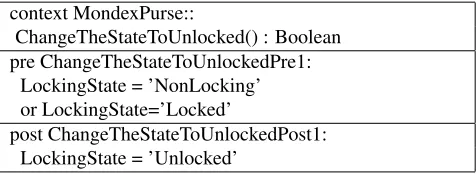
Observations: We first noticed this whilst writing scenar-ios forChangeTheStateToUnlocked()function. Initially, the definition of the function had the pre/postconditions shown in Table 4.
context MondexPurse::
ChangeTheStateToUnlocked() : Boolean pre ChangeTheStateToUnlockedPre1:
LockingState = ’NonLocking’ or LockingState = ’Locked’
pre ChangeTheStateToUnlockedPre2: LockingState = ’NonLocking’ implies
(not PersonalCode.isDefined or PersonalCode = 0) post ChangeTheStateToUnlockedPost1:
LockingState = ’Unlocked’
post ChangeTheStateToUnlockedPost2:
[image:7.612.308.548.69.219.2]PersonalCode.isDefined and PersonalCode<>0
Table 4. ChangeTheStateToUnlocked - First version
We then realised that each time the state is inNonlocking state or changes fromNonlockingstate to any other possible state, we have to check the value ofPersonal Codeeven if the operation itself does not necessarily state a change in the value of Personal Code. This not only creates many duplicates of the same requirement, but also creates a hole in the system when it is forgotten.
To avoid this, we created the following invariant:
inv iPerCode_Nonlocking:
(LockingState = ’Nonlocking’ implies (PersonalCode = 0 or
not PersonalCode.isDefined())) and
(LockingState <> ’Nonlocking’ implies (PersonalCode <> 0 and
PersonalCode.isDefined()))
This invariant states that if the system is in Nonlocking state, the Personal Code is either zero or not defined. When the system is in any other state, the personal code has a value other than zero. After the introduction of this invari-ant, the pre/postcondition definition of the above function became as given in Table 5. As a result, all the related
context MondexPurse::
ChangeTheStateToUnlocked() : Boolean pre ChangeTheStateToUnlockedPre1:
LockingState = ’NonLocking’ or LockingState=’Locked’
post ChangeTheStateToUnlockedPost1: LockingState = ’Unlocked’
Table 5. ChangeTheStateToUnlocked - Sec-ond version
[image:7.612.310.548.552.639.2]Conclusion: If there is a repetition of pre/postconditions, it is worth looking at the relationship between the variables under investigation to see whether such a relationship would hold for all cases. The example given above is a good ex-ample of a case where we noticed the need for an invariant due to this repetition.
Observation5: Incorrect invariant detection
Aim: The rationale behind creating scenarios that violates a pre/postcondition is to be able to construct abstract test cases to challenge our system. One of the advantages of the process of scenario-creation is that it also allows us to test our own model for correctness and consistency.
Context: It is possible to find a set of scenarios that vio-lates an assertion of an operation. The choice of scenario to be used can be done simply by the user or a set of criteria can be defined and the scenarios may be expected to comply with some/all of these criteria.
Issue encountered: In certain circumstances, we re-alised that the set of scenarios that aim to conflict a pre/postcondition of an operation must also violate an in-variant. In one of these situations, the invariant that the sce-nario was supposed to violate seems to be satisfied. After close examination, we found out that the predicate in the invariant was incorrectly written.
Observations: One of the preconditions of the function ReadPaymentLogs() is that the system must either be in stateUnlockedorLocked. There are two possible scenarios that would violate this precondition: the scenario that sets the system state toNonlockingand the scenario that sets it toLockedOut. The invariant that deals with the cases where the state is Nonlocking-iPerCode Nonlocking- was given in Observation4. The invariant that checks the suitability of system variables for theLockedOutstate -iLockedOutState -is given below.
inv iLockedOutState :
LockingState = ’LockedOut’ implies (PurseExhaustionFlag = true or
_NumberOfIncorrectEntries >= PersonalCodeAttempts)
Both of these invariants require that some other variables of the system are set to certain values. In the scenarios created to conflict the precondition about the state of the system, we first followed the approach where the system state is set toLockedOutor Nonlockingand all the relevant variables such as Personal Code, PurseExhaustionFlag, etc. are ex-cluded. This is why we expected that each scenario would conflict at least with the relevant invariant. However, to our surprise, the invariant iPerCode NonLockingwas satisfied in both cases. When we analysed the problem further, we realised that the invariant in the form of
(p implies q) AND (NOT p implies r)
was written as
(p implies q) AND NOT p implies r
which was interpreted as
(p implies q) AND NOT p) implies r
by the tool and therefore the invariant was satisfied although it should not have been. The issue is resolved when the fault in the invariant is corrected.
Conclusion: The example above presents a case where a scenario written with the aim of violating a pre/postcondition also detects a fault in the model itself. This means that the approach supports the process of correctness and consistency check for the model itself. Further research is needed to assess to what degree this support extends.
Extra notes: Note that, whilst creating the scenarios discussed above, the variables that the invariants are associated to are excluded, i.e. the scenario did not deal with the setting of variables such as PersonalCode, PurseExhhaustionFlag, etc. As an alternative, we also created scenarios that add these variables to the FVS of the operation and that handles the correct setting of these extra variables for the given scenario. By doing this, we bring the system in a different stable state and then observe the cases where the precondition under investigation fails, but all the invariants are satisfied. This issue is briefly discussed again in Observation7 in Section 2.3.
Observation6: Overlapping postconditions
- Independent effect of each postcondition
Aim: In our experiments, we create the scenarios that ide-ally violate only one pre/postcondition at a time. We believe that the possibility of finding an error increases when each scenario is dealt with a different assertion since the domain of a possible error differs when the subject matter is differ-ent in a scenario.
Context: In OCL, there may be several ways of navigating to reach an object. Some operations may create even more links and increase the number of navigation possibilities. If such operations have postconditions, the postconditions may also use different navigation routes.
Issue encountered: We noticed that when postconditions use the links created by the operation under investigation, they happen to assume that the links are created success-fully. In other words, they also check the creation of links in addition to their main goal. This conflicts with our initial aim.
Observations: Following assertions were two of the post-conditions initially written for the functionSendValue().
post SendValuePost1 :
pockets->select(Default = true and
post SendValuePost4 :
pockets->select(Default = true)-> asSequence()>first().Value@pre -pockets->select(Default = true)->
asSequence()->first().Value = p_PaymentValue
SendValuePost1 states that the pocket that carries the re-quested currency given by the parameter p ISOCurrCode is the one that is default. In other words, this postcondition ensures that the pocket that carries the currency in which the amount will be transferred is set as the default pocket. The postcondition SendValuePost4 ensures that the value held by the pocket from which the amount is transferred is de-creased byp PaymentValue.
At first sight, both conditions seem to match their defini-tions as given above. However, when analysed further, we noticed that when the first condition fails, both postcondi-tions fail even if the money is transferred in correct cur-rency. This is becauseSendValuePost4assumes that the de-fault pocket is set properly and therefore tries to reach the object through a newly defined link. For instance, if the transfer is made in GBP and the pocket that holds GBP is not set as default, but transfer is made in GBP successfully, then we expectSendValuePost1to fail andpost SendValue-Post4 to pass. We observed that both of the above post-conditions fail for such a scenario. This may seem as an advantage at first sight, but when we try to detect the root cause of such a failure, it is more difficult to find and we are unable to say which assertion is the main target of such a scenario.
The solution to this is to separate the concerns as much as possible for each pre/postcondition. This also requires withdrawing the sequential way of thinking to reach the out-come of an operation. In the above example, one may think that the first action is the change of the default pocket and then the value transfer occurs, so the rationale behind writ-ing a postcondition likeSendValuePost4may be the result of such reasoning. To overcome this issue, we changed the SendValuePost4as below:
post SendValuePost4 : pockets->select
(currency.ISOCurrencyCode@pre = p_ISOCurrCode) >asSequence()>first().Value@pre -pockets->select
(currency.ISOCurrencyCode =
p_ISOCurrCode) ->asSequence()->first().Value = p_PaymentValue
This new version ofSendValuePost subtracts the previous and current values of the pocket that holds the currency in which the payment is made. In this version, there is no as-sumption about any of the actions that the function under investigation must take prior to money transfer. As a result
of this, the failure inSendValuePost1does not necessarily mean a failure inSendValuePost4.
Conclusion: There are several conclusions we can reach by looking at this example. The first one is the im-portance of demonstrating the independent effect of each pre/postcondition. This is similar to that of Modified Con-dition/Decision Coverage (MC/DC), which is a structural coverage criterion that requires that the effect of all con-ditions in a program are demonstrated and that there is no condition that does not affect the outcome of a deci-sion. [12]. Analogous to this criterion, in our approach, we create scenarios - that would then form the abstract test cases - based on the pre/postconditions and therefore, it is important to be able to see the independent effect of each unit, i.e. pre/postcondition. By showing the independent effect, we not only avoid the possibility of an assertion be-ing masked by another assertion, but also let each assertion contribute to the final test suite.
In addition to this, separation of concerns also makesroot cause analysis easier when a fault is detected. In other words, if an error occurs during the execution of a test case that is based on a scenario created by using our approach, we can backtrack and reason about the error by looking at the part of the program that deals with the postcondition under investigation.
2.3
General Scenario Formation-related
observations
Scenarios form the core of our approach and therefore it is crucial to investigate carefully the way they are writ-ten, how well they express their aim in conflicting an asser-tion and the factors that affect their execuasser-tion. This secasser-tion presents the issues encountered during the scenario creation and execution.
Observation7: Frame variables and
treat-ments to frame variables
Context: By definition, if a variable is read/modified dur-ing the execution of an operation, it is considered to be in-cluded in the FVS.
Issue encountered: During the course of scenario creation, we noticed that the above definition alone is not sufficient to cover all the frame variables. There are various external factors such as invariants, nested calls, etc. that require the use of other variables than those listed in the initial form of FVS of an operation.
Observations: Following is a list of some of the cases that must be considered in the determination of FVS:
• If an operation calls another operation from within, ei-ther the elements of the FVS of the called function is added to that of callee function, or the FVSs do not change. Note that, in theory, a static element of callee function’s FVS should not be a dynamic element of the called function’s FVS.
• As explained in Observation5, the change of a variable value may cause an invariant conflict. If the conflict is due to another variable that is not even considered in the scenario, then we have two routes to follow. We ei-ther count these scenarios that conflict with invariants as test cases, or frame variable set will be extended in order to cover the variables required by the invari-ant and new scenarios that do not conflict with the in-variants will be created. So, the point to consider is whether to include the variables that are associated to already existing frame variables through an invariant.
• Another issue that must be taken into account in FVS determination is the case of derived attributes. OCL supports the definition of derived attributes that are prefixed with / in UML and we explained briefly how we dealt with derived attributes in [11]. Cur-rently, there is no automatic way of assigning the value of these attributes. In the context of frame variables, this brings extra work since the opera-tion may not directly use the derived attribute, but if at least one of the dynamic variables included in its FVS set is the variable that affects the value of the derived attribute, then the derived attribute should also be modified accordingly. An example to this can be given by explaining the changes in NumberOfUnusedExceptions. This derived attribute is calculated by subtracting the exceptionlogs− > size()value fromcM axExceptionN oconstant.
When an exception occurs, the system calls CreateEx-ceptionLog()function. This function creates an extra exception log if the current number of exceptions does not exceed a certain value. Since the value of CMax-ExceptionNois constant, but the size of exception logs changes during the course of this operation, we have to
include NumberOfUnusedExceptionsin the FVS and change the value of the attribute accordingly. This also allows us to use it as a counter in the various other functions.
Conclusion: The list presented above is not a complete list by any means, but we believe it demonstrates the need for the extension of FVS through different channels and if this concept is to be integrated into OCL tools, it is necessary that the aforementioned issues are considered.
Observation8: Running scenarios one after
the other - how to avoid them affecting each
other’s territory
Aim: It is important to find the patterns that would help us automate our technique and/or integrate it with other tech-niques that are automated. In the context of scenario cre-ation, automation is not only important in forming the sce-narios, but also in executing them one after the other.
Context: When the instance of the system model is exer-cised by a scenario, the scenario brings the system into a certain state. This new state may be the same as the old one if the scenario does not perform any changes on any of the existing objects and does not create/delete any objects. In this case, a second scenario can be run straight after the first one, since the system is in its initial, stable state. Clearly, each scenario assumes that the system is in a state that ac-cepts the further requests to be made by itself. This assump-tion comes from Step1 on Table 1.
Issue encountered: If the first scenario makes modifica-tions on the initial instance of the model, then the assump-tions made by the second scenario may not hold. Thus, the question that arise in the context of scenario execution is that how the process of running several scenarios one after the other can be achieved especially in the presence of those that modify the system. The following are two solutions to this problem:
• System reset: After each scenario, the system can be reset to its initial state by performing Step1 on Table 1.
• Neutralisation: Actions that would erase the effects of the last scenario can be carried out.
In order to apply theNeutralisationtechnique, we need to undo the actions in the reverse order. Adjusting the value in default pocket by addition, deleting the payment log that holds the details for a transaction, changing the default pocket to its previous form, creating the previously exist-ing exception logs are some of the actions carried out in order to neutralise the effect of the scenarios. This list only gives a rough idea about the actions that needs to be done before executing the next scenario. When we examine fur-ther, we realised that the elaboration of neutralisation pro-cess requires thorough analysis of program semantics and the process itself includes :
• Storage of the previous values (in order to restore them later)
• Implementation of reverse functions, i.e., functions that has the opposite effect of existing functions
On the other hand, system reset only requires the re-compilation of the model and the execution of the first line in the scenario -read basemodel.cmd-.
Conclusion: Neutralisation and system reset are two solu-tions to the problem of running scenarios one after another. System reset may mean the initialisation of the whole model and depending on the technology used and the system en-vironment, this may require extra memory space and ad-justment of certain environment variables. However, during this research, system reset option has been used extensively in order to save time.
3
Future Work and Conclusion
In this paper, some of the observations made during the creation and execution of scenarios for validation of asser-tions have been outlined. The importance of independent scenarios, the effect of overlapping postconditions, the im-portance of the frame variable set and the ability to carry out successive executions of scenarios are some examples of observations that are not only applicable in the context of USE tool, but are also relevant for other tools that support scenario creation and execution. We believe that these ob-servations explain how scenarios for exercising assertions can be defined in a structured manner and what sort of obstacles can be experienced, thus leading us to a better model, and helping to form the basis for test case genera-tion through model artifacts.
In the next phase of our work, we will focus on automatic generation of these scenarios and ultimately transform them into abstract test cases. Integration of ASSL (A Snapshot and Sequence Language) is likely to happen since there is previous work based on the conflict of invariants in USE [7, 8] and the possibility of applying this technique to asser-tions is still open to further research.
References
[1] Gogolla M., Richters, M., Using the UML Specification Environment (USE). http://citeseer.ist/psu.edu/531031.html , 2002.
[2] Clarke R., The mondex value-card scheme, a mid-term report. Chip-Based Payment Schemes:Stored-Value Cards and Beyond, 1997.
[3] Introduction to Mondex Purse Operation, Tech. report., https://mol.mastercard.net/mol/molbe/public/login/ ebusiness/smart cards/mondex/, Mondex International Limited, 1999.
[4] Woodcock J., Banach R., The Verification Grand Chal-lenge, Computer Society of India Communications, 2007.
[5] Stepney S., Cooper D., Woodcock J., An Electronic Purse: Specification, Refinement and Proof. Oxford Uni-versity Computing Laboratory, Tech Report, 2000.
[6] Sendall S., Strohmeier A., Specifying System Be-haviour in UML, Technical Report DI/00/343, EPFL, 2000.
[7] Gogolla M., Bohling J., Richters M., Validation of UML and OCL Models by Automatic Snapshot Gener-ation, Proc. 6th Int. Conf.Unified modelling Language (UML’2003), Springer, LCND 2863, 2003.
[8] Gogolla M., Buettner M., Richters M., USE:UML Specification Environment for Validating UML and OCL, Science of Computer Programming, 2006.
[9] Ziemann P., Gogolla M., Validating OCL Spec-ifications with the USE Tool-An Example Based on the BART Case Study, Elsevier Science, http://www.elsevier.nl/locate/entcs/volume80.html, 2003.
[10] Kassios I.T., Dynamic Frames: Support for Framing, Dependencies and Sharing without Restrictions, Proc. FM 2006, LNCS, Springer, 208-283, 2006.
[11] Aydal E.G., Paige R.F., Woodcock J., Evaluation of OCL for Large-Scale Modelling: a Different View of the Mondex Smart Card Application, Ocl4All: Mod-elling Systems with OCL, Workshop at MODELS’07, Nashville, USA, 2007.
[12] Miller S.P. and Chilenski J.J., Applicability of mod-ified condition/decision coverage to software testing, Software Engineering Journal, 1994.