TANJA RIESE
GRADUATE DIPLOMA
1 9 8 8
CONTENTS
I n t r o d u c t i o n 3
I n f l u e n c e s on my work
i. O r i g i n s 5
i i . A r t i s t s 7
The use of the Face 13
Work Process and Technique 17
W o o d c u t s 19
M o n o p r i n t s 2 1
L i t h o g r a p h s 2 3 1
ii
i v . E t c h i n g s 2 5
P s y c h o l o g y and M e a n i n g 2 7
C o n c l u s i o n 3 3
Chronology of work during 1988 3 4
List of Illustrations 36
Notes 3 7
Fig. 1
I can only make direct statements, only 'tell
stories.' Whether or not the stories are 'true' is not
the problem. The only question is whether what I
tell is my_ fable, mx truth. ^
INTRODUCTION
This year I based my work on the face. It is a metaphor for my internal world,
d e s c r i b i n g my personal c o n f l i c t s and struggles. In e x p l o r i n g the idea of a
continuous internal struggle I feel that I am not alone. I am discovering that
my feelings of self doubt, my attempts to find the self and the d i f f i c u l t i e s
encountered in this j o u r n e y are experienced by many people. It is a journey
that necessarily involves many conflicts, discoveries and doubts.
I know this to be my truth and I believe that there can be no end to learning
Fig. 2
But yearning too has its ghosts. I painted such
ghosts. By no means for my pleasure, it was an
obligation. ^
INFLUENCES ON MY WORK
i. O r i g i n s
In 1987 I completed the Art theory course in Psychology at Sydney College of
the Arts. The 'psychology projects' that formed part of the course have since
then b e c o m e very important to my work. These p r o j e c t s were based on a
theme of our own choice; a dream, an image or feeling about which we felt
s t r o n g l y . T h e idea was then d e v e l o p e d v i s u a l l y , t o g e t h e r with written
d o c u m e n t a t i o n .
I took m y s e l f as a theme, c o n c e n t r a t i n g on my f e e l i n g s about, and my
relationship to my own body. In the writing that accompanied this work I
r e c o r d e d my reactions to certain m o d e s of r e p r e s e n t a t i o n and m e t h o d s of
w o r k i n g . I observed the degrees of nudity and detail revealed by either
d r a w i n g or t a k i n g a direct impression f r o m the body onto paper (fig. 2);
i d e n t i f y i n g myself or creating anonymity by excluding the face and the e f f e c t
on myself of h a n g i n g these life-size i m a g e s on the wall or having them
viewed by others.
It struck me that occasionally I rejected certain trains of thought, f e e l i n g
somehow threatened by them and often found it difficult to continue with the
work. I b e c a m e curious about the things I disliked or avoided and the
p s y c h o l o g i c a l motives for them. This experience has developed in me an
Fig. 3
Art never seems to make me peaceful or pure. I
always seem to be wrapped in the drama of
vulgarity. 3
ii. A r t i s t s
I am attracted to Artists who make visible the intensity of emotion; the painful,
the grotesque as seen in the expressionist art of the twentieth century. In
works such as The good Judges (1894) and Seven deadly sins (1902) 4 J a m e s
Ensor reveals the hideous, unseemly qualities of man. The leering masks show
p h y s i c a l l y what are n o r m a l l y the hidden m o t i v e s ; p e r s o n a l p r e t e n t i o u s n e s s
and greed become clearly visible.
E g o n Schiele joined in that collective probing of the psyche ^ w h i c h t o o k
p l a c e in Vienna in the early twentieth century. Much of his work is an
exploration of voyeurism and the self. ^ This concern became evident in his n u m e r o u s s e l f - p o r t r a i t s with t h e i r d i s t u r b i n g p s y c h o l o g i c a l i n t e n s i t y . I
a d m i r e the work of Schiele f o r its u n a s h a m e d realism in r e p r e s e n t i n g his
anxiety and desires.
Max B e c k m a n n is an Artist I am drawn to f o r the strange tension in his
images. He said in 1938, I am seeking the bridge which leads from the visible to
the invisible, like the famous cabalist who once said 'if you wish to get hold of
the invisible you must penetrate as deeply as possible into the visible'. ^ I
understand this to mean that Beckmann is depicting his emotional reality in
the form of a more tangible visual reality which is also the vehicle and means
Fig. 429
Fig. 530
1 know not if I am
an artist
nor do you!
I have a say, and say to you
what form does it take?
can you tell? ^
The work of Joy Hester deals with the afflictions of her body and mind. It
reads as a personal journey through dreams, relationships and fears. They are
bold, emotional images without hesitation and it is their p a s s i o n a t e honesty that I admire. These works contain a feeling of inevitability, of tragic emotion
that needs to be seen. Joy Hester's drawings have encouraged me to be less
restrained in my own work.
I h a v e also been impressed by the p a i n t i n g s of F r a n c i s Bacon with their
distorted bodies that seem to be agonized and tortured. In an interview with
David S y l v e s t e r , B a c o n d i s c u s s e s the deeper levels of personality which
emerge when allowing chance to work. He says, they came over without the
brain interfering with the inevitability of an image. It seems to come straight
out of what we choose to call the unconscious ^ This idea of allowing an image
to come forward without altering it consciously is of interest to me.
P e t e r Booth m a k e s clear his private tensions and personal trauma ^^ in nightmarish scenes peopled with hideous and deformed figures (fig. 4, 5). The
faces are often mask-like, providing protection to individuals in a crowd who
may then act without responsibility. T h e s e paintings speak to m e of the
darker side of human nature, where the crowd seems to bccome an anonymous
Fig. 631
.the scale seduces me into a loss of view and control. ^^
Miriam Cahn 1986
Miriam Cahn's series of charcoal drawings titled Das W i l d e L i e b e n and D a s
K a s s i s c h e L i e b c n 1983 (fig. 6) attracted my attention at the 1986 Sydney
Biennale. T h e d r a w i n g s were huge figures with a strong, dark presence and
peering, eyes. In the words of Annelie Pohlen her i m a g e s are traumatic,
comparable to that incomprehensible dance of figures in a dream where
location is as difficult to define as it is in Cahn's workA^
In a lecture given at Sydney College of the Arts in May 1986, Cahn d e s c r i b e d
her method of working. She begins to read the image by feeling her way with
powdered charcoal over huge sheets of paper placed on the floor. The image is
completed in one session without stopping or correcting, enabling her to avoid
c o n s c i o u s control of the work. It can only be imagined or physically felt
w h i l e in p r o g r e s s .
This method of working is of interest to me as it seems to grow f r o m the
innerself not the external world. Cahn allows the element of the unknown to
emerge in the method she uses. I am attempting to work this way myself,
u s i n g u n e x p e c t e d q u a l i t i e s w h i c h can be c h a r a c t e r i s t i c of p r i n t m a k i n g
p r o c e s s e s , p a r t i c u l a r l y drypoint, m o n o p r i n t and l i t h o g r a p h y .
Fig. 7
The inner man reveals all of himself by being
himself. He is mirrored by what is visible.
Otto Dix
THE USE OF THE FACE
The face represents to m e the part of a person that most intensely c o n v e y s
their emotion. I have had, as long as I can remember, an immediate attraction
to drawing the face. This year I decided to pursue this subject matter: to bring
to light reasons for this attraction and to see what I could learn of myself from
my own representations of the face.
T h e f o l l o w i n g idea d e v e l o p e d : e x p l o r i n g m y s e l f t h r o u g h the s e l f - p o r t r a i t
while attempting to remain constantly aware of my personal responses to the
images. At times I used other people's faces as a starting point and attempted to
treat them as my own image. Since my interest did not lie in creating a
likeness or in the superficial appearance of the face but rather in the emotion
that it carried and concealed I thought that this could work. H o w e v e r these
images were for the most part, meaningless to me (fig. 12).
I found that the emotional involvement in drawing my own i m a g e was very
strong and that this gave the work a greater intensity. I aimed to know more
about my own emotions. My intention was to move inwards and the face was a
method by which this could be achieved.
Fig. 8
Unconscious impulses make man seek and find
what he thinks comes to him by chance. ^^
Walter Sorrell
The face in our culture is what we use to present ourselves to the outside world
and is also the primary focus for expressing and reading emotions. Of the
senses, sight is by far the most dominant in our society. We look from our
faces into other faces: it is that with which we see and are seen.
I am trying to look through the eyes in both directions - they are a window to
the inside and the outside. I am looking at myself and discovering the face I
normally do not show to myself, and must then rework the personal myth that
I have carefully developed over the years.
T h e face functions both to reveal and conceal the emotions. My intention was
to look through the mask to what lay behind, but found, instead, at times that I
was being confronted by it. The mask protects the innerself but may also stifle
it. To hide behind the mask, in the words of Soren Kierkegaard is to condemn
oneself to a life of half obscurity.
As it is my face, or a face in my imagination that is the base of most of the images, I feel it would be too contrived if I were to consciously try and show in
my facial expression what I feel, then to interpret these expressions. Rather, I
endeavoured not to show any specific or premeditated expression when I drew
f r o m myself. I have found that the expression usually develops in the image
through a distortion of the face (fig. 15) or through the tones and lines of the
work itself (fig. 1, 14). It is intended not as a literal interpretation of facial expression but a glimpse of the inner emotions.
Fig. 9
./ try to express through painting, a function differeitt
from poetry and music but, for me, a predestined
necessity...
Max Beckmann
[image:17.476.12.464.15.519.2]WORK PROCESS AND TECHNIQUE
I used several techniques to find that which suited my method of working best.
T h o s e that I eventually f o u n d m o s t u s e f u l were direct p h y s i c a l t e c h n i q u e s ,
either scratching into an etching plate or into a lithographic s u r f a c e . These
techniques were most successful for me, I think, because the process did not
i n t e r f e r e with or delay the realisation of ideas. T h e s e p r o c e s s e s allowed
i n t u i t i v e i d e a s to e m e r g e leaving the way open for results that were not
e n t i r e l y e x p e c t e d .
Writing accompanied the work in the form of a diary. This diary reads as a
record of my emotions throughout the year and contains many questions and
doubts. I wrote when I felt compelled to write; when I was frustrated with the
work or felt I had come to a halt in my ideas. I do not regard this diary as part
of the work to be presented, rather, it is a personal document where I consult
myself and consider my position both personally and in the work. The writing
provided m e with clues f o r new m e t h o d s of approach. It was here that I
attempted to sort my ideas and observe the directions of the work. Reading the
diary through now shows that I mainly wrote down when the work was going
badly or when I was dissatisfied with the results. There seemed to be no urgent
need to write when things were going well.
I used t h e f o l l o w i n g t e c h n i q u e s of w o o d c u t , m o n o p r i n t , l i t h o g r a p h y and
etching roughly in that sequence although they often overlapped. In some
months for example, the work may have been predominantly lithographs but I
had begun some etchings or may h a v e been r e w o r k i n g a group of earlier
m o n o p r i n t s at the s a m e time. I will t h e r e f o r e d i s c u s s t h e s e t e c h n i q u e s
chronologically in order of their main emphasis.
Fig. 10
Our conscious life simply rests on a sea, a vast sea
of an inner world of which we know very little
Peter O'Connor 1985
i. W o o d c u t s
The woodcuts are the beginning of the inward movement in my work. The two
series of woodcuts show the facade which is impenetrable and reflective like a
shield. The first was based on a drawing of another person and the second was cut from my own image directly onto the block (fig. 10). I find that the second
image has a much greater presence and intensity.
T h e w o o d c u t s are roughly cut and abstracted like c a r v i n g s or masks and
represent a stage of looking without being able to see beyond the face itself.
They are the extreme outside of the face that discourages intimacy. Although
it is a fairly direct way of working, woodcut can be time c o n s u m i n g and I
f o u n d that I b e c a m e overly concerned with the t e c h n i q u e r a t h e r than the
i m a g e .
My f e e l i n g about these images is that they seem g u a r d e d and remote, r e f l e c t i n g my own apprehension at the time.
Fig. 11
/ think, perhaps, that despair is more helpful,
because out of despair you may find yourself
making the image in a more radical way by taking
greater risks.
i i . M o n o p r i n t s
The scries of monoprints were made using photographs, mostly of other people
(fig. 11, 15). I began using the photograph because I wanted to try and draw
facial expressions that a model could not hold. My idea was that even though
they were the faces of other people they would be representative of myself as I
added to the image my own interpretation. It did not work that way however,
as after some time I began to see them merely as flat images. Roland Barthes
writes that, ...the photograph is the advent of myself as other: a cunning
dissociation of consciousness from identity. ^^ Without a sense of identity the
face eventually lost its meaning for me.
I felt I was being seduced by the look of the image. I liked the appearance of
these monoprints and therefore found it difficult to move on and develop in a
more exploratory manner. I realised that a visually pleasing result often acted
as a distraction for me as I was less likely to question myself and inclined to
continue indefinitely in the same manner. As Francis Bacon stated about his
painting, / think that, quite possibly, when things are going badly you will be freer...and you do it with a greater abandon than if things have been working
for you. 2 1
Fig. 12
Fig. 13
.that faint uneasiness which seizes me when I
look at 'myself on a piece of paper.'
i i i . L i t h o g r a p h s
Many of the lithographs, which were begun shortly after the monoprints, also
o r i g i n a t e d f r o m p h o t o g r a p h s . Here, initially, I had similar results to the
monoprints - a too literal representation. The lithographic process however, e n a b l e d me to m a n i p u l a t e the images by a l t e r n a t i v e l y d a r k e n i n g areas or
scratching into the stone to eliminate tone (fig. 12, 13). The original faces
then u n d e r w e n t a m e t a m o r p h o s i s f r o m p o r t r a i t s into a visual representation
of subconscious thoughts and fears.
Through the p h o t o g r a p h the face seemed even more solidly present than in
life, as it was fixed in space and time with a constant expression. I found I had
to move away from the physical reality of the face, to avoid being blocked by
the mask. Following the initial series of lithographs I abandoned the use of
Fig. 14
Rather than setting out to paint something I begin
painting and as I paint the picture begins to assert
itself, or suggest itself under my brush...the first stage
is free, unconscious.'^^
iv. Etchings
In July I began with a series of small etchings which were like visual
notations; an immediate response to a thought or feeling (fig. 3). They were
primarily drypoint and occasionally I worked directly into hardground. The
size of these etchings was significant for me as I was able to develop my ideas
in a short time and I tended to feel less inhibited working on a small scale,
enabling more freedom of expression.
The etchings were, for the most part, spontaneously made with as little
'thinking' about the image as possible. Generally they did not come from a
pre-existing conscious mental image, rather they seemed to 'happen' or
emerge from myself onto the plate. Etching provides the advantage of
working quickly, making immediate responses possible. There is also the
element of the unknown as mentioned previously, whereby the image is never
fully visible until it is inked and printed.
Fig. 15
The shadow personifies everything that the
subject refuses to acknowledge about himself and
yet is always thrusting itself upon him directly or
indirectly.
PSYCHOLOGY AND MEANING
In my process of working, as previously described I was willing to let myself
be led by ideas as they were perceived through the work, letting the innerself
reveal itself. The images that came out of this manner of working show an
increasing degree of anxiety and frustration. Part of me was trying to be
objective, honest and learn about myself, while another part was resisting this
strongly. This caused considerable tension t h r o u g h o u t the year as I felt a
constant , compelling ressistance from a part of myself to what I was doing.
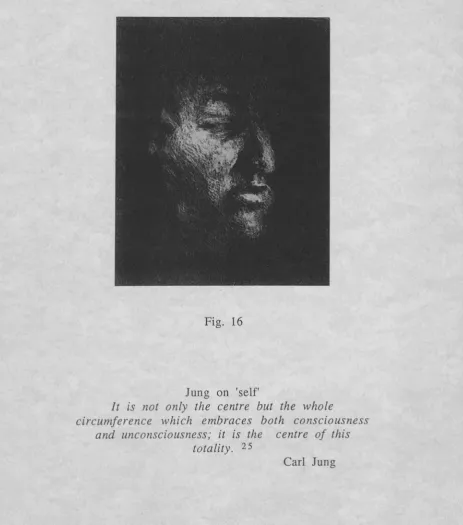
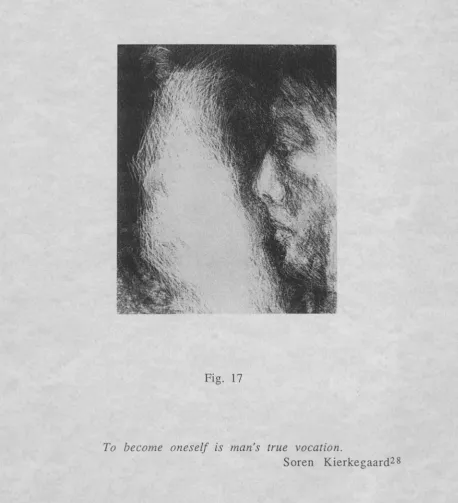
The work describes a growing awareness of the existance of opposing 'forces' within myself and the conflict between these (fig. 15, 16, 17). Their presence
is felt in the form of mutually contradictory thoughts or desires; the desire to
look but not to see. The work deals with my personal struggle of opposites - the
objective and subjective selves. The fear of the unknown is matched by the
attraction to it. My work has become an attempt to present aspects of this
Fig. 16
Jung on 'self
It is not only the centre but the whole
circumference which embraces both consciousness
and unconsciousness; it is the centre of this
totality. 25
I have developed over the years, a growing interest in the theories of Carl
Gustav Jung. Certain ideas expressed by Jung have become increasingly
meaningful to me and my work. Jung writes, the self is our life's goal, for it is
the completest expression of that fateful combination we call individuality.'^^
Jung and his theories are concerned primarily with the reconciliation of
opposites within oneself. This is achieved through the process of
individuation which may be described as bringing into consciousness the
unconscious aspects of our being. According to Jung, self can only be
achieved through the knowledge of these parts and acceptance of them. This
involves coming to terms with parts of the psyche that have been rejected and
pushed into the subconscious; the shadow figures of our personality. In the
words of Jung: Consciousness and unconsciousness do not make a whole when
Fig. 17
To become oneself is man's true vocation.
My subconscious, as I perceive it, is like an unknown store of knowledge and
feeling. I sense it exists but have no words to define it or its contents.
Occasionally, out of the obscurity, something begins to emerge; thoughts that
my logic does not recognise; impulses and desires contradictory to my
conscious will.
While making the work, I intended to allow my subconscious to come forward.
I tried to do this by working quickly, spontaneously and not giving the
conscious thought processes the chance to interfere. Sometimes this tended to
have the reverse effect as I was consciously trying to do these things. I was
not in a relaxed state and therefore not receptive to the messages of the
subconscious.
I have consistently tried to avoid 'working out' or composing the images
beforehand. This however, created feelings of anxiety and insecurity at times.
I felt like I was walking into pitch darkness and often hesitated in my work or
stopped altogether, and was forced to use another approach.
CONCLUSION
This year's work was not intended to resolve internal conflicts, but to reveal
them. As the works are not finite statements with a clear explanation I accept
that they may be seen in several ways. To me the works define an evolving
process - an unfolding experience. I see them as a record of my thoughts and
feelings this year: anxiety and uncertainty; a struggle between my doubting
self and that part of me that tells me to choose and follow a definite direction.
The works speak of both the temptation to remain safe and deal with the
impersonal or to question my feelings and ideas and expand my personal
boundaries.
CHRONOLOGY OF WORK DURING 1988
1. u n t i t l e d m o n o p r i n t (face with d o w n c a s t eyes) 24.0 x 20.0, black ink on A r c h e s 88
2. u n t i t l e d m o n o p r i n t ( f a c e l o o k i n g outwards) 53.2 x 43.2, black ink on B e m b o k a p a p e r
3. u n t i t l e d collage (assembled face) 53.2 x 43.2, mixed m e d i a on B e m b o k a p a p e r
4. u n t i t l e d m o n o p r i n t ( f a c e s u r r o u n d e d by black s h a d o w ) 4 7 . 0 x 41.0, ink on A r c h e s 88
5. u n t i t l e d l i t h o g r a p h (head and shoulders l o o k i n g o u t w a r d s ) 5 7 . 5 x 45.0, edition of 5 on J a p a n e s e p a p e r
6. u n t i t l e d lithograph ( f a c e l o o k i n g o u t w a r d s ) 12.7 x 9.3, edition of 9 on grey BFK Rives
7. u n t i t l e d lithograph ( p r o f i l e with white shadow) 24.3 x 20.0, on grey BFK R i v e s
8. s u s p i c i o n lithograph (double f a c e ) 25.5 x 20.3, edition of 4 on grey BFK Rives 9. u n t i t l e d lithograph (head with black shadow, m o u t h o p e n ) 2 6 . 0 x 20.0, on
grey B F K R i v e s
10. u n t i t l e d d r a w i n g ( p r o f i l e ) 14.2 x 11.0, black pencil and c r a y o n on grey BFK R i v e s
11. u n t i t l e d d r a w i n g ( g a z i n g f a c e ) 14.2 x 11.0, black pencil and crayon on S t o n e h e n g e
12. u n t i t l e d d r a w i n g ( s h o u t i n g f a c e , eyes closed) 21.0 x 18.2, black ink and pencil on grey B F K R i v e s
13. u n t i t l e d d r a w i n g ( l e a n i n g f i g u r e ) 19.0 x 26.0, w a t e r c o l o u r and black p e n c i l on A r c h e s A q u a r e l l e
14. u n t i t l e d d r a w i n g (two h g e a d s , one w h i s p e r i n g ) 19.0 x 2 6 . 0 , w a t e r c o l o u r and b l a c k p e n c i l on A r c h e s A q u a r e l l e
15. u n t i t l e d drypoint (profile looking down) 5.0 x 4.8, edition of 10 on H a h n e m u h l e
16. e m b r a c e aquatint 7.0 x 5.0, edition of 20 on grey BFK Rives
17. u n t i t l e d colour drypoint ( f a c e stretched back) 7.0 x 5.0, edition of 10 on grey B F K R i v e s
18. u n t i t l e d drypoint (hand over one eye) 7.0 x 5.0, edition of 10 on grey BFK R i v e s
19. u n t i t l e d drypoint (gazing f a c e ) 7.0 x 5.0, edition of 10 on grey BFK Rives 20. u n t i t l e d aquatint (face with two masks) 10.2 x 10.0, edition of 10 on
H a h n e m u h l e
21. u n t i t l e d aquatint ( f l o a t i n g m a s k ) 10.2 x 10.0, edition of 2 0 on H a h n e m u h l e 22. u n t i t l e d colour drypoint (head turned away) 12.7 x 11.5, edition of 10 on
23. unlitled colour drypoint (shouting face, eyes closed) 13.5 x 10.5, edition of
10 on grey BFK Rives
24. untitled colour drypoint (ghosty face) 10.3 x 16.1, edition of 10 on grey
BFK Rives
25. untitled mezzotint (gazing face) 10.5 x 6.0, edition of 10 on Hahnemuhle
26. untitled drypoint (profile with second face) 8.7 x 7.2, edition of 10 on
H a h n e m u h l e
LIST OF ILLUSTRATIONS
1. untitled, mezzotint, 1988 10.4 x 5.9
2. Bodyprint in Derivan Kindergarten Bnish and
fingerprint on paper Lifesize
3. untitled, drypoint, 1988 7.0 x 5.0
4. Peter Booth drawing 1983 (face) gouache and paste 14.8 x 6.7
5. Peter Booth drawing 1981 (Landscape with crowd, large
beast and flying figures) gouache, crayon ink 72.0 x 102.6
6. Miriam Cahn Das Klassiche Lieben 1983
charcoal on paper Lifesize
7. untitled, aquatint, 1988 10.0 x 10.0
8. untitled, aquatint, 1988 10.0 x 10.0
9. untitled lithograph, 1988 52.5 x 38.5
10. untitled woodblock with monoprint and
oilstick, 1988 45.5
11. untitled, monoprint on Bemboka paper, 1988 53.0
12. untitled, lithograph, fourth state, 1988 26.0
13. untitled, lithograph, fifth state, 1988 26.0
14. untitled, drypoint, 1988 10.2
15. untitled, monoprint with collage and ink, 1988 53.0
16. Suspicion, lithograph, 1988, third state 25.5
17. untitled, lithograph, 1988, fourth state 24.3
18. untitled, aquatint, 1988 7.0
cover: untitled, drawing, ink on fabrics, 1987 28.8
NOTES
1. Carl Gustav Jung Memories. Dreams. Reflections edited by Aniela Jaffe,
Glasgow, 1987, p.17.
2. Arthur Roessler Erinneungen on Egon Schiele 2nd edition, Vienna, 1948,
p.40.
3. Walter Sorell The other face: the mask in the Arts Thames & Hudson,
London, 1973, p.l82.
4. Jacques Janssens James Ensor Naefels, Switzerland, 1978, p. 71,82.
5. Alessandra Comini, Schiele in Prison. Newyork Graphic Society,
Greenwich, Connecticut, 1973, p.18.
6. Alessandra Comini, Op. cit., p.20.
7. From the Southern cross: a view of world art c.1940-1988. Australian
Biennale 1988, Art Gallery of NSW, Sydney, 1988, p.72.
8. Janine Burke, Jov Hester. Richmond, Victoria, 1983, p.31.
9. Australian Biennale, Op.cit., p.66.
10. Australian Biennale, Op.cit., p.82.
11. Miriam Cahn, 'Exploring the dark world of female taboos'. The
Australian. Ted Snell, 17 July 1986.
12. Annelie Pohlen, 'Reviews: Bonn, Miriam Cahn', Artforum. Summer
1986, pl35-6.
13. Miriam Cahn, sound recording, Sydney College of the Arts, 1986,
catalogue number: AV/CAT/302.
14. Walter Sorell, Op. cit., p. 178.
15 Walter Sorell, Op. cit., p. 168.
16. Peter O'Connor, Understanding Jung. Understanding yourself. Methuen
Haynes, Sydney, 1985, p.61.
17. Australian Biennale 1988, Op. cit., p.72.
18. Peter O'Connor, Op. cit., p.l35.
19. Australian Biennale 1988, Op. cit., p.66. (excerpts from David Sylvester.
Interviews with Francis Bacon 1962-1979. Thames & Hudson 1975
& 1980)
20. Australian Biennale 1988, Op. cit., p.218.
21. Australian Biennale 1988, Op. cit., p.66.
22. Australian Biennale 1988, Op. cit., p.218.
23. Walter Sorell, Op. cit., p. 179.
24. Carl Jung, Collected Works, vol. 9, part 1, p.284.
25. Carl Jung, Cnllprted Works, vol. 12, p.41.
26. ibid
29. University Gallery, University of M e l b o u r n e , Peter Booth: works on p a p e r 1 9 6 3 - 1 9 8 $ . published by University Gallery, 1985, p.35. 30. University Gallery, Op. cit., p.28.
31. Flash Art. March 1984, No. 116, p . l 8 .
B I B L I O G R A P H Y
1- A u s t r a l i a n V e n i c e B i e n n a l e 1982. Visual Arts Board of the Australia Council, S y d n e y , 1982.
2. Burke, Janine. Jov H e s t e r G r e e n h o u s e P u b l i c a t i o n s , R i c h a r d Victoria, 1983. 3. C o m i n i , A l e s s a n d r a , Schiele in Prison . N e w York Graphic Society,
G r e e n w i c h , C o n n e t i c u t , 1973.
4. From the Southern Cross, a view of world art cl940-19RR. Australian Biennale 1988, Art Gallery of N.S.W., Sydney, 1988.
5. Jung, Carl Gustav, The Spirit in man, art and literature. Collected w o r k s , vol. 15, P r i n c e t o n U n i v e r s i t y Press, U S A , 1972.
6. Jung, Carl Gustav, M e m o r i e s . D r e a m s . R e f l e c t i o n s . Flamingo, London, 1987. 7. O'Connor, Peter, U n d e r s t a n d i n g J u n g . U n d e r s t a n d i n g v o u r s e l f . M e t h u e n
H a y n e s , S y d n e y , 1985.
8. O r i g i n s . O r i g i n a l i t y and B e y o n d . Biennale of Sydney 1986, Art Gallery of N S W , Sydney, 1986.
9. P e t e r B o o t h , w o r k s on p a p e r 1963-1985. University of Gallery, University of M e l b o u r n e , M e l b o u r n e , 1985.
10. Pohlen, Annelie, A r t f o r u m . 'Reviews: B o n n , M i r i a m Cahn', S u m m e r , 1986. 11. Snell, T e d , T h e A u s t r a l i a n . 'Exploring the dark world of f e m a l e taboos', 17
July 1986.