Exploring the Importance of Individual Differences to the
Automatic Estimation of Emotions Induced by Music
Hesam Sagha
∗Chair of Complex & Intelligent Systems
University of Passau, Germany
[email protected]
Eduardo Coutinho
†Department of Computing Imperial College London
London, UK
[email protected]
Björn Schuller
‡Chair of Complex & Intelligent Systems
University of Passau, Germany
[email protected]
ABSTRACT
The goal of this study was to evaluate the impact of the in-clusion of listener-related factors (individual differences) on the prediction of music induced affect. A group of 24 sub-jects listened to a set of music excerpts previously demon-strated to express specific emotional characteristics (in terms of Arousal and Valence), and we collected information re-lated to listeners’ stable (personality, emotional intelligence, attentiveness, music preferences) and transient (mood, and physiological activity) states. Through a series of regression analysis we identified those factors which have a significant explanatory power over the affective states induced in the listeners. Our results show that incorporating information related to individual differences permits to identify more ac-curately the affective states induced in the listeners, which differ from those expressed by the music.
Categories and Subject Descriptors
H.1.2 [Information Systems]: Human factorsKeywords
Perceived music emotion, affect induction, personality, emo-tional intelligence, mood states, physiological signals, music liking, attention
1.
INTRODUCTION
It is well known that listening to music interacts with listeners’ affective (and cognitive) states, as demonstrated ∗H. Sagha is also with the Machine Intelligence & Signal Processing group, Technische Universit¨at M¨unchen, Ger-many.
†E. Coutinho is also with the Department of Music, Univer-sity of Liverpool, UK.
‡B. Schuller is also with the Department of Computing, Im-perial College London, UK.
Permission to make digital or hard copies of all or part of this work for personal or classroom use is granted without fee provided that copies are not made or distributed for profit or commercial advantage and that copies bear this notice and the full cita-tion on the first page. Copyrights for components of this work owned by others than ACM must be honored. Abstracting with credit is permitted. To copy otherwise, or re-publish, to post on servers or to redistribute to lists, requires prior specific permission and/or a fee. Request permissions from [email protected].
AVEC’15,October 26 2015, Brisbane, Australia.
c
2015 ACM. ISBN 978-1-4503-3743-4/15/10 ...$15.00 DOI: http://dx.doi.org/10.1145/2808196.2811643.
by numerous studies in the interdisciplinary field of music psychology (see, for instance, [15, 29] for overviews). One of the core processes that underlies the emotional power of music is a strong connection between the acoustic building blocks of music and the communication of emotional and affective meaning [11]. Nonetheless, communicated and per-ceivedemotions are different frominduced (felt)emotion [2]. A piece of music can convey certain emotion, but the same emotion may not be induced in the listener [17, 31]. This is because emotional responses are inherently subjective, and the role of individual differences is prominent in this process [29]. According to [29], individual factors affecting emo-tional responses to music can be broadly categorized as sta-ble dispositions and transient states. Stasta-ble dispositions re-fer to individual difre-ferences such as age, gender, personality, while transient states refer to motivational state, concentra-tion, and mood, among all. These differences can alter both perceived and induced (felt) emotional response.
Some studies have addressed the role of individual fac-tors on music perceived emotions [24, 23, 10, 19, 12, 22, 29, 30], but very few have studied their impact on induced emotions. The focus of this paper is toward induced emo-tions, that is, how individual factors lead to differentiated emotional experiences while listening to music. In this do-main, researchers developed systems to predict induced emo-tion from psychoacoustic features of music (loudness, pitch level,...) and physiological cues (skin conductivity) [7, 18]. However, these studies ignored the individual difference as a mediating variable in affect induction.
In the following we briefly review the factors we considered in our study and have promising effects on emotion induction from music:
• Traits. Vuoskoski and Eerola found some
• Emotional Intelligence. Emotional Intelligence (EI) is another indicative of stable dispositions which is strongly connected to the emotional perception and response. In the music domain, the effects of EI on music consumption [5, 6] has been investigated. Addi-tionally, Petrides and Furnham found that individuals with high trait EI exhibit greater sensitivity to emo-tion inducemo-tion than low trait EI individuals and they identify faster emotional expressions [22].
• Attentiveness. Given the complex interaction
be-tween cognition and emotion in music (see [9]), various individual factors related to cognitive processes modu-late emotional responses to music. For instance, keep-ing attention to the emotional stimuli can affect the felt emotion [26]. Scherer also suggested that high fo-cus on stimulus events is needed to elicit emotions [28]. Consequently, lack of attention (such as day-dreaming, mind-wandering, mindful-attention) can alter the level of induced emotions.
• Mood. In relation to transient states, not only music can elicit moods in a listener, but the listener’s cur-rent mood state can also alter the emotional impact of music. Schellenberg and colleagues [27] found that the intensity of induced emotion is higher when listening to two consecutive music excerpts (as emotion induc-ers) with contrasting emotions. Cantor and Zillman also found that the music rating is influenced by prior emotion induction [4].
• Gender also affects the emotion induction with
mu-sic stimuli; women tend to show hypersensitivity to aversive musical stimuli [21].
In this study, our goal is to quantify the importance of a group of listener-related transient and stable characteris-tics to the prediction of emotional responses after listening to music communicating particular emotions. In particular, we investigate the role of age, gender, personality, EI, atten-tiveness, and music preferences (stable dispositions), as well as mood and physiological states (transient states) on the emotion induced by music. The affective responses to music (as dependent variables) were quantified using the Geneva Music-Induced Affect Checklist (GEMIAC)[8].
Beside emotional response, we also investigated the music rating (in terms of liking) with the same above-mentioned factors. The closest study to ours is from Vuoskoski and Eerola [33]. Nevertheless, our contribution is the inclusion of EI, attentiveness, physiological signals and mood, as well as the use of regression method.
2.
EXPERIMENT
2.1
Participants
[image:2.612.337.534.52.184.2]Twenty-four volunteers (students and employees of the Technische Universit¨at M¨unchen from eleven nationalities) participated in the experiment (16 males/8 females, mean age = 31, SD = 4.7, range = 21 - 40 years). Some of the participants had received musical training or they played music as a hobby, but they were not selected according to any musical background or skill. The participants signed an informed consent form before participation.
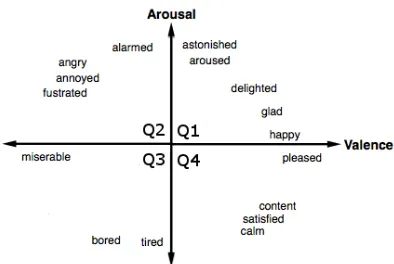
Figure 1: Schematic of the 2DES. Arousal describes the intensity level of an emotion (on a continuous scale ranging from low - bottom - to high - top) and Valence characterizes the hedonic value of an emotion (ranging from bad or unpleasant - left - to good or pleasant - right). The superimposed emo-tion words indicate the approximate locaemo-tion of typ-ical terms used in everyday life to describe specific emotions according to Russell [25].
2.2
Materials
The stimuli consist of 16 excerpts of instrumental mu-sic pieces. The excerpts were selected based on their potential to induce in the listeners a wide range of af-fective states (irrespective of genre). In order to deter-mine the emotional character of each piece we used the MediaEval 2014 “Emotion in Music” (ME14) dataset gold standard. From that set we selected pieces in the ex-tremes of the two-dimensional emotional space (2DES) as described by Valence and Arousal affective dimensions (see Fig. 1). Specifically, we selected four pieces from each af-fective quadrant: high Arousal/positive Valence (Quadrant 1; Q1), high Arousal /negative Valence (Quadrant 2; Q2), low Arousal/negative Valence (Quadrant 3; Q3), and low Arousal/positive Valence (Quadrant 4; Q4). Because the ME14 dataset lacked in pieces that fall onto extremes of Q2 and Q4, we selected 8 music excerpts from other resources and verified by a music psychologist. The list of music ex-cerpts is provided in Table 1.
Table 1: Selected music excerpts. Q: Quadrant.
Q Composer Name Genre
Q1
Patrick Lee Quittin’ Time Electronic
Latch´e Swing Songe D’Automne Jazz
Jahzzar Birthday Cake Pop
Anamanaguchi Helix Nebula Rock
Q2
Cannibal corpse Make them suffer Death metal
Hatebread Another day, another vendetta Hardcore
Jacob Lizotte This Present Darkness Metalcore
Paths of possession Darklands Death metal
Q3
Stephan Siebert When Classical
Blear Moon Cold Summer Landscape Electronic
LJ Kruzer Chantiers Navals 412 Pop
Ergo Phizmiz Simon Cowell Pop
Q4
DeepMindRelaxation Venus meditation New age
Unknown Relaxing music Relaxing
Fridrik Karlsson Make a Wish Healing
Michael Fesser Relaxing background music Relaxing
tool to assess music preference which are related to personal-ity variables, self-views, and cognitive abilities. It consists of 23 items of 7-point ratings, and its subscales are: reflective & complex, intense & rebellious, upbeat & conventional, and energetic & rhythmic. Additionally, during listening, the participants may detach their mind from music listening to unrelated thoughts and consequently their ratings will be affected. Therefore, we assessed their attentiveness in terms of Daydreaming Frequency Scale (DDFS)[32], Mind-Wandering (MWQ)[20] and Mindful Attention Awareness Scale (MAAS)[3].
To assess the participants’ current mood, they completed a mood questionnaire before the start of the first trial. This questionnaire consists of six 7-point bipolar items: Bad–Good, Sad–Happy, Displeased–Pleased, Calm–Excited, Tired–Energetic, and Sedate–Aroused.
Finally, to quantity the induced mood, we used the Geneva Music-Induced Affect Checklist (GEMIAC; [8]), an extension of the popular Geneva Emotional Music Scale (GEMS) [36]. The GEMIAC comprises 14 affective dimen-sions (see Table 2). Participants were asked to rate each item after listening to each excerpt in a 5-point Likert scale according to the emotion they felt.
2.3
Procedure
The participants were asked to sit inside a sound proof booth (see Fig. 2). Music was played with two speakers at a convenient volume level tuned by the subject. Each subject listened to 8 music excerpts (two from each 2DES quadrant) according to a balanced Latin square design (to reduce car-ryover and fatigue effect), and therefore every music piece was rated by at least 12 participants. Each trial lasted for 1’20”: 30 seconds of silence followed by 50 seconds of music. After listening to each piece, participants filled in GEMIAC and indicated how much they liked the music. They were also asked to point out whether they knew the music. 85% (=164) of the trials were rated as “I didn’t know it”, 15% (=28) as “I think I heard it before”, and 0% as “definitely knew it”. Since there is not much variance in this variable, we omit it from the calculations. In between each trial there
Figure 2: A participant inside the booth with the electrodes attached to her just before the experi-ment.
is about 2 minutes rest period for filling the questionnaires and to recover emotionally.
2.4
Physiological measurement
[image:3.612.346.527.292.460.2]2.5
Regression approach
We focused on estimating the relationships between emo-tional characteristics of music, listener’s stable dispositions, physiological responses to music, and participants ratings of affective state for particular music pieces. Therefore, each affective state from GEMIAC was set as the dependent vari-able, and the other normalized variables as explanatory.
To predict each of the affective states, we used a Genetic Algorithm (GA) approach to select the variables which lead to the maximum likelihood1. Binary strings with the length
of the number of variables were used to represent chromo-somes (i. e., if the variable is selected then “1”, otherwise “0”). Three sets of variables were tested; using only per-ceived music emotion, using perper-ceived music emotion and physiological signals, and using perceived music emotion, stable dispositions and mood. Additionally, we added the interaction between each variable with the perceived music emotion (Arousal/Valence). A generalized linear regression model with proportional odds was used for prediction, since it is more suitable for ordinal discrete response variables.
We ran 16 times the GA process to avoid local minima and to take the maximum possible likelihood. The GA it-eration is set to 300 for each run. During GA opit-eration, we penalized the models where one or more variables (ex-cept inter(ex-cepts) were not significantly different from zero (p > 0.05). This ensures that all the variable coefficients are significantly not equal to zero and no extra variable is inflating the correlation.
Once we found the effective variables, we tested them by using a one-subject-out cross validation; a new model with the same selected variables was created, but the coef-ficients were obtained by using N-1 subjects’ trials. Then, this model was tested on the remaining subject. Finally, the correlation (ρ) between the true outputs and the predicted outputs was calculated.
Additionally, we performed the same steps to predict mu-sic liking from the same set of variables. This was to un-derstand better the relationships between emotions in music and music preference given stable dispositions or physiolog-ical signals. Furthermore, we compared the liking predic-tion from self-rated emopredic-tional state and the liking predicpredic-tion from stable dispositions and physiological signals. This was to find out if in the presence of a perfect emotion predictor we could gain more information on music liking prediction.
3.
RESULTS
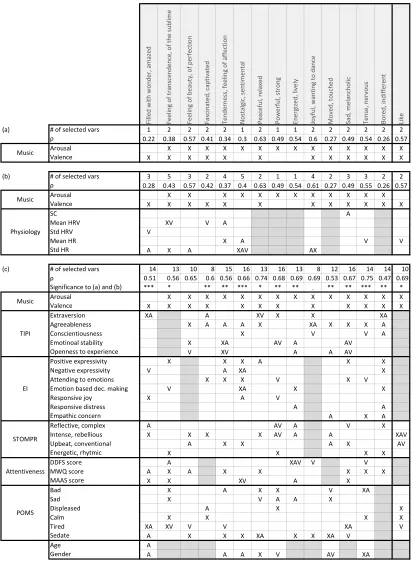
Table 2 depicts the selected variables which yield to the maximum likelihood for each affective state as well as lik-ing ratlik-ing. Once a variable without interaction is selected we marked it as “X”, and once its interaction with music arousal or music valence is selected, we marked it as “A” or “V”, respectively. In Table 2(a) we only included music Arousal and Valence as candidates. Interesting points re-garding these results are that music arousal is not involved in “filled with wonder, amazed” measure and music valence has no effect on being “nostalgic, sentimental”, “powerful, strong”, “energized, lively”, and “being bored, indifferent”. For the other measures both arousal and valence are
effec-1
We have avoided using step-wise approaches (such as for-ward backfor-ward selection) because the may not reach to an optimal solution[14].
tive. Furthermore, correlation (ρ) varies between 0.22 and 0.63 for affective state and is 0.57 for music liking.
In Table 2(b), we included physiological signatures (Skin Conductivity, Heart Rate Variability, and Heart Rate) into the GA process. The important points we can conclude from this table are that physiological signatures are not involved in feeling “peaceful, relaxed”, “powerful, strong”, “energized, lively”, or “moved, touched”. Skin conductivity is only af-fected while being “sad, melancholic”, and HRV is only se-lected for predicting “filled with wonder, amazed”, “feeling of transcendence, sublime”, “fascinated, captivated”, and “ten-derness, feeling of attraction”. In addition in the presence of physiological signatures, music arousal is not any more selected for being “fascinated, captivated” and for music lik-ing. Instead, the interaction of music valence with HRV and HR are selected, respectively. A significance test based on Fisher’s Z-transformation has been taken to compare the correlations with the ones obtained in Table 2(a). We found no significant improvement (Fisher’s Z-transformation with p <0.05) in any of the affective states by inclusion of phys-iological signals.
In Table 2(c), instead of physiological signals, we included stable disposition (TIPI, EI, STOMPR, Attentiveness), age, gender, and mood state (POMS). Age is not affecting the predictions except for “filled with wonder, amazed”. TIPI is not involved in “feeling of transcendence, sublime”, EI sub-scales is not selected for “feeling of beauty, perfection” and “joyful, wanting to dance”, attentiveness is not adding infor-mation in predicting “fascinated, captivated”, and “moved, touched”, and finally mood states are not involved in “being bored, indifferent”. In addition, “feeling of affection, ten-derness” and “sad, melancholic” vastly rely on TIPI as five variables are selected from this. Similarly, seven variables related to EI are selected for predicting “nostalgic, senti-mental”, STOMPR is affecting “powerful, strong” and music liking. Attentiveness and POMS are also promising can-didates for predicting “feeling of transcendence, sublime”. The Fisher’s Z-transformation significance test also has been taken to compare the correlations with the ones in Table 2(a) and (b). In all the affective states except “Feeling of beauty, perfection”, and “Joyful, wanting to dance”, there are sig-nificant improvements (p < 0.05). In general, the mean correlation increase over all the affective states is 0.19 (SD = 0.07). This improvement is greater than when using any physiological signals. It suggests that the level of induced emotions are more tied to the listener’s stable disposition, rather than changes in the physiological signals.
In addition, there is a significant improvement in predict-ing music likpredict-ing by 12% with respect to only considerpredict-ing emotional characteristics of music. Liking music is affected by only STOMPR and mood state, while personality trait, emotional intelligence, attentiveness, age and gender have no effect on it. This could be because of the fact that STOMPR is a well-defined instrument for music preference.
3.1
Music liking prediction from induced
af-fect
Table 2: Selected variables for predicting music induced affect by incorporating (a) Music Arousal and Valence, (b) Music Arousal and Valence and Physiological signals, (c) Music Arousal and Valence and stable disposition and mood states. (X) denotes the variable is selected without interaction, (A) and (V) depict the variable that is selected with its interaction with Music Arousal and Music Valence, respectively. The shaded area denotes the spaces that no variable is selected for certain modality (for reading facilitation). Asterisks
denote the level significance: ***≡p <0.001, **≡p <0.01, *≡p <0.05, .≡p <0.1.
Filled wi th wo n d er, amazed Feeling of tr ans cendence, of th e sublim e Feeling of beaut y, of per fect ion Fa sc in at ed , captivated Te nder n es s, feeling of affe cti o n No stal gi c, se n ti m en tal Pe ace fu l, re la xe d Po we rfu l, stro n g En er gi ze d , lively Jo yf u l, wan ti n g to dance Mo ve d , to uched Sa d , m elancholic Te n se , ner vous Bo re d , indif fe re nt Li ke
(a) # of selected vars 1 2 2 2 2 1 2 1 1 2 2 2 2 2 2
ρ 0.22 0.38 0.57 0.41 0.34 0.3 0.63 0.49 0.54 0.6 0.27 0.49 0.54 0.26 0.57
Arousal X X X X X X X X X X X X X X
Valence X X X X X X X X X X X X
(b) # of selected vars 3 5 3 2 4 5 2 1 1 4 2 3 3 2 2
ρ 0.28 0.43 0.57 0.42 0.37 0.4 0.63 0.49 0.54 0.61 0.27 0.49 0.55 0.26 0.57
Arousal X X X X X X X X X X X X
Valence X X X X X X X X X X X X
SC A
Mean HRV XV V A
Std HRV V
Mean HR X A V V
Std HR A X A XAV AX
(c) # of selected vars 14 13 10 8 15 16 13 16 13 8 12 16 14 14 10
ρ 0.51 0.56 0.65 0.6 0.56 0.66 0.74 0.68 0.69 0.69 0.53 0.67 0.75 0.47 0.69
Significance to (a) and (b) *** * ** ** *** * ** ** . ** ** *** ** *
Arousal X X X X X X X X X X X X X X
Valence X X X X X X X X X X X X
Extraversion XA A XV X X XA
Agreeableness X A A A X XA X X X A
Conscientiousness X V V A
Emotinoal stability X XA AV A AV
Openness to experience V XV A A AV
Positive expressivity X X X A X X
Negative expressivity V A XA X
Attending to emotions X X X V X V
Emotion based dec. making V XA X X
Responsive joy X A V
Responsive distress A A
Empathic concern A X A
Reflective, complex A AV A V X
Intense, rebellious X X X X AV A A XAV
Upbeat, conventional A X X A X AV
Energetic, rhytmic X X X X
DDFS score A XAV V V
MWQ score A X A X X X X X
MAAS score X X XV A X
Bad X A X X V XA
Sad X V A A X
Displeased A X X
Calm X X X X
Tired XA XV V V XA V
Sedate A X X X XA X X XA V
Age A
Gender A A A X V AV XA
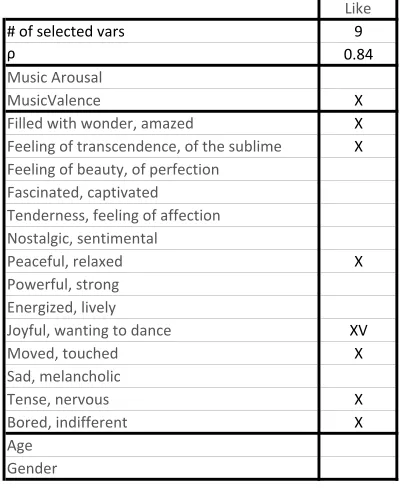
[image:5.612.100.512.143.707.2]Table 3: Selected parameters for prediction of mu-sic liking rate from induced affect. (X) denotes the variable is selected without interaction, (V) depicts the variable that is selected with its interaction with Music Valence.
Like
# of selected vars 9
ρ 0.84
Music Arousal
MusicValence X
Filled with wonder, amazed X
Feeling of transcendence, of the sublime X
Feeling of beauty, of perfection Fascinated, captivated Tenderness, feeling of affection Nostalgic, sentimental
Peaceful, relaxed X
Powerful, strong Energized, lively
Joyful, wanting to dance XV
Moved, touched X
Sad, melancholic
Tense, nervous X
Bored, indifferent X
Age Gender
The correlation coefficient (ρ) is 0.83 which is 15% higher (Fisher’s Z-transformation withp <0.001) than using sta-ble disposition and mood (ρ=0.69) and 27% higher (Fisher’s Z-transformation withp < 0.001) than using physiological signals (ρ=0.57). This means that with a perfect emotion predictor, we can gain higher performance in predicting mu-sic liking.
4.
CONCLUSION
Music has been widely used for inducing affect in listen-ers. However, due to the psycho-physiological differences between listeners, this induction may not be effective as ex-pected. In this study we investigated the possible individual factors (differences) that can influence the emotion induc-tion to a music listener. These factors are: stable disposi-tions (Big-Five personality traits, emotional intelligence, at-tentiveness, personality related to music liking), mood, and physiological signals. Given perceived music emotions, we used variable selection and regression to select the variables which are involved in the prediction of the induced affective states. We found for each type of affect, certain factors are mediating between perceived and felt emotion. This finding suggests that in any scenario if a certain affect is needed to be induced, only certain individual differences need to be taken into account. This can reduce the time for adminis-tration of questionnaires. In addition, inclusion of the stable dispositions and mood factors adds significant information about the felt emotion, while physiological signals provide less information.
Furthermore, we found from stable dispositions, using only personality related to music liking ([24]) collaborating with mood states provide significant information about
mu-sic liking. Moreover, having a perfect emotion predictor we can boost the performance of music liking predictor. The results can be used in personalized music recommenders to boost their performance by incorporating mood and individ-ual differences.
The limitation of our study is that only 24 participants ('192 trials) from various nationalities were participated. This low number may not reflect between- and within-individual differences precisely. However, we found that adding more participants (> 21) does not change the se-lected variables drastically. Nevertheless, we plan to recruit more participants. In addition, in this study we used a lim-ited number of music excerpts with already annotated per-ceived music emotion. However, the annotations may not be available in real scenarios. In this case, an automatic approach can be used to predict perceived emotion from acoustics [7, 35] in tandem operation with an emotion regu-lator.
Acknowledgments
The research leading to these results has received fund-ing from the Technische Universit¨at M¨unchen Founda-tion Fellowship (TUFF), the European Union’s Horizon 2020 Programme research and innovation programme under grant agreements Nos. 644632 (MixedEmotions) and 645378 (ARIA-VALUSPA) and the European Community’s Seventh Framework Programme through the ERC Starting Grant No. 338164 (iHEARu). In addition, the authors would like to thank Fabien Ringeval of University of Passau/Germany for his comments to an earlier version of this manuscript.
5.
REFERENCES
[1] K. Barchard. Seven components potentially related to emotional intelligence.Retrieved August, 2014, [Online], Available: http://ipip.ori.org/newEmotional-IntelligenceKey.htm, 2001.
[2] T. Baumgartner, M. Esslen, and L. J¨ancke. From emotion perception to emotion experience: emotions evoked by pictures and classical music.International journal of psychophysiology: official journal of the International Organization of Psychophysiology, 60(1):34–43, Apr. 2006.
[3] K. W. Brown and R. M. Ryan. The benefits of being present: mindfulness and its role in psychological well-being.Journal of personality and social psychology, 84(4):822, 2003.
[4] J. R. Cantor and D. Zillmann. The effect of affective state and emotional arousal on music appreciation.
The Journal of General Psychology, 89(1):97–108, 1973.
[5] T. Chamorro-Premuzic and A. Furnham. Personality and music: can traits explain how people use music in everyday life? British journal of psychology (London, England : 1953), 98(Pt 2):175–185, 2007.
[6] T. Chamorro-Premuzic, V. Swami, and B. Cermakova. Individual differences in music consumption are predicted by uses of music and age rather than emotional intelligence, neuroticism, extraversion or openness.Psychology of Music, 40(3):285–300, 2012. [7] E. Coutinho and A. Cangelosi. Musical emotions:
physiological measurements.Emotion (Washington, D.C.), 11(4):921–37, Aug. 2011.
[8] E. Coutinho and K. R. Scherer. Geneva Music-Induced Affect Checklist (GEMIAC). InProceedings of the 4th International Conference on Music & Emotion. Swiss Center for Affective Sciences, 2015 (to appear). [9] E. Coutinho and R. Timmer. Letter from the guest
editors.Psychomusicology: Music, Mind, and Brain: special issue on Interactions Between Emotion and Cognition in Music, 24(1), 2014.
[10] P. G. Dunn, B. de Ruyter, and D. G. Bouwhuis. Toward a better understanding of the relation between music preference, listening behavior, and personality.
Psychology of Music, 40(4):411–428, Mar 2011. [11] A. Gabrielsson and E. Lindstr¨om. The role of
structure in the musical expression of emotions. In P. N. Juslin and J. Sloboda, editors,Handbook of music and emotion: Theory, research, applications, pages 367–400. Oxford University Press, Oxford, 2010. [12] S. Garrido and E. Schubert. Individual differences in
the enjoyment of negative emotion in music: A literature review and experiment.Music Perception: An Interdisciplinary Journal, pages 279–296, 2011. [13] S. D. Gosling, P. J. Rentfrow, and W. B. Swann Jr. A
very brief measure of the big-five personality domains.
Journal of Research in personality, 37(6):504–528, 2003.
[14] F. E. Harrell.Regression modeling strategies: with applications to linear models, logistic regression, and survival analysis. Springer Science & Business Media, 2013.
[15] P. N. Juslin and J. Sloboda.Handbook of music and emotion: Theory, research, applications. Oxford University Press, 2011.
[16] K. Kallinen and N. Ravaja. The role of personality in emotional responses to music: Verbal, electrocortical and cardiovascular measures.Journal of New Music Research, 33(4):399–409, 2004.
[17] K. Kallinen and N. Ravaja. Emotion perceived and emotion felt: Same and different.Musicae Scientiae, 10(2):191–213, 2006.
[18] A. Kawakami, K. Furukawa, K. Okanoya, E. Information, and R. Bsi. Musical Emotions : Perceived Emotion and Felt Emotion in Relation to Musical Structures. 2:520–521, 1999.
[19] G. Kreutz, U. Ott, D. Teichmann, P. Osawa, and D. Vaitl. Using music to induce emotions: Influences of musical preference and absorption.Psychology of Music, 36(1):101–126, Nov. 2007.
[20] M. D. Mrazek, D. T. Phillips, M. S. Franklin, J. M. Broadway, and J. W. Schooler. Young and restless: validation of the Mind-Wandering Questionnaire (MWQ) reveals disruptive impact of mind-wandering for youth.Frontiers in psychology, 4:560, 2013. [21] U. M. Nater, E. Abbruzzese, M. Krebs, and U. Ehlert.
Sex differences in emotional and psychophysiological responses to musical stimuli.International journal of psychophysiology: official journal of the International Organization of Psychophysiology, 62(2):300–8, Nov. 2006.
[22] K. V. Petrides and A. Furnham. Trait emotional intelligence: Behavioural validation in two studies of
emotion recognition and reactivity to mood induction.
European Journal of Personality, 57(August 2002):39–57, 2003.
[23] P. J. Rentfrow, L. R. Goldberg, and D. J. Levitin. The structure of musical preferences: a five-factor model.
Journal of personality and social psychology, 100(6):1139, 2011.
[24] P. J. Rentfrow and S. D. Gosling. The do re mi’s of everyday life: The structure and personality correlates of music preferences.Journal of Personality and Social Psychology, 84(6):1236–1256, 2003.
[25] J. A. Russell. A circumplex model of affect.Journal of Personality and Social Psychology, 39(6):1161–1178, 1980.
[26] M. F. Scheier and C. S. Carver. Self-focused attention and the experience of emotion: Attraction, repulsion, elation, and depression.Journal of Personality and Social Psychology, 35(9):625, 1977.
[27] E. G. Schellenberg, K. A. Corrigall, O. Ladinig, and D. Huron. Changing the Tune: Listeners Like Music that Expresses a Contrasting Emotion.Frontiers in psychology, 3:574, Jan 2012.
[28] K. R. Scherer. What are emotions? And how can they be measured? Social Science Information,
44(4):695–729, Dec. 2005.
[29] K. R. Scherer and E. Coutinho. How music creates emotion: a multifactorial process approach. In T. Cochrane, B. Fantini, and K. Scherer, editors,The Emotional Power of Music: Multidisciplinary
perspectives on musical arousal, expression, and social control. Oxford University Press, Oxford, 2013. [30] E. Schubert. Measuring emotion continuously: Validity
and reliability of the two-dimensional emotion-space.
Australian Journal of Psychology, 51(3):154–165, 1999. [31] E. Schubert. Emotion felt by the listener and
expressed by the music: literature review and theoretical perspectives.Frontiers in psychology, 4(December):837, Jan. 2013.
[32] J. L. Singer and J. S. Antrobus.Imaginal Processes Inventory. Center for Research in Cognition and Affect Graduate Center, City University of New York, 1970. [33] J. K. Vuoskoski and T. Eerola. Measuring
music-induced emotion: A comparison of emotion models, personality biases, and intensity of
experiences.Musicae Scientiae, 15(2):159–173, 2011. [34] J. K. Vuoskoski and T. Eerola. Can sad music really make you sad? indirect measures of affective states induced by music and autobiographical memories.
Psychology of Aesthetics, Creativity, and the Arts, 6(3):204, 2012.
[35] F. Weninger, F. Eyben, and B. Schuller. On-line continuous-time music mood regression with deep recurrent neural networks. InIEEE International Conference on Acoustics, Speech and Signal Processing (ICASSP), pages 5412–5416. IEEE, 2014.
[36] M. Zentner, D. Grandjean, and K. R. Scherer. Emotions evoked by the sound of music:
characterization, classification, and measurement.