Elsevier Editorial System(tm) for Fuel Manuscript Draft
Manuscript Number: JFUE-D-12-01092R1
Title: Production of biodiesel from Sterculia foetida and its process optimization
Article Type: Original Research Paper
Keywords: Biodiesel; Sterculia feotida; esterification;
transesterification; physical chemical property; alternative energy Corresponding Author: Dr. ong hwai chyuan, Ph.D
Corresponding Author's Institution: University of Malaya First Author: Silitonga A.S.
Order of Authors: Silitonga A.S.; ong hwai chyuan, Ph.D; Mahlia T.M.I.; Masjuki H.H.; Chong W.T.; Talal F Yusaf
Abstract: The diminishing supply of fossil fuels reserves and the
environmental concerns have made renewable energy an alternative energy source for the future. Sterculia foetida is one of the possible non-edible feedstocks for biodiesel production. This paper explores and examines the potential biodiesel production from sterculia foetida. Besides, this study also aimed to optimize the biodiesel production parameters by using design of experiment (DOE). The parameters involved in the optimization process were the amount of catalyst, reaction
temperature, agitation speed and reaction time. Crude sterculia foetida oil has high acid value which is 5.11 mg KOH/g. Thus, two stage acid catalyst esterification and base transesterification methods are used to produce biodiesel from sterculia foetida. The optimum biodiesel
July 3, 2012
Professor B. Li Editor
FUEL
Sub: Submission of Article
I am pleased to submit an article entitled “Production of biodiesel from Sterculia feotida
and its process optimization” for your consideration.
This paper has not been published previously, it is not under consideration for publication elsewhere, and if accepted it will not be published elsewhere in substantially the same form, in English or in any other language, without the written consent of the Publisher.
It would be highly appreciated if you kindly acknowledge the receipt of my article.
Thank you,
Sincerely yours
Ong Hwai Chyuan
Department of Mechanical Engineering University of Malaya
50603 Kuala Lumpur MALAYSIA
March 19, 2013
Ref. JFUE-D-12-01092
Title: Production of biodiesel from Sterculia foetida and its process optimization
Fuel
Dear,
Prof. Dr, Baoqing Li,
Principal Editor (Fuel)
Sub: Re-submission of REVISED Article (JFUE-D-12-01092)
I am pleased to re-submit a revised article entitled “Production of biodiesel from Sterculia foetida and its process optimization (Ref: JFUE-D-12-01092)” for your reconsideration for publication in FUEL.
We would like to thank the reviewer and the editor for their insightful and thoughtful comments. We have carefully taken their comments into consideration in preparing our revision. In responding to reviewer comments, we believe that this paper is clearer, more compelling and broader.
The authors’ response for reviewers’ comments are in the following page.
Sincerely yours,
Ong Hwai Chyuan
Department of Mechanical Engineering
University of Malaya
50603 Kuala Lumpur
Malaysia.
Phone: +6016-5903110
Production of biodiesel from Sterculia foetida and its process optimization
(JFUE-D-12-01092)
Reviewer #1:
Reviewer’s comment:
Journal of fuel is suitable for this research. Clearly defined scope and purpose for this the study. The scope and applied research methods and materials for the production of biodiesel are selected. Be clearly grounded in standards and statements of the results is very good. Fuel is editor of the journal of the notes have been sent before. Fuel suitable for publication in the Journal.
Author’s response:
The authors are very grateful with the comments and recommendations to accept for publication in Fuel journal.
Reviewer #3:
Reviewer’s comment:
The manuscript is original and reports mainly on the optimization of the conversion process for making biodiesel from non-edible sterculia foetida seed oil. The oil had a relatively high free fatty acid content requiring a two-step process for conversion. The first step, acid-catalyzed esterification of the free fatty acids with methanol, was apparently not optimized in this work. The second step, the more traditional alkali-catalyzed transesterification with methanol, was optimized to maximize yields with respect to oil/methanol molar ratio, catalyst concentration, reaction time, temperature, and speed of mixing of the reactants. Results showed that a 93.5% conversion rate could be achieved within 2-3 hours. Fuel properties of the product were compared with those for biodiesel made from other feedstocks as well as conventional diesel fuel. The manuscript is generally well written and organized. However, there are at least three issues that need to be resolved before this paper will be suitable for publication.
Author’s response:
Reviewer’s comment #1:
First, Section 2.5.2 (pp. 6-7) gives defined reaction conditions for the alkali-catalyzed transesterification of sterculia foetida seed oil and methanol into biodiesel. It is understood that the main objective of this work was to optimize the reaction conditions. This paragraph should be generalized with respect to conditions that are optimized in this study. This might be resolved by replacing specified conditions with ranges over which the conditions will be tested for optimization.
Author’s response #1:
The authors agreed with the reviewer’s suggestion that the paragraph should be generalized with respect to optimize conditions. Thus, the revised paragraph is shown below:
Section 2.5.2:
“In this process, the low free fatty acid content oil was mixed with 6:1-15:1 methanol to oil ratio while stirring at a speed of 800-1500 rpm. Then, 0.5-1.5 %wt. of NaOH was diluted in 25 ml of methanol and added into the oil at 40-60°C for 2-4 hours.”
Reviewer’s comment #2:
Second, important details are omitted with respect to results summarized in Tables 2 and 3. Where did the data for the jatropha curcas, ceiba pentandra, calophyllum inophyllum, and pangium edule oils and their methyl esters come from? Are these properties from the literature or were they reference from earlier studies? If new results were measured for this work, who supplied the oils and what were the apparatuses used and methods applied? Finally, with respect to the properties of the sterculia foetida oil methyl esters, were they measured for the biodiesel produced using the optimized reaction conditions?
Author’s response #2:
The data for the jatropha curcas, ceiba pentandra, calophyllum inophyllum, and pangium edule oils are adopted from literature results. And, the sources for the crude oil are added and cited. However, themethyl esters are purchase from Medan, North Sumentera, Indonesia and they were added and mentioned clearly in the manuscript at section 2.1 as shown below: “However, jatropha curcas methyl ester (JCME), ceiba pentandra methyl ester (CPME), calophyllum inophyllum methyl ester (CIME), pangium edule methyl ester (PEME) were purchased from Medan, North Sumatera, Indonesia.”
Reviewer’s comment #3:
Third, the data in Table 3 present an in-depth analysis of the fuel properties of sterculia foetida seed oil biodiesel. Why are results for so many properties presented yet not discussed aside from one sentence in the Conclusions (Section 4)? If these properties are meant to demonstrate the quality of the biodiesel, then the number of properties could be shortened. For example, just the data for density, viscosity, flash point, cloud point, acid value, oxidative stability, and free and total glycerol would suffice in this case
Author’s response #3:
The reviewer is correct with the biodiesel properties of sterculia foetida as shown in Table 3 are meant to demonstrate the quality of the biodiesel. Thus, we have revised and shortened the number of properties. Besides, a short paragraph is added to discuss briefly the properties results obtained at section 3.1 in the manuscript.
General comments and suggestion Reviewer’s comment 1:
Abstract, next-to-last sentence: Change "ASTM 6751" to "ASTM D 6751".
Author’s response 1:
We agreed and revised the "ASTM 6751" to "ASTM D 6751".
Reviewer’s comment 2:
Figs. 1-5 are photographs that could be omitted to reduce the length of the paper. Their omission would not affect the overall quality of this work.
Author’s response 2:
We agreed and reduced the photographs figures. Thus, the length of the paper is reduced without affecting the overall quality of this work.
Reviewer’s comment 3:
Section 2.5: The term "esterified oil" is misleading since triglycerides themselves are esters. Suggest changing to "low free fatty acid content oil
Author’s response 3:
We agreed and changed all the term of "esterified oil" to "low free fatty acid content oil" in the manuscript.
Reviewer’s comment 4:
Table 3 is not directly referred to in the text of the paper.
Author’s response 4:
Reviewer’s comment 5:
Section 3.1.1: Increasing the methanol/oil molar ratio has no effect on solubility or interfacial contact between methanol and triglyceride molecules. Heating and stirring the reactants does enhance solubility and interfacial contact.
Author’s response 5:
The reviewer is correct and we revised the sentence in section 3.1.1 as below:
“However, transesterification is an equilibrium reaction in which a high molar ratio is used to drive the reaction to the right. Besides, heating and stirring need to set at optimum to enhance the solubility and increase the contact between the triglycerides and alcohol molecules.”
Reviewer’s comment 6:
Section 3.1.3, second sentence: Why was 1 % sulfuric acid put into the reaction mixture being optimized?
Author’s response 6:
In this study, the optimization is focused on alkaline catalyst transesterification process. Therefore, the acid catalyst (sulfuric acid) is fitted using generalized volume which is 1%. Perhaps, we can carry out the optimization process for acid catalyst esterification process in the future study.
Reviewer’s comment 7:
Reference [18] is missing the journal volume number (88).
Author’s response 7:
Reviewer’s comment 8:
Figs. 69: Suggest including the reaction conditions held constant in the figure captions. For example, in Fig. 4, what were the catalyst concentration, reaction time, and stirring speed? Also, the temperature of the reactions conducted for Fig. 9 was not specified anywhere in the paper.
Author’s response 8:
We agreed and added the constant parameters such as catalyst concentration, reaction time, stirring speed, molar ratio and temperature accordingly in the Figs 69 (new figure number are Figs 47). Besides, the molar ratio, temperature and catalyst concentration were also added and included in Fig 9 (new figure number is Fig. 7).
Lastly, I would like to thank the editor and reviewers who have given very valuable comments and suggestions to improve the quality of this article.
Thank you
Highlight:
1. Sterculia feotida is one of non-edible feedstocks for biodiesel production.
2. The fatty acid composition of sterculia feotida was found to be 17.7% (palmitic), 35.1% (sterculoyl) and 1.7% (Malvaloyl).
3. The optimum biodiesel conversion obtained was 93.55% by two stage acid-alkaline transesterification process.
4. The properties of the produced Sterculia feotida methyl esters such as viscosity, density, flash point, acid value etc have been determined and within the limits of ASTM 6751 and EN 14214 specifications.
1
Production of biodiesel from Sterculia foetida and its process optimization
A.S. Silitongaa,b*, H.C.Ongc*,H.H. Masjukia,T.M.I. Mahliad, W.T.Chonga,Talal F.Yusafe
aDepartment of Mechanical Engineering, Faculty of Engineering, University of Malaya
50603 Kuala Lumpur, Malaysia
bDepartment of Mechanical Engineering, Medan State Polytechnic
20155 Medan, Indonesia
cCentre for Energy Sciences, Faculty of Engineering, University of Malaya
50603 Kuala Lumpur, Malaysia
dDepartment of Mechanical Engineering, Faculty Engineering, Universiti Tenaga Nasional,
43000 Kajang, Selangor, Malaysia
eNational Centre for Engineering in Agriculture (NCEA), Faculty of Engineering and Surveying, University
of Southern Queensland, Toowoomba, 4350 QLD, Australia
Abstract
The diminishing supply of fossil fuels reserves and the environmental concerns have
made renewable energy an alternative energy source for the future. Sterculia foetida is one of
the possible non-edible feedstocks for biodiesel production. This paper explores and
examines the potential biodiesel production from sterculia foetida. Besides, this study also
aimed to optimize the biodiesel production parameters by using design of experiment (DOE).
The parameters involved in the optimization process were the amount of catalyst, reaction
temperature, agitation speed and reaction time. Crude sterculia foetida oil has high acid value
which is 5.11 mg KOH/g. Thus, two stage acid catalyst esterification and base
transesterification methods are used to produce biodiesel from sterculia foetida. The optimum
biodiesel conversion efficiency obtained was 93.55% by 1 %vol. of sulphuric acid with 12:1
Corresponding authors at: Department of Mechanical Engineering, University of Malaya, 50603 Kuala Lumpur, Malaysia. Tel.: +6016-5903110, +6017-2459124.E-mail addresses: [email protected] (HC Ong) [email protected] (AS Silitonga)
Manuscript
2 of methanol to oil ratio at 60oC and 1200 rpm agitation rate for 3 hours. On the other hand,
the transesterification process condition is 1 %wt. sodium hydroxide catalyst with 12:1
methanol to oil at 55oC for 2.5 hours. The high viscosity (63.90 mm2/s) of crude sterculia
foetida oil was reduced to 3.96 mm2/s after the transesterification process. Moreover, the
properties of the produced sterculia foetida methyl esters and all the measured properties are
within the limits of ASTM D 6751 and EN 14214 specifications. Therefore, sterculia foetida
oil is one of the non-edible feedstocks for biodiesel production.
Keyword: Biodiesel; sterculia feotida; esterification; transesterification; physical chemical
property; alternative energy.
Abbreviation
CCIO Crude calophyllum inophyllum oil CCPO Crude ceiba pentandra oil
CIME Calophyllum inophyllum methyl ester CJCO Crude jatropha curcas oil
CPME Ceiba pentandra methyl ester CPEO Crude pangium edule oil CSFO Crude sterculia foetida oil
3 1. Introduction
The diminishing supply of fossil fuels reserves and the growing environmental
concerns have made renewable energy an attractive alternative energy source for the future
[1, 2]. Biodiesel is a promising alternative fuel for diesel fuel and is produced by chemical
reaction of a fat or oil with an alcohol in the presence of a catalyst. The renewable fuel has a
lot of technical advantages over fossil fuels such as lower overall exhaust emission and
toxicity, biodegradability, derivation from a renewable and domestic feedstock, negligible
sulphur content, superior flash point and eco-friendly fuel [3-5].
Sterculia foetida plant belongs to Sterculiaceae family which has 2000 type of species
and classified as non-drying oils. It is a wild plant and well adapted to tropical and
sub-tropical area (30o North Latitude to 35o South Latitude). The plant has an average life span of
more than 100 years [6-8]. Sterculia foetida is a large, straight, deciduous tree which can
grow up to 40 m in height and 3 m in girth [9, 10]. The diameter of trees is around 100120
cm and ideal planting pitch has been found to be 3×3 m. The fruit is large, woody, red, nearly
smooth and about 10 cm long. It contains 1015 seeds in each fruit which are initially white
in color and later turns black when ripe. The single large seed is surrounded by a shell and a
thin 12 mm layer of pulp. Sterculia foetida gives about 200350 kg of seed annually [7, 8].
Fig. 1 shows sterculia foetida tree, fruit, seeds and kernels.
[Fig.1]
Sterculia foetida has been planted in many parts of the world such as Australia,
Bangladesh, Djibouti, Eritrea, Ethiopia, India, Indonesia, Kenya, Malaysia, Myanmar, Oman,
Pakistan, Philippines, Somalia, Sri Lanka, Tanzania, Thailand, Uganda and Republic of
4 Java, East Java, Madura and other small islands in Java [11]. The main compositions of
sterculia foetida seeds are fats and protein which are 51.78% and 21.61% respectively. Table
1 shows the composition of sterculia foetida dry shelled seeds [12].
[Fig. 2]
[Table 1]
This paper introduces new non-edible oil which is sterculia foetida (poon) as a
biodiesel feedstock. Sterculia foetida seeds have been collected from Cilacap forest, West
Java, Indonesia. The physical and chemical properties of sterculia foetida have been studied
and compared with other biodiesel feedstocks as well as international biodiesel standards.
Besides, the optimization condition of transesterification process for sterculia foetida methyl
ester (SFME) production was investigated.
2. Material and Methods
2.1 Materials
Sterculia foetida oil was obtained from Cilacap, West Java, Indonesia. However,
jatropha curcas methyl ester (JCME), ceiba pentandra methyl ester (CPME), calophyllum
inophyllum methyl ester (CIME), pangium edule methyl ester (PEME) were purchased from
Medan, North Sumatera, Indonesia. Before the extraction of oil, the seeds have been washed
by hot water and dried under the sun. The extraction of crude sterculia foetida oil was done
by a cutting machine and mechanical pressing machine. It was found that kernel of the seeds
5 2.2 Reagents
All reagents such as methanol (99.9% purity), H2SO4 (purity >98.9%), Phosphoric
acid (20% of H3PO4), sodium hydroxide pellet (NaOH) (purity 99%), CaCl2 and Na2SO4
anhydrous (purity 98%) used in this study were purchased from CV. Rudang Jaya (Medan,
Indonesia). Qualitative filter paper (filter fioroni, France) of 150 mm size was supplied from
Metta Karuna Enterprise (Kuala Lumpur, Malaysia).
2.3 Apparatus
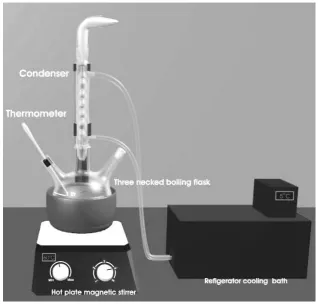
The experiments were conducted using 1 litre of three necked boiling flask with
reflux condenser. The reaction boiling three necked flask was placed on hot plate magnetic
stirrer (Model: IKA C-MAG HS7). A thermometer was immersed in the boiling necked flask
by using a rubber stand. Fig. 3 shows the experimental apparatus for esterification and
transesterification process of crude sterculia foetida oil.
[Fig. 3]
2.4 Refining sterculia foetida crude oil
After the extraction process, crude oil contains some of the impurities such as
uncrushed seed cake and the oil was refined to reduce acid value and moisture content. The
crude sterculia foetida oil was refined in the laboratory through simple filtration methods. In
this process, 0.5 %vol. of H3PO4 (20% concentration) was added with crude sterculia foetida
oil at 60oC for 30 minutes. Gums were then separated from the oil and the oil was washed
twice with warm water at 40°C. After washing, crude oil was filtered using conical glassware
with filter paper for three times. After that, these filtered oils were dried in a vacuum pump
6 refined crude sterculia foetida oil was found to have 3.28 mg KOH/g of acid value. The
refined oil resulted from this process was reported to be light yellow.
2.5 Esterification and transesterification process
Sterculia foetida oil has high viscosity, low volatility and polyunsaturated fatty acids.
Therefore, it cannot be used directly in compression ignition (CI) engines. Thus, acid catalyst
is used to reduce the free fatty acids contents before alkaline transesterification process.
2.5.1 Acid catalysed esterification process
In this process, 400 ml or 374.8 g of CSFO was entered into a three-necked boiling
flask equipped with a magnetic stirrer, reflux condenser and thermometer. The sample of
CSFO was mixed with 12:1 molar ratio of methanol. Then, 1 %vol. sulphuric acid anhydrous
(H2SO4) was added to the sample drop by drop using a connected pipe to the flask. During
the reaction, the mixture was stirred constantly using a magnetic stirrer at a speed of 1200
rpm for 3 hours at 60°C. After that, the low free fatty acid content oil was entered into a
separation funnel and left for 15 minutes to remove the upper layer which is extra methanol
and the lower layer was low free fatty acid content oil. The oil sample was entered into rotary
evaporator for 20 minutes at 6570°C to remove extra methanol from the low free fatty acid
content oil. The low free fatty acid content oil was washed with distilled water in a separation
funnel for two times. Then, the low free fatty acid content oil was dried using 100 g CaCl2
anhydrous in a glass beaker for 1 day and then filtered by a paper filter. The oil was further
7 2.5.2 Alkaline catalysed transesterification
In this process, the low free fatty acid content oil was mixed with 6:115:1 methanol
to oil ratio while stirring at a speed of 8001500 rpm. Then, 0.51.5 %wt. of NaOH was
diluted in 25 ml of methanol and added into the oil at 4060°C for 24 hours. After that, the
oil was entered into a separation funnel and left for 15 minutes to separate the upper layer of
SFME and the lower layer which is extra methanol and glycerol. The SFME was entered into
a rotary evaporator for 20 minutes at 6570°C to remove extra methanol. Then, the produced
biodiesel was washed with distilled water for two times in a separation funnel. The SFME
was dried using 100 g CaCl2 anhydrous in glass beaker for 1 day and filtered with paper filter.
The oil was further dried with 100 g Na2SO4 anhydrous for 23 hours and filtered by a paper
filter again.
3. Results and discussion
3.1 Crude oil and biodiesel sterculia foetida properties
The fatty acid composition and physicochemical properties of crude sterculia foetida
oil such as viscosity at 40oC, density at 15oC, flash point and acid value were analysed and
compared to other non-edible oils from the literature study as shown in Table 2. The fatty
acid composition showed that the primarily composition were oleic acid which is 44.7%,
46.1% and 46.7% for CJCO, CCIO and CPEO respectively. CSFO consists 25% of saturated
fatty acid, 15.3% of unsaturated fatty acid, 1.7% of malvaloyl acid and 35.1% of sterculoyl
acid. These results matched with the results obtained by Bindhu [13] who reported that
sterculia foetida oil contains cyclopropene fatty acids namely sterculoyl acid (44.3%) and
8 fatty acids (malvaloyl acid) which are more reactive than the double bond carbon
(polyunsaturated) in the reaction with radical formation by atmospheric oxygen. Thus, this
hydrocarbon chain reduces oxidation stability in vegetable oil [14]. The physical and
chemical properties of the sterculia foetida methyl ester produced and other methyl ester
were tested using ASTM D 6751 or EN 14214 standards.
The physical and chemical properties of SFME are compared with JCME, CPME,
CIME, and PEME which are listed in Table 3. It is found that all properties fulfilled the
ASTM D 6751 and EN 14214 biodiesel specifications. The obtained viscosity was 3.96
mm2/s, 3.01 mm2/s, 3.15 mm2/s, 3.75 mm2/s and 3.07 mm2/s for SFME, JCME, CPME,
CIME and PEME respectively. According to Devan and Mahalakshmi [15] and Bindhu et al.
[13], the viscosity sterculia foetida was observed at 6.0 mm2/s and 4.72 mm2/s respectively.
Moreover, the density range was 860880 kg/m3 at 15°C which is an acceptable result. The
observed flash point was 160.5°C, 155.5°C, 163.5°C, 161.5°C and 135.5°C for SFME,
JCME, CPME, CIME and PEME respectively which satisfies ASTM and EN biodiesel
standards. Besides, the calorific values for all biodiesel are lower than petrol diesel fuel
(45.825 MJ/kg). The calorific values were 40.427 MJ/kg, 40.179 MJ/kg, 40.490 MJ/kg,
40.254 MJ/kg and 40.079 MJ/kg for SFME, JCME, CPME, CIME and PEME respectively.
Furthermore, the acid value of those biodiesel was also in line within the ASTM and EN
biodiesel standards which is less than 0.5%. Moreover, CIME possesses the highest oxidation
stability (13.05 hours) followed by JCME with 10.42 hours and 5.50 hours for PEME.
However, CPME and SFME possess the lowest oxidation stability of 4.42 hours and 3.44
hours respectively. Sterculia foetida and ceiba pentandra contains cyclopropene chain carbon
(sterculoyl acid and malvaloyl acid) which leads to increased oxidation rate and caused poor
quality of biodiesel [13, 16]. On the other hand, the cetane number of SFME, JCME, CPME,
9 According to Keera et al. [17], the cetane number of biodiesel increases with the increase of
the fatty acid proportion. Typically, the cetane number increases with the increasing chain
length and decreases with the increasing unsaturation fatty acids. Thus, longer fatty acids
chain and more saturated fatty acid will lead to higher cetane number and shows that SFME
have highest cetane compared to JCME, CPME, CIME and PEME.
[Table 2]
[Table 3]
3.1 Effect of optimization process
The design of experiment (DOE) is used to determine the optimization condition of
transesterification process. This method was conducted to determine the optimum condition
for methanol to oil molar ratio, catalyst concentration, reaction temperature and time as well
as agitation intensity speed.
3.1.1 Effect of methanol to oil molar ratio and temperature
One of the most important variables affecting the yield of ester is the molar ratio of
methanol to oil. The stoichiometric ratio for transesterification requires three moles of
methanol and one mole of triglyceride to produce three moles of fatty acid methyl esters and
one mole of glycerol. However, transesterification is an equilibrium reaction in which a high
molar ratio is used to drive the reaction to the right. Besides, heating and stirring need to set
at optimum to enhance the solubility and increase the contact between the triglycerides and
alcohol molecules [18, 19]. In the present work, the transesterification reaction was carried
out at various ratios of 6:1, 8:1, 10:1, 12:1 and 15:1 and temperature varies from 4060oC.
Besides, other factors were kept unchanged such as agitation speed at 1200 rpm and 1 %wt.
10 function of the molar ratio and temperature was carried out using the software design of
experiment (DOE). Fig. 4 shows that the maximum conversion yield methyl ester is 93.55%
which can be obtained at methanol to oil molar ratio of 12:1 and temperature of 55oC.
[Fig. 4]
3.1.2 Effect of catalyst concentration and reaction time
Typically, alkali, acid, enzyme or heterogeneous catalysts were used in
transesterification process for the conversion of crude oil to methyl ester. In this study, the
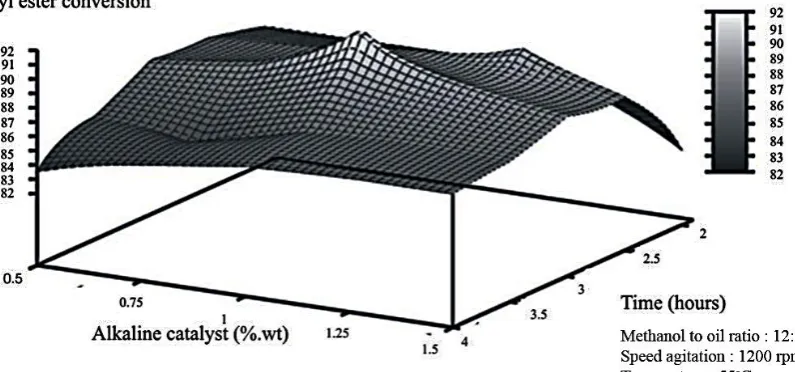
alkaline catalyst used was sodium hydroxide pellet and the alkaline catalyst concentration
ranges from 0.51.5 %wt. with reaction time varies from 24 hours. Furthermore, other
process conditions were fixed at 12:1 methanol molar ratios to oil, at 1200 rpm agitation rate
and reaction temperature at 55oC. The effect of this catalyst’s concentration on the conversion
of methyl esters is depicted in Fig. 5. It was observed that using a lower concentration led to
an incomplete reaction and resulted in a lower yield of methyl esters. The yield increased
with the increase of the catalyst concentration and reached optimum at 1 %wt. of catalyst
amount. However, more soap will be produced owing to the excess catalyst at 1.5 %wt. and
favouring the saponification process.
[Fig. 5]
3.1.3 Effect of reaction temperature and reaction time
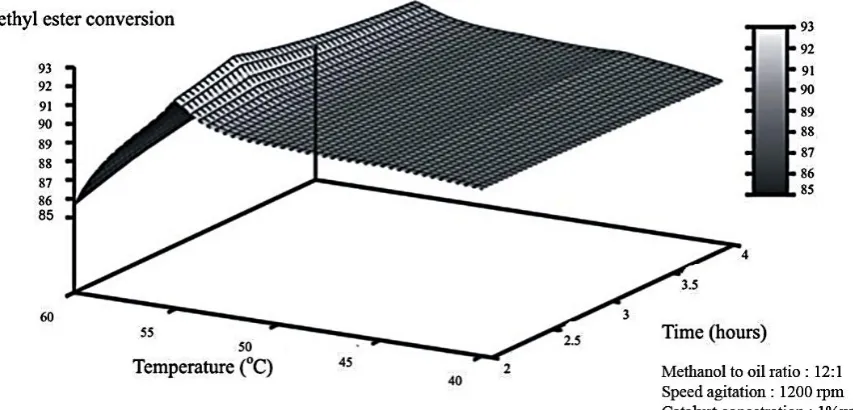
In order to study the effect of reaction temperature, methanolysis of vegetable oil is
normally performed near to the boiling point of the alcohol at 6570oC [20]. In this study, a
methanol to oil ratio of 12:1, 1 %wt. sulphuric acid anhydrous and 1 %wt. sodium hydroxide
11 24 hours and the reaction temperature was varied from 4060oC. The conversion of crude
sterculia foetida oil will be higher as the time increases; but after 3 hours, the yield decreases
as shown in Fig. 6. From this process, it is proven that the shorter time and temperature will
produce less yield methyl ester. On the other hand, with longer time (more than 3 hours) and
the higher temperature (above 60oC) will decrease the yield of methyl ester and cause more
soap. Thus, the optimal conversion yield was observed at the reaction time of 2.5 hours and
reaction temperature of 55oC. Besides, Kafuku and Mbrawa [21] also showed that an increase
in the optimum methyl esters yield was observed at 50oC. On the other hand, the yield
declined slightly after 60oC and it caused the saponification in the transesterification process.
[Fig. 6]
3.1.4 Effect of agitation stirring and reaction time
In this experiment, the stirring speed was varied from 8001500 rpm and reaction
time 24 hours while other parameters were kept at their original values as shown in previous
section. The appearance of two layers between methanol and oil was shown clearly when
intensity and time reaction were higher and longer. Otherwise, the separation of those layers
would not appear due to the lower intensity of stirring and slower reaction time. This
occurred as a result of the hydrolysis from alkyl esters which tends to produce more fatty
acids and caused the soap formation [21]. The optimal methyl ester yield at the stirring speed
of 1200 rpm and reaction time around 2.5 hours was shown in Fig. 7.
12 4. Conclusion
This paper introduces new non-edible oil extracted from sterculia foetida oil to be used
as a biodiesel feedstock. The summary of the experimental results are described as follows:
The biodiesel production from crude sterculia foetida oil is via two stage acid
(H2SO4) catalyst esterification and alkaline (NaOH) catalyst transesterification. The
conversion yield of sterculia foetida biodiesel was obtained up to 93.55%.
The optimum condition was 12:1 methanol to oil ratio of with 1%.wt alkali catalyst at
55oC for 2.5 hours. The fuel properties of SFME fulfilled the ASTM D 6751 and EN
14214. Finally, further research and study need to be carried out before sterculia
foetida can become an alternative fuel in the future.
Acknowledgements
The authors would like to acknowledge for the Ministry of Higher Education
of Malaysia and The University of Malaya, Kuala Lumpur, Malaysia for the financial
support under UM.C/HIR/MOHE/ENG/06 (D000006-16001).
References
[1] Demirbas A. Progress and recent trends in biodiesel fuels. Energy Convers Manage 2009;50:14-34.
[2] Mahanta P, Shrivastava A. Challenges and strategies for sustainable energy deficiency and environment. Technology development of bio-diesel as an energy alternative. India: New Age International; 2011.
[3] Singh SP, Singh D. Biodiesel production through the use of different sources and characterization of oils and their esters as the substitute of diesel: A review. Renew Sust Energy Rev 2010;14:200-16.
[4] Agarwal AK, Rajamanoharan K. Biofuels (alcohols and biodiesel) applications as fuels for internal combustion engines. Prog Energ Combust 2007;33:233-71.
[5] Demirbas AH, Demirbas I. Importance of rural bioenergy for developing countries. Energ Convers Manage 2007;48:2386-98.
13
[7] Munarso J. Plantation of sterculia feotida. L as vegetable oil. Infomation Technology Agriculture. Jakarta, Indonesia: Indonesia Agency for Agricultural Research and Development; 2010. p. 13-5.
[8] Sudrajat R. Optimization of the of science and technology role to improve forest and land productivity. Jakarta: The Forestry Research and Development Agency; 2005.
[9] World Agroforestry Centre (WAC). Sterculia foetida. http://www.worldagroforestry.org/treedb2/AFTPDFS/Sterculia_foetida.pdf; 2010.
[10] Vipunngeun N, Palanuvej C. Fatty acids of sterculia foetida seed oil. J Health Res 2009;23:157. [11]Taman nasional alas purwo (Alas Purwo National Park). Kepuh (Sterculia foetida L.).
http://tnalaspurwo.org/media/pdf/kea_sterculia_foetida_l._(kepuh).pdf; 2011.
[12]Bureau of Plant Industry (BPI). Sterculia feotida. Linn. http://bpi.da.gov.ph/Publications/mp/html/k/kalumpang.htm; 2010.
[13] Bindhu Ch, Reddy JRC, Rao BVSK, Ravinder T, Chakrabarti PP, Karuna MSL, Prasad RBN. Preparation and Evaluation of Biodiesel from Sterculia foetida Seed Oil. J AM Oil Chem Soc 2011;89:891–6.
[14] Yu XH, Rawat R, Shanklin J. Characterization and analysis of the cotton cyclopropane fatty acid synthase family and their contribution to cyclopropane fatty acid synthesis. BMC Plant Biology 2011;11:1471-81.
[15] Devan PK, Mahalakshmi NV. Study of the performance, emission and combustion characteristics of a diesel engine using poon oil-based fuels. Fuel Process Technol 2009;90:513-9.
[16] Silitonga AS, Ong HC, Mahlia TMI, Masjuki HH, Chong WT. Characterization and production of Ceiba pentandra biodiesel and its blends. Fuel 2013; http://dx.doi.org/10.1016/j.fuel.2013.02.014.
[17] Keera ST, El Sabagh SM, Taman AR. Transesterification of vegetable oil to biodiesel fuel using alkaline catalyst. Fuel 2011;90:42-7.
[18] Nakpong P, Wootthikanokkhan S. Roselle (Hibiscus sabdariffa L.) oil as an alternative feedstock for biodiesel production in Thailand. Fuel 2010;89:1806-11.
[19] Sahoo PK, Das LM. Process optimization for biodiesel production from jatropha, karanja and polanga oils. Fuel 2009;88:1588-94.
[20] Patil PD, Deng S. Optimization of biodiesel production from edible and non-edible vegetable oils. Fuel 2009;88:1302-6.
[21] Kafuku G, Mbarawa M. Biodiesel production from Croton megalocarpus oil and its process optimization. Fuel 2010;89:2556-60.
[22] Mofijur M, Masjuki HH, Kalam MA, Hazrat MA, Liaquat AM, Shahabuddin M, Varman M. Prospects of biodiesel from Jatropha in Malaysia. Renew Sust Energy Rev 2012;16:5007-20. [23] Silitonga AS, Masjuki HH, Mahlia TMI, Ong HC, Chong WT. Overview properties of biodiesel
14 Table 1: Composition of dry shelled seeds [12]
Property Percentage (%)
Fat 51.78
Protein 21.61
Starch 12.1
Sugar 5.00
Cellulose 5.51
Ash 3.90
[image:24.595.187.411.92.192.2]15 Table 2: The properties and fatty acid composition of sterculia foetida compared with other non-edible vegetable oils
Properties CSFOa CSFO [13] CSFO [15] CJCO[22] CCPO[16] CCIO[19] CPEO[23]
Kinematic viscosity at 40oC (mm2/s) 63.90 54.0 926.4 35.40 34.45 71.98 35.16
Density at 15oC (kg/m3) 937.0 920.0 49.7 918.0 905.2 896.0 922.3
Acid value (mg KOH/g) 5.11 0.36 11.00 16.80 44.0 6.03
Flash point (oC) 198.5 158.0 186.0 170.5 221.0
Fatty acid composition
C12:0 (Lauric acid) 0.1 0.1 0.1 0.1
C14:0 (Myristic acid) 0.2 0.1 0.1 0.1 0.1
C16:0 (Palmitic acid) 17.7 23.0 22.4 14.2 19.2 14.7 7.7
C16:1 (Palmitoleic acid) 0.2 0.7 0.3 0.3 0.1
C18:0 (Stearic acid) 4.7 8.2 7.3 7.0 2.6 13.2 5.25
C18:1 (Oleic acid) 6.0 1.0 16.4 44.7 17.4 46.1 46.7
C18:2 (Linoleic acid) 9.1 11.0 45.9 32.8 39.7 24.7 35.9
C18:3 (Linolenic acid) 0.7 2.3 0.2 1.5 0.2 2.1
C20:0 ( Arachidic acid) 2.3 6.46 0.2 0.56 0.8 0.23
18:*CE (Malvaloyl acid) 1.7 10.2 18.5
19:*CE (Sterculoyl acid) 35.1 44.3
*cyclopropene ester
16 Table 3: Fuel properties of SFME, JCME, CPME, CIME and PEME with comparison to ASTM and EN standard
Property Unit Test limit Non-edible methyl ester
ASTM D 6751 EN 14214 SFMEa SFME[13] SFME[15] JCMEa CPMEa CIMEa PEMEa
Viscosity at 40 oC mm2/s 1.9–6.0 3.5–5.0 3.96 4.72 6.0 3.01 3.15 3.75 3.07
Density at 15oC kg/m3 880 860–900 879.1 850.0 875.0 860.1 864.9 869.6 862.2
Acid value mg KOH/g Max. 0.50 Max. 0.5 0.14 0.14 0.18 0.18 0.5 0.11
Flash point oC 100170 >120 160.5 179.0 162 160.5 163 161.5 135.5
Pour point oC 15 16 −3.0 3.0 1.0 −1.0 0.0 0.0 −1.0
Cloud point oC 3 12 −3.0 3.0 −2.0 0.8 −1.0 −1.4
Cold filter plugging point oC 19 Max. 5 5.0 0.0 1.0 −1.0 −2.0
Calorific value MJ/kg 35 40.427 40.179 40.490 40.254 40.079
Oxidation stability at 110oC hours 3 min. 6 min. 3.44 3.42 3.42 4.22 13.05 5.50
Cetane number 47 min. 51 min. 57.9 56.8 57.5 56.2 55.2
17
[image:27.595.87.511.69.228.2]
19 Fig. 3 Apparatus experimental for esterification and transesterification of crude Sterculia
20 Fig. 4 Effect of methanol to oil molar ratio and temperature
[image:30.595.98.496.449.635.2]21 Fig. 6 Effect of reaction temperature and reaction time
[image:31.595.85.517.390.577.2]25 JULY 2012
Ref. JFUE-D-12-01092
Title: Production of biodiesel from Sterculia feotida and its process optimization FUEL
Dear,
Professor B. Li Editor (FUEL)
Sub: Re-submission of Article (JFUE-D-12-01092)
Thank you for your useful comments and suggestions on the manuscript. We have modified the manuscript accordingly, and detailed corrections are listed below point by point:
1) In its current state, the level of English throughout your manuscript does not meet the journal's desired standard. There are a number of grammatical errors and instances of badly worded/constructed sentences. Please check the manuscript and refine the language carefully.
The entire manuscript has been checked and revised carefully to avoid any errors in grammatical errors and instances of badly worded/constructed sentences. Furthermore, several colleagues who do well in English writing are also asked to review and proofread the manuscript carefully.
2) For suggested reviewer, reviewer's complete information has to be provided. Name, full details of affiliation and e-mail address have to be included in the list.
The reviewers are provided in detail included name, email id, affiliations and address in the cover letter.
3) Original high-quality research papers should be preferably no more than 20 double line spaced manuscript pages, including tables and illustrations.
We have revised the manuscript carefully and reduce the manuscript pages. We believe that it has now met the original high-quality research paper and acceptable for the review process.
4) Fig. 7 is of low quality; the information it presents is unclear, especially the letters. Please provide a high-resolution figure.
The figure is changed to high resolution and it is clear to read
5) Please note that the reference list must conform strictly to the Guide for Authors. References in reference list should be numbered sequentially with each number within square brackets. For journal articles, journal names provided should be abbreviated. For references with more than six authors give the first six names followed by et al. Please revise accordingly.
Examples:
Reference to a journal publication:
[1] Van der Geer J, Hanraads JAJ, Lupton RA. The art of writing a scientific article. J Sci Commun 2010;163:51-9.
Reference to a book:
[2] Strunk Jr W, White EB. The elements of style. 4th ed. New York: Longman; 2000. Reference to a chapter in an edited book:
[3] Mettam GR, Adams LB. How to prepare an electronic version of your article. In: Jones BS, Smith RZ, editors. Introduction to the electronic age, New York: E-Publishing Inc; 2009, p. 281-304.
We have checked all the references and formatted them strictly according to the Guide for Authors. Moreover, journal names have been abbreviated.
6) Do you intend to have your figures printed in color? If yes, you will have to pay for color printing. If not, submit black and white figures as well, so that the reviews and editor can judge the quality of figures that will be published.
We do not intend to have color printing in figures. Therefore, we have changed all figures into black and white.
7) Avoid vertical lines in tables.
We have checked and deleted the unnecessary vertical lines in table.
8) References 50-62 cited in the manuscript are not provided in the reference list.
We have checked all the references and make sure all the cited references are in the list
9) Pages should be numbered consecutively.
The pages have been numbered consecutively.
The manuscript has been resubmitted to your journal. We look forward to your positive response.
Hwai Chyuan, Ong
Department of Mechanical Engineering University of Malaya
50603 Kuala Lumpur Malaysia.
![Table(s)Table 1: Composition of dry shelled seeds [12]](https://thumb-us.123doks.com/thumbv2/123dok_us/162902.40046/24.595.187.411.92.192/table-s-table-composition-dry-shelled-seeds.webp)
![Table 2: The properties and fatty acid composition of sterculia foetida compared with other non-edible vegetable oils CSFOa CSFO [13] CSFO [15] CJCO[22] CCPO[16] CCIO[19]](https://thumb-us.123doks.com/thumbv2/123dok_us/162902.40046/25.842.65.774.74.350/table-properties-composition-sterculia-foetida-compared-vegetable-csfoa.webp)


![Fig. 2 The plantations area of sterculia foetida around the world [12]](https://thumb-us.123doks.com/thumbv2/123dok_us/162902.40046/28.842.101.739.64.381/fig-plantations-area-sterculia-foetida-world.webp)