RVC OPEN ACCESS REPOSITORY – COPYRIGHT NOTICE
This author’s accepted manuscript may be used for non-commercial purposes in accordance with Wiley Terms and Conditions for Self-Archiving.
The full details of the published version of the article are as follows:
TITLE: Avian mite dermatitis: Diagnostic challenges and unmet needs
AUTHORS: Kavallari, A; Kuester, T; Papadopoulos, E; Hondema, L S; Øines, Ø; Skov, J; Sparagano, O; Tiligada, E
JOURNAL: Parasite Immunology
PUBLISHER: Wiley
PUBLICATION DATE: August 2018
Avian mite dermatitis: Diagnostic challenges and unmet needs
Andriana Kavallari1, Tatiana Küster2, Elias Papadopoulos3, Laurens Severijn Hondema4,
Øines Øivind5, Jacob Skov6, Olivier Sparagano7, Ekaterini Tiligada1
1 Department of Pharmacology, Medical School, National and Kapodistrian University of
Athens, Athens, Greece;
2 Department of Pathobiology and Population Sciences, Royal Veterinary College, Hatfield,
Hertfordshire, United Kingdom;
3 Laboratory of Parasitology and Parasitic Diseases, School of Veterinary Medicine, Aristotle
University of Thessaloniki, Thessaloniki, Greece;
4 GGD Hart voor Brabant, Tilburg, The Netherlands;
5 Animal Health Research Group, Norwegian Veterinary Institute, Oslo, Norway;
6 Department of Veterinary and Animal Sciences, Faculty of Health and Medical Sciences,
University of Copenhagen, Denmark;
7Coventry University, Coventry, United Kingdom
Correspondence: Professor Ekaterini Tiligada Department of Pharmacology Medical School
National and Kapodistrian University of Athens M. Asias 75
11527 Athens Greece
Human infestation with avian mites is commonly manifested by skin lesions that are difficult to recognize particularly in patients from urban areas [1,2]. The cutaneous condition is a zoonotic acariasis caused by the mites Dermanyssus gallinae (poultry red mite, PRM),
Ornithonyssus sylviarum (northern fowl mite) or O. bursa (tropical fowl mite), and referred to as gamasoidosis, avian-mite ectoparasitosis/dermatitis or occasionally as dermanyssosis [1,3]. The PRMis of major economic and veterinary importance for the poultry and egg industry worldwide, whereas the full extent of threats to human health remain elusive [3,4]. The COST Action FA1404 ‘Improving current understanding and research for sustainable control of the poultry red mite Dermanyssus gallinae (COREMI)’ is a network of experts from 27 countries supported by the EU Framework Programme Horizon 2020 that aims to foster a
multidisciplinary approach for advancing current understanding and disseminating knowledge on PRM biology, control and impact on public health. In addition, this initiative provides a platform for early career investigators to gain up-to-date insights into the field. As part of the cross-sectoral activities of the Action, the working group WG2 organized a problem‐based ‘One Health’ training school in Itea, Greece in August 2017 in order to critically evaluate the available literature on the PRM-associated risks for human health, to raise the awareness of medical professionals on human PRM infestation and to communicate recommendations. The outcomes of the training school are summarised in this report.
D. gallinae as a zoonotic hazard
D. gallinae is a cosmopolitan nocturnal, hematophagous, non-permanent ectoparasite, largely considered as being avian-specific, infesting wild, domestic and synanthropic birds [5]. For over 20 years, numerous reports have focused on the animal health and economic
consequences associated with the high PRM prevalence in poultry farms [3]. A recent report states that 83% of the European farms are infested by D. gallinae, PRM prevalence reaching 94% in farms in The Netherlands, Germany and Belgium [4]. The typical density of >50,000 mites per bird in the modern poultry housing systems is attributed to the favourable conditions for PRM proliferation, facilitated at 10-35°C and >70% relative humidity [3].
The growing population of laying hens and the wide spread of synanthropic animals, along with the increased travel and trade and the climate change appear to facilitate PRM expansion to non-avian hosts, including humans and companion animals [3]. Although the available evidence remains inconclusive, the PRM vectorial capacity to transmit bacterial and/or viral diseases, such as salmonellosis,is an emerging scientific and public health concern beyond gamasoidosis [3,6]. Moreover, human exposure to the PRM control measures, such as silica-based products, may increase the risk of developing and/or exacerbating respiratory and cardiovascular disease [4]. In addition, the use of a range of licensed, unlicensed and off-label chemical pesticides, including organophosphates, pyrethroids and carbamates poses
ecological and environmental threats, as well as serious direct and indirect risks for both animal and human health exemplified by the recent scandal of fipronil-contaminated eggs [4]. In fact, all these ‘One Health’ aspects have already provided the basis for recommending the inclusion of PRM as a zoonotic and occupational hazard for poultry workers and hobby poultry keepers [7].
Clinical manifestations of PRM infestation in humans
dermatological lesions both in poultry workers, farmers and veterinarians and in urban settings [3]. In the latter case, human PRM infestation is commonly linked to nearby nests of feral birds like pigeons and sparrows, as well as to the presence of pet birds, such as canaries and parrots [3,9].
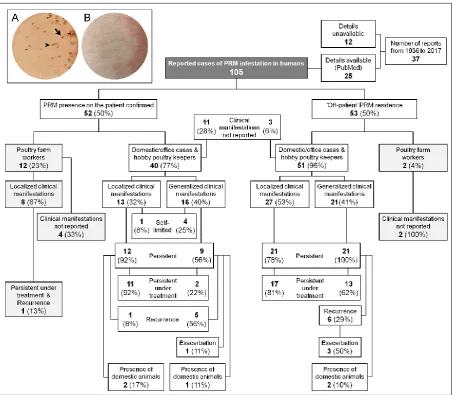
PRM infestation in humans is characterised by itching affecting various parts of the body, including hands, forearms, back, chest, neck, ears and the scalp that may intensify in the evening. Pruritic, papulosquamous eruptions and erythematous maculopapular rash with or without crusts as a result of excessive scratching are commonly reported [2,3] (Table 1S). Interestingly, although the presence of mite allergens tropomyosin and paramyosin has been demonstrated in D. gallinae, the available evidence does not support their natural antigenic properties in humans [10,11]. Moreover, no cases of a PRM-induced typical allergic reaction have been reported (Table 1S). Thus, PRM-associated dermatitis is a local or generalized non-specific skin reaction rather than a systemic response (Fig. 1), bearing the risk of being undiagnosed or misdiagnosed as scabies, pediculosis, general dermatitis or delusional ectoparasitosis and leading to treatment failure [2,3]. The relapse of the symptoms seems to be associated with prior generalized clinical manifestations (Fig. 1), thus pointing to the likely contribution of yet undetermined confounding factors.
Diagnostic challenges in gamasoidosis
The retrospective assessment of the reported cases of avian mite dermatitis is a complicated and occasionally controversial task. The clinical history and the physical examination of the patient are evidently inadequate to provide a firm diagnosis of PRM-associated dermatitis (Box 1), whereas dermoscopic, histologic and/or immunologic diagnostic criteria are virtually lacking [2,3]. The microscopic identification of the mite itself is largely considered as the only currently available confirmatory tool of the causative agent (Fig. 1), also allowing the differentiation of D. gallinae versus O. sylviarum infestation [1,3]. However, recent studies using ultrastructural morphological observations and DNA sequencing argue for the existence of at least two cryptic species with different host spectra, namely D. gallinae s. str. and D. gallinae special lineage L1, which have been associated with poultry and pigeons,
respectively [2]. Therefore, the regional diversity and the variation of the D. gallinae complex appear to be important determinants for the diagnosis of gamasoidosis and for the
identification of the mite [2].
Conclusions
The accumulating reports on the opportunistic non-avian feeding of the avian mite D. gallinae raise concerns on PRM host expansion and/or switching events and on the consequent threats to human health [2,3,4,7]. Although the putative PRM pathogenicity is widely accepted by the veterinary community, the differential diagnosis of gamasoidosis and the dissection of the underlying pathobiological mechanisms remain challenging unmet needs (Box 1). The increased awareness of D. gallinae infestation in humans will foster collaboration and exchange of key information among medical practitioners, veterinarians and academic and industrial researchers under the ‘One Health’ approach, aiming to safeguard both animal and human health.
We wish to thank the EU COST Action FA1404 ‘Improving current understanding and
research for sustainable control of the poultry red mite Dermanyssus gallinae (COREMI)’ for funding and supporting the training school. In particular, we would like to thank the trainees Athanasios Angelou, Petra Bandelj, Andrei Cimpan, Giulio Cocciolo, Helder Espiguinha Cortes, Eirini Fragiadaki, Alexandra Gruianu, Maria Kakolyri, Eleanor Karp-Tatham,
Slobodan Knežević, José Francisco Lima Barbero, Liča Lozica, Margherita Mainiero, Teresa Mateus, Aleksandra Petrović, Alkiviadis Polychroniadis, Sokratis Ptochos, Flora Strikou, Isaia Symeonidou, as well as the local veterinarian Kleoniki Tola, for their contribution and fruitful discussions during the training school. The authors gratefully acknowledge Dr.Thecla Hekker, Consultant Medical Microbiologist, VU Medical Center, Amsterdam, The
Netherlands, and Dr.George Guibas, Allergist, University of Manchester, UK for sharing their perspectives as invited speakers.
Author contributions
All authors were involved in the organization and accomplishment of the training school, and in the writing of the manuscript.
Conflicts of interest
The authors declare that they have no conflicts of interest.
Supporting Information
Additional Supporting Information may be found in the online version of this article: Table S1. Reported cases of human infestation with the poultry red mite.
References
1. Di Palma A, Giangaspero A, Cafiero MA, Germinara GS. A gallery of the key characters to ease identification of Dermanyssus gallinae (Acari: Gamasida: Dermanyssidae) and allow differentiation from Ornithonyssus sylviarum (Acari: Gamasida: Macronyssidae). Parasit Vectors 2012;5:104.
2. Pezzi M, Leis M, Chicca M, Roy L. Gamasoidosis caused by the special lineage L1 of Dermanyssus gallinae (Acarina: Dermanyssidae): A case of heavy infestation in a public place in Italy. Parasitol Int 2017;66:666-670.
3. George DR, Finn RD, Graham KM, Mul M, Maurer V, Valiente Moro C, Sparagano OA. Should the poultry red mite Dermanyssus gallinae be of wider concern for veterinary medical science. Parasit Vectors 2015;8:178.
4. Sigognault Flochlay A, Thomas E, Sparagano O. Poultry red mite (Dermanyssus
gallinae) infestation: a broad impact parasitological disease that still remains a significant challenge for the egg-laying industry in Europe. Parasit Vectors 2017;10:357.
5. Pritchard J, Kuster T, Sparagano O, Tomley F. Understanding the biology and control of the poultry red mite Dermanyssus gallinae: a review. Avian Pathol 2015;44:143‐153. 6. Moro, CV, De Luna, CJ, Tod, A, Guy, JH, Sparagano, OAE, & Zenner, L. The Poultry
7. Cafiero MA, Galante D, Camarda A, Giangaspero A, Sparagano O. Why dermanyssosis should be listed as an occupational hazard. Occup Environ Med 2011;68:628
8. Williams RW. An infestation of a human habitation by Dermanyssus gallinae (Degeer, 1778) (Acarina: Dermanyssidae) in New York City resulting in sanguisugent attacks upon the occupants. Am J Trop Med Hyg 1958;7:627-629.
9. Boseret G, Losson B, Mainil JG, Thiry E, Saegerman C. Zoonoses in pet birds: review and perspectives. Vet Res 2013;44:36.
10. Nisbet AJ, Huntley JF, Mackellar A, Sparks N, McDevitt R. A house dust mite allergen homologue from poultry red mite Dermanyssus gallinae (De Geer). Parasite Immunol 2006;28:401-405.
Figure 1 Characteristics of the cases of human infestation with the poultry red mite (PRM; D. gallinae, DeGeer, 1778) reported since 1936. The clinical manifestations are presented