Phonics screening
check evaluation: final
report
Technical appendices
June 2015
Contents
List of tables 3
Appendix A: Multilevel Modelling 8
Appendix B: Literacy coordinator questionnaire 28
List of tables
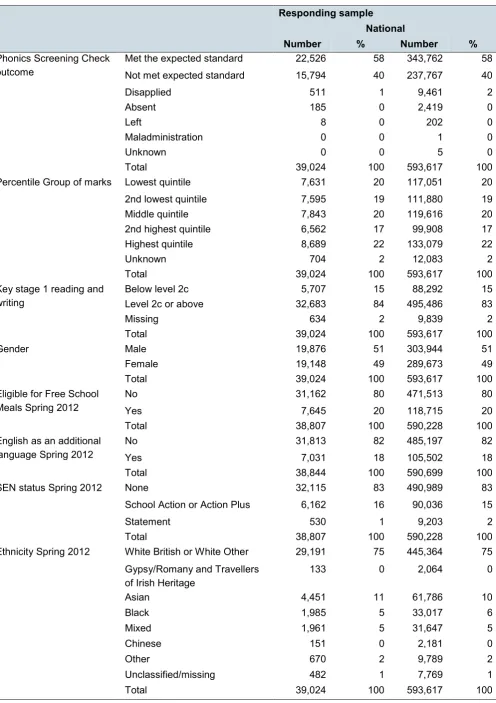
Table A1: National comparison with evaluation responding schools (2012 cohort) 11
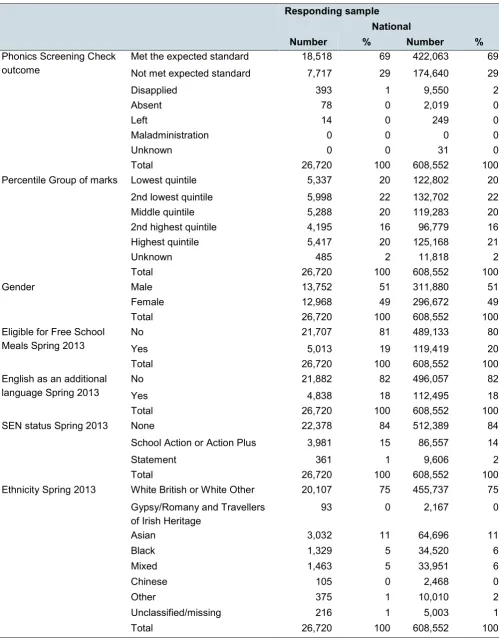
Table A2: National comparison with evaluation responding schools (2013 cohort) 12
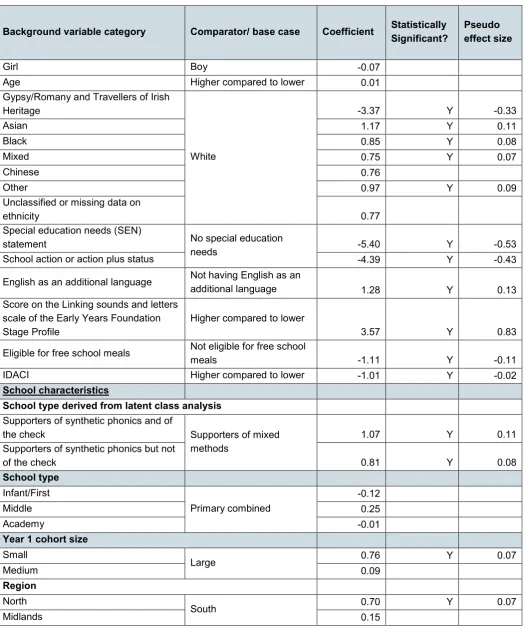
Table A3: List of background variables along with raw coefficients and pseudo effect size
(where statistically significant) – PSC outcomes 2012 13
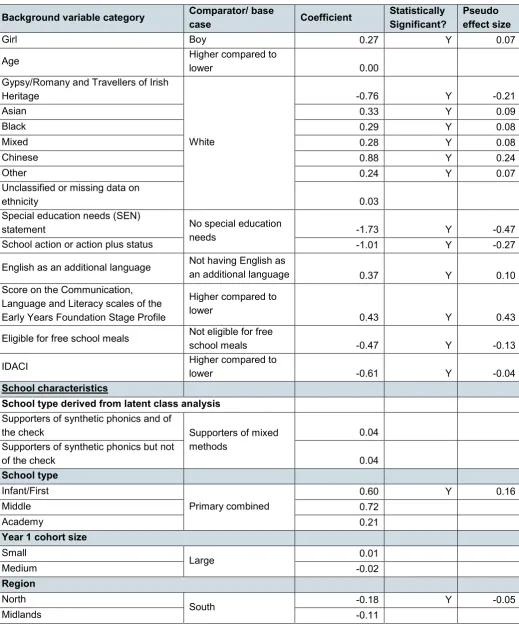
Table A4: List of background variables along with raw coefficients and pseudo effect size (where statistically significant) – KS1 reading & writing outcomes 2013 15
Table A5: List of background variables along with raw coefficients and pseudo effect size
(where statistically significant) – PSC outcomes 2013 17
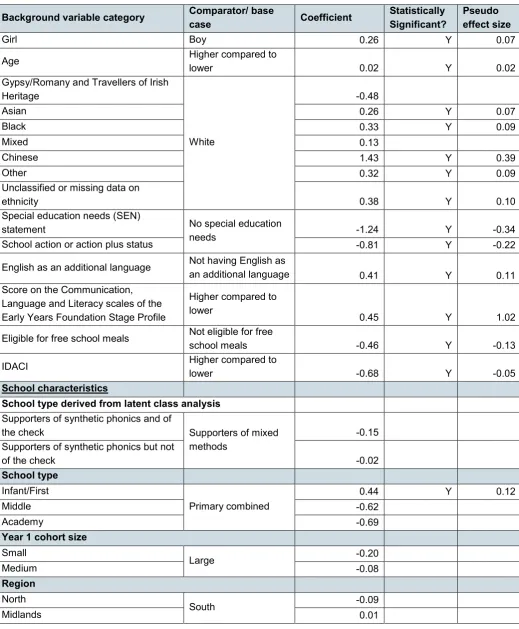
Table A6: List of background variables along with raw coefficients and pseudo effect size (where statistically significant) – KS1 reading & writing outcomes 2014 19
Table A7: List of background variables along with raw coefficients and pseudo effect size
(where statistically significant) – PSC outcomes 2014 21
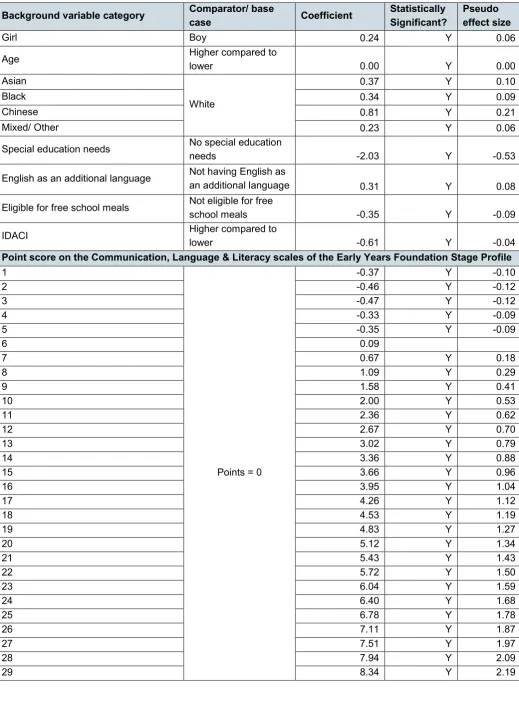
Table A8: List of background variables along with raw coefficients and pseudo effect size (where statistically significant) – KS1 reading & writing outcomes 2011-2014 23
Table A9: List of background variables along with raw coefficients and pseudo effect size (where statistically significant) – KS1 reading & writing outcomes 2011-2014 25
Table B1: Q1.1 – The role of teachers responding to the literacy coordinator
questionnaire 28
Table B2: Q1.1 – The role of teachers responding to the literacy coordinator
questionnaire when ‘other role’ was indicated [filter question based on table B1] 28
Table B3: Q2.1 – The proportions of literacy coordinators who reported the following statements best characterised the approach to phonics within overall early literacy
teaching in their school 29
Table B4: Q2.2 – The proportion of literacy coordinators reporting each of the
'mainstream' or 'core' published phonics programme was used to structure most or all
phonics teaching in each year group 29
Table B5: Q2.3 – The proportion of literacy coordinators who reported making general changes to phonics teaching this school year, in light of their experience of the phonics
screening check in 2012 or 2013 30
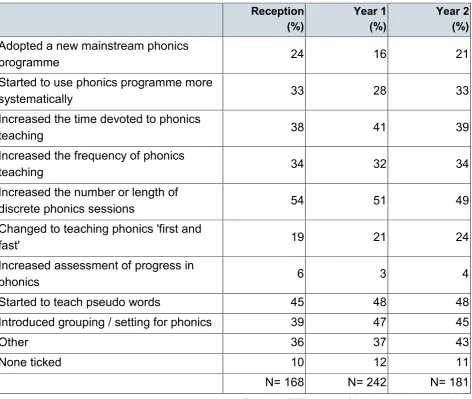
Table B6: Q2.4 – The changes made to teaching in Reception, Year 1 and Year 2
Table B7: Q2.4 – The changes made to teaching across year groups in response to the 2013 check where ‘other changes’ were indicated [filter question based on table B6] 31
Table B8: Q3.1 – The extent to which literacy coordinators agree with each of the
following statements 32
Table B9: Q4.1 – Literacy coordinators’ views on how well prepared their teachers were
to provide effective phonics teaching 33
Table B10: Q5.1 – The teaching methods used with pupils who were disapplied from the
2012 and 2013 check 33
Table B11: Q5.1 – The teaching methods used with pupils who were disapplied from the 2013 check where ‘other teaching methods’ was indicated [filter question based on table
B17] 34
Table B12: Q5.2 – The ways in which Reception, Year 1 and Year 2 teachers were reported to have used the results of the 2013 phonics screening check 34
Table B13: Q5.2 – The ways in which Reception, Year 1 and Year 2 teachers have used the results of the 2013 phonics screening check where ‘other ways’ was indicated [filter
question based on table B12] 35
Table B14: Q5.3 – The type of support given to Year 2 pupils who were in each of the
categories after the 2013 check 35
Table B15: Q5.4 – The time point at which literacy coordinators felt that pupils, who had not previously done so, reached the required standard of the check 36
Table B16: Q6.1 – How literacy coordinators reported teachers in their school prepared
for the phonics screening check 36
Table B17: Q6.1 – How literacy coordinators reported teachers in their school prepared for the phonics screening check where ‘other preparation’ was indicated [filter question
based on table 62] 37
Table B18: Q7.1 – Following the phonics screening check, literacy coordinators’ reports of what actions will be taken to use the results within school 38
Table B19: Q7.2 – The evidence literacy coordinators planned to use to help them
determine if / what type of extra support should be provided to a child? 39
Table B20: Q7.2 – The evidence literacy coordinators planned to use to help them determine if / what type of extra support should be provided to a child where ‘other
evidence’ was indicated [filter question based on table B19] 39
Table B21: Q8.1 – Details of the additional information provided to the parents / carers of current Year 2 pupils who did not meet the standard this year 40
Table B22: Q9.1 – Literacy coordinators’ estimate of the amount of staff time (in hours)
spent on planning and preparation for the check 40
Table B23: Q9.1 – Literacy coordinators’ estimate of the amount of staff time (in hours)
spent on the administration of the check 41
Table B24: Q9.1 – Literacy coordinators’ estimate of the amount of staff time (in hours)
spent on Paperwork 42
Table B25: Q9.1 – Literacy coordinators’ estimate of the amount of staff time (in hours)
spent on training 43
Table B26: Q9.1 – Literacy coordinators’ estimate of the amount of staff time (in hours)
spent on reviewing the results of the check 44
Table B27: Q9.1 – Literacy coordinators’ estimate of the amount of staff time (in hours)
spent on ‘other’ activities surrounding the check 45
Table B28: Q9.1 – Details of the mean time (in hours) spent by each member of staff in relation to planning and preparation for the check, as reported by literacy coordinators 46
Table B29: Q9.1 – Details of the mean time (in hours) spent by each member of staff in relation to the administration of the check, as reported by literacy coordinators 46
Table B30: Q9.1 – Details of the mean time (in hours) spent by each member of staff in
relation to paperwork, as reported by literacy coordinators 47
Table B31: Q9.1 – Details of the mean time (in hours) spent by each member of staff in relation to training for the check, as reported by literacy coordinators 47
Table B32: Q9.1 – Details of the mean time (in hours) spent by each member of staff in relation to reviewing the results of the check, as reported by literacy coordinators 48
Table B33: Q9.1 – Details of the mean time (in hours) spent by each member of staff in relation to ‘other’ activities surrounding the check, as reported by literacy coordinators 48
Table B34: The extent to which literacy coordinators agree with the statement ‘I am convinced of the value of systematic synthetic phonics teaching’ in 2012 and 2013 49
Table B35: The extent to which literacy coordinators agree with the statement ‘Phonics should always be taught in the context of meaningful reading’ in 2012, 2013 and 2014 49
Table B37: The extent to which literacy coordinators agree with the statement ‘A variety of different methods should be used to teach children to decode words’ in 2012, 2013
and 2014 50
Table B38: The extent to which literacy coordinators agree with the statement
‘Systematic phonics teaching is necessary only for some children’ in 2012, 2013 and
2014 51
Table B39: The extent to which literacy coordinators agree with the statement ‘The phonics screening check provides valuable information for teachers’ in 2012, 2013 and
2014 51
Table B40: The extent to which literacy coordinators agree with the statement ‘The phonics screening check provides valuable information for parents/carers’ in 2012, 2013
and 2014 52
Table C1: Q2.2 – The proportion of teachers reporting they conducted the check with
Year 1 pupils last year (2013) 53
Table C2: Q2.3 - The proportion of teachers reporting they conducted the check with
Year 2 pupils this year (2013) 53
Table C3: Q2.4 - Ways teachers reported having changed their practice this year in
preparation for the 2013 phonics check 53
Table C4: Q2.4 - Ways teachers reported having changed their practice this year in preparation for the 2014 phonics check when ‘other change’ was indicated [Filter
question based on table C3] 54
Table C5: Q2.5 – The extent to which teachers felt the results of the 2014 phonics check
gave new information 55
Table C6: Q2.6 – The extent to which teachers felt the results of the 2014 phonics check gave useful information, in terms of planning teaching and learning 55
Table C7: Q2.7 – When thinking only of those pupils who did not have additional
difficulties which may have affected their performance on the screening check, teacher’s views on the suitability of the standard of the check for Year 1 pupils 55
Table C8: Q2.8 – The proportions of teachers reporting they had a local authority
monitoring visit during the week of the check 56
Table C9: Q2.9 – Teacher reports of how many check administrations were observed during the monitoring visit [filter question based on Table C8] 56
Table C10: Q2.10 – Where one or more observations were undertaken, teacher’s reports of how the check administration observations for the monitoring visit were chosen [filter
question based on Table C8] 56
Table C11: Q4.1 – The proportion of teachers who reported they stopped the check early
due to a pupil struggling 57
Table C12: Q4.2 – Teachers’ views on ease of judging when to stop the check early due
to a pupil struggling [filter question based on Table C11] 57
Table C13: Q4.3 – Factors teachers felt would influence their judgment about if and when
Appendix A: Multilevel Modelling
National pupil database (NPD)
DfE granted access to an anonymised NPD dataset on pupil outcomes for key stage 1 (KS1) teacher assessment and for the phonics screening check (PSC)for the academic year 2012/13. The dataset included prior attainment on the Early Years Foundation Stage Profile (EYFSP) for both cohorts and the PSC 2012 outcomes for those pupils now at the end of KS1. It also supplied background characteristics such as gender, ethnicity, and free school meals (FSM) eligibility. Pupils from responding schools in the evaluation sample were identified in the dataset. Tables A1 and A2 present the characteristics of these pupils against all pupils nationally for the 2012 and 2013 cohorts respectively.
Tables A1 and A2 show that both samples of responding schools have very similar background characteristics to England as a whole. The proportions of pupils with certain background characteristics in responding schools are generally within one percentage point of the national proportions.
Multilevel modelling
Multilevel modelling is a development of regression analysis which works by jointly examining the relationship between an outcome of interest and many potentially influential background characteristics including prior attainment. It has a number of distinct advantages over other estimation procedures. First, as with other regression analysis, it allows comparison on a like-with-like basis. It is important that any analysis technique used takes account of the differences in the circumstances in which different pupils and schools are situated.
The other major advantage of multilevel modelling, which is particularly important in the analysis of educational data, is that it takes account of the fact that there is often more similarity between individuals in the same school than between individuals in different schools. By recognising the hierarchical structure of the data, multilevel modelling allows the most accurate estimation of the statistical significance of any effects of the
programme.
Four multilevel models were run with the outcome variables:
• Model 1: score on the PSC 2012 for pupils in Year 1 in 2012 • Model 2: KS1 points score 2013 for pupils in Year 2 in 2013 • Model 3: score on the PSC 2013 for pupils in Year 1
• Model 4: KS1 points score 2014 for pupils in Year 2 in 2014.
Background variables included in the model were:
• Pupil characteristics: gender, age, ethnicity, special educational needs (SEN), English as an additional language (EAL)
• Pupil prior attainment: score on the Linking Sounds and Letters (LSL) scale (for Phonics outcome) and score on the Communication, Language and Literacy (CLL) scales (for KS1 reading and writing) of the EYFSP
• Pupil-level indicators of socio-economic status: IDACI, FSM eligibility
• School characteristics: type, size, region, KS1 attainment band; proportion of pupils eligible for FSM; proportion of pupils with SEN; proportion of pupils with EAL
• Outcome of latent class analysis (see second interim evaluation report1).
A multilevel model analysis takes into account all of these background factors then seeks out the significant differences that remain. That is, the statistical method measures the differences between different groups and controls for them in making the comparison. The resulting findings isolate the differences due to each individual factor, once all the other factors have been taken into account. The findings often illustrate significant
differences between the background category named and the ‘base case’. Tables A3, A4 and A5 list all the background variables in the model and describe the base case for each. They go on to list the coefficients of the model, with pseudo effect sizes2 where these proved to be statistically significant.
Longitudinal modelling of NPD data
The final year of the evaluation included analysis of longitudinal KS1 performance of pupils and schools. Because the latent class outcomes were not included as variables in the model, all relevant data from the NPD could be used for analysis. A ‘random effects’ statistical technique was used to estimate the models, which is similar to a multilevel model, but computationally feasible with more than 2 million pupils in the dataset. The research team compared the results of multilevel and random effects models on a set of randomly drawn subsets of the data and found the results were virtually identical. The random effects model also accounts for both the differences in the circumstances in which different pupils and schools are situated and the hierarchical structure of the data.
1
https://www.gov.uk/government/uploads/system/uploads/attachment_data/file/307229/Evaluation_of_the_p honics_screening_check_second_interim_report_FINAL.pdf [26/02/15]
2 Pseudo effect size is a standardised measure of the size of effect a variable has on the outcome variable.
Coefficients are divided by the standard deviation of the outcome variable and, if the variable is
continuous, multiplied by the standard deviation of the independent variable and the square root of two. The effect size of a dichotomous independent variable is the coefficient divided by the outcome variable standard deviation.
The background variables included in the longitudinal models were very similar to the multilevel models with latent class outcomes included, with a few major differences that reflect the different research question and the use of more pupil data. These were:
• Rather than including EYFSP CLL total points as a linear variable, the research team included dichotomous variables for each point score. This was possible because the number of pupils achieving each point score was large and preferable because the relationship between EYFSP points and KS1 points appeared to be non-linear
• Dichotomous variables for each year. Previous analysis was cross-sectional and only looked at one year at a time, whereas the research question was to describe attainment trends before and after the introduction of the check
• Interaction variables between EYFSP quintile and dichotomous variables for each year. These variables were included in one model to look at the differential
progress made through KS1 by sub-groups according to their attainment at the end of reception.
Responding sample National
Number % Number %
Phonics Screening Check
outcome Met the expected standard Not met expected standard 22,526 15,794 58 40 343,762 237,767 58 40 Disapplied 511 1 9,461 2 Absent 185 0 2,419 0 Left 8 0 202 0 Maladministration 0 0 1 0 Unknown 0 0 5 0 Total 39,024 100 593,617 100 Percentile Group of marks Lowest quintile 7,631 20 117,051 20 2nd lowest quintile 7,595 19 111,880 19 Middle quintile 7,843 20 119,616 20 2nd highest quintile 6,562 17 99,908 17 Highest quintile 8,689 22 133,079 22 Unknown 704 2 12,083 2 Total 39,024 100 593,617 100 Key stage 1 reading and
writing
Below level 2c 5,707 15 88,292 15 Level 2c or above 32,683 84 495,486 83 Missing 634 2 9,839 2 Total 39,024 100 593,617 100 Gender Male 19,876 51 303,944 51 Female 19,148 49 289,673 49 Total 39,024 100 593,617 100 Eligible for Free School
Meals Spring 2012 No Yes 31,162 7,645 80 20 471,513 118,715 80 20 Total 38,807 100 590,228 100 English as an additional
language Spring 2012
No 31,813 82 485,197 82 Yes 7,031 18 105,502 18 Total 38,844 100 590,699 100 SEN status Spring 2012 None 32,115 83 490,989 83 School Action or Action Plus 6,162 16 90,036 15 Statement 530 1 9,203 2 Total 38,807 100 590,228 100 Ethnicity Spring 2012 White British or White Other 29,191 75 445,364 75
Gypsy/Romany and Travellers of Irish Heritage
[image:11.595.61.558.71.775.2]Table A2: National comparison with evaluation responding schools (2013 cohort) Responding sample
National
Number % Number %
Phonics Screening Check
outcome Met the expected standard Not met expected standard 18,518 7,717 69 29 422,063 174,640 69 29 Disapplied 393 1 9,550 2 Absent 78 0 2,019 0 Left 14 0 249 0 Maladministration 0 0 0 0 Unknown 0 0 31 0 Total 26,720 100 608,552 100 Percentile Group of marks Lowest quintile 5,337 20 122,802 20 2nd lowest quintile 5,998 22 132,702 22 Middle quintile 5,288 20 119,283 20 2nd highest quintile 4,195 16 96,779 16 Highest quintile 5,417 20 125,168 21 Unknown 485 2 11,818 2 Total 26,720 100 608,552 100 Gender Male 13,752 51 311,880 51 Female 12,968 49 296,672 49 Total 26,720 100 608,552 100 Eligible for Free School
Meals Spring 2013 No Yes 21,707 5,013 81 19 489,133 119,419 80 20 Total 26,720 100 608,552 100 English as an additional
language Spring 2013
No 21,882 82 496,057 82 Yes 4,838 18 112,495 18 Total 26,720 100 608,552 100 SEN status Spring 2013 None 22,378 84 512,389 84 School Action or Action Plus 3,981 15 86,557 14 Statement 361 1 9,606 2 Total 26,720 100 608,552 100 Ethnicity Spring 2013 White British or White Other 20,107 75 455,737 75
Gypsy/Romany and Travellers of Irish Heritage
93 0 2,167 0 Asian 3,032 11 64,696 11 Black 1,329 5 34,520 6 Mixed 1,463 5 33,951 6 Chinese 105 0 2,468 0 Other 375 1 10,010 2 Unclassified/missing 216 1 5,003 1 Total 26,720 100 608,552 100
statistically significant) – PSC outcomes 2012
Background variable category Comparator/ base case Coefficient Statistically Significant? Pseudo effect size
Girl Boy -0.07
Age Higher compared to lower 0.01
Gypsy/Romany and Travellers of Irish
Heritage
White
-3.37 Y -0.33 Asian 1.17 Y 0.11 Black 0.85 Y 0.08 Mixed 0.75 Y 0.07 Chinese 0.76
Other 0.97 Y 0.09 Unclassified or missing data on
ethnicity 0.77 Special education needs (SEN)
statement No special education
needs -5.40 Y -0.53 School action or action plus status -4.39 Y -0.43 English as an additional language Not having English as an additional language
1.28 Y 0.13 Score on the Linking sounds and letters
scale of the Early Years Foundation Stage Profile
Higher compared to lower
3.57 Y 0.83 Eligible for free school meals Not eligible for free school
meals -1.11 Y -0.11 IDACI Higher compared to lower -1.01 Y -0.02
School characteristics
School type derived from latent class analysis Supporters of synthetic phonics and of
the check Supporters of mixed methods
1.07 Y 0.11 Supporters of synthetic phonics but not
of the check 0.81 Y 0.08
School type
Infant/First
Primary combined
-0.12 Middle 0.25 Academy -0.01
Year 1 cohort size
Small
Large 0.76 Y 0.07 Medium 0.09
Region
North
South 0.70 Y 0.07 Midlands 0.15
[image:13.595.44.570.85.721.2]Background variable category Comparator/ base case Coefficient Statistically Significant? Pseudo effect size KS1 English performance band 2010
Lowest 20% schools
Highest 20% schools
-0.26
2nd lowest 20% schools 0.33
Middle 20% schools 0.36
2nd highest 20% schools 0.45
School quintiles based on percentage pupils with FSM
Low FSM quintile (8%- 20% pupils eligible for FSM)
Lowest FSM Quintile (less than or equal to 8% FSM children)
0.17
Middle FSM quintile (21%- 35% pupils
eligible for FSM) 0.42
High FSM quintile (36%- 50% pupils
eligible for FSM) 1.33 Y 0.13 High FSM quintile (More than 50%
pupils eligible for FSM) 0.24
School band based on percentage of pupils with statements (2009/10)
Schools with no SEN statement pupils
Schools with 1 - 2% SEN statement children
-0.17
Schools with 3 - 29% SEN statement
children -0.52
Schools with 30% or more SEN
statement children -0.89
School band based on percentage pupils with English as an additional language 2010/11
Schools with no EAL children
Schools with 1 - 5% EAL children
0.22 Schools with 6 - 49% EAL children 0.19 Schools with 50% or more EAL
children 0.31
statistically significant) – KS1 reading & writing outcomes 2013
Background variable category Comparator/ base case Coefficient Statistically Significant? Pseudo effect size
Girl Boy 0.27 Y 0.07 Age Higher compared to
lower 0.00
Gypsy/Romany and Travellers of Irish
Heritage
White
-0.76 Y -0.21 Asian 0.33 Y 0.09 Black 0.29 Y 0.08 Mixed 0.28 Y 0.08 Chinese 0.88 Y 0.24 Other 0.24 Y 0.07 Unclassified or missing data on
ethnicity 0.03 Special education needs (SEN)
statement No special education
needs -1.73 Y -0.47 School action or action plus status -1.01 Y -0.27 English as an additional language Not having English as
an additional language 0.37 Y 0.10 Score on the Communication,
Language and Literacy scales of the Early Years Foundation Stage Profile
Higher compared to
lower 0.43 Y 0.43 Eligible for free school meals Not eligible for free school meals -0.47 Y -0.13 IDACI Higher compared to lower -0.61 Y -0.04
School characteristics
School type derived from latent class analysis
Supporters of synthetic phonics and of
the check Supporters of mixed methods
0.04 Supporters of synthetic phonics but not
of the check 0.04
School type
Infant/First
Primary combined
0.60 Y 0.16 Middle 0.72
Academy 0.21
Year 1 cohort size
Small
Large 0.01 Medium -0.02
Region
North
South -0.18 Y -0.05 Midlands -0.11
[image:15.595.45.565.86.716.2]Background variable category Comparator/ base case Coefficient Statistically Significant? Pseudo effect size KS1 English performance band 2010
Lowest 20% schools
Highest 20% schools
-0.11
2nd lowest 20% schools -0.05
Middle 20% schools -0.05
2nd highest 20% schools 0.06
School quintiles based on percentage pupils with FSM
Low FSM quintile (8%- 20% pupils eligible for FSM)
Lowest FSM Quintile (less than or equal to 8% FSM children)
0.06
Middle FSM quintile (21%- 35% pupils
eligible for FSM) 0.08
High FSM quintile (36%- 50% pupils
eligible for FSM) 0.05 High FSM quintile (More than 50%
pupils eligible for FSM) -0.13
School band based on percentage of pupils with statements (2009/10)
Schools with no SEN statement pupils
Schools with 1 - 2% SEN statement children
0.09
Schools with 3 - 29% SEN statement
children 0.10
Schools with 30% or more SEN
statement children -1.32 Y -0.36
School band based on percentage pupils with English as an additional language 2010/11
Schools with no EAL children
Schools with 1 - 5% EAL children
-0.03 Schools with 6 - 49% EAL children -0.01 Schools with 50% or more EAL
children 0.11
statistically significant) – PSC outcomes 2013
Background variable category Comparator/ base case Coefficient Statistically Significant? Pseudo effect size
Girl Boy -0.14 Age Higher compared to
lower 0.04 Y 0.02 Gypsy/Romany and Travellers of Irish
Heritage
White
-1.32
Asian 0.87 Y 0.09 Black 1.15 Y 0.12
Mixed 0.31
Chinese 1.41
Other 1.38 Y 0.15 Unclassified or missing data on
ethnicity 0.89 Special education needs (SEN)
statement No special education
needs -5.12 Y -0.55 School action or action plus status -3.91 Y -0.42 English as an additional language Not having English as
an additional language 1.31 Y 0.14 Score on the Linking sounds and letters
scale of the Early Years Foundation Stage Profile
Higher compared to
lower 3.49 Y 0.85 Eligible for free school meals Not eligible for free school meals -0.74 Y -0.08 IDACI Higher compared to lower -1.08 Y -0.03
School characteristics
School type derived from latent class analysis
Supporters of synthetic phonics and of
the check Supporters of mixed methods
0.82 Y 0.09 Supporters of synthetic phonics but not
of the check 0.45
School type
Infant/First
Primary combined
-0.29 Middle 1.60 Academy 0.31
Year 1 cohort size
Small
Large 0.70
Medium 0.62 Y 0.07
Region
North
South 0.47 Midlands 0.00
Background variable category Comparator/ base case Coefficient Statistically Significant? Pseudo effect size KS1 English performance band 2010
Lowest 20% schools
Highest 20% schools
-0.33
2nd lowest 20% schools -0.06
Middle 20% schools 0.03
2nd highest 20% schools 0.17
School quintiles based on percentage pupils with FSM
Low FSM quintile (8%- 20% pupils eligible for FSM)
Lowest FSM Quintile (less than or equal to 8% FSM children)
0.14
Middle FSM quintile (21%- 35% pupils
eligible for FSM) 0.17
High FSM quintile (36%- 50% pupils
eligible for FSM) 0.80 High FSM quintile (More than 50%
pupils eligible for FSM) 0.88
School band based on percentage of pupils with statements (2009/10)
Schools with no SEN statement pupils
Schools with 1 - 2% SEN statement children
-0.01
Schools with 3 - 29% SEN statement
children -0.06
Schools with 30% or more SEN
statement children -4.49 Y -0.49
School band based on percentage pupils with English as an additional language 2010/11
Schools with no EAL children
Schools with 1 - 5% EAL children
-0.48 Schools with 6 - 49% EAL children -0.41 Schools with 50% or more EAL
children 0.65
statistically significant) – KS1 reading & writing outcomes 2014
Background variable category Comparator/ base case Coefficient Statistically Significant? Pseudo effect size
Girl Boy 0.26 Y 0.07 Age Higher compared to
lower 0.02 Y 0.02 Gypsy/Romany and Travellers of Irish
Heritage
White
-0.48
Asian 0.26 Y 0.07 Black 0.33 Y 0.09
Mixed 0.13
Chinese 1.43 Y 0.39 Other 0.32 Y 0.09 Unclassified or missing data on
ethnicity 0.38 Y 0.10 Special education needs (SEN)
statement No special education
needs -1.24 Y -0.34 School action or action plus status -0.81 Y -0.22 English as an additional language Not having English as
an additional language 0.41 Y 0.11 Score on the Communication,
Language and Literacy scales of the Early Years Foundation Stage Profile
Higher compared to
lower 0.45 Y 1.02 Eligible for free school meals Not eligible for free school meals -0.46 Y -0.13 IDACI Higher compared to lower -0.68 Y -0.05
School characteristics
School type derived from latent class analysis
Supporters of synthetic phonics and of
the check Supporters of mixed methods
-0.15 Supporters of synthetic phonics but not
of the check -0.02
School type
Infant/First
Primary combined
0.44 Y 0.12 Middle -0.62
Academy -0.69
Year 1 cohort size
Small
Large -0.20 Medium -0.08
Region
North
South -0.09 Midlands 0.01
[image:19.595.45.565.86.716.2]Background variable category Comparator/ base case Coefficient Statistically Significant? Pseudo effect size KS1 English performance band 2010
Lowest 20% schools
Highest 20% schools
-0.20
2nd lowest 20% schools -0.35 Y -0.10 Middle 20% schools -0.28
2nd highest 20% schools 0.08
School quintiles based on percentage pupils with FSM
Low FSM quintile (8%- 20% pupils eligible for FSM)
Lowest FSM Quintile (less than or equal to 8% FSM children)
0.07
Middle FSM quintile (21%- 35% pupils
eligible for FSM) 0.24
High FSM quintile (36%- 50% pupils
eligible for FSM) 0.47 Y 0.13 High FSM quintile (More than 50%
pupils eligible for FSM) 0.44
School band based on percentage of pupils with statements (2009/10)
Schools with no SEN statement pupils
Schools with 1 - 2% SEN statement children
0.01
Schools with 3 - 29% SEN statement
children 0.23
Schools with 30% or more SEN
statement children -2.41 Y -0.66
School band based on percentage pupils with English as an additional language 2010/11
Schools with no EAL children
Schools with 1 - 5% EAL children
0.09 Schools with 6 - 49% EAL children 0.05 Schools with 50% or more EAL
children 0.06
statistically significant) – PSC outcomes 2014
Background variable category Comparator/ base case Coefficient Statistically Significant? Pseudo effect size
Girl Boy 0.06 Age Higher compared to
lower 0.02 Gypsy/Romany and Travellers of Irish
Heritage
White
-5.09 Y -0.61 Asian 1.11 Y 0.13 Black 0.84 Y 0.10
Mixed 0.37
Chinese 1.69 Y 0.20 Other 0.96 Y 0.11 Unclassified or missing data on
ethnicity 0.87 Special education needs (SEN)
statement No special education
needs -10.92 Y -1.30 School action or action plus status -5.47 Y -0.65 English as an additional language Not having English as
an additional language 1.65 Y 0.20 Score on the ‘Literacy: reading’ and
‘Communication: understanding’ scales on the Early Years Foundation Stage Profile
Higher compared to lower
3.33 Y 0.64 Eligible for free school meals Not eligible for free school meals -1.09 Y -0.13 IDACI Higher compared to lower -1.20 Y -0.03
School characteristics
School type derived from latent class analysis
Supporters of synthetic phonics and of
the check Supporters of mixed methods
0.01 Supporters of synthetic phonics but not
of the check -0.43
School type
Infant/First
Primary combined
-0.21 Middle -1.08 Academy -0.81
Year 1 cohort size
Small
Large -0.21 Medium 0.23
Region
North
South 1.02 Y 0.12 Midlands 0.17
Background variable category Comparator/ base case Coefficient Statistically Significant? Pseudo effect size KS1 English performance band 2010
Lowest 20% schools
Highest 20% schools
-0.69
2nd lowest 20% schools 0.12
Middle 20% schools -0.15
2nd highest 20% schools 0.34
School quintiles based on percentage pupils with FSM
Low FSM quintile (8%- 20% pupils eligible for FSM)
Lowest FSM Quintile (less than or equal to 8% FSM children)
-0.57
Middle FSM quintile (21%- 35% pupils
eligible for FSM) 0.17
High FSM quintile (36%- 50% pupils
eligible for FSM) 0.55 Highest FSM quintile (More than 50%
pupils eligible for FSM) 1.17
School band based on percentage of pupils with statements (2009/10)
Schools with no SEN statement pupils
Schools with 1 - 2% SEN statement children
0.33
Schools with 3 - 29% SEN statement
children 0.22
Schools with 30% or more SEN
statement children -7.37 Y -0.88
School band based on percentage pupils with English as an additional language 2010/11
Schools with no EAL children
Schools with 1 - 5% EAL children
0.07 Schools with 6 - 49% EAL children -0.30 Schools with 50% or more EAL
children -1.21 Y -0.14
statistically significant) – KS1 reading & writing outcomes 2011-2014
Background variable category Comparator/ base case Coefficient Statistically Significant? Pseudo effect size
Girl Boy 0.24 Y 0.06 Age Higher compared to lower 0.00 Y 0.00 Asian
White
0.34 Y 0.09 Black 0.37 Y 0.10 Chinese 0.81 Y 0.21 Mixed/ Other 0.23 Y 0.06 Special education needs No special education needs -2.03 Y -0.53 English as an additional language Not having English as an
additional language 0.31 Y 0.08 Eligible for free school meals Not eligible for free school meals -0.35 Y -0.09 IDACI Higher compared to lower -0.61 Y -0.04
Point score on the Communication, Language and Literacy scales of the Early Years Foundation Stage Profile
1
Points = 0
-0.37 Y -0.10 2 -0.46 Y -0.12 3 -0.47 Y -0.12 4 -0.33 Y -0.09 5 -0.35 Y -0.09
6 0.09 Y 0.02
7 0.68 Y 0.18
8 1.09
9 1.58 Y 0.41
Background variable category Comparator/ base case Coefficient Statistically Significant?
Pseudo effect size
31 9.38 Y 2.46 32 9.89 Y 2.60 33 10.36 Y 2.72 34 10.82 Y 2.84 35 11.17 Y 2.93 36 11.53 Y 3.03
Year of key stage 1
Year 2012
Year 2011
0.12 Y 0.03 Year 2013 0.27 Y 0.07 Year 2014 0.23 Y 0.06
School type
Infant/First
Primary combined
0.22 Y 0.06 Middle -0.06 Y -0.02 Academy 0.01
Special -3.22 Y -0.85
Year 1 cohort size
Size of cohort Higher compared to lower 0.00 Y -0.01
Region
North
Midlands
-0.03 Y -0.01 South -0.02
London -0.05 Y -0.01
School key stage 1 quintile
Middle-lowest 20%
Lowest 20%
0.61 Y 0.16 Middle 20% 1.00 Y 0.26 Middle-highest 20% 1.32 Y 0.35 Highest 20% 1.78 Y 0.47
School FSM quintile
Middle-lowest 20%
Lowest 20%
0.13 Y 0.03 Middle 20% 0.33 Y 0.09 Middle-highest 20% 0.59 Y 0.16 Highest 20% 0.81 Y 0.21
School SEN quintile
Middle-lowest 20%
Lowest 20%
0.18 Y 0.05 Middle 20% 0.30 Y 0.08 Middle-highest 20% 0.43 Y 0.11 Highest 20% 0.63 Y 0.17
statistically significant) – KS1 reading & writing outcomes 2011-2014
Background variable category Comparator/ base case Coefficient Statistically Significant? Pseudo effect size
Girl Boy 0.24 Y 0.06 Age Higher compared to
lower 0.00 Y 0.00 Asian
White
0.37 Y 0.10 Black 0.34 Y 0.09 Chinese 0.81 Y 0.21 Mixed/ Other 0.23 Y 0.06 Special education needs No special education
needs -2.03 Y -0.53 English as an additional language Not having English as
an additional language 0.31 Y 0.08 Eligible for free school meals Not eligible for free
school meals -0.35 Y -0.09 IDACI Higher compared to lower -0.61 Y -0.04
Point score on the Communication, Language & Literacy scales of the Early Years Foundation Stage Profile
1
Points = 0
-0.37 Y -0.10 2 -0.46 Y -0.12 3 -0.47 Y -0.12 4 -0.33 Y -0.09 5 -0.35 Y -0.09
6 0.09
7 0.67 Y 0.18
8 1.09 Y 0.29
9 1.58 Y 0.41
[image:25.595.45.565.88.794.2]Background variable category Comparator/ base case Coefficient Statistically Significant? Pseudo effect size
30 8.84 Y 2.32 31 9.32 Y 2.45 32 9.82 Y 2.58 33 10.28 Y 2.70 34 10.74 Y 2.82 35 11.09 Y 2.91 36 11.45 Y 3.01
Year of key stage 1
Year 2012
Year 2011
0.12 Y 0.03 Year 2013 0.26 Y 0.07 Year 2014 0.23 Y 0.06
Interaction terms between EYFSP quintiles and year of key stage 1
Lowest 20% * Year 2012
Middle 20% * Year 2012
-0.04 Y -0.01 Lowest 20% * Year 2013 -0.03
Lowest 20% * Year 2014 -0.05 Y -0.01 Middle-lowest 20% * Year 2012 -0.04 Y -0.01 Middle-lowest 20% * Year 2013 -0.04 Y -0.01 Middle-lowest 20% * Year 2014 -0.06 Y -0.02 Middle-highest 20% * Year 2012 0.04 Y 0.01 Middle- highest 20% * Year 2013 0.05 Y 0.01 Middle- highest 20% * Year 2014 0.04 Y 0.01 Highest 20% * Year 2012 0.08 Y 0.02 Highest 20% * Year 2013 0.05 Y 0.01 Highest 20% * Year 2014 0.06 Y 0.02
School type
Infant/First
Primary combined
0.22 Y 0.06 Middle -0.06 Y -0.02 Academy 0.01
Special -3.22 Y -0.85
Year 1 cohort size
Size of cohort Higher compared to
lower 0.00 Y -0.01
Region
North
Midlands
-0.03 Y -0.01 South -0.02
London -0.05 Y -0.01
School key stage 1 quintile
Middle-lowest 20%
Lowest 20%
0.61 Y 0.16 Middle 20% 1.00 Y 0.26 Middle-highest 20% 1.32 Y 0.35 Highest 20% 1.78 Y 0.47
School FSM quintile
Middle-lowest 20%
Lowest 20%
0.13 Y 0.03 Middle 20% 0.33 Y 0.09 Middle-highest 20% 0.59 Y 0.15
Background variable category case Coefficient Significant? effect size
Highest 20% 0.81 Y 0.21
School SEN quintile
Middle-lowest 20%
Lowest 20%
Appendix B: Literacy coordinator questionnaire
[image:28.595.56.540.401.656.2]About you
Table B1: Q1.1 – The role of teachers responding to the literacy coordinator questionnaire
2012
% 2013 % 2014 %
Literacy coordinator 70 68 64
Key stage / year group coordinator 29 25 27
Other senior leader 17 20 21
Headteacher 21 18 18
Other role 8 7 8
None ticked 3 2 2
N= 844 583 573
Source: NFER survey of literacy coordinators, 2012, 2013 and 2014 More than one answer could be given so percentages may sum to more than 100
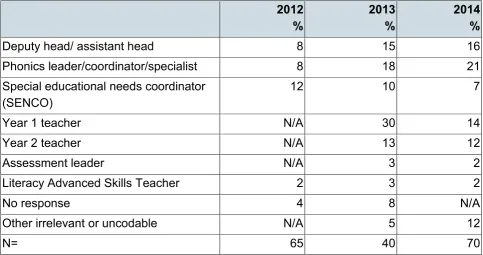
Table B2: Q1.1 – The role of teachers responding to the literacy coordinator questionnaire when ‘other role’ was indicated [filter question based on table B1]
2012
% 2013 % 2014 %
Deputy head/ assistant head 8 15 16
Phonics leader/coordinator/specialist 8 18 21
Special educational needs coordinator
(SENCO) 12 10 7
Year 1 teacher N/A 30 14
Year 2 teacher N/A 13 12
Assessment leader N/A 3 2
Literacy Advanced Skills Teacher 2 3 2
No response 4 8 N/A
Other irrelevant or uncodable N/A 5 12
N= 65 40 70
Source: NFER survey of literacy coordinators, 2012, 2013 and 2014 Due to percentages being rounded to the nearest integer, they may not sum to 100
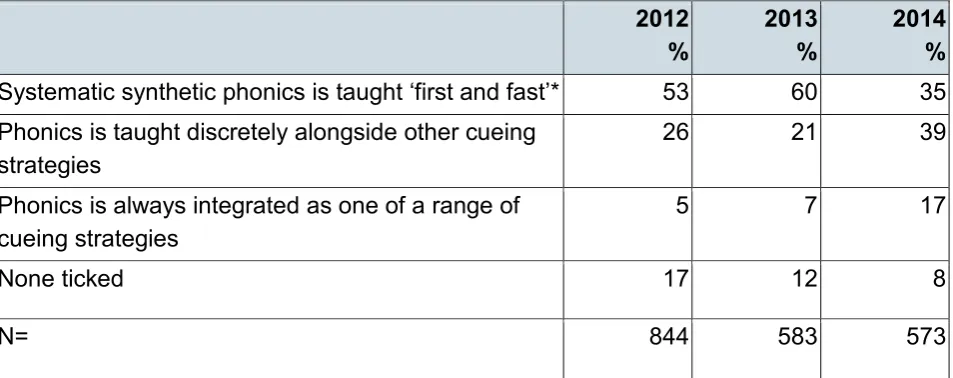
best characterised the approach to phonics within overall early literacy teaching in their school
2012
% 2013 % 2014 %
Systematic synthetic phonics is taught ‘first and fast’* 53 60 35 Phonics is taught discretely alongside other cueing
strategies 26 21 39
Phonics is always integrated as one of a range of
cueing strategies 5 7 17
None ticked 17 12 8
N= 844 583 573
[image:29.595.58.535.96.285.2]Source: NFER survey of literacy coordinators, 2012, 2013 and 2014 Due to percentages being rounded to the nearest integer, they may not sum to 100 * In 2014 the following clarification was added to the statement about systematic synthetic phonics: This envisages phonics as the only way to decode words, i.e. with no other cueing strategies, which should underpin pupils’ reading of all words. The clarification was in response to an apparent misunderstanding of the meaning of ‘first and fast’ in both 2012 and 2013.
Table B4: Q2.2 – The proportion of literacy coordinators reporting each of the 'mainstream' or 'core' published phonics programme was used to structure most or all phonics teaching in each year
group
Letters and Sounds
(%)
Jolly Phonics
(%)
Read, Write, INC
(%)
Other published programme
(%)
No mainstream or core published programme (%)
Reception 72 36 21 12 1
Year 1 73 19 21 13 2
Year 2 72 10 21 13 2
Year 3 35 2 14 12 8
Year 4 upwards 20 2 12 11 11
None ticked 24 63 74 77 88
N=573
Table B5: Q2.3 – The proportion of literacy coordinators who reported making general changes to phonics teaching this school year, in light of their experience of the phonics screening check in
2012 or 2013
2013
% 2014 %
Yes, changes to teaching in Reception 34 29
Yes, changes to teaching in Year 1 52 42
Yes, changes to teaching in Year 2 40 32
No 44 51
None ticked 1 2
N= 583 573
Source: NFER survey of literacy coordinators, 2013 and 2014 More than one answer could be given so percentages may sum to more than 100
Table B6: Q2.4 – The changes made to teaching in Reception, Year 1 and Year 2 classes in response to the 2013 check [filter question based on table B5]
Reception
(%) Year 1 (%) Year 2 (%)
Adopted a new mainstream phonics
programme 24 16 21
Started to use phonics programme more
systematically 33 28 33
Increased the time devoted to phonics
teaching 38 41 39
Increased the frequency of phonics
teaching 34 32 34
Increased the number or length of
discrete phonics sessions 54 51 49
Changed to teaching phonics 'first and
fast' 19 21 24
Increased assessment of progress in
phonics 6 3 4
Started to teach pseudo words 45 48 48
Introduced grouping / setting for phonics 39 47 45
Other 36 37 43
None ticked 10 12 11
N= 168 N= 242 N= 181
Source: NFER survey of literacy coordinators, 2014 More than one answer could be given so percentages may sum to more than 100
where ‘other changes’ were indicated [filter question based on table B6]
2014 %
Support groups/intervention groups 38
More focus on digraphs 8
Pushed the children on more 3
Changed format of phonics to be cross-key stages 3
Greater emphasis on word reading 3
Extra guidance for parents/carers 5
Now only teachers are teaching phonics 3
More individualised phonics teaching 10
Greater focus on teaching pseudo words 8
Stopped setting for phonics 3
New teaching staff 10
Changed format of teaching to be class-based rather than cross-class 3
Other relevant but vague 15
Other irrelevant or uncodable 10
N=40
Table B8: Q3.1 – The extent to which literacy coordinators agree with each of the following statements Agree (%) Agree somewhat (%) Uncertain/ mixed views (%) Disagree somewhat (%) Disagree (%) No Response (%)
2012 2014 2012 2014 2012 2014 2012 2014 2012 2014 2012 2014
I am convinced of the value of systematic synthetic phonics teaching
64 58 26 31 7 7 2 2 <1 1 2 1
Phonics should always be taught in the context of meaningful reading
66 64 24 25 6 5 2 3 1 2 2 2
Phonics has too high a priority in current education policy
11 11 22 20 15 18 28 30 22 20 2 2 A variety of different
methods should be used to teach children to decode words
66 64 24 23 5 6 2 3 2 3 1 1
Systematic phonics teaching is necessary only for some
children
6 9 18 19 19 17 28 30 28 23 2 3
The phonics screening check provides valuable information for teachers
10 8 19 20 22 23 20 21 29 28 <1 1
The phonics screening check provides valuable information for parents/carers
5 5 17 15 24 24 21 24 33 31 1 1
N=844 (2012) N=573 (2014)
effective phonics teaching
2013
% 2014 %
Very well 75 77
Quite well 21 20
Partially or mixed 4 2
No response <1 1
N= 583 573
Source: NFER survey of literacy coordinators, 2012 and 2014 Due to percentages being rounded to the nearest integer, they may not sum to 100
Table B10: Q5.1 – The teaching methods used with pupils who were disapplied from the 2012 and 2013 check
2013
% 2014 %
Systematic synthetic phonics 36 46
Not applicable/I did not disapply any pupils from the 2012/
2013 check 56 47
Other 7 7
None ticked 5 4
N= 583 573
Table B11: Q5.1 – The teaching methods used with pupils who were disapplied from the 2013 check where ‘other teaching methods’ was indicated [filter question based on table B17]
2014 %
Other cueing strategies, e.g. sight reading/ picture cues 16
Use British sign language (BSL) 3
Introduction of new phonics scheme 26
Introduced small intervention groups tailored to needs of particular children 11
1-1 support/tuition 18
Introduced sound discovery programme 3
Other irrelevant or uncodable 29
N= 38
Source: NFER survey of literacy coordinators, 2014 More than one answer could be given so percentages may sum to more than 100
Table B12: Q5.2 – The ways in which Reception, Year 1 and Year 2 teachers were reported to have used the results of the 2013 phonics screening check
Reception teachers (%)
Year 1 teachers (%)
Year 2 teachers (%)
To review/revise their phonics teaching
plans in general 39 54 49
To review/revise teaching plans for
individuals or groups 35 57 60
To inform discussions with the Special
Educational Needs Coordinator (SENCO) 26 41 46
To ask for more support/ more trained
classroom support 15 23 21
To conduct diagnostic assessments in
phonics 23 34 31
Other 4 5 4
None ticked 37 14 16
N= 573
Source: NFER survey of literacy coordinators, 2014 More than one answer could be given so percentages may sum to more than 100
of the 2013 phonics screening check where ‘other ways’ was indicated [filter question based on table B12]
2014 %
None/not used 59
Tailoring teaching to weaknesses 5
Confirmation of own results 3
Deciding new resources 2
To group pupils 6
Performance management targets linked to phonics screening check results 6
To help monitor pupil progress 3
To inform training for TAs 5
Other irrelevant or uncodable 12
N= 66
[image:35.595.63.538.105.334.2]Source: NFER survey of literacy coordinators, 2014 More than one answer could be given so percentages may sum to more than 100 Each participant was allowed to give two answers to this question. Both answers have been coded and amalgamated into the table.
Table B14: Q5.3 – The type of support given to Year 2 pupils who were in each of the categories after the 2013 check
Children who last year…
Continued with systematic phonics teaching (%) Intensive learning in small groups (%) Extra one-to-one time with teacher/ classroom support (%) Diagnostic assessmen t in phonics
(%) Additional classroom support (%) None ticked (%)
had difficulty completing
section 1 of the check 68 65 49 27 46 14
could compete section 1, but had difficulties in section 2
67 64 35 27 39 13
scored close to, but
under, the threshold 72 46 22 20 32 12
N=573
Table B15: Q5.4 – The time point at which literacy coordinators felt that pupils, who had not previously done so, reached the required standard of the check
2013
% 2014 %
Autumn term 2012 8 6
Spring term 2013 55 56
Summer term 2013 25 25
Most pupils have still not reached the
standard 7 7
No response 5 7
N= 583 573
Source: NFER survey of literacy coordinators, 2012 and 2014 Due to percentages being rounded to the nearest integer, they may not sum to 100
Table B16: Q6.1 – How literacy coordinators reported teachers in their school prepared for the phonics screening check
2013
% 2014 %
Externally provided training by local authority 24 16
Externally provided training by another provider 2 3
Individual familiarisation with the Check Administrators’
Guide 89 86
Watching the online video: Scoring the phonics screening
check training 69 62
Discussion with yourself 57 60
Year group or key stage meeting or other staff discussion 60 57
No specific preparation for this year; most teachers
already prepared N/A 24
Other 3 2
None ticked <1 1
N= 583 573
Source: NFER survey of literacy coordinators, 2013 and 2014 More than one answer could be given so percentages may sum to more than 100
phonics screening check where ‘other preparation’ was indicated [filter question based on table 62]
2013
% 2014 %
Familiarising self with last year's check 13 12
Discussed at network meeting 7 19
Meeting with parents/carers 13 8
Reorganisation of class groups in Year 2 to re-focus
support 7 0
Bought sample materials to help with familiarisation 7 4
Practiced with pupils using mock materials 7 4
Carried out own/individual research 13 0
In-school training for staff N/A 19
No response 87 0
Other relevant but vague 13 0
Other irrelevant or uncodable 33 35
N= 15 26
Table B18: Q7.1 – Following the phonics screening check, literacy coordinators’ reports of what actions will be taken to use the results within school
All pupils
%
Pupil who do not meet the threshold in Year 1 %
Pupil who do not meet the threshold in Year 2 %
Review of results by individual Year 1 teacher 67 33 14
Review of results by individual Year 2 teacher 54 26 33
Discussion amongst class teachers 71 27 26
Discussion between Year 1 and/ or Year 2 teacher(s) and Literacy Coordinator,
Headteacher or other senior leader 65 36
30
Identification of pupils experiencing difficulties
with phonics 45 49 39
Specific teaching plans for pupils experiencing
difficulties with phonics 31 52 42
Discussion between Year 1 and Year 2 teachers 58 33 18
Discussion between Year 2 and Year 3 teachers 38 10 41
No action 2 1 1
Other 1 0 0
None ticked 8 0 0
N=573
Source: NFER survey of literacy coordinators, 2014 More than one answer could be given so percentages may sum to more than 100
what type of extra support should be provided to a child?
Year 1 pupils
% Year 2 pupils %
The phonics screening check results 79 70
The results of other assessments 86 79
Teachers’ own records of progress 94 86
Discussion with the Special Educational Needs
Coordinator (SENCO) 71 68
Other 3 3
None ticked 1 0
N=573
Source: NFER survey of literacy coordinators, 2014 More than one answer could be given so percentages may sum to more than 100
Table B20: Q7.2 – The evidence literacy coordinators planned to use to help them determine if / what type of extra support should be provided to a child where ‘other evidence’ was indicated [filter
question based on table B19]
2014 %
Discussion with reading recovery teacher 11
Discussion between relevant staff members 28
General classroom observations 11
Discussions with phonics leaders/teachers in other schools 6
Other irrelevant or uncodable 44
N=18
Table B21: Q8.1 – Details of the additional information provided to the parents / carers of current Year 2 pupils who did not meet the standard this year
2013
% 2014 %
Information about the type of in-school support planned 50 59
Information about how they can support their child 59 66
No extra information in addition to the results 29 19
None ticked 8 9
N= 583 573
[image:40.595.61.542.306.722.2]Source: NFER survey of literacy coordinators, 2013 and 2014 More than one answer could be given so percentages may sum to more than 100
Table B22: Q9.1 – Literacy coordinators’ estimate of the amount of staff time (in hours) spent on planning and preparation for the check
Hours Year 1
teacher time
(%)
Year 2 teacher time
(%)
Classroom support staff time
(%)
Headteacher or other senior leader time (%)
Admin staff time
(%)
0 5 13 21 19 26
0.50 3 3 0 2 1
1 25 20 5 12 7
2 16 9 4 6 2
3 6 2 1 1 0
4 3 0 0 1 0
5 3 2 2 1 0
6 1 2 1 1 0
7 1 0 0 0 0
8 1 1 0 0 0
10 2 1 1 1 0
11 to 20 2 1 3 0 0
21 or more 3 2 2 0 0
No response 28 42 58 54 68
N= 414 334 239 261 210
administration of the check
Hours
Year 1 teacher time
(%)
Year 2 teacher time
(%)
Classroom support staff time
(%)
Headteacher or other senior leader time (%)
Admin staff time
(%)
0 3 13 29 24 30
0.50 1 2 0 1 1
1 3 10 1 5 2
1.5 0 1 1 0 0
2 6 9 29 3 0
2.5 0 1 0 0 0
3 7 9 1 1 0
4 5 4 1 1 0
5 6 0 1 1 0
6 9 3 1 2 0
7 2 1 0 1 0
8 4 1 0 1 0
9 4 0 1 0 0
10 4 2 1 1 0
11 to 20 10 2 2 4 0
21 or more 4 1 1 0 0
No response 21 38 61 56 66
N= 451 357 224 254 195
[image:41.595.62.539.91.545.2]Table B24: Q9.1 – Literacy coordinators’ estimate of the amount of staff time (in hours) spent on Paperwork
Hours
Year 1 teacher time
(%)
Year 2 teacher time
(%)
Classroom support staff time
(%)
Headteacher or other senior leader time (%)
Admin staff time
(%)
0 7 14 28 16 18
0.50 5 5 0 3 0
1 30 22 1 13 13
2 13 6 1 7 5
3 4 1 1 2 1
4 1 1 0 1 0
5 1 1 0 1 0
10 1 1 0 0 0
No response 34 48 65 56 58
N=
Source: NFER survey of literacy coordinators, 2014 Due to percentages being rounded to the nearest integer, they may not sum to 100
training
Hours
Year 1 teacher time
(%)
Year 2 teacher time
(%)
Classroom support staff time
(%)
Headteacher or other senior leader time (%)
Admin staff time
(%)
0 20 22 27 25 31
0.50 2 2 0 0 0
1 16 12 2 6 1
2 8 5 3 4 0
3 5 3 2 1 0
4 2 1 0 1 0
5 2 1 0 0 0
6 1 1 0 0 0
10 0 0 1 0 0
No response 41 52 64 62 67
N=
Table B26: Q9.1 – Literacy coordinators’ estimate of the amount of staff time (in hours) spent on reviewing the results of the check
Hours
Year 1 teacher time
(%)
Year 2 teacher time
(%)
Classroom support staff time
(%)
Headteacher or other senior leader time (%)
Admin staff time
(%)
0 4 9 26 10 26
0.50 7 7 1 4 2
1 35 27 6 18 5
1.5 1 0 0 0 0
2 14 8 1 12 2
3 4 2 0 2 1
4 1 1 0 2 0
5 1 1 0 1 0
No response 31 45 65 49 65
N=
Source: NFER survey of literacy coordinators, 2014 Due to percentages being rounded to the nearest integer, they may not sum to 100
Table B27: Q9.1 – Literacy coordinators’ estimate of the amount of staff time (in hours) spent on ‘other’ activities surrounding the check
Hours
Year 1 teacher time
(%)
Year 2 teacher time
(%)
Classroom support staff time
(%)
Headteacher or other senior leader time (%)
Admin staff time
(%)
0 8 8 8 8 8
0.50 0 0 0 0 1
1 0 0 0 1 2
2 0 0 0 1 1
No response 90 90 90 90 88
N=
Table B28: Q9.1 – Details of the mean time (in hours) spent by each member of staff in relation to planning and preparation for the check, as reported by literacy coordinators
Amount of Year 1 Teacher time Amount of Year 2 Teacher time Amount of classroom support staff time Amount of headteacher or other senior leader time Amount of admin staff time
Mean 5 4 8 2 0
Std. Error of Mean 1 0 2 0 0
Std. Deviation 11 9 37 5 1
N=573
Note: all respondents in this table gave a response to at least one amount of additional time: missing data has been assumed to imply no additional time. Those respondents with missing responses for all parts of the question have been excluded from this analysis. Source: NFER survey of literacy coordinators, 2014
Table B29: Q9.1 – Details of the mean time (in hours) spent by each member of staff in relation to the administration of the check, as reported by literacy coordinators
Amount of Year 1 Teacher time Amount of Year 2 Teacher time Amount of classroom support staff time Amount of headteacher or other senior leader time Amount of admin staff time
Mean 8 3 3 3 0
Std. Error of Mean 0 0 0 0 0
Std. Deviation 8 5 7 4 1
N=573
Note: all respondents in this table gave a response to at least one amount of additional time: missing data has been assumed to imply no additional time. Those respondents with missing responses for all parts of the question have been excluded from this analysis. Source: NFER survey of literacy coordinators, 2014
[image:46.595.58.539.421.630.2]paperwork, as reported by literacy coordinators Amount of Year 1 Teacher time Amount of Year 2 Teacher time Amount of classroom support staff time Amount of headteacher or other senior leader time Amount of admin staff time
Mean 2 2 1 1 1
Std. Error of Mean 0 0 1 0 0
Std. Deviation 6 6 7 3 1
N=573
[image:47.595.60.539.88.284.2]Note: all respondents in this table gave a response to at least one amount of additional time: missing data has been assumed to imply no additional time. Those respondents with missing responses for all parts of the question have been excluded from this analysis. Source: NFER survey of literacy coordinators, 2014
Table B31: Q9.1 – Details of the mean time (in hours) spent by each member of staff in relation to training for the check, as reported by literacy coordinators
Amount of Year 1 Teacher time Amount of Year 2 Teacher time Amount of classroom support staff time Amount of headteacher or other senior leader time Amount of admin staff time
Mean 2 1 1 1 0
Std. Error of Mean 0 0 0 0 0
Std. Deviation 3 2 2 4 1
N=573
[image:47.595.58.539.397.592.2]Table B32: Q9.1 – Details of the mean time (in hours) spent by each member of staff in relation to reviewing the results of the check, as reported by literacy coordinators
Amount of Year 1 Teacher time Amount of Year 2 Teacher time Amount of classroom support staff time Amount of headteacher or other senior leader time Amount of admin staff time
Mean 2 1 0 1 0
Std. Error of Mean 0 0 0 0 0
Std. Deviation 2 1 1 1 1
N=573
[image:48.595.60.539.88.284.2]Note: all respondents in this table gave a response to at least one amount of additional time: missing data has been assumed to imply no additional time. Those respondents with missing responses for all parts of the question have been excluded from this analysis. Source: NFER survey of literacy coordinators, 2014
Table B33: Q9.1 – Details of the mean time (in hours) spent by each member of staff in relation to ‘other’ activities surrounding the check, as reported by literacy coordinators
Amount of Year 1 Teacher time Amount of Year 2 Teacher time Amount of classroom support staff time Amount of headteacher or other senior leader time Amount of admin staff time
Mean 3 0 3 0 0
Std. Error of Mean 1 0 2 0 0
Std. Deviation 7 1 13 1 1
N=573