Towards a Holistic Framework for Ethical Mobile Learning Laurel E. DYSON, University of Technology, Sydney, Australia,
Laurel E. DYSON is a Senior Lecturer in Information Technology at the University of Technology, Sydney, Australia, and President of anzMLearn, the Australian and New Zealand Mobile Learning Group. Dr. Dyson’s interests include mobile learning and mobile technology use in Indigenous communities.
Trish ANDREWS, University of Queensland, Australia, [email protected] Trish ANDREWS is a Senior Lecturer in Higher Education at the University of Queensland and a member of the anzMLearn executive. Dr Andrews’s interests include mobile learning for distance learners and the adoption of mobile learning.
Robyn SMYTH, University of Southern Queensland, Australia, [email protected]
Ruth WALLACE, Charles Darwin University, Australia, [email protected]
Ruth WALLACE is Director of the Northern Institute, Charles Darwin University’s research institute for social and public policy, education and the humanities. Associate Professor Wallace’s particular interest is in research that improves outcomes for stakeholders in regional and remote Australia.
Abstract:
As more universities, colleges and schools adopt mobile learning, concerns have been voiced regarding the emergence of unethical behaviour. This paper examines a range of ethical issues and analyses the reasons for them. A framework for an ethical approach to mobile learning is put forward in which harm minimization is balanced with both the need to prepare students for living in a mobile world and the benefits of an approach to learning which has advantages for students from diverse backgrounds. A case is made for the adoption of an ethic of responsibility by educators, administrators and students.
KEYWORDS: Acceptable Use Policies, AUPs, Cell Phone Etiquette, Cheating, Code of Ethics, Cyberbullying, Data Security, Enhanced Learner Agency, Ethical Behavior, Ethical Guidelines, Ethical Issues, Ethical Framework, Harm
Towards a Holistic Framework for Ethical Mobile Learning New technologies can be positive forces for stimulating change as well as bringing with them new ethical challenges, and mobile technology is no
exception. Ling and Donner (2009) note that the explosion of mobile devices in recent years has created a clash with accepted standards of behavior. One of the problems is the lag between the rapid development of the technology and the more gradual evolution of rules governing its use (Castells, Fernández-Ardèvol, Qiu & Sey, 2007).
sensational ways (Hartnell-Young, 2008). Indeed, some of their fears may be well founded, given that mobile technologies lend themselves to learning across multiple contexts, including outdoors and in the workplace: control over social interaction or content acquisition in these conditions becomes greatly diminished compared to the more carefully supervised environment of the classroom and may lead to potentially inappropriate activities or data capture.
To dismiss such ethical concerns out of hand would be foolish, but it would be equally wrong to let these fears deter educators from adopting a form of learning which has enormous potential for both those students well served by the current education system as well as for addressing the needs of disenfranchised groups of learners. A growing body of studies shows that m-learning has the power to support students from developing countries, indigenous learners, and people from socio-economically disadvantaged backgrounds (Kim, 2009; Ragus et al., 2005; Wallace, 2009). Furthermore, the use of m-learning presents
opportunities to engage with a range of knowledge sets, constructs and contexts beyond those found in many formal educational settings. This might include multimedia-based representations of diverse lives and beliefs systems, or representations of knowledge as constructed by different social and cultural orientations, which can be potentially beneficial for learning. Thus any consideration of the ethics of m-learning must acknowledge the need for a
It must address the problems, but not limit the diffusion of this unique approach to learning.
ETHICAL ISSUES WITH M-LEARNING
In a study of educators’ attitudes to m-learning, Aubusson, Schuck and Burden (2009) recorded five ethical concerns about introducing m-learning into the classroom:
cyberbullying;
the potential for public dissemination of information originally intended
for a limited audience;
the ease and speed with which digital materials can be shared compared to
older non-digital artefacts;
the risk of unethical use of archived materials; and
levels of parental and student consent to recording classroom activity.
Because m-learning lends itself readily to learning outside the classroom, many new ethical situations are likely to arise enabled by the capabilities of the mobile devices. These are exacerbated by the lack of control over student
behavior that occurs if the teacher is absent, for example, where students conduct unsupervised m-learning projects by themselves in the field or workplace.
learning results in information which is often personal and private to the learners. This gives rise to considerations of informed consent and potential misuse of stored data by third parties. The area of clinical and practice-based education, in particular, raises many issues in relation to the ethical use of mobile learning which, while offering great benefits, including opportunities for reflective practice and just-in-time learning (Andrews, Davidson, Hill, Sloane, & Woodhouse, 2011), also creates considerable challenges in preserving individual privacy and ensuring any material is appropriately managed from a learning perspective.
There are particular concerns about how images are used, the ease of their
capture and uploading to an online store and their usefulness in supporting
learning and revision visually has meant that learner captured multimedia is
part and parcel of nearly all the scenarios envisioned (Wishart & Green, 2010,
p. 27).
Aubusson et al. (2009, p. 243) highlight the much smaller size of mobile devices compared to traditional cameras and video cameras. This makes them “infinitely more portable and unobtrusive” allowing students to make surreptitious
recordings much more easily than was possible with the older technology.
Ethical issues in relation to m-learning are not only associated with student behavior but can arise through the actions and beliefs of other stakeholders. ICT (Information and Communications Technology) departments can take very
conservative views in relation to the use of mobile technologies and, in attempting to ensure security of data and information, can severely restrict educational
groups, who may gain considerable advantages from m-learning not necessarily available to them through more traditional teaching and learning approaches (Dyson & Litchfield, 2011)
Furthermore, cultural differences can play a role as different cultural groups have quite different understandings of what constitutes ethics (Traxler, 2012). Consequently the use of mobile learning for a whole range of teaching and learning activities in developing countries can easily and inadvertently contravene locally accepted norms (Traxler, 2012). Equally, cultural differences can be an issue with visiting academics who might take and publish photos of students engaged in m-learning and so inadvertently contravene the students’ privacy norms. Indigenous students, too, will be bound by protocols of ownership of intellectual property which might restrict the ways in which traditional knowledge can be captured using mobile devices or promulgated beyond their community using the Internet or Bluetooth.
ETHICAL ISSUES WITH MOBILE DEVICES IN THE EDUCATIONAL SETTING
Equipping students with mobile technology or encouraging them to use their own devices to undertake m-learning activities obviously opens the way to various ethical abuses in educational settings across different contexts and educational levels. Moreover, there is a marked disparity between students’ expectations arising from their use of mobile technologies in their private lives and academic expectations based on the traditional teacher-centered paradigm of the educational institution.
The smallness and portability of mobile devices, means that theft and loss can be quite common, compromising security of data and information. (Wishart, 2009) Along with this, as Wishart (2009, p. 78) points out, technical systems relating to m-learning can be complex and “leaky” making it difficult to ensure privacy and confidentiality.
distracted both groups, particularly older people. Looking at why mobile phone’s ringing in the classroom are so frowned upon, when their use in other public spaces might well be tolerated, Campbell (2006) suggested that classroom behaviors are very strongly governed by accepted social norms: the classroom represents a public forum with an important focus on learning. In addition, he notes the lack of competing background noises, which make a ringtone in class much more distracting than it might be on a bus or in a restaurant.
Ling and Donner (2009) explored cyberbullying and explained the ways bullies can hide behind the anonymity of mobile phones and send offensive messages without the supervision normally provided by teachers or parents when students are using computers. Cyberbullies can reach their victims at any time and in any place.
received the false answers via SMS from friends who were not sitting the exam at the time. Some authors have gone so far as to claim an “epidemic of cheating”, facilitated by computer, online and mobile technologies (Heyman et al., 2005). Ling (2000) suggests that such practice puts into question the whole concept of the educational institution as a place of control. Students engaged in cheating using mobile devices are subverting their teachers’ role as judges of whether students have attained sufficient knowledge against some abstract standard determined by the teacher or other figure of authority (criterion-based assessment), or have succeeded in comparison with their peers (norm
referencing). While cheating is not new, mobile devices are viewed as acerbating the problem. Avoiding cheating in assessment practices, in particular, has long been a challenge, and the use of mobile devices is facilitating new opportunities for students in this regard and thus creating new challenges for educators to productively control this issue. However, it should be noted that technology is equally providing the means to deter students as there are now wireless devices which enable invigilators to detect when unauthorized devices are in use.
WHY ETHICAL ISSUES ARISE IN M-LEARNING
without their permission – or the taking of embarrassing pictures, or violations of intellectual property, even without students being aware that they are doing so – followed by the rapid sharing of this material via the Internet, Bluetooth or video calls can create enormous ethical challenges at all levels of education. It is to a large extent the convergence of multimedia functionality combined with the “always on” nature of students’ smart phones, laptops or tablet PCs which have created the technical means to transgress acceptable standards of behavior. In addition, the high levels of ownership of smart phones amongst young people, their portability and pocket size, and the lack of security of wireless transmission are all important contributory aspects.
Building on the earlier work of Johnson (1997) on Internet ethics, one can propose the notion that mobile technology has certain unique characteristics which contribute to ethical issues which are “new species of generic moral problems” (Johnson, 1997, p. 61). For example, infringements of privacy are not novel but m-learning in the field and workplace allows threats to privacy of a different nature and on a scale different from that seen before when students were equipped solely with a clipboard and pen and paper. Speaking of mobile
technology generally, Castells et al. (2007) note that technology does not
From a human perspective, ethics can be a “slippery” concept and for many students the notion of what is ethical in relation to the use of mobile devices in teaching and learning environments can be ill-understood (Farrow, 2011). Consequently, as Farrow (2011, p.3) points out, “it’s natural to lapse into … a kind of lazy ethical relativism (‘follow your own path’)”. The general lack of training for students in how to ethically manage the use of their devices during their education allows the problem to continue.
Educators and institutions, too, when faced with ethical issues relating to the use of mobile devices, can take the path of least resistance and opt to ban or severely limit their use, as pointed out previously, rather than find a way to productively integrate them into teaching and learning practices. Further to this, Farrow (2011) suggests that making ethical judgments in relation to mobile learning is complicated by both the diversity of the devices available and the contexts on which their mobility enables use. While there are numerous
PROFESSIONAL ETHICAL DEVELOPMENT
The need to research how systemic, attitudinal and ethical issues may inhibit use of mobile technologies by teachers was raised by Aubusson et al. (2009) when they discussed the potential for mobile learning as a tool for teachers’ professional learning. In their view, mobile technologies are ideally suited to reflection-in-action and capturing learning moments particularly where this is part of collaborative practice enabling “sharing, analysis and synthesis of classroom experiences by teachers and students” (2009, p. 233). Such sentiments align also with the movement towards using e-portfolios as more authentic means of providing evidence of learning (Abrami, et al., 2008; Pink, Cadbury, &
Stanton, 2008; Sargent, Holland, & Frith, 2008; Savin-Baden, 2007). Thus, the impetus for professional development comes from both technological and pedagogical innovation. The speed with which these
the online world, while maintaining professional standards” (AMA, NZMA, NZMSA, & AMSA, 2011, p. 2).
Additionally, there is a need for professional development programs to raise awareness of the benefits of mobile learning, which can minimize or eliminate the fear that can be associated with m-learning. Some studies demonstrate the potential for positive changes in teachers’ attitudes once they have had success with m-learning. Actual experience overcomes the negative reports in the media of mobile phones as disruptive technologies (Hartnell-Young, 2008). Dyson, Litchfield, Raban and Tyler (2009) quote an academic who stopped worrying about students being distracted through wireless access once he
discovered he could use a web-based classroom response system operating from students’ mobile devices to improve his students’ learning:
Wireless access in lectures is a controversial issue. Up to this point I have been
concerned if access was available students would spend the lectures surfing the
net (and I know some do this already). Now of course I would like to open it up
(Dyson et al., 2009).
A FRAMEWORK FOR AN ETHICAL APPROACH TO M-LEARNING
Much of the literature presented above focuses on harm minimization. It sees the potential dangers of implementing m-learning – or the dangers of
– and seeks to prevent the harm to students that might occur. Most AUPs also have this focus, protecting students from unethical uses of mobile devices or discouraging students’ own unethical behavior with the technology.
However, for professionals working in the education arena this is a simplistic approach and overlooks larger concerns. There are moral obligations additional to student protection at issue in the adoption of mobile learning. One example for teachers, the “Code of Ethics for Educators” of the Association of American Educators (n.d.), notes the need “to create a learning environment that nurtures to fulfillment the potential of all students.” For ICT professionals employed in educational institutions there is similarly a higher level of ethical responsibility (Gotterbarn, 2001, p, 229):
The concern to maximize the positive effects for those affected by computing
artifacts goes beyond mere “duty care”, mere avoidance of direct harm. …It
incorporates moral responsibility and the ethically commendable.
services in relation to their own usage patterns, both activities which can be enabled as part of an m-learning strategy (see examples in Pachler, Bachmair, & Cook, 2010, p. 150). They thus overlook the role of m-learning in a mobile world, where mobile activities of all kinds are becoming increasingly commonplace.
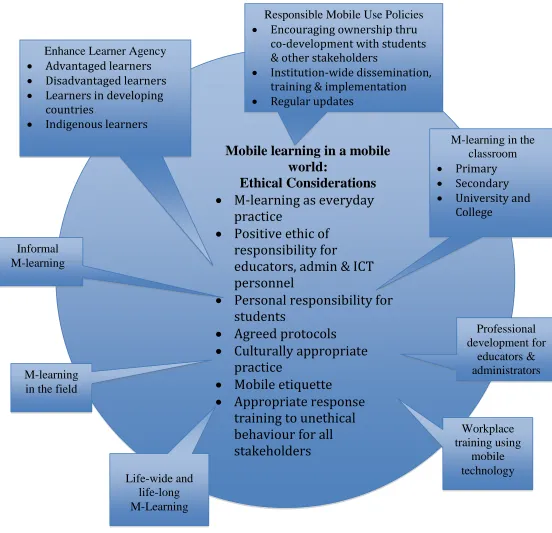
Thus any ethical framework must include a positive ethic of responsibility on the part of the teachers, administrators and ICT personnel in our institutions who make decisions over the availability of mobile technology and mobile learning. It must address the problems but not limit the implementation of this unique learning approach. It must recognize that our students now live in a mobile world and their working lives will be part of that world: no better place to start equipping them to deal with the mobile technology challenges that they will encounter through life than to acknowledge that our educational institutions belong to that world too. An overview of the framework is summarized in Figure 1.
[INSERT FIGURE 1 HERE]
Formulating a Responsible Mobile Use Policy
and further emphasizes the essential role of both an ethic of positive responsibility on the part of educators, administrators and ICT personnel, and the desirability of fostering an ethic of personal responsibility on the part of students.
There are many AUPs and advice available online which provide some guidance on developing a policy suitable for mobile technology use. It should be noted, however, that many existing AUPs are unnecessarily restrictive, with little or only passing recognition of the value of m-learning. Some of the more
comprehensive documents include:
The Australian Mobile Telecommunications Association (AMTA, n.d.)
offers a template for developing an AUP for school use focusing on mobile technology, which could be adapted to other levels of education. It proposes the AUP should have sections on purpose, rationale,
responsibility, acceptable uses, unacceptable uses, theft or damage,
inappropriate conduct, and sanctions, as well as giving a parent permission form.
The Consortium of School Networking (CoSN, 2011) has published a
Becta (2009) has compiled a comprehensive guide to developing an AUP
for Internet use in UK schools, which provides guidelines which could be adapted to developing an AUP for mobile technology use. Most useful is a detailed list of what should be included in the AUP, the style in which it should be written and who should be involved in developing it. They also include notes on different levels of education and how ethical breaches should be dealt with.
Some of the more important principles for devising a Responsible Mobile Use Policy are set out here:
1. Enhanced Learner Agency: the policy should recognize the key role that mobile technology can play in supporting all learners, whatever their background, and whether they are enrolled in the formal education system, engaged in workplace training, or as they continue learning through their lives. Furthermore, it should acknowledge the value of m-learning in supporting greater agency on the part of learners in participating actively in meaning-making rather than being passive consumers of information (Pachler et al., 2010).
students. For example, it should involve strategies for students to assist others who are victims of unethical practices such as cyberbullying. 3. Involvement of All Stakeholders: those who will be effected by the
policy as well as those who will enforce it should be involved in creating the RMUP (students, teachers, administrators, ICT personnel and, if appropriate, parents), including the devising of sanctions. This will encourage ownership at all levels.
4. Focus on Ethical Behavior: in moving towards a more ethical approach to m-learning, Hartnell-Young and Heym (2008) note that we need to shift our focus away from the mobile device, away from the technology, and instead focus on the matter of real concern which is how it is being used in learning. So, instead of banning devices, the policy should introduce steps to limit bad behavior and to equip students with effective tactics to deal with the inappropriate behavior of others.
Aspects of phone etiquette should be included, such as avoiding making calls and texting in the classroom unless it is related to the learning activity, and using soundless features in school grounds such as sending text messages rather than making calls, setting the vibrate function as default and letting calls go to voicemail.
good list of appropriate behaviors covering a number of situations, for example, protecting against theft; not responding to unwanted messages; the importance of seeking adult help; and noting the times, dates, caller I.D. and contents of abusive messages to facilitate tracing.
Strategies for the Successful Implementation of a Responsible Mobile Use Policy
In order to implement a policy successfully, various strategies are suggested in the literature:
1. Education of Stakeholders: all the key stakeholders need to be aware of and understand the policy (Luscre quoted in Nagel, 2011). In particular,
Teachers are often unaware of policies governing technology use and
need to be given a copy of the RMUP and be allowed to discuss how it is being applied as part of their orientation when they begin teaching at an institution. In addition, professional development should focus on their acquisition of an attitude of professional responsibility with relation to m-learning, a recognition of the enhanced learner agency that m-learning can bring, and the building of competencies in
Students need to be made aware of the contents of the RMUP as part
of their induction into classroom rules at the beginning of the school year or, in higher education, at the start of their university studies. Aubusson et al. (2009) note that it is the responsibility of any teacher who implements m-learning into the classroom to educate students about the ethical behaviors expected of them. Luscre (quoted in Nagel, 2011) suggests translating the policy into sets of rules posted around the institution and written in a simple and concise manner. This provides visibility, allows for flexibility in that the rules can be updated easily, and puts them in a language the students can understand, rather than the more formal language of the policy.
One can go further and state that teachers should introduce their students to strategies for responding appropriately to irresponsible behavior, should they become victims themselves. Students also need to be introduced to the benefits of m-learning that can be realized if they take personal responsibility for their use of mobile devices.
If school children are involved, parents need to read the policy and
suggests holding joint classes for parents and students to get parents involved in the policy formulation process while providing some valuable experiences for them. These classes could include
understanding the affordances of mobile devices or editing multimedia content taken using a mobile device.
2. Regular Updating of the RMUP: given the rapid evolution of mobile technologies, the policy will need updating. Luscre (quoted in Nagel, 2011) notes that this provides a good opportunity to renew commitment from the various stakeholders by getting them involved in the updates.
CONCLUSIONS
This chapter has highlighted the need to develop a systematic approach to addressing the ethical use of mobile technologies to support learning for a range of learners and learning contexts. Apart from the disruptive potential of mobile device misuse in the educational setting, perhaps the greatest ethical issue is fear of the technology. Fear has resulted in the underutilization of an approach to learning which has great potential both for students currently well-served by educational institutions and for people from backgrounds whose formal education has historically been neglected.
m-learning into teaching and learning practices as a norm in which established protocols and behaviors are understood and adhered to. This is seen as vastly preferential to the banning of such devices as proposed by Huss (2009) and practised by some institutions. The framework is based on an ethic of responsible mobile technology use that can contribute to informed decision making by all stakeholders and promote a feeling that educators are able to manage the learning environment in a way that fits with their professional beliefs. This offers an approach which minimizes ethical issues around mobile learning while maximizing the potential educational benefits. As such it takes a wider responsibility for education across society which is generally lacking in the existing m-learning ethics literature.
REFERENCES
Abrami, P. C., Wade, C. A., Pillay, V., Aslan, O., Bures, E. M., & Bentley, C. (2008). Encouraging self-regulated learning through electronic portfolios. Canadian Journal of Learning and Technology /La revue canadienne de
l’apprentissage et de la technologie, 34(3), n.p.
practitioners and medical students. Australian Medical Association.
Retrieved January 31, 2012, from http://ama.com.au/socialmedia
Andrews, T., Davidson, B., Hill, A, Sloane, D., & Woodhouse, L. (2011). Using students’ own mobile technologies to support clinical competency
development in speech pathology. In A. Kitchenham (Ed.), Models for interdisciplinary mobile learning: Delivering information to students. (pp.
247-264). Hershy, PA.: Information Science Reference.
Association of American Educators (n.d.). AAE code of ethics for educators. Mission Viejo, CA. Retrieved January 19, 2012, from
http://aaeteachers.org/index.php/about-us/aae-code-of-ethics
Aubusson, P., Schuck, S., & Burden, K. (2009). Mobile learning for teacher professional learning: Benefits, obstacles and issues. ALT-J Research in Learning and Teaching, 17(3), 233-247.
Australian Mobile Telecommunications Association (AMTA) (n.d.). Developing an Acceptable Use Policy for mobile phones in your school. Manuka,
Australia: AMTA. Retrieved January 25, 2012 from
www.amta.org.au/pages/Template.for.Mobile.use.in.Schools Becta (2009). AUPs in context: Establishing safe and responsible online
behaviours. Coventry, UK: Becta. Retrieved January 25, 2012:
Burns, S.M., & Lohenry, K. (2010). Cellular phone use in class: Implications for teaching and learning a pilot study. College Student Journal, 44(3).
Castells, M. Fernández-Ardèvol, M. Qiu, J.L., & Sey, A. (2007). Mobile communication and society: A global perspective. Cambridge, MA: MIT
Press.
Campbell, S.W. (2006). Perceptions of mobile phones in college classrooms: Ringing, cheating, and classroom policies. Communication Education, 55(3), 280-94.
CoSN (Consortium of School Networking) (2011). Acceptable use policies in a Web 2.0 & mobile era: A guide for school districts. Washington, USA:
CoSN.
Dyson & Litchfield (2011). Advancing collaboration between m-learning researchers and practitioners through an online portal and Web 2.0
technologies. International Journal of Mobile and Blended Learning 3(1), 64-72.
Dyson, L. E., Litchfield, A., Raban, R., & Tyler, J. (2009). Interactive classroom mLearning and the experiential transactions between students and lecturer. Same places, different spaces. In Proc. Ascilite, Auckland 2009, pp. 233-242.
Farrow, R. (2011). Mobile learning: A meta-ethical taxonomy. In Proc. IADIS International Conference on Mobile Learning 2011, March, 10-12, Avila,
Spain.
Gayeski, D. (2002). Learning unplugged: Using mobile technologies for organizational training and performance improvement. New York:
AMACOM.
Gotterbarn, D. (2001). Informatics and professional responsibility. Science and Engineering Ethics, 7(2), 221-230.
Hartnell-Young, E. (2008). Mobile phones for learning in mainstream schooling: Resistance and change. In Proc. mLearn 2008, Ironbridge, UK, October. Hartnell-Young, E., & Heym, N. (2008). How mobile phones help learning in
secondary schools. Report to Becta. Coventry, UK: Becta.
Heyman, J.D., Swertlow, F., Ballard, M., Barnes, S., Duffy, T., Gray, L., et al. (2005). psssst… What’s the answer? People, 63(3).
Huss, J. (2009). The potential dangers of electromagnetic fields and their effect on the environment. Parliamentary Assembly, Council of Europe, Committee on
the Environment, Agriculture and Local and Regional Affairs. Retrieved January 31, 2012, from
Johnson, D.G. (1997). Ethics online: Shaping social behaviour online takes more than new laws and modified edicts. Communications of the ACM, 40(1), 60-65.
Kim, P.H. (2009). Action research approach on mobile learning design for the underserved. Educational Technology Research Development, 57, 415-435. Lonsdale, P., Baber, C., Sharples, M., & Arvanitis, T.N. (2003). A context
awareness architecture for facilitating mobile learning. In Proc. mLearn, 1-7. Ling, R. (2000). The impact of the mobile telephone on four established social
institutions. In Proc. ISSEI2000 Conference of the International Society for the Study of European Ideas, 1-23.
Ling, R., & Donner, J. (2009). Mobile communication. Cambridge: Polity Press. Nagel, D. (June 1, 2011). A better approach to AUPs for mobile devices: 5
questions with Anthony Luscre. THE Journal, Nov.-Dec.
Pachler, N., Bachmair, B., & Cook, J. (2011). Mobile learning: Structures, agency, practices. New York: Springer.
Pink, J., Cadbury, N., & Stanton, N. (2008). Enhancing student reflection: The development of an e-portfolio. Medical Education, 42(11), 1132-1133. Ragus, M., Meredith, S., Dacey, D., Richter, C., Paterson, A., & Hayes, A.
(2005). The Australian mobile learning network: Australian innovations. Proceedings of mLearn 2005, 1-21. Retrieved January 31, 2012, from
Sargent, V., Holland, T., & Frith, G. (2008). Using mobile technologies to create ePortfolios and personalised learning environments for 16 health and
social care professions. Paper presented at the conference on ePortfolios,
identity and personalised learning in healthcare education.
Savin-Baden, M. (2007). A practical guide to problem-based learning online. London & New York: Routledge.
Traxler, J. (2012). The ethics of mobile learning: Troubling and complex. Retrieved January 31, 2012 from http://mobileactive.org/ethics-mobile-learning
Traxler, J. (2009). Learning in a mobile age. International Journal of Mobile and Blended Learning, 1(1), 1-12.
Traxler, J., & Bridges, N. (2004). Mobile learning – the ethical and legal challenges. In Proc. mLearn 2004, June, Bracciano, Italy, 203-2007. Wallace, R. (2009). Empowered learner identity through m-learning:
Representations of disenfranchised students’ perspectives. In Proc. mLearn, 13-17.
Wishart, J. (2009). Ethical considerations in implementing mobile learning in the workplace. International Journal of Mobile and Blended Learning, 1(2), 76-92.
Mobile learning in a mobile
world:
Ethical Considerations
M-learning as everyday
practice
Positive ethic of
responsibility for
educators, admin & ICT
personnel
Personal responsibility for
students
Agreed protocols
Culturally appropriate
practice
Mobile etiquette
Appropriate response
training to unethical
behaviour for all
stakeholders
Life-wide and life-long M-Learning Enhance Learner Agency
Advantaged learners
Disadvantaged learners
Learners in developing
countries
Indigenous learners
Workplace training using
mobile technology Responsible Mobile Use Policies
Encouraging ownership thru
co-development with students & other stakeholders
Institution-wide dissemination,
training & implementation
Regular updates
M-learning in the field Informal M-learning Professional development for educators & administrators M-learning in the
classroom
Primary
Secondary
University and
[image:33.612.38.590.78.611.2]College