ResearchOnline@JCU
This is the author-created version of the following work:
Van Reenen, D.D., Huizenga, J.M., Smit, C.A., and Roering, C. (2014)
Fluid-rock interaction during high-grade metamorphism: instructive examples from the
Southern Marginal Zone of the Limpopo Complex, South Africa.
Precambrian
Research, 253 pp. 63-80.
Access to this file is available from:
https://researchonline.jcu.edu.au/34519/
Please refer to the original source for the final version of this work:
1
Fluid-rock interaction during high-grade metamorphism: instructive examples
1from the Southern Marginal Zone of the Limpopo Complex, South Africa
23
D.D. Van Reenena, J.M. Huizengab,c,*, C.A. Smita, C. Roeringa
4
5
aDepartment of Geology, University of Johannesburg, Auckland Park, Johannesburg 2006, South Africa
6
bEconomic Geology Research Centre (EGRU), College of Science, Technology and Engineering, James Cook
7
University, Townsville, Queensland, 4811, Australia 8
c Unit for Environmental Sciences and Management, North-West University, Potchefstroom, 2531, South Africa
9
* Corresponding author. Tel. +61747814597. E-mail address: jan.huizenga@jcu .edu.au (J.M. Huizenga)
10 11
Keywords: brines; CO2-rich fluid; granulite; metasomatism; retrograde hydration; Southern
12
Marginal Zone of the Limpopo Complex
13
14
ABSTRACT
15
The Southern Marginal Zone of the Limpopo Complex documents strong evidence that CO2
-16
rich ( 2
fluid CO
X = 0.7-0.9,
2
fluid H O
X = 0.1-0.3) and brine fluids of greatly reduced water activity
17
interacted with cooling metapelitic granulite during the thrust-controlled emplacement at
18
2.69-2.62 Ga onto the granite-greenstone terrain of the northern Kaapvaal Craton. Interaction
19
of cooling metapelitic granulite with CO2-rich fluids at T< 600-630°C and P< ~6 kbar is
20
recognized by the presence of a regional retrograde Opx-out/Ath-in isograd and an associated
21
zone of retrograde hydrated granulites that occupies ~4500 km2 of retrogressed crust located
22
in the hanging wall section of the shallow north-dipping Hout River Shear Zone that bounds
23
the Southern Marginal Zone in the south. On the other hand, brine fluids are considered to
24
have triggered the main pulse of anatexis that resulted in production of large volumes of
2 granodioritic-trondhjemitic melts that intruded and started to interact with metapelitic
26
granulite in the deep crust at T> ~900°C, P > ~7.5 kbar. Interaction of hot melt with
27
metapelitic granulite continued until final emplacement in the middle crust (P = ~6 kbar, T =
28
~630°C). Brine fluids also initiated shear zone-hosted metasomatism of quartzo-feldspathic
29
gneisses at T between ∼600 and ∼900°C. and amphibolite-facies lode-gold mineralization.
30
Available data implicate devolatilization of underthrusted greenstone material as the dominant
31
deep crustal source for infiltrating CO2-rich and brine fluids.
32
33
1. Introduction
34
35
Interaction of granulite-facies rocks with externally derived fluids remains a contentious
36
issue among metamorphic petrologists (e.g., Rigby and Droop, 2011; Touret and Huizenga,
37
2011, 2012; Yardley, 2013). This is true because most researchers agree that, in most cases,
38
rocks undergoing high-grade metamorphism have a very low permeability and contain only
39
small amounts of metamorphic fluids at near-lithostatic pressures during peak metamorphism
40
(Yardley and Valley, 1997; Yardley, 2009, 2012). When the metamorphic rocks cool, they
41
hardly back react with fluids to form a lower temperature mineral assemblage (retrogression)
42
because fluids produced during prograde metamorphism escape and thus are no longer
43
available.
44
However, in situ geophysical and geochemical studies carried out in active (modern)
45
regional metamorphic terrains have shown that metamorphic fluids are an integral part of the
46
tectonic system (e.g., Koons and Craw, 1991; Wickham et al., 1993; Wannamaker et al.,
47
1997; Koons et al., 1998). Early studies done in the Himalaya, for instance, established the
48
importance of aqueous fluids being driven out during metamorphism of sediments under the
49
Main Central Thrust when overridden by the hot hanging wall of the Tibetan slab (Le Fort et
3 al., 1987). These fluids triggered anatexis in the hanging wall, which resulted in the
51
generation of leucocratic granite, which intruded into the upper levels of the Tibetan slab (Le
52
Fort et al., 1987).
53
Different workers have also provided mineralogical and isotopic evidence for the
54
existence of high time integrated fluid fluxes and fluid flow directions in many thermal
55
aureoles and regional metamorphic belts (Rubenach, 2013). For example, Markl and Bucher
56
(1998) and Gleeson et al. (2003) have documented evidence for amphibolitization of lower
57
crustal granulites through brine influx, while others (Van Reenen, 1986; Ferry and Dipple,
58
1991; Ferry, 1994; Hoernes et al., 1995; Putnis and Austrheim, 2010) described evidence for
59
infiltration-driven regional metamorphism.
60
The reasons why researchers often doubt whether infiltration metasomatism is
61
widespread during regional metamorphism appears to arise from concerns about the
62
availability and source of fluids (e.g., Yardley, 2013). However, recent experimental data
63
(e.g., Newton and Manning, 2010; Aranovich et al., 2013, under review; Safonov et al., under
64
review) clearly show that, regardless of their origin, deep crustal fluids and specifically
65
brines, must be important agents of metasomatism and mass transfer wherever such processes
66
are recognized in the field or hand specimen (e.g., Harlov, 2012).
67
Wet versus dry middle to deep crust furthermore implicates the issue of fluid-absent
68
(dehydration melting) versus fluid-assisted mechanisms of crustal anatexis. Proponents of the
69
fluid-absent origin of granulite (e.g., Rigby and Droop, 2011) argue that granulite (and crustal
70
anatexis) were formed in the mid to deep crust in the absence of a free fluid phase via high
71
temperature metamorphism (dehydration melting/anatexis; e.g., Fyfe, 1973; Thompson, 1983;
72
Clemens and Vielzeuf, 1987; Waters, 1988; Stevens and Clemens, 1993; Yardley and Valley,
73
1997). A strong argument usually used in favour of the fluid-absent model is that important
74
features of granulite facies rocks support a dehydration melting origin, including the
4 temperature nature of a number of granulite assemblages as well as the observation that many
76
granulite-facies rocks preserve the protolith O-isotope signature, thus excluding involvement
77
of a pervasive fluid flow in their origin (e.g., Valley, 1986; Vennemann and Smith, 1992).
78
On the other hand, proponents of the fluid-assisted model for granulite formation and
79
for associated anatexis have shown that temperature estimates (T< 850°C) obtained by
80
geothermobarometry from numerous “normal” granulite facies rocks are in fact lower than the
81
values required for the onset of fluid-absent dehydration melting (Aranovich et al., 1987,
82
under review; Newton, 1989; Johannes and Holtz, 1991; Newton et al., 1998, under review;
83
Nair and Chacko, 2002; Safonov et al., under review). They ascribe the apparent undisturbed
84
protolith O-isotope signatures of granulite to low fluid/rock ratios (e.g., Hoernes et al., 1995).
85
The fluid-assisted model is also supported by the common occurrence of CO2, brine and
86
mixed CO2-brine fluid inclusions (e.g., Touret, 2012; Touret and Huizenga, 2011; Aranovich
87
et al., 2013; Newton et al., under review; Safonov et al., under review). Finally, the presences
88
of large volumes of anatectic granitic melt in high-grade metamorphic terrains argue in favour
89
of a mechanism of “water-fluxed melting” (e.g., Sawyer et al., 2011).
90
High-temperature metasomatism involving chemical and mineralogical changes are
91
undisputable features of high-grade shear zones in granulite-facies terrains and indicates that
92
they are sites of focused fluid flow (Skelton et al., 1995; Smit and Van Reenen, 1997;
93
Glassley et al., 2010; Touret and Huizenga, 2012). Archaean lode-gold mineralisation at
94
different P-T conditions in high-grade gneiss terranes is clearly linked to metasomatism of
95
precursor rocks by infiltrating fluids (e.g., Phillips and Groves, 1983; Phillips, 1985; Smith et
96
al., 1984; Van Reenen et al., 1994; Groves et al., 2003). Such fluids involve H2O-CO2±CH4
97
fluids (e.g., Mikucki, 1998), with a maximum mole CO2 mole fraction (
2
fluid CO
X ) of ∼0.25
98
derived from crystallizing magma at depth, metamorphic devolatilization reactions, or the
99
mantle as is indicated by stable isotope data (Smith, 1986; Golding et al., 1987; Kerrich,
5 1987). These fluids will, depending on their prevailing temperatures and fluid-rock ratios,
101
either metamorphose or metasomatose (and possibly mineralize) the rocks through which they
102
pass (e.g., Le Fort, 1981; Vrolijk, 1987; Sisson et al., 1989; Moore et al., 1987; Hyndman,
103
1988; Hyndman et al., 1989).
104
Given the complexity of the issues involved, it is imperative that strong field evidence
105
in support of regional and local scale fluid-rock interaction should ideally be interpreted
106
within the context of the overall geological evolution of the rocks in which such processes
107
occur (Yardley, 2013; Huizenga et al., 2014; Smit et al., under review). This paper contributes
108
to specific aspects of this contentious issue by providing, for the first time, a comprehensive
109
record compiled from published (Van Reenen, 1986; Van Reenen and Hollister, 1988; Baker
110
et al., 1992; Hoernes and Van Reenen, 1992; Van Reenen et al., 1994; Van Schalkwyk and
111
Van Reenen, 1992; Hoernes et al., 1995; Smit and Van Reenen, 1997; Van Reenen et al.,
112
2011; Huizenga et al., 2014) and unpublished data (Du Toit, 1994; Mokgatlha, 1995; Stefan,
113
1996) regarding interaction of low H2O-activity (
2
fluid H O
a ) fluids and cooling granulites in the
114
Southern Marginal Zone of the Limpopo Complex. Although this paper recognizes
115
devolatilization of underthrusted greenstone material as the primary source for infiltrating
116
fluids, we will also discuss alternative fluid sources (crystallizing granitic magma, upper
117
mantle) that might have contributed to the overall fluid budget of the SMZ during the
thrust-118
controlled exhumation.
119
Fluids that infiltrate cooling granulites of the Southern Marginal Zone is expressed by a
120
variety of high-temperature fluid-rock interaction phenomena including pervasive
121
retrogression of granulite, anatexis, and shear zone-hosted metasomatism of high-grade rocks
122
including gold mineralization. High-temperature metamorphic and metasomatic phenomena
123
have shown not to be mutually exclusive but are closely linked processes involving CO2-rich (
124
2
fluid CO
X = 0.7-0.9,
2
fluid H O
X = 0.1-0.3) fluids and brines. Metasomatism in this context is regarded
6 as changes in the bulk chemical composition of non-volatile components (e.g., Putnis and
126
Austrheim, 2010; Yardley, 2013).
127
Finally, this paper is a general introduction to different case studies in the present issue
128
that deal with special aspects of pervasive and channeled fluid-rock interaction in the
129
Southern Marginal Zone (Dubinina and Aranovich, under review; Koizumi et al., under
130
review; Tsunogae and van Reenen, under review; Safonov et al., under review).
131
Devolatilization of underthrusted greenstone material as a specific deep crustal fluid source
132
and a tectono-metamorphic model that controlled persistent fluid flow into overriding hot
133
granulite during exhumation, are the focus of a separate paper (Smit et al., under review).
134
135
2. Tectonic setting of the Southern Marginal Zone and the northern Kaapvaal Craton
136
137
The high-grade Limpopo Complex in South Africa is a late Archean ENE-WSW
138
trending zone located between the granite-greenstone terrains of the Zimbabwe and Kaapvaal
139
Cratons (Fig. 1). The complex is subdivided into the Northern Marginal Zone, the Central
140
Zone, and the Southern Marginal Zone (e.g., Van Reenen et al. 2011), of which the Northern
141
and Southern Marginal Zones comprise high-grade granitoids and greenstone belt lithologies
142
(inset in Fig. 1) (e.g., Kreissig et al., 2001; Van Reenen et al. 2011). The Northern and
143
Southern Marginal Zone are juxtaposed against the Zimbabwe and Kaapvaal Craton,
144
respectively, as a result of compression-related exhumation during 2.69-2.62 Ga (Van Reenen
145
et al., 2011). The Central Zone is separated from the marginal zones by Paleoproterozoic
146
crustal-scale strike slip shear zones (e.g., Roering et al., 1992b).
147
The origin and critical role that reactive fluids have played in the Southern Marginal
148
Zone (SMZ) can only be appreciated if this process is considered within the context of the
149
geotectonic relationship of the SMZ with the juxtaposed northern Kaapvaal Craton (NKVC)
7 (Fig. 1, 2). Smit et al. (under review) provide a comprehensive overview of the complex
151
shared evolutionary histories of these two disparate juxtaposed terrains, and only pertinent
152
aspects that impact directly on the focus of this paper will be briefly mentioned here.
153
A shallow north-dipping terrain bounding structure named the Hout River Shear Zone
154
(HRSZ) (Fig. 1, 2) separates two distinct geological terrains that, prior to the onset of the
155
Limpopo Orogeny (~2.72 Ga), formed part of the granite-greenstone terrain of the NKVC.
156
The SMZ of the Limpopo Complex (LC) presently occupies the hanging wall section of this
157
major crustal boundary, whereas granite-greenstone belts of the NKVC occupy the footwall
158
section (Fig. 1, 2). These two disparate terrains are typified by different geological
159
characteristics that evolved as a direct result of the superimposed 2.72-2.62 Ga Limpopo
160
Orogeny (see Smit et al., under review, for a detailed discussion). The following discussion
161
mainly focuses on the evolution of the SMZ.
162
The SMZ comprises foliated, banded and migmatitic enderbitic gneisses (locally
163
known as the Baviaanskloof gneiss) that are complexly infolded with mafic-, ultramafic-, and
164
metapelitic granulite and minor granulite facies BIF of the Bandelierkop Formation (Fig. 1).
165
Major-, trace element-, and isotope geochemical data show that the SMZ represents 3.20-2.99
166
Ga old granite-greenstone material similar to that of the NKVC (Kreissig et al., 2000, 2001).
167
This provides irrefutable evidence that the granulite facies rocks exposed in the SMZ
168
represent the high-grade metamorphic equivalents of granite-greenstone lithologies in the
169
adjacent NKVC (Du Toit et al., 1983; Kreissig et al., 2000, 2001).
170
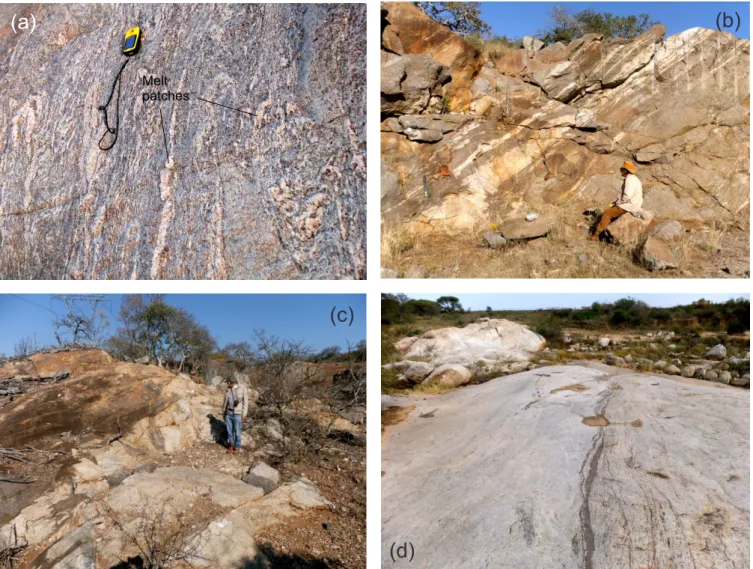
Emplacement of the SMZ onto the NKVC during the exhumation stage of the LC was
171
controlled by 2.68-2.69 Ga shallow verging HRSZ and related system of steep
SW-172
verging deep crustal shear zones within the SMZ (Fig. 1, 2). This is reflected by: (1)
173
Retrograde metamorphism comprising an early decompression-cooling stage (~2.69 Ga)
8 illustrated by the reaction (Perchuk et al., 2000a, Smit et al., 2001) (mineral abbreviations
175
after Whitney and Evans, 2010):
176
177
2 Grt + 3 Qz → Crd + 2 Opx (1a)
178
179
followed by a near-isobaric cooling stage reflected by the reaction (Perchuk et al., 2000a,
180
Smit et al., 2001):
181
182
3 Crd → 2 Grt + 4 Sil + 5 Qz (1b)
183
184
(2) Regional retrograde hydration caused by CO2-rich fluids (e.g., Van Reenen et al., 2011),
185
which illustrates the final visible stage of cooling; (3) A zone of retrograde hydrated
186
granulites, separated from the granulites by the retrograde Ath-in/Opx-out isograd (from here
187
onwards referred to as retrograde isograd) resulted from this event; (4) Development of a
188
dominant gneissic (D2) fabric that has developed during exhumation. Regional-scale D2 shear
189
zones are associated with exhumation; (5) Localized D2 shear zoned-hosted metasomatism
190
and lode gold mineralization caused by brines.
191
While the SMZ shows only evidence for high-grade retrograde metamorphism, the
192
underthrusted Giyani greenstone belt in the footwall of the HRSZ (Fig. 1), on the other hand,
193
provides evidence for prograde metamorphism at ~2.69 Ga (Van Reenen et al., 1987, 1988,
194
2011; De Wit et al., 1992b; McCourt and Van Reenen, 1992; Roering et al., 1992a; Miyano et
195
al., 1992; Perchuk et al., 1996, 2000; Smit et al., under review).
196
197
3. Different sources for the retrograde fluids
198
9 Hollister (1992) discussed three possible sources to account for the retrograde fluid that
200
infiltrated the high-grade rocks of the SMZ during thrust-controlled exhumation and
201
established the retrograde isograd and associated hydration zone: (1) The upper mantle, or
202
mantle derived melts that underplate the lower crust; (2) Crystallizing anatectic melts that
203
originated within the SMZ (Vennemann and Smith, 1992; Stevens, 1997); (3) Prograde
204
devolatilization reactions related to emplacement of hot SMZ granulite over cooler low-grade
205
greenstone belt material of the NKVC (Van Reenen and Hollister, 1988).
206
Hoernes et al. (1995), following on the suggestion by Vennemann and Smith (1992) that
207
O-isotope data failed to identify an external fluid source in the SMZ during hydration, pointed
208
out that recognition of the ultimate fluid source based on O-isotope studies alone is
209
complicated by the fact that the first and second fluid sources are clearly magmatic, and that
210
magmatic rocks (greenstone belt material) also would dominate the third source. This follows
211
from the fact that the SMZ comprises the high-grade metamorphic equivalents of typical
212
greenstone belt material (Kreissig et al., 2001), indicating that the O-isotope signature of the
213
fluids derived from underlying greenstone belts should be similar.
214
215
3.1. Mantle source
216
217
Speculations on the possible role of mantle fluids in metasomatism are supported by the
218
fact that mantle fluids include brines and CO2-rich fluids (e.g., Touret and Huizenga, 2011,
219
2012). Direct evidence that mantle derived mantle fluids have infiltrated the SMZ during
220
exhumation may be provided by C-isotopic compositions of CO2 extracted from magnesite
221
produced by the high-temperature Ol-breakdown reaction Ol + CO2→ Opx+ Mgs. This
222
reaction produced a second generation of porphyroblastic Opx in former unhydrated
223
ultramafic granulite (Van Schalkwyk and Van Reenen, 1992). Four samples collected at two
10
different localities in the zone of retrograde hydrated granulites show Mgs δ13 C values
225
varying between −5.5 and −6.0‰ (Van Schalkwyk and Van Reenen, 1992). However, these
226
values do not conclusively point to a mantle source as similar values are found in different
227
rock types (Kerrich, 1989).
228
229
3.2. Crystallizing granitic melts
230
231
Vennemann and Smith (1992) and Stevens (1997) have suggested that water-rich
232
fluids resulting from crystallizing granitic melts (internally buffered fluids) were responsible
233
for the hydration of the cooling granulites under closed-system conditions to produce the zone
234
of retrograde hydration (Fig. 1). In this model, the crystallizing fluids may become enriched in
235
CO2 species as a result of water-graphite interaction in an oxidized environment (Stevens,
236
1997), while water-rich fluids might evolve into brine fluids during hydration of the granulite
237
(e.g., Markl and Bucher, 1998). However, direct evidence that fluids released by crystallizing
238
granitic melt did interact with hot granulite is restricted to crystallization-hydration (back)
239
reactions that are commonly observed features of metapelitic granulite sampled in close
240
proximity to intrusive leucocratic veins and bodies (Van Reenen et al., 1983; Stevens and Van
241
Reenen, 1992; Safonov et al., under review).
242
243
3.3. Devolatilization of underthrusted greenstone belts
244
245
A large published database comprising field, structural, and petrological data (Van
246
Reenen, 1986; Van Reenen and Hollister, 1988; Van Reenen et al., 1988, 2011; De Wit et al.,
247
1992a,b; McCourt and Van Reenen, 1992; Miyano et al., 1992; Roering et al., 1992a,b; Van
248
Schalkwyk and Van Reenen, 1992; Perchuk et al., 1996, 2000a,b; Passeraub et al., 1999; Smit
11 et al., 2001) supported by geochemical, isotopic (Kreissig et al., 2000, 2001) and geophysical
250
(e.g., De Beer and Stettler, 1992 and references therein) data provide convincing evidence for
251
a tectono-metamorphic scenario that includes the following essential elements. Firstly, the
252
NKVC dips at shallow angles underneath the SMZ at the position of the HRSZ (Fig. 2).
253
Second, greenstone belt material underlies the SMZ for a distance of at least 40 km north of
254
the HRSZ (De Beer and Stettler, 1992). Third, the overriding granulite interacted thermally
255
and dynamically with underthrusted greenstone belts at ~2.69 Ga at the position of the HRSZ
256
(Fig. 2, 3) (e.g., Perchuk et al., 1996). Such a tectono-metamorphic scenario is expected to
257
have resulted in the production of large volumes of fluids derived from devolatilization of
258
underthrusted greenstone belts that infiltrated the overriding SMZ. Evidence for this process
259
will be presented and discussed in this paper and further elaborated on in a separate paper
260
(Smit et al., under review). The upper mantle as an additional fluid source will not be further
261
discussed because of a lack of evidence. Safonov et al. (under review) discuss evidence for
262
localized high-temperature fluid-rock interaction of per-aluminous metapelitic granulite with
263
low
2
fluid H O
a fluids released by crystallizing anatectic trondhjemitic melts at the Petronella
264
locality (Fig. 1) in the SMZ.
265
266
4. Evidence for high-temperature fluid-rock interaction in the SMZ
267
268
The SMZ is subdivided into a northern granulite zone that is separated from a southern
269
zone of retrograde hydrated granulite by the retrograde isograd (Fig. 1). Evidence that cooling
270
granulites interacted with immiscible CO2 and brine fluids of greatly reduced
2
fluid H O
a at T>
271
700°C within the granulite zone (without affecting Opx in metapelitic granulite) will first be
272
discussed, followed by a discussion of pervasive retrograde metamorphism of metapelitic
273
granulite that established the retrograde isograd at T = 600-630°C. Evidence for
12 temperature melt-fluid-rock interaction will be concluded with a discussion of shear
zone-275
hosted metasomatism including the formation of Qz vein-hosted lode gold deposits.
276
277
4.1. P-T evolution of the SMZ
278
279
The essentials of the tectono-metamorphic evolution of the SMZ that directly impact
280
on fluid-rock interaction can be summarized with reference to relevant
structural-281
metamorphic data (see Smit et al., under review, for a detailed discussion). P-T paths (Fig. 3)
282
were constructed for the common Grt-Opx-Crd/Grt-Sil-Crd bearing assemblages in
283
metapelitic rocks that outcrop throughout the granulite domain (Fig. 1) using the net-transfer
284
reactions (1a) and (1b) and Fe-Mg cation exchange reactions (see Perchuk et al., 2000 for
285
mineral compositions and thermodynamic data and Perchuk, 2011 for a detailed explanation
286
of the methodology). The P-T paths show that the retrograde evolution of the SMZ can be
287
linked to two successive stages; an early decompression-cooling (DC) stage that was
288
uninterruptedly followed by a near-isobaric cooling (IC) stage. An important observation is
289
that metapelitic granulite sampled in the granulite domain north of the Annaskraal shear zone
290
(Fig. 1, DR45) only documents evidence for a two-stage DC history (Fig. 3) during which
291
rocks that record maximum P-T conditions of ~8 kbar and ~850°C, were initially emplaced
292
into the middle crust (P = ~6 kbar, T = ~720°C, Fig. 3). This was followed by the second DC
293
stage that resulted in emplacement into the upper crust (Fig. 3, DR45). In contrast, similar
294
metapelitic mineral assemblages sampled in the much larger granulite domain located south
295
of the Annaskraal Shear Zone (Fig. 1) document evidence for a near IC stage that commenced
296
at mid-crustal level, i.e. corresponding to the gap between successive stages of DC P-T paths
297
(Fig. 3). Near IC P-T paths ranging from ~6 kbar and ~700°C to 5-5.5 kbar and 570-600°C
298
(Fig. 3, DR19, DV81, DV101) were followed by decompression-cooling to upper crustal
13
levels (Fig. 3). In this scenario, DC P-T paths are linked to the early exhumation stage of the
300
SMZ that ended with emplacement into the middle crust, whereas IC P-T paths reflect the
301
subsequent thrust-controlled emplacement of the SMZ onto the adjacent NKVC along a
near-302
isobaric surface (6-5.5 kbar), i.e. the HRSZ (Fig. 2) (Smit et al., under review).
303
304
4.2. Evidence for near-peak fluid-rock interaction during granulite-facies metamorphism
305
306
Fluid inclusions and microscale metasomatic textures suggest that CO2-rich fluids and
307
brines interacted with hot granulite at peak and near-peak metamorphic conditions. Primary
308
mixed brine-CO2 fluid inclusions in Opx and in Qz inclusions in Grt, respectively in
309
metapelitic granulite have been described by Van den Berg and Huizenga (2001) and Touret
310
and Huizenga (2011). These inclusions indicate the coexistence of a brine fluid and pure CO2
311
at the peak of metamorphism in the SMZ (Touret and Huizenga, 2011).
312
Further, post-peak micro-scale high-temperature fluid-rock interaction is suggested by
313
the common presence of metasomatic perthitic Kfs micro-veins between Qz and Grt in
314
metapelitic granulite (Touret and Huizenga, 2011). Orthopyroxene in contact with these Kfs
315
veins does not show alteration indicating that 2
fluid H O
a of the fluids responsible for these veins
316
was low (Harlov et al., 1998; Harlov, 2012). The widely accepted interpretation is that Kfs
317
micro-veins are due to influx of low 2
fluid H O
a brines during the initial phases of post-peak
318
metamorphic uplift (e.g., Harlov et al., 2000; Newton and Manning, 2010; Touret and
319
Huizenga, 2012), identical to the situation described for the granulite zone of the SMZ.
320
Thermocalc pseudosections of the Grt-Bt-Opx-Crd-Kfs-Pl-Qz in the NCKFMASH system
321
show that 2
fluid H O
a is between 0.4 and 0.5 (Koizumi et al., under review) for P-T conditions of 9
322
kbar and 900°C, respectively. This is consistent with 2
fluid H O
a calculated from the Bt dehydration
323
reaction using revised thermodynamic data (Newton et al., under review), corresponding to
14 2
fluid H O
X being between 0.3 and 0.4 for mixed CO2-H2O fluids (Aranovich and Newton, 1999).
325
These 2
fluid H O
X values relate to H2O volume fractions between ∼0.15 and ∼0.25 for the highest
326
density CO2-rich fluid inclusions reported in the SMZ (homogenization temperature of the
327
CO2 phase is −30°C; Van den Berg and Huizenga, 2001). Generally, H2O volume fractions
328
below 0.2 are hardly visible in CO2-rich fluid inclusions (Bakker and Diamond, 2006).
329
Finally, the observation that metapelitic granulite sampled south of the Annaskraal
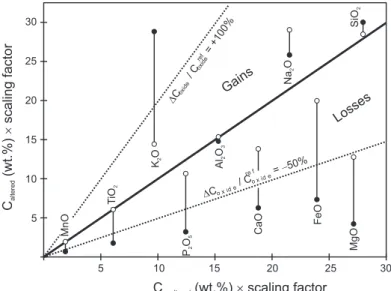
330
Shear Zone (Fig. 1) are characterized by near-IC P-T paths (Fig. 3, DR19, DV81, DV101)
331
strongly suggests that hot rock emplaced at the middle crustal level cooled rapidly while still
332
at a relatively high pressure. The only reasonable mechanism for rapid cooling of hot
333
granulite at mid-crustal level and distant from the juxtaposed NKVC (Fig. 1) is the infiltration
334
of relatively cool fluids derived from underthrusted greenstone belts that underlay much of the
335
granulite domain south of the Annaskraal Shear Zone (Fig. 1, 2) (De Beer and Stettler, 1992;
336
Perchuk et al., 1996, 2000a,b; Smit et al., under review). The observation that rocks north of
337
the Annaskraal shear zone show no evidence for near-isobaric cooling P-T trajectories is thus
338
in agreement with the fact that the northern granulite domain is far removed from the area that
339
is underlain by greenstone belts (De Beer and Stettler, 1992; Smit et al., under review).
340
341
4.3. Dehydration melting versus fluid-induced melting
342
343
The most contentious issue regarding the role of fluids in the evolution of granulite
344
facies terrains relates to fluid-present versus fluid-absent melting mechanisms that might have
345
accompanied high-grade metamorphism (e.g., Stevens and Van Reenen, 1992; Stevens, 1997;
346
Rigby and Droop, 2011; Touret and Huizenga, 2011; Nicoli et al., in press; Belyanin et al., in
347
press). Evidence for anatexis in the SMZ is reflected by: (1)the presence of migmatitic
348
gneisses comprising tonalitic Baviaanskloof gneiss as well as mafic and metapelitic granulite
15 that characterize the entire SMZ (Du Toit et al., 1983). These migmatites are characterized by
350
small volumes (< 10 vol.%) of leucocratic Pl-Qz (± perthite/antiperthite) bearing anatectic
351
material that occurs as small lenticels and veins (cm scale) that enhance the high-grade
352
gneissic fabric of the migmatitic gneisses in which they occur (Fig. 4a). (2) Concordant and
353
discordant almost non-foliated granodioritic/trondhjemitic veins and bodies up to100 meters
354
high and more than a kilometer wide (Fig. 4b-d). These Pl-Qz-perthite/antiperthite
355
(±Grt±Crd±Sil±Bt±Gph) bearing bodies (Du Toit et al., 1983; Stevens and Van Reenen,
356
1992) intrude the Bandelierkop Formation (Fig. 4c,d) (Du Toit et al., 1983) implying that they
357
are related to a major pulse of anatexis that post-dated the main granulite facies and
358
deformational events.
359
Kreissig et al. (2001) obtained a U/Pb age (2691±7 Ma) for monazite that occurs as
360
inclusions in plagioclase and biotite coexisting with Grt, Crd, and Opx in migmatitic granulite
361
from the Bandelierkop locality (Fig. 4b). They interpreted this date as the age of monazite
362
growth under granulite facies conditions reflecting the “peak” of granulite facies
363
metamorphism in the SMZ (~2.69 Ga). The same authors also obtained a U-Pb zircon age of
364
2643±0.3Ma for the large (meters wide) granodioritic band exposed in the Bandelierkop
365
locality (Fig. 4b) and interpreted this age, which is significantly younger than that of the
366
metapelitic granulite (~2.69 Ga) which it intrudes, to indicate decompression melting during
367
exhumation. This interpretation is supported by U-Pb data of monazite from the leucocratic
368
part of a migmatitic granulite that occurs as a xenolith in the Matok Complex that recorded an
369
age of 2663±4Ma (Kreissig et al., 2001). It should be noted that Stevens and van Reenen
370
(1992) and Stevens (1997) interpreted this granodioritic band (Fig. 4b) as the product of
in-371
situ prograde fluid-absent partial melting due to muscovite and biotite breakdown reactions
372
(see also Nicoli et al., in press).
16 Evidence that Crd-bearing metapelitic granulite at Bandelierkop quarry interacted with
374
aqueous fluids released by the crystallizing anatectic melt is plainly provided by intergrowths
375
of fine-grained Ged and Ky (Fig. 5a) and coarser-grained Bt and Ky that replaces Crd (Van
376
Reenen, 1983; Stevens and Van Reenen, 1992). However, Opx from the same granulite was
377
not unaffected by this process (Fig. 5a), testifying that a low
2
fluid H O
a fluid was released during
378
crystallization (Safonov et al., under review).
379
Two prime examples of granodiorite/trondhjemite outcrops on Farm Kameelkuil
380
(S23o13’36.80”; E29o49’19.34”) next to the Bandelierkop quarry and on Farm Petronella
381
located about 25 km west-southwest of the Bandelierkop quarry (S23°20’42.43”;
382
E29°36’42.72”) (Fig. 1). The trondhjemite (Fig. 4d) intruded into high-grade migmatitic
383
metapelitic granulite cutting the D2 fabric. The trondhjemite on Farm Petronella contains
384
small and large remnants of partially assimilated migmatitic metapelitic granulite (Fig. 4d)
385
(Safonov et al., under review). Partially assimilated metapelitic material is also preserved as
386
trails of ferro-magnesium minerals such as Bt, Grt, and Crd that mimic the foliation of the
387
enclosing country rock (Fig. 4d). Garnet porphyroblasts within such trails are often rimmed
388
by symplectic Crd and Opx reflecting evidence for decompression reaction (1a). This reaction
389
was used to determine the retrograde P-T path (sample DR45, Fig. 3) (Perchuk et al., 2000a;
390
Smit et al., 2001) during which the main D2 fabric developed (Smit et al., under review).
391
Features related to the interaction of the metapelitic granulite with fluids expelled by
392
crystallizing trondhjemitic magma are identical to those described at the Bandelierkop quarry
393
and is the focus of a separated paper in the present volume (Safonov et al., under review). The
394
trondhjemitic body at the Petronella locality (Fig. 4d) has recently been dated at ~2.67 Ga
395
(Belyanin et al., under review). This age is in agreement with the emplacement of this
396
magmatic body postdating the main ~2.69 Ga D2 fabric-forming event (Kreissig et al., 2001).
17 The composition (granodioritic to trondhjemitic), intrusive relationships, large
398
volumes, and timing of the main pulse of anatexis (2.67-2.64 Ga) relative to the timing of the
399
main D2 fabric-forming (~2.69 Ga) event at the Bandelierkop quarry and Petronella locality
400
clearly require a mechanism of fluid-fluxed decompression melting. Safonov et al. (under
401
review) show that the tonalitic melt at Petronella locality already intruded the host metapelitc
402
granulite (Fig. 4d) at P> 7.5 kbar, T> 900°C and continued to interact with the host rock
403
until final emplacement into the middle crust (P = ~6 kbar, T = ~630°C). This scenario
404
strongly argues against the hypothesis that these large bodies might represent the products of
405
in-situ fluid-absent partial melting of muscovite and biotite during the prograde stage of
406
metamorphism (Stevens and Van Reenen, 1992; Stevens, 1997; Nicoli et al., in press). A
407
more plausible scenario based on data presented here and also published as separate papers
408
(Aranovich et al., under review; Newton et al., under review; Safonov et al., under review), is
409
that brine-fluxed decompression melting (Sawyer et al., 2011) resulted in emplacement of
410
granodioritic-trondjhemitic magma into rocks of the Bandelierkop Formation during
411
exhumation. Aranovich et al. (under review) in particular argue that the dehydration-melting
412
model of granite genesis has numerous issues: (1) Heat sources for melting large amounts of
413
the lower crust are often inadequate; (2) H2O available in mica and amphibole for lower crust
414
dehydration melting is restricted; (3) Depletion of large-ion lithophile elements in granulites
415
cannot be explaned by dehydration melting. Furthermore, recently obtained O-isotope
416
fractionation data show that the leucocratic band and host granulite exposed at the
417
Bandelierkop locality (Fig. 4b) are not isotopically related to each other and, therefore,
418
excludes the host metapelitic granulite as a source for these veins (Dubinina et al., under
419
review).
420
Three important issues related to the above scenario should be highlighted. Firstly,
421
fluids expelled by crystallizing melts at both the Bandelierkop and Petronella localities
18 reacted with Crd (Fig. 5a) to form Ged and Ky. Orthopyroxene was not affected, which
423
implies that a low
2
fluid H O
a fluid was involved. Secondly, Ky and not Sil (Van Reenen, 1983;
424
1986; Safonov et al., under review; Koizumi et al., under review) was produced by Crd
425
hydration (Fig. 5a). This indicates that anatexis and the associated crystallization-hydration of
426
Crd could not be related to fluid-absent dehydration melting at peak metamorphic conditions
427
as suggested by several authors (Stevens and Van Reenen, 1992; Stevens, 1997; Nicoli et al.,
428
in press). In that case one would expect a relatively high temperature and, therefore, Sil to be
429
formed rather than Ky. Finally, Crd hydration at Bandelierkop and Petronella localities (Fig.
430
5a) (Safonov et al., under review) are identical to the observed hydration reactions involving
431
Crd north and on the retrograde isograd (Fig. 5b), and occurred at similar P-T conditions (~6
432
kbar, 600-630°C, see next section). This suggests that distinct hydration phenomena linked to
433
the establishment of the retrograde isograd (next section) and the crystallizing granitic melts
434
in the granulite zone were triggered by similar low
2
fluid H O
a fluids. Moreover, this also explains
435
the observation that O-isotope fractionation data often fail to identify the presence of an
436
externally derived fluid that interacted with the granulites (Vennemann and Smith, 1992;
437
Hoernes and Van Reenen, 1992; Hoernes et al., 1995), because this fluid was produced as a
438
result of devolatilization of underthrusted greenstone material, which is identical to the
439
precursor material of the granulite facies rocks in the SMZ (Kreissig et al., 2000; Van den
440
Berg and Huizenga, 2001).
441
442
4.4. Pervasive fluid-flow: the regional retrograde isograd
443
444
4.4.1. The retrograde isograd
445
19 An unusual but significant feature of the SMZ is that clear evidence for regional fluid
447
flow is primarily based on retrograde reactions that occurred at relatively high temperatures
448
and affected all rock types of the Bandelierkop formation as well as the Baviaanskloof
449
enderbitic gneiss (e.g., Van Reenen et al., 1983, 2011; Van Reenen, 1986). The infiltrating
450
fluid rehydrated large areas of the SMZ (> 4500 km2), leaving a sharp demarcation between
451
unhydrated Opx-Crd-bearing metapelitic granulite in the north (Fig. 6a,b) and hydrated
(Opx-452
Crd-absent, Ath±Ged±Ky/Sil-bearing gneisses) in the south (Fig. 6c,d) (Fig. 1). This
453
demarcation is defined by the retrograde isograd that cuts major folds and lithologies in the
454
central part of the SMZ (Fig. 1) (Van Reenen, 1986), implying that granulite-facies
455
metamorphism was overprinted by amphibolite-facies metamorphism.
456
Petrographic evidence for regional (pervasive) hydration during cooling is reflected in
457
metapelitic granulite by two major retrograde hydration reactions involving Opx-Crd-bearing
458
granulite (Fig. 6c,d) (Van Reenen, 1986; Huizenga et al., 2014):
459
460
5 Crd + 2 H2O → 2 Ged + 6 Al2SiO5 + 7 Qz (2)
461
462
3.5 Opx + Qz + H2O → Ath (3)
463
464
Reaction (2) is not an accurate reflection of the hydration of Crd since Ged does contain up to
465
2 wt.% Na2O. This suggests that either a Na-bearing aqueous fluid (Huizenga et al., 2014) or
466
plagioclase was involved in the reaction. Crd hydration goes hand-in-hand with production of
467
fine-grained euhedral Grt associated with Ky and Bt. Formation of this assemblage is
468
probably related to the following reaction (Huizenga et al., 2014):
469
470
3 Ged + 2 K2O (in fluid phase) + H2O → Grt + 4 Bt + 3 Al2SiO5 (4)
20
472
Reaction (3) defines the retrograde isograd, which can be uninterruptedly mapped from west
473
to east across the entire SMZ (Fig. 1). This reaction resulted in the coexistence of Opx and
474
Ath (Fig. 6c) over a narrow (hundreds of meters) interval in the field (Van Reenen, 1986; Van
475
Reenen et al., 2011) that follows the trend of the HRSZ (Fig. 1). This implies a direct link of
476
pervasive fluid flux with the thrust-controlled exhumation of the SMZ (Fig. 2) (Van Reenen
477
and Hollister, 1988; Van Reenen et al., 2011; Smit et al., under review). Finally, it is
478
important to note that graphite is commonly associated with the products of the reactions (2),
479
(3), and (4) (Van Reenen, 1986; Stevens, 1997).
480
481
4.4.2. Regional metamorphic control on fluid influx
482
483
The retrograde isograd has been interpreted to reflect evidence for relatively
high-484
temperature interaction of cooling granulite with an externally derived mobile low
2
fluid H O
a fluid
485
that infiltrated the overriding high-grade rocks during the thrust controlled exhumation of the
486
SMZ (Fig. 2). Evidence in support of this is outlined below.
487
Orthopyroxene and Ath coexist in metapelitic gneiss along a restricted metamorphic
488
interval (Fig. 1) that separates a granulite zone in the north showing no evidence for Opx
489
hydration (Fig. 6a,b), from a zone of retrograde hydrated granulite in the south where Opx
490
and Crd have been completely replaced by Ath, and Ged and Ky, respectively, as a result of
491
hydration reactions (2) and (3) (Fig. 6c,d) (Van Reenen et al., 1977, 1983, 1986). This
492
observation suggests that hydration reaction (3) should be univariant in the subsystem
493
(Mg,Fe)O2-SiO2-H2O, which is confirmed by the fact that coexisting Opx and Ath have a
494
similar Mg/(Mg+Fe) mole ratio between 0.6-0.7 (Van Reenen, 1986). Moreover, the
495
univariant nature of hydration reaction (3) requires the presence of a free fluid phase that was
21 externally buffered (Van Reenen, 1986). In contrast, the Crd hydration reaction (3) is
497
divariant in the sub-system MgO-FeO-SiO2-Al2O3-H2O as is shown by contrasting
498
Mg/(Mg+Fe) mole ratios of Crd and Ged (Van Reenen, 1986). Consequently, coexisting
499
reactants and products of reaction (2) straddle the retrograde isograd over a larger surface area
500
in the field. The fact that the retrograde isograd was established as the result of the
501
emplacement of hot granulite over cool greenschist and is superimposed onto major fold
502
structures in the area (Fig. 1) implies a scenario in which regional hydration was controlled by
503
infiltration of a mobile H2O-bearing fluid (Van Reenen, 1986). If this were not the case,
504
reaction (3) would have been divariant; a scenario that would have resulted in the irregular
505
dispersal of retrograde hydrated granulite closely associated with unhydrated rocks.
506
Systematic variations in the composition of coexisting Grt (Fig. 7a) and Bt (Fig. 7b) in
507
metapelitic granulite compared with their hydrated equivalents indicates that hydration
508
occurred at (near) equilibrium conditions.
509
Mafic and ultramafic gneisses in the hydration zone sometimes still contain partially
510
hydrated high-grade minerals (Van Schalkwyk and Van Reenen, 1992), expressed by relict
511
Cpx and/or Opx, which are being replaced by Hbl and/or Mgs, respectively. The peak
512
assemblage of Fo, Opx, Spl and pargasitic Hbl in ultramafic granulite is replaced by hydrous
513
(Hbl, Chl and Tlc) and carbonate (Mgs, Dol) minerals. This provides conclusive evidence that
514
ultramafic rocks interacted with externally derived CO2-rich fluid (Van Schalkwyk and Van
515
Reenen, 1992). Moreover, the occurrence of Opx and Cpx relicts in partially hydrated mafic
516
and ultramafic granulite in the hydrated zone of the SMZ (Van Reenen, 1986; De Wit et al.,
517
1992c; Van Reenen et al., 2011) attests to the fact that the granulite occupied the entire SMZ
518
before retrograde hydration occurred (Fig. 1). The general cooling trend is reflected in the
Ca-519
amphibole compositions of the ultramafic rocks (Fig. 7c) (Van Schalkwyk and Van Reenen,
520
1992).
22
522
4.4.3. P-T constraints and fluid composition
523
524
Garnet-biotite thermometry, using the calibration by Kaneko and Miyano (2004,
525
2006), of samples on the retrograde isograd (using mineral analyses from Van Reenen, 1986)
526
gave a temperature range of600-630°C (P = ~6 kbar) for the breakdown of Opx to Ath
527
(Huizenga et al., 2014). Chemically similar rocks in the zone of hydration (using mineral
528
analyses from Van Reenen, 1986) show slightly lower Grt-Bt temperatures that remain
529
relatively constant at 600-550°C (Huizenga et al., 2014). Pressure conditions on the
530
retrograde isograd are constrained to ~6 kbar as Crd hydration on the isograd produced Ky
531
rather than Sil (Van Reenen, 1986; Koizumi et al., under review). However, Sil has been
532
identified as a stable phase in some rocks in the hydrated zone (Van Reenen, 1986). These
P-533
T conditions have been established by numerous other studies (Van Reenen, 1986; Baker et
534
al., 1992; Hoernes et al., 1992; Huizenga et al., 2014; Koizumi et al., under review; Dubinina
535
et al., under review). This suggests that Opx hydration occurred at temperatures more than
536
200°C lower than the temperature (T = ~830°C at P = ~6 kbar, Fig. 8a) at which En and Ath
537
coexist in presence of a pure H2O fluid phase (e.g., Newton, 1994; Van Reenen, 1986). A
538
lowering of this equilibrium temperature to 600-630°C is only possible if the hydrating fluid
539
has a
2
fluid H O
a of 0.2 (Van Reenen, 1986; Van Reenen and Hollister, 1988; Huizenga et al., 2014;
540
Koizumi et al., under review). However, it should be noted that the
2
fluid H O
a value of 0.2
541
represents a minimum value as Opx and Ath have Mg/(Mg+Fe) mole ratio’s between 0.6 and
542
0.7 (Huizenga et al., 2014). Based on the association of graphite with the hydration reactions
543
(2), (3), and (4) (e.g., Huizenga et al., 2014) and other evidence presented below, it can
544
concluded that the low
2
fluid H O
a fluid phase relates to a CO2-rich fluid, of which
2
fluid H O
X ranges
545
between 0.1 and 0.3.
23 Support for a low
2
fluid H O
a CO2-rich fluid is, in addition to the presence of graphite, also
547
provided by the partial hydration/ carbonation of ultramafic granulites where the
Ol-Ca-Hbl-548
Opx-Spl peak assemblage has been replaced by a retrograde
Ol-Hbl-Opx-Spl-Mgs-Dol-Chl-549
Tlc assemblage (Fig. 8b) (Van Schalkwyk and Van Reenen, 1992). Of special significance is
550
the replacement of Ol (Van Schalkwyk and Van Reenen, 1992) by Mgs according to the
551
reaction Ol + CO2→ Opx + Mgs, providing evidence that granulite interacted with an
552
externally derived CO2-rich fluid (Van Schalkwyk and Van Reenen, 1992). The
553
hydrated/carbonated ultramafic assemblage shows that the granoblastic ultramafic rocks were
554
infiltrated at T= 610-640°C at P = 4-5 kbar by an externally derived CO2-rich fluid of which
555
2
fluid H O
X =∼0.3 (Fig. 8b). Note that the pressure should be lower than 6 kbar considering that Sil
556
(produced by Crd hydration) does occur south of the isograd (Van Reenen, 1986).
557
Further evidence for a CO2-rich fluid is given by fluid inclusion data. Hydrated
558
granulites show dominantly trail bound inclusions composed of (nearly) pure CO2 (Van
559
Reenen and Hollister, 1988; Touret and Huizenga, 2011; Huizenga et al., 2014). Although
560
H2O is not visible in the CO2 inclusions, it has in a few cases been detected by clathrate
561
melting (Van Reenen and Hollister, 1988). This implies that inclusions can contain up to 20
562
vol. % H2O (corresponding to a maximum
2
fluid H O
X of 0.3), which is optically undetectable in
563
the inclusions (e.g., Bakker and Diamond, 2006). Considering the P-T conditions of
564
retrograde hydration, CO2-rich fluid inclusions should have homogenization temperatures
565
(Th) between −20 and −10°C (Huizenga et al., 2014). However, the lowest Th that has been
566
found for these inclusions is +10°C. The absence of high-density CO2-rich fluid inclusions
567
could be explained by re-equilibration during decompression-cooling. However, in that case
568
one would expect a small fraction of the inclusions to maintain their original density (Vityk
569
and Bodnar, 1995; Van den Kerkhof et al., 2014), which is not the case here. Therefore, it is
24 plausible that trapping of the fluid occurred at a pressure between the lithostatic and
571
hydrostatic pressure (Huizenga et al., 2014). Fluid pressures below lithostatic pressures are
572
likely to occur in strike slip shear zones that are present in the hydrated portion of the SMZ
573
(Fig. 1) (Roering et al., 1995). In addition, volume changes associated with hydration
574
reactions (2), (3) and (4) may cause an increase of the rock permeability and, therefore, result
575
in a fluid pressure lower than the lithostatic pressure (Huizenga et al., 2014).
576
Summarizing, retrograde hydration of granulites occurred at P≤ 6 kbar and T≤
600-577
630°C by means of an infiltrating fluid CO2-rich fluid (0.1 <
2
fluid H O
X < 0.3). This is based on (1)
578
volatilization reactions in metapelitic and ultramafic granulites; (2) the presence of graphite in
579
hydrated metapelitic granulites, and (3) the presence of CO2-rich fluid inclusions.
580
581
4.4.4. Open versus closed system behavior during pervasive hydration
582
583
Whole-rock/mineral O-isotope fractionation patterns (Vennemann and Smith, 1992;
584
Hoernes and Van Reenen, 1992; Hoernes et al., 1995) showed that whereas closed system
585
conditions prevailed in some cases (Fig. 9a), many metapelitic and mafic granulite provided
586
clear evidence for influx of an external fluid and thus open system behavior during pervasive
587
hydration (Fig. 9b,c) (Hoernes et al., 1995). This is demonstrated by whole-rock mineral
588
fractionation patterns for Opx-bearing metapelitic and mafic granulite that show evidence for
589
influx of an externally derived fluid at T = ~635-670°C (Fig. 9a,b). The temperature of
590
1230°C calculated from whole-rock/Opx O-isotope fractionation (Fig. 9b) for the same
591
sample is obviously too high, indicating that closed system behavior is not realistic. The
592
absence of Ath, Ged and Ky from this Opx-Crd-bearing metapelitic granulite implies that
593
hydration started at T< 670°C, i.e. Crd and Opx hydration only occurred when the
594
temperature was low enough (Van Reenen, 1986). Moreover, the temperature of 635°C
25 derived from whole-rock/Ath/Qz O-isotope fractionation (Fig. 9b) is in good agreement with
596
temperature conditions of hydration on the retrograde isograd based on Grt-Bt
597
geothermometry (Van Reenen, 1986; Huizenga et al., 2014).
598
Hoernes and Van Reenen (1992) showed, on the basis of whole-rock/mineral
O-599
isotope data, that the amount of infiltrating fluid necessary to hydrate dry granulite is very
600
small. However, it should be kept in mind that the greenstone belt material in the footwall of
601
the HRSZ is chemically identical to their high-grade equivalents in the SMZ (Kreissig et al.,
602
2001). Fluids derived from the devolitilization of footwall greenstone belts may, therefore, not
603
significantly change the granulite whole-rock/mineral O-isotope system upon infiltration. On
604
the other hand, shear zone-hosted metasomatism in the zone of retrograde hydrated granulite
605
demonstrates isotopic re-equilibration due to focused fluid flow reflecting large fluid-rock
606
ratios (Fig. 9c) (Hoernes et al., 1995).
607
608
4.4.5. Narrowing of the zone of retrograde hydrated granulite in the western part of the SMZ
609
610
The dramatic narrowing of the hydration zone in the western part of the SMZ
611
compared with the central part (Fig. 1) is mainly explained by the fact that: (1) the
NE-612
directed dip of the HRSZ changes from near-horizontal in the central part of the SMZ to ~20°
613
in the western part. This change in dip explains the vast exposure of sheared retrograde
614
hydrated gneisses that occur in the hanging wall of the near horizontally north-dipping HRSZ
615
in the central part of the SMZ (Fig. 1, 2). In the area west of the Matok granite (Fig. 1) a much
616
narrower zone of sheared and retrogressed granulite occupies the hanging wall of the much
617
steeper dipping section of the HRSZ (see Smit et al., under review, for a more detailed
618
discussion).
619
26
4.5. High-temperature metasomatism
621
622
4.5.1. Introduction
623
624
The SMZ offers the opportunity to study high-temperature shear zone-hosted
625
metasomatism. This process includes transformation of (1) dark grey homogenous
626
metamorphic enderbite and banded migmatitic enderbitic gneiss (Baviaanskloof gneiss) into
627
pink Grt-bearing potassium-enriched granite in the granulite zone, (2) banded and
628
retrogressed migmatitic tonalitic gneiss into potassium-enriched granite in the zone of
629
hydrated granulite, and (3) high-temperature shear zone-hosted lode-gold mineralization
630
located both in the footwall and hanging wall sections of the HRSZ. Detailed case studies of
631
shear zone-hosted metasomatic phenomena are the focus of separate papers (Dubinina and
632
Aranovich, under review; Tsunogae and Van Reenen, under review).
633
634
4.5.2. Shear zone-hosted metasomatic transformation of enderbitic gneiss
635
636
Excellent continuous outcrops of metasomatically altered and unaltered enderbitic
637
Baviaanskloof gneiss occur within the Petronella Shear Zone on Farms Petronella (Fig. 10a-c)
638
and Commissiedraai (Fig. 10d,e), both located in the granulite zone (Fig. 1). The Petronella
639
locality comprises metapelitic, mafic, and ultramafic granulite, and large volumes of
640
leucocratic anatectic granitoid (Fig. 5d). The locality also provides evidence for numerous
641
local Opx-Pl-Qz-bearing dehydration zones (veins and small bodies) developed within
642
metasomatically altered and unaltered enderbitic gneiss (Fig. 10a) and mafic granulite (Du
643
Toit et al., 1994). Moreover, evidence for hydraulic fracturing under granulite facies
644
conditions is documented by the presence of numerous narrow enderbitic sills that are
27 oriented nearly perpendicular to the principal load (Fig. 10b), and by the presence of
646
granulite-facies breccia (Roering et al., 1995). Roering et al. (1995) interpreted these features
647
as evidence for “deep crustal embrittlement” that resulted from hydro fracturing associated
648
with fluid/melts that infiltrated deep crustal rocks under granulite facies conditions.
649
Grey enderbitic Baviaanskloof gneiss is uninterruptedly altered into a pink
650
metasomatic potassium-enriched granitoid that outcrops continuously over a distance of more
651
than 100 meters in the dry riverbed. The alteration process is easily recognized by the change
652
in color from the unaltered dark grey enderbitic gneiss (Fig. 10a,b) into a pink granitoid
653
characterized by growth of small grains of optically unzoned Mn-rich
654
Grt(∼Alm54Prp27Sps15Gr4) (Fig. 10c). Orthopyroxene is preserved in the pink gneiss and
655
seems not to be affected by the alteration process. The metasomatic alteration process
656
involves infiltrating fluids transforming oligoclase in precursor enderbitic gneiss into
657
homogenous ternary K-rich feldspar at temperatures above the ternary feldspar solvus (T>
658
~680°C) (Du Toit, 1995). The relatively high temperature of metasomatism is confirmed by
659
Grt-Qz O-isotope fractionation indicating a temperature between 710 and 850°C (Hoernes et
660
al., 1995). Depending on the degree of fluid infiltration, cooling of the homogenous ternary
661
feldspar resulted in antiperthite, mesoperthite or perthite, while microcline is completely
662
absent. Antiperthite typically occurs in the less altered rocks while the more altered rocks are
663
characterized by mesoperthite and perthite (Du Toit, 1995). The isocon diagram (Grant, 1986)
664
shows that metasomatism is accompanied by an increase of K2O and, to a lesser extent, Na2O,
665
and a decrease in MgO, FeO, CaO, and TiO2 (Fig. 11) whereas SiO2 and Al2O3 were
666
immobile (Du Toit, 1994; Smit and Van Reenen, 1997). The alteration process was triggered
667
by a low
2
fluid H O
a Na-K bearing brine fluid that infiltrated the rock under near-granulite facies
668
conditions to produce a homogenous ternary K-rich feldspar that subsequently exsolved
669
during cooling to produce antiperthite in the less altered, and mesoperthite in the most altered
28 rocks (Du Toit, 1994; Smit and Van Reenen, 1997). The low
2
fluid H O
a of the metasomatic fluid in
671
the Petronella Shear Zone is supported by the observation that Opx remained stable in narrow
672
metapelitic zones that occur interlayered within metasomatic potassium-enriched granitoid
673
(Du Toit, 1994). Also, the numerous small and near-horizontal oriented Opx-bearing
674
enderbite sills (Fig. 10b) and Opx-Pl-Qz-bearing dehydration zones that occur within the
675
altered rocks show no evidence for interaction with a fluid phase.
676
The Commissiedraai locality shows some differences with the Petronella locality. The
677
precursor enderbite at Commissiedraai is a dark-grey homogenous metamorphic rock (Fig.
678
10d) without any leucocratic veins in contrast to Petronella. Ghost gneissic structures of are
679
preserved within the enderbite and can be traced uninterruptedly into the pink granitoid.
680
Further, alteration is, similar to the Petronella locality, typically characterized by Mn-Grt
681
(∼Alm75Prp15Sps9Gr1) bearing granitoid and narrow foliation zones comprising Sil and Qz
682
(Fig. 10e) whereas microcline is absent (Tsunogae and Van Reenen, under review). Intrusive
683
leucocratic anatectic bodies are absent.
684
Phase equilibrium modeling in the system NCKFMASH using Thermocalc suggested
685
that metasomatic alteration at this locality occurred at ∼900°C, which corresponds to
post-686
peak metamorphic conditions reached during the initial stage of exhumation in the SMZ
687
(Tsunogae and Van Reenen, under review).
688
689
4.5.3. Shear zone-hosted metasomatic transformation of hydrated tonalitic gneiss
690
691
Intense metasomatism of Baviaanskloof gneiss within the retrograde hydrated portion
692
of the SMZ is associated with the D2 Klipbank Shear Zone (locality 3 in Fig. 1). Excellent
693
outcrops in the abandoned dimension stone Klipbank quarry offer the opportunity to study the
694
continuous transformation of precursor retrograde hydrated tonalitic gneiss comprising mainly
29 oligoclase, Bt, Qz and small amounts of Kfs, into intensely altered pink Mn-rich
Grt-Sil-696
bearing potassium-enriched granitoid (Mokgatlha, 1995; Smit and Van Reenen, 1997).
697
Potassium metasomatism is characterized by interstitial growth of fine-grained
698
crosshatched microcline at the expense of oligoclase in slightly altered grey-pink gneiss, and
699
by growth of coarse crosshatched microcline replacing oligoclase in most altered pink gneiss.
700
Interstitial microcline in the least altered grey-pink gneiss reflects limited fluid migration
701
along grain boundaries, whereas replacement microcline perthite in the intensely altered pink
702
gneiss suggests the action of a more pervasive K-bearing fluid (Mokgatlha, 1995). Mn-rich
703
Alm-Grt (∼Alm63Prp13Sps24) in the highly altered pink gneiss occurs as large zoned
704
porphyroblasts with dark cores due to numerous inclusions mainly of Mag and Ilm. A second
705
generation of small idioblastic Grt crystallized during the retrograde growth stage
706
(Mokgatlha, 1995). Similar to Petronella, metasomatism results in an increase of K2O and
707
Na2O, and a decrease of MgO, FeO, CaO and TiO2 whereas SiO2 and Al2O3 remained
708
unchanged (Mokgatlha, 1995). The composition of plagioclase varies from ~An20 in the
709
unaltered rocks to ~An8 in the most altered rocks (Mokgatlha, 1995).
710
Sillimanite needles in the intensely metasomatized rock are associated with
rod-711
shaped Qz in discrete (mm-wide) shear planes that are oriented parallel to but at high angles
712
relative to the steeply oriented gneissic foliation. Sillimanite needles and Qz rods define a
713
stretching mineral lineation that suggests southwards movement during metasomatism (Smit
714
and Van Reenen, 1997), suggesting a direct link between metasomatism and thrust-controlled
715
exhumation of the SMZ.
716
Complete re-equilibration of intensely altered rocks as the result of interaction with an
717
externally derived fluid is revealed by whole-rock mineral O-isotope fractionation data
718
(Hoernes et al., 1995). The whole-rock/mineral O-isotope fractionation for a metasomatic
719
gneiss from the Klipbank Shear Zone shows that all mineral phases, including Mn-rich Grt,
30
plot reasonably close to a straight line, corresponding to O-isotope equilibration at T =
721
~630°C (Fig. 9c, sample KK15, locality 3 in Fig. 1). This temperature is similar to that of the
722
Opx hydration on the isograd, suggesting a direct link with the regional hydration event.
723
Whereas pervasive regional hydration was probably controlled by low CO2-rich fluid-rock
724
ratios, shear zone-hosted metasomatism was most likely controlled by a high brine fluid-rock
725
ratio at similar temperature conditions (Huizenga et al., 2014).
726
Summarizing, metasomatism at Klipbank and Petronella involved similar precursor
727
enderbitic/tonalitic gneisses that were transformed into pink Mn-Grt-bearing
potassium-728
enriched granitoid by infiltrating brine fluids. Metasomatic rocks in the Klipbank Shear Zone
729
are characterized by microcline in contrast to those in the Petronella Shear Zone, which show
730
antiperthite, mesoperthite, and perthite. This difference is due to a different temperature of
731
metasomatism: > 710°C along the Petronella Shear Zone and ∼630°C along the Klipbank
732
Shear Zone (Mokgathla, 1994; Du Toit, 1995; Hoernes et al., 1995; Smit and Van Reenen,
733
1997). Unfortunately, previous studies have mainly focused on the CO2 rich inclusions in
734
metasomatic rocks in both the Petronella and Klipbank Shear Zones, i.e. a systematic study to
735
identify brine fluid inclusions was not done and will be the subject of a separate study.
736
737
4.5.4. Shear zone-hosted lode gold mineralization
738
739
Shear zone-hosted lode gold mineralization has been studied at four localities in the
740
footwall (Giyani greenstone belt in NKVC) (Fig. 1, Birthday, Fumani, Klein Letaba, Frankie),
741
and three localities in the hanging wall (SMZ) (Fig. 1, New Union/Osprey, Louis Moore,
742
Doornhoek) of the HRSZ (Pretorius et al., 1988; Sieber et al., 1991; Van Reenen et al., 1994;
743
Gan and Van Reenen, 1995a,b; Stefan, 1997). The syntectonic ore bodies are located within
744
east west-trending, steeply northward-dipping ductile satellite shear zones of the HRSZ with