A Dynamic Networked Browser Environment
for Distributed Computing
by
Luke Joseph Fletcher, BSc
A dissertation submitted to the
School of Computing
In partial fulfilment of the requirements for the degree of
Bachelor of Computing with Honours
D
ECLARATION
I, Luke Joseph Fletcher, certify that this thesis contains no material which has been accepted for the award of any other degree or diploma in any tertiary institution, and that, to the best of my knowledge and belief, this thesis contains no material previously published or written by another person except where due reference is made in the text of the thesis.
A
BSTRACT
Many organisations have a large number of computers with varying usage patterns. Some of these machines at different locations are often free from time to time leaving them to do very little useful computation or none at all. It is at these times that this dynamically changing environment of machines can be used for a more useful task.
A
CKNOWLEDGEMENTS
Firstly, I wish to thank my supervisor Dr. Vishv Malhotra for his support and invaluable assistance throughout the year with this thesis.
To all my workmates at the School of Computing, a very special thanks go out to you for your continued support, advice, and often welcome distractions. To Julian, Andrea, Ian, Mark, and Nicole thank you for your interest and help with everything. In particular I would like to thank my fellow tech support comrades Dave and Terry for your help, suggestions, and proofreading of various bits of this thesis as well as your excellent thesaurus skills! Also to Young, for the opportunity to both study and work with such a great group of people like everyone at the School.
To all my fellow honours students from the last two years, thanks for your help, fun and often bizarre times. From the LAN parties, BBQ’s to Disco Bowling it was a great time! In particular I would like to thank Edward, Pauline, Ben, Richard, Chris, Adam, and Chloë for your help and just being there to chat whenever.
Finally, a huge thank you to all of my family and friends. Thank you to my parents, Jim & Judy, and my brothers, Stuart & Chris for your continued love and support and especially for your help and assistance in the last year while I have been working on this thesis.
T
ABLE OF
C
ONTENTS
Chapter 1 Introduction and Overview...1
1.1 Motivation ...1
1.2 Distributed Computing ...1
1.3 Thesis Aims ...1
1.4 Thesis Structure...2
Chapter 2 Literature Review...3
2.1 Distributed Computing ...3
2.1.1 Remote Procedure Call (RPC)... 3
2.1.2 Common Object Request Broker Architecture (CORBA)... 4
2.1.3 Distributed Component Object Model (DCOM) ... 6
2.1.4 Distributed Computing Environment (DCE) ... 6
2.1.5 Java Distributed Computing ... 7
2.1.5.1 Java RMI ... 8
2.1.5.2 Java Sockets & URLs... 9
2.1.5.3 Java Servlets... 10
2.2 Web Browser Architecture...12
2.2.1 Java Applets... 13
2.3 Issues in Distributed Computing...14
2.3.1 Security... 14
2.3.2 Scalability ... 15
2.3.3 Other Areas... 16
2.3.3.1 Reliability & Robustness... 16
2.3.3.2 Efficiency ... 16
2.3.3.3 Usability ... 16
2.3.3.4 Transparency... 17
2.4 Current Trends...18
2.4.1 Areas of work in Distributed Computing... 19
2.4.1.1 Java Applet in Massively parallel computing ... 19
2.4.1.2 SETI@home Project ... 21
2.4.1.3 Mobile Agent Technology ... 22
2.5 Summary ...23
Chapter 3 Methodology ...24
3.1 Crossword Problem...24
3.2 Distributed System ...26
3.2.1 Java Servlets ... 26
3.2.2 Distributed Environment ... 27
3.2.3 Standalone Client... 28
3.2.4 Distributed Java Servlet Server... 29
3.2.4.1 Server Scenario A: Client connects to the system... 32
3.2.4.2 Server Scenario B: Client disconnects from the system... 34
3.2.4.3 Server Scenario C: Browser requests client interface ... 34
3.2.4.4 Server Scenario D: Browser posts data from client interface... 34
3.2.4.6 Server Scenario F: Browser posts task data ... 35
3.2.4.7 Server Scenario G: Browser requests task results ... 35
3.2.4.8 Server Scenario H: Client Applet transmits task results... 36
3.2.5 Java Applet based Client... 36
3.2.6 Implementation... 40
3.2.6.1 Server ... 40
3.2.6.2 Client... 42
3.3 Summary ...43
Chapter 4 Results and Discussion...44
4.1 Testing ...44
4.1.1 Distributed Environment ... 44
4.1.2 Crossword Task-Set... 45
4.2 Results ...46
4.3 Discussion...51
4.3.1 Server Load... 51
4.3.2 Synchronisation ... 55
4.3.3 Security... 56
4.3.4 User Interfaces... 57
4.3.4.1 Distributed System Interface... 57
4.3.4.2 Client Selection Interface ... 57
4.3.4.3 Task Management Interface ... 58
4.3.4.4 Java Applet Client Interface... 58
4.4 Summary ...58
Chapter 5 Conclusion and Further Work...59
5.1 Summary ...59
5.2 Further Work ...59
5.2.1 Testing ... 59
5.2.2 Task & Client Interactions... 60
5.2.3 System Reliability... 60
5.2.4 Advanced Distributed Task ... 61
List of References ...62
Appendix A Java Distributed NET Server ...65
Appendix B Java Distributed NET Client...90
Chapter 1 I
NTRODUCTION AND
O
VERVIEW
1.1 Motivation
Organisations such as the University of Tasmania have a large number of computers with varying usage patterns. Some of these machines at different locations are often free from time to time leaving them to do very little useful computation or none at all. The majority of these computers are networked together or connected to a medium such as the Internet, and therefore it is at these times that this dynamically changing environment of machines can be harnessed for a more useful task.
This thesis is an exploration of this concept, in which we will try to harness the free machines through the use of distributed computing and web browsers, in an attempt to develop a feasible dynamic distributed computing environment.
1.2 Distributed Computing
Farley (1998) suggests that distributed computing can be considered in terms of “breaking down an application into individual computing agents that can be distributed on a network of computers, yet still work together to do cooperative tasks”.
The concept of “distributed computing” has gained popularity within the computing industry in the last decade. This is primarily due to the fact that it is now considered a viable alternative for processing large datasets or applications, compared to using traditional and expensive supercomputers.
1.3 Thesis Aims
This thesis aims to show that a NoW (Network of Workstations) where each computer is running a web browser can provide a flexible platform for distributed processing. Therefore aiming to prove that distributed processing is possible using Java within a dynamic and constantly changing environment, rather than the traditional paradigm of fixed hosts.
server and a dynamic client base. Therefore endeavouring to show that this solution is a feasible alternative to the more traditional concept of distributed computing.
1.4 Thesis Structure
This thesis document consists of five chapters and three appendices.
Chapter Two will present a review of the relevant literature, in particular looking at the popular approaches to distributed computing, both past and present, as well as the issues and current trends.
Chapter Three presents the development and the steps used in developing a dynamic distributed computing environment written in the Java programming language.
Chapter Four will present and discuss the results obtained based on the performance of the dynamic distributed computing environment developed in Chapter Three.
Finally, Chapter Five will conclude this thesis with a discussion as to whether the proposed dynamic distributed environment is a feasible alterative to fixed host distributed computing.
Chapter 2 L
ITERATURE
R
EVIEW
Individuals, business and organisations throughout the world are turning to the concept of distributed computing as a viable alternative to the traditional and expensive supercomputers used to perform both simple and complex computational tasks. This review will look at the popular approaches to distributed computing, both past and present, and the mechanisms that can be used to achieve a distributed environment. Also investigated are the issues and current trends of distributed computing.
2.1 Distributed Computing
Distributed Computing is a complex process, to which there a many ways to achieve the results required for a distributed system or application. This section will investigate more closely the popular methods used in distributed computing, starting with the original Remote Procedure Call (Tanenbaum & Steen, 2002) and then moving through to technologies such as CORBA (OMG, 2002) and Java RMI (Waldo, 1998) & (Ahuja & Quintao, 2000).
Overall distributed computing has closely followed the traditional approach of the procedural paradigm that was first introduced with the Remote Procedure Call (RPC). However in recent years there has been a strong shift towards distributed object based systems. CORBA and Java RMI are examples of recent distributed systems that have adopted this model. Objects provide a natural means of transmission of data in object orientated languages such as C++ and Java, this therefore provides developers of distributed systems with an ideal foundation to build their distributed environments on.
2.1.1 Remote Procedure Call (RPC)
another distributed application. This procedure, the callee, would then run while the caller waited, and upon completion the callee would then return its results back to the caller application.
The main focus of RPC was to make the process of distributed computing transparent to the actual applications, meaning that an application would not know the difference between a local or distributed procedure call. This transparency is achieved through the use of client and server stubs, which are procedures designed specifically for making requests to, and receiving responses from, procedures in a distributed application. This concept is summarised by Tanenbaum & Steen (2002, p. 72) as:
1. The client procedure calls the client stub in the normal way.
2. The client stub builds a message and calls the local operating system. 3. The client’s OS sends the message to the remote OS.
4. The remote OS gives the message to the server stub.
5. The server stub unpacks the parameters and calls the server. 6. The server does the work and returns the result to the stub. 7. The server stub packs it in a message and calls the local OS. 8. The server’s OS sends the message to the client’s OS. 9. The client’s OS gives the message to the client stub. 10. The stub unpacks the result and returns to the client.
The basic concepts of a remote procedure call are simplistic and this contributes to their continued success. This concept has since been expanded upon and now forms the basis of many of the current models of distributed computing in modern programming languages.
2.1.2 Common Object Request Broker Architecture (CORBA) The Common Object Request Broker Architecture, or as it is more commonly known CORBA, has provided the computing industry with what Orfali & Harkey (1998, p. 3) describe as “the next generation of middleware” for distributed systems. It is an Object based system, however it is not a distributed system in itself, but forms the specification of one. These specifications where drawn up by a non-profit organisation called the Object Management Group (OMG), which includes more then 800 members, many of them the most successful players in the computer industry.
different languages. Schaaf & Maurer (2001, p. 73) suggest that the primary aim of CORBA is to overcome these problems by providing:
• Access to services
• Discovery of resources and object names
• Error handling, security policies, and
• Language and platform neutrality
Ideally CORBA has the potential to provide distributed applications with a Homogeneous environment; this is where both the client and server’s environment is compatible with each other. Heterogeneity issues are therefore hidden, for example different programming languages and differences in the physical computers or architectures. This homogeneous environment is provided by what is known as the Object Request Broker (ORB), which forms the core of a CORBA distributed system by providing a middleware to allow communication between objects and their clients.
The ORB provides a “programming library suitable for the programming language used in a given software development project” (Schaaf & Maurer 2001, p. 73), therefore enabling CORBA to remain language neutral. This is in part due to the Interface Definition Language (IDL) which specifies all objects and services in CORBA. IDL provides “a precise syntax for expressing methods and their parameters” (Tanenbaum & Steen 2002, p. 496), these methods can then be invoked from a programming language which provides CORBA bindings, such as for example C, C++, and Java.
2.1.3 Distributed Component Object Model (DCOM)
Distributed Component Object Model (DCOM) is an object-based distributed system that in many regards is very similar to CORBA. However CORBA was developed as an open specification and organisations that where involved in this process included many of the largest within the industry, for example Sun Microsystems. However one organisation that was missing from this committee is Microsoft. This is because Microsoft developed their own standard, DCOM, which originated from COM, the underling technology developed by Microsoft for their operating systems from Windows 95 onwards.
COM forms the basis for many of the operations carried out in the Microsoft operating systems, and this is achieved by providing a mechanism to “support the development of components that can be dynamically activated and that can interact with each other” (Tanenbaum & Steen 2002, p. 527). DCOM is basically an extension of this and adds the ability for a process to communicate with components that exist on another physical machine, while also adding a layer of transparency to the distributed system.
Both CORBA and DCOM make use of an IDL, however the DCOM implementation is a more specific IDL called Microsoft IDL (MIDL) which generates standard layout binary interfaces which are specific to the implementation and methods of DCOM, thus it is still very much a closed distributed system. It has been specifically designed for use with Microsoft operating systems and applications running under these operating systems, therefore it is not portable to other platforms. However it is by far one of the most widely used systems and this is primarily due to the success and widespread use of Microsoft operating systems in networked environments today.
2.1.4 Distributed Computing Environment (DCE)
systems and a distributed system. The basic idea is that existing machines can have the DCE software installed and then be able to run distributed applications, without affecting other areas on those systems. The Open Group now sells the source for DCE to organisations so they can develop their own implantations and adapt the system to their specific purposes.
DCE, like other distributed systems still relies heavily on the Interface Definition Language (IDL). Among others, the IDL through the use of client and server stubs provides the bridge between the application and the distributed system.
Because DCE is acting as middleware and is built upon the RPC system where remote services can be accessed by calling a local procedure, existing code can be modified to run in a distributed system using DCE with very little or in some cases no changes. This also has the added advantage that because the clients and servers act independently of one another they can be written in two different programming languages and still be able to act in a distributed environment.
2.1.5 Java Distributed Computing
Java was designed with the potential of being an Internet programming language, and as such it provides a powerful foundation for the development of distributed systems and applications. In particular the core reliability, simplicity and architecture independence Java provide along with built in networking, multithreading, security and support for Java applets make it an ideal choice for distributed programming.
Another attribute of Java which is crucial to its success in distributed computing programming environments is that it is a pure object-orientated programming language. As already mentioned objects provide a natural means of transmission for data within Java and therefore Farley (1998) suggests that the development of a distributed system in Java can simply be thought of as “distributing its objects in a reasonable way, and establishing networked communication links between them using Java’s built-in networked support”.
2.1.5.1 Java RMI
Java Remote Method Invocation (RMI) is an object based distributed system which was first introduced in 1997 by Sun Microsystems in version 1.1 of the Java Development Kit (JDK). At the time Java was still only in its infancy and had no real support built-in for distributed computing, except for the basic services provided by Java Sockets. Thus, the main aim of RMI was to allow for the development of distributed applications from within Java without the use of third-party software sitting on either the client or server side of the system, for example CORBA.
At the basic level, Java RMI like many other distributed systems has originated from and is similar to other RPC based systems. This is because it allows for an object to invoke method calls on another object that may be residing on a different machine, however it also allows a distributed application to transport whole objects across a network, something that is not possible in traditional RPC based systems. However Waldo (1998, p. 5) suggests that beneath the surface it has a number of “differences in the programming model, capabilities, and interactions”.
Unlike other distributed systems, RMI makes an important assumption that moves away from the common idea, although there are exceptions such as CORBA, of distributed systems working in an environment of heterogeneity. This assumption is that RMI operates in an environment where both the client and the server are running on a Java virtual machine, and that the objects within the distributed system are written in the Java programming language, therefore creating a homogeneous environment. This removes issues normally associated with heterogenic environments, while also allowing distributed applications to take advantage of the “dynamic nature” of Java by automatically creating (or activating) remote objects on demand. It is, however, possible to add a layer of heterogeneity to RMI with the use of CORBA, as RMI provides full compatibility with CORBA distributed systems through the use of RMI-over-ORB (Internet inter-ORB protocol).
which allows for the development of CORBA-based Java applications without prior knowledge of IDL.
The main driving force behind RMI is the client interfaces (stubs) to remote objects within the client and server. These exist in the stub/skeleton layer and provide similar services to stubs in RPC based systems. The RMI system also maintains a remote object registry that allows objects to be registered on the network and a client can then easily retrieve a remote objects stub reference by using its reference name. This process is supported by a backbone which is the JRMP (Java Remote Method Protocol) that allows for network communication between the remote objects and a client.
Jim Waldo (1998, p. 7), a senior engineer with Sun Microsystems and project manager for the distributed programming infrastructure for Java, best describes RMI in comparison to other distributed systems by saying:
“In most existing systems, the result of writing an IDL interface is a static wire protocol, which defines the way the stub of one member of the distributed computation will interact with the skeleton that belongs to another part of the distributed computation. In the RMI system, the interaction point has moved into the address space of the client of a remote object and is defined in terms of a Java interface. That interface’s implementation comes from the remote object itself, is dynamically loaded when needed, and can vary in remote objects that appear, from the client’s point of view, to be of the same type (because the client only knows that remote objects are of at least some type).”
2.1.5.2 Java Sockets & URLs
A socket is “one end-point of a two way communication link between programs running on the network” (Sun Microsystems, 2002). At the basic level sockets use TCP which provides a point-to-point communication channel for client/server applications that then can be used read and write across the socket that has been bound to the connection.
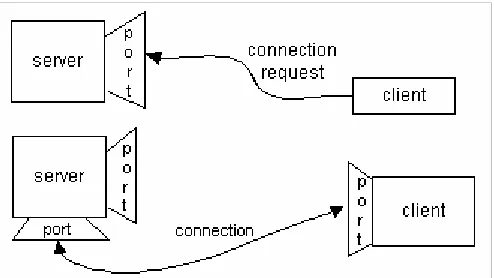
[image:16.595.211.458.326.465.2]The procedure for how a socket connection is made is that a client will attempt to connect to a server on a particular port; if this is successful the server will accept the connection and will create a new socket bound to a different port. This allows the connection to be made and reading and writing to occur over the socket while the server can continue to listen for incoming requests on the original port. This process is illustrated in Figure 2.1.
Figure 2.1 – The process of establishing a connection between two hosts using sockets (Sun Microsystems, 2002)
2.1.5.3 Java Servlets
Hunter & Crawford (1998) suggest that Java Servlets can in many ways be thought of as Java’s answer to Common Gateway Interface (CGI) scripts commonly found on many web servers in use throughout the Internet today. They provide the facility for dynamic content on web pages and are commonly used for creating web based applications. An example of a common Java servlet based web application could be a simple web page counter that keeps track of the number of visitors to a web page, or another could be a more complex online shopping system which allows visitors to select items for purchase and place them in an online “shopping cart”.
core Java API are supported by servlets, therefore anything that can be developed using a traditional Java application can be developed for use with or as a servlet.
Servlets are server extensions that sit on top of many common web servers such as Apache and provide a “Java class that can be loaded dynamically to expand the functionality of a server” (Hunter & Crawford, 1998, p. 6). Servlets run inside the Java Virtual Machine (JVM) of the server, with all computation occurring on the server side of the system, for example in the case of a counter the servlet calculates the visitor information and the result is displayed on the client web browser. Therefore support for Java is not required on the client side web browser for traditional servlet based applications. Figure 2.2 provides an overview of the typical servlet life cycle and shows how servlets are multithreaded and able to handle multiple requests from clients at the same time, i.e. concurrent sessions.
Figure 2.2 - The servlet life cycle (Hunter & Crawford, 1998, p. 6)
2.2 Web Browser Architecture
A web browser is the most popular method in use today to view information from the Internet. It acts as the “main client software residing at the user end, which interacts with a web server to retrieve documents for display on the clients screen” (Web Browser Architecture, pp. 1-2). The process of retrieving documents from the server also requires the browser to interpret what it has downloaded and then display the expected result. The common way this is achieved is through the use of the mark-up language known as HTML, which pages designed for the Internet are usually coded in.
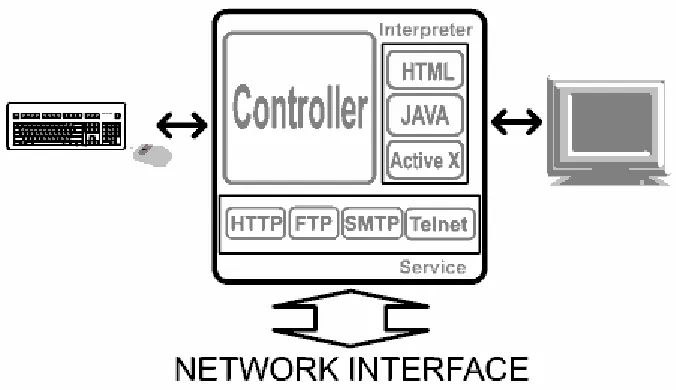
[image:18.595.164.502.481.676.2]However this only provides basic web page viewing capabilities. The baseline architecture of a web browser is constantly being expanded to provide new services. The result of this means that the architecture can be broken up into three primary components, the controller which provides interactions between the client and the user, the service modules which provides drivers for connecting to particular protocols such as HTTP (Hypertext Transfer Protocol) and FTP (File Transfer Protocol), and finally the interpreter module which provides the drivers for the browser to interpret the incoming document. These three levels of architecture are shown in Figure 2.3.
Figure 2.3 – The architecture of a Web Browser (Web Browser Architecture, pp. 1-2)
this would occur with HTML documents. However there is the potential for other documents such as Microsoft’s Active X and in particular Java Applets
2.2.1 Java Applets
The support for Java Applets within the web browser architecture is an area of particular interest in terms of distributed computing. Java applets are a Java programs that rather then running as a traditional application, runs from within the web browser environment. The Applet runs in the web browser through the Java runtime environment which is installed as a plug-in, this plug-in follows the standard Java runtime environment produced by Sun Microsystems.
A Java applet is very similar to a Java application in the features that it provides, including Java RMI and Sockets. Many of the distributed environments mentioned earlier require that a client be written using the features of a particular distributed language. This client then needs to be installed on a physical machine which then allows it to connect to a distributed application server and take part in that application. However Java Applets have an advantage in this area as a distributed client can be written as a Java applet, and then downloaded to a client machine on demand and run from within the web browser environment. This eliminates the need for any client software to be installed while still providing all the features of a distributed system. This concept will be discussed in further detail in Chapter 3.
2.3 Issues in Distributed Computing
While the idea of a distributed application or system running in a distributed environment may seem like a viable alternative to the more traditional approaches, it also introduces new issues that need to be addressed when implementing a system. Firstly the issue of security is one of the most difficult issues involved, as for example a distributed application has the potential to be exposed to outside parties compared to an application that was just run on a stand alone system.
Also scalability (ensuring a distributed system has the resources to service the demand), the robustness and reliability, efficiency, usability, and transparency from clients are all important issues that need to be addressed in a distributed environment. This section will discuss these issues in further detail.
2.3.1 Security
Security is arguably the biggest issue when developing a distributed system. This is because by connecting a client to a distributed system not only exposes it to the risks of being connected to a medium such as the Internet but it also opens it to risks from within the distributed system. The main areas at risk are common to all areas of computer security, these being confidentiality, integrity, and accessibility. Therefore, there are primarily two important issues when looking at security from these regards, firstly there is the security of the communication between the users or processes, and secondly the concept of access control or authorisation to a distributed system.
Authorisation is a crucial issue when looking at security and it is often approached by using secure channels and encryption between the users or processes. This will provide a secure channel that allows the system to “mutually authenticate the communicating parties, and protect messages against tampering during their transmission” (Tanenbaum & Steen 2002, p. 489). Access control is the other important security issue; for example authorising a particular user or process to take part in a distributed system. This can usually be achieved with the use of access control lists.
example banking information, may need high levels of security to ensure data is not compromised. The level of security often relies on the distributed system in use. Consider Java applets in a distributed system for example, special considerations need to be taken into account to ensure that firstly it is secure and secondly that it does not allow the applet to utilise resources outside of the sandbox (a secure area that allows an applet to run while not normally having access to local machine resources).
Security in Java and applets in particular has been significantly improved in recent years with the applet security model in Java2 becoming a “malleable system that could be expanded and personalized on an applet-by-applet basis” (McGraw & Felten, 1999 p. 81). This new security model and also the introduction of access control gives administrators more power over controlling security in Java or applet based distributed applications.
2.3.2 Scalability
Scalability is an important design goal for any type of programming, but it can add a layer of complexity to distributed systems especially those which span the world with the aid of technologies such as the Internet.
According to Tanenbaum & Steen (2002, pp. 10-13) there are three areas of which the issue of the scalability of distributed systems can be measured. These are scalable with respect to size, geographically scalable, and administratively scalable. Scalable with respect to size is crucial for a distributed system and it deals with how easy it is to add extra users to a system and the effect that this will have on that system. The key point with size is that a system needs to have enough resources to prevent a bottleneck occurring as the numbers of users grow.
environment (LAN) tend to be more reliable because they are functioning on an “in-house” environment.
Finally the administration issues with distributed systems can in fact be the most complex. This is especially an issue with large systems with huge numbers of users. The system needs to be designed in a way that protects each of the individual users from attacks within the distributed system.
2.3.3 Other Areas
There are a number of other areas that are important when dealing with a distributed system; these include the reliability, efficiency, usability, and transparency. Each of which will be discussed in the following.
2.3.3.1 Reliability & Robustness
Reliability and robustness are similar to the scalability of a distributed system, as it is important that a bottleneck is not created when a distributed system grows larger. It is also equally important that a system be reliable, for example if a client fails the system can continue to operate normally and is able to recover any lost work that may not have been completed by the client which failed. This also applies to servers on the system whereby if a server fails the system should have redundancy to allow it to continue to operate normally, minimising downtime.
2.3.3.2 Efficiency
Efficiency is a crucial area of distributed computing for a number of reasons. Firstly it needs to be efficient is such a way that it justifies the reasons for having the distributed system, i.e. it is futile to have a distributed system for something that could have been done easier and quicker on a single workstation. Efficiency is also important in the structure of a distributed system, for example ensuring that servers don’t become overloaded and therefore affect the performance of the system, this is usually overcome using load balancing.
2.3.3.3 Usability
allow users to interact with the specific parts of the system, for example client front end interfaces or a server administration interface.
2.3.3.4 Transparency
2.4 Current Trends
In September 1991 the Computer periodical published an article titled “Computer networks and distributed systems” that looked closely at the areas of distributed computing and the trends that it was expected to take over the coming decade. In the article Larry D. Wittie (1991, pp. 67-76) narrowed down these trends into three dominate themes:
• Tapping the immense data-carrying potential of optical fibres (Very high speed optical communication).
• Efficiency using tightly coupled networks of thousands of computers (Fast parallel and distributed computers).
• Making network access inexpensive so many people will buy the services (Ubiquitous networks).
As predicted, these where the three prominent areas that have effected distributed computing in the last ten years and it is still constantly evolving and adapting as new technologies are developed. High speed networks have helped this growth and many individuals and organisations are now starting to turn to the idea of distributed computing as a functional and cost effective alternative to the traditional supercomputers used for solving large problems. Of course one factor that has contributed to the success of distributed computing is the fast growth of the Internet in recent years. The Internet provides a strong backbone in which distributed systems can be built, whether they are local systems or a worldwide system.
2.4.1 Areas of work in Distributed Computing
Distributed systems are in use throughout much of the world today and the popularity of this type of system is constantly growing. This is primarily due to the fact that a distributed system can in many cases result in computing power that greatly exceeds the technological specifications and power of, for example, a single processor system, or expensive supercomputer. Access to this level of computing power has resulted in the number of major distributed system projects increasing.
Research and work in the area of distributed systems has also been accelerating in recent years, partly due to the rapid adoption of Internet technologies. Distributed computing is a very wide ranging area of work and research is being conducted into many of its fields, ranging from the latest object-based distributed systems to the less popular alternatives. Each type of distributed system has its advantages and disadvantages when applied to a particular task, so developers today have a number of possibilities to choose from when deciding the best system to use.
This section will look at several of the areas of research into distributed computing that are closely related to the focus of this thesis, in particular the use of Java as the backbone for distributed systems.
2.4.1.1 Java Applet in Massively parallel computing
The concept of JAM, Java Applet in Massively parallel computing, is research that is being conducted at the School of Computer Science at the Florida International University in the USA. The aim is to achieve high performance distributed computing using the Internet with distributed object technology. Yan & Chen (1999, p. 1) describe basic paradigm of the research as:
“A group of server machines that host a regular web server and a task server, and any number of client machines. Any computer equipped with a Web browser can join the client pool to contribute to the computing. This requires the user of the computer to visit the Web server, either by clicking on a hyperlink embedded in a Web page or by opening an URL address that actually leads to a Java Applet stored in the server”
proposed a distributed system that is based on Java sockets and the use of Applets in web browsers to act as the client to the distributed system server. This research has shown a number of advantages:
• There is a potentially huge client space, as any computer with an Internet connection and a web browser can take part in the system.
• It is also removes the overhead normally associated with distributed system clients of setting up the client and establishing the connection.
• Heterogeneous computing is achieved as any computer can take part so long as it has a web browser equipped with Java
[image:26.595.250.454.406.659.2]• There is a highly dynamic client pool where any computer can join or leave the distributed system at any time.
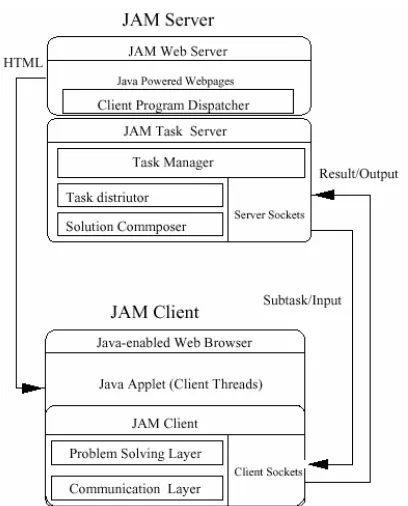
Figure 2.4 provides an overview of the computing scheme proposed by this research. It suggests that a server would act as a task manager, distributing parts of the overall task out to clients and also acting as a solution composer to build an overall solution from the results each client returns. At the client level, within the applet there will be a communication layer which provides the socket interface and also a problem solving layer which will work on tasks received from the server.
Figure 2.4 – The computing scheme of JAM (Yan & Chen 1999, p. 3)
systems, these are “startup (the time needed to start a parallel operation), interference (the slowdown due to access to shared resources), and skew (the level-off of the speedup as the number of parallel process increases and reaches a point where the size of each subtask is too small such that further partition of the task yields little gain in parallelism” (Yan & Chen 1999, p. 5).
2.4.1.2 SETI@home Project
SETI@home is one example of a project that is currently making use of distributed computing. The project is maintained by researchers at the Space Sciences Laboratory of the University of California, Berkeley and is involved in the search for extraterrestrial intelligence (SETI). Researchers use a 305 meter telescope to collect terabytes of data from the radio signals’ emanating from space, this data then needs to be analysed to determine if it is just noise from natural sources of radio emission or if it is in fact a possibility of extraterrestrial intelligence.
This task is potentially huge as “even a small portion of the radio spectrum would require more computational power then is available in the largest existing supercomputer” (Korpela et al. 2002, p. 78). However the process can be achieved through the use of distributed computing as the data collected can be broken up into “work units” which are frequency bands that are basically independent of one another.
The distributed system that is required to analyse this data is huge, therefore the research team make available a client that users can download from the Internet. These users can then install the client, which has been ported to most popular operating systems, on their computers which will then retrieve work units from the server. In effect the users join the distributed system and donate computer time CPU cycles to analysing this data, usually running as a screen saver when the computer is unattended. Once a data unit has been analysed the results are then returned to the server for further analysis.
There are a number of other distributed projects similar to SETI@home which are currently being undertaken with the aid of the Internet. Another example is the Distributed.net RC5 Project. This is a distributed project that attempts to find cracks in current encryption protocols (particularly RC5-64) commonly in use throughout the world today. The project is achieved by using distributed clients that attempt to “crack” encryption keys.
2.4.1.3 Mobile Agent Technology
Mobile agents are a technology that has been used for some time with distributed computing. Basically they are a distributed system that is capable of checking if a client machine is available and then distributing a distributed task to that system if it is willing to take part. There are a number of these agent systems available commercially and being successfully used within the computing industry, such as General Magic’s Odyssy, IBM’s Aglets, and ObjectSpace’s Voyager.
There has been a recent surge in interest in distributed mobile agent systems, Kiniry and Zimmerman (1997, p. 21) credit this to the widespread adoption of Java, and in particular several of Java’s features, saying that “serialisation, remote method invocation, multithreading, and reflection – have made building first-pass mobile agent systems a fairly simple task”.
With the widespread use of mobile agents there are also a number of research projects being conducted at various institutions throughout the world to extend the features provided by agents.
2.5 Summary
The use of distributed computing within the industry has exploded in recent years, and as a result distributed environments are no longer only a viable option for those setting up expensive clusters or supercomputers. With the massive growth of the Internet, distributed computing has been brought to the desktop of all computer users.
Farley (1998) suggests that there are three common motivations for using distributed systems and applications, these being:
• Computing things in parallel by breaking a problem into smaller pieces enables you to solve larger problems without resorting to larger computers. Instead, you can use smaller, cheaper, easier-to-find computers.
• Large data sets are typically difficult to relocate, or easier to control and administer located where they are, so users have to rely on remote data servers to provide needed information.
• Redundant processing agents on multiple networked computers can be used by systems that need fault tolerance. If a machine or agent process goes down, the job can still carry on.
Research underway in these areas of distributed computing is for the most part proving successful with many examples of practical distributed systems being developed. The SETI@home project is a prime example of a well designed distributed project used for analysing a large dataset. Another example is the work proposed by Dermoudy (2002), which considers how parallel execution, load distribution and speculative evaluation can be used in speeding up of the execution of functional programs in an attempt to provide linear speed-ups.
Chapter 3 M
ETHODOLOGY
Distributed Computing is often traditionally associated with a paradigm of fixed hosts; this approach is where a distributed system has a fixed number of clients taking part in a distributed task. In many cases these clients may have special hardware or software requirements in order to take part in this distributed system.
The following chapter presents the steps used in developing a dynamic distributed computing environment written in the Java programming language. This environment is designed to make use of computers with varying usage patterns which are connected to the Internet, thus, providing a distributed computing client base which is dynamically changing.
This provides a dynamic distributed computing environment where an administrator of a large distributed task can submit a task-set to a server and then allow dynamic clients to connect to the server to retrieve individual tasks for processing. These clients will then return the result of the task processing back to the server for viewing by the administrator or for further processing. The processes involved in these interactions between the server and clients will be discussed in further detail later in this chapter.
Also discussed is a description of an example problem that a distributed system such as the one presented here was originally intended to solve. The development of this system is intended to not only solve this problem but could easily be adapted to solve a range of other problems.
3.1 Crossword Problem
The first step in developing any distributed system is defining what the distributed system is going to be used for and in particular the problem that the system is attempting to solve.
form an overall result. These tasks may be totally independent of other tasks or may rely on the results of previous tasks in order for them to be solved successfully.
In the case of this work, the problem chosen to develop the distributed system around was that of a crossword. Crosswords are traditional problems that date back to the early twentieth century and the particular angle that this work will look at is that of a crossword solver or put more simply word guessing. Crosswords are made up of intersecting words, therefore the partitioning of an overall crossword into smaller tasks is a relatively easy process, as each task will form a word from the crossword.
The focus of this work is not primarily this problem; rather it is the development of a dynamic distributed system that can be used to solve this problem or similar ones. Therefore it is assumed for the sake of simplicity that each particular task, or word, of this crossword is independent of the other tasks, and therefore does not rely on the previous results. In this case this means that each task is a unknown word from the crossword and has a word length and at least one or possibly more known letters in certain positions in that word.
3.2 Distributed System
As previously established the language of choice for development of the dynamic distributed computing environment was the Java programming language. A number of key factors contribute to this choice over other languages used for distributed environments, the most crucial of these being the “reliability, simplicity, and architecture neutrality” (Farley 1998) of Java.
Java was not only built from the ground up to include the standard features available in other similar programming languages, but for it to be an Internet programming language as well. As a result the networking, security and multithreaded operations included in the language make it an ideal choice for a web browser based dynamic distributed system operating in an environment which is heterogeneous.
Two areas of Java are particularly well suited for this type of system, these being Java RMI which is included in the core Java API, and Java Servlets which are available as a standard extension to the core API. Both of these approaches have both benefits and disadvantages when being used to develop a system of this type. This work however will concentrate on the approach of Java Servlets, firstly because they are not usually associated with the area of a distributed computing environment of this type, and secondly because there is currently research being conducted within the school of a similar nature into Java RMI and its use in a web based distributed environment.
3.2.1 Java Servlets
Java Servlets have already been discussed in detail in the previous chapter (section 2.1.5.3). However it is important to note here why they are suited to the development of this type of distributed system. Servlets are primarily found in web applications and dynamic content, for example an online book store with shopping cart facilities, and are similar in nature to the more traditional CGI (Common Gateway Interface) scripts often found on web servers.
API they too provide the full networking capabilities required by a distributed environment.
3.2.2 Distributed Environment
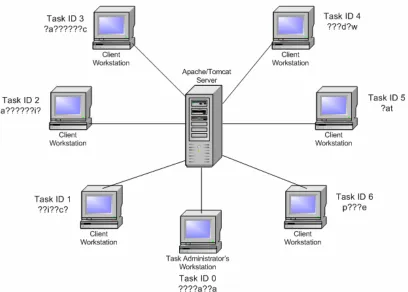
[image:33.595.130.538.326.618.2]The focus of this work is to develop a Java servlet based task system, including a server which receives task requests from Java applet based clients, most likely running inside the Java Virtual Machine (JVM) of a web browser. These clients will then receive a task from the server, in the case of the crossword problem an unknown word with some letters and positions identified from a crossword, and can then preform the required computation on the task and return the results back to the server which processes the results. An overview of this process is shown in Figure 3.1 below.
Figure 3.1 – The Java servlet based distributed server, with connected Java applet based clients.
The distributed system can basically be broken up into three separate components: The Server, Client Workstation and Task Administrator’s Workstation. The roles of each of these components are outlined below.
Client Workstation – Java applet based client workstation which includes a graphical user interface for user interaction with the task.
Task Administrator’s Workstation –Task and system administration comes from a normal client accessing a special set of web pages designed to retrieve and upload task information to the server. This workstation also provides all the features of the normal client applet, thus it can also take part in the current distributed task.
The development of a distributed system of this type was approached as a three step process, firstly to develop a standalone client to solve the problem, secondly to develop a server to manage the distributed system, and thirdly to adapt the standalone client to interface with a server and work in the web based environment. Both the client and server designs will be discussed in detail in the following sections.
3.2.3 Standalone Client
This stage involved the development of a single isolated component of the distributed application that is a totally independent Java application which processes unknown word information and produces a wordlist. This standalone application will form the basis of the client in the distributed environment. Figure 3.2 outlines the model used.
Figure 3.2 – Crossword Solver client as a standalone Java application
The client is made up of two classes, CrosswordSolver and GuessWord.
designed with the intention of later being integrated into a client system which can connect to a server all word information was simply hard coded. The GuessWord
class is the problem or task solver section of the client; it receives word length and known letter information from CrosswordSolver (Figure 3.2 - 1). A connection is established to a dictionary file which contains approximately 81,000 different English words each on a new line of the file (Figure 3.2 - 2). Each line of the dictionary is read and compared to what is known about the current task. If a word from the dictionary matches (i.e. it is the right length, and has known letters in the correct positions) it is stored in a results vector which is returned back to
CrosswordSolver once all words in the dictionary have been checked (Figure 3.2 - 3). Once the results are returned they are displayed on the user’s workstation via the Java console (Figure 3.2 - 4).
While this client is simple it provides the basic client task solving abilities that can be adapted into a Java applet based client that will work within the distributed environment.
3.2.4 Distributed Java Servlet Server
The server for the distributed computing environment forms the basis of this work. It is a servlet based server which provides the task and result management features as well as providing an interface for the client applets to connect to and take part in the current distributed task.
There are a number of possibilities in the way the system could be developed, particularly in regards to the protocol used for the clients to connect to the server. Two possibilities where considered; these being the development of a specialised protocol which could provide all means of communication between the servlet and the client, or the use of the existing HTTP protocol that servlets already commonly use to communicate.
server could be simplified using the standard HTTP GET requests to retrieve data and POST requests to send data.
Therefore the server is not tied to a custom proprietary protocol and allows it to interface with any client that supports the standard HTTP requests and responses in a way that the server understands.
The physical hardware being used to develop this server needs to be sufficient to provide accurate testing results of the distributed environment. Therefore the server chosen for this testing environment was a Sun SPARCstation 5 with 128MB RAM and 9GB hard disk. The server is running the Sun Solaris 9 operating system which includes the Java2 1.4 SDK and is compatible with the add-on Servlet 2.2 API being used to develop the servlets. An Apache web server is required to be installed for serving the standard web pages that make up the system, also installed is the Apache Tomcat server for deploying the servlets. In a real world distributed environment the hardware requirements for this system would be far greater.
The servlets which make up the server need to provide the following functionality:
Client communication and task distribution – provide the facility for clients to connect to the distributed task system server and request a task for processing.
Client database – the ability to store information such as the hostname and IP address of connected clients.
Task database – the ability to store information about tasks. For the problem discussed in this work this will take the form of a task string such as “??i??c?” for the word “science”. Also stored will be information about the task progress, i.e. allocated or unallocated, completed or uncompleted and the details of the client processing the task.
Task result management – the ability to store the task results returned from clients and mark each task as being completed once the results are received successfully.
Handle multiple requests – the system needs to be able to accept multiple clients attempting to connect at the same time. By default servlets are multithreaded; therefore this issue can for the most part simply be handled by the servlet API.
The proposed development is four cooperating servlets to handle the above mentioned functionality. These servlets were developed using version 2.2 of the Java Servlets API and receive requests from clients using the standard HTTP requests, GET and POST. The servl1ets will communicate with each other via the same means. This form of Interservlet communication is possible by the use of the
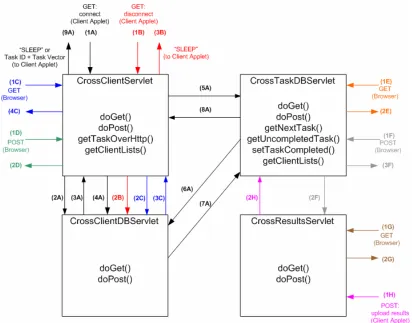
[image:37.595.128.540.326.649.2]HttpMessage class used in the client and described in more detail in section 3.2.5. Figure 3.3 below provides an overview of both the client interactions with the server and interservlet communications.
Figure 3.3 – The distributed task server showing the four primary servlets, client interactions with the server and interservlet communications
3.2.4.1 Server Scenario A: Client connects to the system
1. A client applet makes a connection to the server via CrossClientServlet
and using a GET request, passing the parameter “connect” (Figure 3.3 - 1A & Figure 3.4 - 1).
2. Using a GET request CrossClientServlet makes a connection to
CrossClientDBServlet (Figure 3.3 - 2A) requesting the current connected client lists. Two vectors are returned (clientList & clientListHostName), one containing client host name information, the other containing client IP address information (Figure 3.3 - 3A).
3. The client which is attempting to connect has it’s details compared to those currently in the list – if it is a new client it’s details (hostname and IP address) are transmitted back to CrossClientDBServlet using a POST request (Figure 3.3 - 4A).
4. CrossClientServlet compares the current client information to the vector (clientAuthList) of clients authorised to take part in the distributed system. If the client is not found in the list the servlet transmits a “SLEEP” message contained in an object back to the client as the response to the original GET request (Figure 3.3 - 9A & Figure 3.4 - 2) and this scenario continues no further until the client attempts to connect again after sleeping. Otherwise if a client is authorised a GET request is sent to the CrossTaskDBServlet requesting a task for the client (Figure 3.3 - 5A).
5. CrossTaskDBServlet first checks the task database for unallocated tasks, if one is found it is marked as allocated and the requesting client’s details are stored against that task. The task is converted to an object and then transmitted back as a response to the GET request from CrossClientServlet (Figure 3.3 - 8A).
CrossClientServlet (Figure 3.3 - 8A). If however the original client is still connected to the system it is assumed that the client is still processing the task and the servlet searches for another uncompleted task.
7. If no unallocated task and then no uncompleted task is found the servlet responds to the CrossClientServlet GET request with a “-1” indicating that no task is available at this time (Figure 3.3 - 8A).
[image:39.595.179.492.386.509.2]8. The CrossClientServlet analyses the response to its GET request and if it has received a new unallocated task or an uncompleted task it responds to the original client GET request with the task ID and the actual task vector, both stored in separate objects (Figure 3.3 - 9A & Figure 3.4 - 2). If however the servlet received “-1” it returns “SLEEP” contained in an object as a response, indicating that no tasks are available to the client at this time (Figure 3.3 - 9A & Figure 3.4 - 2).
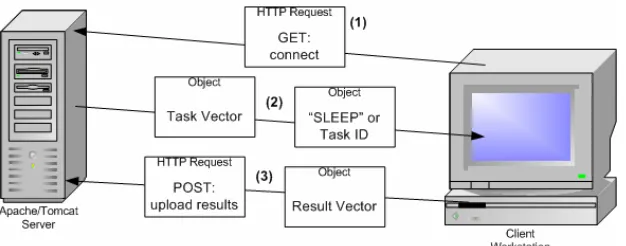
Figure 3.4 below illustrates a typical exchange between the client and server.
Figure 3.4 – The communication between the distributed task server and client. Showing the HTTP requests and the responses sent as a result of these requests.
In the case of (2) the task vector object is only sent if the first object was a task ID, otherwise the “SLEEP” object means that no task is available and it is all that is transmitted in this instance.
[image:39.595.284.385.622.740.2]Figure 3.5 below illustrates the object that is sent to a client containing a typical task vector.
3.2.4.2 Server Scenario B: Client disconnects from the system
1. A client applet makes a connection to the server via CrossClientServlet
and using a GET request, passing the parameter “disconnect” (Figure 3.3 – 1B). 2. CrossClientServlet processes the disconnect request and sends a POST
message to CrossClientDBServlet with the details of the client stored in an object (Figure 3.3 - 2B). The servlet receives the POST request and removes the client’s details from the client hostname and IP address vectors.
3. CrossClientServlet responds to the original disconnect GET request passing a “SLEEP” message contained in an object (Figure 3.3 – 3B). The “SLEEP” object is returned to the client to acknowledge that the disconnect request has been received successfully.
3.2.4.3 Server Scenario C: Browser requests client interface
1. A web browser makes a connection to the server via CrossClientServlet
and using a GET request, passing no parameters. (Figure 3.3 – 1C).
2. Because no parameters where passed with the request, the servlet interprets this as a request for the client selection interface (see section 4.3.4.2).
3. The servlet generates the HTML page and passes it back to the web browser as a response to the original GET request (Figure 3.3 – 4C). During the HTML page generation the servlet will make a connection to the
CrossClientDBServlet requesting (using a GET request) the connected client vectors (Figure 3.3 – 2C). This data is received (Figure 3.3 – 3C) and used to populate the currently connected clients HTML form component.
3.2.4.4 Server Scenario D: Browser posts data from client interface
1. A web browser makes a connection to the server via CrossClientServlet. 2. Using the POST request it transmits data collected from the client selection
interface (Figure 3.3 – 1D). This data will be list of clients authorised to take part in a task or a request to select all clients as being authorised.
4. The servlet acknowledges that the authorised client data has been received and generates a HTML page (listing the selected clients) and passes it back to the web browser as a response to the original POST request (Figure 3.3 – 2D.)
3.2.4.5 Server Scenario E: Browser requests task list
1. A web browser makes a connection to the server via CrossTaskDBServlet
and using a GET request, passing no parameters. (Figure 3.3 – 1E).
2. Because no parameters where passed with the request, the servlet interprets this as a request for a listing of the current tasks in the database.
3. The servlet generates the HTML page and passes it back to the web browser as a response to the original GET request (Figure 3.3 – 2E).
3.2.4.6 Server Scenario F: Browser posts task data
1. A web browser makes a connection to the server via CrossTaskDBServlet. 2. Using a POST request (Figure 3.3 – 1F) it transmits data collected from the task
management interface (see section 4.3.4.3). This data will either be a list of new tasks to be added to the task database or a request to clear all existing tasks in the system.
3. The servlet receives the data and first checks to see if the user selected the clear task database option. If so the task database is cleared and the servlet sends a blank POST request to CrossResultsServlet informing it to clear the task results database (Figure 3.3 – 2F).
4. Otherwise the data being posted is new task strings and this is stored in the task database vector (taskVector).
5. The servlet generates a HTML page (listing the new tasks added or a message saying the database has been cleared) and passes it back to the web browser as a response to the original POST request (Figure 3.3 – 3F).
3.2.4.7 Server Scenario G: Browser requests task results
1. A web browser makes a connection to the server via CrossResultsServlet
and using a GET request, passing no parameters. (Figure 3.3 – 1G).
3. The servlet generates the HTML page and passes it back to the web browser as a response to the original GET request (Figure 3.3 – 2G).
3.2.4.8 Server Scenario H: Client Applet transmits task results
1. A client applet makes a connection to the server via CrossResultsServlet, using a POST request with a parameter informing the servlet that results are about to be transmitted.
2. The client transmits an object containing a vector with includes the task ID information and the results of a task (Figure 3.3 – 1H & Figure 3.4 - 3).
3. The object is received and the task ID is extracted from the vector leaving only the results for that particular task which are then stored within the result database vector (wordVectorResults).
4. The taskIDVectorResults vector is used to store the task IDs of each task in the order they are received by the server.
5. The servlet then sends a POST request to CrossTaskDBServlet informing it that the task has completed and the number of results received for that task. (Figure 3.3 – 2H).
6. CrossTaskDBServlet receives this message and then marks the specified task as being completed.
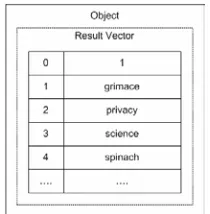
[image:42.595.281.386.535.642.2]Figure 3.6 below illustrates an example result object transmitted between the client and server
Figure 3.6 – The object transmitted between the server and client containing a set of task results. The object contains a vector of results, of which the first element is the task ID for the task
3.2.5 Java Applet based Client
Applet with a graphical user interface (GUI) which allows the end-user easier access in controlling the client as well as providing status information (see section 4.3.4.4).
As already mentioned the server has been designed to use standard HTTP requests to communicate with clients. This means that the client needs to be adapted so that when requesting a task to process it sends a GET request to the server, and then when returning results uses a POST request to transmit the result data. This functionality is provided through the use of the third party class - HttpMessage. The
HttpMessage class has been developed by Hunter, J. for the O’Reilly & Associates publishing group and provides a general-purpose class for HTTP communication between applets and servlets, and in the case of the server interservlet communications between servlets.
HttpMessage allows multiple GET and/or POST requests to be sent to a servlet at a specified URL. Data can be transferred with these requests as serialized Java objects, serialisation being a feature of the java.io package and is the ability to “convert an object into a stream of bytes that can later be deserialized back into a copy of the original object” (Flanagan 1999). Serialization makes it possible to transmit the object via the HTTP protocol, and is ideal for the transmission of task data and results, both of which are contained in vectors. The HttpMessage class is described in further detail in Hunter & Crawford (1998, pp. 289 - 296).
The client has no specific hardware requirements, except that of the Java2 Runtime environment (version 1.3 or 1.4) which is required for the applet Hardware will however affect the speed at which the client can process a task. A Java compatible web browser or applet viewer is also requited to view and interact with the client.
In addition to GUI and server connectivity the distributed version of the client needs to provide the following functionality:
controls all server communications and task solving. This means that this thread could be put to sleep without affecting the overall applet and its GUI components.
Easily adaptable to another task – The client should be easily adaptable to any type of task not just the Crossword problem. This is achievable because in this case the GuessWord class does the bulk of the task processing, while
CrosswordSolver provides the applet interface and servlet communications. Therefore meaning that the GuessWord class could simply be replaced with another class for a new type of task, however some minor changes to CrosswordSolver
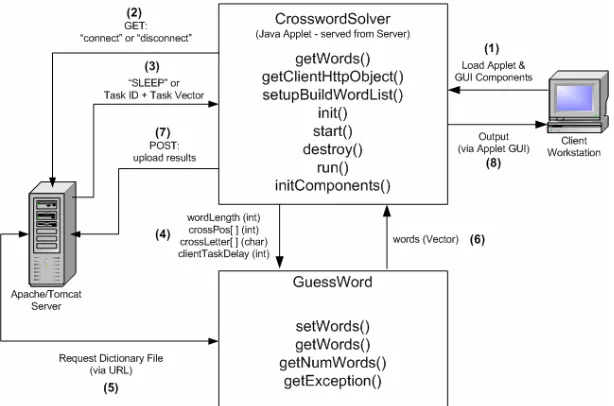
[image:44.595.181.488.297.500.2]would be unavoidable. Figure 3.7 below provides an overview of the modified client which now runs within the distributed environment.
Figure 3.7 - Crossword Solver client operating within the distributed environment
The basic structure of the standalone client still exists; however the
An example of a basic client/server exchange follows:
1. A client workstation would visit the web page to load the client applet (Figure 3.7 - 1).
2. The user would click the “Connect” button and the applet would send a GET request with the parameter “connect” to CrossClientServlet on the server (Figure 3.7 - 2).
3. The server will as a response to the GET request either return an object containing the string “SLEEP” in which case there are no tasks available for this client and it will sleep for 30 seconds before repeating the GET request again, or the server will return an object containing a task ID followed by another object contain a task vector (Figure 3.7 - 3).
4. The task vector will be converted into the form GuessWord is expecting (word length and known letter information) and then passed to the
GuessWord class for processing (Figure 3.7 – 4).
5. GuessWord will establish a connection back to the server requesting the web page containing the word dictionary (Figure 3.7 – 5).
6. Each line of the dictionary is read and compared to what is known about the current task. If a word from the dictionary matches (i.e. it is the right length, and has known letters in the correct positions) it is stored in the results vector which is returned back to CrosswordSolver once all words in the dictionary have been checked (Figure 3.7 – 6).
7. The task ID of the current task is appended to the first element of the result vector for identification purposes.
8. CrosswordSolver then makes a POST request to
CrossResultsServlet passing the results vector back to the distributed server (Figure 3.7 – 7).
9. Finally the client will check if the user requested to see the results of the task via an option on the client interface. If so the results will be displayed on the client interface (Figure 3.7 – 8) and a GET request will be sent to the server with the parameter “disconnect” informing the server that the client should be disconnected from the distributed system (Figure 3.7 – 2).
the process again attempting to connect and retrieve a new task (Figure 3.7 – 2). This process will continue until the user selects the “Disconnect” button on the client interface.
3.2.6 Implementation
This section provides an overview of the classes and methods used in developing the distributed server and client
3.2.6.1 Server
The server requires that the GET and POST requests in CrossClientServlet,
CrossTaskDBServlet, and CrossResultsServlet are synchronised in such a way that allows only either one GET or POST request per servlet to occur at any one time. Java provides this ability by default through the use of synchronisation and any requests that occur when another is already in progress will simply be queued.
The reason for this requirement is that the servlets use global variables for storing task information and if multiple requests are allowed to occur at the same time it increases the chance of the information being transferred getting mixed together. This only has a limited effect on the performance of the server as the GET and POST requests are normally only brief connections.
The source code for the Java servlet based distributed server developed in this work is provided in Appendix A of this thesis. The following is an overview of the implementation used for the server.
CrossClientServlet
This servlet is the first point of contact for a client with the server. It manages all communication with the clients as well as providing access control to authorised clients and distributing tasks.