Ultratrace determination of aluminium
in seawater and complex samples
'
by
Juliette Tria
A thesis submitted in fulfilment of the requirements for the
degree of
Doctor of Philosophy
UNIVERSITY
OF
TASMANIA
DECLARATION
To the best of my knowledge, this thesis contains no copy or paraphrase of material previously published or written by another person, except where due
reference is made in the text of the thesis.
AUTHORITY OF ACESS TO COPYING
This thesis may be made available for loan and limited copying in accordance with the Copyright Act 1968.
ACKNOWLEDGEMENTS
Firstly, I would like to thank my supervisors: Andy for providing me with a PhD
project that interested me enough to stay in Hobart. Ed, for his continual interest in
my progress and willingness to help out wherever possible. Paul for his knowledge
and understanding, especially when things got a bit stressful. And finally but by no
means least, Pavel. For his enthusiasm, lively discussions (even when lost in
translation!), patience and kindness. But above all else for helping me find a means to
successfully complete this PhD and for providing me with direction. I am very much
indebted. Additionally, I'd like to acknowledge Ch!is Measures for his interest and
help during my struggles with FIA!
I would also like to thank members of ACROSS and the Chemistry and Pharmacy
Departments in general, for providing a friendly work environment. In particular,
Emily Hilder, Michael Breadmore, Anne Palmer and Peter Traill for providing
willing ears and advice throughout the years.
I'd especially like to thank my surrogate supervisor and friend Bron Wake. For her
interest and help showing me the ropes, particularly with regard to CSIRO resources.
To both Bron and Krystyna. Where would I have been without our walks and coffee?
Thanks so much for the friendship and understanding of PhD life!
To the Capri Gang. Can't say how much I appreciate everyone's friendship and for
welcoming me into your tight knit group! I'm extremely lucky to have such amazing
friends. Thankyou for providing the perfect outlet for a venting PhD student, for the
shack missions and for keeping me active with bushwalks, tennis and the likes!
To my family and friends. I am so fortunate to have always been surrounded by so
much love and support. In particular, my parents and Lou and James. Words can't
of the way and have always encouraged me and provided me with strength and
determination, not only during my PhD but throughout life. I feel very blessed to be
part of such a close family.
Finally, to my husband Hamish. Firstly, for marrying me, even in the middle of my
PhD! ! ! For your love, comic relief, generous and kind nature, fishing trips and
unwavering confidence in me. Maybe now we can have a normal life ... I'm looking
forward to it!
Special Acknowledgement
I would like to acknowledge two very influential and dear people in my life.
Firstly, to Nonno. Both Nonna and you gave up so much to start a new life in
Australia and for the opportunities your sacrifices have given me I will always be
grateful. You have always instilled in me a hard working attitude and I will always
remember your selfless nature and cheeky sense of humour.
To my beautiful Nan. I know you would have been very proud of this achievement
but nothing is more inspirational to me than the person you were. Your gentleness,
\
strength and loyalty are qualities I have always admired and can only hope to achieve.
HPCIC
IC
ICP-MS
PCR
PCV
CAS
ECR
IDAS
CTAB
FIA
8-HQ i.d. M pKa LOD LOQLDPE
ANN
MESLIST OF ABBREVIATIONS
high performance chelation chromatography ion chromatography
inductively coupled plasma mass spectrometry post column reaction
pyrocatechol violet chrome azurol S eriochrome cyanine R iminodiacetic acid silica
cetyltrimethylammonium bromide flow injection analysis
8-hydroxyquinoline internal diameter moles/L
negative logarithm of acid dissociation constant limit of detection
limit of quantification low density polyethylene artificial neural network
LIST OF PUBLICATIONS
1. J. Tria, P.R. Haddad and P.N. Nesterenko. Potential applicability of a high performance chelation ion chromatographic method to the determi!-Jation of aluminium in antarctic surface seawater, Chemicke listy.102 (2008)
s319-s323.
2. J. Tria, P.R. Haddad, P.N. Nesterenko, Determination of alluminium using high performance chelation ion chromatography, Journal of Separation Science. 31 (2008) 2231.
3. J. Tria, E.C.V. Butler, P.R. Haddad, A.R. Bowie, Determination of aluminium in natural water samples, Analytica Chimica Acta. 588 (2007) 153.
4. J. Tria, P.N. Nesterenko, P. Haddad, Potential applicability of high
performance chelation ion chromatography to the determination of aluminium in Antarctic seawater, Oral, Chemistry and Life 2008, Bmo, Czech Republic.
5. J. Tria, P.N. Nesterenko, P. Haddad, Recent developments in the
determination of dissolved aluminium using high performance chelation ion chromatography, Oral, RAC! R&D Topics 2007, Adelaide, Australia.
6. J. Tria, A.R. Bowie, P.R. Haddad and E.C.V. Butler, Application of shipboard determination of aluminium in seawater to dust deposition
studies in the Ross Sea, Antarctica, Oral, INTERACT 2006, Perth, Australia.
8. J. Tria, P.N. Nesterenko, P. Haddad, Aluminium as a tracer for dust deposition in the Ross Sea, Antarctica, Poster,_RACJ R&D Topics 2006, Woollongong, Australia
9. J. Tria, P.N. Nesterenko, P. Haddad, Quantifying the impact of dust
ABSTRACT
Oceanographers use surface aluminium concentrations in open-ocean seawater as a
tracer to fingerprint the location and magnitude of atmospheric dust deposition. It has become increasingly important to understand the role that such deposition plays in
supplying trace elements to surface waters and consequently the effects such episodic
supply has on moderating biological processes. For the purpose of real time analysis,
quantification must be carried out by a system capable of being deployed shipboard.
The most commonly employed technique for this purpose is flow injection analysis
(FIA).
This project aimed to develop a method for the onboard quantification of aluminium
in seawater, specifically for the analysis of Antarctic surface waters. Initially, the
project focussed on the establishment and optimisation of a FIA system incorporating
fluorescent detection ·of the aluminium-lumogallion complex. Significant variables
affecting the lumogallion chemistry; including, reaction pH, lumogallion
concentration and reaction time were optimised for this specific FIA system. Since
aluminium concentrations in Antarctic seawater are expected to be in the minomolar
to subnanomolar range, investigation into the addition of an 8-hydroxyquinoline
column to the manifold, for preconcentration purposes, was carried out. Although
initial work involving quantification of aluminium in seawater samples appeared
promising, complications .with the robustness of this technique forced an alternative
method to be sought.
High performance chelation ion chromatography (HPCIC) was considered a suitable
alternative for development as a technique for the purpose of shipboard quantification
of aluminium in seawater. The HPCIC system developed, involved the novel use of
iminodiacetic acid functionalised silica for the separation of aluminium. Separation
conditions, such as eluent composition and column temperature were optimised. Both
photometric and fluorometric detection s;:stems were developed, employing post
detection, Eriochrome® Cyanine R, which was used for the first time for PCR
determination of aluminium in a flow system, was found to be the most sensitive. A
limit of detection of 100 nM for a 100 µL injection volume was achieved for this
particular system.
For the HPCIC system with fluorescence detection, lumogallion was the reagent of
choice given its reported high sensitivity. Variables such as buffer type and pH, as
well as temperature and lumogallion concentration were optimised. A limit of
detection of 0.39 nM for a 500 µL injection volume was obtained, with the
performance of the system with a variety of other injection volumes also examined.
Finally, this study presents a discussion on the applicability of the newly developed
HPCIC system to the quantification of aluminium in real samples. This work involves
the analysis of paper mill process water and seawater from the Ross Sea, Antarctica.
Particular attention is given to the topic of aluminium speciation with sample
acidification. Conclusions and suggested future direction of studies in this area
TABLE OF CONTENTS
CHAPTER ONE
1
INTRODUCTION
1.1 Overview ... 1
1.2 Background ... 2
1.2.1 Aluminium in seawater ... 2
1.2.2 Use of aluminium for dust deposition calculations ... 7
1.2.3 Aluminium speciation ... 8
1.3 Analytical Techniques: Separation/Preconcentration and Detection Methods for Trace Aluminium ... 11
1.3. l 1.3.2 1.3.2.1 1.3.2.2 1.3.2.3 1.3.2.4 (i). (ii) (iii) (iv) (v) 1.3.2.5 Overview ... 11
Review of Current Literature ... 12
Atomic spectrometry ... 12
Voltammetry ... 16
Electron capture detection - gas chromatography ... 17
UV-Vis spectrophotometry and fluorometry ... 18
Lumogallion ... 19
8-hydroxyquinoline ... 23
Salicylaldehyde picolinoylhydrazone (SAPH) ... 25
Morin ... 26
Other fluorescent reagents ... 27
Chelation ion chromatography ... 27
1.4 Shipboard Determination of Trace Aluminium in Seawater ... 30
1.4.1 Overview ... 30
1.4.2 Fluorescence detection with lumogallion ... .' ... 32
1.4.3 FIA with fluorescence detection using lumogallion ... 33
CHAPTER
Two
38
METHODS AND MATERIALS2.1 Practical Considerations ... 38·
2 .1.1. Contamination risks ... 3 8 2.1.2. Storage bottles ... 39
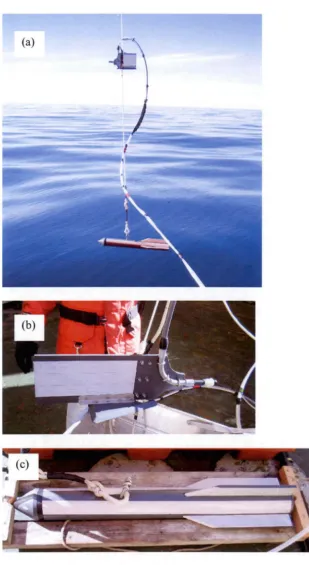
2.1.3. Oceanographic sampling ... 41
2.1.4. Filtration ... 44
2.1.5. Sample enrichment. ... 45
2.2 FIA ... 46
2.2.1 Reagents ... 46
2.2.2 Apparatus ... 46
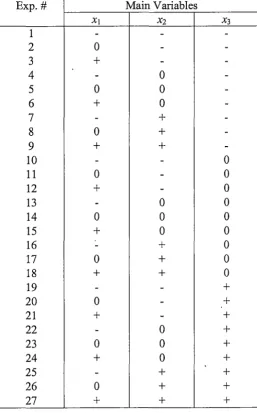
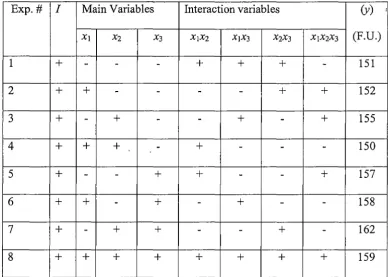
2.2.3 Design of experiments ... 49
2.2.4 Experimental procedure ... 49
2.2.5 Statistical modelling and neural network simulation ... 50
2.3 HPCIC with Photometric Detection ... 51
2.3.l Reagents ... 51
2.3.2 Apparatus ... 52
2.4 HPCIC with Fluorescence Detection ... 52
2.4.1 Reagents ... 52
2.4.2 Apparatus ... 53
2.5 Samples ... 54
2.5.1 Paper mill process water sample ... 54
CHAPTER THREE
55
FIA WITH FLUORESCENCE DETECTION3.1 Introduction ... 55
3 .2 Background to Statistical Optimisation ... 56
3 .2.1 Overview ... 56
3.2.2 Multivariate full factorial experimental design ... 56
3.2.3 Neural networks ... 62
3.3 Optimisation of Lumogallion Chemistry ... 65
3 .3 .1 Choice of experimental variables ... '. ... 65
3.3.2. 3.3.3 Preliminary investigation into lumogallion concentration ... 65
Results of optimisation experiments ... 67
3 .3 .4 Analysis of optimisation results: Statistical modeling based on general linear regression ... 69
3.3.4.1 Model selection ... 69
3.3.4.2 Model Testing ... 72
3.3.5 Analysis of optimisation results: Artificial neural networks ... 7 5 3.3.5.1 Model generation ... 75
3.3.5.2 ANN performance ... 77
3.3.5.3 Optimisation of variables ... 77
3.4 Performance of the FIA System ... 79
3.5 Preconcentration Using 8-Hydroxyquinoline Functionalised Resin ... 84
3.5.1 Synthesis of 8-hydroxyquinoline functionalised resin ... 84
3.5.2 Functionalised resin capacity ... 86
3.5.3 FIA with preconcentration using 8-HQ functionalised resin ... 87
3.5.3.1 Carrier ... 87
3.5.3.2 Milli-Q water standards ... 88
3.5.3.3 Online buffering ... 89
3.6 Difficulties Encountered with FIA System Using Preconcentration on 8-HQ
Functionalised Resin ... 93
3.7 Conclusions ... 97
CHAPTER FOUR
98
HPCIC
SEPARATION OF ALUMINIUM 4.1 4.2 4.2.1 4.2.2 4.2.3 4.2.4 4.3 4.3.1 Introduction ... 98Optimisation of Separation Conditions ... 99
Overview ... 99
EluentpH and ionic strength ... 101
Column temperature ... 104
Final adjustments to separation conditions ... 108
Photometric Detection of Aluminium ... 110
Overview ... 110
4.3.2 Optimisation of post-column reaction detection ... 110
4.3.2.1 Post-column reaction detection ... 110
4.3.2.2 Tiron ... 111
4.3.2.3 ·Alternate PCR reagents ... 111
(i) Pyrocatechol violet. ... 112
(ii) (iii) 4.3.2.4 Eriochrome Cyanine R ... 112
Chrome Azurol S ... 113
Comparison of PCR reagents ... 114
CHAPTER FIVE
117
FLUORESCENCE DETECTION OF ALUMINIUM
5.1 5.2 5.3 5.4 5.4.1 5.4.2 5.4.3 5.4.4 5.5 5.6
Introduction ... 117
Separation Conditions ... 118
Background Fluorescence ... 119
Optimisation of Lumogallion-Based PCR ... 119
Buffer ... 119
Temperature of PCR ... 122
Lumogallion concentration and reaction coil length ... 122
Effect of surfactant addition ... 124
Effect of Injection Volume ... 125
Conclusions ... 127
CHAPTER SIX
130
APPLICATION OFHPCIC
TO REAL SAMPLES 6.1 Introduction ... 1306.2 Analysis of Paper Mill Process Water ... 131
6.3 Analysis of Seawater Samples ... 135
6.3.1 Overview ... 135
6.3.2 Calibration ... 136
6.3.3 Injection Volume ... 136
6.3.4 Quantification of Aluminium in Seawater Using HPCIC ... 140
6.3.5 Aluminium speciation in acidified seawater ... 149
CHAPTER SEVEN
157
CONCLUSIONS AND FUTURE WORK
7 .1 Project Summary ... 157
7 .2 Suggested Future Work ... 160
7 .3 Conclusions ... 161
Chapter.One
-Introduction
1.1
Overview
The focus of this project is on the development of a technique capable of being
deployed shipboard for real-time determination of aluminium in seawater. The chosen
analytical system was intended for use during a cruise of the Ross Sea, Antarctica in
2005-2006 and for subsequent work thereafter. Aluminium concentrations in
seawater are used to trace dust deposition events, which are extremely important to
the supply of trace elements and subsequent biological processes. Very little is known.
about dust supply to the Southern Ocean; however, oceanographers estimate
atmospheric deposition to be limited. Subsequently, aluminium concentrations in the
region are expected to be in the nanomolar to sub-nanomolar range. The method
established during this project consequently had to be not only suitable for use aboard
a ship, but also capable of determining extremely low concentrations of aluminium in
such a complex matrix as seawater.
The following chapter discusses the biogeochemistry of aluminium in the ocean, its
suitability as a tracer for dust deposition, existing methodologies for determination of
aluminium in a range of natural water samples, as well as introducing the aims of the
1.2 Background
1.2.1 Aluminium in seawater
Aluminium is the third most abundant element in the Earth's crust (8.1 % by weight)
[1], but exists at only trace (nanomolar) concentrations in seawater. These very low
concentrations (e.g. <0.5 nM in deep waters of the North Pacific; Figure l.l(a)) can
in part be explained by a balance between its input and removal processes [2]. Early
studies [3] suggested that the concentration of dissolved aluminium in open-ocean
was controlled predominantly by fluvial inputs. However, Maring and Duce [4] have
since demonstrated that fluvial contributions to the remote ocean are negligible.
Although early estimates of global riverine flux of dissolved aluminium were
between 15 and 110 Gmol yr-1 [3], it is now lmown that the majority is lost to
estuarine sediments [ 4-8] and through biological processes in the coastal ocean
[9-12]. In contrast, aluminium-laden particles of aeolian dust with radii <5 µm are
capable of long-range transport and deposition in the open-ocean, where they have
atmospheric residence times of up to several days [ 4]. Aeolian dust, predominantly
from the great deserts of the world, is therefore considered to be the likely major
source of aluminium to the open ocean. Vertical profiles of aluminium in major
oceans have shown that a further minor input occurs in deep waters, most likely from
dissolution of sedimentary particles [13] (Figure 1.1 (a)).
Vertical profiles of dissolved aluminium in the Pacific and Atlantic Oceans
surface waters, mid-depth minima and an .increase at the base of the water column.
Aluminium is known to exhibit a scavenged-type distribution; that is, it has strong
interactions with particles and a short residence time [14]. Although both oceans
follow this type of vertical structure for dissolved aluminium, the concentration
ranges are markedly different (8-40 times lower in the central North Pacific than in
the central North Atlantic) [ 15]. This inter-ocean fractionation can be attributed to
geographical variations, principally in the atmospheric flux experienced by the
different ocean basins.
The Atlantic Ocean is subject to major inputs from the vast Sahara Desert, whereas
the majority of the Pacific Ocean does not have such influential terrestrial sources,
although the NW Pacific may receive dust from the Gobi desert [16]. These Saharan
inputs significantly influence aluminium levels due to the relatively small size of the
Atlantic Ocean compared to the Pacific Ocean. High surface aluminium
concentrations in the Atlantic are also reflected in deep waters due to dissolution of
previously absorbed surface aluminium on sinking particles [17]. The highest levels
of aluminium have been observed in the semi-enclosed Mediterranean Sea
(Figure 1.1 (b) ), a body of water that does not typically demonstrate a surface
maximum [18].
Aluminium is characterised by its relatively short (2-6 yr) residence time in surface
seawater [19, 20]. This short residence time can largely be attributed to the element's
rapid hydrolysis rate and the extremely low solubility of the hydrolysis products [21].
Dissolved Al (nM)* Dissolved Al (nM)
0 5 10 15 20 0 50 100 150 0
«
0•
•
•
:·
• •
..
•
..
•
•
I
•
•
1000
•
•
•
•
•
500•
••
•
2000
•
•
•
EE
•
-
1000-
•
.r:.•
.r:.
--
•
Q.Q. G)
Cl) 3000
•
c
•
c
•
•
•
1500•
4000
•
•
•
•
•
•
20005000
•
•
•
•
• Pacific Ocean
•
• Atlantic Ocean
I
•
tv'editerranean Seal6000 2500
Figu.re 1.1.
(a) Vertical profiles of dissolved aluminium for the Pacific and Atlantic Oceans [17,
19].
(*Original concentrations of aluminium in the Pacific Ocean were given in nmol kg-1)
Al(OH)3 and Al(OHk, are extremely particle-reactive [15]. Removal of aluminium
from seawater may occur by either passive or active processes [19]. Passive
adsorption or scavenging is believed to be the major form of removal, as
demonstrated by the vertical distributions of dissolved aluminium in the major ocean
basins, and occurs via interaction with particles, both inorganic or organic in nature
[15]. Active biological uptake by plankton has also been demonstrated to occur,
although evidence of this is limited to studies on coastal waters, the Mediterranean (a
confined marine basin), and in the laboratory [3, 10-12, 22, 23]. Additionally, the
mechanism of biological removal is uncertain [24] and in part may be the result of
increased adsorptive scavenging due to heightened particle fluxes during periods of
increased primary productivity [19, 25], rather than uptake into cellular tissues [23].
A schematic of the biogeochemical cycle of aluminium is given in Figure 1.2. A
thorough understanding of the marine geochemistry of al,uminium is important for
several reasons. Recently the focus has been on the use of aluminium as a tracer to
fingerprint the location and magnitude of aeolian dust deposition. Atmospheric dust
inputs are a: significant source of several trace elements to the surface waters of the
open-ocean. Delivery of trace metals (such as iron) to the ocean surface may occur
directly by dry deposition (dust) or indirectly by wet deposition (rainfall) [26]. Iron is
of particular interest since although it is an element essential for the growth and
metabolism of all marine organisms [27-30], its concentration in the surface ocean is
extremely low (0.1-0.5 nmol L-1) [31] and limits the growth of marine phytoplankton,
in about 40% of the World's oceans [32]. Thus, increases in dissolved iron
.
OPEN OCEAN
Atmospheric Deposition (wet & dry) Al - silicates
- 3.8-6. 1 Tg/yr (drssolvable}a
t
Hydrolysis.
' ' Scavenging (adsorption onto particles) ---~---~---.
' A.. ' '.
'.
' ' \ ' ..-··F-~~~~1-~~~~t-....
"·-..
~~?~.~?~~~~---·/
'
.
'
'
Vertical Transport
af\9
Deposition Upwelling andVertical Mixing
.
' '
.
'
~1
Dissolved Aluminium "11{• · - · · - · · - · · - · ·-· · - · • Sedimentation dissolution of sediments
e.g. Al-silicates organic-Al w z
2
(.)§
:c a. :::> w cc w ~ ::= a. w w 0Figure 1.2. Biogeochemical cycle of aluminium. The weighting of the arrows
indicates how significant the particular pathway is to the overall cycling of
aluminium.
a
Magnitude of dissolvable aluminium calculated from values given Ill
[image:22.570.101.484.99.553.2]stimulation of primary phytoplankton production and the subsequent drawdown from
the atmosphere of climatically-important gases required for photosynthetic biological
processes (e.g. C02) [33]. A reliable method for monitoring the atmospheric input of
iron-laden dust to the ocean is thus imperative to furthering our understanding of
Earth's climate control system.
1.2.2 Use of aluminium for dust deposition calculations
The concentration of dissolved aluminium in surface marine waters has been used
successfully as a proxy for dust deposition in the ocean [2, 34]. The MADCOW
(Model of Aluminium for Dust Calculation in Oceanic Waters) model first proposed
by Measures and Brown in 1996 [2] estimates the annual dust input required to
maintain background dissolved aluminium concentrations against an annual
scavenging flux of 20% of the existing Al signal. The model assumes an average
surface water residence time of 5 yr and a mixed layer depth of 30 m. As a result,
comparisons between calculated and measured concentrations for different areas of
the global ocean are not all in good agreement. However, Measures and Brown [2]
note that local scaling of such parameters is anticipated to improve results.
Estimates of dust deposition to surface waters, calculated by the MADCOW model
can be used to provide information on the atmospheric delivery of a variety of other
trace metals, including iron. Research has been undertaken to calculate the total input
of iron (dissolved plus particulate) from the calculated dust fluxes, with the
-assumption that continentally-derived dust contains 4.3% iron [35]. Based on the
total flux has also been investigated. Although it was assumed initially that the Al/Fe
molar ratio of the aeolian dust would be reflected in surface ocean waters, much
higher than expected ratios have been observed [36, 37]. This indicates that iron
solubility, along with its rapid removal by biological uptake, controls the extent of
dissolution of aeolian-delivered iron and thus the observed surface water
concentrations.
In order to ensure models such as MADCOW are reliable, there is a need for the
development of robust and portable instrumentation capable of the precise, rapid and
accurate determination of aluminium at extremely low concentrations (detection limit
approaching 1 nM) during oceanographic expeditions. Consequently, in recent years
much research has been undertaken not only to improve the methods of determination
employed for trace elements such as aluminium, but also the entire analytical
procedure starting from sample collection and filtration.
1.2.3 Aluminium speciation
It is important to consider the speciation of aluminium when selecting particular quantification techniques. Fractionation methods have developed primarily in
response to the realisation that toxicity effects of aluminium depend largely on its
chemical forms. Labile positively charged aqua- and hydroxy-mononuclear
aluminium complexes have been reported as the most toxic to aquatic organisms and
Aluminium speciation is somewhat difficult in aquatic systems, in which aluminium
exists in numerous forms including: free Al3+, Al-hydroxide complexes, monomeric
fluoride complexes and various organic complexes. This difficulty arises due to
several factors including: the participation of aluminium species in dynamic
I
reactions, their low concentration and the presence of complex matrices that have the
potential to interfere with analytical detection systems [39]. Distribution of
aluminium species is dependent on factors such as pH, total concentrations of specific
ligands and dissolved organic carbon [ 40] and it must be realised that inappropriate
sample manipulation, storage and separation processes can alter the true distribution
of species [41, 42].
The fractionation of aluminium is normally defined operationally since the content of
real samples is very difficult to determine exactly. Fractions are given terms such as
'total reactive' and 'total monomeric' and generally contain multiple species, e.g for
'total monomeric', all inorganic and organiG monomeric complexes. Aluminium
speciation typically involves either a theoretical or experimental approach. The
theoretical procedure involves the use of thermodynamic data together with the
concentration of total aluminium and significant ligands, determined analytically. The
experimental approach involves separation of species based on different reaction
kinetics with a complexing reagent and/or separation based on size or charge of the
species.
Clarke and co-workers [43] give a thorough review of methods published up until
review focuses on fresh water examples only. This work classifies the main
fractionation principles as: (1) kinetic or binding strength discriminations; (2) ion
chromatographic separations; (3) size exclusion; ( 4) non-invasive methods; (5) ion
mobility in an electric field; ( 6) minimised disturbance.
Pyrzynska et al. [39] also present a review on aluminium speciation in natural waters.
This review pays particular attention to the specific problems associated with
aluminium speciation analysis and highlights some of the more applicable methods
that have been developed. The same authors present a subsequent review of
aluminium speciation in natural waters with particular focus on flow-injection
methodologies [44]. The analytical performance of several separation procedures
based on flow-injection analysis, as well as the detection methods are discussed and
compared.
Five methods used in different laboratories in Norway and Finland for the
fractionation and subsequent determination of aluminium were compared and the
results presented in a paper by Wickstrom and co-workers [ 45]. Different
fractionation principles, types of cation exchanger, reaction time, flow systems and
determination techniques were tested. It was reported that of the procedures studied, determination of the labile fraction was best achieved using ICP-AES with an
Amberlite column. The authors also present a discussion on the influence of various
parameters on the distribution of the species and the effects of filtration and sample
In more recent years, Bi et al. [ 40] and Scancar and Milacic [3 8] have published
reviews regarding aluminium speciation in environmental samples. Bi and
co-workers concentrate on presenting advances in analytical methodologies for both
environmental and biological samples in the preceding five years to publication.
Their review includes concerns about specific problems of aluminium speciation,
such as interference issues experienced by many techniques for samples with
complex matrices, and also advantages and applications of particular methods.
Seanear and Milacic present a comprehensive review of the most important analytical
methodologies of the last decade and new trends for the speciation of aluminium in
environmental samples.
1.3 Analytical Techniques:
Separation/Preconcentration and Detection Methods for
Trace Aluminium
1.3.1 Overview
Numerous methods for the separa~ion, preconcentration and detection of trace
concentrations of aluminium have been developed in order to suit a wide range of
applications. There are many factors, such as sample matrix, potential interferences,
required detection limit, and robustness and portability of the instrumentation that
sections, several established analytical methods for the determination of aluminium in
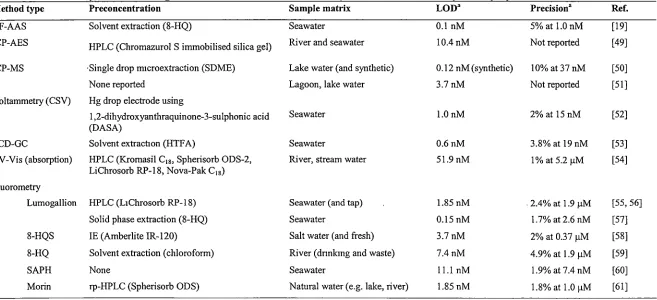
natural waters will be discussed critically. These are summarised in Table 1.1.
1.3.2 Review of Current Literature
1.3.2.1 Atomic spectrometry
Atomic absorption spectrometry (AAS), atomic emission spectrometry (AES) and
mass spectrometry (MS) can all be used for the determination of aluminium, and
these methods are often coupled advantageously with chromatographic separation
techniques, such as high-performance liquid chromatography (HPLC). Although
flame AAS has been used routinely for the detection of many metals in a variety of
matrices, it has insufficient sensitivity for samples containing ultra-trace levels of
aluminium.
Graphite furnace (GF)-AAS has several advantages over flame AAS, the most
important being increased sensitivity due to the sample residence time being greater,
and a smaller required sample size. GF-AAS has been used successfully to determine
trace aluminium levels in natural waters (seawater, river, soil water) [46-48].
Detection limits for this technique for trace metals are generally low and for
aluminium have been reported to be as low as 0.1 nM in a seawater matrix, following preconcentration, with precision at 5% at the 1.0 nM level [19]. The primary
Table 1.1. An overview of analytical methods used for the determination of aluminium in natural water matrices. aConcentrations reported'in the original articles have been converted to µM or nM here for comparison purposes.
Method type Preconcentration Sample matrix LOD" Precision"
GF-AAS Solvent extraction (8-HQ) Seawater 0.1 nM 5% at 1.0 nM ICP-AES HPLC (Chromazurol S immobilised silica gel) River and seawater 10.4 nM Not reported
ICP-MS ·Single drop m1croextraction (SDME) Lake water (and synthetic) 0.12 nM(synthetic) 10% at37nM None reported Lagoon, lake water 3.7nM Not reported Voltammetry (CSV) Hg drop electrode using
l ,2-dihydroxyanthraquinone-3-sulphonic acid Seawater l.OnM 2%at 15nM (DASA)
ECD-GC Solvent extraction (HTF A) Seawater 0.6nM 3.8% at 19nM , UV-Vis (absorption) HPLC (Kromasil C18, Spherisorb ODS-2, River, stream water 51.9 nM 1% at 5.2 µM
LiChrosorb RP-18, Nova-Pak C18)
Fluorometry
Lumogallion HPLC (L1Chrosorb RP-18) Seawater (and tap) 1.85 nM . 2.4% at 1.9 µM Solid phase extraction (8-HQ) Seawater 0.15 nM 1.7% at 2.6 nM 8-HQS IE (Amberlite IR-120) Salt water (and fresh) 3.7nM 2% at 0.37 µM 8-HQ Solvent extraction (chloroform) River (dnnkmg and waste) 7.4nM 4.9% at 1.9 µM
SAPH None Seawater 11.1 nM 1.9% at 7.4 nM
Morin rp-HPLC (Spherisorb ODS) Narural water (e.g. lake, river) 1.85 nM 1.8% at 1.0 µM
[image:29.832.96.753.127.427.2]refractory carbides. The us'e of chemical modifiers has become routine during
GF-AAS in order to overcome these interferences [62-64]. These chemicals act by
helping the analyte to be retained at higher temperatures during pyrolysis, thereby
ensuring that matrix interferences in the vapour stage are minimised. The modifiers
also remove unwanted contaminants and aid in the separation of the analyte signal
from background noise [64]. Nitrates of metals, such as magnesium and calcium,
have been employed commonly as chemical modifiers, but with only a moderate
improvement in sensitivity. More successful approaches have been found in the use
of hydrogen peroxide with nitric acid [62] and ~-diketones such as acetylacetone
[63], with the latter having shown to improve the absorption signal intensity
approximately' 3-fold.
The plasma in inductively coupled plasma - atomic emission spectrometry
(ICP-AES) efficiently atomises the sample before exciting the resulting atoms for
detection. The primary advantage AES has over AAS is that emission modes can
handle multi-element analysis, since all atoms are excited simultaneously.
Additionally, AES is more capable of handling analyses in which the element has
formed stable complexes that need to be broken down. The robustness of the method
allows it to analyse all kinds of dissolved samples from dilute acids to those
containing a high salt content. The detection limits of elements using ICP-AES have
been recorded in the low ng g-1 range. However, the technique does suffer from the
problem of spectral overlap from various elements present in the sample [65].
continuing to b~low 190 nm [66]. This continuum emission makes simultaneous
detection of cadmium, boron and tungsten extremely difficult with aluminium since
the wavelengths of these three elements lie within the same region [67]. Chemical
separation, for example using solid-phase extraction, is one method used to overcome
this form of spectral interference. Successful applications of the technique for the
detection of aluminium have been carried out for the analysis of natural waters (e.g.
reservoir, spring, river and seawater) [49, 68].
Inductively coupled plasma - mass spectrometry (ICP-MS) provides an alternative to
ICP-AES for multi-element analysis and is often the preferred method because of its
much larger elemental scope and greater sensitivity. The technique is able to provide
semi-quantitative data for samples in aqueous or organic media in only a few minutes
[65], as well as the ability to measure individual isotopes of the analyte of interest.
Typically, ions are separated in a quadrupole, with heightened performance having
been attained with chan&es to the RF power source used for ICP generation and the
introduction of high-resolution magnetic sector mass spectrometers. Detection limits
for ICP-MS are now quoted in the ng L-1 range (part per trillion) with specific limits for aluminium between 2.6 pM-0.4 nM depending on the type of instrumentation
used [69]. Although a relatively new technique, ICP-MS has been highly successful
for the analysis of trace metals in a variety of samples including seawater, lake,
spring and forest soil waters [50, 51, 68, 70, 71]. Table 1.1 gives specifics for two
ICP-MS methods for the determination of aluminium in aqueous medium. Although
(0.12 nM) is only reported for synthetic water. The second reference, Prendez et al.
[51], gives a detection limit of 3.7 nM for lake and lagoon water matrices.
Despite the advantages of the atomic spectrometric methods discussed above, it is
generally impossible to analyse a sample directly because of interfering species in the
surrounding matrix, or the concentration of the analyte being below the detection
limit of the instrument. HPLC (using ion-exchangers) is the most common technique
used for sample separation and preconcentration coupled to the atomic spectrometric
instrumentation. An important operational criterion is that the selected mobile phase
must allow for adequate separation within a realistic time frame for the detection
method.
1.3.2.2 Voltammetry
The direct determination of aluminium using classical voltammetric techniques is
difficult, owing to the highly negative reduction potential of aluminium. This
potential (approximately -1.75 V vs. SCE; saturated calomel electrode) is very close
to that of major cations, including sodium and potassium [72]. Nevertheless, two
types of stripping voltammetry - anodic stripping voltammetry (ASV) and cathodic
stripping voltammetry (CSV) - do have the scope to determine aluminium in natural
waters. Since the CSV method involves the complexation of aluminium in a
preliminary reaction in solution, and adsorption of the complex in the concentration
step at the electrode surface, it is often described as adsorption stripping voltammetry.
1,2-dihydroxyanthraquinone-3-sulfonic acid (DASA) [52, 72, 73], with the detection
limit being recorded as low as 1.0 nM for a seawater matrix [52]. However, other
compounds, such as solochrome violet [74, 75] and pyrocatechol violet [76, 77], have
also been employed. The method has been applied successfully to determination of
aluminium in natural waters other than seawater, e.g. river, lake and reservoir waters.
1.3.2.3 Electron capture detection - gas chromatography
Trace levels of aluminium and other metal ions have been detected successfully by
electron capture detection - gas chromatography (ECD-GC), through the formation
and extraction of volatile complexes. The technique is highly sensitive and
subsequently allows for the use of small sample volumes. The basics of ECD (DC or
pulsed mode) have been described elsewhere [78, 79]. The determination of
aluminium by ECD-GC was reported by Measures and Edmond in 1986 [80],
adapting a method first developed for the determination of beryllium in natural waters
(seawater, river and rain water). However, the two methods differ in both the
handling protocols and the type of solvent used for extraction. For aluminium
analyses, 15 mL samples were buffered with sodium acetate and the metal reacted
with 1, 1, 1-trifhioro-2,4-pentanedione (HTFA). This fluorinated volatile derivative
was then extracted using toluene and back-washed using a sodium hydroxide
solution. ECD-GC was carried out on 3 µL aliquots of the extracts using. a Ni63
ionisation source. The method obtained a detection limit of 0.6 nM, with a precision
method is limited by the considerable amount of sample handling, increasing the risk
of contamination, and has not been used widely in recent years.
1.3.2.4 UV-Vis spectrophotometry and fluorometry
The absorption of UV-Vis light may be used to selectively determine trace metal
ions, especially after formation of metal-organic complexes. The spectrophotometric
determination of aluminium is typified by the use of quercetin
(3,5,7,3',4'-penatahydroxyflavone) as the colour-forming reagent. Quercetin selectively forms a
stable complex with aluminium and detection is relatively free from interfering
species [54]. Unlike many other complexing reagents, quercetin may be used for in
viva determination [54]. However, limits of detection for its general use are usually
reported in the mg L-1 to µg L-1 range. Other typical chelating reagents include morin
[81], pyrocatechol violet (PCV) [82] and eriochrome cyanine [83, 84]. UV-Vis
spectrophotometry has been applied to the analysis of natural waters, including river,
stream, spring, pond, lake and sea water and can be coupled to such techniques as
flow injection analysis (FIA) and HPLC. The addition of masking agents is often
required for the spectrophotometric determination of aluminium to increase
selectivity. Masking is achieved by forming a stable complex from the potentially
interfering species so that it can no longer react with the colour-forming reagent.
Common masking agents used in the analysis of aluminium include hydrogen
peroxide and cyanide [85]. However, many masking agents require a specific, and
Photoluminescence, which incorporates fluorescence, is the emission of radiation
resulting from the excitation of a sample by the absorption of photons. It has the
advantages of high sensitivity, selectivity and linearity compared to other methods for
the determination of aluminium, such as colorimetric spectrophotometry. The
majority of fluorescence applications involve the use of extrinsic fluorescent
reagents; that is, chromophoric molecules that react with, or adsorb onto, the analyte
of interest. Since aluminium is not fluorescent itself, it must first react with a ligand
to produce a fluorescing complex. Lumogallion
(4-chloro-6-[(2,4-dihydroxyphenyl)azo ]-1-hydroxybenzene-2-sulfonic acid; Figure 1.3), a tetradentate
ligand that coordinates with aluminium to produce a fluorescent complex, is the most
common, although a number of other compounds have also been investigated with
varying degrees of selectivity, sensitivity and suitability for various applications.
Several fluorescence-based analytical methods for aluminium, ordered by the
particular fluorescent reagent employed, are discussed below.
(i). Lumogallion
The aluminium-lumogallion complex offers excellent fluorescence sensitivity and
minimal interferences, and as such has been used successfully for the determination
of aluminium in matrices with a high salt content, such as body fluids [55] and
seawater [56]. In a method described by Wu and co-workers [52] for the
determination of aluminium in human blood serum, the sample was reacted with
OH
N
//
N
HO
Lumogallion
Cl
S03H
Aluminium
~
"'
"
'
HO
OH
2Oj_O
\I/
Al
II\
NIN
OH
2S03H
,
..
Aluminium-lumogallion complex
column) and detected by fluorescence. A detection limit of 1.9 nM for aqueous solutions was achieved. The authors used the same procedure for the determination of
aluminium in both tap and coastal seawater [56]. The results from this HPLC method
were compared against those determi~ed by GFAAS. For tap water, the results were
in good agreement; 1.04 ± 0.04 µM (HPLC) compared with 1.04 ± 0.06 µM
(GFAAS). However, differences were observed for seawater; 7.8 ± 1.5 µM (HPLC) compared with 9.3 ± 0.52 µM (GFAAS). The authors attributed this difference to inadequate background correction for the high salt content in seawater for GF AAS.
Capillary electrophoresis is another technique that has been used for the separation of
the aluminium-lumogallion complex. He et al. [86] used a fused-silica capillary for
separation after preparation of the complex by a batch method and theyreported a
detection'limit of approximately 0.70 µM with a precision of 3.1% at 3.7 µM (sample
solution). It was found that by using this technique only one peak was observed in sample analyses, suggesting that the method was free from interference from
common species, such as iron. The newly developed procedure was applied
successfully to the determination of aluminium in river, reservoir and spring water
samples, with relatively good agreement of results compared to those obtained by
ICP-MS.
Hara and co-workers [87] developed a method for the fluorometric detection of the
total concentration and individual species of aluminium using lumogallion.
gradient elution cation-exchange chromatography where the separation was based
predominantly on the charge on the analyte. Aluminium fluoride complexes were
estii:p.ated mathematically using a fluoride ion-selective electrode to measure the free
and total amount of fluoride (assuming that all 2+ charged aluminium species were of
the form AlF2+) and complexation constants for the various fluoride complexes. The concentration of total dissolved aluminium was obtained using the same HPLC
system as for the free and total fluoride-complexed species, but without the use of a
separation column. Although the speciation of dissolved aluminium was canied out
on 15 rainwater samples, Hara et· al. [88] concluded in further investigation that the
elution of dissolved aluminium from the column was not quantitative when using this
method.
In a recent article by Fuse et al. [89], the use of a 5 'chloro5dodecyl2,4,2 '
-trihydroxyazobenzene-impregnated XAD-4 resin (for the preconcentration of
aluminium) coupled with fluorometric detection using lumogallion was investigated.
'
The authors found that iron and other common ions caused no interference, and that
successful speciation could be achieved without any change of pH by separating the
aluminium species on ion-exchange resins. A detection limit of 2.2 nM in
environmental water samples, with a precision of 7.3% at 3.7 nM was obtained and
the method was tested on several lake and river samples with satisfactory results.
This section has highlighted the use oflumogallion for the detection of aluminium by
fluorescence
ill
many natural waters However, its application specifically to seawater(ii) 8-hydroxyquinoline
8-hydroxyquinoline (oxine or 8-HQ) and its sulfonated derivative,
8-hydroxyquinoline-5-sulfonic acid (8-HQS), are strong chelators for aluminium and
give rise to fluorescent complexes.
Bloom and co-workers [90] applied the reaction of aluminium with 8-HQ ·in a batch
method using butyl acetate as the solvent for extracti'on of the resulting complex.
Detection was made by both spectrophotometric and fluorometric techniques, with
the latter demonstrating the best detection limit (11.1 nM in distilled water).
Sugimura and Suzuki [91] also utilised the fluorescent complex formed between
aluminium and 8-HQ for the analysis of aluminium in seawater, after adsorption on a
XAD-2 resin. Iron was initially removed by adsorption of the resultant complex with
4,7-diphenyl-1,10-phenanthroline on XAD-4 resin, and magnesium and zinc were
prevented from interfering through sequential washes of ammoniacal solution of
EDTA and acetate buffer solution. 'The reported detection limit was 3.0 nM m
seawater (per 20 mL of chloroform eluent).
Zhu and co-workers [92] reported on the sensitising effect of a
cetyltrimethylammonium bromide (CTAB) microemulsion on the determination of
aluminium using fluorescence detection of its 8-HQ complex. It was found that the
CTAB microemulsion gave a higher sensitivity than both CTAB micelles and water
precision at 2.4%. The technique was applied successfully to the determination of
aluminium in both tap and lake water.
Alonso and co-workers [59] compared three forms of liquid-liquid extraction in FIA
systems and coupled them with fluorometric determination of the Al-8HQ complex.
Of the three procedures investigated, it was found that injecting a single segment of
organic solution into an aqueous stream of buffered sample without phase separation
gave the lowest detection limit of 7.4 nM in distilled water. Each method was also
trialled on real samples, including river and waste waters.
8-HQS has been acknowledged as one of the most sensitive organic ligands used for
the determination of aluminium [93]. It forms a highly fluorescent complex, without
showing any intrinsic fluorescence itself. Alonso and co-workers [58] reported a
method using 8-HQS that was applied to the determination of aluminium in fresh and
saline waters. Continuous determination of aluminium was possible with the use of
FIA. Their method made use of the cationic surfactant cetyltrimethylammonium
bromide (CTAB), which greatly enhanced the fluorescence intensity and accelerated
the reaction rate. Many of the interferences inherent to batch methods were largely
overcome, since post-column reaction after HPLC separation was employed. The
detection limit for the method was 3. 7 nM (in distilled water), with a precision of 2%
at the 0.37 µM level. This system was shown by Fairman and Sanz-Medel [94] to be
also detailed the importance of the separation step for natural water samples (lake)
using an ion-exchange column of Amberlite IR-120 cation-exchange resin.
(iii) Salicylaldehyde picolinoylhydraz.one (SAP H)
Salicylaldehyde picolinoylhydrazone (SAPH) forms a fluorescent chelate with
aluminium in a stoichiometric ratio of 1 :3. The complex exhibits a blue-green
fluorescence at excitation and emission wavelengths of 384 and 468 nm, respectively
[60, 95]. The metho<;l is very sensitive, has minimal interferences, and has been
applied satisfactorily to the determination of trace amounts of aluminium in seawater
and spring water.
Manuel-Vez and co-workers [60] applied the method to a batch determination of
aluminium by reacting the metal with SAPH in an acetate buffer solution and
measuring the resultant fluorescence intensity. The lowest detection limit achieved
was 9.8 nM, with a precision of 1.85% at 166 nM in synthetic seawater. Canizares et
al. [95] coupled the method to both a conventional FIA system and a flow-through
sensor. The manifold of the sensor design involved injection of sample into an acetic
acid/sodium acetate buffer and subsequent merging with the SAPH solution to form
the fluorescent complex. The complex was retained in the flow cell by interaction
with a C18 solid support and flushed to waste by injection of hydrochloric acid. The
flow-through sensor method achieved a detection limit of 0.30 µM (6.7% precision)
compared to 0.57 µM (8.1 % precision) for the conventional FIA system (deionised
(iv) Morin
A particularly sensitive fluorometric reagent for the determination of trace aluminium
is 3,5,7,2',4'-pentahydroxyflavone (morin). Morin can selectively form a highly
fluorescent complex with aluminium and has been used widely as a reagent for both
. fluorometric and spectrophotometric determinations. Various investigations have
been undertaken to improve both the extraction efficiency of the fluorescent complex
into isobutyl methyl ketone (IBMK) [96, 97], and the sensitivity via the addition of
non-ionic surfactants [98]. Despite continued research, the application of morin
remains limited since the very long reaction time with aluminium makes automation
difficult [99].
A recent paper by Lian et al. [100] describes a reversed-phase high-performance
liquid chromatographic method .(Spherisorb ODS column), with pre-column
complexation of morin and aluminium and fluorometric detection. A detection limit
of 2.0 nM in a distilled water matrix and precision of 1.8% at the 1.0 µM level [100]
was achieved and a wide linear range for detection was possible due to the unreactive
morin being separated from the fluorescent Al-morin complex. The method was
applied to the analysis of a substantial number of natural water samples including
canal, river, stream, cave, pond, spring and lake waters. Lian and co-workers [61]
later developed a novel strategy for th'e speciation of aluminium using selective
I
analytical reagents, including morin, under specific pH conditions. They reported
aluminium in natural waters, namely high sensitivity, easy manipulation and the
exclusion of a separation step.
(v) Other fluorescent reagents
Various other fluorescent reagents have been· utilised for the determination of
aluminium in natural waters, such as chromotropic acid [101] and
2,6-bis[(o-hydroxy)phenyliminomethyl]-1-hydroxybenzene (BPhH) [102]. Although some
satisfactory results have been obtained, the use of these reagents is not widespread
and consequently details will not be discussed further.
1.3.2.5 Chelation ion chromatography
The use of ion chromatography (IC) for the quantification of aluminium has been
previously restricted to the determination of Al3+ [103]. However, the scope of this
technique has since been broadened to include separation and determination of
multiple Al complexes (e.g. fluoro, oxalate, citrate) [87, 104-106]. Both anion- and
cation-exchange modes of IC may be utilised in order to determine positively or
negatively charged species of aluminium [107]. The obvious restriction of using
common ion-exchangers in IC separations is their high sensitivity to the presence of
simple electrolytes (KCl, NH4Cl, CaClz and others) which are used frequently for the
extraction of ,aluminium from samples such as soil, sediment and different plant
materials [108]. Chelating ion-exchangers are therefore of particular interest for the
separation and determination of aluminium as an alternative to traditional
of the corresponding complexes with chelating groups on the stationary phase and
allow for the separation and preconcentration of aluminium in complex samples
having a high content of alkali- and alkaline-earth metal salts.
The determination of aluminium can take into account three categories of species.
These groups have been described as labile weakly bound monomeric (free
aluminium, aluminium sulfate, fluoride, and hydroxide complexes), non-labile
thermodynamically stable monomeric (complexes of aluminium with organic ligands)
and kinetically inert thermodynamically stable polymeric type complexes and
colloids [109]. Usually the differentiation of aluminium species is based on
competitive complexation and/or acid reactivity [110]. Recently, competitive
chelation with the chelating Chelex 100 resin (which carries iminodiacetic acid
functional groups) has been used in a resin titration method proposed by Pesavento et
al. [ 111]. So, another possible advantage of chelating ion-exchangers is their ability
to discriminate between kinetically-labile complexes and stable, inert complexes of
aluminium, which provides additional information on the bioavailability and
ecotoxicity of this element in natural samples.
High performance chelation ion chromatography (HPCIC), or other IC modes in'
which chelation is the dominant retention mechanism, offers several advantages over
ion-exchange separation [112, 113]. Firstly, it allows for the possibility of using only
one type of functionalised resin for both preconcentration and separation. This has
obvious consequences in terms of the simplicity of a system for an application
in such a way as to convert all species of aluminium into uniform surface complexes.
While an ion-exchange chromatogram may show multiple peaks for largely
unidentified aluminium species, a chromatogram using chelation will show only one
or two; corresponding to total soluble and more strongly bound species. This is
beneficial if full speciation of aluminium is not required.
There are few known attempts to use HPCIC for the separation and determination of
aluminium. Jones et al. used different neutral polystyrenedivinylbenzene (PS-DVB)
microspherical resins impregnated with Chrome Azurol S dye, which has two
salicylic acid groups in the molecule selective to aluminium [114]. Isocratic
separation of aluminium, indium and gallium was achieved on Benson BPI-10 resin
with 1 M KN03 at pH 2.25 as the eluent. This separation was repeated on PS-DVB resin (Polymer Labs PRLP-S) [115] and a slightly different elution order (Al(III) <
Ga(III) < In(III)) was observed. Two-step pH gradient elution from 2.2 to 1.0 in 1 M
KN03 was used for the separation of aluminium, gallium, indium and iron(III) on a
similar chromatographic column. Finally, this same HPCIC system was used for the
determination of aluminium in seawater [116]. In all of these studies, photometric
detection after post-column reaction (PCR) with 0.004% Pyrocatechol Violet m
0.5 M hexamine adjusted to pH 6 was used.
The chromatographic behaviour of aluminium on Hamilton PRP-1 neutral PS-DVB
resin dynamically modified with 4-chlorodipicolinic acid was investigated by Shaw et
al. [117]. Aluminium was retained by this chelating substrate using an eluent
was higher than 2.0. The retention order Al(III) < La(III) < Lu(III) < Fe(III) < U(VI)
was observed. The separation of aluminium and lead on a short (50 mm.) column
packed with aminocarboxylated polymethacry~ate Bio-Rad HRLC-MA7C resin was
also reported [118].
The most significant problem of the above-mentioned works was very poor column
efficiency which is associated with the use of relatively coarse 7-10 µm
polymer-based chelating resins and their slow kinetics of complexation with aluminium. This
problem can potentially be overcome by the use of iminodiacetic acid functionalized
silica (IDAS), which not only has a similar selectivity to Chelex 100 but also exhibits
remarkable column efficiency in the separation of metal ions by HPCIC.
1.4 Shipboard Determination of Trace Aluminium in
Seawater
1.4.1 Overview
Although many low-cost, sensitive and rapid methods have been developed for the
determination of trace levels of aluminium, few are suitable for the analysis of
seawater samples and fewer still for shipboard determinations. The major con~em for
seawater analysis is the matrix effects from interfering ions. Considerations that must
be made regarding shipboard instrumentation include size, mass, portability,
finding a suitable method for shipboard trace aluminium analysis is in response to
recent progress made in understanding the contamination risks, problems associated
with sample storage and the need for high resolution real-time data to aid in tactical
cruise planning (e.g. following dust deposition events).
The different types of atomic spectrometric techniques may have advantages such as
high sensitivity and multi-element analysis, but the size and shape of such
instruments precludes their use at sea. Additional shortcomings include the inability
to cope with matrix interferences and vibrations encountered on an underway
research vessel. Furthermore the purchase and running costs of such instruments are
relatively high.
Voltammetry and FIA with fluorescence detection are two techniques that have been
shown to be successful for the onboard determination of aluminium in seawater. The
instrumentation needed for these techniques is such that transportation may be
achieved relatively easily and disruptions to the operation by any shocks or vibrations
that may occur whilst at sea are minimal. In addition, the techniques may be fully
automated and operated in a flow-analysis mode, ensuring minimisation of
contamination and an efficient analysis time. Initial equipment and ongoing running
costs are also significantly lower than for most other techniques. FIA with
fluorescence detection using the reagent lumogallion has been used most
comprehensively by oceanographers in recent years, notably due to the suitability of
the instrumentation for shipboard work and the ability to obtain particularly low
1.4.2 Fluorescence detection with lumogallion
In the 1960s, Nishikawa et al. [119] first described the technique for the
determination of aluminium in seawater using the fluorescent reagent lumogallion
(Figure 1.3). Hydes and Liss [120] later lowered the detection limit to nanomolar
levels using a batch method in which 50 mL samples were reacted with a lumogallion
solution and buffered with a sodium acetate/acetic acid solution. The reaction mixture
was heated at 80 °C in a water bath for 1.5 h before fluorescence of the samples was
measured at an excitation wavelength of 465 nm and emission wavelength of 555 nm.
This procedure was reported to detect all forms of aluminium, except that which is
incorporated in stable mineral structures (e.g. clay particles) [120]. Interferences from
iron were insignificant below 100 µg L-1, and the authors suggested that UV irradiation of samples would overcome competition for the Al-lumogallion complex
by naturally-occurring organic ligands. The detection limit for the method was
reported as 1.9 nM with a precision of 5% at the 37 nM level [120].
Subsequently, Howard et al. [121] achieved a 5-6 fold increase in the fluorescence
intensity of the aluminium-lumogallion complex by adding the non-ionic detergent
Triton X~lOO after the reaction between the aluminium and lumogallion, and
immediately before fluorescence detection. Multiple surfactants were tested, and
although cationic surfactants gave initial significant enhancements, only non-ionic
surfactants showed sustained enhancement. Triton X-100 was chosen, based on its