ADOLESCENT: A SINGLE CASE STUDY
,
byT
ko AmRSAllan Haines, B.A.
ACKNOWLEDGEMENTS ABSTRACT
CHAPTER I INTRODUCTION 1.1 Speech Development in the Cri—Du—Chat
Syndrome 2
1.2 Speech Training Procedures 5 1.3 Overview of Operant Speech Training .
Programmes 8
1.4 TheAJoveas Speech Training Programme 20 1.5 Adaption of the Lovaas Speech 'Training
Programme to the present study 22
1.6 Single Case Design 24
CHAPTER II METHOD 27
2.1 Subject 28
2.2 Design and Procedure 29
CHAPTER III RESULTS 44
3.1 Individual Room Situation 45
3.2 Ward Situation 49
3.3 Social Ratings b6
3.4 Summary of Results b8
4.2 Ward Situation 74 4.3 Social Ratings 77 CHAPTER V CONCLUSION
REFERENCES b0
APPENDICES:
ACKNOWLEDGEMENTS
I wish to express my thanks to Mr. Rien Be Vries for his valuable supervision, and to Dr. Graham Perkin for his helpful guidance in setting out this report. I also wish
to acknowledge the assistance' of Mr. Chris Williams and Dr. Merill Jackson for their constructive criticism.
Appreciation is extended to Mr. John Wanless for his technical advice, and to the nurses, raters and speech
ABSTRACT
The thesis examines the efficacy of using speech training procedures with a cri—du—chat adolescent. Research evidence suggests that neither the 'cat—like cry', laryngeal abnormality or level of severe mental retardation are sufficient to warrant precluding cases of the syndrome from speech training. One aim of the study is to determine whether operant training procedures are more effective than attention—control procedures with a case of the syndrome. The subject is trained in two situations, the individual room and ward, during daily training sessions.
The statistical analysis in the individual room demonstrates that the subject's verbal imitation is edgnificantly greater in the operant than in the control procedures. The results of the subject'sverbal object labelling,responses to criterion indicates no significant differences between conditions. However, the follow—up assessment shows that the subject retained significantly more. verbal - object labelling responses to criterion in the
operant than in the control procedures. In the ward situation it is argued that operant speech training is significantly more effective than .control procedures.in increasing the subject's' vocalisations to nurses.
The overall findings support the view that a cri—du—chat adolescent can benefit from a speech training programme.
Furthermore that operant speech training conducted in two
CHAPTER ONE
I .1
SPEECH DEVELOPMENT IN THE
CRI—DU —CHAT SYNDROME
The cri—du—chat syndrome was discovered as late as 1963 . by Lejeune et al. Chromosomal analysis has described a
karyotype of forty six chromosomes, normal except for one large acrocentric chromosome of the B group which has a deleted
portion of the short arm. Common clinical features include: a characteristic 'cat—like cry', and severe mental and physical retardation (Lejeune at al., 1963; MacIntyre, 1964; McCracken et al., 1965; Tadashi Kajii et al., 1966; James et al., 1971).
It is postulated that speech research efforts in the past may have been discouraged by the clinical picture of the 'cat-like cry' and common laryngeal abnormalities, coupled with the general level of severe mental retardation in the syndrome. The seriousness of these features to speech research are considered separately.
The Cat-like Cry
The meowing, high pitched cat-like cry is a common
characteristic and has been reported in every case of the syndrome. Yet the cry is not pathognomonic. Granoff (1971) noted that
spectral analysis of cries produced by infants with congenital hydrocephalus and hyperbilorubinaemia also exhibited abnormal high minimum and maximum pitch. It appears then that the high
pitch cry does not, in itself, serve to differentiate the cri-du-chat syndrome from other entities (Granoff, 1971). Further, children with other disorders who exhibit the high pitched cry, for example hydrocephalics, are suitable for speech training. In any event the cat-like cry in the cri-du-chat child appears to decrease in frequency of emission as a function of increasing age (Ward et al.,
1968; Junien-Lavillayroy et al., 1972). Therefore the cat-cry should not deter speech research in this syndrome.
Laryngeal Abnormalities
cri—du—chat syndrome was distinctive. He offered this as an explanation for the cat—like cry: "The long curved flappy
epiglottis, the narrow diamond—shaped appearance of the larynx and the vocal during inspiration, and the anterior approximation of the vocal cords with an abnormally large air space in the
posterior commissure area during phonation are responsible for the stridor and the cat—like cry" (Ward et al., 1968).
Other researchers maintained that the anatomical anomalies of the larynx were inconsistent and variable. Tadashi et al.,(1966) performed direct laryngoscopy and found no abnormality of the
Level of Mental Retardation
The distribution of reported cases of the syndrome suggests that in the majority of cases "mental retardation appears to be general and profound with an average I.Q. of less than 20"
(Niebuhr, 1971). In general, incidence statistics of language dysfunction show that most subjects with I.Q.'s less than 20 are impaired in their language development (Spreen, 1965). Dispite this, improvement is possible in seriously retarded children as Lubman (1955) and Schlanger (1963) have shown. In such cases training should be regarded as making a change, albeit modest, in the status of the person (Jordon, 1967).
The argument posited, therefore is that neither the cat—like dry,Hlaryngeal abnormality, or level of severe mental retardation are sufficient to warrant precluding cases of the syndrome from speech trainging programmes. , The question arises of what type of speech programme would be best suited to a cri—du—chat infant.
1.2 SPEECH TRAINING PROCEDURES
There are two. different approaches to speech development, thebehaviourist and the psycholinguistic. The behaviourist approach is based on an imitation—reinforcement paradigm and
approach would necessarily be more conversational and more
concerned with spontaneous speech than the behaviourist approach. From this view she has generated a Modified Language Input
procedure (M.L.I.) which is psycholinguitically oriented.
The Modified Language Input Technique
This technique is presented in a conversational setting. It presents language at a child's developmental level in story form, interspersed with questions which elicit speech from the child. This approach has been successful with children of normal intelligence, with poor. auditory perceptual skills. Lee
(1973) states herself that the. M.L.I.-technique is not appropriate for autistic or severely retarded children who do not seem to be able to learn'language in : a normal conversational setting. She suggests such children may profit much more from the behavioural approaches.
Operant Speech Techniques
As mentioned, operant techniques are based on an imitation— reinforcement model. Empirical research supports the contention that reinforcement accelerates the rate of speech development
Success of Operant Techniques
Operant techniques have been used to correct inappropriate speech patterns (Risley & Wolf, 1961); to reinstate speech in currently mute persons who previously spoke (Issacs, Thomas & Goldiamond, 1960), and to develop simple speech in children who
have never talked (Lovaas et al., 1966; Sloane et al., 1966; Guess et al., 1966; Sailor, 19(0).
Generally the success or operant speech techniques has been promising. Due to the need to individually tailor a
programme to a child's particular requirements most of the research reports have been single case studies. For example Sloane et al.,
(196d) found that a young mongoloid boy significantly increased
correct verbal imitations when reinforcement was contingent on such responses as compared to when reinforcement was non—contingent.
In another study a four year old retardate whose speech consisted of only a few vocalisations was trained in eight months to produce forty different words that could be reliably recorded as
approximations to English (Sloane et al., 1966). Risley & Wolf (1967) found that after five sessions of reinforcement training a severely retarded eight year old learnt to reliably imitate,
and appropriately name objects.. Lovaas et al., (1967), who have
after the first steps. For example, With Billy, an autistic child it took several days to train a single word, but in the final stages of the programme he learnt several words a day. Clearly, there has been f) good deal of evidence for the success of operant techniques with a variety of cases of speech deficient children, including autistic, brain damaged, mongoloid and
severely retarded. It would seem appropriate therefore to apply operant speech training to a cri-du-chat child. Accordingly the study aims to evaluate the effectiveness of operant speech
training techniques in increasing the verbal behaviour of. a cri-du-chat adolescent. Detailed components of the operant methods are discussed in the following section.
1.3
OVERVIEW OF OPERANT SPEECH TRAINING
PROGRAMMES
In general, experimenters approach the deliberate develop-ment of functional speech in nonverbal or speech deficient subjects in a two tier training programme. Firstly, the subject learns to emit a given verbal response following the presentation of a cue or descriminative stimulus in order to receive positive reinforce-ment. Similarly he learns to avoid responses which immediately result in negative reinforcement. In this way the subject is taught imitative verbal behaviour. In the second broad phase of speech training programmes the aim is to teach fuctional and
intended that the trainee should use his new vocabulary in his natural environment.
Verbal Imitation TraininR
It seems that verbal imitation training is generated from the observation that "Children acquire words by.hearing speech; that is, children learn tospeak by imitation" (Loveas 1965). This represents an empirically—based approach to the problem or speech development. Peterson (1965) claims imitation is a basic behavioural mechanism. He defines an imitative response as
follows: "We call a response imitative when one individual behaves to match the response of a model".
The sufficient conditions for acquiring any imitative repertoire. need to be made clear., Research evidence suggests that observers trained under nonreinforoement conditions imitated more than controls exposed to no model (Bandura et al., 1961; Berger 1966; Kanfer & Marston 1963). Flanders (1965) also found that observers trained under nonreinforcement conditions imitated above chance. Thus it would seem thpt nonreinforcement training condition's are sufficient for acquiring at least some imitative behavioural repertoires.
It follows that it is necessary to clarify the role of
essential to distinguish between response acquisition and performance because these events are determined by different
variables. Bandura (1965) from a controlled experiment found that the acquisition of matching responses results primarily from stimulus continuity and associated symbolic processes,
whereas the performance of observational learned responses depends largely upon the nature of reinforcing consequences to
the model or to the observer. Therefore, contingent reinforcement alters the performance rate but does not, per se, explain how a response is initially acquired. It seems the explanation of
acquisition is to be sought in terms of mediational variables. The elucidation of such variables is not the subject of this
study, suffice to say that attention, retention and motor response
modes are important components.
In training verbal imitation of new responses or words it appears a basic first step is to assess the subject's range of
vocalisations or sounds. The second step is then to combine the
basic behavioural units or sounds to form words. A certain amount of shaping of some basic response elements is probably
necessary even when the child is fully imitative. Such imitation
training may allow the subject to combine and rcombine basic behavioural units or sounds into new response chains or words. For example, since the child has acquired or is emitting some of
the basic vowel and consonant phonemes he could easily chain them together to form new words to be learned by imitation (Peterson 1960.
Consequently, one aim of this study is to evaluate the effectiveness of operant speech training procedures in increasing verbal imitation in a cri—du—chat adolescent.
In cases where the child is non—imitative, or has a deficient imitative repertoire, it is suggested that the first step in a
speech programme should be to develop motor imitative skills prior to verbal imitative skills. The fundamental assumption here is that gross body movements would be easy to discern, and that
motor imitation would facilitate the learning of verbal imitation. As this issue is clearly of clinical importance it will be
discussed at some length.
Stark et al., (196) reported a programme to increase verbal behaviour in an autistic child. ,Following the child's initial failure to imitate vocalisations, the experimenters attempted to establish a nonvocal imitative repertoire. They reasoned that gross body movements would be more easy to
discriminate than fine body movements. "More discrete stimuli such as movement of the tongue, lips and jaw, could then be introduced and 'a gradual transition from nonvocal imitation of mouth movements to imitation of sounds could be accomplished"
However, an op , osing body of researchers reported success in
remedial speech training and have omitted the motor imitative component (Risley & Wolf, 1967; Kerr, Meyerson & Michael, 1965). Results of the Garcia, Baer & Firestone (1971) study indicated that
training motor imitative responses produced generalisations to other similar motor responses, but not to untrained vocal responses.
Indeed a subject in the Baer et al., (1965) study had developed extensive motor imitations but did not imitate a verbal response. Baer et al., decided to combine or couple verbal-motor responses,
here the verbal response was paired with an imitative motor
response .. For example, the experimenter walked to the centre of
the room and said 'ah'. The child approximated the response. The verbal-motor coupling was continued with a general reduction in the amount of motor imitation until the verbal response was
initiated while both subject and experimenter were seated (Peterson 1968). From this point modelling and differential reinforcement were used to expand the vocal repertoire.
From a treatment standpoint, the important issues still unanswered concern the differences in the success of procedures used to establish vocal imitations. Such answers are necessary
for the establishment of economic treatment programmes (Garcia & DeHaven
19(4).
That is, it is not clear whether motor imitation facilitates the acquisition, retention or generalisation ofimitation training will not be stressed, although it must be stated that an attempt will be made to overemphasise tongue and mouth movements in the Production of target sounds. To this extent it is acknowledged that there will be a coupling of motor and verbal components in the presentation of training stimuli. An evaluation of the effectiveness of the separPte motor—verbal components will not be attempted. It is felt that research into this area may provide more comprehensive and economical speech training programmes.
The theoretical thrust underlying the argument that motor imitation training may facilitate later verbal imitation is
implicitly derived from the concept of generalised imitation (Baer et al., 1964). Briefly, it was found that imitative behaviour would develop if the child was rewarded for imitating. It was also found that imitative behaviour that had never been reinforced could be developed and maintained as long as other imitation responses continued to be reinforced (Metz, 1965; Peterson 1968). The non— reinforced imitations, maintained under these conditions, have been termed 'generalised imitations' (Baer & Sherman, 1964). Theoretical explanations of this phenomena include conditioned reinforcement (Loveas et al., 1966; Baer & Sherman, 1964), the discrimination hypothesis (Bandura 1969), the reinforcement scheduling explanation (Gerwitz, 1968) end Steinman's explanation. Each of these
explanations will be considered separately. .
explanation, stating that for an imitative repertoire to
develop, a class of correspondences must be functional as
stimuli. The child must learn to discriminate a similarity between the model's behaviour and his own. Similarity used in this sense does not refer to
similarity along a simple stimulus dimension, for example, in the intensity of light, but to a correspondence between the stimulus output of the child's behaviour and the
stimulus output of the model's behaviour. For example, the child perceives a correspondence between the appearance
of his hand and the model's hand or his voice and the model's voice as a silent stimulus. (Baer et al., 1967).
In summary, assuming that behavioural similarity is accepted as a stimulus, this stimulus often preceeds reinforcement, and therefore Scan develop conditioned
reinforcement properties. However for the conditioned reinforcement explanation to be tenable it must account for empirical evidence that differential reinforcement
is effective under a variety of circumstances including verbal operant training. For this reason the value of the conditioned reinforcement explanation of generalised imitation is in some doubt.
2. The discrimination explanation suggests that the child
continues to perform non—reinforced imitations because he cannot discriminate reinforced from non—reinforced
3. The reinforcement scheduling explanation emphasises one aspect of the discrimination problem, that is, the variable— ratio schedule character of generalised imitation
procedures. Simply statedl this means that the child is
unaware of which response will be reinforced and so imitate every response modelled.
4. Steinman (1970) suggests a combination of differential reinforcement and social variables as an explanation for generalised imitation. He reports data that challenges
the 'discrimination' and 'scheduling' explanations. His evidence suggests that children would imitate both
reinforced and non—reinforced responses if no choice was offered. In contrast, when instructed not to imitate
responses.that produced no reinforcement they immediately stopped imitating most of the non—reinforced responses. Steiman's conclusion is that even though a child knows a response will not be reinforced he may still imitate
the response if it is the only response modelled, and if he has not been instructed to imitate only reinforced responses.. When a response is modelled the past and present instructions to imitate end the presence of the
The importance of social stimuli in maintaining imitative behaviour was reported by Peterson & Whitehurst (1970) in an experiment where differential reinforcement was applied to one training response and not another. The child imitated both
responses. However, when the trainer ceased watching any imitative behaviour, such behaviours were extinguished. Consistent with this experiment, Steinman (1970) argues that two controlling systems may operate simultaneously when generalised imitation procedures are used. One system being contingent differential reinforcement, the second system, a composite of social setting events : "The reinforcement characteristics of the model, the continued surveillance by the model, and. the child's, previous history regarding adults, their instructions, and the consequences received When the child has complied,or failed to comply with their instructions" (Steinman, 1970).
The question arises as to whether either or both of differential reinforcement nnd social demand characteristics are necessary for the development and maintenance of generalised imitation. As stated earlier, studies in modelling have
successfully developed imitative behaviours without specifically manipulating consequent reinforcement (Flanders 1968; Bandura
provide a correct or complete explanation is a moot point.
Certainly Steinman (1970) has shown that social variables must be accounted for in ongoing research.
As mentioned, operant speech training procedures are presented In a two stage programme. The second stage which includes
expressive speech will be discussed below.
Expressive Speech
Vocal imitation training is followed by vocal labelling,
question — answer procedures and other more complex forms of speech, ranging from productive speech (Guess et al., 1968) receptive speech (Baer &Guess, 1971), pluralisation rules .
(Guess et al., 1966) to the generalised”use fof.:comparative-and superlative adjectives, and the productive use of noun suffixes (Baer & Guess, 1973).
The present research will be limited to verbal object
labelling, as in Sloane's 1968 study of ,a non—verbal severely . retarded child. Sloane's child was taught to name simple
objects and pictures by imitating.the experimenter. To ensure
correct discrimination between the target objects,, the experimenter's
prompts that is verbal clues were faded until the experimenter presented the objects and stated ',What is this?'; The object then
In the initial phases of the programme it seems efficient
training is facilitated by structuring the training environment, limiting disruptive behaviours and conditioning attention and eye contact. (Hartung 1970). It is the aim of such programmes that
as the subject begins to establish expressive speech there will be a concomitant increase in attentive and social behaviours. It
is expected that even when a child has mastered two or three words he will be able to immediately experience considerable control over his environment (Levees, 1968).
The procedures involved in establishing eye contact and environmental control are well illustrated ma classic study by Hewett (1965). Hewett (1965) applied an operant conditioning
speech programme to establish a basic speaking vocebulary in a four.and.a.half year old non—verbal autistic.boy. He suggested that autistic children were highly, selective learners who .obtained gratification by bizzare, inappropriate means._ Following from
this assuption Hewett designed en elaborate programme and main- tained rigorous environmental control in the initial stages. A
teaching booth %vas established, the teacher on one side, the subject on the other, and a dividing shutter between them.. A light
focused on the clinician's side of the booth. When the shutter
W88 lowered.the.subject was deprived of light, rewards, and
the presence of the experimenter. • Using this apparatus
programme the subject was returned to the ward. Verbal imitation generalised from the experimenter and the booth to other adults and even children in the ward environment. At the conclusion of the programme the subject had acquired only a limited vocabulary, but was able to verbally express some of his basic needs, for example,
'I want water'.
Schneider & Vallon (1955) comment that "The mere ability to express one's wants or needs in a socially accepted manner is indeed a valuable asset to the child on an intellectual, an emotional, and a social level". This statement reflects the
signifidance of Hewett's (1965) results. Indeed a further finding in Hewett's (1965) study was that the subject's verbalisation
altered the reaction of others towards him. "This was clearly seen when nursing staff sought him out for verbal interaction, providing
cues for imitation and holding him for speech before granting his requests" (Hewetti 1965). It is claimed that a retardate, who can speak in the ward attracts nurse attention more than a non—verbal retardate.
While the.Hewett (1965) study and other research studies report the positive effects of operant conditioning techniques on verbal behaviour, only a few researchers have presented 'a systematic, explicit account.of how to go about developing speech in non- speaking children- (Hartung, 1970). One of the Most explicit and detailed set of procedures has been outlined by LOV8813
(1966;
196d)1.4
THE LOVAAS SPEECH TRAINING PROGRAMME
The Lovaas programme provides a step—by—step procedure to follow and also allows the clinician to make appropriate clinical
decisions, so that he can adapt the programme to the child's needs. Lovaas suggests it is beneficial to approach the children in an individual, empirical manner, and to allow the programme to
provide guidelines (Lovaas 1966). Consequently the programme is not meant to represent a 'cookbook approach' (Hartung, 1970).
Lovaas' programme was developed for autistic children. Autistic children are typically highly distractable and often
engage in bizarre and other inappropriate behaviours. The speech programme gives clear instructions on how to manage inappropriate behaviours which may lead to 'an attentional deficit and detract from the teaching process. Severely retarded children are similar to autistic children in their inattentiveness in a teaching
situation, and engagement in inappropriate behaviours. According
to Maggs
(1974)
"....the retarded population are deficient in attention to the extent that impairment of attention has come tobe a major disruptive factor in delineating the behaviour of the retarded". Therefore it seems that the programme is appropriate
for both autistic and retarded children.
The Lovaas programme first teaches the subject to verbally
appropriate context for speech. To help select the initial set of sounds for training, Lovaas recommends the following criteria : select those sounds which have concomitant visual components, for
example, open mouth vowels like 'a', and the sounds which can be
prompted, for example, 'b'. The present experimenter suggests the further criterion of assessing the subject's phonetic develop-mental age, and then training him with a developdevelop-mentally realistic
range of sounds as outlined by Templin (1957).
Following the selection of these 'sounds' reinforcement
training is commenced. Initially,, a continuous reinforcement schedule, is applied, that is, every instance of a vocalisation is followed by reinforcement. The rationale for using continuous reinforcement is two fold. Firstly it accelerates learning
(Sloane et al., 196b), secondly, it encourages a.positive
relationship between the experimenter and subject.
A
study. byFinch et al.,
(1975),
underscores the value of such a relation-ship; he reports that significantly more imitative responses wereemitted.to model rated as most liked by the observer than to a
model least liked. Gradually reinforcement becomed contingent on.the correct response, that is, differential , reinforcement . is
used by the clinician.
TO increase the probability of the subject emitting the
A prompt is "a stimulus which cues the correct response prior to training, or with minimal training" (Lovaas 1968). For example,
by holding and guiding the child's lips, the clinician can evoke the desired response. The prompting is then slowly faded. Fading is "the gradual removal of prompts over trials" (Lovaas,
1968). For instance by moving the fingers away from the mouth to the cheek, then by placing them on the jaw, until the subject
can emit the correct response without aid. Once the subject can label an object, that is, emit a correct verbal response, Lovaas
suggests the experimenter should test the subject's ability to label the object in the presence of a distractor object.
The efficiency of the Lovaas operant speech programme has been reliably shown in the individual training situation. Lovaas
(1968) suggests that if training was extended to more than one
situation that the learning would be greater and more resistent to forgetting over time. For this reason training will be carried
out in more than one situation in this study. .
1.5 ADAPTION OF THE DOVAAS SPEECH TRAINING PROGRAMME TO THE PRESENT STUDY
To further maximise the probability of effective intervention the-design of this study will include speech training in two
premise that training in two situations, with a variety of therapists in the natural environment will increase the probability of a
greater speech learning effect, and generalisation of speech taught. Support for this premise is derived from research which has
attempted to extend speech training into the individual's everyday environment (Risley & Wolf, 1967; Lovaas et al., 1968). Further,
evidence would suggest that variations in training situations and/or use of more than one speech therapist would facilitate generalised speech usage in addition to specific training stimuli
(Garcia & DeHaven 1974). Accordingly, another aim of this study
is to determine the effectiveness of operant speech training in increasing generalised verbal behaviour.
It was reasoned that as nurses are in everyday contact with the subject they would be the obvious choice as effective speech trainers for the subject. The principle of nurses
acting as speech trainers on the ward is analogous to Lovaas' et al., (1967) study where parents were using the training procedures in the child's day to day environment.
It follows that the design of the present study will
attempt to maximise the learning effect by giving treatment or training in two settings, individual training room and the ward,
during the same time period (that is, on the same day). The effect of interaction between training in the individual training
the design, and the separate effects in either training room or ward were not intended to be partialed out. it is possible to
compare the experimental and control conditions in terms of the evaluative measures used in the individual training room
situation. Similarly, a comparison between the two conditions
can be made using the evaluative measures adopted in the ward situation. In interpreting the results in either situation the interactional training effect must be taken into account. It
seems reasonable to assume that if the effect produced in the experimental condition is significantly greater than the effect of the attention—control condition in both-training situations,
then the total behavioural procedure can be said to be more effective than the combined attention—control procedures.
The effectiveness of the behavioural procedures will be tested by use of a single case design.
1.6 SINGLE CASE DESIGN
Single—subject designs have been described and advocated by research investigators (Dukes 1965; Shapiro, 1966; Edgington
1967, 1972; Yates, 1970; Barlow et el.,
1973;
Birbrauer,19(4).
The aim of such design is to relate changes in behaviour to changes :
operations crn be meaningfully related to the operations them-selves" (Yates, 1970). When a design permits such a conclusion,
internal validity has been achieved.
Methodologically the single case design is tenable.
From the point of view of "statistical inference per se, the intensive single case can be considered as providing data sampled from a statistical distribution or population defined
by a set of parameters or characteristics of the patient under study" (Chassan, 1969). Further, the intensive model capitalises on variability within a given subject. Changes in states can be
systematically related to patient characteristics. Consequently, each subject serves as his own control, and factors such as sex,
age, genetic endowment, which are rarely satisfactorally controlled in extensive design, are held constant.
Therefore the single—case design is held to be a viable research design. The present study employs a single case design for three aims:
1. To evaluate the effectiveness of operant speech training
.procedures in increasing verbal imitation in a cri—du—chat adolescent. Verbal imitation refers to the subject's
correct vocalisation of the experimenter's verbal response. 2.. To evaluate the effectiveness of operant speech training
procedures in increasing verbal object labelling in a
26.
the subject's verbal labelling of training objects
independent of the experimenter's verbal cues.
3. To evaluate the effectiveness of operant speech
training procedures in increasing generalised verbal behaviour in a cri—du—chat adolescent. Generalised • verbal behaviour refers to the subject's entire range
CHAPTER TWO
2.1 SUBJECT
The subject (M.M.) was a 16 year old sr , verely retarded boy. He was assessed on the Binet as functioning at I.Q. 15.
Chromosomal analysis revealed that all cells analysed had deleted short arms of the member of the B group chromosomes. (Appendix 1). This confirmed the clinical diagnosis of cri-du-
chat.
M.M.'s parents reported that he sat at 14 months, but never walked or talked properly. At 3 years he uttered sounds which seemed to his parents to approximate a couple of words. M.M. has been institutionalised since 4 years and has a history of the 'cat-cry'. -However, he had apparently not emitted the
'cat-cry' at the time of the present study. This evidence
would be consistent with the view that the 'cat-cry' decreases as a function of age. (Julien - Lavillaroy et. al.,1972; Ward 1968).
A laryngoscopy examination by a medical practitioner had found that the subject had a funnelling of the larynx which
could be said to be abnormal. (Appendix 2.) Despite this
laryngeal abnormality the subject was able to vocalise sounds satis-factorally. A speech therapist defined the subject's sounds as nasal, but stated that he could emit a range of articulate sounds as
appeared to have attained the 3-b- Year level (M,P,B,W,H,N,T,D,G,J). These sounds served as the basic behavioural units from which the training words were built.
The subject's behaviour was rated on the Adaptive Behaviour Scale. Scores were expressed in percentile rank and indicate M.M.'s level of functioning in relation to
institutionally retarded persons of similar age. The following selected scores suggest the subject's adaptive behaviour:
• .Independent functioning — 19 Language development — 15 Socialisation — 9
Violent & destructive behaviour — 55 Withdrawal — 85
Selfabusive behaviour , 92.
Prior to the study the subject's ability to imitate was established. He was able to imitate simple verbal & non—verbal behaviours, for example, he could imitate the sound "m", and the behaviour "clap hands". Therefore it was anticipated he would be capable of benefiting from the operant speech training programme.
2.2 DESIGN AND PROCEDURE
end operant training procedures on two matched sets of material, set 1, and set 2. Each set consisted of d words. Two different classes of measurements were taken:
1. In an individual room the subject's verbal imitation and verbal object labeling responses to verbal and non—verbal cues were assessed.
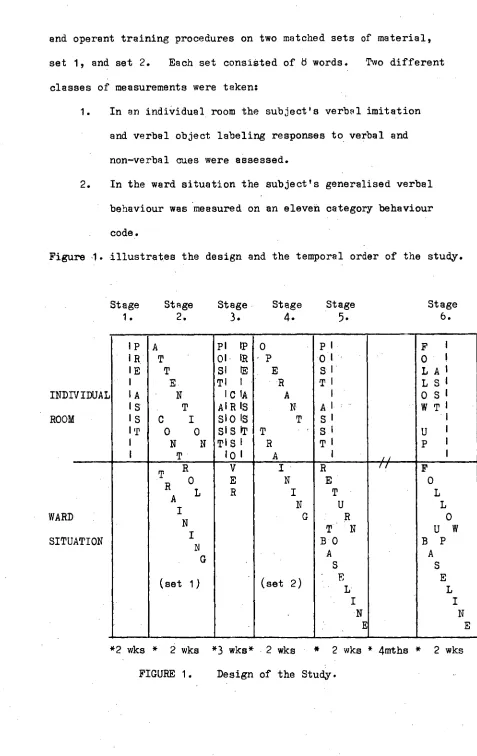
[image:36.557.52.529.72.828.2]2. In the ward situation the subject's generalised verbal behaviour was measured on an eleven category behaviour code.
Figure -1. illustrates the design and the temporal order of the study.
Stage Stage Stage Stage Stage Stage 1. 2.
3. 4. 5.
6.frl A T T E N T C I
0 0 N N
T fr U.2 _ r4 0 u2 u2 0 0 ' P
E R A N T T R A P -4 0 (I) E-I u2 U2 El R T 0 R L A I N I N G (set 1)
>
Pd I N I N (set 2) G R E T U TN BO A S E R L I N E
// F
B 0 L U A S L 0 P EL W I N E INDIVIDUAL ROOM WARD SITUATION
As schematically represented above, both the control and experimental procedures were anraied in an individual and ward training
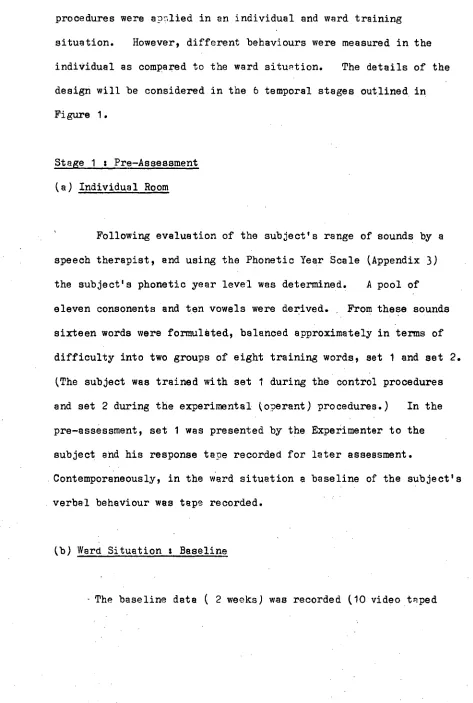
[image:37.557.47.520.117.820.2]situation. However, different behaviours were measured in the individual as compared to the ward situation. The details of the design will be considered in the 6 temporal stages outlined, in Figure 1.
Stage 1 : Pre—Assessment (a) Individual Room
Following evaluation of the subject's range of sounds by a speech therapist, and using the Phonetic Year Scale (Appendix 3)
the subject's phonetic year level was determined. A pool of eleven consonents and ten vowels were derived. From these sounds sixteen words were formulated, balanced approximately in terms of difficulty into two groups of eight training words, set 1 and set 2.
(The subject was trained with set 1 during the control procedures and set 2 during the experimental (operant) procedures.) In the pre—assessment, set 1 was presented by the Experimenter to the subject and his response tape recorded for later assessment.
Contemporaneously, in the ward situation a baseline of the subject's verbal behaviour was tape recorded.
(b) Ward Situation : Baseline
sessions, 20 minutes each) in the ward. Verbal behaviour was
obtained by fitting the subject with a wireless transmitter. Voice transmittions were telemetered to a receiver in a distant observation booth. The video and audio recordings were
continuous throughout the study in the ward situation. Verbal behaviour was rated on an eleven category
behavioural code (Appendix
4)
developed by the experimenter. The code consisted of9
categories including noises, sounds and wordsemitted by the subject to himself, to nurses and to other residents. Another two catergories involved words spoken to the subject by
nurses or residents. The basic assumption for monitoring the subject's vocalisations was that they would indicate the subject's level and frequency of verbal communication in his normal
environment.
Following the pre-assessment of set 1 and the baseline
measures, the attention-control training procedures began in both
the individual and ward situations.
Stage 2 : Attention-Control Procedures
( ) Individual Room
This phase consisted of eleven 20 minute training sessions over a 2 week period. All sessions were tape recorded to
Generally, the attention—control sessions were comprised of stimulating play and the pointing out of various training objects, for example, 'window'. The experimenter mentioned the
verbal labels of the objects as frequently as practicable.
During each session a test was used to check whether the subject
could reliably discriminate a training object from a distractor object. In brief, the experimenter displayed a training object
simultaneously with a distractor object. The subject reached
criterion on the training object when he gave a series of 5 consecutive correct responses. Further, at the conclusion of
each session the subject was given a 'sweet' in order to encourage him to come along to the next session.
To provide some similarity in structure to the operant training of set 2, the experimenter was reasonably directive and gave the subject opportunities to imitate experimenter's
vocalisations. However, no systematic reinforcers followed the subject's acceptable responses. The procedures followed during
the twenty, 20 minute morning training sessions are set out in detail below:
Sessions 1 —
5
: The subject was presented the objects and verballabels, 'window', 'tie', 'door'. All objects were real life representations. Both the experimenter and subject, for example,
pulled the 'window' up and down with the experimenter frequently
saying 'window' and asking the subject', 'what is it?' (experimenter
neck and the subject attempted to do it up while at the same time the experimenter said 'tie'. The'door' was banged on, pointed to, and so on.
Sessions 6 - 11 : Initially it was anticipated that the subject,
because of his short attention spand and sometimes 'silly'
behaviour, would only endure one 20 minute session per morning. However, after five sessions the subject's response to training
was consistently enthusiastic. He would literally run to the training room. Therefore it was decided to have two training sessions per day. The words used in sessions 6 - 11 were 'car',
'knee', 'towel', 'tie', 'door'. Typically three words were
chosen for each session. Included in the apparatus were pencils,
end chalk, so the subject could draw on and try to draw objects. If the subject misbehaved during sessions he was repremanded and told not to be silly.
Sessions 12 - 20 : Although enjoying the sessions the subject did not seem to approximate many training words. It Wes
reasoned that a further intensification of the attention-control
programme could improve the subject's verbal responses.
Three twenty minute training sessions were planned for each day... The •ubject-was also asked to sit in his chair during
morning training sessions in the individual room was followed by
a complementary training programme in the ward during the afternoon sessions.
(b) Ward Situations
This phase consisted of eleven 20 minute video sessions over a 2 week period, and measured the subject's generalised
verbal behaviour. That is, although the subject was taught set
1 verbal object labelling words, the actual responses measured were the subject's general verbal behaviour. Accordingly, the subject's
verbal behaviour during training of set 1 was rated on the eleven category behaviour code.
In order to structure training procedure in the ward the experimenter posted on a notice board in the ward a 'nurses
instruction sheet' (Appendix 5). to suggest to the nurses how. they were to interact with the subject during the attention— control training sessions. In brief, these instructions
recommended that nurses talked to, and played with the subject, that is, try and stimulate him verbally during the 20 minute afternoon training sessions. Consistent with the rationale
for training in a number of situations it was requested that nurses presented the target words, used earlier in the morning special training room sessions. Consequently, following each
words on "to the nurses instruction sheet. Although nurses were
to use training words from the morning sessions that day, they could also use training words from the morning sessions of previous days.
A number of explicit suggestions were reffered to on the
nurses instruction sheet, in an attempt to introduce a certain consistency and standardisation of approach in the training sessions. These included:
. (1)- Try to adopt a friendly, accepting attitude toward the subject.
, (2) Set up object labelling games with the subject and other residents.
(3) Use a puppet to talk to the subject on different , occasions.
(4) Talk to other residents and try to attract the subject into .a social situation where he will have to respond in an appropriate verbal manner.
At the conclusion of these training sessions on the ward, the nurses'. instruction sheet was to be removed.
It was reasoned that this would increase the likelihood that nurses would respond to the subject in a similar way to which
they did prior to the attention control condition. Following the
situation, the cross-over phase began in both situations.
Stage 3 : Cross-Over
This phase was included in order to reduce the direct
transfer of training effects from the attention control procedures to the operant procedures and act as a baseline for the operant
training period.
(a) Individual Room
During this phase a post assessment of set I and a pre-assessment of set 2 was sequentially recorded.
(b) Ward Situation
Unfortunately, after 1 video session the subject began to engage in self-destructive behaviour. He plunged small objects into his ear. It was necessary for him to undergo ear surgery. Although no permanent damage was sustained, treatment took
approximately 2 weeks, it was therefore possible to video only 2 sessions. Therefore proper evaluation of the subjects verbal behaviour on the ward during this phase was not possible. Further,
these sessions were not included in the statistical analysis of
the results. Following the cross-over stage, operant training
Stage 4 : Operant Training Procedures
(a) Individual Room
This phase consisted of eleven 20 minute training sessions over a two week period. All sessions were taped recorded to provide a continuous measure of the subject's performance on set 2. The number, clustering and duration of sessions were balanced with the attention—control condition. The operant training
procedure used followed closely the method of the Lovaas Speech Training Programme (Appendix 4). However, clinical decisions were madeduringthe course of training to tailor the Lovaas method to the subjees individual needs. The details of the present procedure are set outbelow, session by session.
Session 1. To center the subject's attention on the experimenter, and as a physical restraint measure the experimenter sat with the subject's legs between his own. During the session, the subject's percentage of fixating on the experimenter's mouth anLhis verbal response rate met the criterion recommended in the Lovaas programme.
The experimenter introduced the consonant however it was abandoned until'later when it was realisedAhat the subject would require extensive training to make the distinction between
a Consonant he used regularly, and the training consonant 'p'. Therefore it wps decided to postpone presentation of 'p'—'pen' until
cream' when he made an appropriate response.
Sessions 2 —
4.
The consonant 'g' was initially trained by use of prompts to help the subject emit the correct response.Specifically, the experimenter placed his finger on the tip of his tongue and encouraged the subject to imitate his action, when the subject did so, the experimenter said 'g', over trials, the subject made acceptable responses. The consonant 'g' was then blended withigun', until the word 'gun' was presented without blending or any other prompts, end the subject responded appropriately.
Sessions 5 - 9. In the early sessions the experimenter presented the word. book'. It was considered that as the subject had
already acquired the,consonant.'b' that 'book' would be readily learned. Following its acquisition the experimenter tested
whether the subject could distinguish.between the imitative response 'gun' and 'book'. Discrimination was considered complete when the subject had made 5 consecutive correct responses for each training Object,- in the presence of a distrector object.
Giving selected examples of slightly different procedural
tacits seems appropriate. For instance, 'apple' was broken down at first into the behavioural units 'a—pul'. The subject
rapidly made this imitation, and slowly over trials the experimenter presented the correct pronunciation of 'apple'. The subject emitted acceptable responses. 'Aeroplane', the most difficult of all the training stimuli was presented
rhythmically in 3 syllables with an inflection at the end of each syllable. The subject made an attempt to imitate the sounds
while simultaneously copying the rhythm.
Sessions lb-20. These were discrimination sessions to determine
if the subject could distinguish verbally, and non—verbally the
training words. The experimenter held training objects behind his back and presented them randomly saying 'what is it?'. Also
the experimenter put training objects on a table and nominated objects for the subject to retrieve.
(b) Ward Situation
This phase consisted of eleven 20 minute video sessions and measured the subject's generalised verbal behaviour. Accordingly, the subject's verbal behaviour during training of set 2 was rated
on the eleven category behaviour code.
Instruction Sheet' (Appendix 6). This was to inform the nurses how to train the subject in verbal object labelling during the 20
minute afternoon training sessions. The instructions basic-lly followed the Lovaas training model. The structure of the
sessions were to be set out as below.
'Step 1. Sit close to Mark so you get his attention 7nd he
is looking at you.
Step 2. Have a few objects close by for him to label. Step 3. Present an object to Mark and sty 'look Mark....'
Step 4. Allow him about 5 seconds to reply. If he gets.it wrong, repeat step 3 six times, then show him a new object.
Step 5. If he responses correctly reinforce, say 'good boy',
then for the next trial simply hold up the object and say 'what is it?'. If right reinforce. Step 6. Present the same object ) times.
Step 7. Move onto a new object and repeat the process outlined
above.'
As with the control condition, the nurses were to present the target words used earlier in the morning special room sessions.
Accordingly the experimenter wrote the relevant training words on
For similer reasons as stated for the control condition the Nurses Instruction Sheet' was removed at the conclusion of training on the ward. However, it was anticipated that the nurses would continue to ask the subject to label objects because it was a rewarding experience for them.
Stage
5 :
Return to Baseline(a) Individual Room
During this phase a post assessment of set 2 was recorded.
(b) Ward Situation
This phase consisted of ten 20 minute video sessions over a two week period. This phase was included to test for the continuing effects of operant training.
Stage 6 : Follow—up
(a) Individual Room
During this phase the follow—up assessment of set 1 and set 2 were tape recorded.
(b) Ward Situation
two week period. It was included in the study to test for the
persisting effects of operant training.
Assessments of the Subject's Social Functioning
Social measures were recorded as a way of observing whether there was a positive correlation between the subject's
verbal behaviour and social behaviour. The tests applied
included the Adaptive Behaviour Scale (AAMD), a behaviour rating
scale for mentally retarded. It was designed to provide objective descriptions and evaluations of an individual's
adaptive behaviour (Fogelman
1975 ).
The measures wereCHAPTER THREE
The data consisted of measures of verbal behaviour in
the individual and ward situations, and ratings of ward social behaviour. Each situation and the social ratings will be considered separately.
3.1 INDIVIDUAL ROOM SITUATION
Two categories of data were assessed in the individual situation. In the first category, continuous measures taken during training were divided into verbal imitation and verbal
object labelling. The second category of data was verbal object labelling, scores recorded at the pre, post, and follow-up stages.
The first category, the continuous measures, will be considered
below.
Continuous Measures. The subject's responses during the twenty 20 minute training sessions over two weeks in both conditions were tape recorded, and later analysed by speech therapists,
1 and 2. Both were unaware of the direction of the hypotheses. Inter-rater reliability was obtained using Pearson's r correlation co-efficient. The ranges of inter-rater reliability were as follows:
Experimenter presentations: Set 1, .8 - 1.0; Set 2,
.8 -
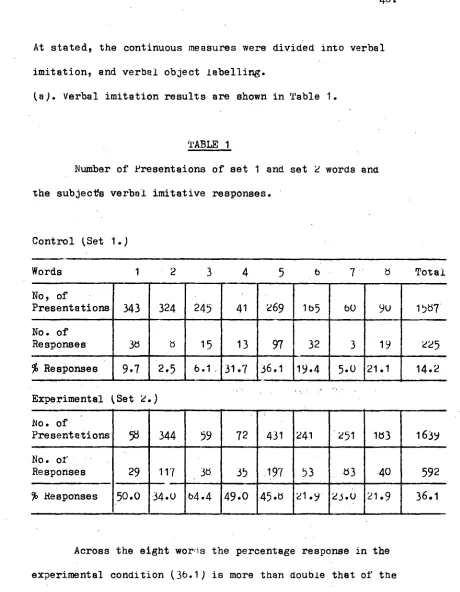
1.0 Subject Verbal Imitations : Set 1, .7 - 1.0; Set 29 .7 - 1.0 Subject Verbal ObjectAt stated, the continuous measures were divided into verbal imitation, and verbal object labelling.
[image:52.555.58.518.62.654.2](a). Verbal imitation results are shown in Table 1.
TABLE 1
Number of Presentaions of set 1 and set 2 words and the subject's verbal imitative responses.
Control (Set 1.)
Words 1 2 3 4 5 b Total
No, of
Presentations 343 324 245 41 269 1b5 60 yu 157
No. of
Responses 3b to 15 13 97 32 3 ly 225
% Responses 9.7 2.5 6.1 31.7 36.1 19.4 5.0 21.1 14.2
Experimental (Set 2.) No. of
Presentations 53 344 59 72 431 241 251 13 1639
No. of
Responses 29 117 3b 35 197 53 b3 40 592
* Responses 50.0 34.0 64.4 49.0 45.b 21.9 23.0 21.9 36.1
Across the eight wonis the percentage response in the experimental condition (36.1) is more than double that of the control condition (14.2). rurther, the subject - emitted . a
significantly greater percentage of verbal imitative responses in
sign test n=0, a=0, p
(b). Verbal object labelling measures were divided into two
classes : the subject's total number of correct verbal object
labelling of set 1 and set 2, and the subject's verbal object labelling of set 1 and set 2 to the criterion or five consecutive correct responses. Table 2 shows the first class of verbal object labelling measures.
Table 2.
The subject's total number of correct verbal object labelling of set 1 and set 2.
Words 1 2 0 Total
Control (set 1.)
2 U 0- b 1 4 14 U 11. A)
Experimental (set 2.)
31 52 32 16 44 .23 16 21 • 244
It is clear from the Table that the subject emitted a significantly greater number of verbal object labelling
responses in the operant procedures as compared to the control— procedures. (ty sign test n=0, a=0, p .01).
[image:53.555.77.515.59.823.2]to the criterion of 5 consecutive correct responses. Words
Correct Incorrect Control
(set 1) 3 5
Experimental
(set 2.) 6 2
Although the results are not significant (by Fishers Exact Test p-=.14) it is clear that most of the words were learned in the experimental condition (6 as compared to 2), whereas for the
control condition only a minority was learned (3 as compared to 5).
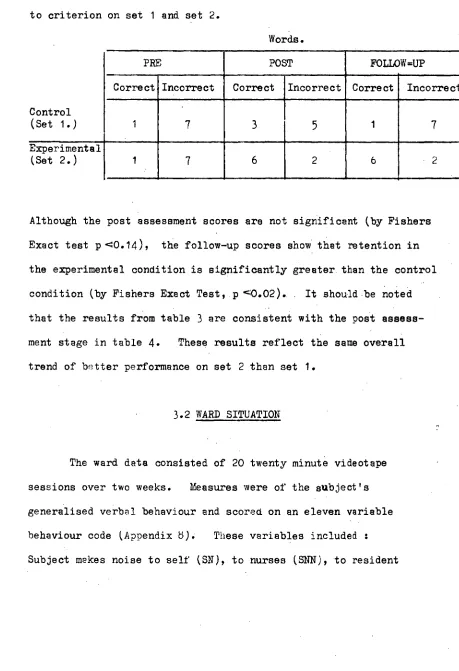
[image:54.557.53.515.42.701.2]PRE POST FOLLOW =UP
Correct Incorrect Correct Incorrect Correct Incorrect
1 7 3 5 1 7
1 7 6 2 6 - 2
Control (Set 1.) Experimental
[image:55.557.68.527.148.819.2](Set 2.)
Table 4.
Number of verbal object labelling responses performed to criterion on set 1 and set 2.
Words.
Although the post assessment scores are not significant (by Fishers Exact test p.40.14), the follow-up scores show that retention in the experimental condition is significantly greater than the control condition (by Fishers Exact Test, p 4.:0.02). It should be noted that the results from table 3 are consistent with the Post
assess-ment stage in table 4. These results reflect the sane overall
trend of better performance on set 2 than set 1.
3.2 WARD SITUATION
(SNR). Noise is defined as a harsh or inarticulate sound, for - example, 'ahh'. Other variables were subject makes sound to
self (SS), to nurse (SSN), to resident (SSR). Sound is defined as an articulate utterance, specifically a consonant plus a vowel, for example, 'me'. Further variables were, subject makes word to self (SW), to nurse (SWN), to resident (SWR). Word is defined as a sound capable of independent grammatical use. The variables directed to the subject were: nurse says word to subject (NWS), and resident says word to subject (RWS). The aim is to determine 'whether operant procedures are significantly more effective in
increasing generalised verbal behaviour than control procedures.
reliability checks were made. The range of reliability was
from
.7 to
1.0 on all variables.Analysis of the data: The Burroughs B6700 version of the Statistical Package for the Social Sciences (Social Sciences data service) was used for all statistical analysis. The raw
data scores were averaged and these scores are shown in Appendix
9.
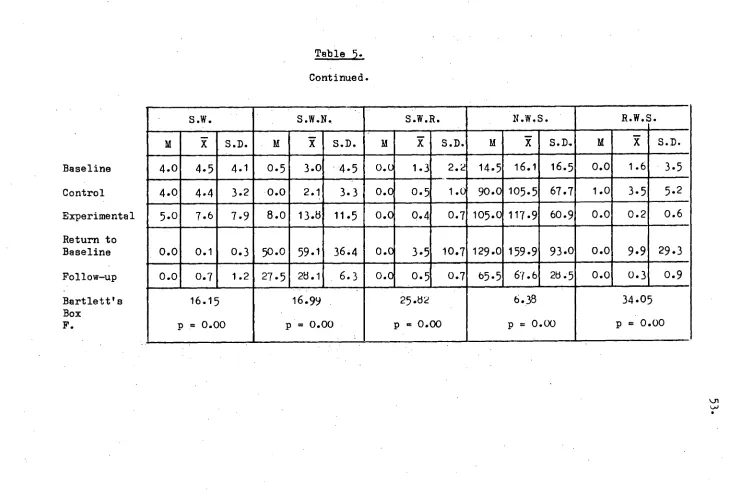
The medians, means and standard deviations are shown in tableS.N. S.N.N. S.N.R. S.S. S.S.N. S.S.R. M
7
S.D, M7
S.D. M7
S.D. M7
S.D. M7
S.D. M3f
S.D. 59. 0 55.7 13.7 8.5 9.6 9.2 2.0 4.8 6.2 8.0 8.2 5.9 0.0 4.2 8.3 1.0 1.3 1.5 49.0 48.4 10.7 3.0 5.7 6.6 4.0 6.2 7.1 8.0 7.0 5.0 0.0 3.3 7.5 0.0 1.5 2.353.0 67.5 36.6 48.0 56.6 44.8 0.0 6.5 9.1 2.0 3.1 4.5 17.0 16.0 12.5 18.0 0.5 1.5
0.0 8.4 21.6 68.5 74.5 36.2 0.0 6.0 13.8 0.0 0.3 0.9 37.0 40.4 26.4 0.0 1.6 4.4 17.5 17.7 8.7 24.5 25.5 13.8 14.5 15.4 4.4 1.0 1.8 2.8 23.5 23.3 12.6 2.0 1.4 1.2
6.35 p = 0.00
10.94 p 2. 0.00
3.18 p = 0.01
5.72 p . 0.00
4.97
p = 0.00
5.45
p=O.00 Baseline
Control Experimental Return to Baseline Follow-up Bartlett's Box
F
. [image:58.828.58.782.64.495.2]• S.W. S.W.N. S.W.R. N.W.S. R.W.S.
M
7
S.D. M7
S.D. M7
S.D. M7
S.D.m
7
S.D.4.0 4.5 4.1 0.5 3.0 4.5 0.0 1.3 2.2 14.5 16.1 16.5 0.0 1.6 3.5
4.0 4.4 3.2 0.0 2.1 3.3 0.0 0.5 1.0 90.0 105.5 67.7 1.0 3.5 5.2
5.0 7.6 7.9 8.0 13.8 11.5 0.0 0.4 0.7 105.0 117.9 60.9_ 0.0 0.2 0.6
0.0 0.1 0.3 50.0 59.1 36.4 0.0 3.5 10.7 129.0 159.9 93.0 0.0 9.9 29.3
0.0 0.7 1.2 27.5 28.1 • 6.3 0.0 0.5 0.7 65.5 6(.6 28.5 0.0 0.3 0.9
16.15
p . 0.00
16.99 •
p = 0.00
25.82
p - 0.00
6.38
p . 0.00
34.05
p = 0 00 Baseline
Control
Experimental
Return to Baseline
Follow-up
Bartlett's Box
[image:59.828.50.779.41.532.2]From Table
5
the Bartlett Box F, a test of homogeneity of variance, shows that none of the eleven variables havehomogeneous variances. In an attempt to make the variances of the variables homogeneous and to meet one of the
S.N. S.N.N. S.N.R. S.S. S.S.N. S.S.R.
M
7
SD M X SD MI
SD MI
SD M7
SD M7
SD3.5 3.4 0.7 1.0 0.9 0.6 2.0 4.0 4.4 8.0 6.7 3.8 0.0 0.4 0.7 1.0 1.3 1.5
3.0 2.8 0.6 1.0 0.6 0.5 4.0 4.6 4.6 8.0 6.3 4.1 0.0 0.4 0.7 0.0 1.5 2.3
3.0 3.7 1.7 3.0 3.3 .2.1 0.0 4.1 5.2 2.0 2.6 3.1 1.0 1.2 0.7 0.0 0.5 1.5
0.0 0.7 1.3 4.0 4.1 2.0 0.0 2.7
4.4
0.0 0.3 0.9 2.5 2.5 1.3 0.0 1.2 3.21.0 1.4 0.5 2.0 1.8 0.6 10.0 10.3 0.5 1.0 1.8 2.8 2.0 1.7 0.7 1.5 1.4 1.2
4.94
p= 0.00
8.40
p . 0.00
7.58
.p = 0.00
3.84
p . 0.00
1.56
p = 0.18
2.87
p . 0.02 Baseline
Control
Experimental
Return to Baseline
Follow-up
Bartlett's
Box .
[image:61.828.21.803.68.543.2]Continued.
S.W. S.W.N. S.W.R. N.W.S. R.W.S.
M X SD M
7
SD M X SD M7
Si)m
7 ST
4.0 4.3 3.7 0.5 0.5 0.5 0.0 1.3 2.2 1.0 1.3 0.9 0.0 1.5 3.z
4.0 4.4 3.2 0.0 0.5 0.5 0.0 0.5 1.0 5.0 4.b 1.8 1.0 2.9 4.1
5.0 5.6 3.5 1.0 1.3 0.6 0.0 0.4 0.7 6.0 5.5 1.b 0.0 0.2 0.6
0.0 0.1 0.3 3.0 3.5 1.t5 0.0 1.2 3.5 7.0 6.0 1.5 0.0 1.7 3.b
0.0 0.7 1.2 2.0 1.9 0.3 0.0 0.5 0.7 4.0 4.0 1.4 0.0 0.3 0.9
10.22
p . 0.00
8.79
p . 0.00
9.11
p = 0.00
1.04
P = 39
9.33
p = 0.00 Baseline
Control
Experimental
Return to Baseline
Follow-up
Bartlett's Box
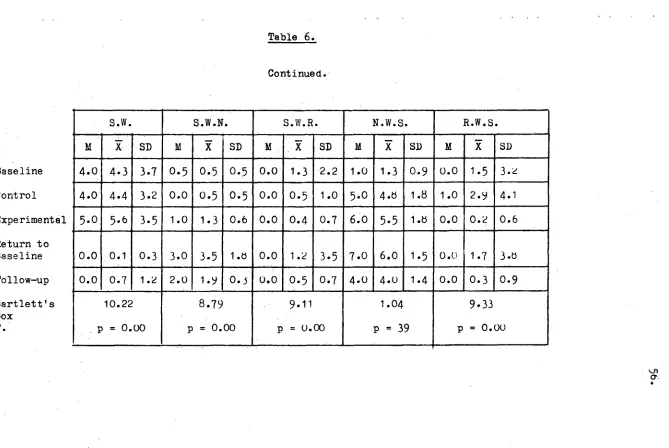
[image:62.828.109.778.54.502.2]Table 6 shows the attempt made to improve homogeneity of
variance by recoding principally extreme high values to reduce skew.
This proved of only limited success, only two variables
(NWS, SSN) being homogeneous. The remainder were significantly non-homogeneous, although their skew (as shown by median and mean differences) was reduced. While not ideal from the statistical assumption point of view, it was still decided to perform an ANOVA on the recoded data. This decision was based
on the notion that for the purposes of this study the inter-pretation advantages of ANOVA outweighed the disadvantages arising from not meeting the assumptions.
Table 7. Summary of one-way ANOVA.
Variables Source DF SS MS FF SN Between 4 70.11 17.53 15,05- **
Within 47 54.72 1.16
SNN Between 4 96.28 24.07 12.78** Within 47 88.49 1.88
SNR Between 4 353.65 88:41 4.96** Within 47 837.65 17.82
SS Between 4 326.16 81.54 8.11** Within 47 472.52 10.05
SSN Between 4 33.49 8.37 11.86** Within 47 33.18 0.71
SSR Between 4 b.52
..
1.63, 0.38 Within 47 199.55 4.25
SW Between 4 ' 250.33 62.58 8.07** Within 47 364.19 7.75 . SWN Between 4 64.19 16.05 . 78.48**
Within 47 40.81 0.87
SWR Between 4 7.76 1.94 0.53 Within 47 171.47 3.65
NWS Between 4 137.31 34.33 14.s61* Within
47
110.46 2.35RWS Between 4 54.19 13.54 1.59 . Within. 47 -8.49
[image:64.556.51.511.135.825.2]The ANOVA's show that a significant difference occurred
in eight variables. Tests of homogeneous subsets were applied
to these variables and the results are discussed separately. (1).Subject, Noise to Self (SN): The results indicate that the experimental, control, and baseline conditions are not significant-ly greater than each other, but all are significantsignificant-ly greater than the return to baseline and follow up conditions.
(2).Subject, Sound to Self (SS): The experimental condition is not significantly greater than the control, or any other condition. But the control, and baseline conditions are significantly greater than the return to baseline and follow—up conditions.
(3).Subject, word to self (SW): The experimental condition is not significantly greater than the control condition. But the return to baseline condition, is significantly. greater than the baseline v control.and experimental „conditions. ,. While the follow—
up. condition is not significantly,, greater than any other condition. (4).Subject, Noise to Nurse (SNN): The experimental and return to baseline conditions are not significantly greater than each ,other,, but both are significantly greater than the control and baseline conditions. While the follow—up condition is significantly less
then return to baseline, yet not significantly greater than the experimental, control, and baseline conditions.
• baseline control, and experimental conditions, while the
follow-up condition is not significantly greater than the experimental condition but is significantly greater than baseline end control conditions.
(6).Subject, Word to Nurse (SWN): The experimental condition is not significantly greeter than the control, but the return to baseline condition is significantly greater than the baseline, control, experimental and follow-up conditions. While the.
follow-up condition is significantly greater than the baseline and
control nonditions, but not significantly greater than the experimental. condition.
(7).Subject, Noise to Resident (SNR): The experimental condition is not significantly greater than the control condition. The follow-up conditions is significantly greater t-h.en.the baseline,
experimental and return to baseline conditions, while the control condition is not significantly greaterAhan any other condition. (b). Nurse, Word to Subject (NWS): The experimental condition is
not significantly greater than the control condition. All conditions are not significantly greater than each .other, exceptthe baseline conditions which is significantly less than the other conditions.
In. summary, the experimental condition is significantly
greater than the control.condition on only one variable, SNN. .
the return to baseline and follow—up conditions, while the subject
to nurse verbal behaviour increased during these periods. That is, it seems that when the subject was verbalising to nurses he did not vocalise much to himself and vice versa. In particular,
the subject vocalised most to the nurses in the return to baseline condition. The subject's noises to residents (SNR) increased during the follow—up condition, but did not vary significantly
across any other condition.
The results suggest that the variables grouped- in self— directed, nurse—directed, and noise to resident groups. In
order to further analyse these trends the data was factor analysed. It was of interest also to examine whether the subject's change
in verbal behaviour over the conditions was as predicted or was related to the order in which the. conditions,were.presented.-.
Accordingly, the experimenter's expected order of effects was included as a variable, referred to as EXPCON, in the factor
analysis. EXPCON was on en increasing scale, baseline, follow—up
control, return to baseline and experimental. A second variable included in the factor analysis was COND I it represented the order in which the conditions were presented.
A varimax rotated factor matrix was performed on the data.
by the data. The second factor accounts for the most residual variance after the effect of the first factor is removed from the data. Subsequent factors are defined similarly until all the variance in the data is exhausted (Nie et al.,
1975).
The results of the factor analysis are shown in table 8.Table 8.
V?rimax Rotated Factor Matrix of the data. Factor 1 Factor 2 Factor
3
Factor4
COND 0.65 0.36 -0.13 .0.56
SN •-0.76 -0.00 -0.08 0.00
SNN 0.56 0.5d 0.00 -0.21
SNR -0.03 -0.19 0.26 0.5d
SS -0.54 -0.23 0.22 -0.31
SSN 0.3 0.32 -0.10 -0.16
SSR -0.02 -0.00 0.59 0.05
SW -0.59 0.13 0.16 -0.22
SWN 0.d4 0.32 0.03
SWR 0.01 -0.29 0.d6 0.18
NWS 0.34 0.63 -0.14 -0.15
RWS -0.09 -0.04 0.59 -0.36
[image:68.557.66.500.109.820.2]