PAPERS AND PROCEEDINGS OF THE ROYAL SOCIETY OF 'fASMANIA, VOLUME 92
NATURAL HYBRIDS IN EUCALYPTS, PART I.
E.
X
taeniola (= E. salicijoliaX
E. sieberiana)*
By
W. D. JACKSON
Department oj Botany, University oj Tasmania
(WITH 3 TEXT FIGURES)
ABSTRACT
Progeny tests of open pollinated seed from E. sieberiana F. v. M., E. salicijolia (Sol.), Cav. (syn. E. amygdalina Labill.) and the presumed hybrid form E. X taeniola B. & S. (pro spJ, from natural populations are described. The variation in juvenile leaf size and shape in progenies of the taeniola form, confirms the suggestion that this
is a hybrid between the above species.
Individuals, intermediate in form between E. sieberiana and E. salicijolia, were collected by L. Irby from the slopes of St. Patrick's Head, Tas-mania. These were given specific rank by Baker and Smith (1912), although affinities with the above species were recognized. Baker and Smith's ranking was recognized by Blakely (1934) in his "Key to the Eucalypts" . In his survey of the Tasmanian species Brett (937) classified E. taeniola as an interspecific hybrid. He stated that there was every indication that E. taeniola was a hybrid between E. sieberiana and E. salicijolia, add-ing without further qualfiication that the hybrid character was evident at the cotyledon stage. The specific ranking was accordingly dropped by Curtis
(1956) .
A study of the natural populations of sieberiana and salicijolia supports Brett's view as to the hybrid nature of the taeniola forms. These are found only within the limits of the sieberiana distribution on the East Coast, between St. Helens and Oyster Bay, extending westward to Rose's Tier. The taeniola form is found only as isolated trees, although the salicijolia within this area exhibits considerable
variation.
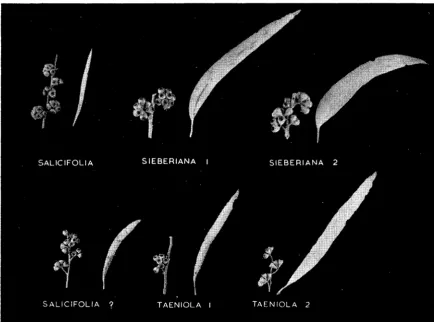
The more important diagnostic characte'rs of the seed parents are listed in Table 1. Typical leaves and fruits are represented in fig. 2. Most taeniola specimens show intermediate bark characters, tending usually towards the salicijolia type. The mature leaves, although wider and more falcate than those in salicijolia, also tend towards this species rather than to sieberiana. In buds and fruit the taeniola form closely resembles sieber ian a with pyriform fruits and sunken discs.
To establish some experimental evidence of the hybrid nature of the taeniola form, seedlings were raised from open pollinated mother trees from the natural population. This seed was collected by Professor H. N. Barber at Bicheno in February,
*Nomenclature is that of Blakely, 2nd Edition, 1955.
1952. The presumed parental types E. sieberiana and E. salicijolia were represented by progenies raised from parents growing in the same locality. Two seed parents of each type were used. How-ever, the progeny size in one of the sets (set 2 below) was restricted because of limited propaga-tion facilities.
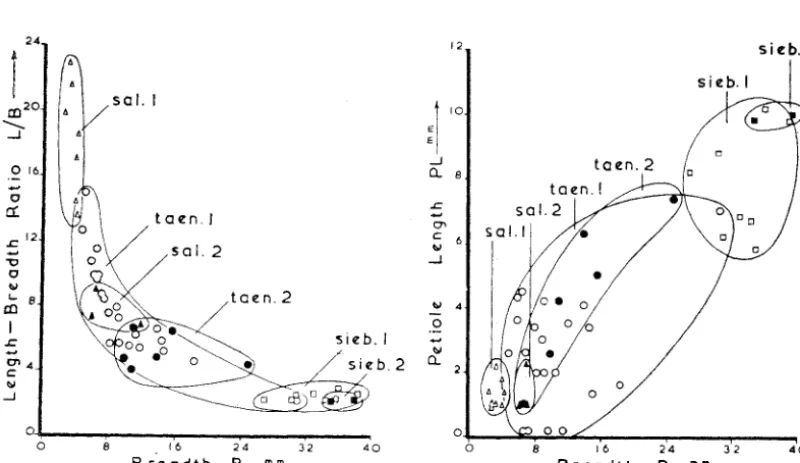
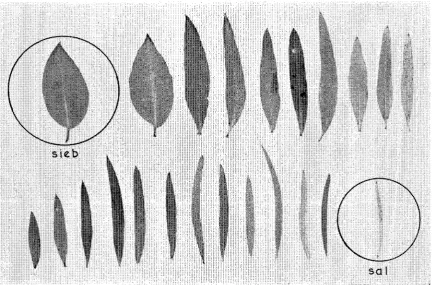
Seed set and viability in the taeniola form did not differ markedly from that in the parental types. Seedlings were raised under standard conditions in the glasshouse, pricked off into 6 x 1'5 inch veneer tubes after three weeks and after six months were propagated in 6 x 6 inch cans. When the seedlings were 12 months old five leaves of average development were removed from each, where pos-sible from the 10th to 14th nodes inclusive. These leaves were measured for size and shape while fresh. Table II shows the progeny means and an anlysis of variance for leaf length, breadth, length/breadth ratio and petiole length for in-dividual seedlings. The distribution of inin-dividual means is shown graphically in figure 1, while the range in leaf shape in the progeny of 21 plants raised from taeniola 1 is shown in fig. 3. In this plate leaves approximating most closely to the mean leaf for each seedling are shown to-gether with average leaves from the two presump-tive parent species.
Because of the non-orthogonal nature of the data the analysis of variance is somewhat tedious. It is here treated as a hierarchy of unequal num-bers thus facilitating the grouping of components. Leaf breadth, length/breadth ratio and petiole length are efficient classification variables. Length of leaf has a high coefficient of variation and is an unsuitable diagnostic. From the analysis of variance shown in Table II it is clear that the within-seedling variance in all progenies is small. The variance between seedlings is very much greater in the taeniola progenies than in the pre-sumptive parental progenies, with the exception of the progeny salicijolia (2). Excluding length the variance ratios for the other three characters in the two sieberiana parents and salicijolia (1), are much lower than the variance ratios for the taeniola progenies and are about one-fifth those for salicijolia (2). The anomalous heterozygosity in salicijolia (2) is at once evident if the variance in parental groups is considered. With the ex-ception of petiole length the between-parent vari-ance and the varivari-ance ratios are disproportionately large in salicijolia. The variance ratios in
142 NATURAL HYBRIDS IN EUCALYPTS, PART I
taeniala suggest that these pareLts may be grouped as presumptive F, hybrids although the between-parent variance indieates a considerable difference in genotype. Salicijolia (2) by its parental char-acters lies well within the salicijo/ia phenotypic range but the segregation in its progeny indicates that it should be classified as an F, or other close derivative. This can be confirmed to some extent by an analysis of variance after regrouping salici-folia (2) with taenia/a ('Table IIl. When this is done the homogeneity in the variance ratios be-tween the groups is restored,
The range of variation in the characters on this grouping leaves no doubt as to the hybrid nature of the taeniola form. The range is tran-sitional between the two parental types although
it is weighted towards salicifolia. This gradation in segregating leaf characters is to be expected on the basis of a polygenic inheritance of leaf size and shape. The marked correlations evident in figure 1 indicate a strong dependence between these characters; a relationship which doubtless has its origins in the common members of the polygenic systems governing cell number and size.
24
016
.c 12
-"0
o
aJ
BI
sal. f
tean.
sal. 2
2
°10---B~----~1~6--=---2~4---~3-2----~40 Breadth B_-.-!!l!L...,..
2
The progeny testing of open pollinated parents thus provides reasonable justificaLion for regarding the taeniola type as an interspecific hybrid between E. sieberiana and E. saliei/o/ta. The fact that the taeniola form is restricted to the limited sieberiana distribution and that it occurs only as isolated trees is itself strong evidence for the classification of the form as a hybrid between these species.
REFERENCES
HAREn, R. T. AJ'..:D SMITH, H .. G., JD13.·~-A .l'E'Bcareh on
of T3smania and their essEnti.al oil~. Roy. Soc. Ta.s., pp. ] ;39*213.
Ih.AKELY. W. F., IH84.~' A key to the euealypts. The \VOl'ker Trustees, Sydney.
BRI~TT, R. G., 19;j8.·--A of .Eucalyptus f-:;peeies in
TaS-.C
en
c
...
....J12
... 4
o
mania. Pa-JJ. and Prot;. Soc 1'as., pp. 75-111.
19G6.-The students flora of Tasmania, Part 1.
so I.
so!. II
Printer, Tasmania.
s i f:b. 2
sieb. I
o~ ____ ~~o_o~~~ ______ ~ ____ ~ ______ ~
o B 16 24 32 40
Breadth B m,m.
[image:2.505.48.448.304.535.2]Parent Bole bark Limb bark
Sieb. 1 ... deep fissured fibrous clean gummy
Sieb.2 . deep fissured fibrous clean gummy
Taen. 1 fissured flaky fibrous clean gummy
Taen. 2 .... fissured flaky fibrous clean gummY'
Sal. 1 flaky fibrous clean gummy
Sal. 2 flaky fibrous thin flaky
. _ - - - _ . _ . - - - -~-- - - _ .. _
-TABLE I
Parental Characters
leaf leaf
length breadth
in cm. in cm.
20'1 1-8
18·7 2·4
13·2 1·0
17·2 1-6
8'9 0·5
9'1 0'8
petiole fruit
length length
in cm. in cm.
1'9 11-4
1·7 12·4
1-4 10·2
1-1 9'3
0'3 6·3
O'S 6'9
fruit diam. in cm.
7'7
7·8
6·4
5'S
6·8
5'7
carpel number
x
3·0
3'1
3'5
3'1
4'0
4'7
~
? '-<
;.-( l p::
r.ll
o Z
....
TABLE II
Means, standard errors of means and the analysis of variance for the juvenile leaf characters, length L, breadth B, length/breadth ratio LIB and petiole length PL.
~-~---~---~"---I
I
L B LIB PL d.L L B LIB PL dL L B L/B PL d.LI
sieberiana 1 taeniola 1 salicifolia 1Progeny means 82·2 333 2·45 7'7 8 69'2 106 7·73 2'6 21 61-1 3-5 17·73 1-4 8
S.E. of means
I
12'6 2·1 0·55 0-1 5·7 0'7 0-61 0-1 2'7 0·7 1-49 0·4Variance
between seedlings 1281-1 72'8 0·35 16-6 7 634'4 1698 47·18 18'9 20 419-2 1·5 79-03 0·9 7
I
within seedlings 74-9 21-8 0'08 66 32 93-2 3'0 1'59 0-8 84 41-1 0-5 11-65 0-1 32
Ratio F 17·1 3·3 4·4 2'5 6-8 56·8 29'7 23·4 10-2 3·2 6·g 6·3
I
sieberiana 2 taeniola 2 salicifolia 2Progeny means 86'9 35-9 2·36 9'9 2 70-8 13'7 5-54 45 6 63·0 8·2 7-34 1·4 3
S.E. of means. 10'5 4-2 0-00 00 24-0 5-7 1-83 2-2 486 4·3 2-24 1-6
Variance
between seedlings 220-9 36'0 0·00 0-1 1 3458-0 2028 20'17 29-9 5 1567-8 54-2 15·09 8-1 2
within seedliml", 99'0 19-9 0-03 0-4 8 249 26 1-16 1·7 24 106-0 1·5 0-51 06 12
I
Ratio F . 2·2 1-8 0-00 0·3 138-8 78-0 17-38 17·9 14-8 *36-1 *29-6 14-1
I
sieberiana 1 and 2 taeniola 1 and 2 salicifolia 1 and 2Variance
between parents 176-8 102·3 0-10 28·1 1 170-9 225-6 117-77 77-8 1 79b71-0 23fH 1166-5 2-1 1
within parents 257,9 29-2 0-11 6·9 48 288-8 35'5 9-07 4-8 133 163'4 2-9 18·16 1-0 53
Ratio F 07 3-5 O-g 4·1 0-6 6-4 12-98 16'3 *487'1 *83-0 *64'2 2·2
sieberianu 1 and 2 taeniola-salicifolia 2 salicifolia 1
Variance
between groups 176-8 1023 0-10 28-1 1 12649-5 128-2 4-88 61'7 1 419-2 1-5 79-03 O-g 7
within groups 237'9 29-2 0-11 6-9 48 856-1 34-3 9·19 5·0 148 41·1 0-5 11-65 0·1 32
Ratio F . 0·7 3-5 0-9 4·1 14'78 3-7 0-5 12-4 10-2 3-2 6-8 6-3
- - - ,
anomalous variance ra tios d.L degrees of freedom
I-'
...
j.t.)..
z
~
...,
c:
~
~
t'
~
:;;
""
~8
w
Z
tr,
c::
"0
?
t"
><:
'"
>-l
7'
"0
:v
::0
w. D. JACK~N 145
[image:5.499.31.465.182.503.2]146 NATURAL HYBRIDS IN EUCALYPTS, PART I
FIG. 3.-Representative leaves from each of the 21 seedlings of the progeny from the presumptive hybrid,
taeniola 1, showing the transition between the parental types sieberiana and salicifolia, typical
repre-sentatives of which are shown in circles. Each leaf is that closest to the me,an of five leaves from
[image:6.496.35.469.176.461.2]